1. Introduction
The study of relationships among geometrically associated curves is a classical theme in differential geometry, often revealing deep structures that transcend individual curve properties. For instance, the interplay among a curve and its associated curves such as the involute, evolute, pedal curve, and contrapedal curve has been extensively studied in Euclidean geometry. These studies have revealed connections to various fields; for example, refs. [
1,
2] focus on mechanical linkages and pedal coordinates, pedal curves of fronts and their singularities are investigated in [
3,
4], and ref. [
5] examines the relationship between pedal and contrapedal curves in the Euclidean plane. Among these associated curves, the pedal curve and contrapedal curve are defined via orthogonal projections onto the tangent and normal lines, respectively, while the evolute is the locus of centers of curvature. The relationships among these three constructions encapsulate fundamental duality principles. In this paper, we focus on these three associated curves in the setting of mixed-type Minkowski plane curves.
The Minkowski plane
, equipped with the indefinite inner product, serves as the two-dimensional model of special relativity. The study of geometric objects in Minkowski space and its subspaces is very extensive, and the research results are abundant (see [
6,
7,
8,
9]). In this space, non-zero vectors are classified as spacelike, timelike, or lightlike according to the sign of their indefinite inner product. For curves, this leads to significant geometric subtleties. While non-lightlike curves can be studied using Frenet–Serret frames (see [
10,
11,
12,
13]), and lightlike curves require specialized tools such as Cartan frames (see [
6,
14,
15,
16]), the situation becomes more intricate when a curve contains points of all three types simultaneously. Such curves are called mixed-type curves. Systematic study became possible after the introduction of the lightcone frame by Izumiya, Romero Fuster and Takahashi in [
17], which provides a unified approach to handle lightlike points. Since then, mixed-type curves have attracted increasing attention. In particular, lightcone framed curves and mixed-type curves are investigated in Minkowski 3-space in [
18,
19], respectively. More recently, framed curve approaches have been developed to study singular curves in Minkowski spaces (see [
16,
20]).
In previous works, we studied evolutes and pedal curves of mixed-type curves. In [
21,
22], we investigated evolutes using a modified Frenet–Serret type frame and a region division method. In [
23], we studied pedal curves (which we call T-dual curves in this paper), discussing their existence at lightlike points, singularities, and point types. However, the contrapedal curve (which we call the N-dual curve) of a mixed-type curve has not yet been systematically studied. This gap is significant because without a complete understanding of the N-dual curve, the full picture of the relationships among the T-dual, N-dual, and evolute remains incomplete. In the Euclidean setting, the pedal and contrapedal curves are known to be dual to each other, and their relationship with the evolute is well documented (see [
5]). In the Minkowski plane, the situation is more delicate due to lightlike points, where the normal line is not well-defined. To reveal the analogous dual relationships in the mixed-type setting, we first establish a rigorous theory for the N-dual curve. This paper aims to fill this gap by providing a systematic treatment of the N-dual curve, and based on this, exploring the geometric connections among the three associated curves. Specifically, we clarify the conditions under which the N-dual curve exists at lightlike points, analyze its singularities and point types, and establish the relations between the T-dual and N-dual curves as well as between the N-dual curve and the evolute. These results complete the theoretical framework for associated curves of mixed-type Minkowski plane curves and reveal a coherent duality structure that parallels the Euclidean case while exhibiting distinctive features arising from lightlike geometry.
To emphasize the dual relationship between the two projection constructions, one using the tangent direction and the other using the normal direction, we adopt the terminology T-dual curve and N-dual curve throughout this paper. Here, T and N stand for tangent and normal, respectively, and the term “dual” reflects the fact that these two curves are related by the pseudo-orthogonal complement. For clarity, we note that the T-dual curve corresponds to the classical pedal curve, and the N-dual curve corresponds to the classical contrapedal curve.
The structure of this paper is as follows. In
Section 2, we review basic concepts of the Minkowski plane, the lightcone frame, and the definitions of T-dual curves and evolutes. In
Section 3, we define the N-dual curve, discuss its existence at lightlike points, and analyze its singularities and point types. In
Section 4, we investigate the relationships among the T-dual curve, N-dual curve and evolute. Finally, in
Section 5, we conclude with a summary and discuss future directions.
All maps and submanifolds considered in this paper are assumed to be smooth unless otherwise stated.
2. Preliminaries
We now review some basic concepts about the Minkowski plane. For further details, please see [
12,
13,
17].
Definition 1. Let be the vector space of dimension 2. If is endowed with the metric induced by the indefinite inner productwhere , , and . Then we call the Minkowski plane and denote it by . Definition 2. For a non-zero vector , it is called spacelike, timelike or lightlike, if , or , respectively. A spacelike or timelike vector is called a non-lightlike vector.
Definition 3. For a vector , if there exists a vector , such that , we say is pseudo-orthogonal to .
Definition 4. The Lorentzian norm of a vector is defined by The pseudo-orthogonal vector of
is given by
. By definition,
and
are pseudo-orthogonal to each other, and
It is obvious that if and only if is lightlike, and is timelike (resp. spacelike) if and only if is spacelike (resp. timelike).
Denote
and
. Then
and
are independent lightlike vectors, and
. We call
a lightcone frame in
. It is given by S. Izumiya, M. C. Romero Fuster and M. Takahashi in [
17].
Let
be a regular mixed-type curve. There exists a smooth map
such that
for all
. We say that a regular curve
has the lightlike tangential data
if the above equation holds. Then we have
Since
is a spacelike (resp. lightlike or timelike) point if and only if
(resp.
or
).
Definition 5. Let be a regular mixed-type curve. We call a point an inflection if .
On the basis of the above definition, if , we call an ordinary inflection.
Proposition 1. If we choose the lightcone frame and the lightlike tangential data , then we can obtain that is an inflection point if and only ifand being an ordinary inflection point means not onlybut also Definition 6. Let be a regular mixed-type curve without inflections. In [17], we have known that the evolute of γ with the lightlike data is defined as 3. N-Dual Curves of the Mixed-Type Curves
For a regular curve in the Minkowski plane, its T-dual curve (pedal curve) is defined as the pseudo-orthogonal projection of a fixed point onto the tangent lines of the base curve, and its N-dual curve (contrapedal curve) is defined as the pseudo-orthogonal projection of a fixed point onto the normal lines of the base curve. We have investigated the T-dual curves of the mixed-type curves in [
23]. Herein, we consider the N-dual curves of the mixed-type curves.
Similar to the definition of the T-dual curve of the regular mixed-type curve, we can define the N-dual curve of a regular mixed-type curve as follows.
Definition 7. Let be a regular mixed-type curve and be a point in . If coincides with the lightlike point or is on the tangent line of the lightlike point, then the N-dual curve of the base curve is given by If is a non-lightlike point, then satisfies the above form obviously.
If is a lightlike point, then , and we suppose that coincides with the lightlike point or is on the tangent line of the lightlike point. In this case we define as , and the specific forms of the N-dual curve at are as follows.
CASE I. Suppose that and ; the condition that coincides with or lies on the tangent line at is equivalent to .
If
coincides with
, then
If
is on the tangent line of the lightlike point, then
CASE II. Suppose that and ; the condition that coincides with or lies on the tangent line at is equivalent to .
If
coincides with
, then
If
is on the tangent line of the lightlike point, then
Remark 1. Let be a regular mixed-type curve, let be a fixed point, and let be its the N-dual. Suppose is a lightlike point. Then either or . In addition, is neither consistent with nor lies on the tangent line of , thenTherefore, is asymptotic to the lightlike line of or . More precisely: If , then is asymptotic with the lightlike line along the positive or negative direction of
If , then is asymptotic with the lightlike line along the positive or negative direction of
Next, we consider that the N-dual curve of a regular mixed-type curve has singular points and we have the following theorem.
Theorem 1. Let be a regular mixed-type curve, be a point in and be the N-dual curve of γ. Then,
- (1)
If is a non-lightlike point, then is a singular point if and only ifand - (2)
If is a lightlike point, and coincides with or is on the tangent line of , then is regular.
Proof. Since the N-dual curve of the mixed-type curve
is given by the Formula (
1), by calculations, we can obtain
Let
be a non-lightlike point.
if and only if
and
Let
be a lightlike point with
and
; a direct inspection of Formula (
2) shows that
. Hence
is regular. The case
is analogous. □
To analyze the point types of the N-dual curve, we introduce the following function . Its definition is chosen so that the Lorentzian squared norm of simplifies to , allowing the causal character of to be read off directly from the signs of , , and .
Specifically,
is defined as
then the following proposition shows the type of points of the N-dual curve of a mixed-type curve.
Proposition 2. Let be a regular mixed-type curve, be a point in and be the N-dual curve of γ. For a regular point , we have the following consequences.
- (1)
When is a non-lightlike point,
- (i)
if , then is a spacelike (or timelike) point if and only if is a spacelike (or timelike) point;
- (ii)
if , then is a spacelike (or timelike) point if and only if is a timelike (or spacelike) point;
- (iii)
if , then is a lightlike point.
- (2)
When is a lightlike point, , and ,
- (i)
suppose that is not the inflection of γ,
- (a)
is a lightlike point if and only if coincides with ;
- (b)
is a non-lightlike point if and only if is on the tangent line of . Moreover, is a spacelike (or, timelike) point if and only if (or, );
- (ii)
suppose that is an ordinary inflection of γ, then is always lightlike.
- (3)
When is a lightlike point, , and ,
- (i)
suppose that is not the inflection of γ,
- (a)
is a lightlike point if and only if coincides with ;
- (b)
is a non-lightlike point if and only if is on the tangent line of . Moreover, is a spacelike (or, timelike) point if and only if (or, );
- (ii)
suppose that is an ordinary inflection of γ, then is always lightlike.
Proof. As
is given by Formula (
2), by calculations we can get
Then we can obtain the type of
easily. □
In the following, we give three examples to present the features of the N-dual curve of the regular mixed-type curve, especially at the lightlike point of the base curve.
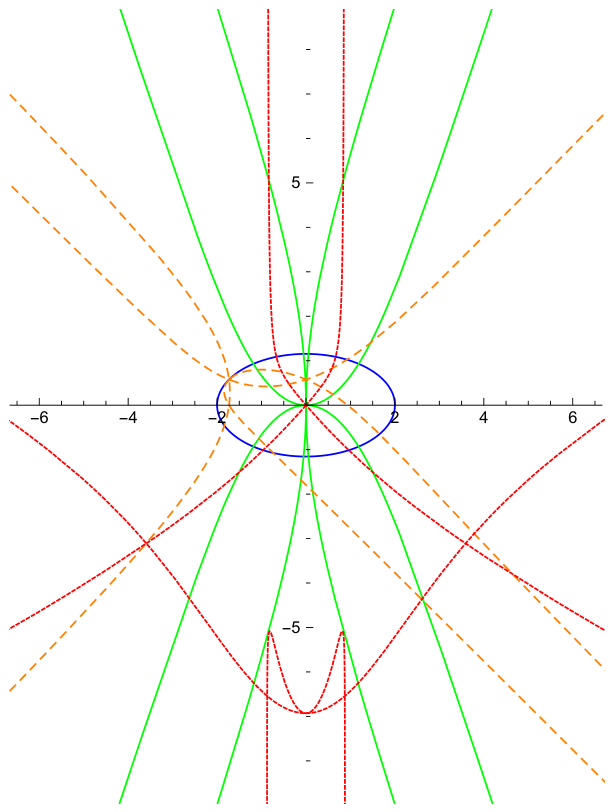
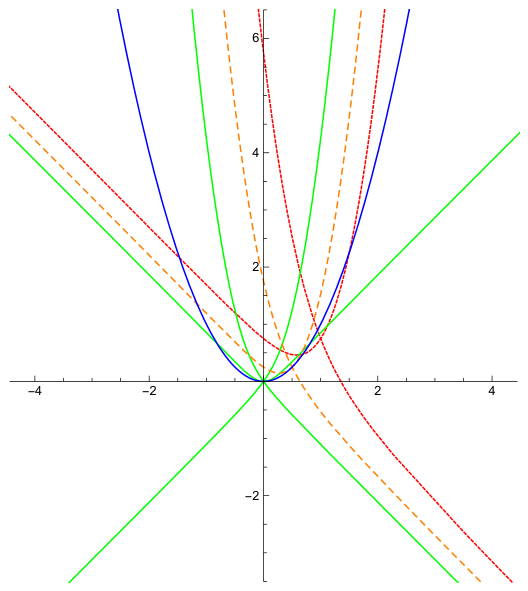
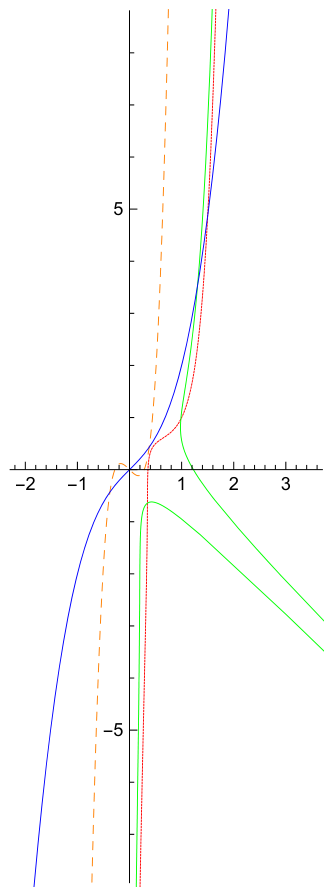
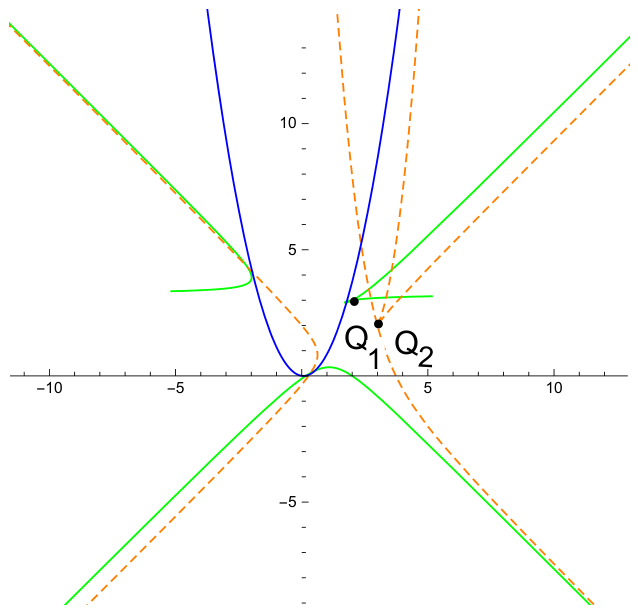
Example 1. Let be a regular mixed-type curve, such thatWhen , is a lightlike point. See the blue curve in Figure 1. If , then , the N-dual curve of isIn this case, is asymptotic with the lightlike line along the positive and negative direction of . See the green curve in Figure 1. If , then coincides with , the N-dual curve of isIn this case, is a lightlike point. See the orange dashed curve in Figure 1. If , then is on the tangent line of , the N-dual curve of isIn this case, is a spacelike point. See the red dashed curve in Figure 1. Example 2. Let be a regular mixed-type curve, such thatWhen , is a lightlike point. See the blue curve in Figure 2. If , then , the N-dual curve of isIn this case, is asymptotic with the lightlike line along the positive and negative direction of . See the green curve in Figure 2. If , then coincides with , and the N-dual curve of isIn this case, is a lightlike point. See the orange dashed curve in Figure 2. If , then is on the tangent line of , and the N-dual curve of isIn this case, is a timelike point. See the red dashed curve in Figure 2. Example 3. Let be a regular mixed-type curve, such thatWhen , is a lightlike point and it is an ordinary inflection. See the blue curve in Figure 3. If , then , and the N-dual curve of isIn this case, is asymptotic with the lightlike line along the positive and negative direction of . See the green curve in Figure 3. If , then coincides with , and the N-dual curve of isIn this case, is a lightlike point. See the orange dashed curve in Figure 3. If , then is on the tangent line of , and the N-dual curve of isIn this case, is a lightlike point. See the red dashed curve in Figure 3. 4. Relationships Among T-Dual Curves, N-Dual Curves and Evolutes of Mixed-Type Curves
As the T-dual curves, N-dual curves and evolutes are all significant curves closely related to the base curve, we would like to investigate the relationships among them in this section. Firstly we study the relationship between the T-dual curves and N-dual curves of a mixed-type curve.
We consider and when is a lightlike point, and we have the following proposition.
Proposition 3. Let be a regular mixed-type curve, be a point in , be the T-dual curve of γ and be the N-dual curve of γ. Suppose that is a lightlike point. If is on the tangent line of , then Proof. Suppose that
is a lightlike point. When
and
, according to the definitions of the T-dual curves and N-dual curves of a regular mixed-type curve, if
is on the tangent line of
, then
Similarly, when
and
, if
is on the tangent line of
, then
Therefore, if
is a lightlike point and
is on the tangent line of
, then
. □
The following example can show this property well.
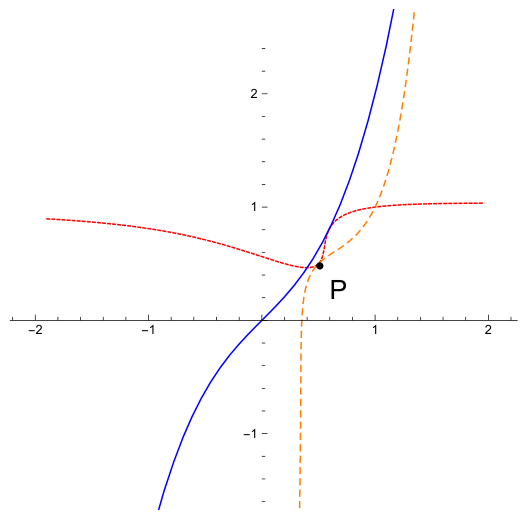
Example 4. Let be a regular mixed-type curve, whereWhen , is a lightlike point. See the blue curve in Figure 4. Let , then is on the tangent line of . In this case, the T-dual curve of isSee the red dashed curve in Figure 4. The N-dual curve of isSee the orange dashed curve in Figure 4. By calculations we can obtain thatSee the point in Figure 4. Proposition 4. Let be a regular mixed-type curve, be a point in , be the T-dual curve of γ and be the N-dual curve of γ. Suppose that is a non-lightlike point.
- (1)
If is on the tangent line of , then coincides with .
- (2)
If is on the normal line of , then coincides with .
Proof. Firstly, suppose that
is on the tangent line of a non-lightlike point
, then we have that
and
are linearly dependent. Therefore, there exists
, such that
Then, we have
Thus,
coincides with
.
Then, we consider that
is on the normal line of
. In this case,
and
are linearly dependent, and there exists
, such that
Therefore,
Hence,
coincides with
. □
We will provide an example to explain the above proposition.
Example 5. Let be a regular mixed-type curve, whereWhen , is a spacelike point. See the blue curve in Figure 5. Let , then is on the tangent line of . The T-dual curve of isIn this case, ; it coincides with . See the green curve in Figure 5. Let , then is on the normal line of . The N-dual curve of isIn this case, ; it coincides with . See the orange dashed curve in Figure 5. Having established the relationships between T-dual and N-dual curves, we now turn to the connection among all three associated curves. The following theorem reveals a fundamental duality: the T-dual curve of the evolute coincides with the N-dual curve of the original curve.
Theorem 2. Let be a regular mixed-type curve without inflection points, be a point in , be the T-dual curve of γ, be the N-dual curve of γ and be the evolute of γ. If coincides with the lightlike point or is on the tangent line of the lightlike point, then Proof. Since the evolute of a regular mixed-type curve without inflections is given by
we have
□
Theorem 2 establishes a key duality among the three associated curves. This commutative relation reveals a coherent geometric framework linking the T-dual curve, N-dual curve and evolute of a mixed-type curve in .
5. Conclusions
In this paper, we have systematically studied the N-dual curve of mixed-type curves in the Minkowski plane, filling a gap in the existing literature. Our main contributions are threefold.
Firstly, we provided a rigorous definition of the N-dual curve, explicitly resolving the technical difficulties that arise at lightlike points where the normal line is not well-defined. Secondly, we analyzed its singularities and classified its point types (spacelike, timelike, and lightlike). Thirdly, based on these results, we established geometric relations among the three associated curves: the T-dual curve, the N-dual curve, and the evolute. In particular, we proved that at lightlike points, the T-dual and N-dual curves coincide when the fixed point lies on the tangent line, and that the T-dual curve of the evolute coincides with the N-dual curve of the original curve. These results reveal a coherent duality framework linking the three objects.
The present analysis is restricted to plane curves. Extension to curves in Minkowski 3-space remains an open problem and is a natural direction for future research. Other possible extensions include applications in geometric optics, where dual curves arise as wavefronts and caustics, as well as numerical computations of N-dual curves for given mixed-type curves.