1. Introduction
One of the central problems in submanifold theory is to understand the relationship between intrinsic invariants of a Riemannian manifold and the extrinsic properties of its immersion into an ambient space. Among intrinsic invariants, the scalar curvature
, obtained as the trace of the Riemannian curvature tensor, plays a fundamental role. However, since scalar curvature averages sectional curvatures over all tangent planes, it often fails to capture finer geometric features. To address this limitation, B.-Y. Chen [
1] introduced a family of invariants known as
-invariants, which measure the deviation of scalar curvature from the sectional curvature of certain plane sections.
For an
n-dimensional Riemannian manifold
N (
), the first
-invariant is defined at a point
by
where
denotes the scalar curvature at
p and the infimum is taken over all plane sections
[
1]. This invariant has proven to be an effective tool for establishing relationships between intrinsic geometry and extrinsic quantities such as the mean curvature. In particular, Chen-type inequalities provide upper bounds for
in terms of
and, in the case of space forms, the ambient curvature. These inequalities have been extensively studied in various geometric settings, including complex space forms [
2,
3], Sasakian space forms, quaternionic space forms [
4,
5], and locally symmetric spaces [
6,
7,
8]. A systematic account of these developments can be found in [
6].
In almost Hermitian and Kähler geometry, the presence of a complex structure
J enriches the study of submanifolds by introducing new geometric interactions between tangent and normal bundles. Foundational results in this direction are presented in the monograph of Bejancu [
9]. A prominent example is that of slant submanifolds, introduced by Chen [
10], for which the angle between
and the tangent space is constant for any tangent vector
X. This notion generalizes both holomorphic submanifolds (
) and totally real submanifolds (
).
For slant submanifolds in complex space forms, Mihai [
2] established a Chen-type inequality of the form
where
c is the holomorphic sectional curvature of the ambient space and
is the slant angle. This result has motivated further studies on generalized slant-type submanifolds, including semi-slant, hemi-slant, and bi-slant submanifolds [
11,
12]. Additional developments include quasi-slant submanifolds introduced by Etayo [
13] and structural studies of semi-slant geometry by Şahin [
14].
Despite these advances, existing Chen-type inequalities do not account for situations where the tangent bundle admits a decomposition involving a distribution that is neither slant, holomorphic, nor totally real. This limitation is addressed by the recently introduced class of partially slant (PS) submanifolds due to Yerlikaya, Poyraz, and Şahin [
15]. A PS-submanifold is characterized by an orthogonal decomposition of the tangent bundle into a proper slant distribution
and an additional distribution
, called the ambiguous distribution, satisfying
and
. This condition ensures that the two distributions remain geometrically independent under the action of the complex structure.
The class of PS-submanifolds provides a unifying framework that includes slant, semi-slant, hemi-slant, and bi-slant submanifolds as special cases, while also allowing more general configurations. In particular, the presence of the ambiguous distribution introduces additional geometric contributions that are not captured in classical Chen inequalities. This motivates the study of -invariants in the PS-setting.
The main objective of this paper is to establish a Chen-type inequality for PS-submanifolds in complex space forms. Our main result (Theorem 1) provides an upper bound for the -invariant in terms of the mean curvature, the ambient holomorphic sectional curvature, and the slant angle of , together with additional terms reflecting the contribution of the ambiguous distribution. The proof is based on the Gauss equation combined with an algebraic optimization procedure applied to the components of the second fundamental form.
We also obtain a complete characterization of the equality case. A PS-submanifold is said to be ideal if it attains equality in the derived inequality identically. The equality characterization reveals that such submanifolds must satisfy strong algebraic conditions on their shape operators, leading to a rigid geometric structure. Although the equality conditions are explicitly determined, constructing concrete examples realizing equality appears to be a nontrivial problem and is left for future investigation.
As applications of the main inequality, we derive several consequences. In particular, for minimal PS-submanifolds, the inequality reduces to a purely curvature-dependent bound. In the case of complex hyperbolic space (), we obtain restrictions on the sign of the -invariant. Furthermore, we show that our result recovers known inequalities for slant, semi-slant, and bi-slant submanifolds as special cases, thereby highlighting the unifying nature of the PS-framework.
The paper is organized as follows.
Section 2 recalls basic notions on Kähler manifolds, complex space forms [
16], and PS-submanifolds. In
Section 3, we derive an expression for the scalar curvature and prove the main Chen-type inequality, including a detailed analysis of the equality case.
Section 4 is devoted to applications and corollaries, while
Section 5 presents concluding remarks and directions for future research.
2. Preliminaries
Let
be a Kähler manifold of real dimension
(complex dimension
m). The almost complex structure
J satisfies
where
denotes the Levi-Civita connection of
g. The condition
implies that
J is parallel, which is equivalent to the Kähler condition
, where
is the fundamental 2-form.
A complex space form, denoted by
, is a Kähler manifold of constant holomorphic sectional curvature
c. The curvature tensor
of
has the well-known expression [
2]
for any vector fields
.
Important examples of complex space forms include complex Euclidean space with , complex projective space with , and complex hyperbolic space with .
Let
N be an
n-dimensional real submanifold of
isometrically immersed via the inclusion map. The induced Riemannian metric on
N is also denoted by
g. For any
, we decompose
into its tangential and normal components:
where
and
. Similarly, for any
, we write
with
and
. The morphisms
P,
F,
t, and
f satisfy various algebraic relations; in particular, from
we obtain
Let
and
denote the Levi-Civita connections on
and
, respectively. The Gauss and Weingarten formulas are given by
for all
and
. Here,
is the second fundamental form, and
is the shape operator (Weingarten map) in the direction of
. These are related by
The mean curvature vector H is defined as . A submanifold is called minimal if , and totally geodesic if .
The covariant derivative of the second fundamental form is given by
for
. The equations of Gauss, Codazzi, and Ricci are respectively
for
and
, where
R and
are the curvature tensors of
and
, respectively.
A distribution
on a submanifold
N of a Kähler manifold is called slant if there exists a constant
such that for every nonzero
, the angle between
and
is constant
. The constant
is called the slant angle of
. An equivalent algebraic characterization is given by [
10]
Special cases arise for particular values of the slant angle. When
, the distribution
becomes holomorphic, that is,
. On the other hand, when
, the distribution
is totally real, meaning that
.
For a slant distribution, it follows from (
5) and (
15) that
We now recall the definition of partially slant submanifolds as introduced in [
15].
Definition 1.
A submanifold N of a Kähler manifold is called a partially slant (PS) submanifold if its tangent bundle admits an orthogonal decompositionwhere is a proper slant distribution with slant angle θ and is an arbitrary complementary distribution, called the ambiguous distribution, satisfying Geometrically, these conditions ensure that the two distributions do not “mix” under
J: the slant distribution is mapped into a subspace orthogonal to the ambiguous distribution, preserving the orthogonal decomposition. Condition (
18) is equivalent to
and
. A PS-submanifold is called proper if
is neither a slant distribution nor a holomorphic nor a totally real distribution. The normal bundle of a PS-submanifold decomposes as [
15]
where
is a
J-invariant subbundle, i.e.,
.
The
J-invariant subbundle
has even dimension. Let
denote the dimension of the maximal holomorphic subdistribution of
at a point
p (i.e., the set of vectors in
that are mapped into
by
J). Since
F is injective on
(for a proper slant distribution with
), we have
. On
, the map
has kernel
, hence
. The total normal space has dimension
. Therefore,
Because
, this simplifies to
The quantity
h is even (it is the real dimension of a complex subspace), so
is even as required. Special cases:
If contains no holomorphic directions (), then .
For a Lagrangian submanifold () with , we obtain , so is trivial.
If is itself holomorphic (), then and .
For the slant distribution
, relations (
15) and (
16) hold. For the ambiguous distribution
, from (
5)–(
8), we obtain
for any
. Moreover, the morphism
t satisfies
Important special cases of PS-submanifolds include the following (see
Table 1):
For an
n-dimensional Riemannian manifold
N, the scalar curvature
at a point
p is defined as
where
is an orthonormal basis of
and
denotes the sectional curvature of the plane spanned by
and
.
Following Chen [
1], we define the
-invariant
by
where the infimum is taken over all plane sections
of
.
The squared norm of the second fundamental form is given by
where
is an orthonormal basis of
. The mean curvature vector
H satisfies
These invariants form the foundation for the Chen inequalities we will establish in the following sections.
3. Chen-Type Inequality for PS-Submanifolds
Let
be a proper partially slant submanifold of a complex space form
. The tangent bundle splits orthogonally as
where
is a slant distribution with slant angle
and
is the ambiguous distribution. Denote
For a point
, we introduce two auxiliary quantities that capture the geometry of the ambiguous distribution. Let
be any orthonormal basis of
. Define
which is independent of the chosen basis due to the skew-symmetry of
P. Let
be a 2-plane in
realizing the infimum of sectional curvature, i.e.,
and set
.
Choose an orthonormal basis
of
adapted to the decomposition, so that
Since
is a slant distribution with angle
, we have
for all
. Using the skew-symmetry of
P, this implies
. Hence,
which further implies
For tangent vectors,
. Thus, (
28) yields
For the ambiguous distribution, we directly have
The defining orthogonality conditions
and
imply
whenever
. Therefore, summing (
29) and (
30),
In a complex space form, the sectional curvature of a plane spanned by orthonormal vectors
is
Summing over all tangent planes gives the ambient scalar curvature restricted to
:
For the distinguished plane
, the ambient sectional curvature is
Subtracting (
34) from (
33), we obtain
Let
be an orthonormal basis of
and denote
. The Gauss equation gives
Summing (
36) over all
and using the standard identity relating scalar curvature to the second fundamental form (see e.g., [
8]), we have
For the plane
, (
36) yields
Now,
. Subtracting (
38) from (
37) gives
where
Fix
and set
,
. Then, from (
40),
since the last term in (
40) is non-positive. Observe that
hence
Define
,
. Then,
, and the expression becomes
To maximize this, we minimize
subject to
. By Cauchy–Schwarz,
so
. Therefore,
Equality in (
41) occurs if and only if equality holds in the Cauchy–Schwarz inequality and in the estimate obtained after discarding the non-positive terms. The equality case of the Cauchy–Schwarz inequality requires that
, which is equivalent to
. In addition, the terms omitted in the previous estimate must vanish, which implies that
for all
with
.
Summing (
41) over
and using
, we obtain
Substituting (
35) and (
42) into (
39), we establish Chen-type inequality for PS-submanifolds of a complex space form, as follows.
Theorem 1.
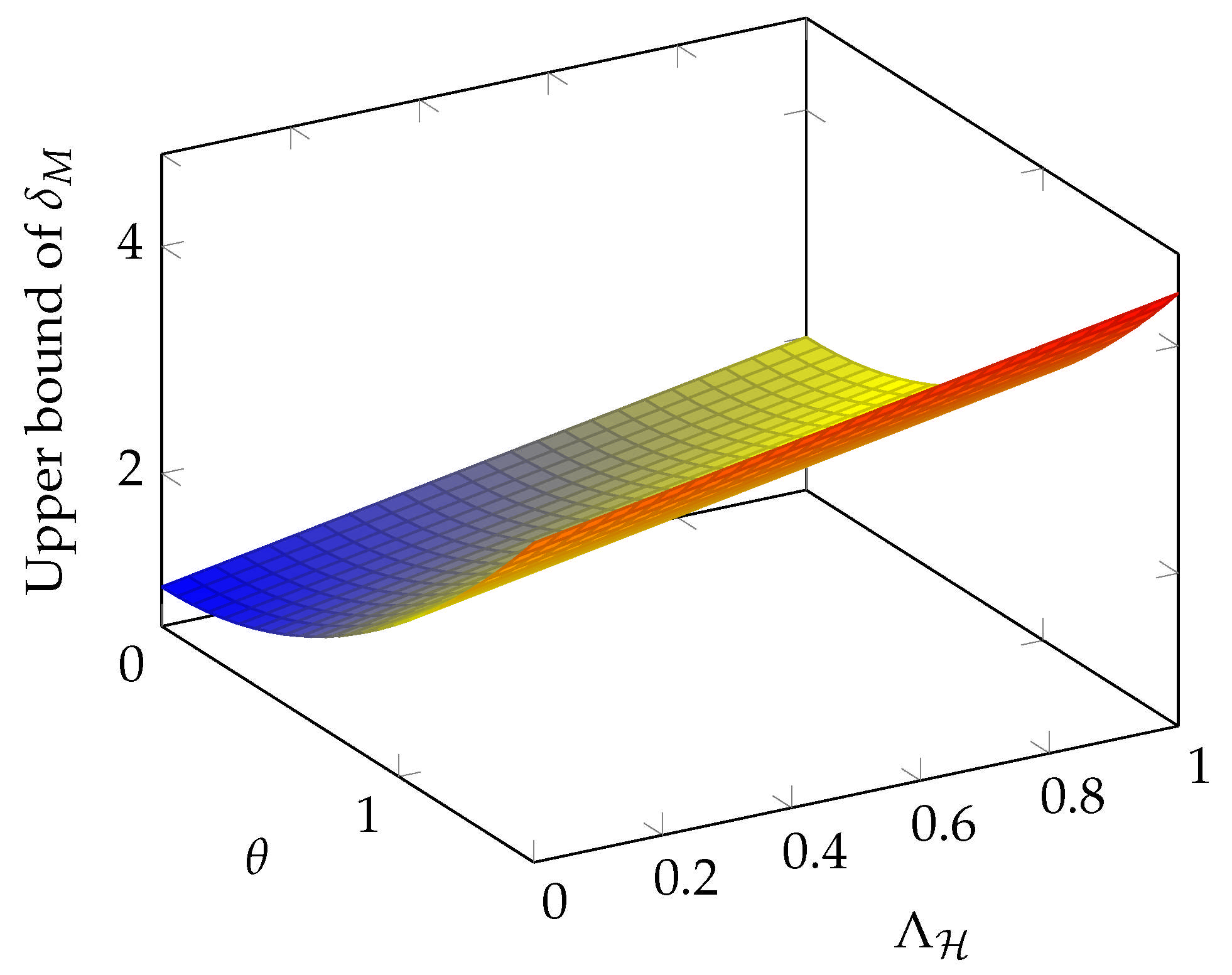
Let be a proper PS-submanifold of a complex space form . Then, at every point , the δ-invariant satisfieswhere ,for any orthonormal basis of , and , where spans a plane realizing the infimum of sectional curvature at p. Moreover, equality holds at p if and only if there exists an orthonormal basis of adapted to the decomposition such that the plane realizes the minimum sectional curvature, that is, . In addition, there exists an orthonormal basis of the normal space for which each shape operator , , has the block-diagonal formwhere , and the diagonal entries satisfy Figure 1 illustrates how the upper bound of
depends on the slant angle
and the ambiguity factor
.
Next, we construct an example inspired by the example in [
15] showing that the bound established in Theorem 1 is sharp.
Example 1.
Consider the complex Euclidean space endowed with the standard Euclidean metric and the standard complex structureThen, is a complex space form with . Let and define an immersionbywhere the coordinates in are ordered as Let be the submanifold determined by this immersion. The tangent vectors areThese vectors form an orthonormal frame on N. DefineWe verify that N is a proper PS-submanifold. First,andHence, the tangential components satisfyTherefore,so is a slant distribution with slant angle θ. Next,so is holomorphic. On the other hand,so is totally real. Hence, is neither holomorphic nor totally real. Moreover, is not a slant distribution, since the angle between and is 0, whereas the angle between and is . Thus, the angle between and is not constant for nonzero .
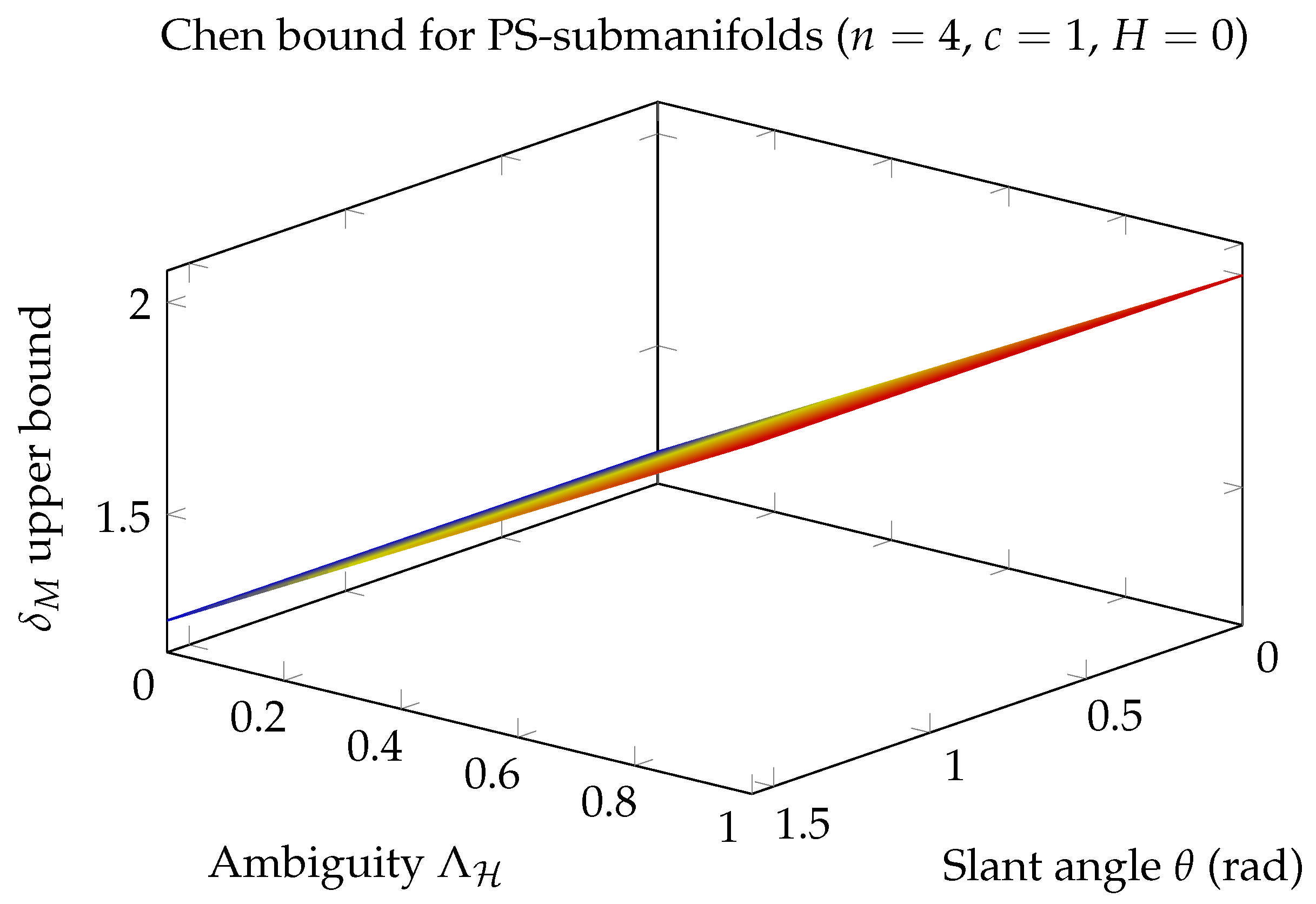
Also, by construction,since involves only the first three complex coordinates, while involves only the fourth and fifth complex coordinates. Therefore, N is a proper PS-submanifold. Since the immersion X is affine linear, the second fundamental form vanishes identically:Thus, N is totally geodesic. Consequently,Hence, Since and , the Chen-type inequality of Theorem 1 reduces toBecause , equality holds identically on N. Finally, the equality characterization in Theorem 1 is trivially satisfied, since all shape operators vanish:Therefore, N is a proper PS-submanifold attaining equality in the Chen-type inequality.This confirms that the obtained Chen-type inequality is sharp. To further illustrate the dependence of the upper bound on the slant angle and the ambiguity factor, we present a graphical representation in Figure 2. Remark 1.
The above example is flat and totally geodesic, which makes the verification particularly simple. However, one can obtain non-flat proper PS-submanifolds that also attain equality by perturbing the immersion in a curved complex space form (e.g., in with ) while preserving the algebraic conditions on the shape operators. For instance, taking a suitable warped product of a slant surface and a holomorphic curve, as outlined in the introduction, yields a non-trivial second fundamental form and non-zero mean curvature while still saturating the inequality. The explicit construction of such non-flat examples is more involved and will be addressed in a forthcoming paper. The flat example already suffices to demonstrate that the bound in Theorem 1 is sharp.
4. Applications and Special Cases of the Chen-Type Inequality
In this section, we derive several consequences of the Chen-type inequality obtained in Theorem 1. These results illustrate how the general estimate simplifies under additional geometric assumptions on the ambient space or on the distributions appearing in the definition of a PS-submanifold. In particular, we obtain simplified bounds when the ambient curvature is nonnegative, when the submanifold is minimal, and when the ambiguous distribution satisfies special conditions such as being holomorphic or totally real. We also show how the inequality recovers known results in the classical slant case and yields restrictions for submanifolds in complex hyperbolic space.
Corollary 1.
Let be a proper PS-submanifold of a complex space form with . Then, at every point , the δ-invariant satisfies Proof. Since
, the term
appearing in (
43) is non-positive and can be omitted, yielding the stated inequality. □
Corollary 2.
Let be a proper PS-submanifold of a complex space form with . Then, at every point ,where . Proof. For any orthonormal basis of , the Cauchy–Schwarz inequality gives , so . Substituting into the previous corollary yields the result. □
Corollary 3.
Let be a minimal proper PS-submanifold of a complex space form . Then,In particular, if , then for . In particular, if , then for . For the exceptional case , the sign of cannot be determined from the inequality alone. Proof. Since N is minimal, , and the inequality follows directly from Theorem 1.
To analyze the sign, observe that
and moreover,
Hence,
For
, the right-hand side is strictly positive. Therefore, when
, the entire expression becomes negative, implying
□
Remark 2.
For compact minimal submanifolds in complex hyperbolic space () with , the inequality at every point forces the integral of the scalar curvature to be strictly less than the integral of the infimum sectional curvature. By the Gauss–Bonnet–Chern theorem (for even n) or index theory, this imposes topological restrictions. In particular, when , the signature of the manifold is constrained.
Corollary 4.
Let be a slant submanifold of a complex space form with slant angle θ. Then,In particular, if the plane realizing satisfies , thenwhich coincides with Mihai’s inequality for slant submanifolds. Proof. For a slant submanifold, the ambiguous distribution is trivial, that is,
Hence, in Theorem 1, we have
Substituting these values into the inequality of Theorem 1, we obtain
If, in addition, the plane realizing
satisfies
then
Therefore, the above inequality reduces to
which is precisely Mihai’s inequality. □
Corollary 5.
Let be a proper PS-submanifold of a complex space form with as a holomorphic distribution. Then, the inequality (
43)
becomes Proof. For a holomorphic distribution, on , so for any unit vector . Hence, . □
Corollary 6.
Let be a proper PS-submanifold of a complex space form with as a totally real distribution. Then, the inequality (
43)
becomes Proof. If is totally real, then for all , so by definition. □
We summarize the equality conditions for different submanifold classes as:
| Submanifold Type | Shape Operator Structure | Mean Curvature Condition | Additional Constraints |
| Slant | for , | None | |
| Semi-slant | Same block-diagonal form | None | holomorphic, |
| Hemi-slant | Same block-diagonal form | None | totally real, |
| Bi-slant | Same block-diagonal form | None | slant with angle |
| General PS | Same block-diagonal form | None | realizes ; arbitrary |
5. Conclusions
In this paper, we have derived a Chen-type inequality for PS-submanifolds of complex space forms. By exploiting the Gauss equation, the curvature structure of complex space forms, and an optimization procedure applied to the components of the second fundamental form, we obtained an explicit upper bound for Chen’s -invariant in terms of the squared mean curvature, the ambient holomorphic sectional curvature, and the geometry of the slant distribution.
A notable feature of the obtained inequality is the appearance of an additional term reflecting the contribution of the ambiguous distribution. This term distinguishes the PS-setting from the classical case of slant submanifolds and shows how the geometry of the complementary distribution influences the intrinsic curvature of the submanifold. The equality case was analyzed, and it was shown that equality occurs precisely when the shape operators take a particular block-diagonal structure satisfying specific trace relations. A concrete affine example in demonstrates that the bound is sharp.
Several consequences of the main inequality were also discussed. In particular, we obtained simplified bounds for minimal PS-submanifolds and dimension-dependent estimates in the case of nonnegative ambient curvature. These results illustrate how Chen’s -invariant continues to serve as an effective tool for relating intrinsic and extrinsic geometry in the broader framework of partially slant submanifolds.
The results obtained here suggest several possible directions for future research. One natural problem is the classification of PS-submanifolds that satisfy the equality case of the derived inequality. Another interesting direction is the investigation of similar inequalities for PS-submanifolds in other ambient geometries, such as generalized complex space forms, Kähler product manifolds, or statistical and contact metric manifolds. The methodology relies heavily on the specific curvature tensor of complex space forms. For generalized complex space forms (with two independent curvature functions), the algebraic optimization becomes significantly more involved because the term does not factor uniformly. However, the same -invariant approach could be extended using pointwise slant angle techniques. Finally, it would be worthwhile to study Chen-type inequalities involving other -invariants in the context of partially slant geometry.