Article

An Infinite Set of One-Range Addition Theorems Without an Infinite Second Series, for Slater Orbitals and Their Derivatives, Applicable to Multiple Coordinate Systems

Department of Physics, Portland State University, Portland, OR 97207-0751, USA
Axioms 2026, 15(4), 242; https://doi.org/10.3390/axioms15040242
Submission received: 19 January 2026 / Revised: 13 March 2026 / Accepted: 18 March 2026 / Published: 24 March 2026

Abstract

Addition theorems have been indispensable tools for the reduction of quantum transition amplitudes. They are normally utilized at the start of the process to move the angular dependence within plane waves, Coulomb potentials, and the like, into a sum over spherical harmonics that allows the angular integration to be carried out. These have historically been “two-range” addition theorems, characterized by the two-fold notation r > = M a x [ r 1 , r 2 ] and r < = M i n [ r 1 , r 2 ] and comprising a single infinite series. More recently, “one-range” addition theorems have been created that have no such piecewise notation, but at the cost of the introduction of another infinite series. We use a very different approach to derive an infinite set of addition theorems for Slater orbitals, hydrogenic and Hylleraas wave functions, and so on, that retain the one-range variable dependence but have, at worst, a finite second series rather than an infinite one. In addition, unlike previous addition theorems, they are applicable to more than one coordinate system. One of these addition theorems may also be used for Yukawa-like functions that may appear late in the reduction of amplitude integrals, and we show its utility for an integral that has stubbornly defied reduction to analytic form for nearly sixty years. Finally, we craft indefinite integrals of 15 half-integer Macdonald functions multiplied by (inverse) powers and negative exponentials containing squares of the integration variable.

1. Introduction

The central impediment to reducing the dimensionality of quantum transition amplitudes is the presence of angular cross-terms | x 1 x 2 |   =   x 1 2 2 x 1 x 2 cos θ + x 2 2 sequestered in various square roots of quadratic forms. Direct spatial integration is sometimes possible (see, for instance, [1], among many others), and at other times addition theorems (e.g., [2,3,4,5,6,7,8]) are more useful. One may instead apply Fourier transforms (e.g., [9,10,11]) and/or Gaussian transforms (e.g., [12,13,14]) to effect these reductions. An example of the latter technique is given in Appendix A.
The author has recently introduced [15] a fifth reduction method in the spirit of Fourier and Gaussian transforms that constitutes an M-1-dimensional integral representation over the interval [ 0 , ] for products of M Slater orbitals, which is one fewer integral dimension than a Gaussian transform requires, and roughly a quarter of the integral dimensions introduced by a Fourier transform for such a product. Subsequent work constructed [16] a sixth reduction method using an M-1-dimensional integral representation over the interval [ 0 , 1 ] .
A comparison of all of these approaches often centers on the Slater orbital e η x x , commonly written without arguments as ψ 000 , which acts as a seed function from which Slater functions [17], Hylleraas powers [18], and hydrogenic wave functions can be derived by differentiation. In nuclear physics, it is known as the Yukawa [19] exchange potential, and in plasma physics as the Debye–Hückel potential, arising from screened charges [20] so that the Coulomb potential is replaced by an effective screened potential [21,22]. Screening of charges also appears in solid-state physics, where this function is called the Thomas–Fermi potential. In the atomic physics of negative ions, the radial wave function is given by the equivalent Macdonald function R ( r ) = C r K 1 / 2 ( η r ) [23]. This function also appears in the approximate ground state wave function [24] for a hydrogen atom interacting with hypothesized non-zero-mass photons [25]. With imaginary η , this function is also ( 4 π times) the free-space Green’s function (see, for instance, [26], among many others). We will simply call these Slater orbitals herein.

2. The Central Problem with Two-Range Addition Theorems

The present work focuses on addition theorems. Probably the most familiar addition theorem, for the Coulomb potential [27] (p. 670, Eq. (B.40)), is
ψ 000 0 , x 12 = 1 x 12 1 r 1 r 2 = 4 π l = 0 m = l l 1 2 l + 1 r < l r > l + 1 Y l m * ( θ 1 , ϕ 1 ) Y l m ( θ 2 , ϕ 2 ) .
This is an example of a “two-range addition theorem” characterized by the two-fold notation r > = M a x [ r 1 , r 2 ] and r < = M i n [ r 1 , r 2 ] and comprising a single infinite series. It may be utilized in the simplest example of a transition amplitude so that [27] (p. 669 (B.35))
S 1 η 1 000 0 ; 0 , x 2 S 1 η 1 j 1 η 2 j 2 p 1 ; y 1 , y 2 p 1 0 , y 1 , 0 , y 2 x 2 , j 1 0 , η 2 0 , j 2 0 = d 3 x 1 e η 1 x 1 x 1 1 x 12 = 0 x 1 2 d x 1 e η 1 x 1 x 1 d Ω 1 4 π Y 00 Ω 1 4 π l = 0 m = l l 1 2 l + 1 r < l r > l + 1 Y l m * Ω 1 Y l m Ω 2 = 4 π 0 x 1 2 d x 1 e η 1 x 1 x 1 l = 0 m = l l 1 2 l + 1 r < l r > l + 1 δ l 0 δ l m 0 4 π Y l m Ω 2 = 4 π 0 x 2 x 1 2 d x 1 e η 1 x 1 x 1 1 x 2 + x 2 x 1 2 d x 1 e η 1 x 1 x 1 1 x 1 = 4 π 1 e η 1 x 2 x 2 η 1 2 , x 2 > 0 , R e η 1 > 0
where the notations r > and r < are made manifest in the second-to-last line. Here, we use the much more general notation of previous work [14], in which the short-hand form for shifted coordinates is x 12 = x 1 x 2 , p 1 is a momentum variable within any plane wave associated with the (first) integration variable, the y i are coordinates external to the integration, and the js are defined in the Gaussian transform [14] of the generalized Slater orbital (A2), as shown below. One can also take derivatives of the Slater orbital e η 1 x 1 / x 1 with respect to η 1 in the integrand to obtain functions with j > 0 , such as hydrogenic s-states, and likewise in the solution on the last line.
If both of the functions have the Slater orbital form, one may use a lesser-known addition theorem found in Magnus, Oberhettinger, and Soni [28],
ψ 000 η , x 12 = e η x 1 2 2 x 1 · x 2 + x 2 2 x 1 2 2 x 1 · x 2 + x 2 2 = x 1 1 / 2 x 2 1 / 2 n = 0 2 n + 1 P n ( cos ( θ ) ) I n + 1 / 2 η x 1 K n + 1 / 2 η x 2 0 < x 1 < x 2
that may be cast into modern notation [27] (p. 670 (B.42) has the equivalent version with imaginary η ):
ψ 000 η , x 12 = e η x 1 2 2 x 1 · x 2 + x 2 2 x 1 2 2 x 1 · x 2 + x 2 2 = x 1 1 / 2 x 2 1 / 2 n = 0 2 n + 1 P n ( cos ( θ ) ) I n + 1 / 2 η x < K n + 1 / 2 η x > .
Weniger [29] gives a brilliant derivation of this addition theorem, and several others, via three-dimensional Taylor expansions.
This allows one to solve the next most complicated integral, [30] (p. 155 No. 2.481.1 with η 1 2 η 2 2 , and GR5 p. 357 No. 3.351.2):
S 1 η 1 0 η 2 0 0 ; 0 , x 2 = d 3 x 1 e η 1 x 1 x 1 e η 2 x 12 x 12 = 0 d x 1 x 1 2 1 1 / 2 e η 1 x 1 x 2 1 / 2 n = 0 2 n + 1 I n + 1 / 2 η 2 x < K n + 1 / 2 η 2 x > × 2 π π π d ( cos ( θ ) ) P 0 ( cos ( θ ) ) P n ( cos ( θ ) ) = x 2 1 / 2 0 d x 1 x 1 2 1 1 / 2 e η 1 x 1 n = 0 2 n + 1 I n + 1 / 2 η 2 x < K n + 1 / 2 η 2 x > × 2 π 1 1 d u P 0 ( u ) P n ( u ) = x 2 1 / 2 0 d x 1 x 1 2 1 1 / 2 e η 1 x 1 n = 0 2 n + 1 I n + 1 / 2 η 2 x < K n + 1 / 2 η 2 x > × 2 π 2 2 · 0 + 1 δ 0 n = 4 π x 2 1 / 2 K 1 / 2 η 2 x 2 0 x 2 d x 1 x 1 1 / 2 e η 1 x 1 I 1 / 2 η 2 x 1 + I 1 / 2 η 2 x 2 x 2 d x 1 x 1 1 / 2 e η 1 x 1 K 1 / 2 η 2 x 1 = 4 π x 2 1 / 2 π 2 η 2 x 2 e η 2 x 2 0 x 2 d x 1 x 1 1 / 2 e η 1 x 1 2 π sinh x 1 η 2 x 1 η 2 + 2 π sinh x 2 η 2 x 2 η 2 x 2 d x 1 x 1 1 / 2 e η 1 x 1 π 2 η 2 x 1 e η 2 x 1 = 4 π x 2 e x 2 η 1 x 2 η 2 η 1 sinh x 2 η 2 + η 2 cosh x 2 η 2 e x 2 η 1 η 2 η 2 2 η 1 2 + η 2 η 1 e x 2 η 1 + η 2 sinh x 2 η 2 η 2 η 2 2 η 1 2 = 4 π e η 2 x 2 e η 1 x 2 x 2 η 1 2 η 2 2 .
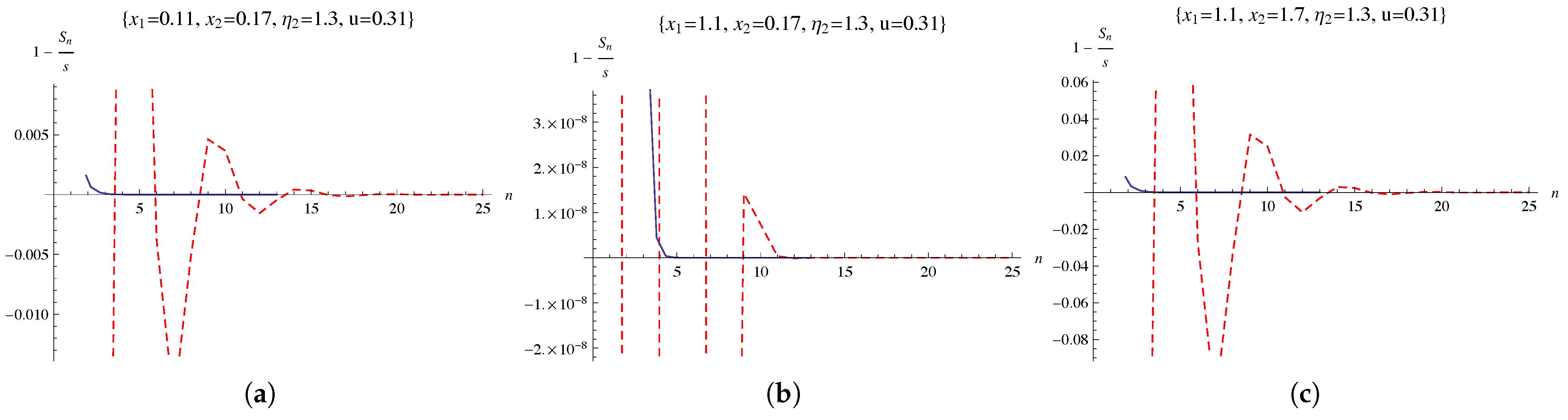
While this approach seems to be an excellent path forward, for more complicated integrals, it manifests problems. For instance, the author attempted to use this approach for a product of five Slater orbitals with shifted coordinates, but the split integrals in this two-range approach manifested pairs of large-amplitude, nearly canceling, terms in numerical checks of each step that eventually brought the project to a standstill for lack of accuracy. Figure 1 shows this sort of oscillating behavior in sequential pairs or triplets of terms in a series having opposite signs.

3. Current One-Range Addition Theorems Have Their Own Problems

One-range addition theorems (see for instance [5,6,8]) remove the need for the notations r > and r < . More crucially, they also bypass significant negative numerical consequences of round-off errors in cancelling terms of large magnitude and opposite signs that may appear in applications of two-range addition theorems. However, one-range addition theorems do so at the cost of the introduction of an additional infinite series—for instance, Guseinov’s version [8] is
ψ 000 ζ , x 12 = e ζ x 1 2 2 x 1 · x 2 + x 2 2 x 1 2 2 x 1 · x 2 + x 2 2 = 2 3 / 2 2 ζ 2 lim N N n = 0 N l = 0 n 1 m = l l u = 0 N v = 0 u 1 s = v v B 000 , n l m α u v s N , N ; η , ζ χ u v s * ζ , x 2 χ n l m ζ , x 1 ,
where α = 1 , 0 , 1 , 2 , , the Slater-type orbitals (STOs) are
χ μ ν σ ζ , x 1 = 2 ζ μ + 1 / 2 2 μ ! r μ 1 e ζ x Y ν σ θ , ϕ ,
and B is a complicated function of its parameters, as given in [8,31].
However, one-range addition theorems need not inherently comprise this costly doubly-infinite series, n and u, as in (6), above. The most obvious counter-example is the often-used addition theorem for plane waves [27] (p. 671 eq. (B.44))
e i k · r = 4 π L = 0 M = L L i L j L ( k r ) Y L M * θ k , ϕ k Y L M θ , ϕ ,
which is useful in problems like photoionization [32], in which the interaction potential takes on the form r cos θ . It has just one infinite series, in L, with the second series in M being finite, and no notation involving r < and r > . The author sought and found just such a one-range addition theorem for Slater orbitals and their derivatives that has just one infinite series, in n, with not even a finite second series in most of its applications, and no notation involving r < and r > .

4. A One-Range Addition Theorem for Slater Orbitals That Has a Single Infinite Series

We wish to prove the following:
Theorem 1.
For k 1 ,
e x 2 B k 2 + C B k 2 + C = n = 0 2 π 1 n B n k 2 n n ! 2 n x 2 n + 1 / 2 C n / 2 1 / 4 K n + 1 / 2 x 2 C
Proof of Theorem 1.
Consider the general Yukawa-form function,
exp x 2 L L ,
where
L k 2 B + C .
An initial solution attempt using a Taylor series expansion in k gave terms that had echoes of Macdonald functions, but the coefficients of the general term were difficult to discern. (This was one of those interesting times when one’s training in graphic design can lend service to abstract mathematical visualization.) However, given that any Yukawa-form function is proportional to a Macdonald function with index 1/2, it occurred to me that performing a Gaussian transform on it [30] (p. 384 No. 3.471.9), splitting off and expanding the k-dependent term in a series [30] (p. 27 No. 1.211.1), and performing the inverse Gaussian transform on the remainder might lead to the correct series of Macdonald functions with increasing indices.
Thus,
e x 2 B k 2 + C B k 2 + C = 1 π 0 d ρ e B k 2 + C ρ e x 2 2 / 4 / ρ ρ 1 / 2 = 1 π n = 0 1 n B n k 2 n n ! 0 d ρ ρ n + 1 / 2 1 e C ρ x 2 2 / 4 / ρ , = 1 π n = 0 1 n B n k 2 n n ! { 2 1 2 n x 2 n + 1 / 2 C n / 2 1 / 4 K n + 1 / 2 x 2 C }
where the factors in braces on the second and third lines constitute the inverse Gaussian transform [30] (p. 384 No. 3.471.9). This completes the proof. □
For any convergent series
S = k a k
whose limit s is known, following Bouferguene and Jones [33], define ϱ as the ratio
ϱ = lim n S n + 1 s S n s
of partial sums
S n = k n a k .
Then, the series converges linearly if 0 < ϱ < 1 and logarithmically if ϱ = 1 . The limit s, in the present case, is simply the left-hand side of (12). Because the right-hand side of (12) has positive powers of B and negative powers of C multiplying a decaying exponential in C, one would expect some interplay between these two for various values of B and C. Since Theorem 1 is restricted to values of k 1 , let us keep it fixed at a small enough value, k = 0.17 , that the interplay between B and C can be explored.
For values of B and C less than one, convergence of (12) is quite rapid, a category well represented by using the arbitrary values C 0.11 , B 0.13 , x 2 0.17 , k 0.23 given in the first line of Table 1, with the first four terms in the series explicitly given by 2.79367 0.051348 + 0.001318 0.000038 . When only C becomes larger than one, the convergence is much more rapid. However, when B is larger than one, the series does not converge very fast (row three, though formally linearly convergent with 0 < ϱ = 0.6 < 1 ), if at all, unless C is also larger than one (row four). Convergence is excellent with C 0.11 , B 0.13 with x 2 either much larger or much smaller ( x 2 = 23 , row six, or x 2 = 0.0023 ).
Since some of the the parameters are variables in semi-infinite integrals and will, thus, vary widely, additional convergence tests follow the next section.

5. A One-Range Addition Theorem for Slater Orbitals

One can consider an application of this new addition theorem, with k = 1 , for a conventional Slater orbital with a shifted-position vector magnitude in spherical coordinates (wherein one has the freedom to choose the direction of the rotational axis such that x 1 · x 2 = x 1 x 2 cos θ ), grouped as
Corollary 1.
e η x 1 2 2 x 1 · x 2 k 2 + x 2 2 x 1 2 2 x 1 · x 2 k 2 + x 2 2 k = 1 = n = 0 1 π 1 n x 1 2 2 x 1 · x 2 n n ! 2 n + 1 / 2 η n + 1 / 2 x 2 n 1 / 2 K n + 1 / 2 η x 2 = n = 0 1 π 1 n n ! 2 n + 1 / 2 η n + 1 / 2 x 2 n 1 / 2 K n + 1 / 2 η x 2 ×    j = 0 n 1 j 2 j x 2 j n j x 1 2 n j m = j , j 2 , ( 2 m + 1 ) j ! 2 m j 2 j m 2 ! ( j + m + 1 ) ! ! P m ( cos ( θ ) ) ,
by setting  x 2 η , C x 2 2 , B x 1 2 2 x 1 · x 2 , k 1 in Theorem 1 (9). Note that this one-range addition theorem has the advantage of consisting of just a single infinite series and two finite series rather than the two infinite series and four finite series in Guseinov’s [8] one-range addition theorem for Slater orbitals (6). Most subsequent applications (corollaries) do not even have these finite series in addition to the infinite one.
One sees that the expansion of powers of cos θ in Legendre polynomials—given in Weisstein [34] (where the smallest value of m is zero or one depending on whether j is even or odd, respectively)—makes this version seem less appealing than the addition theorem found in Magnus, Oberhettinger, and Soni [28] (4), above, since applying orthogonality relations will truncate the finite series in m rather than the infinite series in n. However, in many cases, it will avoid the significant negative numerical consequences of round-off errors in cancelling terms of large magnitude and opposite signs that sometimes appear in applications of the latter two-range addition theorem.
It is interesting that (16) is not the only grouping possible, so we essentially have four one-range addition theorems in one for Slater orbitals in spherical coordinates. One may set x 2 η , C x 1 2 ,   B x 2 2 2 x 1 · x 2 , k 1 in Theorem 1 (9) to obtain:
Corollary 2.
e η x 1 2 + 2 x 1 · x 2 + x 2 2 k 2 x 1 2 + 2 x 1 · x 2 + x 2 2 k 2 k = 1 = n = 0 1 π ( 1 ) n 2 x 1 · x 2 + x 2 2 n n ! 2 1 2 n x 1 n 1 2 η n + 1 2 K n + 1 2 x 1 η
Since the Macdonald function on the right-hand side has half-integer indices, it is an exponential multiplying inverse powers of its argument. Therefore, this addition theorem essentially allows one to pluck out problematic pieces of the quadratic form in the square root of the exponential, leaving an integrable exponential (if we are integrating over x 1 ). The cost of dealing with an infinite series may be worth it if x 2 is small enough that the series converges reasonably fast. One might alternately even decide to pluck out everything except the problematic angular portion of the quadratic from in the square root of the exponential by setting x 2 η , C 2 x 1 · x 2 , B x 1 2 + x 2 2 ,   k 1 to obtain
Corollary 3.
e η x 1 2 + x 2 2 k 2 2 x 1 · x 2 x 1 2 + x 2 2 k 2 2 x 1 · x 2 k = 1 = n = 0 1 π ( 1 ) n x 1 2 + x 2 2 n n ! 2 1 4 3 n 2 η 2 n + 1 2 x 1 · x 2 n 2 1 4 K n + 1 2 2 x 1 · x 2 η 2
While this choice might seem too strange—with its imaginary argument in the Macdonald function—to pursue further, it has secondary value in that one can actually integrate the n = 0 term over the angular variable u = cos θ ,
Theorem 2.
1 1 e 2 η 2 u x 1 x 2 u x 1 x 2 d u = 2 e 2 x 1 x 2 η 2 + e i 2 x 1 x 2 η 2 x 1 x 2 η 2 ,
using the computer calculus program Mathematica 7. This adds to our set of angular integrals that we have not found in the literature—appearing as Equation (24) in a previous paper [32].
Finally, one can take the complement of Corollary 3 by setting { x 2 η , C x 1 2 + x 2 2 ,   B 2 x 1 · x 2 , .   k 1 to obtain
Corollary 4.
e η x 1 2 + x 2 2 + 2 x 1 · x 2 k 2 x 1 2 + x 2 2 + 2 x 1 · x 2 k 2 k = 1 = n = 0 1 π ( 1 ) n x 1 · x 2 n n ! 2 x 1 2 + x 2 2 1 2 n 1 2 η 2 n + 1 2 K n + 1 2 x 1 2 + x 2 2 η
Because this series involving the half-integer Macdonald function has terms of order x j n 1 to x j 1 (multiplying a negative exponential of both variables), it should be the most reliably convergent of these four one-range addition theorems. For this reason, we will use this one-range addition theorem as a test case to solve the integral over two Slater orbitals (21) in the next section.
Before we do this, however, let us perform a side-by-side convergence comparison with the addition theorem found in Magnus, Oberhettinger, and Soni [28] (3). We set the angular parameter to an arbitrary intermediate value, u = cos θ = 0.31 , while the charge (or screening or decay length) parameter η will vary, as will x 1 and x 2 , either of which might take on any value in the semi-infinite range of external integrals they appear in.
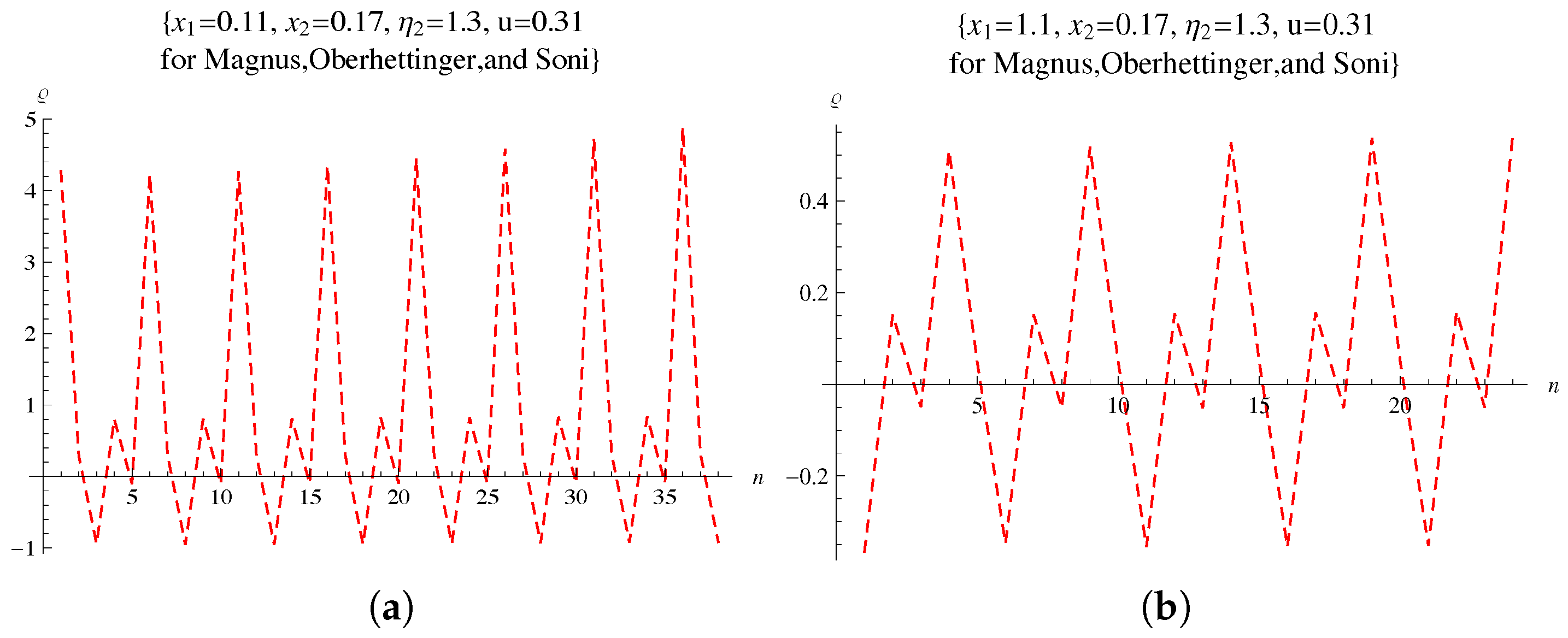
Figure 1a shows that for η = 1.3 , x 1 = 0.11 , and x 2 = 0.17 , Corollary 4 converges rapidly and uniformly, whereas (3) oscillates, with the first two terms in the series positive, the next two negative, the subsequent three terms positive, and so on. While the oscillations die down to the 10 10 level, relative to the first term, no limit for ϱ is discernible within 48 terms in the series, since it oscillates in a manner reminiscent of chaotic systems. Please see Figure 2a.
When x 1 increases by a factor of 10 in Figure 1b to x 1 = 1.1 , while η 2 = 1.3 and x 2 = 0.17 remain the same, Corollary 4 converges uniformly and even more rapidly, and (3), though still oscillating, is likewise improved in the sign and size of the initial terms and in the apparent rate of convergence (at about 13 terms). Again, the values for ϱ oscillate in a manner similar to Figure 2a, but with the amplitudes all less than one, as seen in Figure 2b. If one were to average the magnitudes of the spikes in ϱ in Figure 2b, that would be less than one, so this series might be said to converge linearly in this very rough sense. All these trends continue if one increases x 1 by another factor of 10 to x 1 = 11.0 , while η 2 = 1.3 and x 2 = 0.17 remain the same, as they do if x 1 = 1.1 , and x 2 = 1.7 , while η 2 = 1.3 stays the same. If we have x 1 = 0.011 , and x 2 = 0.17 , and η 2 = 1.3 , the behavior of the two series is not much changed from Figure 1b and Figure 2b.
However, if x 1 = 11.0 and x 2 = 17.0 (while η 2 = 1.3 stays the same), the first term in the addition theorem found in Magnus, Oberhettinger, and Soni (3) is too large by a factor of 10,000, and the partial sums S n only begin to resemble s = 2.24009474794644617691285048238014 × 10 10 in the 41st term of the series, and even there, the convergence parameter ϱ for the sequence of partial sums (14) has oscillation spikes as large as in Figure 2a. Corollary 4, on the other hand, converges nicely.
If we make the charge (or screening or decay length) parameter η 2 ten times larger, and retain large x 1 = 11.0 , and x 2 = 17.0 , even Corollary 4 fails to converge. This might be concerning because the x j will often range over semi-infinite external integrals, but the lack of convergence at tiny values of s for large x j may well be overshadowed by the larger values of s for smaller x j that converge well, even for large η 2 , as seen next.
In this same extremal vein, if we make a hundred-fold boost in η 2 = 130 , while having the x j less than one, x 1 = 0.11 , and x 2 = 0.17 , Corollary 4 converges nicely but the first term in the addition theorem found in Magnus, Oberhettinger, and Soni (3) is too large by a factor of 70,000, and the convergence parameter ϱ for the sequence of partial sums (14) has oscillation spikes as large as in Figure 1a.
Finally, if both x j are of order unity, x 1 = 1.1 and x 2 = 1.7 , Figure 1c, the behavior of both Corollary 4 and (3) are much as in Figure 1a and Figure 2a.
The oscillating behavior seen in the red dashed curves of Figure 1 is typical of two-range addition theorems like (3) and poses significant problems for the numerical checking of intermediate steps in any analytical reducion of integrals using such, as well as final numerical calculations that contain such series.
As for a comparison with Guseinov’s [8] one-range addition theorem, the very complexity of Equation (6), which does not even display the full set of complicated sub-definitions in his addition theorem, in comparison with Corollary 4 (20) is a strong argument in favor of the latter.
One would like to compare the convergence of the new one-range addition theorem that is Corollary 4 (20) to the prior one-range addition theorem of Guseinov (6), but comparing a single infinite series to a series that is doubly infinite and has four additional finite series is a bit like comparing apples to orangutans.
However, even if such a comparison were possible, as one expert in the field of one-range addition theorems of the latter sort, and of convergence in general, Ernst Joachim Weniger, says [35],
One-range addition theorems for Slater-type functions are fairly complicated mathematical objects, whose series coefficients are essentially overlap integrals. Thus, a detailed analysis of the existence and convergence properties of such an addition theorem is certainly a very demanding task.
Analysis by Rico, Loapez, and Ramiarez of a one-range addition theorem they crafted for hydrogenic wave functions—which is akin to (6)—and applied to the integral over a product of two hydrogenic functions with the same charge [6], found that they needed 100 terms in the series to achieve 5 significant figures, and 10,000 were required for 10 significant figures.
One might bear that in mind as we look into convergence in the following test.

6. A Test of a This One-Range Addition Theorem for Slater Orbitals

Let us use this one-range addition theorem, Corollary 4 (20), in the second product within the integral over two Slater orbitals (5). The result is a doubly infinite series whose sum is the known analytic function,
Theorem 3.
S 1 η 1 0 η 2 0 0 ; 0 , x 2 = 4 π e x 2 η 2 e x 2 η 1 x 2 η 1 2 η 2 2 = n = 0 k = 0 ( j = 0 | n 1 | 2 1 2 i = 0 n 2 π i 3 n η 1 ( 1 ) k i 2 j + n 2 + 3 Γ n + 3 2 n 2 i η 2 n 2 i n + 3 2 k j ! k ! Γ ( n + 2 ) 1 2 ( | n 1 | 2 j 1 ) ! × 1 2 ( | n 1 | + 2 j 1 ) ! × x 2 2 i + 1 2 ( n 2 j ) + j + 2 k + n 2 + 2 η 1 2 η 2 2 k Γ 2 i j 2 k n 2 2 , x 2 η 2 ) ,
where the n-sum is over even values only so that the floor function that is the upper limit of the j-sum, | n 1 | 2 1 2 , gives 0 for n = 0 and n / 2 1 for n 2 . There is a restriction η 1 < η 2 that may be circumvented by exchanging these parameters. The case of η 1 = η 2 is given in Theorem 4.
Proof of Theorem 3.
Since there is no angular dependence in the first Slater orbital, we expand the second using (20),
S 1 η 1 0 η 2 0 0 ; 0 , x 2 = d 3 x 1 e η 1 x 1 x 1 e η 2 x 12 x 12 = 2 π 0 d x 1 x 1 2 e η 1 x 1 x 1 1 1 d u n = 0 1 π ( 1 ) n u x 1 x 2 n n ! × 2 x 1 2 + x 2 2 1 2 n 1 2 η 2 n + 1 2 K n + 1 2 x 1 2 + x 2 2 η 2 = 2 π 0 d x 1 x 1 2 e η 1 x 1 x 1 n = 0 1 π ( 1 ) n n ! ( 1 ) n + 1 x 1 n x 2 n n + 1 × 2 x 1 2 + x 2 2 1 2 n 1 2 η 2 n + 1 2 K n + 1 2 x 1 2 + x 2 2 η 2 ,
where the factor ( 1 ) n + 1 on the fourth line gives a factor of two for even n and zero for odd n so that the ( 1 ) n that precedes it is universally— thus redundantly—one. Since the Gaussian transform of the Macdonald function is known [36] (p. 230 No. 3.16.1.13),
p μ K ν a p = 0 2 ν 1 a ν e a 2 4 ρ 2 p ρ 2 ρ 2 μ ν 2 1 U μ + ν 2 , ν + 1 , a 2 4 ρ 2 d ρ 2 , R e p > 0 , a r g a < π / 4 or arg a = ß / 4 , R e μ > 1 / 2
where U is the Tricomi confluent hypergeometric function, one might as well use that approach in the x 1 integral. The Gaussian transform of e η 1 x 1 x 1 is [30] (p. 355 No. 3.325).
e η 1 x 1 x 1 = 1 π 0 d ρ 1 e x 1 2 ρ 1 e η 1 2 / 4 / ρ 1 ρ 1 1 / 2 .
The process of utilizing these two integral transforms is identical to the one laid out for a related integral in Appendix A except that there is neither a plane wave nor a shifted coordinate, both of which lead to cross terms and a need to complete the square. Therefore, in the present integral, the equivalent of the exponential in the last line of the integral in this Appendix (A3) is e x p ρ 1 + ρ 2 x 1 2 x 2 2 ρ 2 , and no change of variables is required to integrate over x 1 :
S 1 η 1 0 η 2 0 0 ; 0 , x 2 = n = 0 0 d ρ 1 0 d ρ 2 ( 1 ) n + 1 x 1 n 2 n + 1 x 2 n ρ 2 n 1 2 ρ 1 + ρ 2 n 2 3 2 Γ n + 3 2 e ρ 2 x 2 2 η 1 2 4 ρ 1 η 2 2 4 ρ 2 ρ 1 Γ ( n + 2 ) = n = 0 0 1 d τ 1 0 d ρ 2 ( 1 ) n + 1 x 1 n 2 n + 1 x 2 n ρ 2 n 2 3 2 1 τ 1 n / 2 Γ n + 3 2 τ 1 Γ ( n + 2 ) × exp x 2 2 ρ 2 η 1 2 1 τ 1 4 τ 1 + η 2 2 4 / ρ 2 ,
where we have used the same change of variables to τ 1 as in the integral in Appendix A (A6). The ρ 2 integral is easily done [30] (p. 384 No. 3.471.9), giving
S 1 η 1 0 η 2 0 0 ; 0 , x 2 = n = 0 0 1 d τ 1 ( 1 ) n + 1 x 1 n 2 n 2 + 5 2 x 2 n 2 + 1 2 1 τ 1 n / 2 Γ n + 3 2 τ 1 Γ ( n + 2 ) η 2 2 τ 1 η 1 2 τ 1 1 τ 1 n 1 4 × K 1 n 2 x 2 η 2 2 τ 1 η 1 2 τ 1 1 τ 1 = n = 0 η 2 d s ( 1 ) n + 1 x 1 n 2 n 2 + 7 2 η 1 s n 2 + 1 2 x 2 n 2 + 1 2 Γ n + 3 2 s 2 η 2 2 n / 2 s 2 + η 1 2 η 2 2 n 2 3 2 Γ ( n + 2 ) × K 1 n 2 s x 2 ,
Here, we changed variables to a somewhat different s = η 2 2 τ 1 η 1 2 τ 1 1 τ 1 for this new problem than in the integral in Appendix A (38), but to the same purpose. This integral can be done if we expand s 2 η 2 2 n / 2 into a finite sum [30] (p. 26 No. 1.111) of isolate powers of s, since n is even, and expand the denominator s 2 + η 1 2 η 2 2 n 2 3 2 into a series via [37] (p. 455 No. 7.3.1.27)
z a = F 1 2 ( a , b ; b ; 1 z ) .
We would like, then, to explicate these powers of z via [37] (p. 430 No. 7.2.1.1),
F 1 2 ( a , b ; c ; 1 z ) = k = 0 ( 1 z ) k ( a ) k ( b ) k k ! ( c ) k .
|1 − z|<1∨(|1 − z|=1∧ℜ(−a − b + c)>0∨(|1 − z|=1∧1 − z≠1∧−1<ℜ(−a − b + c)≤0)|
However, because of the condition | 1 z | < 1 in this second step, we must first rewrite
s 2 + η 1 2 η 2 2 n 2 3 2 = s n 3 1 + η 1 2 η 2 2 s 2 n 2 3 2 ,
and transform the second factor. Since η 2 is typically the nuclear charge or the decay length, s will be larger than one throughout the integral, and so for the most part,
| 1 z | = η 1 2 η 2 2 s 2 < 1 .
Finally, we expand K 1 n 2 s x 2 into a second finite series [30] (p. 978 No. 8.468) (41), below, before integrating to obtain the desired result (21). □
Since Theorem 3 contains two infinite series whose convergence should be checked, let us define a two-dimensional analogue of (13),
S = n k a n , k
whose limit s is known, partial sums
S i , j = n i k j a n , k ,
and ϱ as the limit of the ratio of a partial sum’s average of its three larger-index nearest neighbors:
ϱ = lim i , j 1 3 S i + 1 , j + 1 + S i + 1 , j + S i , j + 1 s S i , j s .
Then, one might have confidence in the convergence of the double series if 0 < ϱ < 1 . The limit s, in the present case, is simply the first line of Theorem 3 (21).
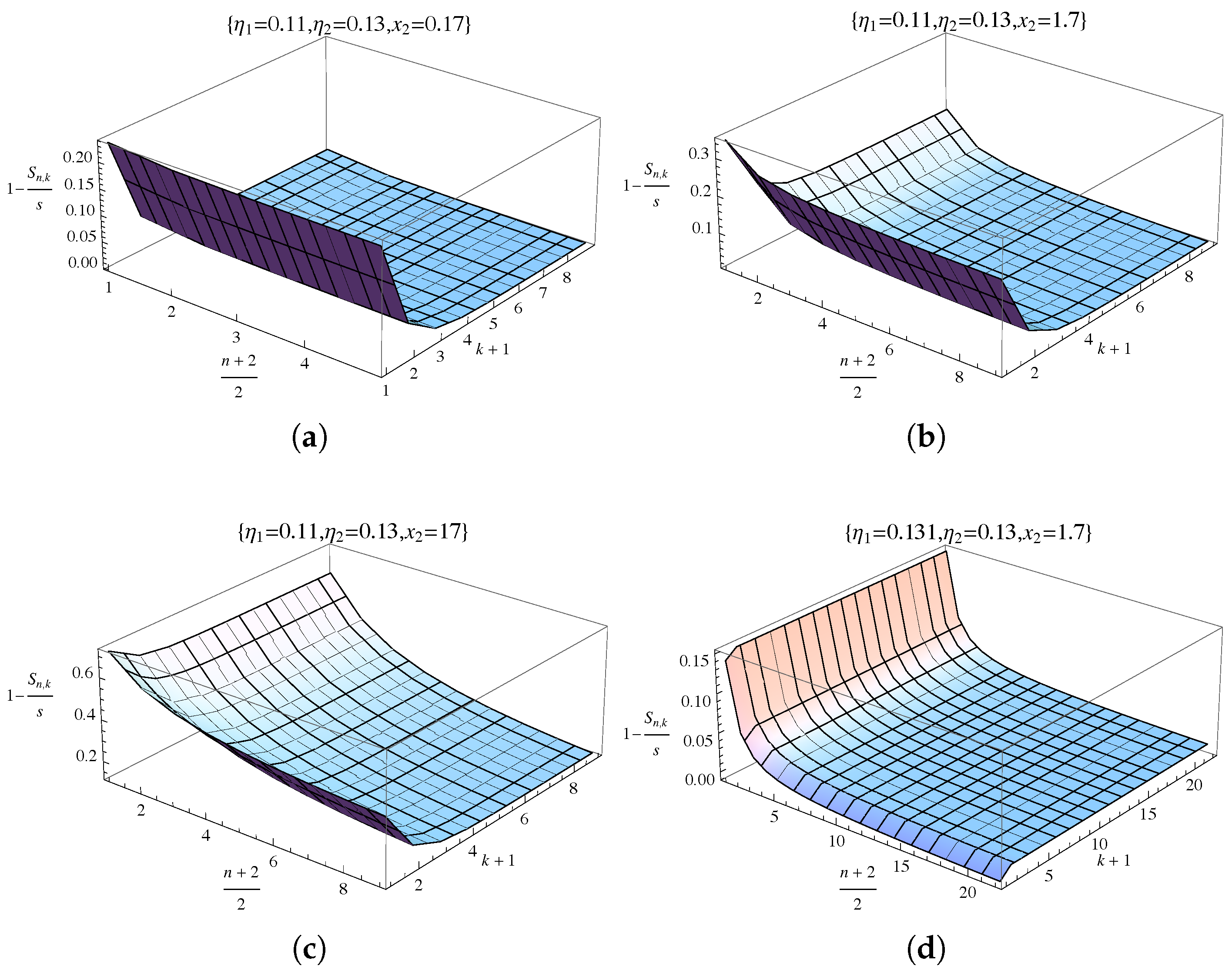
The analytic function in the first line of Theorem 3 (21) has value s = 51.30258210167689 for parameters arbitrarily chosen to be η 1 0.11 , η 2 0.13 , x 2 0.17 . For the n = 0 term in the outermost series, we find that the first three terms in the k series contribute strongly, { 39.1836 , 8.45916 , 2.008 , 0.499656 , 0.127812 , 0.033291 , 0.008782 , 0.002339 , 0.000628 } , and sum to 50.3232 . This is seen as the ridge at k = 0 in Figure 3a. For n = 2 , the terms in the k series fall off more rapidly, { 0.527506 , 0.082122 , 0.017650 , 0.004191 , 0.001043 , 0.000267 , 0.00007 , 0.000018 , 5 × 10 6 } , and sum to 0.632872 . For n = 4 and higher, each term in the k series again shows convergence at roughly a digit of accuracy every other term. The terms are { 0.115654 , 0.017087 ,   0.003642 , 0.000862 , 0.000214 , 0.00005 , 0.000014 , 3 × 10 6 , 1 × 10 6 } and sum to 0.137535 . The next two terms in the n series, 0.0593952 and 0.033087 , indicate fairly slow convergence (to 51.1861 with these five terms), but there are, indeed, no alternating signs that might cause roundoff errors such as I found when using the two-range addition theorem in Magnus, Oberhettinger, and Soni [28] (4), applied to five Slater orbitals.
As x 2 is given a ten-fold increase to x 2 = 1.7 ( s = 42.69956653646056 ), Figure 3b, or a hundred-fold increase to x 2 = 17 ( s = 6.841128050608225 ), Figure 3c, while retaining η 1 = 0.11 and η 2 = 0.13 , one sees that the convergences of the two series are more similar, and somewhat slower but uniform. Using a modest value for x 2 = 1.7 while raising the η j to η 1 = 1.1 and η 2 = 1.3 ( s = 0.6841128050608228 ) , results in convergence very similar to Figure 3c, but for η 1 = 11 and η 2 = 13 , for which s = 1.1258270888939502 × 10 9 , numerical problems ensue in the series of Theorem 3.
The proof of Theorem 3 relied on the inequality η 1 2 η 2 2 s 2 < 1 holding in Equation (28), where the variable of integration s ranges over η 2 < s < , so one might expect problems if η 1 is much larger than η 2 . It turns out that η 1 even 0.8% larger than η 2 produces negative terms in the series that manifest in the downturned lip at k = 0 in the graph, Figure 3d, of 1 S i , j / s . While the graph appears to converge for higher values of k, and the convergence parameter 0.97 = ϱ < 1 , in such a case as this, one should instead simply exchange the definitions η 1 η 2 whenever η 1 > η 2 . The case η 1 = η 2 is given in Theorem 4 in the following subsection.
Theorem 3 is, thus, shown to be valid for a wide range of parameters as one example of the utility of Theorem 1 as manifested in Corollary 4 (20).
We show a technique in Section 7 that might be utilized to avoid the need for the second infinite series (in k), at the modest cost of a term-by-term generation of integrals via computer calculus programs. Even if this sequence of steps gives us “just” a singly infinite series approximation to an analytic function that is obtainable exactly by other means such as (5), this may nevertheless sound like an irrational method of working. However, those other means likely have reached their limit of applicability with Fromm and Hill’s [9] tour-de-force Fourier transform integration over the angular and radial variables for a product of six Slater orbitals in three 3D integration variables, three orbitals of which had shifted coordinates. What are we to do, then, if we have seven Slater orbitals in four 3D integration variables and/or four orbitals with shifted coordinates? It could be that this one-range addition theorem might allow us to trudge a viable path.

The Case of η 1 = η 2

There will be many applications for which the atomic charge (or screened charges or nuclear decay lengths in the various applications noted in the introduction) are the same for both Slater orbitals. One need not entirely rederive (5) but may simply take the limit of the final result, the first line of Theorem 3, to give the first line of the following:
Theorem 4.
S 1 η 2 0 η 2 0 0 ; 0 , x 2 = 2 π e x 2 η 2 η 2 = n = 0 j = 0 | n 1 | 2 1 2 i = 0 n 2 ( π ( 1 ) i i 3 n 2 j + n 2 + 3 Γ n + 3 2 n 2 i 1 2 ( | n 1 | + 2 j 1 ) ! j ! Γ ( n + 2 ) 1 2 ( | n 1 | 2 j 1 ) ! × x 2 2 i + n + 2 η 2 2 i + n + 1 Γ 2 i j n 2 2 , x 2 η 2 ) .
Proof of Theorem 4.
For the general case where η 1 is not necessarily equal to η 2 , to perform the final integral, we had to expand the denominator 1 + η 1 2 η 2 2 s 2 n 2 3 2 into an infinite hypergeometric series (27). However, this step becomes unnecessary if η 1 = η 2 , since this expression then becomes one. As before, we expand K 1 n 2 s x 2 into a finite series [30] (p. 978 No. 8.468) (41), below, before integrating to obtain the desired result (34). □
The reader wishing to take such an approach with a different problem is cautioned that if the expansions of s 2 η 2 2 n / 2 and K 1 n 2 s x 2 into finite sums are not done before a computer calculus integration is attempted, the result may very well include almost-cancelling terms of infinite magnitude along with finite terms.
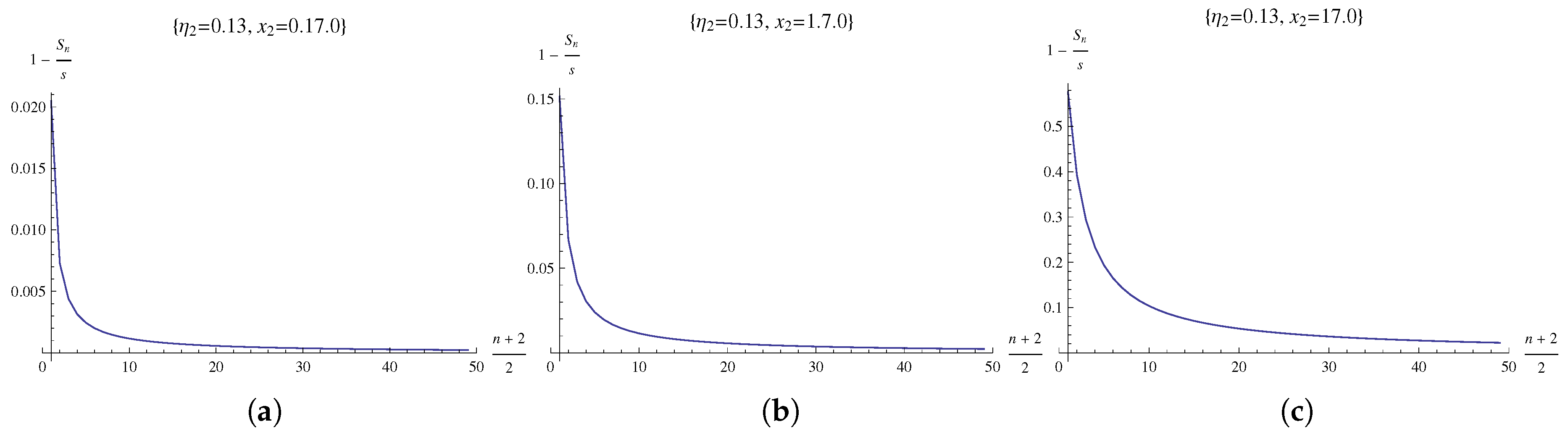
Theorem 4 involves the product x 2 η 2 (apart from an additional power of x 2 in the denominator in the second line, versus an additional power of η 2 in the denominator in the first line), so in these tests, η 2 was held constant at η 2 = 0.13 and only x 2 was varied. The performance of Theorem 4 at x 2 = 0.17 is modest at about four-digit accuracy, though the contribution of subsequent terms falls off uniformly, as seen in Figure 4a. For a tenfold increase to x 2 = 1.7 and another tenfold increase to x 2 = 17 , the curves are similar but the accuracy drops by about one digit for each tenfold increase. A similar trend was seen in the results for Theorem 3. As one increases from x 2 to x 2 = 47 , one must use quadruple precision to obtain reliable results in the terms with higher values of n.
Having shown that this one-range addition theorem (9) produces correct results (though of of modest accuracy) for one particular overlap integral whose exact analytical form is known, we move in the next section to a problem that has defied reduction to analytical form for some sixty years.

7. Application to a Previously Unsolved Problem

Let us now apply (9) to the seemingly insoluble integral (A7), whose reduction to a one-dimensional integral is given in Appendix A, which has an integrand containing the Yukawa-form function,
exp x 2 L L
that has a complicated dependence on the integration variable τ :
L = k 2 B + C k 2 ( 1 τ ) τ + η 1 2 η 2 2 τ + η 2 2 .
The argument of (35) in this example shares a problematic nature with (4) in that it is non-integrable precisely because it is a quadratic form confined within a square root. Therefore, let us apply the one-range addition theorem (9) to it:
S 1 η 1 0 η 2 0 k ; 0 , x 2 = 2 π 0 1 d τ e i k · x 2 τ exp x 2 L L = 2 π n = 0 1 π 1 n k 2 n n ! 2 n + 1 / 2 x 2 n + 1 / 2 0 1 d τ e i k · x 2 τ ( 1 τ ) n τ n × η 1 2 η 2 2 τ + η 2 2 n / 2 1 / 4 K n + 1 / 2 x 2 η 1 2 η 2 2 τ + η 2 2 .
For the first two terms, this can be directly integrated using the computer calculus program Mathematica 7, but for the remainder, we change variables to s = η 1 2 η 2 2 τ + η 2 2 to obtain
S 1 η 1 0 η 2 0 k ; 0 , x 2 = 2 π n = 0 1 π 1 n k 2 n n ! 2 n + 1 / 2 x 2 n + 1 / 2 × 2 3 2 n k 2 n η 1 η 2 2 n η 1 + η 2 2 n π η 2 2 η 1 2 n ! e x p i η 2 2 k · x 2 η 2 2 η 1 2 × η 2 η 1 d s s 1 2 n x 2 n + 1 2 s 2 η 1 2 n s 2 η 2 2 n K n + 1 2 s x 2 e x p i s 2 k · x 2 η 2 2 η 1 2 = 2 π n = 0 2 3 2 n k 2 n η 1 2 η 2 2 2 n 1 π n ! e i k x 2 η 2 2 η 2 2 η 1 2 m = 0 n ( 1 ) m η 1 2 m n m × j = 0 n ( 1 ) j η 2 2 j n j × η 2 η 1 d s x 2 n + 1 2 s 2 j 2 m + 3 n + 1 2 e x p i s 2 k · x 2 η 2 2 η 1 2 K n + 1 2 s x 2 2 π n = 0 2 3 2 n k 2 n η 1 2 η 2 2 2 n 1 π n ! e i k x 2 η 2 2 η 2 2 η 1 2 m = 0 n ( 1 ) m η 1 2 m n m × j = 0 n ( 1 ) j η 2 2 j n j V 2 j 2 m + 2 n , n , η 1 , η 2 , x 2 , k
For n = 0 , we have
S 1 η 1 0 η 2 0 k ; 0 , x 2 = ( 1 i ) 2 π 3 / 2 exp i η 2 2 k · x 2 η 2 2 η 1 2 i x 2 η 1 2 η 2 2 4 k η 1 2 η 2 2 k · x 2 × erf ( 1 ) 3 / 4 x 2 η 1 2 + η 2 η 2 + 2 i k 2 k η 1 2 η 2 2
erf ( 1 ) 3 / 4 x 2 2 i k η 1 + η 1 2 η 2 2 2 k η 1 2 η 2 2 + .
When all of the parameters are of order one or less, this first term accounts for 99% of the value of the integral. Numerical integration of the first line of (37) with η 1 0.82 , η 2 0.66 , x 2 0.036 , k 0.019 , for instance, gives 6.4564 0.210837 i , and the n = 0 term gives an over-estimate of 6.50124 0.212271 i . Adding in the n = 1 contribution ( 0.0452324 + 0.00144522 i ) gives an additional two decimal places of accuracy: 6.45601 0.210825 i . The n = 2 and 3 terms contribute 5 × 10 4 and 5 × 10 6 , respectively.
More generally, we can expand the half-integer Macdonald function as a finite series [30] (p. 978 No. 8.468) (41):
K n + 1 2 s x 2 π 2 e s x 2 s x 2 J = 0 n ( J + n ) ! J ! ( n J ) ! 1 2 J s J x 2 J ,
complete the square in the exponential e x p s x 2 + i s 2 k · x 2 η 2 2 η 1 2 , change variables to s = s + i η 2 2 η 1 2 2 k with unit Jacobian, and expand the binomial s i η 2 2 η 1 2 2 k 2 j J 2 m + 3 n  in a sum over K to give an integrable function, whose value is
V g , n , η 1 , η 2 , x 2 , k = e i x 2 η 1 2 η 2 2 4 k x 2 n + 1 2 π 2 1 x 2 J = 0 n 2 J ( J + n ) ! J ! ( n J ) ! x 2 J K = 0 g J + n i 2 g J + n g J + n K η 2 2 η 1 2 k g J + n 2 k η 2 + i η 2 2 η 1 2 2 k 2 k η 1 + i η 2 2 η 1 2 2 k d s s K e i k s 2 x 2 η 1 2 η 2 2
The integral in the last line is given by [38] (p. 139 No. 1.3.2.5 for even non-negative powers and p. 140 No. 1.3.2.6 for odd positive powers (noting that the exponentials have different coefficients: e a 2 x 2 versus e a x 2 , respectively)), though Mathematica 7 provides the result in a more compact form (and in terms of the incomplete gamma function equivalent of the error function):
e i a x 2 x K d x = 1 2 x K + 1 i a x 2 1 2 ( K 1 ) Γ K + 1 2 , i a x 2 .
For g J + n 2 j 2 m + 3 n J < 0 , however, the derivation leading to (42) would lead to a K-series as a polynomial in the denominator whose integral with e i k s 2 x 2 η 1 2 η 2 2 one would need, and not even the simplest version with u + x in the denominator seems to be tabulated. Alternatively, one could revert to the s integral with inverse powers multiplying the more complicated exponential e i k s 2 x 2 η 1 2 η 2 2 s x 2 , but this does not seem to be tabulated, either. Neither versions 7 nor 13 of Mathematica nor Maple 25 can calculate this integral in general, including for specific powers needed for n > 0 . This leaves one with the prospect of using the process of (27) through (29), above, ultimately resulting in a second infinite series in k like we had in Theorem 3 (21).
However, as shown in Appendix B, if we back up to (38) and write the half-integer Macdonald function as a Meijer-G function, both versions 7 and 13 of Mathematica can calculate this integral using very strict parameters for specific powers of g. The three examples of this that are required for n = 1 and 2 are
V 1 , 1 , η 1 , η 2 , x 2 , k = π 2 ( 1 ) 3 / 4 π e i x 2 η 1 2 η 2 2 4 k k x 2 η 1 2 η 2 2 erfi ( 1 ) 3 / 4 2 k x 2 η 1 η 1 2 η 2 2 i x 2 2 k x 2 η 1 2 η 2 2 e x 2 η 1 i k x 2 η 1 2 η 1 2 η 2 2 η 1 π 2 ( 1 ) 3 / 4 π e i x 2 η 1 2 η 2 2 4 k k x 2 η 1 2 η 2 2 erfi ( 1 ) 3 / 4 2 k x 2 η 2 η 1 2 η 2 2 i x 2 2 k x 2 η 1 2 η 2 2 e x 2 η 2 i k x 2 η 2 2 η 1 2 η 2 2 η 2 , V 0 , 2 , η 1 , η 2 , x 2 , k = π 2 2 η 1 k x 2 η 1 2 η 2 2 exp i k x 2 η 1 2 η 1 2 η 2 2 i x 2 η 1 2 η 2 2 4 k x 2 η 1 ( 1 ) 3 / 4 π η 1 e η 1 x 2 + i k x 2 η 1 η 1 2 η 2 2 6 k x 2 η 1 2 η 2 2 + i x 2 2 erfi ( 1 ) 3 / 4 2 k x 2 η 1 η 1 2 η 2 2 i x 2 2 k x 2 η 1 2 η 2 2 6 e i x 2 η 1 2 η 2 2 4 k k x 2 η 1 2 η 2 2 π 2 2 η 2 k x 2 η 1 2 η 2 2 exp i k x 2 η 2 2 η 1 2 η 2 2 i x 2 η 1 2 η 2 2 4 k x 2 η 2 ( 1 ) 3 / 4 π η 2 e η 2 x 2 + i k x 2 η 2 η 1 2 η 2 2 6 k x 2 η 1 2 η 2 2 + i x 2 2 erfi ( 1 ) 3 / 4 2 k x 2 η 2 η 1 2 η 2 2 i x 2 2 k x 2 η 1 2 η 2 2 6 e i x 2 η 1 2 η 2 2 4 k k x 2 η 1 2 η 2 2 , V 2 , 2 , η 1 , η 2 , x 2 , k = π 2 2 1 4 π e i x 2 η 1 2 η 2 2 4 k k x 2 η 1 2 η 2 2 3 / 2 erfi ( 1 ) 3 / 4 2 k x 2 η 1 η 1 2 η 2 2 i x 2 2 k x 2 η 1 2 η 2 2 + e η 1 x 2 + i k x 2 η 1 η 1 2 η 2 2 2 i k x 2 η 1 2 η 1 2 η 2 2 x 2 η 1 1 η 1 3 π 2 ( 1 ) 3 / 4 π η 2 e η 2 x 2 + i k x 2 η 2 η 1 2 η 2 2 6 k x 2 η 1 2 η 2 2 + i x 2 2 erfi ( 1 ) 3 / 4 2 k x 2 η 2 η 1 2 η 2 2 i x 2 2 k x 2 η 1 2 η 2 2 6 e i x 2 η 1 2 η 2 2 4 k k x 2 η 1 2 η 2 2 2 η 2 k x 2 η 1 2 η 2 2 exp i k x 2 η 2 2 η 1 2 η 2 2 i x 2 η 1 2 η 2 2 4 k x 2 η 2 .
One notes that for the second of these, one has g 2 j 2 m + 2 n = 0 , whereas the concerns in the previous paragraph around the use of (43) would allow its use for this value of g for one term.
The resolution of this seeming discrepancy is more easily seen in the case n = 3 . The integrand s 2 j 2 m + 9 + 1 2 e x p i s 2 k · x 2 η 2 2 η 1 2 K 3 + 1 2 s x 2 in the second form in (38) will have j and m running from zero to n = 3 . The term with j = m = 2 will yield a power for s (after cancelling s 1 2 with the 1 / s arising from the Macdonald function) of 2 j 2 m + 3 n = 4 4 + 9 = n 2 = 1 , giving an integrand of the form s 15 s 3 x 3 + 15 s 2 x 2 + 6 s x + 1 e s x i a s 2 , the last two terms of which would be integrable via (43) and first two of which would not. However, the method derived in Appendix B will only work when the entire set of four terms is simultaneously integrated, so in order to integrate these first two terms, we must drag the last two terms along for the ride, and exclude them from duplicate integration via (43). Since the powers of s increase in steps of 2, the next larger power for s will be 2 j 2 m + 3 n = 4 2 + 9 = n = 3 , for which s 3 15 s 3 x 3 + 15 s 2 x 2 + 6 s x + 1 e s x i a s 2 is fully integrable via (43). Thus, we set the cutoff point for use of (43) at 2 j 2 m + 3 n n or g 2 j 2 m + 2 n 0 .
Consider, now, the first six terms of (38) for η 1 1.1 , η 2 1.3 , x 2 1.7 , k 0.19 . The exact value is unknown, so one cannot use the formalism of (13) through (14) to formally establish convergence. Since the derivations involving several different numerical integrals to represent S 1 η 1 0 η 2 0 k ; 0 , x 2 differ by one part in 10 14 , we will use the τ integral representation in the first line of (38) as a proxy for the exact result and call its numerical value t, which in this case is 0.6665126801715232 0.11794621169698938 i . We find that terms with g 2 j 2 m + 2 n 0 ,
0.6707498857777798 0.11868778740466418 i , 0.2331857259673218 + 0.04265364064698521 i , 0.17006216841663216 0.0302924492592474 i , 0.12671374979967312 + 0.022342484334643115 i , 0.09624634706705158 0.01687436668411478 i , 0.07456274200868238 + 0.013025828449132314 i ,
and those with g < 0 ,
0 , 0.22892531321429133 0.041908010913643615 i , 0.17003883759781038 + 0.030288373620767726 i , 0.12671362546464632 0.02234246260588233 i , 0.09624634640046083 + 0.01687436656753733 i , 0.07456274200508727 0.01302582844857301 i ,
each fall off quite slowly, but their sum (of oppositely signed terms) falls off rapidly:
0.6707498857777798 0.1186877874046642 i , 0.00426041275303 + 0.0007456297333416 i , 0.00002333081882 4.07563848 × 10 6 i , 1.24335 × 10 7 + 2.172876 × 10 8 i , 6.666 × 10 10 1.166 × 10 10 i , 4 .   ×   10 12 + 6 .   ×   10 13 i ,
which in turn sums to 0.66651268017154 0.11794621169705963 i , giving 14 digits of accuracy with just six terms despite the fact that it is the sum of oppositely signed terms having similar magnitudes. Below, we give the solution for charge (or screening or decay length) parameters η 2 = η 1 , but for slightly unequal charges, one must use double-precision calculations, as here, or higher if the values are even closer.
To double-check that this presumption (of the cause of the slow fall-off of both the terms with g 0 and those with g < 0 ) is the case, we set the charge parameters η j to markedly different values while retaining the others as they are: η 1 1.1 , η 2 2.3 , x 2 1.7 , k 0.19 . In this case t = 0.23481751053036914 0.055198322995472456 i . We find that terms with g 0 ,
0.2357123929903357 0.05539708007272415 i , 0.003612596189417 + 0.000891047181929 i , 0.00007037659271 0.00001673481498 i , 1.513486 × 10 6 + 3.473878 × 10 7 i , 3.331 × 10 8 7.464 × 10 9 i , 7 .   ×   10 10 + 2 .   ×   10 10 i ,
and those with g < 0 ,
0 , 0.002714914085972 0.0006916799546823 i , 0.00006756880504 + 0.00001612290107 i , 1.505319 × 10 6 3.456189 × 10 7 i , 3.329 × 10 8 + 7.459 × 10 9 i , 7 .   ×   10 10 2 .   ×   10 10 i ,
each fall off very rapidly, as does their sum (of oppositely signed terms),
0.2357123929903357 0.05539708007272415 i , 0.000897682103445 + 0.0001993672272467 i , 2.807787679 × 10 6 ( 6.119139042   ×   10 7 i , 8.167405 × 10 9 + 1.768947 × 10 9 i , 2.334 × 10 11 5.239 × 10 12 i , 4   ×   10 13 + 6   ×   10 14 i ,
which in turn sums to 0.2348175105300769 0.05519832299561042 i , giving 13 digits of accuracy with only these six terms.
Suppose that we increase x 2 by a factor of ten to 17, while retaining the other parameters, η 1 1.1 , η 2 2.3 , x 2 17 , k 0.19 , then t = 1.3502463781703298 × 10 9 2.452839537565458 × 10 11 i . We find that the terms with g 0 and those with g < 0 both range from 10 9 to 10 16 and sum to 1.3502460355827795 × 10 9 2.4528453239716754 × 10 11 i , accurate to seven places. Given that the size of t drops precipitously as x 2 ranges over large values in a hypothesized external integral, the corresponding drop in accuracy of the series approximation (38) to t is not too worrisome. Homeier, Weniger, and Steinborn [7] cast this sort of thinking into more formal language: The pointwise convergence of their
one-range addition theorem follows in a mathematically rigorous sense neither from this derivation, nor from the numerical experiments reported in [[6]] …. But the very compact addition theorem [their eq. (21)] shows that the Yukawa potential—although not being an element of the Sobolev sapce W 2 ( 1 ) R 3 —is directly related to the Coulomb Sturmians that are elements of this Sobolev space. Hence, the one-range addition theorem should be interpreted in the sense of distributions with respect to this Sobolov space.
Changing the value of k affects the plane wave oscillation frequency in the original integral in (37), but in this series expansion, k also appears in the arguments of the error functions and as powers, so the effects of changes in k are hard to predict. If we increase it to half of its maximal value, η 1 1.1 , η 2 2.3 , x 2 1.7 , k 0.49 , then t = 0.19164813492700847 0.1303837754306246 i . We find that the terms with g 0 range from 10 1 to 10 6 and those with g < 0 range from 10 2 to 10 6 and sum to 0.19164813491335722 0.1303837754222566 i , accurate to ten places.
Pushing k to its maximum, η 1 1.1 , η 2 2.3 , x 2 1.7 , k 0.99 , gives t = 0.06850157908844157 0.18866932850682303 i . At this limit, terms with g 0 converge very slowly,
0.0774520771 0.20843002 i , 0.0280074 + 0.0902197 i , 0.0166 0.0464 i , 0.0106415 + 0.026382 i , 0.00674426 0.0154882 i , 0.00423075 + 0.00924077 i ,
as do those with g < 0 ,
0 , 0.0182402 0.0687662 i , 0.0157 + 0.0446 i , 0.0105701 0.026237 i , 0.0067387 + 0.015477 i , 0.00423032 0.00923991 i ,
but their sum (of oppositely signed terms) falls off fairly nicely,
0.07745208 0.20843 i , 0.00976721 + 0.0214535 i , 0.000883 0.0018274 i , 0.00007145 + 0.000145 i , 5.56 × 10 6 0.0000112 i , 4.3 × 10 7 + 8.6 × 10 7 i ,
and sums to 0.06850154858837343 0.18866926670442002 i , giving 6 digits of accuracy.
Finally, we turn to larger values of η 2 . For η 2 > 5 , Mathematica gives values for the n = 5 term of (42) and g 0 that are a factor of 10 larger than the numerical integral of the penultimate form of (38), and one finds markedly different values for η 1 1.1 , η 2 5.3 , x 2 1.7 , k 0.49 when the incomplete gamma function in (42) is replaced by its exponential integral [39] or confluent hypergeometric 1 F 1 function [40] equivalents. In such cases, the ease of a general expression of (42) must give way to term-by-term derivations like those for g < 0 in (44), which do not have this deficit (and sum to 0.04039922611623113 0.012473503802595898 i , matching t = 0.04039922557428546 0.012473503806664838 i to ten decimal places), or switch from Mathematica to another program for numerical accuracy.
Returning to the Cheshire [41] integral (A9) of Appendix A, which has η 2 η 1 , the complexity of the above reduces considerably to
S 1 η 1 0 η 1 0 k ; 0 , x 2 = 2 π n = 0 1 π 1 n k 2 n n ! 2 n + 1 / 2 x 2 n + 1 / 2 η 1 n 1 2 K n + 1 2 x 2 η 1 , × 0 1 d τ e i k · x 2 τ ( 1 τ ) n τ n = 2 π n = 0 ( 1 ) n 2 3 n 1 2 k 2 n x 2 n + 1 2 η 1 n 1 2 Γ n + 3 2 × K n + 1 2 x 2 η 1 F 1 1 n + 1 ; 2 n + 2 ; i k · x 2
We, thus, have developed a series solution to the Cheshire integral, and its generalization, for k 1 .

8. This One-Range Addition Theorem May Also Be Used for Cartesian Coordinates

There may be some problems for which Cartesian coordinates would be more useful than spherical ones, in which case Corollary 3 becomes (with the choice of coordinates aligning the z axis with the direction of the shifted charge center), with { x 2 η , C z 1 z 2 2 ,   B x 1 2 + y 1 2 , k 1 } ,
Corollary 5.
e η x 1 2 + y 1 2 k 2 + z 1 z 2 2 x 1 2 + y 1 2 k 2 + z 1 z 2 2 k = 1 = n = 0 1 π ( 1 ) n x 1 2 + y 1 2 n n ! 2 n 1 2 K n + 1 2 z 1 z 2 2 η z 1 z 2 2 1 2 n 1 2 η 2 n + 1 2 ,
in which one must be careful to substitute z 1 z 2 2 = z 1 z 2 since z 2 will be larger than z 1 at some points in an integral over the latter. Unfortunately, this reverts to a two-range form, so this form of C would not be one’s first choice.
The Cartesian-coordinate equivalent of Corollary 4, with { x 2 η , C x 1 2 + y 1 2 ,   B z 1 z 2 2 , k 1 } , retains the one range form:
Corollary 6.
e η x 1 2 + y 1 2 + z 1 z 2 2 k 2 x 1 2 + y 1 2 + z 1 z 2 2 k 2 k = 1 = n = 0 1 π ( 1 ) n z 1 z 2 2 n n ! 2 1 2 n K n + 1 2 x 1 2 + y 1 2 η x 1 2 + y 1 2 1 2 n 1 2 η 2 n + 1 2 .
The evaluation of this series follows that for its spherical-coordinate equivalent, Corollary 4, through the substitution (23). However, in this Cartesian-coordinate version, the n = 0 term can be reduced to analytic form,
exp ρ 1 x 1 2 y 1 2 z 1 2 ρ 2 x 1 2 + y 1 2 η 1 2 4 ρ 1 η 2 2 4 ρ 2 π ρ 1 ρ 2 ,
which can be simply integrated over z 1 , , , y 1 , , , x 1 , , , ρ 2 , 0 , , and τ 1 , 0 , 1 in sequence to give 4 π η 2 2 η 1 2 sinh 1 η 2 2 η 1 2 1 . However, for the terms n 1 , an infinite k-series would be required (or possibly the term-by-term computer calculus integration approach in Section 7), so this approach is not really an improvement on the spherical-coordinate equivalent (21), and we will not discuss it further.

9. Additional Coordinate Systems

This one-range addition theorem may be applied to problems expressed in other coordinates provided, of course, that the specific problem results in a Slater orbital that contains a square root of coordinate variables.

9.1. Ellipsoidal Coordinates

Consider, for instance, the 90-year-old paper by Hirschfelder, Eyring, and Rosen [42] that calculates energy integrals related to the H 3 molecule, whose “nuclei a, b, and c, lie symmetrically on a straight line with a separation of R times the first Bohr radius for atomic hydrogen a 0 ; and 1 and 2 are electrons.” Their ellipsoidal coordinates are:
λ n = r i n + r j n / R μ n = r i n r j n / R
and ϕ n is the azimuthal angle of n, “where i and j are the foci, R is the distance them, r i n and r j n are the distances from the arbitrary point n to i and j, respectively.” In this coordinate system, one of the several integrals they calculate has the form we desire to test,
T a , b c = 2 R 3 1 d λ 1 1 d μ λ μ R + λ 2 μ 2 e 3 R λ R μ e R λ 2 + μ 2 1
except that the wave function is hydrogenic rather than a Slater orbital. This is no impediment if we have the following one-range addition theorem at hand:
Theorem 5.
For k 1 ,
e x 2 B k 2 + C = n = 0 2 π 1 n B n k 2 n n ! 2 n x 2 n + 1 / 2 C 1 4 n 2 K n 1 2 C x 2
Proof of Theorem 5.
If we take the derivative of both sides of (9) with respect to x 2 and use the recursion relation for Macdonald functions [30] (p. 982 No. 8.486.10), the result immediately follows. □
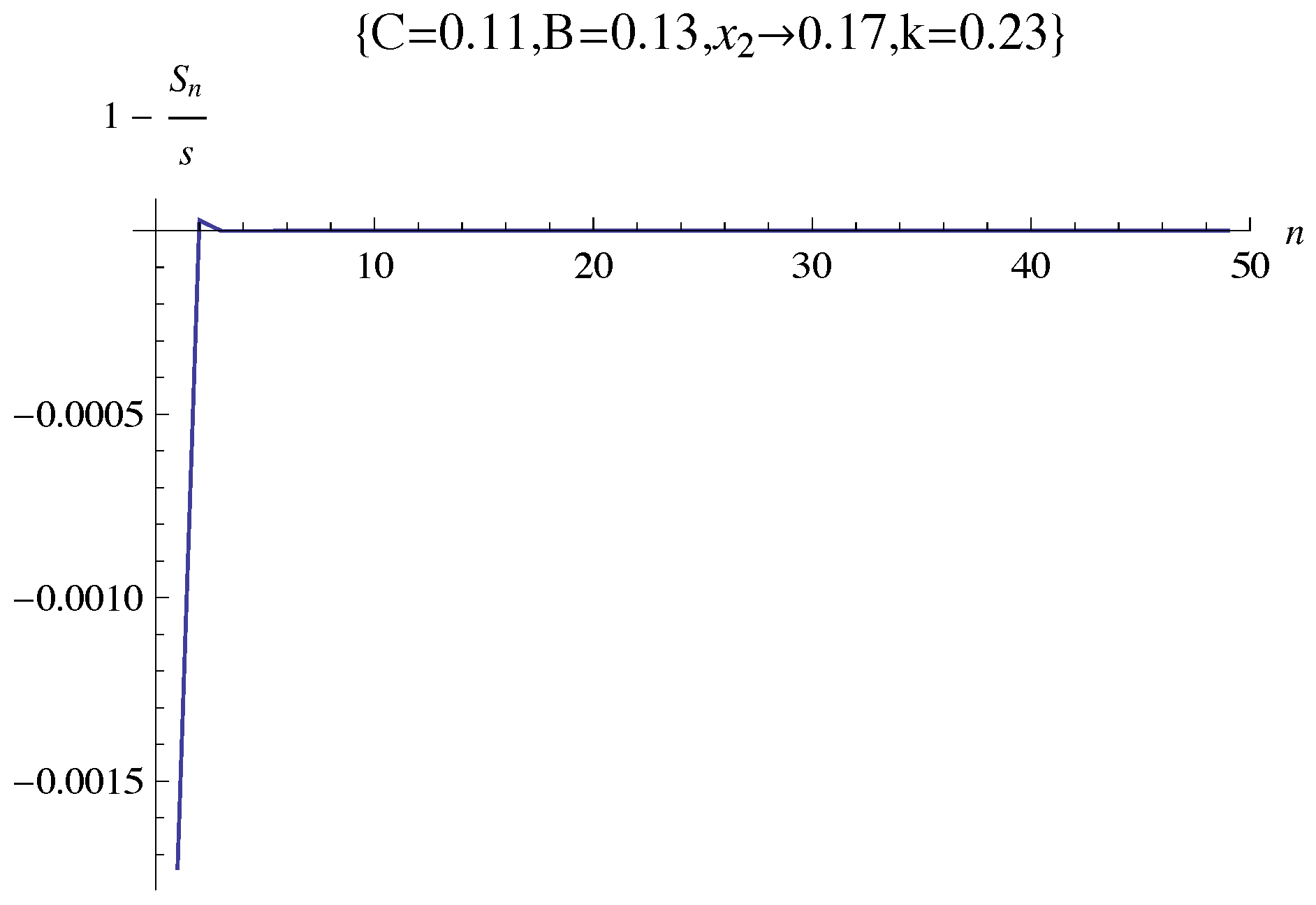
Convergence of Theorem 5 is shown in Figure 5 for arbitrary values C 0.11 ,   B 0.13 , x 2 0.17 , k 0.23 .
For the present problem, we insert (51) in (50) and rewrite the half-integer Macdonald function as a finite series [30] (p. 978 No. 8.468) (41). Then,
T a , b c = 2 R 3 1 d λ 1 1 d μ n = 0 J = 0 n 1 2 1 2 2 J R J 1 2 λ J 1 2 n 1 2 + J 1 2 ! J ! n 1 2 J 1 2 ! × 1 2 n R n + 1 2 μ 2 1 n e 4 R λ R μ n ! λ 3 2 n μ λ 1 2 n R μ 2 λ 1 2 n + λ 5 2 n = n = 0 1 1 d μ J = 0 n 1 2 1 2 ( 1 ) n 2 J + n 5 R 2 n μ 2 1 n e R μ n 1 2 + J 1 2 ! J ! n ! n 1 2 J 1 2 ! × ( 16 R μ ( R μ + 1 ) Γ ( J n + 1 , 4 R ) + 4 Γ ( J n + 2 , 4 R ) + Γ ( J n + 3 , 4 R ) ) = n = 0 J = 0 n 1 2 1 2 i π ( 1 ) 2 n e i π n 2 j + 2 n 9 2 ( R ) n 3 2 R 2 n Γ ( n + 1 ) n 1 2 + j 1 2 ! ( ) j ! n ! n 1 2 j 1 2 ! × R I n + 5 2 ( R ) 16 R 2 Γ ( j n + 1 , 4 R ) 4 Γ ( j n + 2 , 4 R ) Γ ( j n + 3 , 4 R ) ( 2 n + 3 ) I n + 3 2 ( R ) ( 4 Γ ( j n + 2 , 4 R ) + Γ ( j n + 3 , 4 R ) ) ,
where the I j ( R ) are modified Bessel functions and n 1 2 1 2 is the greatest integer less than n 1 2 1 2 , giving 0 for n = 0 and n 1 for higher values. Hirschfelder, Eyring, and Rosen [42] give the exact result as
T a , b c = 1 81 e 3 R 16 R 2 + 44 R + 116 9 R 116 3 Ei ( 8 R ) e 3 R 16 R 2 + 44 R + 116 9 R + 116 3 ( Ei ( 2 R ) + 2 log ( 2 ) ) + + 1 16 e 3 R 624 R 2 + 2256 R + 131 3 R + 1670 1 16 e 5 R 160 R + 131 3 R + 34 ,
which, for R = 0.11 , gives 0.360071 .
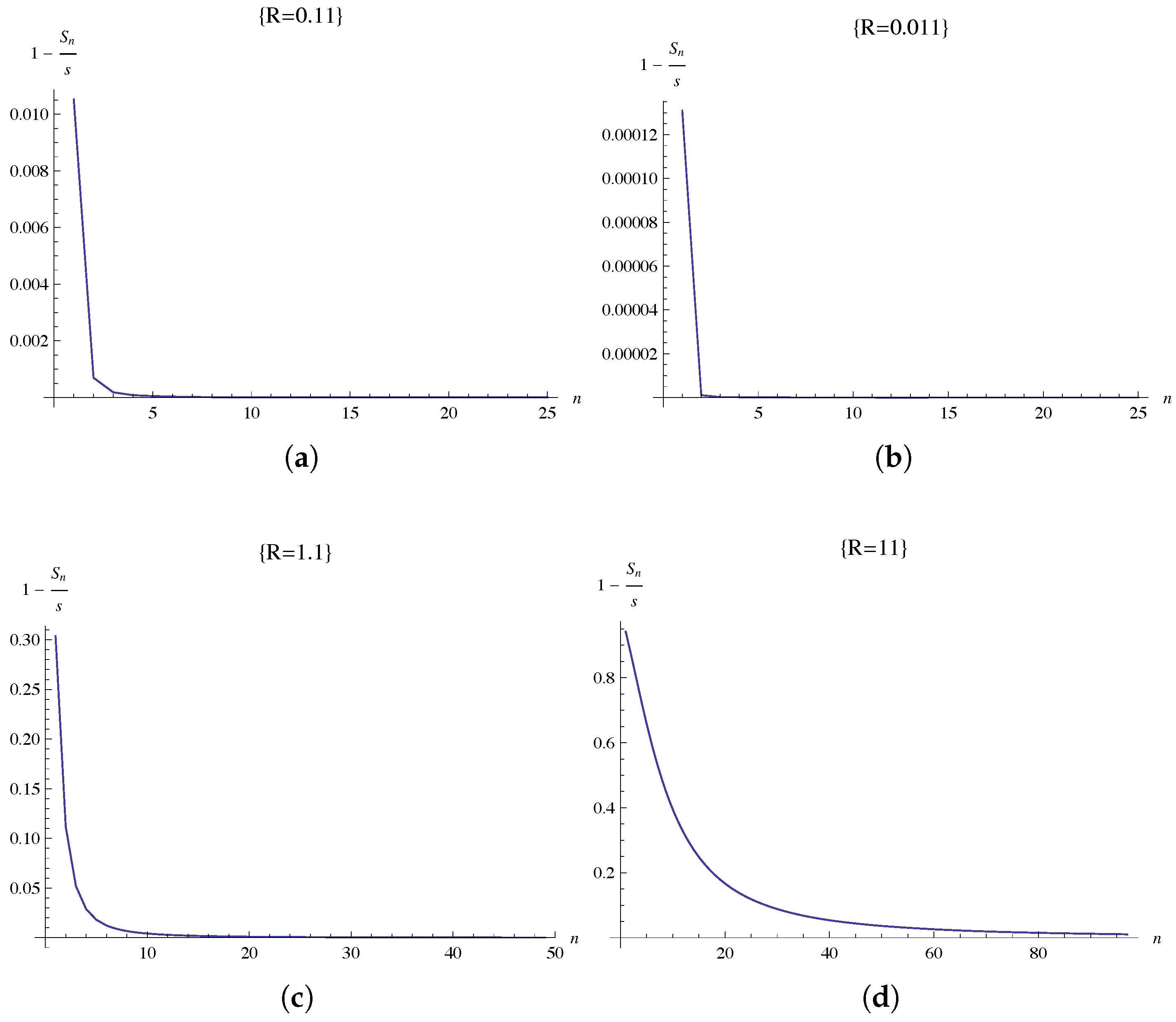
For R = 0.11 , we find that the first six terms of our one-range addition Theorem 5 (51) for the T a , b c integral (52) give 0.356284 + 0.003537 + 0.00019 + 0.000036 + 0.000013 + 0.000005 , and sum to 0.360061 , agreeing with the exact value s = 0.3600712597968286 to five digits. Figure 6a shows this very rapid convergence graphically. For R = 0.011 , the convergence is much more rapid, with the first term giving 99.99% of the series limit. Figure 6b shows what looks like superb convergence, but the eleventh terms and beyond (in a double-precision calculation and 24 terms in the series) are dominated by the J = n 1 term in the Macdonald function expansion, each giving a contribution of 10 10 . Moving to quadruple-precision calculations with 48 terms in the series showed ten terms of order 10 10 , 21 terms of order 10 11 , and at least eight terms of order 10 12 . Therefore, the convergence slows down markedly after the initial superb start. This means that one is unable to discern a limit ϱ to series for this small value of R = 0.011 .
For R = 1.1 , the convergence is less rapid, requiring six terms to reach 99% of the series limit. One can discern a limit 0 < ϱ = 0.96 < 1 . Again, high-order terms are dominated by the J = n 1 term in the Macdonald function expansion, so in quadruple-precision calculations with 48 terms in the series, one sees that the 18th through 38th terms are of order 10 6 , and the final 10 terms are of order 10 7 .
Whether this pattern of fast convergence for low-order terms and slow convergence for high-order terms is a matter of this particular problem, or this particular coordinate system, or this particular choice of B and C, one could not say without attempting further examples in each system. Consider Figure 5, showing convergence for the one-range addition theorem itself, Theorem 5 (51). Given that for the arbitrary values C 0.11 , B 0.13 , x 2 0.17 , k 0.23 , the first four terms 0.945177 0.001665 + 0.000028 0.000000086 converge rapidly to the value on the left-hand side, 0.943538 , and the subsequent 44 terms fall very slowly to 10 11 , one suspects that the fast-then-slow convergence behavior of (52) may well have to do with the use of this one-range addition theorem for hydrogenic functions.
It would be interesting to examine the term-by-term convergence of the one-range addition theorem that is also for hydrogenic wave functions derived by Rico, Loapez, and Ramiarez [6], which they applied to the integral over a product of two hydrogenic functions with the same charge. They found that they needed 100 terms in one infinite series and 12 terms in the second infinite series to achieve five significant figures, and that 10,000 terms in the first infinite series and more than 26 terms in the second infinite series were required for 10 significant figures. This is, of course, a different problem than (52), so no definitive conclusions may be drawn from noting slow convergence in both applications via one-range addition theorems of very different nature: one comprised of a single infinite series versus the second comprised of two infinite series. It seems reasonable to say, however, that results from Theorem 5 (51) applied to (52) are not beyond the pale.
What this means in practice is that in a novel integral of this general type, care should be taken to discern convergence rates if one really needs exceedingly high accuracy.

9.2. Hylleraas Coordinates

Given the widespread use of Hylleraas coordinates [18] for helium-like atoms and ions,
ψ H ( r 1 , r 2 , r 12 ) = 1 2 1 P ^ 12 e α r 1 β r 2 γ u l , m , n c l m n s l t 2 m u n ,
where P ^ 12 is the permutation operator for the two identical electrons and s = r 1 + r 2 , t = r 1 r 2 , and u = r 12 r 1 r 2 , some researchers might find use in a generalized version of the sequence beginning with (9) and (51). Thus, we offer the following infinite set of one-range addition theorems:
Theorem 6.
For k 1 and j 0 ,
B k 2 + C j 1 2 e x 2 B k 2 + C = n = 0 1 π 1 n B n k 2 n n ! C j 2 n 1 2 G 3 , 1 0 , 3 4 C x 2 2 | 1 2 , 1 , 1 2 ( j 2 n + 1 ) j + 1 2 .
Proof of Theorem 6.
The proof structure follows that of (9), except that we use the more general Gaussian transform, that is, the second line of (A2) [30] (p. 846 No. 7.386), and we require the much more general inverse Gaussian transform [43] (p. 452 No. 3.25.2.7 with parameters within this tabled integral set to k = l = 1 ), since our series expansion of e B k 2 ρ gives powers ρ n multiplying powers ρ j from (A2),
0 d ρ ρ μ e a 2 ρ p ρ H j a ρ = 2 j p μ 1 G 3 , 1 0 , 3 1 a 2 p | 1 2 , 1 , μ j + 1 2 . R e p > 0 , arg a < π / 4
In principle, one could instead use [43] (p. 452 No. 3.25.2.5) or [44] (p. 488 No. 2.20.3.22), which express this integral in terms of gamma functions times 1 F 2 hypergeometric functions instead of the Meijer G-function, above, but in one-range addition theorems, infinities ensue when the arguments of the gamma functions sometimes become negative integers. □
For the arbitrary values C 0.11 , B 0.13 , x 2 0.17 , k 0.23 and j = 0 , 1 , the results in the series (55) indeed precisely match those for (9) and (51). For j = 2 , the first four terms in the series (55) 0.31348 + 0.00924 0.000161 + 0.000005 converge rapidly to the value on the left-hand side, 0.32257 .

10. Conclusions

We have crafted an infinite set of one-range addition theorems for Slater orbitals and their derivatives, devoid of the infinite second series that is typical of prior one-range addition theorems. Because its derivation differs markedly from that for prior one-range addition theorems, this approach may also be useful for other sorts of functions. A test with the particular case of integrating over a product of Slater orbitals (one having a center shifted from the origin) used an additional infinite series to bring the problem to closure as a series of analytic functions. Convergence is roughly one digit for every other term in the series. When the charges on the Slater orbitals were identical, this second series was unneeded. The techniques introduced in Section 7 could likely be used to replace this second infinite series with term-by-term integration using a computer algebra program.
Those techniques provide 15 indefinite integrals of half-integer Macdonald functions multiplied by (inverse) powers and negative exponentials containing squares of the integration variable that do not appear to be tabled elsewhere.
Unlike previous addition theorems, this set is applicable to more than one coordinate system. A particular example using ellipsoidal coordinates gives a result in terms of a single infinite series, though the convergence slows down markedly after an initial superb start. Finally, we present an infinite set of one-range addition theorems that can be used in Hylleraas coordinates.
The one-range addition theorem for Slater orbitals can also be applied to other Yukawa-like functions that may appear late in the reduction of quantum amplitude integrals that include plane waves, allowing the reduction of the final integral to an analytic series that converges when the momentum variable k 1 . The general result reduces to a product of Macdonald and confluent hypergeometric 1 F 1 functions for Cheshire’s [41] integral that contains a product of a hydrogenic wave function, a Slater orbital of the same charge, and a plane wave.

Funding

This research received no external funding.

Data Availability Statement

The original contributions presented in this study are included in the article. Further inquiries can be directed to the corresponding author.

Acknowledgments

I would like to thank Sedat Gumus for sharing his Mathematica program for calculating overlap integrals with me.

Conflicts of Interest

The author declares no conflicts of interest.

Appendix A

Integral transforms provide the main alternative to addition theorems for transition amplitudes. Consider, for instance, the Fourier transform of a product of Slater orbitals,
S 1 η 1 0 η 2 0 k , ; 0 , x 2 = d 3 x 1 e η 1 x 1 x 1 e η 2 x 12 x 12 e i k · x 1 .
The Slater orbital and its derivatives have Gaussian transform [14], ref. [30] (p. 846 No. 7.386)
V η j ( R ) = R j 1 e η R = 1 j d j d η j 1 π 0 d ρ 3 e R 2 ρ 3 e η 2 / 4 / ρ 3 ρ 3 1 / 2 η 0 , R > 0 = 1 2 j π 0 d ρ 3 e R 2 ρ 3 e η 2 / 4 / ρ 3 ρ 3 j + 1 / 2 H j η 2 ρ 3
that allow us to combine all angular dependences into one quadratic form, and then complete the square,
S 1 η 1 0 η 2 0 k ; 0 , x 2 = d 3 x 1 1 π 0 d ρ 1 e x 1 2 ρ 1 e η 1 2 / 4 / ρ 1 ρ 1 1 / 2 1 π 0 d ρ 2 e x 12 2 ρ 2 e η 2 2 / 4 / ρ 2 ρ 2 1 / 2 e i k · x 1 = 1 π d 3 x 1 0 d ρ 1 e η 1 2 / 4 / ρ 1 ρ 1 1 / 2 0 d ρ 2 e η 2 2 / 4 / ρ 2 ρ 2 1 / 2 × e x p ρ 1 + ρ 2 x 1 2 x 2 2 ρ 1 ρ 2 ρ 1 + ρ 2 i k · x 2 ρ 2 ρ 1 + ρ 2 k 2 4 ρ 1 + ρ 2 ,
where we have changed variables from x 1 to x 1 = x 1 x 2 ρ 2 i k / 2 ρ 1 + ρ 2 with a unit Jacobian so that the spatial integral may be performed: [30] (p. 382 No. 3.461.2)
e ρ 1 + ρ 2 x 1 2 d 3 x 1 = 4 π 0 e ρ 1 + ρ 2 x 1 2 x 1 2 d x 1 = 4 π 1 + 1 / 2 2 2 ρ 1 + ρ 2 3 / 2 ρ 1 + ρ 2 > 0 .
What is left over is
S 1 η 1 0 η 2 0 k ; 0 , x 2 = π 1 / 2 0 d ρ 1 e η 1 2 / 4 / ρ 1 ρ 1 1 / 2 0 d ρ 2 e η 2 2 / 4 / ρ 2 ρ 2 1 / 2 × 1 ρ 1 + ρ 2 3 / 2 exp x 2 2 ρ 1 ρ 2 ρ 1 + ρ 2 i k · x 2 ρ 2 ρ 1 + ρ 2 k 2 4 ρ 1 + ρ 2 .
Let
τ 1 = ρ 2 ρ 1 + ρ 2 , d τ 1 = d ρ 2 ρ 2 1 / 2 τ 1 1 / 2 1 τ 1 3 / 2 ρ 1 1 / 2 .
When ρ 2 = 0 , then τ 1 = 0 , and when ρ 2 = , then τ 1 = 1 . Then [30] (p. 384 No. 3.471.9),
S 1 η 1 0 η 2 0 k ; 0 , x 2 = π 1 / 2 0 1 d τ 1 τ 1 / 2 e i k · x 2 τ 0 d ρ 1 1 ρ 1 1 / 2 + 1 × exp τ x 2 2 ρ 1 τ η 1 2 ( 4 τ ) ρ 1 + ( 1 τ ) k 2 τ + η 2 2 ( 4 τ ) ρ 1 = π 1 / 2 0 1 d τ e i k · x 2 τ 2 π exp x 2 ( 1 τ ) k 2 τ + η 2 2 + η 1 2 τ ( 1 τ ) k 2 τ + η 2 2 + η 1 2 τ = 2 π 0 1 d τ e i k · x 2 τ exp x 2 L L ,
where
L = ( 1 τ ) k 2 τ + η 2 2 + η 1 2 τ .
Interestingly enough, we see that when some more complicated transition amplitudes have been reduced to a single remaining integral, the integrand can sometimes again take on a form akin to Slater orbitals, but with no angular term in its argument and a complicated dependence on the integration variable.
Cheshire [41] Equation (19) has set up, but not fully solved, the related integral
I 1 = η 1 3 / 2 π S 1 s 1 η 1 0 η 2 0 1 2 k f ; 0 , x 2 η 1 = η 2 = 1 = d 3 x 1 η 2 3 / 2 π e η 2 x 12 η 1 3 / 2 π e η 1 x 1 x 1 e i 1 2 k f · x 1 η 1 = η 2 = 1 = η 1 3 / 2 π η 2 3 / 2 π η 2 d 3 x 1 e η 2 x 12 x 12 e η 1 x 1 x 1 e i 1 2 k f · x 1 η 1 = η 2 = 1 = η 1 3 / 2 π η 2 3 / 2 π η 2 S 1 η 1 0 η 2 0 1 2 k f , ; 0 , x 2 η 1 = η 2 = 1 .
Cheshire’s 1964 [41] Yukawa-form final integral has defied reduction to analytic form for more than sixty years. The motivation for the present paper was to show how to create an addition theorem for this class of problems that allows the final integral to be done term by term for k 1 .

Appendix B

Consider the indefinite integral
e a x 2 x 1 2 h K n + 1 2 b x d s ,
with the half-integer Macdonald function also known as the “modified spherical Bessel function of the second kind,” and the “reduced Bessel function.”
One finds very few indefinite integrals containing any sort of Bessel function, and none combining these with exponentials and powers in Gradshteyn and Ryzhik [30] (Section 5.5) or Prudnikov, Brychkov, and Marichev [38] (Section 1.12.2). Neither versions 7 nor 13 of Mathematica nor Maple 25 can perform this integral in general.
One might hope to instead integrate this term by term for a general power, but one finds no indefinite integrals of the form
e a 2 x 2 b x x n d x ,
in either Gradshteyn and Ryzhik [30] (Section 2.32) or Prudnikov, Brychkov, and Marichev [38] (Section 1.3.3). Neither versions 7 nor 13 of Mathematica nor Maple 25 can perform this integral in general, including for specific values of positive n.
Laplace transforms of e a x 2 multiplying a Heaviside (unit) step function θ ( x c ) [43] (p. 29 No. 2.2.1.11) that would give the finite integration interval of (A10) do not have powers of h. Laplace transforms of the Macdonald function [43] (p. 353 No. 3.16.2.6) do not include θ ( x c ) , nor even appropriate powers of h. Nor does there seem to be a tabled K-transform—utilizing the Macdonald function in an infinite integral—that includes both e a x 2 x 1 2 h and θ ( x c ) . Even the closest form of the former [45] (p. 132 No. 10.2.25) does not have appropriate powers of h, and writing the Heaviside step function as a Meijer-G function, θ ( x ) = G 1 , 1 0 , 1 x + 1 1 0 (for x > 2 ) [46], gives an integrand in [45] (p. 153 No. 10.3.90) that is missing the exponential.
We can, however, rewrite the Macdonald function in (A10) as a Meijer-G function [47],
K n + 1 2 ( b x ) = 1 2 G 0 , 2 2 , 0 b 2 x 2 4 | 1 2 n + 1 2 , 1 2 n 1 2 ,
though this does not not lead to any tabled integrals that overcome all of these problems. One is left, then, with the hope that computer calculus programs might provide an answer, at the cost of their black-box nature, which blocks us from generalizing the results.
Initial results failed for n = 1 in both versions 7 and 13 of Mathematica. In the appropriate notation for execution,
Integrate[E⌃(-I a (s⌃2)) s⌃(1/2-2 j-2 m+3 n) 1/2 MeijerG[{{},{}},{{1/2 (1/2+n),1/2 (-(1/2)-n)},{}},1/4 s⌃2 x ⌃2]x⌃(1/2+n),s]/.{j->n,m->n}/.n->1
(where the notation “/.n->1” means make the substitution n = 1 ) , yields the response
π 2 x 3 / 2 1 s 2 x 2 + 1 e s 2 x 2 + ( i ) a s 2 s s 2 x 2 4 d s ,
which indicates the integral cannot be done. Thinking that perhaps the factor s 2 x 2 in the exponential and in the fourth root in the denominator might be getting in the way, I prepended two factors that each reduce to one for real s and x,
(s⌃2 x⌃2)⌃(1/4)/(Sqrt[s] Sqrt[x]) E⌃(-s x)/E⌃-Sqrt[s⌃2 x⌃2],
and this yielded the response
π 2 x 1 s 2 x 2 + 1 e s x + ( i ) a s 2 s d s ,
which included a term whose denominator is s 2 x 2 that seemed to get in the way of integration. Therefore, I appended the substitution command
/. 1/Sqrt[s⌃2 x⌃2] -> 1/(s x)
and both versions 7 and 13 of Mathematica were able to perform the indefinite integration (which I have written in four equivalent forms)
e i a s 2 x n + 1 2 s 2 j 2 m + 3 n + 1 2 s 2 x 2 4 s x e s x e s 2 x 2 1 2 G 0 , 2 2 , 0 s 2 x 2 4 | 1 2 n + 1 2 , 1 2 n 1 2 d s / . { j n , m n } / . n 1 / . 1 s 2 x 2 1 s x = s x s x e i a s 2 x 1 + 1 2 s 1 + 1 2 K 3 2 ( s x ) d s / . 1 s 2 x 2 1 s x = π 2 x 1 s e s x i a s 2 1 s x + 1 d s = π 2 ( 1 ) 3 / 4 π a e i x 2 4 a erfi ( 1 ) 3 / 4 ( 2 a s i x ) 2 a e s x + ( i ) a s 2 s
However, they were unable to integrate either term on the left-hand side of the third line separately.
For n > 1 , one needs to specify the substitutions
/. {1/Sqrt[s⌃2 x⌃2] -> 1/(s x), 1/(s⌃2 x⌃2)⌃(3/2) -> 1/(s⌃3 x⌃3), 1/(s⌃2 x⌃2)⌃(5/2) -> 1/(s⌃5 x⌃5), 1/(s⌃2 x⌃2)⌃(7/2) -> 1/(s⌃7 x⌃7), 1/(s⌃2 x⌃2)⌃(9/2) -> 1/(s⌃9 x⌃9)}
and so on, which may be why Mathematica is unable to perform the integration for a generic n. For this reason, one must perform a separate integration for each value of 2 j 2 m + 3 n and n for which g = 2 j 2 m + 2 n < 0 .
For n = 2 , we have two such integrals, one with { j n , m n }
e i a s 2 x n + 1 2 s 2 x 2 4 e s x s 2 j 2 m + 3 n + 1 2 G 0 , 2 2 , 0 s 2 x 2 4 | 1 2 n + 1 2 , 1 2 n 1 2 2 s x e s 2 x 2 d s / . { j n , m n } / . n 2 / . 1 s 2 x 2 1 s x = s x s x e i a s 2 x 2 + 1 2 s 2 + 1 2 K 5 2 ( s x ) d s / . 1 s 2 x 2 1 s x = π 2 x 2 1 s 2 3 s 2 x 2 + 3 s x + 1 e s x i a s 2 d s = π 2 2 1 4 π a 3 / 2 e i x 2 4 a erfi ( 1 ) 3 / 4 ( 2 a s i x ) 2 a + e s ( x + i a s ) 2 i a s 2 s x 1 s 3
and two identical integrals for { j n , m n 1 } and { j n 1 , m n } ,
e i a s 2 x n + 1 2 s 2 j 2 m + 3 n + 1 2 s 2 x 2 4 s x e s x e s 2 x 2 1 2 G 0 , 2 2 , 0 s 2 x 2 4 | 1 2 n + 1 2 , 1 2 n 1 2 d s / . { j n , m n 1 } / . n 1 / . 1 s 2 x 2 1 s x = s x s x e i a s 2 x n + 1 2 s 0 + 1 2 K 5 2 ( s x ) d s / . 1 s 2 x 2 1 s x = π 2 x 2 3 s 2 x 2 + 3 s x + 1 e s x i a s 2 d s = π 2 1 2 a s e ( i ) a s 2 i x 2 4 a s x ( 1 ) 3 / 4 π s 6 a + i x 2 e s ( x + i a s ) erfi ( 1 ) 3 / 4 ( 2 a s i x ) 2 a 6 a e i x 2 4 a .
Although one may integrate the constant term separately, and even the first two terms as a pair since that integral is proportional to (A15), one is not able to integrate either of the first two terms separately nor in combination with the constant term.
For n = 3 , we have three such integrals, one with { j n , m n }
e i a s 2 x n + 1 2 s 2 x 2 4 e s x s 2 j 2 m + 3 n + 1 2 G 0 , 2 2 , 0 s 2 x 2 4 | 1 2 n + 1 2 , 1 2 n 1 2 2 s x e s 2 x 2 d s / . { j n , m n } / . n 3 / . 1 s 2 x 2 1 s x , 1 s 2 x 2 3 / 2 1 s 3 x 3 = s x s x e i a s 2 x n + 1 2 s 3 + 1 2 K 7 2 ( s x ) d s / . 1 s 2 x 2 1 s x , 1 s 2 x 2 3 / 2 1 s 3 x 3 = π 2 x 3 1 s 3 15 s 3 x 3 + 15 s 2 x 2 + 6 s x + 1 e s x i a s 2 d s = π 2 e s ( x + i a s ) 4 a 2 s 4 + 2 i a s 2 ( s x + 1 ) s 2 x 2 3 s x 3 s 5 4 ( 1 ) 3 / 4 π a 5 / 2 e i x 2 4 a erfi ( 1 ) 3 / 4 ( 2 a s i x ) 2 a ,
two identical integrals for { j n , m n 1 } and { j n 1 , m n } ,
e i a s 2 x n + 1 2 s 2 j 2 m + 3 n + 1 2 s 2 x 2 4 s x e s x e s 2 x 2 1 2 G 0 , 2 2 , 0 s 2 x 2 4 | 1 2 n + 1 2 , 1 2 n 1 2 d s / . { j n , m n 1 } / . n 3 / . 1 s 2 x 2 1 s x , 1 s 2 x 2 3 / 2 1 s 3 x 3 = s x s x e i a s 2 x n + 1 2 s 1 + 1 2 K 7 2 ( s x ) d s / . 1 s 2 x 2 1 s x , 1 s 2 x 2 3 / 2 1 s 3 x 3 = π 2 x 3 1 s 15 s 3 x 3 + 15 s 2 x 2 + 6 s x + 1 e s x i a s 2 d s = π 2 1 2 a s e ( i ) a s 2 i x 2 4 a s x ( 1 ) 3 / 4 π s 6 a + i x 2 e s ( x + i a s ) erfi ( 1 ) 3 / 4 ( 2 a s i x ) 2 a 6 a e i x 2 4 a ,
and three identical integrals for { j n , m n 2 } , { j n 1 , m n 1 } , and { j n 2 , m n } ,
e i a s 2 x n + 1 2 s 2 j 2 m + 3 n + 1 2 s 2 x 2 4 s x e s x e s 2 x 2 1 2 G 0 , 2 2 , 0 s 2 x 2 4 | 1 2 n + 1 2 , 1 2 n 1 2 d s / . { j n , m n 2 } / . n 3 / . 1 s 2 x 2 1 s x , 1 s 2 x 2 3 / 2 1 s 3 x 3 = s x s x e i a s 2 x n + 1 2 s 1 + 1 2 K 7 2 ( s x ) d s / . { j n , m n 1 } / . n 1 , 1 s 2 x 2 1 s x , 1 s 2 x 2 3 / 2 1 s 3 x 3 = π 2 x 3 s 15 s 3 x 3 + 15 s 2 x 2 + 6 s x + 1 e s x i a s 2 d s = π 2 1 2 a s e ( i ) a s 2 i x 2 4 a s x ( 1 ) 3 / 4 π s 6 a + i x 2 e s ( x + i a s ) erfi ( 1 ) 3 / 4 ( 2 a s i x ) 2 a 6 a e i x 2 4 a .
There is no impediment to proceeding in this manner for any desired value n as long as one can keep track of terms that increase in number as n increases. Fortunately, the same program, Mathematica, that generates these terms can also be programmed to access them in an organized manner for numerical evaluation. One finds that n = 5 is sufficient to see the trends in how the series is performing as the parameters η 1 , η 2 , x 2 , and k vary.
The required terms for n = 4 run over g = 4 , 2 , 0 , 2 . Version 7 of Mathematica is unable to perform these integrals, but version 13 can:
e i a s 2 x n + 1 2 s 2 x 2 4 e s x s n + 1 2 G 0 , 2 2 , 0 s 2 x 2 4 | 1 2 n + 1 2 , 1 2 n 1 2 2 s x e s 2 x 2 d s / . n 4 / . 1 s 2 x 2 1 s x , 1 s 2 x 2 3 / 2 1 s 3 x 3 = s x s x e i a s 2 x n + 1 2 s n + 1 2 K 7 2 ( s x ) d s / . 1 s 2 x 2 1 s x , 1 s 2 x 2 3 / 2 1 s 3 x 3 = π 2 x 4 1 s 4 105 s 4 x 4 + 105 s 3 x 3 + 45 s 2 x 2 + 10 s x + 1 e s x i a s 2 d s = π 2 ( e s ( x + i a s ) 8 i a 3 s 6 + 4 a 2 s 4 ( s x + 1 ) + 2 i a s 2 s 2 x 2 + 3 s x + 3 s 3 x 3 6 s 2 x 2 15 s x 15 s 7 8 1 4 π a 7 / 2 e i x 2 4 a erfi ( 1 ) 3 / 4 ( 2 a s i x ) 2 a ) ,
e i a s 2 x n + 1 2 s 2 x 2 4 e s x s n + 2 + 1 2 G 0 , 2 2 , 0 s 2 x 2 4 | 1 2 n + 1 2 , 1 2 n 1 2 2 s x e s 2 x 2 d s / . n 4 / . 1 s 2 x 2 1 s x , 1 s 2 x 2 3 / 2 1 s 3 x 3 = s x s x e i a s 2 x n + 1 2 s n + 2 + 1 2 K 7 2 ( s x ) d s / . 1 s 2 x 2 1 s x , 1 s 2 x 2 3 / 2 1 s 3 x 3 = π 2 x 4 1 s 2 105 s 4 x 4 + 105 s 3 x 3 + 45 s 2 x 2 + 10 s x + 1 e s x i a s 2 d s = π 2 e s ( x i a s ) ( 2 1 4 π a 3 / 2 x 2 14 i a e i ( 2 a s i x ) 2 4 a erfi ( 1 ) 3 / 4 ( 2 a s i x ) 2 a 28 a 2 s 4 2 i a s 2 s 2 x 2 + 7 s x + 7 + s 3 x 3 + 8 s 2 x 2 + 21 s x + 21 s 5 ) ,
e i a s 2 x n + 1 2 s 2 x 2 4 e s x s n + 4 + 1 2 G 0 , 2 2 , 0 s 2 x 2 4 | 1 2 n + 1 2 , 1 2 n 1 2 2 s x e s 2 x 2 d s / . n 4 / . 1 s 2 x 2 1 s x , 1 s 2 x 2 3 / 2 1 s 3 x 3 = s x s x e i a s 2 x n + 1 2 s n + 4 + 1 2 K 7 2 ( s x ) d s / . 1 s 2 x 2 1 s x , 1 s 2 x 2 3 / 2 1 s 3 x 3 = π 2 x 4 105 s 4 x 4 + 105 s 3 x 3 + 45 s 2 x 2 + 10 s x + 1 e s x i a s 2 d s = π 2 ( 5 e s ( x + i a s ) 14 i a s 2 2 s 2 x 2 7 s x 7 s 3 + 1 4 π e i x 2 4 a 140 a 2 + 20 i a x 2 x 4 erfi ( 1 ) 3 / 4 ( 2 a s i x ) 2 a 2 a ) ,
and
e i a s 2 x n + 1 2 s 2 x 2 4 e s x s n + 6 + 1 2 G 0 , 2 2 , 0 s 2 x 2 4 | 1 2 n + 1 2 , 1 2 n 1 2 2 s x e s 2 x 2 d s / . n 4 / . 1 s 2 x 2 1 s x , 1 s 2 x 2 3 / 2 1 s 3 x 3 = s x s x e i a s 2 x n + 1 2 s n + 6 + 1 2 K 7 2 ( s x ) d s / . 1 s 2 x 2 1 s x , 1 s 2 x 2 3 / 2 1 s 3 x 3 = π 2 x 4 s 2 105 s 4 x 4 + 105 s 3 x 3 + 45 s 2 x 2 + 10 s x + 1 e s x i a s 2 d s = π 2 e s ( x i a s ) 8 a 5 / 2 ( 2 a 420 a 2 2 i a s x 3 ( s x + 10 ) + s x 5 s + 1 4 π 840 i a 3 180 a 2 x 2 18 i a x 4 + x 6 e i ( 2 a s i x ) 2 4 a erfi ( 1 ) 3 / 4 ( 2 a s i x ) 2 a ) .
The required terms for 5 run over g = 5 , 3 , 1 , 1 , 3 :
e i a s 2 x n + 1 2 s 2 x 2 4 e s x s n + 1 2 G 0 , 2 2 , 0 s 2 x 2 4 | 1 2 n + 1 2 , 1 2 n 1 2 2 s x e s 2 x 2 d s / . n 5 / . 1 s 2 x 2 1 s x , 1 s 2 x 2 3 / 2 1 s 3 x 3 , 1 s 2 x 2 5 / 2 1 s 5 x 5 = s x s x e i a s 2 x n + 1 2 s n + 1 2 K 7 2 ( s x ) d s / . 1 s 2 x 2 1 s x , 1 s 2 x 2 3 / 2 1 s 3 x 3 , 1 s 2 x 2 5 / 2 1 s 5 x 5 = π 2 x 5 1 s 5 945 s 5 x 5 + 945 s 4 x 4 + 420 s 3 x 3 + 105 s 2 x 2 + 15 s x + 1 e s x i a s 2 d s = π 2 e s ( x i a s ) ( 1 s 9 16 a 4 s 8 + 8 i a 3 s 6 ( s x + 1 ) + s 4 x 4 + 10 s 3 x 3 + 45 s 2 x 2 + 105 s x + 105 4 a 2 s 4 s 2 x 2 + 3 s x + 3 2 i a s 2 s 3 x 3 + 6 s 2 x 2 + 15 s x + 15 + 16 ( 1 ) 3 / 4 π a 9 / 2 e i ( 2 a s i x ) 2 4 a erfi ( 1 ) 3 / 4 ( 2 a s i x ) 2 a ) ,
e i a s 2 x n + 1 2 s 2 x 2 4 e s x s n + 2 + 1 2 G 0 , 2 2 , 0 s 2 x 2 4 | 1 2 n + 1 2 , 1 2 n 1 2 2 s x e s 2 x 2 d s / . n 5 / . 1 s 2 x 2 1 s x , 1 s 2 x 2 3 / 2 1 s 3 x 3 , 1 s 2 x 2 5 / 2 1 s 5 x 5 = s x s x e i a s 2 x n + 1 2 s n + 2 + 1 2 K 7 2 ( s x ) d s / . 1 s 2 x 2 1 s x , 1 s 2 x 2 3 / 2 1 s 3 x 3 , 1 s 2 x 2 5 / 2 1 s 5 x 5 = π 2 x 5 1 s 3 945 s 5 x 5 + 945 s 4 x 4 + 420 s 3 x 3 + 105 s 2 x 2 + 15 s x + 1 e s x i a s 2 d s = π 2 e s ( x i a s ) 1 s 7 ( 172 i a 3 s 6 4 a 2 s 4 s 2 x 2 + 9 s x + 9 + s 4 x 4 + 12 s 3 x 3 + 57 s 2 x 2 + 135 s x + 135 2 i a s 2 s 3 x 3 + 10 s 2 x 2 + 27 s x + 27 4 1 4 π a 5 / 2 18 a + i x 2 e i ( 2 a s i x ) 2 4 a erfi ( 1 ) 3 / 4 ( 2 a s i x ) 2 a ) ,
e i a s 2 x n + 1 2 s 2 x 2 4 e s x s n + 4 + 1 2 G 0 , 2 2 , 0 s 2 x 2 4 | 1 2 n + 1 2 , 1 2 n 1 2 2 s x e s 2 x 2 d s / . n 5 / . 1 s 2 x 2 1 s x , 1 s 2 x 2 3 / 2 1 s 3 x 3 , 1 s 2 x 2 5 / 2 1 s 5 x 5 s x s x e i a s 2 x n + 1 2 s n + 4 + 1 2 K 7 2 ( s x ) d s / . 1 = s 2 x 2 1 s x , 1 s 2 x 2 3 / 2 1 s 3 x 3 , 1 s 2 x 2 5 / 2 1 s 5 x 5 = π 2 x 5 1 s 945 s 5 x 5 + 945 s 4 x 4 + 420 s 3 x 3 + 105 s 2 x 2 + 15 s x + 1 e s x i a s 2 d s = π 2 e s ( x i a s ) ( 1 s 5 252 a 2 s 4 14 i a s 2 2 s 2 x 2 + 9 s x + 9 + s 4 x 4 + 14 s 3 x 3 + 77 s 2 x 2 + 189 s x + 189 + 1 4 π a 252 i a 2 + 28 a x 2 + i x 4 e i ( 2 a s i x ) 2 4 a erfi ( 1 ) 3 / 4 ( 2 a s i x ) 2 a ) ,
e i a s 2 x n + 1 2 s 2 x 2 4 e s x s n + 6 + 1 2 G 0 , 2 2 , 0 s 2 x 2 4 | 1 2 n + 1 2 , 1 2 n 1 2 2 s x e s 2 x 2 d s / . n 5 / . 1 s 2 x 2 1 s x , 1 s 2 x 2 3 / 2 1 s 3 x 3 , 1 s 2 x 2 5 / 2 1 s 5 x 5 = s x s x e i a s 2 x n + 1 2 s n + 6 + 1 2 K 7 2 ( s x ) d s / . 1 s 2 x 2 1 s x , 1 s 2 x 2 3 / 2 1 s 3 x 3 , 1 s 2 x 2 5 / 2 1 s 5 x 5 = π 2 x 5 s 945 s 5 x 5 + 945 s 4 x 4 + 420 s 3 x 3 + 105 s 2 x 2 + 15 s x + 1 e s x i a s 2 d s = π 2 e s ( x i a s ) ( 1 s 3 2 i a 1260 a 2 s 2 + 210 i a s 2 x 2 + 3 s x + 3 + s 3 x 5 + 1 4 π 2520 a 3 + 420 i a 2 x 2 30 a x 4 i x 6 e i ( 2 a s i x ) 2 4 a erfi ( 1 ) 3 / 4 ( 2 a s i x ) 2 a ) ,
and
e i a s 2 x n + 1 2 s 2 x 2 4 e s x s n + 8 + 1 2 G 0 , 2 2 , 0 s 2 x 2 4 | 1 2 n + 1 2 , 1 2 n 1 2 2 s x e s 2 x 2 d s / . n 5 / . 1 s 2 x 2 1 s x , 1 s 2 x 2 3 / 2 1 s 3 x 3 , 1 s 2 x 2 5 / 2 1 s 5 x 5 = s x s x e i a s 2 x n + 1 2 s n + 8 + 1 2 K 7 2 ( s x ) d s / . 1 s 2 x 2 1 s x , 1 s 2 x 2 3 / 2 1 s 3 x 3 , 1 s 2 x 2 5 / 2 1 s 5 x 5 = π 2 x 5 s 3 945 s 5 x 5 + 945 s 4 x 4 + 420 s 3 x 3 + 105 s 2 x 2 + 15 s x + 1 e s x i a s 2 d s = π 2 e s ( x i a s ) 16 a 7 / 2 ( 1 s 2 a 7560 a 3 4 i a 2 s x 3 s 2 x 2 + 15 s x + 105 + 2 a s x 5 ( s x + 13 ) + i s x 7 + 1 4 π 15120 i a 4 3360 a 3 x 2 360 i a 2 x 4 + 24 a x 6 + i x 8 e i ( 2 a s i x ) 2 4 a erfi ( 1 ) 3 / 4 ( 2 a s i x ) 2 a ) .

References

  1. Ley-Koo, E.; Bunge, C.F. General evaluation of atomic electron-repulsion integrals in orbital methods without using a series representation for r 12 1 . Phys. Rev. A 1989, 40, 1215. [Google Scholar]
  2. Sack, R.A. Generalization of Laplace’s Expansion to Arbitrary Powers and Functions of the Distance between Two Points. J. Math. Phys. 1964, 5, 245. [Google Scholar]
  3. Porras, I.; King, F.W. Evaluation of some integrals for the atomic three-electron problem using convergence accelerators. Phys. Rev. A 1994, 49, 1637. [Google Scholar] [CrossRef]
  4. Weniger, E.J. Addition theorems as three-dimensional Taylor expansions. II. B functions and other exponentially decaying functions. Int. J. Quant. Chem. 2002, 90, 92–104. [Google Scholar] [CrossRef]
  5. Filter, E.; Steinborn, E.O.J. A matrix representation of the translation operator with respect to a basis set of exponentially declining functions. J. Math.Phys. 1980, 21, 2725–2736. [Google Scholar]
  6. Fernandez Rico, J.; Loapez, R.; Ramiarez, G. Simplified expansion of Slater orbitals about displaced centers. Int. J. Quantum Chem. 1988, 34, 121. [Google Scholar] [CrossRef]
  7. Homeier, H.H.H.; Weniger, E.J.; Steinborn, E.O. Simplified derivation of a one-range addition theorem of the Yukawa potential. Int. J. Quantum Chem. 1992, 44, 405. [Google Scholar]
  8. Guseinov, I.I. One-range addition theorems for combined Coulomb and Yukawa like central and noncentral interaction potentials and their derivatives. J. Math. Chem. 2006, 39, 253–258. [Google Scholar]
  9. Fromm, D.M.; Hill, R.N. Analytic evaluation of three-electron integrals. Phys. Rev. A 1987, 36, 1013. [Google Scholar] [CrossRef]
  10. Remiddi, E. Analytic value of the atomic three-electron correlation integral with Slater wave functions. Phys. Rev. A 1991, 44, 5492. [Google Scholar] [CrossRef]
  11. Harris, F.E. Analytic evaluation of three-electron atomic integrals with Slater wave functions. Phys. Rev. A 1997, 55, 1820. [Google Scholar] [CrossRef]
  12. Kikuchi, R. Gaussian Functions in Molecular Integrals. J. Chem. Phys. 1954, 22, 148. [Google Scholar] [CrossRef]
  13. Shavitt, I.; Karplus, M. Multicenter Integrals in Molecular Quantum Mechanics. J. Chem. Phys. 1962, 36, 550. [Google Scholar] [CrossRef]
  14. Straton, J.C. Analytically reduced form of multicenter integrals from Gaussian transforms. Phys. Rev. A 1989, 39, 1676–1684, Erratum in Phys. Rev. A 1989 40, 2819. [Google Scholar] [CrossRef][Green Version]
  15. Straton, J.C. An integral representation for quantum amplitudes. Phys. Scr. 2023, 98, 105406. [Google Scholar] [CrossRef]
  16. Straton, J.C. Integral Representations over Finite Limits for Quantum Amplitudes. Axioms 2024, 13, 120. [Google Scholar] [CrossRef]
  17. Chen, C.J. Introduction to Scanning Tunneling Microscopy; Lapp, M., Nishizawa, J.-I., Snavely, B.B., Stark, H., Tam, A.C., Wilson, T., Eds.; Oxford Series in Optical and Imaging Science 4; Oxford University Press: Oxford, NY, USA, 1993; p. 151, Equation (6.8); ISBN 0-19-507150-6. [Google Scholar]
  18. Hylleraas, E.A. Neue Berechnung der Energie des Heliums im Grundzustande, sowie des tiefsten Terms von Ortho-Helium. Physik 1929, 54, 347. [Google Scholar] [CrossRef]
  19. Yukawa, H. On the Interaction of Elementary Particles. I. Proc. Phys. Math. Soc. Jpn. 1935, 17, 48. [Google Scholar]
  20. Nayek, S.; Ghoshal, A. Dynamics of positronium formation in positron-hydrogen collisions embedded in weakly coupled plasmas. Phys. Plasmas 2012, 19, 113501. [Google Scholar] [CrossRef]
  21. Harris, G.M. Attractive Two-Body Interactions in Partially Ionized Plasmas. Phys. Rev. 1962, 125, 1131. [Google Scholar] [CrossRef]
  22. Ecker, G.; Weizel, W. Zustandssumme und effective Ionisierungsspannung eines Atoms im Innern des Plasmas. Ann. Phys. 1956, 17, 126. [Google Scholar] [CrossRef]
  23. Smirnov, B.M. Physics of Atoms and Ions; Springer: New York, NY, USA, 2003; p. 190. [Google Scholar]
  24. Garavelli, S.L.; Oliveira, F.A. Analytical solution for a Yukawa-type potential. Phys. Rev. Lett. 1991, 66, 1310. [Google Scholar] [CrossRef]
  25. Caccavano, A.; Leung, P.T. Atomic spectroscopy and the photon mass: Effects on the 21 cm radiation. Phys. Lett. A 2013, 377, 2777. [Google Scholar] [CrossRef]
  26. Stilgoe, A.B.; Nieminen, T.A.; Rubinsztein-Dunlop, H. Computational toolbox for scattering of focused light from flattened or elongated particles using spheroidal wavefunctions. J. Quant. Spectrosc. Radiat. Transf. 2025, 331, 109267. [Google Scholar] [CrossRef]
  27. Joachain, C.J. Quantum Collision Theory; North-Holland: Oxford, NY, USA, 1983. [Google Scholar]
  28. Magnus, W.; Oberhettinger, F.; Soni, R.P. Formulas and Theorems for the Special Functions of Mathematical Physics; Springer: New York, NY, USA, 1966; p. 107 (the 1954 edition, p. 21, has the i k version). [Google Scholar]
  29. Weniger, E.J. Addition theorems as three-dimensional Taylor expansions. Int. J. Quantum Chem. 2000, 76, 280–295. [Google Scholar] [CrossRef]
  30. Gradshteyn, I.S.; Ryzhik, I.M. Table of Integrals, Series, and Products, 5th ed.; Academic: New York, NY, USA, 1994. [Google Scholar]
  31. Guseinov, I.I. New Complete Orthonormal Sets of Exponential-Type Orbitals and Their Application to Translation of Slater Orbitals. Int. J. Quantum Chem. 2002, 90, 114. [Google Scholar] [CrossRef]
  32. Yazejian, C.A.; Straton, J.C. Polarization in the production of the antihydrogen ion. Euro. Phy. J. D 2020, 74, 156. [Google Scholar] [CrossRef]
  33. Bouferguene, A.; Jones, H.W. Convergence analysis of the addition theorem of Slater orbitals and its application to three-center nuclear attraction integrals. J. Chem. Phys. 1998, 109, 5718–5729. [Google Scholar] [CrossRef]
  34. Weisstein, E.W. “Legendre Polynomial.” From MathWorld—A Wolfram Resource. Available online: https://mathworld.wolfram.com/LegendrePolynomial.html (accessed on 9 January 2025).
  35. Weniger, E.J. On the Mathematical Nature of Guseinov’s Rearranged One-Range Addition Theorems for Slater-Type Functions. J. Math. Chem. 2012, 50, 17–81, just after Equation (0.39). [Google Scholar] [CrossRef]
  36. Prudnikov, A.P.; Brychkov, Y.A.; Marichev, O.I. Integrals and Series; Gordon and Breach: New York, NY, USA, 1986; Volume 5: Inverse Laplace transforms. [Google Scholar]
  37. Prudnikov, A.P.; Brychkov, Y.A.; Marichev, O.I. Integrals and Series; Gordon and Breach: New York, NY, USA, 1986; Volume 3: More Special Functions. [Google Scholar]
  38. Prudnikov, A.P.; Brychkov, Y.A.; Marichev, O.I. Integrals and Series; Gordon and Breach: New York, NY, USA, 1986; Volume 1: Elementary Functions. [Google Scholar]
  39. Available online: https://functions.wolfram.com/06.34.26.0002.01 (accessed on 9 January 2025).
  40. Available online: https://functions.wolfram.com/06.06.26.0002.01 (accessed on 9 January 2025).
  41. Cheshire, I.M. Positronium formation by fast positrons in atomic hydrogen. Proc. Phys. Soc. 1964, 83, 227–237. [Google Scholar] [CrossRef]
  42. Hirschfelder, J.; Eyring, H.; Rosen, N.I. Calculation of Energy of H3 Molecule. J. Chem. Phys. 1936, 4, 121–130. [Google Scholar] [CrossRef]
  43. Prudnikov, A.P.; Brychkov, Y.A.; Marichev, O.I. Integrals and Series; Gordon and Breach: New York, NY, USA, 1992; Volume 4, Direct Laplace tranforms. [Google Scholar]
  44. Prudnikov, A.P.; Brychkov, Y.A.; Marichev, O.I. Integrals and Series; Gordon and Breach: New York, NY, USA, 1986; Volume 2: Special Functions. [Google Scholar]
  45. Erdelyi, A. Bateman Manuscript Project: Higher Transcendental Functions; McGraw-Hill: New York, NY, USA, 1953; Volume II. [Google Scholar]
  46. Available online: http://functions.wolfram.com/14.01.26.0002.01 (accessed on 9 January 2025).
  47. Available online: http://functions.wolfram.com/03.04.26.0006.01 (accessed on 9 January 2025).
Figure 1. Convergence comparison of how close the partial sums attain their limit, 1 S n s , for Corollary 4 (20)—solid blue curve—versus the addition theorem found in Magnus, Oberhettinger, and Soni [28] (3)—dashed red curve—where u = cos θ = 0.31 and η 2 = 1.3 . (a) For x 1 = 0.11 and x 2 = 0.17 , Corollary 4 converges rapidly (within five terms, with the initial term giving 81% of the series limit s = 4.666232314814737724988197069399638572388596748878 ) and uniformly (with 0 < ϱ = 0.28 < 1 ), whereas (3) oscillates, with the second term worse (at −126% of s) than the first term (at −101% of s). Although the oscillations in (3) appear to settle into convergence at about 25 terms, no limit for ϱ is discernible within the first 48 terms in the series, since it, too, oscillates. (b) For a tenfold increase in x 1 = 1.1 , while holding x 2 = 0.17 , Corollary 4 converges even more rapidly (with the initial term giving 89% of the series limit s = 0.237974555809123343126820377288777187584109368881 ) and uniformly (with 0 < ϱ = 0.092 < 1 ), while (3), though still oscillating, has a first term giving 98% of s. The oscillations in (3) appear to settle into convergence at about 13 terms, though no limit for ϱ is discernible within the first 48 terms in the series, since it, too, oscillates. (c) If we also give a tenfold increase to x 2 = 1.7 , while x 1 = 1.1 , Corollary 4 again converges uniformly and rapidly to the series limit s = 0.062751680024563012058368158893298333984673583003 ) (with 0 < ϱ = 0.28 < 1 as in (a)), whereas (3) oscillates, with the first term over-estimating s by 25%. Although the oscillations in (3) appear to settle into convergence at about 25 terms, no limit for ϱ is discernible within the first 48 terms in the series, since it, too, oscillates.
Axioms 15 00242 g001
Figure 2. The convergence parameter ϱ for the sequence of partial sums (14) for the addition theorem found in Magnus, Oberhettinger, and Soni [28] (3), where u = cos θ = 0.31 . (a) With η = 1.3 , x 1 = 0.11 , and x 2 = 0.17 . (b) For a tenfold increase in x 1 to 1.1 , while holding η = 1.3 and x 2 = 0.17 .
Axioms 15 00242 g002
Figure 3. The convergence of partial sums 1 S i , j s , for Theorem 3 (21), as n varies from 0 to i and k varies from 0 to j. (a) For η 1 = 0.11 , η 2 = 0.13 , and x 2 = 0.17 , giving s = 51.30258210167689 , one sees that without all of the first four terms in the k-series, the n-series falls off very slowly, but both series fall off uniformly. (b) For η 1 = 0.11 , η 2 = 0.13 , and x 2 = 1.7 , for which s = 42.69956653646056 , one sees that the convergence of the two series is more similar. (c) For η 1 = 0.11 , η 2 = 0.13 , and x 2 = 17.0 , giving s = 6.841128050608225 , one sees that the series pair converge slowly but uniformly. (d) When η 1 = 0.131 is only slightly larger than η 2 = 0.13 , while x 2 = 1.7 , giving s = 38.56747246826835 , one sees an artifact at k = 0 that stems from negative terms appearing in the series, though after that, the series seem to converge. One is cautioned to simply exchange the definitions η 1 η 2 whenever η 1 > η 2 to avoid this.
Axioms 15 00242 g003
Figure 4. The convergence of partial sum 1 S n s for Theorem 4 (34). Since the series involves the product x 2 η 2 (apart from an additional power of x 2 in the denominator), we will hold η 2 constant at η 2 = 0.13 . (a) For x 2 = 0.17 , Theorem 4 is nearly, but not fully, converged after 48 terms, with about four-digit accuracy, though the contribution of subsequent terms falls off uniformly. Here, the series limit is s = 47.27576966176761 , and the convergence parameter 0 < ϱ = 0.97 < 1 indicates linear convergence. (b) For a tenfold increase to x 2 = 1.7 , the data points are about 10 times larger with similar fall-off. Note that s = 38.74872666246268  is indeed within 1% of the value in Figure 3d, where we had η 1 = 0.131 only 0.8% larger than η 2 = 0.13 , at this same value of x 2 = 1.7 , giving s = 38.56747246826835 for Corollary 4. (c) For another tenfold increase to x 2 = 17 , the data points are about three times larger than for x 2 = 1.7 , with similar fall-off. Here, the series limit is s = 5.302073099544103 , and the convergence parameter has increased slightly to 0 < ϱ = 0.98 < 1 , indicating linear convergence.
Axioms 15 00242 g004
Figure 5. Convergence for the one-range addition theorem, Theorem 5 (51), for arbitrary values C 0.11 ,   B 0.13 , x 2 0.17 , k 0.23 . The first four terms 0.945177 0.001665 + 0.000028 0.000000086 converge rapidly to the value on the left-hand side, 0.943538 .
Axioms 15 00242 g005
Figure 6. Convergence comparison of how close the partial sums attain their limit, 1 S n s , for T a , b c (52). (a) For R = 0.11 , the first term gives 98.9% of the series limit s = 0.3600712597968286 , and the subsequent convergence is rapid and uniform (with 0 < ϱ = 0.96 < 1 ). (b) For R = 0.011 , the convergence is much more rapid (with the initial term giving 99.99% of the series limit s = 0.374819900683150162649000343115309089068382996508 ). (c) For R = 1.1 , the convergence is not so rapid, with the initial term giving just 67% of the series limit s = 0.067393642328791471605425893515955509203126520905 . In this case, one can discern a limit 0 < ϱ = 0.96 < 1 . (d) For R = 11 , the convergence is much slower, but uniform, with s = 1.705131062317774825224637166452062015194113534 × 10 13 . In this case, one can discern a limit 0 < ϱ = 0.98 < 1 ).
Axioms 15 00242 g006
Table 1. Partial sums of Theorem 1 for various values of B, C, and x 2 , with k = 0.17 .
CB x 2 s ϱ S 0 -s S 1 -s S 2 -s S 3 -s
0.110.130.232.743600789810.030.0500663−0.001281250.0000364306 1.1 × 10 6
1.10.130.230.74751751715−0.0030.0015837 4.112  ×  10 6 1.18 × 10 8 4 × 10 11
0.112.30.232.16124194198−0.60.6324251−0.276030840.1364275−0.0713507
1.12.30.230.72223948336−0.060.0268618−0.00123100.0000621 3.3 × 10 6
0.110.1323.00.00126767922−0.030.00019920.0000169 1.07 × 10 6 5 × 10 8
Disclaimer/Publisher’s Note: The statements, opinions and data contained in all publications are solely those of the individual author(s) and contributor(s) and not of MDPI and/or the editor(s). MDPI and/or the editor(s) disclaim responsibility for any injury to people or property resulting from any ideas, methods, instructions or products referred to in the content.