Article

Wave Structures and Soliton Solutions of the Fractional Bretherton Model for Microchannel Droplet Transport


1
Department of Mathematics, University of Okara, Okara 53600, Pakistan
2
Department of Physics, Faculty of Science, Imam Mohammad Ibn Saud Islamic University (IMSIU), Riyadh 11623, Saudi Arabia
3
Mathematics Department, Faculty of Science, South Valley University, Qena 83523, Egypt
4
Center for Theoretical Physics, Khazar University, 41 Mehseti Street, Baku AZ1096, Azerbaijan
*
Author to whom correspondence should be addressed.
Axioms 2026, 15(3), 171; https://doi.org/10.3390/axioms15030171
Submission received: 29 December 2025 / Revised: 12 February 2026 / Accepted: 20 February 2026 / Published: 28 February 2026
(This article belongs to the Section Mathematical Analysis)

Abstract

This paper investigates the optical solitons to the M-truncated fractional ( 1 + 1 ) -dimensional nonlinear generalized Bretherton model with arbitrary constants. It is employed to forecast the movement of liquid droplets or gas bubbles in microchannels, which is crucial for drug delivery systems, biomedical diagnostics, and lab-on-a-chip technologies. We obtain optical soliton solutions using the extended hyperbolic function method (EHFM) and the modified extended tanh method (METM). Numerous solutions, such as singular, periodic–singular, bright, and dark optical solitons, are obtained from our investigation. The 2 D graphical depiction of the solutions shows a variety of wave patterns that change with varied values of α and t. The wave’s amplitude forms become more apparent as α and t increase. Using 2D plots, the comparison of fractional effects for the M-truncated fractional derivative is demonstrated by giving specific values to the fractional parameter.

1. Introduction

Nonlinear partial differential equations (NLPDEs) find applications across various scientific domains including oceanography, mechanics, aeronautics, nonlinear optics, plasma physics, lattice dynamics, dietary supplements, nonlinear optical fibers, meteorology, hydrodynamics, medicine, biology, and many others [1,2,3]. These equations emerge from diverse mathematical and physical models, each carrying significant implications in the real world.
Fractional calculus (FC) derivatives and integer-order integrals are typically the most helpful extensions and generalizations. Because FC can capture memory effects and nonlocal interactions that integer-order derivatives cannot, it improves the model. It is employed to simulate a wide range of nonlinear processes, including fluid mechanics, chemical and biological processes, etc. [4,5,6]. Nonlinear fractional partial differential equations (NLFPDEs) are a potent tool for modeling systems and structures because they allow for a more thorough and precise depiction of intricate physical events than is possible with conventional integer-order differential equations. FPDEs have been employed to successfully model a wide range of mathematical physics and engineering problems, including those in seismic analysis, biology, engineering, signal processing, systems identification, control theory, finance, viscoelastic materials, polymer physics, and viscous damping [7,8,9,10]. This is the main benefit of fractional-order models over integer-order models, which ignore these effects. Fractional space derivatives are employed in physics to simulate anomalous dispersion or diffusion [11,12,13].
Fractional derivatives greatly increase the model’s accuracy and predictive capacity in complicated systems like respiration-release processes by accounting for memory and nonlocal effects. They can be found in wave propagation in heterogeneous media, anomalous diffusion, viscoelastic materials, heat and mass transfer, and biological processes like drug delivery or respiration. These methods guarantees that the model is realistic, reliable, and closely aligned with experimental results, despite being more computationally intensive.
A soliton is a crucial nonlinear phenomenon that occurs when dispersion is exactly balanced by nonlinearity. The study of solitons is crucial and essential in the development of the telecommunications industry. The development of novel applied physics theories is greatly aided by solitons, which are found in optical physics and plasma physics in particular [14,15,16].
The generalized Bretherton Model is an extension of that model, which was developed to explain the behavior of gas bubbles traveling through capillary tubes that were filled with a viscous liquid [17,18]. The model aids in resource extraction and environmental management by describing how gas displaces liquid in porous rock or soil in enhanced oil recovery and groundwater remediation. The design of stable foams and emulsions in sectors including food processing, cosmetics, and detergents is aided by its support for the investigation of thin-film drainage and rupture.
Bretherton proposed the following partial differential equation [19]:
u t t + u x x + u x x x x + u u 2 = 0 .
The resonant nonlinear interaction between three liner models is studied using a model of a dispersive wave system in time and one spatial dimension. The modified Bretherton equation is given as [20]
u t t + u x x + u x x x x + u u 3 = 0 .
This equation was investigated by Berloff and Howard, Kudryashov, and Kudryashov et al., and traveling wave solutions were found [21,22]. The M-truncated fractional derivative ( 1 + 1 ) -dimemsional nonlinear generalized Bretherton model (NLGBM) is expressed as [23]
D N , t 2 α , τ u + σ D N , x 2 α , τ u + β D N , x 4 α , τ u + δ u + γ u 3 = 0 .
where u = u ( x , t ) is a wave function. σ and β represent the dispersion and higher-order spatial effects. δ and γ represent the linear and nonlinear coefficients. The fractional order α describes the strength of memory effects. The model parameters indicate dispersion, nonlinear interface interactions, and gain or loss mechanisms. The fractional temporal derivative D N , t 2 α , τ u represents inertial effects with memory, accounting for the history-dependent response of the carrier fluid and the delayed adjustment of the fluid–interface system. The fractional spatial dispersion term σ D N , x 2 α , τ u models capillary-driven wave spreading along the interface, reflecting the combined influence of surface tension and confinement in microchannels. The higher-order fractional spatial derivative β D N , x 4 α , τ u captures higher-order dispersive and stabilizing effects associated with thin-film curvature, interfacial bending rigidity, and microchannel wall interactions. The linear restoring term δ u accounts for background restoring forces arising from pressure gradients and linear capillary effects. Finally, the cubic nonlinear term γ u 3 represents nonlinear interfacial deformation and mode coupling, which become significant at finite wave amplitudes and are responsible for the formation of localized structures such as solitons. Fractional calculus plays a crucial role in improving the accuracy and applicability of the proposed model by incorporating memory and nonlocal effects that are not captured by classical integer-order differential equations. In microfluidic systems, droplet and gas bubble transport is strongly influenced by the history of the flow, viscoelastic properties of the carrier fluid, as well as interactions with channel walls. The use of fractional derivatives allows these effects to be modeled more realistically, leading to a better representation of wave propagation, interfacial deformation, and transport behavior under confined conditions. In particular, the fractional-order parameter provides additional flexibility by enabling a continuous transition from classical dynamics ( α = 1 ) to memory-dominated regimes ( 0 < α < 1 ), which enhances the model’s relevance to real-world applications such as drug delivery systems, biomedical diagnostics, and lab-on-a-chip technologies. Despite these advantages, the application of fractional derivatives also introduces certain challenges, including increased mathematical complexity, stricter parameter constraints, and more demanding analytical or numerical treatments.
Numerous analytical and numerical methods have been proposed in recent years to solve NPDEs, such as the auxiliary equation technique [24], the first integral method [25], the tanh-function method [26], the extended generalized Kudryashov technique [27], the ( G / G ) -expansion technique [28], the generalized Riccati equation mapping method [29], and numerous others [30,31,32].
In recent years, numerous analytical techniques have been used to derive solitary wave, periodic, kink-type, singular, complex rational, and complex periodic solutions to the GBM. Akbar et al. [33] employed the improved ( G / G ) -expansion method to attain exact traveling wave solutions to the generalized Bretherton equation. Oguz et al. [34] applied the homogeneous balance method to solve the Riccati equation and reduced the nonlinear ordinary differential equation to derive exact traveling wave solutions to the generalized Bretherton equation. Yu et al. [35] utilized the Riccati equation to construct exact traveling wave solutions to the generalized Bretherton equation.
In this work, we obtain solutions for this model by using the modified extended tanh approach [36] and the extended hyperbolic function method [37], clarifying the numerous soliton solutions presented inside. Many solutions are obtained as a result, including periodic functions and singular, bright, and combined periodic–singular solitons. The solutions are investigated by applying these methods and verifying the impact of fractional parameters when α = 0.8 , 0.9 , 1 . The METM provides more solutions in an elegant, succinct, and straightforward manner. The generalized Bretherton model plays a critical role in bridging theoretical mathematics and practical engineering applications. These little gadgets are used for quick COVID-19 testing and diabetes monitoring tests. When creating inhalers and treating respiratory conditions like asthma or chronic bronchitis, it is crucial to comprehend how air displaces mucus in the lungs, which is what the model does. By simulating the flow of air or bubbles through constricted lung airways, it helps guarantee efficient drug delivery through aerosols [33].
The EHFM and the METM were selected because they are particularly effective for constructing exact traveling wave solutions to nonlinear evolution equations involving higher-order nonlinearities and fractional operators. By incorporating the M-truncated fractional derivative, these methods enable a systematic investigation of fractional effects on wave propagation, allowing us to study different types of soliton solutions and to analyze how their shapes, amplitudes, and propagation behaviors depend on the fractional-order parameter. A key advantage of the EHFM and the METM is their ability to generate a wide variety of analytical solutions, including solitary, periodic, and singular wave structures, through an explicit algebraic procedure. This is especially beneficial for M-truncated fractional derivative equations, where the presence of memory and nonlocal effects complicates the application of many traditional analytical techniques. Moreover, to the best of our knowledge, these methods have not previously been applied to the generalized Bretherton model with the M-truncated fractional derivative, which highlights their novelty in the present context. Therefore, the EHFM and the METM not only provide an efficient and flexible framework for solving the proposed fractional model but also offer deeper physical insight into the influence of fractional order on soliton dynamics, which is of significant interest in various applied fields such as fluid mechanics, wave propagation in complex media, and microfluidic systems.
This paper is structured as follows: An introduction is included in Section 1. Section 2 discusses the definition of the M-truncated fractional derivative, and a mathematical examination of the equation is also given. In-depth discussion of the EHFM is provided in Section 3, which also describes its methodology and uses its application to illustrate the findings. An overview of the METFM and an application demonstrating the outcomes are included in Section 4. Graphical representations of some results are given in Section 5. Closing thoughts are discussed in Section 6.

2. M-Truncated Fractional Derivative and Traveling Wave Reduction

Fractional calculus provides an effective framework for modeling memory and nonlocal effects in complex physical systems. Among various fractional operators, the M-truncated fractional derivative has received considerable attention due to its ability to preserve important properties of classical derivatives while incorporating fractional-order dynamics. This operator is constructed using a truncated Mittag–Leffler function and has been successfully applied to thin-film dynamics, bubble and droplet motion in microchannels, and memory-dependent transport phenomena in fluid mechanics and microfluidics.

2.1. Definition of the M-Truncated Fractional Derivative

Let
w ( x ) : [ 0 , ) R .
The M-truncated fractional derivative of order α is defined as [38]
D N , x α , τ w ( x ) = lim α 0 w   x   E τ ( α x 1 α ) w ( x ) α ,   α ( 0 , 1 ] .
Here, E τ ( · ) denotes the single-parameter truncated Mittag–Leffler function [39], which is given by
E α ( z ) = j = 0 n z j Γ ( α j + 1 ) ,
where z C and α > 0 . This function generalizes the classical exponential function and plays a fundamental role in fractional calculus.

2.2. Fundamental Properties

The M-truncated fractional derivative satisfies several properties analogous to those of classical differential operators, which makes it suitable for analytical investigations:
i :   D N , x α , τ ( m g ( x ) + n h ( x ) ) = m D N , x α , τ g ( x ) + n D N , x α , τ h ( x ) ,     m , n R , ii :   D N , x α , τ ( g ( x ) h ( x ) ) = g ( x ) D N , x α , τ h ( x ) + h ( x ) D N , x α , τ g ( x ) , iii :   D N , x α , τ   g ( x ) h ( x ) = h ( x ) D N , x α , τ g ( x ) g ( x ) D N , x α , τ h ( x ) ( h ( x ) ) 2 , iv :   D N , x α , τ ( A ) = 0 ,     A   constant , v :   D N , x α , τ g ( x ) = x 1 α Γ ( τ + 1 ) .
These properties ensure that the proposed fractional operator retains linearity and compatibility with standard analytical techniques.

2.3. Traveling Wave Transformation and Mathematical Reduction

To facilitate analytical treatment, the governing nonlinear fractional partial differential equation is reduced to an ordinary differential equation using a traveling wave transformation. This approach not only simplifies the mathematical analysis but also provides a clear physical interpretation of wave propagation in the medium.
The transformation is defined as
u ( x , t ) = U ( ξ ) , ξ = Γ ( 1 + τ ) α x α η t α ,
where η represents the soliton velocity. Substituting this transformation into the governing equation yields the following ordinary differential equation:
( σ + η 2 ) U + β U + γ U 3 + δ U = 0 .
This reduced form serves as the foundation for constructing exact traveling wave solutions in the subsequent analysis.

3. Extended Hyperbolic Function Method

The following steps define the extended hyperbolic function method:
  • Step 1
Let us consider the fractional partial differential equation which has the independent variables x , t and the dependent variable u, where u = u ( x , t ) denotes a wave profile.
R ( u , D N , x α , τ u 2 , u 2 u x , u x , ) = 0 ,
Usually, R is a polynomial function of its argument, and the dependent variable’s subscripts indicate the partial derivatives.
  • Step 2
Putting Equation (4) into Equation (7) yields an ordinary differential equation.
S ( U , U 2 U , U , ) = 0 .
  • Step 3
The polynomial form solution to Equation (8) is expressed as
U ( ξ ) = i = 0 M f i [ Y ( ξ ) ] i ,
where M is a positive number that is produced by using the homogeneous balancing rule, f i , where ( i = 0 , 1 , , M ) , represents constants that need to be found, and Y represents the solution to the provided EHFM.
  • Category: 1
Y ( ξ ) = d Y d ξ = Y b + c Y 2 , b , c R .
  • Set 1: If b > 0 , c > 0 .
Y 1 ( ξ ) = b c csch b ξ + ξ 0 .
  • Set 2: If b < 0 , c > 0 .
Y 2 ( ξ ) = b c sec b ξ + ξ 0 .
  • Set 3: If b > 0 , c < 0 .
Y 3 ( ξ ) = b c sech b ξ + ξ 0 .
  • Set 4: If b < 0 , c > 0 .
Y 4 ( ξ ) = b c csc b ξ + ξ 0 .
  • Set 5: If b < 0 , c > 0 .
Y 5 ( ξ ) = cos b ( ξ + ξ 0 ) + i   sin b ( ξ + ξ 0 ) .
  • Set 6: If b = 0 , c > 0 .
Y 6 ( ξ ) = ± 1 c ξ + ξ 0 .
  • Set 7: If b = 0 , c < 0 .
Y 7 ( ξ ) = ± i c ξ + ξ 0 .
  • Category: 2
Y ( ξ ) = d Y d ξ = b + c Y 2 , b , c R .
  • Set 8: If b c > 0 .
Y 8 ( ξ ) = sgn ( b ) b c tan b c ξ + ξ 0 .
  • Set 9: If b c > 0 .
Y 9 ( ξ ) = sgn ( b ) b c cot b c ξ + ξ 0 .
  • Set 10: If b c < 0 .
Y 10 ( ξ ) = sgn ( b ) b c tanh b c ξ + ξ 0 .
  • Set 11: If b c < 0 .
Y 11 ( ξ ) = sgn ( b ) b c coth b c ξ + ξ 0 .
  • Set 12: If b = 0 , c > 0 .
Y 12 ( ξ ) = 1 c ξ + ξ 0 .
  • Set 13: If c = 0 , b < 0 .
Y 13 ( ξ ) = b ξ + ξ 0 .
Remember that sgn represents the Sign function.
Here, the real constants b and c are used. After substituting Equations (8), (9) and (17) into the appropriate ODE, all of the same-order terms ( Y i ) are brought together. The polynomial equation in Y i , where ( i = 0 , 1 , 2 , ) , is thus obtained. The parameters ξ and f i = ( i = 1 , , M ) are obtained by equalizing the coefficients of the resulting polynomial to zero. With Equation (7), the following solutions are obtained.

Applications of the Extended Hyperbolic Function Method

  • Category: 1
In Equation (5), we balance U ( ξ ) and U 3 ( ξ ) to get M = 2 . The solution to Equation (8) can be written as follows:
U ( ξ ) = f 0 + f 1 Y ( ξ ) + f 2 Y 2 ( ξ ) , f 2 0
By substituting Equations (24) and (9) into Equation (5), equating the coefficients of Y 0 ( ξ ) , Y 1 ( ξ ) , Y 2 ( ξ ) , and Y 3 ( ξ ) , and setting them to zero, we get
δ f 0 + γ f 0 3 = 0 , σ b f 1 + β b 2 f 1 + b η 2 f 1 + δ f 1 + 3 γ f 0 2 f 1 = 0 , 3 γ f 0 f 1 2 + 4 σ b f 2 + 16 β b 2 f 2 + 4 b η 2 f 2 + δ f 2 + 3 γ f 0 2 f 2 = 0 , 2 σ c f 1 + 20 β b c f 1 + 2 c η 2 f 1 + γ f 1 3 + 6 γ f 0 f 1 f 2 = 0 , 6 σ c f 2 + 120 β b c f 2 + 6 c η 2 f 2 + 3 γ f 1 2 f 2 + 3 γ f 0 f 2 2 = 0 , 24 β c 2 f 1 + 3 γ f 1 f 2 2 = 0 , 120 β c 2 f 2 + γ f 2 3 = 0 .
The constant values obtained by solving Equation (25) are as follows:
f 0 = 0 , f 1 = 0 , σ = 6 c 2 η 2 + γ b f 2 2 6 c 2 , β = γ f 2 2 120 c 2 , δ = 8 γ b 2 f 2 2 15 c 2 .
  • Set 1: If b > 0 , c > 0 .
u 1 , 1 ( x , t ) = b f 2 csch 2 b ξ + ξ 0 c .
  • Set 2: If b < 0 , c > 0 .
u 1 , 2 ( x , t ) = b f 2 sec 2 b ξ + ξ 0 c .
  • Set 3: If b > 0 , c < 0 .
u 1 , 3 ( x , t ) = b f 2 sech 2 b ξ + ξ 0 c .
  • Set 4: If b < 0 , c > 0 .
u 1 , 4 ( x , t ) = b f 2 csc 2 b ξ + ξ 0 c .
  • Set 5: If b < 0 , c > 0 .
u 1 , 5 ( x , t ) = f 2 cos 2 b ( ξ + ξ 0 ) + i sin 2 b ( ξ + ξ 0 ) .
  • Category: 2
By substituting Equations (24) and (17) into Equation (5), equating the coefficients of Y 0 ( ξ ) , Y 1 ( ξ ) , Y 2 ( ξ ) , and Y 3 ( ξ ) , and setting them to zero, we get
δ f 0 + γ f 0 3 + 2 σ b 2 f 2 + 16 β b 3 c f 2 + 2 b 2 η 2 f 2 = 0 , 2 σ b c f 1 + 16 β b 2 c 2 f 1 + 2 b c η 2 f 1 + δ f 1 + 3 γ f 0 2 f 1 = 0 , 3 γ f 0 f 1 2 + 8 σ b c f 2 + 136 β b 2 c 2 f 2 + 8 b c η 2 f 2 + δ f 2 + 3 γ f 0 2 f 2 = 0 , 2 σ c 2 f 1 + 40 β b c 3 f 1 + 2 c 2 η 2 f 1 + γ f 1 3 + 6 γ f 0 f 1 f 2 = 0 , 6 σ c 2 f 2 + 240 β b c 3 f 2 + 6 c 2 η 2 f 2 + 3 γ f 1 2 f 2 + 3 γ f 0 f 2 2 = 0 , 24 β c 4 f 1 + 3 γ f 1 f 2 2 = 0 , 120 β c 4 f 2 + γ f 2 3 = 0 .
The constant values obtained by solving Equation (31) are as follows:
f 0 = b f 2 c , f 1 = 0 , σ = 6 c 3 η 2 γ b f 2 2 6 c 3 , β = γ f 2 2 120 c 4 , δ = 8 γ b 2 f 2 2 15 c 2 .
  • Set 8: If b c > 0 .
u 1 , 6 ( x , t ) = sgn ( b ) b f 2 sec 2 b c ξ + ξ 0 c .
  • Set 9: If b c > 0 .
u 1 , 7 ( x , t ) = sgn ( b ) b f 2 csc 2 b c ξ + ξ 0 c .
  • Set 10: If b c < 0 .
u 1 , 8 ( x , t ) = sgn ( b ) b f 2 sech 2 b c ξ + ξ 0 c .
  • Set 11: If b c < 0 .
u 1 , 9 ( x , t ) = sgn ( b ) b f 2 csch 2 b c ξ + ξ 0 c .
Remark 1.
The solution sets corresponding to Set 6, Set 7, Set 11, and Set 12 were omitted. This is because, for these cases, assigning the parameters b = 0 and c = 0 leads to trivial or degenerate situations in which several constants vanish. Consequently, the resulting expressions reduce to constant or non-propagating solutions and do not generate new or physically meaningful wave structures. For this reason, these sets do not contribute additional insight to the solution space of the model and were therefore excluded for clarity and conciseness.

4. Modified Extended Tanh Method (METM)

  • Suppose that the solution to Equation (7) has the following form:
    U ( ξ ) = q 0 + i = 0 M ( q i Θ ( ξ ) i + H i Θ ( ξ ) i ) ,
    Θ ( ξ ) = k + ( Θ ( ξ ) ) 2 ,
    where q i and H i are constants to be determined and k is a parameter.
    Several forms of solutions are admitted by Equation (37) based on the following:
    Type 1: If k < 0 , then
    Θ 1 ( ξ ) = k tanh k ( ξ ) ,
    or
    Θ 2 ( ξ ) = k coth k ( ξ ) .
    Type 2: If k > 0 , then
    Θ 3 ( ξ ) = k tan k ( ξ ) ,
    or
    Θ 4 ( ξ ) = k cot k ( ξ ) .
    Type 3: If k = 0 , then
    Θ 5 ( ξ ) = 1 ξ
  • By balancing the nonlinear terms and the highest-order derivatives, we find the positive number M in Equation (36).
  • A system of algebraic equations is obtained by substituting Equations (36) and (37) into Equation (7), gathering all terms of the same power ( Θ i , where ( i = 0 , ± 1 , ± 2 , ) ) and equating them to zero. By solving it, we get the values of constants.

Applications of the Modified Extended Tanh Method

By applying the homogenous balancing principle in Equation (5), we get M = 2 . Therefore, based on Equation (36), we assume the following solution:
U ( ξ ) = q 0 + q 1 Θ ( ξ ) + q 2 Θ 2 ( ξ ) + H 1 Θ ( ξ ) + H 2 Θ 2 ( ξ ) ,
By substituting Equations (43) and (37) into Equation (5), equating the coefficients of Θ i ( ξ ) , and setting them to zero, we have the following system of equations:
2 σ k 2 q 2 + 16 β k 3 q 2 + 2 k 2 η 2 q 2 + δ q 0 + γ q 0 3 + 6 γ q 1 q 0 H 1 + 3 γ q 2 H 1 2 + 2 σ H 2 + 16 β k H 2 + 2 η 2 H 2 + 3 γ q 1 2 H 2 + 6 γ q 2 q 0 H 2 = 0 , 2 σ k q 1 + 16 β k 2 q 1 + 2 k η 2 q 1 + δ q 1 + 3 γ q 1 q 0 2 + 3 γ q 1 2 H 1 + 6 γ q 2 q 0 H 1 + 6 γ q 1 q 2 H 2 = 0 , 8 σ k q 2 + 136 β k 2 q 2 + 8 k η 2 q 2 + δ q 2 + 3 γ q 1 2 q 0 + 3 γ q 2 q 0 2 + 6 γ q 1 q 2 H 1 + 3 γ q 2 2 H 2 = 0 , 2 σ q 1 + 40 β k q 1 + 2 η 2 q 1 + γ q 1 3 + 6 γ q 1 q 2 q 0 + 3 γ q 2 2 H 1 = 0 , 6 σ q 2 + 240 β k q 2 + 6 η 2 q 2 + 3 γ q 1 2 q 2 + 3 γ q 2 2 q 0 = 0 , 24 β q 1 + 3 γ q 1 q 2 2 = 0 , 120 β q 2 + γ q 2 3 = 0 , 2 σ k H 1 + 16 β k 2 H 1 + 2 k η 2 H 1 + δ H 1 + 3 γ q 0 2 H 1 + 3 γ q 1 H 1 2 + 6 γ q 1 q 0 H 2 + 6 γ q 2 H 1 H 2 = 0 , 3 γ q 0 H 1 2 + 8 σ k H 2 + 136 β k 2 H 2 + 8 k η 2 H 2 + δ H 2 + 3 γ q 0 2 H 2 + 6 γ q 1 H 1 H 2 + 3 γ q 2 H 2 2 = 0 , 2 σ k 2 H 1 + 40 β k 3 H 1 + 2 k 2 η 2 H 1 + γ H 1 3 + 6 γ q 0 H 1 H 2 + 3 γ q 1 H 2 2 = 0 , 6 σ k 2 H 2 + 240 β k 3 H 2 + 6 k 2 η 2 H 2 + 3 γ H 1 2 H 2 + 3 γ q 0 H 2 2 = 0 , 24 β k 4 H 1 + 3 γ H 1 H 2 2 = 0 , 120 β k 4 H 2 + γ H 2 3 = 0 .
The constant values obtained by solving Equation (44) are as follows:
  • Set q 0 = H 2 k , q 1 = 0 , q 2 = 0 , H 1 = 0 , σ = 6 k 3 η 2 γ H 2 2 6 k 3 , β = γ H 2 2 120 k 4 , δ = 8 γ H 2 2 15 k 2 .
  • Type 1: If k < 0 , then
u 2 , 1 ( x , t ) = H 2 csch 2 k ( ξ ) k ,
or
u 2 , 2 ( x , t ) = H 2 sech 2 k ( ξ ) k .
  • Type 2: If k > 0 , then
u 2 , 3 ( x , t ) = H 2 csc 2 k ( ξ ) k ,
or
u 2 , 4 ( x , t ) = H 2 k sec 2 k ( ξ ) k .
  • Type 3: If k = 0 , then
u 2 , 5 ( x , t ) = H 2 1 k + ( ξ ) 2

5. Results and Discussion

The fractional generalized Bretherton model is used to analyze and simplify difficult fluid flow issues involving droplets or bubbles in small channels. The model is utilized for stability and asymptotic analyses, which forecast the behavior of fluid interfaces under various circumstances. It is useful for computational validation, applied problem solving, and theoretical research since it offers both mathematical structure and physical insight. The new physical and mathematical insights of the present work relative to previously reported Bretherton-type soliton solutions are clearly contrasted in Table 1.
In this work, we employed two different methods for various soliton solutions as follows: the EHFM provides optical soliton solutions, while the METM yields bright, dark and singular soliton solutions, which are distinct from those generated by the other techniques. The comparative advantages and limitations of the EHFM and the METM relative to other analytical methods are summarized in Table 2.
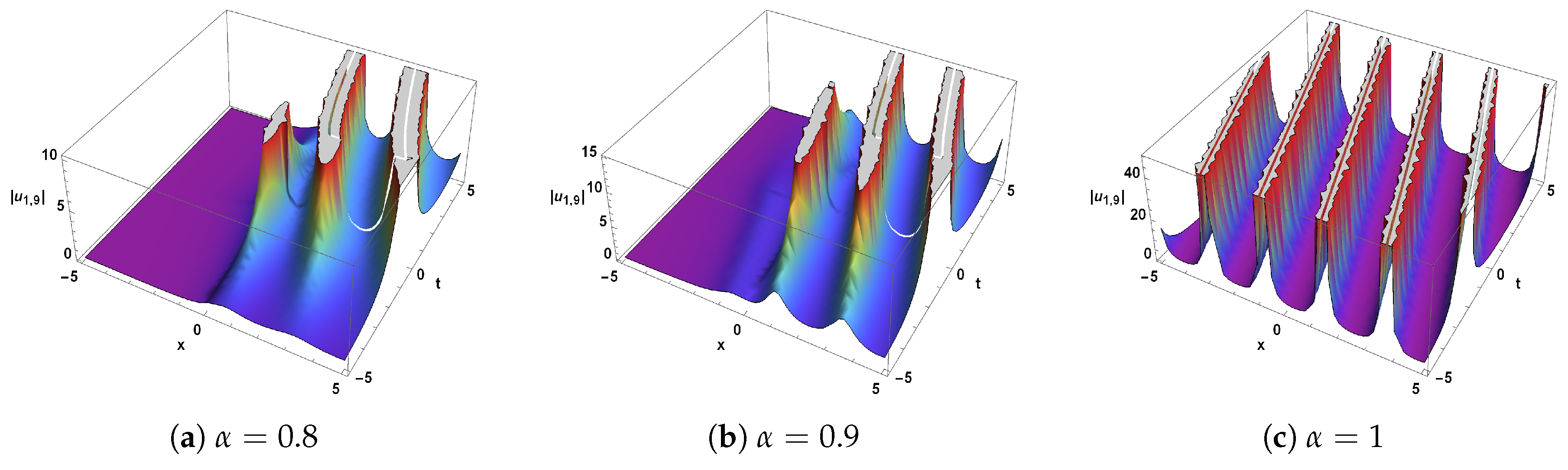
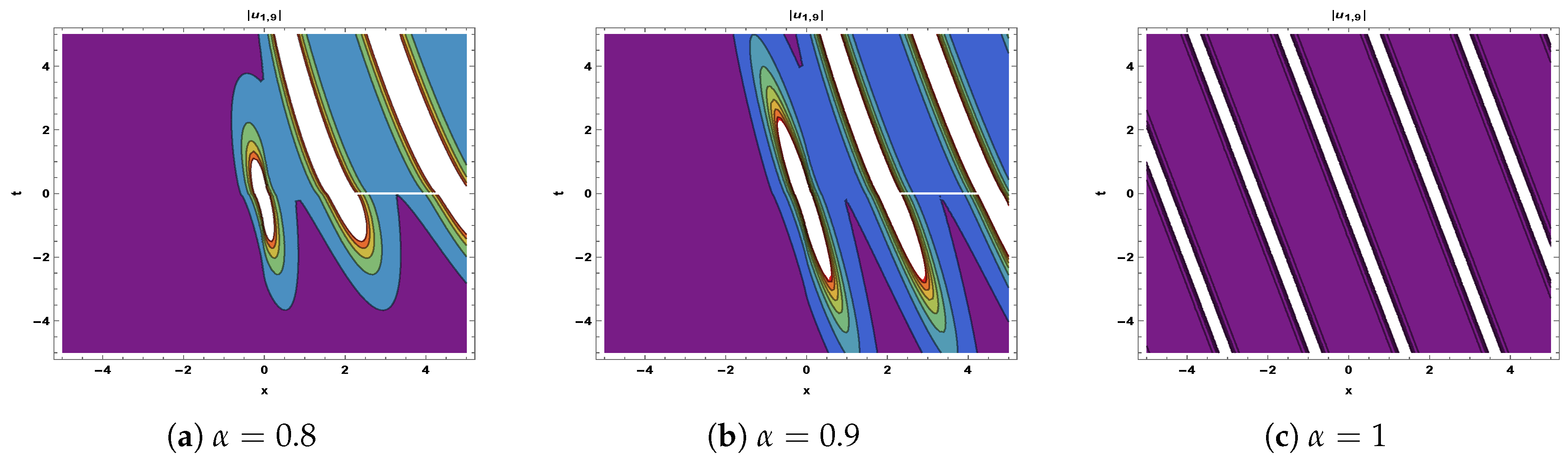
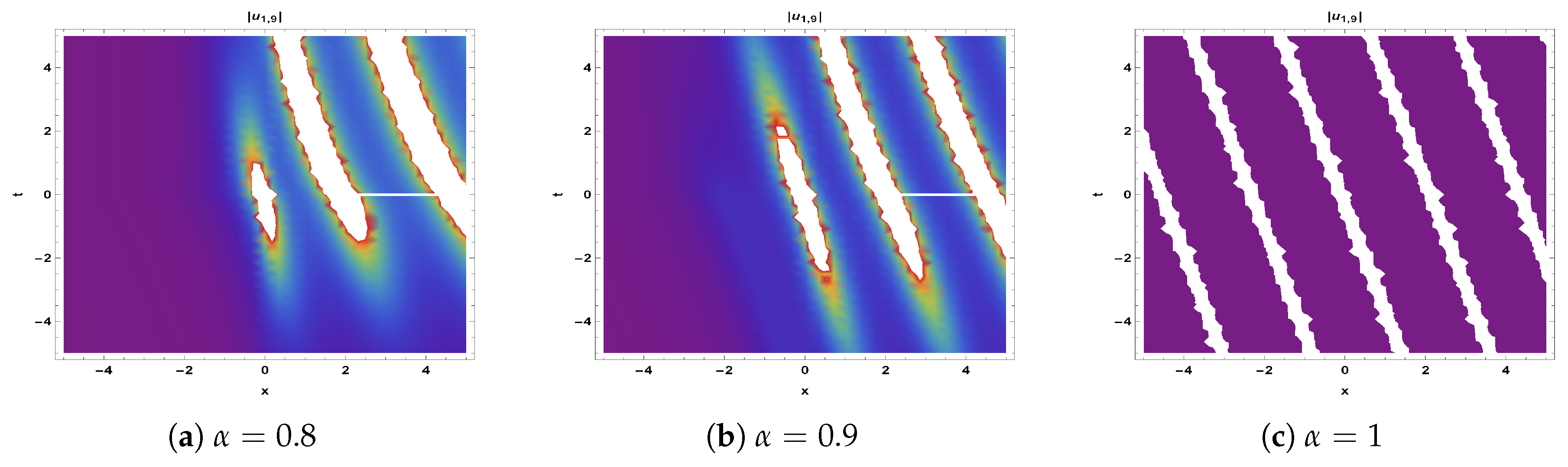
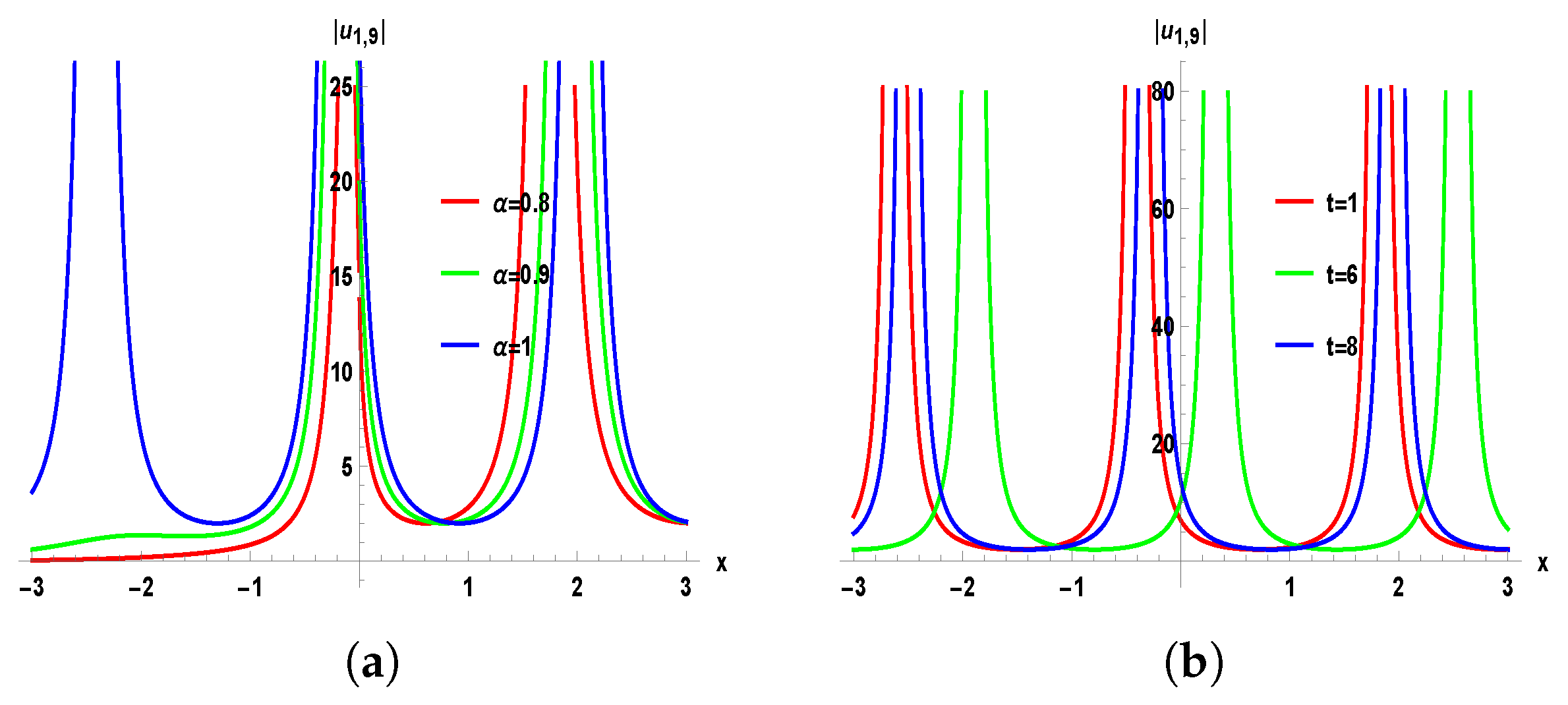
We obtained 2 D , 3 D , contour and density graphs that illustrate particular results. Our main objective is to show the solutions. The solutions we have obtained are more useful and versatile upon examining the depictions of the solutions in their graphical form. We display distinct conclusive graphs for varying values of the fractional parameter. The 2 D graphical representation of the solutions, which varies with different choices of α and t, shows a range of wave patterns. The obtained solutions are compared using the fractional operator in support of the fractional parameters α and t. By using these techniques, it is possible to extract bright, periodic, dark, singular, and periodic–singular soliton solutions. The graphical results obtained through 2D, 3D, contour, and density plots provide important insight into the physical behavior of droplet and gas bubble transport in microchannels. The observed wave patterns correspond to interfacial disturbances along the droplet or bubble surface, where localized peaks indicate regions of high interfacial stress and stable propagation governed by the balance between dispersion and nonlinearity. The contour and density plots further reveal the stability and spatial spreading of these waves, with smooth contours indicating stable transport regimes and sharper gradients reflecting highly localized or sensitive interfacial dynamics. It is important to note that the validity of these wave structures is governed by parameter constraints inherent to the analytical methodology. In particular, the fractional-order parameter must satisfy 0 < α 1 to ensure mathematical consistency and physical relevance of the M-truncated fractional derivative. Parameter choices outside these admissible ranges may result in nonphysical or unstable solutions. These observations emphasize the importance of appropriate parameter selection when modeling realistic microfluidic transport processes. The visual representation of selected outcomes is shown in Figure 1, Figure 2, Figure 3, Figure 4, Figure 5, Figure 6, Figure 7, Figure 8, Figure 9, Figure 10, Figure 11, Figure 12, Figure 13, Figure 14, Figure 15, Figure 16, Figure 17, Figure 18, Figure 19, Figure 20, Figure 21, Figure 22, Figure 23, Figure 24, Figure 25, Figure 26, Figure 27, Figure 28, Figure 29, Figure 30, Figure 31 and Figure 32. This operator contrasted at various order values, and 2 D plots are used to illustrate the comparisons between different values of α and t. Below are the specifications for each figure.
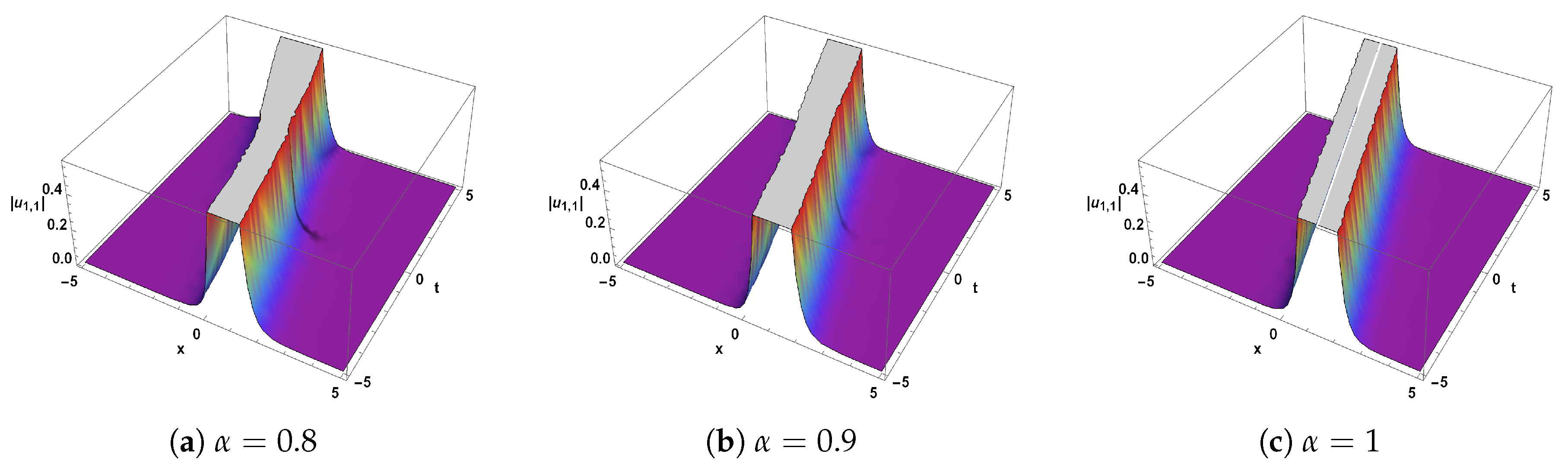
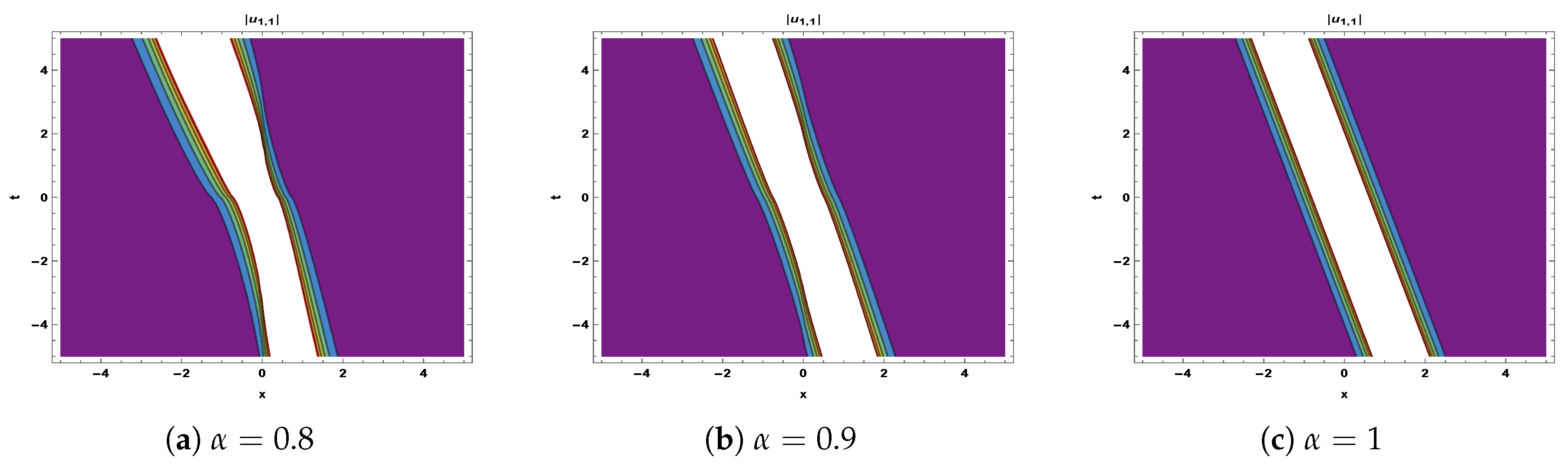
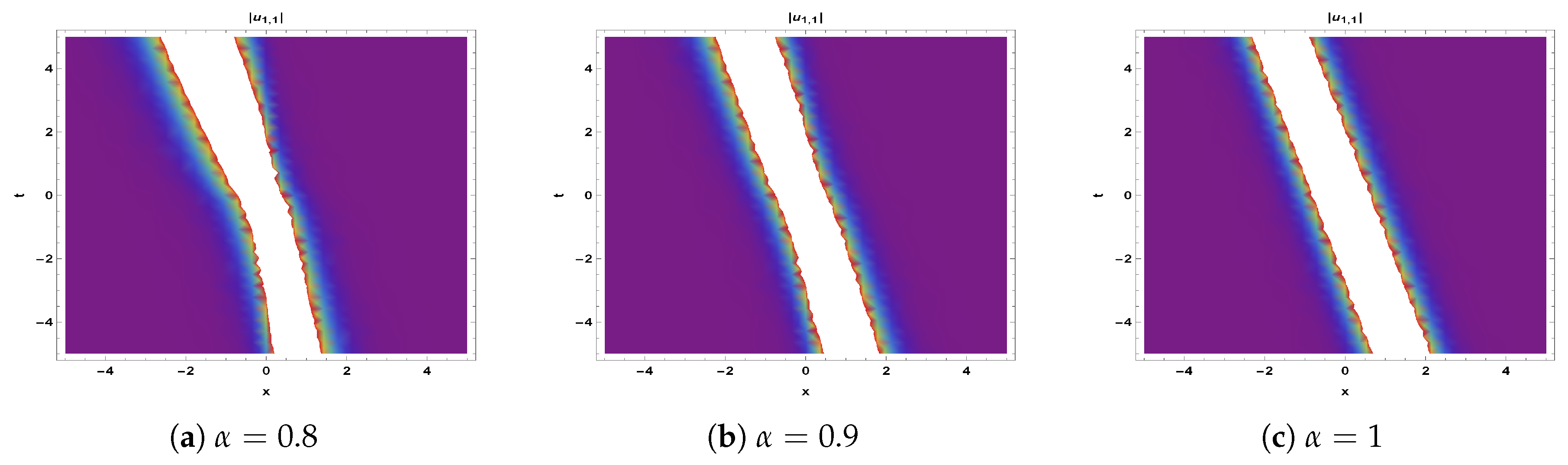
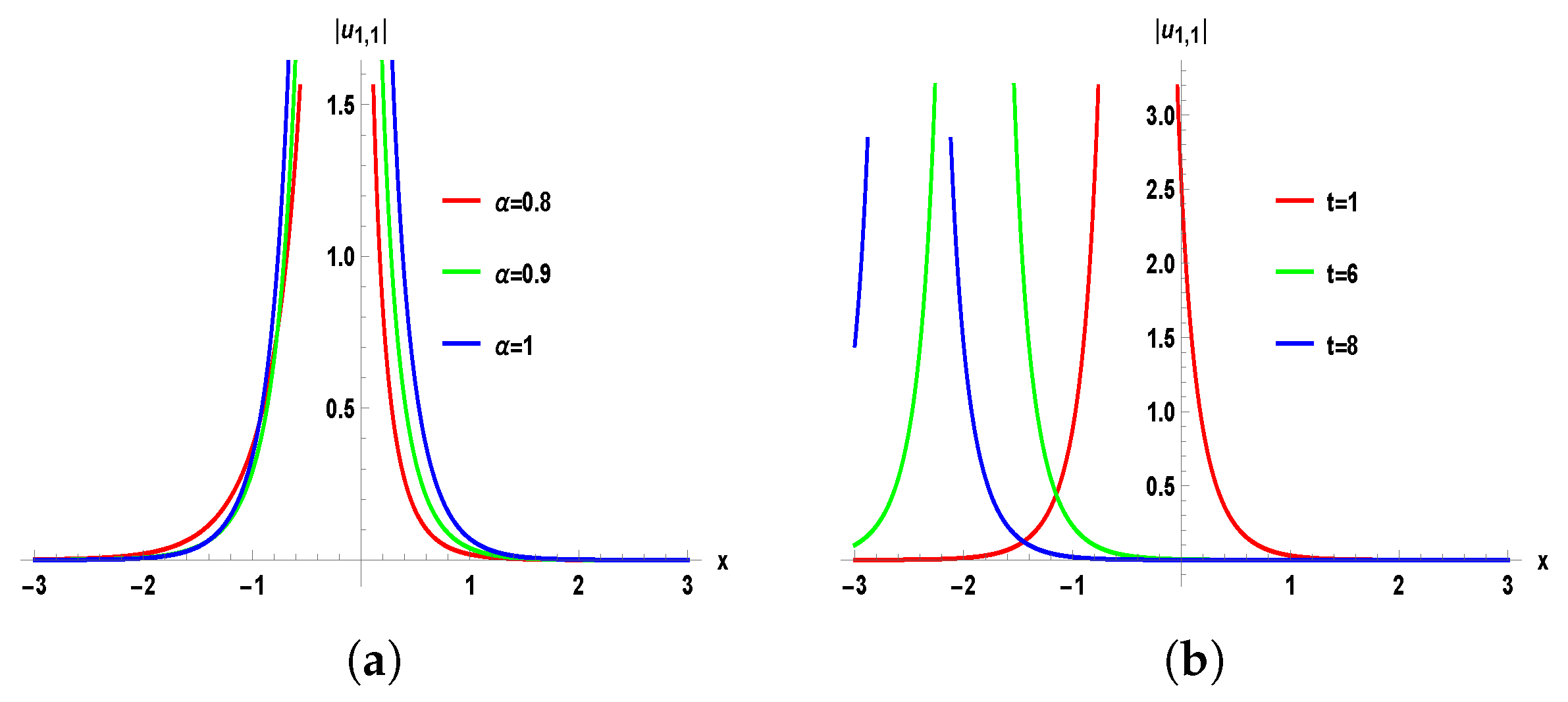
The singular soliton solution for u 1 , 1 ( x , t ) at fractional orders 1 , 0.9 , and 0.8 is depicted by 3 D graphs in Figure 1. Figure 2 shows contour plots, and Figure 3 shows density plots. Figure 4 showcases comparisons among various fractional-order values (1, 0.9, and 0.8) and also comparisons among various values of t using 2 D graphs. This type of soliton has a singular peak within a wave. The parameters utilized are f 0 = 0 , f 1 = 0 , f 2 = 1 , b = 4 , c = 2 , η = 0.3 , ξ 0 = 0.1 , γ = 0.2 , and τ = 1 .
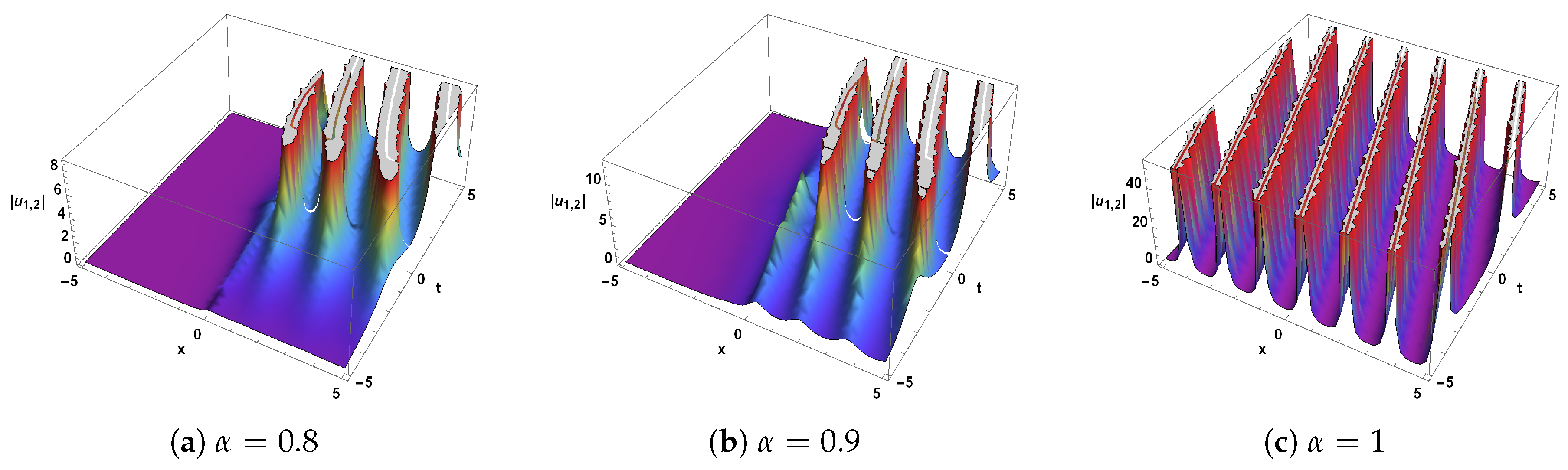
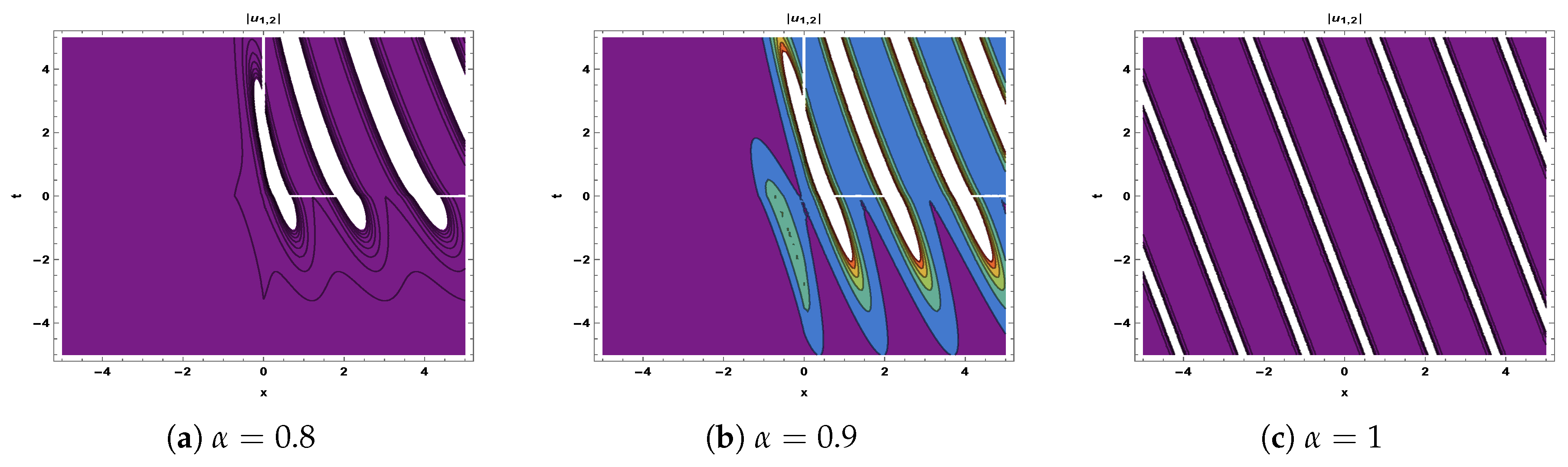
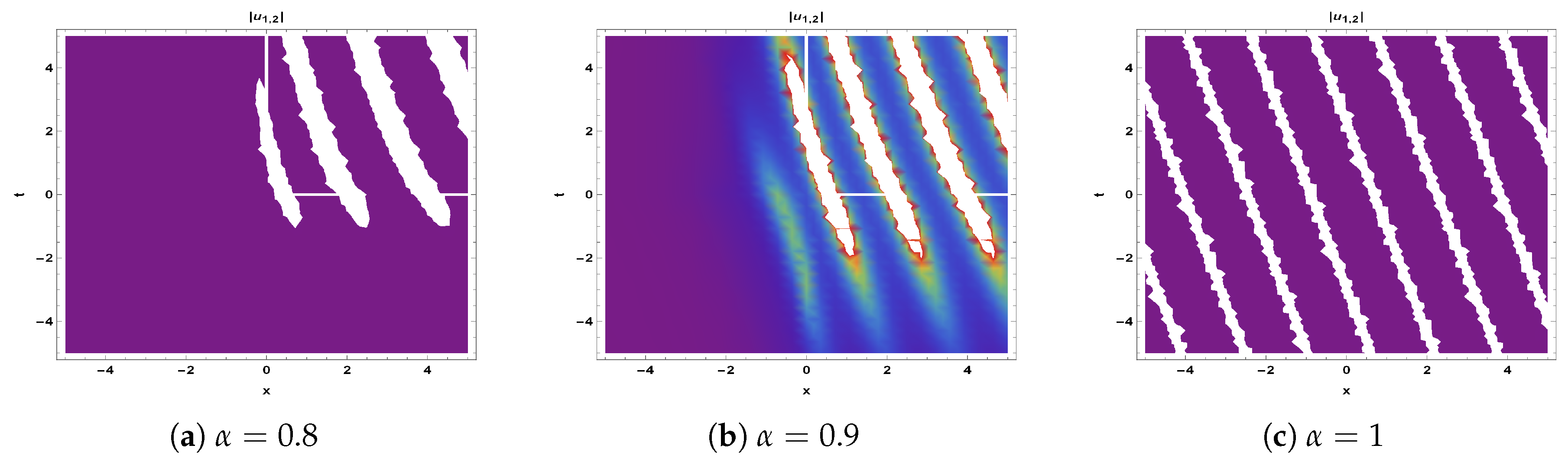
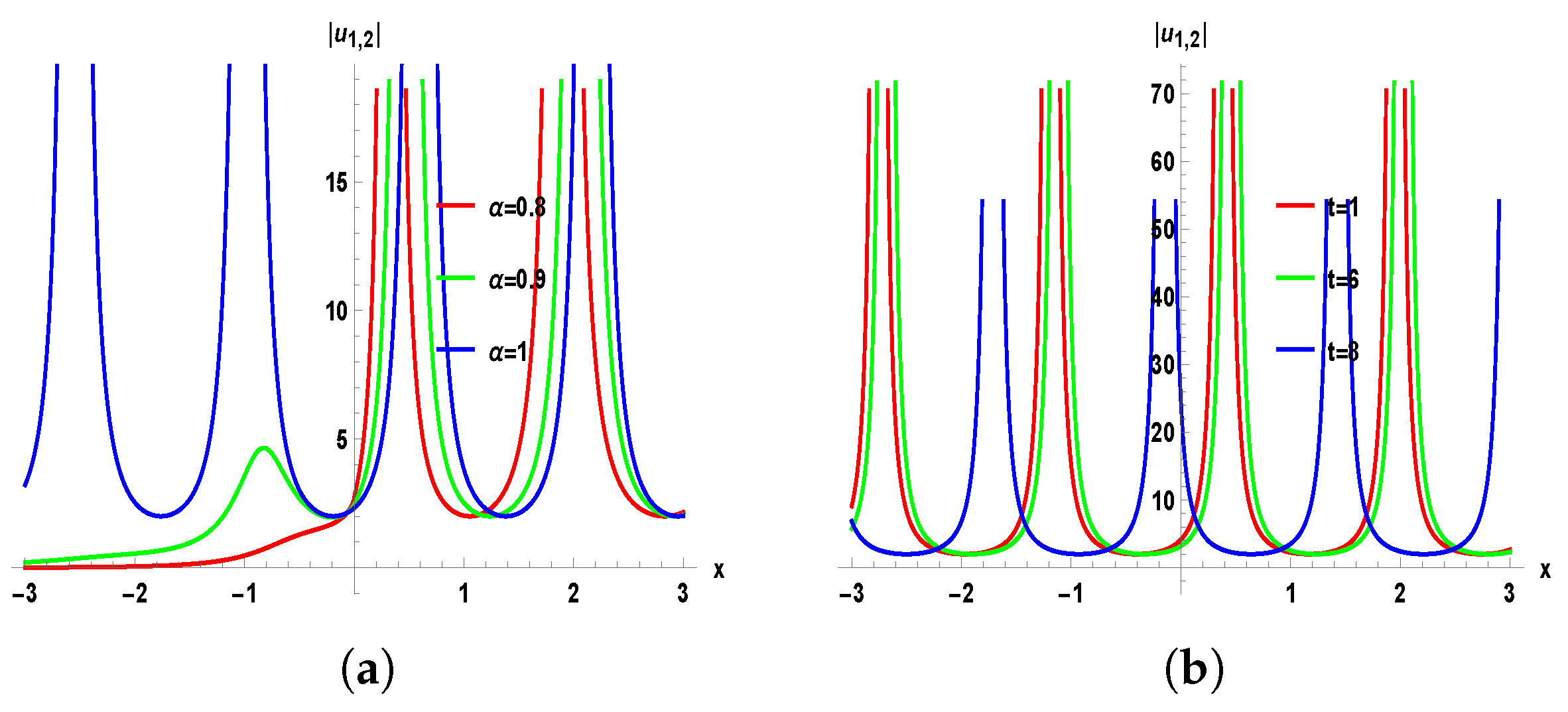
The periodic–singular solution for u 1 , 2 ( x , t ) at fractional orders 1 , 0.9 , and 0.8 is depicted by 3 D graphs in Figure 5. Figure 6 shows contour plots, and Figure 7 shows density plots. Figure 8 showcases comparisons among various fractional-order values ( 1 , 0.9 , and 0.8 ) and also comparisons among various values of t using 2 D graphs. A periodic soliton is a nonlinear wave solution that displays repeating wave patterns. The parameters utilized are f 0 = 0 , f 1 = 0 , f 2 = 1 , b = 4 , c = 2 , η = 0.3 , ξ 0 = 0.1 , γ = 0.2 , and τ = 1 .
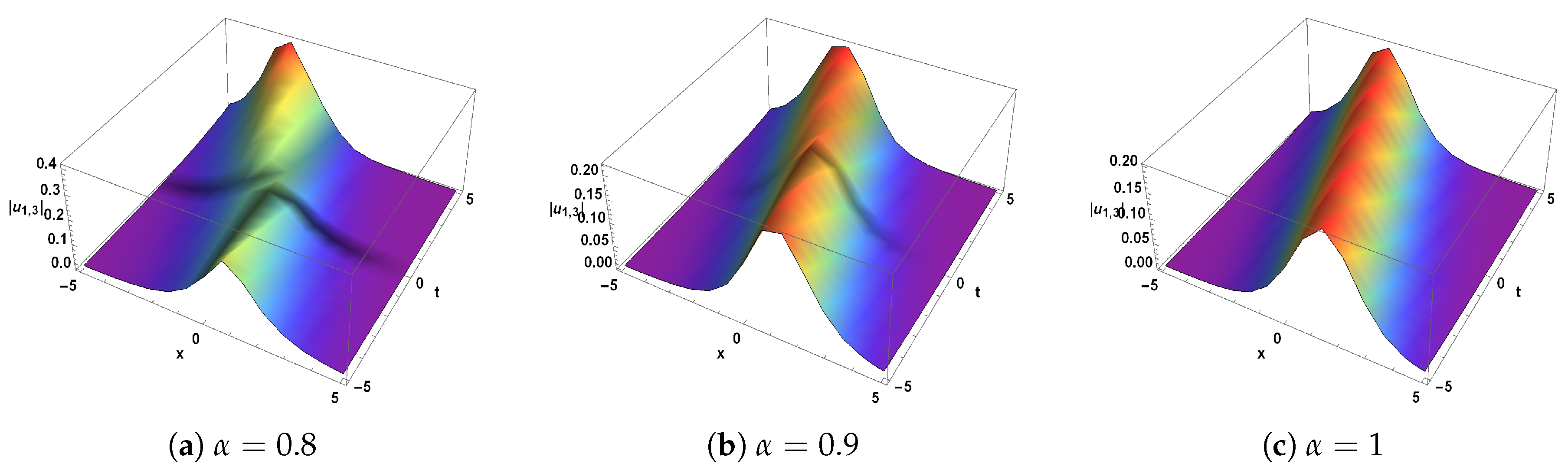
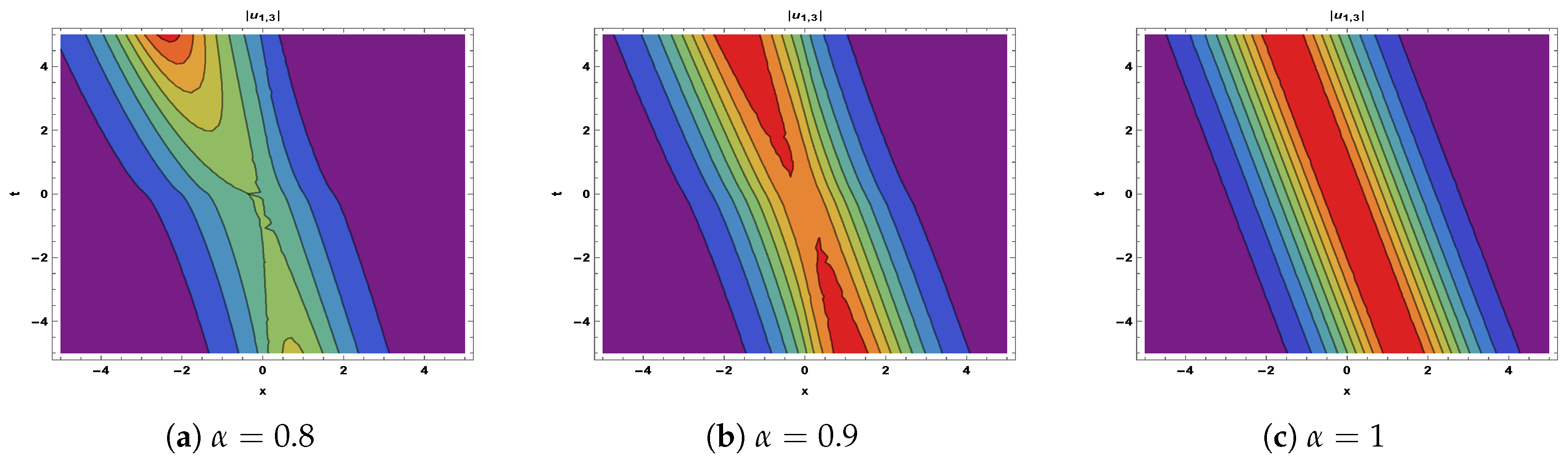
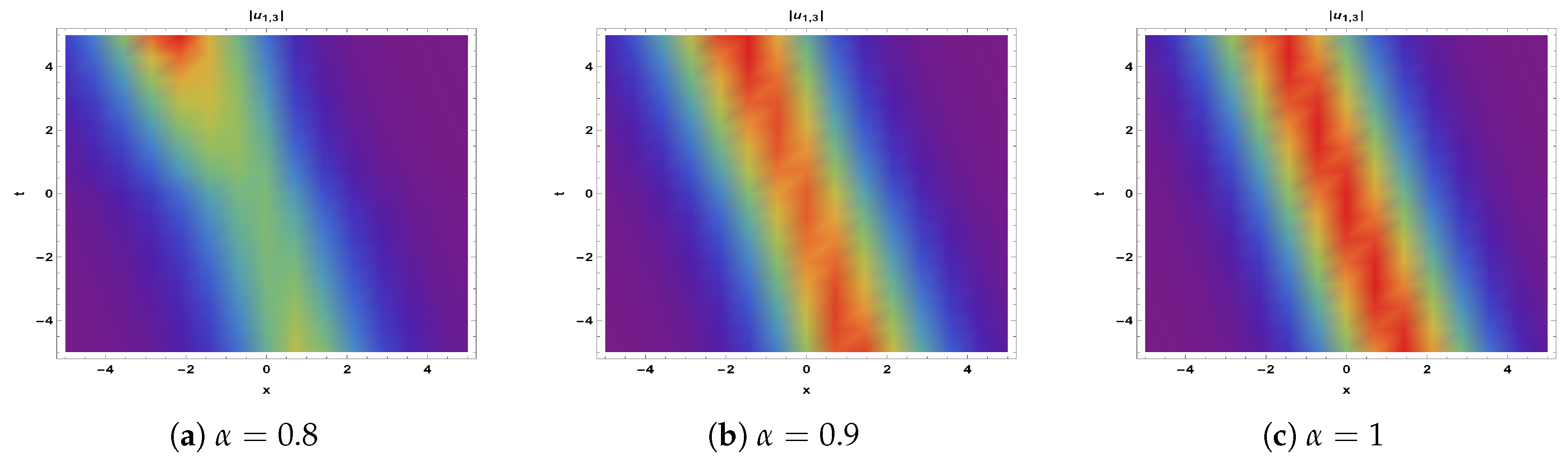
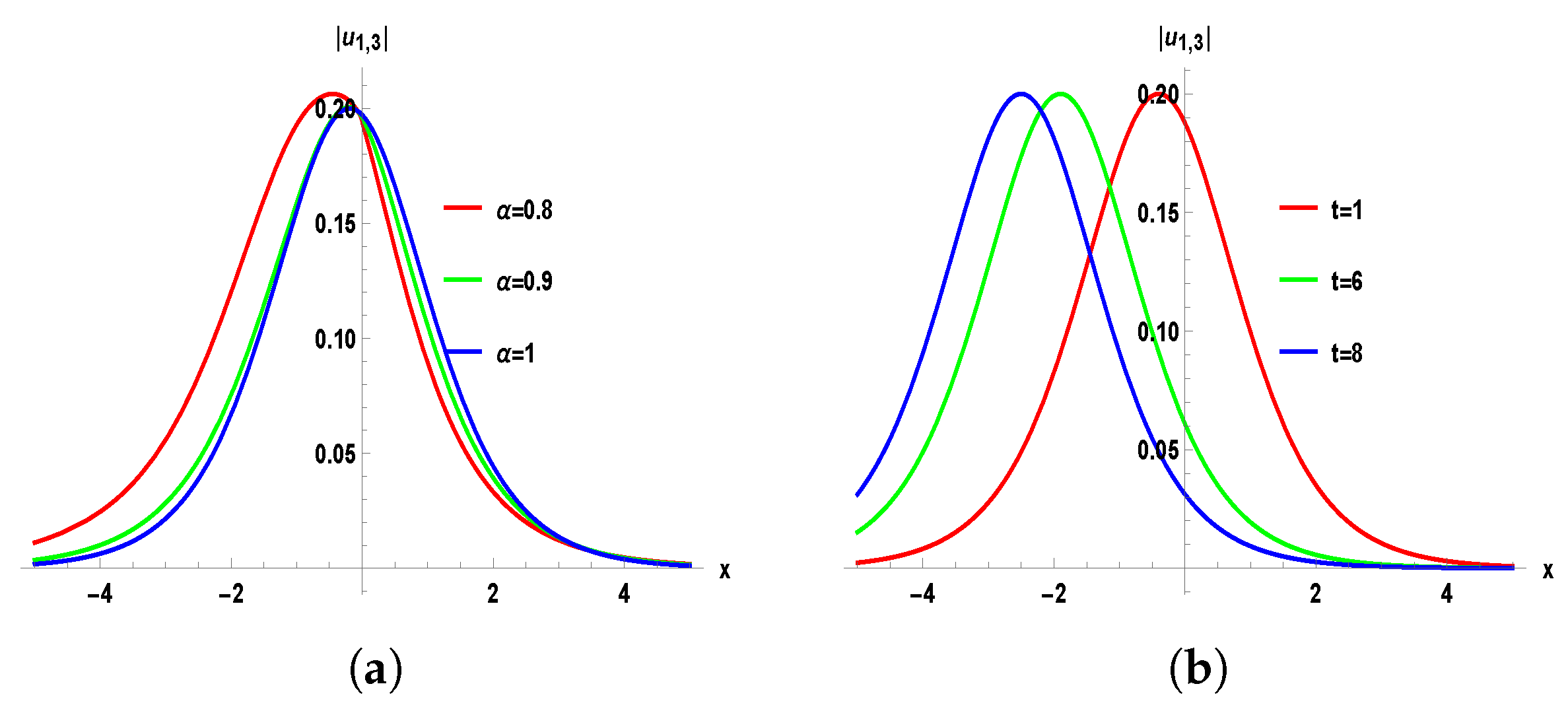
The bright soliton solution for u 1 , 3 ( x , t ) at fractional orders 1 , 0.9 , and 0.8 is depicted by 3 D graphs in Figure 9. Figure 10 shows contour plots, and Figure 11 shows density plots. Figure 12 showcases comparisons among various fractional-order values ( 1 , 0.9 , and 0.8 ) and also comparisons among various values of t using 2 D graphs. The bright soliton has a localized intensity peak above the continuous-wave background. The parameters utilized are f 0 = 0 , f 1 = 0 , f 2 = 1 , b = 0.4 , c = 2 , η = 0.3 , ξ 0 = 0.1 , γ = 0.2 , and τ = 1 .
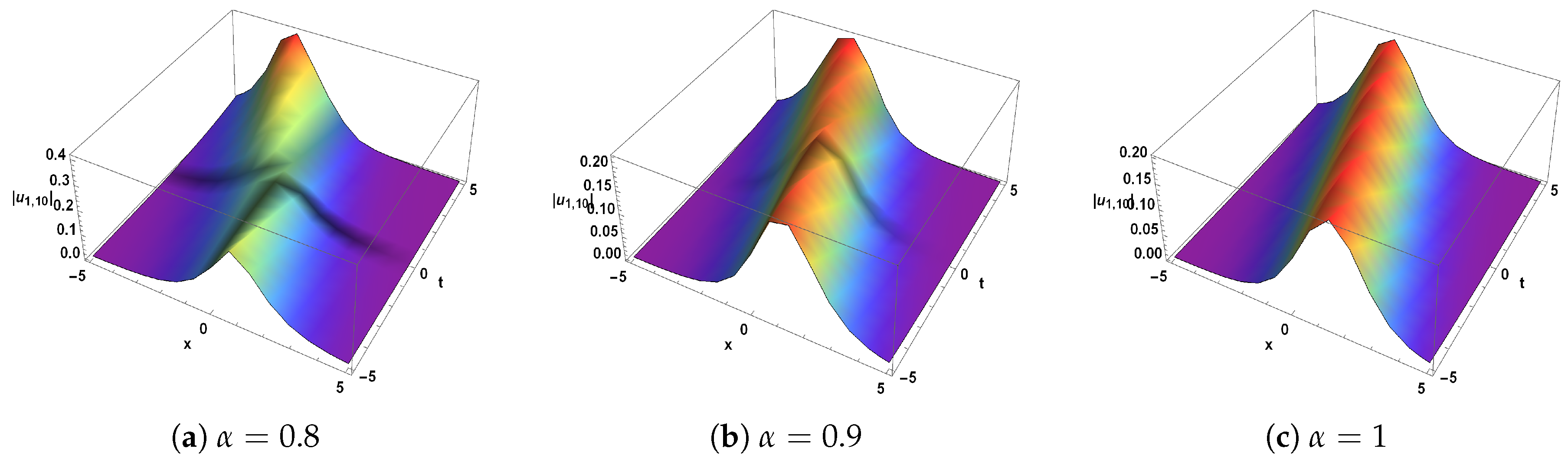
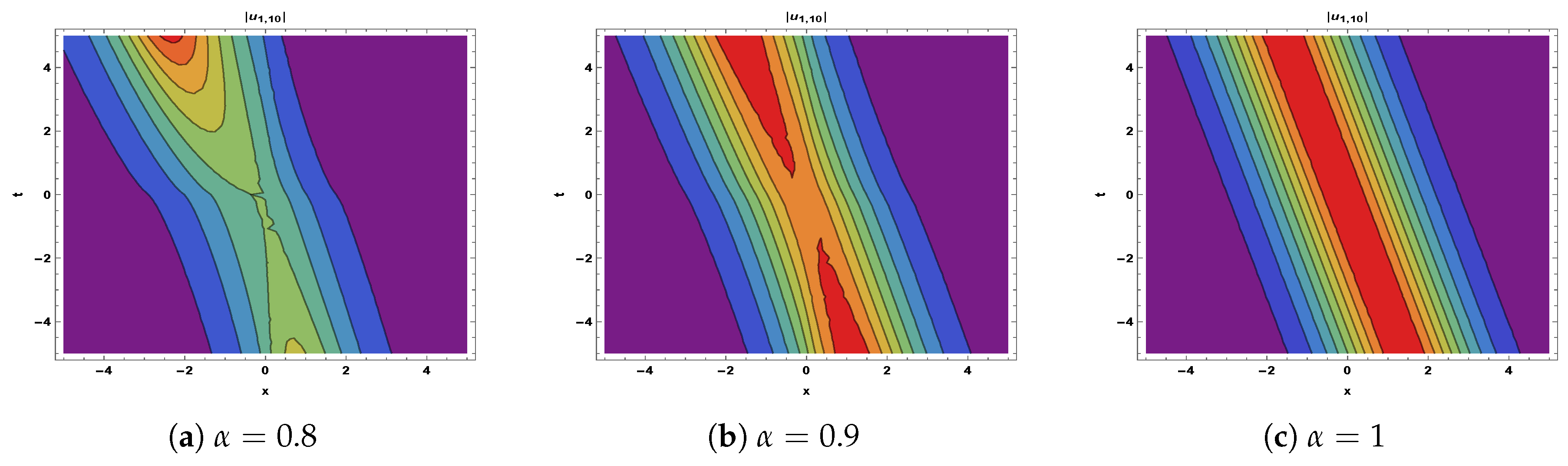
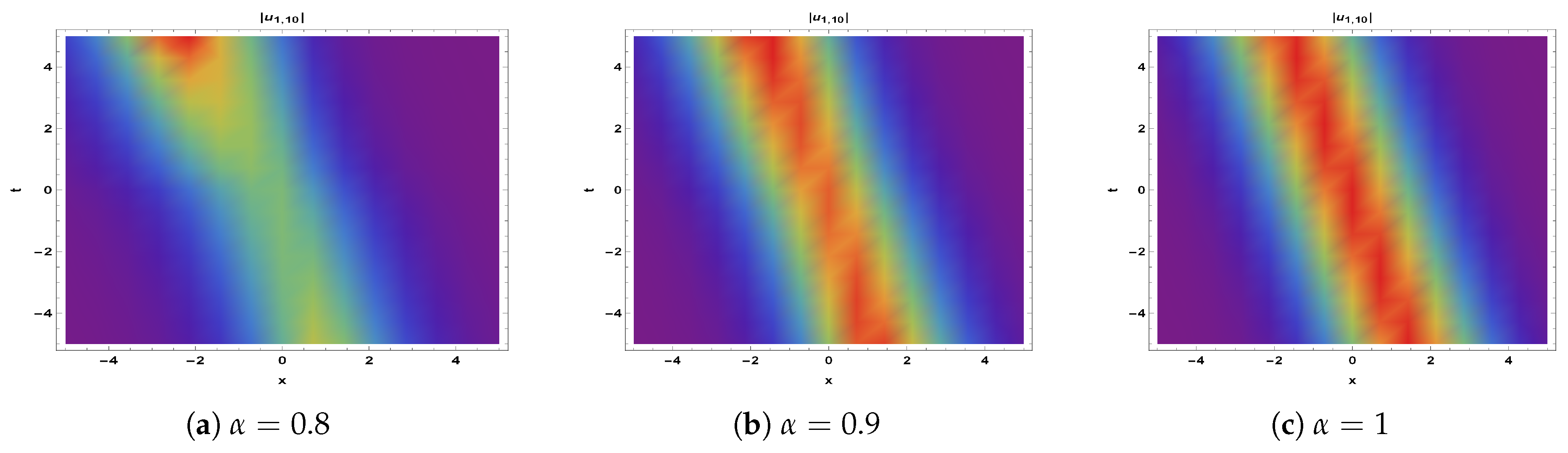
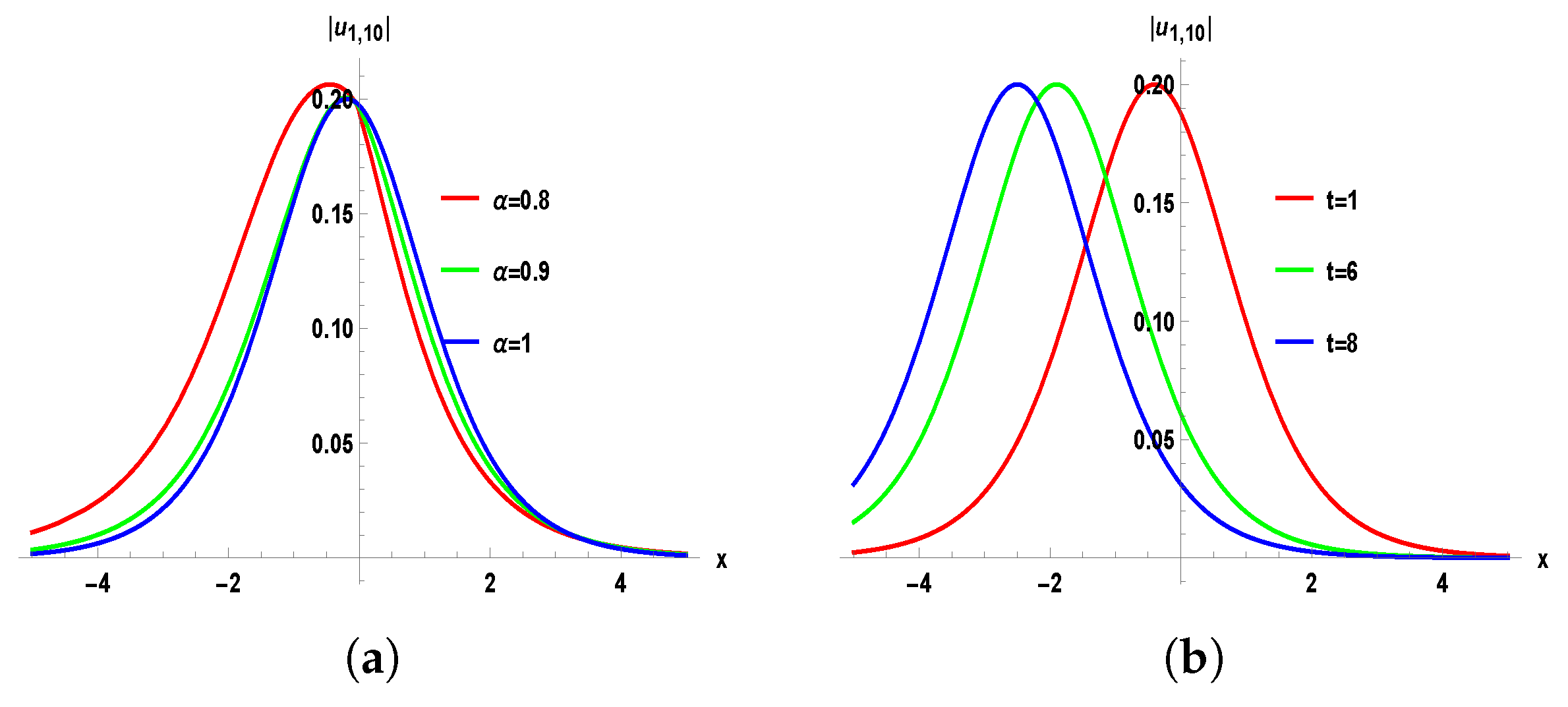
The bright soliton solution for u 1 , 10 ( x , t ) at fractional orders 1 , 0.9 , and 0.8 is depicted by 3 D graphs in Figure 13. Figure 14 shows contour plots, and Figure 15 shows density plots. Figure 16 showcases comparisons among various fractional-order values ( 1 , 0.9 , and 0.8 ) and also comparisons among various values of t using 2 D graphs. The parameters utilized are f 1 = 0 , f 2 = 2 , b = 0.2 , c = 2 , η = 0.3 , ξ 0 = 0.1 , γ = 0.2 , and τ = 1 .
The singular–periodic soliton solution for u 1 , 9 ( x , t ) at fractional orders 1 , 0.9 , and 0.8 is depicted by 3 D graphs in Figure 17. Figure 18 shows contour plots, and Figure 19 shows density plots. Figure 20 showcases comparisons among various fractional-order values ( 1 , 0.9 , and 0.8 ) and also comparisons among various values of t using 2 D graphs. The parameters utilized are f 0 = 0 , f 1 = 0 , f 2 = 1 , b = 2 , c = 1 , η = 0.3 , ξ 0 = 0.1 , γ = 0.2 , and τ = 1 .
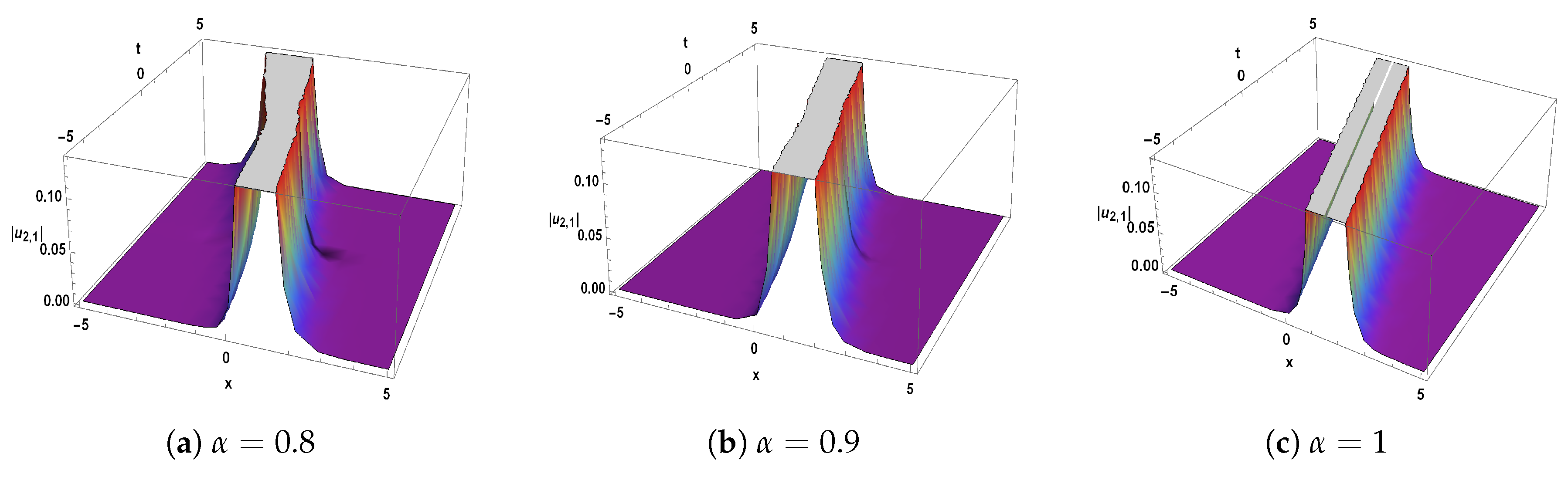
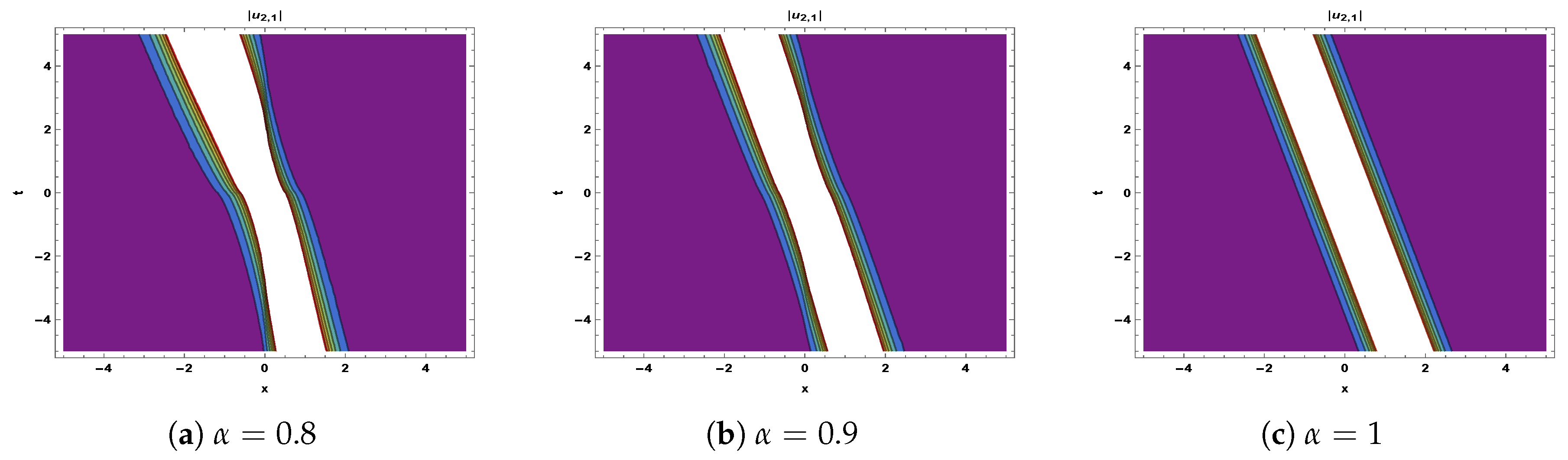
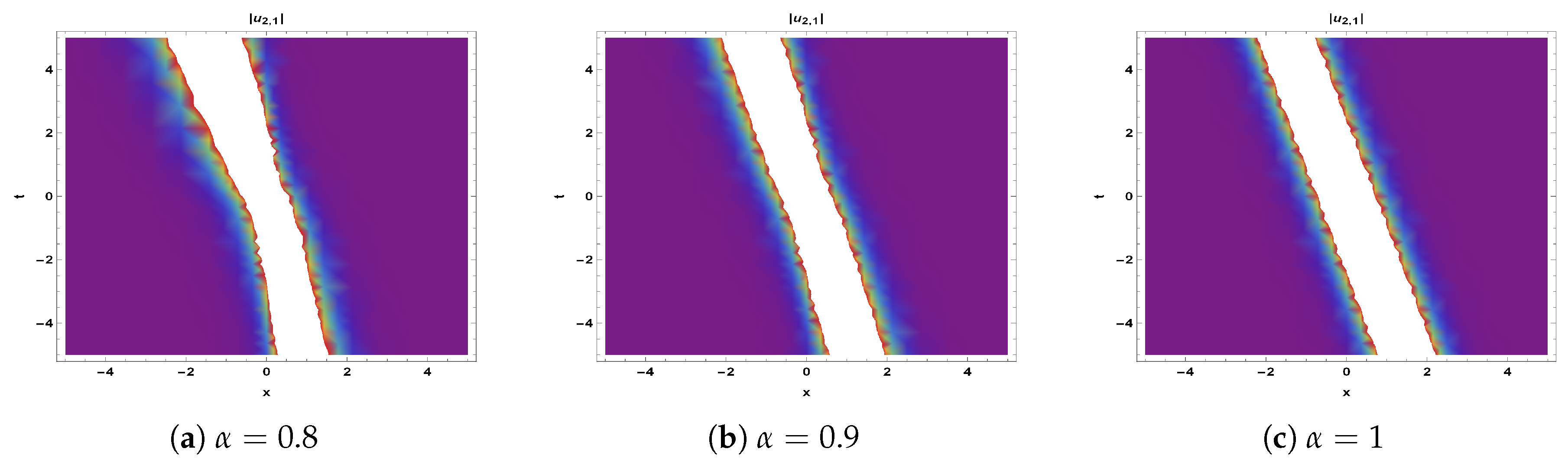
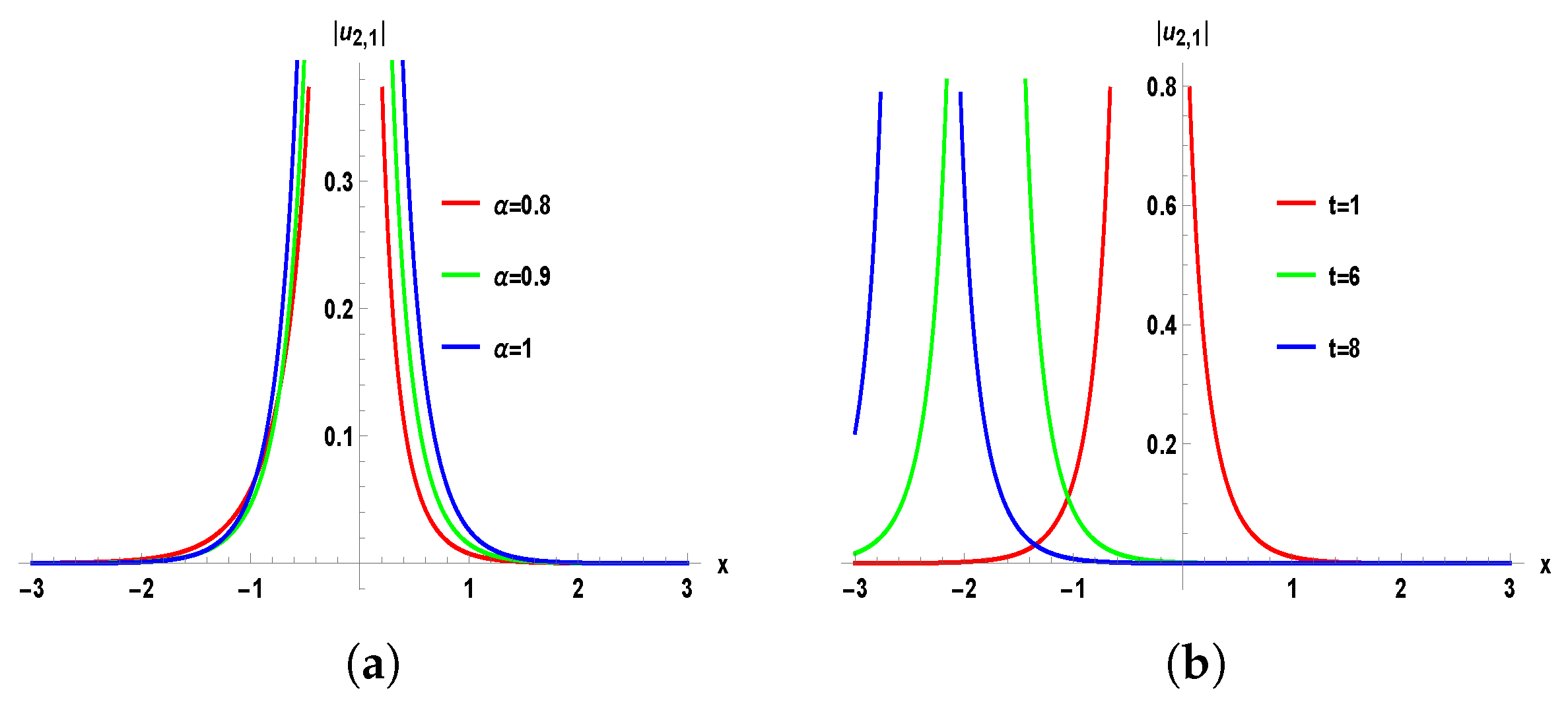
The singular soliton solution for u 2 , 1 ( x , t ) at fractional orders 1 , 0.9 , and 0.8 is depicted by 3 D graphs in Figure 21. Figure 22 shows contour plots, and Figure 23 shows density plots. Figure 24 showcases comparisons among various fractional-order values ( 1 , 0.9 , and 0.8 ) and also comparisons among various values of t using 2 D graphs. The parameters utilized are q 1 = 0 , q 2 = 0 , H 1 = 0 , H 2 = 2 , k = 4 , η = 0.3 , γ = 0.2 , and τ = 1 .
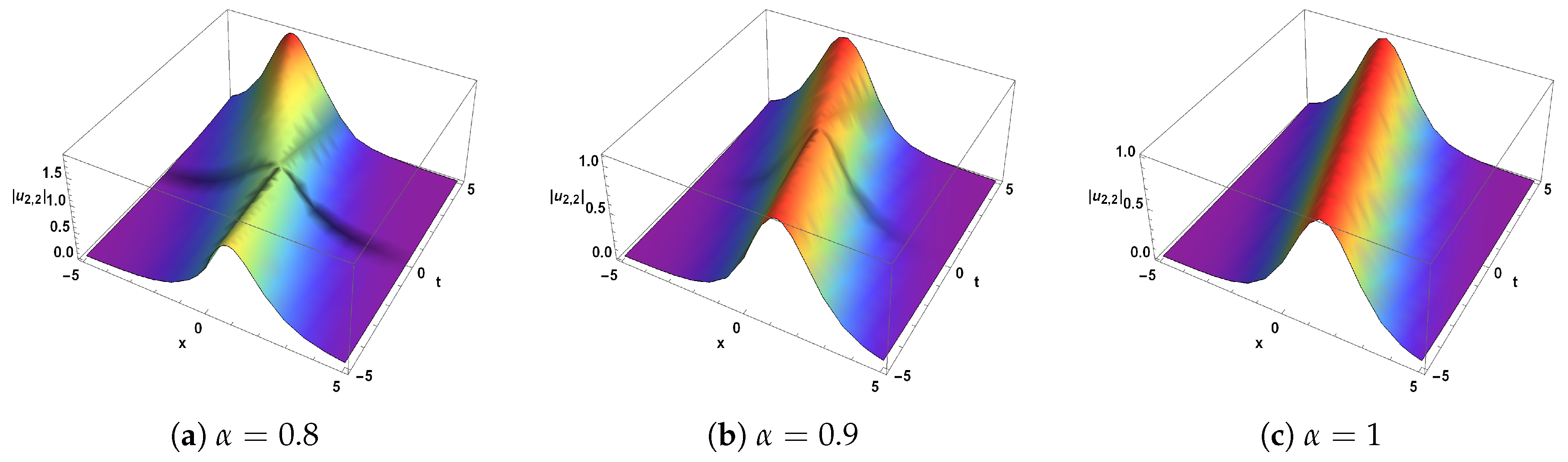
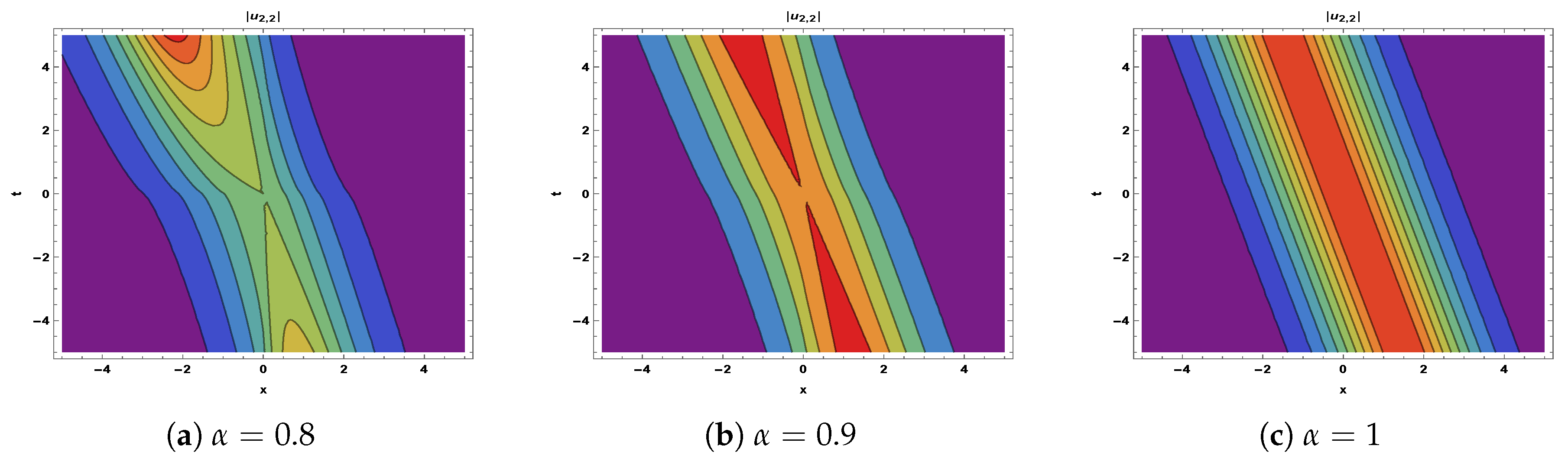
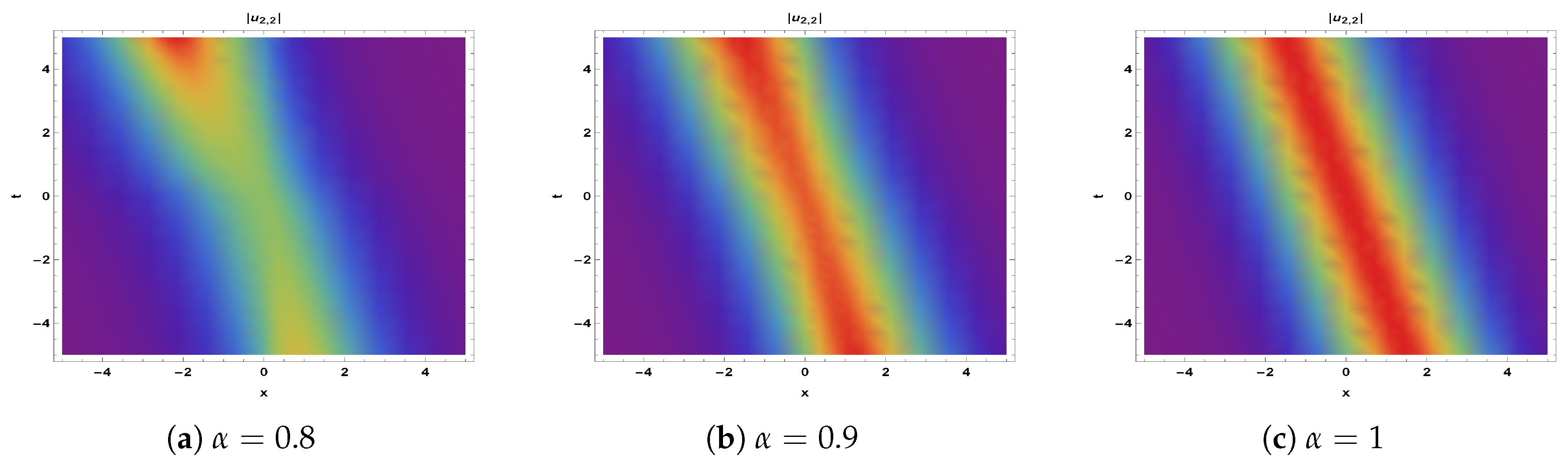
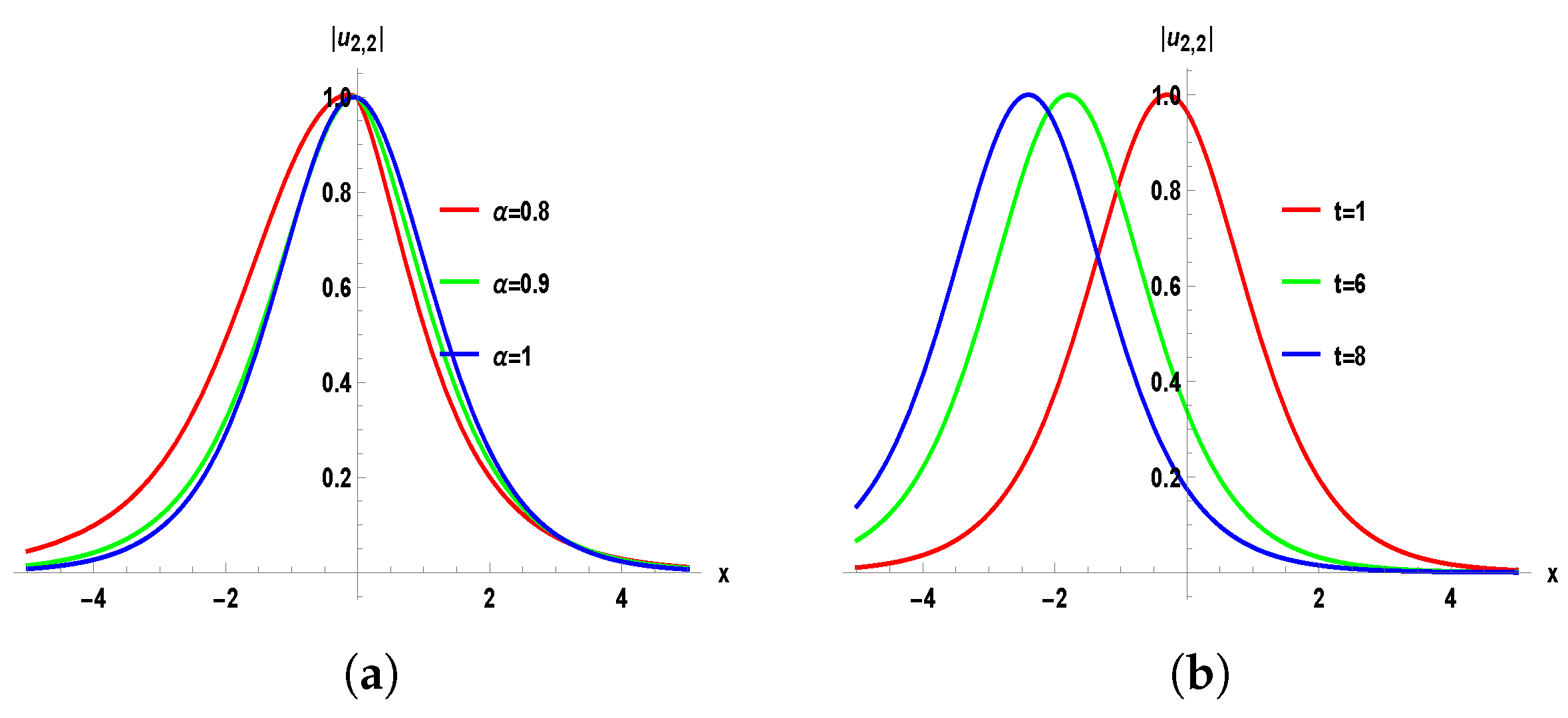
The bright soliton solution for u 2 , 2 ( x , t ) at fractional orders 1 , 0.9 , and 0.8 is depicted by 3 D graphs in Figure 25. Figure 26 shows contour plots, and Figure 27 shows density plots. Figure 28 showcases comparisons among various fractional-order values ( 1 , 0.9 , and 0.8 ) and also comparisons among various values of t using 2 D graphs. The parameters utilized are q 1 = 0 , q 2 = 0 , H 1 = 0 , H 2 = 0.4 , k = 0.4 , η = 0.3 , γ = 0.2 , and τ = 1 .
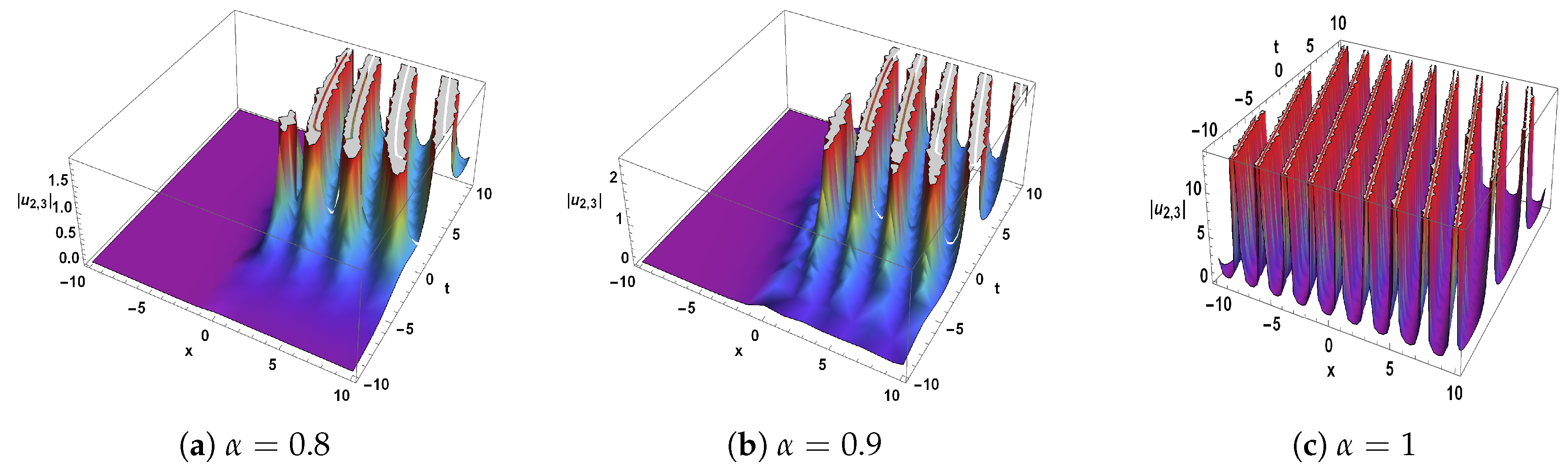
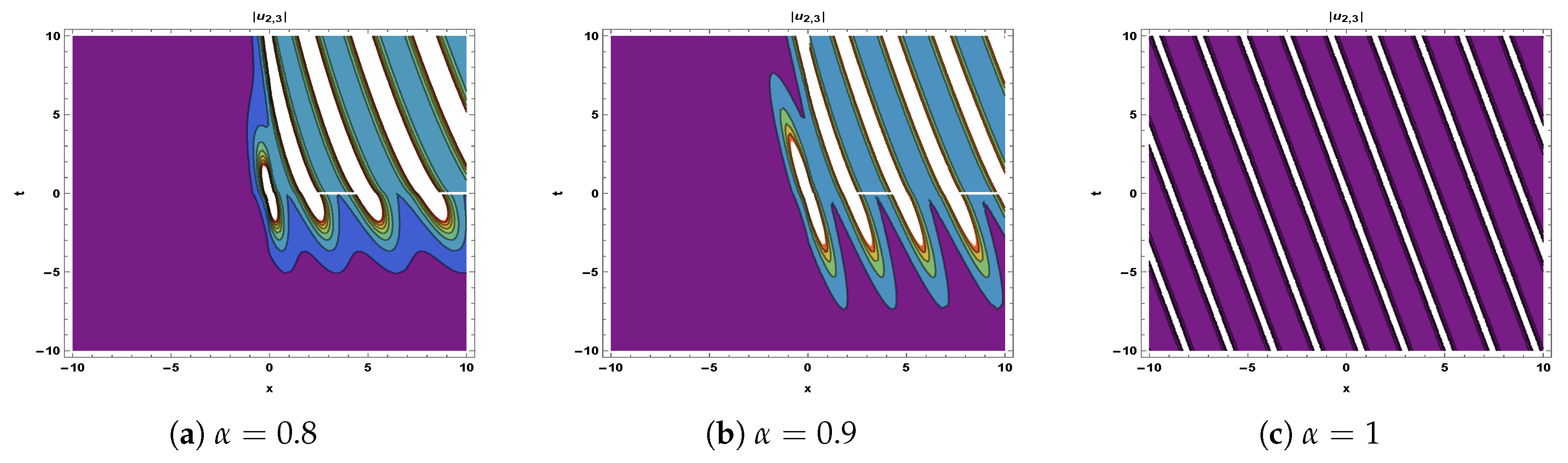
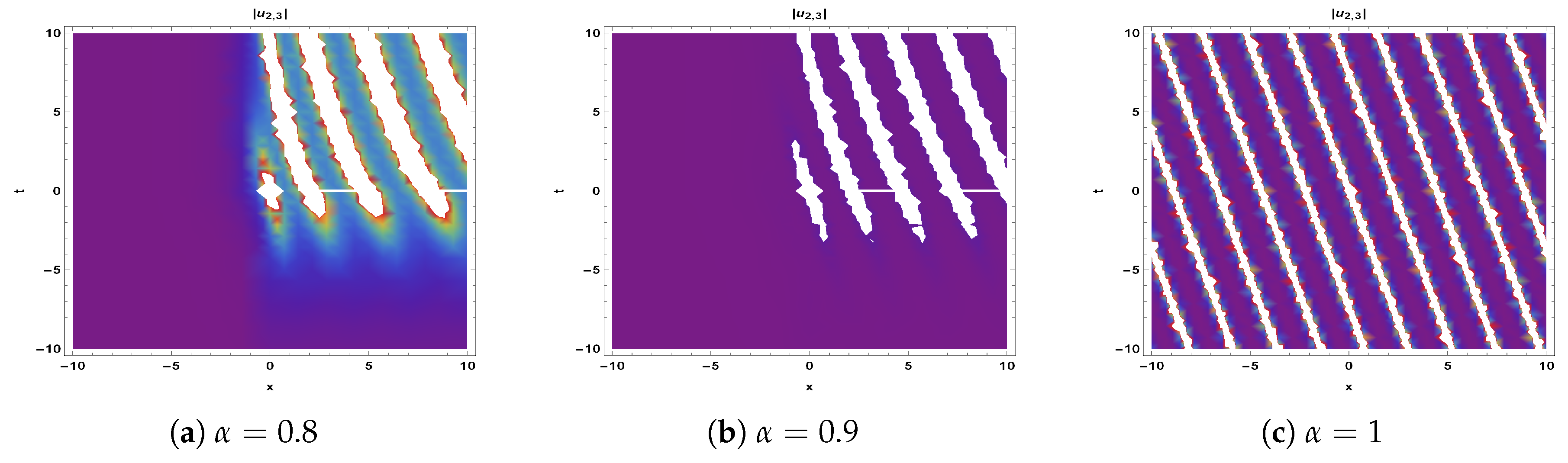
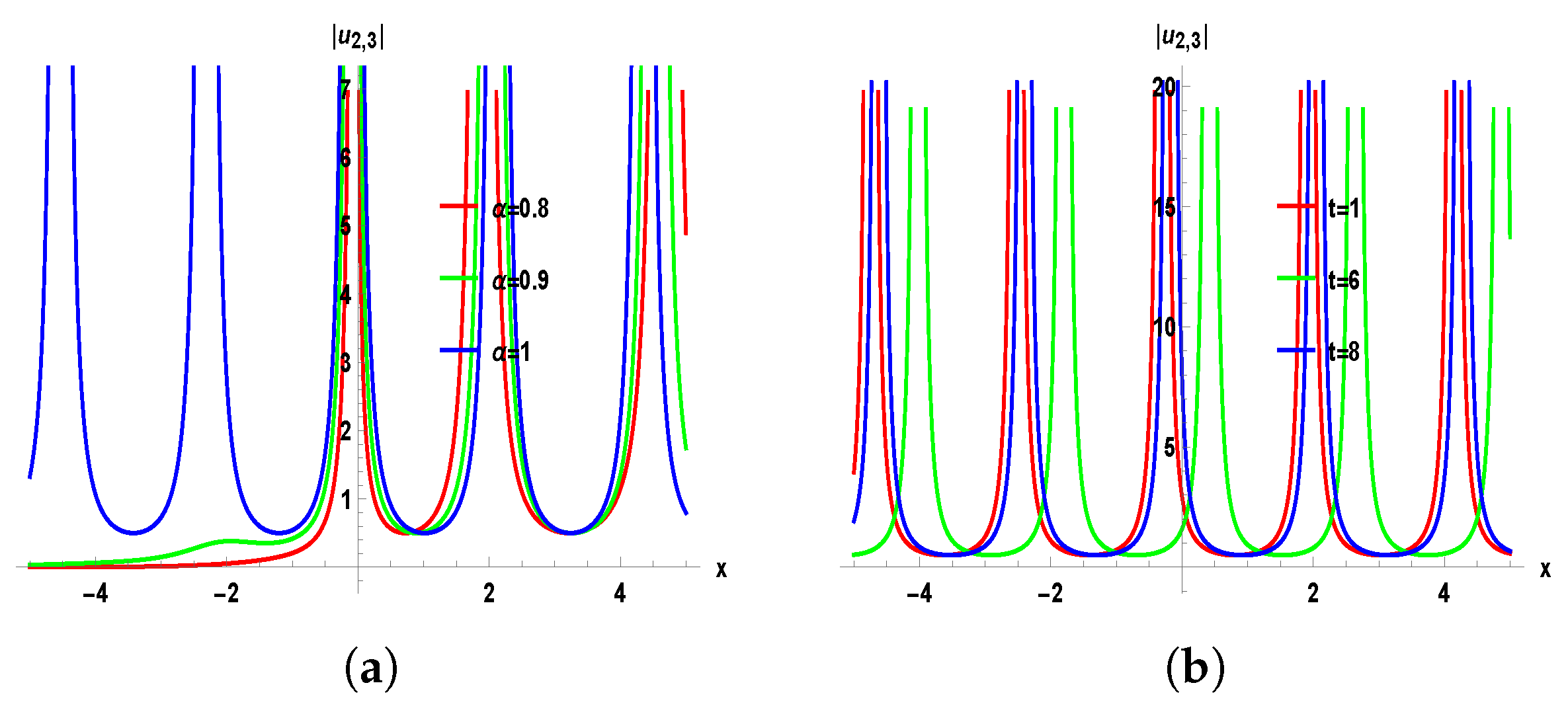
The periodic–singular soliton solution for u 2 , 3 ( x , t ) at fractional orders 1 , 0.9 , and 0.8 is depicted by 3 D graphs in Figure 29. Figure 30 shows contour plots, and Figure 31 shows density plots. Figure 32 showcases comparisons among various fractional-order values ( 1 , 0.9 , and 0.8 ) and also comparisons among various values of t using 2 D graphs. The parameters utilized are q 0 = 0 , q 1 = 0 , q 2 = 0 , H 1 = 0 , H 2 = 1 , k = 2 , η = 0.3 , γ = 0.2 , and τ = 1 .

Sensitivity Analysis of Fractional Parameters and Physical Interpretation

The fractional-order parameter α plays a fundamental role in governing memory and nonlocal effects in droplet and gas bubble dynamics within microchannels. To examine the sensitivity of the model to fractional effects, we analyze the behavior of the obtained soliton solutions for different values of α , namely α = 0.8 , 0.9 , and 1. These values allow a systematic transition from fractional-order dynamics to the classical integer-order case.
Our results indicate that decreasing the fractional order from α = 1 to α = 0.9 and 0.8 significantly influences the amplitude, width, and propagation speed of the soliton waves. Physically, lower values of α correspond to stronger memory effects in the fluid, leading to smoother wave profiles and reduced propagation speed. This behavior reflects the delayed response and enhanced viscous effects commonly observed in non-Newtonian and viscoelastic fluids flowing through confined microchannels.
The time variable t further affects soliton evolution by controlling temporal spreading and stability. As time increases, the interaction between temporal dynamics and fractional effects becomes more pronounced, resulting in noticeable deformation and redistribution of wave energy. The selected fractional values α = 0.8 and α = 0.9 are commonly used in fractional fluid models to represent realistic microfluidic environments, while α = 1 recovers the classical Bretherton model. These findings demonstrate the practical relevance of fractional modeling in capturing diverse transport behaviors encountered in lab-on-a-chip devices, biomedical diagnostics, and controlled droplet-based microfluidic systems.

6. Conclusions

This study investigated the extended hyperbolic function method and the modified extended tanh method to obtain optical soliton solutions for the ( 1 + 1 ) -dimensional nonlinear generalized Bretherton model using the M-truncated fractional derivative. This model is crucial to the advancement of mathematical knowledge of interface-driven flow systems in microfluidics, biomedical engineering, and porous media because it connects mathematical techniques with physical principles. It assists mathematicians in solving nonlinear partial differential equations pertaining to multiphase flow, analyzing thin-film dynamics, and deriving scaling laws. The design of stable foams and emulsions in sectors including food processing, cosmetics, and detergents is aided by its support for the investigation of thin-film drainage and rupture. Various wave patterns, such as dark, singular, periodic, bright, and periodic–singular patterns, are secured to the model under consideration. The extended hyperbolic function method is most effective for integrable or semi-integrable nonlinear partial differential equations. Multi-dimensional partial differential equations cannot be efficiently handled by the modified extended tanh method. To highlight the features of these solutions, they are visualized using two-dimensional, three-dimensional, contour, and density plots. The graphical representation of the solutions in 2 D shows a variety of wave patterns that change with changes in α and t. In computational fluid dynamics, this model acts as a standard for evaluating numerical techniques.

Author Contributions

Conceptualization, K.K. and E.K.J.; methodology, K.K.; software, K.K.; validation, K.K., E.K.J. and S.M.A.-D.; formal analysis, K.K.; investigation, H.U.R.; resources, E.K.J. and S.M.A.-D.; data curation, K.K.; writing—original draft preparation, K.K. and H.U.R.; writing—review and editing, E.K.J., S.M.A.-D. and H.U.R.; visualization, K.K.; supervision, E.K.J., H.U.R. and S.M.A.-D.; project administration, E.K.J.; funding acquisition, E.K.J. All authors have read and agreed to the published version of the manuscript.

Funding

This work was supported and funded by the Deanship of Scientific Research at Imam Mohammad Ibn Saud Islamic University (IMSIU) (grant number: IMSIU-DDRSP 2602).

Institutional Review Board Statement

Not applicable.

Data Availability Statement

No new data were created or analyzed in this study.

Conflicts of Interest

There is no conflicts of interest to declare.

References

  1. Malik, S.; Hashemi, M.S.; Kumar, S.; Rezazadeh, H.; Mahmoud, W.; Osman, M.S. Application of new Kudryashov method to various nonlinear partial differential equations. Opt. Quantum Electron. 2023, 5, 8. [Google Scholar] [CrossRef]
  2. Rehman, H.U.; Awan, A.U.; Tahir, M. Singular and bright-singular combo optical solitons in birefringent fibers to the biswas-arshed equation. Optik 2020, 210, 164489. [Google Scholar]
  3. Rehman, H.U.; Sultan, A.M.; Lu, D.; Arshad, M.; Saleem, M.S. Soliton solutions of higher order dispersive cubic-quintic nonlinear Schrödinger equation and its applications. Chin. J. Phys. 2020, 67, 405–413. [Google Scholar] [CrossRef]
  4. Ray, S.S.; Atangana, A.; Noutchie, S.O.; Kurulay, M.; Bildik, N.; Kilicman, A. Fractional calculus and its applications in applied mathematics and other sciences. Math. Probl. Eng. 2014, 2014, 849395. [Google Scholar] [CrossRef]
  5. Sun, H.; Zhang, Y.; Baleanu, D.; Chen, W.; Chen, Y. A new collection of real world applications of fractional calculus in science and engineering. Commun. Nonlinear Sci. Numer. Simul. 2018, 64, 213–231. [Google Scholar] [CrossRef]
  6. Jumarie, G. Fractional partial differential equations and modified Riemann-Liouville derivative new methods for solution. J. Appl. Math. Comput. 2007, 24, 31–48. [Google Scholar] [CrossRef]
  7. Kumar, D.; Baleanu, D. Fractional calculus and its applications in physics. Front. Phys. 2019, 7, 81. [Google Scholar] [CrossRef]
  8. Liu, F.; Zhuang, P.; Liu, Q. Numerical Methods of Fractional Partial Differential Equations and Applications; Science Press: Beijing, China, 2015. [Google Scholar]
  9. Li, C.; Chen, A. Numerical methods for fractional partial differential equations. Int. J. Comput. Math. 2018, 95, 1048–1099. [Google Scholar] [CrossRef]
  10. Alshehry, A.S.; Shah, R.; Shah, N.A.; Dassios, I. A reliable technique for solving fractional partial differential equation. Axioms 2022, 11, 574. [Google Scholar] [CrossRef]
  11. Zheng, B. (G′/G)-expansion method for solving fractional partial differential equations in the theory of mathematical physics. Commun. Theor. Phys. 2012, 58, 623. [Google Scholar] [CrossRef]
  12. Choi, J.H.; Kim, H. Soliton solutions for the space-time nonlinear partial differential equations with fractional-orders. Chin. J. Phys. 2017, 55, 556–565. [Google Scholar] [CrossRef]
  13. Wang, J.; Liu, Y.; Yan, L.; Han, K.; Feng, L.; Zhang, R. Fractional sub-equation neural networks (fSENNs) method for exact solutions of space-time fractional partial differential equations. Chaos Interdiscip. J. Nonlinear Sci. 2025, 35, 043110. [Google Scholar] [CrossRef]
  14. Biswas, A.; Yildirim, Y.; Yasar, E.; Zhou, Q.; Moshokoa, S.P.; Belic, M. Optical solitons for Lakshmanan-Porsezian-Daniel model by modified simple equation method. Optik 2018, 160, 24–32. [Google Scholar] [CrossRef]
  15. Zahran, E.H.; Bekir, A. Optical soliton solutions to the perturbed Biswas-Milovic equation with Kudryashov’s law of refractive index. Opt. Quantum Electron. 2023, 55, 1211. [Google Scholar] [CrossRef]
  16. Ozisik, M.; Secer, A.; Bayram, M. Retrieval of optical soliton solutions of stochastic perturbed Schrödinger-Hirota equation with Kerr law in the presence of spatio-temporal dispersion. Opt. Quantum Electron. 2024, 56, 101. [Google Scholar] [CrossRef]
  17. Romeiras, F.J. Exact travelling wave solutions of the generalized Bretherton equation. Appl. Math. Comput. 2009, 215, 1791–1805. [Google Scholar] [CrossRef]
  18. Gupta, R.K.; Bansal, A. Similarity reductions and exact solutions of generalized Bretherton equation with time-dependent coefficients. Nonlinear Dyn. 2013, 71, 1–12. [Google Scholar] [CrossRef]
  19. Bretherton, F.P. Resonant interactions between waves. The case of discrete oscillations. J. Fluid Mech. 1964, 20, 457–479. [Google Scholar] [CrossRef]
  20. Kudryashov, N.A. On types of nonlinear nonintegrable equations with exact solutions. Phys. Lett. A 1991, 155, 269–275. [Google Scholar] [CrossRef]
  21. Kudryashov, N.A.; Sinelshchikov, D.I.; Demina, M.V. Exact solutions of the generalized Bretherton equation. Phys. Lett. A 2011, 375, 1074–1079. [Google Scholar] [CrossRef]
  22. Berloff, N.G.; Howard, L.N. Nonlinear wave interactions in nonlinear nonintegrable systems. Stud. Appl. Math. 1998, 100, 195–213. [Google Scholar] [CrossRef]
  23. Qawaqneh, H.; Hakami, K.H.; Altalbe, A.; Bayram, M. Discovery of Truncated M-fractional Exact Solitons, and Qualitative Analysis to the Generalized Bretherton Model. Mathematics 2024, 12, 2772. [Google Scholar] [CrossRef]
  24. Ozisik, M.; Secer, A.; Bayram, M. On the examination of optical soliton pulses of Manakov system with auxiliary equation technique. Optik 2022, 268, 169800. [Google Scholar] [CrossRef]
  25. Ghosh, A.; Maitra, S. The first integral method and some nonlinear models. Comput. Appl. Math. 2021, 40, 79. [Google Scholar] [CrossRef]
  26. Evans, D.J.; Raslan, K.R. The tanh function method for solving some important non-linear partial differential equations. Int. J. Comput. Math. 2005, 82, 897–905. [Google Scholar] [CrossRef]
  27. Zayed, E.M.; Shohib, R.M.; Alngar, M.E. New extended generalized Kudryashov method for solving three nonlinear partial differential equations. Nonlinear Anal. Model. Control 2020, 25, 598–617. [Google Scholar] [CrossRef]
  28. Alam, M.N.; Akbar, M.A.; Mohyud-Din, S.T. A novel (G′/G)-expansion method and its application to the Boussinesq equation. Chin. Phys. B 2013, 23, 020203. [Google Scholar] [CrossRef]
  29. Zayed, E.M.; Al-Nowehy, A.G. Solitons and other solutions to the nonlinear Bogoyavlenskii equations using the generalized Riccati equation mapping method. Opt. Quantum Electron. 2017, 49, 359. [Google Scholar] [CrossRef]
  30. Rehman, H.U.; Akber, R.; Wazwaz, A.M.; Alshehri, H.M.; Osman, M.S. Analysis of Brownian motion in stochastic Schrödinger wave equation using Sardar sub-equation method. Optik 2023, 289, 171305. [Google Scholar] [CrossRef]
  31. Rehman, H.U.; Saleem, M.S.; Zubair, M.; Jafar, S.; Latif, I. Optical solitons with Biswas-Arshed model using mapping method. Optik 2019, 194, 163091. [Google Scholar] [CrossRef]
  32. Boulaaras, S.M.; Rehman, H.U.; Iqbal, I.; Sallah, M.; Qayyum, A. Unveiling optical solitons: Solving two forms of nonlinear Schrödinger equations with unified solver method. Optik 2023, 295, 171535. [Google Scholar] [CrossRef]
  33. Akbar, M.A.; Ali, N.H.M.; Zayed, E.M.E. Abundant exact traveling wave solutions of generalized bretherton equation via improved (G′/G)-expansion method. Commun. Theor. Phys. 2012, 57, 173. [Google Scholar] [CrossRef]
  34. Oguz, C.; Yildirim, A.; Meherrem, S. On the solution of the generalized Bretherton equation by the homogeneous balance method. Commun. Numer. Anal. 2012, 2012, cna-00052. [Google Scholar] [CrossRef]
  35. Yu, X.; Xu, F.; Zhang, L. Abundant Exact Solition-Like Solutions to the Generalized Bretherton Equation with Arbitrary Constants. Abstr. Appl. Anal. 2013, 2013, 284865. [Google Scholar] [CrossRef]
  36. Dubey, S.; Chakraverty, S. Application of modified extended tanh method in solving fractional order coupled wave equations. Math. Comput. Simul. 2022, 198, 509–520. [Google Scholar] [CrossRef]
  37. Akram, G.; Sadaf, M.; Arshed, S.; Riaz, M.S. Exact solutions of paraxial equation via extended hyperbolic function method. Opt. Quantum Electron. 2024, 56, 1621. [Google Scholar] [CrossRef]
  38. Wang, K. New perspective to the fractal Konopelchenko-Dubrovsky equations with M-truncated fractional derivative. Int. J. Geom. Methods Mod. Phys. 2023, 20, 2350072. [Google Scholar] [CrossRef]
  39. Sousa, J.V.D.C.; Oliveira, E.C.D. A new truncated M-fractional derivative type unifying some fractional derivative types with classical properties. arXiv 2017, arXiv:1704.08187. [Google Scholar]
Figure 1. 3D plots of the singular soliton solution for u 1 , 1 ( x , t ) , illustrating the spatiotemporal evolution of the wave profile for different values of the fractional-order parameter α . The (ac) represent subfigures corresponding to different fractional values.
Axioms 15 00171 g001
Figure 2. Contour plots of the singular soliton solution for u 1 , 1 ( x , t ) , illustrating the spatiotemporal evolution of the wave profile for different values of the fractional-order parameter α . The (ac) represent subfigures corresponding to different fractional values.
Axioms 15 00171 g002
Figure 3. Density plots of the singular soliton solution for u 1 , 1 ( x , t ) , illustrating the spatiotemporal evolution of the wave profile for different values of the fractional-order parameter α . The (ac) represent subfigures corresponding to different fractional values.
Axioms 15 00171 g003
Figure 4. 2D plots of the singular soliton solution for u 1 , 1 ( x , t ) with f 0 = 0 , f 1 = 0 , f 2 = 1 , b = 4 , c = 2 , η = 0.3 , ξ 0 = 0.1 , γ = 0.2 , and τ = 1 . The (a,b) represent subfigures corresponding to different fractional values.
Axioms 15 00171 g004
Figure 5. 3D plots of the periodic–singular soliton solution for u 1 , 2 ( x , t ) , illustrating the spatiotemporal evolution of the wave profile for different values of the fractional-order parameter α . The (ac) represent subfigures corresponding to different fractional values.
Axioms 15 00171 g005
Figure 6. Contour plots of the periodic–singular soliton solution for u 1 , 2 ( x , t ) , illustrating the spatiotemporal evolution of the wave profile for different values of the fractional-order parameter α . The (ac) represent subfigures corresponding to different fractional values.
Axioms 15 00171 g006
Figure 7. Density plots of the periodic–singular soliton solution for u 1 , 2 ( x , t ) , illustrating the spatiotemporal evolution of the wave profile for different values of the fractional-order parameter α . The (ac) represent subfigures corresponding to different fractional values.
Axioms 15 00171 g007
Figure 8. 2D plots of the periodic–singular soliton solution for u 1 , 2 ( x , t ) with f 0 = 0 , f 1 = 0 , f 2 = 1 , b = 4 , c = 2 , η = 0.3 , ξ 0 = 0.1 , γ = 0.2 , and τ = 1 . The (a,b) represent subfigures corresponding to different fractional values.
Axioms 15 00171 g008
Figure 9. 3D plots of the bright soliton solution for u 1 , 3 ( x , t ) , illustrating the spatiotemporal evolution of the wave profile for different values of the fractional-order parameter α . The (ac) represent subfigures corresponding to different fractional values.
Axioms 15 00171 g009
Figure 10. Contour plots of the bright soliton solution for u 1 , 3 ( x , t ) , illustrating the spatiotemporal evolution of the wave profile for different values of the fractional-order parameter α . The (ac) represent subfigures corresponding to different fractional values.
Axioms 15 00171 g010
Figure 11. Density plots of the bright soliton solution for u 1 , 3 ( x , t ) , illustrating the spatiotemporal evolution of the wave profile for different values of the fractional-order parameter α . The (ac) represent subfigures corresponding to different fractional values.
Axioms 15 00171 g011
Figure 12. 2D plots of the bright soliton solution for u 1 , 3 ( x , t ) with f 0 = 0 , f 1 = 0 , f 2 = 1 , b = 0.4 , c = 2 , η = 0.3 , ξ 0 = 0.1 , γ = 0.2 , and τ = 1 . The (a,b) represent subfigures corresponding to different fractional values.
Axioms 15 00171 g012
Figure 13. 3D plots of the bright soliton solution for u 1 , 10 ( x , t ) , illustrating the spatiotemporal evolution of the wave profile for different values of the fractional-order parameter α . The (ac) represent subfigures corresponding to different fractional values.
Axioms 15 00171 g013
Figure 14. Contour plots of the bright soliton solution for u 1 , 10 ( x , t ) , illustrating the spatiotemporal evolution of the wave profile for different values of the fractional-order parameter α . The (ac) represent subfigures corresponding to different fractional values.
Axioms 15 00171 g014
Figure 15. Density plots of the bright soliton solution for u 1 , 10 ( x , t ) , illustrating the spatiotemporal evolution of the wave profile for different values of the fractional-order parameter α . The (ac) represent subfigures corresponding to different fractional values.
Axioms 15 00171 g015
Figure 16. 2D plots of the bright soliton solution for u 1 , 10 ( x , t ) , with f 1 = 0 , f 2 = 2 , b = 0.2 , c = 2 , η = 0.3 , ξ 0 = 0.1 , γ = 0.2 , and τ = 1 . The (a,b) represent subfigures corresponding to different fractional values.
Axioms 15 00171 g016
Figure 17. 3D plots of the singular–periodic soliton solution for u 1 , 9 ( x , t ) , illustrating the spatiotemporal evolution of the wave profile for different values of the fractional-order parameter α . The (ac) represent subfigures corresponding to different fractional values.
Axioms 15 00171 g017
Figure 18. Contour plots of the singular–periodic soliton solution for u 1 , 9 ( x , t ) , illustrating the spatiotemporal evolution of the wave profile for different values of the fractional-order parameter α . The (ac) represent subfigures corresponding to different fractional values.
Axioms 15 00171 g018
Figure 19. Density plots of the singular–periodic soliton solution for u 1 , 9 ( x , t ) , illustrating the spatiotemporal evolution of the wave profile for different values of the fractional-order parameter α . The (ac) represent subfigures corresponding to different fractional values.
Axioms 15 00171 g019
Figure 20. 2D plots of the singular–periodic soliton solution for u 1 , 9 ( x , t ) , with f 0 = 0 , f 1 = 0 , f 2 = 1 , b = 2 , c = 1 , η = 0.3 , ξ 0 = 0.1 , γ = 0.2 , and τ = 1 . The (a,b) represent subfigures corresponding to different fractional values.
Axioms 15 00171 g020
Figure 21. 3D plots of the singular soliton solution for u 2 , 1 ( x , t ) , illustrating the spatiotemporal evolution of the wave profile for different values of the fractional-order parameter α . The (ac) represent subfigures corresponding to different fractional values.
Axioms 15 00171 g021
Figure 22. Contour plots of the singular soliton solution for u 2 , 1 ( x , t ) , illustrating the spatiotemporal evolution of the wave profile for different values of the fractional-order parameter α . The (ac) represent subfigures corresponding to different fractional values.
Axioms 15 00171 g022
Figure 23. Density plots of the singular soliton solution for u 2 , 1 ( x , t ) , illustrating the spatiotemporal evolution of the wave profile for different values of the fractional-order parameter α . The (ac) represent subfigures corresponding to different fractional values.
Axioms 15 00171 g023
Figure 24. 2D plots of the singular soliton solution for u 2 , 1 ( x , t ) with q 1 = 0 , q 2 = 0 , H 1 = 0 , H 2 = 2 , k = 4 , η = 0.3 , γ = 0.2 , and τ = 1 . The (a,b) represent subfigures corresponding to different fractional values.
Axioms 15 00171 g024
Figure 25. 3D plots of the bright soliton solution for u 2 , 2 ( x , t ) , illustrating the spatiotemporal evolution of the wave profile for different values of the fractional-order parameter α . The (ac) represent subfigures corresponding to different fractional values.
Axioms 15 00171 g025
Figure 26. Contour plots of the bright soliton solution for u 2 , 2 ( x , t ) , illustrating the spatiotemporal evolution of the wave profile for different values of the fractional-order parameter α . The (ac) represent subfigures corresponding to different fractional values.
Axioms 15 00171 g026
Figure 27. Density plots of the bright soliton solution for u 2 , 2 ( x , t ) , illustrating the spatiotemporal evolution of the wave profile for different values of the fractional-order parameter α . The (ac) represent subfigures corresponding to different fractional values.
Axioms 15 00171 g027
Figure 28. 2D plots of the bright soliton solution for u 2 , 2 ( x , t ) with q 1 = 0 , q 2 = 0 , H 1 = 0 , H 2 = 0.4 , k = 0.4 , η = 0.3 , γ = 0.2 , and τ = 1 . The (a,b) represent subfigures corresponding to different fractional values.
Axioms 15 00171 g028
Figure 29. 3D plots of the periodic–singular soliton solution for u 2 , 3 ( x , t ) , illustrating the spatiotemporal evolution of the wave profile for different values of the fractional-order parameter α . The (ac) represent subfigures corresponding to different fractional values.
Axioms 15 00171 g029
Figure 30. Contour plots of the periodic–singular soliton solution for u 2 , 3 ( x , t ) , illustrating the spatiotemporal evolution of the wave profile for different values of the fractional-order parameter α . The (ac) represent subfigures corresponding to different fractional values.
Axioms 15 00171 g030
Figure 31. Density plots of the periodic–singular soliton solution for u 2 , 3 ( x , t ) , illustrating the spatiotemporal evolution of the wave profile for different values of the fractional-order parameter α . The (ac) represent subfigures corresponding to different fractional values.
Axioms 15 00171 g031
Figure 32. 2D plots of the periodic–singular soliton solution for u 2 , 3 ( x , t ) with q 0 = 0 , q 1 = 0 , q 2 = 0 , H 1 = 0 , H 2 = 1 , k = 2 , η = 0.3 , γ = 0.2 , and τ = 1 . The (a,b) represent subfigures corresponding to different fractional values.
Axioms 15 00171 g032
Table 1. Comparison of the present study with existing works on classical and fractional Bretherton-type models.
AspectClassical Bretherton-Type ModelsExisting Fractional Bretherton ModelsPresent Work
Governing operatorInteger-order derivatives ( α = 1 )Fractional derivatives (mostly Caputo/Riemann–Liouville)M-truncated fractional derivative with tunable memory effects
Physical effects capturedLocal dynamics; no memory effectsNonlocal and memory effects includedContinuous transition between classical and memory-dominated regimes; enhanced modeling of viscoelastic microchannel flows
Analytical methodsTanh, ( G / G ) -expansion, Kudryashov, and first integral methodsSimilar standard methods adapted to fractional formsEHFM and METM applied to M-truncated fractional NLGBM (not previously reported)
Types of exact solutionsBright and periodic solitons mainlyLimited families of soliton solutionsRich spectrum: bright, dark, singular, periodic, and mixed (periodic–singular) solitons
Fractional sensitivity analysisNot applicableOften limited or qualitativeSystematic sensitivity analysis of α = 0.8 , 0.9 , 1 with physical interpretation
Graphical characterizationMostly 2D profilesLimited spatiotemporal visualizationComprehensive 2D, 3D, contour, and density plots revealing fractional effects
Physical interpretationBasic fluid–interface interpretationFractional effects discussed qualitativelyExplicit linkage between model terms and droplet/bubble transport mechanisms in microchannels
New insightsClassical soliton dynamics onlyMemory effects introduced but not systematically exploredDemonstration of how fractional order modifies soliton width, amplitude, and propagation in confined microfluidic systems
Table 2. Comparison of the EHFM and the METM with other analytical methods for nonlinear evolution equations.
MethodKey FeaturesStrengthsLimitations
Extended Hyperbolic Function Method (EHFM)Uses hyperbolic/trigonometric auxiliary functions with polynomial expansionGenerates a wide class of solutions (bright, dark, singular, periodic, and mixed solitons); effective for higher-order nonlinear and dispersive equations; flexible solution ansatzAlgebraic system may become lengthy for very high-order equations
Modified Extended Tanh Method (METM)Employs extended tanh-type auxiliary equations with both positive and negative powersCapable of constructing multiple wave structures from a unified framework; suitable for equations with strong nonlinearity and higher-order derivatives; simple symbolic implementationRequires careful balancing and parameter constraints to avoid trivial solutions
( G / G ) -Expansion MethodExpands solutions in terms of ( G / G ) functionsSimple implementation; effective for low-order integrable systemsOften yields limited families of solutions; less effective for higher-order and fractional models
Kudryashov MethodPolynomial ansatz based on solutions to auxiliary equationsEfficient for polynomial-type nonlinearities; produces compact closed-form solutionsLimited flexibility for generating mixed-type or singular solutions in high-order models
Tanh-Function MethodUses hyperbolic tangent function as solution ansatzStraightforward and computationally simpleTypically produces only solitary wave solutions; restricted solution diversity
First Integral MethodReduces ODE to first integrals using conserved quantitiesUseful for integrable or near-integrable systemsNot directly applicable to many non-integrable higher-order or fractional equations
Disclaimer/Publisher’s Note: The statements, opinions and data contained in all publications are solely those of the individual author(s) and contributor(s) and not of MDPI and/or the editor(s). MDPI and/or the editor(s) disclaim responsibility for any injury to people or property resulting from any ideas, methods, instructions or products referred to in the content.