Next Article in Journal
Parameterized Anti-Periodic Problems: Existence and Ulam-Hyers Stability for Fractional p(t)-Laplacian Langevin Equations
Previous Article in Journal
Bifurcation Analysis of a Generalist Predator-Prey Model with Holling Type II Harvesting
 
 
Due to scheduled maintenance work on our servers, there may be short service disruptions on this website between 11:00 and 12:00 CEST on March 28th.
Article

Dynamics of a Fishery Management Model with Predation-Induced Fear Effect, Impulsive Nonlinear Harvesting Prey and Predator Seasonally Migrating Between Two Patches

by
Bingying Gao
,
Jianjun Jiao
*,
Zeli Zhou
and
Shirui Zhang
School of Mathematics and Statistics, Guizhou University of Finance and Economics, Guiyang 550025, China
*
Author to whom correspondence should be addressed.
Axioms 2026, 15(1), 32; https://doi.org/10.3390/axioms15010032
Submission received: 31 October 2025 / Revised: 22 December 2025 / Accepted: 29 December 2025 / Published: 31 December 2025

Abstract

This paper proposes a novel fishery management model that integrates three critical ecological factors: the prey (fish) fear effect, impulsive nonlinear harvesting, and predator seasonal migration. It is demonstrated that all solutions of the proposed system are uniformly ultimately bounded. We establish the conditions for the local and global asymptotic stability of the prey-extinction periodic solution, derive the permanence criteria for the system, and determine the threshold condition for prey extinction. Numerical simulations are conducted to validate the theoretical findings. These simulations also help identify the key parameters influencing the threshold condition and reveal the complex dynamics of the system. The results provide significant insights for fishery management, suggesting that regulating harvesting intensity and timing, as well as considering predator migration mortality, are crucial for sustaining fish populations and preventing overexploitation.

1. Introduction

Fisheries constitute a key economic driver, supported by a complete industrial chain that encompasses the entire process from fishing and aquaculture to processing and sales [1]. Fisheries sustain employment and livelihoods for millions, worldwide. Nevertheless, combined pressures from population growth and rising demand for aquatic products are intensifying the strain on global fishery resources [2,3]. Overfishing and a lack of scientific planning deplete fish stocks, disrupt aquatic food webs, and threaten biodiversity. The urgent implementation of science-based management is thus essential to ensure the long-term sustainability of fishery resources [4,5].
The long-distance migrations undertaken by many birds under climatic and other influences have been comprehensively explored in studies such as [6,7,8]. Empirical evidence confirms that large-scale bird migration impacts fish resources. Regional studies of Lake Erie (North America), the Dal River (Sweden), Norway, and South Africa demonstrate that migratory birds alter fish population size, distribution, and ecological balance through differential predation pressure [9,10,11]. Given that these birds predate economically valuable fish species, this behavior can lead to significant population declines [12]. Consequently, fishery management models should integrate the impacts of bird migration, necessitating the development of suitable biological models to describe this critical predator–prey dynamic [13].
Biodynamic systems, recognized for their accurate prediction of biological population trends, have attracted considerable worldwide interest [14]. Such systems with impulsive effects are now widely applied across various fields. For instance, Liu et al. [15] examined a Holling-I functional response predator–prey system subject to impulsive linear pesticide spraying and predator release:
d x 1 ( t ) d t = x 1 ( t ) r a x 1 ( t ) b x 2 ( t ) , d x 2 ( t ) d t = x 2 ( t ) d + c x 1 ( t ) , t n T Δ x 1 ( t ) = p 1 x 1 ( t ) , Δ x 2 ( t ) = p 2 x 2 ( t ) + μ , t = n T ,
where x 1 ( t ) stands for the prey (pest) population and x 2 ( t ) for the predator (natural enemy) population. During the non-impulsive phase, the prey population x 1 ( t ) grows at an intrinsic rate r > 0 . It is restricted by the intraspecific competition coefficient a > 0 and the predation rate b > 0 of predators. Meanwhile, the predator population x 2 ( t ) has a natural mortality rate d > 0 and grows through predation with a conversion rate c > 0 . Impulsive events occur periodically with period T. At these moments, pesticides are sprayed, instantly reducing the prey population by proportion 0 p 1 < 1 and the predator population by proportion 0 p 2 < 1 . μ > 0 predators are artificially added. Ultimately, the global asymptotic stability condition for the prey-extinction periodic solution, the persistence condition of the system, and the existence and stability criteria for the positive periodic solution are derived. In [16], a fishery model with impulsive linear harvesting was explored, establishing the global asymptotic stability conditions for the prey extinction periodic solution and the criteria for system permanence. Jiao et al. [17] investigated an impulsive predator–prey model incorporating seasonal large-scale migration of predators. Other related studies can be found in [18,19,20,21,22,23]. In terms of nonlinear impulses, Li [24,25] incorporated nonlinear impulsive control into pest management models, and Cheng [26] studied nonlinear impulsive control in a phytoplankton-fish system.
Most models with impulsive effects in fisheries use linear harvesting. In contrast, impulsive density-dependent nonlinear harvesting has received less attention, despite its direct relevance to the population monitoring central to effective management [27,28,29]. Harvesting efforts should therefore be regulated by monitoring fish population levels. Furthermore, while most existing studies on impulsive predator–prey models rely on Holling-I or Holling-II functional responses that depend solely on prey density, a more ecologically realistic framework requires functional responses influenced by both prey and predator densities [30]. The large-scale migration of piscivorous birds impacts fish populations and fisheries due to their energy dependence on this prey. This interaction, which is bidirectional as fish resource availability indirectly influences bird numbers, is modeled using the Beddington–DeAngelis functional response. This response depends on the densities of both species and quantifies the inhibitory effect of predator interference on predation rates, leading to more accurate predictions that have been validated in several cases [31].
Predator–prey interactions extend beyond direct killing. In reality, prey perceiving threats (fish) may alter their behaviors (e.g., increased concealment), which in turn may affect predators (birds) in terms of search efficiency or handling time. Incorporating such bidirectional behavioral feedback into the model will undoubtedly make the model more ecologically realistic. However, due to significant challenges in quantifying these trophic-level bidirectional behavioral interactions in modeling and parameter estimation, as a preliminary theoretical exploration, we intentionally focus on the core, well-documented direct effect of fear on the growth rate of the prey population (fish). Long-term fear stress induced by predators can significantly alter prey physiology, life history, and reproduction. This phenomenon is now central to ecological research [32]. This is demonstrated by diverse cases: wolves altering elk metabolism [33], odors of mantises causing harm to fruit flies [34], and predator cues causing PTSD-like (post-traumatic stress disorder) impairments that compromise reproduction in chickadees [35]. Beyond traditional predators, the large-scale migration of birds constitutes a significant source of fear stress for aquatic prey like fish [36]. This stress elicits a physiological response, elevating cortisol and other stress hormones via the HPA axis (hypothalamic-pituitary-adrenal axis), which consequently impairs immune function, disrupts reproductive hormones, and suppresses reproduction [37,38]. Prolonged exposure can also alter metabolic scope, hinder growth, and ultimately lead to reduced birth rates [39]. Evidence shows that the predation threat from migratory birds can disrupt fish metabolism and behavior, impair reproduction through energetic and hormonal pathways, and ultimately reduce reproductive success [40,41,42]. The fear effect on fish is still overlooked in fishery models, unlike other ecological factors.
Based on this, this paper establishes a novel Beddington–DeAngelis functional response fishery management system with fear effect, predator large-scale migration and impulsive density-dependent nonlinear harvesting prey (fish),
d x 0 ( t ) d t = x 0 ( t ) ( a 10 b 10 x 0 ( t ) ) , d x 1 ( t ) d t = x 1 ( t ) ( a 11 b 11 x 1 ( t ) ) , t ( n P , ( n + θ ) P ] Δ x 0 ( t ) = h m a x α 0 + x 0 ( t ) x 0 ( t ) , Δ x 1 ( t ) = d 0 x 1 ( t ) , t = ( n + θ ) P d x 0 ( t ) d t = x 0 ( t ) a 20 1 + α x 1 ( t ) b 20 x 0 ( t ) ζ 0 x 0 ( t ) x 1 ( t ) 1 + A 0 x 0 ( t ) + B 0 x 1 ( t ) , d x 1 ( t ) d t = d x 1 ( t ) + c 0 ζ 0 x 0 ( t ) x 1 ( t ) 1 + A 0 x 0 ( t ) + B 0 x 1 ( t ) , t ( ( n + θ ) P , ( n + 1 ) P ] Δ x 0 ( t ) = 0 , Δ x 1 ( t ) = d 1 x 1 ( t ) , t = ( n + 1 ) P .
A seasonal migration pattern is assumed for predators moving between patch 1 and patch 2. The density x 0 ( t ) describes the prey population, which is confined to patch 2. The predator population density is represented by x 1 ( t ) . For prey population x 0 ( t ) in patch 2 over ( n P , ( n + θ ) P ] , a 10 > 0 corresponds to the inherent growth rate; similarly, b 10 > 0 represents the intraspecific competition coefficient. h max α 0 + x 0 ( t ) x 0 ( t ) denotes the impulsive density-dependent nonlinear harvesting of prey (fish) at time t = ( n + θ ) P . The coefficient h max , where h max > 0 , represents the maximum harvest amount. That is, prey harvesting happens right before predators move in large numbers seasonally from patch 1 to patch 2. This happens at time t = ( n + θ ) P . Furthermore, the maximum amount of prey (fish) is harvested when the prey quantity x 0 ( t ) approaches infinity. On the contrary, no harvest is made when the prey quantity approaches 0. The mortality coefficient d 0 ( 0 < d 0 < 1 ) governs the population loss that predators x 1 ( t ) undergo during their seasonal migration from patch 1 to patch 2 at time t = ( n + θ ) P . In patch 2 over ( ( n + θ ) P , ( n + 1 ) P ] , a 20 > 0 denotes the inherent growth rate of prey x 0 ( t ) , while b 20 > 0 denotes its intraspecific competition coefficient in the same period. The fear effect is characterized by the birth rate term a 20 1 + α x 1 ( t ) , with α > 0 quantifying the fear level. Consequently, an increase in α leads to a reduction in the prey birth rate. The term ζ 0 x 0 ( t ) x 1 ( t ) 1 + A 0 x 0 ( t ) + B 0 x 1 ( t ) characterizes the Beddington–DeAngelis functional response, capturing how predator capture ability depends on both prey(fish) and predator densities, rather than prey density alone. Over the interval ( ( n + θ ) P , ( n + 1 ) P ] , ζ 0 > 0 quantifies the prey capture ability by predators in patch 2, and c 0 > 0 denotes the associated conversion rate into predator growth. A 0 > 0 represents the handling time on the feeding rate and B 0 > 0 characterizes the intensity of interference among predators. The coefficient d 1 ( 0 < d 1 < 1 ) represents the mortality rate during the seasonal large-scale migration of predators x 1 ( t ) from patch 2 to patch 1 at t = ( n + 1 ) P . These migratory events occur periodically every P time units, where P > 0 is a constant and 0 < θ < 1 . Additionally, the differences Δ x 0 ( t ) and Δ x 1 ( t ) are defined as Δ x ( t ) = x 0 ( t + ) x 0 ( t ) and Δ x 1 ( t ) = x 1 ( t + ) x 1 ( t ) , respectively.

2. Preliminaries

Remark 1.
In system (2), the dynamics of the predator population x 1 ( t ) in patch 2 are affected by its seasonal immigration and emigration (characterized by impulses) as well as local mortality. The prey-extinction periodic solution ( 0 , x ˜ 1 ( t ) ) focused on in this paper describes the state of the predator population after the collapse of the fish resource x 0 ( t ) in patch 2. Mathematically, this solution arises from the subsystem (3) when x 0 ( t ) = 0 , where predator dynamics are driven solely by intrinsic growth during the migration-free period ( n P , ( n + θ ) P ] , natural mortality during the predation period ( ( n + θ ) P , ( n + 1 ) P ] , and impulsive losses d 0 , d 1 during migration events. The condition ( 1 d 0 ) ( 1 d 1 ) e a 11 θ P d ( 1 θ ) P > 1 ensures a positive periodic solution x ˜ 1 ( t ) , which is sustained not by local prey but by the balance between growth in patch 1 and mortality during migration. This mathematical construct is used to model the ecological scenario where predators are sustained by external resources (e.g., other prey in patch 1) and continue to exert periodic predation pressure on patch 2 even after local prey collapse. From a biological perspective, the sustained oscillations of x 1 ( t ) in this solution do not imply that predators can persist independently of local fish resources for a long time, but rather reflect the following reality: after the depletion of the target fishery population (prey), the predation pressure from migratory populations outside the system will still periodically occur. In fishery management models, the core purpose of analyzing the stability of this solution is to accurately define the critical threshold at which the target fish population moves towards commercial extinction (unable to support sustainable fishing), rather than predicting the long-term independent survival of the predator population.
Consider system (2), whose right-hand side defines a vector mapping p = ( p 1 , p 2 ) . Let R + = [ 0 , ) and R + 2 = ( m 1 , m 2 ) m 1 > 0 , m 2 > 0 . A solution to this system can be expressed as F ( t ) = ( x 0 ( t ) , x 1 ( t ) ) P , where the domain is R + and the range belongs to R + 2 . This solution is continuous on the intervals ( n P , ( n + θ ) P ] and ( ( n + θ ) P , ( n + 1 ) P ] ( n Z + ) , and possesses right limits at pulse instants: x 0 ( ( n + θ ) P + ) = l i m t ( n + θ ) P + x 0 ( t ) , x 1 ( ( n + θ ) P + ) = l i m t ( n + θ ) P + x 1 ( t ) , x 0 ( ( n + 1 ) P + ) = l i m t ( n + 1 ) P + x 0 ( t ) , x 1 ( ( n + 1 ) P + ) = l i m t ( n + 1 ) P + x 1 ( t ) . Thus, F ( t ) is a piecewise continuous function. According to the description in [43], the p is smooth, ensuring global uniqueness of solutions to the system (2). We state several key lemmas that form the basis for our subsequent theoretical developments.
Lemma 1.
If the solution F ( t ) of system (2) satisfies F ( 0 + ) 0 , then F ( t ) 0 for all t 0 . Additionally, if F ( 0 + ) > 0 , then F ( t ) > 0 for all t 0 .
Lemma 2.
There exists a constant J 1 > 0 such that x 0 ( t ) J 1 and x 1 ( t ) J 1 for all sufficiently large t, where ( x 0 ( t ) , x 1 ( t ) ) denotes a solution of system (2).
Proof. 
Suppose V ( t ) = c 0 x 0 ( t ) + x 1 ( t ) , we will obtain t ( n P , ( n + θ ) P ] . By calculating the upper right Dini derivative of V ( t ) , we obtain
D + V ( t ) + k V ( t ) = c 0 ( a 10 + d ) x 0 ( t ) c 0 b 10 x 0 2 ( t ) + ( a 11 + d ) x 1 ( t ) b 11 x 1 2 ( t ) = c 0 b 10 x 0 ( t ) a 10 + k 2 b 10 2 + c 0 ( a 10 + k ) 2 4 b 10 b 11 x 1 ( t ) a 11 + k 2 b 11 2 + ( a 11 + k ) 2 4 b 11 c 0 ( a 10 + k ) 2 4 b 10 + ( a 11 + k ) 2 4 b 11 ,
when t = ( n + θ ) P ,
V ( t + ) = c 0 x 0 ( t ) 1 h max α 0 + x 0 ( t ) + ( 1 d 0 ) x 1 ( t ) V ( t ) ,
when t ( ( n + θ ) P , ( n + 1 ) P ] ,
D + V ( t ) + k V ( t ) = c 0 b 20 x 0 2 ( t ) + c 0 x 0 ( t ) a 20 1 + α x 1 ( t ) + k + ( k d ) x 1 ( t ) c 0 b 20 x 0 2 ( t ) + c 0 x 0 ( t ) ( a 20 + k ) = c 0 b 20 x 0 ( t ) a 20 + k 2 b 20 2 + c 0 ( a 20 + k ) 2 4 b 20 ,
when t = ( n + 1 ) P ,
V ( t + ) = c 0 x 0 ( t ) + ( 1 d 1 ) x 1 ( t ) V ( t ) .
Letting M = m i n c 0 ( a 10 + k ) 2 4 b 10 , ( a 11 + k ) 2 4 b 11 , c 0 ( a 20 + k ) 2 4 b 20 , we derive
V ( t ) + k V ( t ) M , t ( n P , ( n + 1 ) P ] V ( t + ) V ( t ) , t = ( n + 1 ) P .
By applying the comparison theorem for impulsive differential equations, we derive
V ( t ) V ( 0 + ) M k e x p ( n k P ) + M k M k t .
Consequently, it can be deduced that V ( t ) is uniformly ultimately bounded. Furthermore, by the definition of V ( t ) , x 0 ( t ) and x 1 ( t ) possess an upper bound J 1 such that x 0 ( t ) J 1 and x 1 ( t ) J 1 . □
Letting x 0 ( t ) = 0 , the subsystem of system (2) can be obtained as follows:
d x 1 ( t ) d t = x 1 ( t ) ( a 11 b 11 x 1 ( t ) ) , t ( n P , ( n + θ ) P ] Δ x 1 ( t ) = d 0 x 1 ( t ) , t = ( n + θ ) P d x 1 ( t ) d t = d x 1 ( t ) , t ( ( n + θ ) P , ( n + 1 ) P ] Δ x 1 ( t ) = d 1 x 1 ( t ) , t = ( n + 1 ) P .
The analytical solution follows
x 1 ( t ) = a 11 x 1 ( n P + ) e a 11 ( t n P ) a 11 + b 11 x 1 ( n P + ) ( e a 11 ( t n P ) 1 ) , t ( n P , ( n + θ ) P ] x 1 ( ( n + θ ) P + ) e d ( t ( n + θ ) P ) , t ( ( n + θ ) P , ( n + 1 ) P ] .
Equation (4) has a trivial fixed point x * = 0 . Moreover, under the condition ( 1 d 0 ) ( 1 d 1 ) e a 11 θ P d ( 1 θ ) P > 1 , it also admits a positive fixed point x * = a 11 ( ( 1 d 0 ) ( 1 d 1 ) e a 11 θ P d ( 1 θ ) P 1 ) b 11 e a 11 θ P 1 ) . The periodic solution of system (3) is
x ˜ 1 ( t ) = a 11 x * e a 11 ( t n P ) a 11 + b 11 x * ( e a 11 ( t n P ) 1 ) , t ( n P , ( n + θ ) P ] x * * e d ( t ( n + θ ) P ) , t ( ( n + θ ) P , ( n + 1 ) P ] .
where
x * = a 11 ( ( 1 d 0 ) ( 1 d 1 ) e a 11 θ P d ( 1 θ ) P 1 ) b 11 ( e a 11 θ P 1 ) x * * = ( 1 d 0 ) a 11 x * e a 11 θ P a 11 + b 11 x * ( e a 11 θ P 1 ) .
Lemma 3.
(i) The trivial fixed point is globally asymptotically stable when
( 1 d 0 ) ( 1 d 1 ) e a 11 θ P d ( 1 θ ) P < 1 .
(ii) The positive fixed point x * is globally asymptotically stable when
( 1 d 0 ) ( 1 d 1 ) e a 11 θ P d ( 1 θ ) P > 1 .
Proof. 
Letting x n = x 1 ( n P + ) , the stroboscopic map of system (2) is
x n + 1 = ( 1 d 0 ) ( 1 d 1 ) a 11 e a 11 θ P d ( 1 θ ) P x n a 11 + b 11 ( e a 11 θ P 1 ) x n = f ( x n ) , d f ( x n ) d x n = a 11 2 ( 1 d 0 ) ( 1 d 1 ) e a 11 θ P d ( 1 θ ) P ( a 11 + b 11 ( e a 11 θ P 1 ) x n ) 2 .
When x * = 0 ,
d f ( x n ) d x n x n = x * = ( 1 d 0 ) ( 1 d 1 ) e a 11 θ P d ( 1 θ ) P < 1 ,
if ( 1 d 0 ) ( 1 d 1 ) e a 11 θ P d ( 1 θ ) P < 1 . When x * 0 ,
d f ( x n ) d x n x n = x * = 1 ( 1 d 0 ) ( 1 d 1 ) e a 11 θ P d ( 1 θ ) P < 1 ,
if ( 1 d 0 ) ( 1 d 1 ) e a 11 θ P d ( 1 θ ) P > 1 . Next, we will prove the global stability. We have
| x n + 1 0 | = a 11 ( 1 d 0 ) ( 1 d 1 ) e a 11 θ P d ( 1 θ ) P x n a 11 + b 11 ( e a 11 θ P 1 ) x n ( 1 d 0 ) ( 1 d 1 ) e a 11 θ P d ( 1 θ ) P x n .
That is, the trivial fixed point is globally asymptotically stable if ( 1 d 0 ) ( 1 d 1 ) e a 11 θ P d ( 1 θ ) P < 1 .
For the positive fixed point, we have
1 x n + 1 1 x * = a 11 + b 11 e a 11 θ P 1 x n 1 d 0 1 d 1 e a 11 θ P d 1 θ P x n a 11 + b 11 e a 11 θ P 1 x * 1 d 0 1 d 1 e a 11 θ P d 1 θ P x * = 1 1 d 0 1 d 1 e a 11 θ P d 1 θ P 1 x n 1 x * 0 a s n .
Therefore, the positive fixed point x * is globally asymptotically stable if ( 1 d 0 ) ( 1 d 1 ) e a 11 θ P d ( 1 θ ) P > 1 . □
Similar to Ref. [25], we can obtain the following lemma:
Lemma 4.
The periodic solution x ˜ 1 ( t ) becomes globally asymptotically stable when the condition
( 1 d 0 ) ( 1 d 1 ) e a 11 θ P d ( 1 θ ) P > 1
is satisfied.
Consider the following conditions
( H 1 ) ( 1 d 0 ) ( 1 d 1 ) e a 11 θ P d ( 1 θ ) P > 1 ,
( H 2 ) 1 h max α 0 exp a 10 θ P + d ( 1 θ ) P + M < 1 ,
( H 2 ) ( 1 d 0 ) ( 1 d 1 ) e a 11 θ P d ( 1 θ ) P 2 ln a 11 + b 11 x * ( e a 11 θ P 1 ) a 11 < 1 ,
( H 3 ) 1 h max α 0 + b exp a 10 θ P + d ( 1 θ ) P + M < 1 ,
( H 4 ) 1 h max α 0 exp a 10 θ P + d ( 1 θ ) P + M > 1 ,
with
M = ln 1 + α x * * e d ( 1 θ ) P 1 + α x * * + ζ 0 d B 0 ln 1 + B 0 x * * e d ( 1 θ ) P 1 + B 0 x * * ,
M = ln 1 + α x * * e d ( 1 θ ) P 1 + α x * * + ζ 0 d B 0 ln 1 + A 0 b + B 0 x * * e d ( 1 θ ) P 1 + A 0 b + B 0 x * * .

3. Main Results

In bio-dynamical systems, investigating the stability of the prey-extinction periodic solution is not aimed at achieving such a state, but rather to pinpoint the critical threshold at which the system collapses, thereby providing an early warning for irreversible ecological or economic consequences. This section focuses on analyzing the stability of the prey-extinction periodic solution ( 0 , x ˜ 1 ( t ) ) of system (2): if this solution is stable, it implies that once the prey population density falls below a certain critical level, the system will irreversibly decline toward prey extinction. Notably, the periodic dynamics of the predator population in this solution characterize the ecological reality that external predation pressure still persists periodically even after the depletion of the target fish resource. This is mathematically represented by the predator subsystem (3), which is decoupled from prey dynamics and sustained by migration-driven growth and mortality balance, rather than local prey consumption. Consequently, the stability condition of this solution corresponds to a core threshold for preventing the collapse of the target fish population in management practice, offering crucial early warning support for fishery resource risk management.

3.1. Stability

To mathematically define the extinction threshold for the prey population, we analyze the stability of the boundary periodic solution ( 0 , x ˜ 1 ( t ) ) . The stability of this solution implies that once the prey density falls below a critical level due to overharvesting or predation pressure, the system will irreversibly converge to a state where the prey is extinct—a scenario that must be avoided in management.
Theorem 1.
If conditions ( H 1 ) , ( H 2 ) , and ( H 2 ) hold, then the periodic solution ( 0 , x ˜ 1 ( t ) ) of system (2) is locally asymptotically stable.
Proof. 
Define u ( t ) = x 0 ( t ) , v ( t ) = x 1 ( t ) x ˜ 1 ( t ) , the following linear approximation system is obtained for system (2)
d u ( t ) d t d v ( t ) d t = a 10 0 0 a 11 2 b 11 x ˜ 1 ( t ) u ( t ) v ( t ) , t ( n P , ( n + θ ) P ] ,
and
d u ( t ) d t d v ( t ) d t = a 20 1 + α x ˜ 1 ( t ) ζ 0 x ˜ 1 ( t ) 1 + B 0 x ˜ 1 ( t ) 0 c 0 ζ 0 x ˜ 1 ( t ) 1 + B 0 x ˜ 1 ( t ) d u ( t ) v ( t ) , t ( ( n + θ ) P , ( n + 1 ) P ] .
For t ( n P , ( n + θ ) P ] , the fundamental solution matrix can be readily calculated
Y 1 ( t ) = exp ( a 10 ( t n P ) ) 0 exp n P t ( a 11 2 b 11 x ˜ 1 ( s ) ) d s .
For t ( ( n + θ ) P , ( n + 1 ) P ] , the fundamental solution matrix is as follows
Y 2 ( t ) = exp ( n + θ ) P t a 20 1 + α x ˜ 1 ( s ) ζ 0 x ˜ 1 ( s ) 1 + B 0 x ˜ 1 ( s ) d s 0 exp ( d ( t ( n + θ ) P ) ) .
Since the specific expression denoted by ∗ is not used in the subsequent analysis, it is omitted. The linearization of the third and fourth equations in system (2) is given by
u ( ( n + θ ) P + ) v ( ( n + θ ) P + ) = 1 h max α 0 0 0 1 d 0 u ( ( n + θ ) P ) v ( ( n + θ ) P ) ,
and the linearization of the seventh and eighth equations in system (2) is given by
u ( ( n + 1 ) P + ) v ( ( n + 1 ) P + ) = 1 0 0 1 d 1 u ( ( n + 1 ) P ) v ( ( n + 1 ) P ) .
The local stability of the prey-extinction periodic solution ( 0 , x ˜ 1 ( t ) ) can be determined by the eigenvalues of the matrix
G = 1 0 0 1 d 1 Y 2 ( P ) 1 h m a x α 0 0 0 1 d 0 Y 1 ( θ P ) = 1 0 0 1 d 1 exp θ P P a 20 1 + α x ˜ 1 ( s ) ζ 0 x ˜ 1 ( s ) 1 + B 0 x ˜ 1 ( s ) d s 0 exp ( d ( 1 θ ) P ) × 1 h m a x α 0 0 0 1 d 0 exp ( a 10 θ P ) 0 0 exp 0 θ P ( a 11 2 b 11 x ˜ 1 ( s ) ) d s = 1 h m a x α 0 exp θ P P a 20 1 + α x ˜ 1 ( s ) ζ 0 x ˜ 1 ( s ) 1 + B 0 x ˜ 1 ( s ) d s + a 10 θ P 0 G 22 ,
where G 22 = ( 1 d 0 ) ( 1 d 1 ) exp 0 θ P ( a 11 2 b 11 x ˜ 1 ( s ) ) d s d ( 1 θ ) P .
It is straightforward to determine that the matrix G possesses two eigenvalues
λ 1 = 1 h max α 0 exp θ P P a 20 1 + α x ˜ 1 ( s ) ζ 0 x ˜ 1 ( s ) 1 + B 0 x ˜ 1 ( s ) d s + a 10 θ P ,
and
λ 2 = ( 1 d 0 ) ( 1 d 1 ) exp 0 θ P ( a 11 2 b 11 x ˜ 1 ( s ) ) d s d ( 1 θ ) P .
When the condition specified in Theorem 1 is satisfied, we can derive | λ 1 |   <   1 and | λ 2 |   <   1 . By virtue of the Floquet theorem [43], the boundary periodic solution ( 0 , x ˜ 1 ( t ) ) is locally asymptotically stable. □
Denote
ρ 0 = a 10 θ P + ( n + θ ) P ( n + 1 + θ ) P a 20 1 + α ( x ˜ 1 ( s ) ε 1 ) ζ 0 ( x ˜ 1 ( s ) ε 1 ) 1 + A 0 ( b + ϵ ) + B 0 ( x ˜ 1 ( s ) ε 1 ) d s .
Theorem 2.
The global asymptotic stability of ( 0 , x ˜ 1 ( t ) ) is guaranteed when conditions ( H 1 ) , ( H 2 ) and ( H 3 ) hold simultaneously.
Proof. 
We demonstrate the global attraction of the solution. Lemma 4 implies that for any ε 1 > 0 , there exists n 0 P > 0 satisfying
x 1 ( t ) x ˜ 1 ( t ) ε 1 , t > n 0 P .
Define b = max a 10 b 10 , a 20 b 20 . We choose ε 1 > 0 and d > 0 to ensure ρ < 1 with ρ = e ρ 0 1 h max α 0 + b + ϵ 1 . Now, considering system (2), the following inequality holds
d x 0 d t x 0 a 10 b 10 x 0 h max α 0 + b + ε 1 .
Subsequently,
d x 0 ( t ) d t a 10 x 0 ( t ) , t ( n P , ( n + θ ) P ] Δ x 0 ( t ) h max α 0 + b + ϵ x 0 ( t ) , t = ( n + θ ) P d x 0 ( t ) d t a 20 x 0 ( t ) 1 + α ( x ˜ 1 ( t ) ε 1 ) ζ 0 ( x ˜ 1 ( t ) ε 1 ) x 0 ( t ) 1 + A 0 ( b + ϵ ) + B 0 ( x ˜ 1 ( t ) ε 1 ) , t ( ( n + θ ) P , ( n + 1 ) P ] Δ x 0 ( t ) = 0 , t = ( n + 1 ) P .
Thus, we obtain the inequality
x 0 ( ( n + 1 + θ ) P + ) ρ x 0 ( ( n + θ ) P + ) .
This implies that for any integer k 0 > 0 ,
x 0 ( ( n 1 + k 0 + θ ) P ) e k 0 ρ x 0 ( ( n 1 + θ ) P + ) .
As k 0 + , the right-hand side tends to 0, thus,
x 0 ( t ) 0 as t .
We now prove that x 1 ( t ) x ˜ 1 ( t ) as t + . For any ε > 0 with 0 < ε < α c 0 ζ 0 d A 0 , there exists n 1 P > 0 such that for all t n 1 P , we have x 0 ( t ) ε .
From system (2), we derive the following equations:
d x 1 ( t ) d t = x 1 ( t ) ( a 11 b 11 x 1 ( t ) ) , t ( n P , ( n + θ ) P ] Δ x 1 ( t ) = d 0 x 1 ( t ) , t = ( n + θ ) P d x 1 ( t ) d t d + c 0 ζ 0 ε 1 + A 0 ε x 1 ( t ) , t ( ( n + θ ) P , ( n + 1 ) P ] Δ x 1 ( t ) = d 1 x 1 ( t ) , t = ( n + 1 ) P .
Applying the comparison theorem of impulsive differential equations [43], we arrive at the following system of equations:
d x 3 ( t ) d t = x 3 ( t ) ( a 11 b 11 x 3 ( t ) ) , t ( n P , ( n + θ ) P ] Δ x 3 ( t ) = d 0 x 3 ( t ) , , t = ( n + θ ) P d x 3 ( t ) d t = d + c 0 ζ 0 ε 1 + A 0 ε x 3 ( t ) , t ( ( n + θ ) P , ( n + 1 ) P ] Δ x 3 ( t ) = d 1 x 3 ( t ) , t = ( n + 1 ) P .
Consequently, the periodic solution x ˜ 3 ( t ) of the above system is derived as follows:
x ˜ 3 ( t ) = a 11 x 3 * e a 11 ( t n P ) a 11 + b 11 x 3 * ( e a 11 ( t n P ) 1 ) , t ( n P , ( n + θ ) P ] x 3 * * e ( d t + c 0 ζ 0 ε 1 + A 0 ε ) ( t ( n + θ ) P ) , t ( ( n + θ ) P , ( n + 1 ) P ] .
where
x 3 * = Q a 11 b 11 ( e a 11 θ P 1 ) x 3 * * = ( 1 d 0 ) a 11 x 3 * e a 11 θ P a 11 + b 11 x 4 * ( e a 11 θ P 1 ) .
with Q = ( 1 d 0 ) ( 1 d 1 ) e a 11 θ P + d + c 0 ζ 0 ε 1 + A 0 ε ( 1 θ ) P .
Based on the global asymptotic stability of the periodic solution x ˜ 1 ( t ) established in Lemma 4, for any given ε 1 > 0 , there exists n 0 P > 0 such that when t > n 0 P , the inequality x 1 ( t ) x ˜ 1 ( t ) ε 1 holds. For any ε 2 > 0 , there exists t 1 such that when t > t 1 ,
x ˜ 1 ( t ) ε 1 x 1 ( t ) x ˜ 3 ( t ) + ε 2 .
Let ε 0 . Then, for large t,
x ˜ 1 ( t ) ε 1 < x 1 ( t ) < x ˜ 1 ( t ) + ε 1 ,
so x 1 ( t ) x ˜ 1 ( t ) as t + . The proof is complete. □
Proving the permanence of the system, on the other hand, ensures that all populations can be maintained within a positive density range over the long term, enabling sustainable coexistence. This corresponds to the ideal objectives of ecosystem health and sustainable resource utilization. Together, these two aspects delineate both the safety boundaries and sustainable pathways for ecological management.

3.2. Permanence

Complementary to the extinction analysis, it is crucial to identify the positive conditions for sustainable management. Permanence ensures that all population densities remain positive in the long term, corresponding to the desired state of sustainable resource utilization. This subsection aims to establish the mathematical criteria for system permanence, thereby defining the safe operating space for management interventions.
Theorem 3.
Under conditions ( H 1 ) and ( H 4 ) , system (2) exhibits permanence.
Proof. 
An application of Lemma 4 yields
x 1 ( t ) x ˜ 1 ( t ) ε 1 x * * e d ( 1 θ ) P ε 1 = ω 2 .
Select ω 3 > 0 such that ω 3 < min a 10 b 10 , d c 0 ζ 0 A 0 d and ρ 2 > 1 , where
ρ 2 = ( 1 h max α 0 ) e ( a 10 b 10 ω 3 ) l P + ( n + θ ) P ( n + 1 + θ ) P a 20 1 + α 0 ( x ˜ 4 ( s ) + ε ) b 20 ω 3 ζ 0 ( x ˜ 4 ( s ) + ε ) 1 + B 0 ( x ˜ 4 ( s ) + ε ) d s .
We now establish a uniform positive lower bound for the prey population: there exists ω 1 > 0 such that x 0 ( t ) ω 1 holds for all large t.
Moving forward, our task is to prove that there exist t 1 > 0 , ensuring that x 0 ( t 1 ) ω 3 . Otherwise, for all t > 0 , we have x 0 ( t ) < ω 3 , based on system (2), we can gain
d x 1 ( t ) d t = x 1 ( t ) ( a 11 b 11 x 1 ( t ) ) , t ( n P , ( n + θ ) P ) Δ x 1 ( t ) = d 0 x 1 ( t ) , t = ( n + θ ) P d x 1 ( t ) d t d + c 0 ζ 0 ω 3 1 + A 0 ω 3 x 1 ( t ) , t ( ( n + θ ) P , ( n + 1 ) P ) Δ x 1 ( t ) = d 1 x 1 ( t ) , t = ( n + 1 ) P .
Considering comparative system with x 4 ( 0 + ) = x 1 ( 0 + ) ,
d x 4 ( t ) d t = x 4 ( t ) ( a 11 b 11 x 4 ( t ) ) , t ( n P , ( n + θ ) P ) Δ x 4 ( t ) = d 0 x 4 ( t ) , t = ( n + θ ) P d x 4 ( t ) d t = d + c 0 ζ 0 ω 3 1 + A 0 ω 3 x 4 ( t ) , t ( ( n + θ ) P , ( n + 1 ) P ) Δ x 4 ( t ) = d 1 x 4 ( t ) , t = ( n + 1 ) P .
Therefore, the periodic solution x ˜ 4 ( t ) of system (6) is derived as follows:
x ˜ 4 ( t ) = a 11 x 4 * e a 11 ( t n P ) a 11 + b 11 x 4 * ( e a 11 ( t n P ) 1 ) , t ( n P , ( n + θ ) P ) x 4 * * e d + c 0 ζ 0 ω 3 1 + A 0 ω 3 ( t ( n + θ ) P ) , t ( ( n + θ ) P , ( n + 1 ) P ) .
where
x 4 * = P a 11 b 11 ( e a 11 θ P 1 ) x 4 * * = ( 1 d 0 ) a 11 x 4 * e a 11 θ P a 11 b 11 x 4 * ( e a 11 θ P 1 ) ,
with P = ( 1 d 0 ) ( 1 d 1 ) e a 11 θ P + d + c 0 ζ 0 ω 3 1 + A 0 ω 3 ( 1 θ ) P . The periodic solution x ˜ 4 ( t ) is globally asymptotically stable from Lemma 4. Therefore, according to comparison theorem of impulsive differential equations [43], for any ε > 0 , there exists a t 0 such that for t > t 0 , x 1 ( t ) x 4 ( t ) x ˜ 4 ( t ) + ε . From system (2) again, we get
d x 0 d t x 0 ( t ) ( a 10 b 10 ω 3 ) , t ( n P , ( n + θ ) P ) Δ x 0 h max α 0 x 0 , t = ( n + θ ) P d x 0 d t x 0 a 20 1 + α ( x ˜ 4 ( t ) + ε ) b 20 ω 3 ζ 0 ( x ˜ 4 ( t ) + ε ) 1 + B 0 ( x ˜ 4 ( t ) + ε ) , t ( ( n + θ ) P , ( n + 1 ) P ) .
Then x 0 ( ( n + 1 + P ) P + ) ρ 2 x 0 ( ( n + P ) P + ) , for all t > n 1 P , where n 1 P t 0 . Therefore, x 0 ( ( n 1 + k 1 + θ ) P ) k 1 ρ 2 n 1 x 0 ( ( n 1 + θ ) P + ) + as k 1 + , which implies x 0 ( t ) + as t + , which is contradiction. Thus there exists a t 1 > 0 such that x 0 ( t 1 ) ω 3 .
If x 0 ( t ) ω 3 for all t t 1 , then our objective is achieved. We therefore consider only those solutions whose trajectories leave and later re-enter the region defined by R = { x R + 2 : x 0 < ω 3 } . Let t * = inf t t 1 { x 0 ( t ) < ω 3 } . Then x 0 ( t ) ω 3 for t [ t 1 , t * ) .
Case A: with t * = ( n 2 + θ ) P . Select natural numbers n 3 , n 4 N such that
ρ 3 = 1 h max α 0 n 3 e n 3 δ 3 P ρ 2 n 4 > 1 ,
with the conditions δ 1 = a 10 b 10 ω 3 < 0 ,   δ 2 = a 20 1 + b 20 J 1 b 20 ω 3 ζ 0 J 1 1 + b 20 J 1 < 0 , and δ 1 θ P + δ 2 ( 1 θ ) P < 0 . Let δ 3 = max { δ 1 , δ 2 } and P 1 = ( n 3 + n 4 ) P . Then there exists t 2 [ t * , t * + P 1 ] such that x 0 ( t 2 ) ω 3 . If instead x 0 ( t ) < ω 3 for all t [ t * , t * + P 1 ] , then Equation (6) holds. That is, for sufficiently large t, we have
x 1 ( t ) x 4 ( t ) x ˜ 4 ( t ) + ε .
Furthermore, Equation (7) holds on the interval [ t * + n 3 P , t * + P 1 ] . Therefore,
x 0 ( ( n 2 + n 3 + n 4 + θ ) P + ) ρ 2 n 4 x 0 ( ( n 2 + n 3 + θ ) P + ) .
From system (2), we obtain the following:
d x 0 d t x 0 ( t ) δ 3 , t ( n + θ ) P Δ x 0 h max α 0 x 0 , t = ( n + θ ) P .
On the interval [ t * , t * + n 3 P ] , integrate the system (8), we have
x 0 ( ( n 2 + n 3 + θ ) P + ) 1 h max α 0 n 3 x 0 ( ( n 2 + θ ) P + ) e n 3 δ 3 P .
In conclusion, the following inequality can obtain
x 0 ( ( n 2 + n 3 + n 4 + θ ) P + ) ρ 2 n 4 1 h max α 0 n 3 x 0 ( ( n 2 + θ ) P + ) e n 3 δ 3 P = ρ 3 ω 3 > ω 3 ,
which is a contradiction. Hence, there exists t 2 [ t * , t * + P 1 ] such that x 0 ( t 2 ) ω 3 . Let t 1 * = inf t t * { x 0 ( t ) ω 3 } . For any t [ t * , t 1 * ] , we have x ( t ) < ω 3 , then, by integrating (8) on interval [ t * , t 1 * ) , we gain x 0 ( t ) ω 3 1 h max α 0 n 2 + n 3 e ( n 2 + n 3 ) δ 3 P = ω 1 . For t t 1 * , the same discussion can be carried out. Therefore, x 0 ( t ) ω 1 holds for t t 1 .
Case B: t * ( n 2 + θ ) P . Assume t * ( ( n 2 + θ ) P , ( n 2 + θ + 1 ) P ] . The following analysis presents possible outcomes in this scenario.
Case B(a): For all t ( t * , ( n 2 + 1 + θ ) P ) , we have x 0 ( t ) < ω 3 . Following the approach in Case A, there exists t 2 [ ( n 2 + θ + 1 ) P , ( n 2 + n 3 + n 4 + 1 + θ ) P ] such that x 0 ( t 2 ) ω 3 . This proof is omitted here. Define t 2 = inf t t * { x 0 ( t ) ω 3 } . For any t ( t * , t 2 ) , we have x 0 ( t ) < ω 3 . Integrating Equation (8) over ( t * , t 2 ) gives x 0 ( t ) x 0 ( t * ) 1 h max α 0 n 3 + n 4 e δ 3 ( n 3 + n 4 + 1 ) P = ω 1 .
Case B(b): There exists t 0 ( t * , ( n 2 + 1 + θ ) P ) such that x 0 ( t 0 ) ω 3 . Define t 3 = inf t t * { x 0 ( t ) ω 3 } . Then for all t ( t * , t 3 ) , we have x 0 ( t ) < ω 3 . Integrating Equation (8) over the interval ( t * , t 3 ) yields x 0 ( t ) x 0 ( t * ) e δ 3 P = ω 1 . Since x 0 ( t 3 ) ω 3 , the same argument applies for t t 3 . Therefore, x 0 ( t ) ω 1 for all t t 1 . This completes the proof. □

4. Numerical Simulation and Discussion

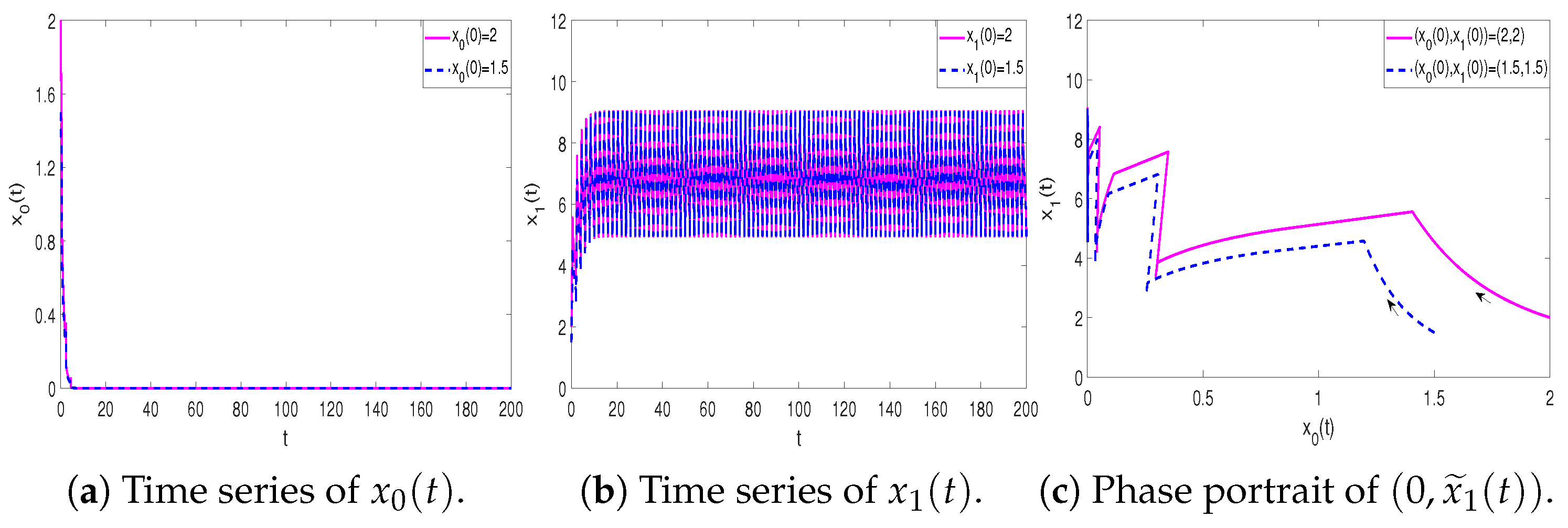
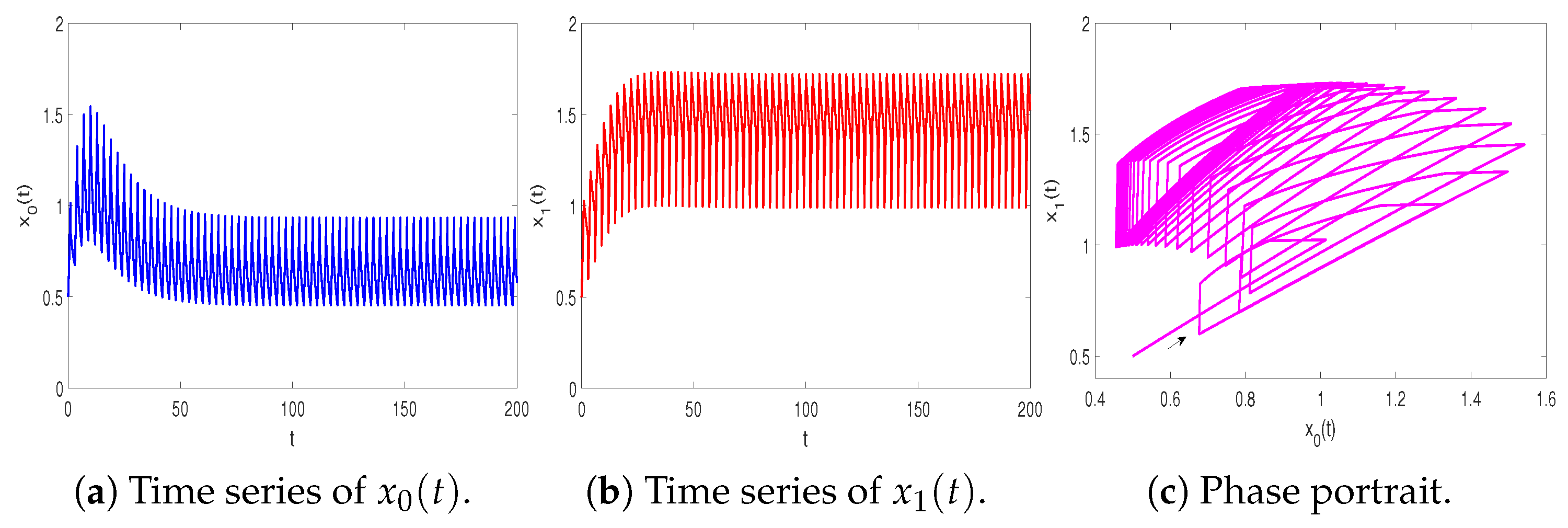
This section employs numerical simulations to achieve three progressive goals: the first is to visually validate the theoretical results of Section 3, demonstrating both extinction and permanence scenarios (Figure 1 and Figure 2). In Figure 1, panels (a), (b), and (c) illustrate the prey population’s decay to zero, the predator’s convergence to a periodic oscillation, and the phase portrait converging to the boundary solution ( 0 , x ˜ 1 ( t ) ) , respectively, thereby visually confirming Theorem 2. Conversely, Figure 2 shows sustained oscillations of both populations, confirming Theorem 2. The second aim is to identify the key management levers by quantifying the influence of major parameters on the extinction threshold condition R 0 through sensitivity analysis (Figure 3, Figure 4 and Figure 5). Figure 3 (the PRCC plot) ranks parameter sensitivity, while Figure 4 and Figure 5 illustrate two-parameter interactions, demonstrating how P, h max , and d 1 jointly modulate R 0 . The third aim is to explore complex dynamics beyond the stable regimes, revealing potential risks (e.g., chaotic fluctuations) that may arise from suboptimal management, thereby extending the theoretical findings to more realistic contexts (Figure 6, Figure 7, Figure 8, Figure 9, Figure 10, Figure 11, Figure 12 and Figure 13). Figure 6, Figure 7, Figure 8, Figure 9, Figure 10, Figure 11, Figure 12 and Figure 13 systematically reveal bifurcations, period-doubling cascades, chaotic transitions, and the coexistence of attractors as key parameters (P, h max , α , d 1 ) are varied, providing a dynamical map of potential management outcomes.
First, to validate the global stability condition in Theorem 2, we select parameters satisfying ( H 1 ) , ( H 2 ) , and ( H 3 ) . The following numerical simulations, conducted using MATLAB R2024a, validate the established theoretical results. The parameter values used in our model are a 10 = 0.6 , b 10 = 0.8 , a 11 = 3 , b 11 = 0.25 , h max = 0.75 , α 0 = 0.76 , d 0 = 0.11 , a 20 = 0.4 , b 20 = 0.2 , α = 15 , ζ 0 = 0.8 , A 0 = 0.05 , B 0 = 1 , d = 0.25 , c 0 = 0.85 , d 1 = 0.11 , P = 2 , θ = 0.25 . The calculations yield the following values:
H 1 = ( 1 d 0 ) ( 1 d 1 ) e a 11 θ P d ( 1 θ ) P = 2.4398 > 1 ,
H 2 = ( 1 d 0 ) ( 1 d 1 ) e a 11 θ P d ( 1 θ ) P 2 ln a 11 + b 11 x * ( e a 11 θ P 1 ) a 11 = 0.9338 < 1 ,
and
H 3 = 1 h max α 0 + b exp a 10 θ P + d ( 1 θ ) P + M = 0.2327 < 1 .
These results satisfy the conditions of Theorem 2. We therefore conclude that the periodic solution ( 0 , x ˜ 1 ( t ) ) of system (2) is globally asymptotically stable (see Figure 1).
As shown in Figure 1, when the parameters satisfy the conditions of Theorem 2, the system exhibits typical prey-extinction dynamics. Specifically, Figure 1a shows that the prey population x 0 ( t ) rapidly decays to zero. Meanwhile, Figure 1b demonstrates that the predator population x 1 ( t ) tends toward a stable periodic oscillation; this behavior is manifested in the phase portrait in Figure 1c as the system trajectory converges to the boundary periodic solution ( 0 , x ˜ 1 ( t ) ) . When the parameters satisfy the conditions of Theorem 2, the system trajectory converges to the boundary periodic solution ( 0 , x ˜ 1 ( t ) ) , i.e., the prey population goes extinct while the predator population exhibits periodic fluctuations. This numerically verifies the theoretically derived extinction threshold. From a management perspective, this state simulates the ecological scenario where, after the collapse of the target fish resource, predation pressure—though at a low level—still recurs periodically due to the existence of migratory sources, thereby highlighting the extreme importance of maintaining the fish population above the extinction threshold.
Figure 1. This figure validates the global asymptotic stability of the prey-extinction periodic solution ( 0 , x ˜ 1 ( t ) ) as stated in Theorem 2. Panel (a) shows the time series of the prey population x 0 ( t ) , which rapidly decays to zero, confirming prey extinction. Panel (b) displays the time series of the predator population x 1 ( t ) , which converges to a stable periodic oscillation; this oscillation is driven by the predator’s intrinsic growth during migration-free periods and mortality during migration, as described by subsystem (3). Panel (c) presents the phase portrait, where the system trajectory converges to the boundary periodic solution ( 0 , x ˜ 1 ( t ) ) , visually confirming the stability of the prey-extinct state. The basic parameters are a 10 = 0.6 , b 10 = 0.8 , a 11 = 3 , b 11 = 0.25 , h max = 0.75 , α 0 = 0.76 , d 0 = 0.11 , a 20 = 0.4 , b 20 = 0.2 , α = 15 , ζ 0 = 0.8 , A 0 = 0.05 , B 0 = 1 , d = 0.25 , c 0 = 0.85 , d 1 = 0.11 , P = 2 , θ = 0.25 .
Axioms 15 00032 g001
Next, to demonstrate the permanence condition in Theorem 3, a different parameter set is used. Setting the model parameters as a 10 = 0.8 , b 10 = 0.15 , a 11 = 0.9 , b 11 = 0.27 , h max = 0.25 , α 0 = 0.9 , d 0 = 0.13 , a 20 = 0.5 , b 20 = 0.22 , α = 0.9 , ζ 0 = 0.4 , A 0 = 0.04 , B 0 = 0.3 , d = 0.2 , c 0 = 0.1 , d 1 = 0.27 , P = 3 , θ = 0.35 , then
H 1 = ( 1 d 0 ) ( 1 d 1 ) e a 11 θ P d ( 1 θ ) P = 1.4284 > 1 ,
and
H 4 = 1 h max α 0 exp ( a 10 θ P + d ( 1 θ ) P + M ) = 5.3298 > 1 ,
which implies that Theorem 3 is satisfied; therefore, system (2) is permanent (see Figure 2).
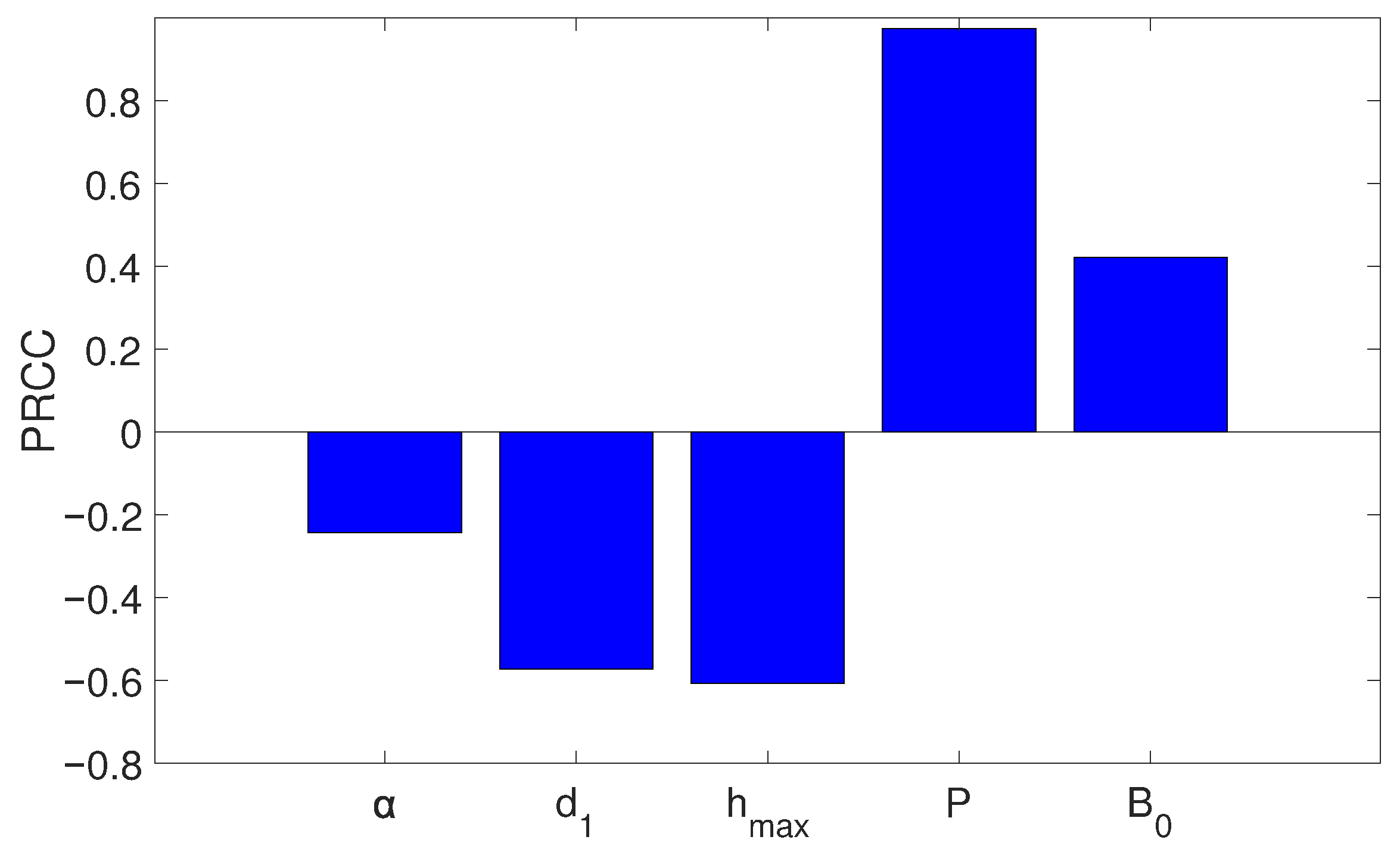
To systematically rank the impact of key parameters on the extinction threshold R 0 , we perform a PRCC (Partial Rank Correlation Coefficient) analysis. This leads us to determine the critical factors governing the prey extinction threshold condition R 0 , and
R 0 = 1 h max α 0 exp a 10 θ P + d ( 1 θ ) P + M .
Figure 2. This figure demonstrates the permanence of system (2) as established in Theorem 3. Panel (a) shows the time series of the prey population x 0 ( t ) , which persists at positive levels with oscillations. Panel (b) shows the corresponding predator population x 1 ( t ) also persisting with oscillations. Panel (c) displays the phase portrait in which the trajectory remains bounded within a positive region of the state space, confirming the long-term coexistence of both populations. The basic parameters are a 10 = 0.8 , b 10 = 0.15 , a 11 = 0.9 , b 11 = 0.27 , h max = 0.25 , α 0 = 0.9 , d 0 = 0.13 , a 20 = 0.5 , b 20 = 0.22 , α = 0.9 , ζ 0 = 0.4 , A 0 = 0.04 , B 0 = 0.3 , d = 0.2 , c 0 = 0.1 , d 1 = 0.27 , P = 3 , and θ = 0.35 .
Axioms 15 00032 g002
Predator fear levels toward prey α , predator migration mortality rate d 1 , prey capture amount h max , pulse period P, and the inter-predator interference coefficient B 0 are selected as research parameters. To thoroughly explore the interactions among key parameters and their combined effects on the system’s threshold condition R 0 , we conduct a systematic sensitivity analysis of P, h max , d 1 , and B 0 in this section. The PRCC values between each parameter and the prey extinction condition R 0 are calculated to evaluate their sensitivity. In this process, the LHS (Latin Hypercube Sampling) method is used to estimate the PRCC values, thereby accurately identifying the parameters that play a decisive role in the prey extinction threshold condition R 0 [44].
Figure 3. The PRCCs of the key parameters ( α , d 1 , h max , P, B 0 ) for the prey extinction threshold condition R 0 . The basic parameters are a 10 = 5 , b 10 = 0.5 , a 11 = 2 , b 11 = 0.5 , h max = 2 , α 0 = 6 , d 0 = 0.2 , a 20 = 4 , b 20 = 0.2 , α = 0.3 , ζ 0 = 0.1 , A 0 = 0.5 , B 0 = 0.5 , d = 0.2 , c 0 = 0.1 , d 1 = 0.2 , P = 3 , and θ = 0.1 .
Axioms 15 00032 g003
As observed in Figure 3, the pulse period P and the predator interference coefficient B 0 are positively correlated with the prey extinction threshold condition R 0 . It has been demonstrated that an increase in P or B 0 raises R 0 , which in turn contributes to an increase in prey density. Conversely, prey fear level α , predator migration mortality d 1 , and maximum prey harvest h max show negative correlations with R 0 . An increase in these parameters decreases R 0 , which ultimately reduces prey density. Further PRCC results indicate that the parameters d 1 , h max , P, and B 0 all demonstrate substantial correlation strengths, with absolute values exceeding 0.4. This demonstrates that these four parameters significantly influence R 0 , thus serving as key regulators of prey population density. From a biological perspective, elevated predator migration mortality d 1 initially leads to a temporary decline in predator abundance. This reduction in density-dependent stress subsequently increases reproductive success and juvenile survival, ultimately triggering a compensatory population surge in the following year. The reinvasion of these recovered predators into prey habitats consequently drives prey population suppression through intensified predation pressure.
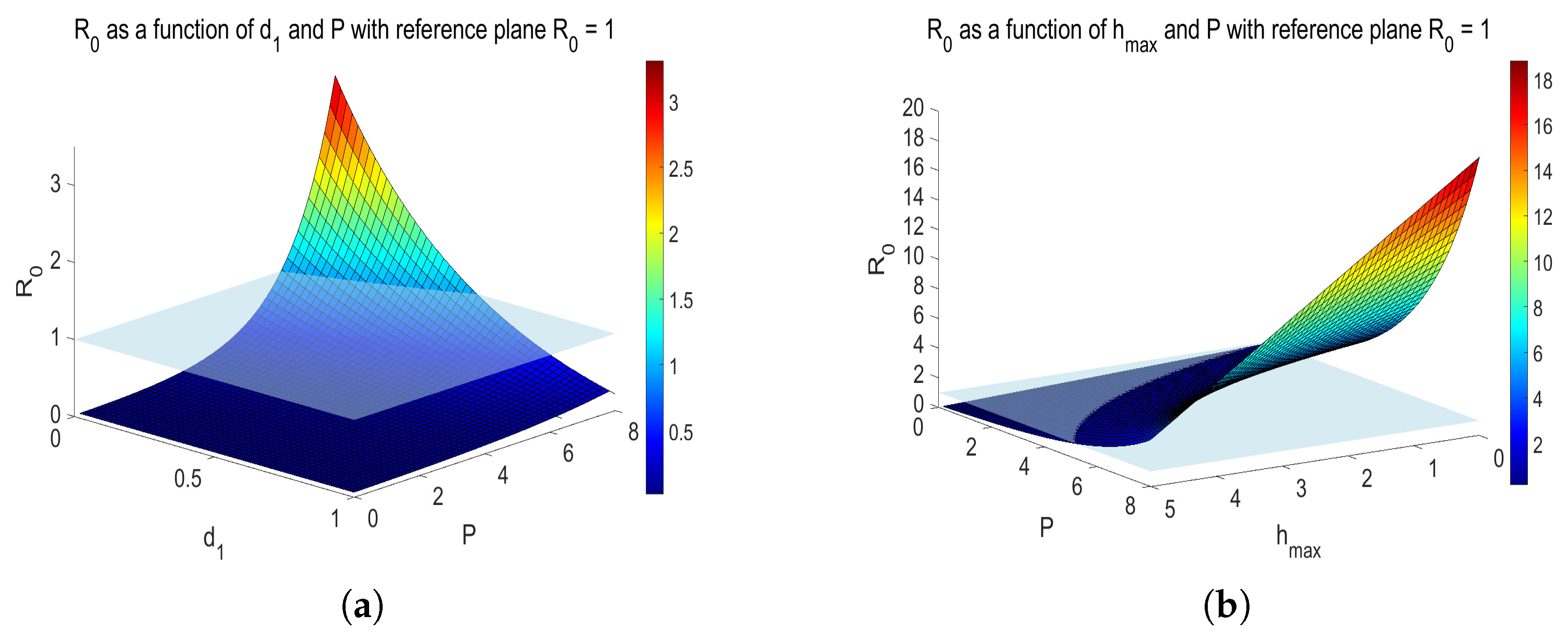
Figure 4. The importance of predator migration mortality rate d 1 , prey capture amount h max , and impulsive period P on the threshold condition R 0 . (a) Effect of predator migration mortality rate d 1 and impulsive period P on R 0 with h max = 5.9 . (b) Effect of prey capture amount h max and impulsive period P on R 0 with d 1 = 0.9 .
Axioms 15 00032 g004
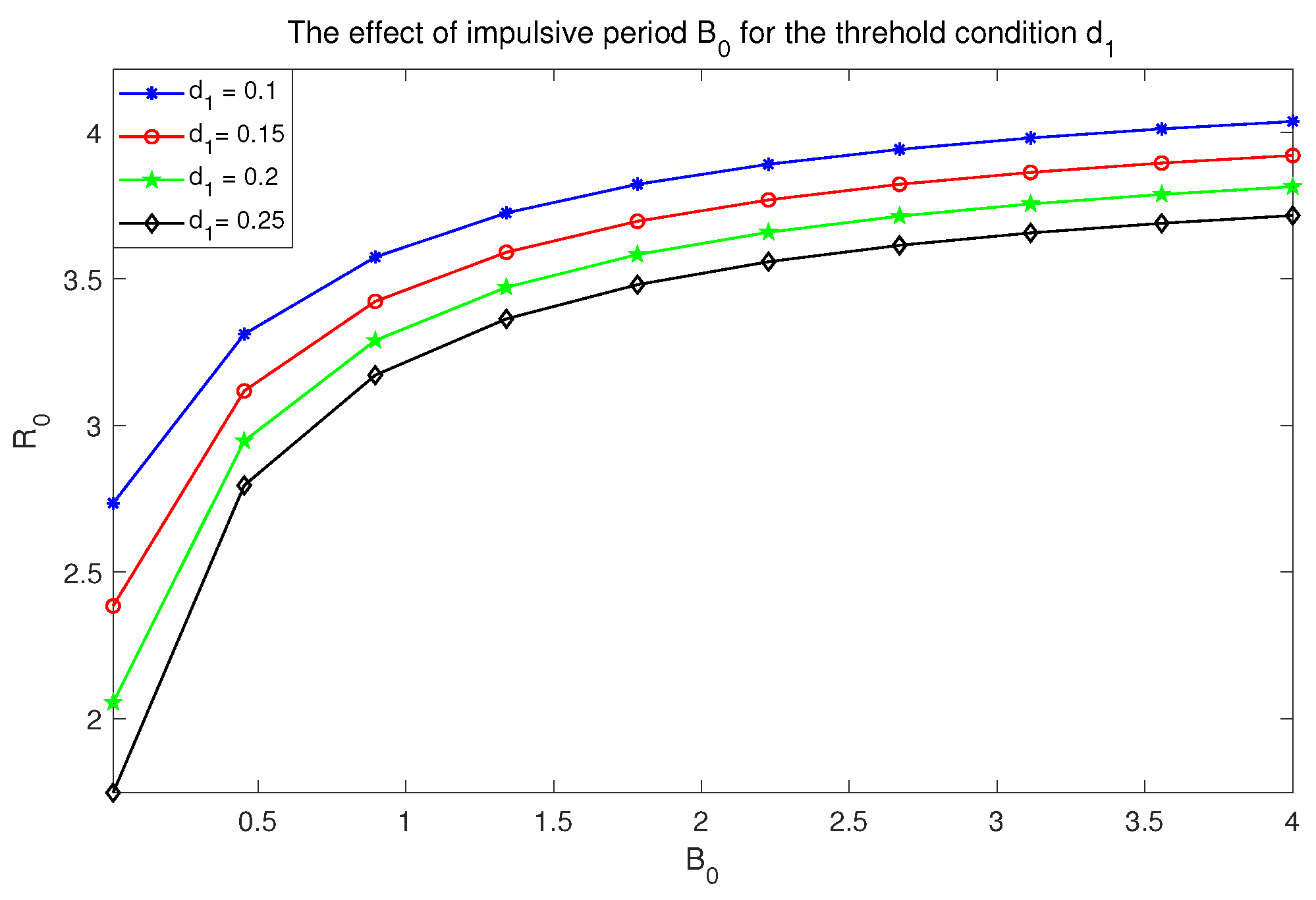
As shown in Figure 4, the impulsive period P, maximum prey harvest amount h max , and predator migration mortality rate d 1 strongly influence the threshold condition R 0 . A higher impulsive period P leads to a higher R 0 . A higher predator migration mortality rate d 1 also increases R 0 . In contrast, a lower maximum prey harvest amount h max decreases R 0 . Therefore, harvesting prey less frequently helps to maintain a larger prey population. The two-parameter analysis (Figure 4) demonstrates that the positive effect of the pulse period P on R 0 is more pronounced at low d 1 or high h max . This finding suggests that tuning the frequency of management interventions (P) is of particular importance in contexts characterized by low predator migration mortality or intense fishing pressure.
Figure 5 reveals that increasing the predator interference coefficient B 0 significantly mitigates top-down control on prey populations. The magnitude of this effect is strongly modulated by predator migration mortality d 1 , with minimal mortality leading to maximal prey survival benefits. Ecological interpretation suggests that low d 1 maintains robust predator populations wherein interference competition B 0 becomes particularly effective at reducing per-capita predation rates. This parameter interaction creates a novel ecological scenario where prey thrive most when predator populations experience both low migration mortality and strong intra-specific interference, highlighting non-linear dependencies in food web regulation. The one-parameter analysis (Figure 5) and its interaction trend with d 1 demonstrate that the regulatory role of predator intraspecific interference B 0 in population dynamics is highly dependent on the intrinsic pressure of the predator population (as indicated by d 1 ), uncovering the nonlinear nature of top-down control processes. The sensitivity and two-parameter analyses collectively demonstrate that the effects of key management levers (e.g., P, h max , d 1 ) are rarely independent. Their interactions can amplify or mitigate each other’s impact on the extinction threshold R 0 , underscoring the necessity for integrated, multi-parameter management strategies rather than isolated adjustments of a single factor.
Figure 5. Parameter dependence of the threshold condition R 0 . Setting the model parameters as a 10 = 5 , b 10 = 0.5 , a 11 = 2 , b 11 = 0.5 , h max = 2 , α 0 = 6 , d 0 = 0.2 , a 20 = 4 , b 20 = 0.2 , α = 0.3 , ζ 0 = 0.1 , A 0 = 0.5 , d = 0.2 , c 0 = 0.1 , P = 3 , θ = 0.1 .
Axioms 15 00032 g005
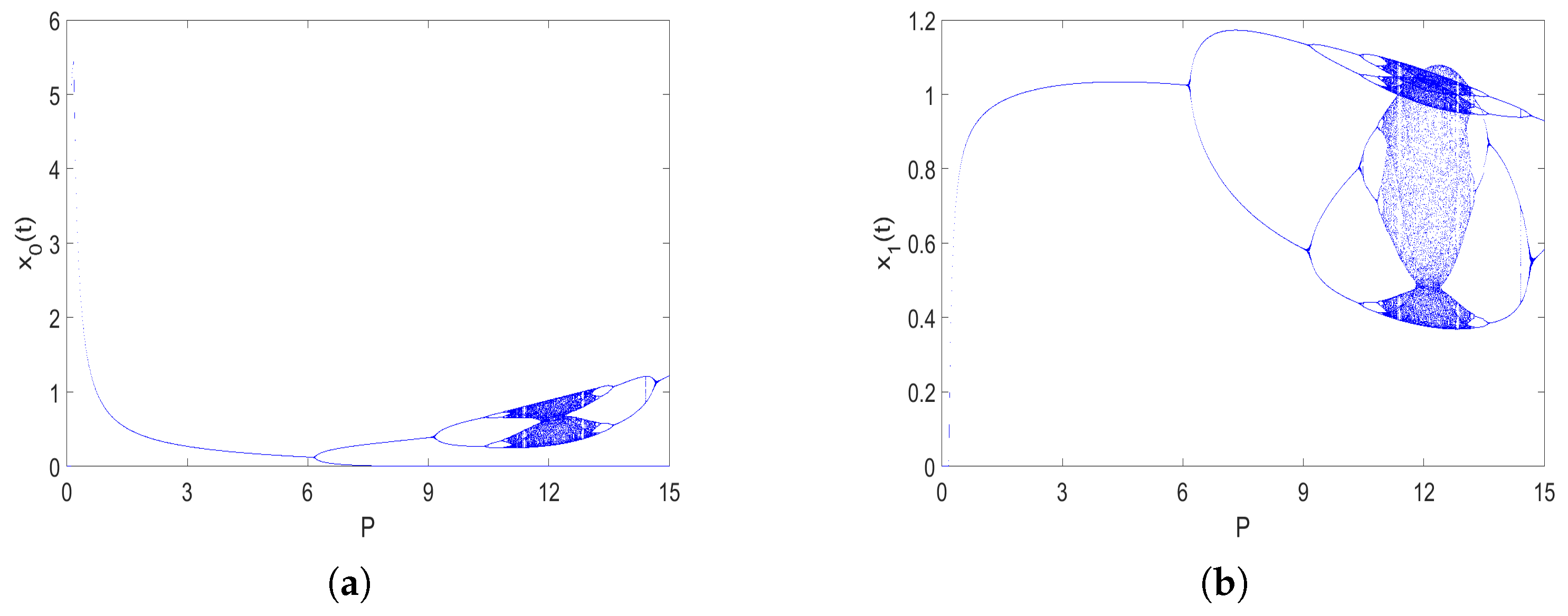
Finally, we explore the complex dynamical behaviors that can emerge outside the stability regimes, taking the pulse period P as a representative example. We proceed to analyze several significant parameters governing the behavioral dynamics of system (2). The following analysis focuses on the role of the impulse period P in governing the dynamics of system (2). Setting the parameters as a 10 = 0.5 , b 10 = 0.1 , a 11 = 0.3 , b 11 = 0.3 , h max = 0.2 , α 0 = 0.5 , d 0 = 0.15 , a 20 = 3 , b 20 = 0.5 , α = 0.1 , ζ 0 = 3.5 , A 0 = 0.2 , B 0 = 0.3 , d = 0.1 , c 0 = 0.3 , d 1 = 0.15 , and θ = 0.3 , we can derive the bifurcation diagrams of predator–prey model (2) with a bifurcation parameter P from 0.01 to 15.
Figure 6. Bifurcation diagrams of system (2) with 0 P 15 . (a) Bifurcation diagram of x 0 ( t ) . (b) Bifurcation diagram of x 1 ( t ) . Setting the parameters as a 10 = 0.5 , b 10 = 0.1 , a 11 = 0.3 , b 11 = 0.3 , h max = 0.2 , α 0 = 0.5 , d 0 = 0.15 , a 20 = 3 , b 20 = 0.5 , α = 0.1 , ζ 0 = 3.5 , A 0 = 0.2 , B 0 = 0.3 , d = 0.1 , c 0 = 0.3 , d 1 = 0.15 , and θ = 0.3 .
Axioms 15 00032 g006
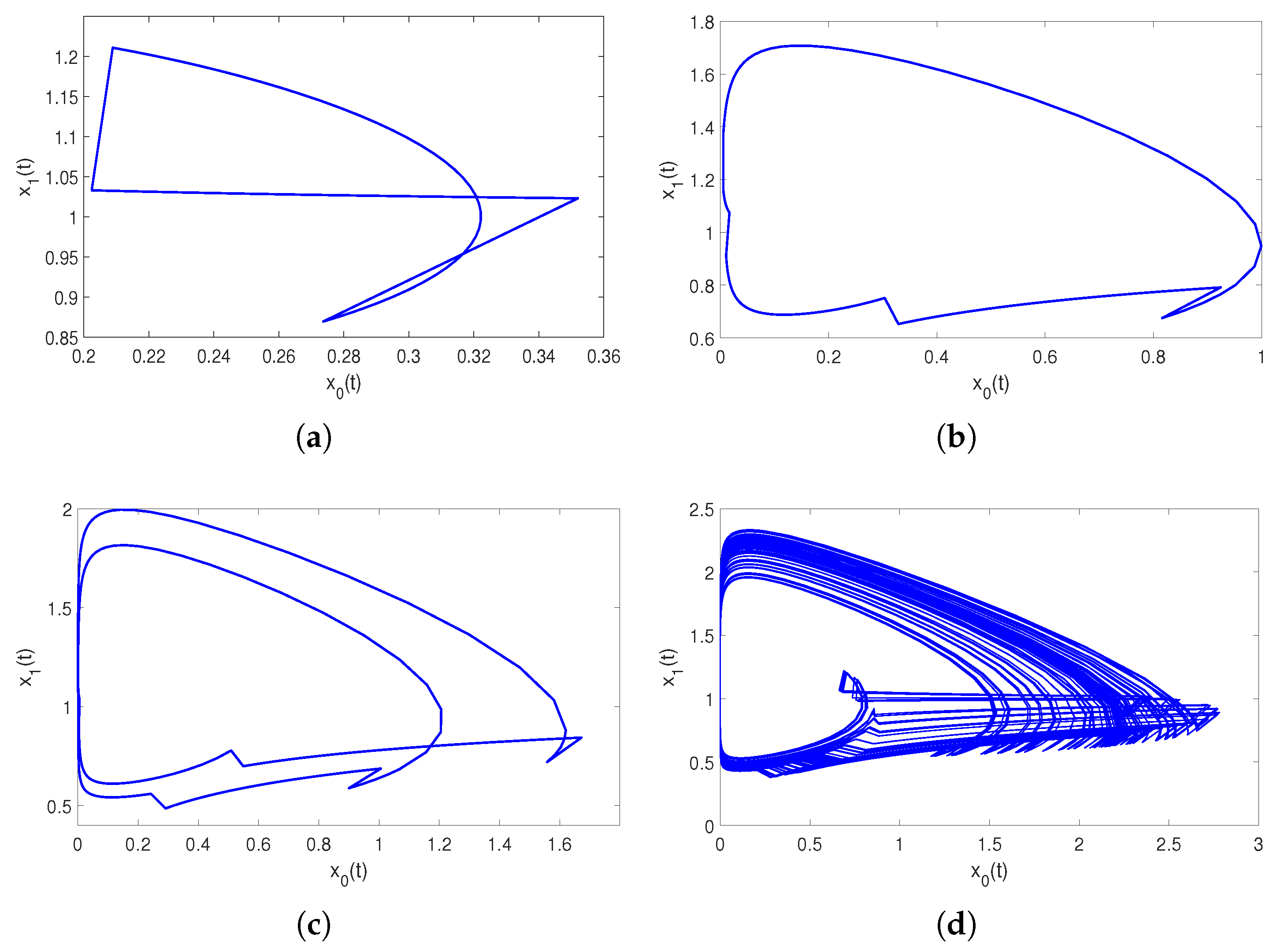
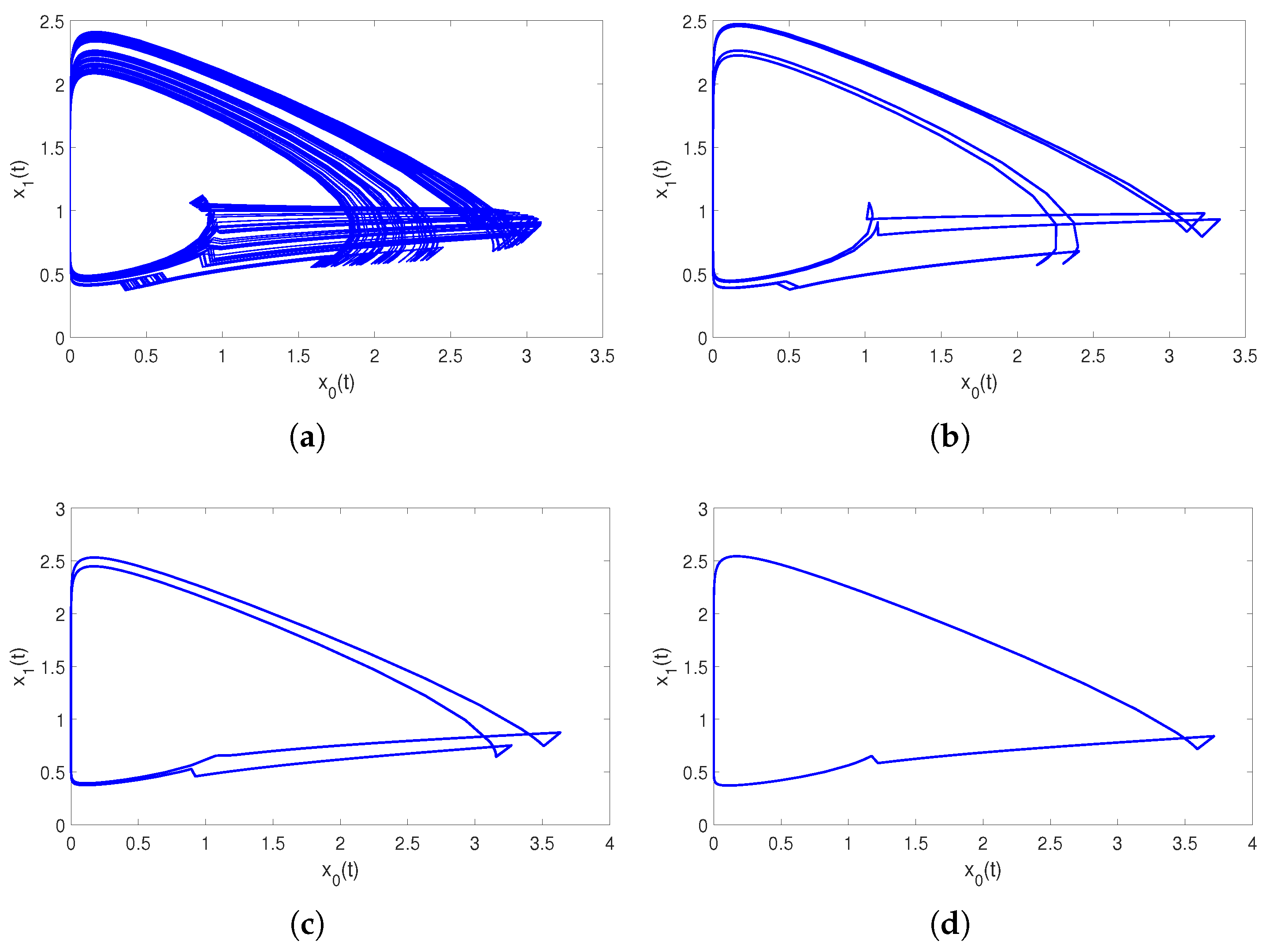
Figure 6 illustrates the complex bifurcation scenario of system (2) under varying impulsive periods P. An increase in P triggers a classical route to chaos through successive period-doubling bifurcations, followed by a reverse sequence of period-halving (inverse period-doubling) bifurcations that restore system order. This complete bifurcation cascade demonstrates the fundamental role of the impulsive period in regulating system dynamics between order and chaos. Notably, chaos emerges in the system when P increases to approximately 12.8 (Figure 8a); as P further rises to 15, the system reverts to a stable P-periodic solution via inverse period-doubling bifurcation. This indicates that there exists a ‘chaotic window’ for the interval of management pulses (P), where an inappropriate interval may lead to unpredictable drastic fluctuations in population size. Supplementary Figure 7 and Figure 8 provide concrete examples of the characteristic behaviors observed during these transitions, numerically verifying the theoretical predictions.
Figure 7. A period-doubling cascade transitions the system from a P-periodic solution to a 4 P -periodic solution. (a) Phase portrait of P-periodic solution when P = 4 . (b) Phase portrait of 2 P -periodic solution when P = 8 . (c) Phase portrait of 4 P -periodic solution when P = 9.6 . (d) Phase portrait of chaos when P = 12 .
Axioms 15 00032 g007
Figure 8. Period-halving bifurcation reduces the system to a P-periodic solution. (a) Phase portrait exhibiting chaotic behavior when P = 12.8 . (b) Phase portrait of the 4 P -periodic solution when P = 13.5 . (c) Phase portrait of the 2 P -periodic solution when P = 14.5 . (d) Phase portrait of the P-periodic solution when P = 15 .
Axioms 15 00032 g008
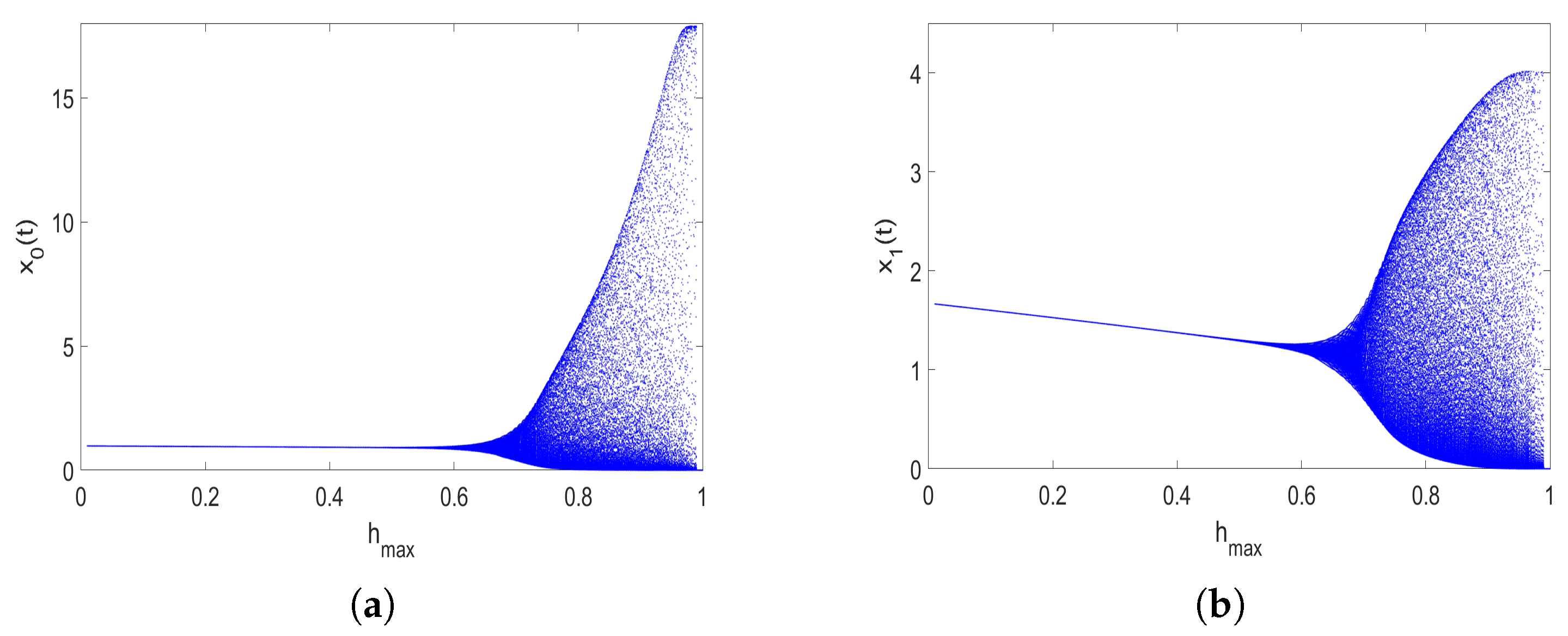
Next, we investigate the influence harvesting ability h max of the prey for system (2). Set the parameters of system (2) as a 10 = 0.4 , b 10 = 0.1 , a 11 = 0.25 , b 11 = 0.25 , α 0 = 0.9 , d 0 = 0.1 , a 20 = 2.8 , b 20 = 0.15 , α = 0.2 , ζ 0 = 2.5 , A 0 = 0.2 , B 0 = 1 , d = 0.1 , c 0 = 0.32 , d 1 = 0.1 , P = 1 , θ = 0.2 , with x 0 ( 0 ) = 0.6 , x 1 ( 0 ) = 0.4 . Figure 9 shows the bifurcation diagrams of system (2) based on the bifurcation parameter h max > 0 .
Figure 9. Bifurcation diagrams of system (2) with the maximum harvest amount h max as the bifurcation parameter (for 0.01 h max < 1 ). (a) Bifurcation diagram of x 0 ( t ) for bifurcation parameter 0.01 h max . (b) Bifurcation diagram of x 1 ( t ) for bifurcation parameter 0.01 h max . Set the parameters of system (2) as a 10 = 0.4 , b 10 = 0.1 , a 11 = 0.25 , b 11 = 0.25 , α 0 = 0.9 , d 0 = 0.1 , a 20 = 2.8 , b 20 = 0.15 , α = 0.2 , ζ 0 = 2.5 , A 0 = 0.2 , B 0 = 1 , d = 0.1 , c 0 = 0.32 , d 1 = 0.1 , P = 1 , and θ = 0.2 .
Axioms 15 00032 g009
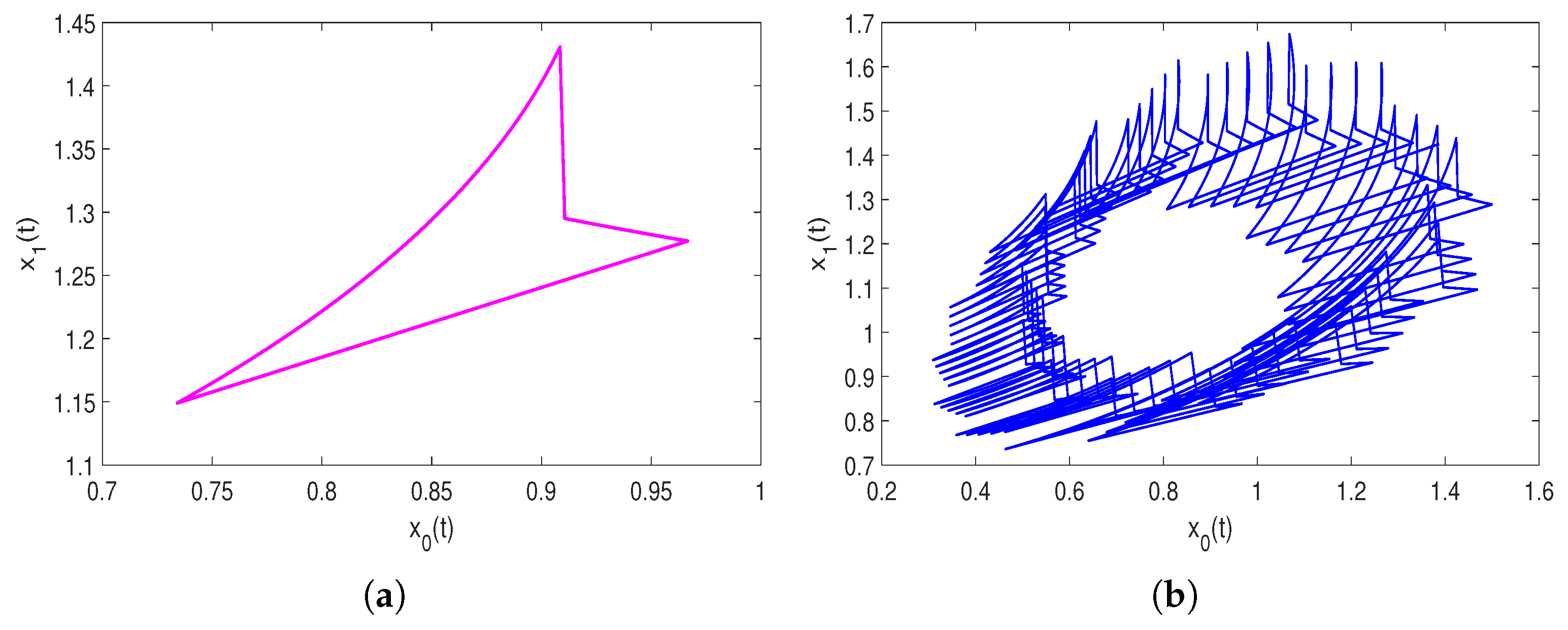
As shown in the bifurcation diagram, the maximum amplitude of system dynamics remains relatively stable. Figure 10 shows that with the increase in fishing intensity h max , the system undergoes an abrupt transition from a P-periodic solution to chaotic behavior, which represents the occurrence of a crisis-induced chaotic transition. Specifically, when h max exceeds the critical value (∼0.6), the system completely loses stability, ultimately leading to the extinction of both prey and predator populations (i.e., population collapse). This result provides a key dynamical basis for setting the “maximum allowable catch” in fishery management.
Figure 10. System (2) suddenly changes from a P-periodic solution to chaos. (a) Phase portrait of P-periodic solution when h max = 0.5 . (b) Phase portrait of chaos when h max = 0.7 .
Axioms 15 00032 g010
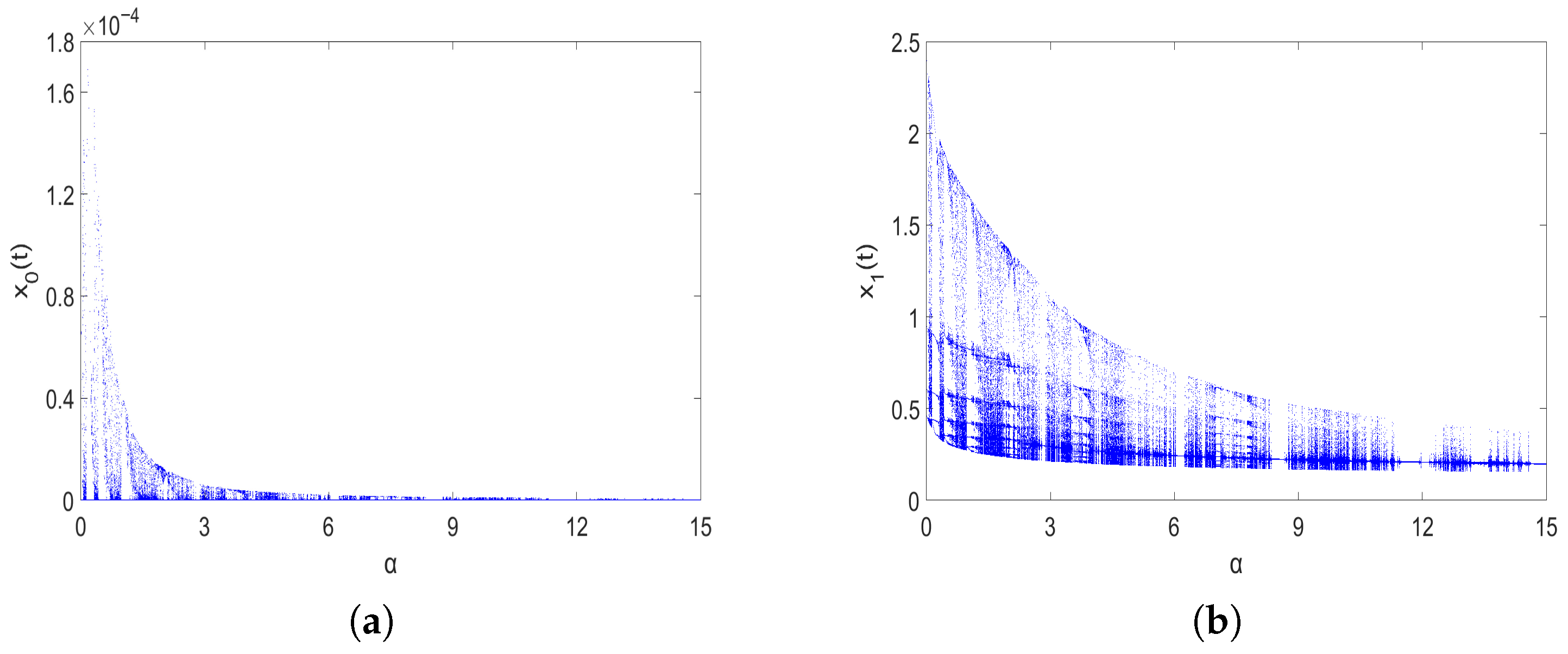
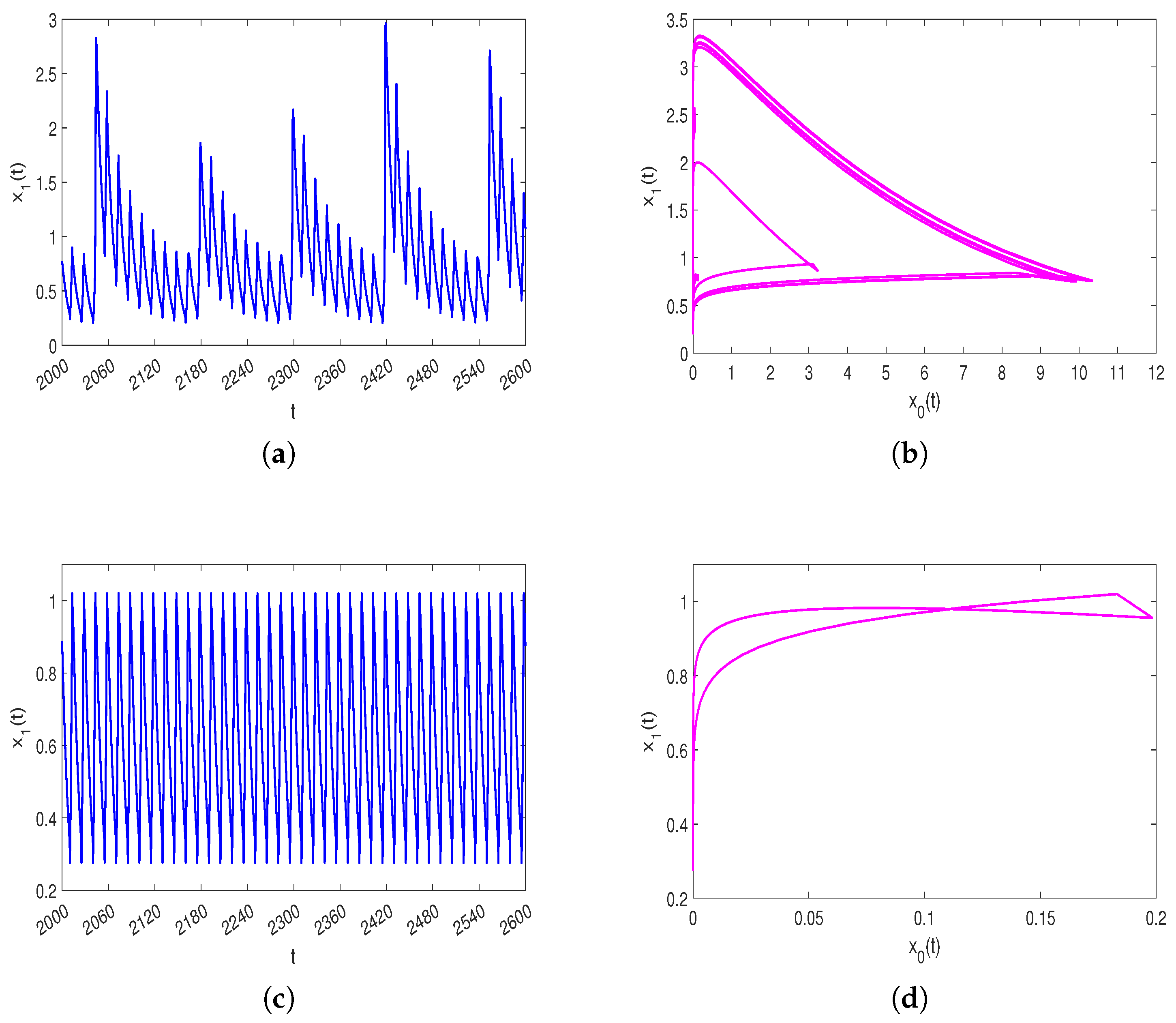
Suppose the parameters of system (2) are a 10 = 5 , b 10 = 0.1 , a 11 = 0.5 , b 11 = 0.1 , h max = 0.1 , α 0 = 0.5 , d 0 = 0.08 , a 20 = 2 , b 20 = 0.5 , ζ 0 = 5 , A 0 = 0.01 , B 0 = 1 , d = 0.1 , c 0 = 0.5 , d 1 = 0.15 , P = 15 , θ = 0.2 . Bifurcation diagrams of system (2) are computed for parameter α in the range [0.01, 15] (see Figure 11). Figure 11 shows that different attractors will coexist for the same fear level alpha. Figure 12 demonstrates that strange attractors coexist with a 4 P -periodic solution at α = 3.72 .
Figure 11. Bifurcation diagram of system (2) with fear level α as the bifurcation parameter. (a) Bifurcation diagram of x 0 ( t ) . (b) Bifurcation diagram of x 1 ( t ) . Suppose the parameters of system (2) are a 10 = 5 , b 10 = 0.1 , a 11 = 0.5 , b 11 = 0.1 , h max = 0.1 , α 0 = 0.5 , d 0 = 0.08 , a 20 = 2 , b 20 = 0.5 , ζ 0 = 5 , A 0 = 0.01 , B 0 = 1 , d = 0.1 , c 0 = 0.5 , d 1 = 0.15 , P = 15 , and θ = 0.2 .
Axioms 15 00032 g011
Figure 12. When α = 3.72 , the 4 P -periodic solution and P-periodic solution coexist. (a) Time series of x 1 ( t ) with ( x 0 ( 0 ) , x 1 ( 0 ) = ( 0.6 , 0.4 ) ) . (b) The solution with ( x 0 ( 0 ) , x 1 ( 0 ) = ( 0.6 , 0.4 ) ) tends to a 4 P -periodic solution. (c) Time series of x 1 ( t ) with ( x 0 ( 0 ) , x 1 ( 0 ) = ( 2 , 2 ) ) . (d) The solution with x 0 ( 0 ) = 2 , x 1 ( 0 ) = 2 tends to a 4 P -periodic solution.
Axioms 15 00032 g012
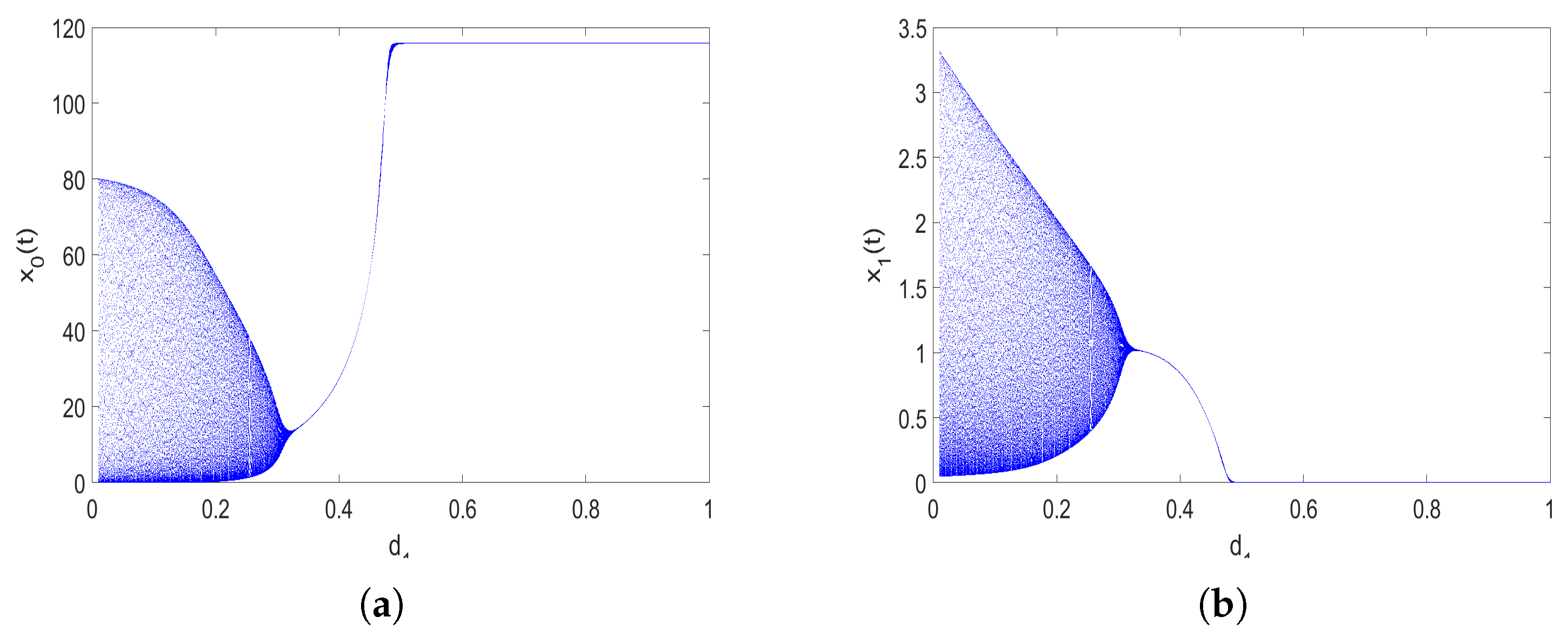
Similarly to Figure 6, Figure 9 and Figure 11, we set the model parameters as a 10 = 1 , b 10 = 0.2 , a 11 = 0.1 , b 11 = 0.1 , h max = 0.2 , α 0 = 0.5 , d 0 = 0.1 , a 20 = 2 , b 20 = 0.01 , α = 1 , ζ 0 = 2 , A 0 = 0.2 , B 0 = 0.3 , d = 0.1 , c 0 = 0.1 , P = 1 , and θ = 0.1 . We obtained the bifurcation diagram of system (2) with respect to the bifurcation parameter d 1 ranging from 0.01 to 1 (see Figure 13). Figure 13 shows that as the predator migration mortality rate d1 increases, the system will transition from chaos to a P-periodic solution.
Figure 13. Bifurcation diagrams of system (2) with the predator migration mortality rate d 1 as the bifurcation parameter (for 0.01 d 1 1 ). (a) Bifurcation diagram of x 0 ( t ) for the bifurcation parameter d 1 . (b) Bifurcation diagram of x 1 ( t ) for the bifurcation parameter d 1 . Set the model parameters as a 10 = 1 , b 10 = 0.2 , a 11 = 0.1 , b 11 = 0.1 , h max = 0.2 , α 0 = 0.5 , d 0 = 0.1 , a 20 = 2 , b 20 = 0.01 , α = 1 , ζ 0 = 2 , A 0 = 0.2 , B 0 = 0.3 , d = 0.1 , c 0 = 0.1 , P = 1 , and θ = 0.1 .
Axioms 15 00032 g013
When the mortality rate of predators, denoted by d 1 , is minimal, predators exert a substantial influence on their prey. The population dynamics of both species demonstrate chaotic behaviour. When the value of d 1 exceeds the critical value of approximately 0.47, a significant proportion of predators perish. The growth rate of prey populations increases exponentially before stabilising, a phenomenon that can be attributed to a significant decrease in predation pressure. A decline in population numbers or even extinction is often the consequence of excessively high mortality rates.
From a management perspective, the discovery of complex dynamical behaviors (e.g., bifurcations and chaos) carries significant implications. It indicates that within specific parameter regions, the long-term evolutionary behavior of the system is highly sensitive to initial conditions and parameter perturbations, which significantly increases the difficulty and potential risks of practical management. Therefore, in the practice of fishery resource management, efforts should be made to avoid setting system parameters within these “sensitive regions” to reduce the unpredictability of population dynamics.
In summary, the exploration beyond stable regimes reveals that the system can exhibit rich dynamics, including periodic doubling, chaos, and the coexistence of attractors, particularly when key parameters like the pulse period P, harvesting intensity h max , or fear level α exceed certain ranges. These findings provide crucial additional insights: (1) They delineate “danger zones” in parameter space where management outcomes become highly unpredictable or sensitive to initial conditions. (2) The presence of chaotic or high-periodic oscillations implies that even in the absence of extinction, populations may undergo severe fluctuations that threaten economic stability and ecosystem health. (3) Therefore, effective management must consider not only the extinction threshold but also the broader dynamical landscape to avoid inadvertently pushing the system into a volatile, though persistent, state.

5. Conclusions

This study formulates a predator–prey model with a Beddington–DeAngelis functional response that incorporates prey fear, large-scale predator migration, and impulsive density-dependent nonlinear harvesting. Through theoretical analysis and numerical simulations, it provides theoretical support for sustainable resource management. The main contributions of this work are threefold: first, we theoretically derive explicit extinction and permanence thresholds (Theorems 1–3), which provide mathematically rigorous boundaries for sustainable harvesting. Second, through systematic numerical exploration (Figure 1, Figure 2, Figure 3, Figure 4, Figure 5, Figure 6, Figure 7, Figure 8, Figure 9, Figure 10, Figure 11, Figure 12 and Figure 13), we identify and quantify the key parameters (P, h max , d 1 , B 0 , α ) that govern system dynamics, highlighting their interactions and nonlinear effects. Third, we uncover complex dynamical regimes (bifurcations, chaos) that emerge outside stability boundaries, revealing previously unrecognized risks in fishery management. These findings collectively advance the field of impulsive bioeconomic modeling by integrating multiple ecological mechanisms (fear, migration, nonlinear harvesting) and by providing both theoretical benchmarks and practical insights for adaptive management. Specifically, the results suggest that management strategies should simultaneously regulate harvesting intensity ( h max ), timing (P), and consider predator migration mortality ( d 1 ) to maintain populations within safe dynamical regimes, thereby preventing both extinction and economically destabilizing fluctuations. The results demonstrate that the scientific and coordinated regulation of the maximum harvesting intensity h max and the management intervention frequency pulse period P is the key pathway to steering the system towards permanence and avoiding the risk of prey extinction. Here, h max establishes the foundation for an adaptive harvesting strategy based on population density, while P serves as a crucial temporal lever for balancing short-term economic benefits with long-term ecological stability. Future fishery management practices should strive to integrate this theoretical framework with field monitoring data to develop more precise and sustainable harvesting strategies.
We first prove the uniform boundedness of all solutions. Subsequently, we establish the local and global asymptotic stability conditions for the prey-extinction periodic solution ( 0 , x ˜ 1 ( t ) ) , derive the criteria for system permanence, and determine the precise threshold condition for prey extinction. Second, numerical simulations were conducted. These not only confirmed the validity of the theoretical results but also identified the core influencing factors. Specifically, sensitivity analysis revealed four key parameters. The prey extinction threshold condition is primarily governed by four critical parameters: the predator migration mortality rate d 1 , the maximum prey capture amount h max , the pulse period P, and the inter-predator interference coefficient B 0 . A two-parameter sensitivity analysis demonstrated that both the pulse period P and interference coefficient B 0 are positively correlated with this threshold. Consequently, increasing either parameter strengthens the threshold condition, thereby enhancing the likelihood of prey population persistence. The predator migration mortality rate d 1 and maximum prey capture amount h max showed a negative correlation with the prey extinction threshold R 0 . Increases in these parameters pushed the prey population closer to extinction. These results suggest that extending the pulse period P and strengthening predator interference B 0 can improve prey survival chances. In contrast, high predator migration mortality d 1 or increased prey capture h max will markedly elevate extinction risk. Therefore, management strategies should maintain appropriate pulse intervals and mitigate predator interference while avoiding excessive migration mortality and overharvesting. Finally, this study analyzed four key parameters including fear level α , predator migration mortality rate d 1 , maximum prey capture amount h max , and pulse period P. These parameters significantly influenced the system state, with the pulse period P having a particularly strong effect. A suitable value of P could stabilize the population dynamics of both prey and predators. In addition, through systematic parameter interaction analysis, we found that the effect of the pulse period P is closely correlated with predator mortality d 1 and fishing intensity h max , which underscores the necessity of integrated management strategies. Exploration of the dynamics outside the stability domain revealed the existence of bifurcation and chaotic behaviors in the system, alerting us to the risk that inappropriate management may trigger unpredictable drastic fluctuations in populations. In summary, these results provide reliable theoretical support for fishery management. They offer guidance for scientifically regulating fishing effort, protecting biodiversity, preventing overfishing, and ensuring the sustainable supply of fishery resources.
It should be emphasized that all of the above conclusions are derived under several simplifying assumptions, including deterministic impulsive harvesting, a fixed predator migration mortality rate, and a time-invariant representation of the prey fear response. These assumptions make it possible to obtain explicit extinction thresholds, stability domains, and bifurcation structures, but they inevitably restrict the range of dynamical behaviours that the model can capture. In real ecosystems, stochastic fluctuations in harvesting effort, migration losses, or behavioural responses may strongly interact with nonlinear functional responses and impulsive effects, thereby shifting extinction thresholds, modifying system robustness, and generating richer short-term dynamics such as noise-induced oscillations, transient population bursts, or regime shifts [24,45,46]. Consequently, the stability, permanence and bifurcation results obtained here should be interpreted as baseline predictions for systems in which environmental and management variability are moderate, and caution is required when extrapolating these findings to strongly stochastic settings.
Building on these limitations, many meaningful questions remain for future research. For example, how can we determine the optimal pulse control period P to achieve an appropriate balance between harvesting yield and ecological risk? If we consider stage structure in predators or prey, what kind of dynamic behavior will the system exhibit? If stochastic variability is introduced into capture intensity, migration loss, or fear responses, and additional mechanisms such as adaptive fear responses or cooperative hunting are incorporated, what kind of dynamic behavior will the system exhibit? Meanwhile, the current model primarily considers the impact of the fear effect on the prey population. In reality, the fear effect may also significantly influence predator behavior and functional response parameters. Investigating how fear shapes predator foraging strategies remains a meaningful direction for future research.


Author Contributions

Writing—Original draft and editing, B.G.; Conceptualization, Writing—Review, editing and Funding acquisition, Z.Z.; Editing, Guidance, J.J.; Validation, S.Z. All authors have read and agreed to the published version of the manuscript.

Funding

This work is supported by National Natural Science Foundation of China (No. 12261018), Graduate Program of Guizhou University of Finance and Economics, China (No. 2025BAZYSY198).

Data Availability Statement

No new data were created or analyzed in this study.

Conflicts of Interest

The authors declare no conflict of interest.

References

  1. Hicks, C.; Cohen, P.; Graham, N. Harnessing global fisheries to tackle micronutrient deficiencies. Nature 2019, 574, 95–98. [Google Scholar] [CrossRef] [PubMed]
  2. Xia, L.; Robock, A.; Scherrer, K.; Harrison, C.S.; Bodirsky, B.L.; Weindl, I.; Jägermeyr, J.; Bardeen, C.G.; Toon, O.B.; Heneghan, R. Global food insecurity and famine from reduced crop, marine fishery and livestock production due to climate disruption from nuclear war soot injection. Nat. Food 2022, 3, 586–596. [Google Scholar] [CrossRef]
  3. Free, C.M.; Cabral, R.B.; Froehlich, H.E.; Battista, W.; Ojea, E.; O’Reilly, E.; Palardy, J.E.; García Molinos, J.; Siegel, K.J.; Arnason, R.; et al. Expanding ocean food production under climate change. Nature 2022, 605, 490–496. [Google Scholar] [CrossRef]
  4. Edgar, G.J.; Bates, A.E.; Krueck, N.C.; Baker, S.C.; Stuart-Smith, R.D.; Brown, C.J. Stock assessment models overstate sustainability of the world’s fisheries. Science 2024, 385, 860–865. [Google Scholar] [CrossRef]
  5. Roberts, C.; Béné, C.; Bennett, N.; Boon, J.S.; Cheung, W.W.; Cury, P.; Defeo, O.; De Jong Cleyndert, G.; Froese, R.; Gascuel, D.; et al. Rethinking sustainability of marine fisheries for a fast-changing planet. npj Ocean Sustain. 2024, 3, 41. [Google Scholar] [CrossRef]
  6. Dänhardt, J.; Lindström, Å. Optimal departure decisions of songbirds from an experimental stopover site and the significance of weather. Anim. Behav. 2001, 62, 235–243. [Google Scholar] [CrossRef]
  7. Gu, Z.; Dixon, A.; Zhan, X. Genetics and evolution of bird migration. Annu. Rev. Anim. Biosci. 2024, 12, 21–43. [Google Scholar] [CrossRef]
  8. Dingle, H.; Drake, V.A. What Is Migration? BioScience 2007, 57, 113–121. [Google Scholar] [CrossRef]
  9. Saraux, C.; Sydeman, W.J.; Piatt, J.F.; Anker-Nilssen, T.; Hentati-Sundberg, J.; Bertrand, S.; Cury, P.M.; Furness, R.W.; Mills, J.A.; Österblom, H.; et al. Seabird-induced natural mortality of forage fish varies with fish abundance: Evidence from five ecosystems. Fish Fish. 2021, 22, 262–279. [Google Scholar] [CrossRef]
  10. Boström, M.K.; Lunneryd, S.-G.; Karlsson, L.; Ragnarsson, B. Cormorant impact on trout (Salmo trutta) and salmon (Salmo salar) migrating from the river Dalälven emerging in the Baltic Sea. Fish. Res. 2009, 98, 16–21. [Google Scholar] [CrossRef]
  11. Hebert, C.E.; Morrison, H.A. Consumption of Fish and Other Prey Items by Lake Erie Waterbirds. J. Great Lakes Res. 2003, 29, 213–227. [Google Scholar] [CrossRef]
  12. Food and Agriculture Organization of the United Nations. The State of World Fisheries and Aquaculture 2022: Towards Blue Transformation; FAO: Rome, Italy, 2022. [Google Scholar] [CrossRef]
  13. Warzybok, P.; Santora, J.A.; Ainley, D.G.; Bradley, R.W.; Field, J.C.; Capitolo, P.J.; Carle, R.D.; Elliott, M.; Beck, J.N.; McChesney, G.J.; et al. Prey switching and consumption by seabirds in the central California Current upwelling ecosystem: Implications for forage fish management. J. Mar. Syst. 2018, 185, 25–39. [Google Scholar] [CrossRef]
  14. Xiao, Y.; Chen, L. Modeling and analysis of a predator–prey model with disease in the prey. Math. Biosci. 2001, 171, 59–82. [Google Scholar] [CrossRef] [PubMed]
  15. Liu, B.; Zhang, Y.; Chen, L. The dynamical behaviors of a Lotka–Volterra predator–prey model concerning integrated pest management. Nonlinear Anal. Real World Appl. 2005, 6, 227–243. [Google Scholar] [CrossRef]
  16. Prathumwan, D.; Trachoo, K.; Maiaugree, W.; Chaiya, I. Preventing extinction in Rastrelliger brachysoma using an impulsive mathematical model. AIMS Math. 2022, 7, 1–24. [Google Scholar] [CrossRef]
  17. Jiao, J.; Quan, Q.; Dai, X. Dynamics of a new impulsive predator–prey model with predator population seasonally large-scale migration. Appl. Math. Lett. 2022, 132, 108096. [Google Scholar] [CrossRef]
  18. Jiao, J.; Xiao, Y.; Jiao, H. Dynamics of a switched predator–prey breeding management model with impulsive nonlinear releasing and age-selective harvesting predator. Adv. Contin. Discret. Model. 2025, 2025, 101. [Google Scholar] [CrossRef]
  19. Jiao, J.; Dai, X.; Quan, Q. Dynamics of a pest-nature enemy model for IPM with repeatedly releasing natural enemy and impulsively spraying pesticides. Adv. Contin. Discret. Model. 2025, 2025, 52. [Google Scholar] [CrossRef]
  20. Zhou, Z.; Jiao, J.; Dai, X.; Wu, L. Dynamics of a Predator–Prey System with Impulsive Stocking Prey and Nonlinear Harvesting Predator at Different Moments. Mathematics 2024, 12, 2369. [Google Scholar] [CrossRef]
  21. Quan, Q.; Wang, M.; Jiao, J. Dynamics of a predator–prey fishery model with birth pulse, impulsive releasing and harvesting on prey. J. Appl. Math. Comput. 2024, 70, 3011–3031. [Google Scholar] [CrossRef]
  22. Liu, Y.; Guo, L.; Liu, X. Dynamical Behaviors in a Stage-Structured Model with a Birth Pulse. Mathematics 2023, 11, 3321. [Google Scholar] [CrossRef]
  23. Zhao, T.; Tang, S. Impulsive harvesting and by-catch mortality for the theta logistic model. Appl. Math. Comput. 2011, 217, 9412–9423. [Google Scholar] [CrossRef]
  24. Li, C.; Cheng, D.; Feng, X.; Liu, M. Complex dynamics of a nonlinear impulsive control predator-prey model with Leslie-Gower and B-D functional response. AIMS Math. 2024, 9, 14454–14472. [Google Scholar] [CrossRef]
  25. Li, C.; Tang, S. Analyzing a generalized pest-natural enemy model with nonlinear impulsive control. Open Math. 2018, 16, 1390–1411. [Google Scholar] [CrossRef]
  26. Cheng, H.; Xu, H.; Fu, J. Dynamic analysis of a phytoplankton-fish model with the impulsive feedback control depending on the fish density and its changing rate. Math. Biosci. Eng. 2023, 20, 8103–8123. [Google Scholar] [CrossRef] [PubMed]
  27. Follana-Berná, G.; Arechavala-Lopez, P.; Ramirez-Romero, E.; Koleva, E.; Grau, A.; Palmer, M. Mesoscale assessment of sedentary coastal fish density using vertical underwater cameras. Fish. Res. 2022, 253, 106362. [Google Scholar] [CrossRef]
  28. Palm, D.; Losee, J.; Holmgren, A.; Englund, J.-E.; Hellström, G. Effects of egg stocking on density, distribution, and size of young-of-year brown trout (Salmo trutta) in a large boreal river in northern Sweden. Fish. Manag. Ecol. 2023, 31, e12658. [Google Scholar] [CrossRef]
  29. Lamberg, A.; Imsland, A.K.D. Using Merged Pre-Fishery Abundance as a Parameter Evaluating the Status of Atlantic Salmon and Anadromous Brown Trout Populations: A Norwegian Case Study. Fishes 2022, 7, 264. [Google Scholar] [CrossRef]
  30. Zhang, H.; Georgescu, P.; Chen, L. On the impulsive controllability and bifurcation of a predator–pest model of IPM. Biosystems 2008, 93, 151–171. [Google Scholar] [CrossRef]
  31. Zhou, Z.; Quan, Q.; Jiao, J.; Dai, X. Bifurcation dynamics of a predator–prey model with impulsive density-dependent nonlinear pesticide spraying and predator release. Commun. Nonlinear Sci. Numer. Simul. 2025, 150, 108979. [Google Scholar] [CrossRef]
  32. Allen, M.C.; Clinchy, M.; Zanette, L.Y. Fear of predators in free-living wildlife reduces population growth over generations. Proc. Natl. Acad. Sci. USA 2022, 119, e2112404119. [Google Scholar] [CrossRef]
  33. Valerio, A.; Borrego, C.S.; Boitani, L.; Casadei, L.; Giuliani, A.; Wielgus, R.B.; Simek, S.L.; Valerio, M. Detecting the effects of predator-induced stress on the global metabolism of an ungulate prey using fecal metabolomic fingerprinting. Sci. Rep. 2021, 11, 6129. [Google Scholar] [CrossRef] [PubMed]
  34. Elliott, K.H.; Betini, G.S.; Dworkin, I.; Norris, D.R. Experimental evidence for within-and cross-seasonal effects of fear on survival and reproduction. J. Anim. Ecol. 2016, 85, 507–515. [Google Scholar] [CrossRef] [PubMed]
  35. Zanette, L.Y.; Hobbs, E.C.; Witterick, L.E.; MacDougall-Shackleton, S.A.; Clinchy, M. Predator-induced fear causes PTSD-like changes in the brains and behaviour of wild animals. Sci. Rep. 2019, 9, 11474. [Google Scholar] [CrossRef] [PubMed]
  36. Koleček, J.; Reif, J.; Šálek, M.; Hanzelka, J.; Sottas, C.; Kubelka, V. Global population trends in shorebirds: Migratory behaviour makes species at risk. Sci. Nat. 2021, 108, 9. [Google Scholar] [CrossRef]
  37. Carrizo, V.; Valenzuela, C.A.; Zuloaga, R.; Aros, C.; Altamirano, C.; Valdés, J.A.; Molina, A. Effect of cortisol on the immune-like response of rainbow trout (Oncorhynchus mykiss) myotubes challenged with Piscirickettsia salmonis. Vet. Immunol. Immunopathol. 2021, 237, 110240. [Google Scholar] [CrossRef]
  38. Butzge, A.J.; Yoshinaga, T.T.; Acosta, O.D.M.; Fernandino, J.I.; Sanches, E.A.; Tabata, Y.A.; de Oliveira, C.; Takahashi, N.S.; Hattori, R.S. Early warming stress on rainbow trout juveniles impairs male reproduction but contrastingly elicits intergenerational thermotolerance. Sci. Rep. 2021, 11, 17053. [Google Scholar] [CrossRef]
  39. Barton, B.A.; Iwama, G.K. Physiological changes in fish from stress in aquaculture with emphasis on the response and effects of corticosteroids. Annu. Rev. Fish Dis. 1991, 1, 3–26. [Google Scholar] [CrossRef]
  40. Gallagher, A.J.; Lawrence, M.J.; Jain-Schlaepfer, S.M.R.; Wilson, A.D.M.; Cooke, S.J. Avian predators transmit fear along the air–water interface influencing prey and their parental care. Can. J. Zool. 2016, 94, 863–870. [Google Scholar] [CrossRef]
  41. Hulthén, K.; Chapman, B.B.; Nilsson, P.A.; Vinterstare, J.; Hansson, L.-A.; Skov, C.; Brodersen, J.; Baktoft, H.; Brönmark, C. Escaping peril: Perceived predation risk affects migratory propensity. Biol. Lett. 2015, 11, 20150466. [Google Scholar] [CrossRef]
  42. Courbin, N.; Pichegru, L.; Seakamela, M.; Makhado, A.; Meÿer, M.; Kotze, P.G.; Mc Cue, S.A.; Péron, C. Seascapes of fear and competition shape regional seabird movement ecology. Commun. Biol. 2022, 5, 208. [Google Scholar] [CrossRef]
  43. Lakshmikantham, V.; Bainov, D.D.; Simeonov, P.S. Theory of Impulsive Differential Equations; World Scientific: Singapore, 1989. [Google Scholar]
  44. Liu, B.; Kang, B.L.; Tao, F.M.; Hu, G. Modelling the Effects of Pest Control with Development of Pesticide Resistance. Acta Math. Appl. Sin. Engl. Ser. 2021, 37, 109–125. [Google Scholar] [CrossRef]
  45. Marino, S.; Hogue, I.B.; Ray, C.J.; Kirschner, D.E. A methodology for performing global uncertainty and sensitivity analysis in systems biology. J. Theor. Biol. 2008, 254, 178–196. [Google Scholar] [CrossRef] [PubMed]
  46. Tian, Y.; Tang, S.; Cheke, R.A. Dynamic complexity of a predator-prey model for IPM with nonlinear impulsive control incorporating a regulatory factor for predator releases. Math. Model. Anal. 2019, 24, 134–154. [Google Scholar] [CrossRef]
Disclaimer/Publisher’s Note: The statements, opinions and data contained in all publications are solely those of the individual author(s) and contributor(s) and not of MDPI and/or the editor(s). MDPI and/or the editor(s) disclaim responsibility for any injury to people or property resulting from any ideas, methods, instructions or products referred to in the content.