Article

Bifurcation Analysis of a Generalist Predator-Prey Model with Holling Type II Harvesting

1
School of Computer and Data Science, Minjiang University, Fuzhou 350108, China
2
Department of Mathematics Research, Fujian Institute of Education, Fuzhou 350025, China
*
Author to whom correspondence should be addressed.
Axioms 2026, 15(1), 31; https://doi.org/10.3390/axioms15010031
Submission received: 21 November 2025 / Revised: 21 December 2025 / Accepted: 28 December 2025 / Published: 30 December 2025

Abstract

In this paper, we consider a generalist predator–prey model with nonlinear harvesting, which has at most eight non-negative equilibria. We prove that the double positive equilibrium is a cusp of codimension up to 3; therefore, the system exhibits a cusp-type degenerate Bogdanov–Takens bifurcation of the same codimension. The elementary antisaddle equilibrium can act as a weak focus of the order of no more than two, giving rise to a degenerate Hopf bifurcation of codimension up to two. These high-codimension bifurcations identify organizing centers in parameter space, indicating regions where the ecosystem is highly sensitive and prone to abrupt regime shifts. Our results indicate that the generalist predator can induce a richer bifurcation phenomenon and more complex dynamics and can drive the system to certain desired stable states.

1. Introduction

The Lotka–Volterra predator–prey model, originally proposed by Lotka [1] and Volterra [2], is one of the most well-known models and has served as the foundational framework for many subsequent models across a wide range of disciplines. Bazykin [3] incorporated competition among predators for resources other than prey and proposed a system
x ˙ = a x b x y ε x 2 , y ˙ = c y + d x y μ y 2 ,
which exhibits relatively simple stability properties; that is, when the natural mortality rate is relatively small, the prey and predator will coexist; otherwise, the predator will go extinct. Based on system (1), Kuznetsov [4] incorporated the Holling type II functional response to model the change in prey density due to predation per unit time. For system (1), Lu and Huang [5] provided a rigorous theoretical proof for the existence of a focus-type degenerate Bogdanov–Takens bifurcation of codimension 3, as well as for the specific codimension associated with the Hopf bifurcation. Furthermore, many scholars have discussed the influence of various functional responses and factors on the dynamics of predator–prey models [6,7,8,9,10].
In classical theoretical ecology, the Lotka–Volterra model and its immediate descendants often depict predators as specialists, relying exclusively on a single prey species for survival. However, there exists a vast class of generalist predators that are prevalent in natural ecosystems, which consume a variety of prey types and often supplement their diet with alternative food sources, such as other prey species or even plant material. This dietary flexibility fundamentally alters the dynamics of the predator–prey interaction [11,12,13]. The study of generalist predator–prey systems is therefore crucial for understanding complex food web dynamics, ecosystem stability, and the outcomes of biological control strategies, providing a more realistic and nuanced perspective on species’ interactions in the wild. Magal et al. [14] proposed a host–parasitoid model with Holling type II functional response and discussed the dynamical behavior using a bifurcation theory approach, while Xiang et al. [15] and Yuan et al. [16] elaborated further on the complete nonlinear dynamics and bifurcations of the system. Sen et al. [17] found that a prey-predator model with a generalist predator exhibits rich and complex dynamics. Refs. [18,19,20] also considered predator–prey systems with a generalist predator and showed that generalist predation can induce richer bifurcation phenomenon and more complex dynamics.
Note that the classic prey–predator model describes a natural oscillation. However, to translate this theory into practical tools for managing real-world resources, such as fisheries, forests, or pest control, we must introduce the concept of harvesting. This addition is necessary to answer several critical questions: What is the maximum sustainable yield we can extract without causing population extinction? How does our intervention alter the natural balance? By incorporating harvesting, the model evolves from a mere description of nature into a vital framework for informed and responsible resource management, ensuring long-term ecological and economic stability [21,22,23]. Hu and Gao [24] presented a qualitative analysis of a predator–prey system with the nonlinear Michaelis–Menten-type predator harvesting. Mortuja, Chaube and Kumar [25] analyzed the dynamics of a predator–prey system with nonlinear prey harvesting. Bifurcation behavior in a modified Leslie–Gower model with nonlinear prey harvesting was explored in the work of Gupta and Chandra [26]. He and Li [27] discussed the bifurcation of a Holling–Tanner predator–prey model incorporating both anti-predator behavior and harvesting. Ref. [28] proposed a Leslie–Gower predator–prey model incorporating a generalist predator and harvesting, revealing that harvesting has the potential to disrupt the ecosystem’s equilibrium. These results can enable policymakers to determine the maximum sustainable yield, ensuring long-term resource availability while maintaining ecological balance.
Holling type II harvesting reveals how the nonlinear exploitation behavior of humans, as predators with limited capacity, profoundly reshapes ecosystem dynamics and creates unique collapse risks. Unlike the linear type, type II harvesting more realistically reflects real-world production functions constrained by factors such as handling time, storage, or market limitations, whose efficiency remains relatively high at low resource densities but saturates at high densities. This leads to a critical consequence: the resource population level corresponding to the maximum sustainable yield is typically higher than predicted by traditional models. Managing resources based on traditional targets can easily trigger hidden over-exploitation. Therefore, this model explains sudden ecological threshold phenomena such as fishery collapses and serves as a warning for resource management to adopt a precautionary principle, maintaining higher population baselines to avoid triggering irreversible regime shifts.
While Bogdanov–Takens and Hopf bifurcations have been studied in related models, the codimension and the specific organizing center structure for a generalist predator with Holling II harvesting remain unexplored. Therefore, building on the preceding analysis to incorporate a generalist predator with intrinsic logistic growth in the absence of prey, we consider the following generalist predator–prey model with nonlinear harvesting
x ˙ = r x 1 x K b x y , y ˙ = y ( α + β x δ y ) d E y m 1 E + m 2 y ,
where x ( t ) and y ( t ) are the densities of prey and predator at time t, respectively; r > 0 and K > 0 are the intrinsic growth rate and carrying capacity of the prey, respectively; b > 0 is the maximum rate of predation; α > 0 is the intrinsic growth rate of the predator who has an alternative food source; β b > 0 describes the efficiency of the predator in converting the consumed prey into the predator; δ > 0 is the mortality rate of the predator due to the intraspecific competition among predators; d > 0 is the catchability coefficient of the predator species; E > 0 is the effort applied to harvest individuals; and m 1 and m 2 are suitable positive constants.
For simplicity, making
x ¯ = x K , y ¯ = b y r , t ¯ = r t ,
with the bars dropped, system (2) reduces to
x ˙ = x ( 1 x y ) , y ˙ = y ( c + n x a y ) h y q + y ,
where
c = α r , n = β K r , a = δ b , h = d b E m 2 r 2 , q = b m 1 E m 2 r ,
whose biological meanings are listed in Table 1.
The remainder of this paper is organized as follows. Section 2 analyzes the existence and types of equilibria in system (3). Section 3 investigates the degenerate Bogdanov–Takens bifurcation of codimension 3 and degenerate Hopf bifurcation of codimension 2. The impact of the generalist predator on the prey–predator system is then explored in Section 4 through numerical bifurcation diagrams and phase portraits. Finally, Section 5 provides a concluding discussion.

2. Equilibria and Their Types

Lemma 1.
All the solutions of system (3) are positive and bounded for t 0 .
Proof. 
Assume that ( x ( t ) , y ( t ) ) is any solution to system (3) with x ( 0 ) > 0 and y ( 0 ) > 0 . Then, we can obtain x ( t ) = x ( 0 ) exp { 0 t ( 1 x ( s ) y ( s ) ) d s } > 0 and y ( t ) = y ( 0 ) exp { 0 t ( α + β x ( s ) δ y ( s ) c E m 1 E + m 2 y ( s ) d s } > 0 . From the first equation of system (3), we have x ˙ < x ( 1 x ) . According to Lemma 2.2 of Chen [29], there is lim sup t + x ( t ) < 1 . Substituting this into the second equation of system (3), we can similarly prove that lim sup t + y ( t ) < c + n a . □
Let
Ω = ( x , y ) | 0 x 1 , 0 y c + n a .
The Jacobian matrix of system (3), evaluated at a non-negative equilibrium E ( x , y ) is expressed as
J E = 1 2 x y x n y c + n x 2 a y h q ( q + y ) 2 ,
and
Det ( J E ) = ( 1 2 x y ) c + n x 2 a y h q ( q + y ) 2 + n x y , Tr ( J E ) = 1 + c + ( n 2 ) x ( 2 a + 1 ) y h q ( q + y ) 2 .

2.1. Boundary Equilibria and Their Types

In this subsection, we discuss the existence and types of boundary equilibria, defined as equilibria on the non-negative x-axis or y-axis. When y = 0 , a straightforward calculation shows that E 00 ( 0 , 0 ) and E 10 ( 1 , 0 ) are always boundary equilibria of system (3).
Theorem 1.
For E 00 ( 0 , 0 ) , we have the following:
(1) 
When h < c q , E 00 is an unstable node; when h > c q , E 00 is a saddle.
(2) 
When h = c q and c a q , E 00 is a saddle-node.
(3) 
When h = c q and c = a q , E 00 is a saddle.
Proof. 
Equation (4) yields the following two eigenvalues for the Jacobian matrix J E 00 : 1 and c q h q . Hence, E 00 is an unstable node if h < c q , and a saddle if h > c q .
When h = c q , system (3) becomes
x ˙ = x x 2 x y , y ˙ = c a q q y 2 n x y c q 2 y 3 + o ( | x , y | 3 ) .
By Theorem 7.1 of [30] (i.e., a saddle-node bifurcation criterion), E 00 is a saddle-node if c a q .
When h = c q and c = a q , by the center manifold theorem, substituting x = m 1 y 2 + m 2 y 3 + o ( | y | 3 ) into x ˙ = 0 , we can obtain m 1 = m 2 = 0 . From the second equation of system (5) with x = o ( | y | 3 ) , we have
y ˙ = c q 2 y 3 + o ( | y | 3 ) .
By Theorem 7.1 of [30] (i.e., a saddle-node bifurcation criterion), E 00 is a saddle if h = c q and c = a q . □
Let
h 0 = ( a q + c ) 2 4 a , h 1 = ( c a ) ( q + 1 ) , h 2 = ( c + n ) q , c 0 = a ( q + 2 ) , c 1 = a ( q + 2 ) + n ( q + 1 ) .
Theorem 2.
For E 10 ( 1 , 0 ) , we have the following:
(1) 
When h > h 2 (or h < h 2 ) , E 10 is a stable node (or a saddle).
(2) 
When h = h 2 and q c + n a + n , E 10 is a saddle-node.
(3) 
When h = h 2 and q = c + n a + n , E 10 is a stable node.
Proof. 
Equation (4) yields the following two eigenvalues for the Jacobian matrix J E 10 : 1 and h 2 h q . So E 10 is a stable node if h > h 2 , and a saddle if h < h 2 .
When h = h 2 , by successive transformations,
x = x 1 + 1 , y = y 1 ; x 1 = x 2 y 2 , y 1 = y 2 ,
system (3) can be rewritten as
x ˙ 2 = x 2 + x 2 2 + ( n + 1 ) x 2 y 2 + a q + n q c n q y 2 2 + c + n q 2 y 2 3 + o ( | x 2 , y 2 | 3 ) , y ˙ 2 = a q + n q c n q y 2 2 n x 2 y 2 c + n q 2 y 2 3 + o ( | x 2 , y 2 | 3 ) .
By Theorem 7.1 of [30] (i.e., a saddle-node bifurcation criterion), E 10 is a saddle-node if q c + n a + n .
When h = h 2 and q = c + n a + n , by the center manifold theorem, substituting x 2 = m 3 y 2 2 + m 4 y 2 3 + o ( | y 2 | 3 ) into x 2 ˙ = 0 , we can obtain
m 3 = 0 a n d m 4 = a + n q .
Then by substituting x 2 = a + n q y 2 3 + o ( | y 2 | 3 ) into the second equation of (6), we have
y 2 ˙ = a + n q y 2 3 + o ( | y 2 | 3 ) .
By Theorem 7.1 of [30] (i.e., a saddle-node bifurcation criterion) again, E 10 is a stable node if h = h 2 and q = c + n a + n . □
Setting x = 0 in the second equation of (3) yields
f 0 ( y ) = a y 2 + ( a q c ) y + h c q ,
whose discriminant is Δ 0 = ( a q + c ) 2 4 a h . Let
y 01 = c a q Δ 0 2 a , y 02 = c a q + Δ 0 2 a .
Lemma 2.
(1) 
If h < c q , or h = c q with c > a q , system (3) has a boundary equilibrium E 02 ( 0 , y 02 ) ;
(2) 
if c q < h < h 0 and c > a q , system (3) has two boundary equilibria E 01 ( 0 , y 01 ) and E 02 ( 0 , y 02 ) ;
(3) 
if h = h 0 and c > a q , system (3) has a boundary equilibrium E ˜ ( 0 , c a q 2 a ) .
Theorem 3.
Supposing that the conditions of Lemma 2 (2) hold, we obtain the stability of E 01 as follows:
(1) 
When c c 0 ; or c > c 0 and h < h 1 , E 01 is an unstable node;
(2) 
when c > c 0 and h > h 1 , E 01 is a saddle;
(3) 
when c > c 0 , h = h 1 and c c 1 , E 01 is a saddle-node;
(4) 
when c > c 0 , h = h 1 and c = c 1 , E 01 is a saddle.
Proof. 
At E ( 0 , y ) , the Jacobian matrix of system (3) is
J E = 1 y 0 n y y h ( q + y ) 2 a .
Easily h ( q + y 01 ) 2 a > 0 . When c c 0 , or c > c 0 and h < h 1 , we have 1 y 01 > 0 , which implies E 01 is an unstable node. When c > c 0 and h > h 1 , there is 1 y 01 < 0 , thus E 01 is a saddle.
When c > c 0 and h = h 1 , by successively transforming
x = x 1 , y = y 1 + y 01 ; x 1 = x 2 , y 1 = x 2 + 1 n y 2 , d τ = c c 0 q + 1 d t ,
denoting τ by t, system (3) is
x ˙ 2 = ( c 1 c ) ( q + 1 ) ( c 0 c ) 2 x 2 2 ( q + 1 ) 2 ( c 0 c ) 2 x 2 y 2 + o ( | x 2 , y 2 | 2 ) , y ˙ 2 = y 2 + ( a c ) n 2 + ( c 1 c ) ( q + 1 ) n ( c 0 c ) 2 x 2 2 + ( a 0 + c ( q + 1 ) 2 ) n ( c 0 c ) 2 x 2 y 2 + a 0 + a ( c 0 c ) 2 y 2 2 + o ( | x 2 , y 2 | 2 ) ,
where a 0 = a q 2 + 3 a q c q . By Theorem 7.1 of [30] (i.e., a saddle-node bifurcation criterion), E 01 is a saddle-node if c c 1 .
When c > c 0 , h = h 1 and c = c 1 , by the center manifold theorem, substituting y 2 = m 5 x 2 2 + m 6 x 2 3 + o ( | x 2 | 3 ) into y 2 ˙ = 0 , we can obtain
m 5 = a + n q + 1 and m 6 = n q + a + n + a q 2 a 2 3 a n n 2 n ( q + 1 ) 2 .
Then, by substituting y 2 = m 5 x 2 2 + m 6 x 2 3 + o ( | x 2 | 3 ) into the first equation of (8), we have
x 2 ˙ = a + n n 2 ( q + 1 ) x 2 3 + o ( | y 2 | 3 ) .
By Theorem 7.1 of [30] (i.e., a saddle-node bifurcation criterion), E 01 is a saddle. □
Theorem 4.
Assume that the conditions of Lemma 2 (1) or (2) hold, we obtain the stability of E 02 as follows.
(1) 
When c c 0 , or a < c < c 0 and h > h 1 , E 02 is a stable node;
(2) 
when c a , or a < c < c 0 and h < h 1 , E 02 is a saddle;
(3) 
when a < c < c 0 and h = h 1 , E 02 is a saddle-node.
Proof. 
From (7), one has h ( q + y 02 ) 2 a < 0 . If c c 0 , or a < c < c 0 and h > h 1 , which implies 1 y 01 < 0 , then E 02 is a stable node. If c a , or a < c < c 0 and h < h 1 —that is, 1 y 01 > 0 —then E 02 is a saddle.
When a < c < c 0 and h = h 1 , similarly to the proof of Theorem 3 (3), we can prove that E 02 is a saddle-node. □
Theorem 5.
Assume that h = h 0 and c > a q .
(1) 
If c c 0 , E ˜ is a saddle-node.
(2) 
if c = c 0 , E ˜ is a nilpotent singularity including a hyperbolic sector and an elliptic sector.
Proof. 
Make transformations successively
x = x 1 , y = y 1 + c a q 2 a ; x 1 = c 0 c 2 a y 2 , y 1 = c c 0 2 a x 2 + n ( c a q ) 2 a y 2 , d τ = c 0 c 2 a d t .
Letting τ remain as t, system (3) becomes
x ˙ 2 = a ( c a q ) a q + c x 2 2 + n ( 2 a n + c c 0 ) ( a 2 q 2 c 2 ) a n 2 ( a q c ) 3 ( c 0 c ) 2 ( a q + c ) y 2 2 2 a n ( a q + c ( a q c ) 2 ) ( c 0 c ) ( a q + c ) x 2 y 2 + o ( | x 2 , y 2 | 2 ) , y ˙ 2 = y 2 + x 2 y 2 + a n q a q c n 2 a + c c 0 c y 2 2 + o ( | x 2 , y 2 | 2 ) .
By Theorem 7.1 of [30] (i.e., a saddle-node bifurcation criterion), E ˜ is a saddle-node if c c 0 .
When c = c 0 , by successive transformations
x = x 1 , y = y 1 + c a q 2 a ; x 1 = y 2 , y 1 = x 2 , d τ = n d t ,
still denoting τ by t, system (3) is
x ˙ 2 = y 2 a n ( q + 1 ) x 2 2 + x 2 y 2 + o ( | x 2 , y 2 | 2 ) y 2 + P ( x 2 , y 2 ) , y ˙ 2 = 1 n x 2 y 2 1 n y 2 2 + o ( | x 2 , y 2 | 2 ) Q ( x 2 , y 2 ) .
By the center manifold theorem, substituting y 2 = m 7 x 2 2 + m 8 x 2 3 + o ( | x 2 | 3 ) into x 2 ˙ = 0 , we can obtain
m 7 = a n ( q + 1 ) a n d m 8 = a n ( q + 1 ) 2 .
Then, by substituting y 2 = m 7 x 2 2 + m 8 x 2 3 + o ( | x 2 | 3 ) into Q ( x 2 , y 2 ) , we obtain
Q ( x 2 , y 2 ( x 2 ) ) = a n 2 ( q + 1 ) x 2 3 + o ( | x 2 | 3 ) , P x 2 ( x 2 , y 2 ( x 2 ) ) + Q y 2 ( x 2 , y 2 ( x 2 ) ) = q + 2 a + 1 n ( q + 1 ) x 2 + o ( | x 2 | ) .
By Theorem 7.2 of [30] (i.e., a saddle-node bifurcation criterion), we can easily verify that E ˜ is a nilpotent singularity including a hyperbolic sector and an elliptic sector. □

2.2. Positive Equilibria and Their Types

In this section, we study the types of positive equilibria of (3), which satisfies equations
1 x y = 0 , ( c + n x a y ) h q + y = 0 .
Substitute y = 1 x into the second equation of (9), then let
f ( x ) = ( a + n ) x 2 ( a q + n q + 2 a c + n ) x + h ( q + 1 ) ( c a ) .
The discriminant of f ( x ) = 0 is
Δ = ( a q + n q + c + n ) 2 4 ( a + n ) h ,
and
f ( x ) = 2 ( a + n ) x ( a + n ) q 2 a n + c .
For any positive equilibrium E ( x , y ) , we can obtain
Det ( J E ) = x ( x 1 ) q + 1 x f ( x ) .
Let
h 3 = ( a q + n q + c + n ) 2 4 ( a + n ) , c 3 = a q + n q n , c 4 = a q + n q + a , x 11 = c 1 c Δ 2 ( a + n ) , x 12 = c 1 c + Δ 2 ( a + n ) , x = c 1 c 2 ( a + n ) .
Lemma 3.
System (3) has, at most, two positive equilibria. Moreover,
(1) 
if h 2 < h < h 1 with c > c 4 , or h = h 1 with c 4 < c < c 1 , system (3) has a unique positive equilibrium E 12 ( x 12 , 1 x 12 ) , which is a hyperbolic saddle;
(2) 
if h 1 < h < h 2 and a < c < c 4 , or h = h 2 with max { 0 , c 3 } < c < c 4 , system (3) has a unique positive equilibrium E 11 ( x 11 , 1 x 11 ) , which is an elementary and antisaddle one;
(3) 
if max { h 1 , h 2 } < h < h 3 and max { 0 , c 3 } < c < c 1 , system (3) has two positive equilibria E 11 ( x 11 , 1 x 11 ) and E 12 ( x 12 , 1 x 12 ) ;
(4) 
if h = h 3 and max { 0 , c 3 } < c < c 1 , system (3) has a unique positive equilibrium E ( x , 1 x ) , which is degenerate.
Proof. 
From (10), (11) and the derivative property of f ( x ) , we can easily verify that Det ( J E 11 ) > 0 , Det ( J E 12 ) < 0 and Det ( J E ) = 0 . Thus, E 11 is an elementary antisaddle, E 12 is a hyperbolic saddle, and E is a degenerate equilibrium. □
Next, we discuss the stability of the degenerate equilibrium E . Let
c = a n q + n 2 q + a q + n q + 2 a + n n 2 1 + n , q = 2 a + n 1 ( 1 + n ) 2 , q 1 = c + n a + n .
Theorem 6.
Assume that h = h 3 and max { 0 , c 3 } < c < c 1 . Moreover,
(1) 
if c 0 or 0 < c < c , E is a saddle-node;
(2) 
if 0 < c < c , E is a saddle-node.
Proof. 
When h = h 3 , making transformations successively,
x = x 1 + x , y = y 1 + 1 x ; x 1 = c c 1 2 ( a + n ) x 2 + c c 1 2 ( a + n ) y 2 , y 1 = c 1 c 2 ( a + n ) x 2 + n ( c c 3 ) 2 ( a + n ) y 2 ; d τ = ( n + 1 ) ( c c ) 2 ( a + n ) d t ,
still denoting τ by t, system (3) becomes
x ˙ 2 = ( a + n ) ( c c 3 ) ( c 1 c ) 2 ( c c ) 2 ( n + 1 ) 2 ( a q + n q + c + n ) x 2 2 + c 11 x 2 y 2 + c 02 y 2 2 + o ( | x 2 , y 2 | 2 ) , y ˙ 2 = y 2 + d 20 x 2 2 + d 11 x 2 y 2 + d 02 y 2 2 + o ( | x 2 , y 2 | 2 ) ,
where c 11 , c 02 , d 20 , d 11 and d 02 are listed in Appendix A. By Theorem 7.1 of [30] (i.e., a saddle-node bifurcation criterion), E is a saddle-node if c c . □
Theorem 7.
Assume that h = h 3 and q > 0 . Moreover,
(1) 
E is a cusp of codimension 2, if c = c > 0 and q q ;
(2) 
E is a cusp of codimension 3, if c = c > 0 and q = q .
Proof. 
When c = c > 0 , by successive transformations,
x = x 1 + x , y = y 1 + 1 x ; x 1 = n 1 + n x 2 , y 1 = n 1 + n x 2 + y 2 ,
system (3) becomes
x ˙ 2 = y 2 x 2 y 2 + o ( | x 2 , y 2 | 2 ) , y ˙ 2 = n 2 ( a + n ) ( 1 + n ) 2 ( n q + q + 1 ) x 2 2 + n ( n 2 q + 2 n q 2 a n + q + 1 ) ( 1 + n ) ( n q + q + 1 ) x 2 y 2 + n 2 q + n q a n q + q + 1 y 2 2 + o ( | x 2 , y 2 | 2 ) .
By Lemma 3.1 of Huang, Gong and Ruan [31], near the origin, system (13) can be reduced to
X ˙ = Y + o ( | X , Y | 3 ) , Y ˙ = D X 2 + E ˇ X Y + o ( | X , Y | 3 ) ,
where
D = n 2 ( a + n ) ( 1 + n ) 2 ( n q + q + 1 ) , E ˇ = n ( n 2 q + 2 n q 2 a n + q + 1 ) ( 1 + n ) ( n q + q + 1 ) .
Therefore, if c = c > 0 and q q , then E ˇ 0 , which implies E is a cusp of codimension two.
Assume that c = c > 0 and q = q , then system (13) can be rewritten as
x ˙ 2 = y 2 x 2 y 2 + o ( | x 2 , y 2 | 4 ) , y ˙ 2 = n 2 2 ( 1 + n ) x 2 2 + n 1 2 y 2 2 n 3 l 1 + n x 2 3 3 n 2 l x 2 2 y 2 3 n ( n + 1 ) l x 2 y 2 2 ( 1 + n ) 2 l y 2 3 + n 4 l 2 ( a + n ) x 2 4 + 2 n 3 ( 1 + n ) l a + n x 2 3 y 2 + 3 n 2 ( 1 + n ) 2 l a + n x 2 2 y 2 2 + 2 n ( 1 + n ) 3 l a + n x 2 y 2 3 + ( 1 + n ) 4 l 2 ( a + n ) y 2 4 + o ( | x 2 , y 2 | 4 ) ,
where l = 2 a + n 1 4 ( a + n ) .
Denote
x 2 = x 3 + n 3 4 x 3 2 , y 2 = y 3 + n 1 2 x 3 y 3 ,
then system (14) is
x ˙ 3 = y 3 + a ˜ 21 x 3 2 y 3 + a ˜ 40 x 3 4 + a ˜ 31 x 3 3 y 3 + a ˜ 50 x 3 5 + a ˜ 41 x 3 4 y 3 + o ( | x 3 , y 3 | 5 ) , y ˙ 3 = b ˜ 20 x 3 2 + b ˜ 30 x 3 3 + b ˜ 21 x 3 2 y 3 + b ˜ 12 x 3 y 3 2 + b ˜ 40 x 3 4 + b ˜ 31 x 3 3 y 3 + b ˜ 22 x 3 2 y 3 2 + b ˜ 50 x 3 5 + b ˜ 41 x 3 4 y 3 + b ˜ 32 x 3 3 y 3 2 + o ( | x 3 , y 3 | 5 ) ,
where b ˜ 20 = n 2 2 ( 1 + n ) 0 , and the other coefficients are omitted here.
From Lemma 2.4 of Lu, Huang and Wang [18], system (15) near the origin is equivalent to
X ˙ = Y + o ( | X , Y | 4 ) , Y ˙ = X 2 + M X 3 Y + o ( | X , Y | 4 ) ,
where
M = ( 2 a + n 1 ) n 5 16 ( a + n ) 2 < 0 ,
thus E is a cusp of codimension 3. □
Based on the above conclusions, we summarize the quantity and stability of positive equilibria of system (3) in Table 2.

3. Bifurcations

Next, we discuss bifurcations of the system, such as Bogdanov–Takens bifurcation and Hopf bifurcation.

3.1. Bogdanov–Takens Bifurcation of Codimension 3

According to Theorem 7, the occurrence of a degenerate Bogdanov–Takens bifurcation of codimension 3 is possible for system (3) near E , if h = h 3 , c = c > 0 and q = q > 0 . Now, select c, h and q as bifurcation parameters. Consider a system
x ˙ = x ( 1 x y ) , y ˙ = y ( c + λ 1 + n x a y ) ( h + λ 2 ) y q + λ 3 + y ,
where λ = ( λ 1 , λ 2 , λ 3 ) is a parameters vector lying in a small neighborhood of the origin.
Theorem 8.
If h = h 3 , c = c > 0 and q = q > 0 , then system (3) undergoes a degenerate Bogdanov–Takens bifurcation of codimension 3 around E .
Proof. 
In a manner analogous to the transformations employed by [13,32], we reformulate system (16) as
u ˙ = v , v ˙ = μ 1 + μ 2 v + u 2 + μ 3 u v u 3 v + o ( | u , v | 4 ) ,
with μ i ( i = 1 , 2 , 3 ) being functions of λ 1 , λ 2 , λ 3 , a and q, and their explicit forms are omitted. Using Maple, it is found that
| D ( μ 1 , μ 2 , μ 3 ) D ( λ 1 , λ 2 , λ 2 ) | = ( 1 + n ) 36 / 5 ( 2 a + n 1 ) 4 / 5 8 n 7 / 5 ( a + n ) 23 / 5 0 , if q > 0 .
Therefore, according to [33], it can be shown that a degenerate Bogdanov–Takens bifurcation of codimension 3 takes place in system (3) around E , if h = h 3 , c = c > 0 and q = q > 0 . □

3.2. Hopf Bifurcation

From the proof of Lemma 3, we have Det ( J E 11 ) > 0 . This means that, when Tr ( J E 11 ) = 0 , a Hopf bifurcation may occur in system (3) near the equilibrium E 11 . To simplify the subsequent analysis, the coordinate x 11 is hereafter denoted by z. From f ( z ) = 0 and Tr ( J E z ) = 0 , we can obtain
a = ( 1 z ) ( c ( 1 n ) z ) q z ( 1 z ) ( q + 2 ( 1 z ) ) , h = ( q + 1 z ) 2 ( n z + c + z ) q + 2 ( 1 z ) .
From a > 0 , h > 0 and Det ( J E z ) > 0 , we let
M = ( c , n , q , z ) R + 4 | q < c ( 1 n ) z z , c > ( 1 n ) z and n > z 1 z .
To derive the focal values near E 11 ( z , 1 z ) , we implement the following sequence of coordinate transformations:
( i ) d t = ( q + y ) d τ 0 ; ( ii ) x = x 1 + z , y = y 1 + 1 z ; ( iii ) x 1 = z ( z 1 ) n x 2 D 0 ( q + 1 z ) ( z 1 ) n y 2 , y 1 = x 2 , d τ = D 0 d τ 0 ,
where
D 0 = z ( q + 1 z ) 2 ( n z n z ) .
For notational simplicity, we continue to use t to represent τ , upon which system (3) becomes
x ˙ 2 = y 2 + a 20 x 2 2 + a 11 x 2 y 2 + a 30 x 2 3 + a 21 x 2 2 y 2 , y ˙ 2 = x 2 + b 20 x 2 2 + b 11 x 2 y 2 + b 02 y 2 2 + b 30 x 2 3 + b 21 x 2 2 y 2 + b 12 x 2 y 2 2 ,
where the expressions of the coefficients are listed in Appendix B.
At the equilibrium E 11 , we present the first- and second-order Lyapunov coefficients according to [30] (i.e., a saddle-node bifurcation criterion):
L 1 = z ( n z + c + z ) ( q + 1 z ) l 1 4 ( q 2 z + 1 ) 2 D 0 3 / 2 , L 2 = z ( n z + c + z ) ( q + 1 z ) l 2 24 n 2 ( z 1 ) 2 ( q 2 z + z ) 4 D 0 5 / 2 ,
where
l 1 = ( 2 n z 2 n + 2 z 1 ) q 2 3 ( z 1 ) 2 ( n + 1 ) q + 2 ( z 1 ) 2 ( c + n 1 ) ,
the lengthy expression for l 2 is omitted.
Obviously, the signs of L 1 and L 2 are determined by those of l 1 and l 2 , respectively. In the following, we let V ( l 1 , l 2 ) be the set of common zeros of l 1 and l 2 , and res ( l 1 , l 2 , x ) denote the Sylvester resultant of the two polynomials l 1 and l 2 with respect to the variable x.
Lemma 4.
Assuming that (17) and (18) hold, then V ( l 1 , l 2 ) M = Ø .
Proof. 
By Maple software, we can obtain
res ( l 1 , l 2 , c ) = 4 n q z ( z 1 ) 7 ( q 2 z + 2 ) 3 ( n z n + z ) R 1
with
R 1 = 3 ( 1 z ) ( 2 q z + 1 ) n 2 + ( 7 z 2 10 q z + 9 q 16 z + 9 ) n 4 ( q + 1 z ) z .
We can easily verify that R 1 > 0 for n > z 1 z . Thus, res ( l 1 , l 2 , c ) < 0 in M , which implies that V ( l 1 , l 2 ) M = Ø . □
Now, we give some examples to discuss the signs of l 1 and l 2 .
l 1 | ( c , n , q , z ) = ( 1 , 2 , 0.4 , 0.2 ) = 44 125 < 0 , l 1 | ( c , n , q , z ) = ( 1 , 2 , 0.2 , 0.2 ) = 157 125 > 0 , l 1 | ( c , n , q , z ) = ( 1 , 2 , 32 11 72 95 , 0.2 ) = 0 , l 2 | ( c , n , q , z ) = ( 1 , 2 , 32 11 72 95 , 0.2 ) 18.6683 > 0 .
Thus, system (3) can exhibit supercritical Hopf bifurcation, subcritical Hopf bifurcation, and degenerate Hopf bifurcation of codimension 2. Therefore, according to Lemma 4, we can obtain the following theorem.
Theorem 9.
Supposing that (17) and (18) hold, then E 11 is a weak focus of order at most 2. Moreover,
(1) 
if l 1 < 0 , then E 11 is a weak focus of order 1, which can result in a supercritical Hopf bifurcation and give rise to a stable limit cycle around E 11 ;
(2) 
if l 1 > 0 , then E 11 is a weak focus of order 1, which can result in a subcritical Hopf bifurcation and give rise to an unstable limit cycle around E 11 ;
(3) 
if l 1 = 0 , then E 11 is a weak focus of order 2, which can result in a degenerate Hopf bifurcation and give rise to two limit cycles around E 11 .

4. Numerical Simulations

In this section, we show the bifurcation phenomena of system (3) by some numerical simulations using Matcont and discuss the influence of a generalist predator on the dynamic behaviors of system (3).
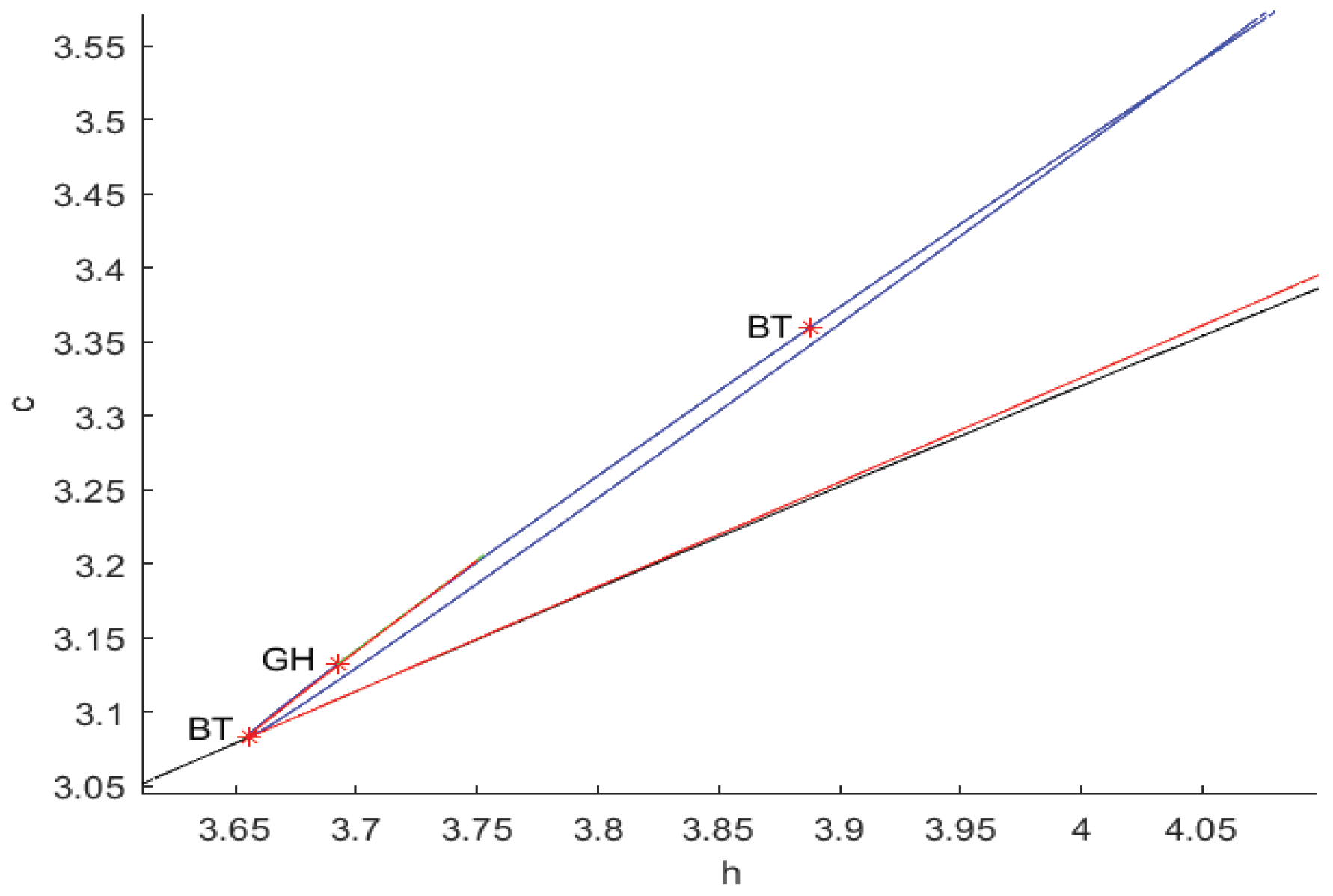
We fix ( n , a , q ) = ( 0.62 , 1.2 , 0.8 ) , then we present the bifurcation diagram in ( h , c ) -plane in Figure 1, where the degenerate Hopf ( G H ) and Bogdanov–Takens ( B T ) points are indicated. Solid curves correspond to Hopf (blue), saddle-node (black), saddle-node of limit cycles (green), and homoclinic (red) bifurcations.
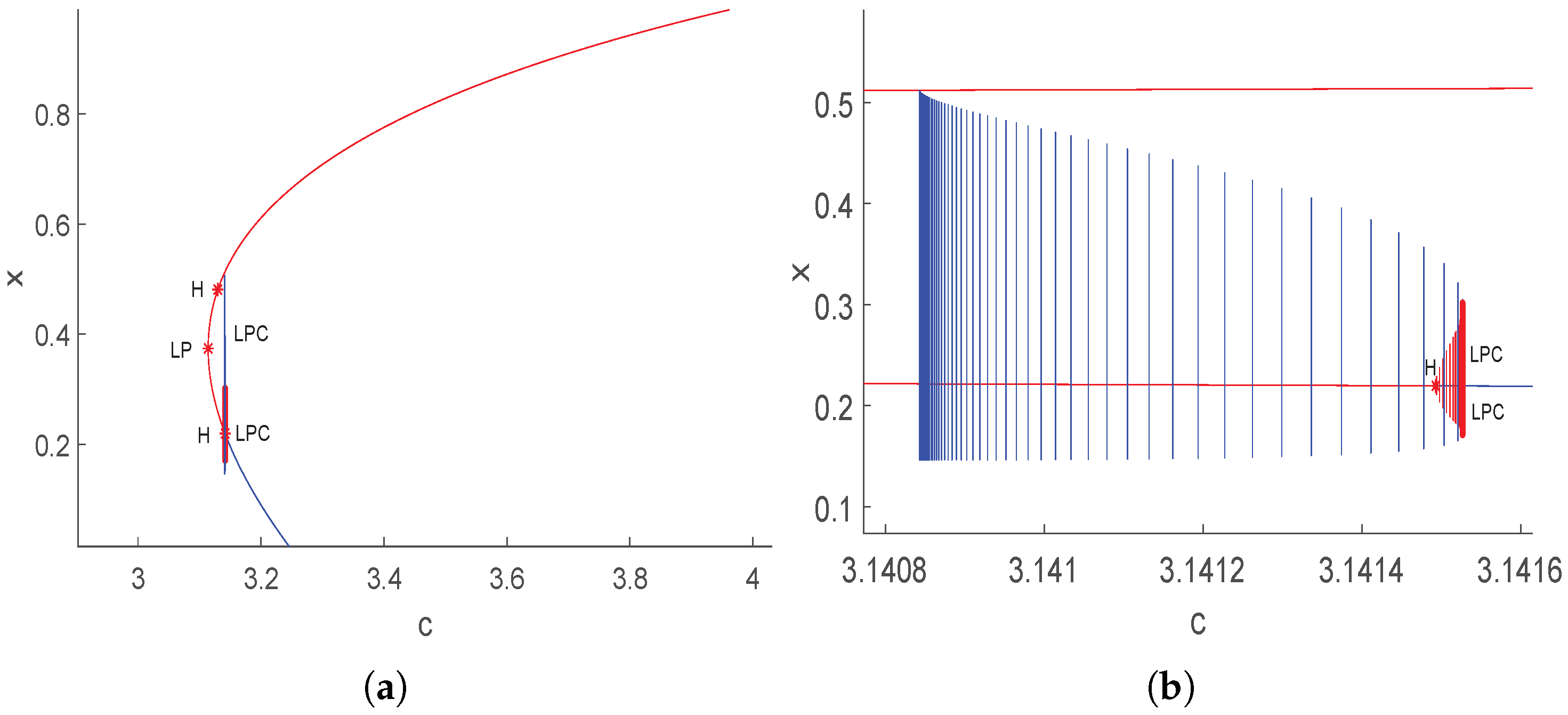
The parameter plane is partitioned into distinct regions by the above curves, indicating that even minor variations in ( h , c ) can lead to qualitative changes in the long-term behavior of the system. Particularly near the G H and B T points, the system exhibits its most complex and sensitive dynamics, where abrupt transitions and intricate behaviors are most likely to occur. Therefore, we further fix h = 3.7 and give the bifurcation diagram in ( c , x ) -plane in Figure 2, whose dynamical behaviors are listed in detail in Table 3.
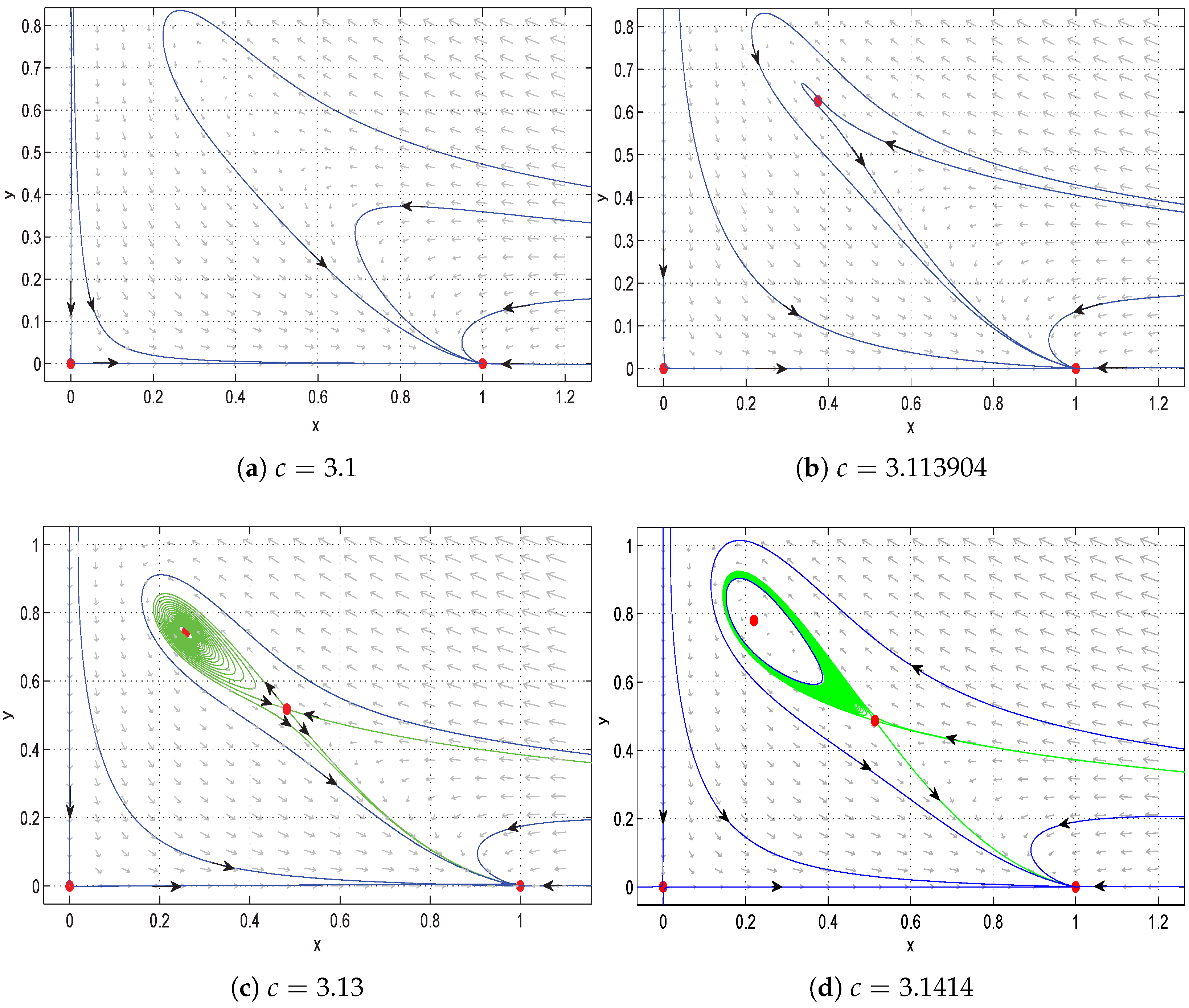
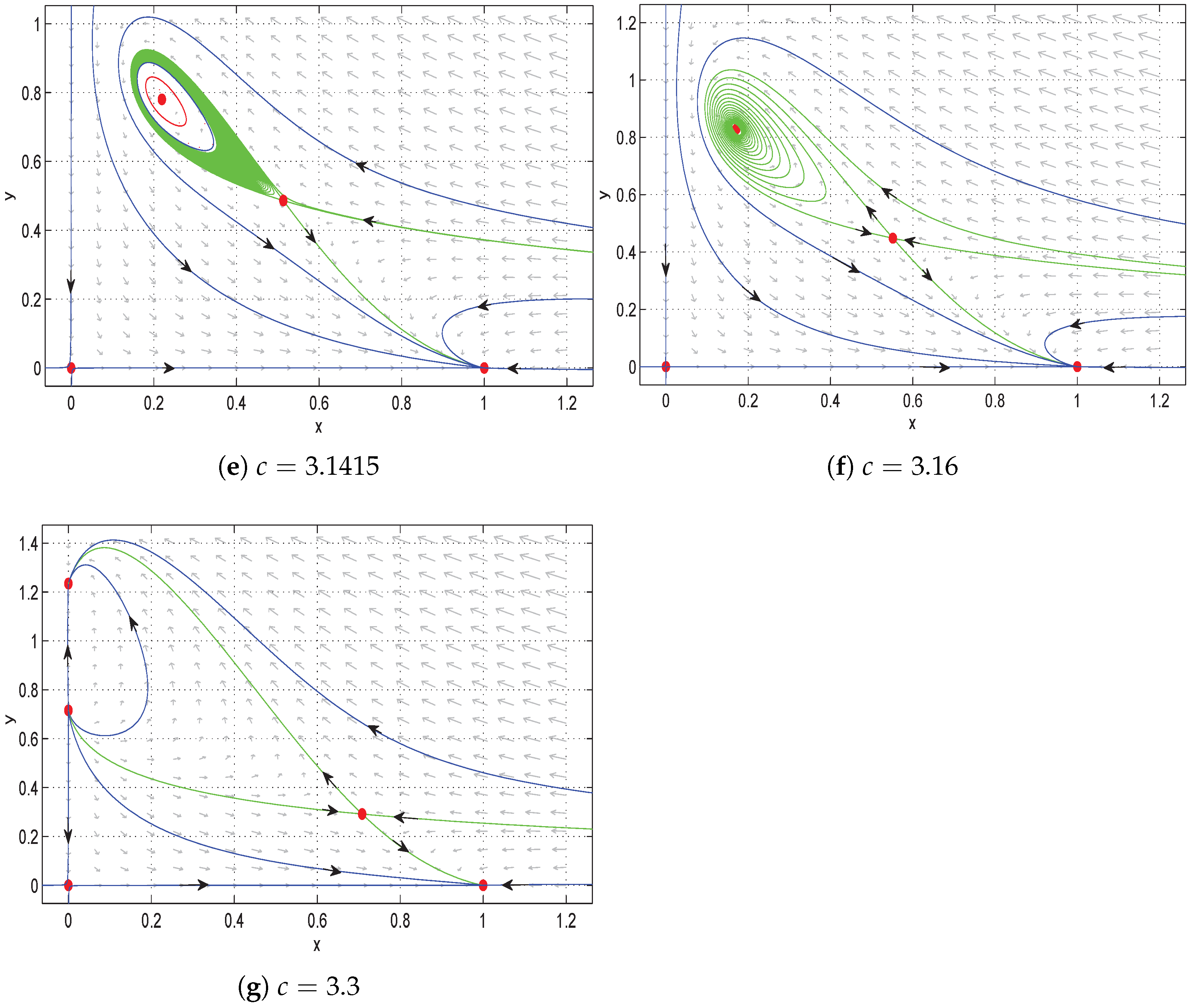
To further verify the above conclusions, we will now fix c to the following specific values and present the corresponding phase diagrams. For different types of equilibrium stability, we have the following conclusions. (1) Monostability: In Figure 3a–c, only the boundary equilibrium E ( 1 , 0 ) is stable, which indicates that all populations will eventually be attracted to E ( 1 , 0 ) . This means the prey will persist at a constant level while the predator eventually becomes extinct. (2) Bistability: In Figure 3d, the unique limit cycle and E ( 1 , 0 ) are stable. That is, system (3) exhibits two distinct basins of attraction, which determined by the initial position. This indicates initial states lying inside the region bounded by the two stable manifolds are attracted to the limit cycle, indicating that in such cases, both prey and predator populations will ultimately coexist on a periodic orbit. Conversely, trajectories starting from any point outside this region will eventually stabilize at E ( 1 , 0 ) , which indicates the persistence of the prey and the extinction of the predator. In Figure 3f, both populations will stabilize at E ( 1 , 0 ) and E 11 . Thus, if the initial state lies within the region bounded by the two stable manifolds, all populations converge asymptotically to E 11 ; that is, both the prey and predator will coexist at constant levels; otherwise, all populations will eventually stabilize at E ( 1 , 0 ) . In Figure 3g, the boundary equilibria E ( 1 , 0 ) and E 02 are stable; that is, if the initial state lies above the two stable manifolds, the prey population will eventually go extinct; otherwise, the predator population will be driven to extinction. (3) Tristability: In Figure 3e, the outer limit cycle, E 11 and E ( 1 , 0 ) are stable. That is, system (3) exhibits three distinct basins of attraction, which are determined by the initial position: If the initial state is interior to the inner limit cycle, all populations converge asymptotically to E 11 ; if it lies in the region bounded by the inner limit cycle and the two stable manifolds, they converge to the outer limit cycle; that is, the prey and predator species will eventually achieve coexistence through periodic oscillations; otherwise, convergence occurs to the boundary equilibrium E ( 1 , 0 ) ; that is, the prey will persist while the predator eventually becomes extinct. Thus, guided by practical ecological needs, it is essential to continuously monitor populations and prudently select suitable values of c and initial conditions to ensure the system remains outside the basin of attraction that leads to extinction. This is crucial for achieving the long-term sustainability of the ecosystem.

5. Conclusions

We investigate a predator–prey model featuring a generalist predator and nonlinear harvesting. It can be shown that the system has no more than four boundary equilibria and no more than two positive equilibria. E 00 ( 0 , 0 ) is unstable from Theorem 1; E 10 ( 1 , 0 ) is unstable under the condition that h < h 2 , and is otherwise stable in the first quadrant from Theorem 2; E 01 is unstable if it exists from Theorem 3; E 02 is unstable when c a , or a < c < c 0 and h < h 1 , and is otherwise stable in the first quadrant from Theorem 4, if it exists.
It follows from Theorems 7 and 8 that the unique positive equilibrium E is a cusp of codimension up to 3 and the occurrence of a codimension-3 cusp-type degenerate Bogdanov–Takens bifurcation occurs in system (3) around E when h = h 3 , c = c and q = q . This point acts a bifurcation organizing center, which means in its neighborhood, multiple critical bifurcation curves (saddle-node, Hopf, homoclinic) converge. That is, the system is in a highly sensitive state. Ecologically, small changes around ( h , c , q ) = ( h 3 , c , q ) , such as variations in harvesting intensity, the availability of alternative food sources, or predation efficiency, can lead to dramatic shifts in population dynamics. For example, the system may transition abruptly from stable coexistence to predator extinction, exhibit multiple possible stable states (multistability), or experience the emergence or disappearance of limit cycles, which corresponds to the onset or cessation of periodic population fluctuations (as shown numerically). This has direct implications for resource management, warning against operating near such sensitive thresholds.
According to Theorem 9, a codimension-2 degenerate Hopf bifurcation can be observed in system (3) around E 11 , which can possibly exist when min { h 1 , h 2 } < h h 3 and is a weak focus of the order of no more than two. This indicates that the system operates near a higher-order critical point and exhibits high sensitivity to parameter variations. Even minor parameter perturbations can induce strong dynamic responses, resulting in distinct stable states. Further, the system governs not just the birth of a limit cycle, but the potential for bistable oscillations (two limit cycles of different stability), which leads to the possibility of alternative stable periodic states, where populations can exhibit different amplitudes of fluctuation depending on initial conditions, a crucial concept for predicting population resilience.
The above conclusions indicate that when min { h 1 , h 2 } < h h 3 , the prey and predator populations may stabilize at a positive equilibrium point or a limit cycle. Otherwise, when h increases further, the system will stabilize at the boundary equilibria ( 1 , 0 ) or E 02 . This means when the harvesting intensity is maintained at an appropriate level, the prey and predator populations can coexist sustainably. Otherwise, if overharvesting occurs, either the prey or the predator will become extinct.

Author Contributions

Methodology, M.H.; Software, M.H. and Y.W.; Writing—original draft, M.H. and Y.W. All authors have read and agreed to the published version of the manuscript.

Funding

This work was supported by the Natural Science Foundation of Fujian Province (2025J011265) and Scientific Research Foundation of Minjiang University (MJY22027).

Data Availability Statement

Data is contained within the article.

Conflicts of Interest

The author declares that there are no competing interests.

Appendix A. The Coefficients of System (12)

c 11 = 1 ( a n q + n 2 q + a q c n n 2 + n q + 2 a c + n ) 2 ( a q + n q + c + n ) ( 2 ( a + n ) ( a 3 q 3 + 3 a 2 n q 3 + 3 a n 2 q 3 + n 3 q 3 + 2 a 3 q 2 3 a 2 c q 2 + 4 a 2 n q 2 6 a c n q 2 + 2 a n 2 q 2 3 c n 2 q 2 4 a 2 c q 4 a 2 n q + a 2 q 2 + 3 a c 2 q 2 a c n q 5 a n 2 q + 2 a n q 2 + 3 c 2 n q + 2 c n 2 q n 3 q + n 2 q 2 + 2 a 2 q + 2 a c 2 + 4 a c n + 2 a n 2 + 4 a n q c 3 2 c 2 n c n 2 + 2 n 2 q + 2 a c + 2 a n c 2 + n 2 ) n ) , c 02 = 1 ( a n q + n 2 q + a q c n n 2 + n q + 2 a c + n ) 2 ( a q + n q + c + n ) ( ( a q + n q c n ) ( a 3 n q 2 + 4 a 2 n 2 q 2 + 5 a n 3 q 2 + 2 n 4 q 2 2 a 2 c n q 2 a 2 n 2 q + 2 a 2 n q 2 4 a c n 2 q 4 a n 3 q + 4 a n 2 q 2 2 c n 3 q 2 n 4 q + 2 n 3 q 2 + 2 a 2 n q + a 2 q 2 + a c 2 n + 2 a c n 2 + a n 3 + 4 a n 2 q + 2 a n q 2 + 2 n 3 q + n 2 q 2 + 2 a 2 q + 2 a c n + 2 a n 2 + 4 a n q 2 c 2 n 2 c n 2 + 2 n 2 q + 2 a c + 2 a n c 2 + n 2 ) n ) , d 20 = ( a + n ) ( a q + n q c n ) ( a q + n q + 2 a c + n ) 2 ( a n q + n 2 q + a q c n n 2 + n q + 2 a c + n ) 2 ( a q + n q + c + n ) , d 11 = 1 ( a n q + n 2 q + a q c n n 2 + n q + 2 a c + n ) 2 ( a q + n q + c + n ) ( ( a q + n q + 2 a c + n ) ( 2 a 3 n q 2 + 7 a 2 n 2 q 2 + 8 a n 3 q 2 + 3 n 4 q 2 4 a 2 c n q 4 a 2 n 2 q + 2 a 2 n q 2 8 a c n 2 q 8 a n 3 q + 4 a n 2 q 2 4 c n 3 q 4 n 4 q + 2 n 3 q 2 + 2 a 2 n q + a 2 q 2 + 2 a c 2 n + 4 a c n 2 + 2 a n 3 + 4 a n 2 q + 2 a n q 2 + c 2 n 2 + 2 c n 3 + n 4 + 2 n 3 q + n 2 q 2 + 2 a 2 q + 2 a c n + 2 a n 2 + 4 a n q 2 c 2 n 2 c n 2 + 2 n 2 q + 2 a c + 2 a n c 2 + n 2 ) ) , d 02 = 1 ( a n q + n 2 q + a q c n n 2 + n q + 2 a c + n ) 2 ( a q + n q + c + n ) ( ( a 4 n 2 q 3 + 5 a 3 n 3 q 3 + 9 a 2 n 4 q 3 + 7 a n 5 q 3 + 2 n 6 q 3 3 a 3 c n 2 q 2 3 a 3 n 3 q 2 + a 3 n 2 q 3 10 a 2 c n 3 q 2 10 a 2 n 4 q 2 + 3 a 2 n 3 q 3 11 a c n 4 q 2 11 a n 5 q 2 + 3 a n 4 q 3 4 c n 5 q 2 4 n 6 q 2 + n 5 q 3 + 2 a 3 n 2 q 2 a 3 n q 3 + 3 a 2 c 2 n 2 q + 6 a 2 c n 3 q a 2 c n 2 q 2 + 3 a 2 n 4 q + 5 a 2 n 3 q 2 3 a 2 n 2 q 3 + 5 a c 2 n 3 q + 10 a c n 4 q 2 a c n 3 q 2 + 5 a n 5 q + 4 a n 4 q 2 3 a n 3 q 3 + 2 c 2 n 4 q + 4 c n 5 q c n 4 q 2 + 2 n 6 q + n 5 q 2 n 4 q 3 2 a 3 n q 2 a 3 q 3 + a 2 c n q 2 5 a 2 n 2 q 2 3 a 2 n q 3 a c 3 n 2 3 a c 2 n 3 a c 2 n 2 q 3 a c n 4 2 a c n 3 q + 2 a c n 2 q 2 a n 5 a n 4 q 4 a n 3 q 2 3 a n 2 q 3 c 2 n 3 q 2 c n 4 q + c n 3 q 2 n 5 q n 4 q 2 n 3 q 3 4 a 3 q 2 + a 2 c q 2 11 a 2 n q 2 2 a c 2 n 2 + a c 2 n q 4 a c n 3 + 2 a c n 2 q + 2 a c n q 2 2 a n 4 + a n 3 q 10 a n 2 q 2 + c 3 n 2 + c 2 n 3 + c 2 n 2 q c n 4 + 2 c n 3 q + c n 2 q 2 n 5 + n 4 q 3 n 3 q 2 4 a 3 q 12 a 2 n q + 2 a c 2 n + a c 2 q + 4 a c n 2 + 2 a c n q + 2 a n 3 11 a n 2 q c 3 n c 2 n 2 + c 2 n q + c n 3 + 2 c n 2 q + n 4 3 n 3 q 4 a 2 c 4 a 2 n + 4 a c 2 4 a n 2 c 3 + c 2 n + c n 2 n 3 ) .

Appendix B. The Coefficients of System (19)

a 20 = ( 1 + z ) ( n z + c + z ) ( q 2 z + 2 ) z ( q + 1 z ) 2 ( n z n + z ) , a 11 = q 2 z + 2 ( 1 + z ) ( q + 1 z ) , a 30 = n z + c + z ( q 2 z + 2 ) z ( q + 1 z ) 2 ( n z n + z ) , a 21 = 1 ( 1 + z ) ( q + 1 z ) , b 20 = 1 ( q + 1 z ) n ( q 2 z + 2 ) ( n z n + z ) ( 1 + z ) ( n 2 q z 2 n 2 z 3 + c n z 2 2 n 2 q z + 4 n 2 z 2 + n q 2 z 2 n q z 2 + n z 3 2 c n z + n 2 q 5 n 2 z n q 2 + 5 n q z 4 n z 2 + q 2 z 3 q z 2 + 2 z 3 + c n + 2 n 2 3 n q + 5 n z + 3 q z 4 z 2 2 n + 2 z ) , b 11 = ( q + 1 z ) ( 2 n z n + 2 z ) n ( 1 + z ) z ( q + 1 z ) 2 ( n z n + z ) , b 02 = 1 n ( 1 + z ) , b 30 = n 2 z 2 + c n z n 2 z n q z + 3 n z 2 c n + n q 5 n z q z + 2 z 2 + 2 n 2 z ( q + 1 z ) n ( q 2 z + 2 ) ( n z n + z ) ( 1 + z ) , b 21 = 2 n z n + 2 z n ( 1 + z ) z ( q + 1 z ) 2 ( n z n + z ) , b 12 = 1 n ( 1 + z ) ( q + 1 z ) .

References

  1. Lotka, A.J. Elements of Physical Biology; Williams and Wilkins: Baltimore, MD, USA, 1925. [Google Scholar]
  2. Volterra, V. Fluctuations in the abundance of species considered mathematically. Nature 1926, 118, 558–560. [Google Scholar] [CrossRef]
  3. Bazykin, A.D. Structural and Dynamic Stability of Model Predator-Prey Systems; International Institute for Applied Systems Analysis: Laxenburg, Austria, 1976. [Google Scholar]
  4. Kuznetsov, Y. Elements of Applied Bifurcation Theory, 3rd ed.; Springer: New York, NY, USA, 2004. [Google Scholar]
  5. Lu, M.; Huang, J.C. Global analysis in Bazykin’s model with Holling II functional response and predator competition. J. Differ. Equ. 2021, 280, 99–138. [Google Scholar] [CrossRef]
  6. Liu, Y.Z.; Zhang, Z.Y.; Li, Z. The impact of Allee effect on a Leslie-Gower predator-prey model with hunting cooperation. Qual. Theory Dyn. Syst. 2024, 23, 88. [Google Scholar] [CrossRef]
  7. Ma, Y.X.; Yang, R.Z. Bifurcation analysis in a modified Leslie-Gower with nonlocal competition and Beddington-DeAngelis functional response. J. Appl. Anal. Comput. 2025, 15, 2152–2184. [Google Scholar] [CrossRef]
  8. Li, S.; Yuan, S.; Jin, Z.; Wang, H. Double Hopf bifurcation induced by spatial memory in a diffusive predator-prey model with Allee effect and maturation delay of predator. Commun. Nonlinear Sci. Numer. Simul. 2024, 132, 107936. [Google Scholar] [CrossRef]
  9. Yin, W.; Li, Z.; Chen, F.; He, M. Modeling Allee effect in the Lesile-Gower predator-prey system incorporating a prey refuge. Int. J. Bifurc. Chaos 2022, 32, 2250086. [Google Scholar] [CrossRef]
  10. Wei, F.R.; Wang, C.H.; Yuan, S.L. Spatial dynamics of a diffusive predator-prey model with Leslie-Gower functional response and strong Allee effect. J. Nonlinear Model. Anal. 2020, 2, 267–285. [Google Scholar]
  11. Guo, Z.; Liu, J.; Li, B.; Zhang, T. Stability analysis of a delayed predator-prey model with generalist predator and fear effect. Math. Comput. Simul. 2025, 228, 274–297. [Google Scholar] [CrossRef]
  12. Zhang, M.X.; Li, Z. Bifurcation analysis of a modified Leslie-Gower predator-prey system with fear effect on prey. Discret. Contin. Dyn.-Syst.-B 2025, 30, 3730–3760. [Google Scholar] [CrossRef]
  13. Xiang, C.; Huang, J.C.; Wang, H. Linking bifurcation analysis of Holling-Tanner model with generalist predator to a changing environment. Stud. Appl. Math. 2022, 49, 124–163. [Google Scholar] [CrossRef]
  14. Magal, C.; Cosner, C.; Ruan, S.; Casas, J. Control of invasive hosts by generalist parasitoids. Math. Med. Biol. 2008, 25, 1–20. [Google Scholar] [CrossRef]
  15. Xiang, C.; Huang, J.C.; Ruan, S.G.; Xiao, D.M. Bifurcation analysis in a host-generalist parasitoid model with Holling II functional response. J. Differ. Equ. 2020, 268, 4618–4662. [Google Scholar] [CrossRef]
  16. Yuan, P.; Chen, L.L.; You, M.S.; Zhu, H.P. Dynamics complexity of generalist predatory mite and the leafhopper pest in tea plantations. J. Dyn. Differ. Equ. 2023, 35, 2833–2871. [Google Scholar] [CrossRef]
  17. Sen, D.; Ghorai, S.; Sharma, S.; Banerjee, M. Allee effect in prey’s growth reduces the dynamical complexity in prey-predator model with generalist predator. Appl. Math. Model. 2021, 91, 768–790. [Google Scholar] [CrossRef]
  18. Lu, M.; Huang, J.C.; Wang, H. An organizing center of codimension four in a predator-prey model with generalist predator: From tristability and quadristability to transients in a nonlinear environmental change. SIAM J. Appl. Dyn. Syst. 2023, 22, 694–729. [Google Scholar] [CrossRef]
  19. He, M.X.; Li, Z. Dynamics of a Leslie-Gower predator-prey model with square root response function and generalist predator. Appl. Math. Lett. 2024, 157, 109193. [Google Scholar] [CrossRef]
  20. Wu, H.; Li, Z.; He, M.X. Bifurcation analysis of a Holling-Tanner model with generalist predator and constant-yield harvesting. Int. J. Bifurc. Chaos 2024, 34, 2450076. [Google Scholar] [CrossRef]
  21. Singh, S.; Umrao, A.K.; Singh, H.P.; Srivastava, P.K. Cooperation and harvesting-induced delays in a predator-prey model with prey fear response: A crossing curves approach. Chaos Solitons Fractals 2025, 194, 116132. [Google Scholar]
  22. Roy, S.; Tiwari, P. Bistability in a predator-prey model characterized by the Crowley-Martin functional response: Effects of fear, hunting cooperation, additional foods and nonlinear harvesting. Math. Comput. Simul. 2025, 228, 274–297. [Google Scholar] [CrossRef]
  23. Huangfu, C.; Li, Z.; Chen, F.; Chen, L.; He, M. Dynamics of a harvested Leslie-Gower predator-prey model with simplified Holling type IV functional response. Int. J. Bifurc. Chaos 2025, 25, 550023. [Google Scholar] [CrossRef]
  24. Hu, D.P.; Cao, H.J. Stability and bifurcation analysis in a predator-prey system with Michaelis-Menten type predator harvesting. Nonlinear Anal. Real World Appl. 2017, 33, 58–82. [Google Scholar] [CrossRef]
  25. Mortuja, M.G.; Chaube, M.K.; Kumar, S. Dynamic analysis of a predator-prey system with nonlinear prey harvesting and square root functional response. Chaos Solitons Fractals 2021, 148, 111071. [Google Scholar] [CrossRef]
  26. Gupta, R.P.; Chandra, P. Bifurcation analysis of modified Leslie-Gower predator-prey model with Michaelis-Menten type prey harvesting. J. Math. Anal. Appl. 2013, 398, 278–295. [Google Scholar] [CrossRef]
  27. He, M.X.; Li, Z. Dynamics of a Holling-Tanner predator-prey model with harvesting and anti-predator behavior. Appl. Math. Lett. 2026, 172, 109732. [Google Scholar] [CrossRef]
  28. He, M.X.; Li, Z. Bifurcation of a Leslie-Gower predator-prey model with nonlinear harvesting and a generalist predator. Axioms 2024, 13, 704. [Google Scholar] [CrossRef]
  29. Chen, F.D. On a nonlinear non-autonomous predator-prey model with diffusion and distributed delay. J. Comput. Appl. Math. 2005, 180, 33–49. [Google Scholar] [CrossRef]
  30. Zhang, Z.F.; Ding, T.R.; Huang, W.Z.; Dong, Z.X. Qualitative Theory of Diffrential Equations; Translation of Mathematical Monographs; American Mathematical Society: Providence, RI, USA, 1992. [Google Scholar]
  31. Huang, J.C.; Gong, Y.J.; Ruan, S.G. Bifurcations analysis in a predator-prey model with constant-yield predator harvesting. Discret. Contin. Dyn. Syst. Ser. B 2013, 18, 2101–2121. [Google Scholar] [CrossRef]
  32. Zhang, M.; Li, Z.; Chen, F.; Chen, L. Bifurcation analysis of a Leslie-Gower predator-prey model with Allee effect on predator and simplified Holling type IV functional response. Qual. Theory Dyn. Syst. 2025, 24, 131. [Google Scholar] [CrossRef]
  33. Dumortier, F.; Roussarie, R.; Sotomayor, J. Generic 3-parameter families of vector fields on the plane, unfolding a singularity with nilpotent linear part. The cusp case of codimension 3. Ergod. Theory Dyn. Syst. 1987, 7, 375–413. [Google Scholar] [CrossRef]
Figure 1. Bifurcation diagram for system (3) with ( n , a , q ) = ( 0.62 , 1.2 , 0.8 ) in ( h , c ) -plane.
Axioms 15 00031 g001
Figure 2. Fix ( n , a , h , q ) = ( 0.62 , 1.2 , 3.7 , 0.8 ) . (a) Bifurcation diagram of (3) in ( c , x ) -plane. Blue and red curves correspond to stable and unstable equilibria (limit cycles or equilibria), respectively. (b) Local amplifed portrait of (a).
Axioms 15 00031 g002
Figure 3. Phase portraits of system (3) with ( n , a , h , q ) = ( 0.62 , 1.2 , 3.7 , 0.8 ) .
Axioms 15 00031 g003aAxioms 15 00031 g003b
Table 1. Biological interpretation of parameters (after nondimensionalization).
ParameterBiological Meaning
cNet intrinsic growth rate of predator (due to alternative food)
nPrey-dependence strength
aIntraspecific competition strength among predators
hNonlinear harvesting intensity parameter
qHarvesting saturation parameter
Table 2. The quantity and stability of positive equilibria of system (3).
cConditions of ParametersPositive Equilibrium
> c 4 h 2 < h < h 1 E 12 : saddle
h = h 1 with c < c 1 E 12 : saddle
< c 4 h 1 < h < h 2 with c > a E 11 : antisaddle
h = h 2 with c > max { 0 , c 3 } E 11 : antisaddle
< c 1 max { h 1 , h 2 } < h < h 3 with c > max { 0 , c 3 } E 11 : antisaddle; E 12 : saddle
h = h 3 , c > max { 0 , c 3 } and c c E : saddle-node
h = h 3 , c > max { 0 , c 3 } and c = c E : cusp
Table 3. Dynamical behaviors in Figure 2.
c E 11 E 12 E Closed Orbits
( 0 , 3.113904 ) ---No (see Figure 3a)
3.113904--cuspNo (see Figure 3b)
( 3.113904 , 3.1408439 ) unstable focussaddle-No (see Figure 3c)
( 3.1408439 , 3.1414929 ) unstable focussaddle-A stable limit cycle (see Figure 3d)
( 3.1414929 , 3.1415268 ) stable focussaddle-Two limit cycle (see Figure 3e)
( 3.1415268 , 3.2555556 ) stable focussaddle-No (see Figure 3f)
( 3.2555556 , 4.005 ) -saddle-No (see Figure 3g)
Disclaimer/Publisher’s Note: The statements, opinions and data contained in all publications are solely those of the individual author(s) and contributor(s) and not of MDPI and/or the editor(s). MDPI and/or the editor(s) disclaim responsibility for any injury to people or property resulting from any ideas, methods, instructions or products referred to in the content.