Isogeometric Transfinite Elements: A Unified B-Spline Framework for Arbitrary Node Layouts


Abstract
1. Introduction
2. Transfinite Interpolation Using B-Splines
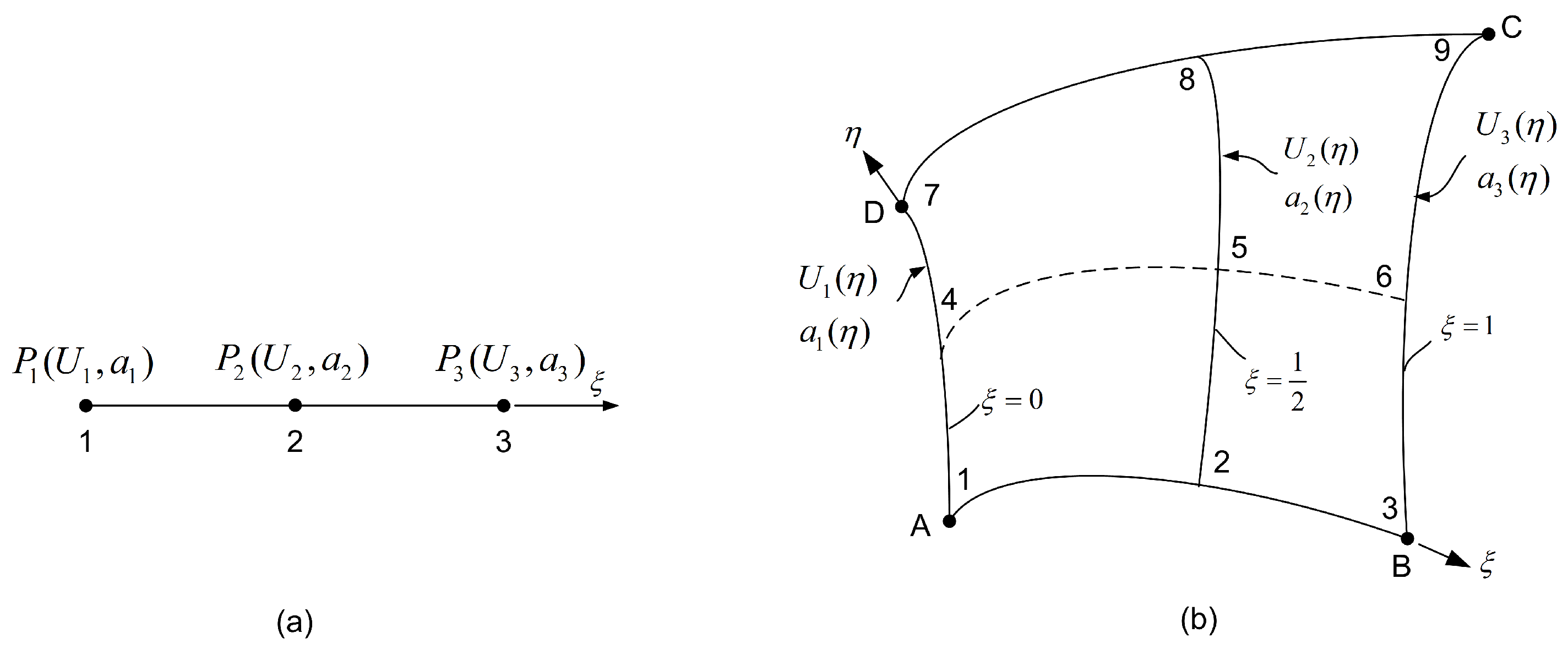
2.1. Terminology
2.2. State of the Art
2.3. Extension of the Projectors Using Bernstein Polynomials
2.4. B-Splines Projectors
3. Construction of Classical B-Spline Transfinite Elements
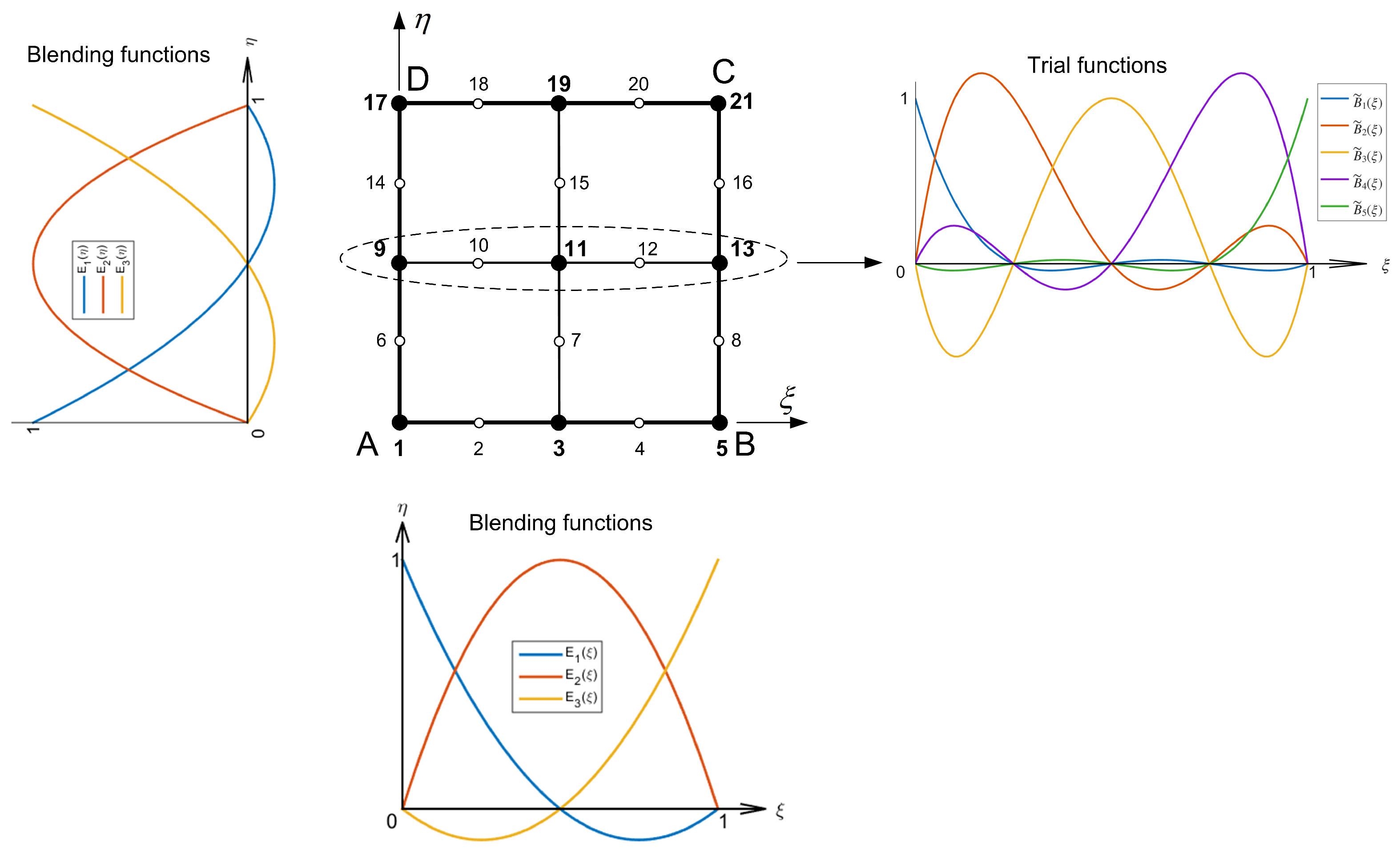
- Nodes at section intersections (including corner nodes A, B, C, and D), for example:In this expression, denotes the second blending function in the -direction, corresponding to the second vertical station where node 69 is located. Likewise, refers to the ninth B-spline basis function in the -direction, as node 69 is the ninth node from the bottom. The same logic applies to the remaining terms.
- Intermediate nodes on single stations, for example:Here, is the third blending function in the -direction, indicating that node 71 lies on the third horizontal station. Similarly, represents the seventh B-spline basis function in the -direction, as node 71 is the seventh node from the left boundary.

3.1. Model-1: Lagrange Polynomials
- Lagrange polynomials of degree and are employed as blending functions in the - and -directions, respectively.
- Lagrange polynomials of degree and are used as trial functions in the - and -directions, respectively.
3.2. Model-2: Mixed Scheme
3.3. Model-3: Cubic B-Splines

4. Construction of Multi-Layer Finite Elements with Nodes Arranged in Parallel Layers
4.1. Unidirectional Multi-Layer Transfinite Lagrange and Bernstein Elements

4.2. Unidirectional Transfinite B-Spline Elements
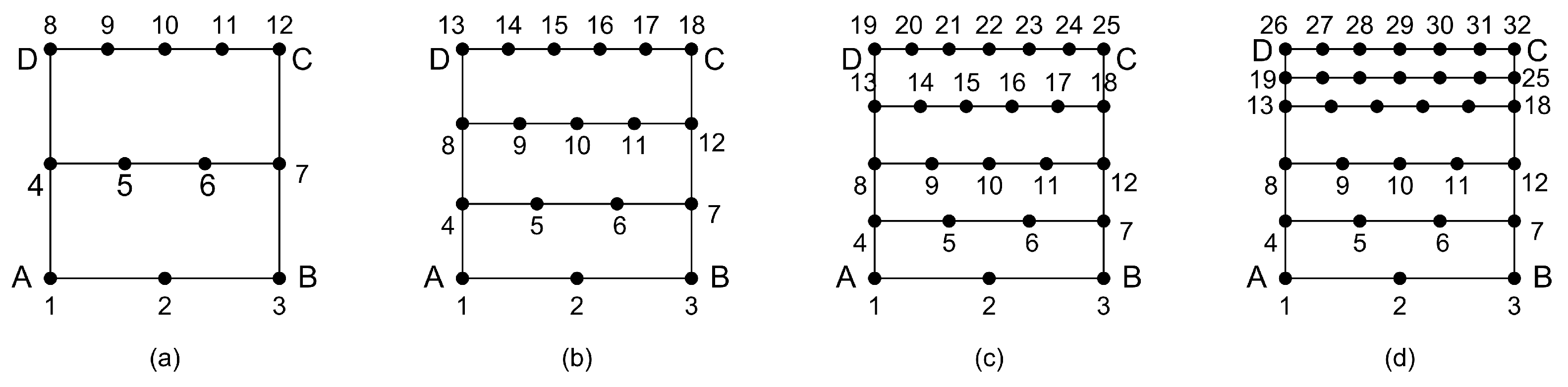
- The blending functions in vertical ()-direction were taken as cubic Bernstein polynomials, , where .
- The base 1-2-3 was modelled by quadratic Bernstein polynomials: .
- The second layer, with nodes 4-5-6-7, was modelled by cubic Bernstein polynomials, .
- The third layer, with nodes 8-9-10-11-12, was modelled as a set of five cubic B-splines, , with knot vector .
- The fourth (top) layer, with nodes 13-14-15-16-17-18, was modelled as a set of six cubic B-splines, , with knot vector .


5. Finite Elements Featuring Tensor-Product Interior Nodes and Nonuniform Boundary Node Placement
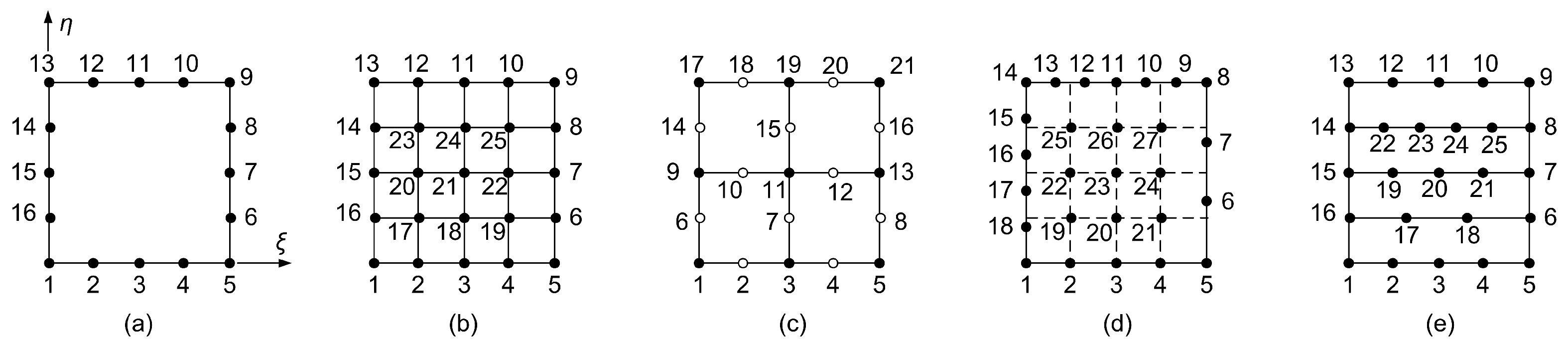
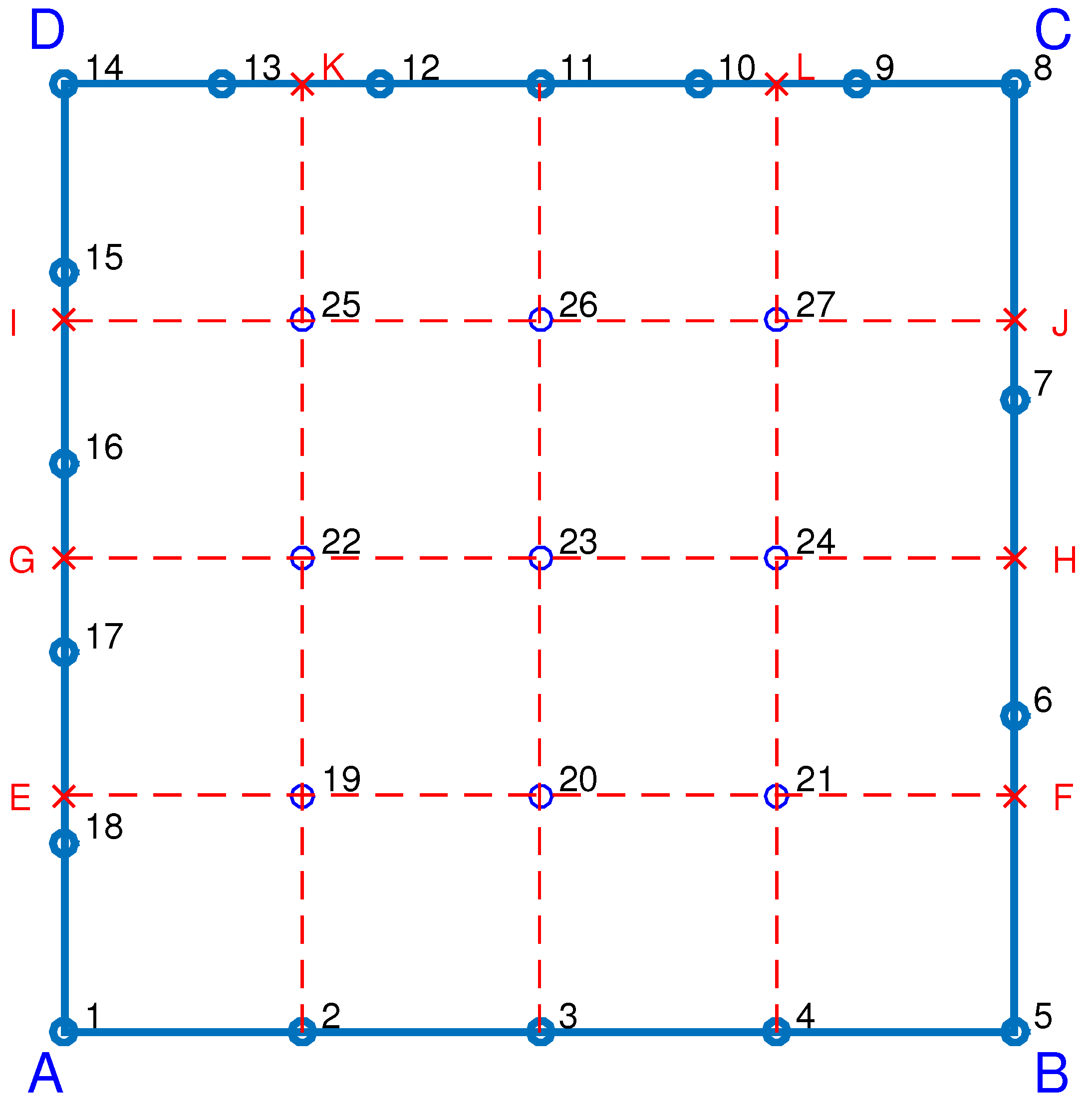
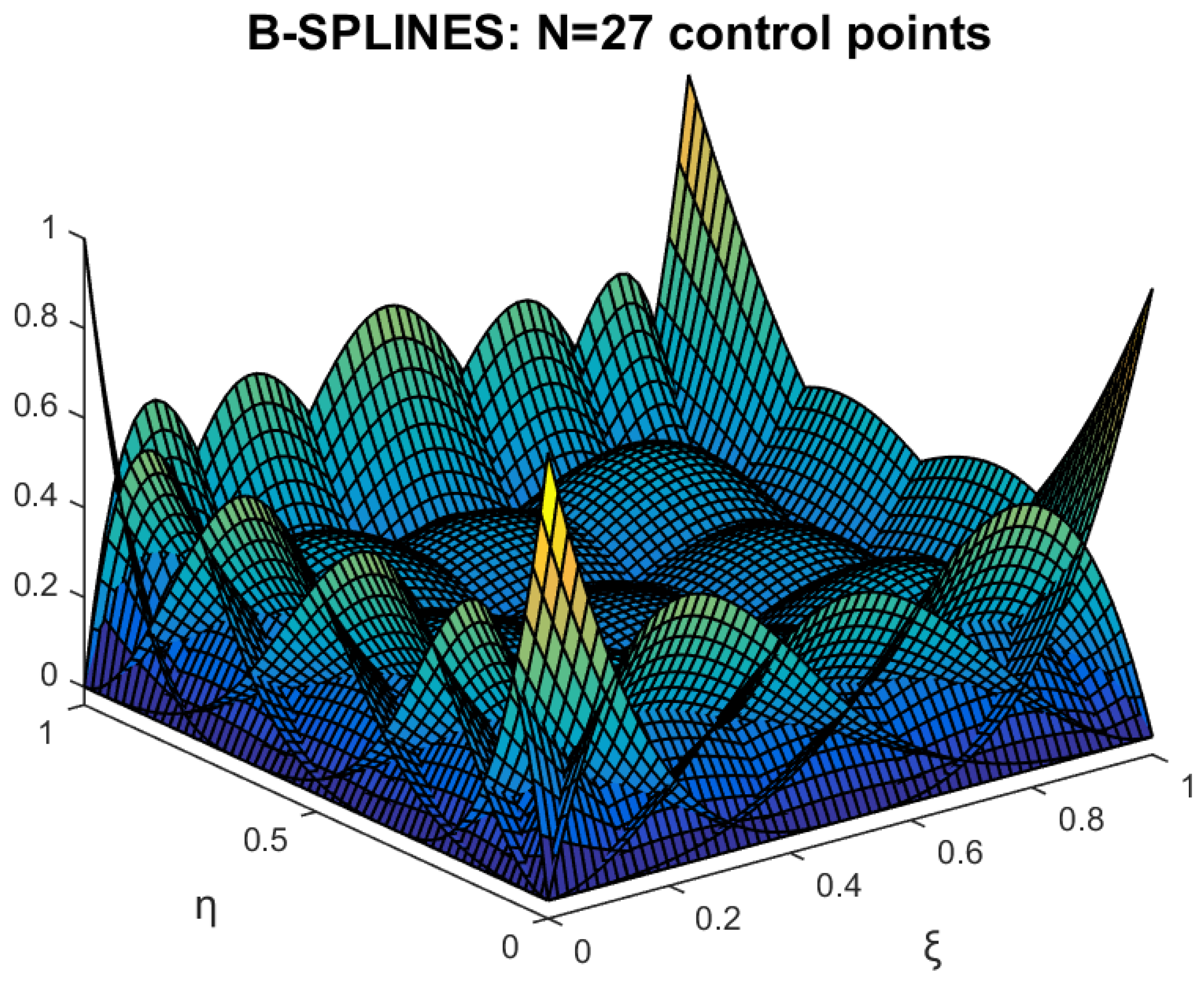
5.1. 27-Node Transfinite Element
- Lagrange polynomials;
- Bernstein polynomials;
- B-splines.

- The five blending functions per direction, horizontal or vertical, can be ensured by the knot vector which guarantees five control points.
- The trial functions along the edge are chosen to match the blending functions in the -direction, since all associated control points are orthogonal projections of the internal points onto this edge.
- The four control points along the edge are ensured by the knot vector , which effectively corresponds to a set of four Bernstein polynomials of degree 3.
- The seven control points along the edge are ensured by the knot vector .
- The six control points along the edge are determined by the knot vector .
- Internal nodes: Defined by a simple tensor product of blending functions.
- Intermediate boundary nodes: Constructed as local tensor products of trial functions along the edge and blending functions in the perpendicular direction.
- Corner nodes: Formulated using a Boolean sum of three terms. Two terms correspond to projectors perpendicular to the edges connected to the corner node, while the third term is a tensor product of the associated blending functions, serving as a correction.

6. Software Issues
6.1. Lagrange and Bernstein Polynomials
- [shp, xsj] = shapeX(xi, eta, XL, NEL, …)
- -
- shp contains the basis functions and their partial derivatives:shp(1,i) = ,shp(2,i) = ,shp(3,i) = N, for .
- -
- xsj is the determinant of the Jacobian matrix.
- -
- xi, eta are the parametric coordinates .
- -
- XL contains the Cartesian coordinates of the element nodes.
- -
- NEL is the number of nodes in the element.
6.2. B-Spline Interpolation
7. Numerical Solution of Boundary-Value Problems
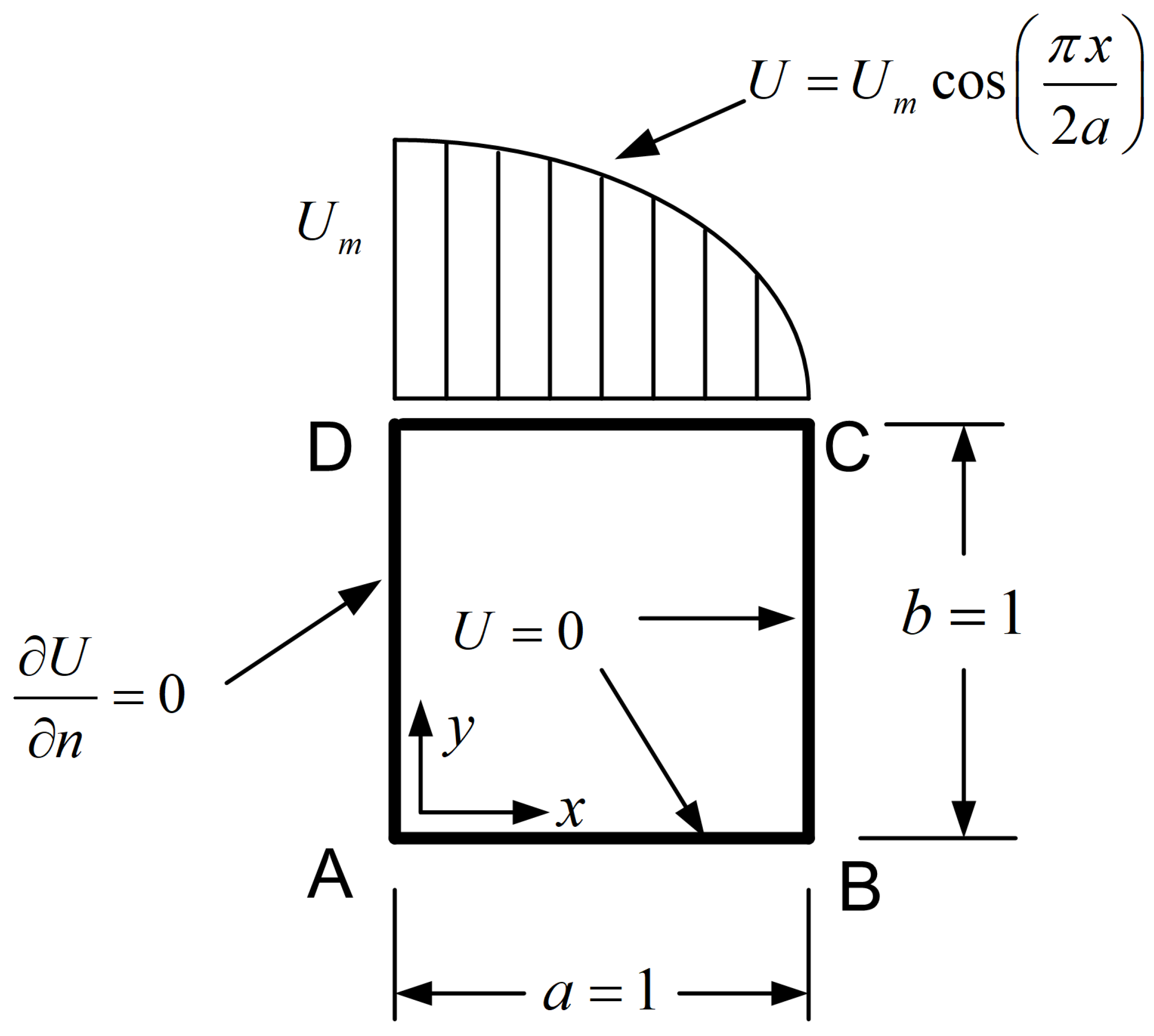
7.1. Example 1
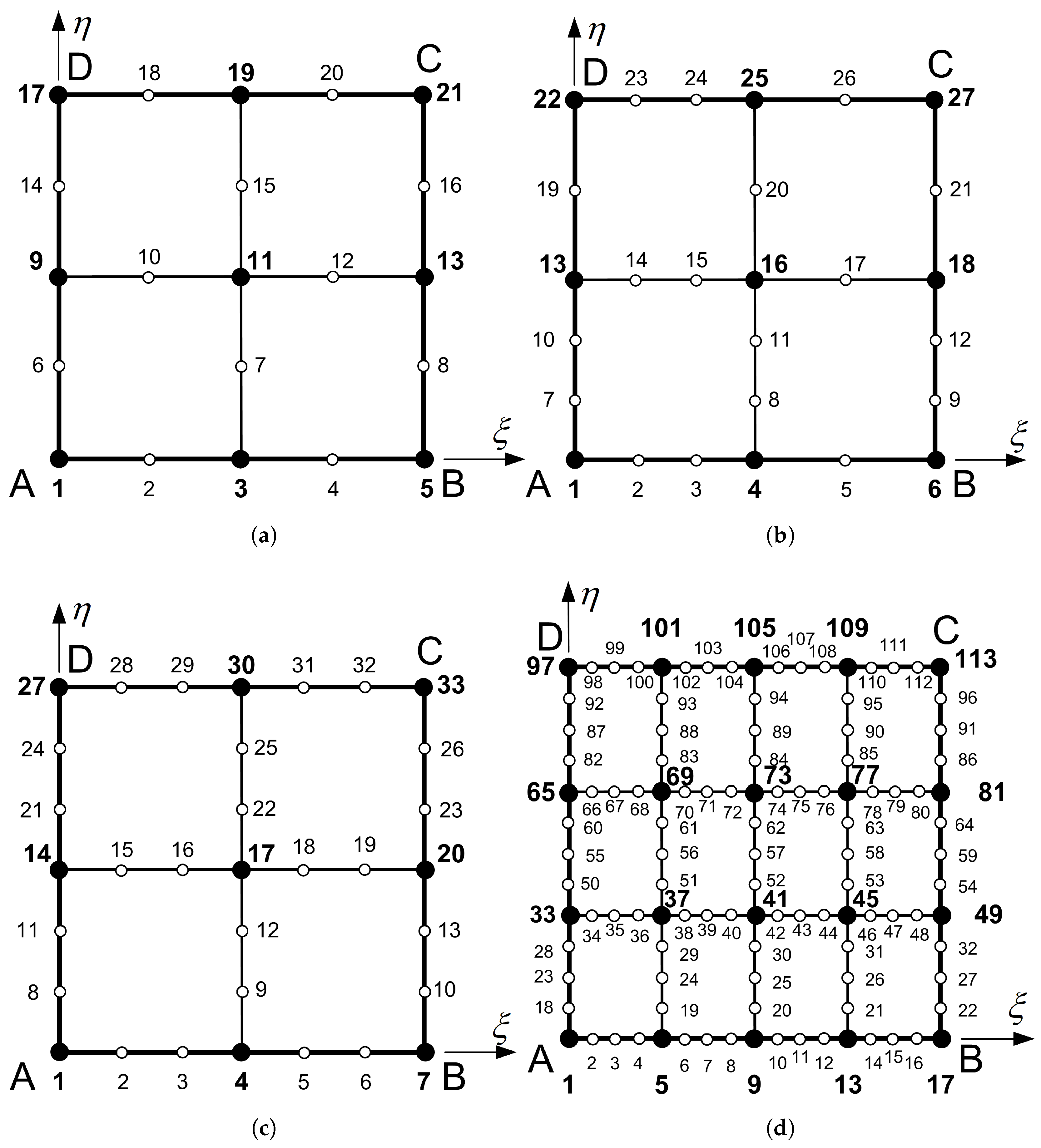
7.1.1. Classical Transfinite Elements (21-27-33-113 Nodes)
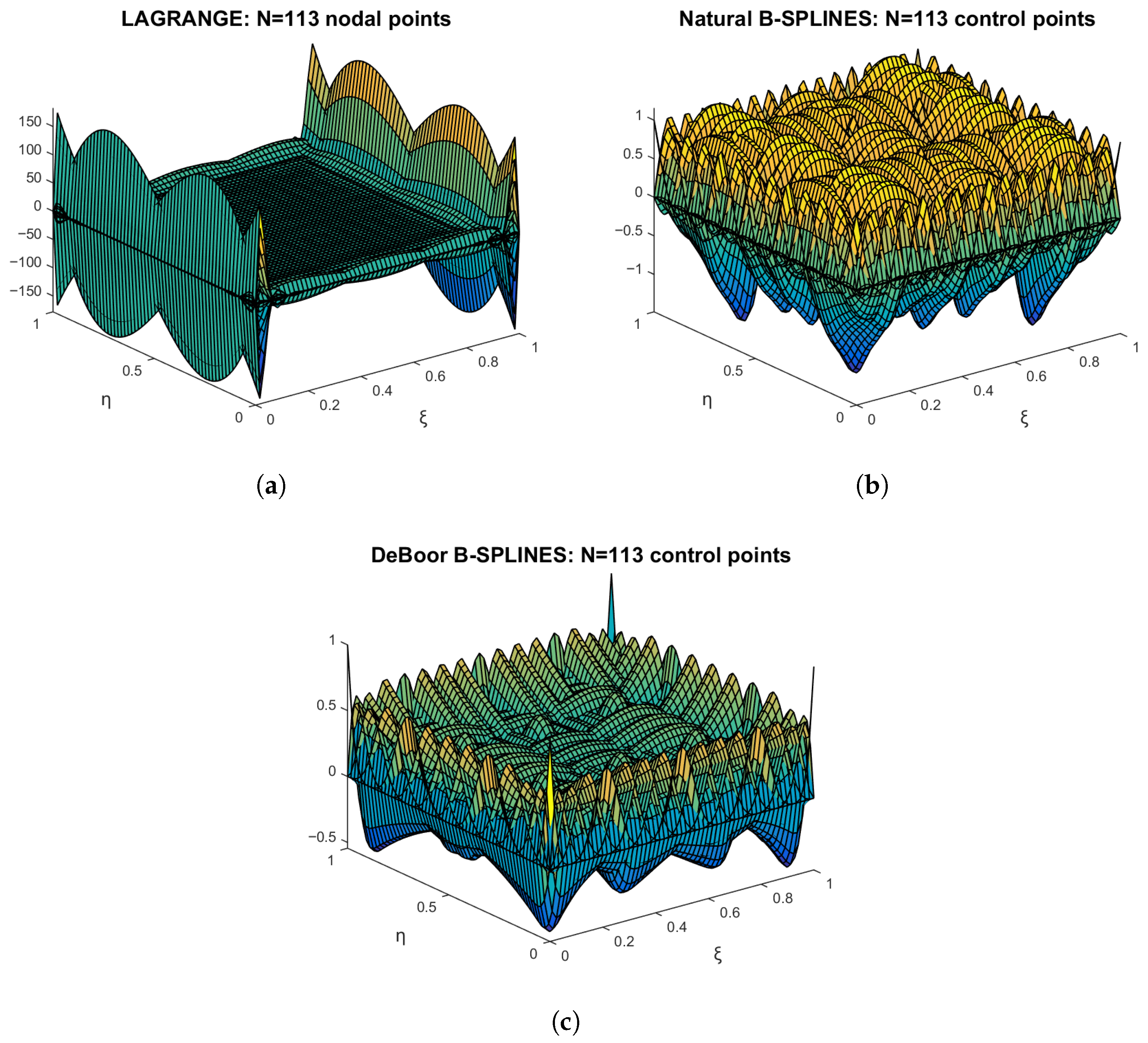
- The implementation of Model-1 (Section 3.1), based entirely on Lagrange polynomials for both blending and trial functions (of degree ), yields an excellent result: , using a Gaussian quadrature scheme. The same result was obtained using Bernstein polynomials.
- For Model-2 (Section 3.2), using integration cells (also referred to as natural B-spline elements), and applying a Gaussian quadrature per cell, the error was found to be .
- Finally, Model-3 (Section 3.3) requires integration cells (also referred to as Cox–de Boor spline elements), with Gauss points per cell, and yields an error () of the same order of magnitude when using either Lagrange or Bernstein polynomials.
7.1.2. Unidirectional 12-18-25-32-Node Elements

| Element Type | Lagrange | Bernstein | De Boor B-Spline |
|---|---|---|---|
| 12-node | 2.6671 | 2.6654 | 2.6704 |
| 18-node | 0.1638 | 0.1556 | 0.1567 |
| 25-node | 0.0385 | 0.0192 | 0.0273 |
| 32-node a | 0.0327 | 0.0039 | 0.0173 |
| 32-node b | 0.0327 | 0.0039 | 0.0182 |
7.1.3. Arbitrary-Noded 27-Node Transfinite Element
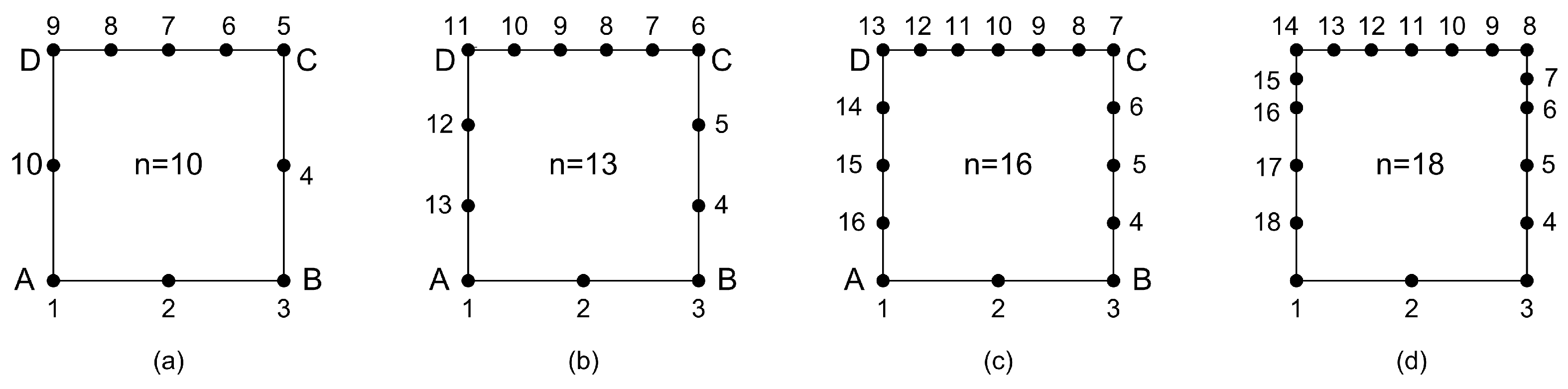
7.1.4. Coons-Patch Elements

| First Set: | Second Set: | ||||||
|---|---|---|---|---|---|---|---|
| 10-Node | 13-Node | 16-Node | 18-Node | 10-Node | 13-Node | 16-Node | 18-Node |
- In a fully two-dimensional problem without any symmetry, the conventional Coons interpolation—implemented with linear blending functions—is insufficient for accurately representing the exact solution. Therefore, the inclusion of internal nodes is generally necessary to enhance accuracy.
- These internal nodes may be arranged along horizontal and/or vertical stations and can follow a transfinite interpolation formula that is applied globally across the entire patch.
- One practical approach is to place internal nodes along horizontal layers (stations), i.e., parallel to the -axis. The station locations may correspond to either uniform or non-uniform -values, and the associated blending functions will be constructed accordingly—based on uniform or non-uniform nodal points (breakpoints).
- Regardless of whether the blending functions are uniform or non-uniform, the trial functions along each station may also be chosen to be uniform or non-uniform.
- Once the closed-form expressions for the global bivariate shape functions have been derived using Lagrange polynomials, they can be readily extended to Bernstein polynomials and B-splines. While the local support property of B-splines affects the resulting bivariate basis functions, splines should be viewed as a specific choice of trial functions for univariate interpolation along each station. The same flexibility applies to the blending functions, which need not be restricted to cardinal types; in addition to Lagrange polynomials, Bernstein polynomials and B-splines are also valid options.
7.2. Example 2
7.2.1. Coons-Patch Element
- (i)
- piecewise-linear functions,
- (ii)
- cardinal natural cubic B-splines,
- (iii)
- Lagrange polynomials.
- –
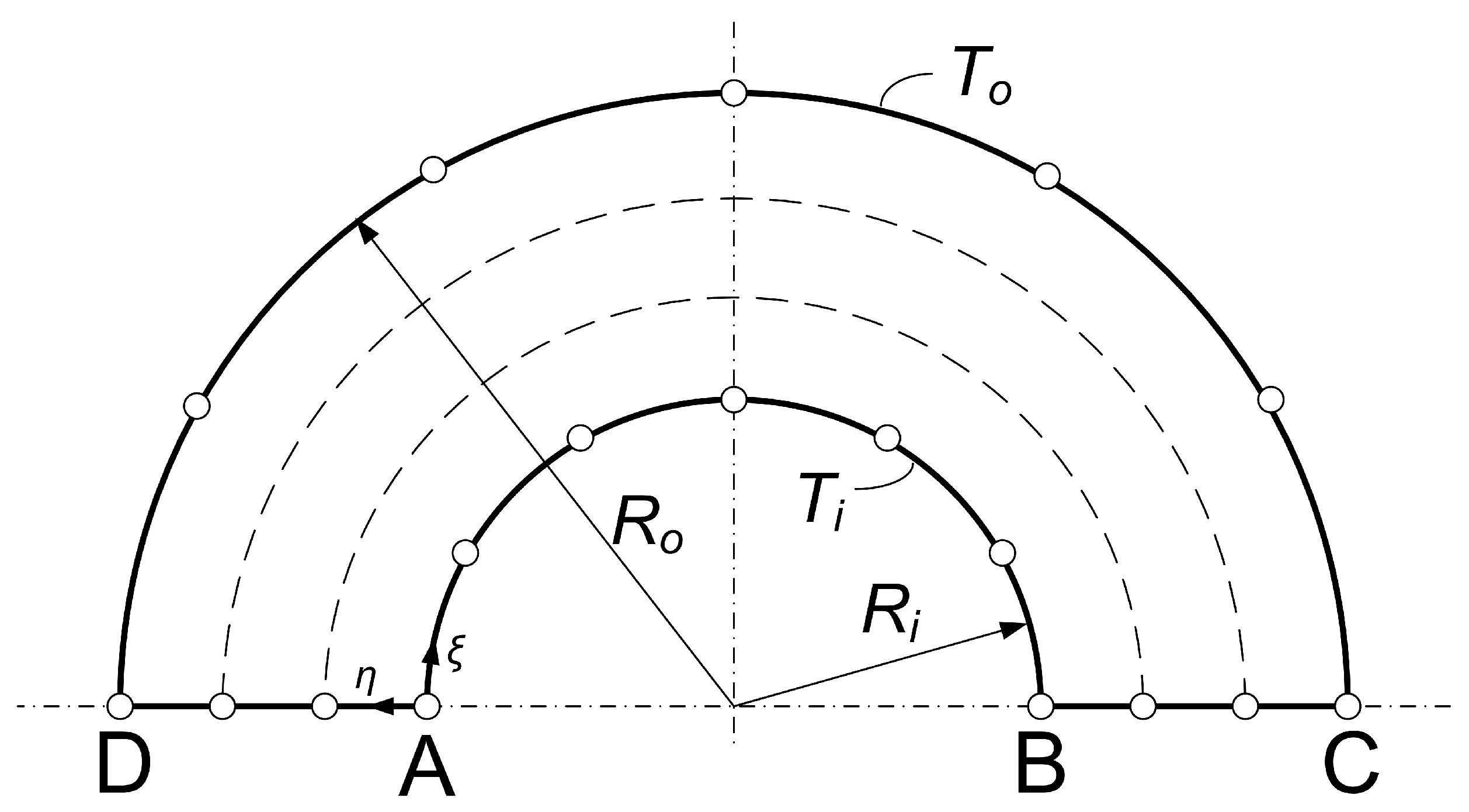
- The number of spans along the parallel edges is denoted .
- –
- The number of spans along the edges is denoted .
- -
- Point A is the origin of the axis
- -
- Arc defines the -axis
- -
- Segment defines the -axis
- -
- Edges and are subjected to Dirichlet boundary conditions (, respectively)
- -
- Edges and are subjected to Neumann boundary conditions (), due to symmetry.

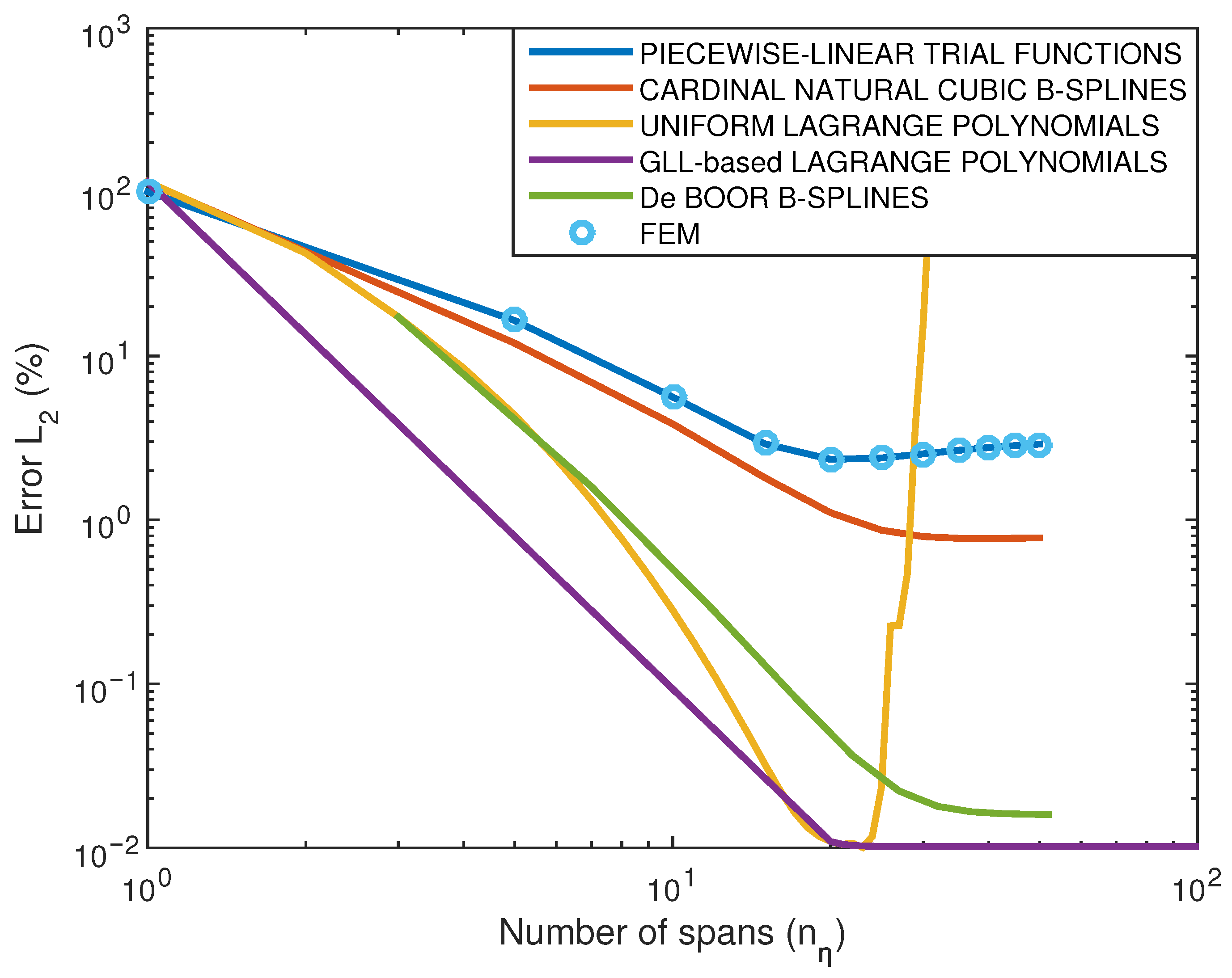
- All models converge to different values. This fact is mainly due to the inability to accurately represent the circular arc (for ). Below, we start from the less accurate model and end with the most accurate model.
- The piecewise-linear Coons interpolation model coincides with the FEM solution. This is because Example 2 is an axisymmetric problem with no angular dependence.
- The cardinal natural cubic B-spline model is characterized by a smaller error than the above piecewise-linear model and FEM.
- The uniform Lagrange polynomials model leads to a smaller error, but after the value , they diverge.
- The Cox–de Boor cubic B-splines model closely follows the accuracy of uniform Lagrange polynomials up to , then becomes less accurate until , and eventually converges to the value .
- The non-uniform Lagrange polynomials model based on GLL points rapidly converges to the accurate solution. A small error () remains, due to the incapability of accurately representing the circular arc using spans.
7.2.2. Transfinite Elements
7.3. Example 3
7.3.1. Classical Transfinite Elements (21-27-33-113 Nodes)
7.3.2. Unidirectional (Multi-Layer) 12-18-25-32-Node Elements
7.3.3. Coons-Patch Elements
7.3.4. Finite Element Solution
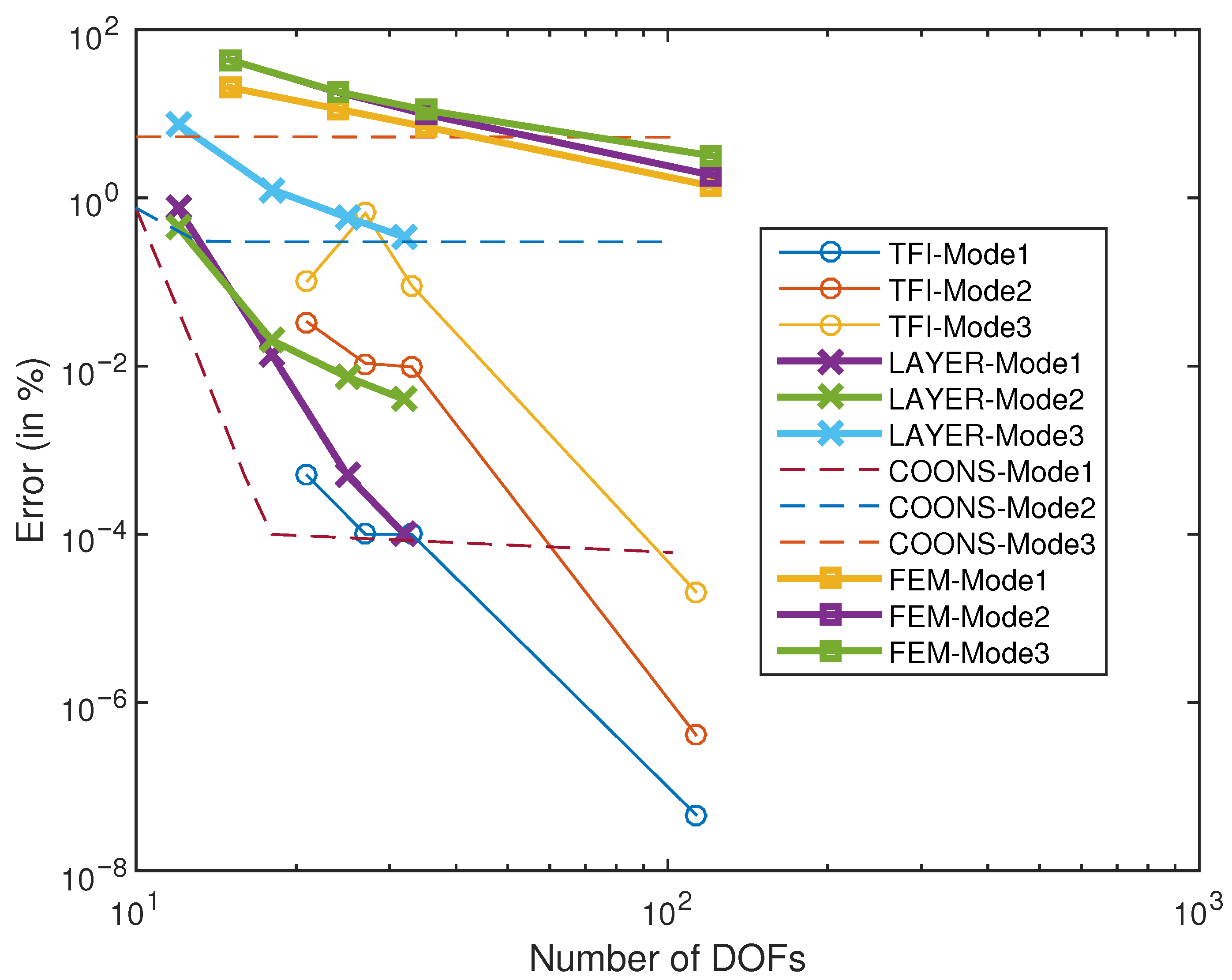
- The class of classical transfinite interpolation (TFI) elements exhibits the highest convergence rate.
- The Coons element (labelled COONS) is sufficiently accurate for the first mode, but for higher modes, it experiences difficulty converging toward the exact solution.
- The unidirectional (multi-layer) elements (labelled LAYER) provide adequate accuracy, but their convergence rate is lower than that of the TFI formulation.
- The FEM solution, based on a bilinear formulation, displays the lowest convergence rate.

7.3.5. Remark on Spectral Aspects
7.4. Example 4
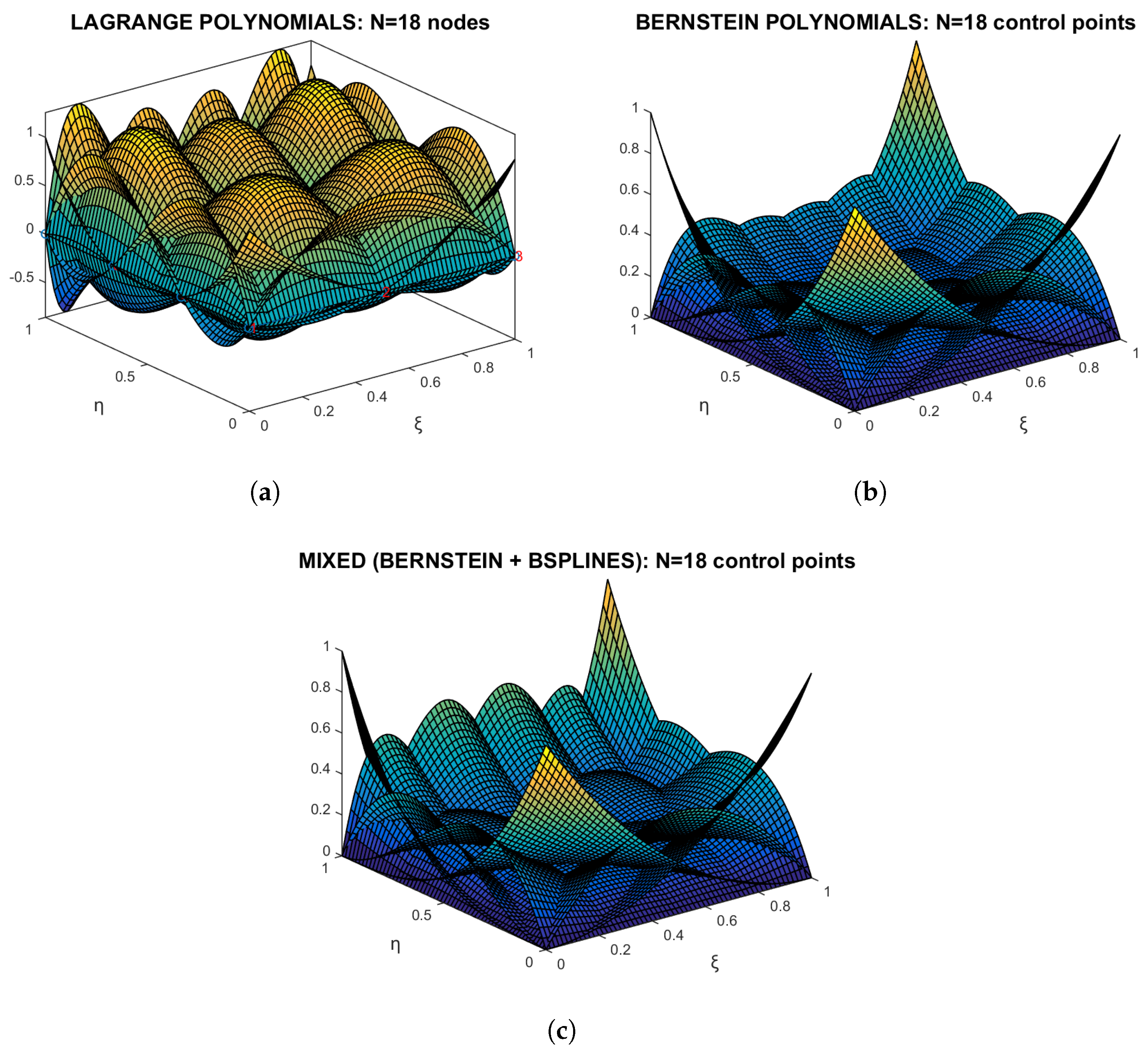
- On the bottom layer (consisting of 3 nodes: 1–2–3), a non-cardinal Bernstein polynomial of degree was used.
- On the middle layer (consisting of 4 nodes: 4–5–6–7), a Bernstein polynomial of degree was employed. Alternatively, one could adopt a quadratic B-spline () with knot vector .
- On the top layer (consisting of 5 nodes: 8–9–10–11–12), a cubic B-spline () was used with knot vector .
8. Extension to Collocation Method
9. Discussion
- Mesh refinement. Within the framework of traditional isogeometric analysis (IgA), truncated hierarchical B-splines (THB-splines) [48,49] constitute the prevailing refinement strategy, as they preserve the partition of unity within refined regions while leaving the remainder of the mesh unaffected. As an alternative, the proposed transfinite interpolation framework can naturally accommodate hanging nodes arising from one or multiple successive refinements (see Ref. [17], p. 24). In principle, the closed-form expressions presented therein require only the replacement of Lagrange polynomials (used as blending and trial functions) by B-splines.
- T-splines. Lagrange polynomials have been successfully employed for the treatment of single T-spline meshes [50]. Ongoing research indicates that the same concept extends naturally to Bernstein polynomials and B-splines, which may act both as blending and trial functions. Alternatively, a background tensor-product grid may be introduced, followed by successive elimination procedures. In both approaches, the partition of unity property holds a priori (([51], pp. 14–24) and papers therein).
- Large-scale problems. In Section 7.2.1, it was noted that B-splines generally require more Gauss points than high-degree Lagrange polynomials. It should be emphasized, however, that the local support of B-splines leads to a sparse global stiffness matrix, in contrast to the fully populated matrix typically associated with global Lagrange polynomials. This sparsity substantially offsets the increased integration cost and is particularly advantageous for large-scale problems, both in terms of matrix assembly and the computational efficiency of solving the resulting system of equations. In the present work, standard direct solvers in MATLAB were sufficient for the problem sizes considered, and bandwidth optimization was not the focus. Nevertheless, this is an important topic in which advanced solution techniques have been proposed for large-scale isogeometric and B-spline systems. For example, multigrid approaches [52,53] and domain decomposition methods [54] have been successfully applied to efficiently solve the algebraic systems arising in IgA and similar frameworks, and could be naturally adopted in future large-scale applications using the proposed transfinite element formulations.
- Implementation of weights. Although the present work focuses exclusively on unweighted B-splines, the incorporation of weights has recently been proposed. In particular, blending functions and trial functions may be weighted independently, not necessarily using identical weights. Within the context of CAGD, this generalized formulation enables the representation of cylindrical and spherical patches with machine-level accuracy [55].
10. Conclusions
Funding
Data Availability Statement
Conflicts of Interest
Appendix A. Natural Cubic B-Splines
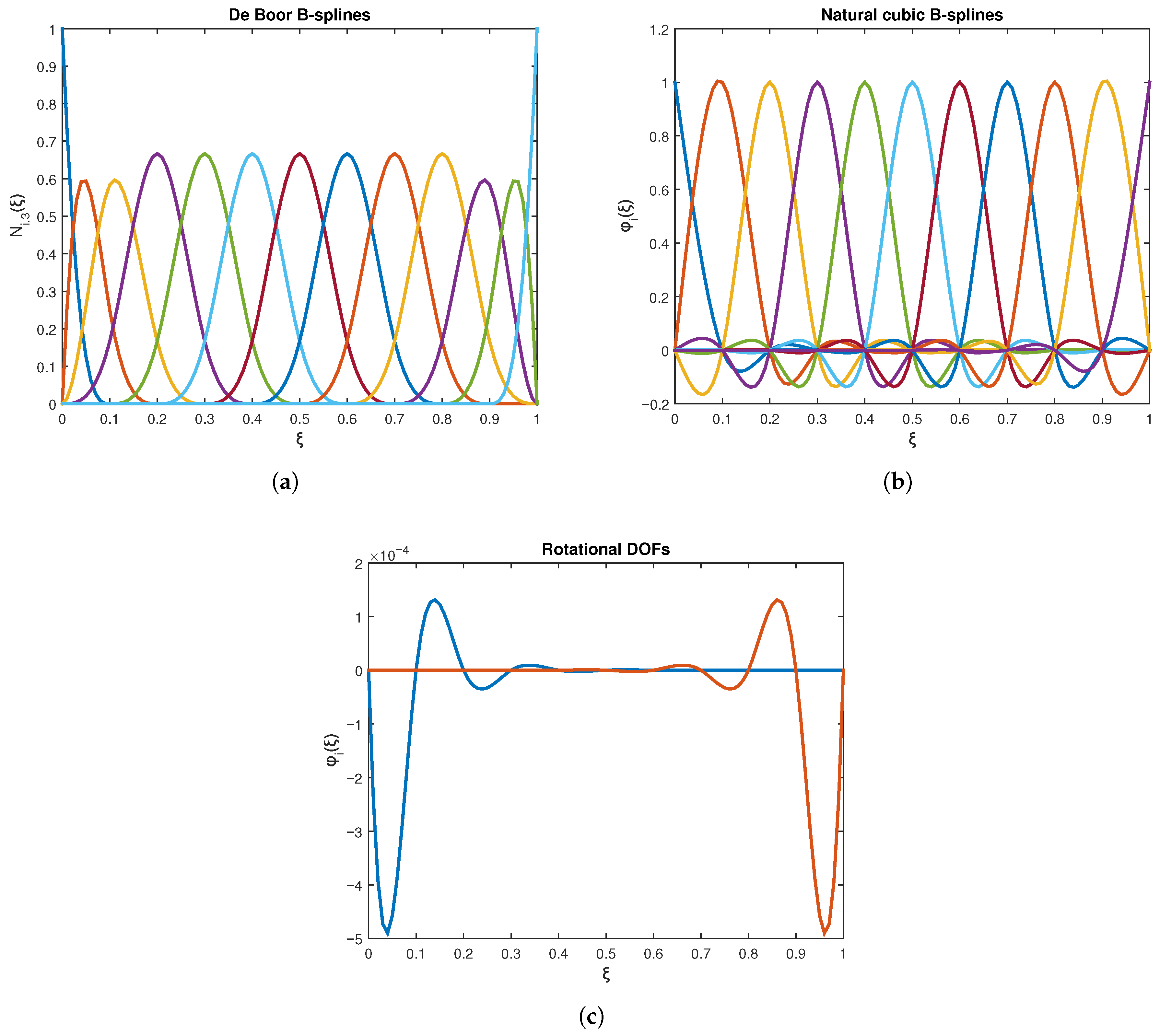
- Including end curvatures: If the curvatures (second derivatives) at the boundaries of the interval are retained, the formulation involves shape functions and correspondingly degrees of freedom. These consist of the n nodal values shown in Figure A1b, along with the two boundary curvatures illustrated in Figure A1c.
- Natural B-spline assumption: If the boundary curvatures are assumed to vanish—consistent with the natural B-spline formulation—the last two shape functions (out of the ) are effectively multiplied by zero and thus do not contribute to the solution. Consequently, the number of active shape functions reduces to n, as depicted in Figure A1b. It is worth noting that this reduced functional set, comprising n functions (), satisfies the partition of unity property, ensuring rigid-body consistency. A MATLAB® implementation for is provided in Listing A1, which also generates the graphical results shown in Figure A1.

| Listing A1. Typical MATLAB code for calculating and plotting cubic B-splines and natural cubic B-splines . |
%% PROGRAM TO DERIVE NATURAL CUBIC BSPLINES % In the interval [0,L], a number of internal breakpoints (nbrksIn), % the polynomial degree (p), and the multiplicity is given: L = 1; % length of interval p = 3; % polynomial degree multiplicity = 1; % Number of knots per inner breakpoint nbrksIn = 9; % Number of inner breakpoints nbrks = 2 + nbrksIn; % TOTAL number of breakpoints (2 ends + inner) nodes = nbrks; knots = augknt(linspace(0,L,nodes),p+1,multiplicity); % knot sequence numknots = size(knots,2); % Number of knots fprintf(’Number of knots = %3i\n’, numknots); nctrlpoints = numknots - (p+1); fprintf(’Number of control points = %3i\n’, nctrlpoints); % Points where the basis functions will be calculated: Ndivisions = 100; tau = linspace(0,L,Ndivisions+1); %% B-Splines nstep=p; colmat1=spcol(knots,p+1,brk2knt(tau,nstep)); [i1,i2]=size(colmat1); Basis1 = colmat1(1:nstep:i1,:); % Plot basis functions plot(tau,Basis1,’LineWidth’,2) xlabel(’cs’) ylabel(’Ni,p’) title([’P = ’, int2str(p)]) legend(’N1p’,’N2p’,’N3p’,’N4p’,’N5p’,’N6p’,’N7p’,’Location’,’best’) %% NATURAL BSPLINES % MATRIX [A] for i=1:nbrks tau0 = knots(p+i); A(i,1:nctrlpoints) = spcol(knots,p+1,brk2knt(tau0,1)); end tau1=0; tau2=1; basis=spcol(knots,p+1,brk2knt(tau1,3)); A(nbrks+1,1:nctrlpoints)=basis(3,:); basis=spcol(knots,p+1,brk2knt(tau2,3)); A(nbrks+2,1:nctrlpoints)=basis(3,:); Ainv = inv(A); % Calculate and plot natural B-spline N=[]; for i=1:length(tau) x=tau(i); lineN=spcol(knots,p+1,brk2knt(x,1)); for j=1:nbrks+2 N(i,j) = lineN * Ainv(1:nbrks+2,j); end end Figure~(2) plot(tau,N(:,1:nbrks),’LineWidth’,2) Figure~(3) plot(tau,N(:,nbrks+1:nbrks+2),’LineWidth’,2) |
Appendix B. Bernstein Polynomials and Derivatives
| Listing A2. Computation of Bernstein polynomials and derivatives. |
               function [ Basis, dBasis ] = Bernstein( tau, p )
		% BERNSTEIN polynomials and derivatives within [0,1], at 'tau' sites.
		multiplicity = 1;                        % multiplicity
		knots = augknt([0 1], p+1, multiplicity);
		nset  = 2;                               % number of sets
		colmat = spcol(knots, p+1, brk2knt(tau, nset));
		imax = size(colmat,1);
		Basis  = colmat(1:nset:imax, :);         % Bernstein polynomials B_i
		dBasis = colmat(2:nset:imax, :);         % Bernstein derivatives B_i'
		end
|
Appendix C. Shape Functions of 12-Node Element
function [SHP,XSJ] = SHAPE_Pht_12_BEZIER(xcor,ycor,cs,ht)
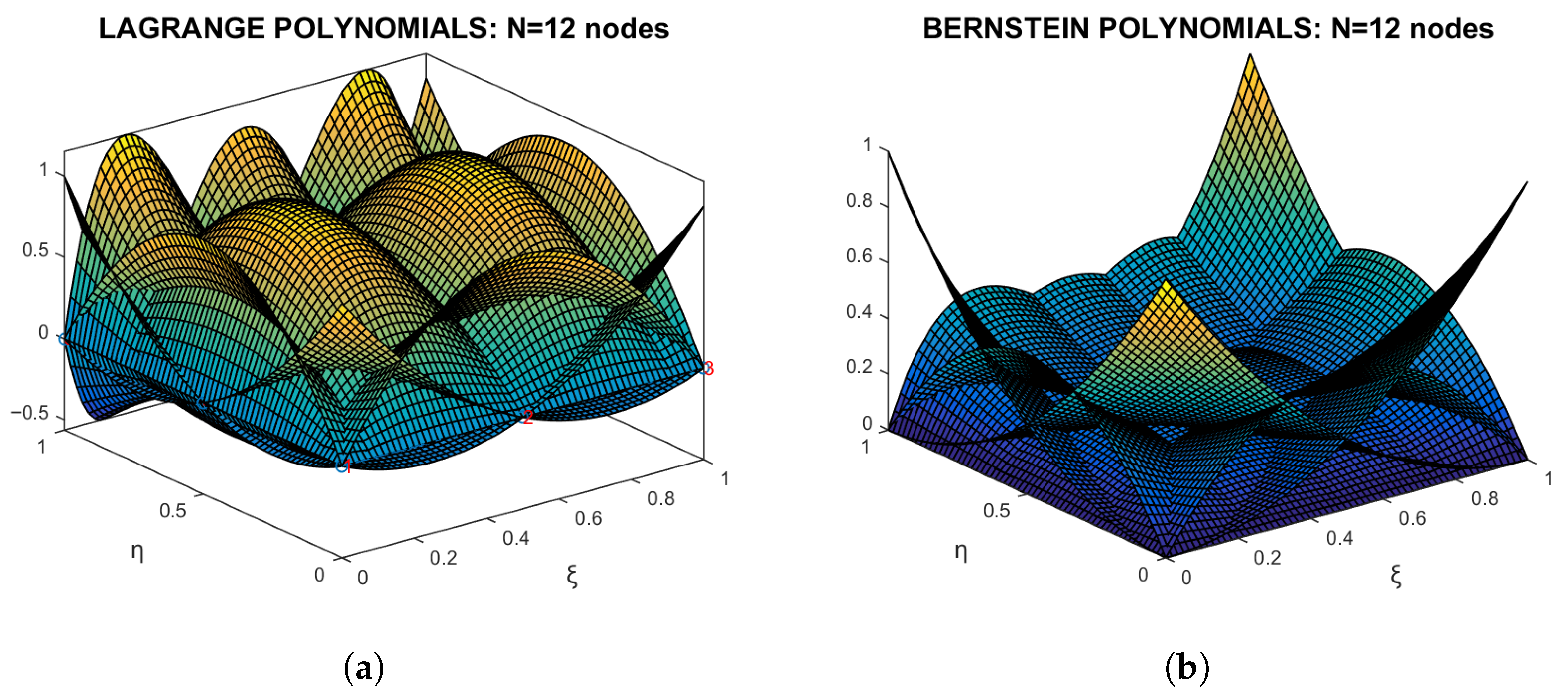
%% TRANSFINITE ELEMENT, 12 nodes, interboundaries at xi,eta=0,1/2,1.
%{
% 10 bounday nodes + 1*1 = 11 total nodes
                13       14      15      16     17     18
              D o-------o--------o--------o-------o------o  C
                |                                        |
                |                   10                   |
                8 o         o 9       o       o 11       o 12
                |                                        |
                |                                        |
                4 o         o 5             o 6          o 7
                |                                        |
                |                                        |
                o---------------------o------------------o--->X
                A 1                     2                  3 B
                %}
%% BLENDING FUNCTIONS IN Y-dir:
py=2; tauy=ht;
[ Basis, dBasis ] = Bernstein( tauy, py );      %Bernstein polynomials
E1y=Basis(1);    E2y=Basis(2);   E3y=Basis(3);  %Blending functions
dE1y=dBasis(1); dE2y=dBasis(2); dE3y=dBasis(3); %Derivatives of >>
%--------------------------------------------------------------------------
NEL = 12; SHP(1:3,1:NEL)=0;
%---LAYER#1:
px=2; taux=cs;
[ Basis, dBasis ] = Bernstein( taux, px );  % Bernstein polynomials
L1x=Basis(1);    L2x=Basis(2);   L3x=Basis(3);
dL1x=dBasis(1); dL2x=dBasis(2); dL3x=dBasis(3);
%---ASSOCIATED BIVARIATE BASIS FUNCTIONS (1-3) [see, Equation~(20)]:
SHP(3,1) = L1x* E1y;    %psi_1
SHP(1,1) =dL1x* E1y;    %d(psi_1)/dxi;
SHP(2,1) =  L1x*dE1y;   %d(psi_1)/deta;
SHP(3,2) = L2x* E1y;    %psi_2
SHP(1,2) =dL2x* E1y;    %d(psi_2)/dxi;
SHP(2,2) = L2x*dE1y;    %d(psi_2)/deta;
SHP(3,3) = L3x* E1y;    %psi_3
SHP(1,3) =dL3x* E1y;    %d(psi_3)/dxi;
SHP(2,3) = L3x*dE1y;    %d(psi_3)/deta;
%---LAYER No.2: HT=1/2:
px=3; taux=cs;
[ Basis, dBasis ] = Bernstein( taux, px );
L1x=Basis(1);    L2x=Basis(2);   L3x=Basis(3);   L4x= Basis(4);
dL1x=dBasis(1); dL2x=dBasis(2); dL3x=dBasis(3); dL4x=dBasis(4);
%---ASSOCIATED BIVARIATE BASIS FUNCTIONS (4-7) [see, Equation~(20)]:
SHP(3,4) = L1x* E2y; SHP(1,4) =dL1x* E2y; SHP(2,4) = L1x* dE2y;
SHP(3,5) = L2x* E2y; SHP(1,5) =dL2x* E2y; SHP(2,5) = L2x* dE2y;
SHP(3,6) = L3x* E2y; SHP(1,6) =dL3x* E2y; SHP(2,6) = L3x* dE2y;
SHP(3,7) = L4x* E2y; SHP(1,7) =dL4x* E2y; SHP(2,7) = L4x* dE2y;
%---LAYER No.3: HT=1:
px=4; taux=cs;
[ Basis, dBasis ] = Bernstein( taux, px );
L1x=Basis(1);    L2x=Basis(2);   L3x=Basis(3);   L4x= Basis(4);  L5x= Basis(5);
dL1x=dBasis(1); dL2x=dBasis(2); dL3x=dBasis(3); dL4x=dBasis(4); dL5x=dBasis(5);
%---ASSOCIATED BIVARIATE BASIS FUNCTIONS (8-12) [see, Equation~(20)]:
SHP(3,8)  = L1x* E3y; SHP(1,8)  = dL1x* E3y; SHP(2,8)  = L1x* dE3y;
SHP(3,9)  = L2x* E3y; SHP(1,9)  = dL2x* E3y; SHP(2,9)  = L2x* dE3y;
SHP(3,10) = L3x* E3y; SHP(1,10) = dL3x* E3y; SHP(2,10) = L3x* dE3y;
SHP(3,11) = L4x* E3y; SHP(1,11) = dL4x* E3y; SHP(2,11) = L4x* dE3y;
SHP(3,12) = L5x* E3y; SHP(1,12) = dL5x* E3y; SHP(2,12) = L5x* dE3y;
%-----CONSTRUCT JACOBIAN:
XL(1,1:NEL)=xcor(1:NEL);
XL(2,1:NEL)=ycor(1:NEL);
for I=1:2
for J=1:2
XS(I,J)=0.0;
for K=1:NEL
XS(I,J)=XS(I,J)+XL(I,K)*SHP(J,K);
end
end
end
%---INVERSE OF JACOBIAN:
XSJ=XS(1,1)*XS(2,2)-XS(1,2)*XS(2,1);
SX(1,1)=XS(2,2)/XSJ;
SX(2,2)=XS(1,1)/XSJ;
SX(1,2)=-XS(1,2)/XSJ;
SX(2,1)=-XS(2,1)/XSJ;
% C-----FORM GLOBAL DERIVATIVES
for I=1:NEL
TP       = SHP(1,I)*SX(1,1)+SHP(2,I)*SX(2,1);
SHP(2,I) = SHP(1,I)*SX(1,2)+SHP(2,I)*SX(2,2);
SHP(1,I) = TP;
end
end     %end-of-subroutine
Appendix D. Main Program
| SHAPE_Peta_12_LAGRANGE | Shape functions using univariate Lagrange polynomials, as blending and trial functions. |
| SHAPE_Peta_12_BEZIER | Basis functions using univariate Bernstein-Bézier polynomials, as blending and trial functions (cited in Appendix C). |
| SHAPE_Peta_12_BSPLINES | Basis functions using univariate B-splines, as blending and trial functions. |
| lgwt | Gauss points and associated weights (see Ref. [23]). |
| area | Is the calculated patch area using Lagrange (L), Bernstein-Bézier (B) and B-spline (C) interpolation. |
| Coeffs | Calculated coefficients () using Lagrange (L), Bernstein-Bézier (B) and B-spline (C) interpolation. |
| gi | Location of Gauss points (). |
| L2percent | -error norm (in %) of the numerical solution . |
| NEL | Is the number of Nodes on the ELement. |
| ncellx | Is the number of integration cells in -direction. |
| ncelly | Is the number of integration cells in -direction. |
| ngauss | Is the number of Gauss points per direction. |
| ome | Weights associated with Gauss points. |
| SHPL | Shape functions and partial derivatives for Lagrange polynomials. |
| SHPB | Shape functions and partial derivatives for Bernstein-Bézier polynomials (see, Appendix C). |
| SHPC | Shape functions and partial derivatives for B-splines. |
| x,y,XL | Cartesian coordinates of nodal points or breakpoints. |
| xi,eta | Parameters . |
| XLb | Cartesian coordinates of control points for Bernstein-Bézier polynomials. |
| XLc | Cartesian coordinates of control points for B-splines. |
| XSJ | Determinant of Jacobian matrix. |
%********************************************************************
%% Solves the BVP for 12-node Transfinite Element
%********************************************************************
%{
     D  o---------o---------o--------o--------o C      Layer#3
        |8        9         10       11     12|
        |                                     |
        4 o   ---   o 5     ---    o 6   ---    o 7    Layer#2
        |                                     |
        |                                     |
        o-------------------o-----------------o        Layer#1
        A 1                   2                 3  B
        %}
%--------------------------------------------------------------------------
clear all; clc
%**********************************************************************
%%                                PRE-PROCESSOR
%**********************************************************************
%---CARTESIAN COORDINATES (UNIT SQUARE: xmax=1, ymax=1):
NEL = 12;   %number of element nodes
x(1:3) =linspace(0,1,3); y(1:3)=0.0;    % Layer#1: uniform
x(4:7) =linspace(0,1,4); y(4:7)=1/2;    % Layer#2: uniform
x(8:12)=linspace(0,1,5); y(8:12)=1;     % Layer#1: uniform
% Store both coordinates in the single array XL:
XL(1,1:NEL)=x(1:NEL);     XL(2,1:NEL)=y(1:NEL); %store in one array
Figure~(1)
plot(x,y,’o-’)      % Plot Cartesian coordinates (nodes or breakpoints)
for i=1:NEL
text(x(i)+0.02,y(i)+0.02,int2str(i),’Color’,’red’) % node numbering
end
%% ADJUST CONTROL POINTS SO THAT TO PRODUCE UNIFORM IMAGES:
for i=1:NEL
xi=x(i); eta=y(i);
[SHPB,~] = SHAPE_Peta_12_BEZIER(x,y,xi,eta);            %Bezier
Bmat(i,1:NEL)=SHPB(3,1:NEL);
[SHPC,XSJdummy] = SHAPE_Peta_12_BSPLINES(x,y,xi,eta);   %B-splines
Cmat(i,1:NEL)=SHPC(3,1:NEL);
end
% Control points (CTRLs) for BERNSTEIN-BEZIER approximation:
XLb(1,1:NEL) = Bmat \ XL(1,1:NEL)’; %control pts (x-coordinate)
XLb(2,1:NEL) = Bmat \ XL(2,1:NEL)’; %control pts (y-coordinate)
% Control points (CTRLs) for B-SPLINE approximation:
XLc(1,1:NEL) = Cmat \ XL(1,1:NEL)’; %control pts (x-coordinate)
XLc(2,1:NEL) = Cmat \ XL(2,1:NEL)’; %control pts (y-coordinate)
%Finalize the plot:
hold on
plot(XLb(1,1:NEL), XLb(2,1:NEL),’b+’)   %Plot BERNSTEIN-BEZIER CTRLs
hold on
plot(XLc(1,1:NEL), XLc(2,1:NEL),’rx’)   %Plot B-SPLINE CTRLs
% For each layer, store location of breakpoints (or nodes) into a vector:
Layer1=[0,1/2,1];           % Breakpoints (BRKs) of Layer#1
Layer2=[0 1/3 2/3 1];       % BRKs of Layer#2
Layer3=[0 1/4 2/4 3/4 1];   % BRKs of Layer#3
AllValues = [Layer1, Layer2, Layer3];    % All possible BRKS, together.
Ubrkx = unique(AllValues);  % Determine Unique values
ncellx=length(Ubrkx)-1;     % number of cells in horizontal direction
ncelly=2;                   % number of cells in vertical direction
%*********************************************************************
%%                                ANALYSIS
%*********************************************************************
%---Usual Gauss Points (GPTs) per direction in each integration cell:
ngauss = 04;    % For rectangle: (p+1) GPTs per direction are required.
[gi,ome]=lgwt(ngauss,-1,1); % Gauss points and weights
% Initialize Stiffness and Patch area: L=Lagrange, B=Bernstein, C=B-spline
KL=zeros(NEL,NEL); KB=zeros(NEL,NEL); KC=zeros(NEL,NEL); % stiffness
areaL=0; areaB=0; areaC=0;                               % patch area
dy=1/ncelly;    % vertical distance betwen successive layers
xmax=1; ymax=1; % edge lengths of quadrilateral patch
% Loop over all integration cells
for jcelly=1:ncelly
ym=(jcelly-1)*dy+dy/2; etam=ym/ymax;
for icellx=1:ncellx
dx=Ubrkx(icellx+1)-Ubrkx(icellx);
Jloc=1/4*dx*dy; % local det(Jacobian)
xm=(Ubrkx(icellx)+Ubrkx(icellx+1))/2; xim=xm/xmax;
for igau=1:ngauss
for jgau=1:ngauss
xsj=1;  %square [0,1]x[0,1]
xi=xim+gi(igau)*dx/2;
eta=etam+gi(jgau)*dy/2;
% For current Gauss point (xi,eta), find Shape Functions:
[SHPL,XSJL] = SHAPE_Peta_12_LAGRANGE( x, y, xi, eta );%Lagrange
[SHPB,XSJB] = SHAPE_Peta_12_BEZIER(XLb(1,1:NEL),XLb(2,1:NEL),xi,eta);%Bezier
[SHPC,XSJC] = SHAPE_Peta_12_BSPLINES(XLc(1,1:NEL),XLc(2,1:NEL),xi,eta);%B-splines, p=3
% Weighted Jacobian term:
dvolL=XSJL*ome(igau)*ome(jgau)*Jloc; %volume element (Lagrange)
dvolB=XSJB*ome(igau)*ome(jgau)*Jloc; %volume element (Bernstein)
dvolC=XSJC*ome(igau)*ome(jgau)*Jloc; %volume element (B-spline)
% Patch area using (L=Lagrange, B=Bernstein, C=B-spline):
areaL=areaL+dvolL;
areaB=areaB+dvolB;
areaC=areaC+dvolC;
% Stiffness matrices in three fomulations (L, B, C):
for i=1:NEL
for j=1:NEL
%---LAGRANGE:
KL(i,j)=KL(i,j) + (SHPL(1,i)*SHPL(1,j) + SHPL(2,i)*SHPL(2,j))*dvolL;
%---BEZIER-BERNSTEIN:
KB(i,j)=KB(i,j) + (SHPB(1,i)*SHPB(1,j) + SHPB(2,i)*SHPB(2,j))*dvolB;
%---B-SPLINES:
KC(i,j)=KC(i,j) + (SHPC(1,i)*SHPC(1,j) + SHPC(2,i)*SHPC(2,j))*dvolC;
end
end
end
end
end
end
fprintf(’\nAREAS: areaL = %12.5e  areaB = %12.5e  areaC = %12.5e\n’,areaL,areaB,areaC);
%% IMPOSE BOUNDARY CONDITIONS
BC(1:NEL)=0;
BC(1:3)=1;                  %edge AB (bottom)
BC(3)=1;BC(7)=1;BC(12)=1;   %edge BC (right vertical)
BC(8:12)=1;                 %edge DC (top)
%----------------------------------------------------------------------
% LAGRANGE POLYNOMIALS (index ’L’):
fiL(1:NEL)=0;
edofTop=[8 9 10 11 12];
Xtop=x(edofTop);
fiL(edofTop)=1000*cos(pi*Xtop/2/1);
%----------------------------------------------------------------------
% BERNSTEIN POLYNOMIALS (index ’B’):
fiB(1:NEL)=0;
rhsB(1:NEL)=0;
TopU(1:5)=1000*cos(pi*Xtop/2/1);
px=4;
knotsx=augknt([0 1],px+1,1);
taux=Xtop;
Bmatrix=spcol(knotsx,px+1,brk2knt(taux,1));
nctrlx=size(Bmatrix,2);
fiB(edofTop)=Bmatrix \ TopU’;
%----------------------------------------------------------------------
% B-SPLINES (index ’C’):
fiC(1:NEL)=0;
rhsC(1:NEL)=0;
TopU(1:5)=1000*cos(pi*Xtop/2/1);
px=3;
knotsx=[0 0 0 0 1/2 1 1 1 1];
taux=Xtop;
Cmatrix=spcol(knotsx,px+1,brk2knt(taux,1));
nctrlx=size(Cmatrix,2);
fiC(edofTop)=Cmatrix \ TopU’;
%----------------------------------------------------------------------
%% DIVIDE DOFs IN TWO PARTS:
free_dofs  = find(BC==0);
fixed_dofs = find(BC==1);
%% SOLVE FOR LAGRANGE POLYNOMIALS:
rhsL(1:NEL)=0;
rhsL(free_dofs)=-KL(free_dofs,fixed_dofs)*fiL(fixed_dofs)’;
UnodalL(fixed_dofs)=fiL(fixed_dofs);
UnodalL(free_dofs) = KL(free_dofs,free_dofs) \ rhsL(free_dofs)’;
%% SOLVE FOR BERNSTEIN POLYNOMIALS:
rhsB(1:NEL)=0;
rhsB(free_dofs)=-KB(free_dofs,fixed_dofs)*fiB(fixed_dofs)’;
CoeffsB(fixed_dofs)= fiB(fixed_dofs);
CoeffsB(free_dofs) = KB(free_dofs,free_dofs) \ rhsB(free_dofs)’;
%% SOLVE FOR B-SPLINES:
rhsC(1:NEL)=0;
rhsC(free_dofs)=-KC(free_dofs,fixed_dofs)*fiC(fixed_dofs)’;
CoeffsC(fixed_dofs)= fiC(fixed_dofs);
CoeffsC(free_dofs) = KC(free_dofs,free_dofs) \ rhsC(free_dofs)’;
%**************************************************************************
%%                                POST-PROCESSOR
%**************************************************************************
%% CALCULATE THE ERROR IN THE DOMAIN
areaL=0;        areaB=0;        areaC=0;
numeratorL=0;   numeratorB=0;   numeratorC=0;
denominatorL=0; denominatorB=0; denominatorC=0;
for jcelly=1:ncelly
ym=(jcelly-1)*dy+dy/2; etam=ym/ymax;
for icellx=1:ncellx
dx=Ubrkx(icellx+1)-Ubrkx(icellx);
Jloc=1/4*dx*dy;
xm=(Ubrkx(icellx)+Ubrkx(icellx+1))/2; xim=xm/xmax;
for igau=1:ngauss
for jgau=1:ngauss
xi=xim+gi(igau)*dx/2; eta=etam+gi(jgau)*dy/2; %parameters
% Shape functions:
[SHPL, XSJL] = SHAPE_Peta_12_LAGRANGE( x,y,xi,eta ); %Lagrange
[SHPB, XSJB] = SHAPE_Peta_12_BEZIER( XLb(1,1:NEL), XLb(2,1:NEL), xi, eta );  %Bezier
[SHPC, XSJC] = SHAPE_Peta_12_BSPLINES( XLc(1,1:NEL), XLc(2,1:NEL), xi, eta );  %Bezier
% Calculated values at Gauss points:
UcalculatedL = SHPL(3,:)*UnodalL’;
UcalculatedB = SHPB(3,:)*CoeffsB’;
UcalculatedC = SHPC(3,:)*CoeffsC’;
% Cartesian coordinates of Gauss points:
xgpt=SHPL(3,:)*XL(1,:)’; ygpt=SHPL(3,:)*XL(2,:)’;
Uexact=1000*sinh(pi*ygpt/2/1)/sinh(pi*1/2/1) * cos(pi*xgpt/2/1);
% Volume elements
dvolL=XSJL*ome(igau)*ome(jgau)*Jloc;
dvolB=XSJB*ome(igau)*ome(jgau)*Jloc;
dvolC=XSJC*ome(igau)*ome(jgau)*Jloc;
% Lagrange polynomials (L):
areaL=areaL+dvolL;
numeratorL  =numeratorL   + (UcalculatedL-Uexact)^2*dvolL;
denominatorL=denominatorL + (0-Uexact)^2*dvolL;
% Bernstein-Bezier polynomals (B):
areaB=areaB+dvolB;
numeratorB  =numeratorB   + (UcalculatedB-Uexact)^2*dvolB;
denominatorB=denominatorB + (0-Uexact)^2*dvolB;
% B-splines (C):
areaC=areaC+dvolC;
numeratorC  =numeratorC   + (UcalculatedC-Uexact)^2*dvolC;
denominatorC=denominatorC + (0-Uexact)^2*dvolC;
end
end
end
end
L2percentL = sqrt(numeratorL/denominatorL)*100;
fprintf(’\nLAGRANGE : Area = %12.5e  L2-error norm(percent) = %12.5e\n’,areaL,L2percentL);
L2percentB = sqrt(numeratorB/denominatorB)*100;
fprintf(’BERNSTEIN: Area = %12.5e  L2-error norm(percent) = %12.5e\n’,areaB,L2percentB);
L2percentC = sqrt(numeratorC/denominatorC)*100;
fprintf(’B-SPLINES: Area = %12.5e  L2-error norm(percent) = %12.5e\n’,areaC,L2percentC);
return
References
- Rayleigh, L. Scientific Papers; Cambridge University Press: Cambridge, UK, 1900; Volume II. [Google Scholar]
- Ritz, W. Über eine neue Methode zur Lösung gewisser Variationsprobleme der mathematischen Physik, (On a new method for the solution of certain variational problems of mathematical physics). J. Reine Angew. Math. 1909, 135, 1–61. [Google Scholar] [CrossRef]
- Zienkiewicz, O.C. The Finite Element Method, 3rd ed.; McGraw-Hill: London, UK, 1977. [Google Scholar]
- Bathe, K.J. Finite Element Procedures, 2nd ed.; Prentice-Hall: Saddle River, NJ, USA, 1996. [Google Scholar]
- Gordon, W.J.; Hall, C.A. Transfinite element methods: Blending-function interpolation over arbitrary curved element domains. Numer. Math. 1973, 21, 109–129. [Google Scholar] [CrossRef]
- Birkhoff, G.; Cavendish, J.C.; Gordon, W.J. Multivariate Approximation by Locally Blended Univariate Interpolants. Proc. Nat. Acad. Sci. USA 1974, 71, 3423–3425. [Google Scholar] [CrossRef]
- Coons, S.A. Surfaces for Computer-Aided Design of Space Forms; MIT Report; Massachusetts Institute of Technology: Cambridge, MA, USA, 1967. [Google Scholar]
- Kanarachos, A.; Deriziotis, D. On the solution of Laplace and wave propagation problems using “C-elements”. Finite Elem. Anal. Des. 1989, 5, 97–109. [Google Scholar] [CrossRef]
- Provatidis, C.G. Precursors of Isogeometric Analysis: Finite Elements, Boundary Elements, and Collocation Methods; Springer: Cham, Switzerland, 2019. [Google Scholar] [CrossRef]
- Hughes, T.J.R.; Cottrell, J.A.; Bazilevs, Y. Isogeometric Analysis: CAD, Finite Elements, NURBS, Exact Geometry and Mesh Refinement. Comput. Methods Appl. Mech. Eng. 2005, 194, 4135–4195. [Google Scholar] [CrossRef]
- Cottrell, J.A.; Hughes, T.J.R.; Bazilevs, Y. Isogeometric Analysis: Towards Integration of CAD and FEA; Wiley: Chichester, UK, 2009. [Google Scholar]
- Scholz, E.; Altenbach, J. Kompatible übergangselemente für lokale Netzverfeinerungen bei 2D- und 3D-Finite-Elemente-Modellen. Tech. Mech. 1985, 6, 72–78. [Google Scholar]
- Altenbach, J.; Scholz, E. Ableitung von Formfunktionen für finite Standard- und Übergangselemente Grundlage der gemischten Interpolation. Tech. Mech. 1987, 8, 18–30. [Google Scholar]
- Weinberg, K.; Gabbert, U. Adaptive local-global analysis by pNh transition elements. Tech. Mech. 1999, 19, 115–126. [Google Scholar]
- Weinberg, K.; Gabbert, U. An adaptive pNh-technique for global-local finite element analysis. Eng. Comput. 2002, 19, 485–500. [Google Scholar] [CrossRef]
- Duczek, S.; Saputra, A.A.; Gravenkamp, H. High Order Transition Elements: The xNy-Element Concept—Part I: Statics. Comput. Methods Appl. Mech. Eng. 2020, 362, 112833. [Google Scholar] [CrossRef]
- Provatidis, C. Transfinite patches for isogeometric analysis. Mathematics 2025, 13, 35. [Google Scholar] [CrossRef]
- Provatidis, C. Transfinite elements using Bernstein polynomials. Axioms 2025, 14, 433. [Google Scholar] [CrossRef]
- Farin, G. Curves and Surfaces for CAGD; Morgan Kaufmann-Elsevier: Burlington, MA, USA, 2002. [Google Scholar] [CrossRef]
- Provatidis, C. Bézier versus Lagrange polynomials-based finite element analysis of 2-D potential problems. Adv. Eng. Softw. 2014, 73, 22–34. [Google Scholar] [CrossRef]
- Farouki, R.; Hinds, J. A hierarchy of geometric forms. IEEE Comput. Graph. Appl. 1985, 5, 51–78. [Google Scholar] [CrossRef]
- DeBoor, C. A Practical Guide to Splines, Revised ed.; Springer: New York, NY, USA, 2001. [Google Scholar]
- von Winckel, G. Legendre-Gauss Quadrature Weights and Nodes. MATLAB Central File Exchange. Recovered 6 August 2025. 2025. Available online: https://www.mathworks.com/matlabcentral/fileexchange/4540-legendre-gauss-quadrature-weights-and-nodes (accessed on 20 December 2025).
- Carslaw, H.S.; Jaeger, J.C. Conduction of Heat in Solids, 2nd ed.; Oxford University Press: Oxford, UK, 1969. [Google Scholar]
- Curry, H.B.; Schoenberg, I.J. On Pólya Frequency Functions IV: The Fundamental spline functions and their limits. J. D’analyse Math. 1966, 17, 71–107. [Google Scholar] [CrossRef]
- Cox, M.G. The Numerical Evaluation of B-Splines. IMA J. Appl. Math. 1972, 10, 134–149. [Google Scholar] [CrossRef]
- De Boor, C. On Calculating with B-Splines. J. Approx. Theory 1972, 6, 50–62. [Google Scholar] [CrossRef]
- Karniadakis, G.E.; Sherwin, S.J. Spectral/Hp Element Methods for Computational Fluid Dynamics; Oxford Science Publications: Oxford, UK, 2005. [Google Scholar] [CrossRef]
- Piegl, L.; Tiller, W. A menagerie of rational B-spline circles. IEEE Comput. Graph. Appl. 1989, 9, 48–56. [Google Scholar] [CrossRef]
- Courant, R.; Hilbert, D. Methods of Mathematical Physics, 1st English ed.; Translated and Revised from the German Original; InterScience: New York, NY, USA, 1966; Volume I. [Google Scholar]
- Garoni, C.; Speleers, H.; Ekström, S.-E.; Reali, A.; Serra-Capizzano, S.; Hughes, T.J.R. Symbol-based analysis of finite element and isogeometric B-spline discretizations of eigenvalue problems: Exposition and review. Arch. Comput. Methods Eng. 2019, 26, 1639–1690. [Google Scholar] [CrossRef]
- Felippa, C.A.; Haugen, B.; Militello, C. From the individual element test to finite element templates: Evolution of the patch test. Int. J. Numer. Methods Eng. 1995, 38, 199–229. [Google Scholar] [CrossRef]
- Provatidis, C.G. Lumped mass acoustic and membrane eigenanalysis using the global collocation method. Cogent Eng. 2014, 1, 981366. [Google Scholar] [CrossRef]
- Provatidis, C.G. CAD-based collocation eigenanalysis of 2-D elastic structures. Comput. Struct. 2017, 182, 55–73. [Google Scholar] [CrossRef]
- Yağmurlu, N.M.; Karakaş, A.S. A novel perspective for simulations of the MEW equation by trigonometric cubic B-spline collocation method based on Rubin-Graves type linearization. Comput. Methods Differ. Equ. 2022, 10, 1046–1058. [Google Scholar] [CrossRef]
- Kutluay, S.; Yağmurlu, N.M.; Karakaş, A.S. A novel perspective for simulations of the Modified Equal-Width Wave equation by cubic Hermite B-spline collocation method. Wave Motion 2024, 129, 103342. [Google Scholar] [CrossRef]
- Kutluay, S.; Yagmurlu, N.M.; Karakaş, A.S. A robust septic Hermite collocation technique for Dirichlet boundary condition Heat conduction equation. Int. J. Math. Comput. Eng. 2025, 3, 253–266. [Google Scholar] [CrossRef]
- Eisenträger, S.; Eisenträger, J.; Gravenkamp, H.; Provatidis, C.G. High order transition elements: The xNy-element concept, Part II: Dynamics. Comput. Methods Appl. Mech. Eng. 2021, 387, 114145. [Google Scholar] [CrossRef]
- Provatidis, C.G.; Sevilla, R.; Schillinger, D.; Eisenträger, S. Revisiting Transfinite Elements: Unifying Element Formulations for IGA, SEM, NEFEM, p-FEM and h-FEM. Arch. Comput. Methods Eng. 2025. [Google Scholar] [CrossRef]
- Provatidis, C.G. Non-rational and rational transfinite interpolation using Bernstein polynomials. Int. J. Comput. Geom. Appl. 2022, 32, 55–89. [Google Scholar] [CrossRef]
- Nguyen, V.P.; Anitescu, C.; Bordas, S.P.; Rabczuk, T. Isogeometric analysis: An overview and computer implementation aspects. Math. Comput. Simul. 2015, 117, 89–116. [Google Scholar] [CrossRef]
- Garau, E.M.; Vázquez, R. Algorithms for the implementation of adaptive isogeometric methods using hierarchical B-splines. Appl. Numer. Math. 2018, 123, 58–87. [Google Scholar] [CrossRef]
- Provatidis, C.G.; Angelidis, D.I. Performance of Coons’ macroelements in plate bending analysis. Int. J. Comput. Methods Eng. Sci. Mech. 2014, 15, 110–125. [Google Scholar] [CrossRef]
- Bogner, F.K.; Fox, R.L.; Schmit, L.A. The generation of inter-element-compatible stiffness and mass matrices by the use of interpolation formulas. In Proceedings of the Conference on Matrix Methods in Structural Mechanics, Wright-Patterson Air Force Base, OH, USA, 26–28 October 1965; pp. 397–444. [Google Scholar]
- Thomas, D.C.; Engvall, L.; Schmidt, S.K.; Tew, K.; Scott, M.A. U-splines: Splines over unstructured meshes. Comput. Methods Appl. Mech. Eng. 2022, 401, 115515. [Google Scholar] [CrossRef]
- Wei, X.; Li, X.; Qian, K.; Hughes, T.J.R.; Zhang, Y.J.; Casquero, H. Analysis-suitable unstructured T-splines: Multiple extraordinary points per face. Comput. Methods Appl. Mech. Eng. 2022, 391, 114494. [Google Scholar] [CrossRef]
- Sangalli, G.; Takacs, T.; Vázquez, R. Unstructured spline spaces for isogeometric analysis based on spline manifolds. Comput. Aided Geom. Des. 2016, 47, 61–82. [Google Scholar] [CrossRef]
- Giannelli, C.; Jüttler, B.; Speleers, H. THB-splines: The truncated basis for hierarchical splines. Comput. Aided Geom. Des. 2012, 29, 485–498. [Google Scholar] [CrossRef]
- Vuong, A.V.; Giannelli, C.; Jüttler, B.; Simeon, B. A hierarchical approach to adaptive local refinement in isogeometric analysis. Comput. Methods Appl. Mech. Engrg. 2011, 200, 3554–3567. [Google Scholar] [CrossRef]
- Provatidis, C.; Eisenträger, S. Macroelement analysis in T-patches using Lagrange polynomials. Mathematics 2025, 13, 1498. [Google Scholar] [CrossRef]
- Provatidis, C.G. Unstructured transfinite elements including T-Splines. Preprints 2025, 2025101500. [Google Scholar] [CrossRef]
- Donatelli, M.; Garoni, C.; Manni, C.; Serra-Capizzano, S.; Speleers, H. Symbol-based multigrid methods for Galerkin B-spline isogeometric analysis. SIAM J. Numer. Anal. 2017, 55, 31–62. [Google Scholar] [CrossRef]
- Jomo, J.; Oztoprak, O.; de Prenter, F.; Zander, N.; Kollmannsberger, S.; Rank, E. Hierarchical multigrid approaches for the finite cell method on uniform and multi-level hp-refined grids. Comput. Methods Appl. Mech. Energ. 2021, 386, 114075. [Google Scholar] [CrossRef]
- Widlund, O.B.; Zampini, S.; Scacchi, S.; Pavarino, L.F. Block FETI–DP/BDDC preconditioners for mixed isogeometric discretizations of three-dimensional almost incompressible elasticity. Math. Comp. 2021, 90, 1773–1797. [Google Scholar] [CrossRef]
- Provatidis, C.G. Weighted transfinite interpolation for slightly unstructured curvilinear patches. Comput. Aided Geom. Des. 2025, 124, 102497. [Google Scholar] [CrossRef]
- Schoenberg, I.J. Contributions to the problem of approximation of equidistant data by analytic functions. Part A. On the problem of smoothing or graduation. A first class of analytic approximation formulae. Q. Appl. Math. 1946, 4, 45–99. [Google Scholar] [CrossRef]


| Element Type | Model-1 (Lagrange) | Model-2 (Natural B-Spline) | Model-3 (De Boor B-Spline) |
|---|---|---|---|
| 21-node | |||
| 27-node | |||
| 33-node | |||
| 113-node |
| Lagrange | Bernstein | De Boor B-Spline |
|---|---|---|
| 0.0191 | 0.0126 | 0.0245 |
| 21-Node | 27-Node | 33-Node | 113-Node |
|---|---|---|---|
| 8.5839 | 4.3548 | 2.0773 | 0.1127 |
| MODEL | Mode-1 | Mode-2 | Mode-3 | Mode-4 | Mode-5 | Mode-6 | Mode-7 |
|---|---|---|---|---|---|---|---|
| 21-node | 0.0005 | 0.0334 | 0.1028 | 13.5363 | 9.6868 | 27.8023 | 18.6680 |
| 27-node | 0.0001 | 0.0108 | 0.6582 | 0.1905 | 0.0755 | 0.5610 | 2.7985 |
| 33-node | 0.0001 | 0.0098 | 0.0907 | 2.3633 | 0.0160 | 0.5051 | 2.7342 |
| 113-node | 0.0000 | 0.0004 | 0.0208 | 0.7636 | 0.0371 | 0.1873 | 0.8891 |
| MODEL | Mode-1 | Mode-2 | Mode-3 | Mode-4 | Mode-5 | Mode-6 | Mode-7 |
|---|---|---|---|---|---|---|---|
| 12-node | 0.7522 | 0.4482 | 7.5494 | 63.6512 | 53.5242 | 46.8740 | 43.1462 |
| 18-node | 0.0137 | 0.0203 | 1.2620 | 18.9535 | 7.8167 | 4.9200 | 12.4160 |
| 25-node | 0.0005 | 0.0074 | 0.5855 | 10.0763 | 0.5376 | 0.5007 | 2.2968 |
| 32-node | 0.0001 | 0.0040 | 0.3422 | 5.4634 | 0.0755 | 0.0730 | 0.9024 |
| MODEL | Mode-1 | Mode-2 | Mode-3 | Mode-4 | Mode-5 | Mode-6 | Mode-7 |
|---|---|---|---|---|---|---|---|
| 10-node | 0.7522 | 0.7573 | 5.3454 | 63.6512 | 54.7545 | 49.5222 | 108.5697 |
| 13-node | 0.0137 | 0.3075 | 5.3376 | 3.9774 | 5.3346 | 6.6324 | 124.0532 |
| 16-node | 0.0005 | 0.3010 | 5.3341 | 4.8844 | 0.5376 | 2.2317 | 12.8249 |
| 18-node | 0.0001 | 0.3008 | 5.3341 | 4.8837 | 0.0663 | 1.7983 | 12.8249 |
| FEM: Error (in %) | ||||||
|---|---|---|---|---|---|---|
| MODE | (m, n) | (15 DOF) | (24 DOF) | (35 DOF) | (231 DOF) | |
| 1 | (0, 0) | 2.039174 | 20.6150 | 11.3761 | 7.0307 | 1.1640 |
| 2 | (1, 0) | 3.618311 | 43.9549 | 18.0698 | 9.9169 | 1.3161 |
| 3 | (2, 0) | 8.355721 | 43.8271 | 18.2452 | 11.0758 | 1.1431 |
| 4 | (3, 0) | 16.251405 | 46.7519 | 28.8735 | 19.9321 | 1.8626 |
| 5 | (0, 1) | 18.352570 | 45.2297 | 23.8842 | 14.0259 | 2.5834 |
| 6 | (1, 1) | 19.931707 | 50.7517 | 30.8681 | 19.5464 | 3.4274 |
| 7 | (2, 1) | 24.669117 | 34.6244 | 35.1754 | 21.8653 | 3.0007 |
Disclaimer/Publisher’s Note: The statements, opinions and data contained in all publications are solely those of the individual author(s) and contributor(s) and not of MDPI and/or the editor(s). MDPI and/or the editor(s) disclaim responsibility for any injury to people or property resulting from any ideas, methods, instructions or products referred to in the content. |
© 2025 by the author. Licensee MDPI, Basel, Switzerland. This article is an open access article distributed under the terms and conditions of the Creative Commons Attribution (CC BY) license.
Share and Cite
Provatidis, C.G. Isogeometric Transfinite Elements: A Unified B-Spline Framework for Arbitrary Node Layouts. Axioms 2026, 15, 28. https://doi.org/10.3390/axioms15010028
Provatidis CG. Isogeometric Transfinite Elements: A Unified B-Spline Framework for Arbitrary Node Layouts. Axioms. 2026; 15(1):28. https://doi.org/10.3390/axioms15010028
Chicago/Turabian StyleProvatidis, Christopher G. 2026. "Isogeometric Transfinite Elements: A Unified B-Spline Framework for Arbitrary Node Layouts" Axioms 15, no. 1: 28. https://doi.org/10.3390/axioms15010028
APA StyleProvatidis, C. G. (2026). Isogeometric Transfinite Elements: A Unified B-Spline Framework for Arbitrary Node Layouts. Axioms, 15(1), 28. https://doi.org/10.3390/axioms15010028