


Abstract
A quantitative study of the complicated three-dimensional structures of artificial atoms in the field of intense matter physics requires a collaborative method that combines a statistical analysis of unusual graph features related to atom topology. Simplified circuits can also be produced by using similar transformations to streamline complex circuits that need laborious mathematical calculations during analysis. These modifications can also be used to determine the number of spanning trees required for specific graph families. The explicit derivation of formulas to determine the number of spanning trees for novel pyramid graph types based on the Fritsch graph, which is one of only six graphs in which every neighborhood is a 4- or 5-vertex cycle, is the focus of our study. We conduct this by utilizing our understanding of difference equations, weighted generating function rules, and the strength of analogous transformations found in electrical circuits.
Keywords:
number of spanning trees; pyramid graph; Fritsch graph; electrically equivalent transformations MSC:
97K30; 05C50; 05C63
1. Introduction
A spanning tree is a subgraph of an undirected, connected graph that contains every vertex in the original graph but only utilizes the fewest edges required to join them, creating a tree structure (i.e., no cycles). It basically connects every node in a network without forming unnecessary loops.
The complexity of is another name for the number of spanning trees , which is equal to the total number of different spanning subgraphs of that are trees.
Determining closed-form expressions for the complexity (number of spanning trees) in various graph types has garnered significant interest. Eulerian circuit counting [1], network analysis techniques in psychological networks [2], chemical isomer enumeration [3,4], and solving intractable issues like the traveling salesman and Steiner tree problems [5] are some of the important applications of this field of study. It is also possible to identify the most complex graphs by examining various graph types, which have applications in network resilience [6,7].
A graph must have a spanning tree since every node in the network it represents needs to be able to communicate with every other node. Dependability can be raised by increasing the number of spanning trees.
A Kirchhoff classical result [8] from 1847 can be used to determine the number of spanning trees for a connected graph with vertices. With representing the adjacency matrix of and representing the diagonal matrix of its degrees, the Kirchhoff matrix is a characteristic matrix , where is defined as follows:
All co-factors of are equal to the number of spanning trees in the graph .
Another technique to calculate the complexity of a graph is as follows: Let represent the matrix’s eigenvalues. Kelmans and Chelnokov [9] demonstrated the following in 1974:
One common method for counting the number of spanning trees is the deletion–contraction strategy. This method is dependable for determining the number of spanning trees in a multigraph . This technique makes use of the fact that
where indicates the graph that is produced by deleting an arbitrary edge , and indicates the graph that is produced by contracting an arbitrary edge e [10,11]. Numerous works have focused on counting and maximizing the number of spanning trees for various graph families [12,13,14].
Kirchhoff’s interest in electrical networks stemmed from the possibility that an edge-weighted graph, whose weights represent the conductance of the associated edges, may be thought of as an electrical network. It is possible to express the effect conductance between two vertices as the quotient of the (weighted) number of spanning trees and the (weighted) number of so-called thickets, which are spanning forests that have exactly two components and the characteristic that each component contains exactly one of the vertices [15,16]. Below are the effects of several simple changes on the number of spanning trees. is the weighted number of spanning trees. Let be an edge weighted graph and be its electrically equivalent graph.
- Parallel edges: The count of spanning trees, , stays the same when two parallel edges in with conductances of and are combined to form a single edge in with a conductance of .
- Serial edges: is equal to times if two serial edges in with conductances and are linked to generate a single edge in with a conductance .
- Δ-Y transformation: The number of spanning trees in , , can be computed as times once a triangle in with conductances , and is transformed into an electrically equivalent star graph in with conductances , , and
- Y-Δ transformation is the process of converting a star graph in with conductances , , and into an electrically equivalent triangle in H with conductances , , and . The result is given by multiplied by .
2. Main Results
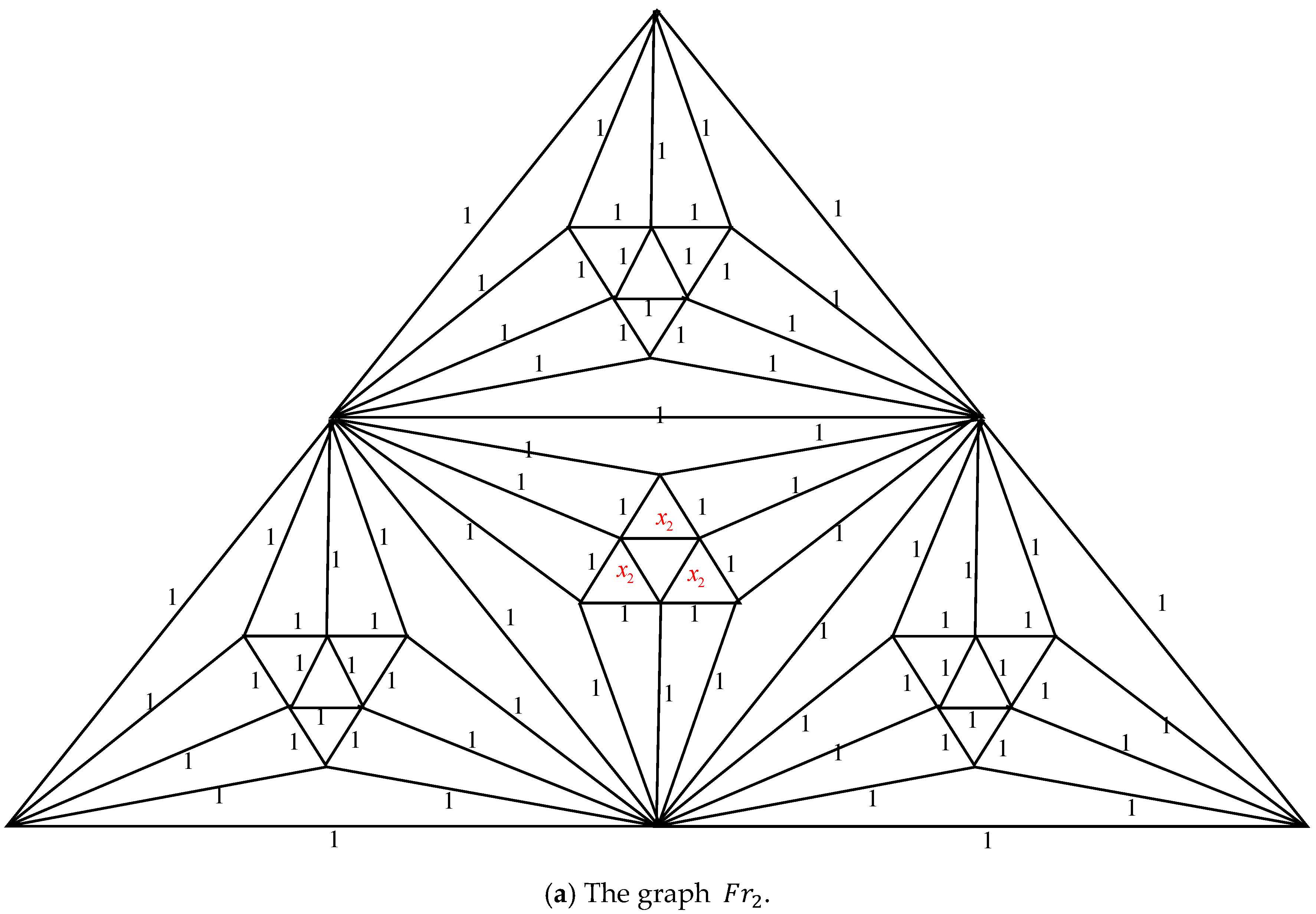
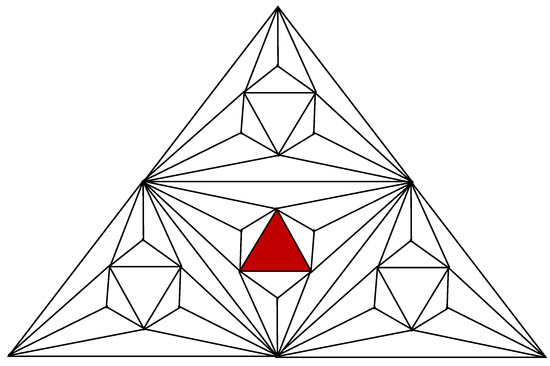
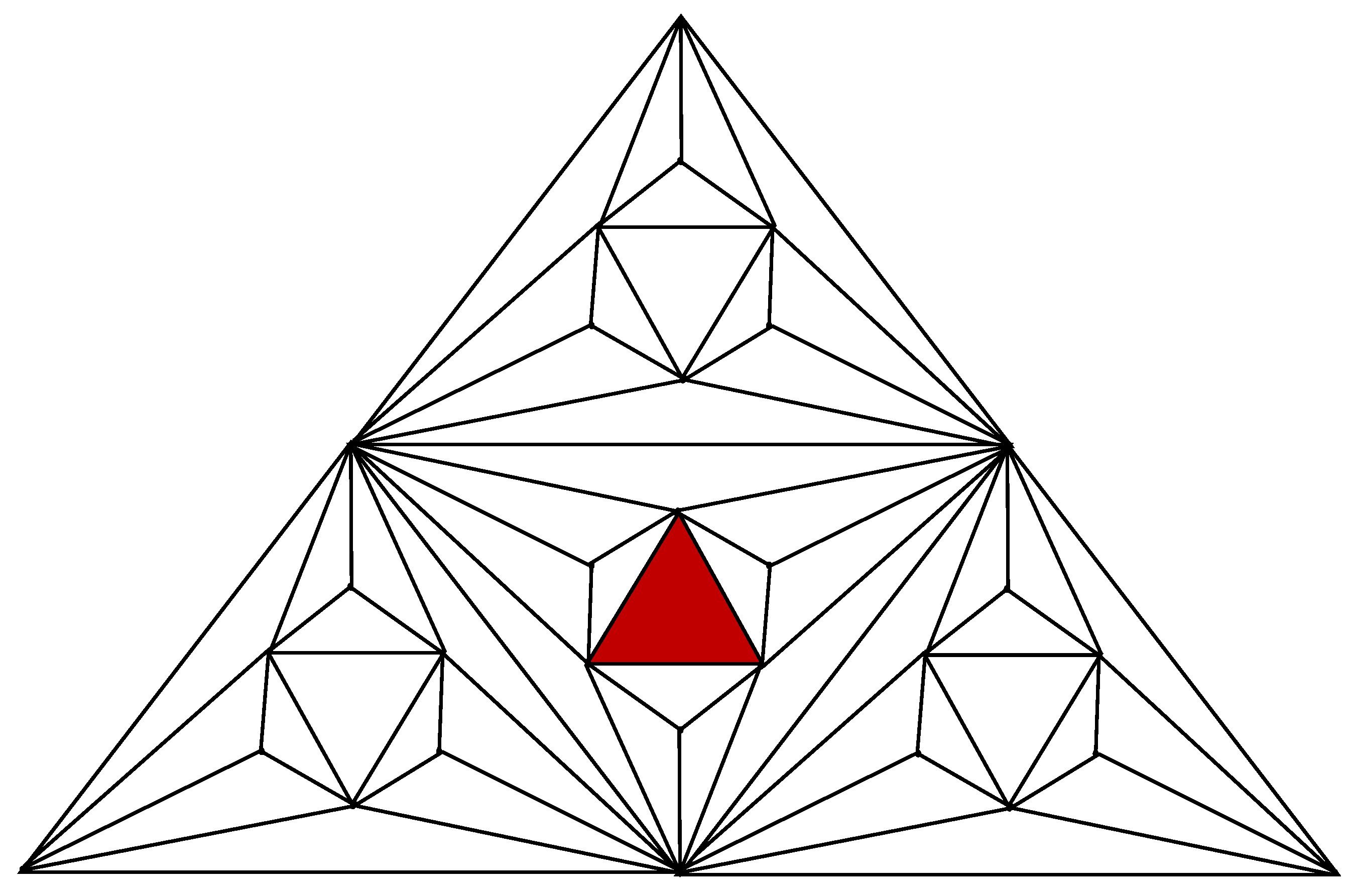
The Fritsch graph has nine vertices and twenty-one edges, making it a maximum planar graph. It is isomorphic to the triaugmented triangular prism’s skeleton. The Fritsch graph plays a crucial role in demonstrating flaws in Kempe’s attempted proof of the four-color theorem. The graph is notable because it highlights how Kempe chains, used in the flawed proof, can interact in a way that invalidates the color swapping strategy.
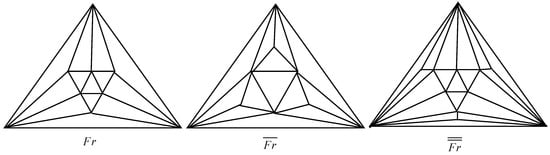
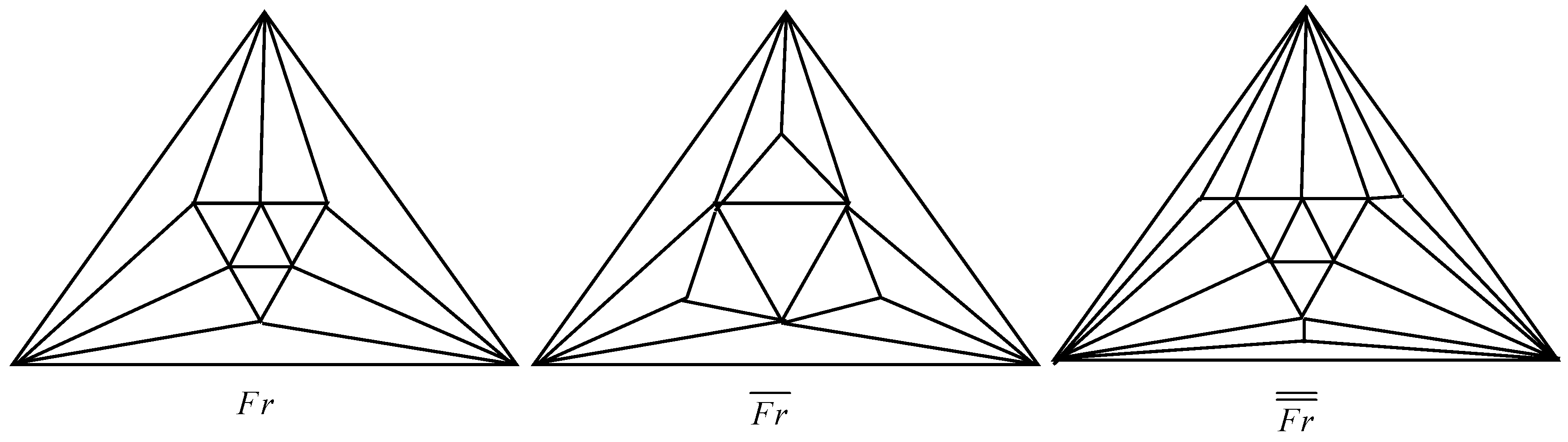
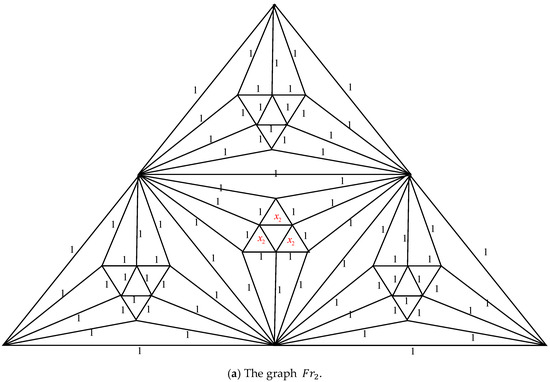
Creating a new structure from an old one is always the aim in mathematics. Graphs are another area where this is true, as a given set of graphs can be used to create many new graphs. The number of spanning trees of three new forms of pyramidal graphs made from the Fritsch graph and two of their related graphs, represented by and respectively, will be precisely determined in this work, as illustrated in Figure 1.
Figure 1.
The Fritsch graph and two related graphs and .
2.1. Number of Spanning Trees of Pyramid Graph Created by Fritsch
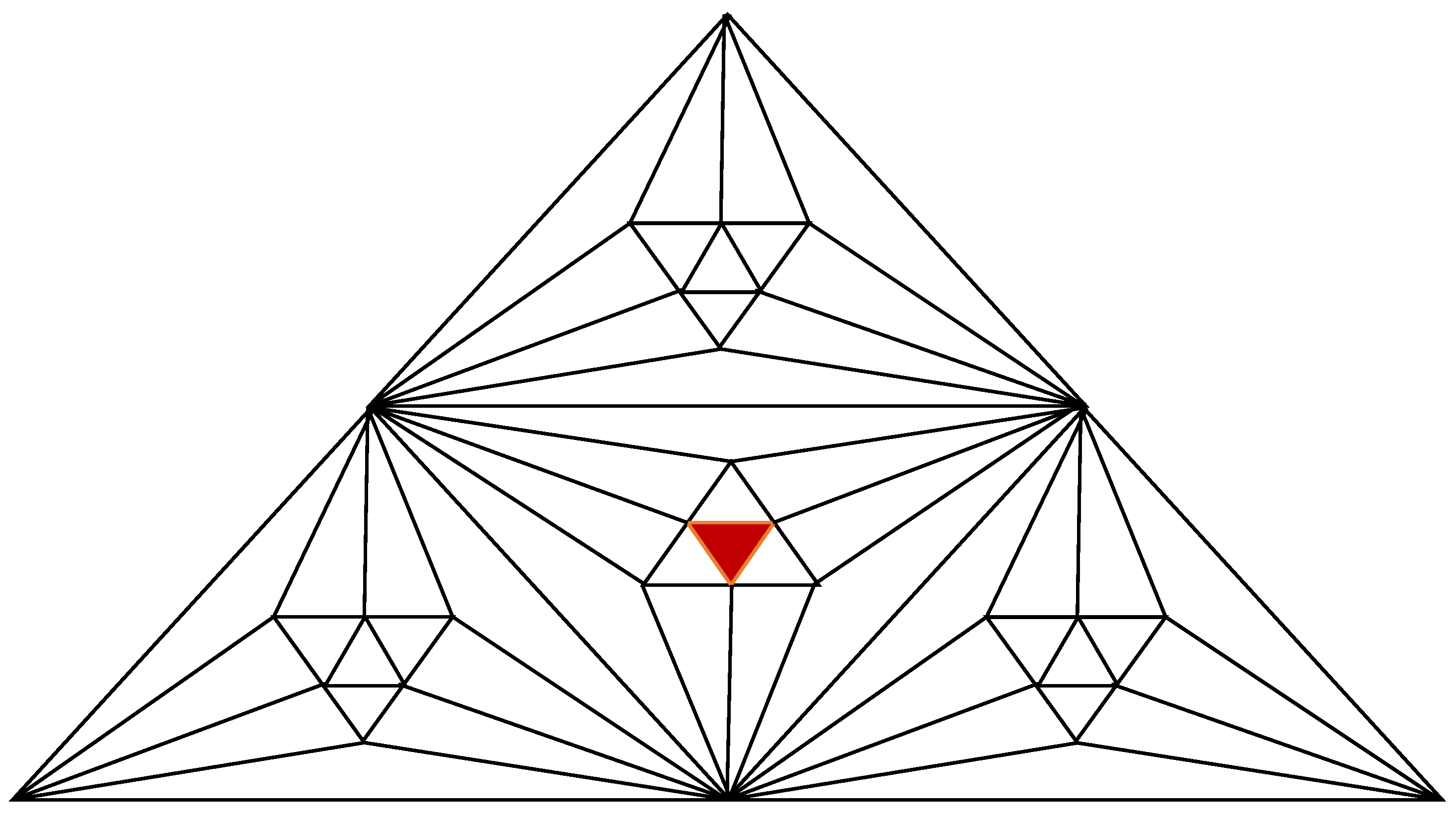
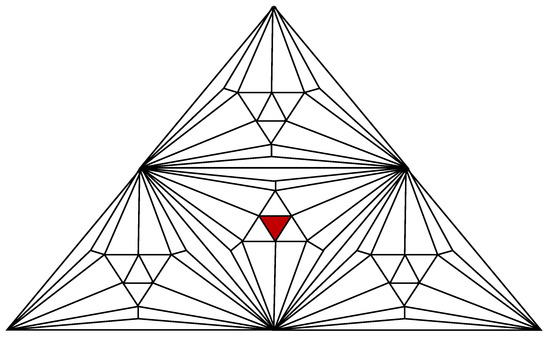
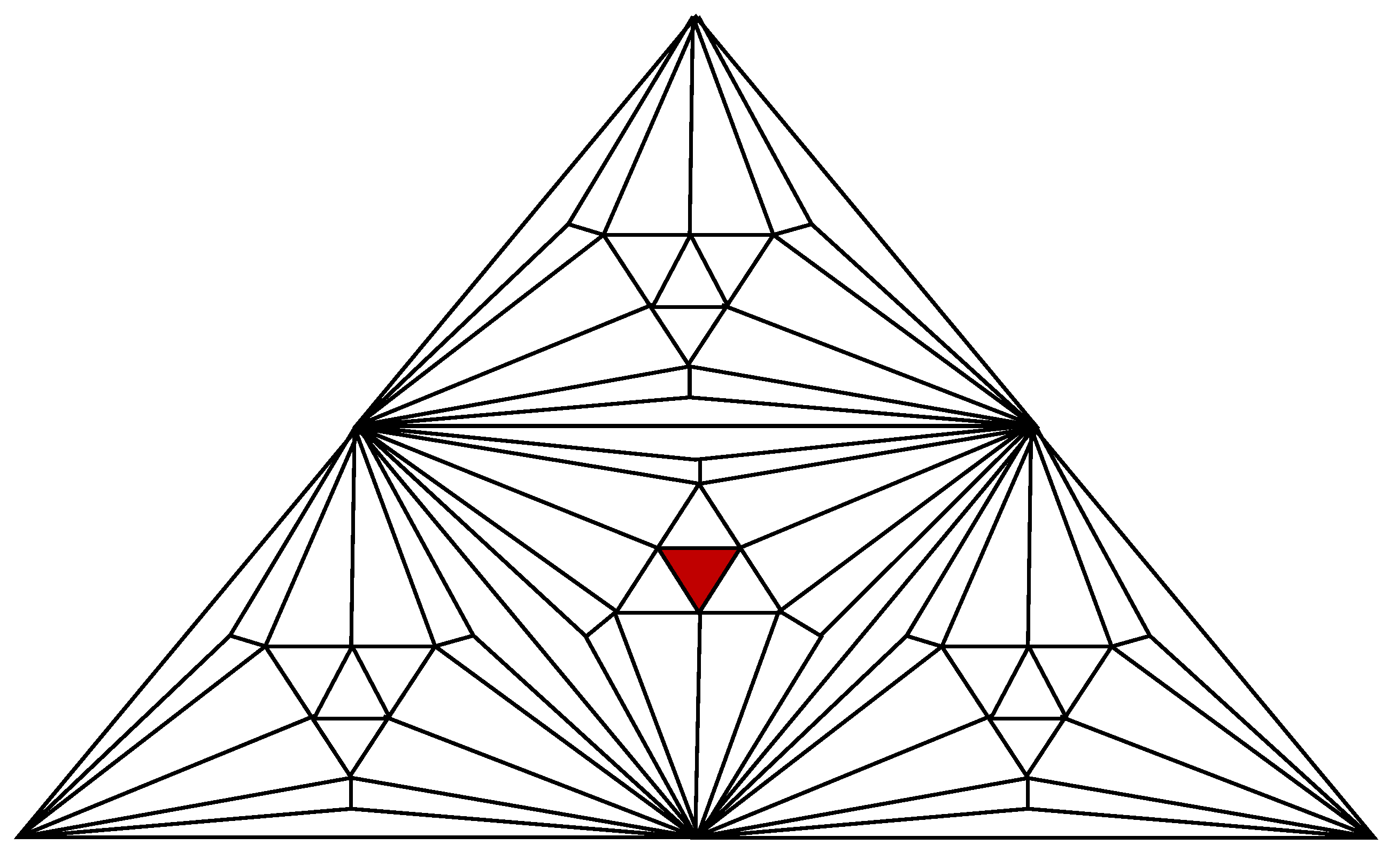
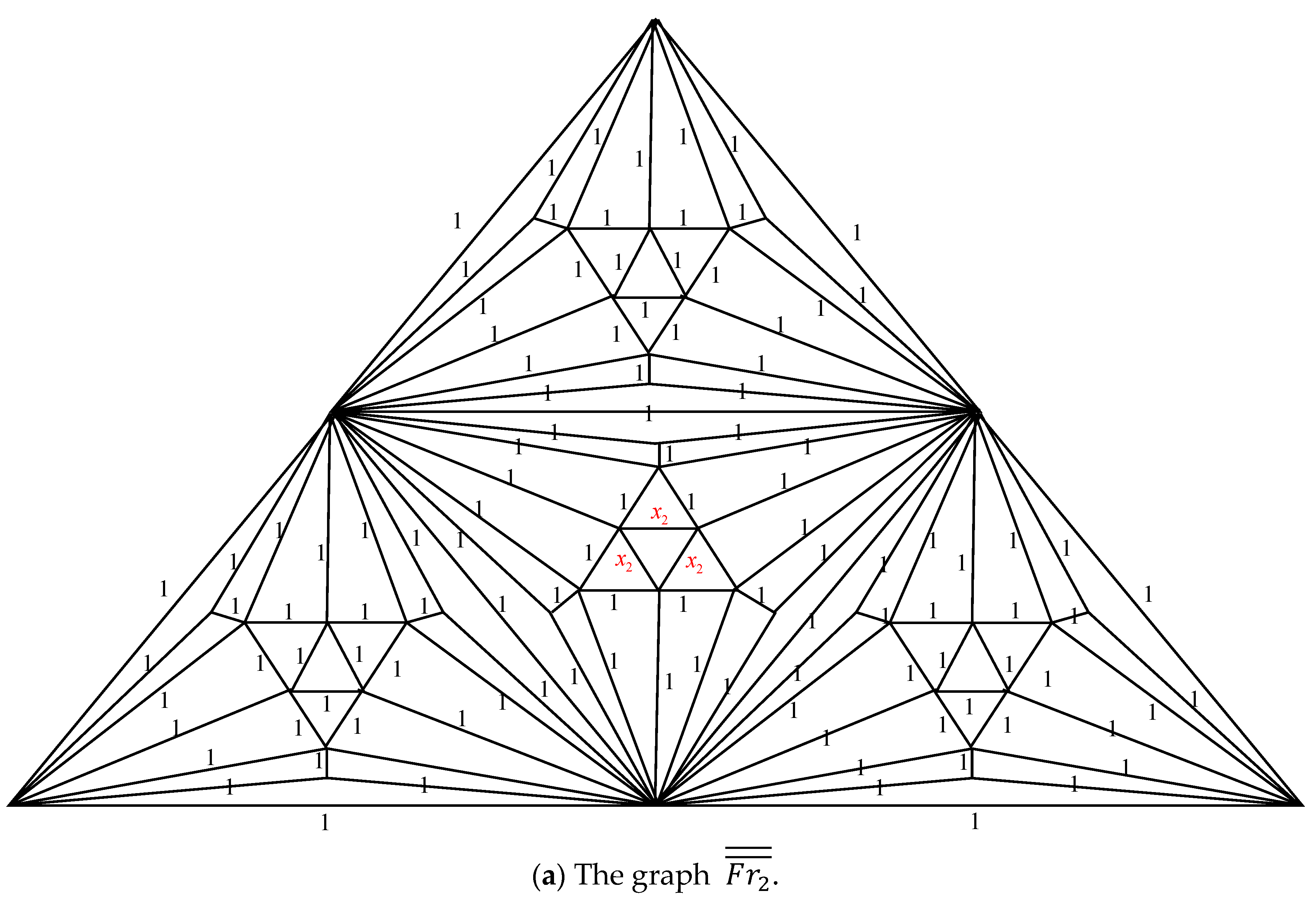
The pyramid graph is defined recursively using the graph and the graph (triangle or ) as follows: is created by replacing the center triangle in with . See Figure 2. According to this construction, the total vertices and edges are and , . The average degree of is in the large limit which is .
Figure 2.
The pyramid graph
Theorem 1.
The number of spanning trees in a pyramid graph, , created by the Fritsch graph series for , is determined by
Proof.
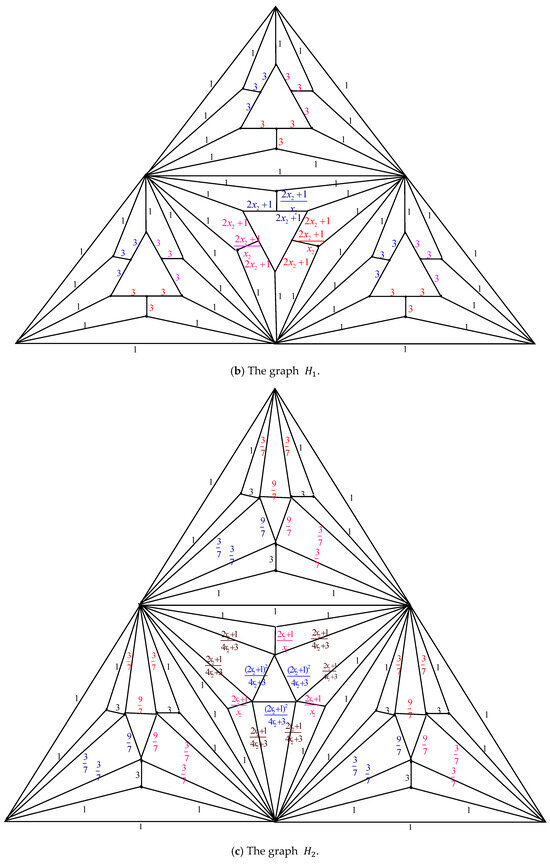
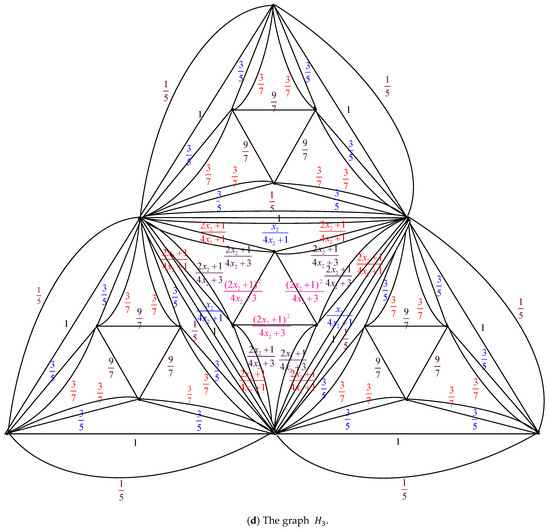
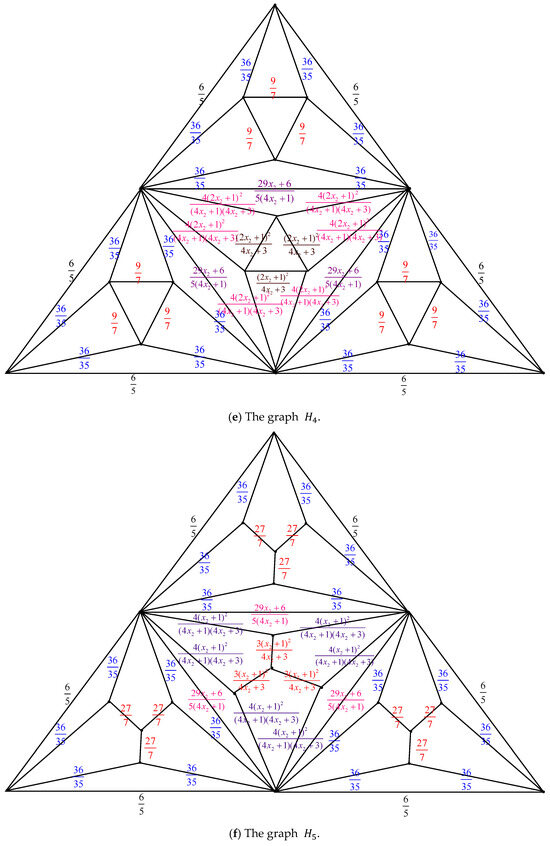
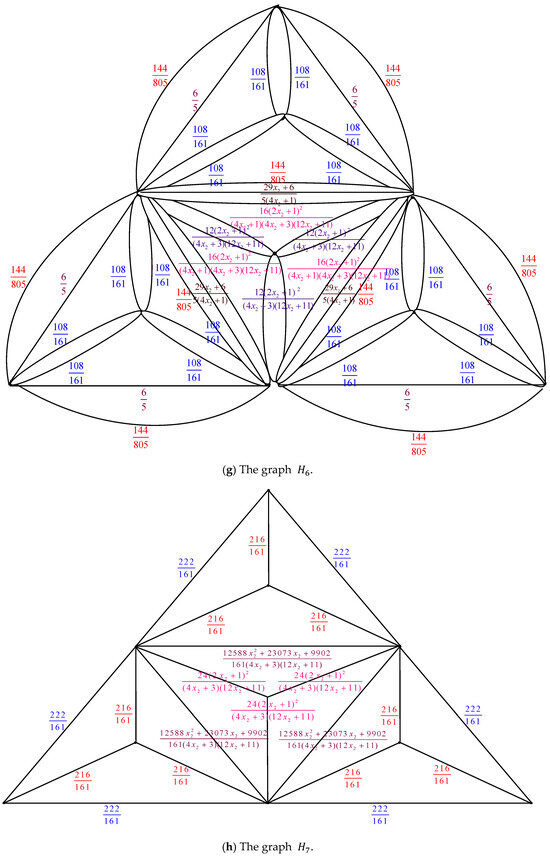
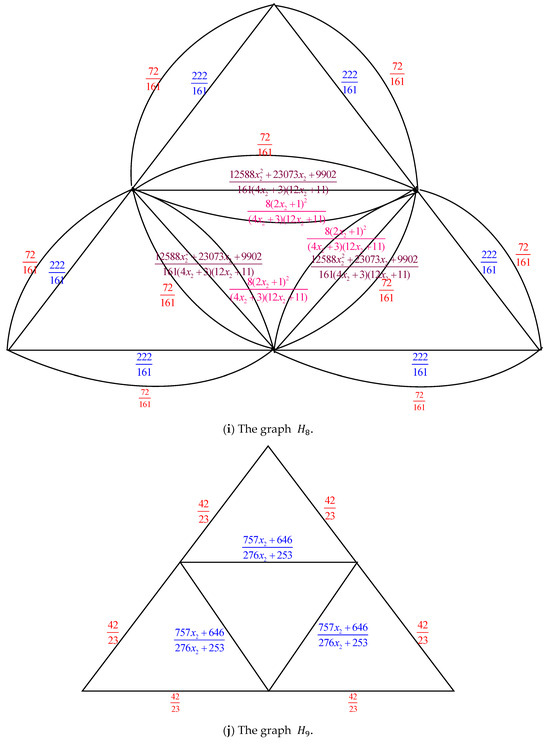
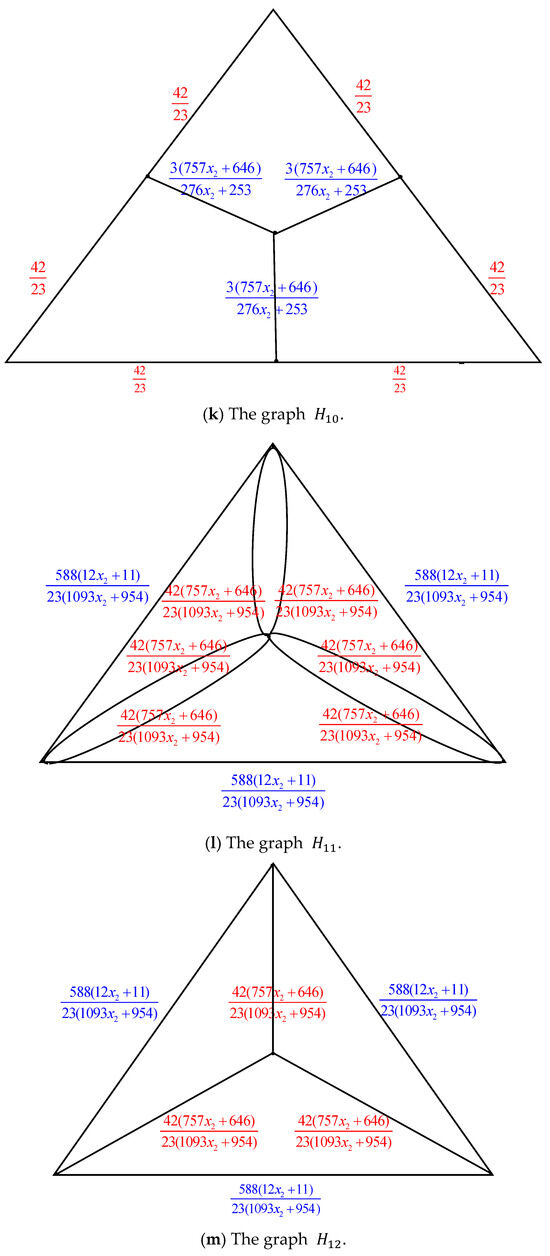
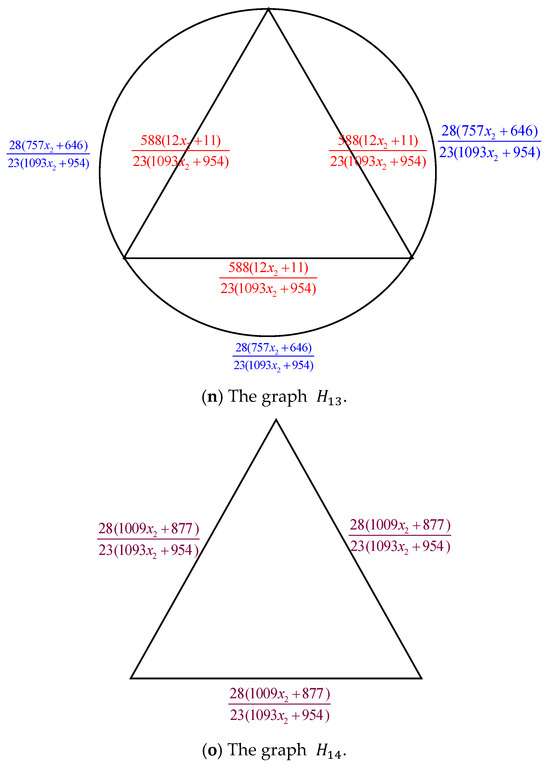
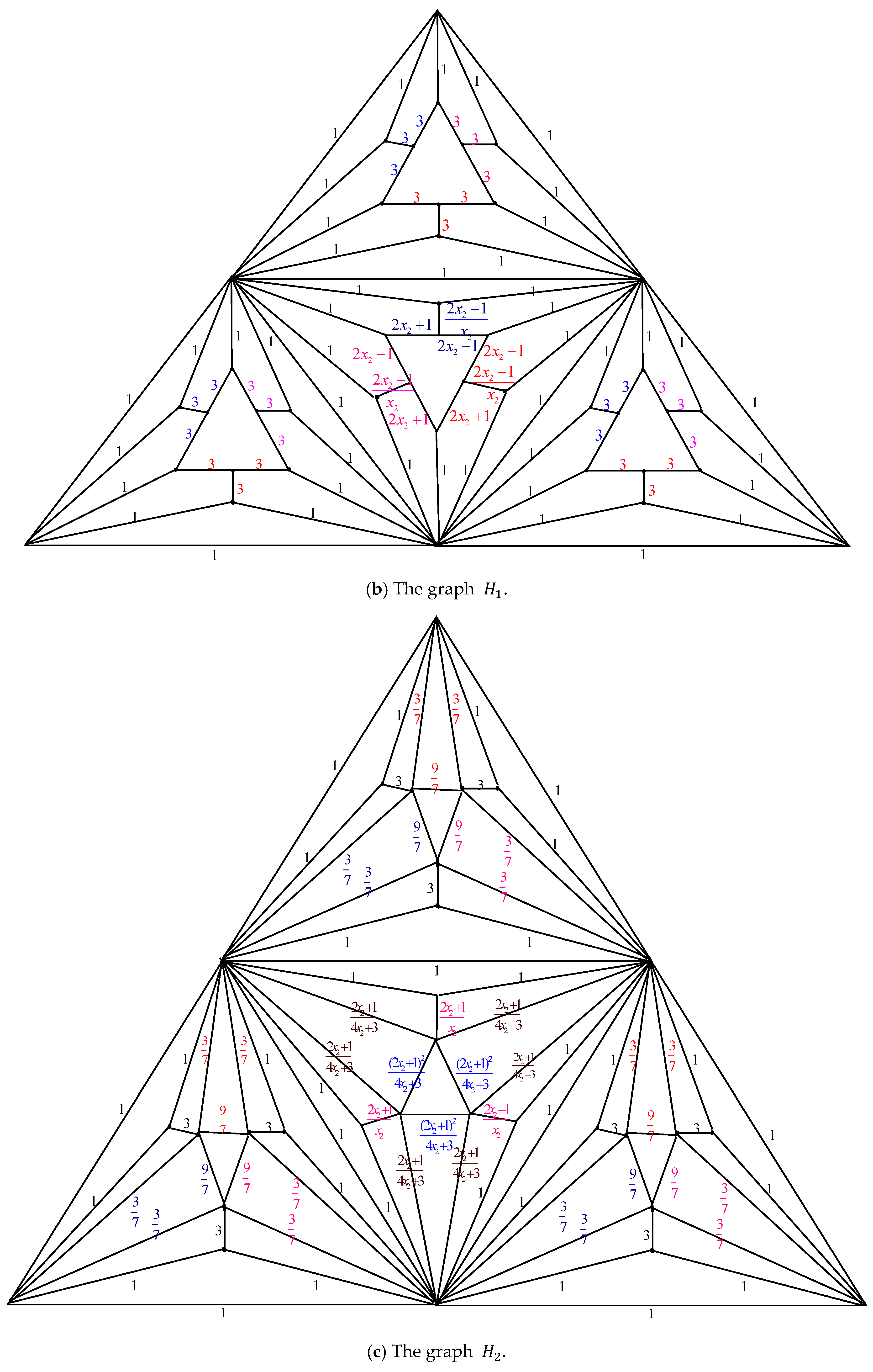
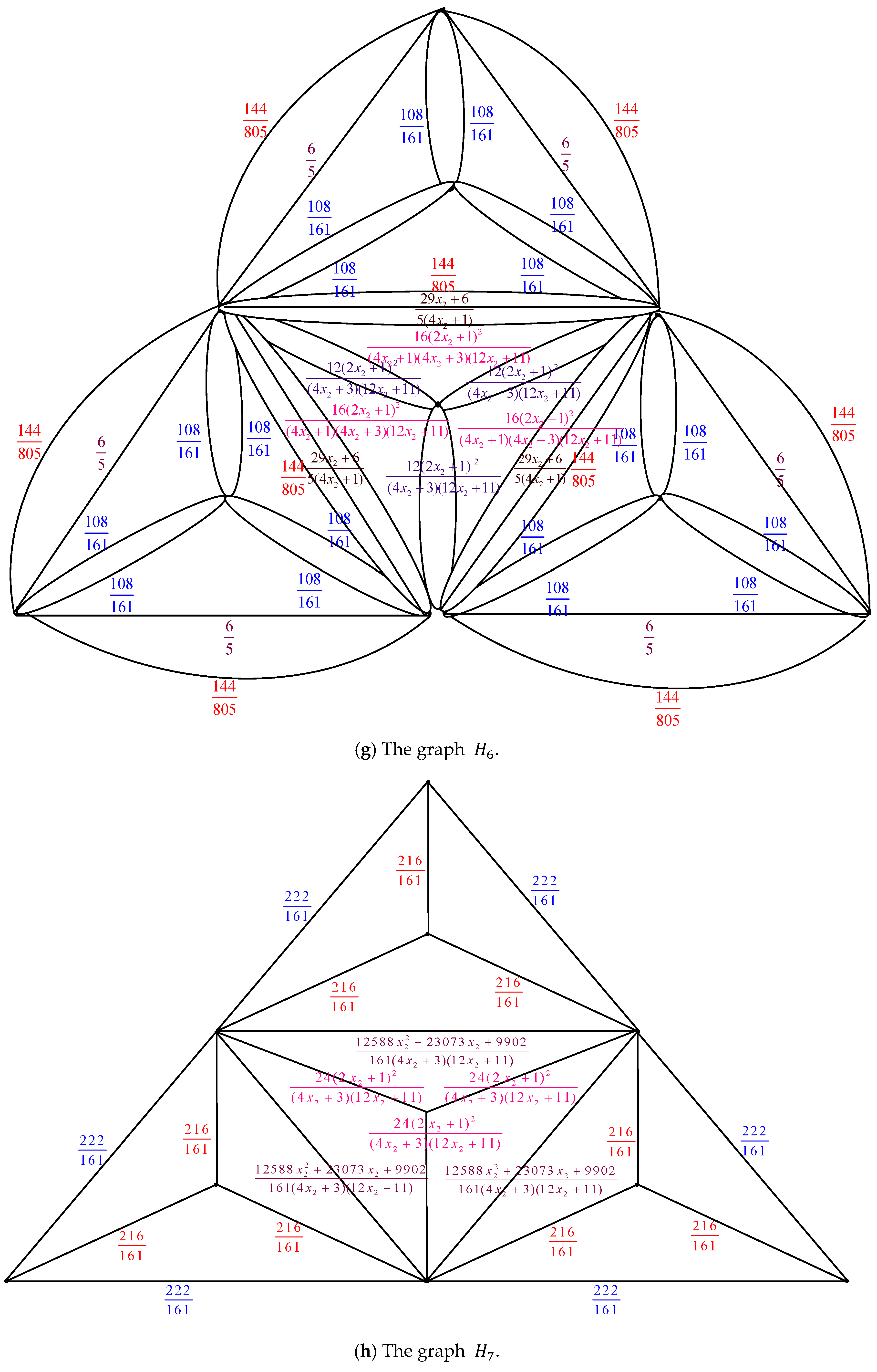
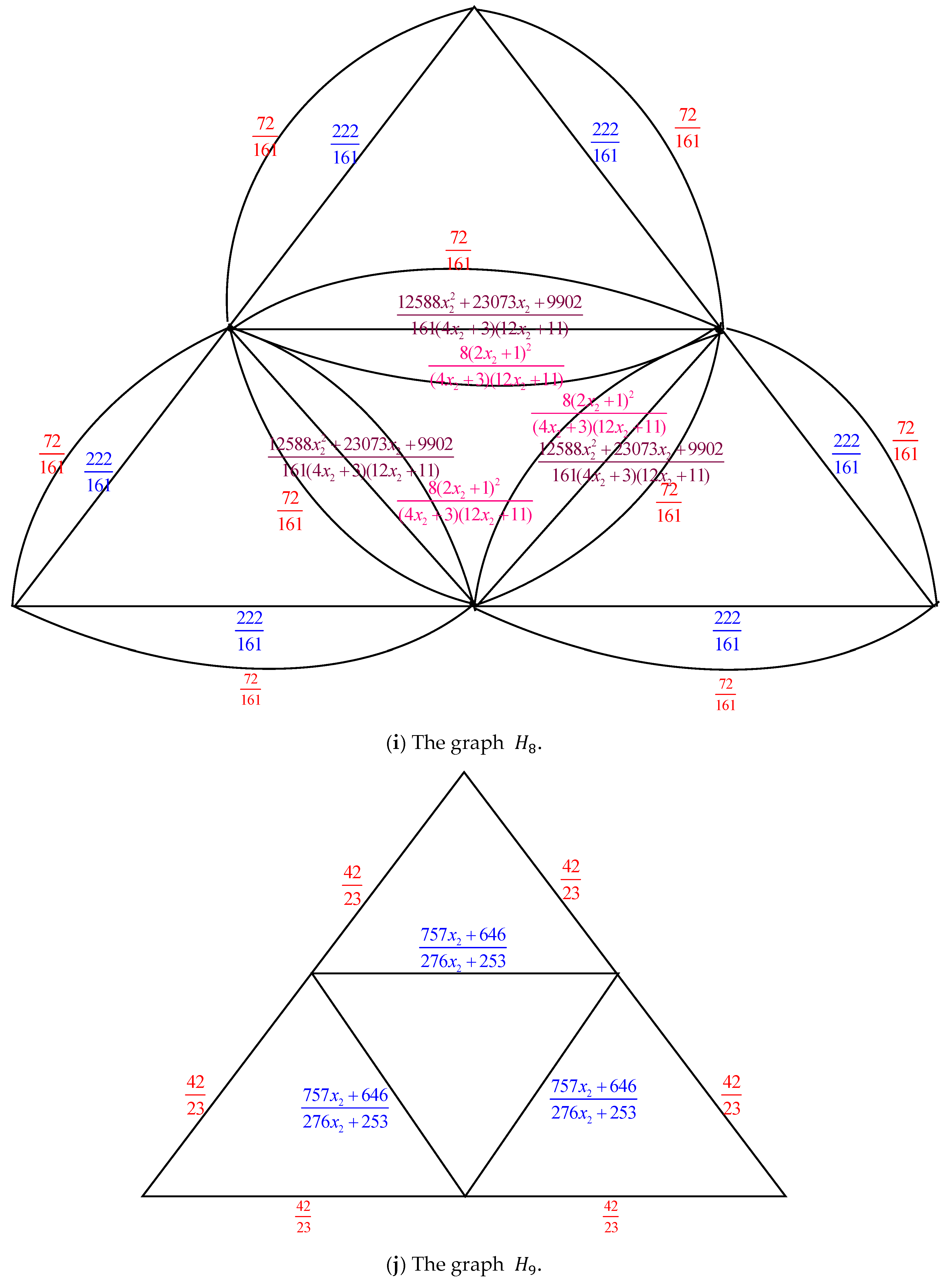
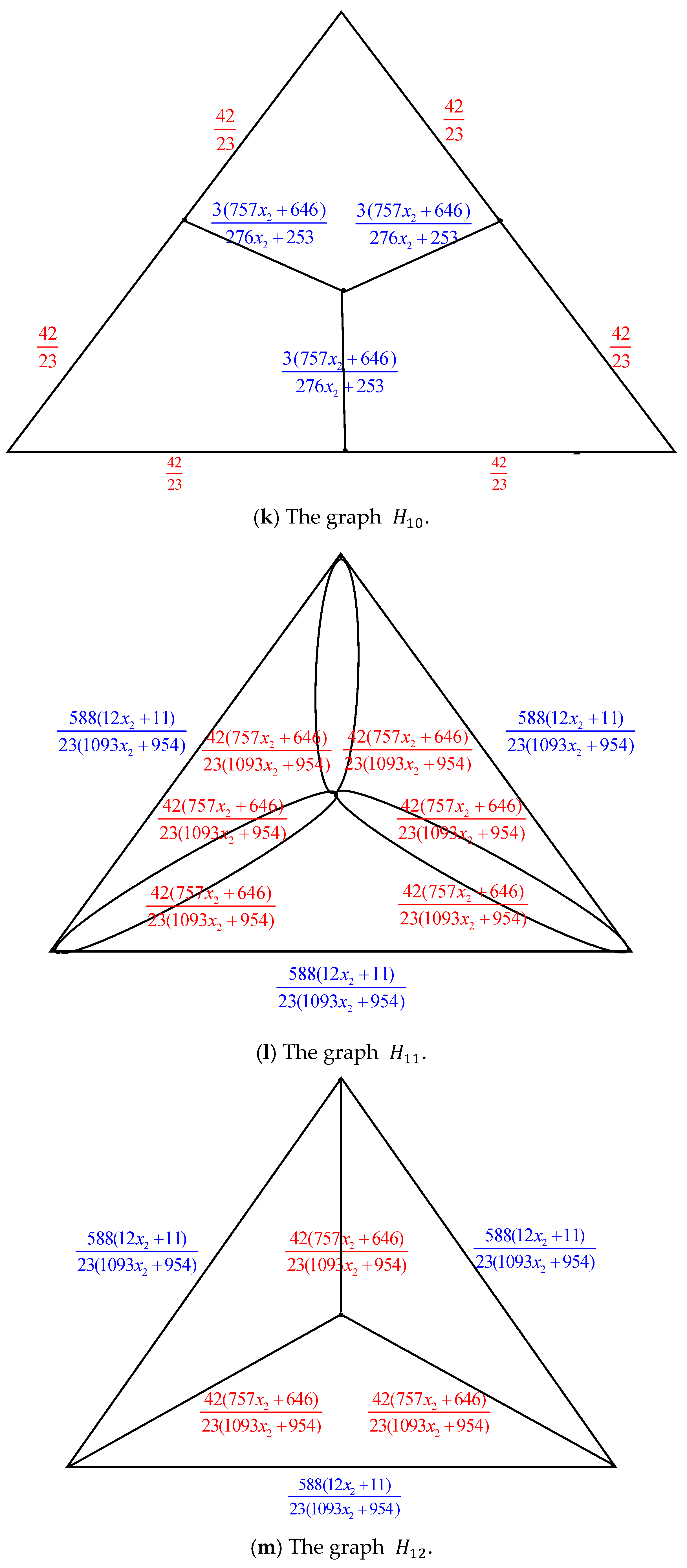
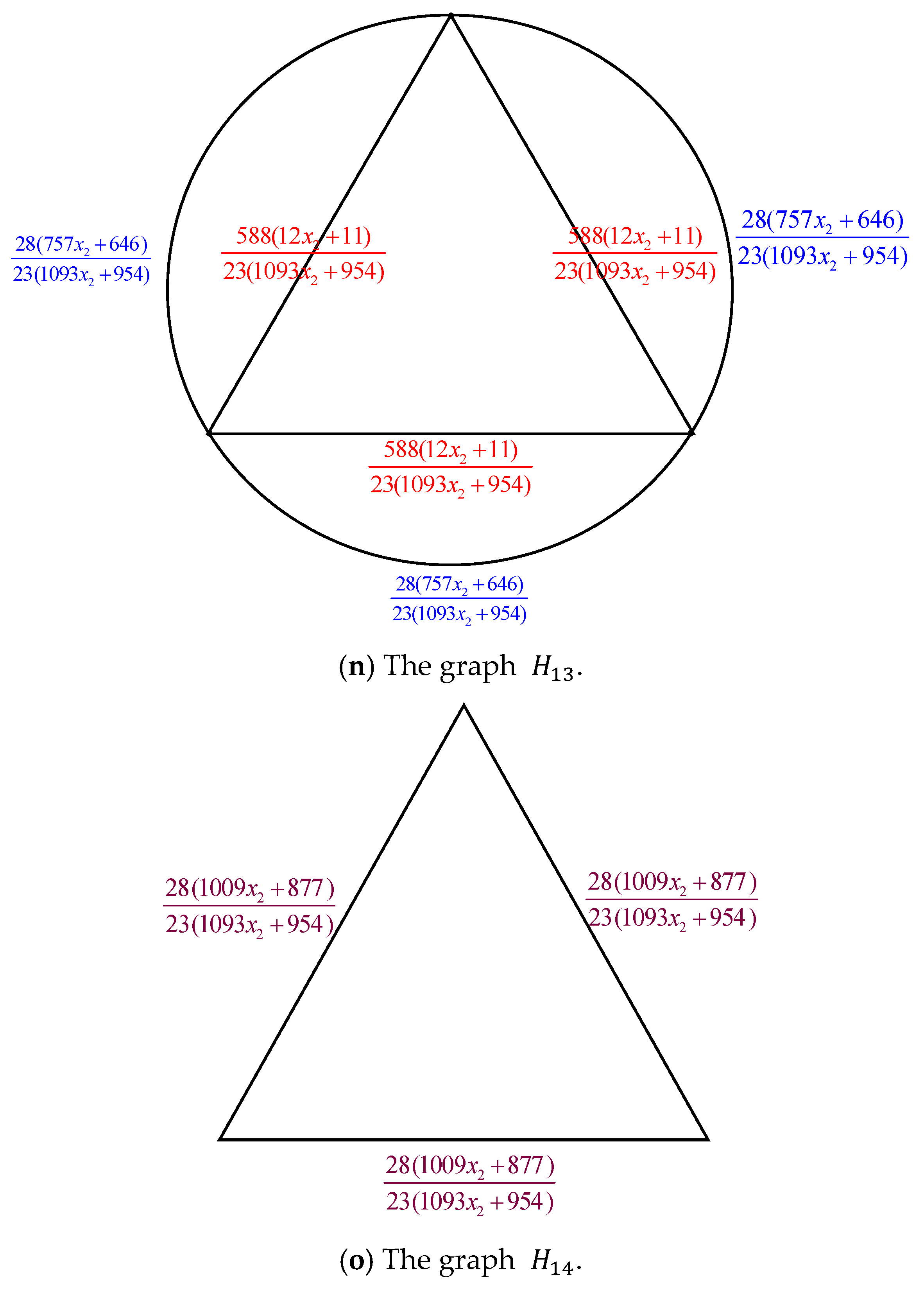
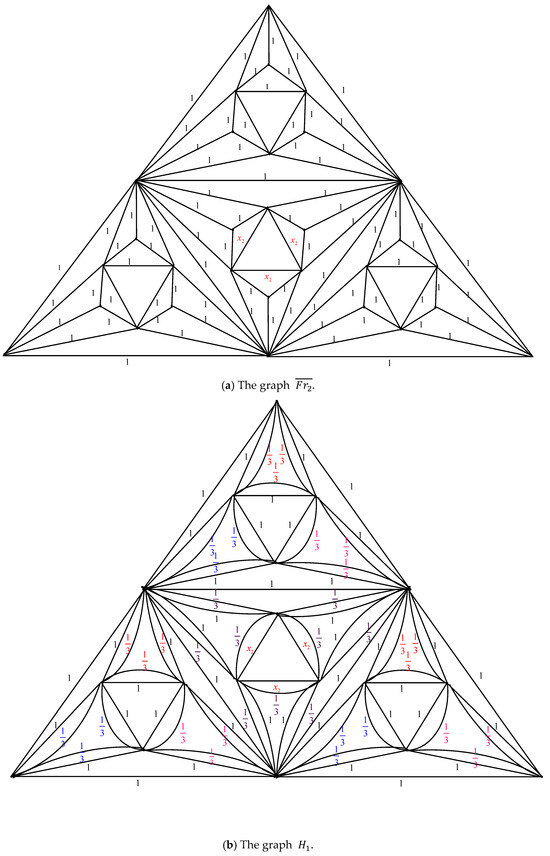
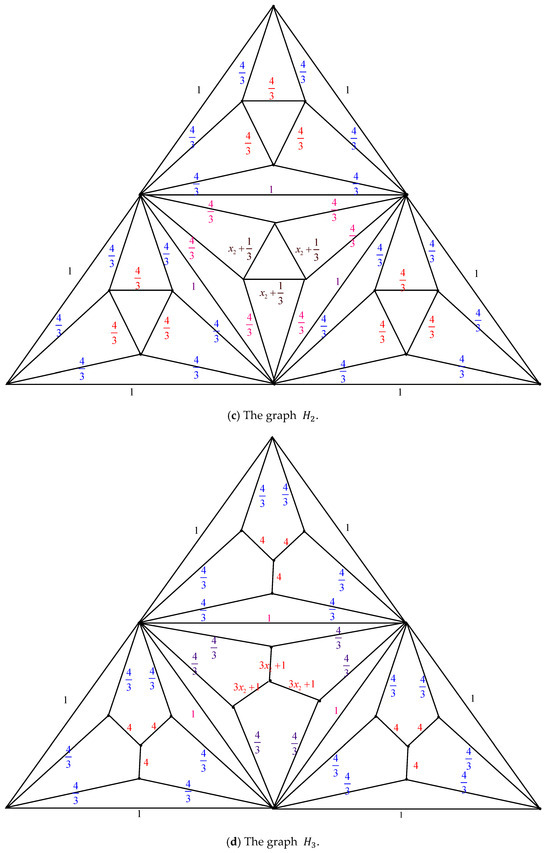
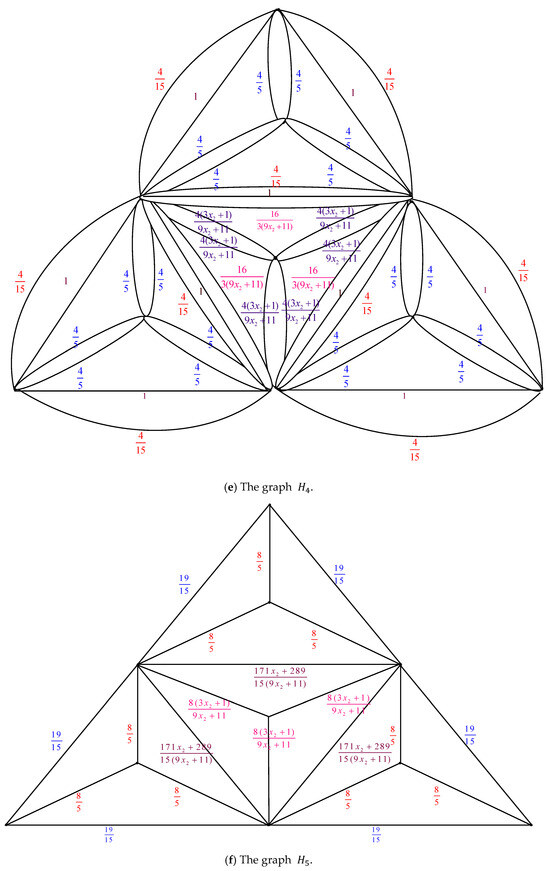
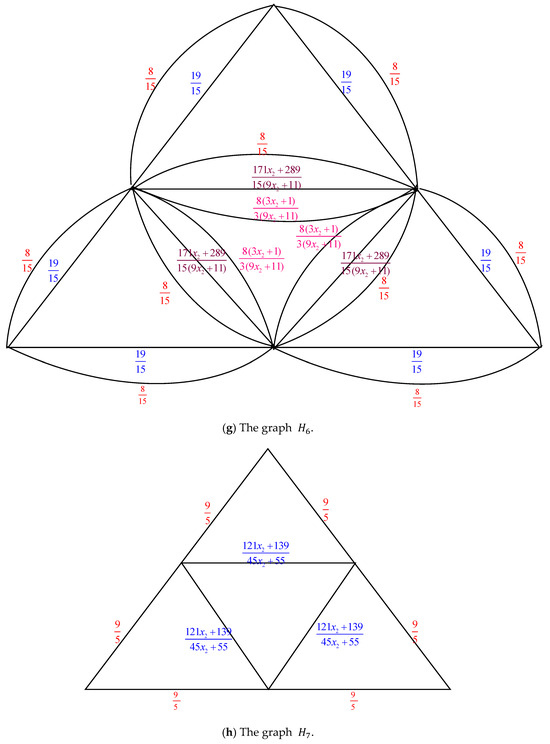
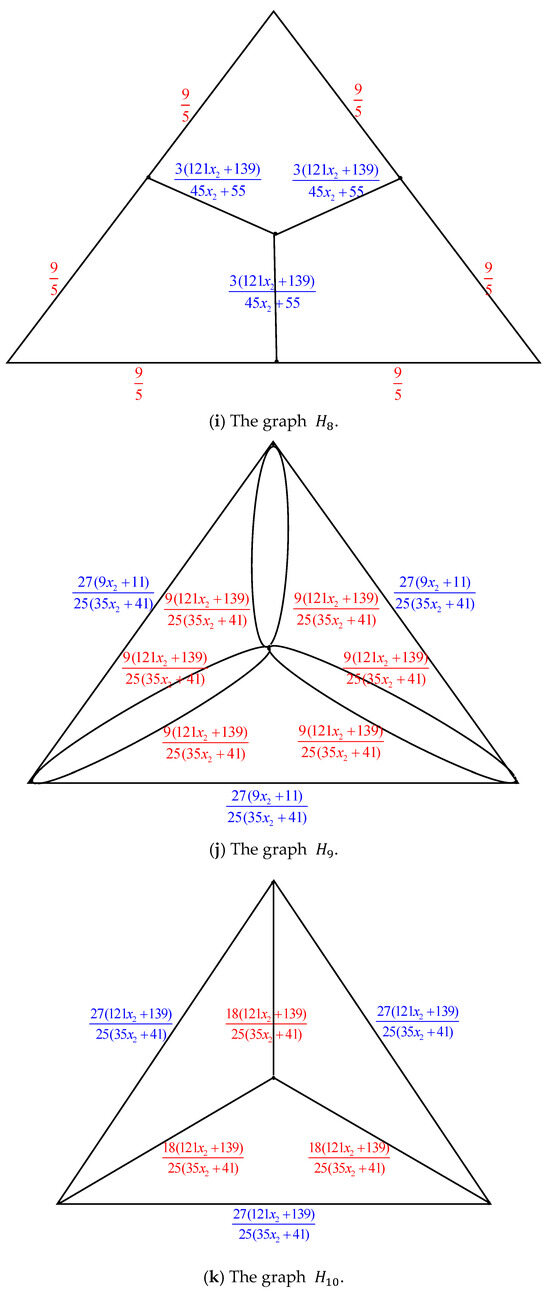
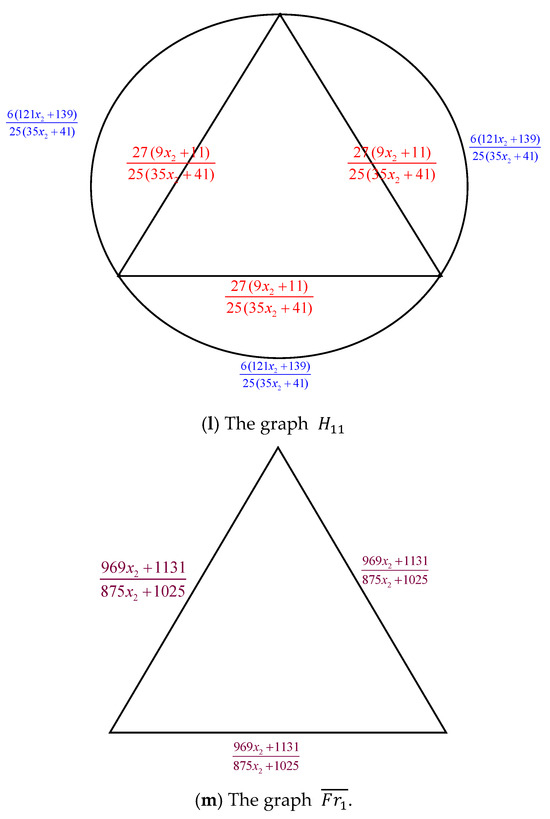
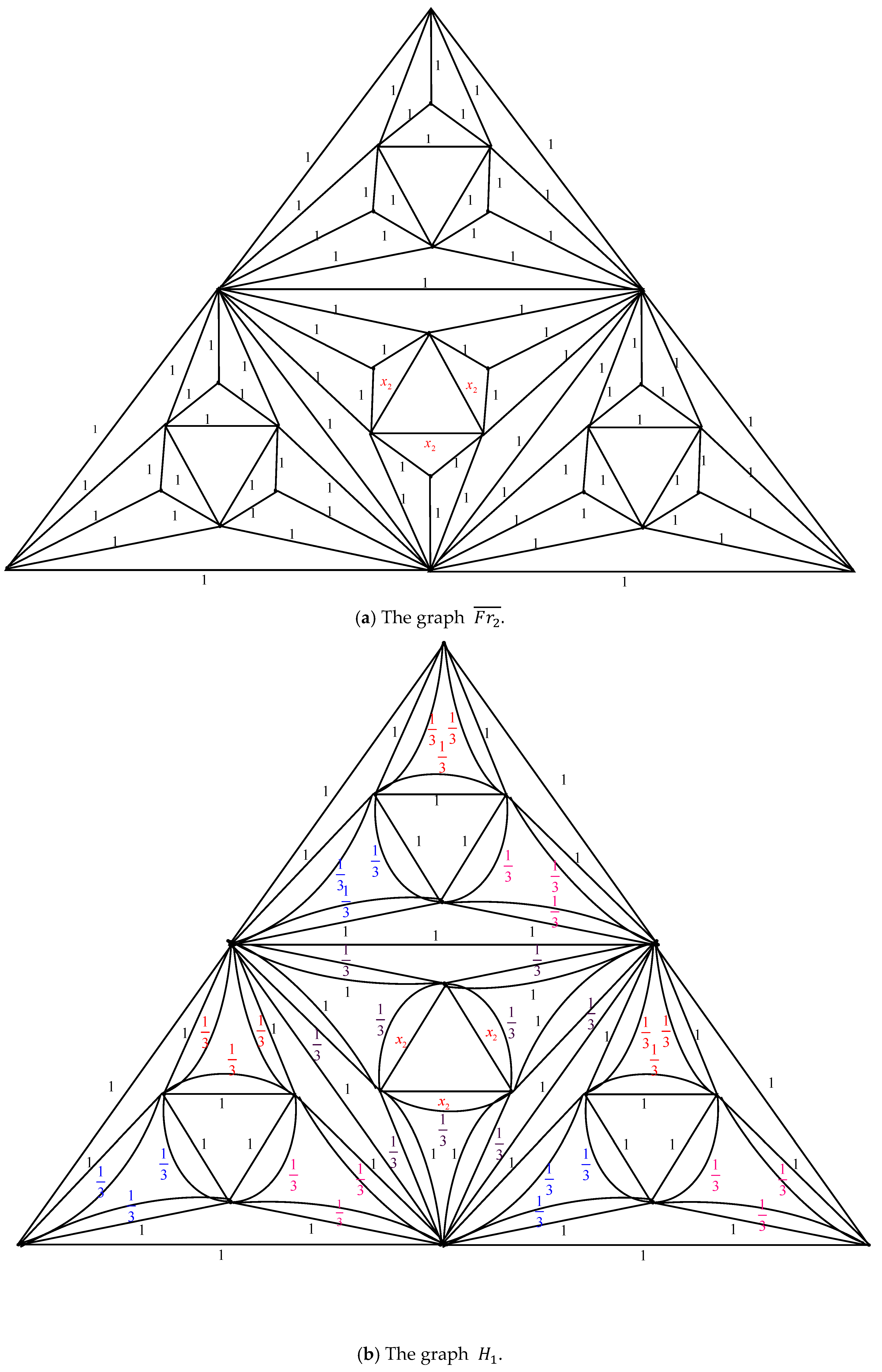
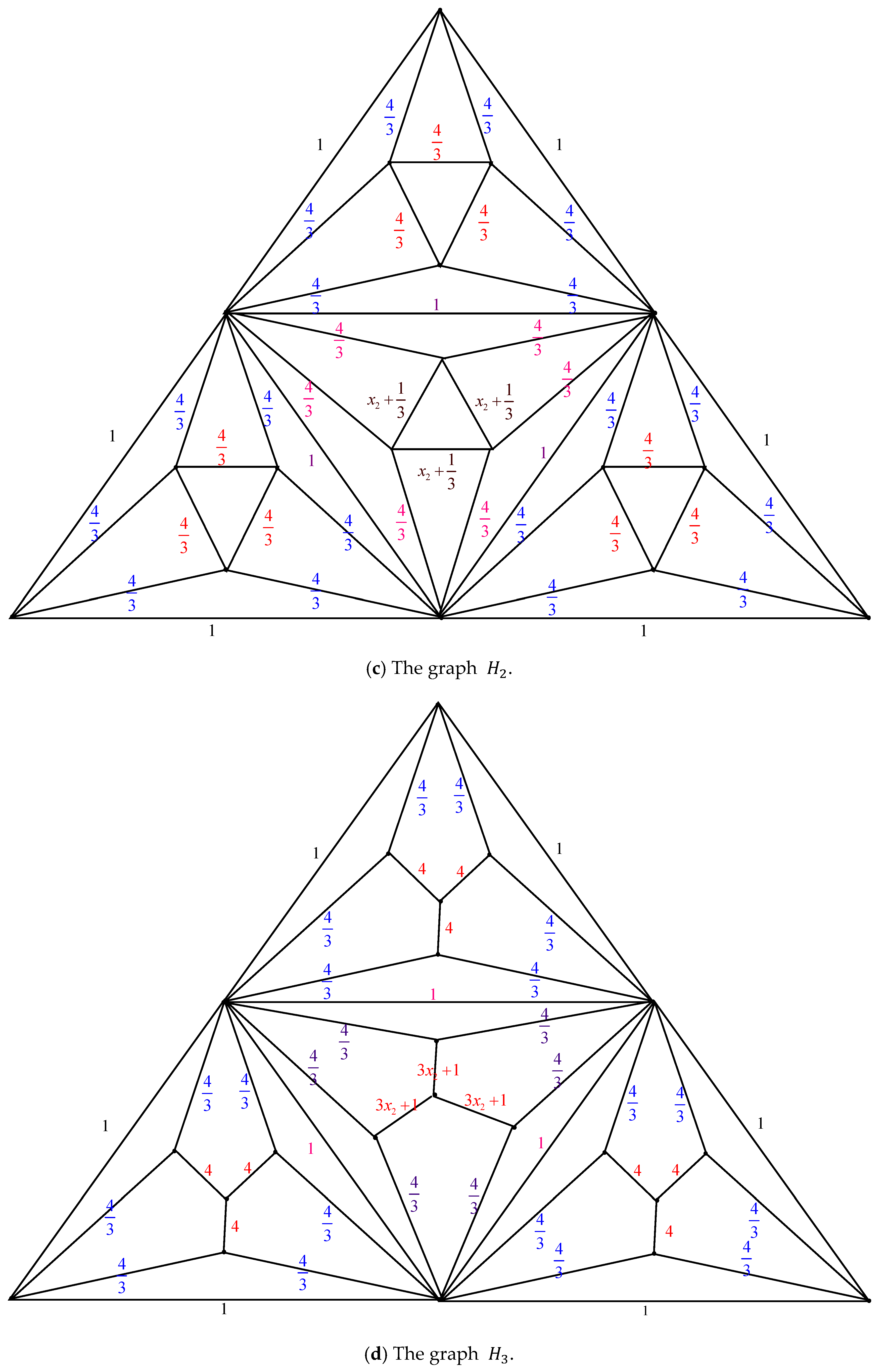
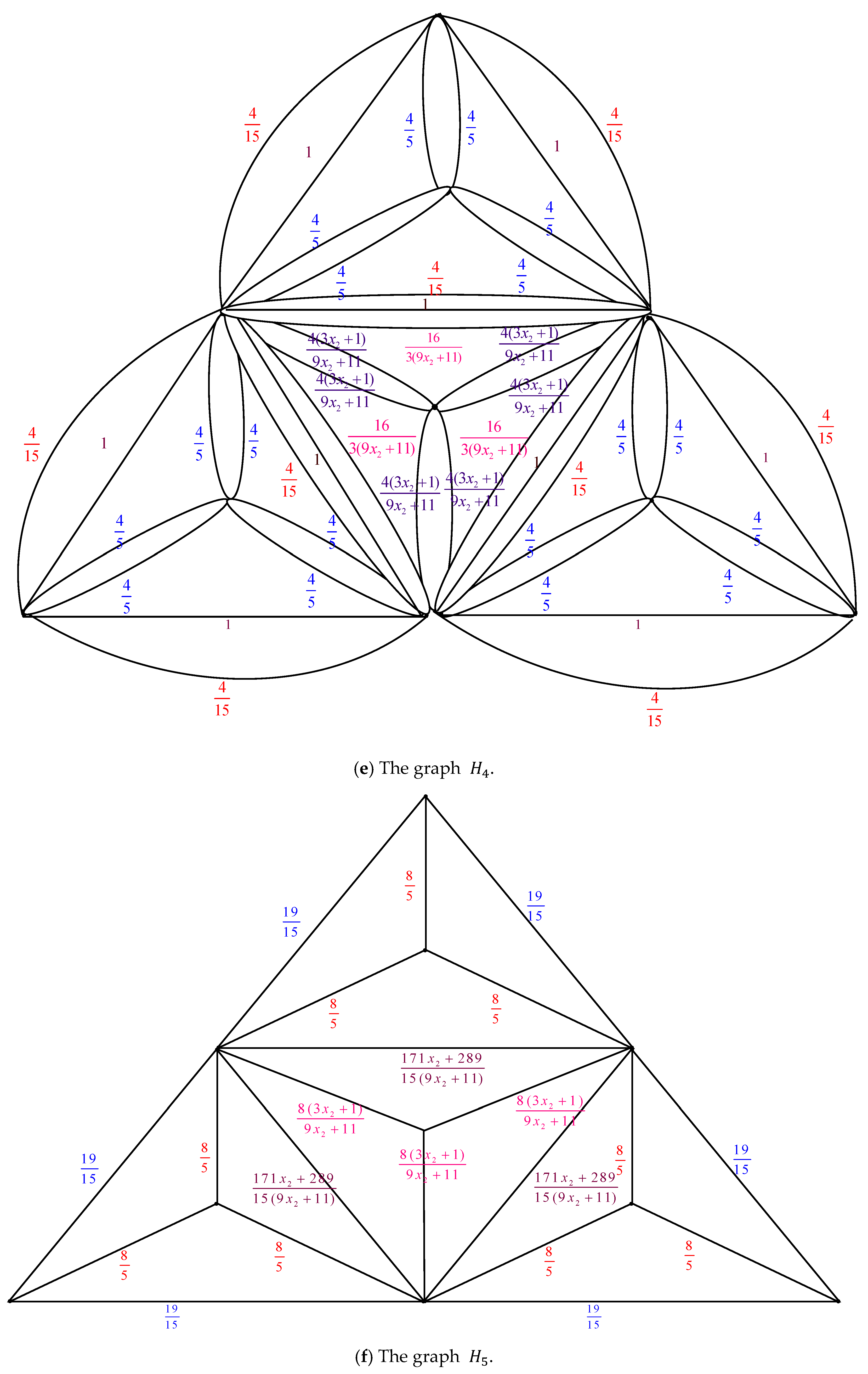
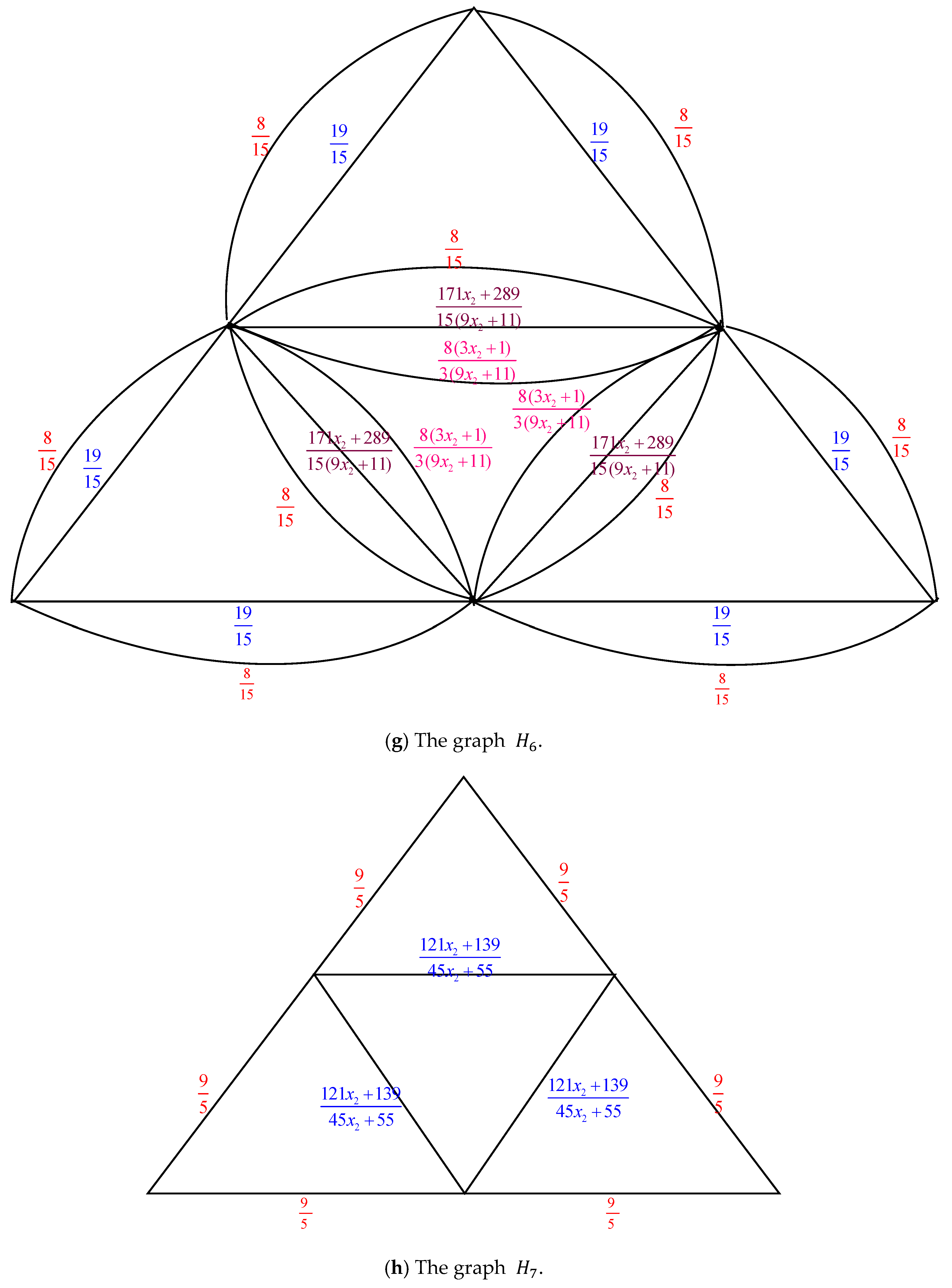
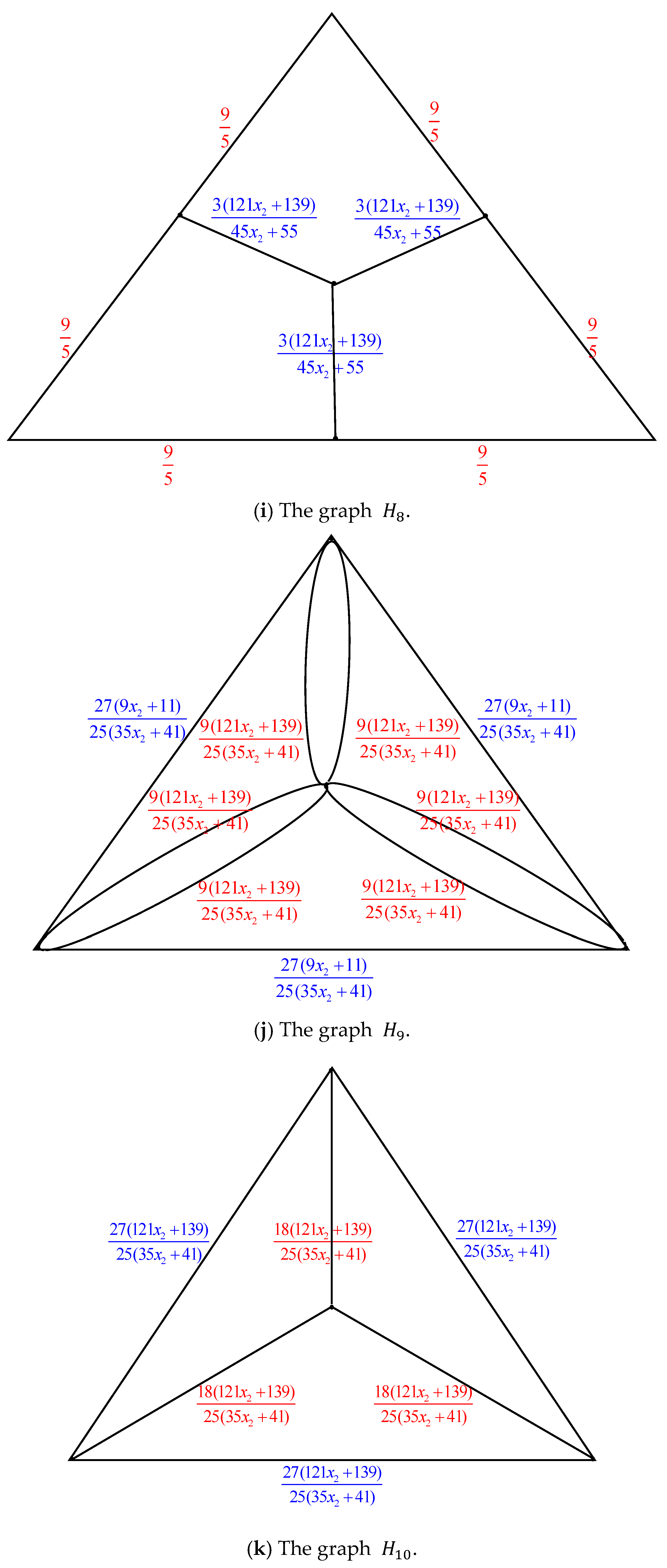
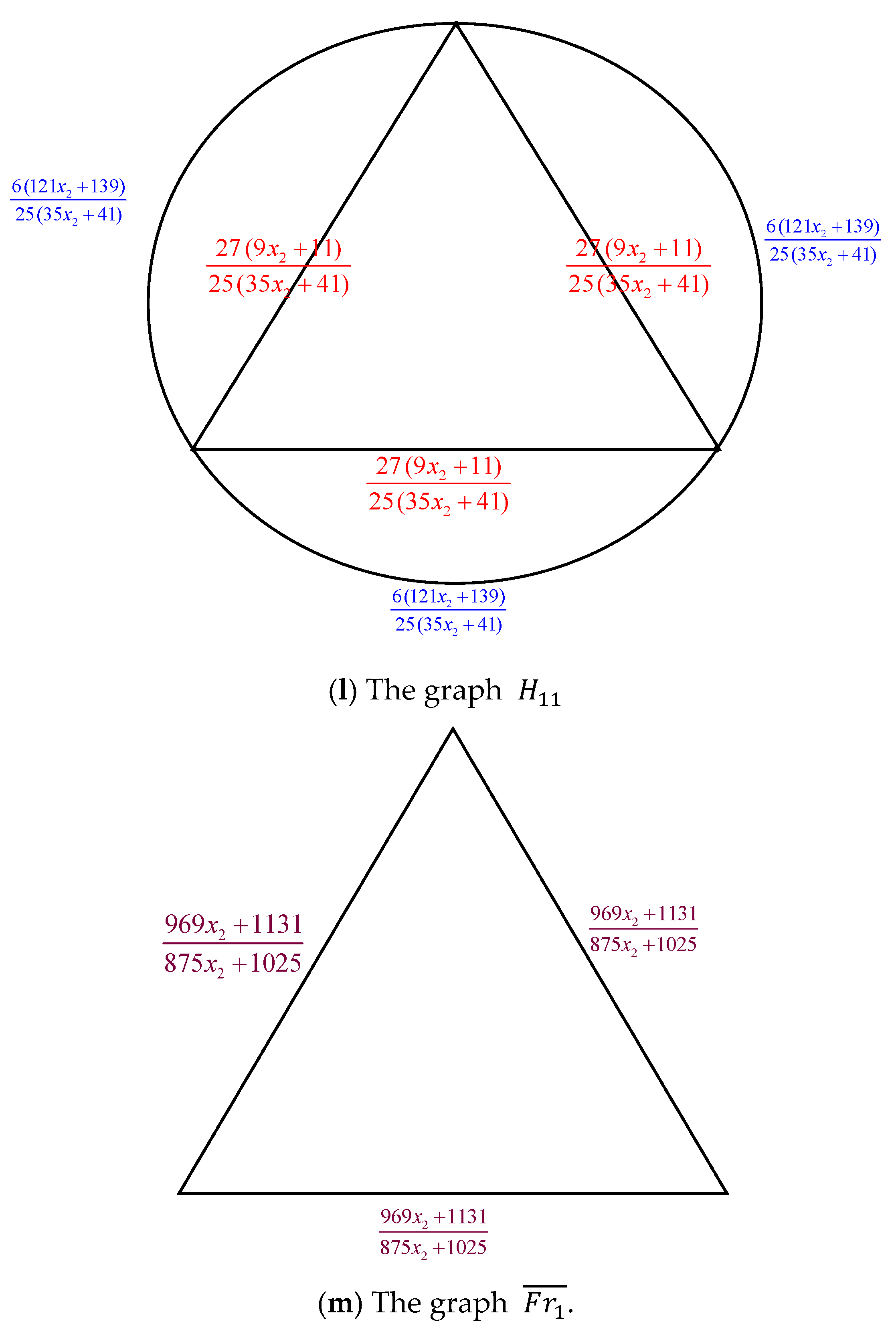
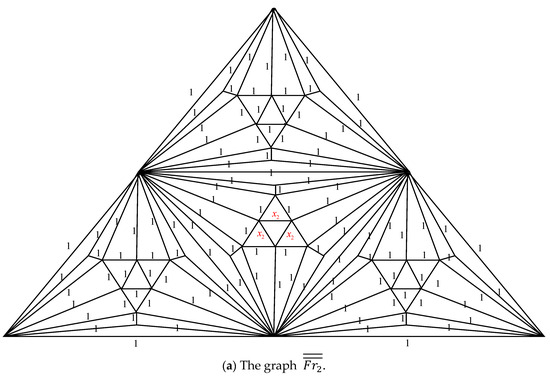
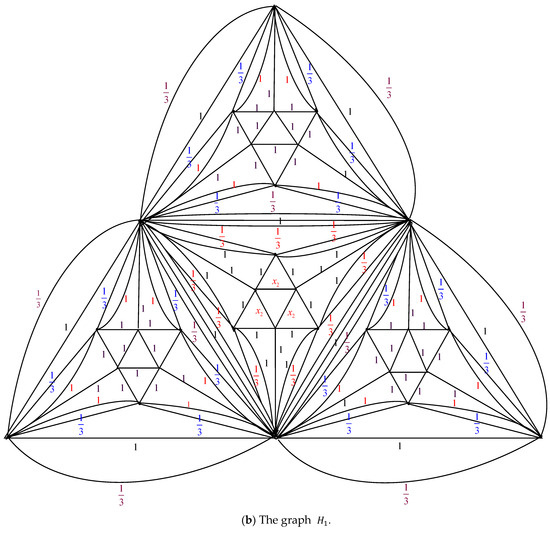
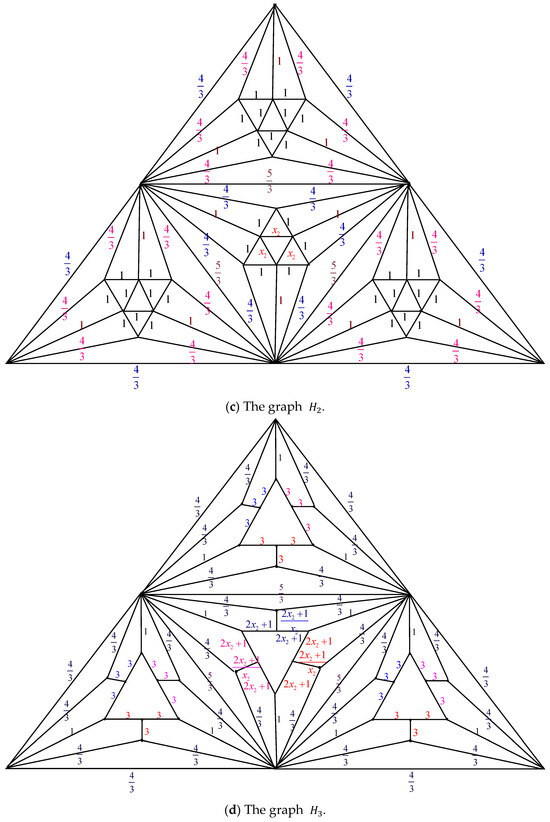
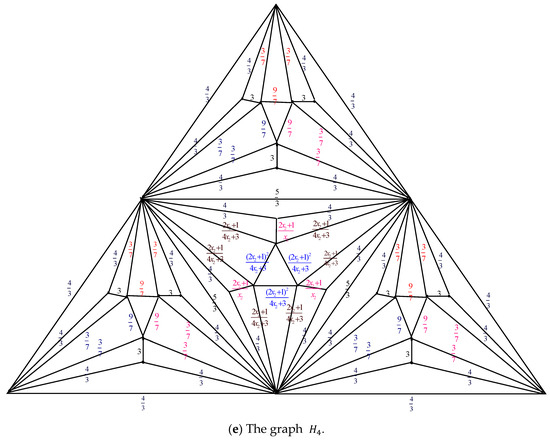
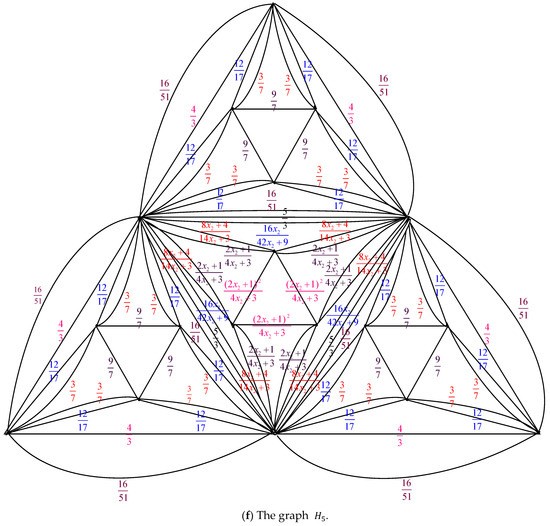
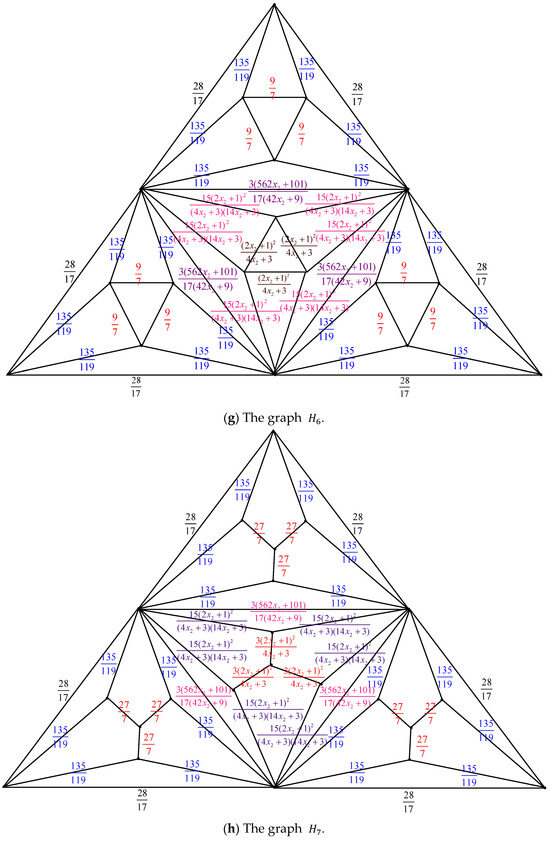
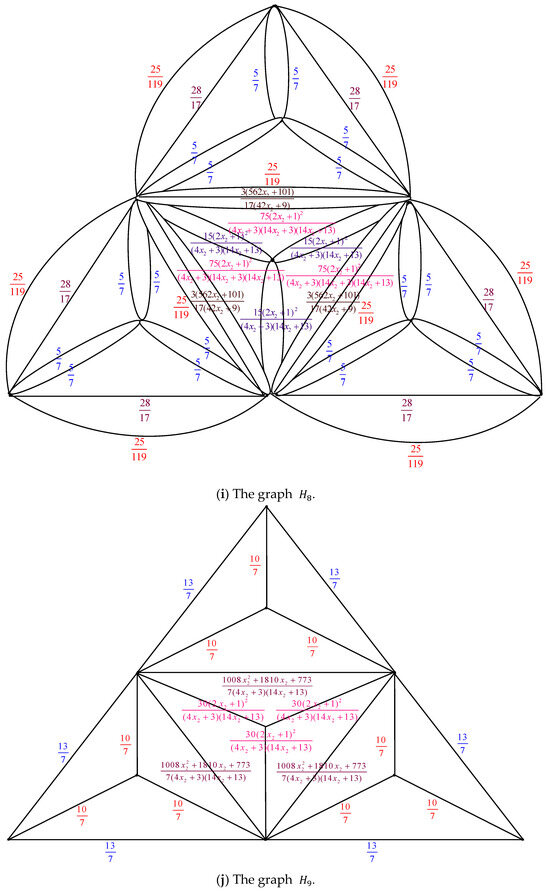
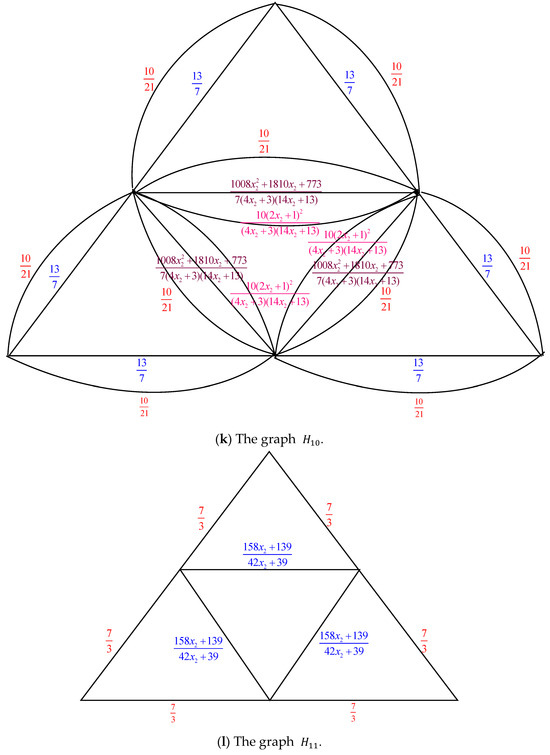
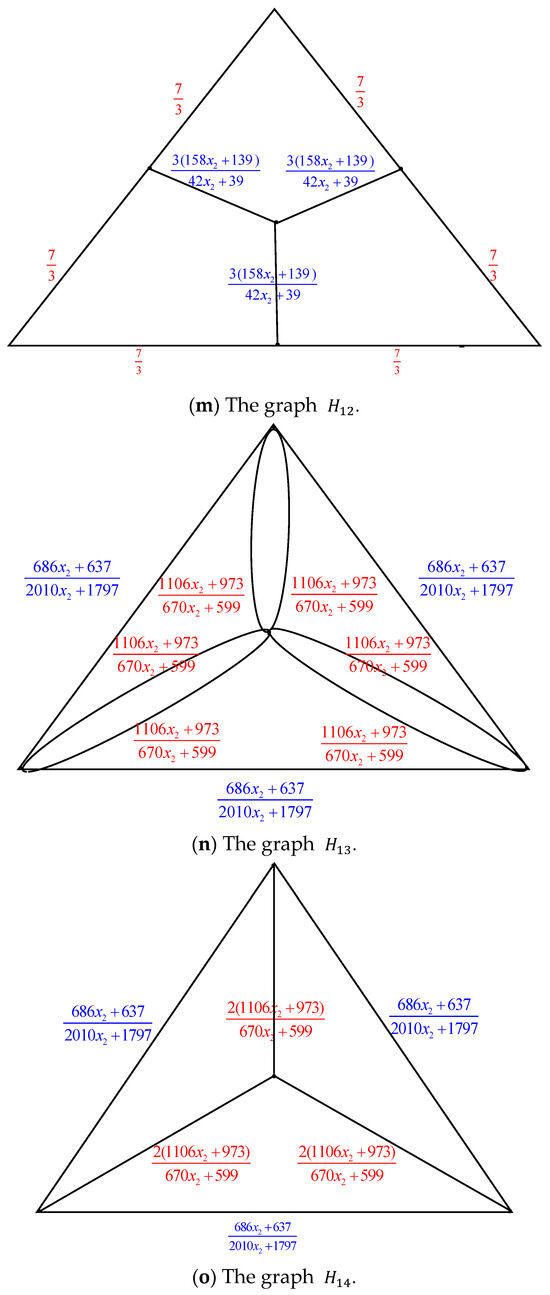
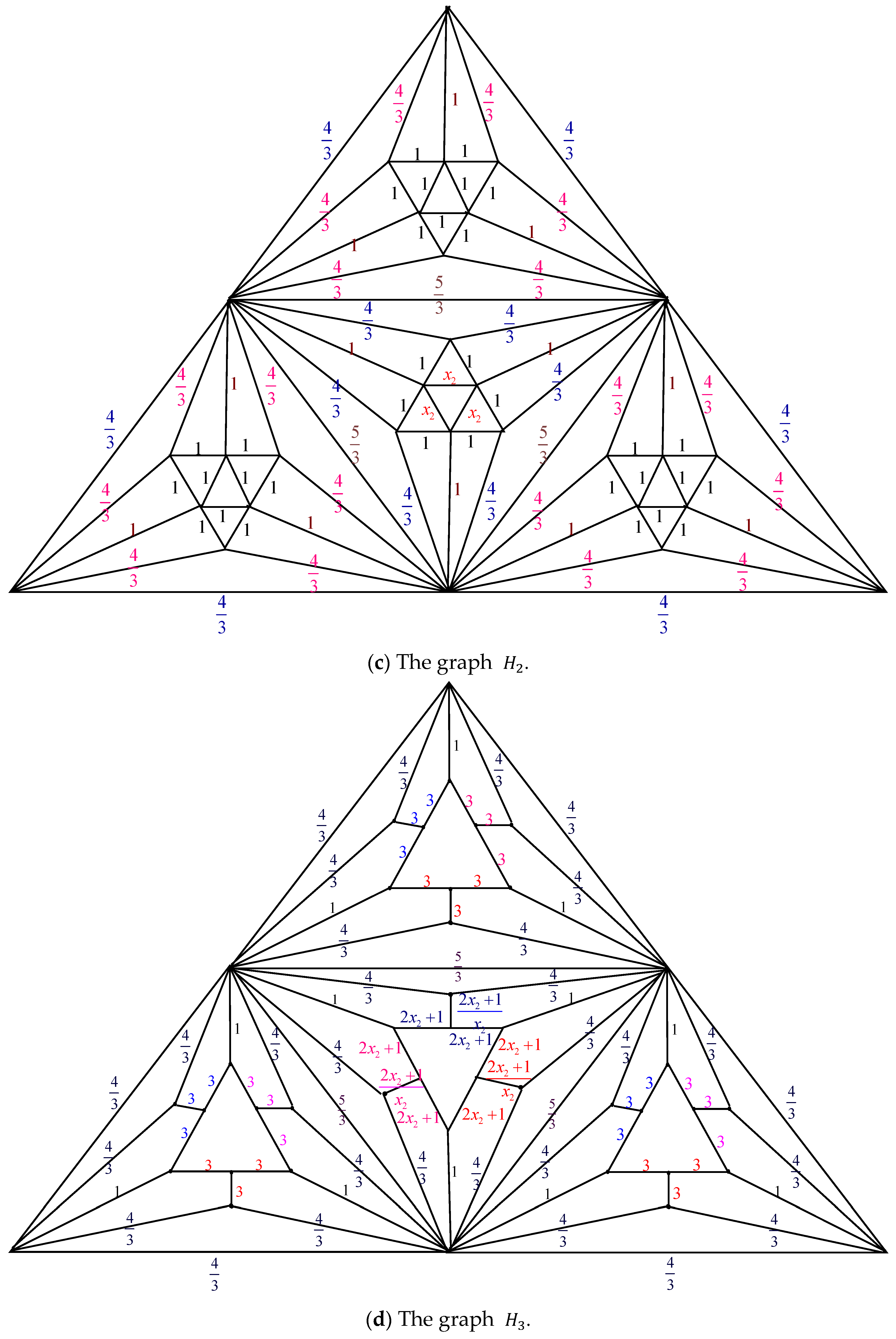
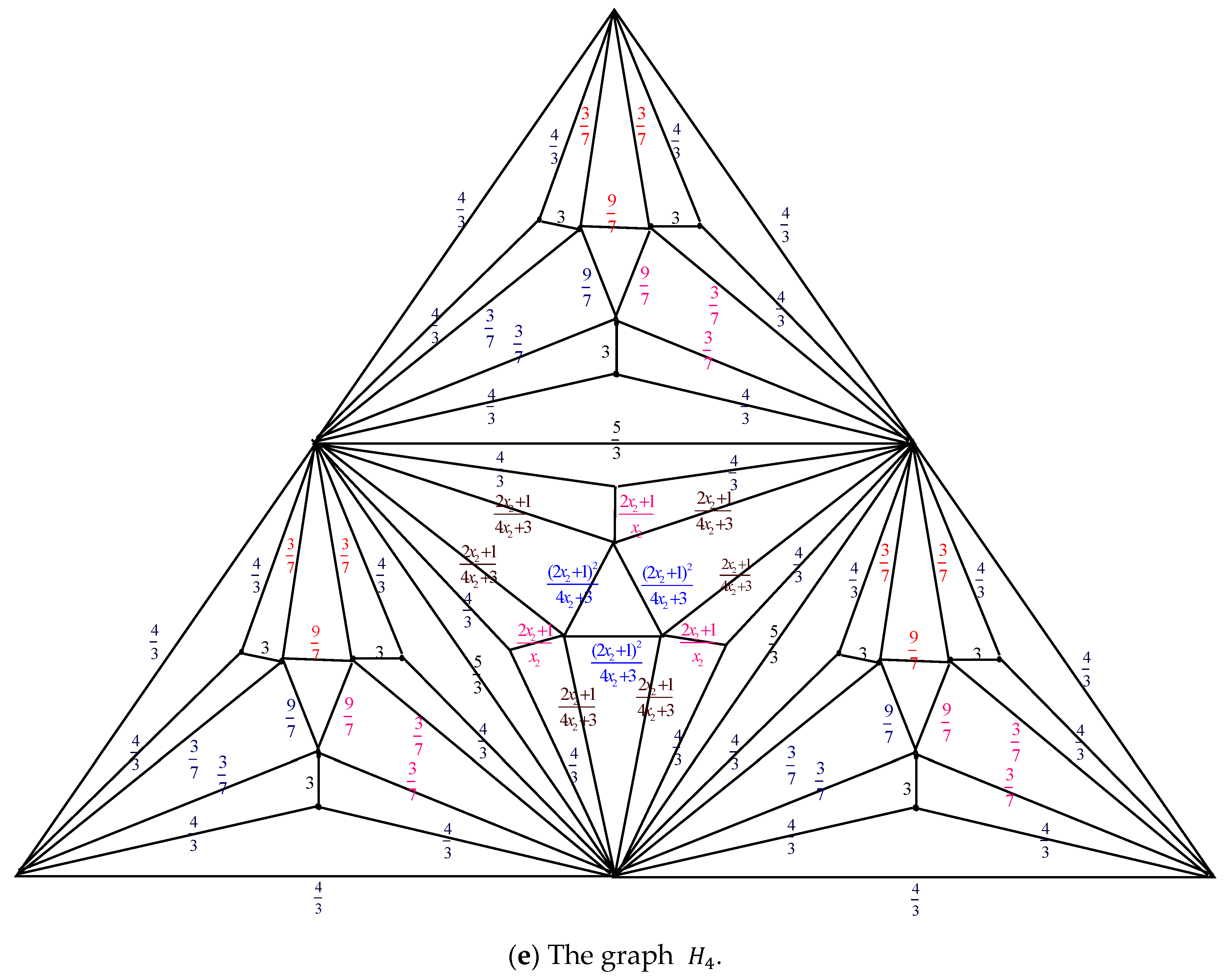
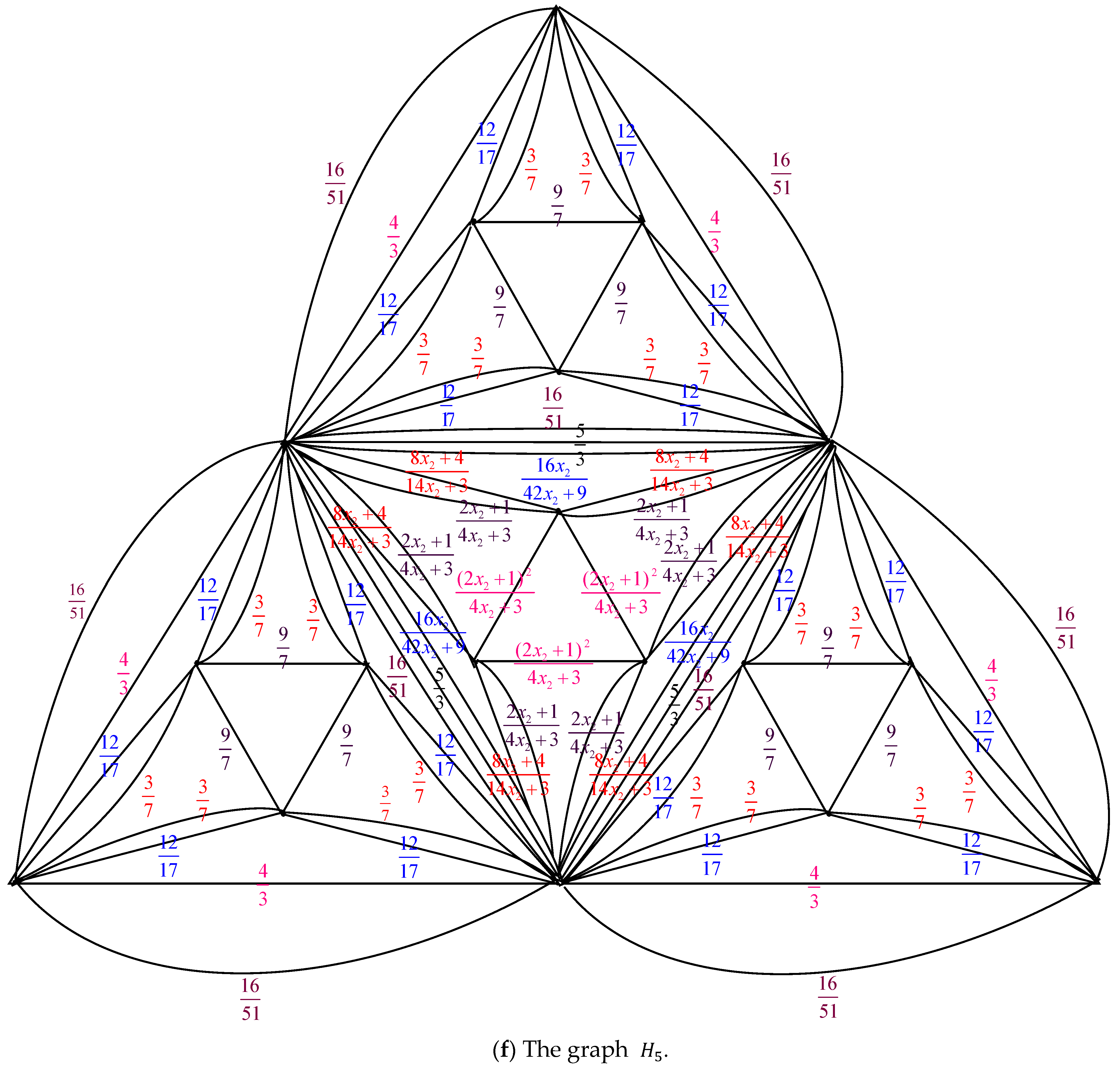
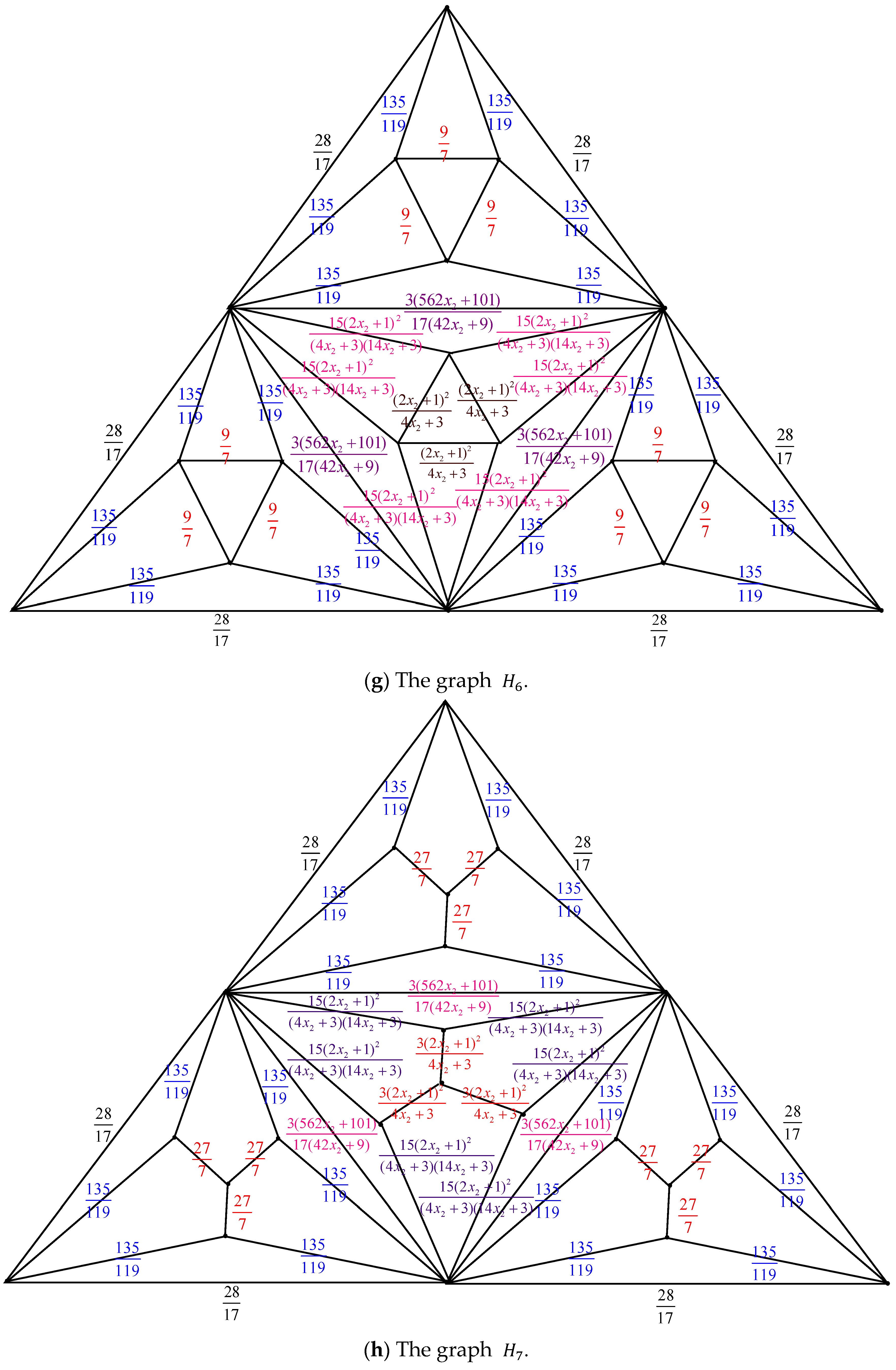
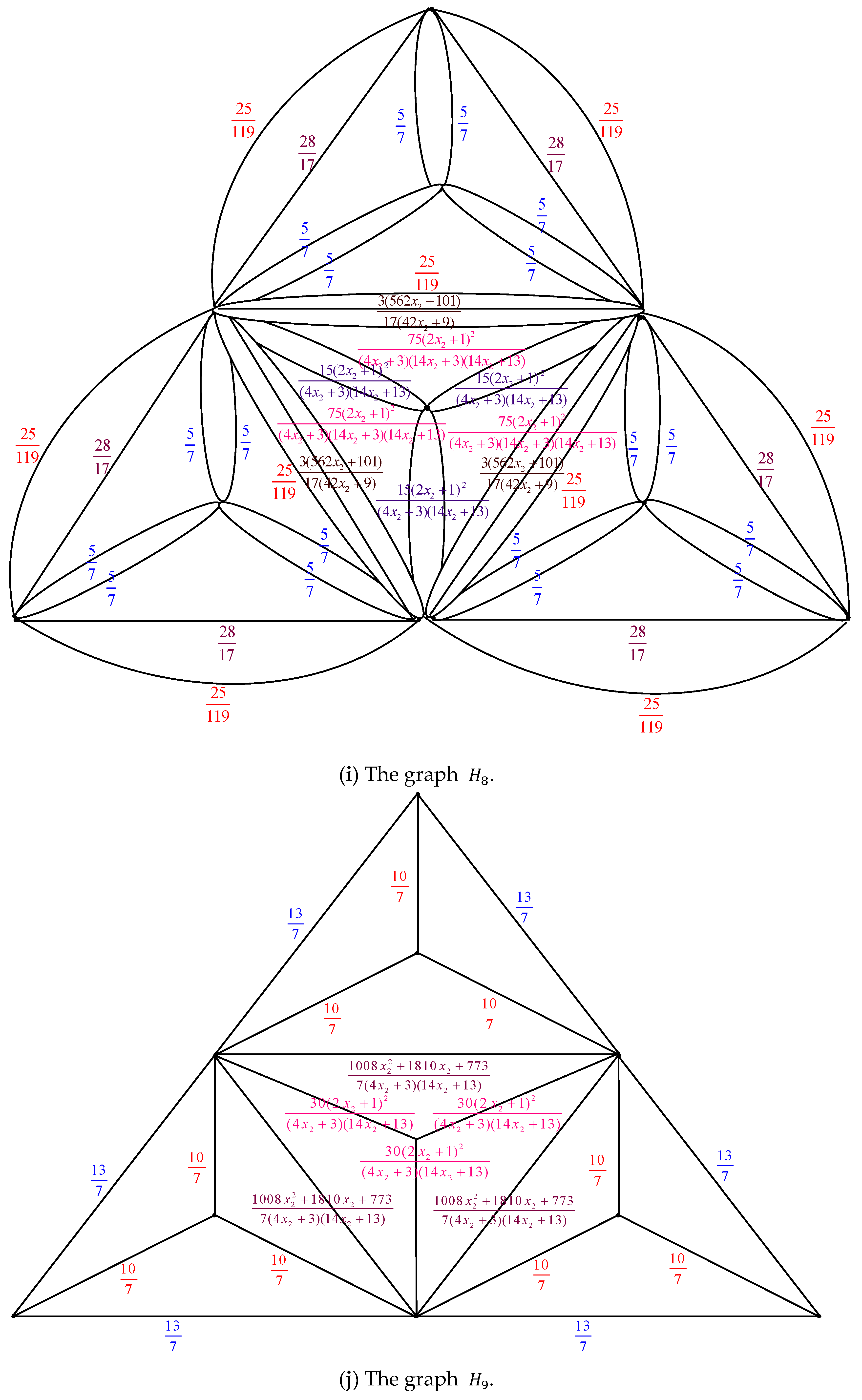
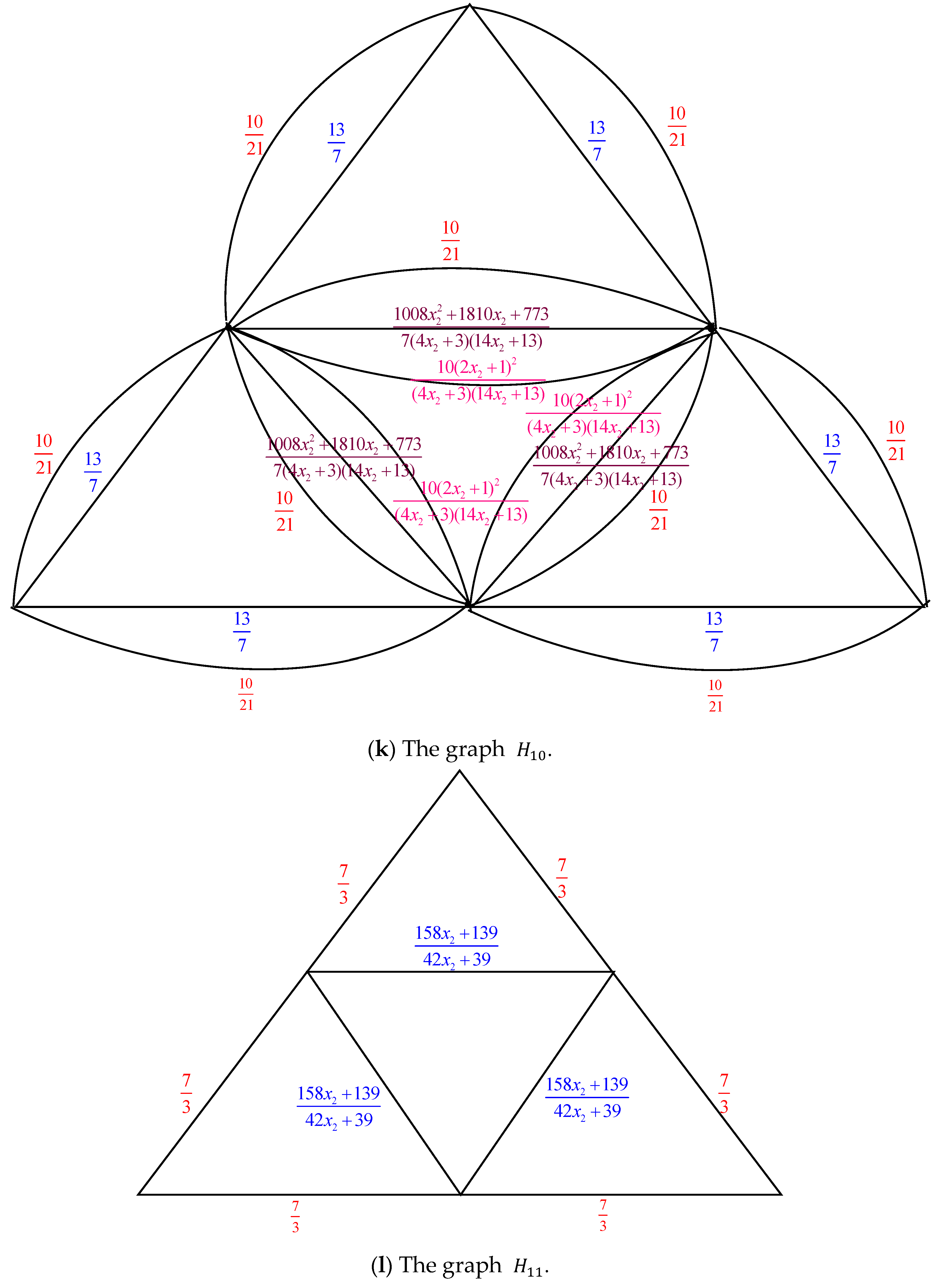
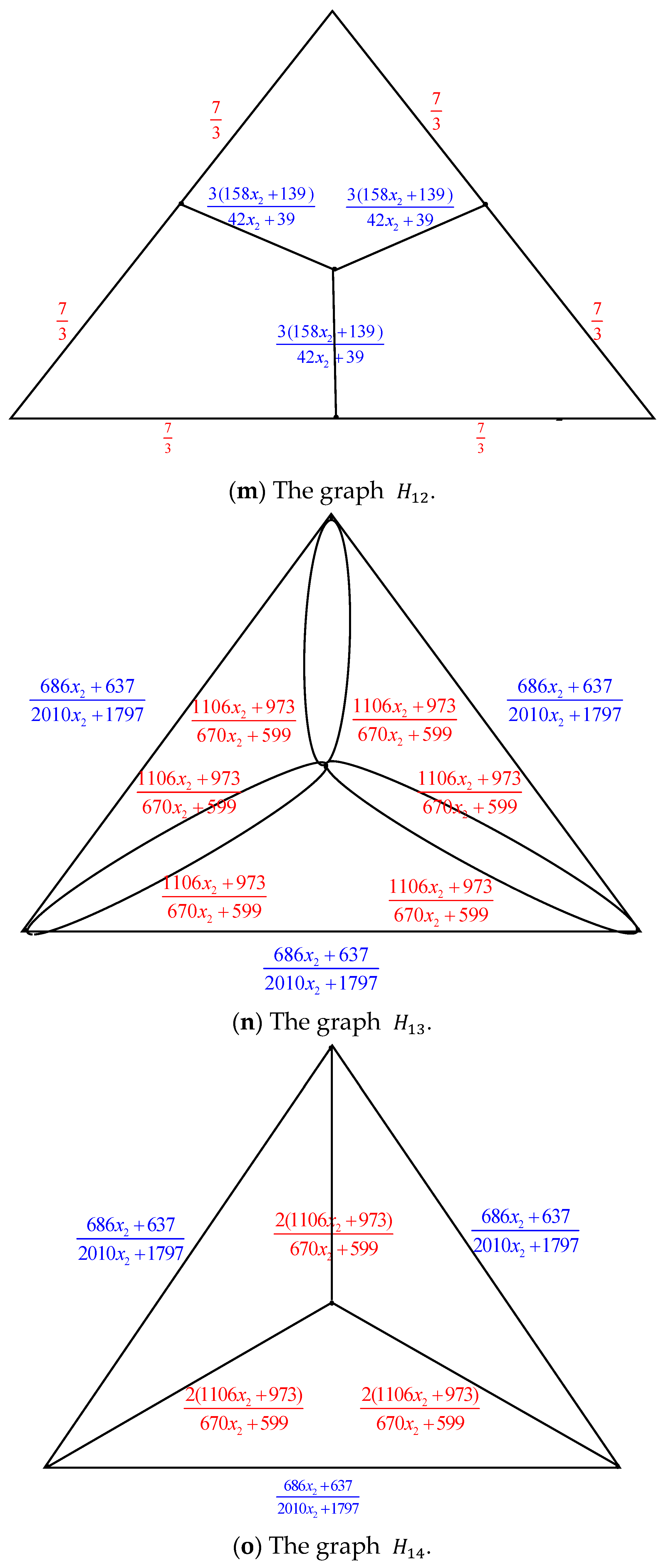
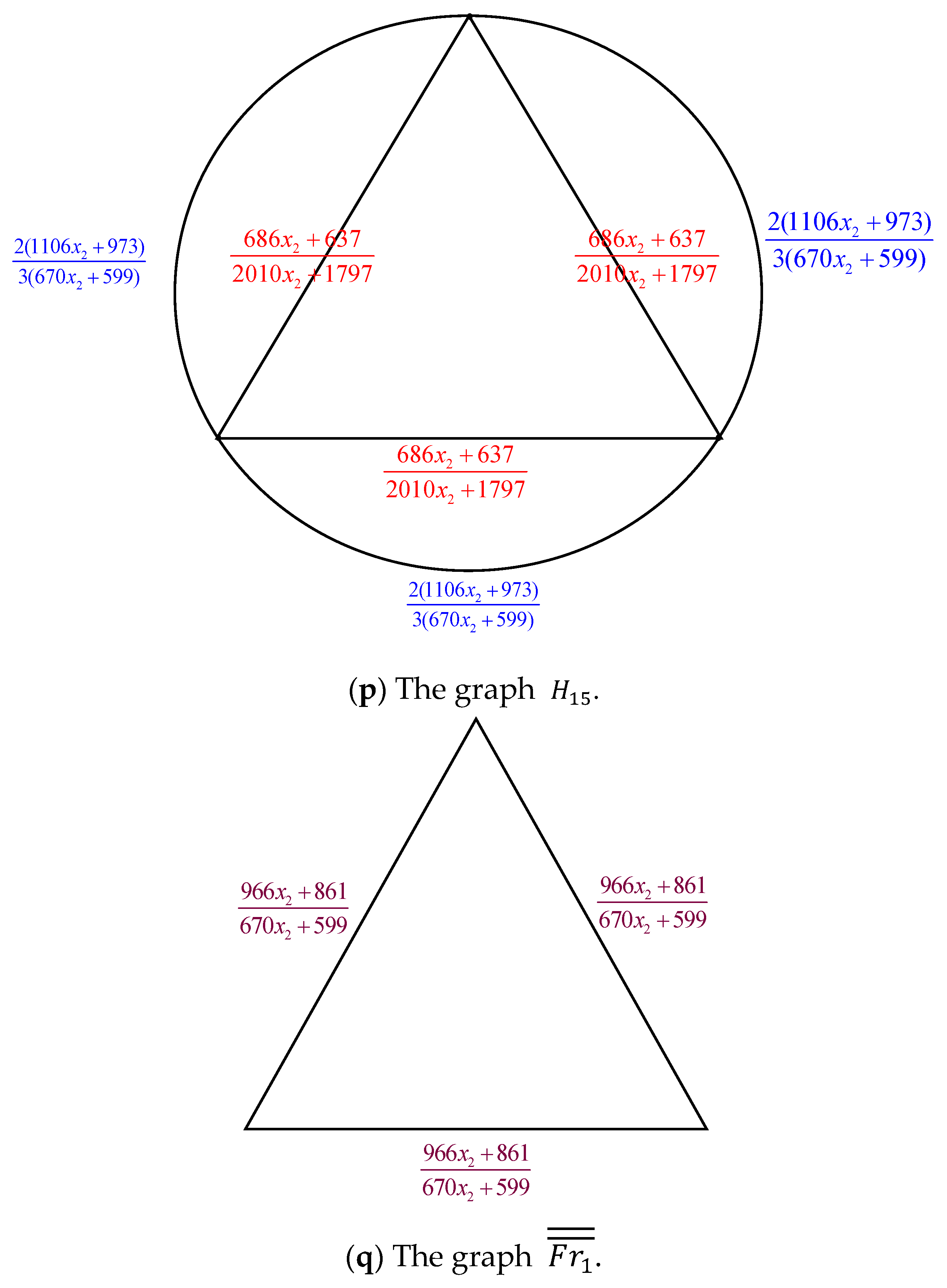
By applying the electrically equivalent transformation, is converted to . Figure 3 illustrates the process of converting to .
Figure 3.
The electrically equivalent transformations from to Utilizing the Δ-Y transformation rule on (a), we arrive at the following: Using the Y-Δ transformation rule on (b), we get . Reapplying the Y-Δ transformation rule on (c) yields the following: . When the parallel edge transformation rule is used on (d), we get . When the Δ-Y transformation rule is applied on (e), we get Using the Y-Δ transformation rule on (f), we get . Applying the parallel edge transformation rule on (g), we obtain the following: Utilizing the Y-Δ transformation rule on (h), we arrive at the following: . Applying the parallel edge transformation rule on (i), we obtain the following: . Applying the Δ-Y transformation rule on (j), we obtain the following: . When we use the Y-Δ transformation rule on (k), we get . The parallel edge transformation rule is applied on (l), and we get . Applying the Y-Δ transformation rule on (m),we obtain the following: . Applying the parallel edge transformation rule on (n), we obtain the following: .
The result of combining these thirteen transformations is
Thus
Additionally
where
The equation for its characteristic is with roots and . These two roots can be subtracted from both sides of , to obtain
Let . Then by Equations (5) and (6), we get the following:
Therefore
Thus
With the coefficients of and , represented by the symbols and , respectively, and using the formula , we have
When Equation (10) is substituted into Equation (4), we get
where and . By the expression and using Equations (8) and (9), we have
Equation (12) has the characteristic equation . Its roots are and .
The general solutions of Equation (12) are .
Given the initial conditions and we obtain
If , this means that is without any electrically equivalent transformation.
When Equation (13) is inserted into Equation (11), we obtain
Equation (14) is satisfied for and . Thus, the number of spanning trees in the pyramid graph is determined by
where
The result is obtained by inserting Equation (16) into Equation (15). □
2.2. Number of Spanning Trees of Pyramid Graph Created by Related Fritsch Graph
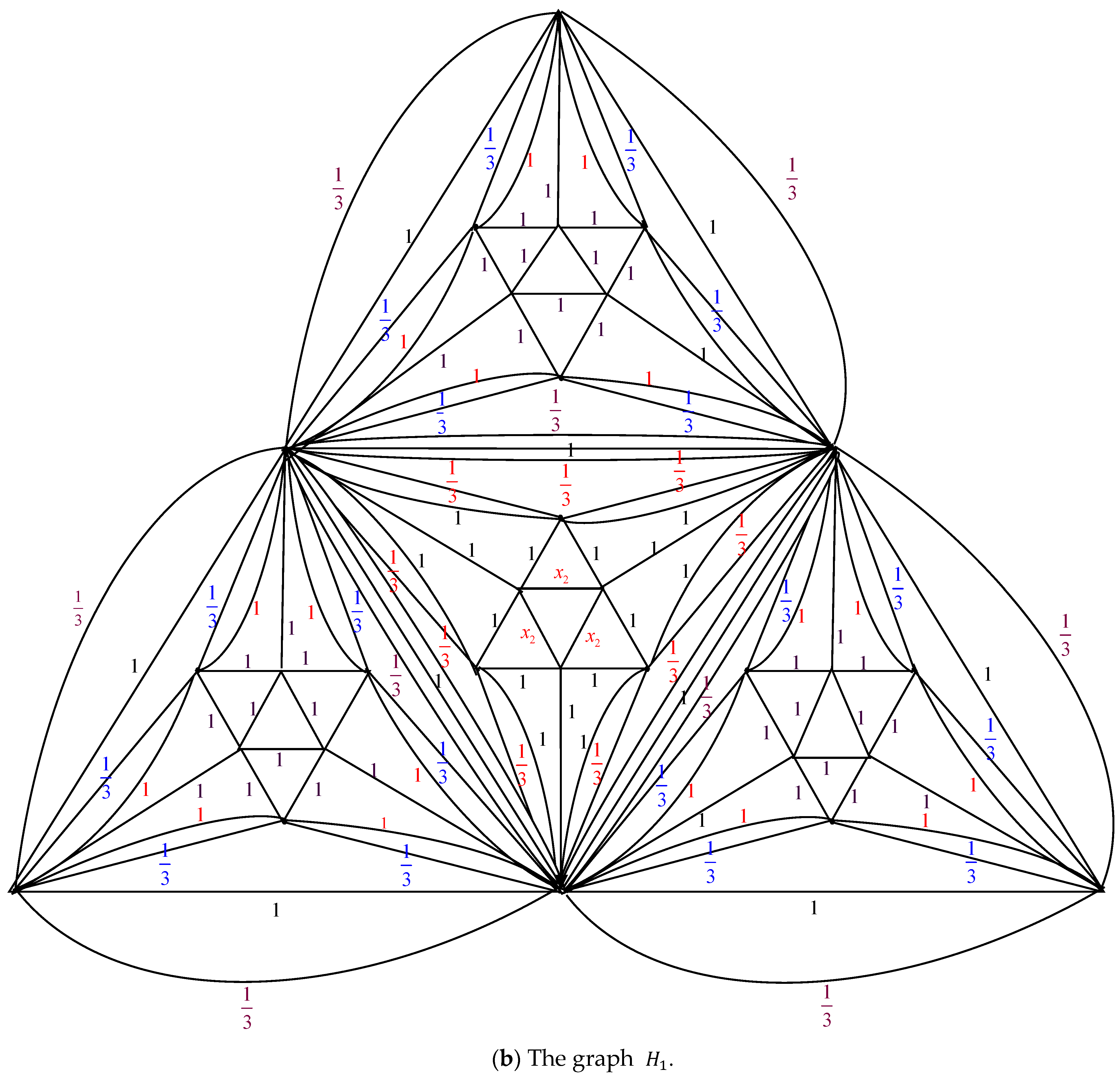
The pyramid graph is defined recursively using the graph and the graph (triangle or ) as follows: is created by replacing the center triangle in with . See Figure 4. According to this construction, the total vertices and edges are and , The average degree of is in the large n limit which is 5.2.
Figure 4.
The pyramid graph
Theorem 2.
The number of spanning trees in a pyramid graph, , created by the related Fritsch graph series for , is determined by
Proof.
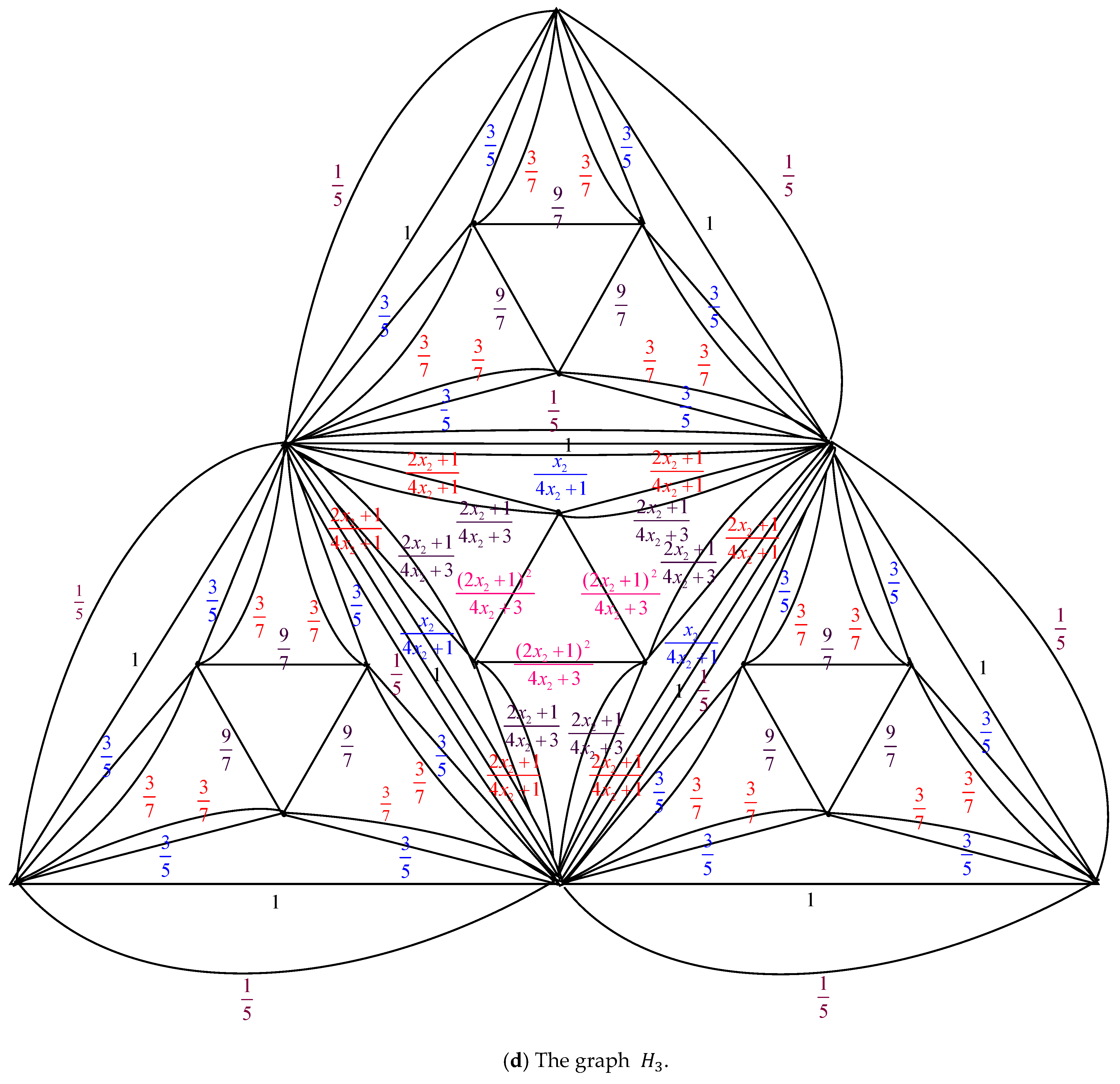
By applying the electrically equivalent transformation, is converted to . Figure 5 illustrates the process of converting to .
Figure 5.
The electrically equivalent transformations from to Utilizing the Y-Δ transformation method on (a), we arrive at . Applying the parallel edge transformation rule on (b), we obtain the following: . Using the Δ-Y transformation rule on (c), we get the following: . Applying the Y-Δ transformation rule on (d), we obtain the following: . Applying the parallel edge transformation rule on (e), we obtain the following: . Applying the Δ-Y transformation rule on (f), we obtain the following: . Applying the parallel edge transformation rule on (g), we obtain the following: . Utilizing the Δ-Y transformation rule on (h), we arrive at the following: Applying the Y-Δ transformation rule on (i), we obtain the following: . Applying the parallel edge transformation rule on (j), we obtain the following: . Utilizing the Y-Δ transformation rule on (k), we arrive at the following: . By using the transformation rule for parallel edges on (l), we get the following: .
The result of combining these ten transformations is
Thus
Additionally
where
This has a characteristic equation with the roots and . These two roots can be subtracted from both sides of , to obtain
Let . Then by Equations (19) and (20), we get and
Therefore
Thus
Using the formula and designating the coefficients of as and , we have
When Equation (24) is substituted into Equation (18), we get
where and . By the expression and Equations (23) and (24), we have
Equation (26) has the characteristic equation Its roots are and .
The general solutions of Equation (26) are .
Given the initial conditions and , we have
If , this means that is without any electrically equivalent transformation.
When Equation (27) is inserted into Equation (25), we obtain the following:
Equation (28) is satisfied for and . Thus, the number of spanning trees in the pyramid graph is determined by
where
The result is obtained by inserting Equation (30) into Equation (29). □
2.3. Number of Spanning Trees of Pyramid Graph Created by Graph
The pyramid graph is defined recursively using the graph and the graph (triangle or ) as follows: is created by replacing the center triangle in with . See Figure 6. According to this construction, the total vertices and edges are and , . The average degree of is in the large limit which is .
Figure 6.
The pyramid graph
Theorem 3.
The number of spanning trees in a pyramid graph , created by the related Fritsch graph series for , is determined by
Proof.
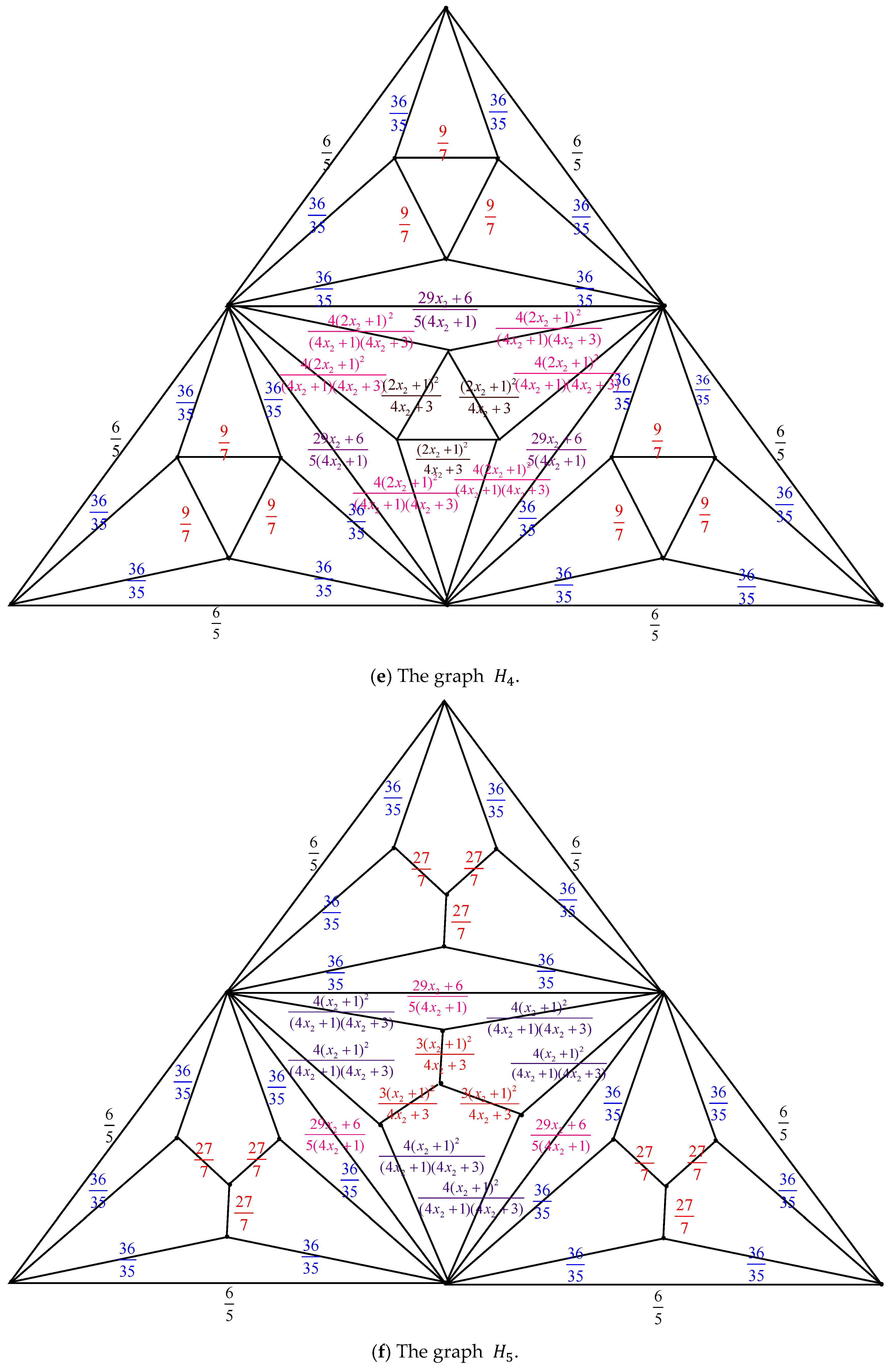
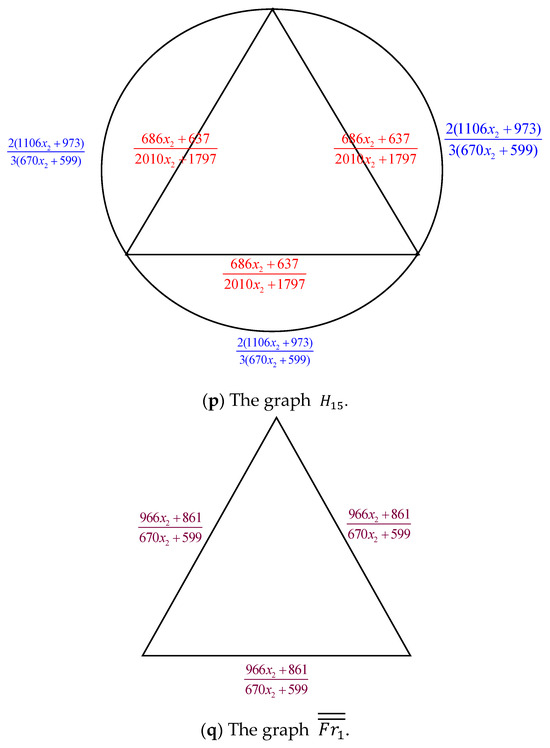
By applying the electrically equivalent transformation, is converted to . Figure 7 illustrates the process of converting to .
Figure 7.
The electrically equivalent transformations from to Applying the Y-Δ transformation rule on (a), we obtain the following: . Applying the parallel edge transformation rule on (b), we obtain the following: . Applying the Δ-Y transformation rule on (c), we obtain the following: . Applying the Y-Δ transformation rule on (d), we obtain the following: . Reapplying the Y-Δ transformation rule on (e) yields the following: . Applying the parallel edge transformation rule on (f), we obtain the following:. Utilizing the Δ-Y transformation rule on (g), we arrive at the following: . Applying the Y-Δ transformation rule on (h), we obtain the following: . Applying the parallel edge transformation rule on (i), we obtain the following: . When we use the Y-Δ transformation rule on (j), we get the following: . Using the rule of parallel edge transformation on (k), we get the following: . When we use the Δ-Y transformation rule on (l), we get the following: . Applying the Y-Δ transformation rule on (m), we obtain the following: . Applying the parallel edge transformation rule on (n), we obtain the following: . Applying the Y-Δ transformation rule on (o), we obtain the following: . Applying the parallel edge transformation rule on (p), we obtain the following: .
The result of combining these fifteen transformations is
Thus
Additionally
where Its characteristic equation is , with roots and . Subtracting these two roots on both sides of , we get
Let .
Then by Equations (33) and (34), we get and
Therefore
Thus
Using the formula and designating the coefficients of and as and , we have
When Equation (38) is substituted into Equation (32), we get
where and . By the expression and Equations (36) and (37), we have
Equation (40) has the characteristic equation Its roots are and .
The general solutions of Equation (40) are .
Given the initial conditions and , we have
If , this means that is without any electrically equivalent transformation.
When Equation (41) is inserted into Equation (39), we obtain
Equation (42) is satisfied for and . Thus, the number of spanning trees in the sequence of the graph is determined by
where
The result is obtained by inserting Equation (44) into Equation (43). □
3. Numerical Results
The values of the number of spanning trees in the graphs , and are shown in the following Table 1, Table 2 and Table 3:
Table 1.
This table shows some of the numbers for the pyramid graph spanning tree count.
Table 2.
This table shows some of the numbers for the pyramid graph spanning tree count.
Table 3.
This table shows some of the numbers for the pyramid graph spanning tree count.
4. Spanning Tree Entropy
Once we have exact formulas for the number of spanning trees of the three pyramid graphs, , , and , we can compute the spanning tree entropy Z, a finite number and an interesting metric defining the network topology. In [17,18], this is explained as follows: With reference to graph ,
Despite having the same number of vertices, edges, and average degree, the pyramid graph has a higher entropy than the pyramid graph . Similarly, even though the pyramid graph has more vertices, edges, and average degrees than the pyramid graphs and , its entropy is lower. Additionally, the apollonian graph [19], which has an average degree of 5 (entropy 1.354), has a lower entropy than all pyramid graphs , , and .
The entropy of the graphs under investigation is also higher than that of the square grid graph, which has an average degree of 4 and an entropy of 1.166, and lower than that of the triangle grid graph, which has an average degree of 6 and an entropy of 1.62 [20].
5. Conclusions
In this study, we use electrically equivalent transformations to determine the number of spanning trees of particular pyramid graphs produced from the Fritsch graph and other related graphs. This technique’s strength is its ability to avoid the laborious computation of Laplacian spectra, which is a requirement for a general approach to spanning tree determination. Furthermore, our findings indicate a relationship between entropy and the graph’s average degree.
Author Contributions
Methodology, A.A. and S.N.D.; Software, A.A. and S.N.D.; Validation, A.A. and S.N.D.; Formal analysis, A.A. and S.N.D.; Investigation, A.A. and S.N.D.; Resources, A.A. and S.N.D.; Data curation, A.A. and S.N.D.; Writing—original draft, A.A. and S.N.D.; Writing—review & editing, A.A. and S.N.D.; Visualization, A.A. and S.N.D.; Supervision, A.A. and S.N.D.; Project administration, A.A. and S.N.D.; Funding acquisition, A.A. All authors have read and agreed to the published version of the manuscript.
Funding
The authors extend their appreciation to the Deanship of Scientific Research at King Khalid University for funding this work through Larg Groups (Project under grant number (RGP.2/372/45)).
Data Availability Statement
Data is contained within the article.
Acknowledgments
The authors wish to extend their gratitude to the anonymous referees for their valuable feedback, which significantly enhanced the quality of the manuscript.
Conflicts of Interest
The authors declare no conflicts of interest. The funders had no role in the design of the study; in the collection, analyses, or interpretation of data; in the writing of the manuscript; or in the decision to publish the results.
References
- Nikolopoulos, S.D.; Palios, L.; Papadopoulos, C. Counting spanning trees using modular decomposition. Theor. Comput. Sci. 2014, 526, 41–57. [Google Scholar] [CrossRef] [Scilit]
- Letina, S.; Blanken, T.F.; Deserno, M.K.; Borsboom, D. Expanding network analysis tools in psychological networks: Minimal spanning trees, participation coefficients, and motif analysis applied to a network of 26 psychological attributes. Complexity 2019, 2019, 9424605. [Google Scholar] [CrossRef] [Scilit]
- Zhang, F.; Yong, X. Asymptotic enumeration theorems for the number of spanning trees and Eulerian trail in circulant digraphs & graphs. Sci. China Ser. A Math. 1999, 43, 264–271. [Google Scholar]
- Huaxiao, Z.; Fuji, Z.; Qiongxiang, H. On the number of spanning trees and Eulerian torus in iterated line digraph. Discret. App. Math. 1997, 73, 59–67. [Google Scholar] [CrossRef] [Scilit]
- Applegate, D.L.; Bixby, R.E.V.; Chvátal; Cook, W.J. The Traveling Salesman Problem: A Computational Study; Princeton University Press: Princeton, NJ, USA, 2006. [Google Scholar]
- Atajan, T.; Inaba, H. Network reliability analysis by counting the number of spanning trees, ISCIT 2004. IEEE Int. Symp. Commun. Inf. Technol. 2004, 1, 601–604. [Google Scholar]
- Caşcaval, P. Approximate Method to Evaluate Reliability of Complex Networks. Complexity 2018, 2018, 5967604. [Google Scholar] [CrossRef] [Scilit]
- Kirchhoff, G.G. Über die Auflösung der Gleichungen auf welche man bei der Untersucher der linearen Verteilung galuanischer Strome gefhrt wird. Ann. Phg. Chem. 1847, 72, 497–508. [Google Scholar] [CrossRef] [Scilit]
- Kelmans, A.K.; Chelnokov, V.M. A certain polynomial of a graph and graphs with an extremal number of trees. J. Comb. Theory B 1974, 16, 197–214. [Google Scholar] [CrossRef] [Scilit]
- Biggs, N.L. Algebraic Graph Theory, 2nd ed.; Cambridge University Press: Cambridge, UK, 1993; p. 205. [Google Scholar]
- Daoud, S.N. The Deletion-Contraction Method for Counting the Number of Spanning Trees of Graphs. Eur. J. Phys. Plus 2015, 130, 217. [Google Scholar] [CrossRef] [Scilit]
- Daoud, S.N. Number of Spanning Trees in Different Product of Complete and Complete Tripartite Graphs. Ars Comb. 2018, 139, 85–103. [Google Scholar]
- Daoud, S.N. Number of Spanning Trees of Cartesian and Composition Products of Graphs and Chebyshev Polynomials. IEEE Access 2019, 7, 71142–71157. [Google Scholar] [CrossRef] [Scilit]
- El Deen, M.R.Z.; Aboamer, W.A.; El-Sherbiny, H.M. The Complexity of the Super Subdivision of Cycle-Related Graphs Using Block Matrices. Computation 2023, 11, 162. [Google Scholar] [CrossRef] [Scilit]
- Teufl, E.; Wagner, S. Determinant identities for Laplace matrices. Linear Algebra Appl. 2010, 432, 441–457. [Google Scholar] [CrossRef] [Scilit]
- Daoud, S.N. Number of spanning Trees in the sequence of some Nonahedral graphs. Util. Math. 2020, 115, 39–56. [Google Scholar]
- Wu, F.Y. Number of spanning trees on a lattice. J. Phys. A Math. Gen. 1977, 10, 113–115. [Google Scholar] [CrossRef] [Scilit]
- Lyons, R. Asymptotic enumeration of spanning trees. Combin. Probab. Comput. 2005, 14, 491–522. [Google Scholar] [CrossRef] [Scilit]
- Zhang, Z.; Wu, B.; Comellas, F. The number of spanning trees in Apollonian networks. Discret. Appl. Math. 2014, 169, 206–213. [Google Scholar] [CrossRef] [Scilit]
- Teufl, E.; Wagner, S. On the number of spanning trees on various lattices. J. Phys. A Math. Theor. 2010, 43, 415001. [Google Scholar] [CrossRef] [Scilit]

Disclaimer/Publisher’s Note: The statements, opinions and data contained in all publications are solely those of the individual author(s) and contributor(s) and not of MDPI and/or the editor(s). MDPI and/or the editor(s) disclaim responsibility for any injury to people or property resulting from any ideas, methods, instructions or products referred to in the content. |
© 2025 by the authors. Licensee MDPI, Basel, Switzerland. This article is an open access article distributed under the terms and conditions of the Creative Commons Attribution (CC BY) license (https://creativecommons.org/licenses/by/4.0/).