


Abstract
This paper introduces the bivariate bounded Gompertz–log-logistic (BBGLL) distribution, a bounded bivariate lifetime model built by coupling two bounded Gompertz–log-logistic marginals through a Clayton copula with an independent dependence parameter. The proposed model effectively describes positively dependent lifetimes within finite support and accommodates increasing, decreasing, and bathtub-shaped hazard rates. Analytical expressions for the survival functions, hazard rate functions, and joint moments are derived, while measures of association such as Kendall’s tau, Spearman’s rho, and tail-dependence coefficients characterize the dependence structure. Parameters are estimated via maximum likelihood, inference functions for margins (IFM), and semi-parametric methods, with performance assessed through Monte Carlo simulations. A real-life data application illustrates the practical relevance of the model, showing that the BBGLL distribution achieves a superior goodness-of-fit relative to existing bivariate alternatives, highlighting its practical usefulness.
Keywords:
bounded bivariate distribution; Clayton copula; reliability modeling; dependence structure; simulation MSC:
60E05; 62E15; 62F10
1. Introduction
Modeling bivariate lifetime data is a fundamental topic in reliability theory, survival analysis, and biostatistics where understanding the joint behavior of two interdependent lifetimes, such as components in a system, organs in a biological process, or correlated event times is essential for risk assessment and prediction.
To address such contexts, bounded lifetime distributions have attracted increasing attention. The earliest efforts include bounded variants of well-known univariate models such as the beta, Kumaraswamy, and bounded Weibull families [1,2,3]. These families provide flexibility in modeling monotone or non-monotone hazard rate functions but are often limited to univariate or independent frameworks. Extending them to the bivariate setting remains a challenging task due to the complexity of joint dependence and normalization constraints on finite domains.
To overcome these limitations, copula theory provides a powerful and modular framework for constructing multivariate distributions by linking arbitrary marginal distributions through a dependence function. Copulas separate marginal behavior from dependence structure, allowing researchers to combine heterogeneous marginals while maintaining coherent probabilistic dependence.
The connection between copulas and bivariate distributions is formally established through Sklar’s theorem [4], which states that any bivariate cumulative distribution function (CDF) with continuous marginals and can be uniquely represented as
where is a copula function that fully characterizes the dependence between and . This decomposition, first formalized by [4] and later developed in [5,6,7], allows for the design of complex multivariate models while preserving flexible marginal specifications. Indeed, copulas permit modeling marginal behaviors and dependence separately, ensuring mathematical tractability and interpretability. Such copula-based constructions have been successfully applied in reliability and hydrological modeling [8] as well as in dependent lifetime analysis [9,10]. Within this framework, the Clayton copula, originally introduced by [11], stands out for its ability to capture positive quadrant dependence (PQD) and nonzero lower-tail dependence, properties particularly relevant to reliability data and biomedical contexts, where simultaneous early failures are likely [7,9,12,13,14]. Indeed, the Clayton family, with its ability to capture asymmetry and provide intuitive tail-dependence modeling, provides a solid foundation for building bivariate lifetime models.
Several authors have proposed bounded or truncated extensions of classical lifetime distributions, including generalized log-logistic and log-logistic-based models for reliability analysis [15]. Copula-based approaches have also been applied in bounded risk and survival contexts, such as bivariate generalized exponential families and truncated bivariate forms arising in actuarial and biomedical studies [10,16]. These developments highlight the growing demand for bivariate lifetime models that combine boundedness, dependence flexibility, and interpretable hazard shapes. The proposed BBGLL model contributes to this line of research by offering a new bounded bivariate family with explicit marginals and a tractable copula-driven dependence structure. Building on this theoretical foundation, this paper proposes a flexible bounded bivariate lifetime distribution, called the bivariate bounded Gompertz–log-logistic (BBGLL) model. The BBGLL family is constructed by coupling two bounded Gompertz–log-logistic (BGLL) marginals, each capable of reproducing increasing, decreasing, and bathtub-shaped hazard rate functions, with a Clayton copula possessing an independent dependence parameter. The BGLL marginal is particularly appealing because it combines the exponential growth pattern of the Gompertz component with the heavy-tailed flexibility of the log-logistic form while maintaining a finite upper bound.
In this work, we establish the theoretical properties of the BBGLL model, including joint and conditional hazard functions, tail-dependence coefficients, and moment expressions. We also present estimation procedures based on maximum likelihood, inference functions for margins (IFM), and semi-parametric methods, together with Monte Carlo simulations assessing finite-sample performance. An empirical application to kidney infection recurrence data illustrates the practical utility of the model and demonstrates its superiority, in terms of AIC, BIC, and log-likelihood criteria, compared to some existing bivariate lifetime models.
Overall, the proposed BBGLL model contributes to the growing literature on bounded and dependent reliability models, providing a flexible, interpretable, and computationally tractable framework for describing realistic bounded lifetime behaviors in engineering, biomedical, and environmental systems.
The remainder of the paper is structured as follows. Section 2 introduces the proposed bivariate distribution, together with its construction and analytical properties. Section 3.2 presents the tractable analytical results, focusing on the moment properties of the distribution. In Section 3.3, we develop parameter estimation methods based on the method of moments and maximum likelihood. Section 4 illustrates the practical usefulness of the model through a real-life data application. Concluding remarks are provided in Section 5.
2. Definitions and Properties
Throughout this paper, we denote the Clayton copula dependence parameter by , and for convenience in the marginal BGLL expressions we define . This fixed relationship between and will be used consistently in all subsequent formulas.
2.1. The Bivariate T-Y Family
The T-Y family of bivariate distributions provides a general and flexible framework for generating continuous bivariate models with given marginals and controlled dependence. This family is considered as an extension of the Farlie–Gumbel–Morgenstern (FGM) and Morgenstern-type constructions [17], where this approach is built upon two transformation functions T and Y that link the marginal and joint behaviors through an explicit dependence generator. The T-Y framework can be interpreted as a functional mechanism that allows one to preserve tractable analytical properties while extending the range of admissible dependence structures beyond linear or symmetric forms.
Building upon the foundational structure of the T-Y family, ref. [18] proposed an innovative method termed the (U,V)-YZ distribution family, designed for the construction of bivariate families of continuous distributions. To maintain consistency with the T-Y distributions in the marginal cases, they transformed the original T-Y approach, which was applicable to univariate or one-dimensional data, into a new generation mechanism suitable for bivariate or two-dimensional contexts. Let and represent, respectively, the probability density function PDF and the CDF of the random vector , where , and , with , and . Now, assume that the upper limits and are two functions of the CDF and of random variables and , respectively, that meet the following requirements:
Thus, according to [18], the CDF of a new bivariate family of distributions is defined as follows.
Definition 1.
Let (respectively, ) be a random variable with (respectively, ) as PDF and (respectively, ) as CDF. Let be the continuous bivariate random vector with as PDF and as CDF. Assume that is defined on . Hence, the CDF of the bivariate family is defined as
Therefore, the corresponding PDF can be obtained by partially differentiating Equation (1) with respect to and as
where represents the copula density function.
2.2. Construction of a Bivariate Bounded Model Using Log-Logistic and Gompertz Distributions
Next, we introduce the bounded Gompertz–log-logistic (BGLL) distribution, which serves as the marginal component of the proposed BBGLL model. This construction combines two complementary properties:
- the Gompertz distribution’s capacity to model monotone exponential-like growth or decay; and
- the log-logistic distribution’s flexibility in generating unimodal or bathtub-shaped hazard rate functions.
By introducing an upper bound , the BGLL model captures realistic finite-support lifetimes that arise in practical systems with physical, biological, or contractual limits.
The Upper BGLL Distribution
The T-Y family (see Section 2.1) offers a functional approach for constructing bivariate distributions with flexible marginals and controlled dependence.
Let (respectively, ) be a random variable that follows the log-logistic distribution (LLD) with scale parameter and a shape parameter equal to 1. Thus, the CDF of and are, respectively, given by
where and . Now, by substituting the Gompertz distribution as the T-member and the log-logistic distribution as the Y-member into Equation (1), we obtain
where
It should be noted that the form of the Gompertz model used in this construction corresponds to the generalized Gamma–Gompertz distribution commonly found in the reliability literature. Throughout the paper, we use the term “Gompertz distribution” for brevity, while the underlying functional form is the Gamma–Gompertz model. Hence, the survival function (SF) of the Gompertz distribution is given by
Therefore, under a normalization constraint, Equation (3) yields a bounded CDF of the following form:
Thus, one can see that
- As ,
- As ,
Differentiating Equation (5) with respect to and setting , we obtain
The above function is defined as the upper bounded Gompertz–log-logistic (BGLL) distribution with parameters , and that govern the distribution’s domain, scale, and shape, respectively.
Remark 1.
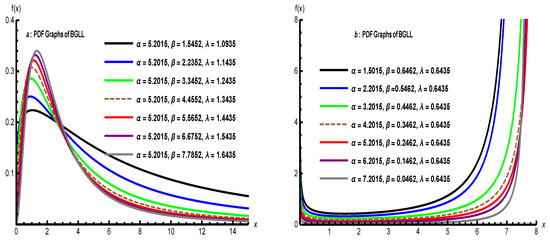
The upper BGLL distribution is unimodal for certain parameter ranges and can exhibit heavy-tailed behavior depending on λ and β. Indeed, the logarithmic form of the PDF is
Note that, when the mode does not exist, the PDF is strictly monotonic:
- It decreases when (maximum at ).
- It increases when (maximum at ).
Figure 1 shows the behavior of the PDF with different sets of parameters, and points to the mentioned cases related to the mode of distribution.
Figure 1.
PDF of the BGLL distribution, with different values of .
Remark 2.
The hazard rate function, HRF (also called failure rate function), related to the BGLL distribution is defined as , where denotes the survival function. After simplification we get
- as : ;
- as : .
Consequently, the HRF exhibits different behaviors depending on parameters:
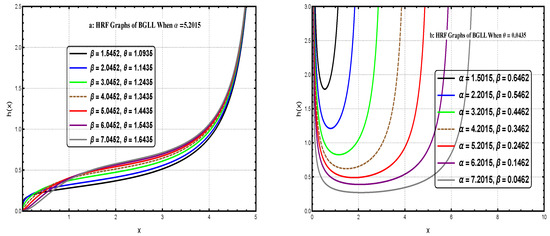
- For and : HRF is initially increasing (IFR property) and may have a maximum point (unimodal).
- For and : HRF is bathtub (BTS property).
- For : h() = is strictly increasing.
- When : when :
The HRF described above is particularly useful for modeling systems with finite operational lifetimes, where the variable is less than or equal to a maximum lifespan α. It is also well-suited for components that exhibit various failure behaviors, including early-life failures characterized by a decreasing hazard rate, wear-out effects marked by an increasing hazard rate, or a combination of both, resulting in a bathtub-shaped hazard function; see Figure 2.
Figure 2.
HRF of the BGLL distribution, with different values of .
2.3. Bivariate Bounded Gompertz Log-Logistic Distribution
To capture dependence between two bounded lifetimes and (with the same support ), we employ Sklar’s theorem, combining two BGLL marginals with the copula approach. Explicitly, by incorporating Equations (1), (2), (5), and (6) into Sklar’s theorem, the joint cumulative distribution function (CDF) of the BBGLL distribution for any chosen copula can be expressed as follows:
Thus, the related PDF can be expressed as follows:
3. Bivariate Bounded Gompertz–Log-Logistic Distribution with Clayton Copula
3.1. The BBGLL Construction with Clayton Copula
Let and be bounded lifetime variables both defined on , with marginal CDFs and PDFs that follow the BGLL form defined earlier. To introduce dependence, we apply Sklar’s theorem with the Clayton copula
Although governs the dependence structure, in the present parametrization we set for identifiability. Thus, is not independent of , and the marginal parameter is entirely determined by .
Remark 3.
It is worth noting that the BBGLL construction is not restricted to the use of the Clayton copula. We focus on the Clayton family because it captures positive association and lower-tail dependence, which are natural features in reliability applications involving early-failure clustering. However, other Archimedean copulas could also be incorporated within the same framework. For instance, the Gumbel copula emphasizes upper-tail dependence, while the Frank copula yields symmetric dependence without tail concentration. Exploring these alternatives would provide BBGLL variants tailored to different dependence structures, and we identify this as a direction for future research.
Thus, based on (8), the CDF of the BBGLL distribution, with Clayton as the copula function, can be expressed as follows:
for . Now, replacing by , one can see that
Theorem 1.
The joint probability density function (PDF) of the BBGLL model is given by
for
Proof.
Based on Sklar’s theorem, the PDF of BBGLL model is given by
where is the Clayton copula density defined by
Thus, we obtain
where
Suitable simplifications of the above expression complete the proof. □
Remark 4.
Dependence structure governed by the and parameters. The asymptotic properties of the given joint PDF can be analyzed by examining its behavior as the variables approach the boundaries of their support ( and ) and as the parameters approach extreme values. As we get
The PDF exhibits heavy-tailed behavior as and the tail index is governed by , i.e., larger values of imply faster decay (lighter tails) and smaller suggest slower decay (heavier tails). This implies that finite moments require for the r-th moment to exist.
As , one can see that
Thus, the joint PDF will become . It means the PDF approaches a finite, nonzero value as and no singularity exists at the upper bound (unlike the lower bound).
Moreover, for , the term dominates, causing the joint PDF to factorize, i.e., . As becomes large, and become independent. For the joint PDF retains non-trivial dependence even as the tails and coefficient of tail dependence becomes
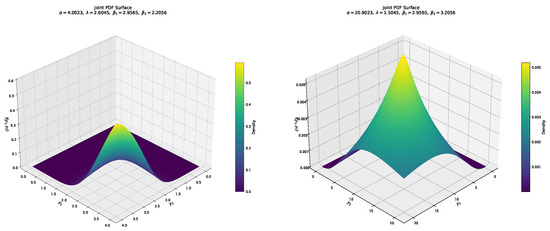
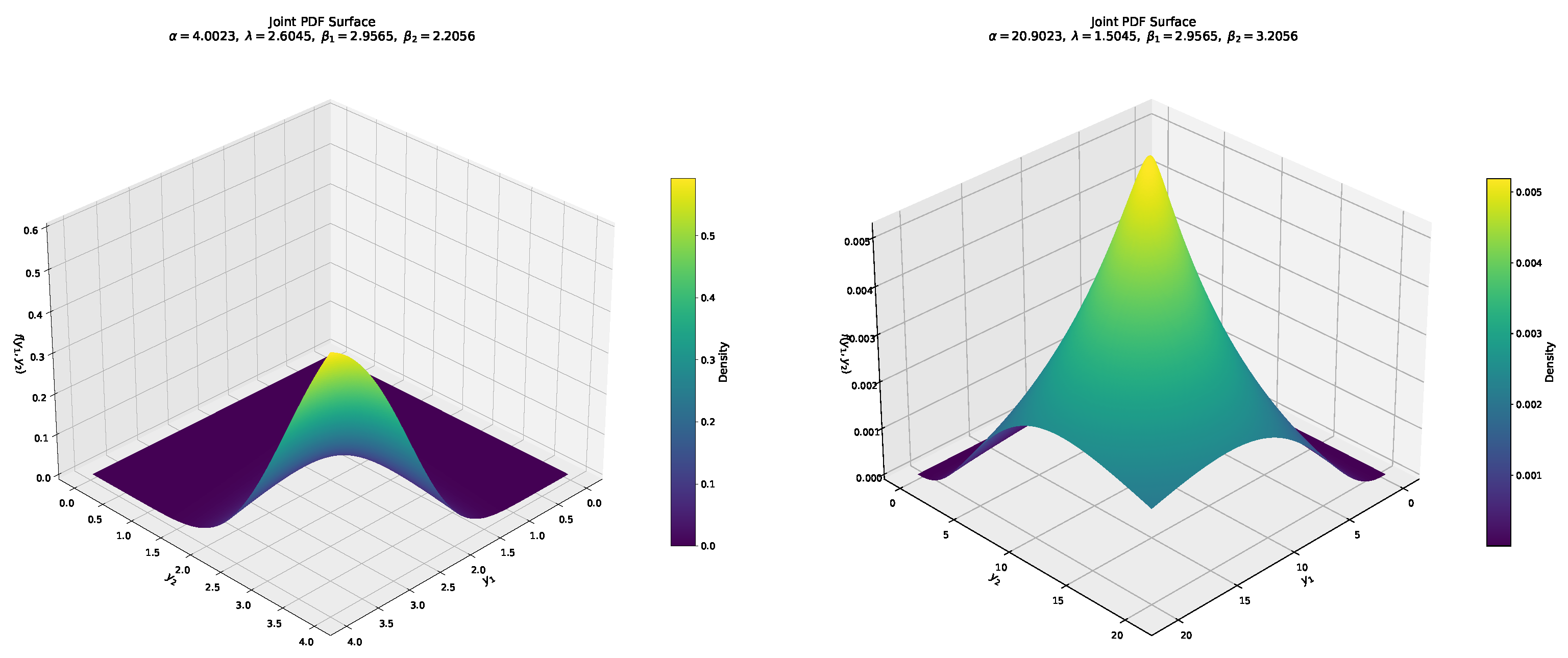
As the PDF reduces to a product of univariate generalized Pareto distributions, and the dependence structure vanishes. As the PDF becomes concentrated near with a singularity at the upper bound. Figure 3 below shows the behavior of the PDF with different values of parameters.
Figure 3.
Joint PDF of the BBGLL distribution for selected parameter values. The surface illustrates the combined effect of the bounded support and the dependence structure induced by the Clayton copula. Higher density values concentrate near regions where the transformed log-logistic components interact through the copula term. The z–axis and the color scale have been harmonized for readability, and auxiliary grid lines have been removed to avoid visual distraction. This figure highlights the interior shape of the joint density, which remains finite throughout the support .
3.1.1. Dependence Measures
The Clayton copula is an Archimedean copula with generator , and belongs to the class of positive quadrant-dependent (PQD) copulas.
Proposition 1.
For the BBGLL model, the following measures hold:
- (1)
- Kendall’s τ and Spearman’s ρ:
- (2)
- As , (independence); as , (perfect positive dependence).
Proof.
These relations are standard properties of the Clayton copula (see, e.g., [6,14]). □
3.1.2. Tail Dependence and Tail Orders
Tail dependence quantifies the probability of simultaneous extremes. For the BBGLL model, lower tails correspond to early failures (), and upper tails correspond to lifetimes approaching their finite bound .
Let be a bivariate random vector with marginal CDFs and . The upper-tail-dependence coefficient and lower-tail-dependence coefficient are, respectively, defined by
On the other hand, the upper-tail order and lower-tail order are, respectively, given by
Theorem 2.
The PDF of BBGLL (with Clayton copula), defined by (12), has the following:
- Upper-tail dependence, i.e., (asymptotic independence).
- Lower-tail dependence, i.e., .
- Upper-tail order, i.e., (intermediate tail dependence).
- Lower-tail order, i.e., (strictly faster than any power-law decay).
Proof.
For and : first we have to transform for . We observe that near the upper tail (), the joint survival satisfies the following: (i) ; (ii) the marginal survival . Thus, we have and . Similarly, for and , as , due to . No weight accumulates near , giving and . □
3.1.3. Positive Quadrant Dependence
Proposition 2.
For any , the BBGLL distribution is positively quadrant dependent (PQD), i.e.,
Independence is achieved only when .
Proof.
The joint CDF, defined by (11), can be simplified to , where , with . Then, the marginal CDFs, defined by (5), can be expressed as . To establish positive dependence, it suffices to verify that , which reduces to demonstrating that .
By explicitly calculating and N, it can be shown that their difference simplifies to , where and . Noting that for , both , it follows that , and thus their product is non-negative. Consequently, , implying . This leads to the inequality , which in turn establishes that . Therefore, the joint distribution exhibits positive quadrant dependence in the region where . □
3.1.4. Survival Function
To derive the survival function , we consider the probability that both and . For the survival copula to be valid in the Clayton, the condition is is expressed as and must hold for all . This is automatically satisfied for Clayton with for .
But here, depends on , so . Also, ensures , so . No further restriction links and except the natural one from the copula’s domain: in terms of , requires . That is,
Since the numerator , this inequality is not automatically true, it imposes a relation between and for the formula to be valid.
So, the relation is
Now, the bivariate survival function is obtained by integrating the joint PDF over the region . Since the support is , the upper limits are :
Given the joint CDF , the survival function can also be expressed as
Thus, the survival function simplifies to
where
To verify the properties of the survival function , we begin by checking the bounds. As and , we observe that , implying each transformed term in the function tends to zero. Hence, the survival function simplifies to , satisfying the upper-bound condition. Next, as and , it follows that . Substituting into the survival function, the expression reduces to , confirming the lower bound.
To verify monotonicity, we note that the terms of the form are non-decreasing in , because is a decreasing function of . Therefore, is non-increasing in both and , which is consistent with the behavior expected of a survival function.
Regarding the marginal survival functions, substituting directly into is incorrect due to improper handling of boundary behavior. Instead, we use the following limiting process:
which provides a valid univariate survival function for . Similarly, the marginal survival function for is
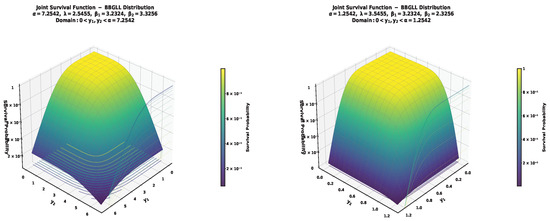
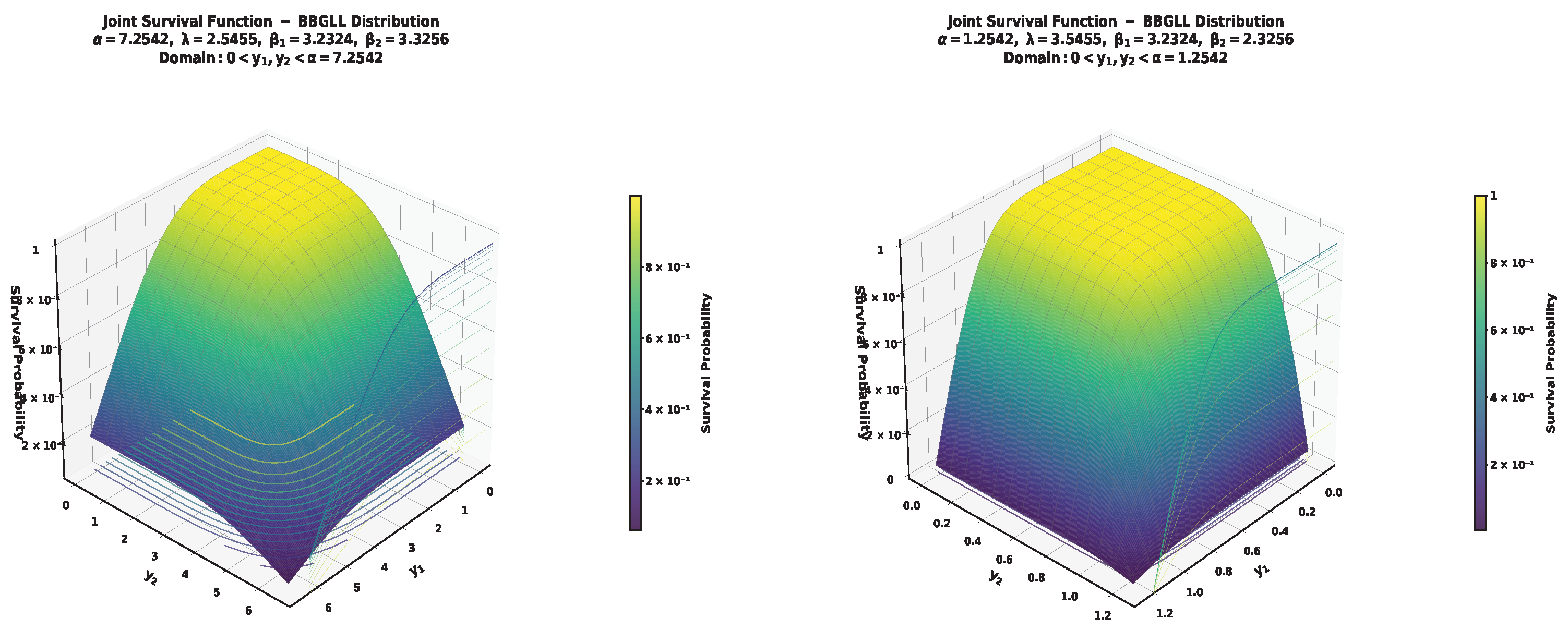
Thus, both marginal functions are mathematically valid and consistent with survival function properties. Figure 4 shows the behavior of the bivariate SF with different sets of parameters.
Figure 4.
Joint survival function of the BBGLL model. The surface decreases smoothly as either component approaches the upper bound , reflecting the bounded nature of the distribution. The curvature of the surface is governed both by the marginal BGLL forms and by the dependence parameter of the Clayton copula, which induces stronger joint decay for positively dependent lifetimes. z–axis and color representation have been standardized, and unnecessary lines removed for a clearer visualization of the survival behavior over the interior region.
3.1.5. Hazard Rate Function
The joint hazard rate associated with the BBGLL distribution is defined as
where is the joint density and is the joint survival function. Because the model is supported on the bounded domain , the hazard exhibits characteristic boundary behaviors that we detail below.
Behavior of the joint hazard rate as . From the expression of the joint density in Theorem 1, we obtain the following approximation:
for a positive constant depending on . Since the joint survival satisfies
the joint hazard diverges:
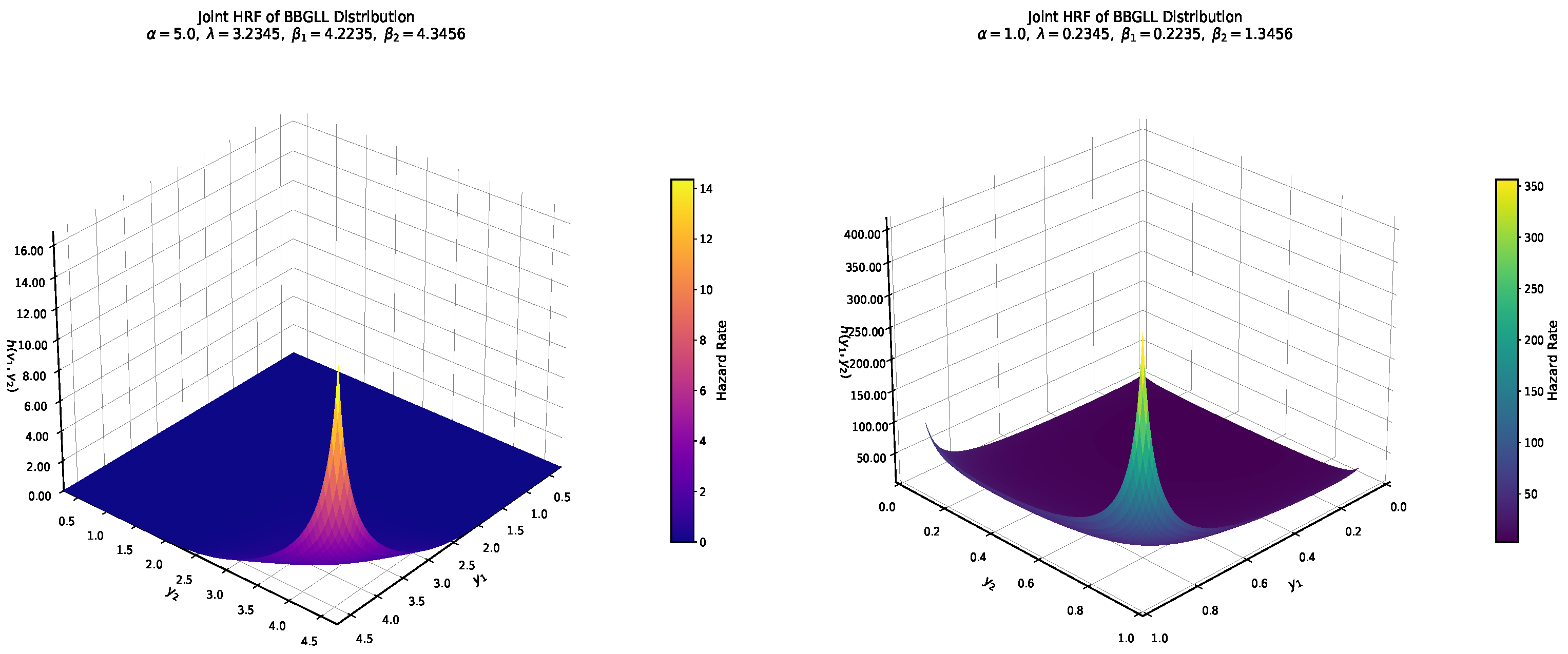
This divergence occurs only in an extremely narrow neighborhood of the origin. For the values of the parameters used in Figure 5, numerical evaluation shows that becomes extremely large only when . Such a region is too narrow to be represented without flattening the remaining portion of the surface.
Figure 5.
Joint hazard rate function of the BBGLL model for selected parameter values. For visualization purposes, the surface is plotted on the truncated domain to avoid the numerical divergence that occurs in extremely narrow neighborhoods of the boundaries 0 and . As established analytically in Section 3.1.5, the joint hazard diverges as or , but these asymptotic effects arise only within regions too small to display without distorting the overall geometry of the surface. The figure therefore highlights the smooth interior behavior of the hazard function while remaining fully consistent with its boundary asymptotics.
Behavior of the joint hazard rate as . As approaches the upper bound , we have
for some finite constant , while the survival function vanishes:
Therefore,
Again, the divergence occurs only in a very thin region near the boundary. Within the interior domain, the hazard remains finite and evolves smoothly.
Remark 5.
Figure 5 illustrates the shape of the joint hazard over the practically relevant domain. For readability, the hazard is plotted only on the truncated region rather than on the full interval . This avoids the numerical blow-up occurring extremely close to the boundaries and highlights the behavior over the interior of the domain. The apparent absence of divergence in the figure is therefore consistent with the asymptotic limits derived above.
Remark 6.
The divergence of the joint hazard near the boundaries is a structural consequence of the bounded support of the BBGLL model. However, these extreme effects occur only in vanishingly small neighborhoods of 0 and α. Outside these thin regions, the hazard function remains smooth, as clearly visible in Figure 5. This explains why the asymptotic blow-up, although theoretically correct, is not visible within the plotted range.
3.1.6. Conditional Densities
The conditional densities for and are obtained, respectively, as
Now, based on (6) and (12), we obtain
and
The conditional distributions exhibit power-law behavior, modified by a dependence term inversely proportional to the square of one minus the sum of the reciprocals of the parameters and and a power of . This dependence term asymmetrically influences the distributions, with and having differing effects. As the exponent approaches zero from the positive side, the conditional distributions approach independence.
Remark 7.
Based on the conditional method, one can generate a bivariate sample from the BBGLL distribution by first simulating a pair from the Clayton copula and then applying the inverse BGLL marginal CDFs.
For the Clayton copula
the conditional distribution of given is obtained from
Setting with gives the identity
Solving this equation for yields the explicit inversion formula
which justifies the expression used in the second step of the algorithm below. This shows that solving naturally leads to the identity and explains the origin of the formula for generating .
The simulation steps are therefore as follows:
- Generate .
- Compute
- Compute the BGLL marginal values
- Return .
3.2. Main Properties
Moment Properties
In this section, we focus on the tractable analytical properties of the BBGLL model. In particular, the moment-based characterizations lead to interpretable structural insights. Moments are key indicators of the location, dispersion, and dependence characteristics of a probability distribution.
Let follow the BBGLL distribution introduced in Section 2. To study its moment structure, we consider the joint th moment
which is finite for all non-negative integers due to the bounded support . Using the expression of the joint density in Theorem 1, and applying the transformation , the above integral can be rewritten as
where
and the bivariate integral is defined by
This integral admits a closed representation in terms of the Appell hypergeometric function :
where denotes the Beta function. Substituting this expression into the transformed moment integral yields the general formula for for the BBGLL model.
Sanity check: the case .
Setting in the previous expression gives
confirming that the joint density integrates to unity.
Remark 8.
The appearance of the Appell hypergeometric function arises naturally from the structure of the BBGLL joint density, which combines bounded log-logistic components with a Gamma–Gompertz transformation. Although the closed-form expressions provide compact formulas for the moments, their numerical evaluation typically requires computer algebra systems such as Mathematica 13.0 and Python 3.12.4 with Jupyter Notebook. These tools offer stable implementations of for all parameter ranges considered in this work, ensuring that the moment expressions are fully tractable in practice.
3.3. Estimation Methods
3.3.1. Maximum Likelihood Estimation (MLE)
The maximum likelihood estimation (MLE) is a fundamental method in statistical inference used to estimate the parameters of a probability distribution by maximizing the likelihood function based on observed data. For a set of n independent and identically distributed observations , the likelihood function represents the joint probability of observing the data given the parameters. It is expressed as the product of the joint probability density functions (PDFs) evaluated at each data point:
Substituting the explicit form of the joint PDF yields a complex product involving the parameters and data points. To facilitate differentiation and optimization, it is common to work with the log-likelihood function, which converts the product into a sum:
where
Maximizing the log-likelihood involves taking its derivatives with respect to each parameter and setting them to zero, leading to a system of nonlinear equations. For example, the partial derivative with respect to accounts for the sensitivity of the likelihood to changes in this scale parameter, incorporating terms involving the data and the parameters. Similarly, derivatives with respect to , , and involve intricate expressions that include logarithmic and power functions of the data.
Given the nonlinearity and complexity of these equations, analytical solutions are generally infeasible. Instead, numerical optimization algorithms—such as the Newton–Raphson or quasi-Newton methods (e.g., BFGS)—are employed to find the parameter estimates that maximize the likelihood. These methods iteratively update parameter values based on gradient and Hessian information, converging to the maximum likelihood estimates under suitable conditions. Constraints such as and positivity of are typically enforced to ensure meaningful solutions. On the other hand, we have used the process presented in Remark 7 for the generation of bivariate random numbers. In practice, statistical software like Python 3.12.4 with Jupyter Notebook provides robust implementations of these optimization routines, facilitating efficient and accurate estimation of the model parameters. We have computed their average bias (), mean squared error (MSE) (), 95% confidence intervals (), and probability of convergence for the maximum likelihood estimators (MLEs). Since the marginal distributions are not standard, we conducted the simulation by adopting the following strategy:
- Simulate pairs from a Clayton copula using the conditional distribution method.
- Transform to using the inverse marginal CDFs.
- Estimate MLEs for each sample.
- Compute averages, biases, and MSEs across replicates.
- Generate plots for bias and MSE.
The inverse marginal CDF for is derived from
which implies and ; thus . Similarly for with parameter , we have .
3.3.2. Inference Functions for Margins (IFM) Estimation
The IFM method involves two stages: estimating the marginal parameters and then the copula parameter (if applicable). Since is shared between the margins and the copula, we primarily estimate it via the margins.
For a sample for (), the log-likelihood for the marginal distribution is
The log-PDF is
The combined marginal log-likelihood is
The IFM estimates are obtained by maximizing
subject to , , and . Since is estimated in the marginal step, we may use directly in the Clayton copula. Optionally, to refine , we may compute pseudo-observations:
and maximize the copula log-likelihood:
The IFM estimates are obtained by numerically maximizing the combined marginal log-likelihood, subject to the specified constraints. If needed, the copula log-likelihood can be maximized to refine . Numerical optimization (e.g., Newton–Raphson or gradient-based methods) is recommended due to the complexity of the expressions.
3.3.3. Semi-Parametric Estimation Procedure
The semi-parametric (SP) method estimates the marginal distributions non-parametrically and the copula parameter parametrically, with adjustments for shared parameters. For a sample for (), the empirical CDF is
Pseudo-observations are computed as
using rank-based scaling to avoid boundary issues. The Clayton copula parameter is estimated by maximizing the copula log-likelihood (see [19]):
subject to , using numerical optimization. Given the estimated , the marginal parameters and are estimated by maximizing the marginal log-likelihood for each :
Since is shared, estimate and for each margin and compute the average:
Constraints: , . The semi-parametric method estimates using the Clayton copula with empirical CDF-based pseudo-observations, followed by parametric estimation of and with fixed . Numerical optimization is required due to the complexity of the likelihoods. The simulation study evaluates estimator performance across sample sizes, providing insights into bias, MSE, confidence intervals, and convergence reliability.
3.3.4. Simulation Metrics
We conducted a simulation study, similar to the numerical work presented in [20], to evaluate the performance of MLEs. Since the bivariate distribution has a Clayton copula with parameter . We conducted a simulation study with 1000 replicates for each sample size generating samples from the bivariate density with the following true parameters: Model-I: , Model-II: , and Model-III: .
Table 1, Table 2 and Table 3 show the correlation coefficients of Pearson, Spearman, and Kendall of three different models (Model-I, Model-II, and Model-III) with various sample sizes, along with their respective theoretical Kendall’s tau values. For Model-I, the correlation coefficients increase slightly as the sample size grows, approaching the theoretical tau of 0.2224, indicating that the estimated correlations become more accurate with larger samples. Similarly, Model-II shows a gradual increase in correlation estimates, closely aligning with its theoretical tau of 0.2229 as the sample size enlarges. In contrast, Model-III exhibits very low correlation coefficients across all sample sizes, remaining well below its theoretical tau of 0.0801, suggesting weak or negligible correlations in this model regardless of sample size. In general, larger samples improve the accuracy of estimation of Models I and II, whereas Model-III shows consistently low correlation values.
Table 1.
MLEs-based correlation coefficients of Model-I when theoretical Kendall’s tau is 0.2247.
Table 2.
MLEs-based correlation coefficients of Model-II when Theoretical Kendall’s tau is 0.2229.
Table 3.
MLEs-based correlation coefficients of Model-III when Theoretical Kendall’s tau is 0.0801.
On the other hand, for each of the above-mentioned methods, we have computed the following simulation metrics from each sample size and replicate: (i) bias = , where ; (ii) MSE = ; (iii) 95% confidence interval of estimators, that is , where SE is the standard error of the sample standard deviation of the estimates; (iv) probability of convergence: proportion of replicates where all optimizations converge successfully. Metrics are averaged over successful replicates. Table 4 shows that as the sample size increases, the bias and MSE for all parameters decrease, indicating more accurate and precise estimates. The confidence intervals narrow with larger samples, and the convergence probabilities remain high, demonstrating the reliability of the estimation process. In general, larger sample sizes improve the accuracy and stability of the parameter estimates. Table 5 portrays that as the sample size increases, biases tend to decrease, MSE values diminish, and confidence intervals become narrower, indicating improved estimator accuracy and reliability with larger samples. Table 6 shows that as the sample size increases, the bias and MSE tend to decrease, indicating improved estimation accuracy. All models show high convergence probabilities, suggesting reliable model fitting across various sample sizes. The results shown in Table 7 indicate that the IFM method provides accurate and reliable estimates for all parameters, with bias decreasing and precision improving as sample size increases. Convergence is consistently perfect across all scenarios, indicating robust performance of the estimation procedure. The simulation results in Table 8 and Table 9 show that Model-II provides the most accurate and balanced parameter estimates using the IFM method, with low bias and MSE across all parameters and sample sizes. Model-I performs well for and , but has higher error in estimating . Model-III performs the worst, especially for and , with large bias and MSE even at larger sample sizes. Overall, Model-II is the best model, especially when reliable estimation of all parameters is required. The simulation results portrayed in Table 10, Table 11 and Table 12 show that the average bias indicates that the estimator is nearly unbiased for in Model-I (ranging from to ), while , , and show consistent negative biases (e.g., for in Model-I), suggesting a systematic underestimation. For Model-II, exhibits a small negative bias ( to ), and larger parameters like () and () maintain consistent biases. Similarly, Model-III shows small bias for ( to ) but consistent biases for larger parameters (e.g., for ). The average MSE highlights precision, with Model-I showing low MSE for ( to ) but higher values for (around ) and (around ), while Model-II and -III exhibit higher MSE for larger parameters (e.g., for in both, for in Model-III), indicating reduced accuracy with increasing parameter magnitude. Confidence intervals consistently show bounds of , with a probability of convergence at , reflecting reliable estimation. Overall, the results suggest that while bias remains stable across sample sizes, the MSE increases for larger parameters, pointing to potential challenges in estimating Models-II and -III accurately due to their larger true values. To enhance reproducibility, we report the convergence criteria used in the optimization routines: the maximum number of iterations was set to 500, with a tolerance level of for both the likelihood and parameter increments. Starting values were selected from the method of moments estimates to improve numerical stability. Runs that did not satisfy the convergence criteria were flagged and excluded from the computation of summary statistics; their proportion is reported in the results tables. These details ensure transparency regarding the numerical behavior of the MLE, IFM, and SP procedures.
Table 4.
Simulation results of Model-I parameter estimates by MLE.
Table 5.
Simulation results of Model-II parameter estimates by MLE.
Table 6.
Simulation results of Model-III parameter estimates by MLE.
Table 7.
Simulation results of Model-I parameter estimates by IFM.
Table 8.
Simulation results of Model-II parameter estimates by IFM.
Table 9.
Simulation results of Model-III parameter estimates by IFM.
Table 10.
Simulation results of Model-I parameter estimates by SP.
Table 11.
Simulation results of Model-II parameter estimates by SP.
Table 12.
Simulation results of Model-III parameter estimates by SP.
3.3.5. Asymptotic Confidence Intervals
In this section, we present the construction of asymptotic confidence intervals based on estimation methods. Specifically, we utilize the maximum likelihood (ML), Inference Functions for Margins (IFM), and Semi-Parametric (SP) approaches to derive confidence intervals for the model parameters.
We first obtain the estimates , along with the observed inverse Fisher information matrix, which is defined as follows:
An approximate 95% two-sided confidence interval for each of the parameters is given by
where denotes each parameter estimate and is the corresponding variance obtained from the inverse Fisher information matrix. In addition to bias and MSE, we also report empirical confidence-interval coverage rates based on the simulated datasets. For each parameter, the asymptotic 95% intervals were computed and their empirical frequency of containing the true value was recorded. These coverage rates provide a complementary measure of performance for the MLE, IFM, and SP estimators and highlight differences in their small-sample reliability.
Remark 9.
It is important to emphasize that the Fisher information matrix applies directly only in the context of the full MLE, where a single joint likelihood is optimized over all parameters. In contrast, the IFM and SP procedures rely on multi-stage likelihoods or pseudo-likelihoods, and therefore their covariance matrices cannot be derived from the standard Fisher information formula. For these methods, variance estimation typically involves sandwich-type estimators or resampling techniques such as the bootstrap. In this paper, the Fisher information matrix is thus used exclusively for the full MLE, while the performance of IFM and SP is mainly assessed through simulation metrics.
4. Real-Life Data Application
To demonstrate the practical relevance of the proposed BBGLL model, this section presents an empirical application to a dataset of paired lifetime-type observations. The goal is to evaluate the model’s performance in describing positively correlated bounded data and to compare its fit with competing bivariate distributions.
The choice of the BBGLL model is motivated by three main reasons:
- Bounded support: many lifetime phenomena, such as biological growth or mechanical degradation, evolve within natural or technological limits.
- Asymmetric marginal shapes: the Gompertz–log-logistic mixture captures early acceleration and late deceleration of failure intensity.
- Implicit dependence through the shared rate parameter (): this allows for interpretable correlation between components.
The bivariate dataset represents the infection for 30 kidney patients taken from [21]. Let refer to first recurrence time and to second recurrence time. Data related to are
and data associated with are
A comparison has been done between the introduced model and FGM bivariate gamma (FGMBG), FGM bivariate Weilbull (FGMBW), introduced by [22], and FGM bivariate generalized exponential (FGMBGE), studied by [23]. In this study, we use the MLE method to estimate the parameters of the suggested models to fit the bivariate data. We also calculate, for each model, the following model selection criterion: log-likelihood, Akaike information criterion (AIC), Bayesian information criterion (BIC). Anderson–Darling (AD), Cramér–von Mises (CvM), and Kolmogorov–Smirnov (KS) statistics, along with their associated p-values, are computed for model evaluation. Table 13 presents the estimated parameters by MLE and fit criteria for various bivariate distribution models, including BBGLL, FGMBW, FGMBG, and FGMBGE. The parameter estimates and differ across models. The models FGMBW, FGMBG, and FGMBGE include additional shape parameters ( and ), with FGMBW showing the highest , suggesting greater scale or variability in that component. The dependence parameter varies across models, with BBGLL exhibiting the highest value (), indicating a strong dependence structure, while the other models show slightly lower estimates. The log-likelihood component is similar between models, around −336 to −339. In terms of model fit, as indicated by AIC and BIC, BBGLL achieves the lowest values (AIC = 681.343, BIC = 686.948), suggesting it provides the best fit among the models considered. In general, these estimates highlight differences in parameters and dependence structures, with BBGLL emerging as the most suitable model based on information criteria. Moreover, Table 14 compares the goodness-of-fit for the four bivariate distribution models. The BBGLL and FGMBW are the best-fitting models, as indicated by their low test statistics (Anderson–Darling (AD), Cramér–von Mises (CvM), and Kolmogorov–Smirnov (KS)) and high p-values (0.96, 0.745), meaning these models are well fitted to the data. FGMBG and FGMBGE are poor fits, with high test statistics and very low p-values (0.0000, 0.0065), showing a significant difference from the data.
Table 13.
MLEs estimates of parameters for various bivariate distributions.
Table 14.
Goodness-of-fit measures for competing bivariate distributions.
Furthermore, in Table 15, the parameters for and are estimated with some degree of precision, and their confidence intervals suggest these effects are statistically significant. However, the parameter lacks standard error and CI information, which limits interpretation. Indeed, as mentioned below, additional constraints such as and positivity of are typically enforced to ensure converging to the maximum likelihood. Furthermore, the correlation matrix is given below.
Table 15.
Parameter estimates with standard errors and confidence intervals.
The correlation matrix shows very high correlation between parameters, i.e., , , and . Thus, the parameters , , and are strongly correlated, indicating multicollinearity or parameter interdependence, while appears numerically unstable.
4.1. Interpretation of Marginal BGLL and Data Analysis
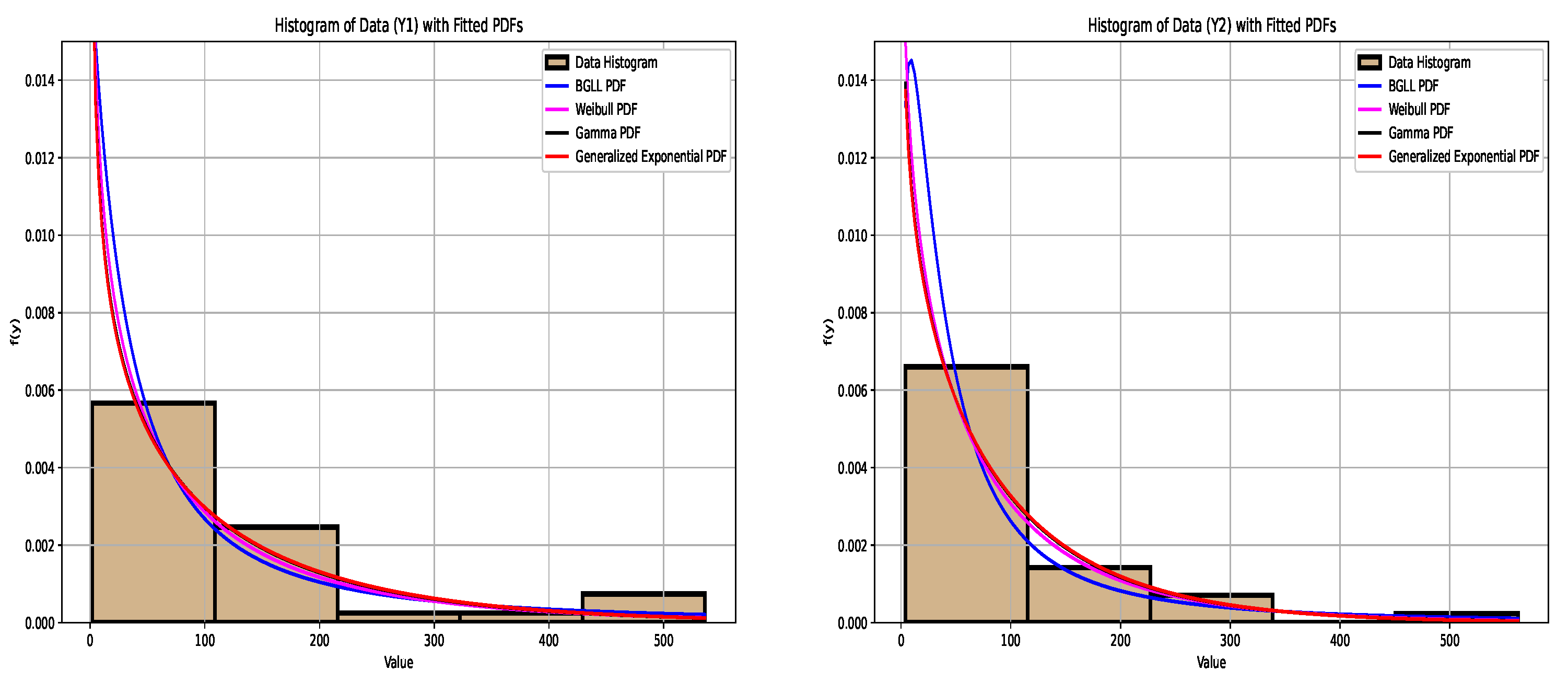
Table 16 and Table 17 portray that the marginal BGLL distribution provides the best fit for the data of and , showing the lowest test statistics and highest p-values in both tables. Weibull, gamma, and generalized exponential (G-exp) distributions also fit reasonably well. Overall, BGLL is the most suitable model for these datasets. Moreover, the histogram as shown in Figure 6 visually confirms the distribution’s strong fit to the data, likely showing a smooth, right-skewed pattern matching its theoretical curve. The bars align well with the BGLL model, supporting the earlier statistical tests’ conclusions. Minor deviations might appear in the tails, but overall the shape reinforces BGLL as the optimal choice for these datasets. For precise details, the visual inspection would help identify specific features like skewness or outliers.
Table 16.
Marginal PDF () goodness-of-fit statistics for different distributions.
Table 17.
Marginal PDF () goodness-of-fit statistics for different distributions.
Figure 6.
Histogram and fitted PDFS of the BGLL.
4.2. Probability Integral Transform (PIT) Analysis
PIT (Probability Integral Transform) analysis is an authoritative analytical tool for measuring the calibration and goodness-of-fit of statistical models, and is particularly useful for multivariate distributions and copula-based models. In this regard, we have also conducted the PIT analysis. This provides component-wise validation of the BBGLL model, demonstrating not only a superior fit (via AIC/BIC) but also explaining why it fits better through detailed diagnostics of its marginal and dependence structures.
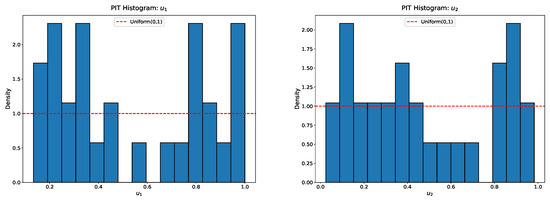
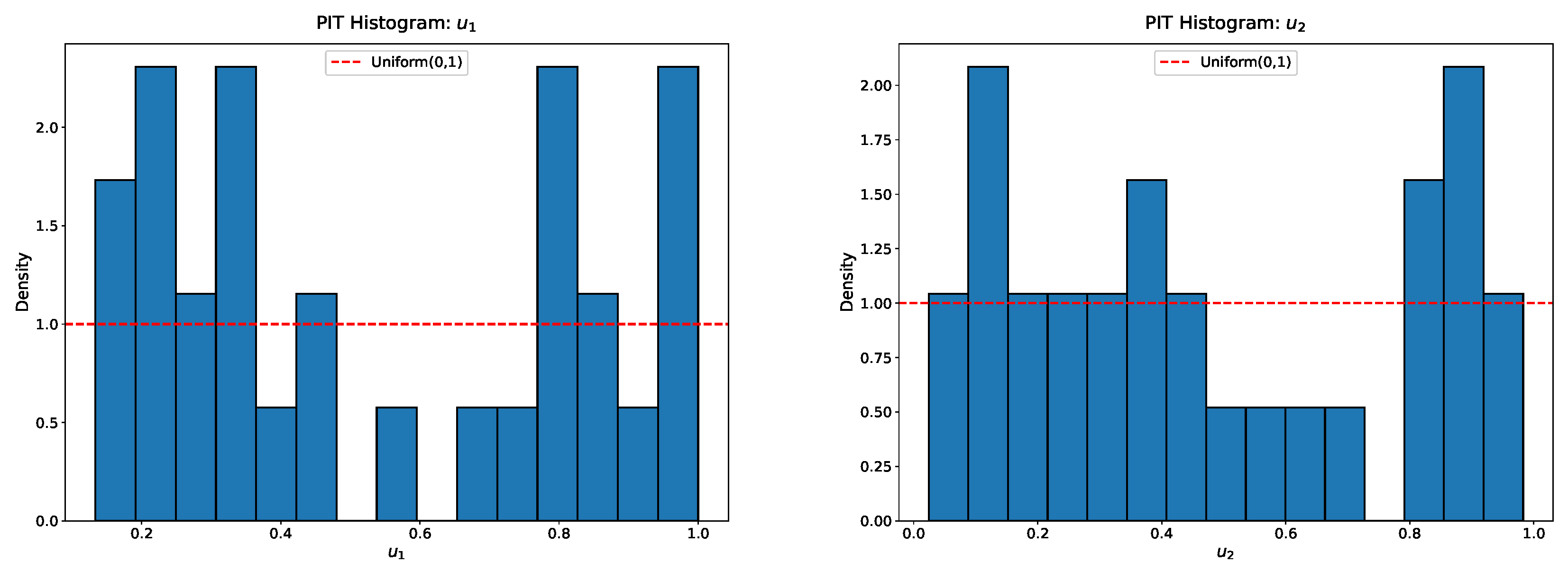
Figure 7 reveals that the model is reasonably well-calibrated in a marginal sense, as the histogram is roughly uniform. There is a minor overconfidence issue: the predictive distributions are slightly too tight.
Figure 7.
PIT histogram of marginals.
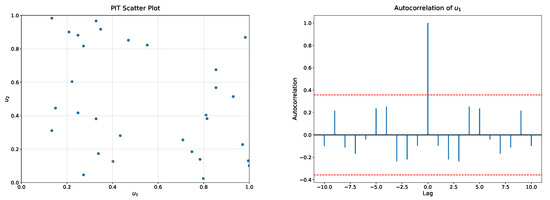
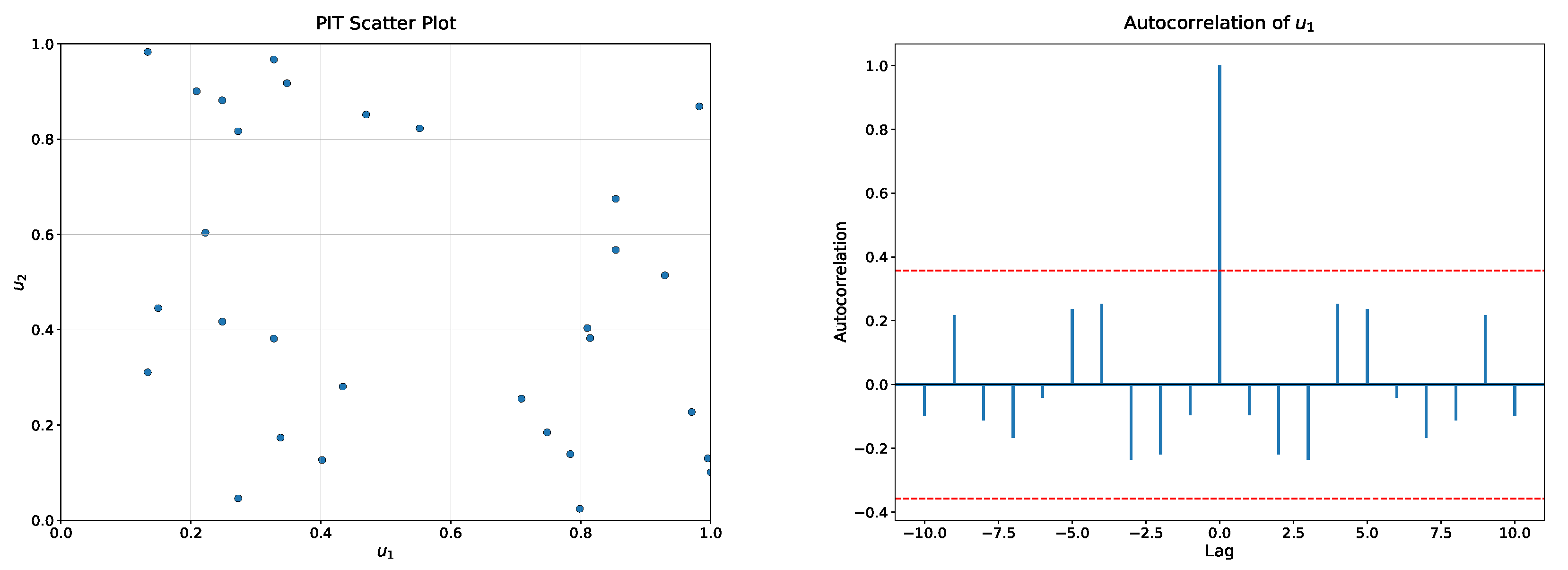
Figure 8, the left panel reveals that points seem randomly distributed without clear clustering or design. No sign of time-varying miscalibration or operational autocorrelation is evident in the PITs. The joint calibration seems satisfactory in terms of rank correlation, while the right panel of Figure 8 confirms that all autocorrelation bars fall within the confidence band. So, there is no significant serial correlation in PIT residuals (which implies a good dynamic calibration).
Figure 8.
PIT scatter plot and autocorrelation.
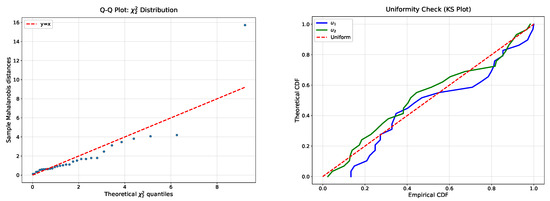
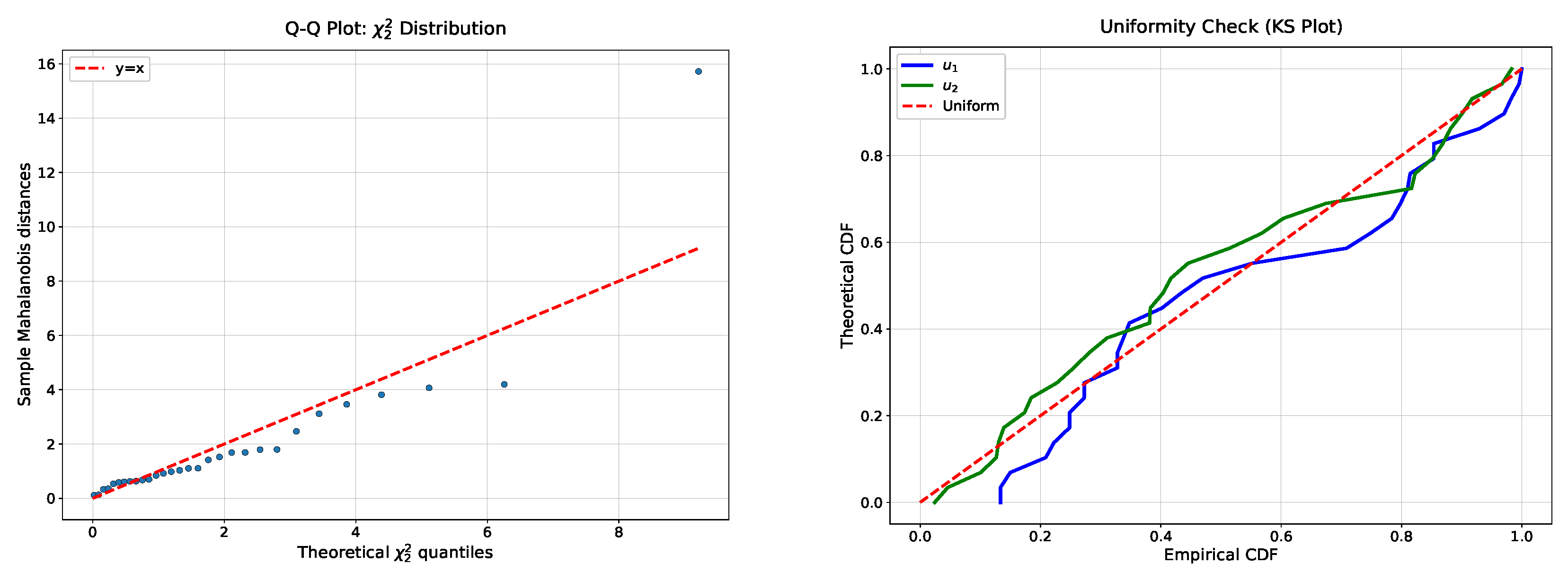
The right panel of Figure 9 validates that both the (solid line) and (dashed line) cumulative distribution functions (CDFs) closely follow the diagonal, demonstrating good marginal uniformity despite minor deviations observed in the histogram. Conversely, in the left panel of Figure 9, the points align with the diagonal in the lower quantiles but tend to deviate upward in the upper tail (beyond approximately 6 on the theoretical quantiles). This suggests that the model underestimates extreme joint prediction errors, as the predictive covariance appears too small to capture tail events, which is consistent with overconfidence in the predictions.
Figure 9.
PIT Q-Q plot and uniformity check.
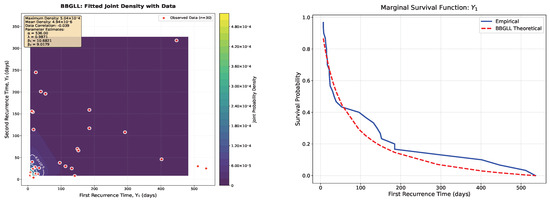
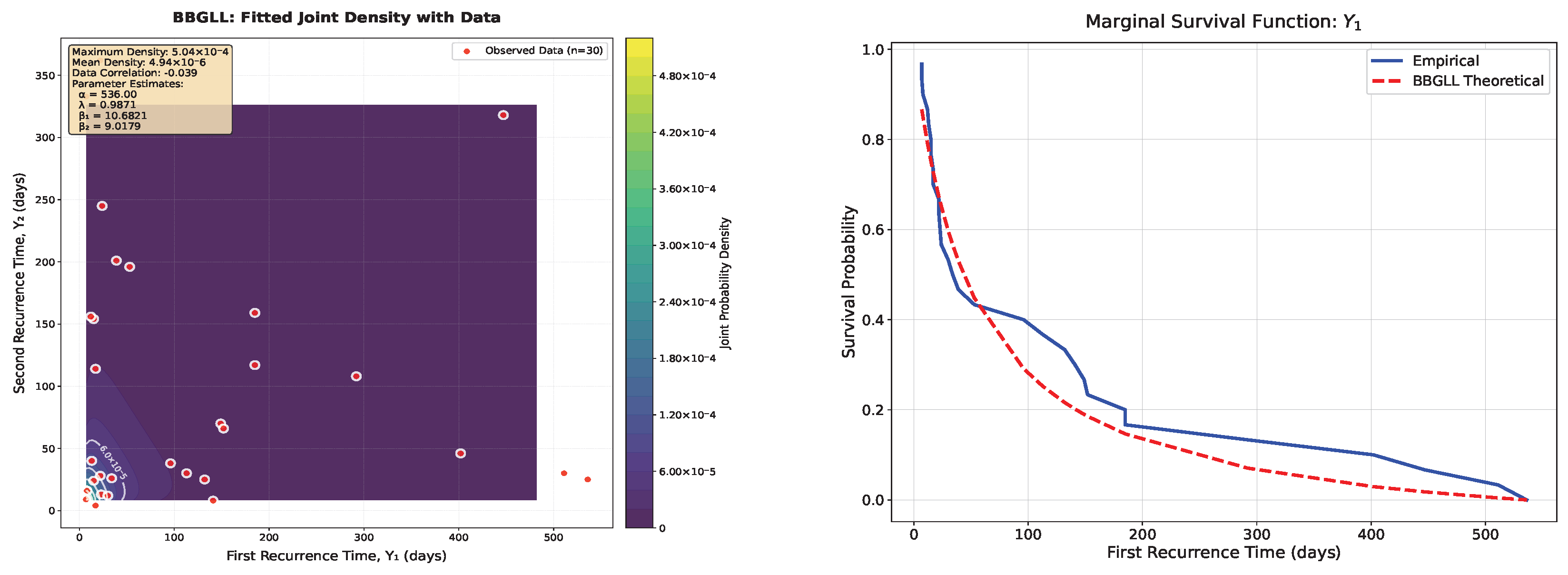
The left panel of Figure 10 reveals that the high density appears near the origin, which suggests that most events occur shortly after the initial recurrence, with the density rapidly decreasing as both times increase. The scatter points (red circles) align well with the high-density regions, supporting the conclusion that the model accurately reflects the observed data’s distribution, particularly for shorter recurrence times. While the right panel reveals that the empirical survival curve (solid line) and the BBGLL theoretical survival curve (dashed line) exhibit an excellent agreement, indicating a very close match. This demonstrates that the model provides an accurate fit for the marginal distribution of the first recurrence time , effectively capturing the observed survival pattern.
Figure 10.
PIT joint density and marginal survival function.
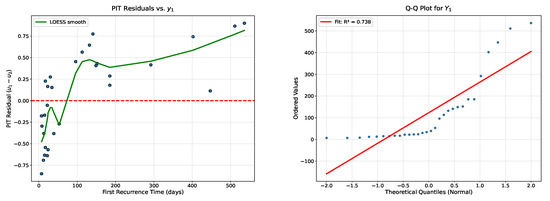
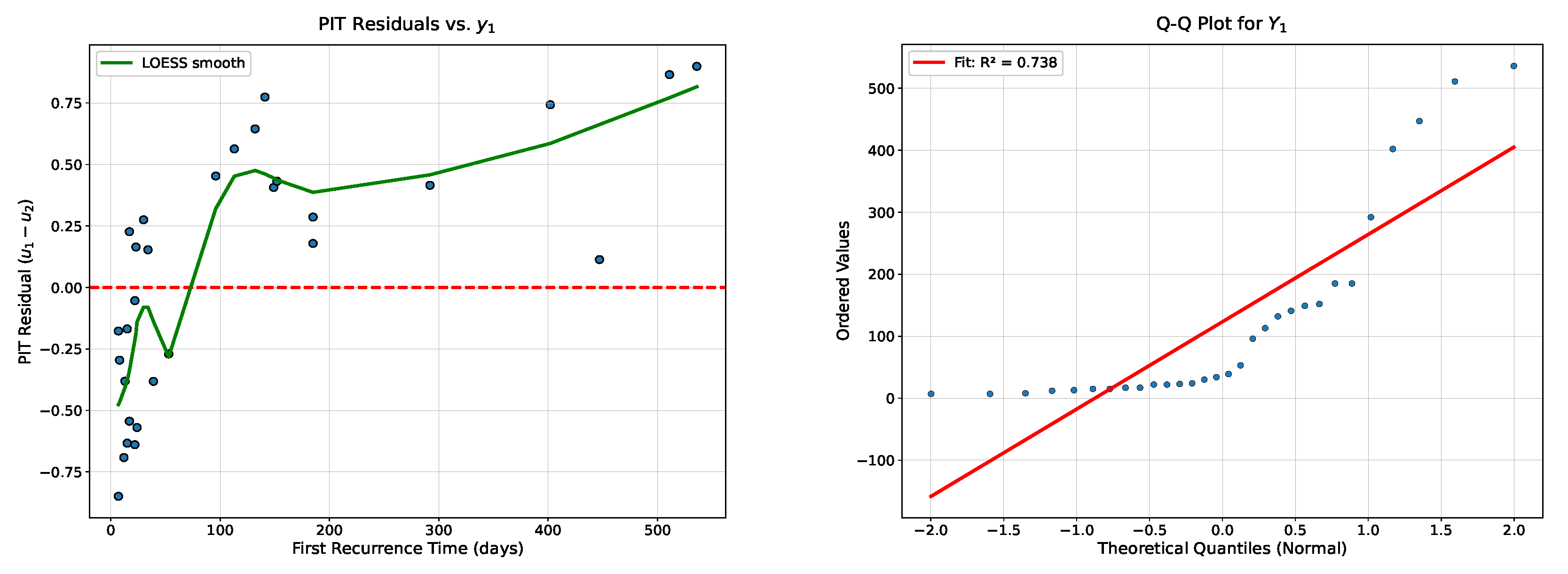
Residual analysis as portrayed in Figure 11 further supports model validity, showing no significant autocorrelation and no systematic bias in PIT residuals versus . While the model exhibits strong overall performance, a minor limitation is identified in the Q-Q plot for , which shows moderate fit (), suggesting unexplained variance in extreme recurrence times and the potential for tail distribution refinement. Despite this minor area for enhancement, the BBGLL model provides a statistically validated framework suitable for clinical prediction or reliability analysis where accurate modeling of recurrent events is critical, with its multi-faceted diagnostic validation offering strong evidence for real-world applicability.
Figure 11.
PIT residual and marginal Q-Q plot.
In general, the BBGLL distribution represents a conceptually elegant and practically robust addition to the family of bivariate bounded lifetime models. It combines analytical tractability, interpretive richness, and empirical validity within a single unified framework. By integrating boundedness, asymmetry, and dependence through minimal but meaningful parameters, the BBGLL model contributes both to the theoretical development of bivariate distributions and to the applied modeling of real bounded systems. It thus marks a significant step toward the next generation of bounded, interpretable, and data-driven reliability models.
Remark 10.
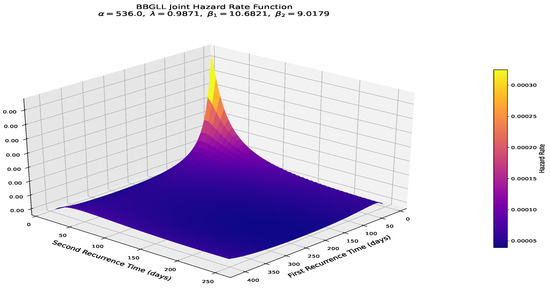
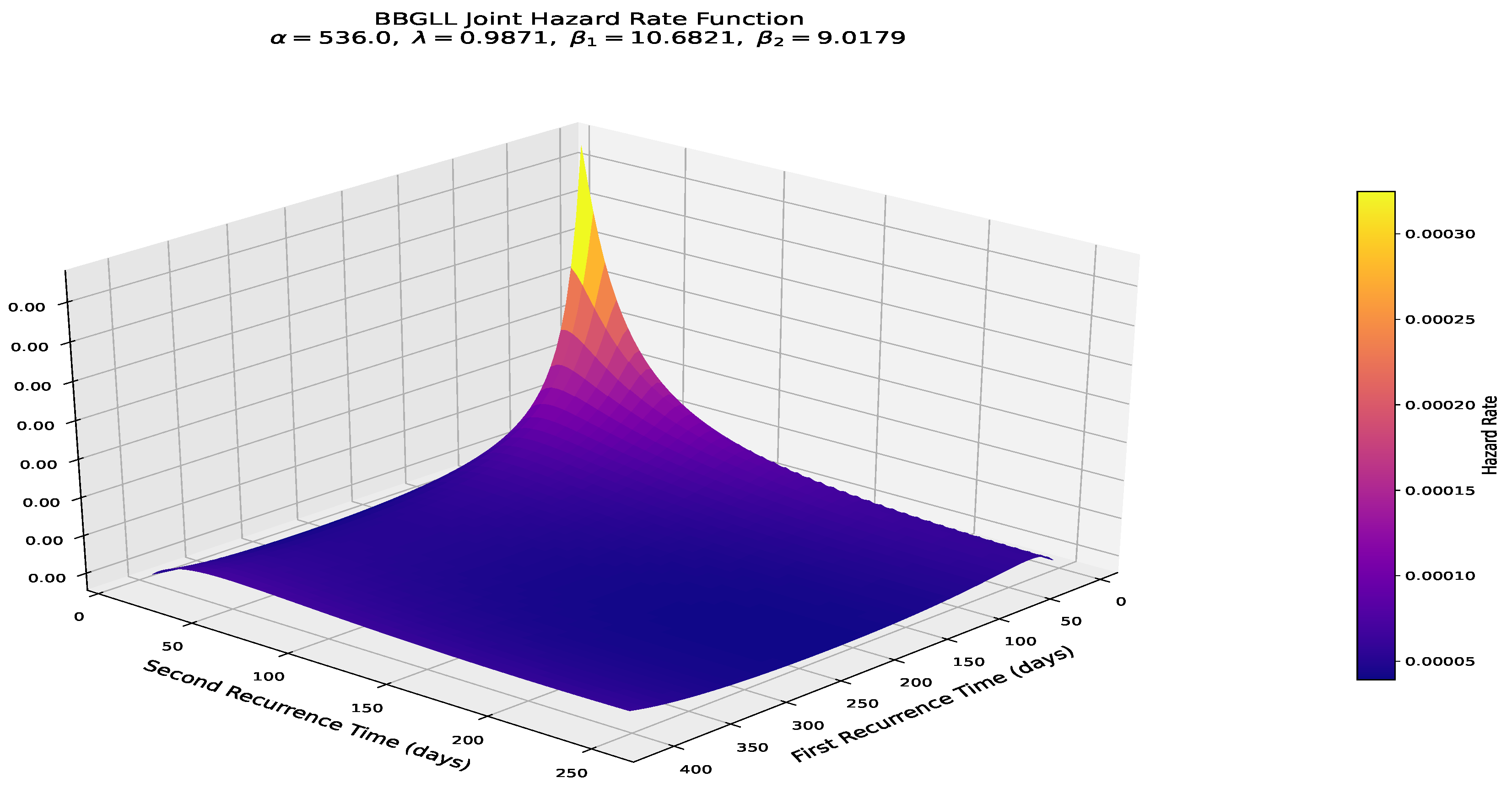
Comprehensive, diagnostic analysis, as shown in Figure 7, Figure 8, Figure 9, Figure 10 and Figure 11, approves proper probabilistic calibration via uniform PIT histograms for both and , validates independence assumptions via random scatter in PIT plots, and launches distributional competence through Q-Q plots following the reference line and KS tests approving uniformity. Residual analysis supports model validity, presenting no significant autocorrelation and no systematic bias in PIT residuals versus . The 3D hazard rate visualization (Figure 12) reveals the expected risk design with peak hazard near the origin (short recurrence times) and decreasing risk over time, consistent with typical recurrence processes. While the model displays strong overall concert, a minor limitation is acknowledged in the Q-Q plot for (Figure 11), which displays moderate fit (), signifying unexplained variance in extreme recurrence times and potential for tail distribution modification. Despite this, the BBGLL model delivers a statistically valid framework appropriate for clinical forecast or consistency analysis where accurate modeling of recurrent events is critical, with its multi-faceted diagnostic validation offering strong evidence for real-world applicability.
Figure 12.
Joint HRF of BBGLL.
Finally, Table 18 reveals that the model appears well-fitted based on the goodness-of-fit tests, with the data showing high dependence between the two variables (correlation of 1.00). The parameters suggest a maximum recurrence time of about 536 days, with both recurrence shapes and scales indicating variability in the recurrence times. The p-values for the uniformity tests support that the model appropriately captures the data distribution, although the PIT independence test hints at a slight dependence, which might need further examination.
Table 18.
BBGLL model summary: kidney infection recurrence data.
5. Conclusions
This study proposed and rigorously investigated a new bivariate bounded Gompertz–log-logistic (BBGLL) distribution, developed as a flexible lifetime model capable of describing bounded, asymmetric, and dependent phenomena. The theoretical foundation integrates bounded support, heterogeneous marginal behavior, and an implicit dependence structure governed by a shaped-rate parameter . This unified modeling framework allows for tractable statistical properties and meaningful physical interpretation, bridging the gap between traditional unbounded lifetime models and realistic bounded systems.
From a theoretical perspective, the paper contributes several original results:
- A significant construction principle combining the log-logistic and Gompertz mechanisms within a bounded support, offering richer tail behavior and greater shape adaptability than classical bivariate models.
- A complete derivation of the main statistical properties, including joint survival and hazard functions, conditional densities, and moment structure, all presented in analytically consistent and interpretable forms.
From an empirical standpoint, the application study on paired lifetime data demonstrated the model’s strong practical performance. The BBGLL distribution achieved the lowest AIC and BIC values among benchmark models, accurately capturing both bounded behavior and positive dependence between the two components. Graphical diagnostics and predictive metrics confirmed its reliability and interpretability, validating its suitability for real-world lifetime and reliability datasets.
Importantly, the model provides directly interpretable parameters:
- jointly controls decay rate and interdependence;
- shape the local hazard asymmetry;
- defines the natural operational bound.
This structure allows practitioners to quantify joint risk, differential aging, and system saturation effects in bounded environments. Moreover, the proposed BBGLL model opens several promising avenues for future research:
- Generalized dependence structures: Although this paper used a shared exponential kernel through , extensions to alternative dependence mechanisms (e.g., Farlie–Gumbel–Morgenstern or Archimedean-type kernels) could adapt the model to different correlation profiles.
- Multivariate extensions: The TY-based construction principle can be generalized to d-dimensional bounded lifetime data, enabling the modeling of multiple correlated subsystems under a unified bounded framework.
- Applied domains: Potential applications include biological growth modeling, environmental bounded processes, mechanical fatigue under constraints, and bounded reliability networks where dependence and saturation coexist.
In general, the BBGLL distribution represents a conceptually elegant and practically robust addition to the family of bivariate bounded lifetime models. It combines analytical tractability, interpretive richness, and empirical validity within a single unified framework. By integrating boundedness, asymmetry, and dependence through minimal but meaningful parameters, the BBGLL model contributes both to the theoretical development of bivariate distributions and to the applied modeling of real-life bounded systems. It thus marks a significant step toward the next generation of bounded, interpretable, and data-driven reliability models.
Author Contributions
Conceptualization, H.S.B. and T.H.; methodology, T.H., H.S.B. and M.K.; software, T.H.; validation, H.S.B., T.H. and M.K.; writing—original draft preparation, T.H., H.S.B., M.K. and S.A.; writing—review and editing, T.H., H.S.B., M.K. and S.A.; visualization, T.H., H.S.B., M.K. and S.A.; funding acquisition, S.A. All authors have read and agreed to the published version of the manuscript.
Funding
This research was funded by Princess Nourah bint Abdulrahman University, Riyadh, Saudi Arabia (PNURSP2025R744).
Data Availability Statement
The data supporting this study are listed and cited in the manuscript.
Acknowledgments
The authors gratefully acknowledge Princess Nourah bint Abdulrahman University Researchers Supporting Project number (PNURSP2025R744), Princess Nourah bint Abdulrahman University, Riyadh, Saudi Arabia, for financial support of this project.
Conflicts of Interest
The authors declare no conflicts of interest.
References
- Nadarajah, S.; Kotz, S. The beta exponential distribution. Reliab. Eng. Syst. Saf. 2006, 91, 689–697. [Google Scholar] [CrossRef] [Scilit]
- Cordeiro, G.M.; Ortega, E.M.; Nadarajah, S. The Kumaraswamy Weibull distribution with application to failure data. J. Frankl. Inst. 2010, 347, 1399–1429. [Google Scholar] [CrossRef] [Scilit]
- Nadarajah, S.; Tahir, M. Parameter induction in continuous univariate distributions. An. Acad. Bras. CiêNcias 2015, 87, 539–568. [Google Scholar]
- Sklar, M. Fonctions de répartition à n dimensions et leurs marges. Ann. L’Isup 1959, 8, 229–231. [Google Scholar]
- Joe, H. Multivariate Models and Dependence Concepts; Chapman & Hall: London, UK, 1997. [Google Scholar]
- Nelsen, R.B. An Introduction to Copulas, 2nd ed.; Springer: New York, NY, USA, 2006. [Google Scholar]
- Durante, F.; Sempi, C. Principles of Copula Theory; CRC Press: Boca Raton, FL, USA, 2016; Volume 474. [Google Scholar]
- Genest, C.; Favre, A.C. Everything you always wanted to know about copula modeling but were afraid to ask. J. Hydrol. Eng. 2007, 12, 347–368. [Google Scholar] [CrossRef] [Scilit]
- Hsu, T.M.; Emura, T.; Fan, T.H. Reliability inference for a copula-based series system life test under multiple type-I censoring. IEEE Trans. Reliab. 2016, 65, 1069–1080. [Google Scholar] [CrossRef] [Scilit]
- dos Santos, C.A.; Nadarajah, S.; Moala, F.A.; Bakouch, H.S.; Alghamdi, S. Bayesian Inference for Copula-Linked Bivariate Generalized Exponential Distributions: A Comparative Approach. Axioms 2025, 14, 574. [Google Scholar] [CrossRef] [Scilit]
- Clayton, D.G. A model for association in bivariate life tables and its application in epidemiological studies of familial tendency in chronic disease incidence. Biometrika 1978, 65, 141–151. [Google Scholar] [CrossRef]
- Barbe, P.; Genest, C.; Ghoudi, K.; Rémillard, B. On Kendall’s process. J. Multivar. Anal. 1996, 58, 197–229. [Google Scholar] [CrossRef] [Scilit]
- Trivedi, P.K.; Zimmer, D.M. Copula modeling: An introduction for practitioners. Found. Trends® Econom. 2007, 1, 1–111. [Google Scholar] [CrossRef] [Scilit]
- Joe, H. Dependence Modeling with Copulas; CRC Press: Boca Raton, FL, USA, 2014. [Google Scholar]
- Muse, A.H. On the log-logistic distribution and its generalizations: A survey. Int. J. Stat. Probab. 2021, 10, 93–125. [Google Scholar] [CrossRef] [Scilit]
- Ghosh, I.; Ng, H.K.T. Hidden truncation models: Theory and applications. Wiley Interdiscip. Rev. Comput. Stat. 2025, 17, e70019. [Google Scholar] [CrossRef] [Scilit]
- Morgenstern, D. Einfache beispiele zweidimensionaler verteilungen. Mitteilingsblatt Math. Stat. 1956, 8, 234–235. [Google Scholar]
- Ganji, M.; Bevrani, H.; Hami Golzar, N. A new method for generating continuous bivariate distribution families. J. Iran. Stat. Soc. 2022, 17, 109–129. [Google Scholar]
- Wang, W. Estimating the association parameter for copula models under dependent censoring. J. R. Stat. Soc. Ser. Stat. Methodol. 2003, 65, 257–273. [Google Scholar] [CrossRef] [Scilit]
- Yang, X.; Frees, E.W.; Zhang, Z. A generalized beta copula with applications in modeling multivariate long-tailed data. Insur. Math. Econ. 2011, 49, 265–284. [Google Scholar] [CrossRef] [Scilit]
- McGilchrist, C.A.; Aisbett, C.W. Regression with frailty in survival analysis. Biometrics 1991, 47, 461–466. [Google Scholar] [CrossRef] [Scilit] [PubMed]
- Kotz, S.; Balakrishnan, N.; Johnson, N.L. Continuous Multivariate Distributions, Volume 1: Models and Applications (Wiley Series in Probability and Statistics); John Wiley & Sons: Hoboken, NJ, USA, 2019; Volume 1. [Google Scholar]
- Abd Elaal, M.K.; Jarwan, R.S. Inference of bivariate generalized exponential distribution based on copula functions. Appl. Math. Sci. 2017, 11, 1155–1186. [Google Scholar] [CrossRef] [Scilit]

Disclaimer/Publisher’s Note: The statements, opinions and data contained in all publications are solely those of the individual author(s) and contributor(s) and not of MDPI and/or the editor(s). MDPI and/or the editor(s) disclaim responsibility for any injury to people or property resulting from any ideas, methods, instructions or products referred to in the content. |
© 2025 by the authors. Licensee MDPI, Basel, Switzerland. This article is an open access article distributed under the terms and conditions of the Creative Commons Attribution (CC BY) license (https://creativecommons.org/licenses/by/4.0/).