1. Introduction
Optimization techniques inspired by natural and biological systems have become increasingly important for addressing complex computational problems that are difficult to solve through conventional mathematical methods [
1,
2]. By mimicking swarm intelligence, cooperative behaviors, and evolutionary strategies, these approaches provide robust mechanisms to balance exploration and exploitation in high-dimensional and nonlinear search spaces. Among them, the Dragonfly Algorithm (DA) [
3] and Cuckoo Search (CS) [
4] have gained significant attention for their simplicity, adaptability, and capability to escape local optima across diverse domains.
The DA is derived from the swarming patterns of dragonflies, which involve both static and dynamic group interactions [
5]. Its design is based on five fundamental components, separation, alignment, cohesion, attraction to food, and avoidance of enemies, which collectively allow the algorithm to alternate between exploration and exploitation. However, previous studies have noted challenges such as premature convergence and sensitivity to parameter settings [
6]. Similarly, CS is modeled after the brood parasitism behavior of cuckoos, combined with Lévy flight-based random walks [
7]. This mechanism enables wide exploration and reduces stagnation, though CS may struggle with maintaining consistent exploitation in multimodal search spaces [
8].
Despite these advantages, no single optimization algorithm can perform best across all types of problems, as supported by the No Free Lunch theorem [
9]. Consequently, researchers have investigated adaptive control strategies to improve robustness and convergence. One promising direction is the integration of fuzzy logic systems for parameter control. Type-1 fuzzy logic has demonstrated effectiveness in dynamically tuning algorithmic parameters, but its capacity is limited in environments with high uncertainty or noise [
10]. Type-2 fuzzy logic, by contrast, introduces an additional degree of freedom through the Footprint of Uncertainty (FOU), allowing for improved management of imprecision and ambiguity.
This paper presents three core contributions:
- (1)
It introduces an optimization model that enhances DA and CS with Type-2 fuzzy logic controllers based on Gaussian and Trapezoidal membership functions (MFs);
- (2)
It proposes a diversity-aware fuzzy adaptation strategy to regulate critical parameters such as inertia weight, attraction coefficient, and Lévy step size;
- (3)
It benchmarks the proposed model against its Type-1 and baseline counterparts using 10 benchmark functions in 1000 dimensions with Z-tests to statistically validate performance. Our findings indicate that the integration of uncertainty-aware fuzzy models significantly enhances convergence, robustness, and adaptability, particularly in high-dimensional search spaces. Unlike previous implementations of fuzzy-enhanced metaheuristic, this work introduces a novel diversity-aware fuzzy adaptation mechanism that directly links real-time population diversity to key control parameters in DA and CS. Specifically, the fuzzy inference systems (FISs) are fed with normalized diversity values, which are dynamically computed at each iteration, serving as the sole input to modulate inertia weight
w, attraction coefficient
β, and Lévy step-size
λ. For Type-2 fuzzy controllers, both Gaussian and Trapezoidal membership functions were adopted, with interval widths chosen to reflect the uncertainty range empirically observed in benchmark landscapes. The type-reduction process is handled via the Interval Weighted Average (IWA) method, ensuring computational efficiency and consistency. Importantly, the fuzzy rule bases were manually designed to emphasize stability under high diversity and exploration under low diversity, a coupling strategy not previously explored in the literature to this degree. This integration offers a transparent and interpretable approach to self-adaptive behavior in swarm optimization under uncertain or noisy scenarios. The layout of this article is outlined as follows:
Section 2 outlines the materials and methods;
Section 3 outlines the Results; and
Section 4 outlines the Conclusions.
2. Materials and Methods
Type-2 fuzzy logic represents a natural extension of traditional Type-1 fuzzy logic, specifically designed to handle elevated levels of uncertainty in dynamic or poorly defined systems. Unlike Type-1 systems, where MFs yield precise values between 0 and 1, Type-2 systems feature MFs that themselves are subject to uncertainty, represented as fuzzy sets of fuzzy sets [
11,
12,
13]. This structure allows for modeling not only the degree of membership of a value in a fuzzy set but also the uncertainty associated with that membership.
The Type-2 fuzzy inference system (FIS) used in this work is based on Gaussian and Trapezoidal MFs, with uncertainty in both the mean and standard deviation, forming Type-2 Gaussian and Trapezoidal functions [
14,
15]. Gaussian and Trapezoidal MFs were selected for the fuzzy controllers due to their complementary properties in modeling uncertainty and controlling smoothness in dynamic optimization environments. Gaussian functions offer smooth, continuous, and infinitely differentiable curves, making them ideal for systems that require gradual transitions and stable gradient-based behavior, such as adaptive parameter tuning during exploration phases. This is particularly useful in high-dimensional optimization problems, where abrupt changes in parameter values can destabilize convergence. On the other hand, Trapezoidal MFs provide a compact and interpretable structure, with well-defined plateau regions that allow for robust rule firing under uncertainty. Their piecewise linear shape makes them computationally efficient and effective for modeling bounded linguistic categories (low, medium, and high) in systems with discrete or abrupt transitions, such as switching behaviors in the DA or CS algorithms. These functions define the area of uncertainty, known as the FOU, which encapsulates the inherent variability of the system parameters and the MFs. The full process of Type-2 fuzzy inference includes fuzzification, rule evaluation, aggregation, type-reduction, and defuzzification [
12].
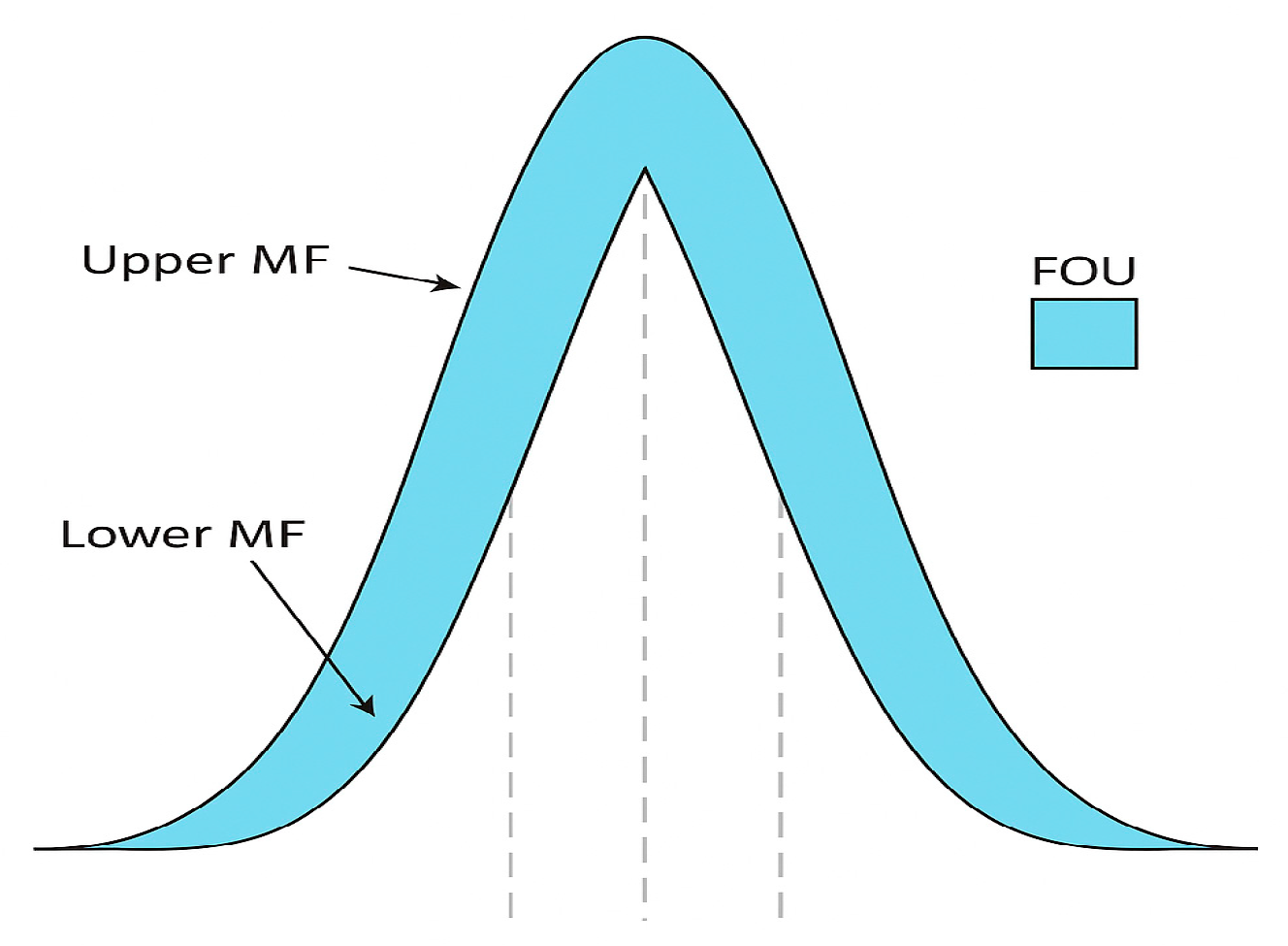
In
Figure 1 we can observe the upper MF limit, the lower MF limit, and the FOU. The type-reduction method implemented in this study is the Iterative Weighted Average (IWA) algorithm, known for balancing precision and computational efficiency [
12]. This technique computes an equivalent Type-1 output set that represents the result of the Type-2 system, allowing direct integration with metaheuristic algorithms. A key advantage of combining Type-2 fuzzy logic with optimization algorithms such as DA or CS is the ability to dynamically adapt algorithm parameters such as the attraction coefficient or the Lévy flight step size based on search context [
15]. For instance, one can use input variables such as relative solution quality or algorithm stagnation level to infer optimal adjustments for swarm parameters.
Additionally, Type-2 Gaussian functions possess smooth and differentiable properties, enabling seamless integration into computational simulation environments. Their continuous and parametrizable form also facilitates the construction of interpretable and flexible fuzzy rules. In this study, a file was used containing three Type-2 Gaussian and Trapezoidal MFs for both input and output, within a [0, 1] range. These fuzzy regions define behaviors such as “low,” “medium,” and “high” for the adapted parameter value.
Numerous previous studies have demonstrated the effectiveness of Type-2 fuzzy systems in applications such as classification, adaptive control, and robust. By integrating this approach with bio-inspired algorithms, a hybrid system is achieved that enhances the accuracy, adaptability, and convergence of classical optimization models. The DA derives its conceptual basis from the coordinated swarming behavior of dragonflies, which alternate between static swarms when exploiting food sources and dynamic swarms during long-range migration or predator evasion. These natural strategies translate into computational rules of separation, alignment, cohesion, attraction toward food, and repulsion from enemies, which together guide the artificial agents across the search space [
16]. Similarly, CS is inspired by the brood parasitism of cuckoos, where Lévy flights generate long-tailed random steps that enhance global exploration while selection strategies provide local refinement [
17,
18]. Both algorithms embody a balance of exploration and exploitation, essential for solving high-dimensional and multimodal optimization problems.
Similarly, the CS algorithm, inspired by the brood parasitism of certain cuckoo species, combines Lévy flights with selective survival strategies. Candidate solutions are represented as nests, where new solutions replace weaker ones, and the random long-tailed steps generated by the Lévy distribution enhance global exploration while retaining local refinement through selection.
To further improve adaptability and robustness, Type-2 fuzzy systems were incorporated into the parameter adaptation schemes of DA and CS. Unlike Type-1 fuzzy systems, which operate with crisp membership degrees, Type-2 fuzzy logic allows the MFs themselves to be fuzzy, thus capturing higher-order uncertainty [
9]. In DA, fuzzy controllers adjusted the inertia weight (w) and attraction coefficient (β) using trapezoidal and Gaussian MFs defined over [0, 1]. In this study, the input variable used for the Type-2 fuzzy logic system corresponds to the normalized diversity of the population, calculated dynamically at each iteration. This diversity metric reflects how spread out the candidate solutions are in the search space, serving as a contextual indicator of the algorithm current exploration versus exploitation phase. A high diversity value suggests global exploration, while a low value indicates potential stagnation or convergence. This input is then fuzzified using the designed MFs (Trapezoidal or Gaussian), allowing the fuzzy controller to adapt parameters such as inertia weight and step size accordingly.
Three fuzzy rules were defined: if the input is low, then the output is high; if the input is medium, then the output is medium; and if the input is high, then the output is low [
14,
15]. Similarly, in CS, Type-2 fuzzy logic dynamically adjusted the Lévy flight step size, enabling adaptive modulation of exploration and exploitation [
19,
20,
21]. Numerous studies demonstrate the effectiveness of Type-2 fuzzy systems in classification, adaptive control, and robust optimization [
22,
23,
24]. Their integration into DA and CS produced hybrid systems that improved accuracy, adaptability, and convergence stability compared to classical models. In this work, both algorithms were tested with a population of 40 agents across 500 iterations for ten benchmark functions (F1 to F10) at 1000 dimensions. This set of ten benchmark functions (F1 to F10) was employed to evaluate the performance of the proposed algorithms. These functions are commonly used in the CEC benchmark suite and represent a diverse collection of problem landscapes with varying degrees of complexity, modality, separability, and conditioning.
Table 1 summarizes their mathematical nature and characteristics. The primary set of experiments was conducted on 1000 dimensions to simulate real-world high-dimensional optimization problems encountered in big data analytics, hyper parameter tuning, and design optimization. However, to ensure methodological robustness and completeness, additional results were generated for 30 D and 100 D to represent low and mid-scale optimization settings.
These functions allow a comprehensive evaluation of the algorithms under various scenarios: Unimodal vs. Multimodal: Functions like F1–F3 test exploitation capability, while F4–F10 evaluate exploration strength. Separable vs. Non-separable: Separable functions allow dimension-wise optimization, whereas non-separable ones (Rosenbrock) test the algorithm ability to coordinate variables. Smooth vs. Rugged landscapes: Rugged multimodal functions (F5–F10) test the algorithm robustness against local optima traps.
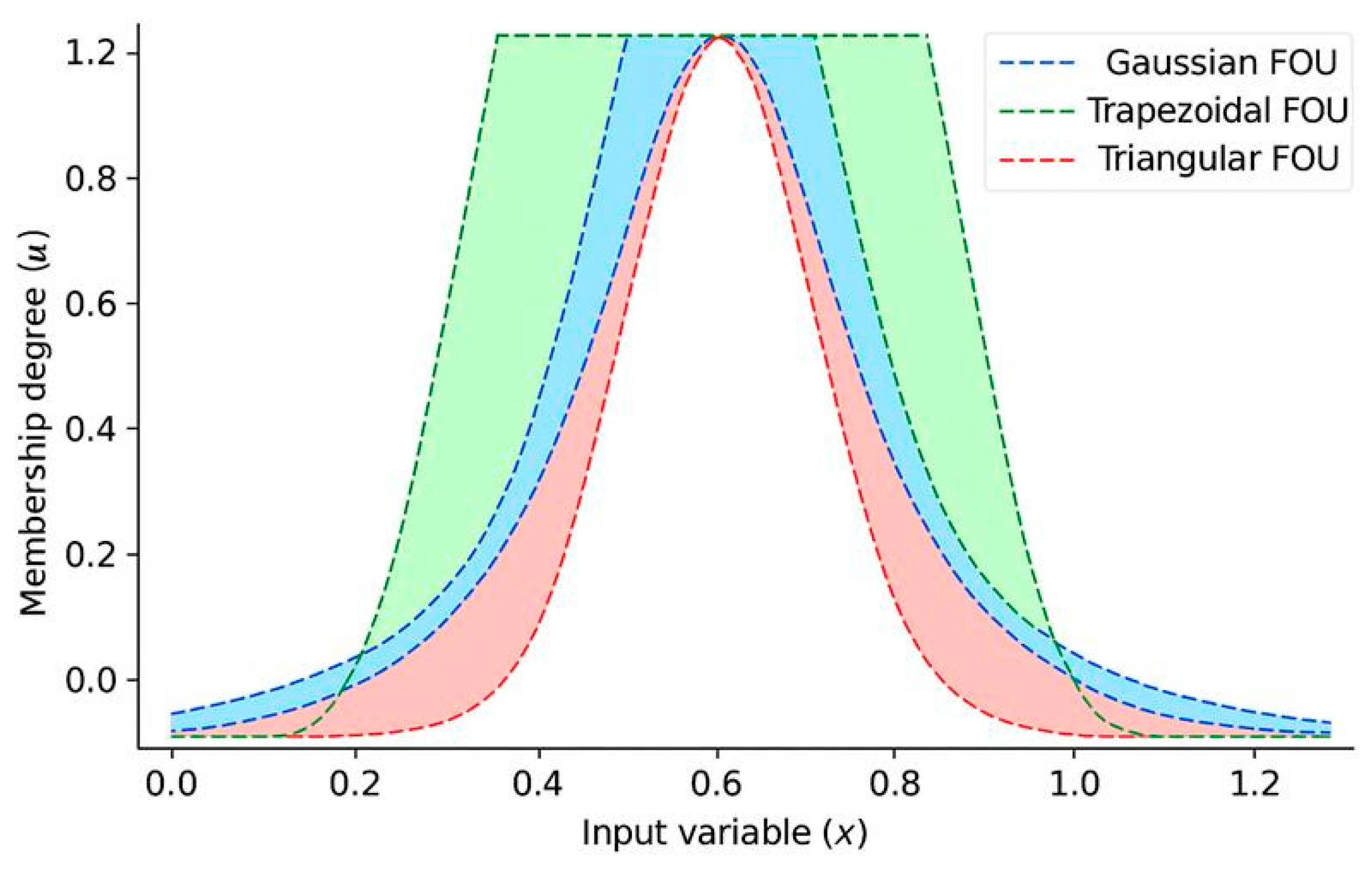
Each configuration was executed 30 times independently to ensure statistical reliability. Performance was measured using mean and standard deviation of results, and statistical significance was assessed with a Z-test at a 95% confidence level. In
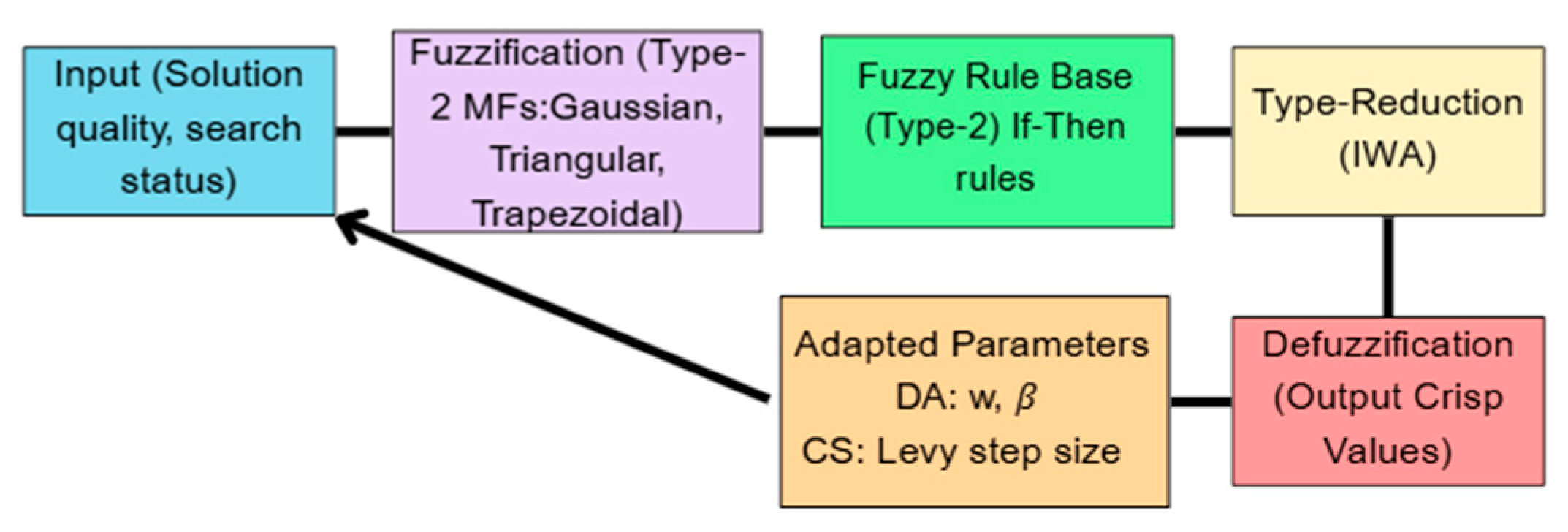
Figure 2, we can observe the behavior of Type-2 MFs using Gaussian, Trapezoidal, and Triangular shapes. These include their respective upper and lower bounds, which form the FOU and represent the uncertainty in membership levels. The schematic structure of the Type-2 fuzzy inference system (FIS) applied to DA and CS is illustrated in
Figure 3, showcasing the flow from input fuzzification through rule evaluation, type-reduction, and output defuzzification. This diagram clarifies the integration of fuzzy logic into the metaheuristic structure.
All simulations were implemented using MATLAB R2022a, with the Fuzzy Logic Toolbox and Statistical Toolbox for fuzzy system design and statistical validation, respectively. Numerical experiments were performed on a workstation equipped with an Intel Core i9-11900KF CPU @ 3.50 GHz, 16 GB RAM, running Windows 11 Pro (64-bit). The code and fuzzy controllers developed for this research will be made available upon request for replication and future extensions.
2.1. Dragonfly Algorithm Overview
In the animal kingdom, dragonflies exhibit complex and adaptive behaviors that have inspired the development of advanced computational models. These insects, known for their aerial agility and predatory efficiency, exhibit dual behavioral modes individual hunting and collective swarming. Dragonflies demonstrate group coordination in two main scenarios: during collective feeding and long-range relocation. These behaviors are reflected in what researchers classify as static and dynamic swarming. In static swarms, individuals remain in a relatively confined space, coordinating their movement to exploit a food-rich environment. Conversely, dynamic swarming involves organized flight patterns over large distances, typically for migratory purposes.
These natural dynamics form the conceptual basis of the DA, the algorithm simulates both the explorative phase (mirroring dynamic swarming) and the exploitative phase (analogous to static swarming), allowing artificial agents to search the solution space efficiently. During exploration, agents traverse diverse regions, seeking global optima, while in exploitation, they fine-tune solutions by converging near high-potential areas.
In the context of DA, Type-2 fuzzy systems can be employed to dynamically adjust critical parameters such as alignment, cohesion, separation, and inertia weights. By encoding environmental and behavioral uncertainty into the optimization process, these fuzzy controllers enable each agent to better balance exploration and exploitation in real time. As a result, the hybrid fuzzy DA model becomes more resilient to noise, more effective at avoiding local optima, and more responsive to varying problem landscapes.
The integration of Type-2 fuzzy logic into the DA represents a significant leap in the evolution of intelligent optimization techniques. It reflects a growing trend in computational intelligence where adaptive control mechanisms are tailored not only to the behavior of natural organisms but also to the intrinsic uncertainty found in real-world applications.
In this research, the adaptation of the w and beta parameters of the DA was carried out using Type-2 fuzzy logic with trapezoidal and Gaussian MFs. The results demonstrated improved performance compared to the original DA without the application of Type-2 fuzzy logic.
The Type-2 fuzzy logic system implemented uses Gaussian MFs within a range of [0, 1]. The parameters and input values for each fuzzy region are specified as follows in
Table 2.
2.2. Cuckoo Search Algorithm with Type-2 Fuzzy Logic
In recent years, the field of computational optimization has increasingly looked to the natural world for inspiration. One standout algorithm in this space is CS, a population-based metaheuristic modeled after the brood parasitism behavior of certain Cuckoo species. These birds lay their eggs in the nests of other species, relying on host birds to raise their offspring. This biological strategy has been abstracted into an optimization technique where each “cuckoo” represents a solution, and its “egg” signifies a potential improvement over existing candidate. The best solutions survive and influence future generations, while poor ones are discarded.
A key mechanism that empowers CS is the Lévy flight, a random walk pattern that allows for both local and global search by varying step sizes. While this method grants the algorithm impressive exploration capabilities, it can sometimes result in inefficient exploitation or convergence on suboptimal solutions.
In a Type-2 fuzzy-enhanced CS model, fuzzy logic controllers dynamically adjust parameters such as discovery rate, step size, and abandonment probability based on feedback from the search environment. This adaptive mechanism allows the algorithm to intelligently regulate the intensity and direction of the search process in real time. For example, in the early stages of optimization, the fuzzy system may encourage broader exploration by increasing the likelihood of large Lévy flights. As the algorithm approaches convergence, the controller can gradually reduce the randomness to focus on fine-tuning local solutions.
This fusion of CS and Type-2 fuzzy logic yields an optimization method that is both flexible and resilient. The algorithm becomes more responsive to changing problem landscapes and is better equipped to escape local optima. Moreover, its ability to self-tune under uncertain conditions makes it highly suitable for real-world applications where the search space is not clearly defined or stable.
In summary, augmenting the CS algorithm with Type-2 fuzzy logic introduces a dynamic layer of adaptability, significantly enhancing its performance across diverse and complex optimization challenges. This flight is used to generate a new solution from the current one, the equation is:
where
α: Step-size scaling.
Levy(λ): Random step drawn from a Levy distribution.
X: Current position of the i-th nest at iteration t.
We applied the same procedure for applying the Lévy flight parameters of the CS algorithm using a Type-2 fuzzy logic system. This system employs Trapezoidal MFs defined over the interval [0, 1]. The specific input values and parameter ranges for each fuzzy region are detailed in
Table 3.
2.3. Experimental Setup
To ensure reproducibility and fairness in comparison, all experiments were conducted under identical algorithmic and computational conditions. The population size was set to
N = 40 across all algorithms and problem dimensions. Each individual was randomly initialized within the specified domain of each benchmark function using a uniform distribution. The boundary handling strategy employed was clipping, where individuals exceeding the upper or lower bounds were reassigned to the respective boundary values. The stopping criterion was defined by a fixed maximum number of iterations, set to 500 for each run, leading to a total of 40 × 500 = 20,000 function evaluations per run. For each algorithm variant baseline, Type-1 fuzzy, and Type-2 fuzzy experiments were repeated 30 times independently to ensure statistical significance, and the random seed was fixed per run index for consistency across variants. In all fuzzy logic enhanced configurations, parameter tuning efforts were kept equivalent, ensuring that membership function parameters, rule bases, and fuzzification and defuzzification methods were equally considered for both Type-1 and Type-2 systems. The computational platform used consisted of MATLAB R2022a on an Intel Core i9 CPU with 16 GB RAM. This is the link to find the files
https://github.com/montana661/axioms---3931653.git (accessed on 4 November 2025).
4. Conclusions
This study conducted a comprehensive evaluation of two nature-inspired optimization algorithms DA and CS each enhanced with Type-2 fuzzy logic controllers using Gaussian and Trapezoidal MFs. The comparative statistical analysis across DA Type-2 Gaussian, DA Type-2 Trapezoidal, and CS Type-2 Gaussian models demonstrates that Type-2 fuzzy systems consistently outperform their Type-1 counterparts in terms of robustness, flexibility, and precision when handling uncertainty across diverse benchmark functions.
Among all models, CS Type-2 Gaussian delivered the most consistent and accurate performance, achieving the lowest mean fitness values and smallest standard deviations. Its superior results are attributed to a highly effective balance between exploration and exploitation, further strengthened by the adaptive nature of Type-2 fuzzy logic. This robustness and reliability position CS Type-2 Gaussian as a leading candidate for solving complex and dynamic optimization problems.
While DA Type-2 Gaussian showed strong performance in highly nonlinear and multimodal functions, and DA Type-2 Trapezoidal offered a practical balance between computational cost and optimization quality in moderate-difficulty scenarios, both DA variants generally exhibited greater variability and weaker convergence in comparison to CS. Nonetheless, DA Type-2 Trapezoidal demonstrated notable advantages over Type-1 models, particularly in reducing variability and managing noise-prone environments.
Overall, these findings underscore the value of integrating Type-2 fuzzy logic—both Gaussian and Trapezoidal—with swarm intelligence algorithms to enhance convergence stability and solution quality under uncertain conditions. Future work could explore hybrid models that combine the strengths of both CS and DA or integrate learning mechanisms within the fuzzy logic controllers to further improve adaptability and efficiency in dynamic or real-world applications.
Future work may explore hybrid approaches that combine the strengths of both CS and DA, or extend the fuzzy logic component to incorporate learning mechanisms, thereby further improving adaptability and efficiency in dynamic or real-world environments. These findings are supported by a robust statistical analysis, including the Wilcoxon signed-rank test and effect size measurement via Cliff’s Delta. Statistical significance was validated under the Holm–Bonferroni correction to account for multiple comparisons. This confirms that the observed improvements across F1–F10 are not only consistent but also statistically meaningful, reinforcing the advantages of Type-2 fuzzy logic integration.
Other possible future works would be to consider the emerging needs for intelligent optimization models in dynamic decision-making scenarios, echoing recent studies such as multi-criteria frameworks for sustainable technologies [
30], adaptive policy prioritization for climate change mitigation [
31], and AI-based decision support in smart regions [
32].