1. Introduction
Ranked set sampling (RSS) is an advanced statistical sampling technique introduced by [
1] that improves parameter estimation accuracy compared to simple random sampling (SRS). It is particularly beneficial in situations where precise measurements are costly, time-consuming, or destructive, while ranking the units is relatively easy and inexpensive. The RSS is widely applied in various fields, including agriculture, environmental science, reliability analysis, and medical research. Over time, it has been adapted into different variations, such as modified RSS, extreme RSS, median RSS, and multistage RSS to suit specific research needs. Its efficiency and flexibility make RSS an essential tool in modern statistical inference and data collection methodologies.
Let X be a random variable representing a characteristic of interest with mean and variance . Let denote the j-th observation in the i-th set, where and .
The RSS process can be performed with m sets, each of size m as in the following steps:
Chose
m random sets from the population of interest as
Rank the units in each set through an inexpensive technique, for example, visual ranking or using an auxiliary variable as
where
denotes the
j-th smallest order unit in
i-th set.
From the
i-th set, select the
i-th ranked unit
, by selecting from the first set, the smallest-ranked observation
is measured, from the second set, the second-smallest observation
is measured. This process continues, with the
m-th set contributing the highest-ranked observation
as

Then, the final RSS sample which can be used for actual measurement is:
The probability density function (pdf) and cumulative distribution function (CDF) of the
, respectively, are given by
and
The final RSS sample consists of the measured values
for
. The RSS-based estimator for the population mean is given by
which is generally more efficient than the simple SRS estimator. It can be shown that
, that is the RSS estimator is unbiased for
[
2]. The variance of the RSS mean estimator is generally lower than that of the SRS estimator (
) based on the same size of measured units with variance:
In general, the RSS enhances estimation accuracy by incorporating ranking information, particularly when ranking is highly correlated with actual measurements. The efficiency gain depends on the strength of ranking and the underlying population distribution. In many practical applications, RSS achieves the same estimation precision as SRS but with a smaller sample size, making it a valuable method in scenarios where exact measurements are costly or time-consuming.
Recently, numerous studies have explored RSS by introducing modifications or applying it to estimate population parameters across various fields.
Ref. [
3] proposed balanced groups RSS for mean estimation. Ref. [
4] suggested a multistage RSS for estimating the population mean, which increases efficiency for a fixed sample size. A modified robust extreme RSS is proposed by [
5] for estimating the population mean. Ref. [
6] offered a mixed RSS as a variation of the RSS for parameters estimation. Ref. [
7] studied the maximum likelihood estimators using RSS of the log–logistic distribution parameters. Ref. [
8] investigated the problem of estimating log–logistic parameters using the moving extremes RSS. Ref. [
9] considered the RSS in estimating the inverted Kumaraswamy distribution parameters. Ref. [
10] investigated the population mean under stratified RSS. Ref. [
11] studied the RSS in estimating the Xgamma distribution parameters with an application to real data. Ref. [
12] introduced a review of RSS and its modified methods in developing control charts. Ref. [
13] proposed the dual RSS method. Ref. [
14] investigated the RSS in various estimation methods for the power logarithmic distribution. Ref. [
15] suggested new modification to the median quartile double RSS for estimating the population mean. Ref. [
16] utilized the neutrosophic median RSS for mean estimation with an application to demographic data. Ref. [
17] considered mean estimation using RSS in the presence of measurement errors. Ref. [
18] recommended the RSS in evaluating the performance of control charts. Ref. [
19] used the RSS in estimating the parameters of the unit Lindley distribution. Ref. [
20] used the RSS for estimating the stress-strength reliability for the Beta-Lomax distribution. Ref. [
21] investigated the RSS in estimating the parameter of the exponential-Poisson distribution. Ref. [
22] considered the MRSS for estimating the log–logistic distribution using median RSS based on the maximum likelihood estimation.
The Lindley distribution is proposed by [
23] by mixing the exponential and gamma distributions with respective pdfs:
to get the pdf of Lindley distribution as
Due to the importance of this distribution, many modifications and applications for this distribution are investigated in the literature as the inverse Lindley distribution by [
24], the power Lindley distribution by [
25], which is a mixture of Weibull distribution with shape parameter
and scale parameter
and the generalized gamma distribution with scale parameter
, and shape parameters 2 and
. Ref. [
26] considered Bayesian and non-Bayesian estimations of truncated inverse power Lindley distribution under progressively type-II censored data and studied it by Bayesian and non-Bayesian estimations. Ref. [
27] suggested heavy-tailed inverse power Lindley Type-I model.
The pdf of the inverse power Lindley distribution [
28] is given by
where
is the location parameter and
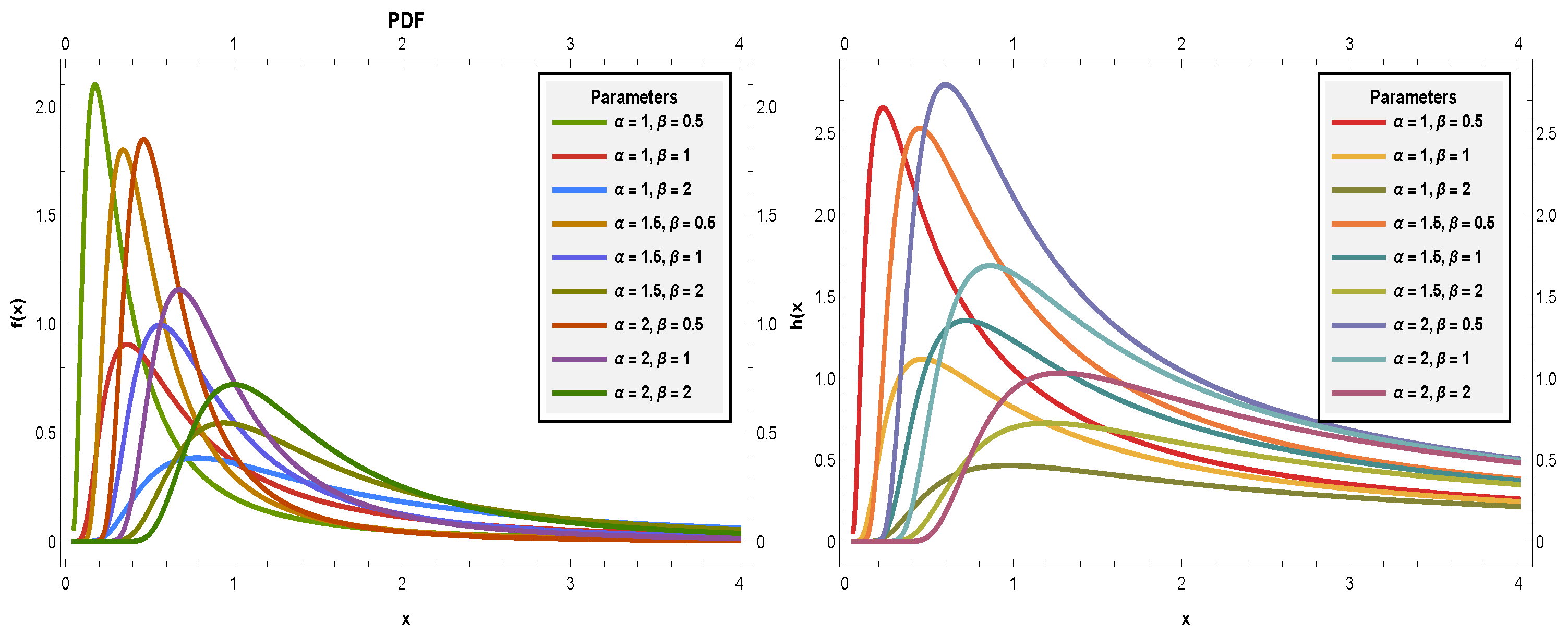
the scale parameter. The corresponding cumulative distribution function (CDF) and hazard rate function (HRF) for the PILD are respectively in
Figure 1, given by
The main objectives of the study are
To estimate the parameters of the inverse power Lindley distribution using RSS technique, and to compare the performance of RSS with the SRS method in parameter estimation.
To evaluate and compare multiple estimation techniques, including: maximum Likelihood estimation, minimum distance estimation methods (Anderson–Darling, right-tail AD, left-tail AD, left-tail second order AD, Cramér–von Mises), maximum and minimum spacing distance methods, ordinary and weighted least squares methods, and the Kolmogorov–Smirnov method.
To conduct a simulation study assessing each estimation method under RSS and SRS using performance criteria such as mean squared error (MSE), bias, efficiency, and mean relative estimation error (MRE).
To apply the proposed estimation approaches to a real failure data set to demonstrate the practical utility of RSS in estimating IPLD parameters.
The rest of this paper is organized as follows. In
Section 2, different estimation methods are introduced. A detailed numerical simulations are given in
Section 3. An application of real data is presented in
Section 4. In
Section 5, main results for the work are presented along with some directions for further works.
2. Methods of Estimation
In this section, we investigate fifteen estimation method to estimate the parameters and of the I-PL distribution. Within this framework, we denote as the ranked observation (i.e., the order statistic) in the subset of the cycle, where s ranges from 1 to d and h ranges from 1 to v. These observations form the RSS data for T, with a total sample size of . For simplification, we represent the selected sample under the RSS design as
2.1. Maximum Likelihood Estimation
This section derives the maximum likelihood estimators (MLEs) for parameters and of the I-PL distribution using the RSS methodology. MLEs is the most widely used estimation method in statistics due to its optimal asymptotic properties (consistency, asymptotic efficiency, and asymptotic normality). Let represent the observed RSS data with sample size , where d indicates the set size and v denotes the number of cycles, all sampled from the I-PL distribution.
Based on this RSS data, the likelihood function
is expressed as
where
The log-likelihood function of (
2) is as follows:
where
The MLEs
of
, and
of
can be obtained by solving simultaneously the following normal equations:
and
where,
and
.
To solve for and , numerical methods are required since these estimators cannot be expressed in closed form. Nonlinear optimization algorithms such as the Newton–Raphson iterative method would be appropriate for computing these values.
2.2. Minimum Distance Estimation Methods
Estimation methods that rely on minimizing well-established goodness-of-fit statistics are often effective and yield reliable results in various scenarios. In this study, five widely used techniques are considered, each aiming to minimize the discrepancy between the theoretical and empirical cumulative distribution functions.
2.2.1. Anderson–Darling
The Anderson–Darling method is particularly appropriate for capturing tail behavior accurately. Consider an ordered sample
obtained from a RSS of size
, where
d represents the set size and
v is the cycle number, drawn from the I-PL distribution. The Anderson–Darling estimates (ADEs) for
and
, denoted as
and
, are obtained by minimizing the following function:
where
represents the survival function. Instead of directly using (
3), the values
and
can be numerically determined by solving the following nonlinear equations:
and
where
and
and
and
have similar expressions with the ordered sample
.
2.2.2. Right-Tail Anderson–Darling
The Right-Tail Anderson–Darling specifically emphasizes the right tail of the distribution. Consider an ordered sample
obtained from an RSS of size
, where
d represents the set size and
v is the cycle number, drawn from the I-PL distribution. The right-tail Anderson–Darling estimates (RTADEs) for
and
, denoted as
and
, are obtained by minimizing the following function:
Instead of directly using (
6), the values
and
can be determined numerically by solving the following nonlinear equations:
and
where
and
are given in (
4) and (
5).
2.2.3. Left-Tail Anderson–Darling
The Left-Tail Anderson–Darling focuses on the left tail of the distribution. It is useful when early failures or small values are of particular concern, such as in quality control applications. Let
be an ordered sample obtained from the I-PL distribution and forming an RSS of size
, where
s represents the set size and
w is the cycle number. The Left-Tail Anderson–Darling estimates (LTADEs) for
and
, denoted as
and
, are determined by minimizing the following function:
The following nonlinear equations can be solved numerically instead of (
7) to obtain
and
:
and
where
and
are given in (
4) and (
5).
2.2.4. AD Left-Tail Second Order
The Left-Tail Anderson–Darling second-order provides enhanced emphasis on the extreme left-tail with second-order weighting and offers even more sensitivity to the behavior of the distribution near zero, which can be critical for certain applications. Let
be an ordered sample constructed using the I-PL distribution, resulting in an RSS of size
with set size
s and cycle number
w. The Left-Tail Anderson–Darling second-order estimate (ADSOE) for
and
, denoted as
and
, is obtained by minimizing the function below:
Instead of solving Equation (
8) directly, one can solve the following nonlinear equations to obtain
and
:
and
where
and
are given in (
4) and (
5).
2.2.5. Cramér–von Mises Estimators
The Cramér–von Mises provides balanced estimation across the entire support of the distribution without emphasizing any particular region, making it a robust general-purpose estimator. Let
be an ordered sample created using the I-PL distribution, which yields an RSS of size
, where
d is the set size and
v is the cycle number. The Cramér–von Mises estimates (CVMEs) for
and
, denoted as
and
, can be obtained by minimizing the following function:
Instead of using (
9), one may solve the following nonlinear equations to obtain
and
:
and
where,
amd
are given in (
4) and (
5).
2.3. Method of Maximum and Minimum Spacing Distance
The MPS approach was first presented by Cheng and Amin [
29,
30]. This approach depends on maximizing the geometric mean of the data’s spacings. For the most part, the MPS method is particularly effective for small samples and distributions with complex functional forms. MPS is less sensitive to outliers and model misspecification than MLE.
2.3.1. Maximum Product Spacing Distance
Suppose that
form an ordered sample creating an RSS of size
, gathered from the I-PL distribution. The uniform spacing is then determined by
Note that
and
The following function is maximized with respect to
and
to obtain the MPS estimates (MPSEs)
and
:
The MPSEs
and
can be obtained through the numerical computation of the following equations:
and
where
and
are given in (
4) and (
5).
2.3.2. Minimum Spacing Distance
Minimum spacing distance estimators provide a distribution-free approach that does not require complete specification of the likelihood function and is computationally simpler in some cases. Consider as an ordered sample obtained from the I-PL distribution distribution, with cycle number w and set size s, forming an RSS of size . We can derive various parameter estimates by minimizing specific objective functions.
Minimum spacing absolute distance
By minimizing the following function, we obtain the minimum spacing absolute distance Estimates (MSADEs)
of
and
of
:
Instead of directly solving Equation (
10), the following non-linear equations can be solved to obtain
and
:
and
where
and
are given in Equations (
4) and (
5).
Minimum spacing absolute-log distance
By minimizing the following function, we obtain and the minimum spacing absolute-log distance Estimates (MSALDEs)
of
and
of
,
Similarly, we can solve the following non-linear equations instead of Equation (
11) to obtain
and
:
and
where
and
are given in Equations (
4) and (
5).
Minimum spacing square distance
Next, by minimizing the following function, we determine the minimum spacing square distance Estimates (MSSDEs)
of
and
of
:
Instead of solving Equation (
12) directly, the following non-linear equations can be solved to obtain
and
:
and
where
and
are given in Equations (
4) and (
5).
Minimum spacing square log-distance
By minimizing the following function, we determine the minimum spacing square log-distance Estimates (MSSLDEs)
of
and
of
,
Similarly, we can solve the following non-linear equations instead of Equation (
13) to obtain
and
:
and
where
and
are given in Equations (
4) and (
5).
Minimum spacing Linex distance
Finally, we can obtain the minimum spacing Linex distance Estimates (MSLDE)
of
and
of
by minimizing the following function:
Instead of solving Equation (
14) directly, the following non-linear equations can be solved to obtain
and
:
and
where
and
are given in Equations (
4) and (
5).
2.4. Methods of Ordinary and Weighted Least Squares
The OLS estimates (OLSE) and WLS estimates (WLSE) were introduced by [
31] to estimate the parameters of the beta distribution. They are simple to implement, computationally efficient, and provides reasonable estimates without requiring iterative likelihood maximization. Consider
an ordered sample obtained from the I-PL distribution, with cycle number
v and set size
d,forming an RSS of size
. By minimizing the following function, the OLSEs
of
and
of
are found to be, respectively:
The following non-linear equations can also be solved to produce these estimators:
and
The WLSEs
of
amd
of
are determined by minimizing the following function:
The following non-linear equations can also be solved to produce these estimators:
and
where,
and
are given in (
4) and (
5).
2.5. Kolmogorov Method
Kolmogorov method focuses on worst-case fit rather than average fit, ensuring that the estimated distribution does not deviate excessively from the data at any point. Consider
an ordered sample obtained from the I-PL distribution, with cycle number
v and set size
d, forming an RSS of size
. In order to obtain the Kolmogorov estimates (KEs)
and
the following function is minimized with regard to
and
3. Numerical Simulation
This section evaluates different estimation methods for the IPLD discussed in
Section 2. We compare both the SRS and RSS approaches under various configurations. All computations were performed using R software (R Core Team, 2024). All parameter estimates were obtained using the
optim() function from the
stats package with the Nelder-Mead method (
method = "Nelder-Mead") for optimization. To ensure consistency and assess the robustness of all estimation methods, initial values were randomly selected from a uniform distribution around the true parameter values. Specifically, for true parameters
, initial values were drawn from
and
, representing perturbations within
of the true values. This approach allowed us to evaluate the stability and convergence properties of each estimation method across different starting points. All methods consistently converged to the same estimates regardless of the specific initial values, demonstrating the global convergence of the optimization algorithms. The convergence was verified in all cases with a tolerance level of
.
To evaluate the accuracy of the estimation between methods and sampling designs, we calculate four statistical metrics:
where
M = 10,000 represents the number of simulations and
are the parameters of interest.
The efficiency of RSS relative to SRS is calculated as
where
,
, and
represent the bias, mean squared error, and mean relative error under SRS, respectively, and
,
, and
represent the corresponding metrics under RSS. Values of
indicate that RSS outperforms SRS.
Our simulation examines two parameter set values:
, which represents a case with pronounced right-skewness and heavy tails, and
, which corresponds to a more moderate skewness and dispersion, reflecting data with lighter tails and wider spread. For RSS, we use set sizes of
with cycle numbers of 4 and 9. For SRS, the sample size is calculated as the set size multiplied by the number of cycles to ensure comparable sizes between RSS and SRS approaches. The results are presented in
Table 1,
Table 2,
Table 3,
Table 4,
Table 5 and
Table 6 for both sampling methods in all configurations.
Also, in
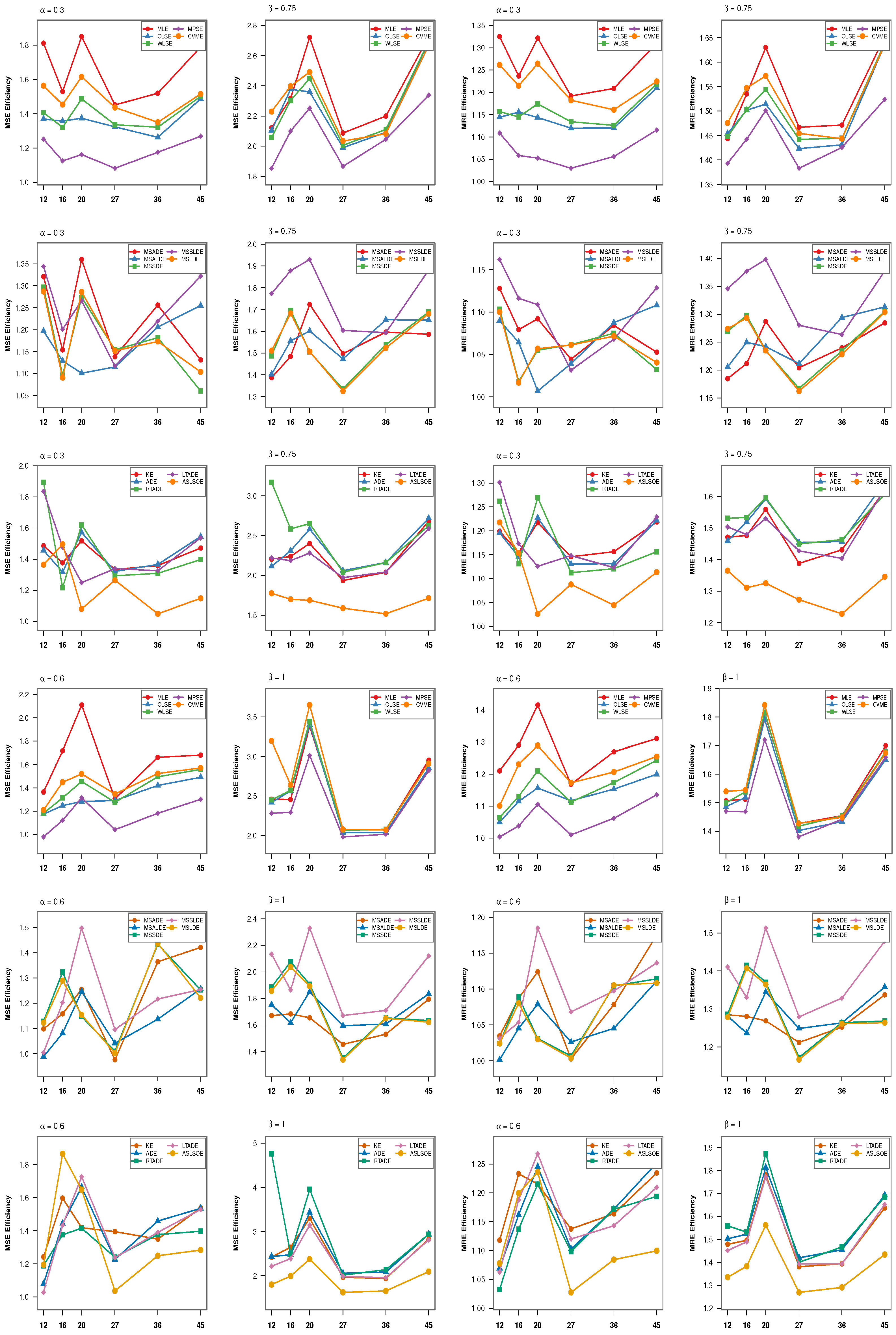
Figure 2, we plotted the efficiency values based on the RSS relative to SRS for the MSE and MRE using all estimation methods with different sample sizes for easy comparison.
- A.
Case 1:
For Parameter :
For bias reduction in the parameter
, the MLE (
Table 1) consistently demonstrates strong efficiency. Similarly, the MSSLDE and MSADE estimators in
Table 2 show solid performance. Additionally, the RTADE and LTADE estimators presented in
Table 3 exhibit comparable bias reduction capabilities.
Regarding MSE efficiency for
, MLE and CVME in
Table 1 show high performance, with Eff values ranging from 1.1088 to 1.8115. For instance, at
under MLE, the MSE for
decreases from
(SRS) to
(RSS), achieving an efficiency of 1.812. In
Table 2, MSSLDE demonstrates good MSE reduction, with Eff values up to 1.5. Similarly, RTADE and LTADE in
Table 3 are particularly effective in reducing MSE, showing Eff values between 1.3 and 1.8.
For Parameter :
All estimation methods evaluated in
Table 1,
Table 2 and
Table 3 consistently exhibit substantial bias reduction when applied under the RSS framework.
A substantial reduction in MSE for
is a consistent observation across all methods. Specifically, MLE and CVME in
Table 1 frequently achieve Eff values above 2.0, occasionally surpassing 3.0. For instance, at
, the MLE for
shows an MSE improvement from
(SRS) to
(RSS), resulting in an efficiency of 2.154. In
Table 2, MSSLDE distinguishes itself with high MSE efficiency, typically ranging from 1.8 to 2.1. Most notably, RTADE in
Table 3 exhibits exceptionally high MSE efficiency, with an Eff value reaching up to 3.138 for
, underscoring a very strong advantage of RSS for this particular estimator.
- B.
Case 2:
For Parameter :
The MLE results in
Table 4 consistently exhibit effective bias reduction. In contrast, the MSSLDE estimator in
Table 5 shows a moderate improvement, while the KE and ADLSOE estimators in
Table 6 achieve slightly greater reductions in bias, highlighting their relatively superior efficiency under the RSS framework.
Furthermore, both MLE and CVME in
Table 4 maintain robust MSE efficiency, with Eff values ranging from 1.3 to 1.7. Within
Table 5, MSSDE and MSLDE typically achieve good MSE reduction, showing Eff values between 1.1 and 1.4, and MSSLDE’s efficiency also improves with increasing
m (up to 1.556). For the estimators in
Table 6, ADLSOE, KE, and RTADE demonstrate commendable MSE efficiency, ranging from 1.2 to 1.8.
For Parameter :
All methods presented in
Table 4,
Table 5 and
Table 6 consistently demonstrate substantial bias reduction under RSS. Among them, RTADE (
Table 6) shows the most pronounced improvement, while MSSLDE (
Table 5) also performs notably well in minimizing bias.
A pronounced reduction in MSE is observed for
under RSS. In
Table 4, both MLE and CVME exhibit substantial improvement, with CVME reaching a notably high value of 3.174 for
. MSSLDE in
Table 5 also shows consistently strong performance, maintaining MSE reductions within the range of 1.7 to 2.3. The most remarkable gains, however, are achieved by RTADE in
Table 6, which demonstrates exceptional variance reduction for
, with values extending up to 4.750 for
.
The RSS consistently shows superior performance over SRS in estimation. This superiority is clearly demonstrated by efficiency values consistently greater than 1 for MSE and MRE, which strongly validates the use of RSS to enhance the precision and accuracy of estimation.
4. Real Data Analysis
In this section, we demonstrate the utility of our proposed estimation approaches by analyzing a carefully selected dataset. Our goal is to showcase the practical applications and effectiveness of these estimation techniques through a comprehensive examination of the data set. By presenting a real data that present failure time of 40 items discussed by [
32]. The data is reported on
Table 7.
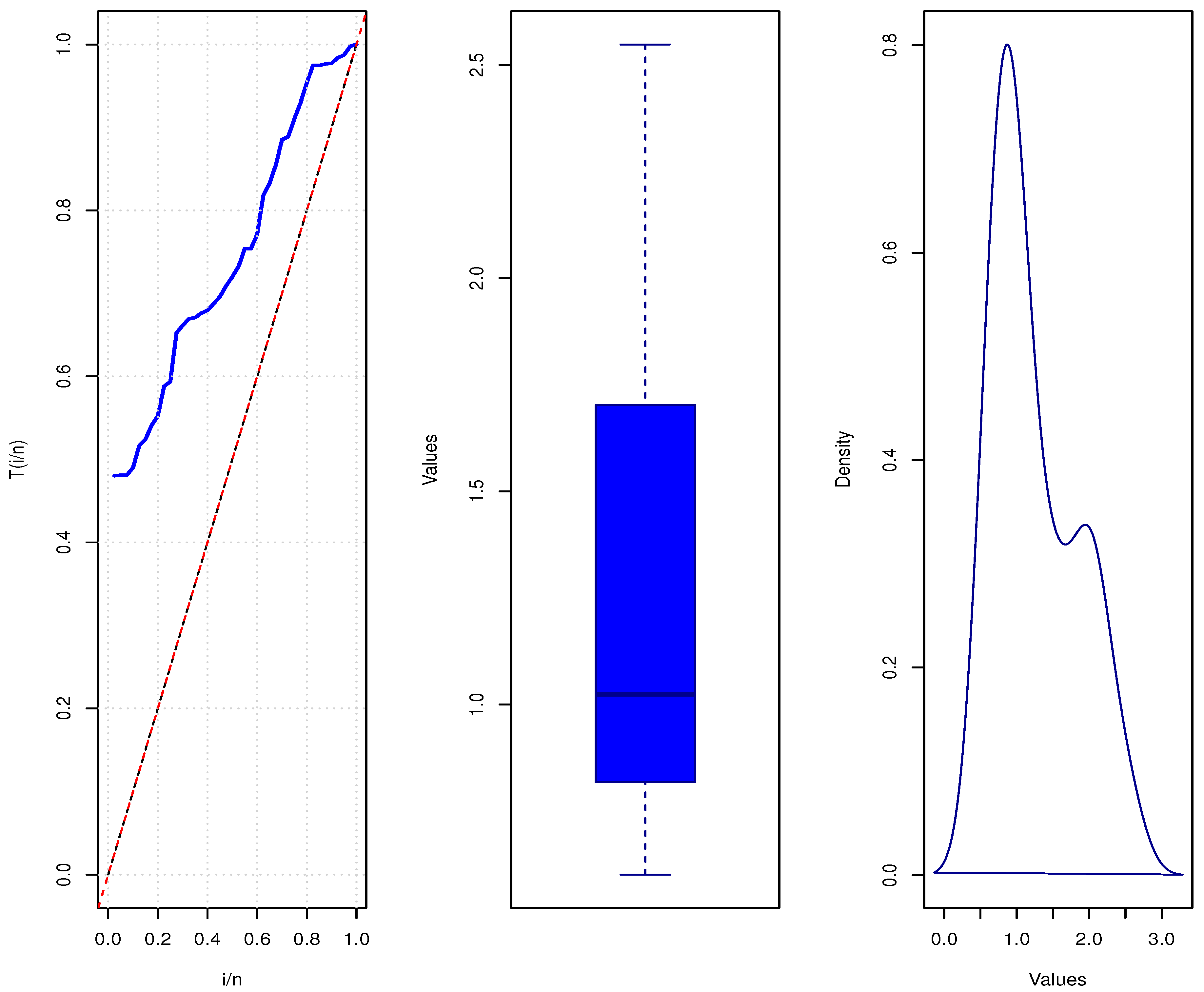
Table 8 and
Figure 3 represent the descriptive statistical analysis and some graphical representations, including the TTT, box, and density plots, to illustrate the dataset used.
The descriptive statistics in
Table 8 and the graphical representation in
Figure 3 demonstrate a right-skewed distribution, characterized by a skewness of 0.71. The mean (1.25) being higher than the median (1.02) indicates the presence of some notably large values that pull the average upward. The data exhibits moderate dispersion, with a standard deviation of 0.57 and a coefficient of variation of 45.66%. The slightly platykurtic kurtosis of 2.25 suggests a distribution with fewer extreme values compared to a normal distribution.
To evaluate the adequacy and superiority of the proposed estimation methods under the I-PLD, we compare its performance with three related lifetime distributions: the Lindley distribution [
23], the Inverse Lindley distribution [
33], and the Inverse Weibull distribution [
34]. Each of these models provides a different degree of flexibility in modeling positively skewed data, which allows us to assess the robustness and accuracy of the I-PLD fit. These models were fitted to the same real dataset, and their performances were evaluated using several goodness-of-fit criteria, including the Akaike Information Criterion (AIC), Corrected AIC (CAIC), Bayesian Information Criterion (BIC), Hannan–Quinn Information Criterion (HQIC), and the Kolmogorov–Smirnov (K–S) test.
The results in
Table 9 show that the IPLD provides the best fit to the data, as indicated by their lower AIC, CAIC, BIC, and HQIC values, and by their non-significant K–S test results (high
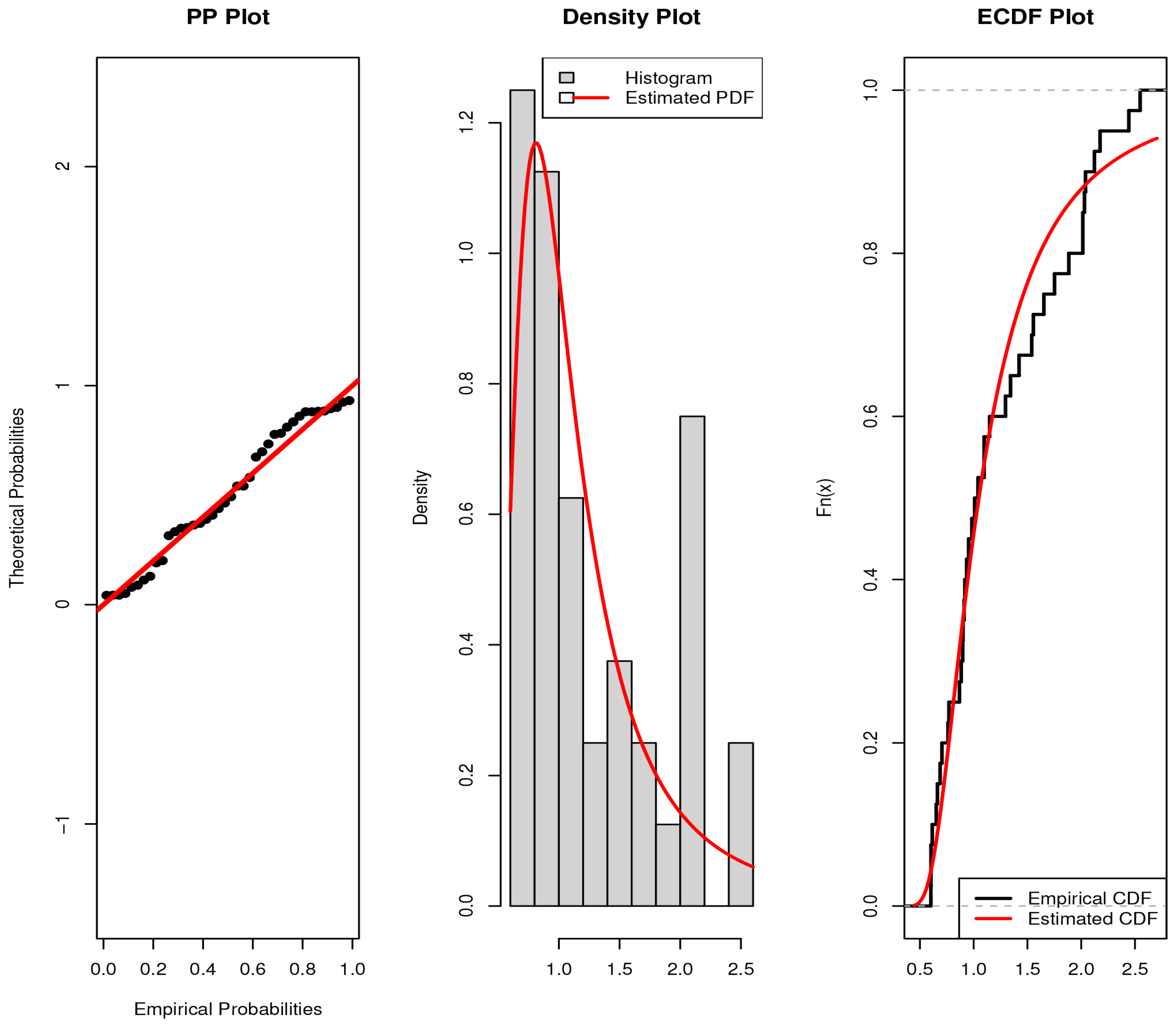
p-values). Between these two, the IPLD demonstrates slightly better performance and stability, confirming its superiority and flexibility in modeling positively skewed lifetime data compared to the standard Lindley-type distributions. The graphical representation in
Figure 4 provides visual confirmation of these statistical findings.
To comprehensively examine the superiority of ranked set sampling over SRS across different estimation methods, an SRS sample of size 12 was chosen for comparability, while an RSS scheme was designed with a set size of 3 and four cycles to maintain the same total sample size. Assuming a perfect sampling design, an extensive evaluation was carried out using several goodness-of-fit statistics to assess the performance and reliability of each sampling approach. Specifically, we employed the Anderson–Darling test
, the Cramér-von Mises test
, and the Kolmogorov–Smirnov test
. These statistical measures were systematically applied to assess model fit and provide comparative insights into the effectiveness of RSS in capturing the underlying data distribution relative to SRS. A detailed comparison of the goodness-of-fit values for both sampling designs is presented in
Table 10.
Table 10 revealed a consistent superiority of RSS over SRS across multiple estimation techniques. The RSS methodology demonstrated notably improved model fit, characterized by reduced
,
, and
test values, coupled with elevated
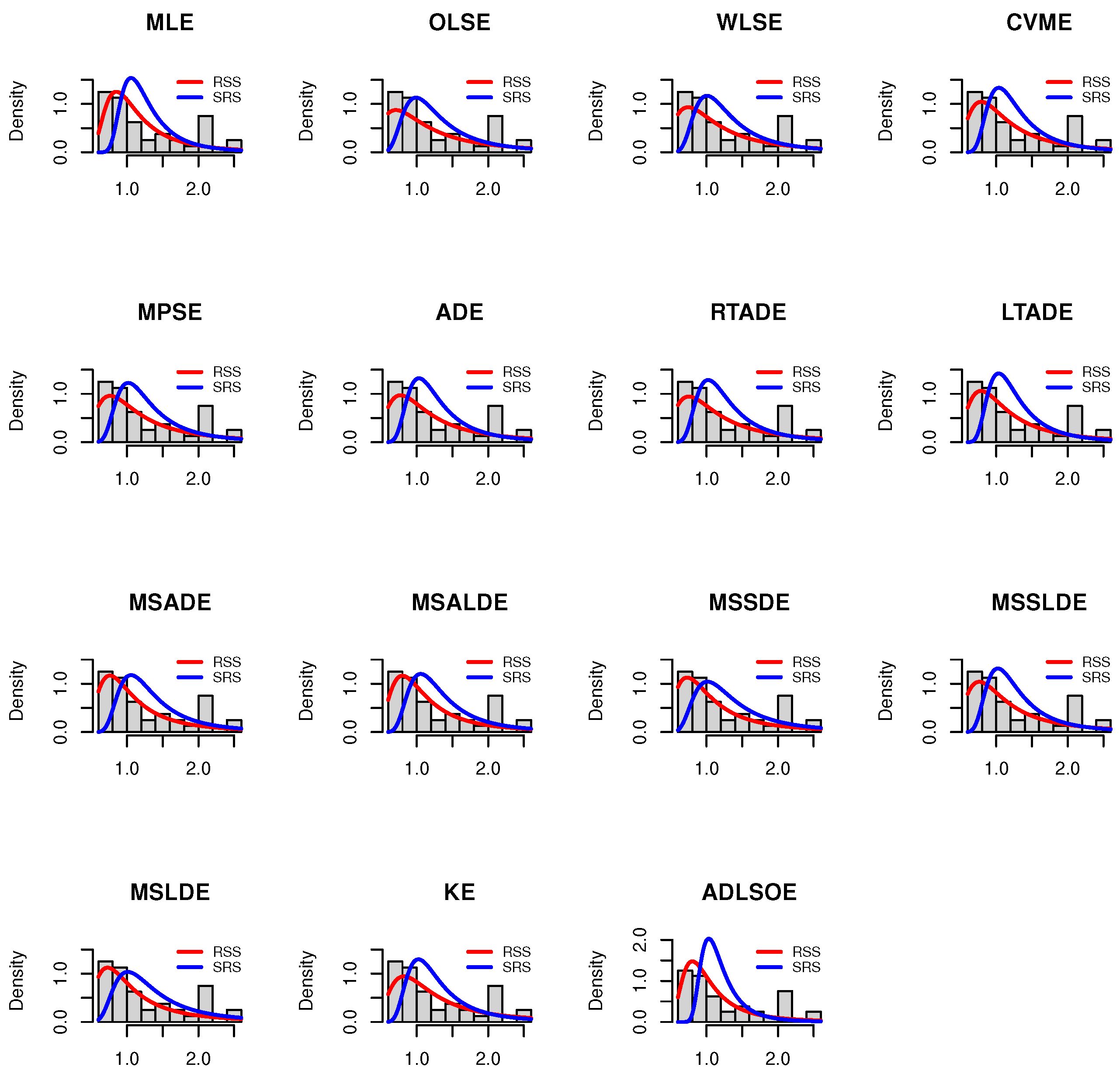
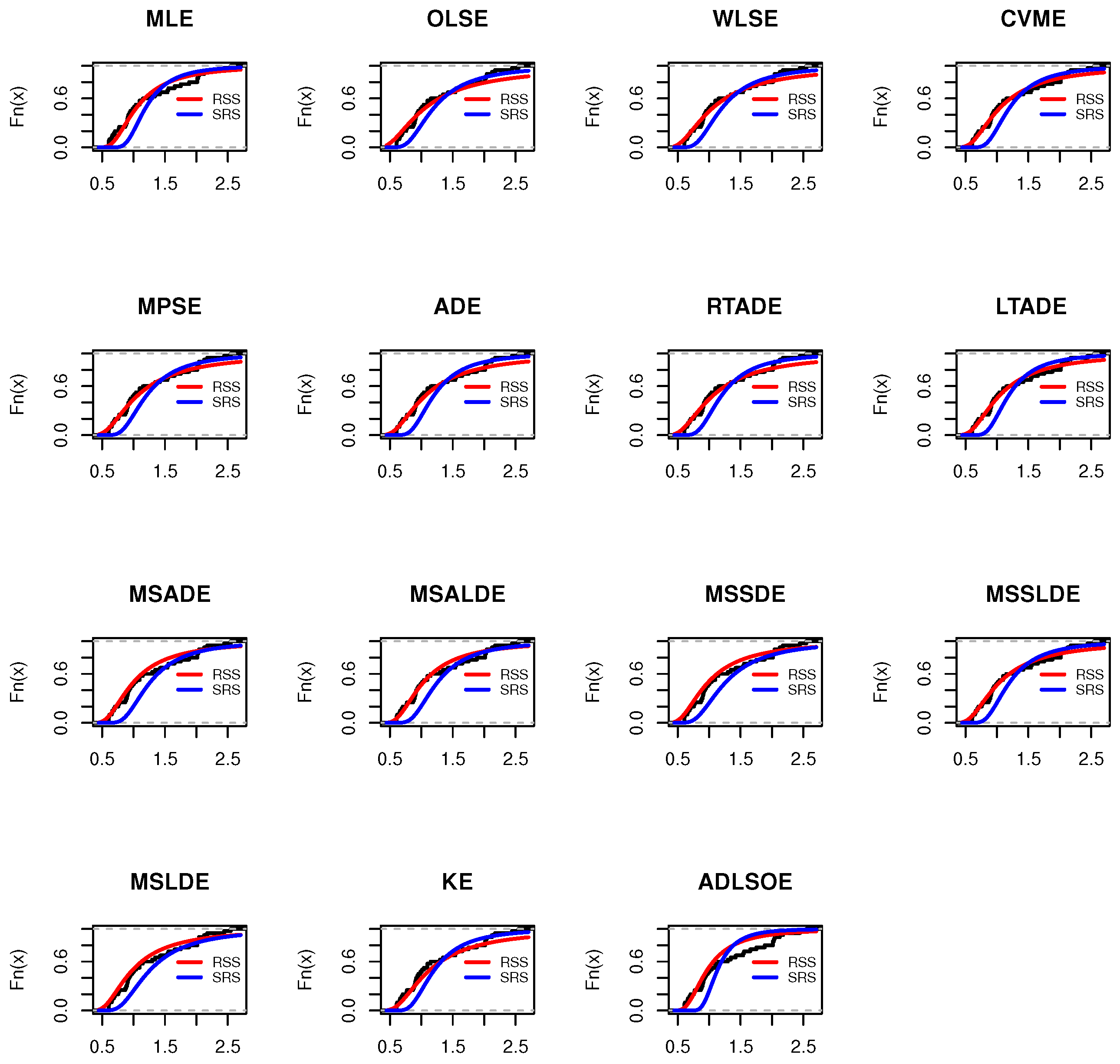
p-values. These empirical findings substantiate the theoretical advantages of RSS design. The graphical representations in
Figure 5 and
Figure 6 provide additional visual corroboration of these findings, reinforcing the robust performance of the RSS approach in statistical modeling.