1. Introduction
Decision-making in uncertain environments is a major challenge in many real-life problems across Operations Research and Management Science (especially in the fields where real-world problems often involve parameters that are imprecise, fluctuating, or only partially known). For example, in supply chain management, sudden shifts in demand or disruptions in transportation can make cost and delivery times unpredictable. In healthcare, treatment outcomes and patient responses vary widely, introducing uncertainty into medical planning. Financial markets face constant volatility in prices and interest rates, while in engineering design, material properties and system loads may deviate from expected values.
Similar issues arise in areas like time-series signal analysis, product design, multi-criteria decision-making, data mining, and remote-control systems, where parameters are inherently imprecise and often unpredictable. Recently, several researchers, viz., Maleki et al. [
1], Ahmadi et al. [
2], Ruiz and Dashti [
3], Hamlehvar and Aazami [
4], Deldadehasl et al. [
5], and others, have reported their findings in these sectors without considering the uncertainty of parameters. In all these contexts, the presence of uncertainty can hinder the reliability of mathematical models and complicate the search for optimal solutions.
Researchers have therefore devoted substantial effort to model imprecise parameters in a way that preserves practical usefulness. Approaches such as fuzzy sets, stochastic methods, fuzzy–stochastic hybrids, and interval analysis have been widely used to address uncertainty. Among those, the interval approach has gained prominence due to its simplicity and ease of implementation. Recently, a new type of interval approach, named the Type-2 interval approach, was developed by Rahman et al. [
6] as a generalization of the interval approach. The goal of the present study is to propose another generalization of the interval approach, named as Semi-Type-2 interval.
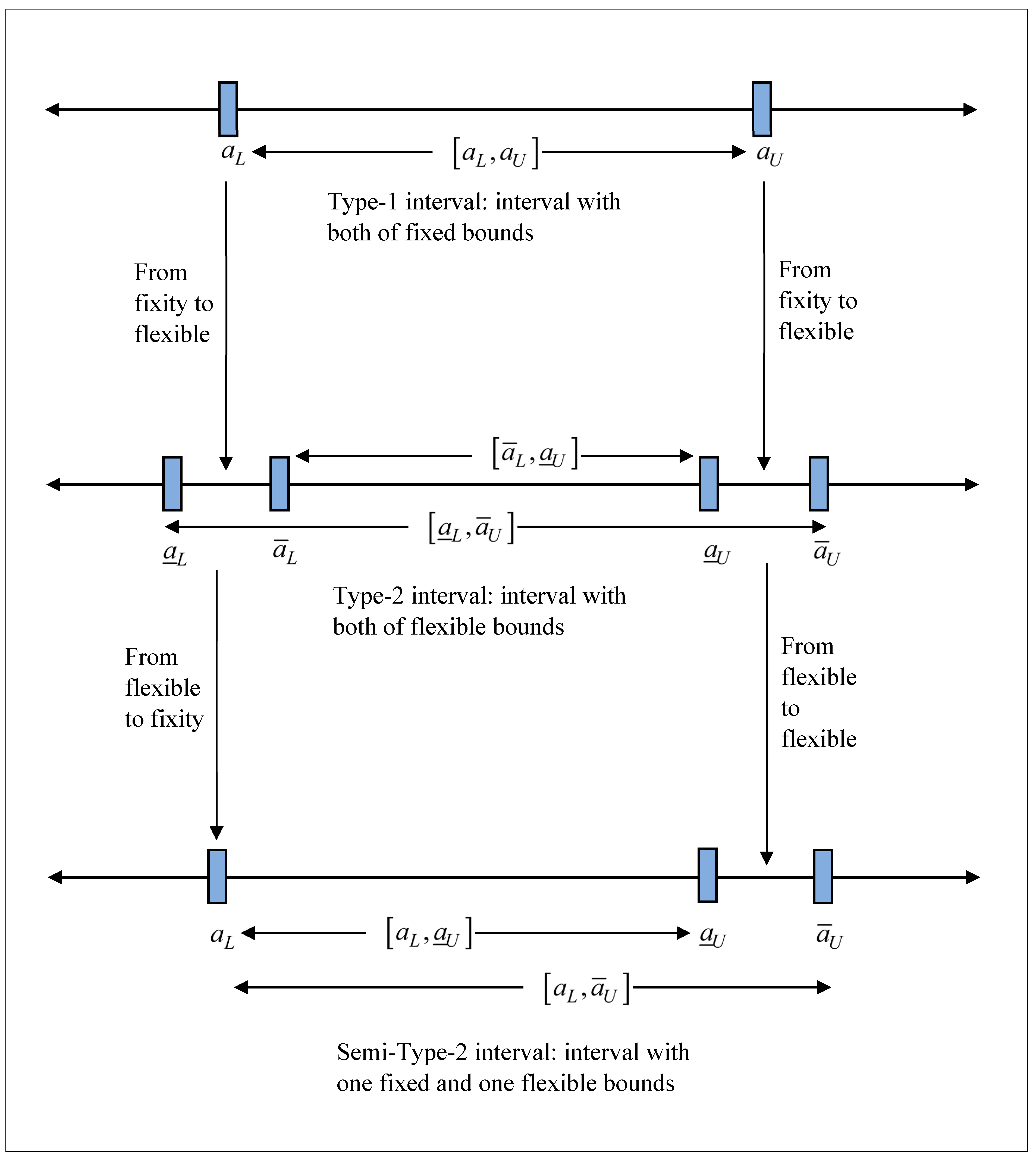
Depending upon the several generalizations of the usual interval approach, it can be categorized into the following approaches:
- ❖
Type-1 interval approach;
- ❖
Type-2 interval approach;
- ❖
Proposed Semi-Type-2 interval approach.
In the Type-1 interval approach, an uncertain parameter is represented by an interval with known upper and lower bounds. The research area of the Type-1 interval approach was enriched by the scholarly contributions of several researchers. Moore [
7] was the pioneer of this area, and he wrote a book presenting interval mathematics, the concept of interval-valued functions, and several interval-based approaches with a number of real-life applications. Again, he wrote another book [
8] by proposing interval order relations with some more real-life applications. Then, Hansen and Walster [
9] wrote another excellent book mentioning the technique of global optimization using interval analysis. Ramos et al. [
10] introduced the concepts of interval mapping in an arbitrary space. Sahoo et al. [
11] developed a modified genetic algorithm for solving a multi-objective-based interval optimization problem. Bhunia and Samanta [
12] proposed a complete interval order relation, and using this ordering, they studied the application of the interval metric in a multi-objective interval optimization problem. Malinowski [
13] derived some existence theorems on symmetric functional set-valued differential equations. Besides these, there are a lot of works on the developments and applications of Type-1 intervals. Among those, some selected ones were reported here, which were accomplished by Ruidas et al. [
14], Mondal and Rahman [
15], Yadav et al. [
16], and others. In their works, interval uncertainty is represented by fixed lower and upper bounds. However, in reality, several situations arise where representing an imprecise parameter as an interval with fixed bounds is challenging. For instance, the cost of various commodities in a developing country is often depicted as an interval with fixed bounds. In these situations, two fundamental questions often arise regarding the selection of bounds. Firstly, how should one handle the situation if the cost exceeds both bounds? Secondly, what should we do if the cost never reaches either bound? If the first question is ignored, then significant numerical errors may arise during the decision-making process, whereas in the case of the second question, uncertainty may increase, which is contrary to the principles of an optimistic decision-maker.
To overcome the challenges arising in the first approach, Rahman et al. [
6] proposed a new interval approach named the Type-2 interval, considering flexibility instead of fixity of the bounds in the interval. Formally, a Type-2 interval is defined as a class of Type-1 intervals where the lower and upper bounds of the intervals of the said class belong to two given Type-1 intervals. With the introduction of the Type-2 interval, very few scholarly articles were written by researchers to enrich the recently developed approach. Rahman et al. [
6,
17] established Type-2 interval mathematics, Type-2 interval order relations, and the optimality conditions of Type-2 interval optimization problems. Later, Rahman et al. [
18] again studied an application of the Type-2 interval approach in the inventory control problem. Das et al. [
19] introduced the parametric representations of the Type-2 interval and, using these, derived the optimality theories of Type-2 interval non-linear programming. Then, Rahaman et al. [
20] used this Type-2 interval approach in fractional calculus to study some applications in memory-based inventory control. Rahaman et al. [
21] again derived the solvability criteria for Type-2 interval differential equations, and they applied these concepts in an economic lot-size model under uncertainty.
In the last-mentioned approach, the fluctuation of both the bounds of an interval is considered. However, in reality, there are also some situations, viz., fluctuation of cost and demand of essential goods from the present to the near future, in which to represent the fluctuating parameters in terms of an interval. In these cases, the lower bounds of the intervals would be known, but the upper bounds may be flexible. Thus, during the modelling of real-life problems in such circumstances, to represent the imprecise parameters more appropriately, one has to require an approach other than both Type-1 and Type-2 intervals. The present work tries to propose such an approach named as Semi-Type-2 interval, which is defined as the class of all Type-1 intervals with common lower bounds and variable upper bounds. Put simply, a Semi-Type-2 interval is an interval whose lower bound is a real number and upper bound is another Type-1 interval. Similarly, the lower bounds of the intervals may be flexible, and the upper bounds may be fixed. The first one is known as a Semi-Type-2 interval for the first kind, and the second one is a Semi-Type-2 interval for the second kind. The main contributions of this paper are presented below:
Introduction of Semi-Type-2 interval: A new generalization of interval numbers is proposed to capture uncertainty more effectively.
Development of arithmetic operations and algebraic properties: Arithmetic operations on Semi-Type-2 intervals are developed along with their algebraic properties.
Introduction of interval ranking: A new order relation to compare Semi-Type-2 interval numbers is introduced, and the related total order properties are established.
Exploration of potential applications: Potential uses of the Semi-Type-2 interval approach are discussed in fields like supply chain management, engineering, and medical sciences as future research scopes.
The present work proposes a new generalized interval approach named the Semi-Type-2 interval to handle uncertainty involved in real-life decision-making problems. The motivation, literature review, and context of introducing this approach are presented in this section. The rest of the work has been organized as follows: In
Section 2, first, the mathematical definition of a Semi-Type-2 interval and all the definitions of different kinds of Semi-Type-2 intervals are introduced. Then, different arithmetic operations of Semi-Type-2 intervals are defined and illustrated with a set of numerical examples. In
Section 3.1, the extension of a real-valued function to a Semi-Type-2 interval-valued function and inclusion function are defined. Thereafter, definitions of periodic functions of Semi-Type-2 interval arguments are provided with some illustrative examples. In
Section 3.2, some algebraic properties of Semi-Type-2 intervals are discussed with numerical illustration. In
Section 4, the Semi-Type-2 interval order relation is introduced by using the score components. Also, it is proved that the proposed order relation is the total order relation. In
Section 5, a summary of the findings, with possible applications and future research directions, is presented.
3. Semi-Type-2 Interval-Valued Functions and Inclusion Functions
The introduction of Semi-Type-2 interval-valued functions enriches the developments of Semi-Type-2 interval analysis beyond interval arithmetic. In this section, the extension of a real-valued function to a Semi-Type-2 interval-valued function and inclusion function has been defined. Then the definitions of values of periodic functions at a Semi-Type-2 interval have been proposed.
Remark 4. Semi-Type-2 interval-valued functions can be defined in different ways. We can define a Semi-Type-2 interval-valued function by selecting a real-valued function and computing the range of where varied through some Semi-Type-2 interval Another process is the extension of a given real-valued function by applying its formula directly to Semi-Type-2 interval arguments, which is shown in Theorem 1.
Definition 7. Let be a real-valued function of real variables and be a Semi-Type-2 interval-valued function with Semi-Type-2 interval arguments Then is said to be a Semi-Type-2 interval extension of if i.e., for 1-degenerate Semi-Type-2 interval arguments, agrees with .
Again, a Semi-Type-2 interval-valued function
is said to be inclusion monotonic if
Let and be a Semi-Type-2 interval-valued function defined by where
Theorem 1. Let be an inclusion monotonic Semi-Type-2 interval extension of a crisp function Then where i.e., contains the range of values of
Proof. Since is a Semi-Type-2 interval extension of Also, for every in as is inclusion monotonic. Therefore □
Again, monotonicity can be applied directly to calculate the images of Semi-Type-2 intervals under some standard functions, as shown in Proposition 1 and Example 6.
Proposition 1. (i) If is a monotonically increasing in the Semi-Type-2 interval where then,
- (ii)
If is a monotonically decreasing in the Semi-Type-2 interval then
Proof. (i) Here is monotonically increasing in and implies that Then maps the Semi-Type-2 interval into the Semi-Type-2 interval
- (ii)
Let is monotonically decreasing in Then Hence □
Example 6. Let the exponential function and also let Since, is monotonically increasing in
Similarly, the logarithmic function is also expressed for Semi-Type-2 interval arguments, as it is strictly monotonic function.
3.1. Periodic Functions of Semi-Type-2 Arguments
Definition 8. Let be a Semi-Type-2 interval.
- (i)
,
- (ii)
- (iii)
if .
- (iv)
if
where
- (v)
if
where
- (vi)
if .
Example 7. Let
Here
Hence
Example 8. Let
Example 9. Let
3.2. Algebraic Properties of Semi-Type-2 Intervals
In this section, we have discussed some algebraic properties of Semi-Type-2 intervals with numerical illustration.
(i) Commutative property
For any (a) (b)
Proof. Let
- (a)
- (b)
Now
where
Again,
where
Since hence □
(ii) Associative property
Let Then
(a)
(b)
Proof. Let
- (a)
Now
- (b)
Now
where
and
where
Then
where
and
where
Clearly,
Therefore, □
(iii) Existence of additive, multiplicative identities
The degenerate Semi-Type-2 intervals and are additive and multiplicative identity elements respectively because
and
(iv) Non-existence of inverse
Let Now, So the additive inverse of does not exist in general. holds only if is degenerate.
Similarly, in general. holds only if is degenerate.
(iv) Sub-distributive property
Proof. Proof is trivial. It follows from the definitions of Semi-Typ-2 interval arithmetic. □
Note 3. The equality does not hold in general.
We have shown this with the help of an example as follows:
Example 10. For example, let
Note 4. (1) If is degenerate Semi-Type-2, then equality holds.
(2) Let If then
(v) Cancellation property
Proof. Let
Now,
Hence
Note 5. Cancellation Law for multiplication does not hold in Semi-Type-2 interval arithmetic, i.e., may not imply
We have shown this with the help of an example as follows:
Example 11. For example, let and Then But
4. Order Relations of Semi-Type-2 Interval
In this section, we have proposed a Semi-Type-2 interval order relation to compare any two Semi-Type-2 intervals. Then, we have shown that the proposed order relation is a total order relation. Before proposing the said order relation, some score components have been defined to determine a Semi-Type-2 interval uniquely. We have introduced score components to determine any Semi-Type-2 interval uniquely and compare any two such intervals easily, similar to the centre radius in the case of an interval. However, two Semi-Type-2 intervals can also be compared by their bounds; score components are introduced to define a complete interval order relation in an easy way. Also, the order relation based on score components will be very user-friendly in real-life scenarios.
Definition 9. Let be a Semi-Type-2 interval. Then a set of score components of is defined by the set which uniquely determines , where .
Proposition 2. Let and be two Semi-Type-2 intervals with corresponding sets of score components and . Then, iff
Proof. Follows from Definitions 3 and 9. □
Definition 10. Let and be two Semi-Type-2 intervals with corresponding sets of score components and . Then the ordering relation between two Semi-Type-2 intervals and is defined as follows:and Example 12. Compare the following pairs of Semi-Type-2 intervals using Definition 10:
- (1)
and
- (2)
and
- (3)
and
- (4)
and
Solution. Depending upon the corresponding set of score components of and given Semi-Type-2 intervals are compared for each case and the results have been presented in the Table 2. Theorem 2. Let be any three Semi-Type-2 intervals.
Then
- (i)
(Reflexivity)
- (ii)
and (Anti-symmetric)
- (iii)
and (Transitive)
- (iv)
or (Comparability).
Proof. (i) Let be the set of score components of
From Definition 10 it is clear that for any Semi-Type-2 interval.
(ii) Let and be any two Semi-Type-2 intervals with set of score functions and .
Also, let and hold.
Then and and so
On the other side,
(1) and (2)
On the other hand,
(3) and (4)
Therefore, and
(iii) Let Also, let and hold.
Then, and
Therefore
Now, if then
On the other hand, if then and
Therefore
Now, if then
On the other hand, if then and
Now, and
(iv) Let
Now, from the law of trichotomy of real numbers one has or or
If, or if
Again if then either, or or
If, and or and
Finally, if and then either or
Now, and
OR, and □
Combining all of the above, we can say that for any two Semi-Type-2 intervals and , either or hold.
5. Conclusions
In this work, the concept of a Semi-Type-2 interval is proposed as a new uncertainty handling approach. Then, the definitions of interval mathematics and ranking of Semi-Type-2 intervals are established. Also, some other related properties are introduced. This proposed interval framework extends classical interval mathematics by introducing flexibility in one of the interval bounds. This modification addresses a limitation of both Type-1 and Type-2 intervals, where either full rigidity or complete flexibility may not adequately reflect real-world uncertainty. By bridging this gap, Semi-Type-2 intervals offer a more balanced mathematical structure that strengthens accuracy in uncertainty modelling and provides a richer foundation for future theoretical development in interval analysis and Operational Research/Management Sciences.
Beyond the mathematical contributions, Semi-Type-2 intervals carry important implications for practical decision-making under uncertainty. For instance, in financial forecasting, the method allows managers/system analysts to represent price fluctuations where lower thresholds are relatively stable but upper limits are uncertain. This leads to more robust predictions and reduced forecasting errors. In risk management and avoidance, Semi-Type-2 intervals can model asymmetric uncertainties such as fluctuating demand in supply chains/inventory, unpredictable patient responses in healthcare, or variable energy consumption in power systems. These applications highlight how the proposed approach can help decision-makers to minimize risk, optimize resource allocation, and improve resilience in uncertain environments.
With the introduction of the Semi-Type-2 interval approach, this work opens up several avenues for further research. Firstly, integrating it into optimization models, machine learning algorithms, and simulation-based decision systems could further enhance its utility in the area of financial risk, smart grids, epidemics, and climate modelling. Secondly, one can also extend the optimality theory for interval non-linear programming into the Semi-Type-2 interval case. Also, one can generalize the gH difference with the theory of interval differential equations in a Semi-Type-2 interval environment.



 ,
,