Abstract
In this paper, a high-accuracy conservative implicit algorithm for computing the space fractional coupled Schrödinger–Boussinesq system is constructed. Meanwhile, the conservative nature, a priori boundedness, and solvability of the numerical solution are presented. Then, the proposed algorithm is proved to be second-order convergence in temporal and fourth-order spatial convergence using the discrete energy method. Finally, some numerical experiments validate the effectiveness of the conservative algorithm and confirm the accuracy of the theoretical results for different choices of the fractional-order .
Keywords:
fractional Schrödinger–Boussinesq equation; conservative difference scheme; high-order approximation; convergence MSC:
65M06; 65M12; 35Q51
1. Introduction
The coupled Schrödinger–Boussinesq system (CSBS) is a basic equation in laser and plasma physics. It describes how coupled Langmuir and dust-acoustic waves propagate nonlinearly in a dusty plasma. Over the years, the theoretical results on the well-posedness and dynamic behaviors of the analytical solution to the CSBS have been widely exploited [1,2,3,4,5,6]. Several methods for finding the exact solutions to the CSBS have been presented [7,8,9,10]. Because the exact solutions to the CSBS often contain certain special functions, scholars have begun utilizing efficient methods to seek numerical solutions for it, such as the multi-symplectic method [11], orthogonal spline collocation method [12], radial basis function-finite difference method [13], cut-off function method [14], scalar auxiliary variable method [15], Adams prediction–correction method [16], finite-element method [17,18], and energy-preserving compact finite difference methods [19].
Laskin, a Canadian scholar, in 2000, enhanced Feynman’s path integral to Lévy paths and formulated a Schrödinger model incorporating a nonlocal Laplacian operator [20,21]. The fractional Laplacian operator is a powerful tool for describing memory and hereditary properties. It is widely used in addressing various nonlinear problems, including the fractional wave equations [22], fractional Schrödinger equation [23], fractional Ginzburg-Landau equation [24], fractional coupled Schrödinger–Boussinesq equation [25], fractional Korteweg–de Vries equation [26,27,28], and fractional Fornberg–Whitham equation [29]. Additional notable results on this subject are available in [30,31,32,33].
This paper primarily focuses on the numerical solution for the fractional coupled Schrödinger–Boussinesq system (FCSBS)
where , and coefficients and are positive constants. The function is sufficiently smooth and real, with . The complex function represents the electric field in Langmuir oscillations, while the real function characterizes low-frequency density perturbations.
Assuming , then system FCSBS (1) transforms into the following equivalent form:
where and , , are given smooth functions. The fractional Laplacian can be considered as the Riesz fractional derivative
where represents the left Riemann–Liouville fractional derivative
and represents the right Riemann–Liouville fractional derivative
It is noteworthy that the initial-boundary value problem (3)–(7) possesses three conservative laws, namely, the Langmuir Plasmon number
the total perturbed number density
and the total energy
Here, is the primitive function of .
Han et al. [25] investigated the local and global well-posedness in , for FCSBS, in which the nonlinear term remains undetermined. Shao and Guo [34] derived local mild solutions to the Schrödinger-damped Boussinesq system and its fractional counterpart in one dimension using the contracting mapping principle. They also presented the precise results concerning the existence and nonexistence of global mild solutions. Given the inherent nonlocality and nonlinearity of FCSBS, obtaining analytical solutions for the system is an extremely challenging task. Therefore, numerical simulation has emerged as a crucial approach for its study. Ray [35] developed a time-splitting Fourier spectral method, which has been proven to be unconditionally stable. The error norms and graphical solutions are also presented in this work. In [36], Liao et al. developed and rigorously analyzed two efficient conservative difference schemes for FCSBS. Each scheme is demonstrated to preserve two fundamental conservation laws: mass conservation and energy conservation, while converging with an accuracy of . Compared to CSBS, numerical methods for solving FCSBS are quite scarce. Thus, the goal of this paper is to develop a new conservative scheme for solving FCSBS, while also rigorously implementing error estimates for the proposed scheme.
The contributions of this article are summarized as follows: (1) To maintain the same physical properties as the original differential equation, we develop a conservative scheme. We rigorously demonstrate that the scheme can preserve three conservative laws simultaneously, as evidenced by numerical examples. (2) The boundedness and solvability of the numerical solutions obtained from the conservative scheme are established. (3) Importantly, the numerical solutions provided by the conservative scheme unconditionally converges to the exact solutions in the -norm with a convergence order of .
The subsequent sections of this paper are organized as follows: In Section 2, we introduce relevant notations and auxiliary lemmas, followed by the derivation of the conservative scheme. Theoretical analyses for the proposed scheme are presented in Section 3. Numerical experiments, conducted to validate the proposed scheme, are discussed in Section 4. Finally, concluding remarks are provided in Section 5.
2. Construction of Conservative Difference Scheme
In this section, we initially introduce relevant notations and auxiliary lemmas that will be utilized later. Subsequently, we elaborate on the establishment of a conservative difference scheme for the initial-boundary value problems (3)–(7).
2.1. Notations and Lemmas
Let and denote the uniform step sizes in the spatial and temporal directions, respectively, where J and N are positive integers. Define
For any grid function , we define the following notations:
Denote the space
where is the Fourier transformation of . We now introduce several lemmas crucial for constructing the conservative difference scheme.
Lemma 1
(see [22,37]). Suppose the function , and let
be the fractional centered difference. Then, we have
where
and denotes the set of all integers.
Here, the we define is consistent with the defined in [22,37], just with a simplified notation.
Remark 1.
If is defined by
and suppose . Then, for , we have
The classical fourth-order compact approximation for standard second-order derivatives is obtained when in Formula (11).
Lemma 2
(see [38]). Suppose ; then, we have
where
2.2. Derivation of the Conservative Difference Scheme
Let , , and . Meanwhile, , , and represent the numerical approximations of , , and at the point , respectively.
By considering Equation (3) at both and , and then combining them, from Taylor expansion, we can derive
Then, acting the operator on both sides of (12), we have
Using Lemma 1, we obtain
Considering Equations (4) and (5) at and , respectively, and then combining them, from Taylor expansion, we can obtain
Then, considering the discretizations (6) and (7), we have
Neglecting the small terms in Equations (14), (17) and (18), and considering Equations (19) and (20), we can derive the following numerical scheme for (3)–(7):
Define
where and are square matrices with order . Denote
it is easy to verify that and are symmetric positive definite matrixes. Thus, the vector forms of the fourth-order difference scheme (21)–(25) and can be written as
3. Theoretical Analysis
Define the grid function spaces on as and . For any grid function , the discrete inner product is defined as follows:
For any two grid functions , the discrete inner product and the associated -norm are defined as follows:
where represents the complex conjugate of . We also define the discrete -norm as
and the discrete maximum norm (-norm) as
Provided the constant , the fractional Sobolev norm and semi-norm can be defined as [39]
where
Obviously, we can obtain
For convenience, we denote a general constant as C, which may vary across different contexts. Next, we introduce several useful auxiliary Lemmas.
Lemma 3
([23]). For any two grid functions , a linear operator exists such that
Lemma 4
([23]). For any complex grid function , , we have
3.1. The Conservative Property
Considering (26)–(30), we have following discrete conservative laws.
Theorem 1.
Proof.
Computing the inner product of (26) with and taking the imaginary part, we have
By virtue of the first identity (32) of Lemma 4 and direct computation, we can deduce
Then, substituting the above equalities into (34), one can obtain
Making the inner product of (27) with , we have
Then, according to the first identity of Lemma 3, we obtain that
Thus,
By computing the inner product of (26) with and taking the real part, we have
Calculating directly, we have
According to (33) of Lemma (32), we obtain
Thus,
Next, taking the inner product of (27) with can yield
and using the relation
we obtain
3.2. A Priori Bound
Lemma 5
([23]). For any nonsingular matrix G and , two positive integers and exist such that
where , , is the singular value of the nonsingular matrix G.
Lemma 6
((Young’s inequality) [40]). If , , then
where , , , and .
Lemma 7
([24]). For any and , a constant independent of exists such that
Lemma 8
([24]). For any and , it holds that
Lemma 9
([41]). For any and , a constant independent of exists such that
Lemma 10
([42,43]). For any grid functions . Given , a constant dependent on ϵ exists such that
where , .
Theorem 2.
The difference solution of the scheme (26)–(30) satisfies
Proof.
Theorem 1 shows that
It follows from Lemmas 3 and 5 that three positive constants exist such that
Using Lemma 8, we have
where . Considering , we have
Using Lemma 6 with parameters and yields
When using Lemma 7 with , Lemma 8 with and (31) lead to
where is an arbitrary positive constant. Let , and considering (39)–(46), we have
which implies that
It follows from Lemmas 9 and 10 that
This completes the proof. □
3.3. Solvability
In this section, we discuss the solvability of the finite difference scheme (26)–(30).
Theorem 3.
If , and , then the difference solution of the conservative difference scheme (26)–(30) exists.
Proof.
Define , , , and ; then, z is a -dimensional vector or a point of -dimensional Euclidean space . Now, we use the Schauder fixed point to prove the existence of the solutions for the finite difference scheme (26)–(30). For this purpose, we construct a mapping of the -dimensional Euclidean space into itself, with a parameter
Obviously, the mapping defined here is continuous and there is a fixed point
satisfying . Now, we prove the boundedness of all the possible solutions to the mapping.
Making the inner product of (48) with and taking the real part, by virtue of Lemma 4, we obtain
and thus a is uniformly bounded. Now, we prove the boundedness of b and c.
Computing the inner product of (49) and (50) with and , respectively, we obtain
The addition of (52) to (53) yields
Using Young’s inequality Lemma 6 with and , we have
Applying Taylor’s Theorem, Young’s inequality Lemma 6 with and , and Theorem 2, we obtain
By substituting (55)–(57) into (54), we have
It follows from Theorem 2 that we have
If is sufficiently small, we have
According to the definition of the norm and (51), we can obtain the following estimates:
This implies that
Obviously, (51) and (60) imply that , , and are uniformly bounded. Thus, is uniformly bounded. It follows from the Schauder fixed-point theorem [43] that the conclusion of Theorem 3 holds. This completes the proof. □
3.4. Convergence
In this subsection, we will first introduce two important Lemmas and then prove the convergence of the conservative scheme.
Lemma 11
([43]). Suppose that and ; then, and exist such that
Lemma 12
([43]). Suppose that the discrete time sequence satisfies the recurrence formula
where A, B, and are nonnegative constants. Then,
where τ is sufficiently small, such that , .
From the construction of the scheme, we obtain the following result.
Theorem 4.
Proof.
Replacing , , and by , , and in (26)–(30), respectively. Using Taylor expansion, we obtain
where
We directly obtain the result. □
We present the error estimation of the conservative difference scheme (26)–(30) in the following theorem. Readers can refer to [23,24,32,33] for the same style of analysis method regarding the proof of convergence.
Theorem 5.
Proof.
Define the errors
The corresponding vectors are defined as
By subtracting (26)–(30) from (61)–(65), respectively, we can obtain the following error equations:
where
By computing the inner product of (66) with and taking the imaginary part, we obtain
According to Lemma 4 and Cauchy–Schwarz inequality, we have
and
Thus,
Computing the inner product of (57) with can yield
By computing the inner product (58) with , we have
4. Numerical Experiments
In this section, we will conduct multiple numerical experiments to validate the theoretical findings. The conservative scheme (26)–(30) can be implemented by the Algorithm 1:
| Algorithm 1: The conservative scheme (26)–(30) of the FCSBS |
1 Given: , and . 2 Step 1: Solve and from (27) and (28). 3 Step 2: Solve from (26). |
When , , , and , the FCSBS (3)–(7) has the exact solitary wave solutions
Here, , , , , and M, are free parameters. In the following simulations, the solutions at are taken as the initial conditions, and the parameters are chosen as follows:
Furthermore, we ensure that the computational domain is sufficiently large to minimize errors introduced by the boundary conditions relative to the entire spatial domain.
Firstly, we measure the accuracy of the proposed scheme by computing errors and convergence rates through
Since exact solutions for are not available, we obtain reference “exact” solutions U and V using the derived scheme with and . Additionally, we set and . Table 1 and Table 2 demonstrate that the numerical scheme (26)–(30) achieves second-order accuracy in time and fourth-order accuracy in space for numerical solutions and with . Table 3 presents the -norm errors and convergence orders for different . The table indicates that the scheme is second-order accurate in time. Next, we maintain a fixed time step of to assess spatial errors and convergence orders for varying , with the results summarized in Table 4. It is evident that the scheme achieves fourth-order accuracy in space. These convergence findings align with the theoretical expectations.
Table 1.
Errors and temporal convergence rates at with and .
Table 2.
Errors and spatial convergence rates at with and .
Table 3.
Errors and temporal convergence orders at with and .
Table 4.
Errors and spatial convergence orders at with and .
Secondly, we compute the discrete conservation laws. For this test, we set , , , and , leaving as the only free parameter. Table 5, Table 6 and Table 7 present the Langmuir plasmon number , the total perturbed number density , and the total energy , respectively, where
It is observed that schemes (26)–(30) effectively preserve these quantities, making them suitable for long-term simulation. Notably, the Langmuir plasmon number and the total perturbed number density remain unaffected by , while the total energy varies selectively with . To enhance conservation accuracy, a smaller iteration tolerance can be applied, albeit at the expense of increased computational cost.
Table 5.
The values of at different times with and .
Table 6.
The values of at different times with and .
Table 7.
The values of at different times with and .
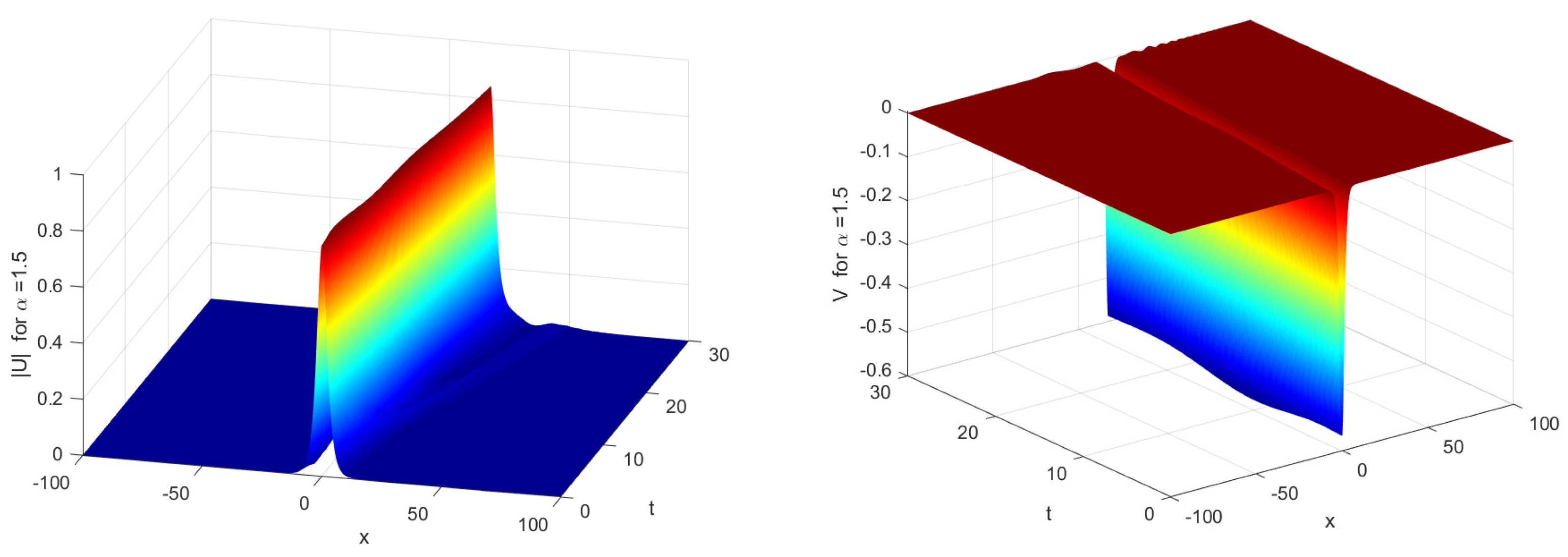
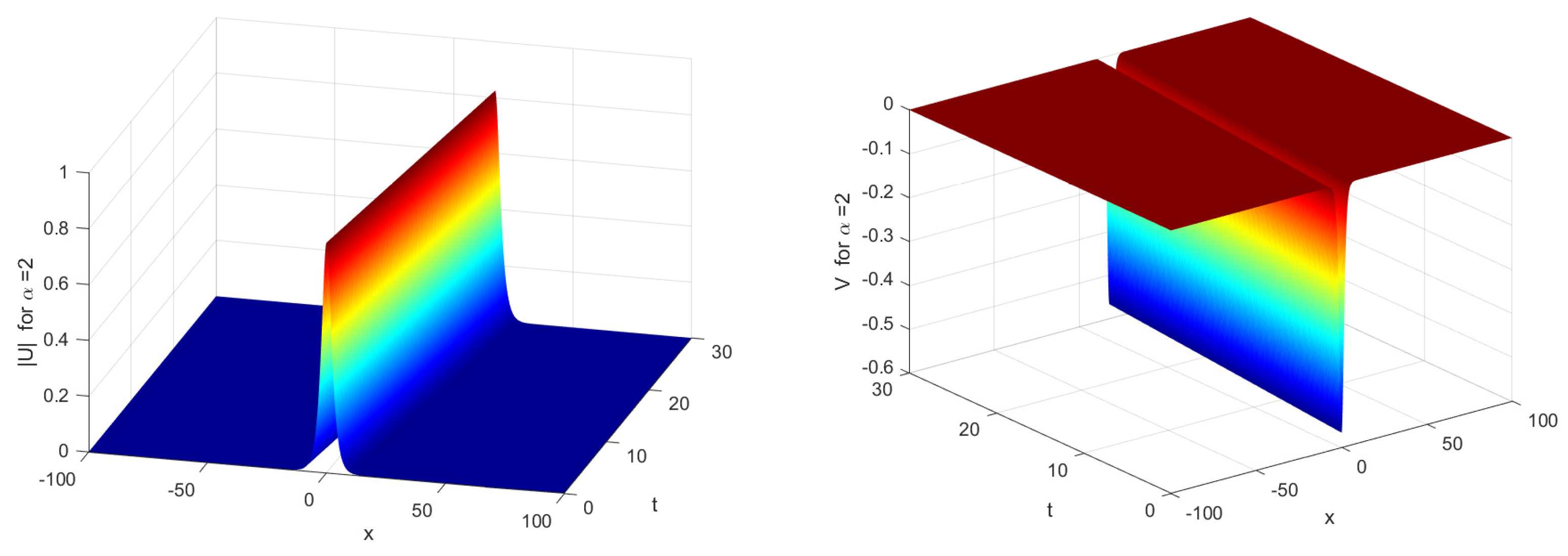
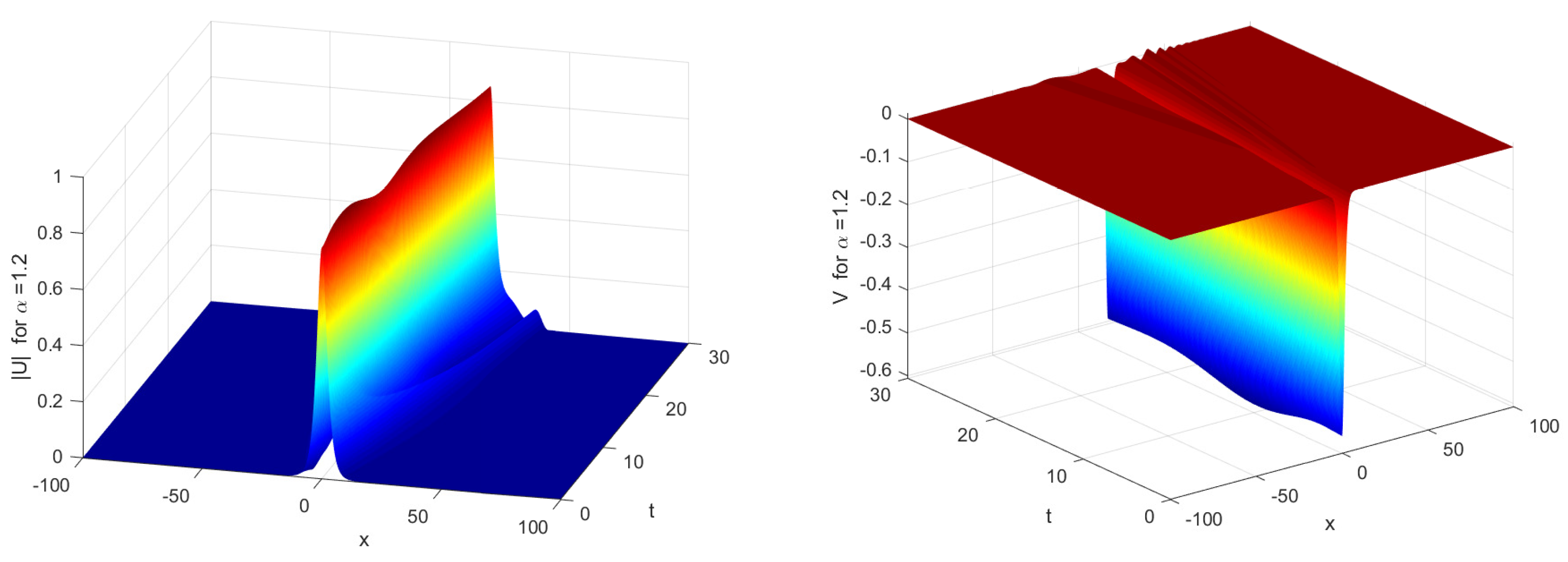
Next, we simulate the solitary wave solution with , , , and . Figure 1, Figure 2 and Figure 3 depict the waveforms for and V at varying values. These figures demonstrate that variations in the order directly impact the shapes of the solitons. As decreases, small oscillations are observed near the solitary wave of and V, with the amplitudes of these oscillations in V being larger than those in . These characteristics mirror the numerical simulations of the space fractional Schrödinger system, which are utilized in physics to alter waveforms without altering nonlinearity and dispersion effects.
Figure 1.
The wave forms of the numerical solution for and V with .
Figure 2.
The wave forms of the numerical solution for and V with .
Figure 3.
The wave forms of the numerical solution for and V with .
Finally, we present a numerical comparison between our scheme (26)–(30) and Scheme I from [36]. Table 8 lists the errors and computational times for both schemes with different values of . Clearly, our scheme provides a more accurate solution than Scheme I in [36], with only a slightly higher computational time cost.
Table 8.
The comparison of errors and CPU time at with and .
5. Conclusions
In this paper, based on the compact difference approach, we derived a novel conservative numerical algorithm for solving the space fractional coupled Schrödinger–Boussinesq system. The conservative property, boundedness, solvability, and convergence of the numerical solution are evidenced. Finally, numerical experiments for different fractional-order illustrated that the derived algorithm can guarantee conservation and convergent with order . The results presented in this paper are applicable for numerical solutions to the classical coupled Schrödinger–Boussinesq system. In further work, we will try to discuss more complex and higher-dimensional fractional partial differential equations.
Author Contributions
Conceptualization, Y.S. and R.Y.; formal analysis, Y.S.; funding acquisition, Y.S. and R.Y.; investigation, Y.S. and R.Y.; validation, Y.S. and T.L.; and writing—original draft, Y.S. and T.L. All authors have read and agreed to the published version of the manuscript.
Funding
This research was funded by the Innovation Foundation of Hebei University of Engineering (SJ2401002097), the National Natural Science Foundation of China (12201199), the Natural Science Foundation of the Department of Education of Hunan Province (2022JJ40021), and the Educational Department of Hunan Province of China (21B0722).
Data Availability Statement
Data are contained within the article.
Acknowledgments
The authors are grateful to the reviewers for their valuable comments and suggestions.
Conflicts of Interest
The authors declare no conflict of interest.
References
- Guo, B. The global solution of the system of equations for complex Schrödinger field coupled with Boussinesq type self-consistent field. Acta Math. Sin. 1983, 26, 295–306. (In Chinese) [Google Scholar] [CrossRef]
- Guo, B. Initial boundary value problem for one class of system of multidimensional nonlinear Schrödinger–Boussinesq type equations. J. Math. Res. Expo. 1988, 8, 61–71. [Google Scholar]
- Banquet, C.; Ferreira, C.F.; Villamizar-Roa, E.J. On the Schrödinger–Boussinesq system with singular initial data. J. Math. Anal. Appl. 2013, 400, 487–496. [Google Scholar] [CrossRef]
- Esfahani, A.; Pastor, A. Well-posedness and orbital stability of traveling waves for the Schrödinger–Boussinesq system. Nonlinear Anal. Real 2015, 22, 206–218. [Google Scholar] [CrossRef]
- Liu, T. Porosity reconstruction based on biot elastic model of porous media by homotopy perturbation method. Chaos Soliton. Fract. 2022, 158, 112007. [Google Scholar] [CrossRef]
- Liu, T. Parameter estimation with the multigrid-homotopy method for a nonlinear diffusion equation. J. Comput. Appl. Math. 2022, 413, 114393. [Google Scholar] [CrossRef]
- Yao, R.; Li, Z. Exact explicit solutions of the nonlinear Schrödinger equation coupled to the Boussinesq equation. Acta Math. Sci. 2003, 23B, 453–460. [Google Scholar] [CrossRef]
- Kumar, D.; Kaplan, M. Application of the modified Kudryashov method to the generalized Schrödinger–Boussinesq equations. Opt. Quant. Electron. 2018, 50, 329. [Google Scholar] [CrossRef]
- Bilige, S.; Chaolu, T.; Wang, X. Application of the extended simplest equation method to the coupled Schrödinger–Boussinesq equation. Appl. Math. Comput. 2013, 224, 517–523. [Google Scholar] [CrossRef]
- Deng, X. Exact solitary and periodic wave solutions for the coupled Schrödinger–Boussinesq equation. Optik 2017, 136, 312–318. [Google Scholar] [CrossRef]
- Huang, L.; Jiao, Y.; Liang, D. Multi-symplectic scheme for the coupled Schrödinger–Boussinesq equations. Chin. Phys. B 2013, 22, 070201. [Google Scholar] [CrossRef]
- Liao, F.; Zhang, L.; Wang, S. Numerical analysis of cubic orthogonal spline collocation methods for the coupled Schrödinger–Boussinesq equtions. Appl. Numer. Math. 2017, 119, 194–212. [Google Scholar] [CrossRef]
- Oruç, Ö. A local radial basis function-finite difference (RBF-FD) method for solving 1D and 2D coupled Schrödinger–Boussinesq (SBq) equations. Eng. Anal. Bound Elem. 2021, 129, 56–66. [Google Scholar] [CrossRef]
- Li, M. Cut-off error splitting technique for conservative nonconforming VEM for N-coupled nonlinear Schrödinger–Boussinesq equations. J. Sci. Comput. 2022, 93, 86. [Google Scholar] [CrossRef]
- He, Y.; Chen, H. Efficient and conservative compact difference scheme for the coupled Schrödinger–Boussinesq equations. Appl. Numer. Math. 2022, 182, 285–307. [Google Scholar] [CrossRef]
- Yan, J.; Zheng, L.; Lu, F.; Zhang, Q. Efficient energy-preserving methods for the Schrödinger–Boussinesq equation. Math. Meth. Appl. Sci. 2022. early view. [Google Scholar] [CrossRef]
- Tian, J.; Sun, Z.; Liu, Y.; Li, H. TT-M finite element algorithm for the coupled Schrödinger–Boussinesq equations. Axioms 2022, 11, 314. [Google Scholar] [CrossRef]
- Yang, Y.; Sun, Z.; Liu, Y.; Li, H. Structure-preserving BDF2 FE method for the coupled Schrödinger–Boussinesq equations. Numer. Algorithms 2023, 93, 1243–1267. [Google Scholar] [CrossRef]
- Almushaira, M. Efficient eighth-order accurate energy-preserving compact difference schemes for the coupled Schrödinger–Boussinesq equations. Math. Methods Appl. Sci. 2023, 46, 17199–17225. [Google Scholar] [CrossRef]
- Laskin, N. Fractional quantum mechanics and Lévy path integrals. Phys. Lett. A 2000, 268, 298–305. [Google Scholar] [CrossRef]
- Laskin, N. Fractional Schrödinger equation. Phys. Rev. E 2002, 66, 056108. [Google Scholar] [CrossRef]
- Macías-Díaz, J.E.; Hendy, A.S.; De Staelen, R.H. A compact fourth-order in space energy-preserving method for Riesz space-fractional nonlinear wave equations. Appl. Math. Comput. 2018, 325, 1–14. [Google Scholar] [CrossRef]
- Wang, P.; Huang, C. An energy conservative difference scheme for the nonlinear fractional Schrödinger equation. J. Comput. Phys. 2015, 293, 238–251. [Google Scholar] [CrossRef]
- Wang, P.; Huang, C. An implicit midpoint difference scheme for the fractional Ginzburg-Landau equation. J. Comput. Phys. 2016, 312, 31–49. [Google Scholar] [CrossRef]
- Han, L.; Zhang, J.; Guo, B. Global well-posedness for the fractional Schrödinger–Boussinesq system. Commun. Nonlinear Sci. Numer. Simulat. 2014, 19, 2644–2652. [Google Scholar] [CrossRef]
- Alzahrani, A.B.M. Numerical analysis of nonlinear coupled Schrödinger-KdV system with fractional derivative. Symmetry 2023, 15, 1666. [Google Scholar] [CrossRef]
- Alzahrani, A.B.M.; Alhawael, G. Novel computations of the time-fractional coupled Korteweg-de Vries equations via non-singular kernel operators in terms of the natural transform. Symmetry 2023, 15, 2010. [Google Scholar] [CrossRef]
- Noor, S.; Alotaibi, B.M.; Shah, R.; Ismaeel, S.M.E.; El-Tantawy, S.A. On the solitary waves and nonlinear oscillations to the fractional Schrödinger-KdV equation in the framework of the Caputo operator. Symmetry 2023, 15, 1616. [Google Scholar] [CrossRef]
- Noor, S.; Hammad, M.A.; Shah, R.; Alrowaily, A.W.; El-Tantawy, S.A. Numerical investigation of fractional-order Fornberg-Whitham equations in the framework of Aboodh transformation. Symmetry 2023, 15, 1353. [Google Scholar] [CrossRef]
- Liu, T.; Shateyi, S. Efficient fourth-order weights in Kernel-Type methods without increasing the stencil size with an application in a time-dependent fractional PDE problem. Mathematics 2024, 12, 1121. [Google Scholar] [CrossRef]
- Shi, Y.; Ma, Q.; Ding, X. Dynamical behaviors in a discrete fractional-order predator-prey system. Filomat 2018, 32, 5857–5874. [Google Scholar] [CrossRef]
- Shi, Y.; Ma, Q.; Ding, X. A New Energy-Preserving Scheme for the Fractional Klein-Gordon-Schrödinger Equations. Adv. Appl. Math. Mech. 2019, 11, 1219–1247. [Google Scholar]
- Shi, Y.; Ma, Q.; Ding, X. Conservative difference scheme for fractional Zakharov system and convergence analysis. Int. J. Comput. Math. 2021, 98, 1474–1494. [Google Scholar] [CrossRef]
- Shao, J.; Guo, B. The Cauchy problem for Schrödinger-damped Boussinesq system. J. Math. Anal. Appl. 2021, 494, 124639. [Google Scholar] [CrossRef]
- Ray, S. A novel approach with time-splitting spectral technique for the coupled Schrödinger–Boussinesq equations involving Riesz fractional derivative. Commun. Theor. Phys. 2017, 68, 301–308. [Google Scholar]
- Liao, F.; Zhang, L.; Hu, X. Conservative finite difference methods for fractional Schrödinger–Boussinesq equations and convergence analysis. Numer. Methods Partial Differ. Equ. 2019, 35, 1305–1325. [Google Scholar] [CrossRef]
- Ortigueira, M.D. Riesz potential operators and inverses via fractional centred derivatives. Int. J. Math. Math. Sci. 2006, 2006, 048391. [Google Scholar] [CrossRef]
- Sun, Z.Z. On the compact difference schemes for heat equation with Neumann boundary conditions. Numer. Methods Partial Differ. Equ. 2009, 25, 1320–1341. [Google Scholar] [CrossRef]
- Kirkpatrick, K.; Lenzmann, E.; Staffilani, G. On the continuum limit for discrete NLS with long-range lattice interactions. Commun. Math. Phys. 2013, 317, 563–591. [Google Scholar] [CrossRef]
- Hardy, G.; Littlewood, J.; Polya, G. Inequalities; Cambridge University Press: London, UK, 1952. [Google Scholar]
- Sun, Z.; Gao, G. A Finite Difference Method for Fractional Differential Equations; Science Press: Beijing, China, 2015. [Google Scholar]
- Sun, Z. Numerical Methods of the Partial Differential Equation, 3rd ed.; Science Press: Beijing, China, 2022. [Google Scholar]
- Zhou, Y.L. Application of Discrete Functional Analysis to the Finite Difference Method; International Academic Publishers: Beijing, China, 1991. [Google Scholar]
Disclaimer/Publisher’s Note: The statements, opinions and data contained in all publications are solely those of the individual author(s) and contributor(s) and not of MDPI and/or the editor(s). MDPI and/or the editor(s) disclaim responsibility for any injury to people or property resulting from any ideas, methods, instructions or products referred to in the content. |
© 2024 by the authors. Licensee MDPI, Basel, Switzerland. This article is an open access article distributed under the terms and conditions of the Creative Commons Attribution (CC BY) license (https://creativecommons.org/licenses/by/4.0/).