Abstract
Many immigrants have risked their lives searching for a better future by crossing the Mediterranean Sea or the Atlantic Ocean. The Canary Islands became the centre of another emerging humanitarian and human rights crisis at Europe’s frontier in 2020. The study aims to analyse whether attitudes towards immigrants are affected by territories close to these humanitarian crises. To this end, the study is based on previous studies using a Fuzzy-Hybrid TOPSIS method to analyse attitudes toward immigrants. The synthetic indicator will be built upon a set of eight indicators that proxy the ethnic, economic, cultural, and religious threats experienced by the citizens. The International Social Survey Program (ISSP) dataset for the year 2013 for six countries, namely Belgium, Germany, Spain, France, United Kingdom, and Portugal, will be used. Results show that the attitude toward immigrants is affected by the territorial dimension as classified by the nomenclature of territorial units for statistics at NUTS2 and NUTS3 levels, and that attitudes are very different between those of some of the archipelagos and islands considered in the study. In particular, our results point out a sort of duality between the Balearic Islands—the most open territory toward immigrants, and Corse—the least open territory toward immigrants.
Keywords:
attitudes toward immigrants; Europe; island regions; International Social Survey Program (ISSP); Fuzzy-Hybrid TOPSIS MSC:
03E72
1. Introduction
In recent years, migration flows have been growing in the Mediterranean Sea and the Atlantic Ocean. Southern European islands have increasingly been a port of arrival for migrants [1,2]. This phenomenon has developed an important public and academic debate on the attitude towards immigrants. Many scholars argue that the anti-immigrant sentiment can depend on the country and socioeconomic characteristics [3,4,5].
Despite the scientific academic advances in the study of attitudes towards immigrants (ATI) and their related methods, the literature confirms that Confirmatory Factor Analysis (CFA) and Structural Equation Modelling (SEM) have been the most frequently adopted approaches to study immigration attitudes. These methods are based on measurement models in which latent variables are obtained using econometric models adapted to the observed elements [6,7].
However, other methodological approaches that have been used in different fields are less common. This study aims to introduce one of these less-common methods in the field of social sciences, the Fuzzy-Hybrid TOPSIS. The approach has been applied in other disciplines, leading to interesting findings [8,9,10]. The data are extracted from the International Social Survey Program (ISSP) and the analysis of the attitudes toward immigration was conducted for six European countries, considering the regions at NUTS2 and NUTS3 levels. First, country-level research is conducted. Then, the paper analyses ATI across different socioeconomic characteristics, such as religion, age, income, citizenship, gender, education, work status, and political orientation. As a last step, ATI across regional territories is analysed in order to detect which areas present more positive attitudes toward immigrants.
The paper complements other studies [11,12,13,14,15] using a new approach in the field that has not been commonly used. Therefore, our study will serve as a guideline to apply a new quantitative method based on fuzzy logic and expand the literature of studies on attitudes toward immigrants at the territorial level.
2. Theorical Background
The anti-immigration and exclusionary sentiment of immigrants derives from a perception of the threat to the natives. This threat affects the social, cultural, and institutional status of a country’s society [3,16].
Scholars have attributed negative attitudes towards immigrants to various individual factors, such as religion, political orientation, citizenship, or economic status [3,4,15,16,17]. Martín and Indelicato [1,5] affirm that openness toward immigrants can depend on the socio-economic characteristics of citizens. They focused on a division of Europe into the most open countries to immigration, i.e., those of central and northern Europe, and those that have shown more hostility to immigration (Eastern Europe). Furthermore, they found religion, education, and age as the main determinants of attitudes towards immigrants. At the country level, Davidov and Semyonov [18] argue that anti-immigration sentiments are shaped by terrorist events, the social and political climate of institutions, number of immigrants, and integration policies.
In the global context of immigration, studying the phenomenon at a regional level is arousing much interest among scholars [12,13,14,15,19]. Dirksmeier (2021) states that although regionalism per se does not influence the feeling of hostility towards immigrants, local economic disparities may accentuate a trend of negative attitudes towards immigrants.
On the other hand, Markaki and Longhi [14] affirm that anti-immigrant sentiment is a regional factor rather than a national one. They focus on the study of attitudes towards immigrants in a local context, analysing the impact of regional characteristics on anti-immigrant sentiment. They conclude that regional unemployment and high levels of immigration from outside the EU negatively affect natives’ attitudes towards immigrants. Although the economic level does not particularly determine anti-immigrant sentiment among regions, the characteristics of immigrant populations are a critical factor in the construction of these sentiments [14].
The relationship between ethnic regional sentiment and anti-immigrant attitudes has been studied by Escandell and Ceobanu [15]. They explain that at the aggregate level, the results show that where there are high levels of feeling of regionalism, there are often high levels of exclusion of immigrants. Thus, they trace individual prejudice to the collective values of specific regions. Similarly, Sanjay Jeram et al. [20] find that hostile attitudes towards immigration can be masked under the umbrella of regionalism or regional identity.
Eger and Breznau [11] shifted the focus of the analysis from national-level attitudes towards immigration to the impact of immigration on regional-level welfare allocation attitudes. In other words, while the literature focuses on a transnational analysis of anti-immigration attitudes, Eger and Breznau [11] examine the contextual determinants of anti-immigrant sentiment in European regions. In particular, they address whether and to what extent the size of the region’s foreign-born population has reduced support for national welfare state programs. They analysed 114 regions and concluded that although the percentage of immigrants in the region has reduced support for generous welfare state policies, immigration itself has not increased its opposition to the social rights of immigrants in the regions [18]. Karreth et al. [13] show that locals living in regions with traditionally high levels of immigration tend to be more open to immigrants. However, recent increases in immigration and immigration levels in socially “racially diverse” and economically less developed regions of Europe are generally associated with a lower acceptance of immigration, but only among natives who vote for right-wing parties [13]. Dalle Nogare et al. [19] presented a cross-country analysis across Italian territories and found that the increase in the population support to some anti-immigration parties may be negatively correlated with the presence of public policies that are addressed to immigrants’ integration, such as free or discounted access to museums.
Thus, anti-immigrant sentiment has increased in the last few years in a regional context. Researchers have also focused on the peculiar context of island regions [21,22,23]. For example, in recent years, there have been demonstrations against the “invasion” of immigrants in the Canary Islands. The motto of these demonstrations proclaimed the islanders’ right to have their own territory “free of blood” and to “be saved from invasion” [23]. Similarly, in Corsica, the population feels a loss of identity and accuses the institutions of this loss as they feel abandoned because of the massive immigration from North Africa. This fact has fuelled in the Corsican islanders an ever-larger increase in the negative attitudes toward immigrants [22]. The author attributes the Corsican anti-immigrant sentiment to a crumbling economic and social situation, which is correlated with a loss of identity and generates an increase in racism and xenophobia.
On the contrary, after years of emigration, in recent years, the Balearic Islands in Spain have experienced a significant increase in new citizens. Immigrants come from central and northern European countries and do not seek economic stability, and they are not even fleeing a war. Following Provenzano [24], there is a nexus between migration and tourism flows. Immigrants to the Balearic Islands are often citizens that at a first glance were attracted by the archipelago because of tourism and then have returned as immigrants. Therefore, this has not caused economic and cultural instability, and consequently, the Balearic attitudes towards immigrants are positive [21].
3. Data
This study uses the International Social Survey Program (ISSP) dataset for 2013. ISSP is a cross-national study on diverse topics relevant to social sciences. Many scholars have adopted the ISSP dataset to study attitudes toward immigrants [11,12,25]. The data we consider cover six European countries, namely Belgium, Germany, Spain, France, the UK, and Portugal. Due to the different regional level of the data provided by the ISSP dataset (2013), Belgium, Germany, Portugal, and Spain will be analysed at the NUTS2 level; France at the NUTS3 level; and the UK at the NUTS1 level. The choice of countries allows for analysing the differences between continental regions and islands in Europe, in line with the main objective. In addition, countries including separatist territories were selected to broaden the comparison.
Nine thousand sixty-six was the total number of individuals interviewed, distributed across countries as reported in Table 1. There were more females (51.67%) than males (48.24%). The vast majority of the sample was represented by natives (92.69%) compared to foreign citizens (6.43%). Almost 50% of the sample was in paid work, while only 4.47% was studying. Twenty-four-year-old or younger citizens represented the smallest age group in the sample (7.70%), whereas the 45–54 age group represented the biggest one (18.94%). The sample was almost equally distributed across medium incomes, and the highest and lowest income categories represented only 0.87% and 2.10% of the sample, respectively. More than 60% of the sample preferred that newcomers adapt to the traditions of the larger society. From the political views side, more than 55% was moderate, in which conservatives represented 21.97%, left-centre citizens 23.90%, and liberals 9.20% and the extremist wings, far-left and far-right, 4.40% and 2.69%, respectively. Finally, the majority of the respondents were Catholic (44.50%) or agnostic (31.50%).
Table 1.
Descriptive statistics 1.
The ISSP National Identity module contains eight items that concern the immigration issue. As in [26], the items chosen to measure the attitudes toward immigrants (ATI) are:
- 1.
- Immigrants increase crime rates;
- 2.
- Immigrants take jobs away from people born in [Country];
- 3.
- Legal immigrants should have the same rights;
- 4.
- Immigrants are generally good for the economy;
- 5.
- Immigrants bring new ideas and cultures;
- 6.
- Immigrants undermine the culture;
- 7.
- Illegal immigrants should be excluded;
- 8.
- Legal immigrants should have equal access to education.
Each of the items were evaluated through a 5-point Likert scale, where one refers to “Agree strongly” and five to “Disagree strongly”. Items three, four, five, and eight were recoded reversely in order to obtain that the higher scores express a positive attitude towards immigrants.
4. Methodology
4.1. Fuzzy-Hybrid TOPSIS Approach
In this study, a hybrid method based on a fuzzy approach and technique of similarity to ideal solution (TOPSIS) is used to measure the citizens’ attitudes toward immigrants. This approach has had a growing interest in many fields, such as the hotel industry [27], education [8], green energy [28], logistics [29], social sciences [30], agriculture [31], and healthcare [31].
The vagueness associated with subjective assessments is a problem when researchers look for a way to synthesize information for the sake of applying econometric or mathematical models. Fuzzy logic models are an appropriate tool for partially solving such vagueness, which is related with linguistic terms [32,33]. These models handle ambiguous information by deconstructing the concept of objective information to a degree of different strengths. The degree of intensity is conceptualized by a membership function, also called characteristic functions, discriminant functions, or indicator functions [34].
Let be a set of real numbers , that is, ; a fuzzy set in is a set of ordered pairs, where is a membership function; and . Thus, the membership function is used as a proxy for the relative truth that exists in the statements [35,36]. The set is known as the universe of discourse of the fuzzy set theory and emerged as a generalization of the classical set theory.
Fuzzy TOPSIS consists of 6 consecutive steps. First, the ISSP’s answers will be converted into Triangular Fuzzy Numbers (TFNs). As in Salih et al. [37], it has been considered that TFNs are valid tools to deal with the vagueness and uncertainty of information.
Thus, a triplet of real numbers is considered to assign each scale point to a TFN, as follows:
The information provided by the scale will be converted into TFNs in a universe of discourse within the interval [0, 100]. In order to perform no-loss generalization and clarity information, 5 intervals were chosen to represent the original 5-scale points: (1) Disagree strongly (0, 0, 30); (2) Disagree (20, 30, 40); (3) Neither agree nor disagree (30, 50, 70); (4) Agree (60, 70, 80); and (5) Agree strongly (70, 100, 100). For each country and for each region, the information has been aggregated through the Fuzzy Set Logic Algebra, and the average fuzzy number is given by:
where stand for the multiplication of a scalar and a TFN, the internal addition of TFNs [38]. Thus, we obtain a matrix of TFNs of each analysed group, which contains a lot of information that is difficult to analyse. Therefore, in agreement with Kumar [27], the matrix is defuzzified into a matrix of real and clear information since the uncertainty and vagueness of the information have been adequately managed. Crisp values are then obtained through the weighted average of the 3-tuple calculated as follows:
4.2. TOPSIS Steps
Once the matrix of crisp values has been obtained, the following steps concern the calculation of the TOPSIS index, which measures attitudes towards immigrants (ATI). Following Hwang and Yoon [39], the ideal positive and negative solutions are calculated as follows:
where = 1 to m (groups), = 1 to J (criteria), and are crisp values. Therefore, the positive ideal solution indicates the maximum value of the observations indicated by the sample, while the negative ideal solution is the minimum value. All criteria are considered as benefit criteria, as higher values represent more positive values of ATI [40].
The next step is the measurement of the distance of each group with the ideal solutions. To this end, the Euclidean distance between each observation group and the ideal solutions are computed as follows:
The ATI indicator, which measures the attitudes of citizens towards immigrants, is given by the ratio of the negative Euclidean distance and the sum of the positive and negative Euclidean distances. Mathematically, this ratio is given by:
The group observation is more open toward immigrants when ATI is closer to one. Therefore, the groups are classified using the values obtained from the indicator, in descending order, to find which population group has the most positive attitudes towards immigrants. The ATI indicator logic is clear: the higher the indicator is, the closer it is to the positive ideal solution and the further away from the negative one [41].
Finally, the elasticity of the index for each group j concerning each of the eight criteria i included in ATI is calculated. These values measure the sensitivity of ATI for each of the groups studied to each variation of each criterion. Elasticity, therefore, provides a measure of how each criterion shapes the indicator. Mathematically, elasticities are given by:
5. Results
In this section, we detail the results provided by the Fuzzy Hybrid approach. First, the groups that represent the positive ideal solution and the negative ideal solution will be described. Then, the ATI at the country level will be detailed. Finally, the section ends by showing the ATI at the regional level, with a particular focus on comparing the differences between capital regions and island territories.
5.1. Attitudes toward Immigrants
The aforementioned methodology was applied to ISSP data for the categories described in Table 1 and at the territorial level (NUTS2 and NUT3) for the six countries considered. The positive and negative ideal solutions, respectively, indicate the groups with the maximum and minimum crisp values for each ISSP indicator. This means that each group that represents the positive ideal solutions shows the maximum defuzzified value. The contrary happens for groups that are in the negative ideal solutions.
Table 2 shows the results of the ideal solutions for each indicator included in the ATI latent variable. Generally, both for positive and negative ideal solutions, the ideal solutions are represented by territories and political orientations. Residents of the French district of Calvados represent those who do not associate immigration with the crime rate, whereas far-right citizens idealize that the immigrant increases the criminal threat. The inhabitants of the French Occitan province of Gers do not perceive the immigrant as a threat to their job, while in the province of Correze, the immigrant is perceived as a threat to the labour market. The Spanish community of Navarre represents the group of those who support the equality of rights between natives and immigrants. At the same time, the French of Lot prefer that immigrants have fewer rights than natives. In the province of Hautes-Pyrenees, the immigrant is considered a benefit to the economy, while far-right citizens associate immigration with an economic downfall.
Table 2.
Ideal solutions.
Furthermore, citizens who vote for right-wing parties support the idea that immigrants do not bring ideas and undermine the culture of the country, unlike the Orthodox and the residents of Tarn-et-Garonne. Residents of the northern French province of Ardennes represent those who prefer legal immigration and are opposed to illegal immigration. They prefer legal immigrants having access to education as much as natives, but they would like to expel illegal immigrants. On the contrary, the French from Ariege are more open to illegal immigrants, and those from Lozere are not in favour of educational equality between natives and immigrants.
Once the ideal solutions have been obtained, the distances between the groups of observations and the ideal solutions are measured. Thus, ATI for each group has been calculated (Table 3). At the country level, the results show that the Iberian Peninsula shows more positive attitudes towards immigrants than the other countries in the group under analysis. On the contrary, the UK and Belgium show negative attitudes towards immigrants. France and Germany represent both the intermediate ATI.
Table 3.
Attitudes toward immigrants.
At a subsequent step, the ATI for some socio-economic characteristics have been measured. The results show that citizens with more positive attitudes toward immigrants are foreign ones, whereas natives are less open toward immigrants. Those who prefer newcomers to adapt to the traditions of the country show negative ATI values. Instead, the citizens who support the power of the European Union are more open to immigrants. Religion is a determinant of the attitudes toward immigrants too. Muslims and Orthodox show a more positive ATI, whereas Christian religions show low values of attitudes towards immigrants. Levels of education, employment status, age, and political orientation are also decisive in being associated with attitudes towards immigrants. Those with a master’s or doctorate, in student status, younger age groups, and far-left voters show a more positive attitude. On the other hand, individuals with primary or lower educational levels, retirees or the disabled, older age groups, and citizens of a conservative or far-right political orientation are less open toward immigrants. Finally, the results are less conclusive with respect to other variables, such as country pride, gender, work status, attendance at religious events, and income.
5.2. Differences across Territories
Table 4 shows the results of the ATI at the regional and provincial levels (NUTS2 and NUTS3) of the countries analysed. The results are sorted in descending order to rank the ATI at the regional level. Thus, the regions or provinces in the first positions of the first column on the left of the table are the areas with the most positive attitudes towards immigrants. Meanwhile, the territories with more negative attitudes toward immigrants are in the last positions of the last column on the right.
Table 4.
Regional ATI.
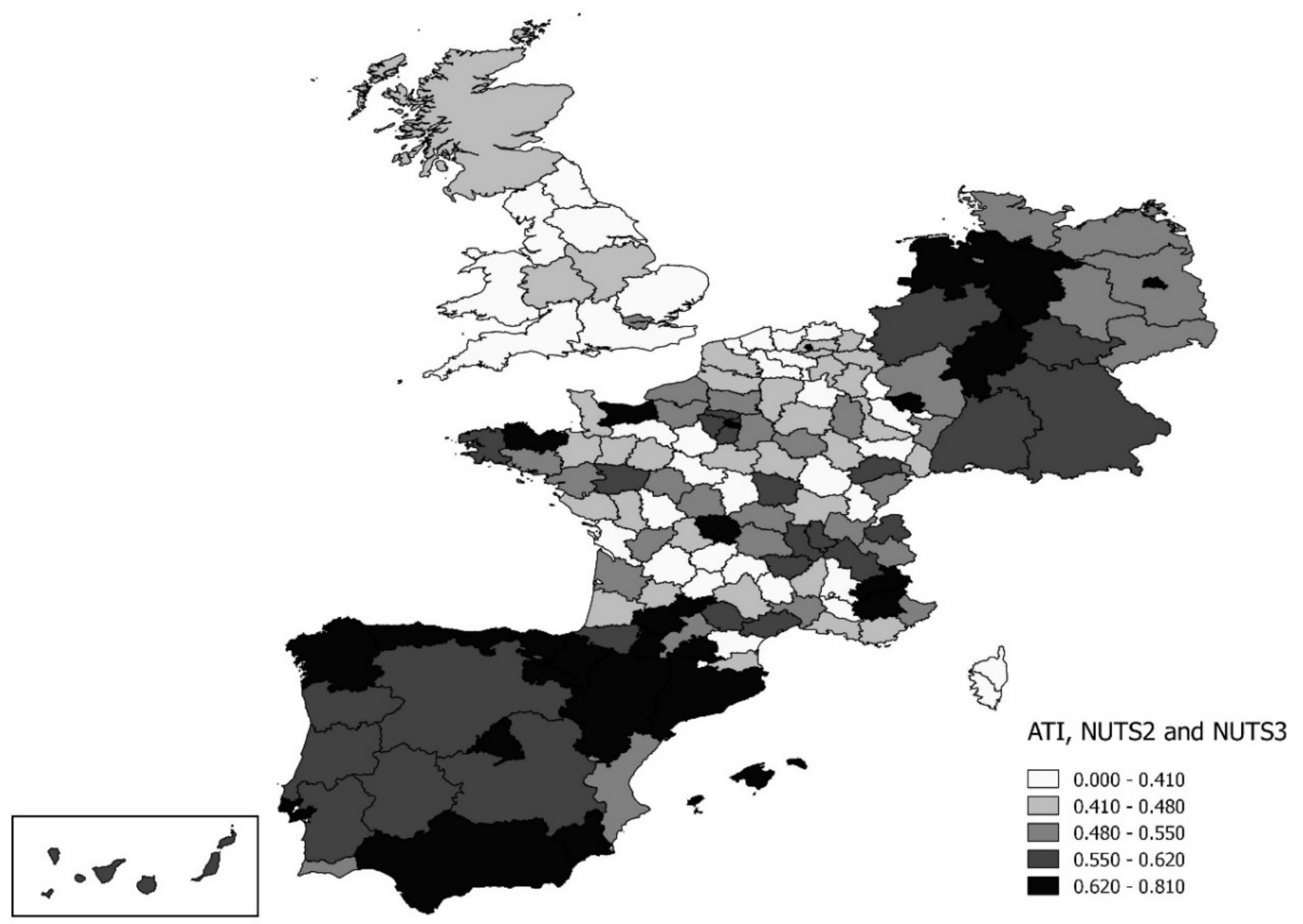
At the regional level, the Spanish territories are located in the first part of Table 4, that is, among those with the most positive attitude. The Balearic Islands and the community of Navarre are the first two regions in the ATI ranking of all the regions and provinces considered in this study. There are also the Catalans, Madrid, Murcia, and the Basque country among the most open to immigrants. Therefore, the regions with a strong regional identity feeling have the highest ATI values. Even if the Spanish regions are all in the first half of the ATI ranking, the Valencian community is the region with the worst value of attitudes towards immigrants compared to other compatriots.
Although Portugal has high ATI values at the country level, the Portuguese territories are not present in the top positions of the ATI ranking at NUTS2 and NUTS3 levels. The French provinces are the most heterogeneous ones. The territories most open to immigrants are the southwestern French provinces and the territories close to Paris. Citizens residing in Hautes-Pyrenees, Hautes-Alpes, Hauts-de-Seine, and Creuse are the French with a better perception of immigrants. At the same time, the central and northern provinces, Eure-et-Loire, Correze, and Cantal, show a more negative attitude towards immigrants. Despite this, no reference patron divides the territories among France, even if the results reveal that the territories with regionalist movements, such as Brittany and the French area of the Basque country, present more positive attitudes toward immigrants.
German regions are divided into two macro areas: the former East Germany and the former West Germany. It is evident from the results that the formerly socialist territories are more hostile to immigrants than the former Federal Republic of Germany. The results show that the most economically advanced regions report the most positive ATI values, such as Hessen, Saarland, and Hamburg. The regions adverse to immigration are the eastern regions of Brandenburg, Sachsen, and Mecklenburg.
The results show that the Belgian and British regions have the lowest ATI values. The Belgian case shows that the western Flamenco region (West-Vlaanderen) is the territory with the lowest ATI value in Belgium. All the other Belgian regions are hostile towards immigrants, except for the Namur region and the capital region. Even more hostile are the British towards immigrants. The northern regions of England and Wales have the worst indicators of attitudes toward immigrants in the UK. The only region with slightly more positive attitudes toward immigrants is the capital region of London.
Furthermore, Table 4 also focuses on the capital regions of our six countries under analysis. The results have been summarised in Table 5 to study the capital effect more easily. In this context, it is evident that there could be a capital effect between the regions analysed, as their ATI indicator is always above the respective national average. The value of Berlin’s attitude towards immigrants is at least 11 points above the German ATI (11 for West Berlin and 14 for East Berlin). The seat of the French government, Paris, has an ATI of 0.72, even 20 points higher than the national ATI. Madrid’s Spanish capital has an ATI value of 0.70, only two points above the national average, while Lisbon is eight points above the ATI Portuguese average. Brussels is much more open to immigrants than other Belgian regions, with ATI values of 0.65, 21 points above the ATI of Belgium. The last capital in the order of ATI is London, the capital region most hostile to immigrants. Thus, it is in line with the rest of the country, although compared to the British average, it ranks 11 points above.
Table 5.
ATI Capital regions.
We now want to provide a comparison between island regions and continental regions. Regarding island regions, Table 6 summarises the values of the attitudes towards immigrants from the Balearic Islands, the Canary Islands, and Corsica. The regions have been sorted in order of ATI values. Regional data on the number of immigrants in the regions were extracted from the respective national statistical institutes (Spain: INE; France: INSEE) to provide a broader overview of ATI in insular territories. The Balearic Islands are the island region with both the highest indicators, and it has a high immigration rate (20%) and the best ATI value of all regions. The Canary Islands have more moderate openness towards immigrants and an immigration rate of 14%. The results highlight a dual behaviour between the Balearic Islands and Corsica. These two island regions exhibit an opposite behaviour, as Corsica has the lowest immigration rate and a high hostility towards immigrants.
Table 6.
ATI and immigration rate in Corsica, Balearic, and Canary Islands.
Finally, the elasticities of ATI by Islands regions and capital regions were calculated (Table 7). The elasticity analysis was studied because it provides interesting insights into the criteria that affect more ATI in each territory. In this study, the elasticities for each item of the capital and island regions were calculated. The ATI of the Balearic Islands is quite inelastic to all criteria, even if the criteria concerning equality of rights and access to education between natives and immigrants have a more significant impact than other criteria. The same behaviour is repeated in the Canary Islands, but the criterion concerning the equality of rights has the most significant impact. The competition in the labour market, the perception of the economic threat of immigrants, and the equal access to education between natives and immigrants are criteria that have a significant impact on the Corsican ATI, and, interestingly, these three values are part of the five most elastic values that are analysed. The ATI is inelastic concerning all attributes as far as the capital regions are concerned. The criterion with the highest elasticity is the same rights between natives and immigrants, especially for Berlin-West and Paris.
Table 7.
Elasticities.
The five most inelastic pairs also show that three are observed in insular territories (Corse and Balearic Islands) and two in Berlin-East. The criteria involved were those of bringing new ideas and cultures, and illegal immigrants should be excluded.

6. Discussion
Now, the results presented above will be discussed highlighting that the more open citizens toward immigrants depend on some socioeconomic characteristics. This section explains which individual characteristics can have a positive or negative influence on ATI. Thus, an overview of why some regions are more or less open toward immigrants than others will be further discussed.
6.1. Pro-Immigrants Profiles
Previous studies have analysed the attitudes of citizens towards immigrants by country, religion, age, income, and education [1,3,5,11,13,18,42]. The socio-economic characteristics of individuals are seen as proxies of factors that affect anti-immigrant sentiments.
The study introduced a methodology not commonly used in the social sciences. The Fuzzy-Hybrid TOPSIS approach was recently introduced in attitudes toward immigrants by Martín and Indelicato [1]. The methodology is effective, as the results replicate other studies [18,26,43,44].
The analysis of the positive and negative ideal solutions shows that the maximum and minimum values expressed for each criterion are mainly represented by French territories and the political orientation of the extreme right. In particular, the criteria concerning the crime rate, the economy, and culture are negatively represented by the political orientation of the far right. In agreement with Creighton et al. [45], financial and economic crises, such as in the first decade of the 2000s, immediately impacted anti-immigrant sentiment. Especially among far-right citizens, the perception of economic and country safety threats arises when immigration increases [46,47].
At the country level, three areas of attitudes towards immigrants have been detected. The Iberian Peninsula is the most open territory towards immigrants; civic nationalist countries, France and Germany, present moderate attitudes towards immigrants; and, finally, the UK and Belgium represent the group of countries with anti-immigrant sentiments. Following McLaren and Johnson’s [48] work, what worries the British citizens is the impact of immigration on society. In this regard, the key factors requiring specific attention are the economy, crime, and symbols of British identity. Brits are concerned that immigration threatens the jobs of their compatriots, which in turn affects how attitudes towards immigrants are shaped. Furthermore, the British are concerned about the symbolic and cultural threats arising from mass immigration, such as perceived religious threats to emphasise non-British values and end communities outside the UK and threats to shared customs and lifestyles [48,49].
Religion is an essential determinant of anti-immigrant attitudes. The results show that citizens who profess minority religions in the countries analysed show more positive attitudes towards immigrants. For example, Muslims are the ones most in favour of immigration. This issue can be explained because Muslims are the ethnic minority and the largest share of immigrants to European countries. According to Marfouk [50], anti-immigrant sentiment is a more Islamophobic sentiment. Therefore, it is easy to think that Muslims show more positive attitudes toward immigration as solidarity.
On the contrary, Catholics display negative attitudes towards immigrants. According to Kerwin and Alulema [51], many Catholics do not align with Christian teachings, as they have negative feelings and attitudes towards immigrants. Following Ambrosini’s [52] work, the charitable activities of Catholics do not include activities toward immigrants because according to the priorities of many Catholics, the protection of migrants and refugees is a secondary or lower priority [51].
6.2. Capital Regions and Islands
Attitudes towards immigrants at the territorial level have been summarised in Figure 1. The first result that the study confirms is the capital effect of the six countries, which can be explained by the fact that European capitals are multicultural societies. The literature shows that multiculturalism tends to have beneficial effects on immigrant attitudes, but it can also be a detonator against immigration [53,54]. According to Mahfud et al. [55], multiculturalism is related to more positive attitudes towards immigration. They have shown that in the condition of multiculturalism, citizens perceive low feelings of threat and, therefore, less prejudice. Research among majority group members has shown that multiculturalism can promote positive relationships between groups, evoke resistance, and hinder harmony between groups [55]. This last result is supported by the findings of the British regions, as multiculturalism has resulted in an increased perception of the threat to Britain [48].
Figure 1.
ATI at the territorial level—our own elaboration.
This study obtains significant results at the island region level. There is a perfect duality between Corsica and the Balearic Islands, as the French island shows negative attitudes towards immigrants and the Balearics are more open to immigrants. One explanation may be the difference in the level of multiculturalism between the two regions, as the immigrant population in the Balearic Islands is 20%, while in Corsica, immigrants do not exceed 10%. In addition, it can be explained through the nexus between immigration and tourism [24,56,57].
Provenzano [24] shows that the tourist flow between the two countries is affected by the migration rate and vice versa. His findings suggest a positive relationship between tourism and immigration. In other words, the greater the number of migrants from one country to another, the greater the flow of tourists from the first country to the second. Therefore, the duality between the Balearic Islands and Corsica can be dictated by the differences in tourism policies. Provenzano [24] shows that the islands are characterized by a tourism development model that has favoured the construction of large hotels with a high average number of beds per structure, thus creating important and prominent tourist destinations. According to Capó et al. [56] and Ruggieri and Cal [57], the Balearic Islands is an archipelago that invests more in tourism, creating infrastructures and promoting tourist activity, while Corsica is an island region with the lowest levels of tourism. Thus, the differences between the Balearic Islands and Corsica can be explained by the fact that high levels of tourism cause high rates of immigration [24]. Thus, high levels of immigration build multicultural societies, which are societies that show more positive attitudes towards immigrants [55].
7. Conclusions
Attitudes towards immigrants (ATI) is a very studied topic at the academic level [3,4,5]. The issue of immigration is still a very hot topic in political and social debate. Researchers studying the ATI commonly use Confirmatory Factor Analysis (CFA) and Structural Equation Models (SEM), which have proven to be valid methodologies that are confirmed as efficient tools [11,26,42]. Despite this, the research does not seem to advance on a methodological level.
The study aimed to introduce a new methodology in this field of studies, namely the Fuzzy-Hybrid TOPSIS, which is not commonly used in the social sciences. The advantage of this approach is that it deals with the vague information provided by the Likert scale commonly used in social science questionnaires. The 2013 ISSP data from the National Identity form were extracted. Eight items were chosen to measure attitudes towards immigrants (ATI), such as Immigrants increase crime rates; Immigrants take jobs away from people born in [Country]; Legal immigrants should have the same rights; Immigrants are generally good for the economy; Immigrants bring new ideas and cultures; Immigrants undermine culture; Illegal immigrants should be excluded; and Legal immigrants should have equal access to education. The analysis was carried out at the country and territorial levels (NUTS2 and NUTS3).
The results confirm previous studies in the literature, giving an innovative approach by applying the methodology based on the fuzzy set theory. At the country level, the countries showing the highest ATI values are the countries of the Iberian Peninsula and Germany. At the same time, the United Kingdom and Belgium represent the group of countries with negative attitudes towards immigrants. At the territorial level, a capital effect is highlighted, as the capitals of the countries analysed tend to have more positive ATI than the average of the respective country. Finally, a duality between the Balearic Islands and Corsica has been pointed out. The Spanish archipelago, driven by the nexus between tourist and migratory flows [24], has built a multicultural society tolerant of immigrants [55], while Corsica, which has invested less in tourism, presents more hostile attitudes.
As with any other study, future research is needed to overcome some limitations such as: (1) a small number of countries were chosen; (2) only 2013 was considered; and (3) the analysis was carried out at an aggregate level, although the methodology allows the study at an individual level. Future research should first aim to introduce new ISSP versions after those of 2013 in the analysis providing more insights into the dynamic of ATI. Furthermore, second, it would be interesting to provide a more complete overview of Europe, introducing countries such as Italy, Austria, and other Eastern European countries. Thus, it will be possible to obtain interesting insights with respect to whether the territorial differences obtained in the study are more or less reinforced using a wide sample of countries between the North, West, East, and South of Europe. In addition, other econometrics models could be used to detect if some socioeconomic variables are important drivers or not on ATI formation.
Author Contributions
Conceptualization, J.C.M., A.I., and R.S.; methodology, J.C.M.; software, J.C.M., A.I., and R.S.; validation, J.C.M., A.I., and R.S.; investigation, J.C.M., A.I., and R.S; data curation, J.C.M. and A.I.; writing—original draft preparation, J.C.M., A.I., and R.S.; writing—review and editing, J.C.M., A.I., and R.S. All authors have read and agreed to the published version of the manuscript.
Funding
This research received no external funding.
Institutional Review Board Statement
Not applicable.
Informed Consent Statement
Informed consent was obtained from all subjects involved in the study.
Data Availability Statement
Data available on http://www.issp.org/data-download/by-topic/ (accessed on 15 June 2021).
Conflicts of Interest
The authors declare no conflict of interest.
References
- Martín, J.C.; Indelicato, A. A fuzzy-hybrid analysis of citizens’ perception toward immigrants in Europe. Qual. Quant. 2022. [Google Scholar] [CrossRef]
- King, R.; DeBono, D. Irregular Migration and the “Southern European Model” of Migration. J. Mediterr. Stud. 2013, 22, 1–31. [Google Scholar]
- Czymara, C.S. Attitudes toward Refugees in Contemporary Europe: A Longitudinal Perspective on Cross-National Differences. Soc. Forces 2021, 99, 1306–1333. [Google Scholar] [CrossRef]
- De Vreese, C.H. How changing conditions make us reconsider the relationship between immigration attitudes, religion, and EU attitudes. Eur. Union Polit. 2017, 18, 137–142. [Google Scholar] [CrossRef] [PubMed] [Green Version]
- Martín, J.C.; Indelicato, A. A DEA MCDM Approach Applied to ESS8 Dataset for Measuring Immigration and Refugees Citizens’ Openness. J. Int. Migr. Integr. 2021. [Google Scholar] [CrossRef]
- Meuleman, B.; Billiet, J. Measuring attitudes toward immigration in Europe: The cross–cultural validity of the ESS immigration scales. Ask. Res. Methods 2012, 21, 5–29. [Google Scholar]
- Thomsen, J.P.F.; Rafiqi, A. When does superficial intergroup contact reduce anti-foreigner sentiment? Negative contact as an essential condition. Int. J. Comp. Sociol. 2018, 59, 25–43. [Google Scholar] [CrossRef] [Green Version]
- Di Nardo, E.; Simone, R. A model-based fuzzy analysis of questionnaires. Stat. Methods Appl. 2019, 28, 187–215. [Google Scholar] [CrossRef] [Green Version]
- Palczewski, K.; Sałabun, W. The fuzzy TOPSIS applications in the last decade. Procedia Comput. Sci. 2019, 159, 2294–2303. [Google Scholar] [CrossRef]
- Cantillo, J.; Martin, J.C.; Román, C. A hybrid-fuzzy TOPSIS method to analyze the consumption and buying behavior of fishery and aquaculture products (FAPs) in the EU28. Br. Food J. 2020, 122, 3403–3417. [Google Scholar] [CrossRef]
- Eger, M.A.; Breznau, N. Immigration and the welfare state: A cross-regional analysis of European welfare attitudes. Int. J. Comp. Sociol. 2017, 58, 440–463. [Google Scholar] [CrossRef]
- Dirksmeier, P. The impact of regionalism on anti-immigrant attitudes: A multilevel international comparative study. Territ. Polit. Gov. 2021, 9, 1–21. [Google Scholar] [CrossRef]
- Karreth, J.; Singh, S.P.; Stojek, S.M. Explaining Attitudes toward Immigration: The Role of Regional Context and Individual Predispositions. West Eur. Polit. 2015, 38, 1174–1202. [Google Scholar] [CrossRef]
- Markaki, Y.; Longhi, S. What determines attitudes to immigration in European countries? An analysis at the regional level. Migr. Stud. 2013, 1, 311–337. [Google Scholar] [CrossRef] [Green Version]
- Escandell, X.; Ceobanu, A.M. Nationalisms and anti-immigrant sentiment in Spain. South Eur. Soc. Polit. 2010, 15, 157–179. [Google Scholar] [CrossRef]
- Sides, J.; Citrin, J. European opinion about immigration: The role of identities, interests and information. Br. J. Polit. Sci. 2007, 37, 477–504. [Google Scholar] [CrossRef] [Green Version]
- Dekeyser, E.; Freedman, M. Elections, Party Rhetoric, and Public Attitudes Toward Immigration in Europe. Polit. Behav. 2021. [Google Scholar] [CrossRef]
- Davidov, E.; Semyonov, M. Attitudes toward immigrants in European societies. Int. J. Comp. Sociol. 2017, 58, 359–366. [Google Scholar] [CrossRef] [Green Version]
- Dalle Nogare, C.; Scuderi, R.; Bertacchini, E. Immigrants, voter sentiment, and local public goods: The case of museums. J. Reg. Sci. 2021, 61, 1087–1112. [Google Scholar] [CrossRef]
- Jeram, S.; van der Zwet, A.; Wisthaler, V. Friends or Foes? Migrants and Sub-state Nationalists in Europe Sanjay. J. Ethn. Migr. Stud. 2016, 42, 1229–1241. [Google Scholar] [CrossRef] [Green Version]
- Salvà-Tomàs, P.A. Tourist development and foreign immigration in Balearic Islands. Rev. Eur. Migr. Int. 2002, 18, 87–101. [Google Scholar] [CrossRef] [Green Version]
- Vincenzini, N. Racisme Corse anti-maghrébin. Multitudes 2004, 19, 85. [Google Scholar] [CrossRef]
- Engelken-Jorge, M. The anti-immigrant discourse in tenerife: Assessing the lacanian theory of ideology. J. Polit. Ideol. 2010, 15, 69–88. [Google Scholar] [CrossRef]
- Provenzano, D. The migration–tourism nexus in the EU28. Tour. Econ. 2020, 26, 1374–1393. [Google Scholar] [CrossRef]
- Ceobanu, A.M.; Escandell, X. Comparative Analyses of Public Attitudes Toward Immigrants and Immigration Using Multinational Survey Data: A Review of Theories and Research. Annu. Rev. Sociol. 2010, 36, 309–328. [Google Scholar] [CrossRef] [Green Version]
- Grigoryan, L.K.; Ponizovskiy, V. The three facets of national identity: Identity dynamics and attitudes toward immigrants in Russia. Int. J. Comp. Sociol. 2018, 59, 403–427. [Google Scholar] [CrossRef]
- Kumar, H. Some recent defuzzification methods. Theor. Pract. Adv. Fuzzy Syst. Integr. 2017, 31–48. [Google Scholar] [CrossRef] [Green Version]
- Mohsin, M.; Zhang, J.; Saidur, R.; Sun, H.; Sait, S.M. Economic assessment and ranking of wind power potential using fuzzy-TOPSIS approach. Environ. Sci. Pollut. Res. 2019, 26, 22494–22511. [Google Scholar] [CrossRef]
- Liu, Y.; Li, L.; Tu, Y.; Mei, Y. Fuzzy topsis-ew method with multi-granularity linguistic assessment information for emergency logistics performance evaluation. Symmetry 2020, 12, 1331. [Google Scholar] [CrossRef]
- Indelicato, A.; Martín, J.C. Two Approaches to Analyze Whether Citizens’ National Identity Is Affected by Country, Age, and Political Orientation—A Fuzzy Eco-Apostle Model. Appl. Sci. 2022, 12, 3946. [Google Scholar] [CrossRef]
- Cagri Tolga, A.; Basar, M. The assessment of a smart system in hydroponic vertical farming via fuzzy MCDM methods. J. Intell. Fuzzy Syst. 2022, 42, 2–12. [Google Scholar] [CrossRef]
- Martínez, M.P.; Cremasco, C.P.; Gabriel Filho, L.R.A.; Braga Junior, S.S.; Bednaski, A.V.; Quevedo-Silva, F.; Correa, C.M.; da Silva, D.; Moura-Leite Padgett, R.C. Fuzzy inference system to study the behavior of the green consumer facing the perception of greenwashing. J. Clean. Prod. 2020, 242, 116064. [Google Scholar] [CrossRef]
- Behdioğlu, S.; Acar, E.; Burhan, H.A. Evaluating service quality by fuzzy SERVQUAL: A case study in a physiotherapy and rehabilitation hospital. Total Qual. Manag. Bus. Excell. 2019, 30, 301–319. [Google Scholar] [CrossRef]
- Martin, J.C.; Bustamante-Sánchez, N.S.; Indelicato, A. Analyzing the Main Determinants for Being an Immigrant in Cuenca (Ecuador) Based on a Fuzzy Clustering Approach. Axioms 2022, 11, 74. [Google Scholar] [CrossRef]
- Mamdani, E.H.; Assilian, S. An experiment in linguistic synthesis with a fuzzy logic controller. Int. J. Hum. Comput. Stud. 1999, 51, 135–147. [Google Scholar] [CrossRef]
- Zadeh, L.A. Information and control. Fuzzy Sets 1965, 8, 338–353. [Google Scholar]
- Salih, M.M.; Zaidan, B.B.; Zaidan, A.A.; Ahmed, M.A. Survey on fuzzy TOPSIS state-of-the-art between 2007 and 2017. Comput. Oper. Res. 2019, 104, 207–227. [Google Scholar] [CrossRef]
- Buckley, J.J. Fuzzy hierarchical analysis. Fuzzy Sets Syst. 1985, 17, 233–247. [Google Scholar] [CrossRef]
- Hwang, C.-L.; Yoon, K. Methods for Information on Attribute Given. In Multiple Attribute Decision Making; Springer: Berlin/Heidelberg, Germany, 1981; pp. 58–191. [Google Scholar]
- Behzadian, M.; Khanmohammadi Otaghsara, S.; Yazdani, M.; Ignatius, J. A state-of the-art survey of TOPSIS applications. Expert Syst. Appl. 2012, 39, 13051–13069. [Google Scholar] [CrossRef]
- Martín, J.C.; Moreira, P.; Román, C. A hybrid-fuzzy segmentation analysis of residents’ perception towards tourism in Gran Canaria. Tour. Econ. 2020, 26, 1282–1304. [Google Scholar] [CrossRef]
- Löw, A.; Puzić, S.; Matić Bojić, J. Anti-immigrant prejudice in a post-socialist context: The role of identity-based explanations. Ethn. Racial Stud. 2022, 45, 113–132. [Google Scholar] [CrossRef]
- Storm, I. When does religiosity matter for attitudes to immigration? The impact of economic insecurity and religious norms in Europe. Eur. Soc. 2018, 20, 595–620. [Google Scholar] [CrossRef] [Green Version]
- Bail, C.A. The configuration of symbolic boundaries against immigrants in Europe. Am. Sociol. Rev. 2008, 73, 37–59. [Google Scholar] [CrossRef] [Green Version]
- Creighton, M.J.; Jamal, A.; Malancu, N.C. Has Opposition to Immigration Increased in the United States after the Economic Crisis? An Experimental Approach. Int. Migr. Rev. 2015, 49, 727–756. [Google Scholar] [CrossRef] [Green Version]
- Boateng, F.D.; McCann, W.S.; Chenane, J.L.; Pryce, D.K. Perception of Immigrants in Europe: A Multilevel Assessment of Macrolevel Conditions. Soc. Sci. Q. 2021, 102, 209–227. [Google Scholar] [CrossRef]
- Melossi, D. The Processes of Criminalization of Migrants and the Borders of ‘Fortress Europe. In Borders and Crime; McCulloch, J., Pickering, S., Eds.; Palgrave Macmillan UK: London, UK, 2012; pp. 17–34. ISBN 978-1-137-28382-5. [Google Scholar]
- McLaren, L.; Johnson, M. Resources, group conflict and symbols: Explaining anti-immigration hostility in Britain. Polit. Stud. 2007, 55, 709–732. [Google Scholar] [CrossRef]
- Evans, G. In search of tolerance. Br. Soc. Attitudes 2002, 57, 213–228. [Google Scholar]
- Marfouk, A. I’m neither racist nor xenophobic, but: Dissecting European attitudes towards a ban on Muslims’ immigration. Ethn. Racial Stud. 2019, 42, 1747–1765. [Google Scholar] [CrossRef] [Green Version]
- Kerwin, D.; Alulema, D. The CRISIS Survey: The Catholic Church’s Work with Immigrants in a Period of Crisis. J. Migr. Hum. Secur. 2021, 9, 271–296. [Google Scholar] [CrossRef]
- Ambrosini, M. Protected but separate: International immigrants in the Italian Catholic Church. In Migration, Transnationalism and Catholicism; Springer: Berlin/Heidelberg, Germany, 2016; pp. 317–335. [Google Scholar]
- Deaux, K.; Verkuyten, M. The social psychology of multiculturalism: Identity and intergroup relations. In The Oxford Handbook of Multicultural Identity; Benet-Martínez, V., Hong, Y.-Y., Eds.; Oxford University Press: Oxford, UK, 2014; pp. 118–138. [Google Scholar]
- Rattan, A.; Ambady, N. Diversity ideologies and intergroup relations: An examination of colorblindness and multiculturalism. Eur. J. Soc. Psychol. 2013, 43, 12–21. [Google Scholar] [CrossRef]
- Mahfud, Y.; Badea, C.; Verkuyten, M.; Reynolds, K. Multiculturalism and Attitudes Toward Immigrants: The Impact of Perceived Cultural Distance. J. Cross Cult. Psychol. 2018, 49, 945–958. [Google Scholar] [CrossRef]
- Capó, J.; Font, A.R.; Nadal, J.R. Dutch disease in tourism economies: Evidence from the Balearics and the Canary Islands. J. Sustain. Tour. 2007, 15, 615–627. [Google Scholar] [CrossRef]
- Ruggieri, G.; Cal, P. Tourism Dynamics and Sustainability: A Comparative Analysis between Mediterranean Islands—Evidence for Post-COVID-19 Strategies. Sustainability 2022, 14, 4183. [Google Scholar] [CrossRef]
Publisher’s Note: MDPI stays neutral with regard to jurisdictional claims in published maps and institutional affiliations. |
© 2022 by the authors. Licensee MDPI, Basel, Switzerland. This article is an open access article distributed under the terms and conditions of the Creative Commons Attribution (CC BY) license (https://creativecommons.org/licenses/by/4.0/).