1. Introduction
Since the concept of ordered weighted averaging (OWA) operators was initiated by Yager in 1988 [
1], it has received wide application in various domains, including decision expert systems, market surveys, neural networks, analysis, fuzzy logic control, etc. [
2,
3,
4]. In 2005, Yager further put forward the recursive forms of OWA operators [
5]. Its fundamental basic idea is to directly derive the aggregated result of
n data by using the aggregated result of
data while keeping the orness level unchanged. However, the attribute indexes are mostly related with each other in the process of deriving aggregation results of
n data using the existing aggregation results of
data. The main reason lies in the fact that the existing recursive forms of OWA operators are established on the base of the classical probability measure and Lebesgue integral integration operator [
6]. That is to say, the weight vector is not able to be measured independently, and it may also not meet the countable additivity of the classical probability measure. Fortunately, fuzzy measure, defined by Sugeno in 1974, can be utilized to depict the correlations of attribute indexes [
7,
8,
9,
10]. Meanwhile, aggregation functions and aggregation operators are investigated by many researchers recently [
11,
12,
13,
14]. Because of the fuzziness and uncertainty of actual decision issues, the evaluation values involved in the decision process are not always expressed as crisp numbers. However, Intuitionistic fuzzy number (IFN) is a critical tool for settling imprecise information [
15,
16] and could offer the membership degree and the nonmembership degree simultaneously. Thus, IFN performs more flexibly and efficiently than a traditional fuzzy set in addressing uncertainty. In this work, recursive aggregation of OWA operators for IFN based on a non-additive measure (NAM) with
rules is put forward and researched.
The rest of this work is organized as follows. In
Section 2, we review the non-additive measure (NAM) with
rules and IFN and propose an OWA operator for IFN based on a NAM with
rules. In
Section 3, we derive the recursive forms of OWA operators for IFN according to NAM with
rules while keeping the orness grade unchanged. In
Section 4, the procedure for integrator design in recursive aggregation is designed, and the process of calculation is demonstrated by an example.
3. The OWA Operator for Intuitionistic Fuzzy Numbers (IFNs) on a Non-Additive Measure (NAM) with Rules
In the following discussion, we will always default to unless otherwise specified.
Definition 6. Let be a fuzzy measure satisfying rules, , . An OWA operator of dimension n for INFs based on a NAM with rules is a mapping defined aswhere is the i-th largest value out of (. By Definitions 5 and 6, we can easily obtain the result below.
Theorem 1. Let be fuzzy measure satisfying rules, denote , , be an OWA operator of dimension n for IFNs based on a NAM with rules. Then, That is to say,where is the i-th largest value out of (. Proof. By Definitions 5 and 6, we easily obtain the result below. As
and
we have
□
Theorem 2. When , and is an IFN, then the OWA operator for a series of INFs based on a NAM with rules would degenerate to the classic OWA operator form for a series of IFNs. In fact, based on countable additivity, we haveand Corollary 1. When , and is a special IFN, namely, real number, then the OWA operator for a series of IFN based on a NAM with rules degenerates to the classic OWA operator in Reference [2]. Definition 7. Let be fuzzy measure meeting rules. Denote , , . The measure of orness involved with an OWA operator of dimension n for IFNs based on a NAM with rules can be defined by The measure of andness associated with the OWA operator of dimension n for IFNs based on a NAM with rules can be further defined by Theorem 3. Let be the fuzzy measure meeting rules. Denote , , . is an OWA operator for IFNs based on a NAM with rules, then
(1) The measure of orness associated with an OWA operator of dimension n for IFNs based on a NAM with rules is defined as (2) The measure of andness associated with the OWA operator of dimension n for IFN based on a NAM with rules is defined as Remark 1. When , the measure of orness associated with an OWA operator of dimension n for IFNs based on a NAM with rules degenerates to the classic case [5]. Remark 2. When , and the weighting vector is , then .
Remark 3. When , and the weighting vector is , then .
Remark 4. When , and the weighting vector is , then .
4. Recursive Aggregation of the OWA Operator for Intuitionistic Fuzzy Numbers (INFs) Based on a Non-Additive Measure (NAM) with Rules
In this part, we will derive recursive aggregation of the OWA operator for INFs based on a NAM with rules under the condition that the orness grade remains unchanged.
Lemma 1. Suppose and be two IFNs, and then
(1)
(2)
Theorem 4. Let be the fuzzy measure meeting rules. Denote , , . is the i-th element for the weighting vector of dimension n. denotes the correlation coefficient. The Left Recursive Form (LRF) of the OWA operator for IFNs based on a NAM with rules can be expressed as:where For a fixed level of orness α, we have Furthermore, is the i-th largest value out of (.
Proof. The simplest aggregation is for two elements, as
,
Let us now consider the aggregation
. In this case,
This leads to the system of independent equations
More generally, in the case of
n arguments, we obtain the system of
independent equations
whose solution is
The proof is complete. □
Theorem 5. Let be the fuzzy measure meeting rules, and let , , be an OWA operator of dimension n for IFNs based on a NAM with rules. denotes the correlation coefficient. , . Then, For a fixed level of orness α, we have Furthermore, is the i-th largest value out of (.
Remark 5. Similar to Theorems 4 and 5, the Reft Recursive Form (RRF) and the General Recursive Form (GRF) of the OWA operator for IFNs based on a NAM with rules can be discussed easily. However, the Recursive Aggregation (RA) refers to Reft Recursive Form (RRF) if it is not emphasized.
Remark 6. However, in practice, it is more suitable to settle some problems with a fixed level of orness α. Thus, it is interesting to notice that depends on n and α, as 5. Calculation of NAM and Fusion Process Design Based on Recursive Aggregation
Theorem 6. Let be two intuitionistic fuzzy numbers. The distance measure of IFNs and , referring to [17], is defined by An OWA operator for IFNs based on a NAM with rules is a multiple input and single output model. By solving the model, we can obtain necessary data.
Let
,
be a set of attributes, and
be a set of objects. Y is the given target.
Table 1 shows the evaluation information, where
is a value for
i-th object with respect to attribute
, and
is an evaluation value.
Below, we present a procedure for the calculation of the fuzzy measure and integrator design in recursive aggregation:
Step 1: According to the information evaluation table, we utilize the genetic algorithm to gain and
Step 2: Evaluation function:
Step 3: Employ to derive .
Step 4: Utilize RA for IFNs based on a NAM with rules proposed in this work to obtain with the condition of increasing the attribute index .
Step 5: When a new object i gives values to the attributes, we can utilize the presented OWA operator to obtain . Then, utilize RF for IFNs based on a NAM with rules to directly obtain aggregation results of attributes from aggregation results of k attributes.
Step 6: Similarly, when adding, in turn, the attribute index to evaluation, we can always utilize the old aggregation results of attributes to directly derive the final aggregation results of n attributes.
Example 1. Online shopping is prevalent in e-commercial area. Thus, making a relatively accurate and reasonable evaluation for online shopping is very useful. An online shop’s management randomly chooses five customers for a satisfaction evaluation of online shop. The evaluation value is denoted as , and is an IFN. The attributes are : logistics, : service attitude, : price, : product quality in satisfaction evaluation, and the results are shown in Table 2. When customers further consider “after-sale service” or “payment security”, the online shop management want to obtain a new evaluation result. Step 1: Collecting the evaluation values of the customers for a good in
Table 2. The IFNs in
Table 2 shows that the evaluation values of the customers for the attributes of the good. That is to say, the satisfaction evaluation and dissatisfaction evaluation of the customer for the attribute of a good.
Step 2: According to
Table 3, we utilize the genetic algorithm to gain
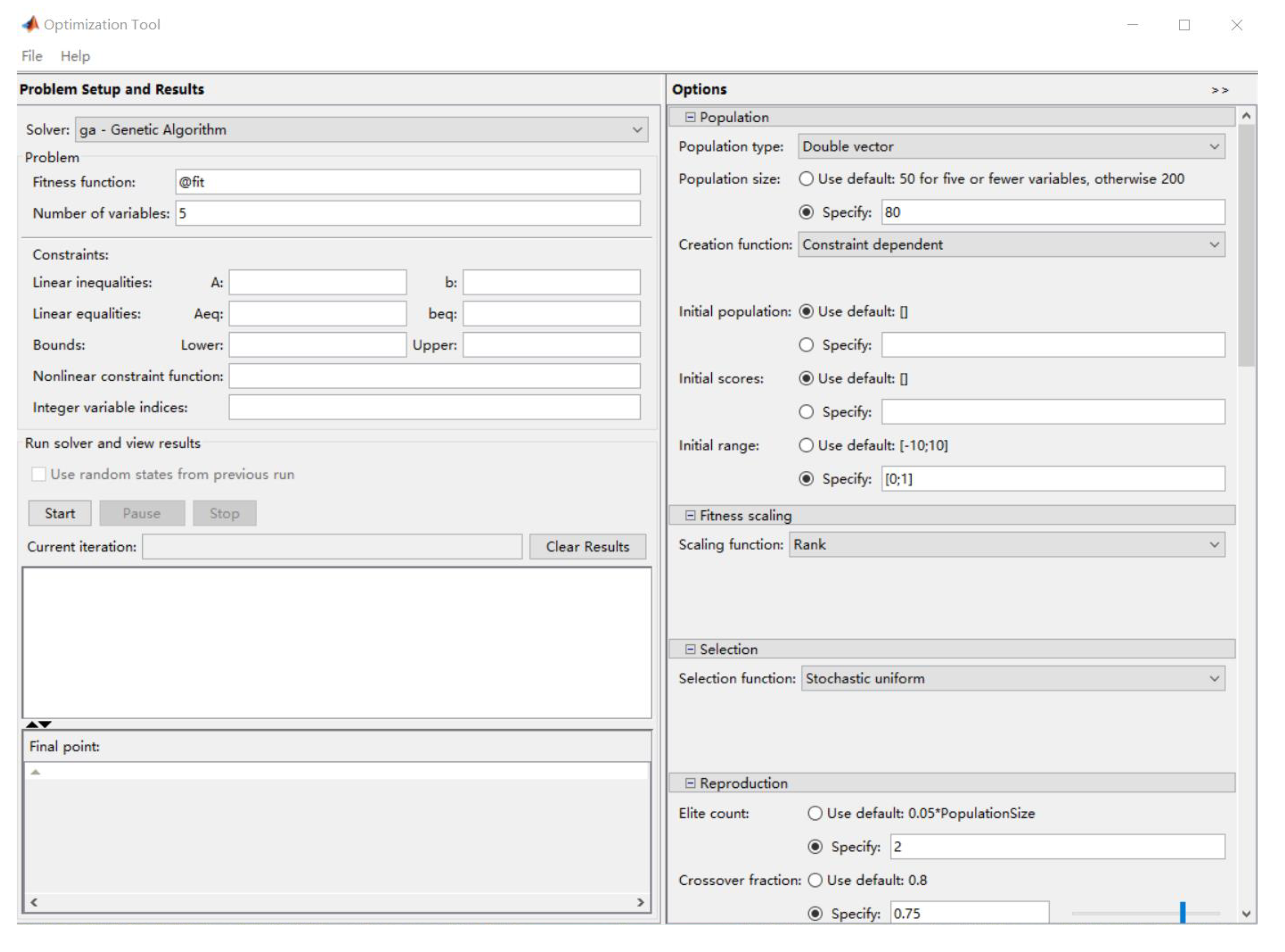
and
. The genetic algorithm is shown in Algorithm 1.
| Algorithm 1: The genetic algorithm to gain and . |
|
Step 3: Utilizing to derive .
; ;
.
Step 4: Utilizing LRF for IFNs based on a NAM with rules proposed in this paper to obtain with the attribute index “after-sale service” increasing, we have
; ;
; ;
; .
Step 5: When a new customer (6) gives values to logistics, service attitude, price, product quality, as listed in
Table 2. We can utilize the OWA operator proposed in this paper to obtain
. Then, utilize LRF to directly derive aggregation results
of 5 attributes from aggregation results
of 4 attributes.
.
Step 6: When a new customer (7) gives values to the attributes, as listed in
Table 2,
.
Table 2.
The satisfaction evaluation.
Table 2.
The satisfaction evaluation.
| Customer | Logistics | Service Attitude | Price | Product Quality | After-Sale Service |
|---|
| 1 | | | | | |
| 2 | | | | | |
| 3 | | | | | |
| 4 | | | | | |
| 5 | | | | | |
| 6 | | | | | |
| 7 | | | | | |
| Customer | Payment Security | Evaluation | | | |
| 1 | | | | | |
| 2 | | | | | |
| 3 | | | | | |
| 4 | | | | | |
| 5 | | | | | |
| 6 | | ? | | | |
| 7 | | ? | | | |
Table 3.
The triangular fuzzy number changed into the interval number.
Table 3.
The triangular fuzzy number changed into the interval number.
| Customer | Logistics | Service Attitude | Price | Product Quality | Evaluation |
|---|
| 1 | | | | | |
| 2 | | | | | |
| 3 | | | | | |
| 4 | | | | | |
| 5 | | | | | |
Table 4.
The parameters of the genetic algorithm.
Table 4.
The parameters of the genetic algorithm.
| Parameter | Population Size | Initial Rang | Elite Count | Crossover Probability |
|---|
| | 80 | | 2 | |
Table 5.
Results of Step 2.
Table 5.
Results of Step 2.
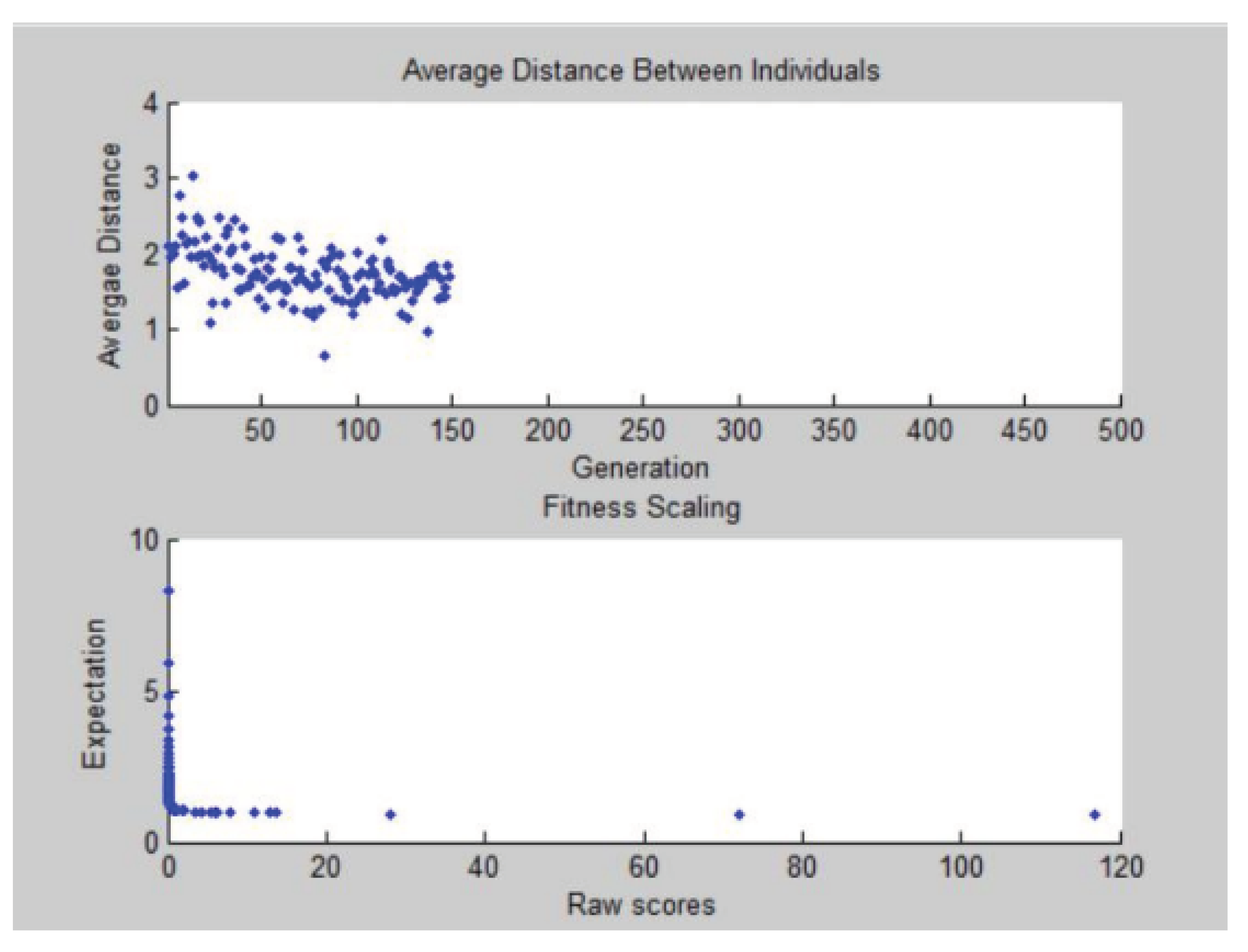
| Point Set | | | Error | Hereditary Algebra |
|---|
| | | | 149 |
| | | | |
| | | | |
| | | | |
Figure 1.
The GUI running interface of the genetic algorithm toolbox.
Figure 1.
The GUI running interface of the genetic algorithm toolbox.
Figure 2.
The operation result diagram of Step 2.
Figure 2.
The operation result diagram of Step 2.