Abstract
(1) Background: symmetry breaking (self-organized transformation of symmetric stats) is a global phenomenon that arises in an extensive diversity of essentially symmetric physical structures. We investigate the symmetry breaking of time-2D space fractional wave equation in a complex domain; (2) Methods: a fractional differential operator is used together with a symmetric operator to define a new fractional symmetric operator. Then by applying the new operator, we formulate a generalized time-2D space fractional wave equation. We shall utilize the two concepts: subordination and majorization to present our results; (3) Results: we obtain different formulas of analytic solutions using the geometric analysis. The solution suggests univalent (1-1) in the open unit disk. Moreover, under certain conditions, it was starlike and dominated by a chaotic function type sine. In addition, the authors formulated a fractional time wave equation by using the Atangana–Baleanu fractional operators in terms of the Riemann–Liouville and Caputo derivatives.
1. Introduction
Symmetry breaking is a phenomenon in which (infinitesimally) small fluctuations performing on a system possessing a critical point (fixed point, the roots of the transform operator) adopts the system’s outcome, by defining which division of a bifurcation is occupied. This procedure is known symmetry breaking, because such changes typically transform the system from a symmetric but the disorganized state into one or more certain conditions. Symmetry breaking is studied theoretically in the nonlinear optics, lasers, liquid crystals and other areas in physics (see [1,2,3]).
Recently, Sa et al. [4] presented a review study on a complex-plane generalization of the successive distribution utilized to distinguish regular from chaotic quantum spectra. The approach structures the spreading of complex valued ratios between nearest- and next-to-nearest-neighbor spacing. Some results are discussed in the open unit disk.
In this study, we propose a time-2D space fractional wave equation of a complex variable using the modified Atangana–Baleanu fractional differential operator without singular kernel, which is catting in a special class of normalized analytic functions in the open unit disk. Some of its properties are discussed geometrically. The fractional differential operator is used together with a symmetric operator to define a new fractional symmetric operator. Then the new operator is employed to formulate a generalized time-2D space fractional wave equation. Our method is based on the subordination and majorization theory in the open unit disk [5,6]. For two analytic functions f and g in the open unit disk we say that f is majorized by if there is an analytic function in the open unit disk such that Moreover, f is subordinated to g if (see [5]). As a result, we obtain altered formulas of analytic geometric solutions based on the geometric function theory.
2. Materials and Methods
Our methods are divided into two subsections as follows:
2.1. Complex Fractional Differential Operator
Fernandez [7] formulated Atangana–Baleanu complex fractional differential operator in terms of the Caputo derivative and the Riemann–Liouville formula respectively, as follows:
where is normalized function by and is the Mittag–Leffler function
Moreover, Fernandez [7] introduced the following fractional differential operator
where is the complex Atangana and Baleanu differential operator in Caputo formula and is the complex Atangana and Baleanu differential operator in the Riemann–Liouville formula. The Atangana–Baleanu fractional operators are used the generalized Mittag–Leffler function as non-local and non-singular kernel. Therefore, they have ability for practising in physics and computational studies. They are recommended in filtering and information theory.
To modify the above operators, we present a class of analytic functions by
This class is denoted by and knowing as the class of univalent functions which is normalized by
Definition 1.
For example, let then in virtue of [8]—Theorem 2.4 or [9]—Theorem 11.2, we conclude that
According to [8], Theorem 2.2, we obtain
Clearly, we have
Generally, we have
Next, we study some properties of the above operators.
Proposition 1.
- (A)
- and
- (B)
- (C)
- provided that is locally univalent of the first order (like convex function [10]) when or locally univalent of the second order (like the class of univalent functions [10]) when
Proof.
For a computation brings
Similarly, we have This completes the first part. For the second part, it is adequate to show that (see [11])
A calculation yields
The last part immediately recognizes by [11]—Corollaries 1 and 2 respectively. □
2.2. Symmetric Fractional Differential Operator (SFDO)
For a function and a constant the SFDO can be defined by using or as follows:
Similarly, we can use to obtain the following SFDO
where
Obviously, and are in the normalized class with functional connected coefficients. Next, we shall introduce a generalized time-2D space wave equation using the SFDO. In this place, we note that there are different applications of the class of complex differential operators (see [12,13,14,15,16]).
2.3. Time-2D Space Wave Equation
The Koebe function is an extreme function in the field of geometric function theory. To study the generalized wave equation associated with SFDO, we deal with the parametric Koebe function taking the formula
Then the generalized heat equation is given by
Or
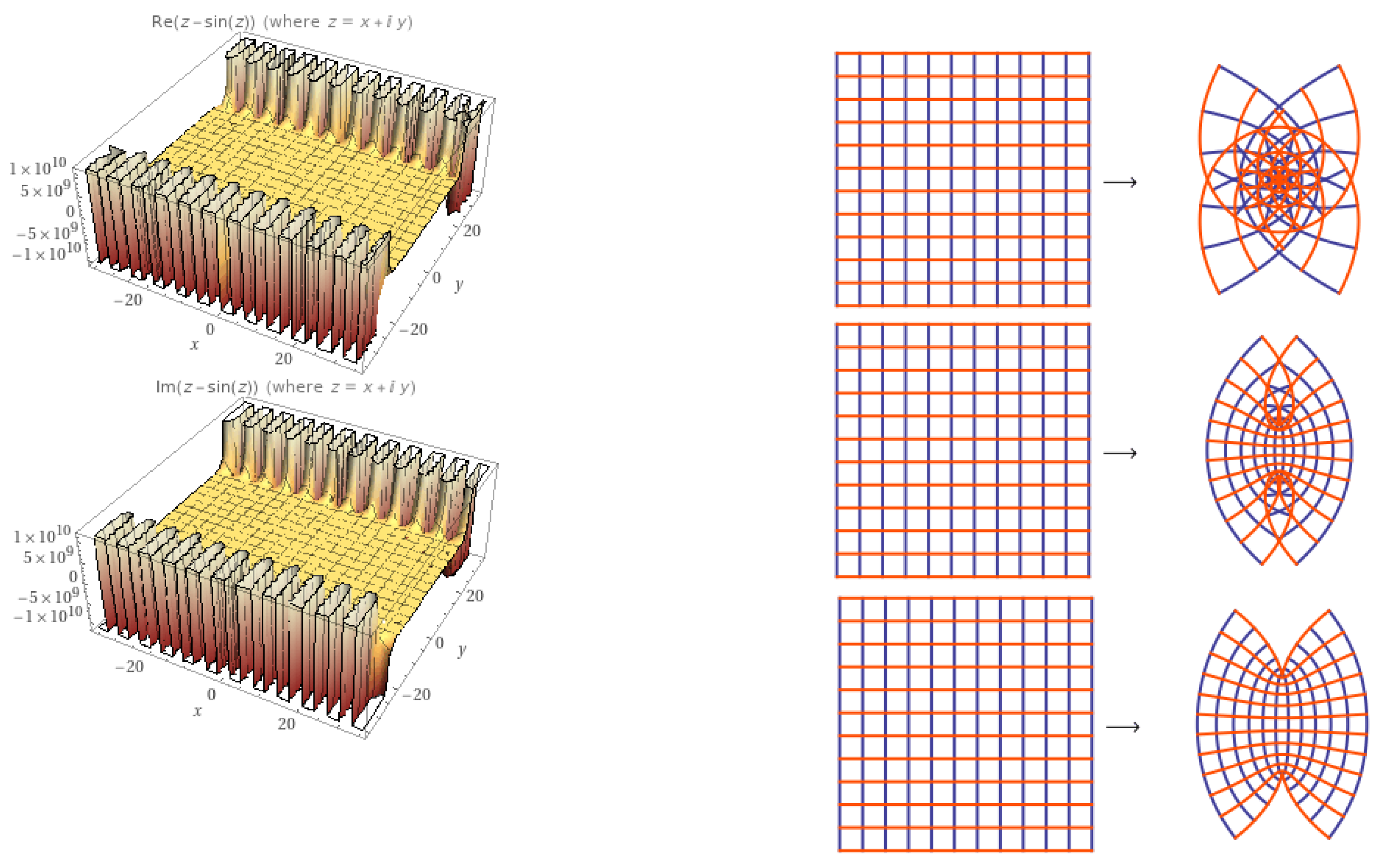
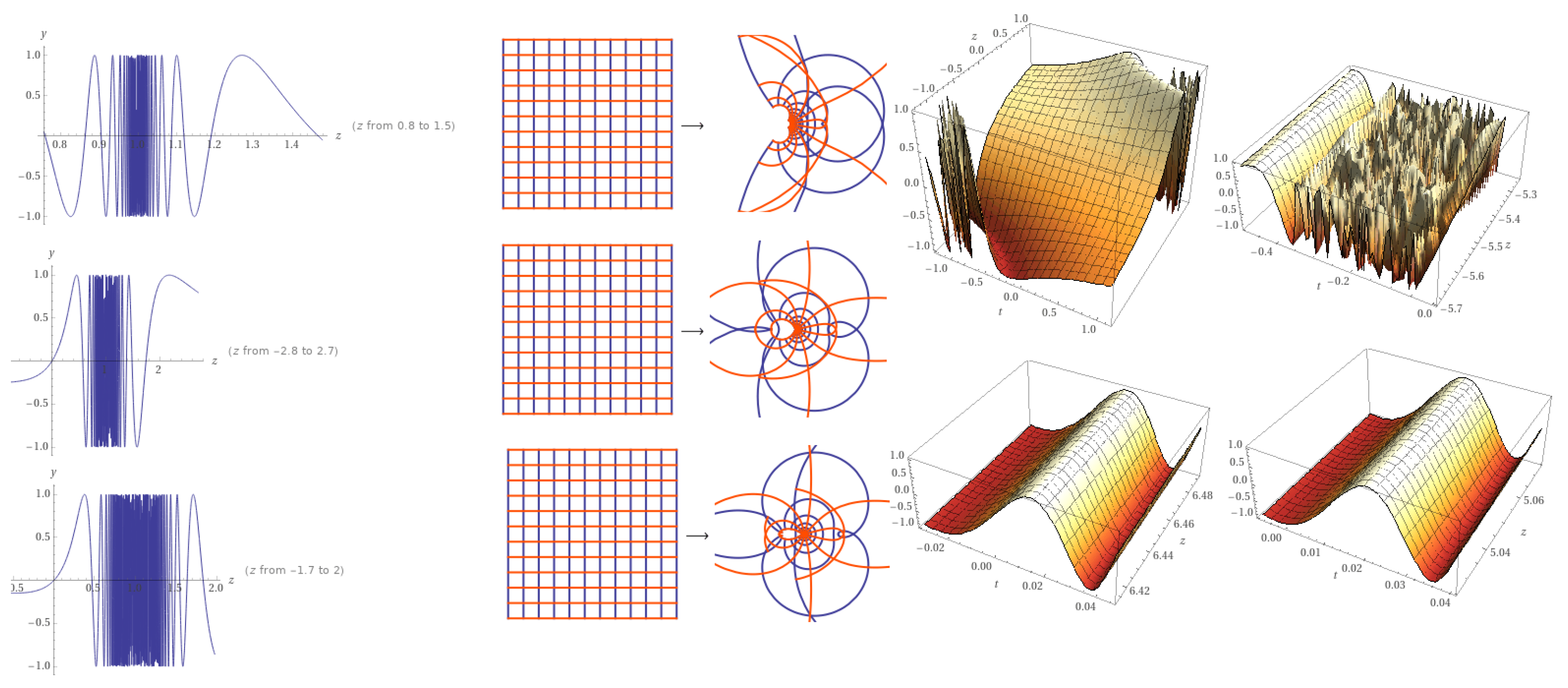
Figure 1.
The plot of when . The last two columns are 2D plot for .
Note that is univalent in the disk (see [17]).
3. Results
In this section, we shall present the analytic solution of Equations (6) and (7) for , which is optimized by .
Proposition 2.
Proof.
Clearly, implies
then
To optimize the solution of (6), it is sufficient to show that A comparison between the coefficients and we obtain the optimization for all value of and Similarly, for
Thus, a computation yields whenever and □
Proof.
In view of Proposition 2, we have
Since is univalent and then in view of [11]—Corollary 2, we conclude that
Similarly for the second part. □
Proof.
According to Proposition 2, we obtain
In view of [11]-Theorem 1, where is of the second kind of locally univalent function, we get the require assertions. □
3.1. Time-Fractional Wave Equation
Wave equation can be generalized to time-fractional wave equation by using the Riemann–Liouville derivative:
where and ℓ is a positive coefficient known as the diffusion of the medium. By using the complex transformation
Equation (11) becomes
where and are constants. Now, we solve Equation (12) to get the following solution
Since then we have and Similar conversation can be considered for the operator We conclude the above construction in the following result
3.2. Dominated Solutions by a Chaotic Function
Next propositions indicate different conditions for the upper bound solutions of the wave Equations (6) and (7).
Proposition 4.
If and satisfy
and
respectively then for and the inequalities
and
are occurred and is the best dominate whenever .
Proof.
For and in view of Proposition 1, the operators and are in the class Moreover,
A computation leads to (see Figure 3)
thus is convex in the disk
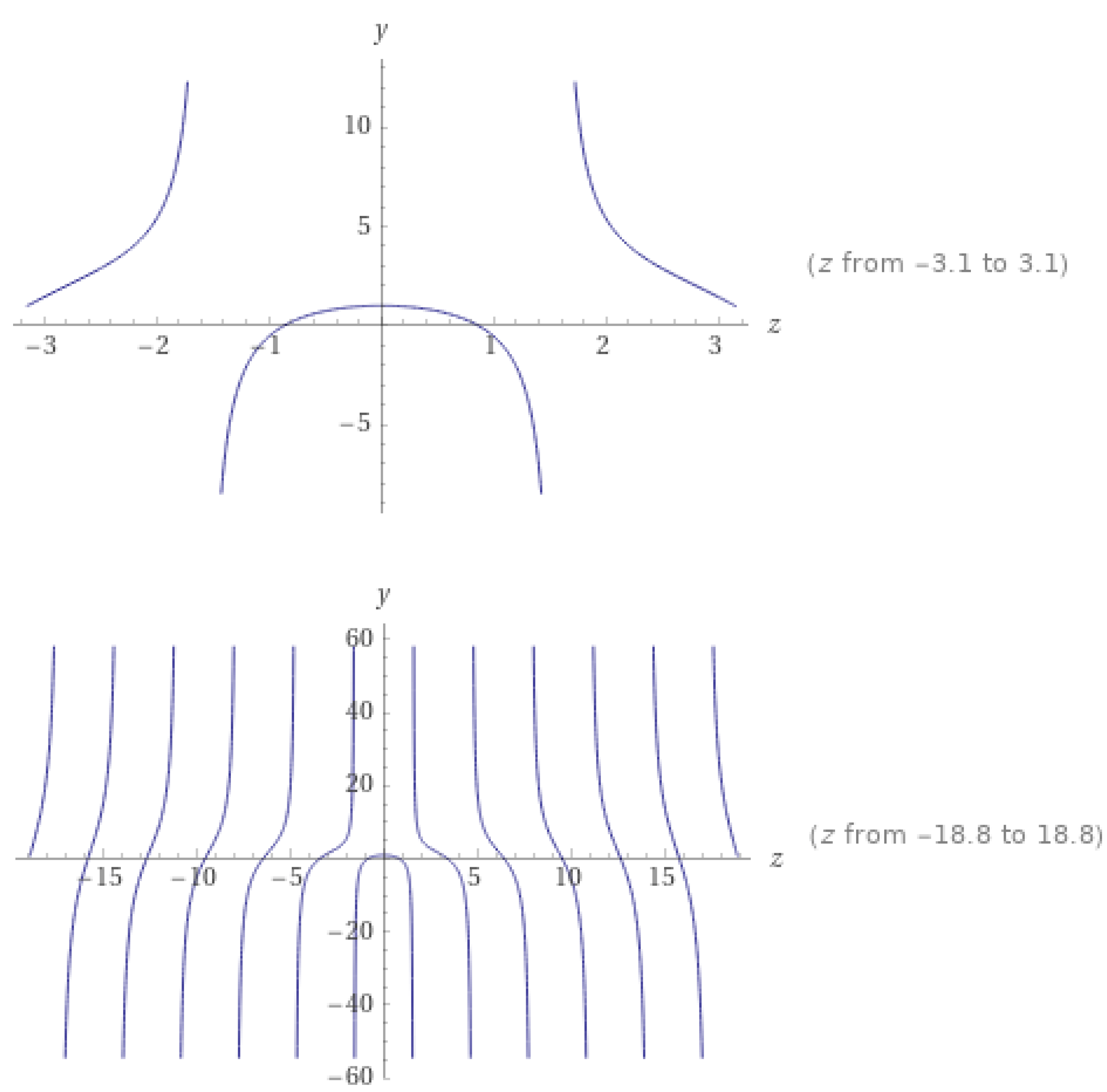
Figure 3.
Plot of which shows the convexity of in the disk .
Proposition 5.
If and satisfy
and
respectively then for
and
And is the best dominate when .
4. Conclusions
From the above study, we introduced a new method for finding the analytic chaotic solution of a class of the symmetric wave equations defined by a symmetric fractional differential operator (SFDO) of a convex structure. The solution was suggested to be univalent (1-1) in the open unit disk. Moreover, under certain conditions, it was starlike. In addition, we formulated a fractional time wave equation by using the Riemann–Liouville derivative. We have utilized different techniques including majorization and subordination theory. The above approach can be used in various classes of physical equations like the Schrodinger equation. For future works, one can suggest different classes of analytic functions such as meromorphic functions, multivalent functions and harmonic functions.
Author Contributions
Conceptualization, R.W.I. and D.B.; methodology, D.B.; software, R.W.I.; validation, R.W.I. and D.B.; formal analysis, D.B.; investigation, R.W.I. All authors have read and agreed to the published version of the manuscript.
Funding
This research received no external funding.
Institutional Review Board Statement
Not applicable.
Informed Consent Statement
Not applicable.
Data Availability Statement
Not applicable.
Acknowledgments
The authors would like to express their thanks to the editors and the reviewers for their kind comments to improve our paper.
Conflicts of Interest
The authors declare no conflict of interest.
References
- Li, P.; Malomed, B.A.; Mihalache, D. Symmetry breaking of spatial Kerr solitons in fractional dimension. Chaos Solitons Fractals 2020, 132, 109602. [Google Scholar] [CrossRef] [Green Version]
- Rusin, R.; Marangell, R.; Susanto, H. Symmetry breaking bifurcations in the NLS equation with an asymmetric delta potential. Nonlinear Dyn. 2020, 100, 3815–3824. [Google Scholar] [CrossRef]
- Yagasaki, K.; Yamazoe, S. Numerical analyses for spectral stability of solitary waves near bifurcation points. Jpn. J. Ind. Appl. Math. 2021, 38, 125–140. [Google Scholar] [CrossRef]
- Sa, L.; Ribeiro, P.; Prosen, T. Complex spacing ratios: A signature of dissipative quantum chaos. Phys. Rev. 2020, 10, 021019. [Google Scholar] [CrossRef]
- Miller, S.S.; Mocanu, P.T. Differential Subordinations: Theory and Applications; CRC Press: Boca Raton, FL, USA, 2000. [Google Scholar]
- MacGregor, T.H. Majorization by univalent functions. Duke Math. J. 1967, 43, 95–102. [Google Scholar] [CrossRef]
- Fernandez, A. A complex analysis approach to Atangana-Baleanu fractional calculus. Math. Methods Appl. Sci. 2019, 44, 8070–8087. [Google Scholar] [CrossRef] [Green Version]
- Shukla, A.K.; Prajapati, J.C. On a generalization of Mittag-Leffler function and its properties. J. Math. Anal. Appl. 2007, 336, 797–811. [Google Scholar] [CrossRef] [Green Version]
- Haubold, H.J.; Mathai, A.M.; Saxena, R.K. Mittag-Leffler functions and their applications. J. Appl. Math. 2011, 2011, 298628. [Google Scholar] [CrossRef] [Green Version]
- Godula, J.; Starkov, V.V. Sharpness of certain Campbell and Pommerenke estimates. Math. Notes 1998, 63, 586–592. [Google Scholar] [CrossRef]
- Campbell, D.M. Majorization-subordination theorems for locally univalent functions, II. Can. J. Math. 1973, 25, 420–425. [Google Scholar] [CrossRef]
- Ibrahim, R.W.; Baleanu, D. On quantum hybrid fractional conformable differential and integral operators in a complex domain. In Revista de la Real Academia de Ciencias Exactas, Fisicas y Naturales. Serie A. Matemáticas; Springer: Berlin, Germany, 2021; Volume 115, pp. 1–13. [Google Scholar]
- Ibrahim, R.W.; Baleanu, D. On a combination of fractional differential and integral operators associated with a class of normalized functions. AIMS Math. 2021, 6, 4211–4226. [Google Scholar] [CrossRef]
- Ibrahim, R.W.; Elobaid, R.M.; Obaiys, S.J. Generalized Briot-Bouquet differential equation based on new differential operator with complex connections. Axioms 2020, 9, 42. [Google Scholar] [CrossRef]
- Ibrahim, R.W.; Elobaid, R.M.; Obaiys, S.J. On subclasses of analytic functions based on a quantum symmetric conformable differential operator with application. Adv. Differ. Equ. 2020, 2020, 325. [Google Scholar] [CrossRef]
- Ibrahim, R.W.; Baleanu, D. Analytic Solution of the Langevin Differential Equations Dominated by a Multibrot. Fractal Set. Fractal Fract. 2021, 5, 50. [Google Scholar] [CrossRef]
- Goodman, A.W. An invitation to the study of univalent and multivalent functions. Intr. Nat. J. Hath. Mh. Sci. 1979, 2, 163–186. [Google Scholar]
Publisher’s Note: MDPI stays neutral with regard to jurisdictional claims in published maps and institutional affiliations. |
© 2021 by the authors. Licensee MDPI, Basel, Switzerland. This article is an open access article distributed under the terms and conditions of the Creative Commons Attribution (CC BY) license (https://creativecommons.org/licenses/by/4.0/).