
Article

Selective Synthesis of FAU- and CHA-Type Zeolites from Fly Ash: Impurity Control, Phase Stability, and Water Sorption Performance

by
Selin Cansu Gölboylu
1,2,*,
Süleyman Şener Akın
1 and
Burcu Akata
1,3
1
Department of Micro and Nanotechnology, Middle East Technical University, Ankara 06800, Turkey
2
Kalyon PV Research and Development Center, Kalyon Güneş Teknolojileri Üretim A.Ş., Ankara 06909, Turkey
3
Central Laboratory, Middle East Technical University, Ankara 06800, Turkey
*
Author to whom correspondence should be addressed.
Minerals 2025, 15(11), 1153; https://doi.org/10.3390/min15111153
Submission received: 26 September 2025 / Revised: 18 October 2025 / Accepted: 30 October 2025 / Published: 31 October 2025

Abstract

Fly ash from coal-fired power plants is a promising precursor for zeolite synthesis due to its aluminosilicate-rich composition. However, its direct utilization is often limited by impurities and a low silicon-to-aluminum ratio (SAR). This study demonstrates the conversion of Class C fly ash from the Soma thermal power plant (Turkey) into FAU- and CHA-type zeolites through optimized acid leaching and hydrothermal synthesis. Acid treatment increased the SAR from 1.33 to 2.85 and effectively reduced calcium-, sulfur-, and iron-bearing impurities. The SAR enhancement by acid leaching was found to be reproducible among Class C fly ashes, whereas Class F materials exhibited a limited response due to their acid-resistant framework. Subsequent optimization of alkaline fusion-assisted synthesis enabled selective crystallization of FAU and CHA, while GIS and MER appeared under prolonged crystallization or higher alkalinity. SEM revealed distinct morphologies, with MER forming rod-shaped clusters, and CHA exhibiting disc-like aggregates. Water sorption analysis showed superior uptake for metastable FAU (~23 wt%) and CHA (~18 wt%) compared to stable GIS and MER (~12–13 wt%). Overall, this study establishes a scalable and sustainable route for producing high-performance zeolites from industrial fly ash waste, offering significant potential for adsorption-based applications in dehumidification, heat pumps, and gas separation.

1. Introduction

Coal remains one of the primary sources of global energy production, significantly contributing to electricity generation despite increased investment in renewable energy sources [1]. The combustion of coal leads to the generation of large quantities of fly ash, an industrial by-product rich in aluminosilicates, mainly composed of silica (SiO2), alumina (Al2O3), iron oxide (Fe2O3), and lime (CaO) [2,3]. The annual global production of fly ash is approximately 750 million tons, a large fraction of which remains unutilized and poses a severe environmental hazard due to heavy metal leaching, groundwater contamination, and air pollution [4,5].
One of the most promising valorization routes for fly ash is the synthesis of zeolites—microporous crystalline aluminosilicates widely applied in catalysis, adsorption, ion exchange, and gas separation [6,7,8,9,10,11,12]. Zeolites offer numerous advantages, including tunable pore structures, high surface areas, and ion-exchange capacity, making them attractive for environmental and industrial applications [6,13]. Conventionally, zeolites are synthesized from high-purity precursors using organic structure-directing agents (OSDAs), such as quaternary ammonium salts, to control framework topology and phase selectivity [9,14]. While OSDAs improve crystallinity and reproducibility, they also raise significant concerns for large-scale application due to their high cost, the need for high-temperature calcination for removal, and associated environmental impacts such as NOₓ emissions [15,16]. Moreover, the use of organic templates increases process complexity and environmental burden, further limiting industrial scalability [16]. These drawbacks have motivated growing interest in OSDA-free synthesis routes using alternative raw materials such as fly ash [2,3,5]. Fly ash-based zeolite synthesis not only mitigates environmental challenges associated with fly ash disposal but also provides a sustainable, economically attractive route to zeolite production. Nonetheless, the complexity of fly ash composition, notably the presence of impurities and a typically low silicon-to-aluminum ratio (SAR), poses significant challenges in synthesizing high-quality zeolites directly from fly ash. In this context, silica-rich residues such as rice husk ash may be co-utilized with fly ash to increase the SAR and enable the formation of sustainable high-silica zeolite structures, as also demonstrated in recent studies [17].
Despite extensive research efforts toward zeolite synthesis from fly ash, obtaining zeolites of sufficient quality, particularly metastable and industrially valuable phases such as Faujasite (FAU) and Chabazite (CHA) remains a major challenge. Many studies tend to yield low-silica zeolites such as LTA and/or thermodynamically stable phases like GIS or SOD, which are less valuable for industrial applications due to their limited surface area and adsorption capacity [18]. The synthesis of high-quality FAU and CHA phases is particularly hindered by the heterogeneous and impurity-rich nature of raw fly ash and its typically low SAR. Given the global scale of fly ash generation, practical and scalable synthesis routes are needed, not just to produce any zeolite phase, but to obtain targeted structures with acceptable properties suitable for application.
While numerous studies have demonstrated the feasibility of synthesizing zeolites from fly ash, relatively few have focused on the systematic investigation of how precursor characteristics—particularly impurity content and oxide composition—influence phase selectivity and crystallization pathways. Impurities such as calcium, iron, and sulfur oxides are known to interfere with the formation of high-silica zeolites by stabilizing competing amorphous or dense phases, yet their precise role in phase evolution remains poorly understood [19,20,21]. Furthermore, studies often emphasize final product formation rather than the mechanistic aspects of zeolitization, overlooking how synthesis parameters such as silicon-to-aluminum ratio, alkali concentration, and thermal profile can be fine-tuned to direct specific framework types [15,22]. This gap limits the development of predictive synthesis strategies and ultimately hinders the scalability and industrial viability of fly ash valorization approaches. Therefore, research that combines careful compositional analysis with controlled synthesis optimization is crucial to establish a more predictive understanding of zeolite formation from fly ash, paving the way for scalable, application-oriented valorization strategies.
Water sorption behavior is a critical indicator of the hydrophilicity and textural properties of nanoporous materials, including zeolites. The interaction of water molecules with zeolite frameworks depends strongly on factors such as pore size, framework topology, surface chemistry, and the presence of extra-framework cations [23]. Metastable phases like FAU and CHA, characterized by large pore openings and high surface areas, typically offer superior water adsorption performance compared to thermodynamically stable phases such as GIS and MER. In hydrothermal synthesis systems, FAU and CHA often form as kinetically favored metastable phases, which can subsequently transform into more stable GIS and MER structures under prolonged synthesis time, elevated temperatures, or in higher alkali synthesis gel, following Ostwald’s step rule [24]. This metastable-to-stable phase transition is well documented in the zeolite literature using pure chemical precursors, where synthesis parameters can be precisely controlled to favor a desired framework [14,15,16,22,25,26]. However, demonstrating similar phase selectivity using complex raw materials such as fly ash remains essential, since achieving the formation of these metastable phases requires careful tuning of synthesis conditions. Assessing water sorption capacities across different zeolite structures provides insight into their practical suitability for applications like gas separation, dehumidification, and adsorption-based processes. Therefore, in this study, although the primary aim was not to track phase transitions in detail, their qualitative identification and comparative assessment as a function of synthesis conditions were investigated using fly ash waste material, and comparative water sorption analyses were conducted for FAU, CHA, GIS, and MER-type zeolites synthesized from fly ash to better understand the structure–property relationships and to highlight the advantages of metastable zeolite frameworks for moisture-related applications.
In this study, a systematic, template-free, and scalable approach was developed to synthesize FAU- and CHA-type zeolites from Class C fly ash obtained from the Soma thermal power plant in Turkey. A key focus was placed on understanding and controlling the effects of acid pretreatment and hydrothermal synthesis parameters on phase selectivity and material properties. The acid leaching process was optimized to reduce impurities and increase the silicon-to-aluminum ratio (SAR), enabling the formation of high-quality zeolite phases. Subsequently, alkaline fusion-assisted hydrothermal synthesis was tailored to evaluate the influence of alkali concentration, water content, crystallization temperature, and reaction time on zeolite crystallization. Through detailed characterization and phase identification, this study provides insights into the role of impurity removal and synthesis conditions in selectively promoting the formation of metastable zeolites. The findings contribute to a deeper mechanistic understanding of zeolitization from fly ash and offer a practical basis for designing scalable synthesis strategies that combine waste valorization with high-value material production.

2. Materials and Methods

2.1. Materials

Fly ash was obtained from the Kolin Thermal Power Plant, located in the Soma district of Manisa, Turkey. The chemicals used in this study included 12 M hydrochloric acid (36.5%–38%, Macron Fine Chemicals, Center Valley, PA, USA), sodium hydroxide (NaOH, Sigma-Aldrich, St. Louis, MO, USA), potassium hydroxide (KOH, Merck, Darmstadt, Germany), and double-distilled water (DDW) with a resistivity of less than 18 MΩ·cm.

2.2. Zeolite Synthesis

2.2.1. Acid Leaching

To lower the impurities and increase the silicon-to-aluminum ratio (SAR), the raw fly ash was subjected to acid leaching which was carried out by combining 8 g of raw fly ash with hydrochloric acid solutions of different concentrations, using a solid-to-liquid ratio of 1:5 g/mL, and heating at 90 °C for 2 h, in HDPE containers. After leaching, the solid residue was filtered, washed with deionized water until the pH was neutral, and dried at 60 °C overnight.

2.2.2. Alkali Fusion

The alkali fusion step was carried out to activate the acid-leached fly ash (AFA). Sodium hydroxide (NaOH) or potassium hydroxide (KOH) pellets were ground into fine powder and mixed with the AFA in predetermined ratios. For NaOH-based syntheses, a gel composition of 1 FA:1.2 NaOH was employed, while KOH-based systems were FA:KOH ratio vary between 1.2–2 and mixed-alkali systems were also prepared. The mixtures were placed in ceramic crucibles and heated at a rate of 10 °C·min−1 up to 750 °C, held for 1.5 h, and then cooled naturally to room temperature.

2.2.3. Hydrothermal Synthesis

Fusion products were homogenized with distilled water to prepare synthesis gels. The suspensions were aged at 25 °C under continuous agitation for 12 h before being transferred to sealed HDPE bottles and placed in preheated ovens at selected temperatures. Hydrothermal crystallization was conducted at 75–105 °C for durations between 12 and 96 h, depending on the optimization study. All hydrothermal syntheses were conducted in a pre-heated convection oven, where the internal temperature variation was maintained within ±2 °C to ensure uniform crystallization conditions across all experiments. After synthesis, the suspensions were cooled in water baths and washed with distilled water to remove residual alkali. The final solids were dried at 60 °C overnight. After drying, zeolite powders were obtained and used for subsequent characterization and water sorption experiments.

2.3. Water Sorption Measurements

The water sorption behavior of the optimized zeolite samples (FAU, GIS, CHA, and MER) was investigated using an Axis ATS120 moisture analyzer equipped with a halogen lamp heater. Prior to testing, the samples were equilibrated in a controlled-humidity room (~50% relative humidity, 25 °C) overnight. Water sorption and desorption were then measured using a thermobalance equipped with a halogen lamp heater, which increased the temperature to 160 °C within 10 min. After reaching equilibrium weight loss (corresponding to desorbed water), the heater was turned off and the samples were re-exposed to ambient conditions for re-adsorption. Although this procedure does not represent equilibrium sorption behavior at controlled relative humidities, it allowed direct comparison of framework-dependent water sorption capacities under identical conditions.

2.4. Characterization

The chemical composition of the raw and acid-leached fly ash was determined by X-ray fluorescence (XRF) using a Rigaku ZSX Primus II spectrometer (Rigaku Corporation, Tokyo, Japan). The crystal structure transformation and phase composition of the fly ash and zeolite products were analyzed by X-ray diffraction (XRD) (Rigaku Miniflex, Rigaku Corporation, Tokyo, Japan; CuKα radiation, 40 kV, 15 mA) in Bragg–Brentano geometry with a Ni filter. Qualitative and quantitative phase analyses were performed using SmartLab Studio II software (version 4.3.287.0) equipped with the International Center for Diffraction data ICDD) PDF-4+ database. The morphology of the fly ash and synthesized zeolite samples was investigated by field emission scanning electron microscopy (FE-SEM) (FEI Quanta 400). Samples were placed on carbon tape and coated with a thin layer of gold to ensure surface conductivity prior to imaging. All characterizations were conducted at the Central Laboratory of Middle East Technical University (METU) (Ankara, Turkey).

3. Results

3.1. Characterization of Fly Ash

Fly ash was obtained from the combustion of lignite-type coal at the Kolin Thermal Power Plant located in Soma District of Manisa, Turkey. The chemical composition of the fly ash sample was analyzed by X-ray fluorescence (XRF), and the results are summarized in Table 1.
According to the XRF results, the total percentage of silica, alumina, and iron oxide was determined to be 67.51%. This percentage falls below the threshold of 70%, and considering that the fly ash originated from lignite-type coal combustion, this further supports the classification of the Soma sample as Class C fly ash [27,28].
The XRD pattern of the raw fly ash sample is shown in Figure 1. Several crystalline phases were identified based on characteristic diffraction peaks. Peaks at 25.4°, 31.3°, 38.6°, and 40.8° were attributed to anhydrite (PDF 01-072-0916) (Ca2SO4), while peaks at 20.8° and 26.5° corresponded to quartz (PDF 01-089-8937) (SiO2). Additional peaks at 22.0° and 31.4° were associated with calcian albite (PDF 01-076-0927) (Ca(AlSi3O8)), and peaks at 33.1° and 35.7° indicated the presence of hematite (PDF 01-071-5088) (Fe2O3). Beyond the sharp crystalline reflections, a broad amorphous hump was observed between 15° and 35°, suggesting the presence of a significant amorphous phase; however, its quantitative estimation was not pursued, as the alkali-fusion step decomposes this matrix into soluble species, making the initial amorphous content irrelevant to zeolite yield.
To further quantify the crystalline content, the Reference Intensity Ratio (RIR) quantification method was applied, and results were given in Table 2. The semi-quantitative analysis indicated that more than 50% of the crystalline portion was composed of anhydrite, a phase considered undesirable for zeolite synthesis due to its potential interference with nucleation and crystallization processes.

3.2. Acid Leaching

Acid leaching is a widely recognized method for improving the silicon-to-aluminum ratio (Si/Al) of fly ash while removing impurity phases such as Ca-, Fe-, and S-bearing compounds, which are known to hinder zeolite crystallization [20,21,29,30,31]. XRF results revealed that the raw fly ash exhibited a low Si/Al ratio of 1.33 and contained significant concentrations of SO3 (9.26%), CaO (14.7%), and Fe2O3 (7.81%), as summarized in Table 3.
Upon leaching with increasing concentrations of HCl (1–5 M), a progressive removal of impurities was observed. SO3 and CaO contents showed a sharp decrease even at low acid concentrations, while Fe2O3 exhibited greater resistance to acidic dissolution, in agreement with earlier studies [32,33]. The apparent increase in Fe2O3 content after low-concentration acid leaching is attributed to the preferential dissolution of Ca-, S-, and Al-bearing phases, while iron remains largely insoluble. As the total solid mass decreases, the relative proportion of Fe2O3 increases, although its absolute amount remains essentially constant. Anhydrite was the least acid-resistant phase, dissolving substantially even after 1 M HCl treatment, whereas Hematite showed minor reduction until 3 M HCl and was only significantly diminished after 5 M HCl leaching [32]. quartz remained largely unaffected by acid leaching, consistent with its known high chemical stability, whereas the partial dissolution of albite contributed to the observed increase in the Si/Al ratio of fly ash.
The Si/Al ratio improved steadily with increasing acid concentration, reaching 2.6 after 5 M HCl treatment. After 5 M treatment, SO3 and CaO levels were reduced to 0.97% and 2.65%, respectively, while Fe2O3 decreased to 2.22%. XRD patterns (Supplementary Material, Figure S1) confirmed that albite, anhydrite, and hematite phases were eliminated, and only quartz remained. These results align with previous findings by Gao et al. [33] and Panitchakarn et al. [32], who also reported preferential dissolution of Ca-, S- and Fe-rich phases during acid leaching of fly ash.
The reproducibility of Si/Al ratio enhancement through acid leaching depends strongly on the mineralogical characteristics of the fly ash source. For Class C fly ashes, acid pretreatment not only removes detrimental impurities but also enhanced the fly ash reactivity by increasing the SAR, which is critical for obtaining high-silica zeolite frameworks. This behavior is primarily attributed to the high solubility of Ca-rich phases and was verified using additional local Class C fly ash samples [34]. In contrast, Class F fly ashes containing higher fractions of mullite and other acid-resistant aluminosilicate phases, exhibit significantly lower dealumination upon acid leaching [35]. Based on chemical and mineralogical data, no further acid leaching beyond 5 M HCl was considered necessary, as impurity reduction was deemed sufficient for subsequent zeolite synthesis. These results confirm that controlling acid concentration provides a practical route to regulate fly ash composition, facilitating the selective crystallization of desirable zeolite phases during hydrothermal treatment.

3.3. FAU-Type Zeolite Synthesis

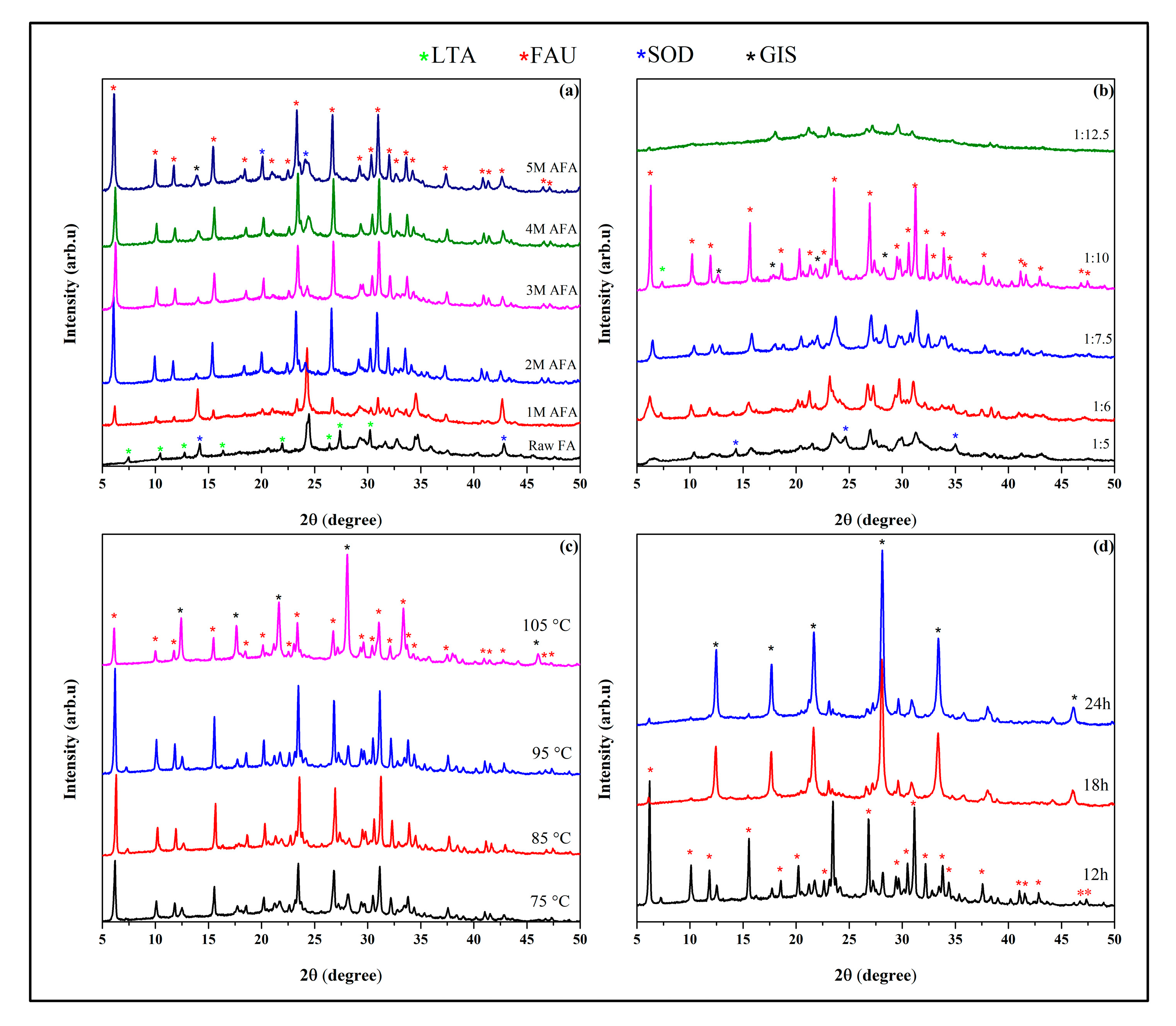
The influence of acid leaching concentration, water content, crystallization time, and crystallization temperature on the phase development of zeolites synthesized from fly ash was systematically investigated. The XRD patterns corresponding to these experimental parameters are presented in Figure 2.
In Figure 2a, the influence of acid leaching concentration is evident. Without acid pretreatment, the diffraction pattern exhibited a mixture of SOD- and LTA-type zeolitic phases, consistent with the low initial silicon-to-aluminum ratio (SAR) of approximately 1.33 in raw fly ash. This low SAR, combined with the presence of calcium- and sulfate-based impurities such as anhydrite, restricted the formation of high-silica frameworks like FAU [15,20,29]. Upon treatment with 1 M HCl, a notable shift occurred, producing a mixture of SOD- and FAU-type zeolites, attributed to an SAR increase to approximately 1.69. Although LTA zeolite is typically favored at SAR values near 1, a compositional transition region between SAR 1.0 and 1.2 allows for the coexistence of LTA–FAU frameworks [15,37]. Further increasing the acid concentration to 2 M and beyond resulted in the predominant formation of pure FAU-type zeolite with minimal residual SOD phase, as evidenced by the sharpening and dominance of FAU characteristic peaks. This behavior correlates with the substantial removal of sulfate-containing phases, which are known to promote SOD formation if left in the synthesis solution [20,29].
As shown in Figure 2a, the 3 M acid-leached sample with moderate Fe content exhibited weaker GIS reflections near 14°, whereas the 5 M sample with lower Fe showed enhanced GIS crystallinity. Higher alkali or alkaline earth content appeared to favor GIS formation, while Fe acted as a GIS suppressor and sulfur promoted SOD-type phases. Despite the presence of iron oxides, which have been reported to inhibit zeolite crystallization in some cases [30], no significant inhibitory effect was detected in this study, possibly due to effective impurity reduction via acid leaching. Based on these results, the 5M acid-leached fly ash sample, offering the highest SAR and minimal impurity content, was selected for further synthesis optimization.
The influence of water content on zeolite crystallization is shown in Figure 2b. Increasing the water content progressively enhanced FAU-type zeolite crystallinity, reaching a maximum at a 1:10 AFA:H2O mass ratio. Under these conditions, strong and sharp FAU reflections were observed, confirming successful phase selectivity. At a 1:12.5 ratio, however, the diffraction pattern collapsed into a broad amorphous hump, suggesting that the precursor concentration was insufficient to achieve the supersaturation threshold necessary for zeolite nucleation [24]. Moderate water dilution improves mass transport and reaction homogeneity, favoring the stabilization of open-framework FAU structures, while excessive dilution impedes nucleation. Additionally, minor LTA formation at the 1:10 ratio supports previous observations that increased water content can expand the phase transition zone between FAU and LTA [15]. At lower water contents (1:5 and 1:6 ratios), GIS and SOD phases were more dominant, likely due to elevated alkalinity promoting the formation of thermodynamically stable frameworks over metastable FAU. The progressive appearance of SOD under very low water conditions mirrors known phase stability trends between low- and high-silica zeolite domains. Therefore, a 1:10 AFA:H2O mass ratio was selected as the optimum synthesis condition for achieving high-purity FAU zeolite, and subsequent experiments employed a gel composition of 1 AFA:1.2 NaOH:10 H2O.
Figure 2c,d present the interrelated effects of crystallization temperature and synthesis time on zeolite phase development. Increasing the synthesis temperature from 75 °C to 95 °C progressively enhanced FAU crystallinity. The sample synthesized at 85 °C exhibited strong FAU peaks with only minor GIS contributions, whereas the 95 °C sample showed the highest FAU crystallinity. However, at 105 °C, a notable decrease in FAU peak intensity accompanied by stronger GIS reflections indicated a thermodynamic transformation favoring the denser GIS structure [15,24]. These findings align with Ostwald’s step rule, where less stable phases such as FAU nucleate first but can transform into more stable structures like GIS over time or under elevated temperatures [24]. The amorphous hump observed between 20° and 35° in the 75 °C sample suggests incomplete nucleation at lower thermal energy, supporting the need for sufficient activation temperature during synthesis. The earlier onset of GIS formation in this study compared to some literature reports may be attributed to the sulfate content in the fly ash, which has been shown to influence phase evolution pathways [15,38].
Crystallization time further influenced phase selectivity. A reaction time of 12 h was sufficient to form predominantly FAU-type zeolite with minor GIS impurities and minimal amorphous background. However, extending the synthesis duration to 18 and 24 h resulted in decreased FAU crystallinity and increased GIS intensity, indicating a progressive transformation into the thermodynamically stable GIS phase. This kinetic behavior is again consistent with Ostwald’s step rule, where longer crystallization times allow metastable phases to recrystallize into more stable forms [16,24]. Literature studies similarly report that while initial crystallization favors FAU formation, prolonged reaction times or slightly elevated synthesis temperatures promote transitions toward GIS [14,15,16,22,38]. Although in situ monitoring or rapid quenching could provide additional insight into the intermediate stages of this transformation, the present work focused on mapping different zeolite phase formations rather than transient kinetics, allowing clear identification of FAU, GIS, and related phase boundaries.
Overall, these findings emphasize the delicate interplay between precursor purification, synthesis gel chemistry, thermal energy, and reaction kinetics in governing zeolite crystallization behavior from fly ash. Through careful optimization of acid leaching, water content, temperature, and time, it was possible to selectively synthesize highly crystalline FAU-type zeolites from industrial waste. In this study, the optimum conditions were identified as a 5M acid-leached fly ash precursor, a 1:10 AFA:H2O mass ratio, a crystallization temperature between 85–95 °C, and a reaction time of 12 h, offering a scalable and sustainable strategy for producing high-surface-area zeolites from fly ash resources.

3.4. CHA-Type Zeolite Synthesis

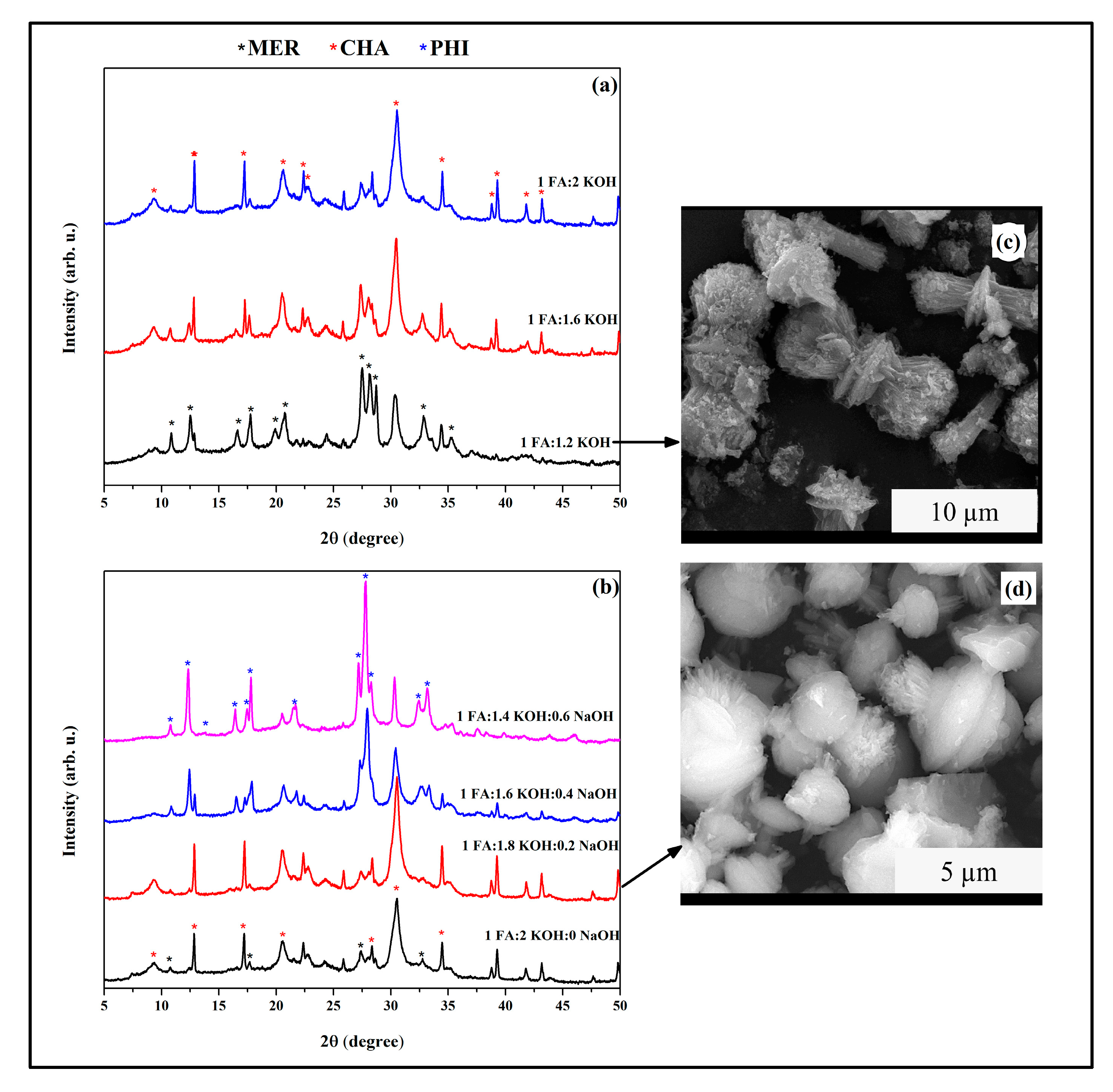
The synthesis of CHA-type zeolite was carried out by replacing NaOH with KOH in the alkaline fusion-assisted hydrothermal process. The acid-pretreated fly ash (5 M HCl) was selected as the precursor due to its higher Si/Al ratio and reduced impurity content, which is favorable for high-silica zeolite frameworks. Previous optimization of FAU synthesis employed a gel composition of 1 FA:1.2 NaOH:10 H2O; this was adapted by substituting KOH, and the influence of varying FA/KOH ratios was systematically investigated. The results of the synthesis studies were summarized in Figure 3.
At a FA:KOH ratio of 1:1.2 (1 FA: 1.2 KOH), the XRD patterns exhibited the coexistence of CHA and merlinoite (MER) phases, with MER peaks remaining dominant. Increasing the KOH content to 1:1.6 significantly enhanced the crystallinity of CHA, producing well-defined characteristic reflections. At a FA:KOH ratio of 1:2, the diffraction pattern revealed reduced CHA crystallinity alongside competitive MER formation. These results indicate that the alkali concentration plays a decisive role in directing phase selectivity, where moderate KOH levels favor CHA nucleation, while excess alkalinity stabilizes competing frameworks such as MER. This observation is consistent with earlier reports highlighting the critical role of alkali content in governing framework type during zeolite crystallization [39,40,41].
To further clarify the role of cations in phase selectivity, NaOH was partially substituted for KOH while keeping the total alkali content constant (Figure 3b). At a 1 FA: 2 KOH:0 NaOH ratio, a CHA phase with minor MER was obtained with no addition of NaOH. Introducing a small amount of NaOH (1 FA: 1.8 KOH:0.2 NaOH) further stabilized the CHA phase, with MER almost completely suppressed. In contrast, higher sodium substitution (1 FA: 1.6 KOH:0.4 NaOH) led to the crystallization of PHI as the dominant phase with minor CHA, while at 1 FA:1.4 KOH:0.6 NaOH, an almost pure PHI phase was observed.
These observations demonstrate that small sodium additions favor CHA stability by suppressing MER, whereas excessive Na+ promotes PHI crystallization at the expense of CHA. This trend is consistent with earlier studies, where Na+ was reported to promote the formation of small 4-ring units, while K+ facilitated their assembly into the composite building units characteristic of CHA [42,43]. Murayama et al. similarly showed that a balanced Na+/K+ ratio was required to stabilize CHA from fly ash, whereas higher sodium fractions promoted PHI formation [44]. Based on these results, a synthesis gel composition of 1 FA:1.8 KOH:0.2 NaOH:10 H2O was identified as optimal for producing CHA-rich zeolite in this study.
SEM micrographs further supported the XRD findings (Figure 3c,d). In agreement with our results, both Skofteland et al. and Hu et al. reported that the high KOH sample (1 FA:1.2 KOH:0 NaOH) MER structure typically appears as clusters composed of bunches of rod-shaped crystals [45,46]. In contrast, the general morphology of CHA particles is often described in the literature as cubic crystals or nested discs arranged in spherical aggregates [47,48]. However, Chawla et al. observed that when CHA and MER phases intergrow, the resulting morphology resembles what we detected the CHA-rich sample obtained under mixed-alkali conditions (1 FA:1.8 KOH:0.2 NaOH) [25]. This suggests that even when the XRD pattern does not clearly display MER peaks in the CHA sample, MER domains may still be present in the product.
These observations demonstrate the strong link between alkali composition, phase selectivity, and crystal morphology. The samples listed in Table 4 represent the optimized and purest zeolite phases obtained after systematic synthesis optimization. FAU and GIS were selectively crystallized under NaOH-based conditions by varying the synthesis time: FAU was achieved after 12 h, whereas prolonging the reaction to 24 h promoted transformation into the thermodynamically stable GIS phase. In contrast, CHA and MER were produced under KOH- and mixed-alkali conditions. A NaOH/KOH mixture (1 FA:1.8 KOH:0.2 NaOH) yielded nearly phase-pure CHA after 96 h, while lower KOH content (1 FA:1.2 KOH:0 NaOH) favored MER formation under the same conditions. These optimized products were selected as benchmark zeolite samples for subsequent water-sorption measurements, providing a representative comparison between metastable (FAU, CHA) and stable (GIS, MER) frameworks.

3.5. Water Sorption Measurements

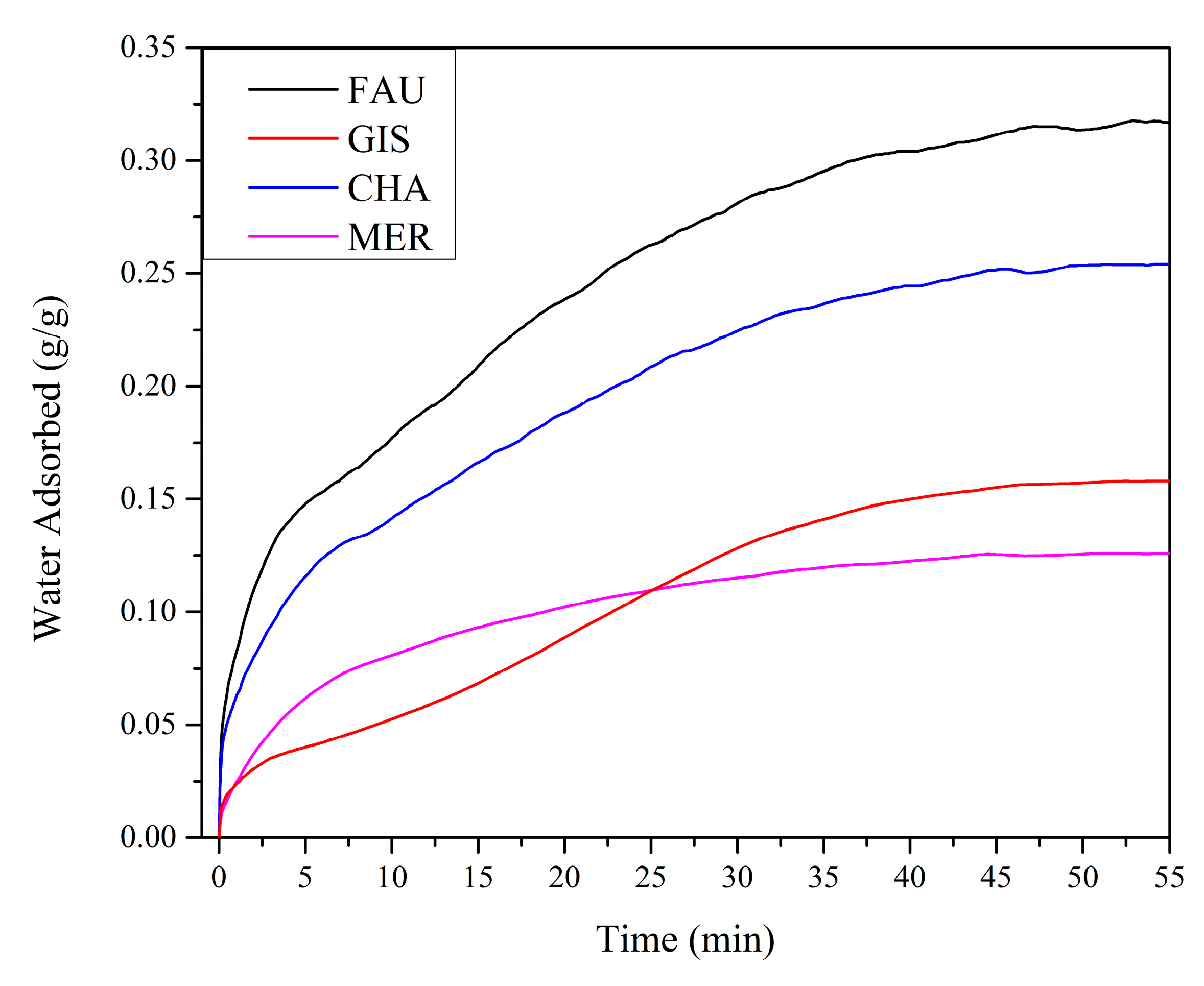
The impact of delicate balance among different fly ash treatment conditions and synthesis parameters were evaluated by measuring the water uptake amounts using the optimized benchmark products obtained in the current study. This allowed the assessment of the impact of performance of these products obtained using a waste material using fly ash. The water sorption behavior of the optimized zeolite samples (FAU, GIS, CHA, and MER) was investigated to establish the relationship between framework topology, phase stability, and adsorption performance. Figure 4 presents the corresponding sorption curves obtained under identical conditions. All samples exhibited a rapid initial uptake within the first 10 min of exposure to moisture, followed by a slower increase that stabilized after approximately 50 min, in line with previous observations for zeolitic materials [23,49]. This two-step kinetic profile is commonly attributed to the rapid filling of easily accessible adsorption sites (external surface and pore openings), followed by the slower diffusion of water molecules into the internal micropore network [49,50].
Among the tested frameworks, FAU demonstrated the highest water uptake (~23 wt%). This behavior can be attributed to its three-dimensional pore system consisting of 12-membered ring channels (~7.4 Å) and large supercages, which provide high accessibility and significant pore volume for water molecules [23,49]. CHA also exhibited considerable water uptake (~18 wt%). Despite its smaller 8-ring apertures (~3.8 × 3.8 Å), CHA possesses a three-dimensional cage-based structure in which water molecules interact strongly with the framework and extra-framework cations [9,51].
In contrast, GIS and MER displayed significantly lower water uptakes (~12–13 wt%). Both structures are characterized by relatively narrow pore systems and higher framework densities, which limit the number of accessible adsorption sites [24,52]. GIS-type frameworks, composed of interconnected 8-rings, provide only moderate sorption pathways, while MER, typically stabilized under high alkalinity, crystallizes into denser frameworks with restricted porosity [24,52]. Although GIS and MER are denser than FAU and CHA, they share structural motifs with PHI-type zeolites such as double crankshaft chains and 8-ring channels that enable selective adsorption of small molecules like CO2. Therefore, their coexistence in mixed-phase systems may still provide functional benefits, including enhanced selectivity or structural stability in specific adsorption or separation applications [53].
A clear trend emerged when comparing metastable and stable zeolite phases synthesized under the same precursor system. In the NaOH route, FAU (metastable) exhibited nearly double the uptake of GIS (stable), while in the KOH route, CHA (metastable) outperformed MER (stable). This observation reflects the general principle that metastable zeolites often nucleate with more open and less dense frameworks, providing superior sorption functionality, whereas prolonged crystallization yields denser, more stable frameworks with reduced accessible porosity [24,50,52]. This principle has been emphasized in both classical zeolite crystallization studies and more recent investigations of framework flexibility and stability [50].
Taken together, these findings highlight that controlling synthesis parameters to favor metastable frameworks (FAU and CHA) offers a clear functional advantage for adsorption-based applications. By tuning alkali composition and crystallization time, it is possible to stabilize open-framework zeolites that maximize sorption performance. These results align with broader trends identified in zeolite–water adsorption technologies for dehumidification, adsorption-driven heat pumps, and desalination [23,54]. This underlines the importance of targeting metastable frameworks when designing zeolites for moisture-related applications.

4. Discussion

The conversion of Soma Class C fly ash into zeolitic phases demonstrates how precursor chemistry, impurity removal, and synthesis conditions act together to control phase evolution and functional properties. The study shows that even high-Ca, sulfate-rich fly ash can be transformed into high-performance zeolites, provided that pretreatment and synthesis parameters are precisely tuned.
The starting fly ash contained abundant Ca-, S-, and Fe-bearing phases, with anhydrite dominating the crystalline fraction. These phases restrict nucleation and consume alkalinity, limiting zeolite formation [20,21,29,30]. HCl leaching effectively removed them, while also raising the Si/Al ratio to values favorable for high-silica zeolites. At 5 M HCl, Ca– and S–phases were eliminated, Fe content was reduced to ~2 wt.%, and the Si/Al ratio increased to 2.85. This transformation established precursor chemistry suitable for FAU- and CHA-type zeolite crystallization. Identifying this threshold is particularly important for Class C fly ashes, which are often considered unsuitable for high-silica zeolite production.
The synthesis results confirm that FAU is a metastable product requiring precise conditions. Without leaching, the low SAR and high impurity load yielded LTA and SOD, whereas leached precursors with SAR >1.7 produced FAU. The optimum water dilution (1:10 AFA:H2O) ensured sufficient supersaturation and crystallinity, while deviations either suppressed nucleation or shifted stability toward GIS and SOD [15]. Temperature and time also acted as kinetic levers: FAU crystallized strongly at 85–95 °C after 12 h, but prolonged synthesis or higher temperatures promoted GIS, consistent with Ostwald’s step rule [14,15,16,22].
Previous studies have shown that FAU crystals can transform into GIS-type zeolites upon prolonged synthesis or exposure to elevated temperatures [15,24,55,56], while similar time-dependent transitions from LTA to SOD have also been reported [55]. Our earlier in situ SR-XRD study using kaolin confirmed comparable transformations, identifying Al–Si spinel as a key intermediate phase [26]. Despite such progress, the underlying mechanisms remain complex, particularly when using heterogeneous raw materials like fly ash, whose variable cation composition promotes multiple framework formations. In the present study, the observed FAU→GIS transition with increasing synthesis time follows Ostwald’s step rule, where metastable phases evolve toward more stable structures. Although in situ SR-XRD analysis was beyond the scope of this work, systematic leaching experiments allowed the establishment of compositional boundaries, demonstrating sustainable, OSDA-free routes for zeolite synthesis from complex feedstocks. These findings delineate a clear operating window for selectively capturing FAU before transformation into denser phases.
Cation composition played a decisive role in determining whether CHA, MER, or PHI crystallized. With KOH, low alkalinity (FA:KOH = 1:1.2) favored MER, while higher KOH loading (FA:KOH = 1:1.2) promoted CHA. Introducing small Na+ fractions further stabilized CHA and suppressed MER, whereas larger Na+ fractions redirected the system toward PHI [39,40,41,42,43,44]. These outcomes highlight the complementary roles of Na+, which favors smaller 4-ring units, and K+, which supports the larger building units required for CHA. SEM morphologies confirmed these trends: rod bundles for MER and nested-disc aggregates for CHA, with evidence of intergrowth in mixed-alkali samples [25,45,46,47,48]. The ability to fine-tune framework type through controlled alkali speciation provides a practical handle for stabilizing CHA, even from challenging Class C fly ash precursors.
The influence of impurities on zeolite crystallization was found to have different effects on the framework type. In this study, impurity effects were most evident in the FAU–GIS phase relationship. In contrast, CHA formation was less sensitive to precursor composition; using identical gel formulations and synthesis temperatures, CHA consistently crystallized from different fly ash sources [34]. This indicates that CHA nucleation is comparatively more robust against compositional fluctuations in fly ash.
Water sorption measurements directly linked framework topology to functional performance. FAU displayed the highest uptake (~23 wt%) due to its 12-ring channels and supercages, while CHA also showed strong sorption (~18 wt%) through cooperative cage filling and cation–water interactions [9,23,49]. Previous studies have shown that CHA can achieve substantial sorption due to the cooperative filling of cages once initial adsorption sites are occupied [51]. Nevertheless, its uptake is lower than FAU due to the narrower pore openings, which impose diffusional constraints and limit the overall sorption capacity [49]. In contrast, GIS and MER, with their denser frameworks and narrow 8-ring channels, adsorbed less (~12–13 wt%) [24,52]. The consistent trend of FAU > CHA >> GIS ≈ MER illustrates the trade-off between metastability and performance: metastable frameworks provide superior sorption capacity, while thermodynamically stable phases sacrifice porosity for structural density [24,50,52]. For adsorption-based applications, this underscores the importance of stabilizing FAU and CHA within their kinetic windows.
Most studies on fly ash zeolitization have focused on Class F precursors [3,12,18,57], while this work demonstrates that high-Ca Class C fly ash can also be directed to FAU and CHA through strong acid leaching and controlled synthesis. Impurity removal acts as a lever for framework selectivity, and alkali composition provides an effective switch between CHA, MER, and PHI. The comparative results further confirm that metastable frameworks (FAU, CHA) outperform thermodynamically stable phases (GIS, MER) in water sorption capacity, underscoring the value of kinetic stabilization. While acid leaching increases the bulk Si/Al ratio, our findings indicate that FAU formation is not governed solely by SAR but rather by the nucleation kinetics and speciation of reactive aluminosilicate species, which limit FAU stability to an intrinsic range around Si/Al ≈ 2 regardless of precursor composition.
This study highlights a practical and scalable pathway for transforming underutilized Class C fly ash into high-performance zeolites, demonstrating that a waste stream long considered problematic can be converted into functional sorbents for adsorption-driven applications. By establishing the critical roles of acid pretreatment and alkali speciation, the findings not only expand the raw material base for zeolite synthesis but also provide design principles for tailoring framework topology to desired properties. Building on this, ongoing work is exploring solar-driven calcination as an energy-efficient route to further enhance the techno-economic and environmental feasibility of large-scale production [58]. This approach aims to replace the conventional alkali-fusion step with solar thermal energy, thereby significantly reducing fossil energy input and associated CO2 emissions. In this way, fly ash-derived FAU and CHA zeolites could contribute both to waste valorization and to the development of sustainable adsorption technologies.

5. Conclusions

This study established a systematic, template-free synthesis route for FAU and CHA zeolites from Class C fly ash, with the following key outcomes:
  • Acid pretreatment (5 M HCl) effectively removed Ca-, Fe-, and S-bearing impurities and increased the Si/Al ratio from 1.2 to 2.6, enabling the formation of high-silica frameworks.
  • FAU crystallization was optimized at 95 °C for 12 h, while longer synthesis promoted transformation into GIS, demonstrating the metastable–stable transition governed by Ostwald’s step rule.
  • CHA crystallization was favored under moderate KOH or mixed-alkali conditions, whereas higher KOH concentrations stabilized MER and PHI. SEM confirmed distinct morphologies associated with each framework.
  • Water sorption tests revealed that metastable FAU and CHA exhibited superior adsorption capacities (~23 wt% and ~18 wt%) compared to their stable analogues GIS and MER (~12–13 wt%).
Overall, these findings emphasize that metastable frameworks offer functional advantages over stable zeolites for adsorption applications, despite requiring more precise kinetic control during synthesis. By converting fly ash into high-performing metastable zeolites, this approach contributes to sustainable waste valorization while producing materials with significant potential in dehumidification, adsorption-driven heat pumps, gas separation, and environmental remediation.

Supplementary Materials

The following supporting information can be downloaded at https://www.mdpi.com/article/10.3390/min15111153/s1, Figure S1: XRD patterns of raw fly ash and acid-leached fly ash samples treated with 1–5 M HCl. The major crystalline phases identified are quartz (Qz), albite (Ab), anhydrite (An), and hematite (Hm), with their intensities progressively decreasing as the acid concentration increases. The magnified region (20–44° 2θ) highlights the reduction in impurity-related reflections.

Author Contributions

Conceptualization, S.C.G., S.Ş.A. and B.A.; methodology, S.C.G., S.Ş.A. and B.A.; validation, S.C.G. and B.A.; formal analysis, S.C.G.; investigation, S.C.G.; resources, B.A.; writing—original draft preparation, S.C.G. and B.A.; writing—review and editing, S.C.G., S.Ş.A. and B.A.; visualization, S.C.G. and B.A.; supervision, B.A.; project administration, B.A.; funding acquisition, B.A. All authors have read and agreed to the published version of the manuscript.

Funding

This research was funded by The Scientific and Technological Research Council of Turkey (TÜBİTAK), grant number 123M054, and the Middle East Technical University Scientific Research Projects Coordination Unit under grant number GAP-702-2023-11152.

Data Availability Statement

The data used to support the findings of this study are available from the corresponding author upon request.

Acknowledgments

The support provided by METU-Central Laboratory (Ankara, Turkey) is greatly acknowledged.

Conflicts of Interest

The authors declare no conflicts of interest.

Abbreviations

The following abbreviations are used in this manuscript:
SARSilicon-to-Aluminum Ratio
FAUFaujasite (zeolite framework type)
CHAChabazite (zeolite framework type)
GISGismondine (zeolite framework type)
MERMerlinoite (zeolite framework type)
LTALinde Type A zeolite
SODSodalite zeolite
OSDAOrganic Structure Directing Agent
XRDX-Ray Diffraction
XRFX-Ray Fluorescence
SEM/FE-SEMScanning Electron Microscopy/Field Emission Scanning Electron Microscopy
BETBrunauer–Emmett–Teller (surface area method)
DDWDouble-Distilled Water
HDPEHigh-Density Polyethylene

References

  1. International Energy Agency. Global Energy Review 2025; IEA: Paris, France, 2025. [Google Scholar]
  2. Belviso, C. State-of-the-Art Applications of Fly Ash from Coal and Biomass: A Focus on Zeolite Synthesis Processes and Issues. Prog. Energy Combust. Sci. 2018, 65, 109–135. [Google Scholar] [CrossRef]
  3. Akın, S.Ş.; Kirdeciler, S.K.; Kazanç, F.; Akata, B. Critical Analysis of Zeolite 4A Synthesis through One-Pot Fusion Hydrothermal Treatment Approach for Class F Fly Ash. Microporous Mesoporous Mater. 2021, 325, 111338. [Google Scholar] [CrossRef]
  4. Lin, S.; Jiang, X.; Zhao, Y.; Yan, J. Zeolite Greenly Synthesized from Fly Ash and Its Resource Utilization: A Review. Sci. Total Environ. 2022, 851, 158182. [Google Scholar] [CrossRef] [PubMed]
  5. Ahmaruzzaman, M. A Review on the Utilization of Fly Ash. Prog. Energy Combust. Sci. 2010, 36, 327–363. [Google Scholar] [CrossRef]
  6. Ghassemi, A. Handbook of Pollution Control and Waste Minimization; CRC PRESS: Boca Raton, FL, USA, 2001; ISBN 0824705815. [Google Scholar]
  7. Yao, Z.T.; Ji, X.S.; Sarker, P.K.; Tang, J.H.; Ge, L.Q.; Xia, M.S.; Xi, Y.Q. A Comprehensive Review on the Applications of Coal Fly Ash. Earth Sci. Rev. 2015, 141, 105–121. [Google Scholar] [CrossRef]
  8. Li, L.; Shen, Q.; Li, J.; Hao, Z.; Xu, Z.P.; Lu, G.Q.M. Iron-Exchanged FAU Zeolites: Preparation, Characterization and Catalytic Properties for N2O Decomposition. Appl. Catal. A Gen. 2008, 344, 131–141. [Google Scholar] [CrossRef]
  9. Ji, Y.; Deimund, M.A.; Bhawe, Y.; Davis, M.E. Organic-Free Synthesis of CHA-Type Zeolite Catalysts for the Methanol-to-Olefins Reaction. ACS Catal. 2015, 5, 4456–4465. [Google Scholar] [CrossRef]
  10. Liu, L.; Singh, R.; Xiao, P.; Webley, P.A.; Zhai, Y. Zeolite Synthesis from Waste Fly Ash and Its Application in CO2 Capture from Flue Gas Streams. Adsorption 2011, 17, 795–800. [Google Scholar] [CrossRef]
  11. Terzano, R.; Spagnuolo, M.; Medici, L.; Tateo, F.; Ruggiero, P. Characterization of Different Coal Fly Ashes for Their Application in the Synthesis of Zeolite X as Cation Exchanger for Soil Remediation. Fresenius Environ. Bull. 2005, 14, 263–267. [Google Scholar]
  12. Feng, W.; Wan, Z.; Daniels, J.; Li, Z.; Xiao, G.; Yu, J.; Xu, D.; Guo, H.; Zhang, D.; May, E.F.; et al. Synthesis of High Quality Zeolites from Coal Fly Ash: Mobility of Hazardous Elements and Environmental Applications. J. Clean. Prod. 2018, 202, 390–400. [Google Scholar] [CrossRef]
  13. Lee, Y.R.; Soe, J.T.; Zhang, S.; Ahn, J.W.; Park, M.B.; Ahn, W.S. Synthesis of Nanoporous Materials via Recycling Coal Fly Ash and Other Solid Wastes: A Mini Review. Chem. Eng. J. 2017, 317, 821–843. [Google Scholar] [CrossRef]
  14. Oleksiak, M.D.; Rimer, J.D. Synthesis of Zeolites in the Absence of Organic Structure-Directing Agents: Factors Governing Crystal Selection and Polymorphism. Rev. Chem. Eng. 2014, 30, 1–49. [Google Scholar] [CrossRef]
  15. Maldonado, M.; Oleksiak, M.D.; Chinta, S.; Rimer, J.D. Controlling Crystal Polymorphism in Organic-Free Synthesis of Na-Zeolites. J. Am. Chem. Soc. 2013, 135, 2641–2652. [Google Scholar] [CrossRef] [PubMed]
  16. Mizuno, Y.; Miyake, K.; Tanaka, S.; Nishiyama, N.; Fukuhara, C.; Kong, C.Y. Phase-Controlled Synthesis of Zeolites from Sodium Aluminosilicate under OSDA/Solvent-Free Conditions. Eur. J. Inorg. Chem. 2021, 2021, 1405–1409. [Google Scholar] [CrossRef]
  17. Xu, Q.; Lu, J.; Zhou, Z.; Jin, Y. FAU Zeolites from Coal/Rice Husk Co-Combustion Ash (Co-Ash) for CO2 Adsorption: Synthesis, Characterization, Adsorption and Regeneration Performance. Sep. Purif. Technol. 2025, 369, 133147. [Google Scholar] [CrossRef]
  18. Ramírez-Zamora, R.M.; Solís-López, M.; Robles-Gutierrez, I.; Reyes-Vidal, Y.; Espejel-Ayala, F. A Statistical Industrial Approach for the Synthesis Conditions of Zeolites Using Fly Ash and Kaolinite. Environ. Prog. Sustain. Energy 2018, 37, 318–332. [Google Scholar] [CrossRef]
  19. Molina, A.; Poole, C. A Comparative Study Using Two Methods to Produce Zeolites from Fly Ash. Miner. Eng. 2004, 17, 167–173. [Google Scholar] [CrossRef]
  20. Wang, S.; Vaughan, J.; Xia, F.; Etschmann, B.; Brugger, J.; Brand, H.; Peng, H. Revealing the Effect of Anions on the Formation and Transformation of Zeolite LTA in Caustic Solutions: An In Situ Synchrotron PXRD Study. Cryst. Growth Des. 2023, 23, 3660–3670. [Google Scholar] [CrossRef]
  21. Sun, C.; Liu, Z.; Wang, S.; Pang, H.; Bai, R.; Wang, Q.; Chen, W.; Zheng, A.; Yan, W.; Yu, J. Anionic Tuning of Zeolite Crystallization. CCS Chem. 2021, 3, 189–198. [Google Scholar] [CrossRef]
  22. Oleksiak, M.D.; Soltis, J.A.; Conato, M.T.; Penn, R.L.; Rimer, J.D. Nucleation of FAU and LTA Zeolites from Heterogeneous Aluminosilicate Precursors. Chem. Mater. 2016, 28, 4906–4916. [Google Scholar] [CrossRef]
  23. Ng, E.P.; Mintova, S. Nanoporous Materials with Enhanced Hydrophilicity and High Water Sorption Capacity. Microporous Mesoporous Mater. 2008, 114, 1–26. [Google Scholar] [CrossRef]
  24. Feijen, E.J.P.; Martens, J.A.; Jacobs, P.A. Zeolites and Their Mechanism of Synthesis. Stud. Surf. Sci. Catal. 1994, 84, 3–21. [Google Scholar] [CrossRef]
  25. Chawla, A.; Mallette, A.J.; Jain, R.; Le, N.; Robles Hernández, F.C.; Rimer, J.D. Crystallization of Potassium-Zeolites in Organic-Free Media. Microporous Mesoporous Mater. 2022, 341, 112026. [Google Scholar] [CrossRef]
  26. Pasabeyoglu, P.; Akata, B. Calcination Effects on Meta-Forms of Kaolin and Halloysite: Role of Al-Si Spinel Crystallization in Zeolite Synthesis. Microporous Mesoporous Mater. 2025, 391, 113626. [Google Scholar] [CrossRef]
  27. ASTM C618–17a; Standard Specification for Coal Fly Ash and Raw or Calcined Natural Pozzolan for Use in Concrete. ASTM International: West Conshohocken, PA, USA, 2017. Available online: https://store.astm.org/c0618-17a.html (accessed on 1 September 2025).
  28. Vassilev, S.V.; Vassileva, C.G. A New Approach for the Classification of Coal Fly Ashes Based on Their Origin, Composition, Properties, and Behaviour. Fuel 2007, 86, 1490–1512. [Google Scholar] [CrossRef]
  29. Peng, H.; Ding, M.; Vaughan, J. The Anion Effect on Zeolite Linde Type A to Sodalite Phase Transformation. Ind. Eng. Chem. Res. 2018, 57, 10292–10302. [Google Scholar] [CrossRef]
  30. Kuwahara, Y.; Ohmichi, T.; Mori, K.; Katayama, I.; Yamashita, H. Synthesis of Zeolite from Steel Slag and Its Application as a Support of Nano-Sized TiO2 Photocatalyst. J. Mater. Sci. 2008, 43, 2407–2410. [Google Scholar] [CrossRef]
  31. Berti, D.; Groppo, J.G.; Joshi, P.; Preda, D.V.; Gamliel, D.P.; Beers, T.; Schrock, M.; Hopps, S.D.; Morgan, T.D.; Zechmann, B.; et al. Electron Microbeam Investigations of the Spent Ash from the Pilot-Scale Acid Extraction of Rare Earth Elements from a Beneficiated Kentucky Fly Ash. Int. J. Coal Geol. 2025, 303, 104738. [Google Scholar] [CrossRef]
  32. Panitchakarn, P.; Klamrassamee, T.; Laosiripojana, N.; Viriya-Empikul, N.; Pavasant, P. Synthesis and Testing of Zeolite from Industrial-Waste Coal Fly Ash as Sorbent for Water Adsorption from Ethanol Solution. Eng. J. 2014, 18, 1–12. [Google Scholar] [CrossRef]
  33. Gao, J.M.; Wang, B.; Li, W.; Cui, L.; Guo, Y.; Cheng, F. High-Efficiency Leaching of Al and Fe from Fly Ash for Preparation of Polymeric Aluminum Ferric Chloride Sulfate Coagulant for Wastewater Treatment. Sep. Purif. Technol. 2023, 306, 122545. [Google Scholar] [CrossRef]
  34. Akın, S.Ş. Pore Engineering and Surface Functionalization of Porous Carbon Structures Derived from Biochar, and Zeolites Derived from Fly Ashes; Middle East Technical University: Ankara, Turkey, 2025. [Google Scholar]
  35. Valeev, D.; Mikhailova, A.; Atmadzhidi, A. Kinetics of Iron Extraction from Coal Fly Ash by Hydrochloric Acid Leaching. Metals 2018, 8, 533. [Google Scholar] [CrossRef]
  36. Treacy, M.M.J.; Higgins, J.B. Collection of Simulated XRD Powder Patterns for Zeolites Editors; Elsevier: Amsterdam, The Netherlands, 2001. [Google Scholar]
  37. Julbe, A.; Drobek, M. Zeolite A Type. In Encyclopedia of Membranes; Drioli, E., Giorno, L., Eds.; Springer: Berlin/Heidelberg, Germany, 2016. [Google Scholar] [CrossRef]
  38. Liu, Y.; Wang, G.; Luo, Q.; Li, X.; Wang, Z. The Thermodynamics and Kinetics for the Removal of Copper and Nickel Ions by the Zeolite y Synthesized from Fly Ash. Mater. Res. Express 2019, 6, 025001. [Google Scholar] [CrossRef]
  39. Jin, X.; Ji, N.; Song, C.; Ma, D.; Yan, G.; Liu, Q. Synthesis of CHA Zeolite Using Low Cost Coal Fly Ash. Procedia Eng. 2015, 121, 961–966. [Google Scholar] [CrossRef][Green Version]
  40. Gong, H.; Goyal, N.; Liu, L.; Wang, Y.; Fang, X.; Jia, H.; Li, G.; Du, T. Green Synthesis Strategy of Chabazite Membrane and Its CO2/N2 Separation Performance. J. Porous Mater. 2021, 28, 1401–1410. [Google Scholar] [CrossRef]
  41. Du, T.; Fang, X.; Wei, Y.; Shang, J.; Zhang, B.; Liu, L. Synthesis of Nanocontainer Chabazites from Fly Ash with a Template- and Fluoride-Free Process for Cesium Ion Adsorption. Energy Fuels 2017, 31, 4301–4307. [Google Scholar] [CrossRef]
  42. Yang, X.; Zhao, X.; Xiao, J.; Fan, Q.; Yang, R.; Yu, L. High Silica Zeolite Phi, a CHA Type Zeolite with ABC-D6R Stacking Faults. Microporous Mesoporous Mater. 2017, 248, 129–138. [Google Scholar] [CrossRef]
  43. Imai, H.; Hayashida, N.; Yokoi, T.; Tatsumi, T. Direct Crystallization of CHA-Type Zeolite from Amorphous Aluminosilicate Gel by Seed-Assisted Method in the Absence of Organic-Structure-Directing Agents. Microporous Mesoporous Mater. 2014, 196, 341–348. [Google Scholar] [CrossRef]
  44. Murayama, N.; Yamamoto, H.; Shibata, J. Zeolite Synthesis from Coal Fly Ash by Hydrothermal Reaction Using Various Alkali Sources. J. Chem. Technol. Biotechnol. 2002, 77, 280–286. [Google Scholar] [CrossRef]
  45. Skofteland, B.M.; Ellestad, O.H.; Lillerud, K.P. Potassium Merlinoite: Crystallization, Structural and Thermal Properties. Microporous Mesoporous Mater. 2001, 43, 61–71. [Google Scholar] [CrossRef]
  46. Hu, Z.; Zhao, B.; Zhang, S.; Tan, Z.; Liu, X.; Cao, J. Rapid and High Efficient Synthesis of Zeolite W by Gel-like-Solid Phase Method. Microporous Mesoporous Mater. 2019, 281, 75–83. [Google Scholar] [CrossRef]
  47. Kim, J.; Kim, D.H. Synthesis of Faulted CHA-Type Zeolites with Controllable Faulting Probability. Microporous Mesoporous Mater. 2018, 256, 266–274. [Google Scholar] [CrossRef]
  48. Zhou, J.; Gao, F.; Sun, K.; Jin, X.; Zhang, Y.; Liu, B.; Zhou, R. Green Synthesis of Highly CO2-Selective CHA Zeolite Membranes in All-Silica and Fluoride-Free Solution for CO2/CH4 Separations. Energy Fuels 2020, 34, 11307–11314. [Google Scholar] [CrossRef]
  49. Pérez-Botella, E.; Valencia, S.; Rey, F. Zeolites in Adsorption Processes: State of the Art and Future Prospects. Chem. Rev. 2022, 122, 17647–17695. [Google Scholar] [CrossRef] [PubMed]
  50. Ghojavand, S.; Dib, E.; Mintova, S. Flexibility in Zeolites: Origin, Limits, and Evaluation. Chem. Sci. 2023, 14, 12430–12446. [Google Scholar] [CrossRef] [PubMed]
  51. Gölboylu, S.C. Synthesis of FAU and CHA Zeolites from Class C Fly ASH; Middle East Technical University: Ankara, Turkey, 2023. [Google Scholar]
  52. Cundy, C.S.; Cox, P.A. The Hydrothermal Synthesis of Zeolites: Precursors, Intermediates and Reaction Mechanism. Microporous Mesoporous Mater. 2005, 82, 1–78. [Google Scholar] [CrossRef]
  53. Choi, H.J.; Bruce, E.L.; Kencana, K.S.; Hong, J.; Wright, P.A.; Hong, S.B. Highly Cooperative CO2 Adsorption via a Cation Crowding Mechanism on a Cesium-Exchanged Phillipsite Zeolite. Angew. Chem. 2023, 135, e202305816. [Google Scholar] [CrossRef]
  54. Saadat, F.; Hashmi, A.R.; Zheng, X.; Pan, Q.; Wang, B.; Gan, Z. Progress in Zeolite–Water Adsorption Technologies for Energy-Efficient Utilization. Energy 2024, 308, 133001. [Google Scholar] [CrossRef]
  55. Tounsi, H.; Mseddi, S.; Djemel, S. Preparation and Characterization of Na-LTA Zeolite from Tunisian Sand and Aluminum Scrap. Phys. Procedia 2009, 2, 1065–1074. [Google Scholar] [CrossRef]
  56. De Lima, R.C.F.; Da, D.; Oliveira, S.; Pergher, S.B.C.; Zubkova, N.V.; Djerdj, I. Interzeolitic Transformation of Clinoptilolite into GIS and LTA Zeolite. Minerals 2021, 11, 1313. [Google Scholar] [CrossRef]
  57. Derkowski, A.; Michalik, M. Statistical Approach to the Transformation of Fly Ash into Zeolites. Mineral. Pol. 2007, 38, 47–69. [Google Scholar] [CrossRef][Green Version]
  58. Pasabeyoglu, P.; Moumin, G.; de Oliveira, L.; Roeb, M.; Akata, B. Solarization of the Zeolite Production: Calcination of Kaolin as Proof-of-Concept. J. Clean. Prod. 2023, 414, 137611. [Google Scholar] [CrossRef]
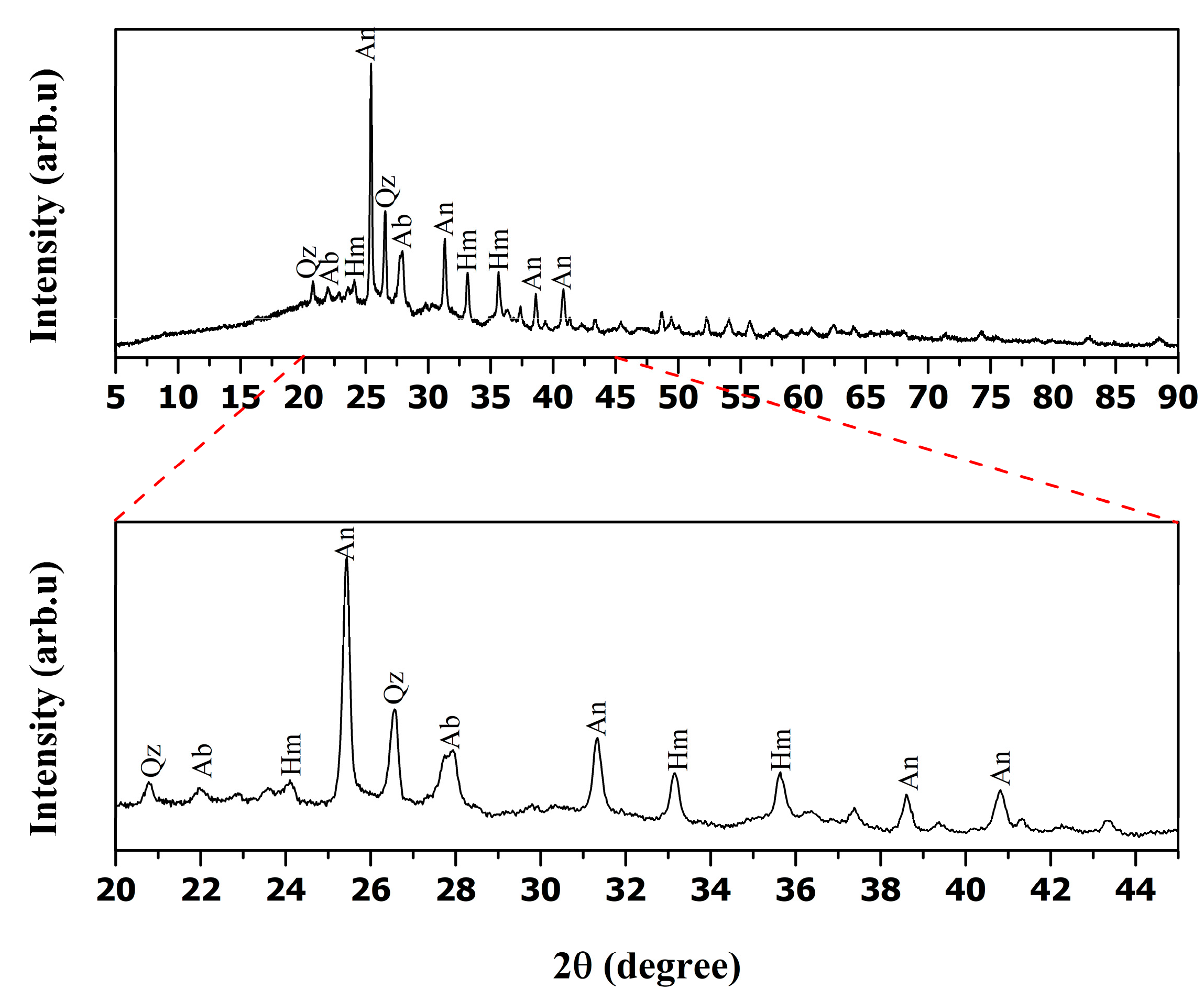
Figure 1. XRD pattern of raw fly ash sample. Qz: Quartz, Ab: Albite (Calcian), Hm: Hematite, An: Anhydrite.
Minerals 15 01153 g001
Figure 2. XRD patterns of zeolites synthesized from 5 M HCl-leached fly ash under various synthesis conditions and, (a) shows the effect of HCl concentration during acid pretreatment, (b) presents the effect of AFA:H2O mass ratio in the synthesis solution, (c) illustrates the influence of crystallization temperature, (d) displays the effect of crystallization time. Characteristic diffraction peaks were indexed to the corresponding zeolitic phases (FAU, GIS, LTA, SOD) based on reference patterns from the International Zeolite Association database [36].
Minerals 15 01153 g002
Figure 3. (a) XRD patterns of zeolites synthesized from 5 M HCl–leached fly ash under different KOH loadings (FA:KOH = 1:1.2, 1:1.6, 1:2). The diffraction peaks correspond to CHA, MER, and PHI phases, indexed using reference patterns from the International Zeolite Association database [36]. database. (b) XRD patterns of zeolites obtained under mixed-alkali conditions with varying NaOH/KOH ratios (FA:KOH:NaOH = 1:2:0, 1:1.8:0.2, 1:1.6:0.4, 1:1.4:0.6). (c,d) Representative SEM images of optimized MER (1 FA:1.2 KOH) and CHA (1 FA:1.8 KOH:0.2 NaOH) products respectively.
Minerals 15 01153 g003
Figure 4. Water sorption performance of optimized zeolite samples (FAU, GIS, CHA, MER) synthesized from acid-leached fly ash.
Minerals 15 01153 g004
Table 1. Chemical Analysis of Soma Fly Ash.
wt.%SiO2Al2O3CaOSO3Fe2O3Other Oxides
Fly Ash36.423.314.79.267.818.53
Table 2. Semi-quantitative analysis results based on Reference Intensity Ratio (RIR) method for the fly ash sample.
Phase NameContent (%)
Anhydrite (CaSO4)56
Quartz (SiO2)12.4
Albite, calcian (NaCaAlSi3O8)21.2
Lime (CaO)2.0
Hematite (Fe2O3)8.7
Table 3. Summary of acid leaching studies on Soma fly ash with different HCl concentrations. Chemical compositions were determined by XRF, while the impurity phases were identified by XRD (Figure S1, Supplementary Information).
SampleSi/Al RatioSO3 (%)CaO (%)Fe2O3 (%)Impurity Phases (XRD)
Raw Fly Ash1.339.2614.77.81Albite (Ca), Hematite, Anhydrite
1M HCl-Leached FA1.696.017.478.18Minor Albite (Ca), Hematite, Trace Anhydrite
2M HCl-Leached FA2.193.294.318.74Minor Albite (Ca), Minor Hematite
3M HCl-Leached FA2.573.013.626.41Very Minor Hematite
4M HCl-Leached FA2.771.963.354.28Trace Hematite
5M HCl-Leached FA2.850.972.652.22-
Table 4. Optimized synthesis conditions of benchmark zeolite samples (FAU, GIS, CHA, and MER) prepared from acid-leached fly ash under NaOH/KOH fusion–hydrothermal treatment.
ZeolitesGel Composition (FA:KOH:NaOH:H2O)Temperature (°C)Synthesis Time (h)
FAU1:0:1.2:109512
GIS1:0:1.2:109524
CHA1:1.8:0.2:1010096
MER1:1.2:0:1010096
Disclaimer/Publisher’s Note: The statements, opinions and data contained in all publications are solely those of the individual author(s) and contributor(s) and not of MDPI and/or the editor(s). MDPI and/or the editor(s) disclaim responsibility for any injury to people or property resulting from any ideas, methods, instructions or products referred to in the content.