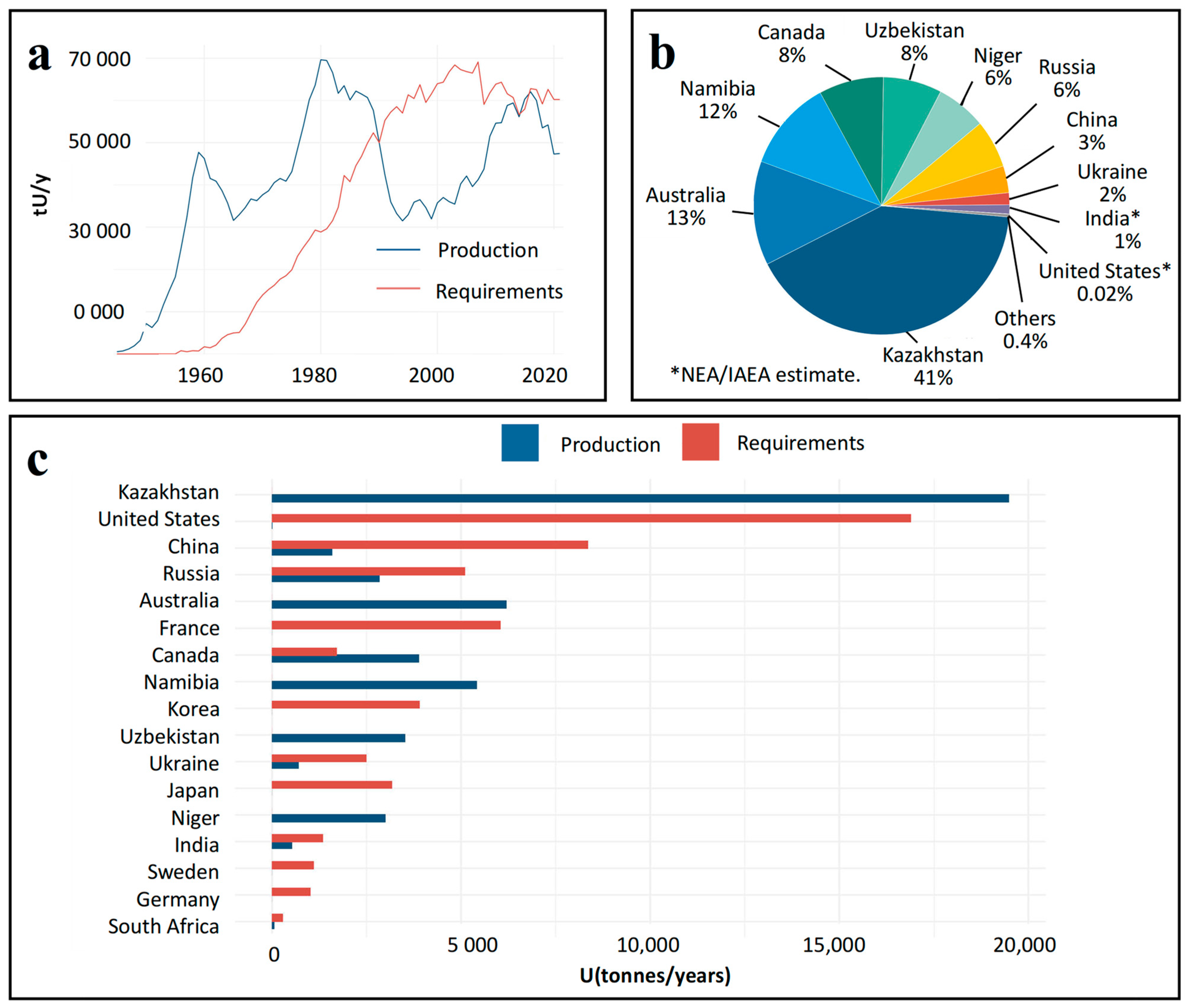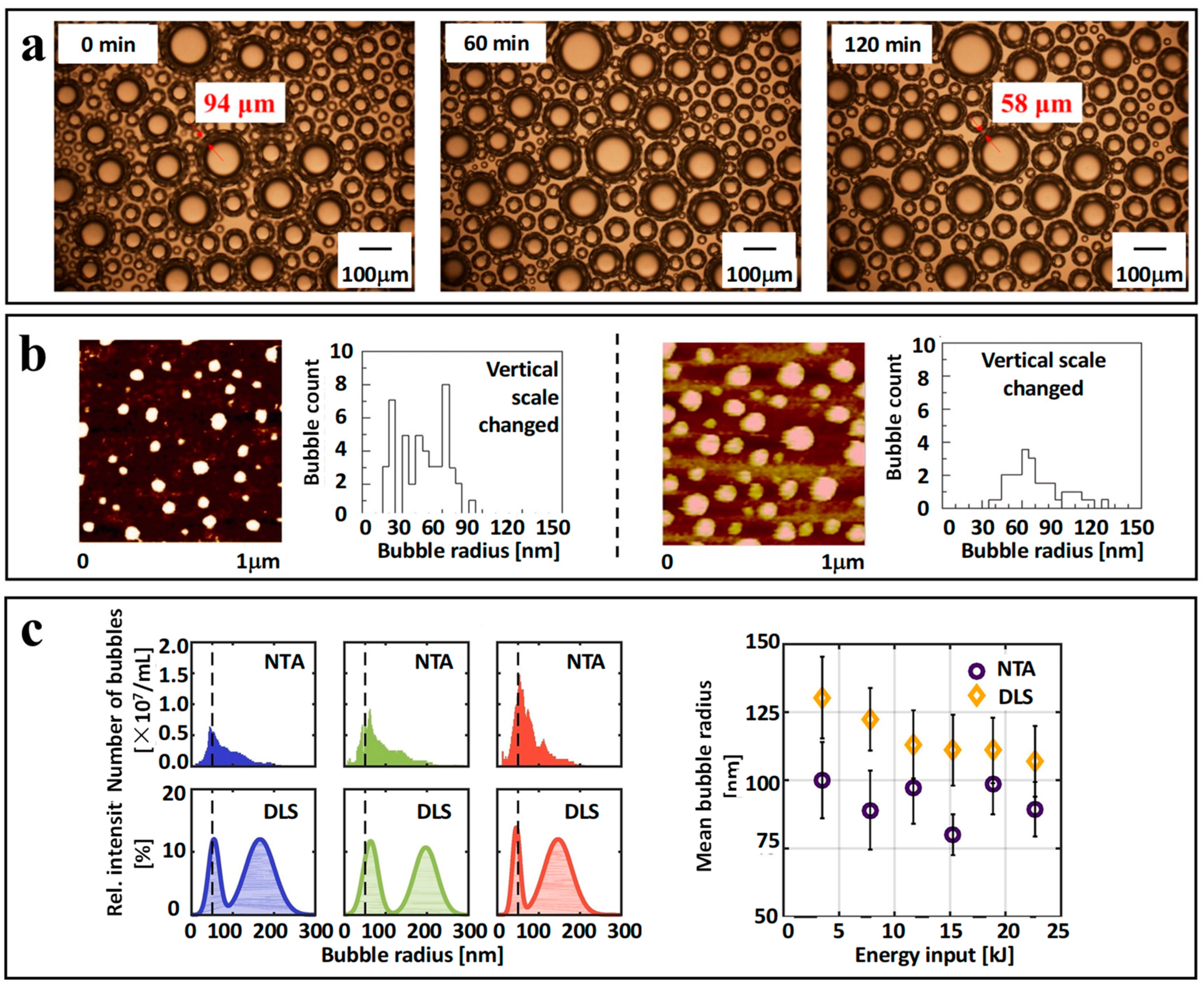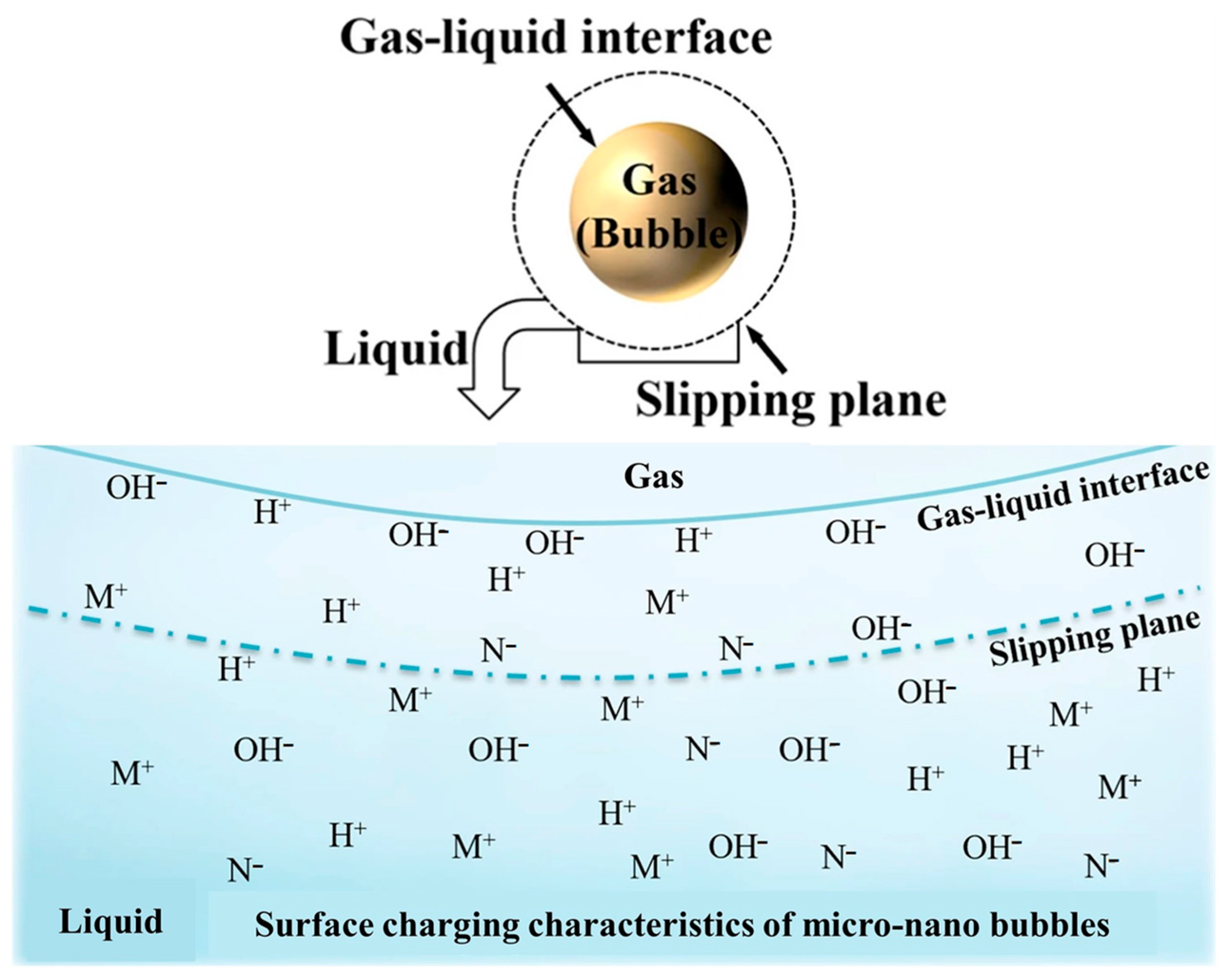

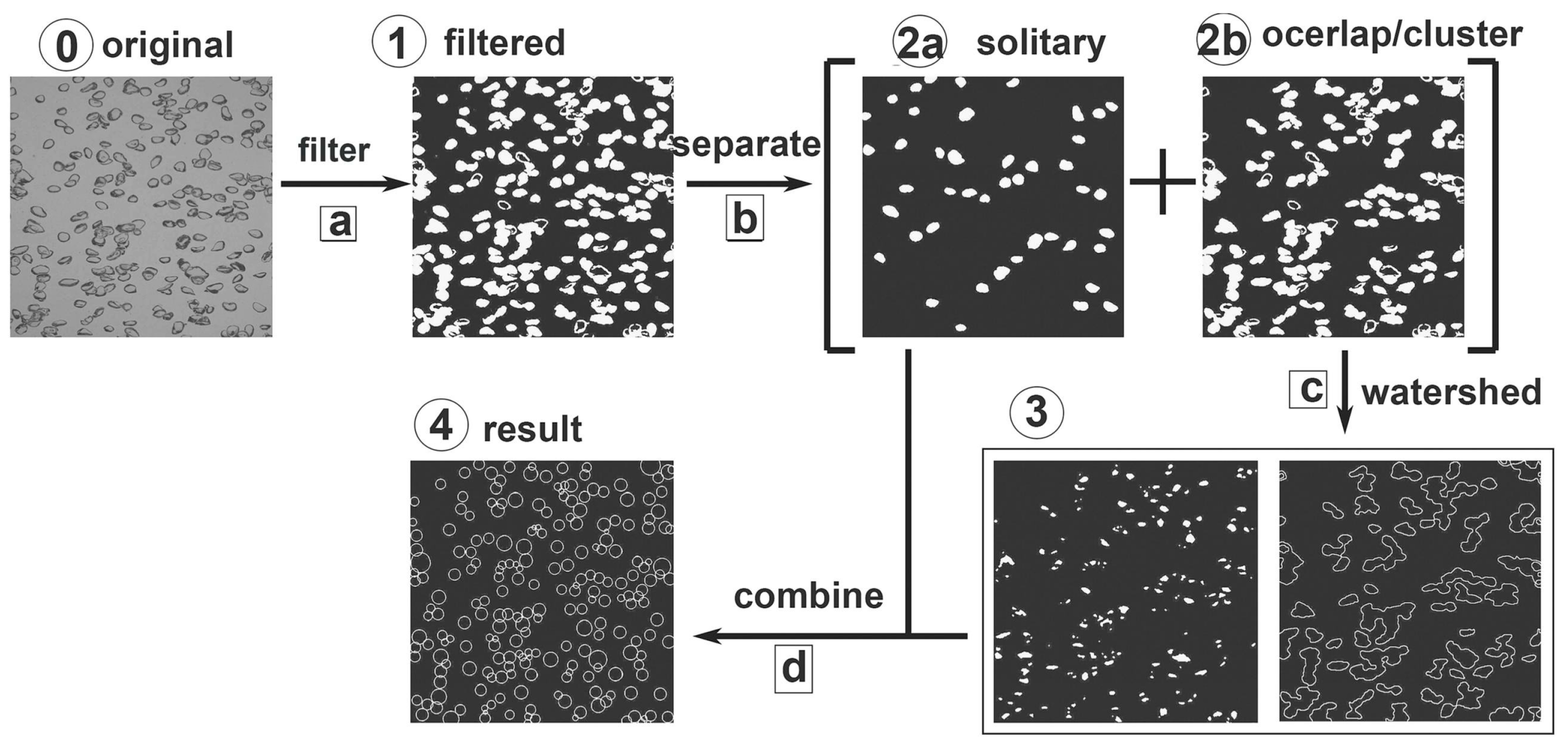
Feasibility and Challenges of In Situ Uranium Leaching Using Ozone Bubbles: A Review


Abstract
1. Introduction
- Summarize the characteristics of OMNBs and their preparation approaches, characterization techniques, and examine the factors influencing the properties of OMNBs, with the aim of enhancing the understanding pertaining to this type of aeration;
- Analyze the mechanism behind the application of OMNBs in uranium recovery and explore their potential uses;
- Discuss the difficulties in the implementation of OMNBs in ISL methods and propose relevant suggestions to overcome the difficulties.
2. The Characteristics of MNBs and Ozone
2.1. The Size of MNBs


| Properties | Bubble Type | ||
|---|---|---|---|
| Macro-Bubble | Microbubble | Nanobubble | |
| Size range | 100~10,000 mm | 1~100 mm | 0.001~1 mm |
| Lasting time 1 | Seconds | Minutes | Hours-month |
| Rising velocity | Fast | Slow | Brownian motion |
| Mass transfer Coefficient (m/s) | ~10−4 | 10−4~10−3 | >10−3 |
| Surface area to volume ratio | Low | Large | Superior |
| Internal pressure | Low | High | High |
| Zeta potential (mV) | ~0 | −50~−20 | −70~−30 |
| Gas dissolution rate | Low | High | High |
| Collapse type | Burst at surface | Burst in bulk liquid | Shrink and burst in bulk liquid |
2.2. The Rise Velocity of MNBs
2.3. The Mass Transfer Efficiency of MNBs
2.4. The Gas Dissolution of MNBs
2.5. The Zeta Potential of MNBs
2.6. The Characteristics of Ozone
3. The Selection and Generation of Ozone MNBs
3.1. The Selection of MNB Generating Methods
3.2. MNB Preparation Techniques
3.2.1. Electrolysis and Chemical Reaction Methods
3.2.2. Ultrasonic Method
3.2.3. Gaseous Diffusion Method
3.2.4. UV-C and Vacuum-UV (VUV) Ozone Generation
3.2.5. Ozone Storage and Pressurized Use
4. Characterization Methods of MNBs
4.1. Size Measurement
4.2. Measurement of Zeta Potential
4.3. Other Measurements for MNBs
5. The Impact Factors of OMNBs
5.1. pH Value
5.2. The Concentration of Ozone
5.3. Other Impact Factors
6. Potential and Challenge of Applying OMNBs During In Situ Uranium Leaching
6.1. Theoretical and Applicable Basis for OMNBs During In Situ Leaching
6.2. Difficulties of Applying OMNBs During ISL
6.2.1. Oxidation Mechanism of OMNBs and Impact Factors
6.2.2. Issues That Limit the Field Applications of OMNBs During ISL Process
7. Conclusions and Future Perspectives
- (1)
- Studying the reaction mechanism: Investigating the reaction mechanism of OMNBs with uranium ore under varying pH conditions, particularly focusing on the primary oxidizing components. This will provide valuable insights for optimizing test conditions and will help in understanding the underlying chemical processes, and aid in refining the application of OMNBs in uranium extraction.
- (2)
- Feasibility, economics, and risk assessment: Conducting a comprehensive evaluation of the feasibility and risks associated with the ISL method using OMNBs from economic cost and environmental perspectives is essential. This assessment will guide engineering practices and provide a clear understanding of the potential benefits and challenges of implementing OMNB-based uranium extraction on a larger scale.
- (3)
- Updating MNB generating devices: Improving the design of bubble generating devices to produce MNBs with controllable sizes and concentrations is crucial for reducing operational costs and enhancing overall efficiency.
Funding
Data Availability Statement
Conflicts of Interest
References
- International Energy Agency. Greenhouse Gas Emissions from Energy: Overview. 2021. Available online: https://www.iea.org/reports/greenhouse-gas-emissions-from-energy-overview (accessed on 26 March 2024).
- Liu, L.; Guo, H.; Dai, L.; Liu, M.; Xiao, Y.; Cong, T.; Gu, H. The role of nuclear energy in the carbon neutrality goal. Prog. Nucl. Energy 2023, 162, 104772. [Google Scholar] [CrossRef]
- Monnet, A.; Gabriel, S.; Percebois, J. Long-term availability of global uranium resources. Resour. Policy 2017, 53, 394–407. [Google Scholar] [CrossRef]
- International Energy Agency. Nuclear: A New Dawn for Nuclear Energy? 2021. Available online: https://www.iea.org/fuels-and-technologies/nuclear (accessed on 26 March 2024).
- Nuclear Energy Agency; International Atomic Energy Agency. Uranium 2022 Resources, Production and Demand; Nuclear Energy Agency: Paris, France; International Atomic Energy Agency: Vienna, Austria, 2023. [Google Scholar]
- Cuney, M.; Bruneton, P.; Fairclough, M.; Tulsidas, H. Geological Classification of Uranium Deposits and Description of Selected Examples; International Atomic Energy Agency: Vienna, Austria, 2018. [Google Scholar]
- International Atomic Energy Agency. World Distribution of Uranium Deposits (UDEPO) with Uranium Deposit Classification; International Atomic Energy Agency: Vienna, Austria, 2009. [Google Scholar]
- Abzalov, M.Z. Sandstone-hosted uranium deposits amenable for exploitation by in situ leaching technologies. Appl. Earth Sci. 2013, 121, 55–64. [Google Scholar] [CrossRef]
- International Atomic Energy Agency. Manual of Acid In Situ Leach Uranium Mining Technology; International Atomic Energy Agency: Vienna, Austria, 2001. [Google Scholar]
- International Atomic Energy Agency. In Situ Leach Uranium Mining: An Overview of Operations; International Atomic Energy Agency: Vienna, Austria, 2016. [Google Scholar]
- Su, X.; Liu, Z.; Yao, Y.; Du, Z. Petrology, mineralogy, and ore leaching of sandstone-hosted uranium deposits in the Ordos Basin, North China. Ore Geol. Rev. 2020, 127, 103768. [Google Scholar] [CrossRef]
- Yang, Y.; Zuo, J.; Qiu, W.; Wu, J.; Que, W.; Zhou, G.; Liu, Z.; Wu, J. Assessment of the Greenhouse Gas Footprint and Environmental Impact of CO2 and O2 In Situ Uranium Leaching. Acta Geol. Sin. (Engl. Ed.) 2023, 97, 986–994. [Google Scholar] [CrossRef]
- Zhang, L.; Nowak, W.; Oladyshkin, S.; Wang, Y.; Cai, J. Opportunities and challenges in CO2 geologic utilization and storage. Adv. Geo-Energy Res. 2023, 8, 141–145. [Google Scholar] [CrossRef]
- Zheng, F.; Teng, Y.; Zhai, Y.; Hu, J.; Dou, J.; Zuo, R. Geo-Environmental Models of In-Situ Leaching Sandstone-Type Uranium Deposits in North China: A Review and Perspective. Water 2023, 15, 1244. [Google Scholar] [CrossRef]
- Zhang, T.; Liu, J.; Yang, X.; Sun, S. Advances in the microscopic and mesoscopic simulation technologies developed for subsurface gas storage. Adv. Geo-Energy Res. 2024, 14, 1–3. [Google Scholar] [CrossRef]
- Zhao, K.; Sun, Z.; Du, C.; Zhou, Y.; Li, G.; Lui, J.; Xu, L. Blockage and uranium migration via CO2 + O2 leaching within autoclave: A test study from Mengqiguer deposit in Yili Basin, Northwest of China. J. Radioanal. Nucl. Chem. 2022, 331, 2631–2644. [Google Scholar] [CrossRef]
- Adenuga, A.A.; Amos, O.D.; Oyekunle, J.A.O.; Umukoro, E.H. Adsorption performance and mechanism of a low-cost biosorbent from spent seedcake of Calophyllum inophyllum in simultaneous cleanup of potentially toxic metals from industrial wastewater. J. Environ. Chem. Eng. 2019, 7, 103317. [Google Scholar] [CrossRef]
- Jabesa, A.; Ghosh, P. Removal of diethyl phthalate from water by ozone microbubbles in a pilot plant. J. Environ. Manag. 2016, 180, 476–484. [Google Scholar] [CrossRef]
- Temesgen, T.; Bui, T.T.; Han, M.; Kim, T.-I.; Park, H. Micro and nanobubble technologies as a new horizon for water-treatment techniques: A review. Adv. Colloid Interface Sci. 2017, 246, 40–51. [Google Scholar] [CrossRef] [PubMed]
- Jia, M.; Farid, M.U.; Kharraz, J.A.; Kumar, N.M.; Chopra, S.S.; Jang, A.; Chew, J.; Khanal, S.K.; Chen, G.; An, A.K. Nanobubbles in water and wastewater treatment systems: Small bubbles making big difference. Water Res. 2023, 245, 120613. [Google Scholar] [CrossRef]
- Shen, D.; Xie, Z.; Shentu, J.; Long, Y.; Lu, L.; Li, L.; Qi, S. Enhanced oxidation of aromatic hydrocarbons by ozone micro-nano bubble water: Mechanism and influencing factors. J. Environ. Chem. Eng. 2023, 11, 110281. [Google Scholar] [CrossRef]
- Xu, Y.; Xia, H.; Zhang, Q.; Cai, W.; Jiang, G.; Zhang, L. Green and efficient recovery of valuable metals from by-products of zinc hydrometallurgy and reducing toxicity. J. Clean. Prod. 2022, 380, 134993. [Google Scholar] [CrossRef]
- Yang, Z.; Yang, Z.; Yang, S.; Liu, Z.; Liu, Z.; Liu, Y.; Drewniak, L.; Jiang, C.; Li, Q.; Li, W.; et al. Life cycle assessment and cost analysis for copper hydrometallurgy industry in China. J. Environ. Manag. 2022, 309, 114689. [Google Scholar] [CrossRef] [PubMed]
- Ruby, K.; Majumder, S.K. Studies on stability and properties of micro and nano-particle-laden ionic microbubbles. Powder Technol. 2018, 335, 77–90. [Google Scholar] [CrossRef]
- Fan, W.; An, W.; Huo, M.; Yang, W.; Zhu, S.; Lin, S. Solubilization and stabilization for prolonged reactivity of ozone using micro-nano bubbles and ozone-saturated solvent: A promising enhancement for ozonation. Sep. Purif. Technol. 2020, 238, 116484. [Google Scholar] [CrossRef]
- Ushikubo, F.Y.; Furukawa, T.; Nakagawa, R.; Enari, M.; Makino, Y.; Kawagoe, Y.; Shiina, T.; Oshita, S. Evidence of the existence and the stability of nano-bubbles in water. Colloids Surf. A Physicochem. Eng. Asp. 2010, 361, 31–37. [Google Scholar] [CrossRef]
- Li, H.; Hu, L.; Song, D.; Al-Tabbaa, A. Subsurface Transport Behavior of Micro-Nano Bubbles and Potential Applications for Groundwater Remediation. Int. J. Environ. Res. Public Health 2013, 11, 473–486. [Google Scholar] [CrossRef]
- Yang, Y.; Yao, X.; Wu, S.; Wang, X.; Feng, L.; Feng, X.; Ma, Y. Enhanced treatment of azo dyes in wastewater using heat-activated persulfate with micro-nano bubble aeration. Chem. Eng. Res. Des. 2023, 197, 24–37. [Google Scholar] [CrossRef]
- Hu, L.; Xia, Z. Application of ozone micro-nano-bubbles to groundwater remediation. J. Hazard. Mater. 2018, 342, 446–453. [Google Scholar] [CrossRef]
- Shangguan, Y.; Yu, S.; Gong, C.; Wang, Y.; Yang, W.; Hou, L. A review of microbubble and its applications in ozonation. IOP Conf. Ser. Earth Environ. Sci. 2018, 128, 012149. [Google Scholar] [CrossRef]
- Zhou, Y.; Zhou, B.; Xu, F.; Muhammad, T.; Li, Y. Appropriate dissolved oxygen concentration and application stage of micro-nano bubble water oxygation in greenhouse crop plantation. Agric. Water Manag. 2019, 223, 105713. [Google Scholar] [CrossRef]
- Ryskie, S.; Gonzalez-Merchan, C.; Neculita, C.M.; Genty, T. Efficiency of ozone microbubbles for ammonia removal from mine effluents. Miner. Eng. 2020, 145, 106071. [Google Scholar] [CrossRef]
- Zhang, X.; Sun, H.; Zhao, H.; Qin, Y.; Wang, Q.; Li, Y. Formation and stabilization of CO2 bubbles with different sizes and the interaction with solid particles. Colloids Surf. A Physicochem. Eng. Asp. 2020, 598, 124815. [Google Scholar] [CrossRef]
- Bhushan, B.; Pan, Y.; Daniels, S. AFM characterization of nanobubble formation and slip condition in oxygenated and electrokinetically altered fluids. J. Colloid Interface Sci. 2013, 392, 105–116. [Google Scholar] [CrossRef] [PubMed]
- Li, M.; Ma, X.; Eisener, J.; Pfeiffer, P.; Ohl, C.-D.; Sun, C. How bulk nanobubbles are stable over a wide range of temperatures. J. Colloid Interface Sci. 2021, 596, 184–198. [Google Scholar] [CrossRef] [PubMed]
- Haris, S.; Qiu, X.; Klammler, H.; Mohamed, M.M.A. The use of micro-nano bubbles in groundwater remediation: A comprehensive review. Groundw. Sustain. Dev. 2020, 11, 100463. [Google Scholar] [CrossRef]
- Thi Phan, K.K.; Truong, T.; Wang, Y.; Bhandari, B. Nanobubbles: Fundamental characteristics and applications in food processing. Trends Food Sci. Technol. 2020, 95, 118–130. [Google Scholar] [CrossRef]
- Favvas, E.P.; Kyzas, G.Z.; Efthimiadou, E.K.; Mitropoulos, A.C. Bulk nanobubbles, generation methods and potential applications. Curr. Opin. Colloid Interface Sci. 2021, 54, 101455. [Google Scholar] [CrossRef]
- Haapala, A.; Honkanen, M.; Liimatainen, H.; Stoor, T.; Niinimäki, J. Hydrodynamic drag and rise velocity of microbubbles in papermaking process waters. Chem. Eng. J. 2010, 162, 956–964. [Google Scholar] [CrossRef]
- Xia, Z.; Hu, L. Theoretical model for micro-nano-bubbles mass transfer during contaminant treatment. J. Environ. Eng. Sci. 2019, 14, 157–167. [Google Scholar] [CrossRef]
- Xie, Z.; Shentu, J.; Long, Y.; Lu, L.; Shen, D.; Qi, S. Effect of dissolved organic matter on selective oxidation of toluene by ozone micro-nano bubble water. Chemosphere 2023, 325, 138400. [Google Scholar] [CrossRef]
- Xiao, W.; Xu, G. Mass transfer of nanobubble aeration and its effect on biofilm growth: Microbial activity and structural properties. Sci. Total Environ. 2020, 703, 134976. [Google Scholar] [CrossRef]
- Ulatowski, K.; Sobieszuk, P.; Mróz, A.; Ciach, T. Stability of nanobubbles generated in water using porous membrane system. Chem. Eng. Process. Process Intensif. 2019, 136, 62–71. [Google Scholar] [CrossRef]
- Zheng, T.; Wang, Q.; Zhang, T.; Shi, Z.; Tian, Y.; Shi, S.; Smale, N.; Wang, J. Microbubble enhanced ozonation process for advanced treatment of wastewater produced in acrylic fiber manufacturing industry. J. Hazard. Mater. 2015, 287, 412–420. [Google Scholar] [CrossRef] [PubMed]
- Ushikubo, F.Y.; Enari, M.; Furukawa, T.; Nakagawa, R.; Makino, Y.; Kawagoe, Y.; Oshita, S. Zeta-potential of Micro- and/or Nano-bubbles in Water Produced by Some Kinds of Gases. IFAC Proc. 2010, 43, 283–288. [Google Scholar] [CrossRef]
- Takahashi, M.; Chiba, K.; Li, P. Free-Radical Generation from Collapsing Microbubbles in the Absence of a Dynamic Stimulus. J. Phys. Chem. B 2007, 111, 1343–1347. [Google Scholar] [CrossRef]
- Takahashi, M. Zeta potential of microbubbles in aqueous solutions: Electrical properties of the gas-water interface. J. Phys. Chem. B 2005, 109, 21858–21864. [Google Scholar] [CrossRef]
- Ke, S.; Xiao, W.; Quan, N.; Dong, Y.; Zhang, L.; Hu, J. Formation and Stability of Bulk Nanobubbles in Different Solutions. Langmuir 2019, 35, 5250–5256. [Google Scholar] [CrossRef]
- Jin, N.; Zhang, F.; Cui, Y.; Sun, L.; Gao, H.; Pu, Z.; Yang, W. Environment-friendly surface cleaning using micro-nano bubbles. Particuology 2022, 66, 1–9. [Google Scholar] [CrossRef]
- Meegoda, J.N.; Aluthgun Hewage, S.; Batagoda, J.H. Stability of Nanobubbles. Environ. Eng. Sci. 2018, 35, 1216–1227. [Google Scholar] [CrossRef]
- Dimitrova, S.; Ivanov, G.; Mehandjiev, D. Metallurgical slag as a support of catalysts for complete oxidation in the presence of ozone. Appl. Catal. A Gen. 2004, 266, 81–87. [Google Scholar] [CrossRef]
- Yang, J.; Chen, L.; Wu, D.; Cao, J.; Guo, J. Leaching of cuprite with ozone as an oxidant in sulfuric acid solution and its oxidation leaching mechanism. Arab. J. Chem. 2023, 16, 105159. [Google Scholar] [CrossRef]
- Guo, X.; Xin, Y.; Wang, H.; Tian, Q. Mineralogical characterization and pretreatment for antimony extraction by ozone of antimony-bearing refractory gold concentrates. Trans. Nonferrous Met. Soc. China 2017, 27, 1888–1895. [Google Scholar] [CrossRef]
- Liu, Z.; Kou, J.; Xing, Y.; Sun, C.; Liu, P.; Zhang, Y. Ozone ice as an oxygen release reagent for heap leaching of gold ore. Miner 2021, 11, 1251. [Google Scholar] [CrossRef]
- Nuclear Energy Agency. Electronic database of the TDB Project. 2025. Available online: https://www.oecd-nea.org/jcms/pl_37223/the-new-electronic-database-of-the-thermochemical-database-project-tdb (accessed on 3 November 2025).
- Wang, Q.; Zhao, H.; Qi, N.; Qin, Y.; Zhang, X.; Li, Y. Generation and Stability of Size-Adjustable Bulk Nanobubbles Based on Periodic Pressure Change. Sci. Rep. 2019, 9, 1118. [Google Scholar] [CrossRef] [PubMed]
- Ren, M.; Zhang, J.; Xu, Z.; Wang, J.; Qiu, J.; Xie, Y. Accelerated metal separation from chalcopyrite assisted with ozone. Chem. Eng. Process. Process Intensif. 2025, 212, 110263. [Google Scholar] [CrossRef]
- Zhang, R.; Hou, W.; Wang, H.; Hu, E.; Lei, Z.; Hu, F.; Zhou, W.; Wang, Q. Oxidative leaching of sandstone uranium ore assisted by ozone micro-nano bubbles. J. Radioanal. Nucl. Chem. 2022, 331, 1645–1658. [Google Scholar] [CrossRef]
- Zhou, L.; Wang, S.; Zhang, L.; Hu, J. Generation and stability of bulk nanobubbles: A review and perspective. Curr. Opin. Colloid Interface Sci. 2021, 53, 101439. [Google Scholar] [CrossRef]
- Luo, L.; White, H.S. Electrogeneration of Single Nanobubbles at Sub-50-nm-Radius Platinum Nanodisk Electrodes. Langmuir 2013, 29, 11169–11175. [Google Scholar] [CrossRef]
- Ren, H.; German, S.R.; Edwards, M.A.; Chen, Q.; White, H.S. Electrochemical Generation of Individual O2 Nanobubbles via H2O2 Oxidation. J. Phys. Chem. Lett. 2017, 8, 2450–2454. [Google Scholar] [CrossRef]
- Ren, H.; Edwards, M.A.; Wang, Y.; White, H.S. Electrochemically Controlled Nucleation of Single CO2 Nanobubbles via Formate Oxidation at Pt Nanoelectrodes. J. Phys. Chem. Lett. 2020, 11, 1291–1296. [Google Scholar] [CrossRef] [PubMed]
- Jia, J.; Zhu, Z.; Chen, H.; Pan, H.; Jiang, L.; Su, W.; Chen, Q.; Tang, Y.; Pan, J.; Yu, K. Full life circle of micro-nano bubbles: Generation, characterization and applications. Chem. Eng. J. 2023, 471, 144621. [Google Scholar] [CrossRef]
- Bai, X.; Liu, J.; Xu, Y.; Ma, Y.; Liu, Z.; Pan, J. CO2 Pickering emulsion in water templated hollow porous sorbents for fast and highly selective uranium extraction. Chem. Eng. J. 2020, 387, 124096. [Google Scholar] [CrossRef]
- Bai, X.; Wang, Y.; Li, H.; Tian, X.; Ma, Y.; Pan, J. Stalagmites in karst cave inspired construction: Lotus root-type adsorbent with porous surface derived from CO2-in-water Pickering emulsion for selective and ultrafast uranium extraction. J. Hazard. Mater. 2021, 419, 126398. [Google Scholar] [CrossRef]
- Levitsky, I.; Tavor, D.; Gitis, V. Micro and nanobubbles in water and wastewater treatment: A state-of-the-art review. J. Water Process Eng. 2022, 47, 102688. [Google Scholar] [CrossRef]
- Zaruba, A.; Krepper, E.; Prasser, H.M.; Schleicher, E. Measurement of bubble velocity profiles and turbulent diffusion coefficients of the gaseous phase in rectangular bubble column using image processing. Exp. Therm. Fluid Sci. 2005, 29, 851–860. [Google Scholar] [CrossRef]
- Daryabor, M.; Ahmadi, A.; Zilouei, H. Solvent extraction of cadmium and zinc from sulphate solutions: Comparison of mechanical agitation and ultrasonic irradiation. Ultrason. Sonochem. 2017, 34, 931–937. [Google Scholar] [CrossRef]
- Svetovoy, V.B.; Prokaznikov, A.V.; Postnikov, A.V.; Uvarov, I.V.; Palasantzas, G. Explosion of Microbubbles Generated by the Alternating Polarity Water Electrolysis. Energies 2020, 13, 20. [Google Scholar] [CrossRef]
- Rodríguez-Peña, M.; Barrios Pérez, J.A.; Llanos, J.; Sáez, C.; Rodrigo, M.A.; Barrera-Díaz, C.E. New insights about the electrochemical production of ozone. Curr. Opin. Electrochem. 2021, 27, 100697. [Google Scholar] [CrossRef]
- Xu, Q.; Nakajima, M.; Ichikawa, S.; Nakamura, N.; Shiina, T. A comparative study of microbubble generation by mechanical agitation and sonication. Innov. Food Sci. Emerg. Technol. 2008, 9, 489–494. [Google Scholar] [CrossRef]
- Jafari Sojahrood, A.; de Leon, A.C.; Lee, R.; Cooley, M.; Abenojar, E.C.; Kolios, M.C.; Exner, A.A. Toward Precisely Controllable Acoustic Response of Shell-Stabilized Nanobubbles: High Yield and Narrow Dispersity. ACS Nano 2021, 15, 4901–4915. [Google Scholar] [CrossRef]
- Yasuda, K.; Matsushima, H.; Asakura, Y. Generation and reduction of bulk nanobubbles by ultrasonic irradiation. Chem. Eng. Sci. 2019, 195, 455–461. [Google Scholar] [CrossRef]
- Sakr, M.; Mohamed, M.M.; Maraqa, M.A.; Hamouda, M.A.; Aly Hassan, A.; Ali, J.; Jung, J. A critical review of the recent developments in micro–nano bubbles applications for domestic and industrial wastewater treatment. Alex. Eng. J. 2022, 61, 6591–6612. [Google Scholar] [CrossRef]
- Yoshida, A.; Takahashi, O.; Ishii, Y.; Sekimoto, Y.; Kurata, Y. Water Purification Using the Adsorption Characteristics of Microbubbles. Jpn. J. Appl. Phys. 2008, 47, 6574. [Google Scholar] [CrossRef]
- Khuntia, S.; Majumder, S.K.; Ghosh, P. Microbubble-aided water and wastewater purification: A review. Rev. Chem. Eng. 2012, 28, 191–221. [Google Scholar] [CrossRef]
- Hain, N.; Handschuh-Wang, S.; Wesner, D.; Druzhinin, S.I.; Schönherr, H. Multimodal microscopy-based identification of surface nanobubbles. J. Colloid Interface Sci. 2019, 547, 162–170. [Google Scholar] [CrossRef] [PubMed]
- Shafi, A.S.; McClements, J.; Albaijan, I.; Abou-Saleh, R.H.; Moran, C.; Koutsos, V. Probing phospholipid microbubbles by atomic force microscopy to quantify bubble mechanics and nanostructural shell properties. Colloids Surf. B Biointerfaces 2019, 181, 506–515. [Google Scholar] [CrossRef]
- Xie, B.; Zhou, C.; Sang, L.; Ma, X.; Zhang, J. Preparation and characterization of microbubbles with a porous ceramic membrane. Chem. Eng. Process Intensif. 2021, 159, 108213. [Google Scholar] [CrossRef]
- Juwana, W.E.; Widyatama, A.; Dinaryanto, O.; Budhijanto, W.; Indarto; Deendarlianto. Hydrodynamic characteristics of the microbubble dissolution in liquid using orifice type microbubble generator. Chem. Eng. Res. Des. 2019, 141, 436–448. [Google Scholar] [CrossRef]
- Huszka, G.; Gijs, M.A.M. Super-resolution optical imaging: A comparison. Micro Nano Eng. 2019, 2, 7–28. [Google Scholar] [CrossRef]
- Azevedo, A.; Etchepare, R.; Calgaroto, S.; Rubio, J. Aqueous dispersions of nanobubbles: Generation, properties and features. Miner. Eng. 2016, 94, 29–37. [Google Scholar] [CrossRef]
- Lau, Y.M.; Deen, N.G.; Kuipers, J.A.M. Development of an image measurement technique for size distribution in dense bubbly flows. Chem. Eng. Sci. 2013, 94, 20–29. [Google Scholar] [CrossRef]
- Klemeshev, S.A.; Petrov, M.P.; Rolich, V.I.; Trusov, A.A.; Voitylov, A.V.; Vojtylov, V.V. Static, dynamic and electric light scattering by aqueous colloids of diamond. Diam. Relat. Mater. 2016, 69, 177–182. [Google Scholar] [CrossRef]
- Wan, Y.; Zhang, L.; Man, T.; Ali, Z.; Zhou, H. Three-dimensional tracking of dynamic nanoparticles based on direct correlation method in fluorescence self-interference microscopy. Opt. Lasers Eng. 2024, 178, 108126. [Google Scholar] [CrossRef]
- Huang, G.; Xu, B.; Qiu, J.; Peng, L.; Luo, K.; Liu, D.; Han, P. Symmetric electrophoretic light scattering for determination of the zeta potential of colloidal systems. Colloids Surf. A Physicochem. Eng. Asp. 2020, 587, 124339. [Google Scholar] [CrossRef]
- Michailidi, E.D.; Bomis, G.; Varoutoglou, A.; Kyzas, G.Z.; Mitrikas, G.; Mitropoulos, A.C.; Efthimiadou, E.K.; Favvas, E.P. Bulk nanobubbles: Production and investigation of their formation/stability mechanism. J. Colloid. Interface Sci. 2020, 564, 371–380. [Google Scholar] [CrossRef] [PubMed]
- Li, C.; Zhang, A.M.; Wang, S.; Cui, P. Formation and coalescence of nanobubbles under controlled gas concentration and species. AIP Adv. 2018, 8, 015104. [Google Scholar] [CrossRef]
- Bae, K.; Go, G.S.; Noh, N.S.; Lim, Y.-I.; Bae, J.; Lee, D.H. Bubble characteristics in pressurized bubble column associated with micro-bubble dispersion. Chem. Eng. J. 2020, 386, 121339. [Google Scholar] [CrossRef]
- Hu, L.; Chen, B.; Ma, J. Micro-/nano-bubbles ozonation for effective industrial wastewater remediation: From lab to pilot-scale application. J. Environ. Chem. Eng. 2023, 11, 110807. [Google Scholar] [CrossRef]
- Nirmalkar, N.; Pacek, A.W.; Barigou, M. On the Existence and Stability of Bulk Nanobubbles. Langmuir 2018, 34, 10964–10973. [Google Scholar] [CrossRef] [PubMed]
- Rodríguez-Rodríguez, C.; Nava-Alonso, F.; Uribe-Salas, A. Silver leaching from pyrargyrite oxidation by ozone in acid media. Hydrometallurgy 2014, 149, 168–176. [Google Scholar] [CrossRef]
- Zhang, R.; Wang, H.; Hu, E.; Lei, Z.; Hu, F.; Hou, W.; Wang, Q. Oxidation of pyrite using ozone Micro-Nano bubbles. Min. Metall. Explor. 2022, 39, 709–719. [Google Scholar] [CrossRef]
- Li, Q.; Ying, Y.; Liu, S.; Hu, Y.; Long, Y. Measuring temperature effects on nanobubble nucleation via a solid-state nanopore. Analyst 2020, 145, 2510–2514. [Google Scholar] [CrossRef] [PubMed]
- Ohgaki, K.; Khanh, N.Q.; Joden, Y.; Tsuji, A.; Nakagawa, T. Physicochemical approach to nanobubble solutions. Chem. Eng. Sci. 2010, 65, 1296–1300. [Google Scholar] [CrossRef]
- Bui, T.T.; Nguyen, D.C.; Han, M. Average size and zeta potential of nanobubbles in different reagent solutions. J. Nanopart. Res. 2019, 21, 173. [Google Scholar] [CrossRef]
- Bu, X.; Zhou, S.; Tian, X.; Ni, C.; Nazari, S.; Alheshibri, M. Effect of aging time, airflow rate, and nonionic surfactants on the surface tension of bulk nanobubbles water. J. Mol. Liq. 2022, 359, 119274. [Google Scholar] [CrossRef]
- Azmin, M.; Mohamedi, G.; Edirisinghe, M.; Stride, E.P. Dissolution of coated microbubbles: The effect of nanoparticles and surfactant concentration. Mater. Sci. Eng. C 2012, 32, 2654–2658. [Google Scholar] [CrossRef]
- Zhang, M.; Seddon, J.R.T.; Lemay, S.G. Nanoparticle–nanobubble interactions: Charge inversion and re-entrant condensation of amidine latex nanoparticles driven by bulk nanobubbles. J. Colloid Interface Sci. 2019, 538, 605–610. [Google Scholar] [CrossRef]
- Khuntia, S.; Majumder, S.K.; Ghosh, P. Oxidation of As(III) to As(V) using ozone microbubbles. Chemosphere 2014, 97, 120–124. [Google Scholar] [CrossRef]
- Xia, Z.; Hu, L. Treatment of organics contaminated wastewater by ozone Micro-Nano-Bubbles. Water 2019, 11, 55. [Google Scholar] [CrossRef]
- Kurmanseiit, M.B.; Tungatarova, M.S.; Royer, J.-J.; Aizhulov, D.Y.; Shayakhmetov, N.M.; Kaltayev, A. Streamline-based reactive transport modeling of uranium mining during in-situ leaching: Advantages and drawbacks. Hydrometallurgy 2023, 220, 106107. [Google Scholar] [CrossRef]
- Liu, S.; Zhang, L.; Su, X.; Zhao, L.; Wang, Y. Micro-CT characterization on pore structure evolution of low-permeability sandstone under acid treatment. Appl. Geochem. 2023, 152, 105633. [Google Scholar] [CrossRef]
- Qiu, W.; Yang, Y.; Song, J.; Que, W.; Liu, Z.; Weng, H.; Wu, J.; Wu, J. What chemical reaction dominates the CO2 and O2 in-situ uranium leaching? Insights from a three-dimensional multicomponent reactive transport model at the field scale. Appl. Geochem. 2023, 148, 105522. [Google Scholar] [CrossRef]
- Belli, K.M.; Taillefert, M. Geochemical controls of the microbially mediated redox cycling of uranium and iron. Geochim. Cosmochim. Acta 2018, 235, 431–449. [Google Scholar] [CrossRef]
- Cumberland, S.A.; Douglas, G.; Grice, K.; Moreau, J.W. Uranium mobility in organic matter-rich sediments: A review of geological and geochemical processes. Earth-Sci. Rev. 2016, 159, 160–185. [Google Scholar] [CrossRef]
- Zhao, Y.; Gao, Y.; Luo, C.; Liu, J. Improved uranium leaching efficiency from low-permeability sandstone using low-frequency vibration in the CO2 + O2 leaching process. J. Rock Mech. Geotech. Eng. 2022, 14, 770–780. [Google Scholar] [CrossRef]
- John, A.; Carra, I.; Jefferson, B.; Jodkowska, M.; Brookes, A.; Jarvis, P. Are microbubbles magic or just small? a direct comparison of hydroxyl radical generation between microbubble and conventional bubble ozonation under typical operational conditions. Chem. Eng. J. 2022, 435, 134854. [Google Scholar] [CrossRef]
- Tang, L.; Huang, J.; Zhuang, C.; Zhou, S.; Sun, L.; Lu, H. Micronano-bubble ozonation as an efficient pretreatment technology for raw oxytetracycline production wastewater discharged to biological treatment. Chem. Eng. J. 2023, 476, 146518. [Google Scholar] [CrossRef]
- Liu, W.; Zhang, R.; Liu, Z.; Li, C. Removal of chloride from simulated zinc sulfate electrolyte by ozone oxidation. Hydrometallurgy 2016, 160, 147–151. [Google Scholar] [CrossRef]
- Rodríguez-Rodríguez, C.; Nava-Alonso, F.; Uribe-Salas, A.; Viñals, J. Pyrargyrite (Ag3SbS3): Silver and antimony dissolution by ozone oxidation in acid media. Hydrometallurgy 2016, 164, 15–23. [Google Scholar] [CrossRef]
- Tian, Q.; Wang, H.; Xin, Y.; Yang, Y.; Li, D.; Guo, X. Effect of selected parameters on stibnite concentrates leaching by ozone. Hydrometallurgy 2016, 165, 295–299. [Google Scholar] [CrossRef]
- Kim, T.-K.; Kim, T.; Lee, I.; Choi, K.; Zoh, K.-D. Removal of tetramethylammonium hydroxide (TMAH) in semiconductor wastewater using the nano-ozone H2O2 process. J. Hazard. Mater. 2021, 409, 123759. [Google Scholar] [CrossRef] [PubMed]
- Li, Y.; Li, J.; Ding, J.; Song, Z.; Yang, B.; Zhang, C.; Guan, B. Degradation of nano-sized polystyrene plastics by ozonation or chlorination in drinking water disinfection processes. Chem. Eng. J. 2022, 427, 131690. [Google Scholar] [CrossRef]
- Lu, J.; Huang, X.; Zhang, Z.; Pang, H.; Chen, K.; Xia, H.; Sui, Y.; Chen, R.; Zhao, Z. Co-coagulation of micro-nano bubbles (MNBs) for enhanced drinking water treatment: A study on the efficiency and mechanism of a novel cleaning process. Water Res. 2022, 226, 119245. [Google Scholar] [CrossRef]
- Lim, S.; Shi, J.L.; von Gunten, U.; McCurry, D.L. Ozonation of organic compounds in water and wastewater: A critical review. Water Res. 2022, 213, 118053. [Google Scholar] [CrossRef]
- Xiao, Z.; Li, D.; Zhang, R.; Wang, F.; Pan, F.; Sun, Z. An experimental study on the simultaneous removal of NO and SO2 with a new wet recycling process based on the micro-nano bubble water system. Environ. Sci. Pollut. Res. 2020, 27, 4197–4205. [Google Scholar] [CrossRef] [PubMed]
- Sander, R. Compilation of Henry’s Law Constants for Inorganic and Organic Species of Potential Importance in Environmental Chemistry. 1999. Available online: https://www.ready.noaa.gov/documents/TutorialX/files/Chem_henry.pdf (accessed on 3 November 2025).
- Lyu, T.; Wu, S.; Mortimer, R.J.G.; Pan, G. Nanobubble Technology in Environmental Engineering: Revolutionization Potential and Challenges. Environ. Sci. Technol. 2019, 53, 7175–7176. [Google Scholar] [CrossRef]
- Zhu, X.; Wang, B.; Kang, J.; Shen, J.; Yan, P.; Li, X.; Yuan, L.; Zhao, S.; Cheng, Y.; Li, Y.; et al. Interfacial mechanism of the synergy of biochar adsorption and catalytic ozone micro-nano-bubbles for the removal of 2,4-dichlorophenoxyacetic acid in water. Sep. Purif. Technol. 2022, 299, 121777. [Google Scholar] [CrossRef]
- Liu, S.; Kawagoe, Y.; Makino, Y.; Oshita, S. Effects of nanobubbles on the physicochemical properties of water: The basis for peculiar properties of water containing nanobubbles. Chem. Eng. Sci. 2013, 93, 250–256. [Google Scholar] [CrossRef]
- Wang, D.; Yang, X.; Tian, C.; Lei, Z.; Kobayashi, N.; Kobayashi, M.; Adachi, Y.; Shimizu, K.; Zhang, Z. Characteristics of ultra-fine bubble water and its trials on enhanced methane production from waste activated sludge. Bioresour. Technol. 2019, 273, 63–69. [Google Scholar] [CrossRef] [PubMed]
- Achar, J.C.; Nam, G.; Jung, J.; Klammler, H.; Mohamed, M.M. Microbubble ozonation of the antioxidant butylated hydroxytoluene: Degradation kinetics and toxicity reduction. Environ. Res. 2020, 186, 109496. [Google Scholar] [CrossRef] [PubMed]
- Kwon, H.; Mohamed, M.M.; Annable, M.D.; Kim, H. Remediation of NAPL-contaminated porous media using micro-nano ozone bubbles: Bench-scale experiments. J. Contam. Hydrol. 2020, 228, 103563. [Google Scholar] [CrossRef]
- Gao, J.; Duan, X.; O’Shea, K.; Dionysiou, D.D. Degradation and transformation of bisphenol A in UV/Sodium percarbonate: Dual role of carbonate radical anion. Water Res. 2020, 171, 115394. [Google Scholar] [CrossRef]
- Wojnárovits, L.; Tóth, T.; Takács, E. Rate constants of carbonate radical anion reactions with molecules of environmental interest in aqueous solution: A review. Sci. Total Environ. 2020, 717, 137219. [Google Scholar] [CrossRef]
- Xiao, R.; Meng, Y.; Fu, Y.; Wacławek, S.; Wei, Z.; Spinney, R.; Dionysiou, D.D.; Zeng, W.; Hu, W. The overlooked carbonate radical in micropollutant degradation: An insight into hydration interaction. Chem. Eng. J. 2023, 474, 145245. [Google Scholar] [CrossRef]
- Yoon, S.-H.; Lee, J.H.; Oh, S.; Yang, J.E. Photochemical oxidation of As(III) by vacuum-UV lamp irradiation. Water Res. 2008, 42, 3455–3463. [Google Scholar] [CrossRef]
- Wang, P.; Hu, E.; Wang, Q.; Lei, Z.; Wang, H.; Zhang, Y.; Hou, W.; Zhang, R. Selective extraction of uranium from uranium–beryllium ore by acid leaching. J. Radioanal. Nucl. Chem. 2019, 322, 597–604. [Google Scholar] [CrossRef]
- Minamikawa, K.; Takahashi, M.; Makino, T.; Tago, K.; Hayatsu, M. Irrigation with oxygen-nanobubble water can reduce methane emission and arsenic dissolution in a flooded rice paddy. Environ. Res. Lett. 2015, 10, 084012. [Google Scholar] [CrossRef]
- Ma, Y.; Kong, X.; Scheuermann, A.; Galindo-Torres, S.A.; Bringemeier, D.; Li, L. Microbubble transport in water-saturated porous media. Water Resour. Res. 2015, 51, 4359–4373. [Google Scholar] [CrossRef]
- Bai, M.; Liu, Z.; Zhan, L.; Yuan, M.; Yu, H. Effect of pore size distribution and colloidal fines of porous media on the transport behavior of micro-nano-bubbles. Colloids Surf. A Physicochem. Eng. Asp. 2023, 660, 130851. [Google Scholar] [CrossRef]


| Methods | Mechanism | Applications | Advantages and Disadvantages |
|---|---|---|---|
| Electrolysis | Through electrochemical reaction on the electrodes | Generation of H2 NB [60], O2 NB [61] and CO2 NB [62] | Easy process, high purity, mature technique [63]; MNB collapse affects the surface of erosion; the accumulated hydrogen may cause a safety problem [36]. |
| Chemical reaction | By chemical reaction | Function material preparation [64,65] | Low energy consumption and high efficiency; Employed under certain conditions, limited bubble type. |
| Ultrasonic | Local pressure changes induced by ultrasonic waves lead to formation of MNBs | Drug delivery, surface cleaning [63] | Mature technology, simple process; Limited in large-scale industrial applications [66]. |
| Gaseous diffusion | Utilize various devices to break the gas phase into tiny size [67] | Food process, function, material preparation [63] | Mature technology, high flexibility; Relatively large bubble size, high energy consumption [68]. |
| Reactants | Operating Condition-Initial Solution pH | Operating Condition-Gas Flow Rate | Operating Condition- Reaction Time | Operating Condition-Other Key Parameters | Oxidation Extent (%) | References |
|---|---|---|---|---|---|---|
| Sandstone uranium ore | 1 | 1 L/min | 2 h | Ozone production rate: 1.67 mg/s; Stirring speed: 200 r/min | 96.3 ± 3.5 | [58] |
| Pyrite | 1 | Not reported | 1 h | Ozone production rate: 1.67 mg/s; Stirring speed: 500 r/min; Initial concentration of pyrite: 500 mg/L, | 57.6 | [93] |
| As(III) | 7 | Not reported | 1 h | Ozone production rate: 0.56 mg/s; As(III) concentration range: 50 to 200 μg/L, | >90 | [100] |
| Nitrobenzene | 3, 5, 7, 9, 11 | 0.5 L/min | 15 min | Measured ozone concentration: 20 mg/L; Initial nitrobenzene concentration: 0.1 mmol/L | >80 | [90] |
| Methyl orange | 3, 5, 7, 9, 11 | Not reported | 50 min | Initial methyl orange concentration: 50 mg/L; temperature: 20 °C | 100 | [101] |
| Ammonia nitrogen (NH3-N) | 9. | Not reported | 90 min | Initial ammonia nitrogen concentration: 50 mg/L | 97.6 | [32] |
| pH | U Extraction (%) | Dissolved Ozone (mg/L) | Eh (mV) |
|---|---|---|---|
| 1 | 93.02 | 12.84 | 1303 |
| 3 | 74.58 | 10.95 | 1210 |
| 5 | 11.76 | 10.66 | 1085 |
| 7 | 82.89 | 9.84 | 989 |
Disclaimer/Publisher’s Note: The statements, opinions and data contained in all publications are solely those of the individual author(s) and contributor(s) and not of MDPI and/or the editor(s). MDPI and/or the editor(s) disclaim responsibility for any injury to people or property resulting from any ideas, methods, instructions or products referred to in the content. |
© 2025 by the authors. Licensee MDPI, Basel, Switzerland. This article is an open access article distributed under the terms and conditions of the Creative Commons Attribution (CC BY) license.
Share and Cite
Fang, Z.; Gan, M.; Zhang, L.; Wang, Y.; Fu, X. Feasibility and Challenges of In Situ Uranium Leaching Using Ozone Bubbles: A Review. Minerals 2026, 16, 2. https://doi.org/10.3390/min16010002
Fang Z, Gan M, Zhang L, Wang Y, Fu X. Feasibility and Challenges of In Situ Uranium Leaching Using Ozone Bubbles: A Review. Minerals. 2026; 16(1):2. https://doi.org/10.3390/min16010002
Chicago/Turabian StyleFang, Zhiming, Manguang Gan, Liwei Zhang, Yan Wang, and Xiaojuan Fu. 2026. "Feasibility and Challenges of In Situ Uranium Leaching Using Ozone Bubbles: A Review" Minerals 16, no. 1: 2. https://doi.org/10.3390/min16010002
APA StyleFang, Z., Gan, M., Zhang, L., Wang, Y., & Fu, X. (2026). Feasibility and Challenges of In Situ Uranium Leaching Using Ozone Bubbles: A Review. Minerals, 16(1), 2. https://doi.org/10.3390/min16010002