

Application of Portable X-Ray Fluorescence Analysis in Mineral Exploration: A Case Study from Cimabanshuo Porphyry Copper Deposit

Abstract
1. Introduction
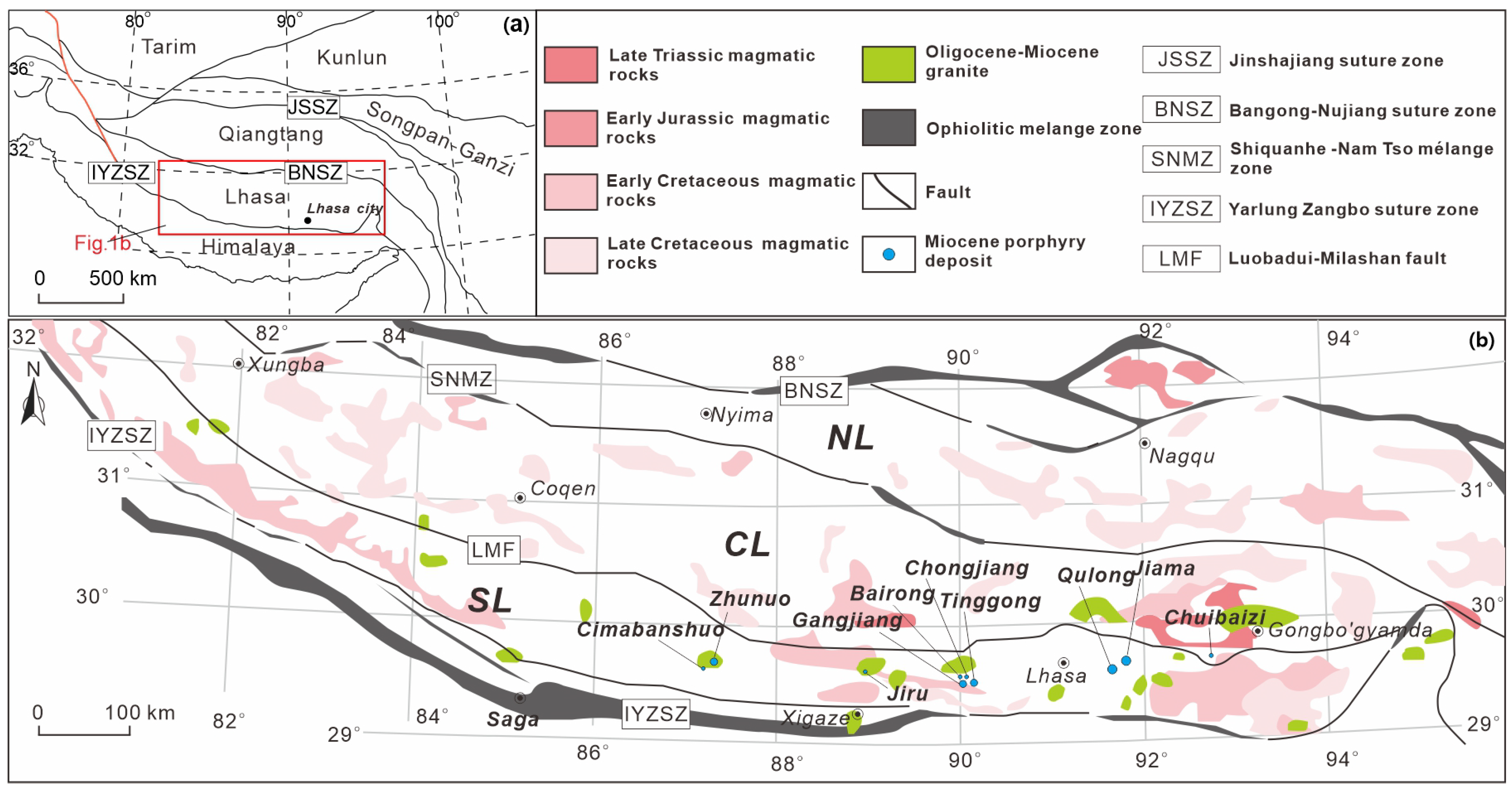
2. Regional Setting
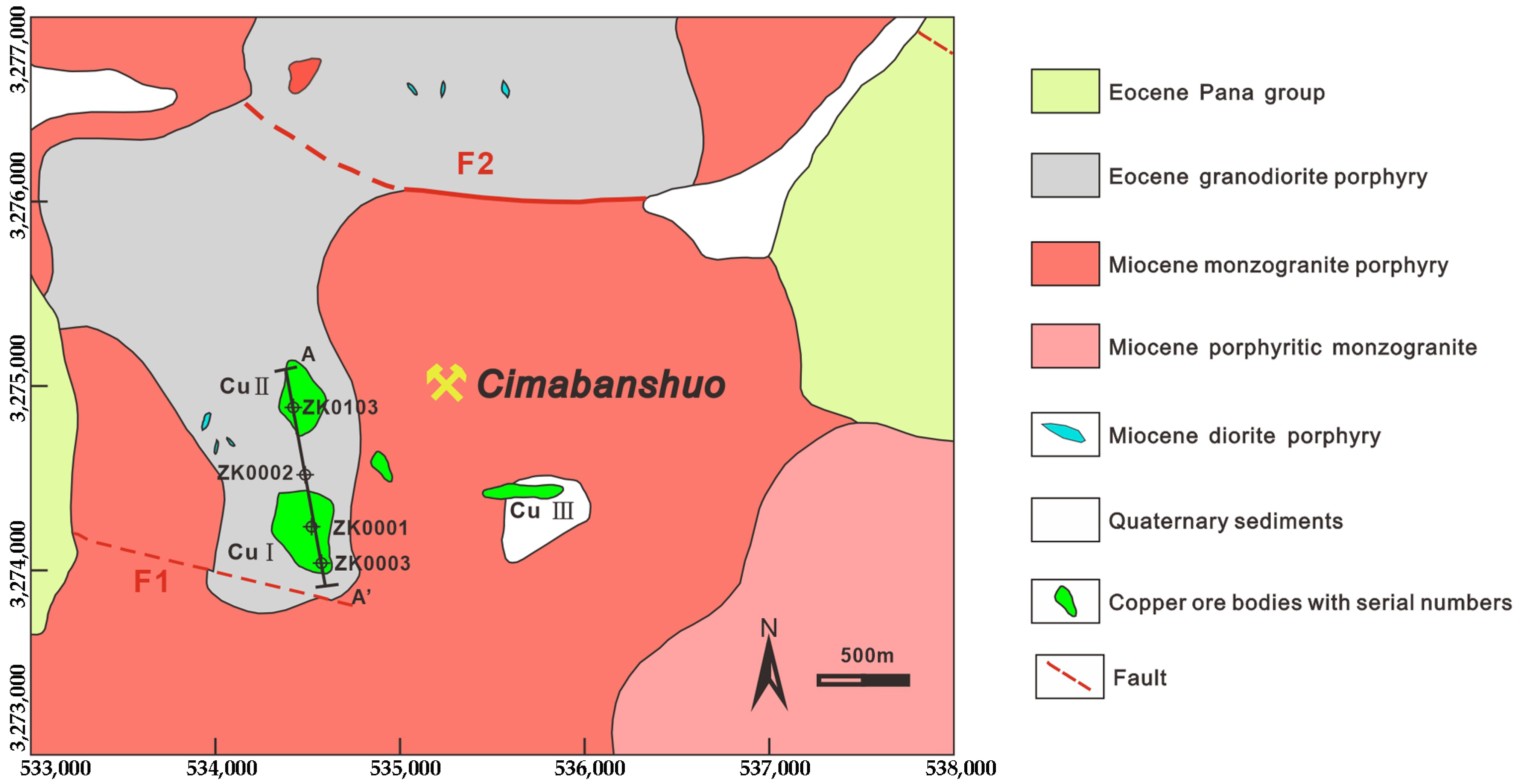
3. Deposit Geology
4. Sampling and Analytical Methods
5. Data Processing and Analysis
5.1. Treatment of Data Below the Detection Limit
5.2. Correlation Analysis
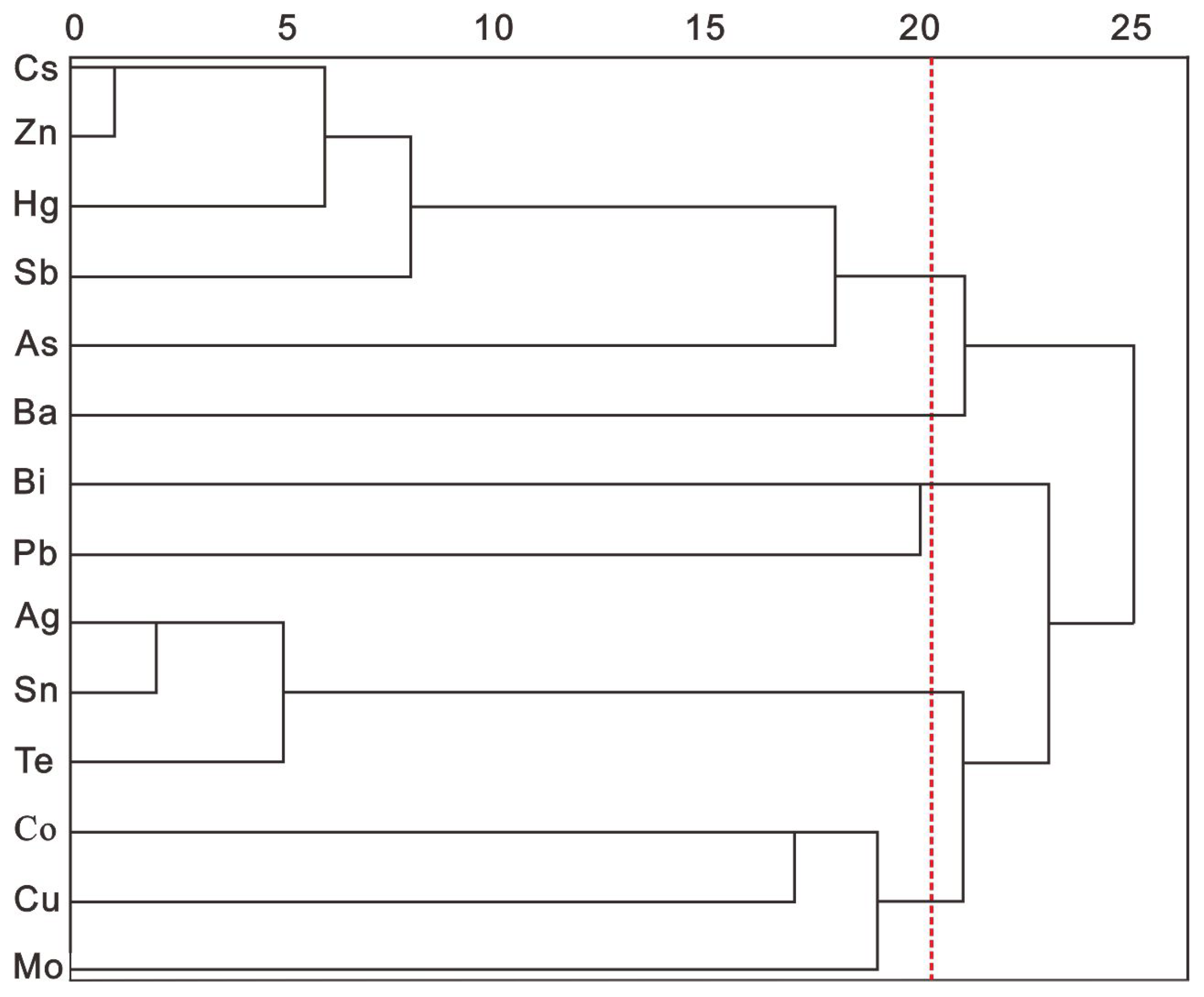
5.3. R-Type Cluster Analysis
5.4. Factor Analysis
6. Discussion
6.1. Characteristics of Primary Halos
6.1.1. Determination of Anomaly Thresholds
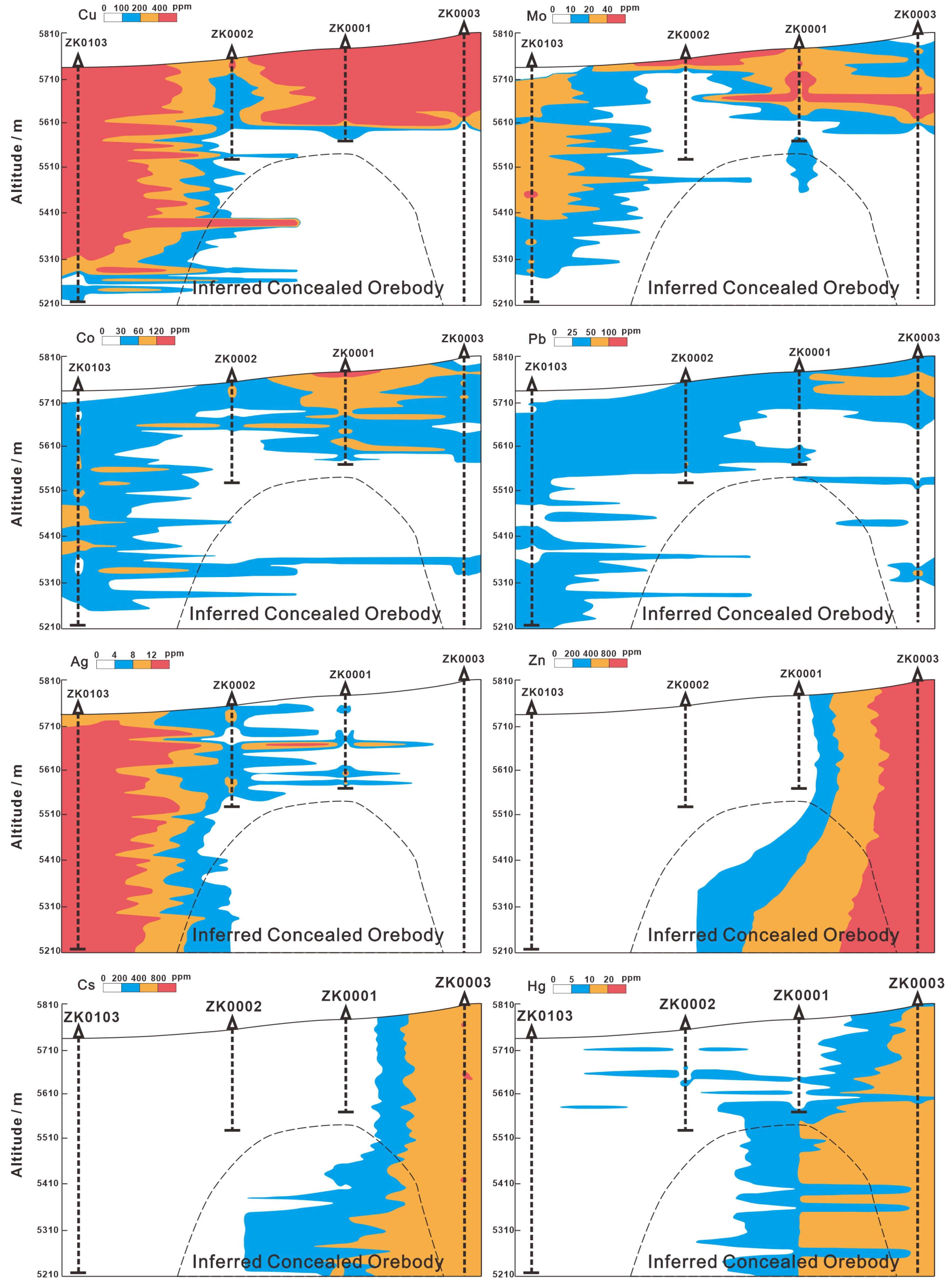
6.1.2. Profile Characteristics of Primary Halos
- (1)
- Ore-forming elements (Cu, Mo):
- (2)
- Near-ore elements (Co, Pb, Ag):
- (3)
- Frontal halo elements (Zn, Cs, Hg, Sb, As, Ba):
- (4)
- Distal or tail halo elements (Te, Sn, Bi):
6.1.3. Axial Zoning Sequence of the Primary Halo
- (1)
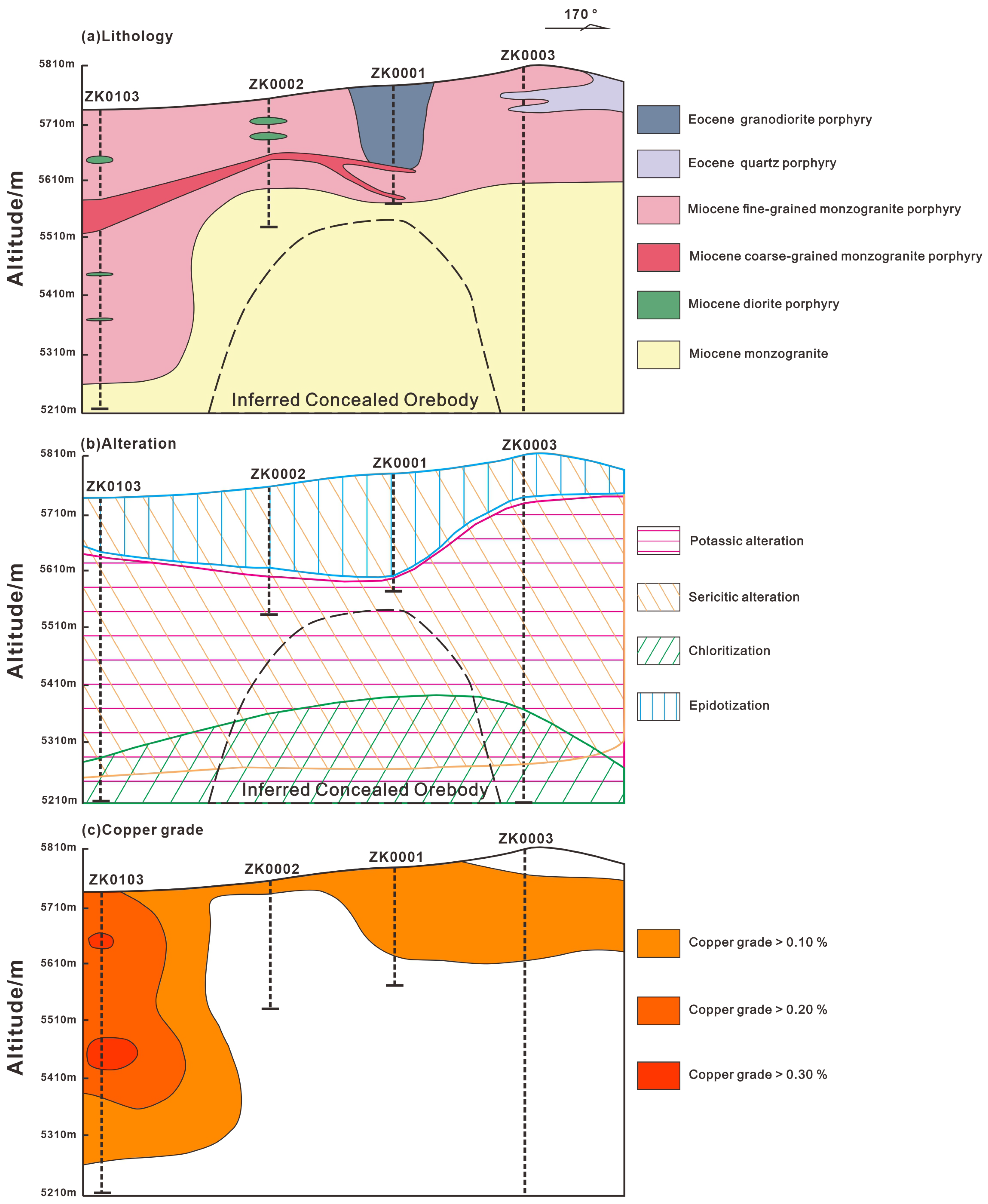
- The ore-forming elements Cu and Mo occur at the uppermost part of the sequence, close to the surface, suggesting that the orebody has experienced a certain degree of erosion. This is consistent with the observation that the Cu orebody was not intercepted in the shallow drill holes (Figure 4c). Sun et al. (2021) [53] reported an exhumation rate of ~150 m/m.y. and an erosion depth of ~1.4 km for the nearby Zhunuo deposit. Given that Cimabanshuo lies ~10 km southwest of Zhunuo, both deposits likely experienced similar preservation conditions, further indicating partial erosion of the Cimabanshuo orebody.
- (2)
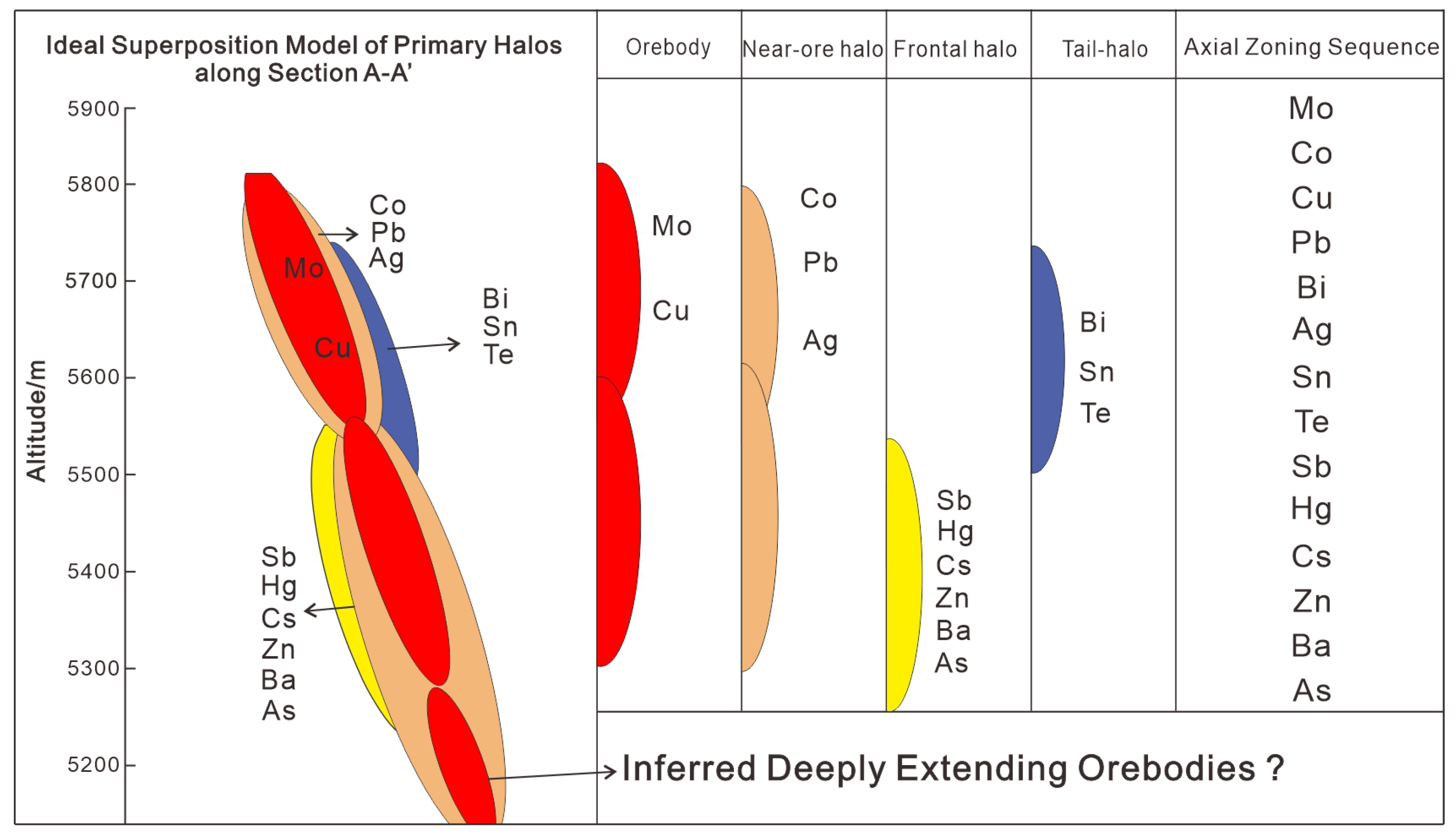
- Compared with the standard zoning sequence [4], the A-A′ profile at Cimabanshuo exhibits a distinct reverse zoning pattern, in which tail-halo elements (Bi, Sn, Te) appear in the middle section, whereas frontal-halo elements (Sb, Hg, Cs, Zn, Ba, As) occur in the lower section. This observation agrees with the concept of structural superimposition halos proposed by Li et al. (2006) [5], in which the occurrence of tail-halo elements upward or frontal-halo elements downward indicates a multi-stage superimposed mineralization system. The presence of downward frontal-halo anomalies suggests a potential concealed orebody at depth.
6.2. Geochemical Characteristics of Primary Halos
6.2.1. Vertical Characteristics
6.2.2. Horizontal Characteristics
6.2.3. Ideal Superposition Model of Primary Halos
7. Conclusions
- (1)
- Based on cluster analysis, factor analysis, and primary halo element anomalies in the Cimabanshuo deposit, Co, Pb, and Ag were identified as near-ore halo elements; Zn, Cs, Hg, Sb, As, and Ba as frontal halo elements; and Te, Sn, and Bi as tail-halo elements. From shallow to deep, the axial zoning sequence of the primary halo is Mo-Co-Cu-Pb-Bi-Ag-Sn-Te-Sb-Hg-Cs-Zn-Ba-As, exhibiting a reverse zoning pattern that suggests the possible presence of a concealed ore body at depth in the Cimabanshuo deposit.
- (2)
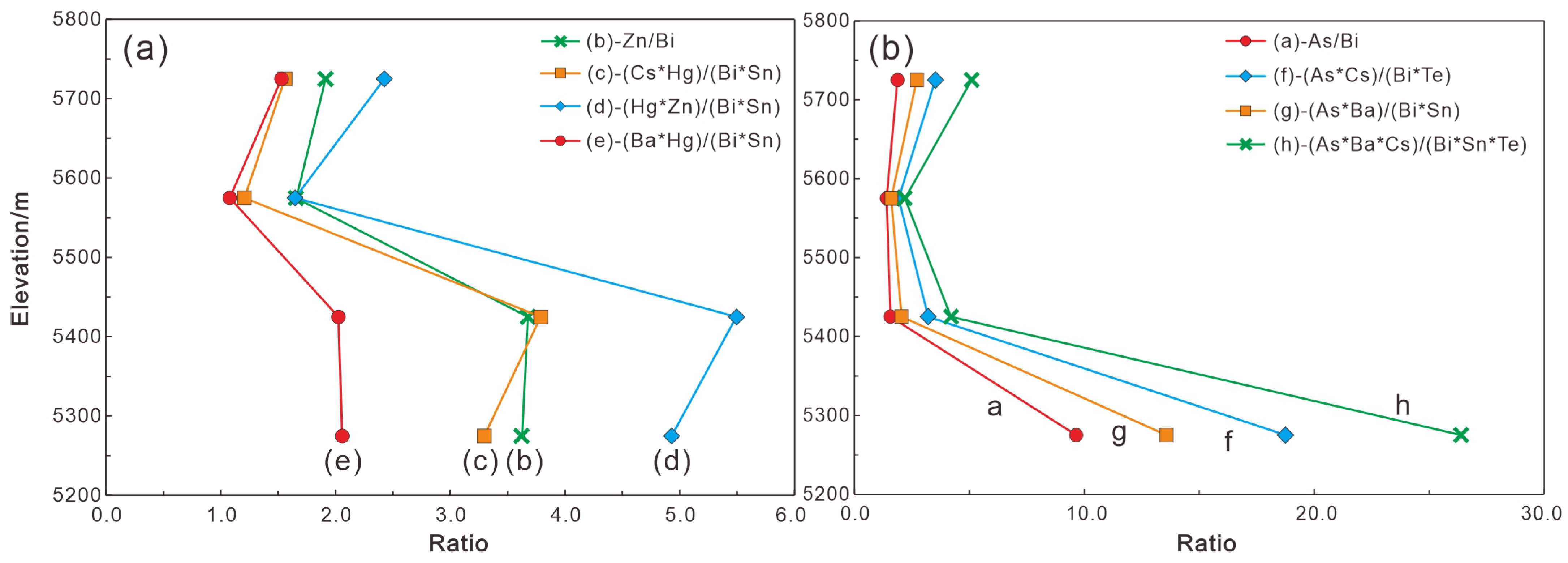
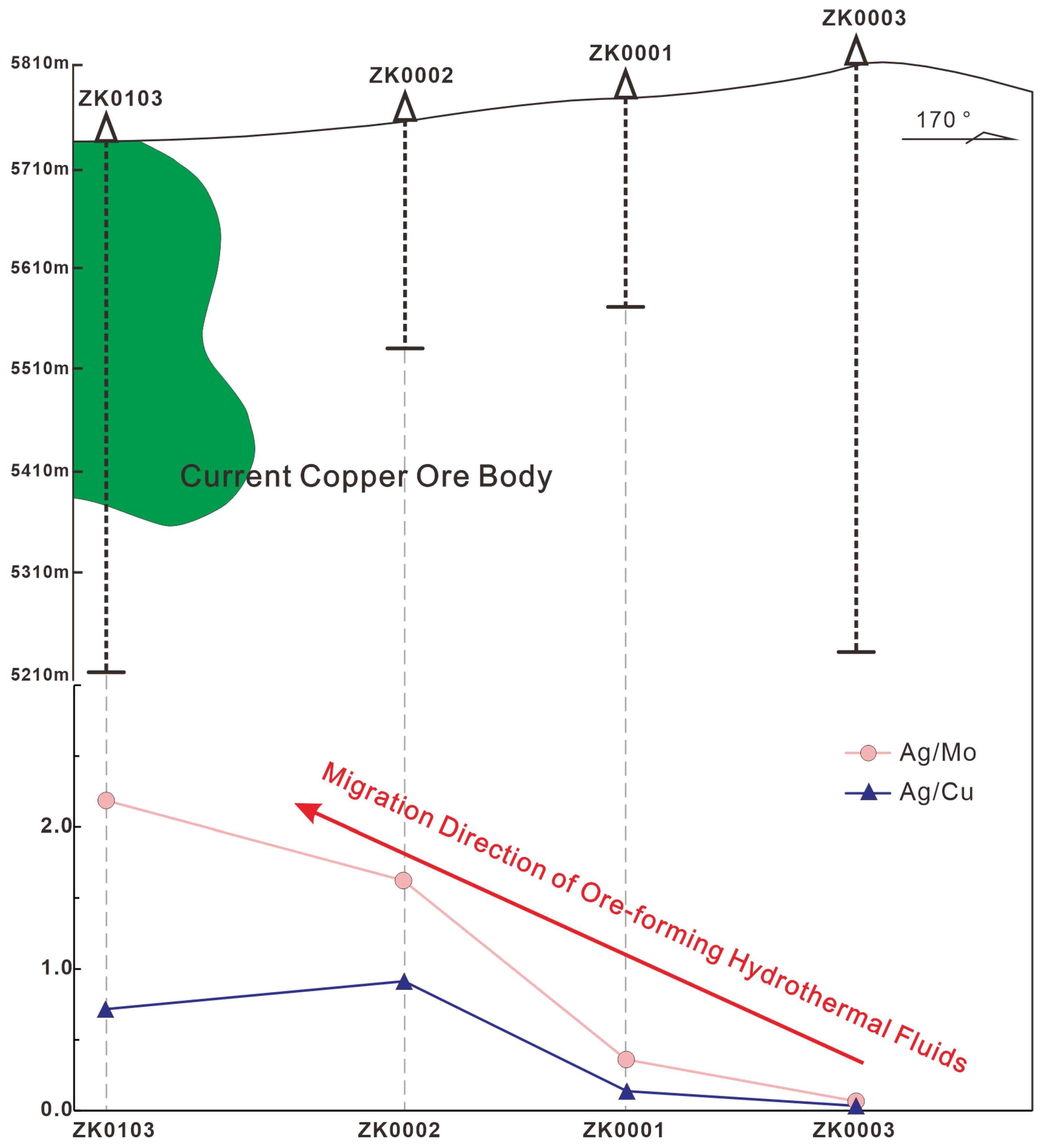
- The geochemical evaluation indices Ag/Mo and Ag/Cu show a decreasing trend from northwest to southeast along the A-A′ section of the Cimabanshuo deposit, indicating hydrothermal fluid flow from southeast to northwest. Major vertical indices—As/Bi, (As × Cs)/(Bi × Te), (As × Ba)/(Bi × Sn), and (As × Ba × Cs)/(Bi × Sn × Te)—first decrease and then increase from shallow to deep levels, implying the presence of a concealed ore body at depth within the deposit. Integrating both horizontal and vertical variations in geochemical indices, the concealed ore body is likely located in the deep southeastern part of the Cimabanshuo deposit.
Supplementary Materials
Author Contributions
Funding
Data Availability Statement
Acknowledgments
Conflicts of Interest
References
- Zhao, P. Quantitative mineral prediction and deep mineral exploration. Earth Sci. Front. 2007, 14, 1–10. [Google Scholar]
- Lai, Y.; Qu, H.; Zhao, G.; Chen, Y.; Wang, S.; Cui, Y.; Yan, Y.; Cheng, Y.; Guo, Q.; Yu, H. Study on the primary halo-zonal sequence and prediction of mineral exploration in shallow overburden area. Miner. Explor. 2018, 9, 311–319. [Google Scholar]
- Li, H.; Yu, B.; Li, D.; Ma, J.; Sun, F.; Li, Y.; Wang, Y.; Li, S. Structural superimposed halo models for predicting deep blind deposits in different types of gold deposits. Miner. Resour. Geol. 2015, 29, 648–653+658. [Google Scholar]
- Shao, Y. Rock Survey (Primary Halo Method) of Hydrothermal Deposits Prospecting; Geological Publishing House: Beijing, China, 1997. [Google Scholar]
- Li, H.; Zhang, G.Y.; Yu, B. Structural superimposed halo model and prospecting effect for predicting deep blind deposits in gold mining. Geol. China 2006, 21, 632. [Google Scholar]
- Wang, C.; Carranza, E.J.M.; Zhang, S.; Zhang, J.; Liu, X.; Zhang, D.; Sun, X.; Duan, C. Characterization of primary geochemical haloes for gold exploration at the Huanxiangwa gold deposit, China. J. Geochem. Explor. 2013, 124, 40–58. [Google Scholar] [CrossRef]
- Li, H.; Yu, B.; Li, D.; Zhang, G.; Ma, J.; Sun, F.; Li, Y.; Wei, J.; Zhao, J.; Wang, J.; et al. Innovation and new breakthroughs in exploring blind mines by structural superimposed halos. Gold Sci. Technol. 2014, 22, 7–13. [Google Scholar]
- Lin, C.; Cheng, Z.; Pang, Z.; Xue, J.; Tao, W.; Tan, J. Primary halo characteristics and prediction of deep ore body in the Laoliwan Ag-Pb-Zn deposit, Henan Province. Miner. Explor. 2020, 11, 53–64. [Google Scholar]
- An, W.; Chen, J.; Li, Y.; Wei, J.; Wang, J. The superposition characteristics of primary halo in the Daping gold deposit, Yunnan Province, China and its significance for exploration. J. Geochem. Explor. 2021, 228, 106809. [Google Scholar] [CrossRef]
- Wu, J.; Zeng, Q.; Wei, Z.; Fan, H.; Yang, K.; Zhang, Z.; Li, X.; Liang, G.; Xia, F. Prospecting potential of the Yanjingou gold deposit in the east Kunlun orogen, NW China: Evidence from primary halo geochemistry and in situ pyrite thermoelectricity. Minerals 2021, 11, 1117. [Google Scholar] [CrossRef]
- Sun, W.; Zheng, Y.; Wang, W.; Feng, X.; Zhu, X.; Zhang, Z.; Hou, H.; Ge, L.; Lv, H. Geochemical Characteristics of Primary Halos and Prospecting Significance of the Qulong Porphyry Copper–Molybdenum Deposit in Tibet. Minerals 2023, 13, 333. [Google Scholar] [CrossRef]
- Zhao, Y.; Liu, X.; Liu, Y.; Liu, B.; Fu, H.; Lv, J.; Zheng, C. Copper metallogenic condition of Cimabanshuo area around Zhunuo copper mine in Tibet. Acta Geol. Gansu 2017, 26, 28–36. [Google Scholar]
- Li, J.; Wu, S.; Li, Y.; Jiang, Z.; Yi, J.; Jiang, G.; Liu, X.; Hua, K.; Ci, Q.; Zhao, Y. Alteration-mineralization style and prospecting potential of Cimabanshuo porphyry copper deposit in Tibet. Earth Sci. 2022, 47, 2219–2244. [Google Scholar]
- Zhu, D.; Zhao, Z.; Niu, Y.; Mo, X.; Chung, S.; Hou, Z.; Wang, L.; Wu, F. The Lhasa Terrane: Record of a microcontinent and its histories of drift and growth. Earth Planet. Sci. Lett. 2011, 301, 241–255. [Google Scholar] [CrossRef]
- Hou, Z.; Gao, Y.; Qu, X.; Rui, Z.; Mo, X. Origin of adakitic intrusives generated during mid-Miocene east-west extension in southern Tibet. Earth Planet. Sci. Lett. 2004, 220, 139–155. [Google Scholar] [CrossRef]
- Yang, Z.; Goldfarb, R.; Chang, Z. Generation of Postcollisional Porphyry Copper Deposits in Southern Tibet Triggered by Subduction of the Indian Continental Plate; Society of Economic Geologists: Littleton, CO, USA, 2016. [Google Scholar]
- Zheng, Y.; Sun, X.; Gao, S.; Zhao, Z.; Zhang, G.; Wu, S.; You, Z.; Li, J. Multiple mineralization events at the Jiru porphyry copper deposit, southern Tibet: Implications for Eocene and Miocene magma sources and resource potential. J. Asian Earth Sci. 2014, 79, 842–857. [Google Scholar] [CrossRef]
- Lin, Y.; Cheng, Z.; Zheng, Y.; Xu, R.; Bai, J.; Chen, X.; Yan, T. Application of pXRF in-situ analysis in the exploration of Yuka rutile deposit, North Qaidam. Geol. Bull. China 2023, 42, 966–977. [Google Scholar]
- Bendicho, C.; Lavilla, I.; Pena-Pereira, F.; Romero, V. Green chemistry in analytical atomic spectrometry: A review. J. Anal. At. Spectrom. 2012, 27, 1831–1857. [Google Scholar] [CrossRef]
- Ma, J.; Tang, L.; Lao, C.; Zeng, Y. Analysis techniques and applications of field geological experiments. Anal. Instrum. 2018, 1, 12–19. [Google Scholar]
- Greenfield, S.; Bernard, M.; Burgess, C.; Edwards, D.; Hill, S.; Jarvis, K.; Lord, G.; Sargent, M.; Potts, P.; Price, J. Evaluation of analytical instrumentation. Part XXIII. Instrumentation portable X-ray fluorescence spectrometry. Accredit. Qual. Assur. J. Qual. Comp. Reliab. Chem. Meas. 2008, 13, 453–464. [Google Scholar]
- Craig, N.; Speakman, R.J.; Popelka-Filcoff, R.S.; Glascock, M.D.; Robertson, J.D.; Shackley, M.S.; Aldenderfer, M.S. Comparison of XRF and PXRF for analysis of archaeological obsidian from southern Peru. J. Archaeol. Sci. 2007, 34, 2012–2024. [Google Scholar] [CrossRef]
- Xia, Q.; Cheng, Q.; Lu, J.; Xiao, W.; Sang, H.; Yuan, Z.; Liu, Y.; Qiu, J. Application of portable XRF technology to identification of mineralization and alteration along drill in the Nihe iron deposit, Anhui, East China. Earth Sci. 2011, 36, 336–340. [Google Scholar]
- Stockmann, U.; Cattle, S.; Minasny, B.; McBratney, A.B. Utilizing portable X-ray fluorescence spectrometry for in-field investigation of pedogenesis. Catena 2016, 139, 220–231. [Google Scholar] [CrossRef]
- Andrew, B.S.; Barker, S.L. Determination of carbonate vein chemistry using portable X-ray fluorescence and its application to mineral exploration. Geochem. Explor. Environ. Anal. 2018, 18, 85–93. [Google Scholar] [CrossRef]
- Balaram, V. Field-portable analytical instruments in mineral exploration: Past, present and future. J. Appl. Geochem. 2017, 19, 382–399. [Google Scholar]
- Lemiere, B. A review of pXRF (field portable X-ray fluorescence) applications for applied geochemistry. J. Geochem. Explor. 2018, 188, 350–363. [Google Scholar] [CrossRef]
- Yin, A.; Harrison, T.M. Geologic evolution of the Himalayan-Tibetan orogen. Annu. Rev. Earth Planet. Sci. 2000, 28, 211–280. [Google Scholar] [CrossRef]
- Zhu, D.; Zhao, Z.; Niu, Y.; Dilek, Y.; Hou, Z.; Mo, X. The origin and pre-Cenozoic evolution of the Tibetan Plateau. Gondwana Res. 2013, 23, 1429–1454. [Google Scholar] [CrossRef]
- Lee, H.; Chung, S.; Lo, C.; Ji, J.; Lee, T.; Qian, Q.; Zhang, Q. Eocene Neotethyan slab breakoff in southern Tibet inferred from the Linzizong volcanic record. Tectonophysics 2009, 477, 20–35. [Google Scholar] [CrossRef]
- Ding, L.; Kapp, P.; Wan, X. Paleocene–Eocene record of ophiolite obduction and initial India—Asia collision, south central Tibet. Tectonics 2005, 24, TC3001. [Google Scholar] [CrossRef]
- Zhu, D.; Wang, Q.; Zhao, Z.; Chung, S.; Cawood, P.A.; Niu, Y.; Liu, S.; Wu, F.; Mo, X. Magmatic record of India-Asia collision. Sci. Rep. 2015, 5, 14289. [Google Scholar] [CrossRef]
- Mo, X.; Hou, Z.; Niu, Y.; Dong, G.; Qu, X.; Zhao, Z.; Yang, Z. Mantle contributions to crustal thickening during continental collision: Evidence from Cenozoic igneous rocks in southern Tibet. Lithos 2007, 96, 225–242. [Google Scholar] [CrossRef]
- Chung, S.; Liu, D.; Ji, J.; Chu, M.; Lee, H.; Wen, D.; Lo, C.; Lee, T.; Qian, Q.; Zhang, Q. Adakites from continental collision zones: Melting of thickened lower crust beneath southern Tibet. Geology 2003, 31, 1021–1024. [Google Scholar] [CrossRef]
- Zhao, Z.; Mo, X.; Dilek, Y.; Niu, Y.; DePaolo, D.J.; Robinson, P.; Zhu, D.; Sun, C.; Dong, G.; Zhou, S. Geochemical and Sr-Nd-Pb-O isotopic compositions of the post-collisional ultrapotassic magmatism in SW Tibet: Petrogenesis and implications for India intra-continental subduction beneath southern Tibet. Lithos 2009, 113, 190–212. [Google Scholar] [CrossRef]
- Zheng, Y.; Hou, Z.; Li, W.; Liang, W.; Huang, K.; Li, Q.; Sun, Q.; Fu, Q.; Zhang, S. Petrogenesis and geological implications of the Oligocene Chongmuda-Mingze adakite-like intrusions and their mafic enclaves, southern Tibet. J. Geol. 2012, 120, 647–669. [Google Scholar] [CrossRef]
- Sun, X.; Lu, Y.; McCuaig, T.C.; Zheng, Y.; Chang, H.; Guo, F.; Xu, L. Miocene ultrapotassic, high-Mg dioritic, and adakite-like rocks from Zhunuo in Southern Tibet: Implications for mantle metasomatism and porphyry copper mineralization in collisional orogens. J. Petrol. 2018, 59, 341–386. [Google Scholar] [CrossRef]
- Zheng, Y.; Xue, Y.; Cheng, L.; Fan, Z.; Gao, S. Finding, characteristics and significances of Qulong superlarge porphyry copper (molybdenum) deposit, Tibet. Earth Sci. 2004, 29, 103–108. [Google Scholar]
- Lin, B.; Tang, J.; Tang, P.; Beaudoin, G.; Laflamme, C.; Li, F.; Zheng, W.; Song, Y.; Qi, J.; Sun, M. Multipulsed magmatism and duration of the hydrothermal system of the giant Jiama porphyry Cu system, Tibet, China. Econ. Geol. 2024, 119, 201–217. [Google Scholar] [CrossRef]
- Zheng, Y.; Wu, S.; Ci, Q.; Chen, X.; Gao, S.; Liu, X.; Jiang, X.; Zheng, S.; Li, M.; Jiang, X. Cu-Mo-Au metallogenesis and minerogenetic series during superimposed orogenesis process in Gangdese. Earth Sci. 2021, 46, 1909–1940. [Google Scholar]
- Gazley, M.F.; Tutt, C.M.; Fisher, L.A.; Latham, A.R.; Duclaux, G.; Taylor, M.D.; de Beer, S.J. Objective geological logging using portable XRF geochemical multi-element data at Plutonic Gold Mine, Marymia Inlier, Western Australia. J. Geochem. Explor. 2014, 143, 74–83. [Google Scholar] [CrossRef]
- Sun, W.; Zheng, Y.; Niu, X.; Qin, Y.; Wang, W.; Qiao, Y.; Di, B.; Hou, M.; Zhao, S.; Cong, P. Practicality of hand-held XRF analyzer in rapid exploration of porphyry copper deposit. Rock Miner. Anal. 2021, 40, 206–216. [Google Scholar]
- Li, Y.; Zhang, D.; Dai, L.; Wan, G.; Hou, B. Characteristics of structurally superimposed geochemical haloes at the polymetallic Xiasai silver-lead-zinc ore deposit in Sichuan Province, SW China. J. Geochem. Explor. 2016, 169, 100–122. [Google Scholar] [CrossRef]
- Sun, L.; Xiao, K.; Gao, Y. Geochemical characteristics of primary halos and evaluation of deep mineral resources in the Caixiashan lead-zinc deposit. J. Jilin Univ. (Earth Sci. Ed.) 2013, 43, 1179–1189. [Google Scholar] [CrossRef]
- Zhao, P.; Hu, W.; Li, Z. Statistical Prediction of Mineral Deposits, 2nd ed.; China Geological Publishing House: Beijing, China, 1994. [Google Scholar]
- Zhou, X.; Yang, G.; Tan, X. Application of SPSS based regression analysis in trace element analysis of Donggualin gold deposit in Yunnan. China Min. Mag. 2016, 25, 148–153. [Google Scholar]
- Fang, G.; Chen, Z.; Chen, Y.; Huang, F.; Zhao, Z. Characteristics of primary halos for quartz vein-type tungsten deposits and its implication in locating ore bodies at depth—A case study of the Taoxikeng deposit, Southern Jiangxi Province. Geotecton. Metallog. 2012, 36, 406–412. [Google Scholar]
- Liu, C.; Ma, S.; Hu, S. Exploration indicators for primary halos in metal deposits. Geophys. Geochem. Explor. 2010, 34, 765–771. [Google Scholar]
- Beus, A.A.; Grigorian, S.V. Geochemical Exploration Methods for Mineral Deposits; Applied Publishing Ltd.: Portsmouth, UK, 1977. [Google Scholar]
- Wang, J.; Sang, X.; Guo, X.; Xie, H.; Zhao, L.; Sun, Y. The improved gregorian’s zoning index calculating method. J. Jilin Univ. (Earth Sci. Ed.) 2007, 37, 884–888. [Google Scholar]
- Xianrong, L.; Meilan, W.; Fei, O.; Jiaguang, T. Exploration Geochemistry; Metallurgical Industry Press: Beijing, China, 2007. [Google Scholar]
- Wang, H.; Wang, Y.; Kong, F.; Shen, L.; Huang, X.; Xu, C.; Zhang, Y. A study on the characteristics of primary halos and deep exploration prediction of the Fanjiazhuang gold deposit in Shandong province. Miner. Explor. 2019, 10, 108–117. [Google Scholar]
- Sun, X.; Leng, C.; Hollings, P.; Song, Q.; Li, R.; Wan, X. New 40Ar/39Ar and (U-Th)/He dating for the Zhunuo porphyry Cu deposit, Gangdese belt, southern Tibet: Implications for pulsed magmatic-hydrothermal processes and ore exhumation and preservation. Miner. Depos. 2021, 56, 917–934. [Google Scholar] [CrossRef]
- Sillitoe, R.H. Porphyry copper systems. Econ. Geol. 2010, 105, 3–41. [Google Scholar] [CrossRef]
- Zhou, D.; Zhuang, G.; Zhang, D.; Gao, R. The axial zoning characteristics of primary halos and evaluation of deep mineralization prospects in the Hongzhuang Yuanling gold deposit in Luanchuan County, Henan Province. Geol. Explor. 2015, 51, 1126–1137. [Google Scholar]
- Zhang, H.; Zhang, X.; Yao, C.; Wang, X.; Hua, S.; Wang, J. Primary halo indicators for deep ore body prediction of the Nanhegou copper deposit in Hujiayu, Shanxi. Geol. Sci. Technol. Inf. 2010, 29, 106–110. [Google Scholar]
- Wang, R.; Zhang, J.; Li, M.; Wang, B.; Dong, S.; Niu, H.; Sun, Y. The characteristics of primary halos and prospecting prospects in the Shimole area of Inner Mongolia. Geol. Explor. 2016, 52, 128–138. [Google Scholar]
- Chen, Y.; Huang, J.; Liang, Z. Geochemical characteristics and zonation of primary halos of Pulang porphyry copper deposit, Northwestern Yunnan Province, Southwestern China. J. China Univ. Geosci. 2008, 19, 371–377. [Google Scholar] [CrossRef]
- Sun, H.; Sun, L.; Cao, X.; Wang, C.; Tan, J.; Liu, F.; Yang, K. Exploration geochemical indicators for primary halo axis (vertical) zoning characteristics and deep ore body prediction of the Shangzhuang gold deposit in northwest Jiaozhou. Miner. Depos. 2008, 27, 64–70. [Google Scholar]
- Li, H.; Zhang, W.; Liu, B.; Wang, J.; Guo, R. The study on axial zonality sequence of primary halo and some criteria for the application of this sequence for major types of gold deposit in China. Geol. Prospect. 1999, 35, 34–37. [Google Scholar]
- Qi, P.; Yin, Y.; Jin, S.; Wei, W.; Xu, L.; Dong, H.; Huang, J. Three-dimensional audio-magnetotelluric imaging including surface topography of the cimabanshuo porphyry copper deposit, Tibet. Minerals 2021, 11, 1424. [Google Scholar] [CrossRef]




| Element | Ag | As | Ba | Bi | Co | Cs | Cu | Hg | Mo | Pb | Sb | Sn | Te | Zn |
|---|---|---|---|---|---|---|---|---|---|---|---|---|---|---|
| LOD/ppm | A/S | 4 | 61 | 4 | 28 | 30 | 17 | 6 | 4 | 7 | 21 | 26 | 30 | 11 |
| Ag | As | Ba | Bi | Co | Cs | Cu | Hg | Mo | Pb | Sb | Sn | Te | Zn | |
|---|---|---|---|---|---|---|---|---|---|---|---|---|---|---|
| Ag | 1 | |||||||||||||
| As | −0.107 * | 1 | ||||||||||||
| Ba | 0.224 ** | 0.067 | 1 | |||||||||||
| Bi | −0.034 | 0.066 | 0.013 | 1 | ||||||||||
| Co | −0.139 * | −0.083 * | 0.126 ** | −0.098 ** | 1 | |||||||||
| Cs | −0.468 ** | 0.347 ** | 0.002 | −0.070 | −0.182 ** | 1 | ||||||||
| Cu | −0.231 ** | −0.079 * | −0.027 | −0.193 ** | 0.320 ** | −0.296 ** | 1 | |||||||
| Hg | −0.182 | 0.145 ** | 0.071 | −0.018 | −0.082 | 0.629 ** | −0.205 ** | 1 | ||||||
| Mo | −0.134 * | −0.122 ** | −0.007 | −0.265 ** | 0.302 ** | −0.235 ** | 0.614 ** | −0.052 | 1 | |||||
| Pb | 0.078 | −0.016 | 0.084 * | 0.154 ** | 0.105 ** | −0.233 ** | 0.302 ** | −0.048 | 0.136 ** | 1 | ||||
| Sb | 0.030 | 0.276 ** | 0.059 | −0.057 | −0.029 | 0.579 ** | −0.102 * | 0.480 ** | −0.047 | −0.076 | 1 | |||
| Sn | 0.839 ** | −0.259 ** | 0.123 ** | 0.039 | 0.104 ** | −0.927 ** | 0.151 ** | −0.458 ** | 0.140 ** | 0.191 ** | −0.348 ** | 1 | ||
| Te | 0.782 ** | −0.246 ** | 0.115 ** | 0.066 | 0.174 ** | −0.684 ** | 0.272 ** | −0.085 | 0.236 ** | 0.281 ** | 0.004 | 0.842 ** | 1 | |
| Zn | −0.096 | 0.323 ** | 0.028 | −0.079 * | −0.230 ** | 0.957 ** | −0.341 ** | 0.503 ** | −0.257 ** | −0.198 ** | 0.461 ** | −0.570 ** | −0.797 ** | 1 |
| Factor | Ag | As | Ba | Bi | Co | Cs | Cu | Hg | Mo | Pb | Sb | Sn | Te | Zn | Eigenvalue | Variance (%) | Cumulative Variance (%) |
|---|---|---|---|---|---|---|---|---|---|---|---|---|---|---|---|---|---|
| F1 | –0.31 | 0.31 | 0.11 | –0.26 | –0.19 | 0.96 | –0.18 | 0.79 | –0.04 | –0.06 | 0.82 | –0.30 | 0.23 | 0.90 | 3.52 | 25.104 | 25.104 |
| F2 | 0.88 | –0.11 | 0.00 | –0.04 | 0.03 | –0.07 | 0.02 | –0.23 | 0.04 | 0.08 | 0.46 | 0.93 | 0.95 | –0.28 | 2.90 | 20.713 | 45.817 |
| F3 | 0.16 | –0.07 | –0.10 | –0.52 | 0.43 | –0.11 | 0.69 | –0.02 | 0.73 | 0.09 | –0.05 | 0.02 | –0.04 | –0.10 | 1.54 | 11.012 | 56.829 |
| F4 | –0.02 | 0.53 | –0.09 | 0.40 | 0.24 | 0.04 | 0.14 | –0.05 | –0.08 | 0.82 | 0.06 | –0.01 | 0.01 | 0.08 | 1.22 | 8.684 | 65.513 |
| F5 | –0.03 | 0.12 | 0.88 | –0.17 | 0.47 | 0.05 | 0.06 | 0.02 | –0.18 | –0.08 | 0.07 | 0.01 | 0.02 | –0.06 | 1.08 | 7.739 | 73.252 |
| Element | Ag | As | Ba | Bi | Co | Cs | Cu | Hg | Mo | Pb | Sb | Sn | Te | Zn |
|---|---|---|---|---|---|---|---|---|---|---|---|---|---|---|
| Background Value/10−6 | 2 | 5 | 400 | 12.5 | 15 | 100 | 50 | 2.5 | 5 | 12.5 | 15 | 10 | 50 | 100 |
| Threshold/10−6 | 4 | 10 | 800 | 25 | 30 | 200 | 100 | 5 | 10 | 25 | 30 | 20 | 100 | 200 |
| Outer Zones/10−6 | 4 | 10 | 800 | 25 | 30 | 200 | 100 | 5 | 10 | 25 | 30 | 20 | 100 | 200 |
| Middle Zones/10−6 | 8 | 20 | 1600 | 40 | 60 | 400 | 200 | 10 | 20 | 50 | 60 | 40 | 200 | 400 |
| Inner Zones/10−6 | 12 | 40 | 3200 | 80 | 120 | 800 | 400 | 20 | 40 | 100 | 120 | 80 | 400 | 800 |
| Section | Ag | As | Ba | Bi | Co | Cs | Cu | Hg | Mo | Pb | Sb | Sn | Te | Zn |
|---|---|---|---|---|---|---|---|---|---|---|---|---|---|---|
| I | 0.000 | 0.009 | 0.000 | 0.000 | 0.248 | 0.000 | 0.248 | 0.000 | 0.248 | 0.248 | 0.000 | 0.000 | 0.000 | 0.000 |
| II | 0.165 | 0.001 | 0.036 | 0.165 | 0.080 | 0.024 | 0.043 | 0.018 | 0.052 | 0.075 | 0.064 | 0.165 | 0.106 | 0.004 |
| III | 0.067 | 0.000 | 0.070 | 0.010 | 0.013 | 0.132 | 0.051 | 0.132 | 0.026 | 0.000 | 0.132 | 0.101 | 0.132 | 0.132 |
| IV | 0.084 | 0.114 | 0.114 | 0.006 | 0.000 | 0.103 | 0.000 | 0.093 | 0.000 | 0.053 | 0.111 | 0.100 | 0.114 | 0.109 |
| Evaluation Index | I | II | III | IV |
|---|---|---|---|---|
| >5650 m | 5500–5650 m | 5350–5500 m | <5350 m | |
| a = As/Bi | 1.88 | 1.40 | 1.57 | 9.64 |
| b = Zn/Bi | 1.91 | 1.65 | 3.68 | 3.62 |
| c = (Cs × Hg)/(Bi × Sn) | 1.56 | 1.21 | 3.79 | 3.30 |
| d = (Hg × Zn)/(Bi × Sn) | 2.43 | 1.65 | 5.49 | 4.93 |
| e = (Ba × Hg)/(Bi × Sn) | 1.53 | 1.08 | 2.03 | 2.06 |
| f = (As × Cs)/(Bi × Te) | 3.52 | 1.92 | 3.21 | 18.75 |
| g = (As × Ba)/(Bi × Sn) | 2.71 | 1.60 | 2.05 | 13.57 |
| h = (As × Ba × Cs)/(Bi × Sn × Te) | 5.09 | 2.20 | 4.20 | 26.39 |
Disclaimer/Publisher’s Note: The statements, opinions and data contained in all publications are solely those of the individual author(s) and contributor(s) and not of MDPI and/or the editor(s). MDPI and/or the editor(s) disclaim responsibility for any injury to people or property resulting from any ideas, methods, instructions or products referred to in the content. |
© 2025 by the authors. Licensee MDPI, Basel, Switzerland. This article is an open access article distributed under the terms and conditions of the Creative Commons Attribution (CC BY) license (https://creativecommons.org/licenses/by/4.0/).
Share and Cite
Li, Z.; Wei, N.; Li, M.; Wu, S.; Li, H.; Liu, P. Application of Portable X-Ray Fluorescence Analysis in Mineral Exploration: A Case Study from Cimabanshuo Porphyry Copper Deposit. Minerals 2025, 15, 1286. https://doi.org/10.3390/min15121286
Li Z, Wei N, Li M, Wu S, Li H, Liu P. Application of Portable X-Ray Fluorescence Analysis in Mineral Exploration: A Case Study from Cimabanshuo Porphyry Copper Deposit. Minerals. 2025; 15(12):1286. https://doi.org/10.3390/min15121286
Chicago/Turabian StyleLi, Zheming, Naiying Wei, Miao Li, Song Wu, Hao Li, and Peng Liu. 2025. "Application of Portable X-Ray Fluorescence Analysis in Mineral Exploration: A Case Study from Cimabanshuo Porphyry Copper Deposit" Minerals 15, no. 12: 1286. https://doi.org/10.3390/min15121286
APA StyleLi, Z., Wei, N., Li, M., Wu, S., Li, H., & Liu, P. (2025). Application of Portable X-Ray Fluorescence Analysis in Mineral Exploration: A Case Study from Cimabanshuo Porphyry Copper Deposit. Minerals, 15(12), 1286. https://doi.org/10.3390/min15121286