Article

Lithofacies-Controlled Pore Characteristics and Mechanisms in Continental Shales: A Case Study from the Qingshankou Formation, Songliao Basin


1
School of Energy Resources, China University of Geosciences Beijing, Beijing 100083, China
2
Beijing Key Laboratory of Unconventional Natural Gas Geological Evaluation and Development Engineering, Beijing 100083, China
3
School of Land Science and Technology, China University of Geosciences Beijing, Beijing 100083, China
4
Heilongjiang Provincial Key Laboratory of Continental Shale Oil, Daqing 163712, China
5
Exploration and Development Research Institute, Daqing Oilfield Company Ltd., Daqing 163712, China
*
Author to whom correspondence should be addressed.
Minerals 2025, 15(12), 1239; https://doi.org/10.3390/min15121239
Submission received: 13 October 2025 / Revised: 16 November 2025 / Accepted: 21 November 2025 / Published: 23 November 2025

Abstract

Pore systems in continental shales are controlled by lithofacies and show strong heterogeneity, which challenges shale oil development. The Qingshankou Formation in the Songliao Basin is a major shale oil play in China. Previous studies have focused on macroscopic reservoir properties, with limited analysis of pore differences among lithofacies. This study integrates mineralogy, organic geochemistry, and multi-scale pore structure characterization to examine four typical lithofacies: argillaceous, siliceous, calcareous, and mixed shales. Results show that pore evolution in the Qingshankou Formation can be divided into five stages: immature (Ro < 0.6%), low maturity (0.6% < Ro ≤ 0.8%), middle maturity (0.8% < Ro ≤ 1.0%), high maturity (1.0% < Ro ≤ 1.2%), and over maturity (Ro > 1.2%). The overall pattern follows a “three declines and two increases” trend. Due to differences in mineral composition and organic matter (OM), each lithofacies displays dis-tinct pore characteristics, which further influence oil-bearing potential and mobility. Siliceous shale, rich in felsic minerals, exhibits well-preserved pores and a developed micro-fracture network, providing the largest pore volume and average diameter. This facilitates the storage and flow of free oil, making it the preferred exploration target. Argillaceous shale, characterized by abundant clay minerals and OM, supports micropore development and offers the highest specific surface area (SSA). This yields significant adsorbed oil potential, highlighting its value as a secondary exploration target. This study clarifies the lithofacial controls on pore development in continental shales, providing a scientific basis for predicting favorable intervals and optimizing exploration strategies in the Qingshankou Formation and analogous basins.

1. Introduction

Shale oil, as a core component of unconventional oil and gas resources, has become a critical frontier in the global energy sector [1,2,3,4,5]. China possesses vast shale oil resources, representing a key strategic replacement for future oil and gas reserve and production growth, holding significant importance for national energy security [6,7]. Unlike conventional reservoirs, shale oil reservoirs are typically characterized by “self-generation and self-storage”, with their enrichment and production efficiency highly dependent on the development of nano- to micro-scale pore systems [8,9,10,11,12]. Therefore, in-depth research on shale pore characteristics and elucidation of their controlling mechanisms are crucial for evaluating shale oil resource potential and optimizing development technologies [13,14].
In recent years, with the continuous advancement of unconventional oil and gas exploration and development, significant progress has been made in shale pore characterization techniques [15,16,17]. The integrated application of technologies such as low-pressure carbon dioxide adsorption (LPCO2A), low-temperature nitrogen adsorption (LTNA), high-pressure mercury intrusion (HPMI), nuclear magnetic resonance (NMR), field emission scanning electron microscopy (FE-SEM), focused ion beam scanning electron microscopy (FIB-SEM), small-angle neutron scattering (SANS), and nanoscale computed tomography (nano-CT) has enabled the qualitative and quantitative characterization of pores across full scales and multiple dimensions [18,19,20,21]. Based on multi-technique integration strategies, the academic community has gradually established a relatively comprehensive theoretical framework for shale pore classification, structural parameter evaluation, and controlling factor analysis [22,23,24,25,26]. It is widely accepted that shale storage space can be categorized into three types: inorganic pores, organic pores, and microfractures [27,28,29,30], whose development is jointly controlled by mineral compositions [31,32,33,34,35], organic matter (OM) properties [36,37,38,39,40], and diagenesis [41,42,43,44,45,46,47].
However, research on pore systems in continental shales faces distinct challenges [48,49,50,51,52,53,54,55]. Continental shales develop in dynamic lacustrine basins with strong lithofacies heterogeneity and pore variability due to water-level fluctuations and multiple sediment sources [56,57,58,59]. Although a ternary classification based on mineral composition is widely used to categorize continental shales into argillaceous, siliceous, calcareous, and mixed types [60,61,62,63,64,65,66], significant uncertainties remain in establishing a predictive “lithofacies–pore” relationship pattern. For instance, Wang et al. [43] and Li et al. [65] reported contrasting dominant favorable lithofacies in different basins, highlighting the complex controls of regional geology and diagenetic history. Therefore, an integrated quantitative analysis across different lithofacies, considering specific sedimentary and diagenetic contexts, is needed to establish a reliable “lithofacies–pore” pattern for better resource evaluation.
The shale of the Qingshankou Formation in the Songliao Basin is a representative sequence for continental shale oil exploration and development in China [11,12,37,62]. Its diverse lithofacies provide ideal conditions for investigating pore characteristics across different lithofacies [67,68,69]. Addressing the research gaps above-mentioned, this study focused on four typical lithofacies within the Qingshankou Formation, namely argillaceous, siliceous, calcareous, and mixed shales. By integrating techniques such as X-ray diffraction (XRD), total organic carbon (TOC) measurement, rock pyrolysis, vitrinite reflectance (Ro) analysis, FE-SEM, LTNA, and HPMI, this research aims to achieve the following objectives: (1) to quantitatively characterize the lithofacies-controlled pore structure differentiation in the Qingshankou Formation shale; (2) reveal the synergistic control mechanisms of mineral composition and OM on pore development; (3) establish a dynamic pore evolution pattern driven by the coupling of OM hydrocarbon generation and diagenesis; and (4) construct a lithofacies-based grading framework for shale oil exploration to identify preferential targets. This multi-scale pore analysis coupled with lithofacies differentiation provides a methodological advance, deepening the understanding of continental shale reservoirs and supporting sweet spot prediction and efficient development in the Songliao Basin and analogous basins.

2. Geological Setting

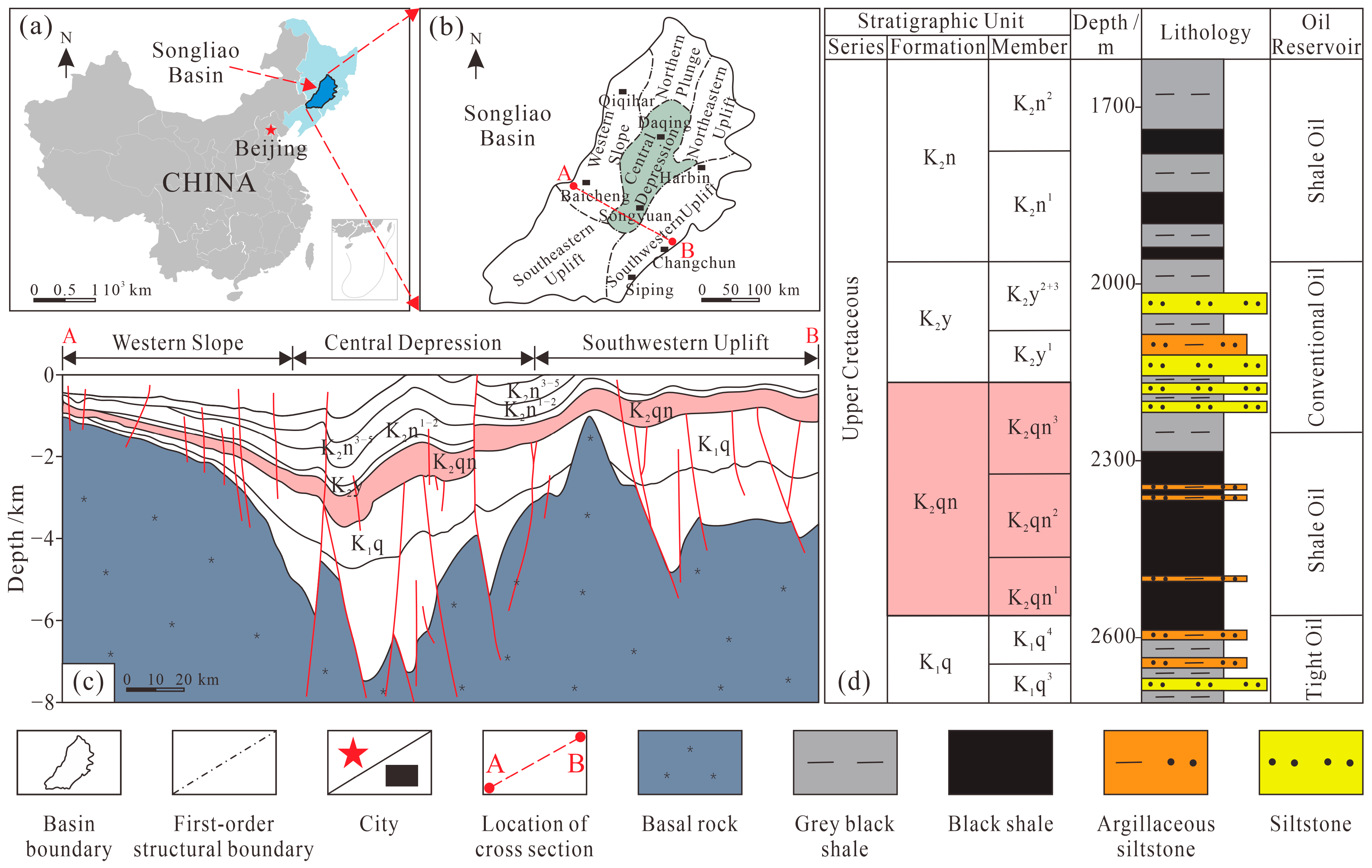
The Songliao Basin, located in northeastern China, is the country’s largest Mesozoic-Cenozoic continental petroliferous basin (Figure 1a). In the regional tectonic framework, the Central Depression represents the primary depocenter of the basin, characterized by long-term stable subsidence, persistent anoxic conditions, and high OM burial efficiency (Figure 1b). It is recognized as the most significant hydrocarbon source rock development zone and a strategic target for oil and gas exploration in the basin as well as the focal area of this study [62,68,69,70].
From the perspective of geological evolution, the Songliao Basin has undergone three main developmental stages: the rift stage (Jurassic–Early Cretaceous), the depression stage (early Late Cretaceous), and the tectonic inversion stage (late Late Cretaceous). The Qingshankou Formation (K2qn) was deposited during the peak transgression of the Late Cretaceous lacustrine basin (Figure 1c). Under a warm and humid paleoclimate, it developed high-quality shales with great thickness, wide distribution, and high OM abundance (Figure 1d). These shales are typically buried deeper than 2000 m and have been subjected to complex and intense diagenesis, which significantly influenced their pore systems [68,69,70,71,72]. Recent exploration confirms the formation’s substantial shale oil potential [11,12]. However, due to varying depositional environments and diagenetic history, the formation contains diverse lithofacies that create heterogeneous pore systems [68,69,70]. This heterogeneity directly affects oil storage and fluid flow in the reservoirs [12]. Therefore, studying how lithofacies control pore characteristics is crucial for effective shale oil development in the Qingshankou Formation.

3. Samples and Methods

3.1. Shale Samples

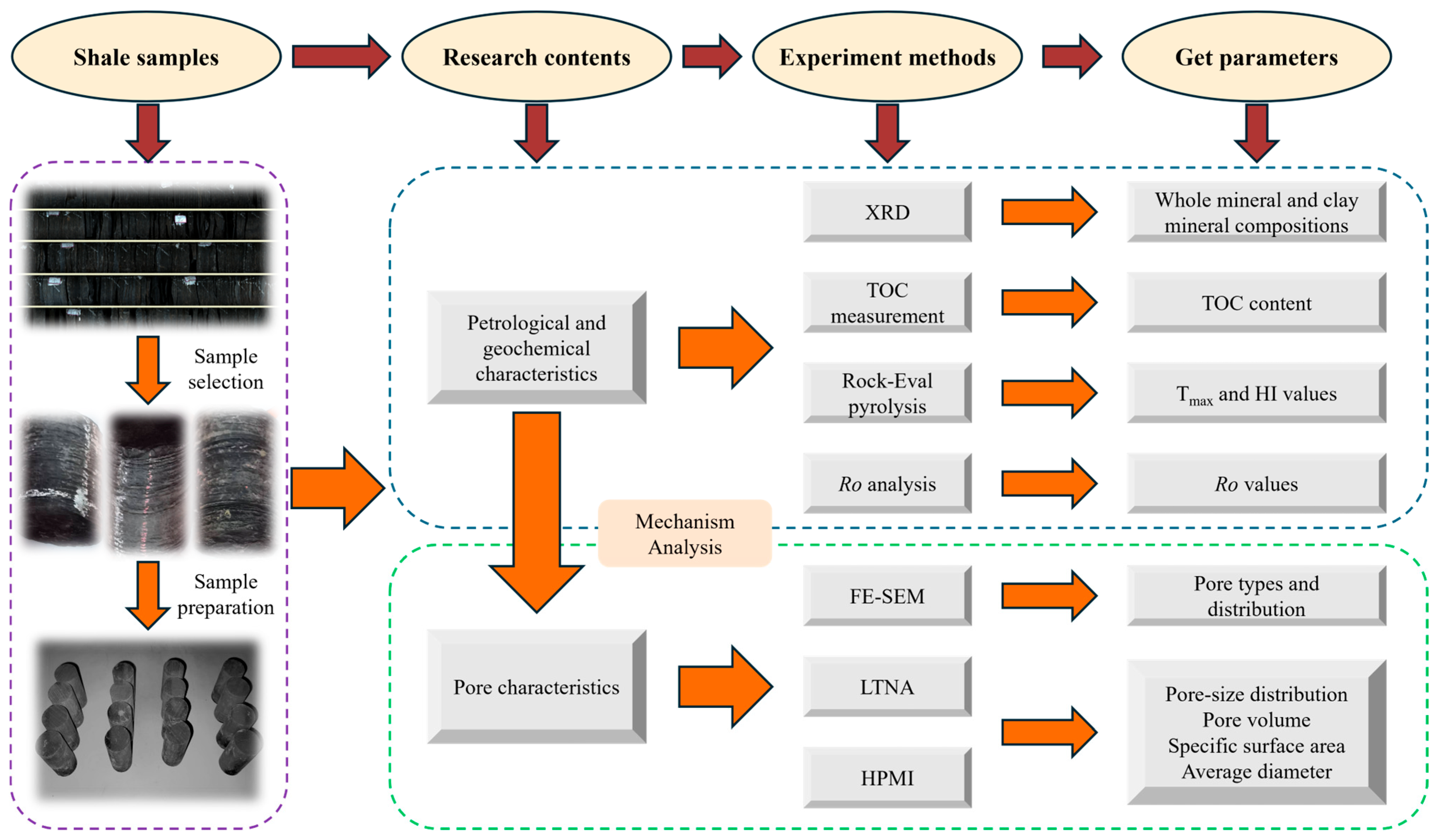
The shale samples were provided by the Daqing Oilfield Core Repository of China National Petroleum Corporation (CNPC). All were collected from the Qingshankou Formation in the Songliao Basin at burial depths of 2200–2500 m. To adequately capture reservoir heterogeneity, 56 samples were obtained with variable spacing: 1–3 m in uniform intervals and 0.1–0.5 m in heterogeneous sections. Mineral composition, as determined by XRD, was used to classify lithofacies based on quantitative thresholds. Samples containing more than 50% clay, felsic, or carbonate minerals were classified as argillaceous, siliceous, or calcareous shale, respectively; the remainder were categorized as mixed shale [60,61,62,63,64,65,66]. From these, 16 representative samples (four from each lithofacies) were selected for detailed analysis, with their numbers listed in Table 1. All selected samples were structurally intact, fracture-free, and weighed over 500 g, allowing for preparation into various dimensions to meet the requirements of subsequent experimental procedures (Figure 2).

3.2. Experimental Methods

This study analyzed the petrological, geochemical, and pore structural characteristics of the Qingshankou Formation shale samples using a multi-method workflow [16,17,24,25,26]. As shown in Figure 2, XRD was used to determine the whole mineral and clay mineral compositions. Geochemical analyses, including TOC measurement, Rock-Eval pyrolysis, and Ro analysis, were performed to assess OM abundance, type, and maturity. Pore structure was characterized using FE-SEM for pore type identification and distribution, along with LTNA and HPMI for quantitative pore parameter measurement. All analyses for each sample were performed on subsamples from the same core specimen to ensure data comparability. Integration of these multi-scale datasets clarifies the relationships among mineral composition, OM properties, and pore structure, and elucidates lithofacies-controlled pore characteristics and mechanisms.
XRD analysis was performed using an Olympus BTX III diffractometer (Olympus Corporation, Tokyo, Japan) with Cu-Kα radiation, operating at 40 kV and 40 mA. The measurements were conducted over a 2θ range of 5° to 70° with a step size of 0.02° and a scanning speed of 2°/min. Samples were crushed to below 100-mesh (<150 μm) prior to analysis. For clay mineral identification, glycol-saturated oriented mounts were additionally prepared. Minerals were identified using MDI Jade 9 software, and semi-quantitative analysis was performed using the relative intensity ratio (RIR) method. Analytical reproducibility, monitored by repeated measurements of a standard sample, was within ±5%.
TOC content was determined using a Leco CS-230 carbon/sulfur analyzer (LECO Corporation, St. Joseph, MI, USA). Samples crushed to 100-mesh were treated with dilute hydrochloric acid to remove carbonate minerals and subsequently rinsed with deionized water to neutrality. The TOC content was calculated based on the peak area of CO2 generated from the combustion of OM. The instrument was calibrated using certified carbon standards, and the analytical uncertainty was less than 2%.
Rock-Eval pyrolysis was conducted using a Rock-Eval®6 instrument (Vinci Technologies, Nanterre, France). Approximately 100 mg of sample (100-mesh) was heated in an inert atmosphere according to the following program: isothermal at 300 °C for 3 min to record the S1 peak (free hydrocarbons), followed by programmed heating to 650 °C at a rate of 25 °C/min to record the S2 peak (hydrocarbons from cracking of kerogen). The maximum pyrolysis temperature (Tmax) was recorded at the peak of the S2 curve. The hydrogen index (HI) was calculated as HI = (S2/TOC) × 100.
Ro values was measured using a CRAIC CoalPro micro-photometer (CRAIC Technologies, Inc., San Dimas, CA, USA). Samples were embedded in epoxy resin and polished to a smooth surface. To avoid bias from sample anisotropy, blocks (1 cm × 1 cm × 0.5 cm) were prepared perpendicular to the bedding plane. At least 50 valid measurements were obtained per sample, and the average value was reported as the final Ro. The instrument was calibrated with a synthetic reflectance standard prior to analysis, and the standard deviation for replicate measurements was typically below 0.05%.
FE-SEM was conducted using a Zeiss SIGMA 300 microscope (Carl Zeiss AG, Oberkochen, Germany). The instrument was operated at an accelerating voltage of 5–15 kV and magnifications ranging from 100× to 100,000×. Sample blocks (1 cm × 0.5 cm × 0.2 cm) were prepared perpendicular to the bedding plane to obtain representative surface morphological information. After mounting and grinding, the sample surfaces were polished using a Hitachi IM4000 argon ion polisher (Hitachi High-Tech Corporation, Tokyo, Japan) to create a pristine, damage-free surface for high-resolution imaging.
LTNA was performed using a Micromeritics ASAP 2020M analyzer (Micromeritics Instrument Corporation, Norcross, GA, USA). Samples were crushed to 100-mesh, vacuum-degassed at 120 °C for 12 h, and then analyzed at 77.35 K over a relative pressure (P/P0) range of 0.01 to 0.99. The pore size distribution and pore volume were calculated using the Barrett–Joyner–Halenda (BJH) model from the adsorption branch. The specific surface area (SSA) was determined by the Brunauer–Emmett–Teller (BET) method.
HPMI was conducted using a Micromeritics Autopore 9510 porosimeter (Micromeritics Instrument Corporation, Norcross, GA, USA). Samples were prepared as standard cylinders (2.5 cm in diameter, 5 cm in height) parallel to the bedding plane to facilitate mercury intrusion and extrusion. The test pressure range was 0.01–414 MPa. Pore size was calculated based on the Washburn equation, pore volume was determined from the volume of intruded mercury, and the SSA was calculated based on a cylindrical pore model.

4. Results

4.1. Petrological and Geochemical Characteristics

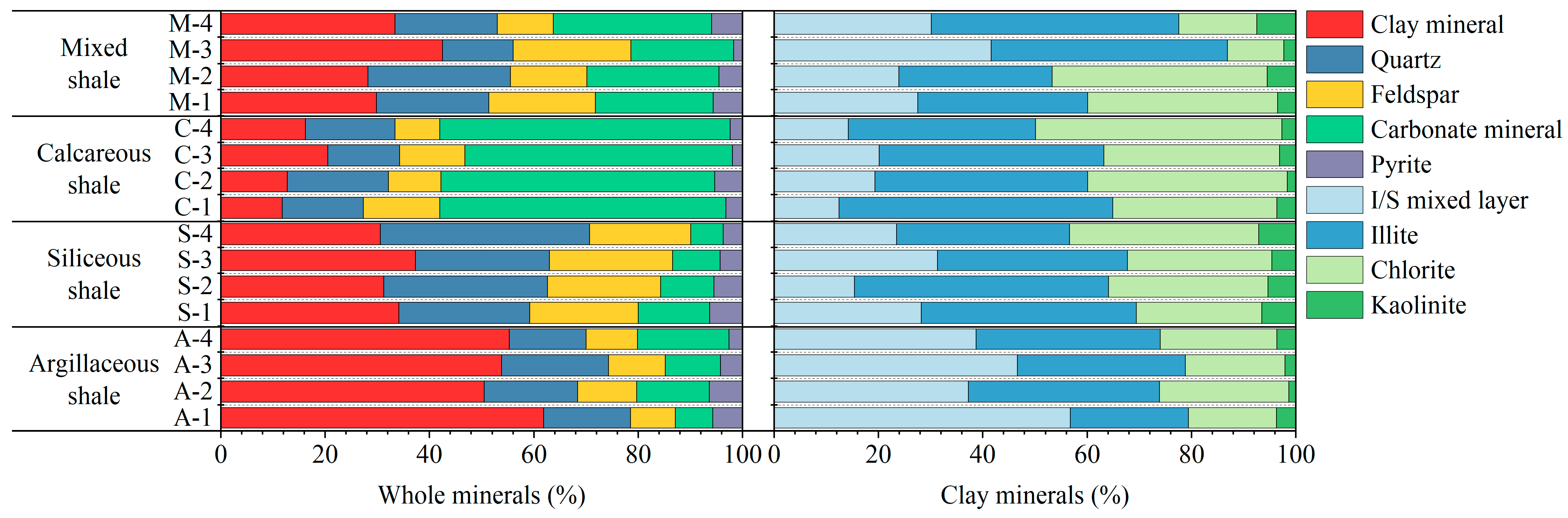
The mineral composition exerts a primary control on the petrophysical properties of the shale [31,32,33,34,35]. XRD results (Table 1, Figure 3) indicate that the shale mineral composition in the Qingshankou Formation is complex and varies significantly among different lithofacies. Argillaceous shale exhibited the highest clay mineral content (avg. 55.4%), dominated by I/S mixed layer minerals (avg. 44.8%). Siliceous shale had the highest felsic mineral content (avg. 56.9%), with its clay fraction primarily consisting of illite (avg. 39.9%) and chlorite (avg. 29.7%). Calcareous shale contained the highest carbonate mineral content (avg. 53.6%), with a clay mineral composition similar to that of siliceous shale. Mixed shale showed a relatively balanced content of the three main mineral types, with considerable variation in its clay mineral composition and no clearly dominant component.
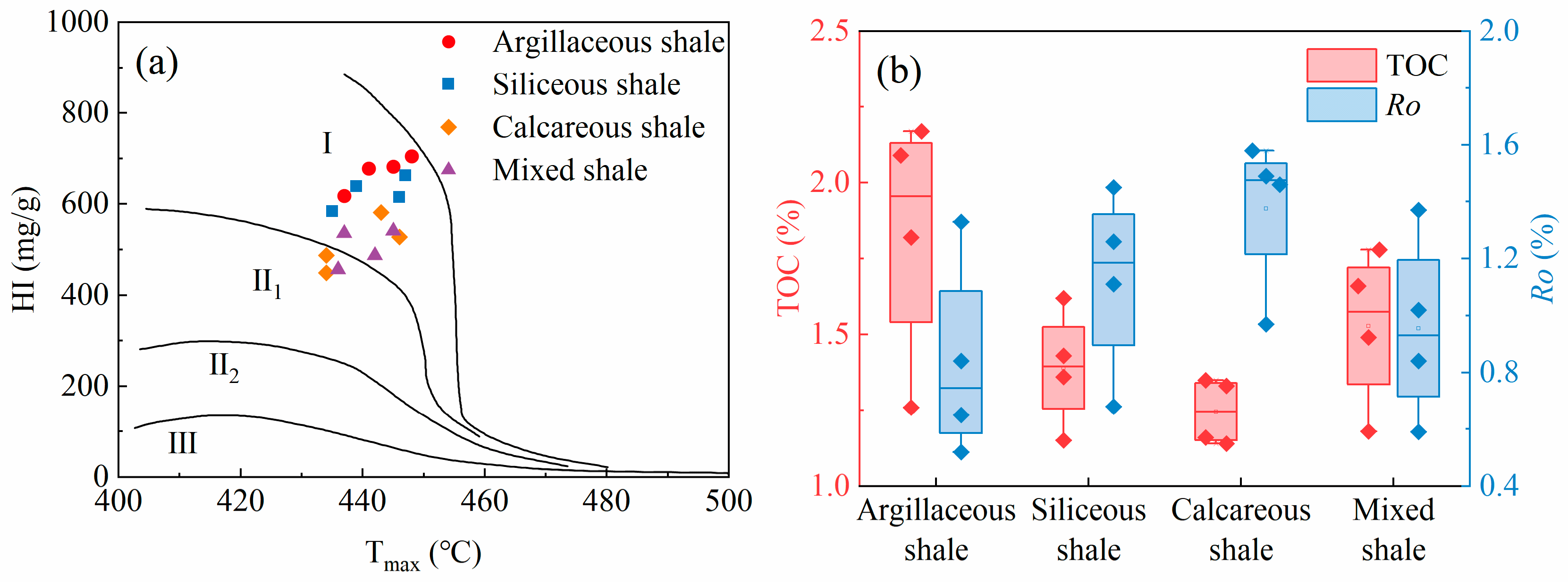
Results from the rock pyrolysis and organic carbon analysis (Table 1, Figure 4) showed that the Tmax values of the shales in the Qingshankou Formation primarily range from 434 to 448 °C. The HI values exhibited a wide variation (449–705 mg/g). Argillaceous shales (avg. 671 mg/g) and siliceous shales (avg. 625 mg/g) displayed high HI values, consistent with Type I kerogen. Mixed shales (avg. 512 mg/g) and calcareous shales (avg. 506 mg/g) showed relatively lower HI values, with some samples indicating characteristics of Type II1 kerogen. The TOC content distribution revealed a clear lithofacies-dependent pattern. Argillaceous shales possessed the highest TOC content (avg. 1.84%), followed by mixed shales (avg. 1.53%) and siliceous shales (avg. 1.39%), while calcareous shales had the lowest TOC content (avg. 1.25%). Ro values varied widely (0.52%–1.58%), indicating that the shales in the Qingshankou Formation have experienced a complete thermal evolution sequence [11,12,68,72]. Calcareous shales exhibited the highest maturity (avg. Ro = 1.38%), followed by siliceous shales (avg. Ro = 1.13%) and mixed shales (avg. Ro = 0.96%), with argillaceous shales showing the lowest maturity (avg. Ro = 0.84%).

4.2. Pore Types and Distribution

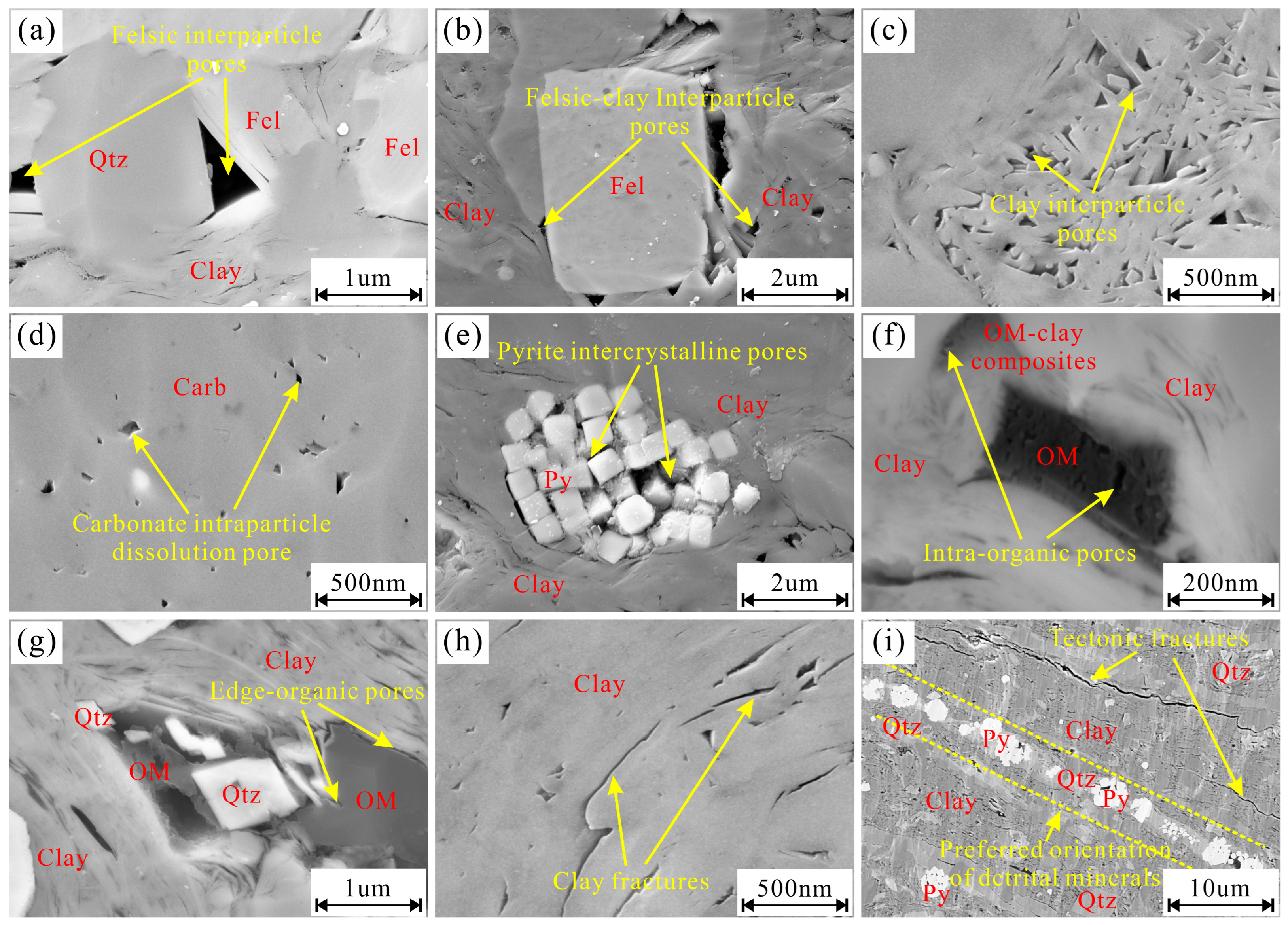
FE-SEM revealed three main pore types in the shales of the Qingshankou Formation: inorganic pores, organic pores, and microfractures (Figure 5) [26,27,28,29].
Inorganic pores include interparticle pores, intraparticle pores, and intercrystalline pores [63,64,65,66,67,68,69,70,71]. Interparticle pores, located at mineral grain contacts, can be subdivided into felsic interparticle pores (Figure 5a), felsic-clay interparticle pores (Figure 5b), and clay interparticle pores (Figure 5c). These pores exhibited diverse morphologies, including triangular, polygonal, and irregular shapes, with pore sizes ranging from several nanometers to hundreds of nanometers [21,31,38]. Among them, felsic interparticle pores were larger (tens to hundreds of nanometers) and common in siliceous shales, whereas clay interparticle pores were smaller (several to tens of nanometers) and enriched in argillaceous shales. Intraparticle pores primarily occurred within feldspar and carbonate minerals (Figure 5d), often appearing circular or elliptical with diameters typically less than 100 nm; these were frequently observed in calcareous shales. Intercrystalline pores mainly developed in framboidal pyrite aggregates (Figure 5e), displaying triangular or polygonal shapes with sizes generally below 100 nm, and were distributed across all lithofacies [43].
Organic pores commonly developed within and at the edges of OM, showing significant spatial heterogeneity [28,29]. Intra-organic pores were mostly circular, elliptical, or sponge-like, with diameters usually less than 100 nm (Figure 5f). Edge-organic pores were primarily slit-like shrinkage pores, reaching lengths up to 1 μm but widths of only a few nanometers (Figure 5g). Organic pores developed in all lithofacies but were unevenly distributed: these were most abundant in argillaceous shales, mainly within the OM and OM-clay composites; less numerous and often isolated in siliceous shales; primarily hosted within bioclastic shells in calcareous shales; and moderately developed in mixed shales, and intermediate between argillaceous and siliceous shales.
Microfractures can be classified by origin into clay fractures and tectonic fractures. Clay fractures developed within the clay-rich matrix (Figure 5h), appearing as curved bands or fracture networks with lengths of several micrometers and widths of tens to hundreds of nanometers; these were most common in argillaceous shales. Tectonic fractures developed in silty bands, aligning with the mineral orientation (Figure 5i), and appeared straight or branched. These were larger in scale, with lengths reaching tens to hundreds of micrometers and widths from hundreds of nanometers to several micrometers; these were frequently observed in siliceous shales [12,62].

4.3. Pore Structure Characterization

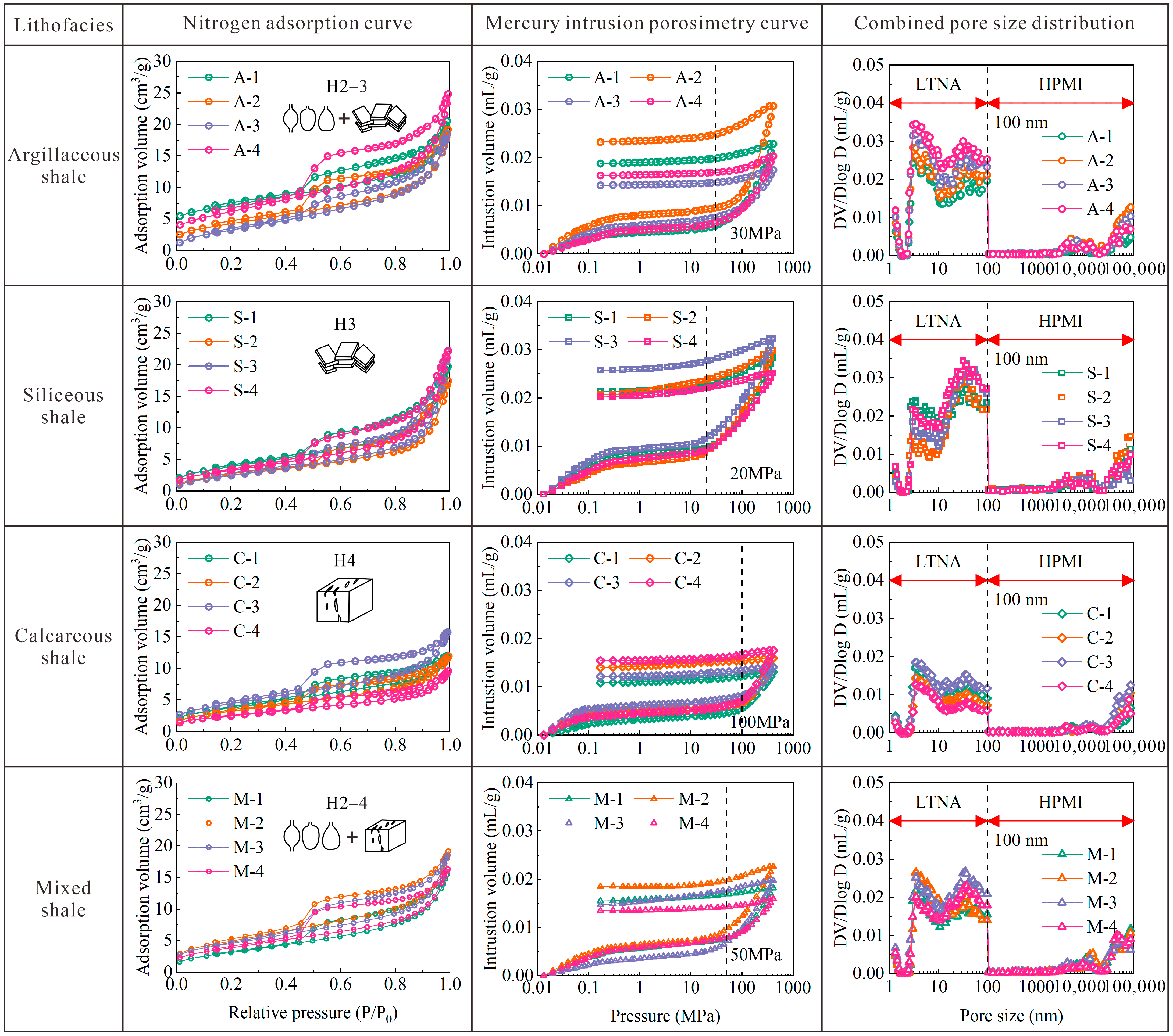
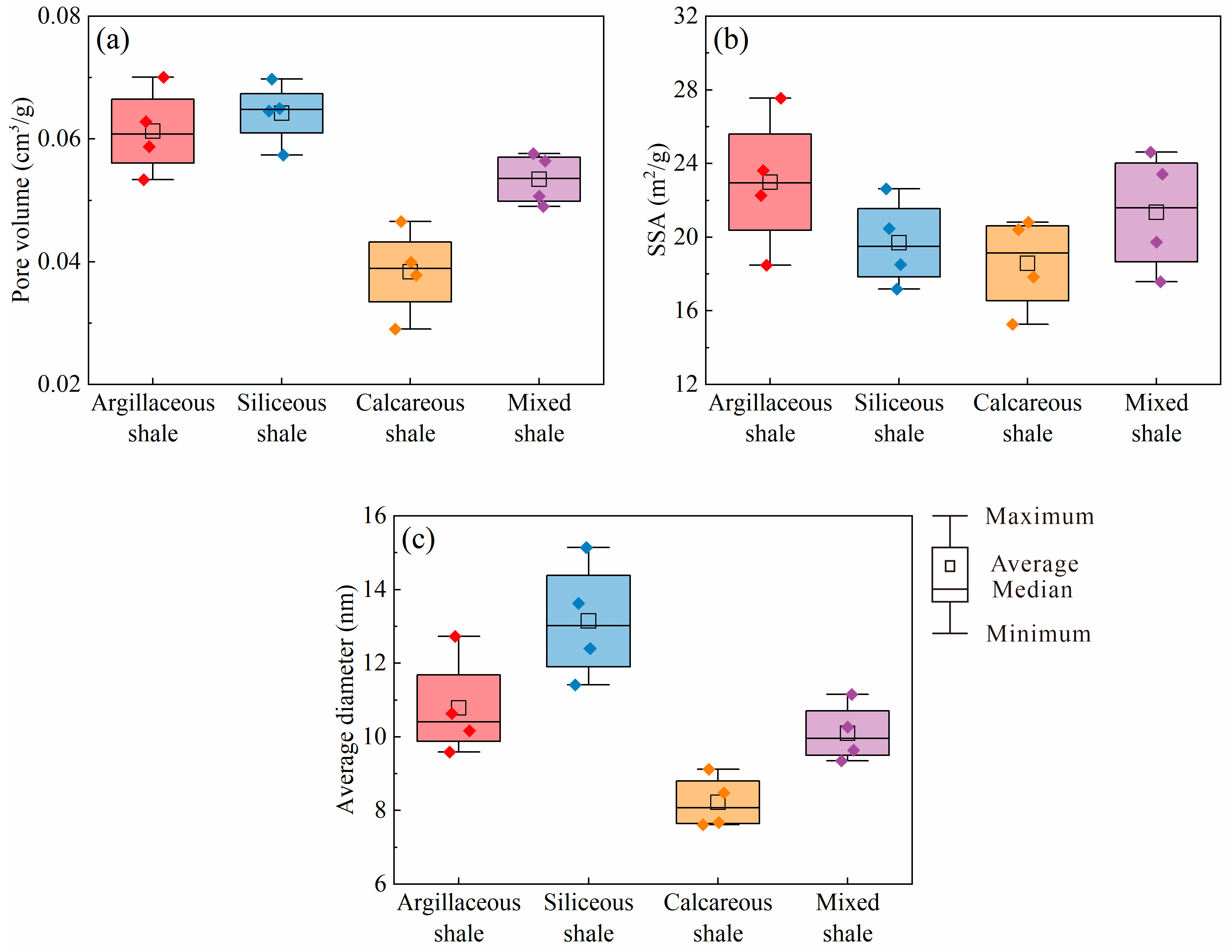
LTNA and HPMI are commonly used methods for characterizing the shale pore structure [16,17,18,19,20,21]. LTNA, based on the physical adsorption behavior of nitrogen molecules (kinetic diameter ≈ 0.354 nm) on pore surfaces, offers high sensitivity and accuracy for nanopores but has limited capability for detecting larger pores [18]. HPMI intrudes mercury into pores under high pressure up to 414 MPa, enabling the characterization of pores ranging from several nanometers to hundreds of micrometers. However, the high pressure may alter the original pore structure, leading to data distortion [19,20]. Therefore, this study adopted a combined characterization approach: LTNA for pores < 100 nm and HPMI for pores > 100 nm, achieving continuous and complementary analysis across the full pore size range [19,24,25]. Based on the pore structure of continental shale and the occurrence mode of crude oil, the following pore size classification was used: micropores (<10 nm), mesopores (10–100 nm), and macropores (100–10,000 nm) [37,55]. Pores larger than 10,000 nm are not discussed, as they mainly represent artificial fractures or surface irregularities induced during sample preparation and are considered ineffective storage space. Figure 6 presents the nitrogen adsorption curves, mercury intrusion curves, and combined pore size distributions of different lithofacies. Based on these, the pore volume, SSA, and average diameter were further calculated, as summarized in Table 2 and Figure 7.
Argillaceous shale exhibited an H2–3 type hysteresis loop in the nitrogen adsorption curve, indicating the coexistence of ink-bottle and slit-shaped pores. Significant adsorption at low relative pressure (P/P0 < 0.4) suggests well-developed micropores. The mercury intrusion curve showed a sharp increase after 30 MPa, indicating the presence of microfractures. Combined with the FE-SEM results, these were identified as clay fractures (Figure 5h). Argillaceous shale had the highest cumulative nitrogen adsorption capacity (avg. 20.77 cm3/g) among the four lithofacies, and the second highest cumulative mercury intrusion volume (avg. 0.0229 mL/g) after siliceous shale. The combined pore size distribution indicates a well-developed pore system, with the average values of pore volume, SSA, and average diameter being 0.06127 cm3/g, 22.980 m2/g, and 10.78 nm, respectively.
Siliceous shale showed an H2 type hysteresis loop in the nitrogen adsorption curve, suggesting that slit-shaped pores dominate. A sharp increase in nitrogen adsorption at high relative pressure (P/P0 > 0.8) reflects the developed mesopores. The mercury intrusion curve rose noticeably after 20 MPa, 10 MPa earlier than in argillaceous shale, indicating more large tectonic fractures (Figure 5i). Its cumulative nitrogen adsorption (avg. 20.35 cm3/g) was similar to that of argillaceous shale, while its cumulative mercury intrusion (avg. 0.0289 mL/g) was the highest among all lithofacies. The combined pore size distribution showed the most developed pore system, with the average values of pore volume, SSA, and average diameter being 0.06419 cm3/g, 19.703 m2/g, and 13.15 nm, respectively.
Calcareous shale displayed an H4 type hysteresis loop in the nitrogen adsorption curve, indicating wedge-shaped pores. The mercury intrusion curve rose slowly only after 100 MPa, suggesting poorly developed microfractures. It had the lowest cumulative nitrogen adsorption (avg. 12.34 cm3/g) and mercury intrusion (avg. 0.0152 mL/g) among the lithofacies. The combined pore size distribution confirms the least developed pore system, with the average values of pore volume, SSA, and average diameter being 0.03834 cm3/g, 18.587 m2/g, and 8.22 nm, respectively.
Mixed shale showed an H2–4 transitional hysteresis loop in the nitrogen adsorption curve, reflecting composite development of ink-bottle and wedge-shaped pores. Concentrated mercury intrusion occurred after 50 MPa. Its cumulative nitrogen adsorption averaged 17.39 cm3/g, and the mercury intrusion averaged 0.0191 mL/g. The combined pore size distribution indicates a moderately developed pore system, slightly better than that of calcareous shale, with the average values of pore volume, SSA, and average diameter being 0.05344 cm3/g, 21.345 m2/g, and 10.10 nm, respectively.

5. Discussion

5.1. Controlling Factors on Pore Development

The pore structure of continental shale is co-controlled by multiple geological factors, including the depositional environment, shale composition, and diagenetic evolution [36]. Shale composition serves as the material basis for pore development. The type and content of inorganic minerals and OM are key intrinsic factors controlling the formation and evolution of the pore system, constituting the core focus of this study. Accordingly, this study systematically analyzed the correlations between the contents of clay minerals, felsic minerals, carbonate minerals, TOC, and the volumes of micropores, mesopores, macropores, and total pores in the Qingshankou Formation shale to reveal the underlying control mechanisms. To validate these correlations, published data from the study by Li et al. [65] on the Shahejie Formation are introduced for comparison. It should be noted that due to differences in pore size classification standards among studies, this comparison focused solely on the total pore volume. Furthermore, to minimize the interference of OM abundance on the comparison results, the selected Shahejie Formation samples (n = 9) had a TOC range largely consistent with the Qingshankou Formation samples in this study.

5.1.1. Control of Inorganic Minerals

(1)
Clay Minerals
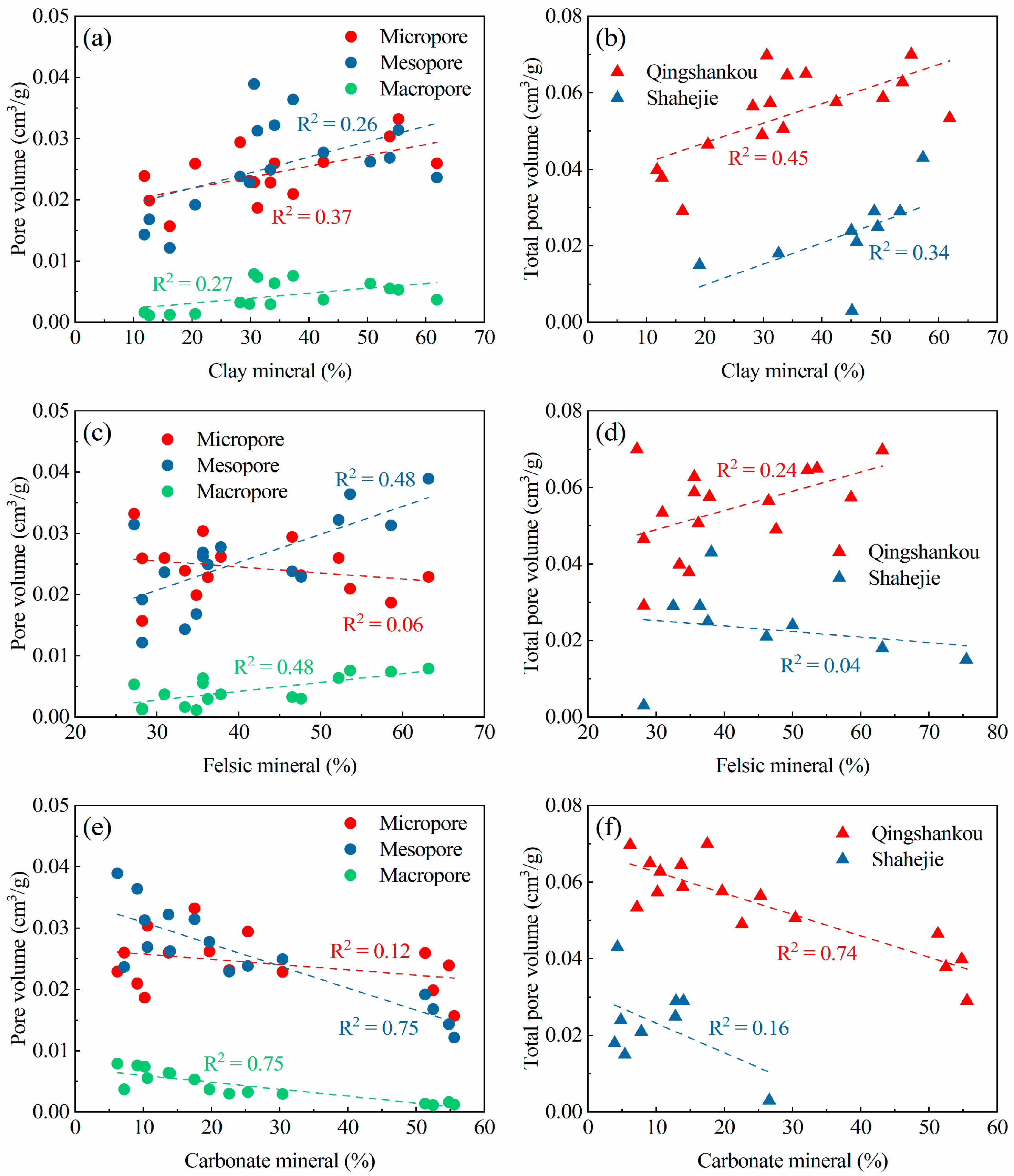
In the Qingshankou Formation, the clay mineral content showed positive correlations with micropore, mesopore, and macropore volumes (Figure 8a; R2 = 0.37, 0.26, and 0.27, respectively), indicating a positive contribution of clay minerals to pore development across all scales. Previous studies suggest that the layered structure of clay minerals provides favorable conditions for pore formation [34,51,59]. Among them, I/S mixed layer minerals, with their larger interlayer spacing and expansibility, particularly promote micropore development [33,48]. For instance, in this study, argillaceous shale exhibited the highest clay mineral content (average 55.4%, predominantly I/S mixed layer) and the largest micropore volume (average 0.02897 cm3/g). Figure 8b shows that both the Qingshankou and Shahejie Formations displayed a trend of increasing total pore volume with higher clay mineral content (R2 = 0.45 and 0.34, respectively), strongly supporting the key role of clay minerals as primary pore builders in continental shales.
(2)
Felsic Minerals
In the Qingshankou Formation, felsic mineral content showed a weak negative correlation with micropore volume (Figure 8c; R2 = 0.06). This is primarily because an increase in felsic minerals leads to a relative decrease in clay minerals [69,72], thereby affecting micropore development. In contrast, mesopore and macropore volumes showed strong positive correlations with felsic mineral content (Figure 8c; R2 = 0.48 for both). This is mainly attributed to the rigid framework provided by felsic minerals, which effectively resists compaction and helps maintain pore structure integrity [31,34,44,59]. Concurrently, feldspar dissolution and responses to tectonic stress can create secondary pores and microfractures, further expanding the pore space. Overall, felsic mineral content was positively correlated with total pore volume (Figure 8d; R2 = 0.24), indicating a generally positive impact on pore development. Siliceous shale, with the highest felsic mineral content (average 56.9%) and the largest total pore volume (average 0.0642 cm3/g), provides strong support for this conclusion. However, in the Shahejie Formation, the felsic mineral content showed a weak negative correlation with total pore volume (Figure 8d; R2 = 0.04), indicating a suppressive role. This may be related to the greater burial depth of the Shahejie Formation (approximately 4000 m, significantly deeper than the 2200–2500 m range of the samples in this study), where stronger compaction weakens the supportive effect of the felsic mineral framework. Furthermore, Li et al. [65] noted that felsic minerals in the Shahejie Formation are predominantly terrigenous quartz, with low feldspar content, lacking significant secondary pores from dissolution. Additionally, quartz overgrowths further occlude pores, exacerbating pore structure degradation.
(3)
Carbonate Minerals
In the Qingshankou Formation, the carbonate mineral content showed negative correlations with micropore, mesopore, and macropore volumes (Figure 8e; R2 = 0.12, 0.75, and 0.75, respectively), with the most significant negative impact on mesopores and macropores. This is because carbonate minerals in continental shale often exist as calcareous cements. Their precipitation and filling preferentially occur in medium to large pores, leading to substantial loss of these pores, followed by the filling of smaller pores, also causing some damage to them [32,33,34,35]. Although existing studies indicate that carbonate dissolution can create some micropores, partially mitigating the reduction in micropores (resulting in the weakest negative correlation) [59], this effect generally cannot offset the negative impact of cementation. The significant negative correlation between total pore volume and carbonate content (Figure 8f; R2 = 0.74), along with the lowest total pore volume in calcareous shale (average 0.0383 cm3/g), further confirms the inhibitory effect of carbonate minerals on pore development. This destructive pattern also holds for the Shahejie Formation, but the correlation was weaker (Figure 8f; R2 = 0.16). This is presumably because carbonate dissolution contributes more significantly to pores in this formation, potentially related to the intrusion of deep acidic hydrothermal fluids [65].

5.1.2. Control of OM

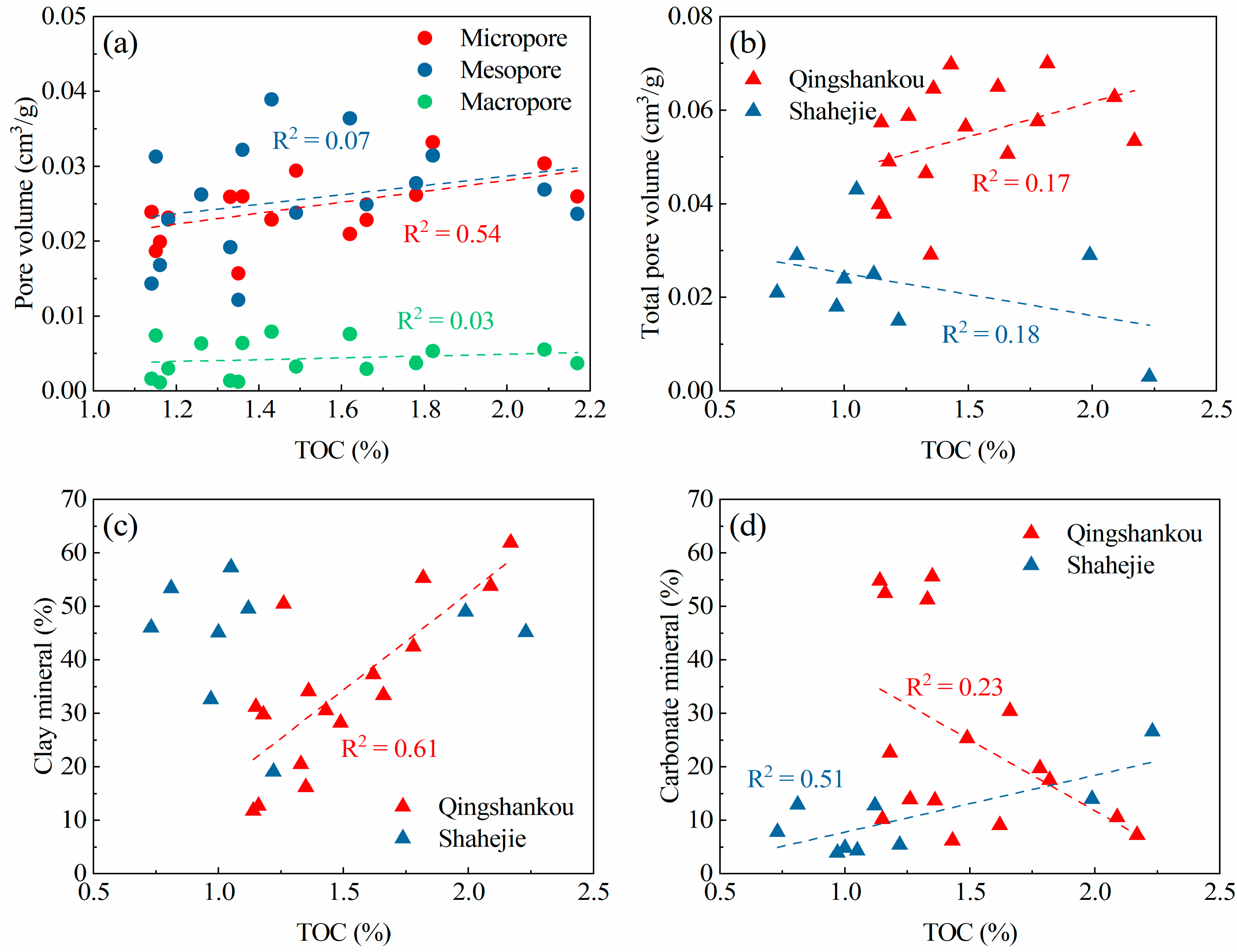
TOC content, a fundamental indicator of OM abundance in shale, is key to understanding the control of OM on pore development [26,35,60]. In the Qingshankou Formation, TOC showed positive correlations with micropore, mesopore, and macropore volumes (Figure 9a; R2 = 0.54, 0.07, and 0.03, respectively), with the strongest relationship observed for micropores. This is primarily because hydrocarbon generation from OM not only directly creates micropores (e.g., organic pores and dissolution pores), but also helps support the interlayer structures of clay minerals, effectively inhibiting micropore compression during compaction [28,36,48]. The positive correlations with mesopores and macropores are relatively weak, possibly due to the partial pore-occluding effect of some OM [48,60]. Overall, the total pore volume showed a positive correlation with TOC (Figure 9b; R2 = 0.17), indicating a positive role of OM in pore development. However, the Shahejie Formation exhibited the opposite trend, with a negative correlation between TOC and total pore volume (Figure 9b; R2 = 0.18). This difference is likely attributed to variations in OM type and maturity between the two formations. This study showed that the OM in the Qingshankou Formation is primarily Type I kerogen, with a small amount of Type II1 kerogen. The Ro ranged from 0.52% to 1.58%, and most values were within the oil window. In contrast, Li et al. reported abundant Type II2-III kerogen in the Shahejie Formation, with lower Ro values of 0.41%–0.75% [65]. This indicates that a substantial portion of the OM is immature and has not reached the oil generation threshold. Consequently, the OM in the Qingshankou Formation possesses strong hydrocarbon generation potential. This promotes both the formation of nanoporous organic pores and the development of secondary pores from mineral dissolution by organic acids generated during thermal maturation. In comparison, the limited hydrocarbon generation potential of the Shahejie Formation means that residual OM is more likely to occlude interparticle pores and microfractures, significantly inhibiting pore development.
Furthermore, the coupling relationship between OM and inorganic minerals is another important reason for this discrepancy [35,39]. In the Qingshankou Formation, TOC showed a significant positive correlation with clay minerals (Figure 9c; R2 = 0.61), facilitating a favorable pattern where OM and clay minerals synergistically contribute to pore development [11,31,46,73,74]. On the one hand, the layered structure of clay minerals provides ideal hosting spaces for OM, favoring the development of organic pores. On the other hand, OM, through intermolecular forces, effectively supports the interlayer pores of clay minerals. FE-SEM observations revealed well-preserved pores within the OM–clay composites, providing direct evidence for this synergistic mechanism (Figure 5f). Simultaneously, the negative correlation between TOC and carbonate minerals (Figure 9d; R2 = 0.23) helps avoid strong cementation-related destruction, which is also an important reason why OM effectively promotes pore development in the Qingshankou Formation. Conversely, in the Shahejie Formation, TOC showed no clear correlation with clay minerals (Figure 9c) but exhibited a significant positive correlation with carbonate minerals (Figure 9d; R2 = 0.51). This suggests that the carbonate minerals in the Shahejie Formation are largely biogenic, sharing a common origin with the OM [65]. Therefore, the OM in the Shahejie Formation is likely hosted within a carbonate matrix prone to cementation. Ions like Ca2+, Mg2+, and Fe2+ released during hydrocarbon generation can reprecipitate elsewhere when formation conditions change (e.g., pH, temperature, or pressure) [37]. This process promotes late-stage cement formation and ultimately leads to the negative correlation between TOC and pore volume.

5.2. Pore Evolution Pattern and Lithofacies Differentiation Results

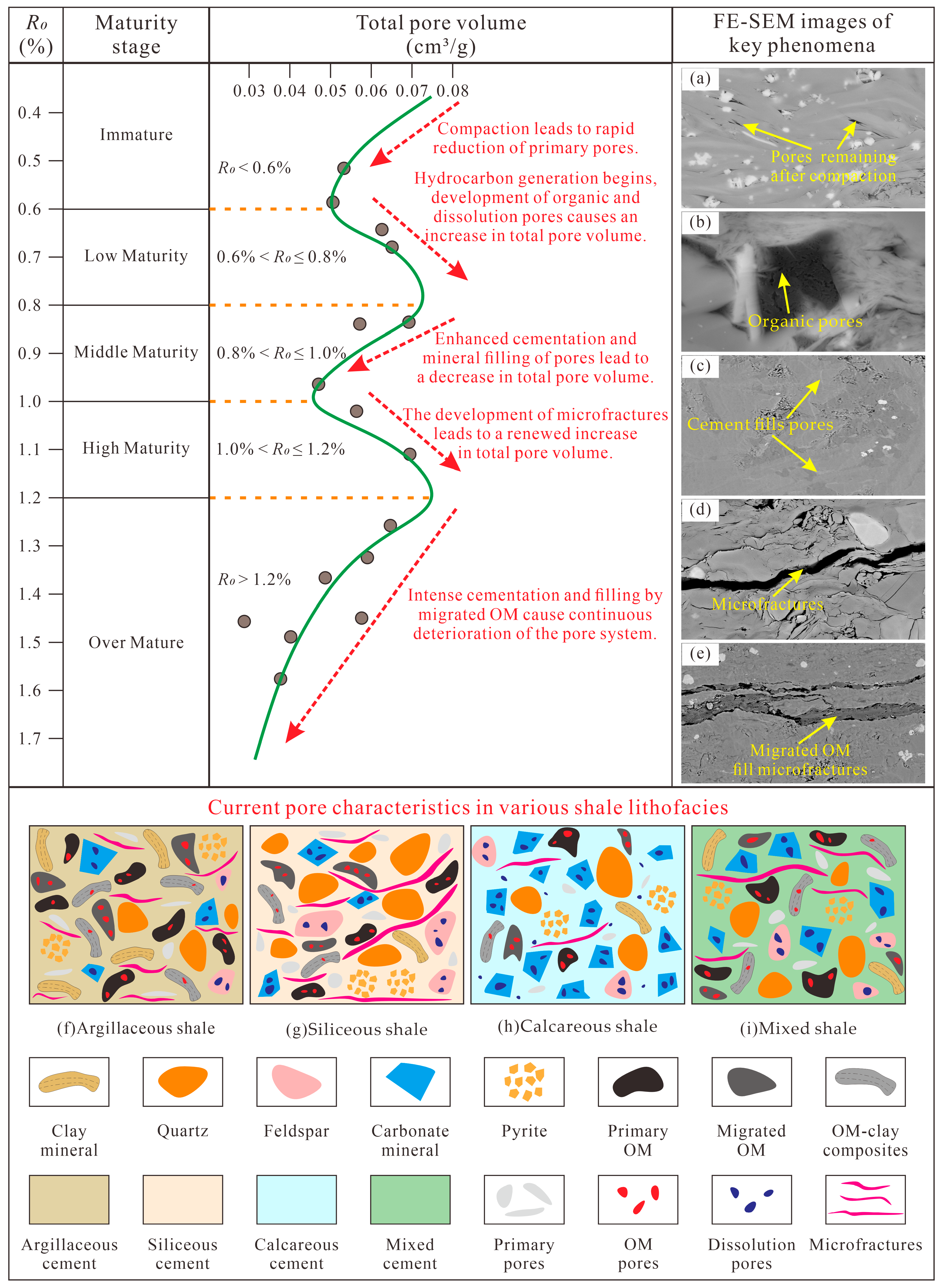
The evolution of shale pores during burial diagenesis is a dynamic process controlled by multiple variables and complex mechanisms [38,39,40,41,42,43]. Ro, as a direct indicator of OM maturity, governs key geological processes such as hydrocarbon generation and diagenetic alteration, making it the most suitable parameter for characterizing pore evolution [38,40,43]. Results from this study show that the Ro values of the Qingshankou Formation shale range from 0.52% to 1.58%, reflecting a complete thermal evolution sequence and providing a reliable basis for dividing pore evolution stages. Based on the quantitative relationship between Ro and the total pore volume in Figure 10, the pore evolution of the Qingshankou Formation shale can be divided into five stages: immature (Ro < 0.6%), low maturity (0.6% < Ro ≤ 0.8%), middle maturity (0.8% < Ro ≤ 1.0%), high maturity (1.0% < Ro ≤ 1.2%), and over maturity (Ro > 1.2%).
During the immature stage (Ro < 0.6%), the total pore volume decreased. At this stage, OM has not yet entered the hydrocarbon generation threshold, and intense compaction dominated pore evolution, leading to a rapid reduction in primary pores [42]. As shown in Figure 10a, after strong compaction, the clay matrix underwent recrystallization and formed a highly oriented dense schistose structure. Interlayer micropores in clay minerals were largely closed, and the remaining nanopores were mostly slit-shaped and aligned along the clay sheets [12]. Rigid mineral grains were embedded into the plastic clay matrix under compaction, forming a typical “embedded” structure, with only a small number of intergranular pores preserved around them.
In the low maturity stage (0.6% < Ro ≤ 0.8%), the total pore volume began to increase. As OM started to generate hydrocarbons, a critical transition occurred in the pore system [38,40], with the total pore volume gradually rising from 0.051 cm3/g to approximately 0.073 cm3/g. Scanning electron microscopy (Figure 10b) revealed the initial development of organic pores during this stage. In addition, organic acids generated during hydrocarbon generation dissolved soluble minerals such as feldspar and carbonates, forming secondary pores (Figure 5d), which collectively promote pore development [36,59].
In the middle maturity stage (0.8% < Ro ≤ 1.0%), the total pore volume decreased again. Although continuous hydrocarbon generation favors the development of organic and dissolution pores, enhanced cementation significantly negatively impacts the pore system [41,42,43,44,45], causing the total pore volume to drop from 0.073 cm3/g to about 0.048 cm3/g. As shown in Figure 10c, mineral crystals noticeably filled the intergranular pores, with cements occupying space and blocking throats, directly reducing porosity.
During the high maturity stage (1.0% < Ro ≤ 1.2%), the total pore volume increased for the second time, rising from 0.048 cm3/g to 0.076 cm3/g. At this stage, further maturity enhancement strengthens organic acid dissolution [47], and a microfracture network develops [12,39], jointly promoting the formation of secondary pores. Figure 10d shows that the shale in the study area developed distinct microfractures under tectonic stress, significantly increasing pore space and improving flow capacity.
In the over maturity stage (Ro > 1.2%), intense cementation and the filling of migrated OM led to renewed deterioration of the pore system, with continuous decline in porosity and effective storage space [48,60]. As shown in Figure 10e, migrated OM filled the pre-existing microfractures, damaging pore structure and reducing reservoir quality.
Overall, the pore evolution of the shale in the study area exhibited a notable “three declines and two increases” pattern. However, due to differences in mineral composition and OM content, different lithofacies showed distinct responses during this multi-stage evolution process, resulting in significant variations in current pore characteristics [41,43]. Argillaceous shale, with its high clay content, was highly sensitive to early compaction, suffering severe loss of primary pores (Figure 10a). However, its high OM abundance promoted the development of numerous organic pores during the low- to high-maturity stages, demonstrating the strongest pore recovery capacity (Figure 10b). Meanwhile, hydrocarbon-generation overpressure facilitates the formation of clay fractures (Figure 5h), improving pore connectivity (Figure 10f). Siliceous shale remained the most stable throughout the evolution process. Its rigid mineral framework effectively resisted early compaction, preserving some primary pores (Figure 5a,b). The high content of brittle minerals made it more prone to forming tectonic fractures under stress (Figure 5i), resulting in the most developed pore network (Figure 10g). Calcareous shale exhibited the poorest pore structure due to intense carbonate cementation (Figure 10c). Although dissolution pores provided limited local porosity, the overall rock remained highly tight, making it the lithofacies with the worst reservoir performance among the four types (Figure 10h). Mixed shale showed transitional evolution characteristics between the other lithofacies. Influenced by mineralogical heterogeneity, it ultimately developed a moderately developed pore system (Figure 10i).

5.3. Implications for Shale Oil Exploration

Continental shale is a typical “self-generation and self-storage” unconventional reservoir, with its commercial development potential primarily determined by two key parameters: oil-bearing potential and mobility. Oil-bearing potential is controlled by OM abundance, type, and maturity, whereas mobility is closely related to mineral composition, pore structure, and fracture development [6,7,8,9,10,11,45,56,58]. This study systematically evaluated the oil-bearing potential and mobility characteristics of different lithofacies through integrated mineral-petrological, geochemical, and multi-scale pore structure analyses.
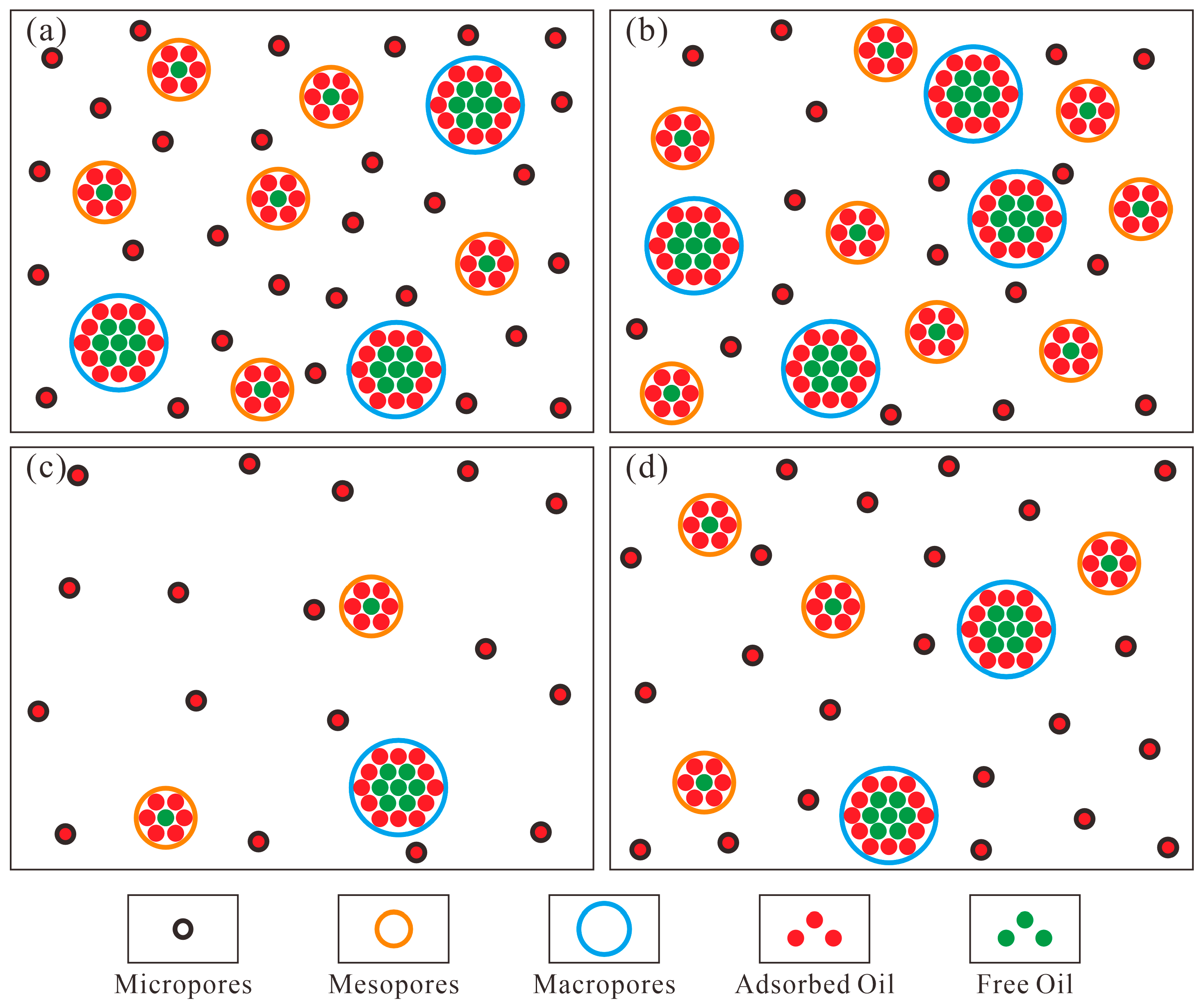
Based on the occurrence state of crude oil in shale nano- to micro-scale pore systems, it can be classified into free oil and adsorbed oil (Figure 11) [64,65]. Free oil mainly occurs in fractures and macro-mesopores, serving as the primary contributor to shale oil productivity. In contrast, adsorbed oil is predominantly attached to pore surfaces, especially enriched in micropores, making it difficult to extract effectively. Results of this study show that argillaceous shale had the highest TOC content, with kerogen predominantly Type I and mostly within the oil window, indicating excellent hydrocarbon generation potential. However, its high clay mineral content and large SSA resulted in a pore structure dominated by micropores and mesopores, leading to oil occurring mainly in the adsorbed state. The small average diameter further limits free oil storage. Although the developed clay fracture system enhanced pore connectivity, the proportion of free oil remained low (Figure 11a). In comparison, siliceous shale not only exhibited favorable OM properties but also a high brittle mineral content. This combination facilitated the formation of a pore system dominated by mesopores and macropores. Coupled with a well-developed microfracture network, it demonstrated the best pore volume, diameter, and connectivity, providing ideal conditions for the storage and flow of free oil (Figure 11b). Additionally, mixed shale has a complex mineral composition, and diagenetic differences result in strong pore structure heterogeneity and generally poor pore-throat connectivity. Calcareous shale, affected by strong cementation, suffers a significant loss of primary pores, with an isolated and poorly connected microfracture system, making it difficult to form an effective storage-seepage system. As a result, both mixed and calcareous shales exhibited a significantly lower oil content and mobility compared to argillaceous and siliceous shales (Figure 11c,d).
Comprehensive evaluation confirmed that siliceous shale is the most favorable lithoface in the Qingshankou Formation due to its high free oil content and excellent flow capacity. Although argillaceous shale has poor mobility, its high adsorbed oil content makes it a valuable secondary exploration target. These findings differ from those of Wang et al. [43], who considered argillaceous shale the best target in the Qingshankou Formation, Songliao Basin. The difference may come from sample selection, experimental methods, or regional geology. For example, the limited number of samples in this study may not fully represent the formation’s heterogeneity. Also, experimental methods have inherent limitations. For instance, combining LTNA and HPMI can cause errors due to model assumptions and pore size linking issues, which may lead to systematic bias. Given the widespread distribution of both argillaceous and siliceous shales in the Qingshankou Formation, subsequent exploration should prioritize these two lithofacies.

6. Conclusions

This study, through multi-scale pore characterization and mechanism analysis, yielded the following main conclusions:
(1)
The pore structure of the Qingshankou Formation shale exhibited significant litho-facial differentiation. Argillaceous shale displayed the most developed micropore system and abundant clay fractures, contributing to the highest SSA. Siliceous shale possessed the most favorable pore structure, characterized by the largest pore volume and average diameter, with tectonic fractures significantly enhancing pore connectivity. In contrast, calcareous shale had the least developed pore system, while mixed shale showed transitional characteristics.
(2)
The close symbiosis between OM and clay minerals established a synergistic pore-enhancement pattern, serving as the primary contributor to micropore development in the Qingshankou Formation shale. Feldspathic minerals formed a rigid framework that effectively supports pores and resists compaction, while also promoting the development of tectonic fractures, which are critical to the formation and preservation of mesopores and macropores. In contrast, carbonate minerals act mainly as cements that fill pore spaces, significantly inhibiting pore development.
(3)
The pore evolution of the Qingshankou Formation shale can be divided into five stages, exhibiting a dynamic “three declines and two increases” pattern. During the low- and high-maturity stages, hydrocarbon generation, dissolution, and tectonic stress collectively serve as the primary mechanisms for enhancing secondary porosity, providing the key driving forces for pore expansion and fracture network formation.
(4)
Siliceous shale, with its well-developed pore-fracture network, provides excellent storage space and efficient seepage pathways for free oil, making it the preferred exploration target in the Qingshankou Formation. In contrast, argillaceous shale, despite its poor fluid mobility, possesses significant potential as a secondary exploration target due to its abundant adsorbed oil resources. It is proposed that high priority be given to both lithofacies in subsequent exploration.
Limitations and future work: Although this study identified siliceous shale as the most favorable lithofacies, its conclusions remain limited by sample size and experimental methods. To obtain more reliable results, future work should first expand the sample set to better represent the heterogeneity of the Qingshankou Formation. Second, advanced techniques like FIB-SEM should be used for 3D pore imaging to directly characterize pore networks and minimize errors from integrated methods such as LTNA-HPMI. Finally, incorporating multiphase flow simulations and cross-scale data will help clarify the storage and flow mechanisms in shales, offering a more robust basis for identifying favorable lithofacies.

Author Contributions

Conceptualization, X.H. (Xinshu Huang) and Z.L.; methodology, Z.L. and Y.W.; software, X.H. (Xiangxue Han); validation, X.H. (Xinshu Huang), X.H. (Xiangxue Han) and Y.G.; formal analysis, Z.L. and Y.W.; investigation, Y.W.; resources, Z.L. and Y.W.; data curation, Y.G.; writing—original draft preparation, X.H. (Xinshu Huang); writing—review and editing, Z.L.; visualization, X.H. (Xiangxue Han); supervision, Z.L.; project administration, Z.L.; funding acquisition, Z.L. All authors have read and agreed to the published version of the manuscript.

Funding

This research was funded by the China National Petroleum Corporation Major Science and Technology Project (No. 2023ZZ15) and the National Natural Science Foundation of China Joint Fund for Enterprise Innovation Development Project (No. U22B2073). The APC was funded by China University of Geosciences (Beijing).

Data Availability Statement

The data used to support the findings of this study are included within the article.

Acknowledgments

The authors gratefully acknowledge the editors and anonymous reviewers for their constructive comments and valuable suggestions, which have significantly improved the quality of this manuscript.

Conflicts of Interest

Author Yongchao Wang was employed by the Daqing Oilfield Company Ltd. The remaining authors declare that the research was conducted in the absence of any commercial or financial relationships that could be construed as a potential conflict of interest.

References

  1. Soeder, D.J. The successful development of gas and oil resources from shales in North America. J. Pet. Sci. Eng. 2018, 163, 399–420. [Google Scholar] [CrossRef]
  2. Wang, Z.; Fan, Z.; Chen, X.; Li, Y.; Fan, Z.; Wei, Q.; Peng, Y.; Liu, B.; Yue, W.; Wang, X.; et al. Global oil and gas development situation, trends and enlightenment in 2023. Pet. Explor. Dev. 2024, 51, 1536–1555. [Google Scholar] [CrossRef]
  3. Fauchille, A.L.; Ma, L.; Rutter, E.; Chandler, M.; Lee, P.; Taylor, K. An enhanced understanding of the Basinal Bowland shale in Lancashire (UK), through microtextural and mineralogical observations. Mar. Pet. Geol. 2017, 86, 1374–1390. [Google Scholar] [CrossRef]
  4. Iqbal, M.A.; Rezaee, R.; Smith, G.; Ekundayo, J.M. Shale lithofacies controls on porosity and pore structure: An example from Ordovician Goldwyer Formation, Canning Basin, Western Australia. J. Nat. Gas Sci. Eng. 2021, 89, 103888. [Google Scholar] [CrossRef]
  5. Zanoni, G.; Šegvić, B.; Moscariello, A. Clay mineral diagenesis in Cretaceous clastic reservoirs from West African passive margins (the South Gabon Basin) and its impact on regional geology and basin evolution history. Appl. Clay Sci. 2016, 134, 186–209. [Google Scholar] [CrossRef]
  6. Xia, L.; Zhao, X.; Wu, Y. Status, disadvantages, and prospects of oil shale in China: An economic perspective. Energy Policy 2023, 183, 113795. [Google Scholar] [CrossRef]
  7. Lei, Q.; Weng, D.; Guan, B.; Shi, J.; Cai, B.; He, C.; Sun, Q.; Huang, R. Shale oil and gas exploitation in China: Technical comparison with US and development suggestions. Pet. Explor. Dev. 2023, 50, 944–954. [Google Scholar] [CrossRef]
  8. Yang, Z.; Zou, C. “Exploring petroleum inside source kitchen”: Connotation and prospects of source rock oil and gas. Pet. Explor. Dev. 2019, 46, 181–193. [Google Scholar] [CrossRef]
  9. Slatt, R.M.; O’Brien, N.R. Pore types in the Barnett and Woodford gas shales: Contribution to understanding gas storage and migration pathways in fine-grained rocks. AAPG Bull. 2011, 95, 2017–2030. [Google Scholar] [CrossRef]
  10. Kibria, M.G.; Hu, Q.; Liu, H.; Zhang, Y.; Kang, J. Pore structure, wettability, and spontaneous imbibition of Woodford shale, Permian Basin, West Texas. Mar. Pet. Geol. 2018, 91, 735–748. [Google Scholar] [CrossRef]
  11. He, W.; Zhu, R.; Cui, B.; Zhang, S.; Meng, Q.; Bai, B.; Feng, Z.; Lei, Z.; Wu, S.; He, K.; et al. The Geoscience Frontier of Gulong Shale Oil: Revealing the Role of Continental Shale from Oil Generation to Production. Engineering 2023, 28, 79–92. [Google Scholar] [CrossRef]
  12. Wang, X.; Cui, B.; Feng, Z.; Shao, H.; Huo, Q.; Zhang, B.; Gao, B.; Zeng, H. In-situ hydrocarbon formation and accumulation mechanisms of micro- and nano-scale pore-fracture in Gulong shale, Songliao Basin, NE China. Pet. Explor. Dev. 2023, 50, 1269–1281. [Google Scholar] [CrossRef]
  13. Li, G.; Luo, K.; Shi, D. Key technologies, engineering management and important suggestions of shale oil/gas development: Case study of a Duvernay shale project in Western Canada Sedimentary Basin. Pet. Explor. Dev. 2020, 47, 791–802. [Google Scholar] [CrossRef]
  14. Zhou, L.; Zhao, X.; Chai, G.; Jiang, W.; Pu, X.; Wang, X.; Han, W.; Guan, Q.; Feng, J.; Liu, X. Key exploration & development technologies and engineering practice of continental shale oil: A case study of Member 2 of Paleogene Kongdian Formation in Cangdong Sag, Bohai Bay Basin, East China. Pet. Explor. Dev. 2020, 47, 1138–1146. [Google Scholar] [CrossRef]
  15. Josh, M.; Esteban, L.; Delle Piane, C.; Sarout, J.; Dewhurst, D.; Clennell, M. Laboratory characterisation of shale properties. J. Pet. Sci. Eng. 2012, 88, 107–124. [Google Scholar] [CrossRef]
  16. Qian, Y.; Gao, P.; Fang, X.; Sun, F.; Cai, Y.; Zhou, Y. Microstructure Characterization Techniques for Shale Reservoirs: A Review. Front. Earth Sci. 2022, 10, 930474. [Google Scholar] [CrossRef]
  17. Wang, Y.; Wang, Z.; Zhang, Z.; Yao, S.; Zhang, H.; Zheng, G.; Luo, F.; Feng, L.; Liu, K.; Jiang, L. Recent techniques on analyses and characterizations of shale gas and oil reservoir. Energy Rev. 2024, 3, 100067. [Google Scholar] [CrossRef]
  18. Groen, J.C.; Peffer, L.A.; Pérez-Ramírez, J. Pore size determination in modified micro-and mesoporous materials. Pitfalls and limitations in gas adsorption data analysis. Microporous Mesoporous Mater. 2003, 60, 1–17. [Google Scholar] [CrossRef]
  19. Zhang, J.; Tang, Y.; He, D.; Sun, P.; Zou, X. Full-scale nanopore system and fractal characteristics of clay-rich lacustrine shale combining FE-SEM, nano-CT, gas adsorption and mercury intrusion porosimetry. Appl. Clay Sci. 2020, 196, 105758. [Google Scholar] [CrossRef]
  20. Wu, Y.; Tahmasebi, P.; Lin, C.; Zahid, M.A.; Dong, C.; Golab, A.N.; Ren, L. A comprehensive study on geometric, topological and fractal characterizations of pore systems in low-permeability reservoirs based on SEM, MICP, NMR, and X-ray CT experiments. Mar. Pet. Geol. 2019, 103, 12–28. [Google Scholar] [CrossRef]
  21. Zhan, H.; Li, X.; Hu, Z.; Chen, L.; Shen, W.; Guo, W.; He, W.; Zhou, Y. Effect of Particle Size on Pore Structure and Fractal Characteristics of Deep Siliceous Shales in Southern Sichuan, China, Measured Using Small-Angle Neutron Scattering and Low-Pressure Nitrogen Adsorption. Fractal Fract. 2025, 9, 165. [Google Scholar] [CrossRef]
  22. Pommer, M.; Milliken, K. Pore types and pore-size distributions across thermal maturity, Eagle Ford Formation, southern Texas. AAPG Bull. 2015, 99, 1713–1744. [Google Scholar] [CrossRef]
  23. Ko, L.T.; Ruppel, S.C.; Loucks, R.G.; Hackley, P.C.; Zhang, T.; Shao, D. Pore-types and pore-network evolution in Upper Devonian-Lower Mississippian Woodford and Mississippian Barnett mudstones: Insights from laboratory thermal maturation and organic petrology. Int. J. Coal Geol. 2018, 190, 3–28. [Google Scholar] [CrossRef]
  24. Liu, D.; Tian, T.; Liang, R.; Yang, F.; Ye, F. Characterization of shale pore structure by multitechnique combination and multifractal analysis and its significance. Geofluids 2020, 2020, 8896940. [Google Scholar] [CrossRef]
  25. Iltaf, K.H.; Hu, Q.; Fan, M.; Oware, P.; Wang, Q.; Zhao, C.; Zhang, T.; Awan, R.S.; Khan, D.; Raza, A. Multiscale Pore Characterization of the New Albany Shale: Insights from Complementary Analytical Techniques. Energy Fuels 2025, 39, 10356–10373. [Google Scholar] [CrossRef]
  26. Chen, S.; Li, X.; Zhu, G.; Lu, Z.; Wang, R.; Huang, Y.; Lan, W.; Jia, F.; Zhu, Y. Classification, controlling factors, and multi-scale characterization techniques in shale reservoir pores: A comprehensive review. Gas Sci. Eng. 2025, 140, 205662. [Google Scholar] [CrossRef]
  27. Loucks, R.G.; Reed, R.M.; Ruppel, S.C.; Jarvie, D.M. Morphology, Genesis, and Distribution of Nanometer-Scale Pores in Siliceous Mudstones of the Mississippian Barnett Shale. J. Sediment. Res. 2009, 79, 848–861. [Google Scholar] [CrossRef]
  28. Milliken, K.L.; Rudnicki, M.; Awwiller, D.N.; Zhang, T. Organic matter-hosted pore system, Marcellus Formation (Devonian), Pennsylvania. AAPG Bull. 2013, 97, 177–200. [Google Scholar] [CrossRef]
  29. Yang, Y.; Yao, J.; Wang, C.; Gao, Y.; Zhang, Q.; An, S.; Song, W. New pore space characterization method of shale matrix formation by considering organic and inorganic pores. J. Nat. Gas Sci. Eng. 2015, 27, 496–503. [Google Scholar] [CrossRef]
  30. Katz, B.J.; Arango, I. Organic porosity: A geochemist’s view of the current state of understanding. Org. Geochem. 2018, 123, 1–16. [Google Scholar] [CrossRef]
  31. Liu, R.; Zhou, W.; Xu, H.; Zhou, Q.; Jiang, K.; Shang, F.; Gao, W.; Song, W.; Liu, D.; Zhao, H.; et al. Impact of Minerals and Sealing Systems on the Pore Characteristics of the Qiongzhusi Formation Shale in the Southern Sichuan Basin. ACS Omega 2022, 7, 15821–15840. [Google Scholar] [CrossRef]
  32. Liu, B.; Teng, J.; Li, C.; Li, B.; Bie, S.; Wang, Y. The Control of Shale Composition on the Pore Structure Characteristics of Lacustrine Shales: A Case Study of the Chang 7 Member of the Triassic Yanchang Formation, Ordos Basin, North China. Energies 2022, 15, 8353. [Google Scholar] [CrossRef]
  33. Kuila, U.; Prasad, M. Specific surface area and pore-size distribution in clays and shales. Geophys. Prospect. 2013, 61, 341–362. [Google Scholar] [CrossRef]
  34. He, S.; Li, H.; Qin, Q.; Long, S. Influence of Mineral Compositions on Shale Pore Development of Longmaxi Formation in the Dingshan Area, Southeastern Sichuan Basin, China. Energy Fuels 2021, 35, 10551–10561. [Google Scholar] [CrossRef]
  35. Zhao, R.; Xue, H.; Lu, S.; Li, J.; Tian, S.; Wang, M.; Dong, Z. Multi-scale pore structure characterization of lacustrine shale and its coupling relationship with material composition: An integrated study of multiple experiments. Mar. Pet. Geol. 2022, 140, 105648. [Google Scholar] [CrossRef]
  36. Xu, J.; Wu, S.; Liu, J.; Yuan, Y.; Cui, J.; Su, L.; Jiang, X.; Wang, J. New Insights into Controlling Factors of Pore Evolution in Organic-rich Shale. Energy Fuels 2021, 35, 4858–4873. [Google Scholar] [CrossRef]
  37. He, W.; Sun, N.; Zhang, J.; Zhong, J.; Gao, J.; Sheng, P. Genetic mechanism and petroleum geological significance of calcite veins in organic-rich shales of lacustrine basin: A case study of Cretaceous Qingshankou Formation in Songliao Basin, China. Pet. Explor. Dev. 2024, 51, 1083–1096. [Google Scholar] [CrossRef]
  38. Curtis, M.E.; Cardott, B.J.; Sondergeld, C.H.; Rai, C.S. Development of organic porosity in the Woodford Shale with increasing thermal maturity. Int. J. Coal Geol. 2012, 103, 26–31. [Google Scholar] [CrossRef]
  39. Yang, G.; Zeng, J.; Qiao, J.; Liu, Y.; Liu, S.; Jia, W.; Cao, W.; Wang, C.; Geng, F.; Wei, W. Role of Organic Matter, Mineral, and Rock Fabric in the Full-Scale Pore and Fracture Network Development in the Mixed Lacustrine Source Rock System. Energy Fuels 2022, 36, 8161–8179. [Google Scholar] [CrossRef]
  40. Cao, T.; Deng, M.; Cao, Q.; Huang, Y.; Yu, Y.; Cao, X. Pore formation and evolution of organic-rich shale during the entire hydrocarbon generation process: Examination of artificially and naturally matured samples. J. Nat. Gas Sci. Eng. 2021, 93, 104020. [Google Scholar] [CrossRef]
  41. Wang, Y.; Cheng, H.; Hu, Q.; Liu, L.; Hao, L. Diagenesis and pore evolution for various lithofacies of the Wufeng-Longmaxi shale, southern Sichuan Basin, China. Mar. Pet. Geol. 2021, 133, 105251. [Google Scholar] [CrossRef]
  42. Fu, Q.; Hu, Z.; Qin, T.; Feng, D.; Yang, B.; Zhu, Z.; Xing, L. Diagenesis and Pore Formation Evolution of Continental Shale in the Da’anzhai Lower Jurassic Section in the Sichuan Basin. Minerals 2023, 13, 535. [Google Scholar] [CrossRef]
  43. Wang, L.; Liu, B.; Bai, L.; Yu, Z.; Huo, Q.; Gao, Y. Pore evolution modeling in natural lacustrine shale influenced by mineral composition: Implications for shale oil exploration and CO2 storage. Adv. Geo-Energy Res. 2024, 13, 218–230. [Google Scholar] [CrossRef]
  44. Taylor, K.; Macquaker, J.H. Diagenetic alterations in a silt-and clay-rich mudstone succession: An example from the Upper Cretaceous Mancos Shale of Utah, USA. Clay Miner. 2014, 49, 213–227. [Google Scholar] [CrossRef]
  45. Yan, Y.; Wang, M.; Misch, D.; Sachsenhofer, R.F.; Wu, Y.; Li, J. Mineral diagenesis in lacustrine organic-rich shales: Evolution pathways and implications for reservoir characteristics. J. Asian Earth Sci. 2024, 263, 106026. [Google Scholar] [CrossRef]
  46. Ling, K.; Wang, Z.; Zhang, C.; Dong, L. Coupled Evolution of Clay Minerals and Organic Matter During Diagenesis: Mechanisms of Smectite Illitization in Organic-Rich Shale. Processes 2025, 13, 2966. [Google Scholar] [CrossRef]
  47. Wang, J.; Zhou, L.; Liu, J.; Zhang, X.; Zhang, F.; Zhang, B. Acid-base alternation diagenesis and its influence on shale reservoirs in the Permian Lucaogou Formation, Jimusar Sag, Junggar Basin, NW China. Pet. Explor. Dev. 2020, 47, 962–976. [Google Scholar] [CrossRef]
  48. Li, F.; Wang, M.; Liu, S.; Hao, Y. Pore characteristics and influencing factors of different types of shales. Mar. Pet. Geol. 2019, 102, 391–401. [Google Scholar] [CrossRef]
  49. De Silva, P.N.K.; Simons, S.J.R.; Stevens, P.; Philip, L.M. A comparison of North American shale plays with emerging non-marine shale plays in Australia. Mar. Pet. Geol. 2015, 67, 16–29. [Google Scholar] [CrossRef]
  50. Yang, C.; Zhang, J.; Tang, X.; Ding, J.; Zhao, Q.; Dang, W.; Chen, H.; Su, Y.; Li, B.; Lu, D. Comparative study on micro-pore structure of marine, terrestrial, and transitional shales in key areas, China. Int. J. Coal Geol. 2017, 171, 76–92. [Google Scholar] [CrossRef]
  51. Li, H.; He, S.; Radwan, A.E.; Xie, J.; Qin, Q. Quantitative Analysis of Pore Complexity in Lacustrine Organic-Rich Shale and Comparison to Marine Shale: Insights from Experimental Tests and Fractal Theory. Energy Fuels 2024, 38, 16171–16188. [Google Scholar] [CrossRef]
  52. Jiang, S.; Xu, Z.; Feng, Y.; Zhang, J.; Cai, D.; Chen, L.; Wu, Y.; Zhou, D.; Bao, S.; Long, S. Geologic characteristics of hydrocarbon-bearing marine, transitional and lacustrine shales in China. J. Asian Earth Sci. 2016, 115, 404–418. [Google Scholar] [CrossRef]
  53. Hackley, P.C.; Dennen, K.O.; Garza, D.; Lohr, C.D.; Valentine, B.J.; Hatcherian, J.J.; Enomoto, C.B.; Dulong, F.T. Oil-source rock correlation studies in the unconventional Upper Cretaceous Tuscaloosa marine shale (TMS) petroleum system, Mississippi and Louisiana, USA. J. Pet. Sci. Eng. 2020, 190, 107015. [Google Scholar] [CrossRef]
  54. Wang, X.; Yu, Z.; He, K.; Huang, X.; Ye, M.; Guan, M.; Zhang, S. Assessment and exploration prospects of the oldest marine shale oil in North China. Pet. Explor. Dev. 2025, 52, 630–648. [Google Scholar] [CrossRef]
  55. McMahon, T.P.; Larson, T.E.; Zhang, T.; Shuster, M. Geologic characteristics, exploration and production progress of shale oil and gas in the United States: An overview. Pet. Explor. Dev. 2024, 51, 925–948. [Google Scholar] [CrossRef]
  56. Hu, S.; Bai, B.; Tao, S.; Bian, C.; Zhang, T.; Chen, Y.; Liang, X.; Wang, L.; Zhu, R.; Jia, J.; et al. Heterogeneous geological conditions and differential enrichment of medium and high maturity continental shale oil in China. Pet. Explor. Dev. 2022, 49, 257–271. [Google Scholar] [CrossRef]
  57. Lu, H.; Li, Q.; Yue, D.; Wu, Y.; Gao, J.; Wu, S.; Wang, W.; Li, M.; An, K. Quantitative characterization and formation mechanism of the pore system heterogeneity: Examples from organic-rich laminated and organic-poor layered shales of the upper triassic chang 7 member in the southern Ordos Basin, China. Mar. Pet. Geol. 2023, 147, 105999. [Google Scholar] [CrossRef]
  58. Pang, X.; Li, M.; Li, B.; Wang, T.; Hui, S.; Liu, Y.; Liu, G.; Hu, T.; Xu, T.; Jiang, F.; et al. Main controlling factors and movability evaluation of continental shale oil. Earth-Sci. Rev. 2023, 243, 104472. [Google Scholar] [CrossRef]
  59. Li, T.; Jiang, Z.; Li, Z.; Wang, P.; Xu, C.; Liu, G.; Su, S.; Ning, C. Continental shale pore structure characteristics and their controlling factors: A case study from the lower third member of the Shahejie Formation, Zhanhua Sag, Eastern China. J. Nat. Gas Sci. Eng. 2017, 45, 670–692. [Google Scholar] [CrossRef]
  60. Feng, G.; Zhang, L.; Yan, J.; Chen, S.; Pu, X.; Han, W.; Shi, Z.; Zhang, W. Lithofacies-based analysis of pore structure characteristics and controlling factors of shale reservoirs: A case study of the second member of the Kongdian Formation in the Cangdong Sag, Bohai Bay Basin, China. Mar. Pet. Geol. 2025, 182, 107575. [Google Scholar] [CrossRef]
  61. Fu, Y.; Ruan, Z.; Yu, B.; Hou, G.; Bai, C.; Chang, Q. Reservoir Characterization and Genetic Analysis Based on Shale Lithofacies Classification: A Case Study of the Paleogene Shahejie Formation, East China. Minerals 2025, 15, 406. [Google Scholar] [CrossRef]
  62. Wang, X.; Sun, Y.; Wang, T.; Yan, B.; Liu, R. Analysis of Controlling Factors of Pore Structure in Different Lithofacies Types of Continental Shale—Taking the Daqingzi Area in the Southern Songliao Basin as an Example. Minerals 2024, 14, 1025. [Google Scholar] [CrossRef]
  63. Hu, H.; Wang, D.; Li, W.; Zhu, G.; Chen, X. The Heterogeneity Characterization of Lacustrine Shale Pores in the Daanzhai Member of the Ziliujing Formation in the Yuanba Area, Sichuan Basin. Minerals 2024, 15, 11. [Google Scholar] [CrossRef]
  64. Lu, H.; Xia, D.; Li, Q.; Yue, D.; Wu, S.; Wang, W.; Zhang, X. Quantitative Characterization and Differences of the Pore Structure in Lacustrine Siliceous Shale and Argillaceous Shale: A Case Study of the Upper Triassic Yanchang Formation Shales in the Southern Ordos Basin, China. Energy Fuels 2021, 35, 15525–15544. [Google Scholar] [CrossRef]
  65. Li, B.; Pang, X.; Dong, Y.; Peng, J.; Gao, P.; Wu, H.; Huang, C.; Shao, X. Lithofacies and pore characterization in an argillaceous-siliceous-calcareous shale system: A case study of the Shahejie Formation in Nanpu Sag, Bohai Bay Basin, China. J. Pet. Sci. Eng. 2019, 173, 804–819. [Google Scholar] [CrossRef]
  66. Li, P.; Gong, H.; Jiang, Z.; Zhang, F.; Liang, Z.; Wang, Z.; Wu, Y.; Shao, X. Characteristics and Influencing Factors of Multi-Scale Pore Structure Heterogeneity of Lacustrine Shale in the Gaoyou Sag, Eastern China. Minerals 2023, 13, 359. [Google Scholar] [CrossRef]
  67. Liu, Y.; Li, W.; Yuan, J.; Li, P.; Ge, X.; Ge, X.; Liu, P.; Wu, H.; Yu, X.; Huang, B. Lithofacies Characteristics of the Lower Cretaceous Qing 1 Member in the Heiyupao Depression, Northern Binbei Area of the Songliao Basin. Minerals 2025, 15, 125. [Google Scholar] [CrossRef]
  68. Liu, B.; Wang, H.; Fu, X.; Bai, Y.; Bai, L.; Jia, M.; He, B. Lithofacies and depositional setting of a highly prospective lacustrine shale oil succession from the Upper Cretaceous Qingshankou Formation in the Gulong sag, northern Songliao Basin, northeast China. AAPG Bull. 2019, 103, 405–432. [Google Scholar] [CrossRef]
  69. Sun, L.; Zhu, R.; Zhang, T.; Cai, Y.; Feng, Z.; Bai, B.; Jiang, H.; Wang, B. Advances and trends of non-marine shale sedimentology: A case study from Gulong Shale of Daqing Oilfield, Songliao Basin, NE China. Pet. Explor. Dev. 2024, 51, 1367–1385. [Google Scholar] [CrossRef]
  70. Yang, W.; Li, Y.; Gao, R. Formation and evolution of nonmarine petroleum in Songliao Basin, China. AAPG Bull. 1985, 69, 1112–1122. [Google Scholar] [CrossRef]
  71. Feng, Z.; Jia, C.; Xie, X.; Zhang, S.; Feng, Z.; Timothy, A.C. Tectonostratigraphic units and stratigraphic sequences of the nonmarine Songliao basin, northeast China. Basin Res. 2010, 22, 79–95. [Google Scholar] [CrossRef]
  72. Song, Z.; Qin, Y.; George, S.C.; Wang, L.; Guo, J.; Feng, Z. A biomarker study of depositional paleoenvironments and source inputs for the massive formation of Upper Cretaceous lacustrine source rocks in the Songliao Basin, China. Palaeogeogr. Palaeoclimatol. Palaeoecol. 2013, 385, 137–151. [Google Scholar] [CrossRef]
  73. Kennedy, M.J.; Löhr, S.C.; Fraser, S.A.; Baruch, E.T. Direct evidence for organic carbon preservation as clay-organic nano-composites in a Devonian black shale; from deposition to diagenesis. Earth Planet. Sci. Lett. 2014, 388, 59–70. [Google Scholar] [CrossRef]
  74. Rahman, H.M.; Kennedy, M.J.; Löhr, S.C.; Dewhurst, D.N. Clay-organic association as a control on hydrocarbon generation in shale. Org. Geochem. 2017, 105, 42–55. [Google Scholar] [CrossRef]
Figure 1. Geological setting of the study area. (a) Geographical location of Songliao Basin. (b) Tectonic division of Songliao Basin, with the study area of Central Depression specifically highlighted. (c) Structural cross-section along the A–B red line in (b), with the Qingshankou Formation specifically highlighted. (d) Stratigraphic column of the depression period in Songliao Basin, with the Qingshankou Formation specifically highlighted.
Minerals 15 01239 g001
Figure 2. Flowchart illustrating the sample preparation and key experiments for this study.
Minerals 15 01239 g002
Figure 3. Whole mineral and clay mineral compositions of the shale samples. The left panel presents the whole mineral compositions, and the right panel shows the clay mineral compositions.
Minerals 15 01239 g003
Figure 4. Geochemical characteristics of the shale samples. (a) HI vs. Tmax, indicating kerogen types (denoted by Roman numerals I, II1, II2, III) present in different lithofacies; (b) TOC content vs. Ro, showing OM abundance and maturity across different lithofacies.
Minerals 15 01239 g004
Figure 5. FE-SEM characterization of pore types and their lithofacies associations in the shale samples (Clay: clay mineral; Qtz: quartz; Fel: feldspar; Carb: carbonate mineral; Py: Pyrite; OM: organic matter). (ac) Interparticle pores, including (a) large felsic interparticle pores common in siliceous shale, (b) felsic-clay interparticle pores, and (c) fine clay interparticle pores characteristic of argillaceous shale. (d) Intraparticle pores, exemplified by dissolution pores within carbonate minerals, predominantly found in calcareous shale. (e) Intercrystalline pores within framboidal pyrite aggregates, occurring across all lithofacies. (f,g) Organic pores, showing (f) intra-organic pores and (g) edge-organic pores, both most developed in argillaceous shale. (h,i) Microfractures, comprising (h) clay fractures forming a network in argillaceous shale, and (i) large-scale, oriented tectonic fractures that enhance connectivity in brittle siliceous shale.
Minerals 15 01239 g005
Figure 6. Pore structure characteristics revealed by integrated LTNA-HPMI analysis. The nitrogen adsorption curves reflect pores below 100 nm, while the mercury intrusion curves characterize pores above 100 nm. The combined dataset provides continuous pore-size characterization across the full measurable range.
Minerals 15 01239 g006
Figure 7. Pore structure parameters in various shale lithofacies. (a) Pore volume (PV) and (b) SSA, integrating LTNA (<100 nm) and HPMI (>100 nm) data. (c) Average diameter, calculated as 4 × PV/SSA.
Minerals 15 01239 g007
Figure 8. Relationships between mineral composition and multi-scale pore volumes. (a) In the Qingshankou Formation, clay mineral content showed positive correlations with micropore, mesopore, and macropore volumes (R2 = 0.37, 0.26, and 0.27, respectively). (b) Positive correlations were observed between clay mineral content and total pore volume in both the Qingshankou and Shahejie Formations (R2 = 0.45 and 0.34, respectively). (c) In the Qingshankou Formation, felsic mineral content exhibited a weak negative correlation with micropore volume but strong positive correlations with mesopore and macropore volumes (R2 = 0.06, 0.48, and 0.48, respectively). (d) A positive correlation between felsic mineral content and total pore volume was observed in the Qingshankou Formation (R2 = 0.24), while a weak negative correlation was found in the Shahejie Formation (R2 = 0.04). (e) In the Qingshankou Formation, carbonate mineral content showed negative correlations with micropore, mesopore, and macropore volumes (R2 = 0.12, 0.75, and 0.75, respectively). (f) A strong negative correlation between carbonate content and total pore volume was evident in the Qingshankou Formation (R2 = 0.74), with a weaker negative correlation in the Shahejie Formation (R2 = 0.16).
Minerals 15 01239 g008
Figure 9. Relationships between TOC content and multi-scale pore volumes as well as clay and carbonate mineral contents. (a) In the Qingshankou Formation, TOC content showed positive correlations with micropore, mesopore, and macropore volumes (R2 = 0.54, 0.07, and 0.03, respectively); (b) A positive correlation between TOC and total pore volume was observed in the Qingshankou Formation (R2 = 0.17), while a negative correlation was found in the Shahejie Formation (R2 = 0.18); (c) TOC was positively correlated with clay mineral content in the Qingshankou Formation (R2 = 0.61) but showed no significant correlation in the Shahejie Formation; (d) TOC was negatively correlated with carbonate content in the Qingshankou Formation (R2 = 0.23) but positively correlated in the Shahejie Formation (R2 = 0.51).
Minerals 15 01239 g009
Figure 10. Pore evolution pattern and lithofacies differentiation results of Qingshankou Formation shale. (ae) shows the key phenomena observed during the five stages of pore evolution; (fi) illustrates the current pore characteristics of argillaceous shale, siliceous shale, calcareous shale, and mixed shale, respectively.
Minerals 15 01239 g010
Figure 11. Oil-bearing potential and mobility of Qingshankou Formation shale. (ad) illustrate the occurrence states of crude oil in argillaceous, siliceous, calcareous, and mixed shales, respectively.
Minerals 15 01239 g011
Table 1. The sample numbers, whole mineral and clay mineral compositions, and geochemical parameters of the shale samples.
LithofaciesNo.Whole Minerals (%)Clay Minerals (%)Geochemical Parameters
ClayQtzFelCarbPyI/SIChKaoTOC (%)Tmax (°C)HI (mg/g)Ro (%)
Argillaceous
shale
A-161.916.68.67.25.756.822.616.93.72.174456820.52
A-250.517.911.313.96.437.236.724.81.31.264376181.33
A-353.820.510.910.64.246.632.219.12.12.094487050.65
A-455.314.79.917.52.638.735.322.43.61.824416780.84
A-Average55.4 17.4 10.2 12.3 4.7 44.8 31.7 20.8 2.7 1.84 443 671 0.84
Siliceous
shale
S-134.125.120.813.76.328.241.224.16.51.364466151.26
S-231.231.421.710.25.515.448.730.65.31.154355841.45
S-337.325.723.69.14.331.336.427.74.61.624396390.68
S-430.640.119.46.23.723.533.136.37.11.434476631.11
S-Average33.3 30.6 21.4 9.8 5.0 24.6 39.9 29.7 5.9 1.39 442 625 1.13
Calcareous
shale
C-111.815.514.754.83.212.452.531.53.61.144465281.49
C-212.719.410.152.55.319.340.838.31.61.164344491.58
C-320.513.812.551.31.920.143.133.73.11.334435820.97
C-416.217.28.655.62.414.235.947.22.71.354344881.46
C-Average15.3 16.5 11.5 53.6 3.2 16.5 43.1 37.7 2.8 1.25 439 512 1.38
Mixed
shale
M-129.821.620.422.65.627.532.636.43.51.184364571.37
M-228.227.314.725.34.523.929.441.25.51.494375361.02
M-342.513.522.619.71.741.645.310.82.31.784424880.84
M-433.419.610.730.45.930.147.514.97.51.664455410.59
M-Average33.5 20.5 17.1 24.5 4.4 30.8 38.7 25.8 4.7 1.53 440 506 0.96
Note: No.: sample number; Clay: clay mineral; Qtz: quartz; Fel: feldspar; Carb: carbonate mineral; Py: Pyrite; I/S: illite/smectite mixed layer; I: illite; Ch: chlorite; Kao: kaolinite; TOC: total organic carbon; Tmax: maximum pyrolysis temperature; HI: hydrogen index; Ro: vitrinite reflectance.
Table 2. Pore structure parameters of the shale samples.
LithofaciesNo.Pore Volume (cm3/g)SSA (m2/g)Average
Diameter (nm)
MicroporesMesoporesMacroporesTotal Pores
Argillaceous
shale
A-10.026000.023680.003720.0534022.2709.59
A-20.026240.026220.006320.0587818.47112.73
A-30.030400.026910.005540.0628523.63310.64
A-40.033240.031480.005340.0700627.54610.17
A-Average0.02897 0.02707 0.00523 0.06127 22.98010.78
Siliceous
shale
S-10.026000.032200.006380.0645822.63511.41
S-20.018680.031310.007420.0574118.52312.40
S-30.020980.036410.007620.0650117.18115.14
S-40.022920.038960.007880.0697620.47413.63
S-Average0.02215 0.03472 0.00733 0.06419 19.70313.15
Calcareous
shale
C-10.023900.014360.001640.0399020.8207.67
C-20.019910.016820.001120.0378517.8478.48
C-30.025960.019210.001380.0465520.4209.12
C-40.015680.012140.001240.0290615.2617.62
C-Average0.02136 0.01563 0.00135 0.03834 18.587 8.22
Mixed
shale
M-10.023140.022880.003010.0490317.58511.15
M-20.029420.023820.003220.0564623.4219.64
M-30.026180.027740.003680.0576024.6309.35
M-40.022860.02490.002920.0506819.74210.27
M-Average0.02540 0.02484 0.00321 0.05344 21.34510.10
Disclaimer/Publisher’s Note: The statements, opinions and data contained in all publications are solely those of the individual author(s) and contributor(s) and not of MDPI and/or the editor(s). MDPI and/or the editor(s) disclaim responsibility for any injury to people or property resulting from any ideas, methods, instructions or products referred to in the content.