
Article

Mineralogical and Spectroscopic Investigation of Turquoise from Dunhuang, Gansu
1
School of Ocean and Earth Sciences, Tongji University, Shanghai 200082, China
2
The State Key Laboratory of Marine Geology, Tongji University, Shanghai 200092, China
3
Lab of Gem and Technological Materials, Tongji University, Shanghai 200092, China
4
School of Humanities, Tongji University, Shanghai 200082, China
*
Author to whom correspondence should be addressed.
Minerals 2025, 15(11), 1199; https://doi.org/10.3390/min15111199
Submission received: 5 October 2025 / Revised: 5 November 2025 / Accepted: 12 November 2025 / Published: 14 November 2025

Abstract

A recently discovered turquoise deposit in the Fangshankou area of Dunhuang, Gansu Province, has been relatively understudied compared to turquoise from other sources due to its short mining history. Currently, no relevant research literature on this deposit has been identified. Therefore, a systematic mineralogical and spectroscopic study of Dunhuang turquoise samples was conducted using conventional gemological testing methods, combined with techniques such as X-ray powder diffraction (XRD), electron probe microanalysis (EPMA), Fourier transform infrared spectroscopy (FTIR), laser Raman spectroscopy, ultraviolet-visible spectroscopy (UV-Vis), and X-ray fluorescence (XRF) mapping. The test results indicate that the turquoise samples from this area have a density ranging from 2.40 to 2.77 g/cm3 and a refractive index between 1.59 and 1.65. The samples generally exhibit a cryptocrystalline structure, with some displaying spherulitic radial and radial fibrous structures. The texture is relatively dense and hard, with particle diameters less than 10 μm. Chemically, the turquoise samples from this region are characterized by high Fe and Si content and relatively low Cu content. Samples contain, in addition to the turquoise mineral, other minerals such as quartz, goethite and alunite, etc. The oxide content ranges are as follows: w(P2O5) between 23.83% and 33.66%, w(Al2O3) between 26.47% and 33.36%, w(CuO) between 5.26% and 7.91%, w(FeO) between 2.46% and 4.11%, and w(SiO2) between 0.97% and 10.75%. In the infrared absorption spectra of Dunhuang turquoise, the bands at 3510 cm−1 and 3464 cm−1 are attributed to ν(OH) stretching vibrations, while the bands near 3308 cm−1 and 3098 cm−1 are assigned to ν(M-H2O) stretching vibrations. The infrared absorption bands near 1110 cm−1 and 1058 cm−1 are due to v[PO4]3− stretching vibrations, and the bands near 651 cm−1, 575 cm−1, and 485 cm−1 are attributed to δ[PO4]3− bending vibrations. A clear correlation exists between the Raman spectral features and the infrared spectra of this turquoise. The hue and chroma of the turquoise from this area are primarily influenced by the mass fractions of Fe3+, Cu2+, and Fe2+, as well as their bonding modes with water molecules. The ultraviolet-visible spectra are attributed to O2−–Fe3+ charge transfer, the 6A14Eg + 4A1 transition of Fe3+ ions (D5 configuration) in hydrated iron ions [Fe(H2O)6]3+, and the spin-allowed 2Eg2T2g transition of Cu2+ ions in hydrated copper ions [Cu(H2O)4]2+. Associated minerals include goethite, alunite, jarosite, and quartz. Fine-grained quartz often exists as secondary micron-sized independent mineral phases, which have a certain impact on the quality of the turquoise.

1. Introduction

Turquoise is one of the four famous Chinese jades and also one of the earliest types of jade exploited by humans around the world [1]. According to existing archaeological and documentary sources, turquoise has a unique dual use: it can be used both as an ornamental stone and as a traditional material for jade carving [2,3,4], and it is also widely used in modern costume jewelry. Its distinctive blue-green hue holds special significance in cross-cultural studies, and archaeological evidence shows that this stone was already used in ancient civilizations such as the Egyptians, Persians and Mayans [5].
The crystal chemical formula of turquoise is CuAl6(PO4)4(OH)8·4H2O. In its structure, [PO4]3− tetrahedra and Al octahedra are linked by sharing O-H bonds, while Cu2+ ions are located within the interstitial sites of this crystal framework and are coordinated by four (OH) groups and two H2O molecules. In the crystal structure, Al3+ can be partially replaced by Fe3+ through complete isomorphous substitution. The aluminum-rich end member is termed turquoise, while the iron-rich end member is called planerite. Additionally, Cu2+ can be incompletely replaced by Zn2+ through isomorphous substitution [6].
Globally, turquoise resources are mainly distributed in countries such as Iran, the United States, and China [7,8]. Currently, China has become the most significant producer of turquoise resources, with major production areas including Zhushan in Hubei, Baihe in Shaanxi, Ma’anshan in Anhui, Xichuan in Henan, and Hami in Xinjiang, among others [9,10,11,12,13,14]. Existing research has yielded relatively comprehensive findings on the mineral composition [15,16,17,18,19,20,21], chemical composition, surface patterns, and associated minerals of turquoise from these traditional producing areas. This paper examines turquoise from a recently discovered deposit in the Fangshankou area of Dunhuang, Gansu Province, which has been little studied due to its short mining history.
In terms of tectonics, the Dunhuang Fangshankou Turquoise Mining Area is situated at the junction of the Tarim Plate and the Kazakhstan-Beishan Plate, located at the eastern end of the Tianshan-Beishan Trough, roughly distributed within the range of 41°13′ N to 41°15′ N and 94°16′ E to 94°30′ E. It is an area with relatively intense tectonic activity and deformation. The exposed strata in the region mainly include the Sinian, Cambrian, and Ordovician systems. The ore-bearing rock series of the Fangshankou Turquoise Deposit primarily belong to the Cambrian system, with the ore-bearing segment located in the middle of the Shuangyingshan Formation. The lithology mainly consists of carbon-bearing silicous slate and siliceous rocks [22,23]. The turquoise ore bodies exhibit diverse occurrences, with common forms including vein-like, massive, tabular, nodular, and film-like structures, often found in tectonic fractures or interlayer fracture zones. Their formation process is closely related to weathering and leaching processes [24].
Based on field geological investigations of the deposit, this study employs analytical techniques such as X-ray powder diffraction, electron probe microanalysis, Fourier transform infrared spectroscopy, laser Raman spectroscopy, ultraviolet-visible spectroscopy, and XRF mapping to conduct a systematic investigation of the gemological and mineralogical characteristics, chemical composition, and spectroscopic properties of turquoise from this mining area. The aim of the work is to explore the formation patterns of the mineral, create a database on its composition and thus provide a scientific basis for discussing key quality control factors such as its colour.

2. Materials and Methods

2.1. Materials

The turquoise samples used in this study were all collected by the research team from the Fangshankou mining area in Dunhuang, Gansu Province. A total of 12 turquoise samples were selected and polished into smooth surfaces as shown in Figure 1. The characteristics of the turquoise samples are shown in Table 1.

2.2. Methods

The conventional gemological characteristics of all samples, such as color, refractive index and density, were evaluated using the GemDialogue color comparison chart developed by Howard Rubin, a refractometer and hydrostatic weighing method.
Relatively pure sample DHT002 and veined samples DHT009~DHT011 were selected and ground into 0.03 mm-thick rock thin sections for observation using a BM2100 POL polarizing microscope (Nanjing jiangnan Novel Optics Co., Ltd., Nanjing, China). Location: Gemstone and Material Technology Laboratory (Tongji University).
Representative samples of different hues (DHT002, DHT009, DHT010) were selected, and relatively pure parts were ground into powder for X-ray powder diffraction experiments. X-ray powder diffraction analysis was performed using a PANalytical X’Pert PRO X-ray diffractometer (Malvern Panalytical B.V., Almelo, The Netherlands). Testing conditions: Cu target Kα radiation, current 40 mA, voltage 45 kV, scanning range 4~80° (2θ), step size 0.033°. Location: State Key Laboratory of Marine Geology (Tongji University).
Turquoise samples of different hues and saturation levels (DHT001, DHT002, DHT004, DHT005, DHT009~DHT012) were selected, and relatively pure, flat surfaces were chosen and polished for electron probe microanalysis. Three points were tested per sample and averaged. The instrument used was a JEOL JXA-8230 electron probe microanalyzer (JEOL Ltd., Akishima, Japan). Testing conditions: accelerating voltage 15 kV, probe current 10 nA, beam diameter 10 μm. Location: State Key Laboratory of Marine Geology (Tongji University).
Fourier transform infrared spectroscopy of the turquoise samples was performed using a Bruker TENSOR 27 FTIR spectrometer (Bruker Corporation, Billerica, MA, USA) with a diffuse reflectance accessory. Spectra were transformed into absorption spectra via Kramers-Kronig transformation. Testing conditions: aperture 6 mm, scanning speed 10 kHz, resolution 8 cm−1, scan time 32 s, measurement range 400–4000 cm−1. Location: Gemstone and Material Technology Laboratory (Tongji University).
Laser Raman spectroscopy of the turquoise samples was conducted using a Horiba Jobin Yvon LabRAM HR Evolution confocal micro-Raman spectrometer (HORIBA, Ltd., Kyoto, Japan). Testing conditions: laser power 50 mW, laser wavelength 532 nm, magnification 40×, grating groove density of 600 or 1800 gr/mm selected based on fluorescence intensity, spectral range 180–4000 cm−1, acquisition time 16 s, accumulations 5 times, confocal pinhole 100 μm or 260 μm selected according to the grating used. Location: Gemstone and Material Technology Laboratory (Tongji University).
Ultraviolet-visible spectroscopy of the turquoise samples was conducted using a Guangzhou Biaoqi Instrument Ocean Optics GEM3000 gem UV-Vis spectrophotometer (Guangzhou Biaoqi Optoelectronic Technology Development Co., Ltd., Guangzhou, China) with an integrating sphere accessory, using the reflectance method. Testing conditions: integration time 148 milliseconds, averages 20 times, smoothing width 1, measurement range 220–980 nm. Location: Gemstone and Material Technology Laboratory (Tongji University).
X-ray fluorescence mapping of the turquoise samples was performed using a Bruker M4 Tornado micro-XRF spectrometer (Bruker Corporation, Billerica, MA, USA) equipped with a rhodium target micro-focus X-ray tube and a 30 mm2 silicon drift detector (SDD) for signal detection. Testing conditions: resolution 10 μm, dwell time per pixel 5 ms, high voltage: 50 kV, anode current: 600 μA, tested under vacuum, vacuum pressure: 20 mbar. Location: State Key Laboratory of Marine Geology (Tongji University).

3. Test Results and Analysis

3.1. Conventional Gemological Characteristics

The turquoise samples are opaque and exhibits a vitreous to earthy luster. The color of the relatively pure areas in the turquoise samples was described with reference to the GemDialogue color comparison chart developed by Howard Rubin. In the GemDialogue color system description, the first half represents the hue, denoted by the first letter of the color (for transitional colors, it is represented as “X”-2-“X”, where “X” is the first letter of the color). The second half represents the saturation, divided into ten levels from 100 to 10, indicating the intensity of the color from strong to weak, approaching near-colorless [25]. The color of the Dunhuang turquoise can be divided into three main categories: light blue, green-blue, and blue-green. Its density ranges from 2.40 to 2.77 g/cm3, and the refractive index ranges from 1.60 to 1.65. Detailed results are shown in Table 2:
Density testing revealed that most samples were consistent with the standard density value for turquoise [26]. However, samples such as DHT002, DHT006, and DHT007 showed significantly low values, which is speculated to be related to the tested samples containing associated minerals and surrounding rock.
Refractive index test results showed that samples DHT002, DHT004–DHT007, and DHT011 were consistent with the standard refractive index for turquoise [26]. However, samples such as DHT003 and DHT008 exhibited higher measured refractive indices due to the presence of iron-bearing minerals like goethite.

3.2. Material Composition

3.2.1. Polarizing Microscope

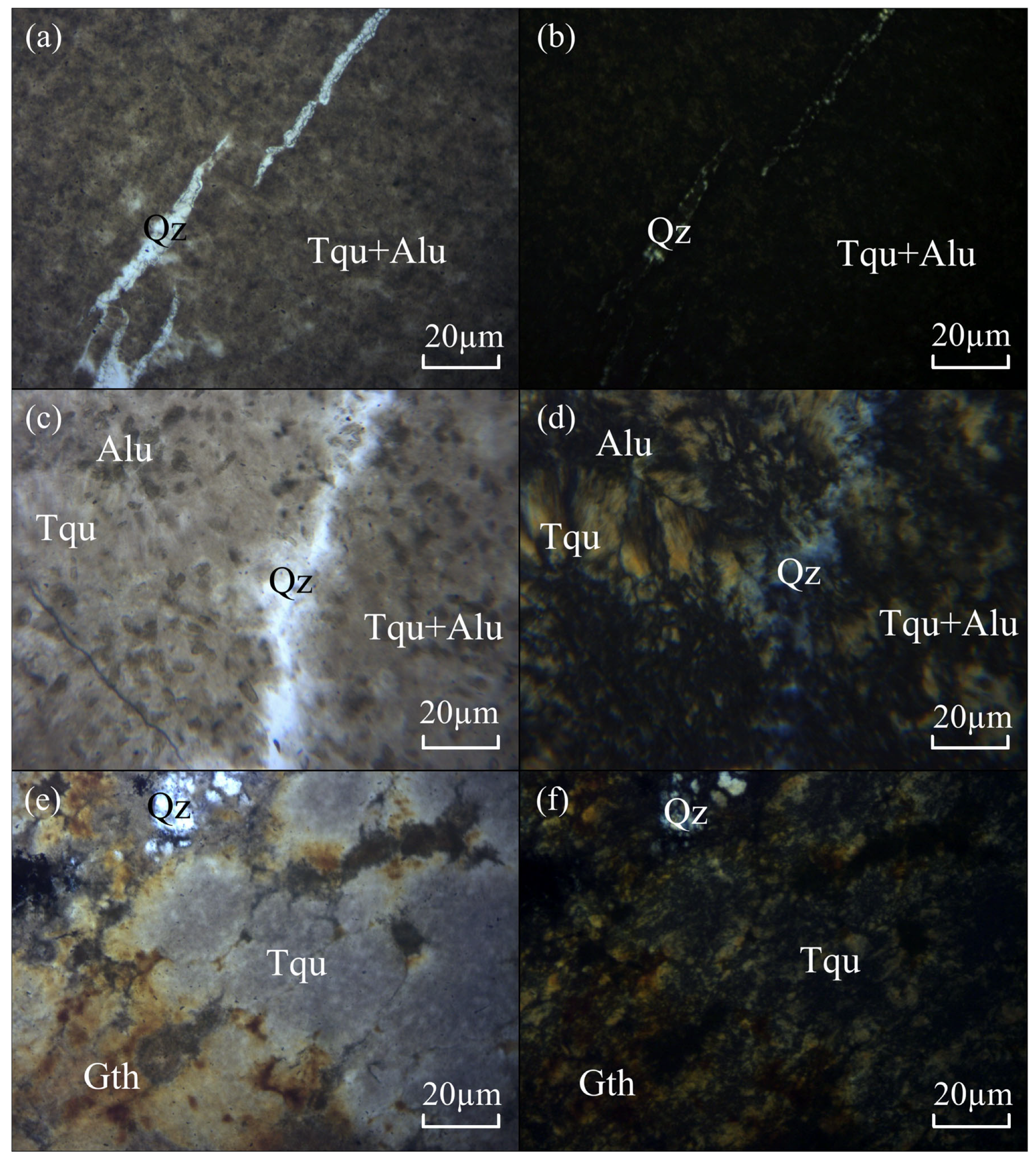
Observation under the microscope indicates (Figure 2) that the turquoise generally exhibits a cryptocrystalline to microcrystalline structure. Some turquoise samples (DHT009) display spherulitic radial and radial fibrous structures, while others (DHT012) show agglomerated structures. Under plane-polarized light, the turquoise appears greyish-yellow with medium relief. Under cross-polarized light, the highest interference color ranges from first-order grey-white to first-order yellow-white; the particle size cannot be determined due to the extremely fine grain size.
Late-stage goethite and Fe-alunite hydrothermal fluids infiltrate or replace along the edges of the turquoise ore body and micro-fractures. Under plane-polarized light, Fe-alunite appears yellowish-brown with high positive relief, forming cryptocrystalline aggregates. Under cross-polarized light, its highest interference color is first-order grey-white to first-order yellow-white. Under plane-polarized light, goethite appears reddish-brown with high positive relief. Under cross-polarized light, it exhibits brown anomalous interference colors due to being masked by its body color.
A small amount of secondary microcrystalline quartz fills the micro-fractures in the samples. Under plane-polarized light, the quartz is colorless with low positive relief. Under cross-polarized light, its highest interference color is first-order yellow-white.

3.2.2. X-Ray Powder Diffraction

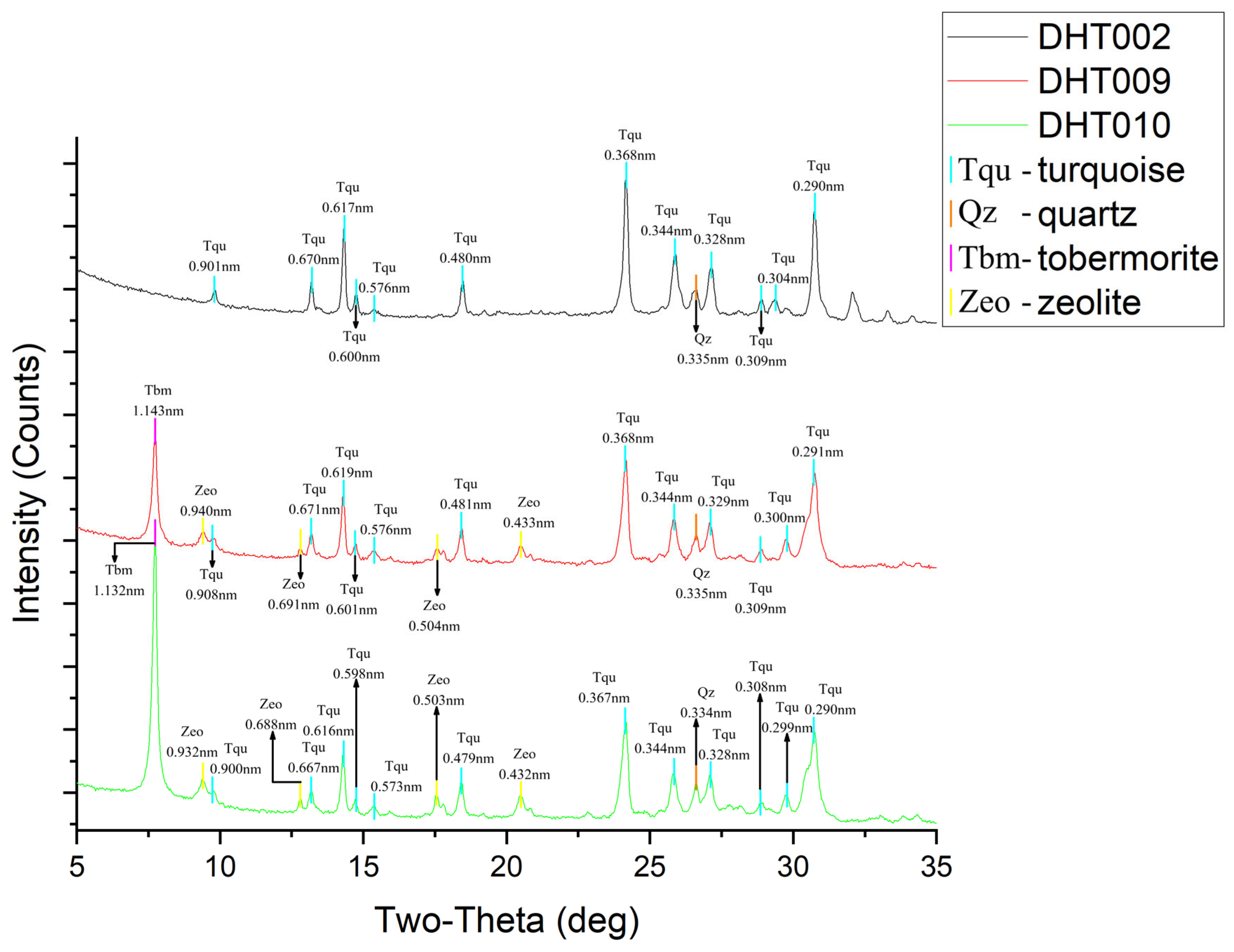
XRD analysis results indicate that the blue sample (DHT002) contains two main phases: turquoise and quartz. The composition of the blue-green samples (DHT009~DHT010) is substantially similar, but in addition to the two phases mentioned above, they also contain hydrated calcium silicate and zeolite (Figure 3). The d-values of turquoise can be seen in Table 3.
To further determine the relative content of minerals in the samples, the whole-rock patterns were fitted and analyzed using the Rietveld method [27]. The relative mineral content was calculated using Profex 5.6 software, leading to the conclusion that the main component of both the selected blue and green parts is turquoise. The turquoise content in the light blue sample is approximately 95%, while in the blue-green samples it is about 85%. The quartz content in both the light blue and blue-green samples ranges from 2% to 5%. Additionally, the two blue-green samples, DHT009 and DHT010, contain approximately 10% calcium silicate hydrate and minor amounts of zeolite.
Based on XRD analysis using Profex software, some of the turquoise in the samples was identified as ferrian turquoise, with the chemical formula Cu(Al,Fe)6(PO4)4(OH)8·4H2O. The results indicate that Fe3+ replaces Al3+ in turquoise to varying degrees through isomorphic substitution. Owing to the close similarity in their diffraction peak positions with those of ordinary turquoise, they are categorized collectively under the label “turquoise” in Figure 3. A detailed comparison of the d-values for turquoise, ferrian turquoise, and the measured samples is provided in Table 3. The diffraction peak data for turquoise and ferrian turquoise were obtained from the Powder Diffraction File (PDF) in the standard diffraction database compiled by the International Centre for Diffraction Data (ICDD).

3.2.3. Infrared Spectroscopy

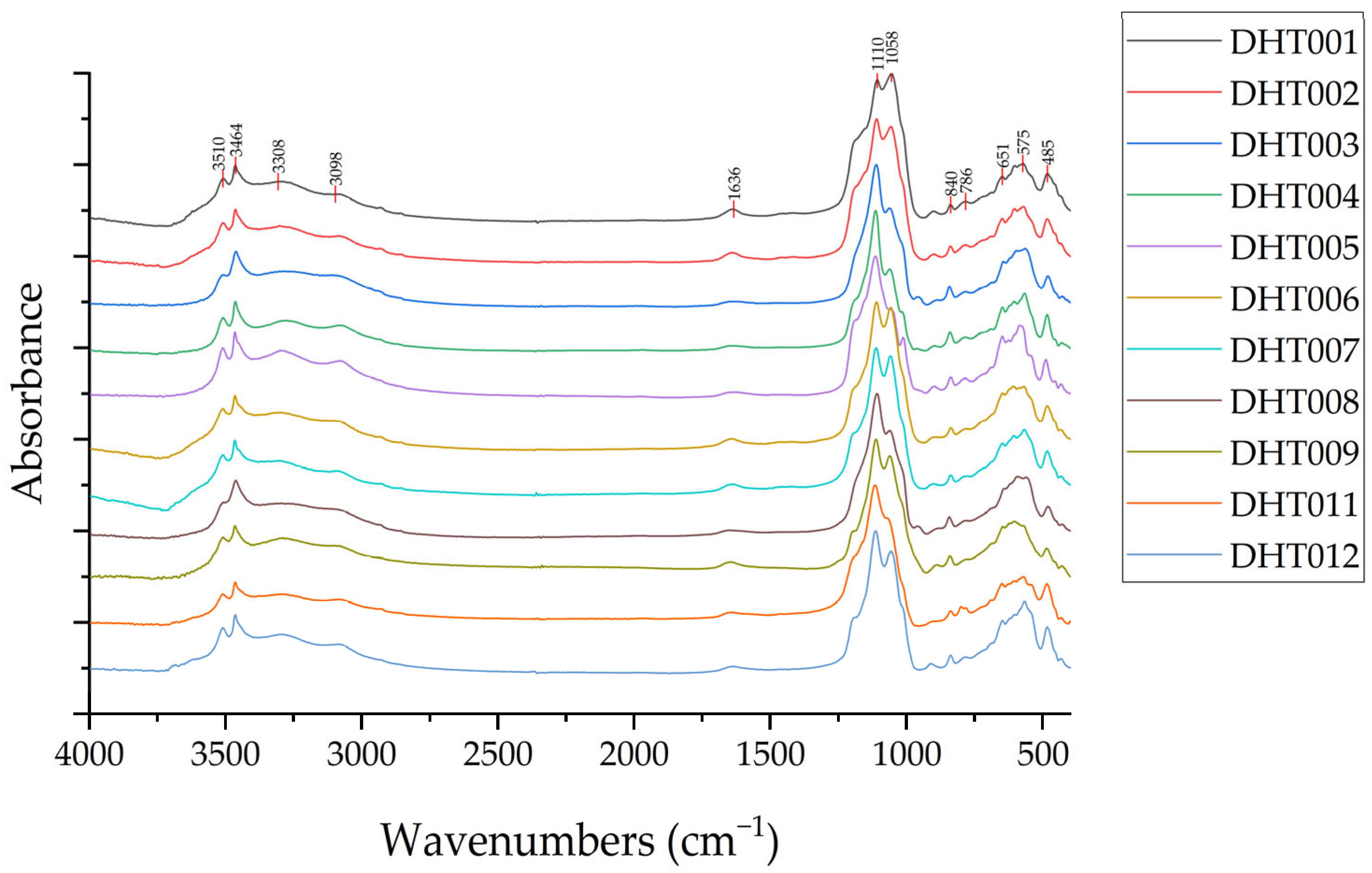
The infrared absorption spectra for the turquoise from the Dunhuang area are shown in Figure 4 and Table 4, conforming to the characteristic infrared spectral vibrations of turquoise [28,29,30].
  • Vibrational Spectra of Structural Water
The infrared absorption bands caused by the stretching vibrations of structural water are located near 3510 cm−1 and 3464 cm−1, exhibiting relatively sharp peak shapes. The corresponding infrared absorption bands caused by bending vibrations are located near 840 cm−1 and 786 cm−1; the former has a relatively sharp peak shape, while the latter is relatively broad and gentle.
2.
Vibrational Spectra of Crystalline Water
The infrared absorption bands caused by the stretching vibrations of crystalline water are located near 3308 cm−1 and 3098 cm−1, exhibiting relatively broad and gentle peak shapes. The corresponding infrared absorption band caused by bending vibrations is located near 1636 cm−1, also showing a relatively broad and gentle peak shape.
3.
Vibrational Spectra of Phosphate Groups
The infrared absorption bands caused by the stretching vibrations of phosphate groups are located near 1110 cm−1 and 1058 cm−1. The absorption peak near 1117 cm−1 is the main peak, exhibiting a relatively sharp shape. The corresponding infrared absorption bands caused by bending vibrations are located near 651 cm−1, 575 cm−1, and 485 cm−1. The crystallinity of turquoise varies among different samples, leading to differences in the stretching vibrations of the phosphate groups. As a result, the relative intensities of these two peaks have changed.

3.2.4. Raman Spectroscopy

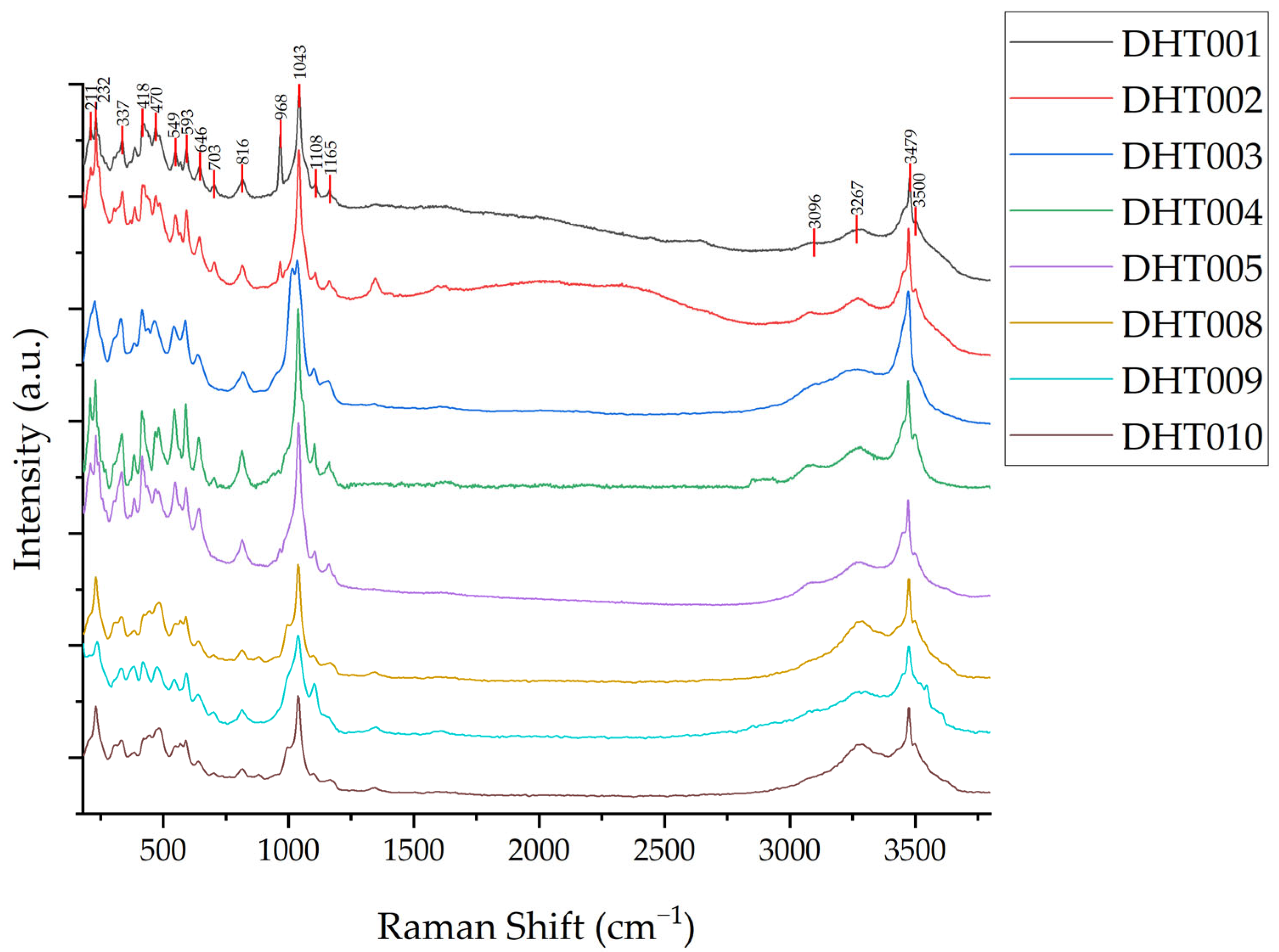
The Raman analysis spectra for the Dunhuang turquoise are shown in Figure 5, conforming to the characteristic Raman spectral vibrations of turquoise [28,29,30].
  • Vibrational Spectra of Structural Water
The Raman peaks caused by the stretching vibrations of structural water appear at 3500 cm−1 and 3479 cm−1. The main peak is located at 3479 cm−1, exhibiting a sharp shape. A shoulder peak can be observed at 3453 cm−1. The corresponding Raman peak caused by bending vibrations appears at 816 cm−1.
2.
Vibrational Spectra of Crystalline Water
The Raman peaks caused by the stretching vibrations of crystalline water appear at 3267 cm−1 and 3096 cm−1, with relatively gentle peak shapes. The corresponding Raman peak caused by bending vibrations should appear near 1625 cm−1 but could not be observed due to strong sample fluorescence.
3.
Vibrational Spectra of Phosphate Groups
The Raman peaks caused by the antisymmetric stretching vibration (v3) of the phosphate group appear at 1165 cm−1, 1108 cm−1, 1043 cm−1, and 968 cm−1. Among these, the Raman peak at 1043 cm−1 is sharp and has the highest intensity. The shift in this peak in the direction of low frequency is also related to crystallinity. The Raman peaks caused by the in-plane bending vibration (v4) appear at 646 cm−1, 593 cm−1, and 549 cm−1. The Raman peaks caused by the out-of-plane bending vibration (v2) appear at 470 cm−1 and 418 cm−1.
Furthermore, Raman peaks caused by lattice vibrations were observed at 337 cm−1, 232 cm−1, and 209 cm−1.
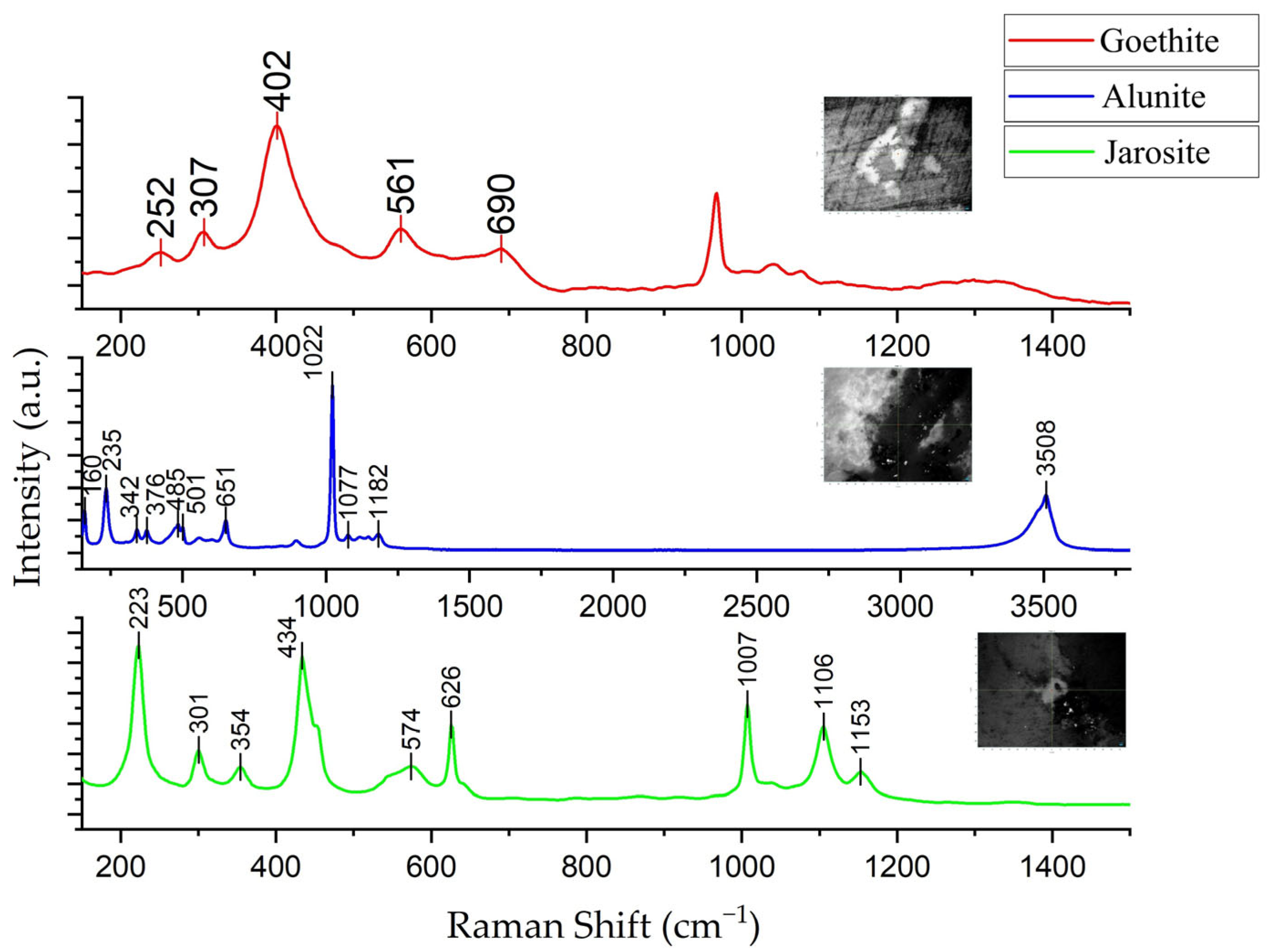
In addition to turquoise, the Raman spectra revealed the presence of several minerals associated with the turquoise in the samples, including: goethite, alunite and jarosite (Figure 6).
The Raman spectrum of goethite shows a significant peak near 402 cm−1, primarily attributed to the Fe-O stretching vibration. The deviation from the standard peak position for goethite is mainly due to changes in bond lengths and angles caused by external geological processes. Other peaks at 252, 307, 561, and 690 cm−1 are also standard Raman peaks for FeO(OH) goethite [31,32].
The Raman peaks of alunite appearing in the range of 150–350 cm−1 are all caused by Al-O stretching vibrations. The Raman peaks at 376 cm−1 and 485 cm−1 belong to v2(SO42−). The Raman peak at 501 cm−1 is attributed to v(OH), while the peak at 651 cm−1 belongs to v1(SO42−). The Raman peak at 1027 cm−1 is caused by the symmetric stretching vibration of SO42−; the Raman peaks at 1080 and 1188 cm−1 are caused by the antisymmetric stretching vibration of SO42−. A Raman peak at 3507 cm−1 appears around 3500 cm−1, induced by the OH stretching vibration [33,34].
Laser Raman spectroscopy also identified a mineral not observed under the microscope: jarosite. The Raman peak caused by the symmetric stretching vibration of the S-O bond in the SO42− group is located near 1007 cm−1. The Raman peak near 434 cm−1 is assigned to the symmetric bending vibration of the S-O bond. The Raman peak near 626 cm−1 is caused by the antisymmetric bending vibration of the S-O bond. The Raman peaks near 1106 and 1153 cm−1 belong to the antisymmetric stretching vibration of the S-O bond. The Raman peaks near 223 and 301 cm−1 are attributed to the Fe-O bond stretching vibration in jarosite [35,36]. Since the turquoise samples in this experiment were collected primarily from the near-surface oxidized zone, the jarosite present in the turquoise is mainly formed through oxidation processes.

3.3. Chemical Composition

3.3.1. Electron Probe Microanalysis

The EMPA results (Table 5) indicate that the chemical composition of the green-blue samples (DHT004, DHT005) is relatively close to the theoretical values for turquoise [10,14]. However, the mass fraction of w(Al2O3) is slightly lower than the standard value, while the mass fraction of w(FeOT) is slightly higher. The main reason is that Fe3+ replaces Al3+ in turquoise to varying degrees through isomorphic substitution.
The chemical composition of the light blue (DHT001, DHT002) and blue-green (DHT009~DHT012) turquoise samples shows a relatively narrow range of variation. The mass fractions of w(P2O5), w(Al2O3), and w(CuO) are all slightly lower than the theoretical values. Specifically, w(P2O5) ranges from 23.83% to 27.00%, with an average of 25.29%; w(Al2O3) ranges from 26.47% to 30.42%, averaging 27.55%; w(CuO) ranges from 5.26% to 5.77%, averaging 5.44%; and w(FeOT) ranges from 2.46% to 3.83%, averaging 3.13%.
In addition to the main elements mentioned above, we found that the mass fraction of w(SiO2) is approximately 20% in some light blue samples (DHT001, DHT002) and about 10% in blue-green samples (DHT009~DHT012), both higher than the theoretical value for turquoise. The reason is that the turquoise contains finely dispersed quartz existing as independent micron-sized mineral phases. Since the quartz particle size is generally smaller than the electron probe beam diameter, this results in the high measured w(SiO2) values in some samples. Consequently, this causes the measured mass fractions of w(P2O5), w(Al2O3), and w(CuO) to be significantly lower than the theoretical values for turquoise. It also results in a higher total elemental sum when calculating based on the theoretical H2O content of turquoise. Compared to turquoise samples from Zhushan, Hubei and Ma’anshan, Anhui, the turquoise samples from Dunhuang, Gansu are mainly characterized by their rich silicon content.

3.3.2. XRF Mapping Analysis

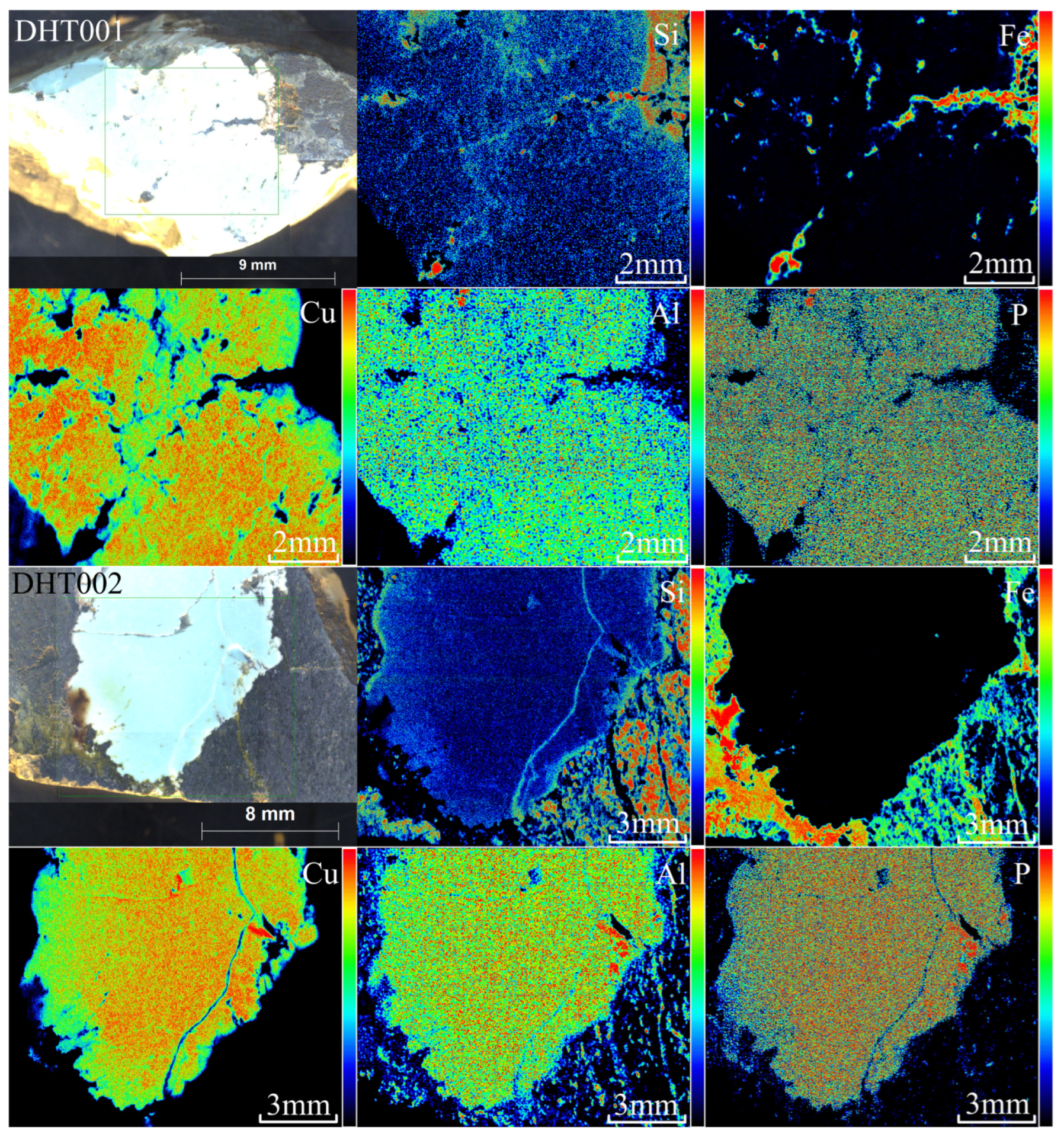
During the electron probe microanalysis, it was observed that the silicon (Si) content in the selected Dunhuang turquoise samples was anomalously high. To further investigate the cause of this abnormal Si content, as well as its site occupancy and distribution, we conducted X-ray fluorescence (XRF) mapping analysis. Mapping for the Cu, Al, P, Fe and Si was performed on samples DHT001 and DHT002, which showed the highest Si content in the electron probe analysis. The specific results are shown in Figure 7 below:
The results indicate that the elements Cu, Al, and P are inhomogeneously distributed in a finely dispersed manner within the samples, with similar distribution patterns for all three. Their mass fractions decrease towards the turquoise-country rock interface or near fractures. Since Cu, Al and P are the main chemical elements of turquoise, their distribution characteristics indicate that the turquoise in the studied samples exists as finely dispersed particles (grain size < 10 μm) within the ore body.
The elements Si and Fe are also finely dispersed, but their distribution pattern is opposite to that of the main turquoise constituents (Cu, Al, P). Specifically, their mass fractions increase towards the turquoise-country rock interface or near fractures. This indicates that Si and Fe are not incorporated into the crystal structure of the turquoise mineral but instead exist as secondary, micron-scale independent mineral phases.
Since the electron probe beam diameter is larger than the turquoise particle diameter, the analyzed points often contained a mixture of turquoise and other associated minerals. This reasonably explains the lower measured contents of the main turquoise elements Cu, Al, and P in the electron probe data.
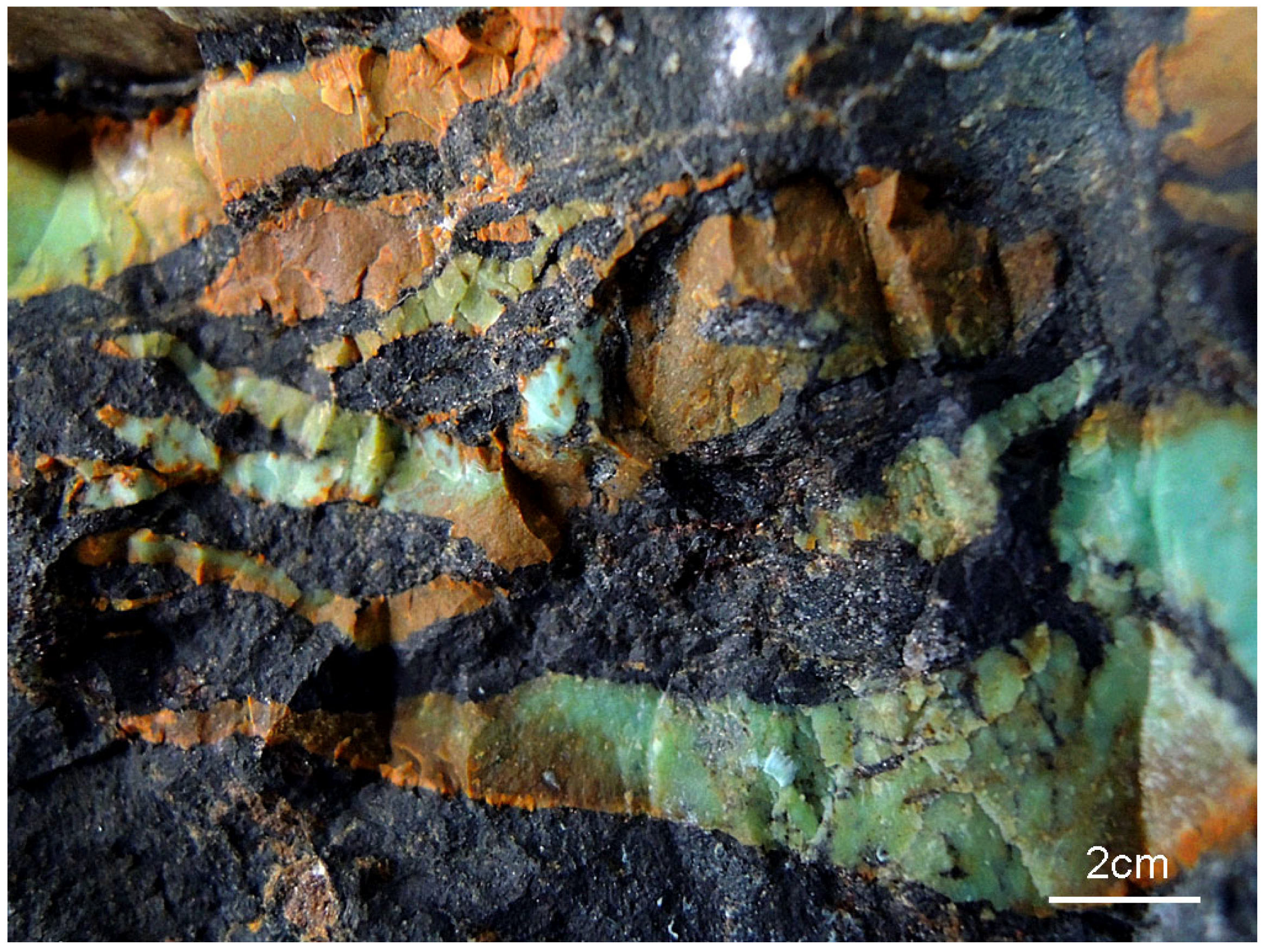
In combination with microscopic observation of the field image of the samples (Figure 8), the replacement of turquoise by late-forming goethite and alunite and the presence of thin quartz veins penetrating along the fractures can be observed. These characteristics indicate that the Si and Fe elements were introduced after the main turquoise mineralization stage, infiltrating as low-temperature hydrothermal fluids along fractures or micro-fissures. They are products of subsequent hydrothermal fluid alteration and did not form contemporaneously with the turquoise.

3.3.3. Ultraviolet-Visible Spectroscopic Analysis

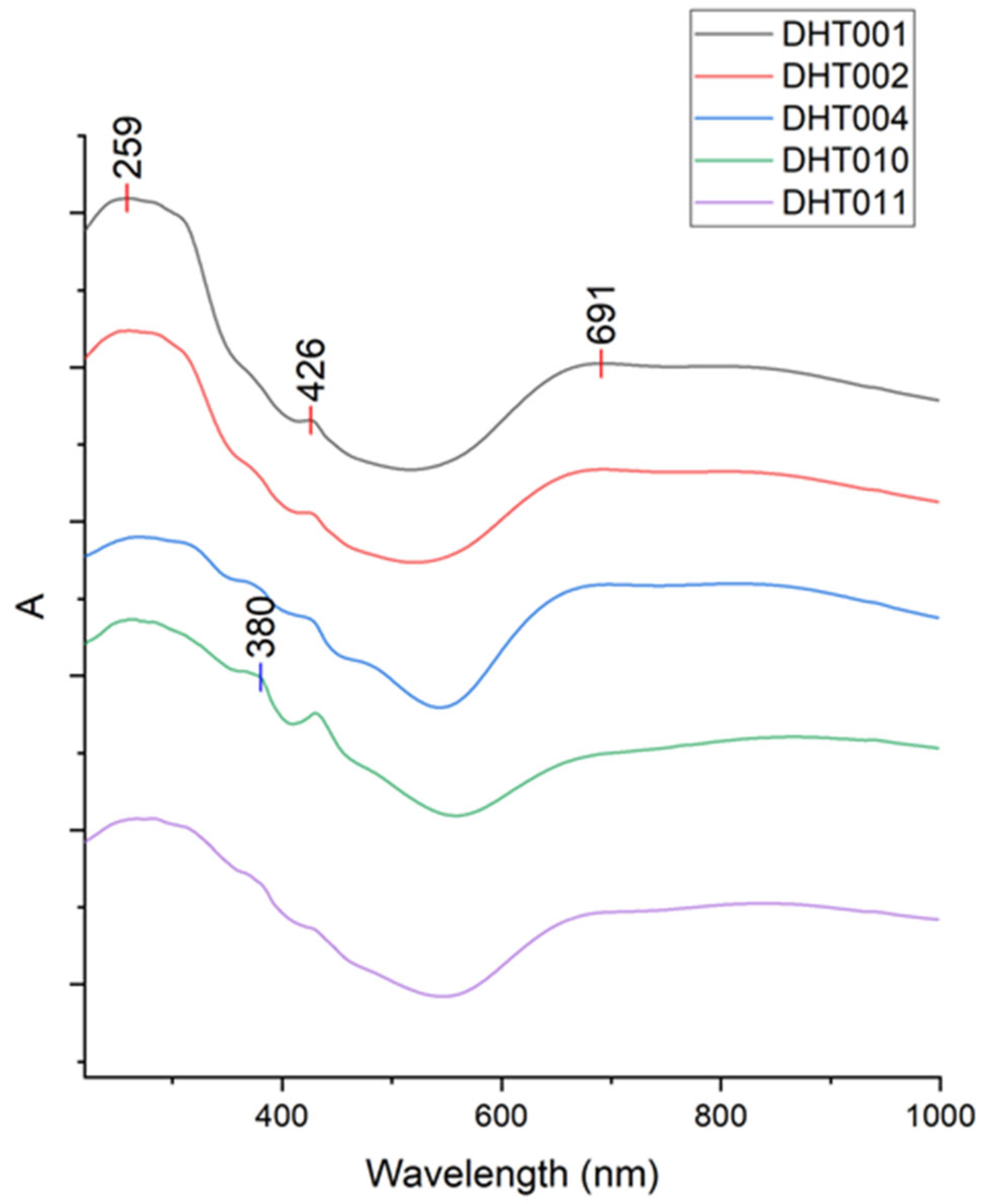
The coloration mechanism of turquoise is primarily controlled by the crystal field effects and charge transfer processes of transition metal ions such as Fe3+, Cu2+, and Fe2+ [38,39,40,41]. The ultraviolet-visible absorption spectra (Figure 9) show that while the overall peak shapes are similar across different samples, there are discernible differences in the relative intensity of absorption bands, full width at half maximum, and specific peak positions. These differences are primarily attributed to various factors including variations in chromogenic ion content, isomorphous substitution by impurity elements, the degree of lattice distortion, and differences in the ligand field micro-environment.
Specifically, the peak positions are similar for most samples (DHT001, DHT002, DHT011). The absorption peak near 259 nm can be attributed to the O2− → Fe3+ charge transfer. The characteristic absorption peak near 426 nm originates from the 6A1g4Eg + 4A1g (4G) d-d electronic transition of Fe3+ in [Fe(H2O)6]3+. The broad, gentle absorption band starting beyond 691 nm should be attributed to the 2Eg2T2g (2D) d-d electronic transition of Cu2+ in [Cu(H2O)4]2+ [17].
Among the turquoise samples involved in this study, some green samples (e.g., DHT004, DHT010, DHT011) exhibit an additional absorption peak near 380 nm (Figure 9). Combined with compositional analysis results, this absorption feature originates from the 6A14T2g (4D) transition of Fe3+ via d-d electron excitation. This reflects the significant influence of localized Fe enrichment on the UV-Vis spectral behavior of turquoise.

4. Conclusions

Based on the previous analysis of Dunhuang turquoise, the following conclusions are drawn:
  • The selected Dunhuang turquoise samples in this study have a density ranging from 2.40 to 2.77 g/cm3 and a refractive index between 1.59 and 1.65.
  • The chemical composition of the turquoise samples from this area is characterized by a high content of Fe and Si and a low content of Cu. The specific oxide content ranges are: w(P2O5) between 23.83% and 33.66%, w(Al2O3) between 26.47% and 33.36%, w(CuO) between 5.26% and 7.91%, w(FeOT) between 2.46% and 4.11%, and w(SiO2) between 0.97% and 10.75%. Si and Fe are not incorporated into the crystal structure of the turquoise mineral but instead exist as secondary, micron-scale independent mineral phases (quartz, goethite and alunite).
  • In the infrared absorption spectra of Dunhuang turquoise, the bands caused by ν(OH) stretching vibrations are located at 3510 cm−1 and 3464 cm−1, respectively. The bands near 3308 cm−1 and 3098 cm−1 are assigned to ν(M-H2O) stretching vibrations. The bands caused by v[PO4]3− stretching vibrations are located near 1110 cm−1 and 1058 cm−1. The bands near 651 cm−1, 575 cm−1, and 485 cm−1 are assigned to δ[PO4]3− bending vibrations. The band near 1636 cm−1 is caused by δ(M-H2O) bending vibrations. The bands near 840 cm−1 and 786 cm−1 are caused by δ(OH) bending vibrations.
  • The Raman peaks in Dunhuang turquoise caused by ν(OH) stretching vibrations are located near 3500 and 3479 cm−1, while the peaks near 3267 and 3096 cm−1 are attributed to ν(M-H2O) stretching vibrations. Raman peaks resulting from the asymmetric stretching vibration (v3) of phosphate groups appear near 1165, 1108, 1043, and 968 cm−1. Peaks due to in-plane bending vibration (v4) are observed near 646, 593, and 549 cm−1, and those from out-of-plane bending vibration (v2) appear near 470 and 418 cm−1. The Raman peak near 1625 cm−1, attributed to δ(M-H2O) bending vibration, could not be observed due to fluorescence interference. The peak near 816 cm−1 is caused by δ(OH) bending vibration. Additionally, Raman peaks resulting from lattice vibrations were observed near 337, 232, and 209 cm−1.
  • The hue and chroma of Dunhuang turquoise are primarily controlled by the mass fractions of Fe3+, Cu2+, and Fe2+, and the form of their hydrated ions. In the UV-Vis spectra, the absorption peak caused by O2−–Fe3+ charge transfer is mainly located near 259 nm; the characteristic absorption peak near 426 nm originates from the 6A1g4Eg + 4A1g (4G) d-d electronic transition of Fe3+ in [Fe(H2O)6]3+. The broad, gentle absorption band starting beyond 691 nm should be attributed to the 2Eg2T2g (2D) d-d electronic transition of Cu2+ in [Cu(H2O)4]2+.
  • Results from polarizing microscope observation, XRD, electron probe microanalysis, and XRF mapping indicate that the Dunhuang turquoise is distributed in a finely dispersed form with particle diameters smaller than 10 μm. Associated minerals include goethite, alunite, jarosite, quartz, and others. These minerals infiltrated along fractures and replaced the primary turquoise body after its formation.

Author Contributions

Conceptualization, D.X. and Z.Z.; Methodology, D.X. and Q.C.; Validation, D.X., J.L. and M.Y.; Investigation, D.X., Q.C., J.L., M.Y. and Y.S.; Resources: Z.Z.; Data Curation, D.X., Q.C., J.L., M.Y. and Y.S.; Writing—Original Draft Preparation, D.X.; Writing—Review and Editing, D.X. and Z.Z.; Supervision, Q.C.; Project Administration, D.X.; Funding Acquisition, Z.Z. All authors have read and agreed to the published version of the manuscript.

Funding

This work was supported by the Project of Science and Technology Commission of Shanghai Municipality (ID 18DZ2281300).

Data Availability Statement

The data presented in this study are available on request from the corresponding author. The data are not publicly available due to privacy.

Conflicts of Interest

The authors declare no conflicts of interest.

Abbreviations

The following abbreviations are used in this manuscript:
XRDX-ray powder diffraction
EPMAelectron probe microanalysis
UV-Visultraviolet-visible
XRFX-ray fluorescence

References

  1. Zalinski, E.R. Turquoise in the Burro Mountains, New Mexico. Econ. Geol. 1907, 2, 464–492. [Google Scholar] [CrossRef]
  2. Wei, S.; Song, G.; He, Y. The Identification of Binding Agent Used in Late Shang Dynasty Turquoise-Inlayed Bronze Objects Excavated in Anyang. J. Archaeol. Sci. 2015, 59, 211–218. [Google Scholar] [CrossRef]
  3. Hull, S.; Fayek, M.; Mathien, F.J.; Roberts, H. Turquoise Trade of the Ancestral Puebloan: Chaco and Beyond. J. Archaeol. Sci. 2014, 45, 187–195. [Google Scholar] [CrossRef]
  4. Hedquist, S.L.; Thibodeau, A.M.; Welch, J.R.; Killick, D.J. Canyon Creek Revisited: New Investigations of a Late Prehispanic Turquoise Mine, Arizona, USA. J. Archaeol. Sci. 2017, 87, 44–58. [Google Scholar] [CrossRef]
  5. Fritsch, E.; McClure, S.F.; Ostrooumov, M.; Andres, Y.; Moses, T.; Koivula, J.I.; Kammerling, R.C. The Identification of Zachery-Treated Turquoise. Gems Gemol. 1999, 35, 4–16. [Google Scholar] [CrossRef]
  6. Liu, X.; Lin, C.; Li, D.; Zhu, L.; Song, S.; Liu, Y.; Shen, C. Study on Mineralogical and Spectroscopic Characteristics of Turquoise from Hami, Xinjiang. Spectrosc. Spectr. Anal. 2018, 38, 1231–1239. [Google Scholar]
  7. Bai, X.; Liu, Y. A Study on Gemological and Mineralogical Characteristics of American Sleeping Beauty Turquoise. Acta Petrol. Mineral. 2014, 33, 61–68. [Google Scholar]
  8. Zhang, Y.; Yang, M.; Liu, L.; Wen, H.; Shirdam, B.; Shen, X. Mineralogical and Spectroscopic Characteristics of Turquoise and Associated Minerals from Baghu, Iran. J. Gems Gemmol. 2023, 25, 43–53. [Google Scholar] [CrossRef]
  9. Ma, C. Gemological and Mineralogical Study of Baihe Turquoise from Shaanxi Province. Master’s Thesis, China University of Geosciences Beijing, Beijing, China, 2025. [Google Scholar]
  10. Zhou, Y.; Qi, L.; Dai, H.; Yang, L.; Zhang, Q.; Jiang, X. Study on the Gemological Characteristics of Dian’anshan Turquoise from Anhui Province. J. Gems Gemmol. 2013, 15, 37–45. [Google Scholar] [CrossRef]
  11. Chen, W.; Shi, G.; Wang, Y.; Ren, J.; Yuan, Y.; Dai, H. Significance and Characteristics of FTIR and Raman Spectra of High-Quality Turquoise from Hubei and Anhui Provinces. Spectrosc. Spectr. Anal. 2018, 38, 1059–1065. [Google Scholar]
  12. Zhang, S. A Comparative Study of Natural and Treated Turquoise from Zhushan, Hubei. Master’s Thesis, China University of Geosciences Beijing, Beijing, China, 2012. [Google Scholar]
  13. Li, X.; Xian, Y.; Fan, J.; Zhang, L.; Guo, J.; Gao, Z.; Wen, R. Mineralogical Characteristics of Xichuan Turquoise from Henan Province Studied by SEM-XRD-EPMA. Rock. Miner. Anal. 2019, 38, 373–381. [Google Scholar] [CrossRef]
  14. Liu, L.; Yang, M.; Li, Q.; Tang, Y.; Wen, H.; Yuan, Y.; Li, Y.; Liu, J. Mineralogy and Geochemistry of Turquoise from Tianhu East, Xinjiang, China. Gems Gemol. 2024, 60, 2–25. [Google Scholar] [CrossRef]
  15. Lind, T.; Schmetzer, K.; Bank, H. The Identification of Turquoise by Infrared Spectroscopy and X-Ray Powder Diffraction. Gems Gemol. 1983, 19, 164–168. [Google Scholar] [CrossRef][Green Version]
  16. Fuquan, W. A Gemological Study of Turquoise in China. Gems Gemol. 1986, 22, 35–37. [Google Scholar] [CrossRef]
  17. Chen, Q.; Yin, Z.; Qi, L.; Xiong, Y. Turquoise from Zhushan County, Hubei Province, China. Gems Gemol. 2012, 48, 198–204. [Google Scholar] [CrossRef]
  18. Liu, L.; Yang, M.; Li, Y. Unique Raindrop Pattern of Turquoise from Hubei, China. Gems Gemol. 2020, 56, 380–400. [Google Scholar] [CrossRef]
  19. Ku, Y.; Yang, M.; Li, Y. Spectral Study of Associated Minerals of Yellow-Green to Green Turquoise from Zhushan, Hubei Province. Spectrosc. Spectr. Anal. 2020, 40, 1815–1820. [Google Scholar]
  20. Ku, Y.; Yang, M. Spectral Characteristics of Blue “Water Wave Pattern” Turquoise from Shiyan, Hubei Province. Spectrosc. Spectr. Anal. 2021, 41, 636–642. [Google Scholar]
  21. Wen, H.; Yang, M.; Liu, L. Mineralogical and Spectral Characteristics of Alunite from the Xiaodonggou Turquoise Deposit in Baihe, Shaanxi Province. Spectrosc. Spectr. Anal. 2023, 43, 1088–1094. [Google Scholar]
  22. Zhao, S.; Nie, F.; Jiang, S.; Bai, D.; Wang, X.; Su, X. REE Geochemical Study of the Dunhuang Fangshankou Large-Scale Vanadium-Phosphorus-Uranium Deposit. Acta Petrol. Mineral. 2003, 22, 55–60. [Google Scholar]
  23. Zhao, S.; Nie, F.; Jiang, S.; Bai, D. Geological Characteristics and Genesis of the Dunhuang Fangshankou Large-Scale Vanadium-Phosphorus-Uranium Deposit. Acta Geosci. Sin. 2002, 23, 207–212. [Google Scholar]
  24. Wang, Y.; Yang, M.; Dun, J.-H.; Jiang, Y.; Liu, L.; Yuan, Y. Spectroscopic Characteristics Study of Turquoise from Nanhuatang, Shiyan, Hubei Province. Spectrosc. Spectr. Anal. 2025, 45, 2467–2474. [Google Scholar]
  25. Li, L.; Chen, H.; Luo, Q. Application of GemDialogue and GemSet Colour System in Colour Description and Grading of Coloured Gemstones. J. Gems Gemmol. 2005, 7, 20–24. [Google Scholar] [CrossRef]
  26. Gemological Institute of America. GIA Gem Laboratory Identification Manual, 2nd ed.; China University of Geosciences Press: Wuhan, China, 2005; pp. 111–112. ISBN 7-5625-2057-7. [Google Scholar]
  27. Li, Y.; Liu, Z. A Method for Quantitative Analysis of Whole-Rock Mineral Composition: A Case Study of Samples from the 9th Renou Cup. Mar. Geol. Quat. Geol. 2025, 45, 208–215. [Google Scholar] [CrossRef]
  28. Foord, E.E.; Taggart, J.E., Jr. A Reexamination of the Turquoise Group: The Mineral Aheylite, Planerite (Redefined), Turquoise and Coeruleolactite. Mineral. Mag. 1998, 62, 93–111. [Google Scholar] [CrossRef]
  29. Frost, R.L.; Reddy, B.J.; Martens, W.N.; Weier, M. The Molecular Structure of the Phosphate Mineral Turquoise—A Raman Spectroscopic Study. J. Mol. Struct. 2006, 788, 224–231. [Google Scholar] [CrossRef][Green Version]
  30. Čejka, J.; Sejkora, J.; Macek, I.; Malíková, R.; Wang, L.; Scholz, R.; Xi, Y.; Frost, R.L. Raman and Infrared Spectroscopic Study of Turquoise Minerals. Spectrochim. Acta. A. Mol. Biomol. Spectrosc. 2015, 149, 173–182. [Google Scholar] [CrossRef] [PubMed]
  31. Berrodier, I.; Farges, F.; Benedetti, M.; Winterer, M.; Brown, G.E.; Deveughèle, M. Adsorption Mechanisms of Trivalent Gold on Iron- and Aluminum-(Oxy)Hydroxides. Part 1: X-Ray Absorption and Raman Scattering Spectroscopic Studies of Au(III) Adsorbed on Ferrihydrite, Goethite, and Boehmite. Geochim. Cosmochim. Acta 2004, 68, 3019–3042. [Google Scholar] [CrossRef]
  32. De Faria, D.L.A.; Lopes, F.N. Heated Goethite and Natural Hematite: Can Raman Spectroscopy Be Used to Differentiate Them? Vib. Spectrosc. 2007, 45, 117–121. [Google Scholar] [CrossRef]
  33. Frost, R.L.; Wills, R.-A.; Weier, M.L.; Martens, W.; Theo Kloprogge, J. A Raman Spectroscopic Study of Alunites. J. Mol. Struct. 2006, 785, 123–132. [Google Scholar] [CrossRef]
  34. Maubec, N.; Lahfid, A.; Lerouge, C.; Wille, G.; Michel, K. Characterization of Alunite Supergroup Minerals by Raman Spectroscopy. Spectrochim. Acta. A. Mol. Biomol. Spectrosc. 2012, 96, 925–939. [Google Scholar] [CrossRef]
  35. Chio, C.H.; Sharma, S.K.; Ming, L.-C.; Muenow, D.W. Raman Spectroscopic Investigation on Jarosite–Yavapaiite Stability. Spectrochim. Acta. A. Mol. Biomol. Spectrosc. 2010, 75, 162–171. [Google Scholar] [CrossRef] [PubMed]
  36. Adamou, A.; Manos, G.; Messios, N.; Georgiou, L.; Xydas, C.; Varotsis, C. Probing the Whole Ore Chalcopyrite–Bacteria Interactions and Jarosite Biosynthesis by Raman and FTIR Microspectroscopies. Bioresour. Technol. 2016, 214, 852–855. [Google Scholar] [CrossRef] [PubMed]
  37. Yue, D. Study on Pseudomorphic Turquoise from the Ma’anshan Area, Anhui Province. Acta Petrol. Mineral. 1995, 14, 79–83. [Google Scholar]
  38. Dai, Z.; Lv, X.; Gong, Y.; Ni, J. The Coupling Relationship Between Turquoise Quality and Water and Its Characterization by Variable-Temperature Spectroscopy. J. Gems Gemmol. 2017, 19, 12–23. [Google Scholar] [CrossRef]
  39. Zuo, R.; Dai, H.; Huang, W.; Yu, L.; Deng, W. UV-Vis Spectroscopy Characteristics and Color Characterization of Tongling Turquoise from Anhui Province. J. Gems Gemmol. 2020, 22, 13–19. [Google Scholar] [CrossRef]
  40. Wang, X. The Influence of Different Metal Ions and Adsorbed Water on Turquoise Color. Master’s Thesis, China University of Geosciences Beijing, Beijing, China, 2022. [Google Scholar]
  41. Liu, Y. Composition Analysis and Study on the Color Genesis of Ma’anshan Turquoise from Anhui Province. Master’s Thesis, China University of Geosciences Beijing, Beijing, China, 2022. [Google Scholar]
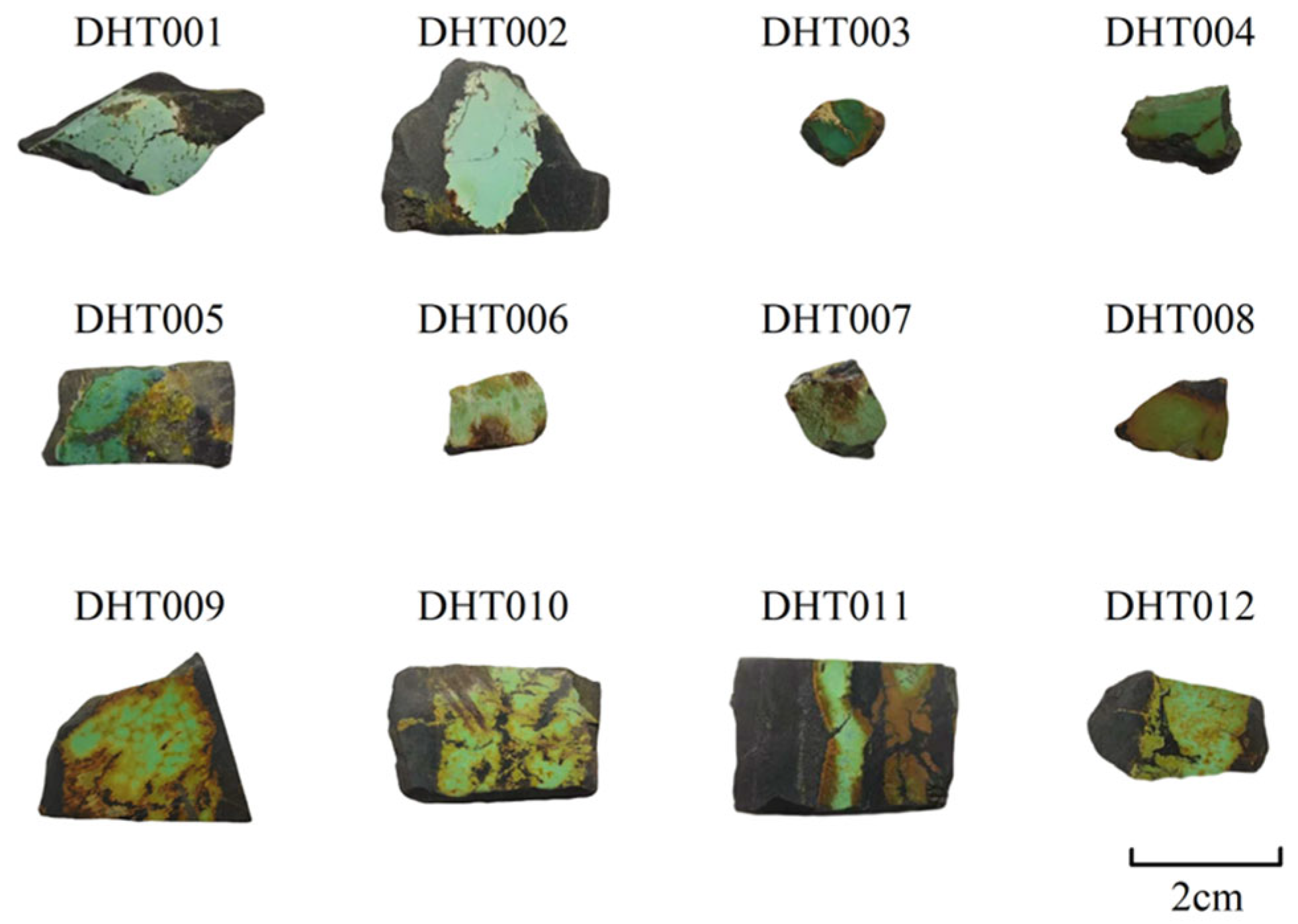
Figure 1. Images of Dunhuang Turquoise Samples.
Minerals 15 01199 g001
Figure 2. Photomicrographs of the turquoise ore body ((a) DHT002 (–), (b) DHT002 (+), (c) DHT009 (–), (d) DHT009 (+), (e) DHT012 (–), (f) DHT012 (+)) (Tqu: Turquoise, Qz: Quartz, Alu: Alunite, Gth: Goethite).
Minerals 15 01199 g002
Figure 3. XRD Patterns.
Minerals 15 01199 g003
Figure 4. Infrared Absorption Spectra of Dunhuang Turquoise.
Minerals 15 01199 g004
Figure 5. Raman Spectra of Dunhuang Turquoise.
Minerals 15 01199 g005
Figure 6. Raman Spectra of Associated Minerals (Top: Goethite; Middle: Alunite; Bottom: Jarosite).
Minerals 15 01199 g006
Figure 7. Si, Fe, Cu, Al, P Mapping Results (Top: DHT001, Bottom: DHT002, the green box: mapping area).
Minerals 15 01199 g007
Figure 8. Field Image of Dunhuang Turquoise.
Minerals 15 01199 g008
Figure 9. Ultraviolet-Visible Absorption Spectra of Dunhuang Turquoise.
Minerals 15 01199 g009
Table 1. Characteristics of Turquoise Samples.
SampleStructureDescription of Appearance Characteristics
DHT001MassiveShows black veinlet permeation, contains minor scattered black and yellow veining
DHT002MassiveRelatively well-developed fractures, visible black veinlets and yellow veining
DHT003MassiveWell-developed fractures filled with yellow material
DHT004MassiveWell-developed fractures filled with yellow and black material, minor yellow veining visible
DHT005MassiveShows black veinlet permeation, contains minor yellow veining
DHT006MassiveShows brown veinlet permeation, contains yellow filamentous veining
DHT007MassiveShows brown veinlet permeation, contains abundant yellow filamentous veining
DHT008MassiveShows abundant scattered yellowish-brown veining
DHT009MassiveRelatively well-developed fractures filled with black material, minor yellowish-brown veining visible
DHT010MassiveWell-developed fractures filled with black and brown material, visible yellow veinlets
DHT011MassiveShows brown veinlet permeation
DHT012MassiveRelatively well-developed fractures filled with black material, abundant yellowish-brown veining visible
Table 2. Conventional Gemological Characteristics of Turquoise Samples (B: blue, G2B: green-blue, primarily blue with a green tone, B2G: blue-green, primarily green with a blue tone).
SampleColorDensity (g/cm3)Refractive Index
DHT001B102.54-
DHT002B102.441.60
DHT003G2B402.771.65
DHT004G2B302.751.62
DHT005G2B502.611.62
DHT006B2G102.401.60
DHT007B2G102.481.60
DHT008B2G402.761.65
DHT009B2G302.51-
DHT010B2G302.53-
DHT011B2G302.621.61
DHT012B2G202.47-
Note: “-” indicates that the refractive index could not be measured due to severe surface weathering.
Table 3. Dunhuang turquoise X-ray powder diffraction d-values (unit: nm).
PDF: 00-050-1655
Turquoise
PDF: 00-025-0260
Turquoise, Ferrian
DHT002DHT009DHT010
0.8980.8980.9010.9080.900
0.6700.6710.6700.6710.667
0.6160.6220.6170.6190.616
0.5990.6030.6000.6010.598
0.5740.5760.5760.5760.573
0.4790.4830.4800.4810.479
0.3670.3700.3680.3680.367
0.3420.3460.3440.3440.344
0.3320.3310.3280.3290.328
0.3080.3070.3090.3090.308
0.2900.2910.2900.2910.290
Table 4. Infrared Spectral Absorption Peaks and Their Assignments for Dunhuang Turquoise (unit: cm−1).
Sampleν(OH)ν(M-H2O)δ(M-H2O)δ(OH)ν[PO4]3−δ[PO4]3−
DHT0013510, 34643308, 30981636840, 7861110, 1058651, 575, 485
DHT0023509, 34653303, 30801638841, 7841112, 1059651, 573, 485
DHT0033507, 34633289, 31121627844, 7861113, 1064646, 599, 483
DHT0043512, 34673287, 30871654844, 7891117, 1066652, 570, 488
DHT0053511, 34663298, 30841639840, 7871116, 1060650, 586, 490
DHT0063510, 34663298, 31001645839, 7801112, 1060650, 571, 485
DHT0073510, 34663309, 30991636840, 7791113, 1061650, 569, 486
DHT0083508, 34643293, 31111651845, 7851110, 1064643, 593, 483
DHT0093510, 34663291, 30811653842, 7851114, 1064648, 572, 487
DHT0113514, 34673304, 30861643842, 7851119, 1071654, 575, 488
DHT0123511, 34653298, 30831643840, 7841115, 1059650, 569, 485
Table 5. Electron Probe Data for Dunhuang Turquoise Samples.
CommentDHT001DHT002DHT004DHT005DHT009DHT010DHT011DHT012Hubei Zhushan [18]Anhui Ma’anshan [37]Theoretical Value
P2O523.8324.1533.6633.6526.8825.6427.0024.2531.6931.0634.1200
Al2O326.4726.9832.1333.3627.3426.8930.4227.2033.5033.4636.8400
CuO5.485.777.917.335.265.445.405.273.757.049.5700
FeOT2.462.494.112.703.833.692.963.386.644.14——
SiO220.0019.491.560.979.3610.759.6513.990.503.70——
Na2O2.973.130.430.486.846.492.807.330.03Total 0.88——
MgO0.220.210.110.130.070.050.280.040.01——
K2O0.490.530.100.050.580.730.200.860.02——
TiO20.030.020.030.150.070.060.040.060.02——
SO30.220.160.340.290.140.100.150.13——————
CaO0.700.910.241.240.280.420.250.270.01————
BaO0.090.180.000.070.120.020.070.04——————
ZnO0.030.050.110.170.280.230.160.200.04————
MnO0.010.000.010.020.000.010.020.00——————
Cr2O30.050.030.080.180.070.080.130.04——————
V2O30.010.000.040.000.100.060.030.08——————
H2O19.4719.4719.4719.4719.4719.4719.4719.4722.8218.3619.47
Total102.53103.57100.33100.26100.69100.1399.03102.6199.0398.64100
Disclaimer/Publisher’s Note: The statements, opinions and data contained in all publications are solely those of the individual author(s) and contributor(s) and not of MDPI and/or the editor(s). MDPI and/or the editor(s) disclaim responsibility for any injury to people or property resulting from any ideas, methods, instructions or products referred to in the content.