Article

Multidisciplinary Constraints on the Lithospheric Architecture of the Eastern Heihe-Hegenshan Suture (NE China) from Magnetotelluric Imaging and Laboratory-Based Conductivity Experiment

1
Harbin Center for Integrated Natural Resources Survey, China Geological Survey, Harbin 150086, China
2
Observation and Research Station of Earth Critical Zone in Black Soil, Ministry of Natural Resources, Harbin 150086, China
3
Northeast Geological S&T Innovation Center of China Geological Survey, Shenyang 110034, China
*
Author to whom correspondence should be addressed.
Minerals 2025, 15(11), 1144; https://doi.org/10.3390/min15111144
Submission received: 12 September 2025 / Revised: 23 October 2025 / Accepted: 27 October 2025 / Published: 31 October 2025

Abstract

The Central Asian Orogenic Belt (CAOB) represents one of the largest Phanerozoic accretionary orogenic systems globally, with its easternmost segment located in Northeast China. This study integrated broadband magnetotelluric (MT) surveys, geochemical analyses, and high-pressure, high-temperature electrical conductivity experiments to elucidate the deep structural characteristics and tectonic evolution of the Heihe-Hegenshan Suture (HHS) within the CAOB. A dense MT profile survey comprising 15 stations was deployed across the HHS, revealing distinct high-conductivity anomalies interpreted as the suture zone and associated tectonic features. Geochemical and petrophysical analyses of representative andesite and granite samples under simulated crustal conditions (573–973 K, 1.0 GPa) provided critical constraints for MT data interpretation. The integration of MT inversion results with aeromagnetic and Bouguer gravity anomaly data delineates the strike and spatial extent of the HHS, confirming its continuity and northward extension beyond previously recognized limits. Numerical modeling of geothermal gradients and electrical conductivity–depth relationships highlights the dominant role of hydrothermal fluids and alteration minerals in controlling shallow high-conductivity anomalies (<5 km), while deeper structures (>5 km) reflect temperature-controlled rock conductivity. These findings offer novel insights into the lithospheric-scale architecture and geodynamic processes governing the HHS, advancing our understanding of complex accretionary orogenesis in the CAOB.

1. Introduction

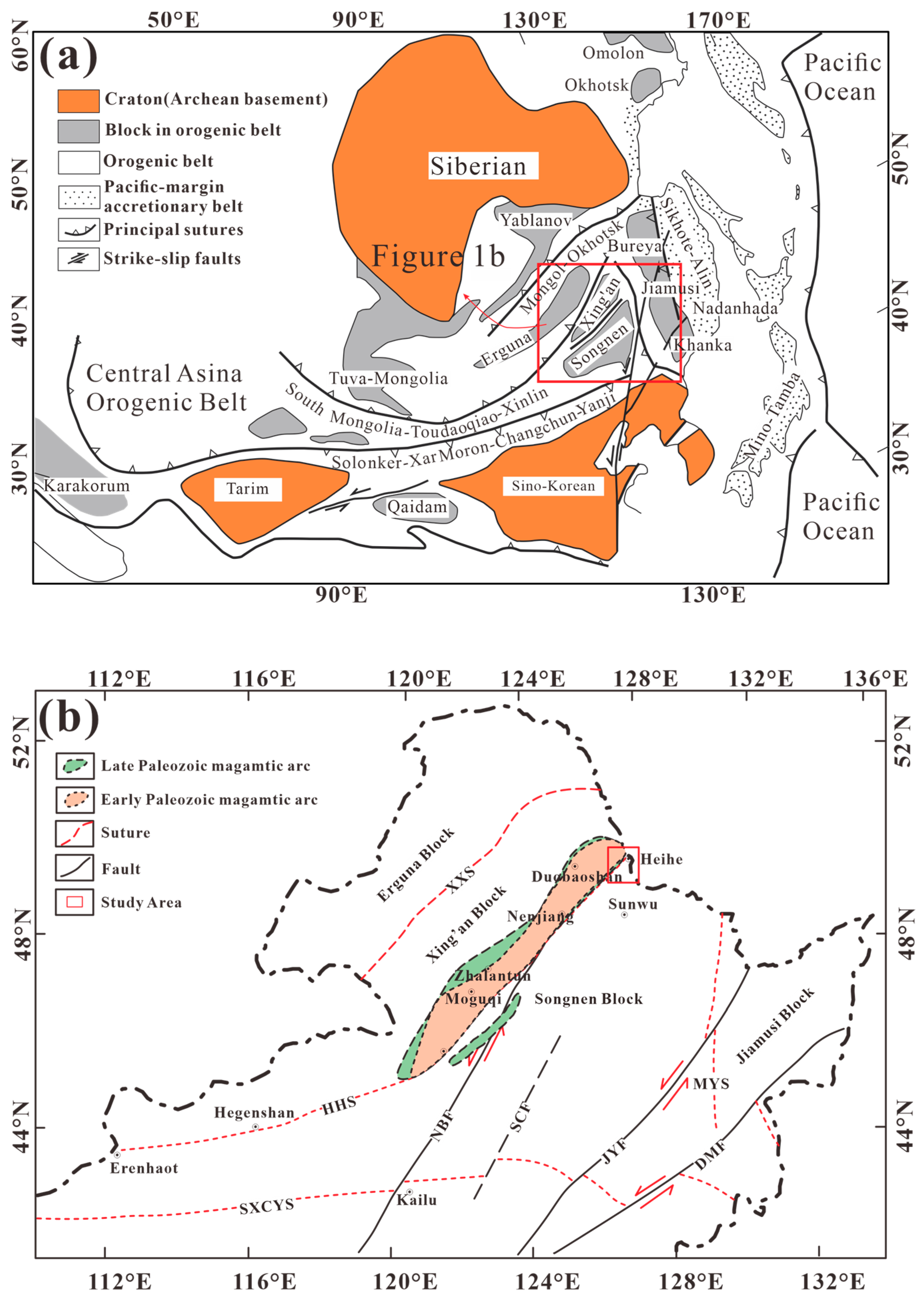
The Central Asian Orogenic Belt (CAOB) is generally considered to have formed due to the closure of the Paleo-Asian Ocean. It extends over 5500 km from west to east, making it one of the largest Phanerozoic accretionary orogenic belts in the world [1,2,3,4]. It is widely accepted that the CAOB is a complex collage composed of abundant accretionary mélanges, magmatic arcs, arc-related basins, ophiolites, seamounts, and continental fragments, exhibiting characteristics of multiple ocean basins, multiple subduction zones, and multi-directional convergent accretionary orogenesis [4,5]. Northeast China lies at the easternmost segment of the CAOB and consists, from west to east, of the Erguna Block, Xing’an Block, Songnen Block, and Jiamusi Block. The suture zones between these blocks include the Xinlin-Xiguitu Suture (XXS), Heihe-Hegangshan Suture (HHS), and Mudanjiang-Yilan Suture (MYS) (Figure 1) [6]. Among these, the Xing’an and Songnen blocks are two microblocks in central Northeast China with significant controversy. Traditionally, the Xing’an and Songnen blocks were considered to have experienced early Paleozoic marginal arc formation, late Paleozoic marginal arc development, and late Paleozoic collisions. Their amalgamation took place from the late Early Carboniferous to the early Late Carboniferous, culminating in the formation of the Heihe-Hegangshan Suture (HHS) [7,8]. Nevertheless, the nature of the HHS remains controversial, and its northward extension is still unclear. Generally, the suture zone is considered to extend from Heihe–Nenjiang through Moguqi and Hegenshan to the Erlianhot region [9,10,11,12,13]. However, ophiolites that indicated the closure of ocean basins were exposed only in the Hegenshan area. Further north, extending into the Greater Khingan Range and beyond, relevant geological evidence became scarce due to extensive soil and vegetation coverage [14].
Geophysical methods have provided additional insights into the location of the Heihe–Hegenshan Suture and the regional tectonic evolution. Geophysical surveys along the Heihe–Hegenshan Suture have revealed distinct anomalous responses, providing deep structural evidence for its northward extension [15,16,17,18,19]. Magnetotelluric surveys in the southern segment of the suture zones show two main features. A south-dipping broad anomaly in Inner Mongolia [15] and a north-dipping mantle reflector [16] have been interpreted as a remnant of earlier northward subduction of oceanic crust. In the central segment, magnetotelluric analysis shows a west-dipping high-conductivity anomaly interpreted as a feature of the amalgamation of the Xing’an and Songnen blocks [17]. Deep seismic reflections profiles reveal a crocodile-mouth-shaped reflection pattern and west-dipping mantle reflections as evidence of westward subduction and closure of an oceanic basin [18,19]. However, understanding of the deep structure in the northern part of the suture zone remains limited, highlighting the need for further geophysical evidence.
Aerogravity and aeromagnetic data are effective in delineating regional structural trends; however, they are unable to characterize the scale and contact relationships of subsurface formations at depth [20,21]. While seismic surveys can provide this information, their effectiveness is frequently constrained by uneven station coverage, resulting in significant data gaps across numerous areas. Consequently, deep probing techniques such as magnetotelluric (MT) sounding are extensively employed to characterize the electrical structure of subsurface formations. The application of broadband and long-period magnetotelluric sounding techniques enables effective identification of the suture zone between the Xing’an and Songnen blocks, as well as tectonic fractures within the continental blocks [22,23]. To reduce the inherent non-uniqueness in geophysical interpretation, high-temperature and high-pressure experiments can be conducted to obtain in situ geophysical properties of deep-seated rocks, thereby providing tighter constraints on interpretative models [24]. In recent years, obtaining in situ electrical conductivity data on rock minerals through high-temperature and high-pressure experiments has become a crucial and mature technique for interpreting deep-seated anomalies observed in MT surveys. This method simulates the authentic temperature and pressure conditions within the Earth’s interior to precisely measure the electrical properties of rock minerals, providing essential experimental constraints for MT inversion [25,26]. Consequently, it effectively elucidates the mechanisms behind MT anomalies in regions such as suture zones, subduction zones, and intraplate magma chambers [27,28,29,30,31,32].
This study deployed a network of 15 broadband magnetotelluric (MT) stations along an approximately south–north transect, crossing the presumed Heihe-Hegangshan (HHS) area and intersecting major stratigraphic units in Heihe region. Representative rock samples from key stratigraphic sequences near the stations were collected for geochemical analysis, and their electrical conductivities were measured under simulated crustal conditions of 573–973 K and 1.0 GPa. By integrating these results with publicly available aeromagnetic and airborne Bouguer gravity data, along with previous geophysical observations, the study further refines the strike and precise location of the suture zone in the Heihe region. Systematic correlations between electrical conductivity, geothermal gradient, and depth for the HHS are proposed to be established using published regional thermodynamic parameters. This conductivity-depth model aims to provide a physical basis for interpreting the deep electrical structures revealed by magnetotelluric (MT) inversion, thereby offering important insights for a deeper understanding of the subsurface properties in the region.

2. Experimental Procedures and Data Acquirement

2.1. Magnetotellurics (MT)

In this study, a broadband magnetotelluric (MT) profile was acquired across the HHS, intersecting key stratigraphic units within the region. This broadband magnetotelluric (MT) survey was employed to image the electrical structure of the northern Heihe-Hegenshan Suture (HHS) down to the lower crust with high vertical resolution, specifically addressing its precise location, dip direction, and deep-rooted nature beyond the previously recognized northern limits. This new survey complements previous studies focused on the southern and central segments [15,17,20] by providing crucial constraints in the less-studied northern termination area, thereby helping to determine the full spatial extent and continuity of the HHS.
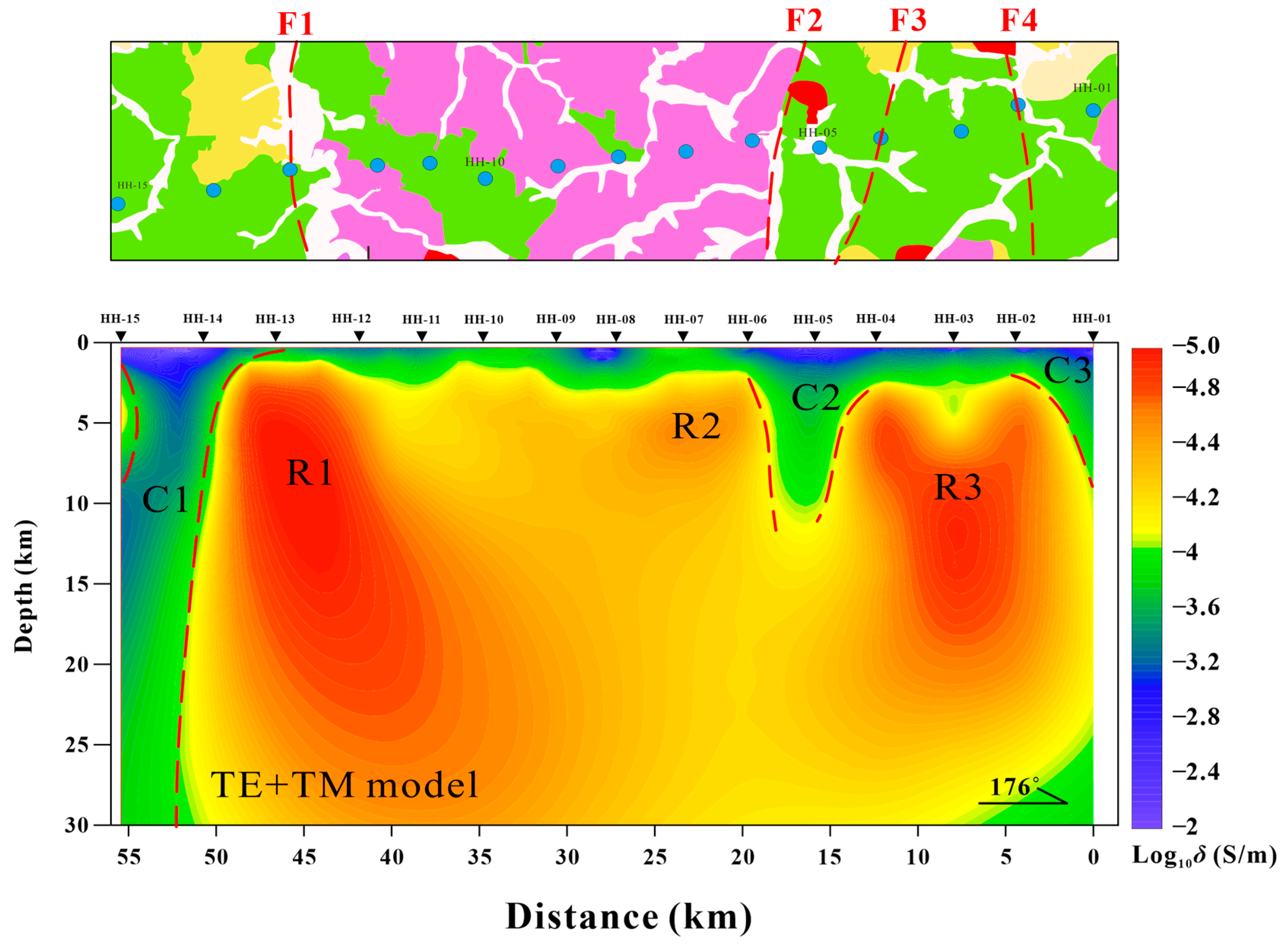
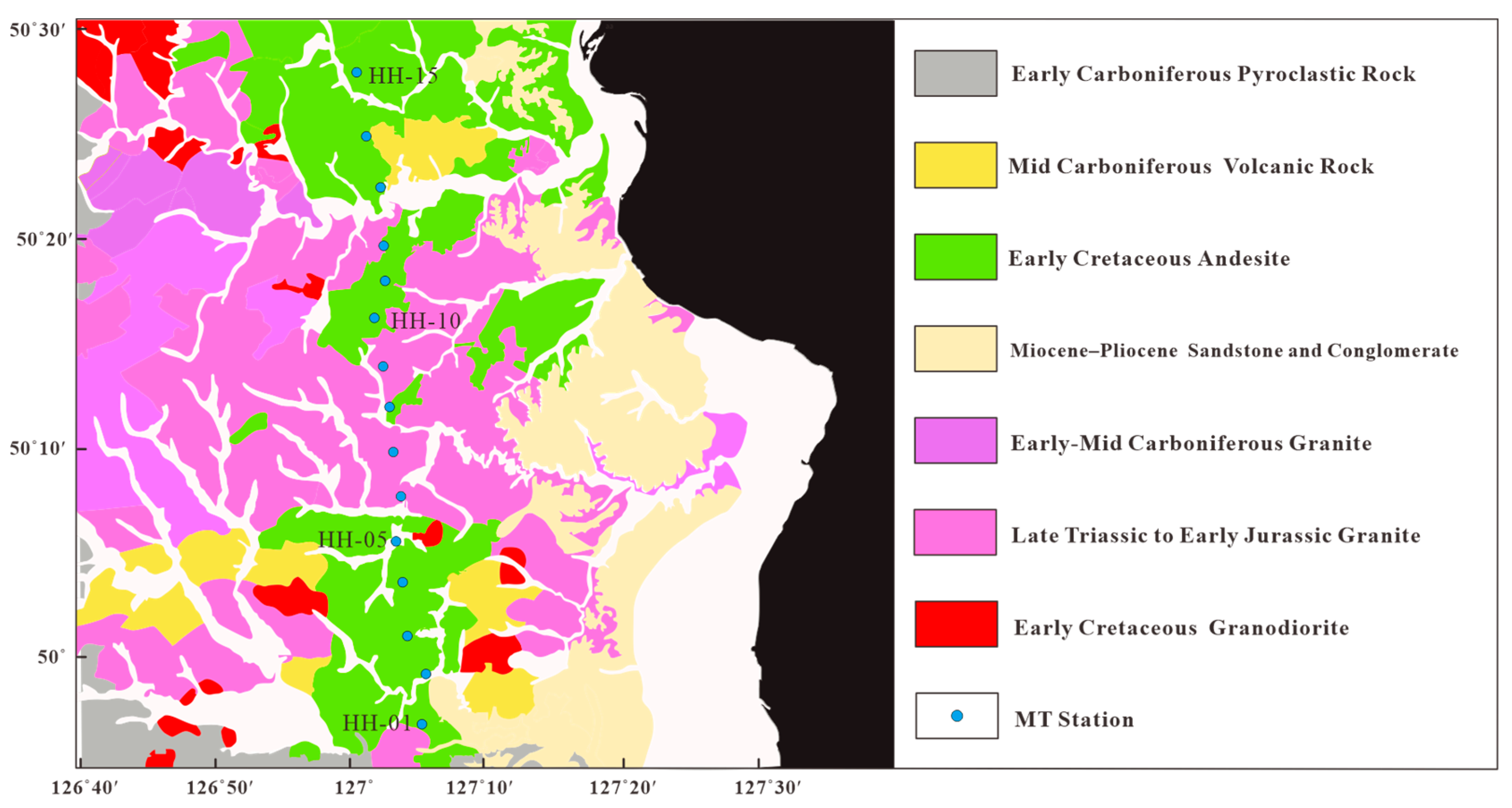
The profile extends approximately 56 km with an azimuth of 176°, along which 15 MT stations were systematically deployed (Figure 2). Data were collected using the GDP-32II multi-function resistivity system (Zonge Engineering, Tucson, AZ, USA), simultaneously recording two orthogonal electric field components (Ex, Ey) and two magnetic field components (Hx, Hy). The acquisition frequency range spanned from 0.0007 Hz to 8192 Hz, with continuous recording at each station for approximately 24 h.
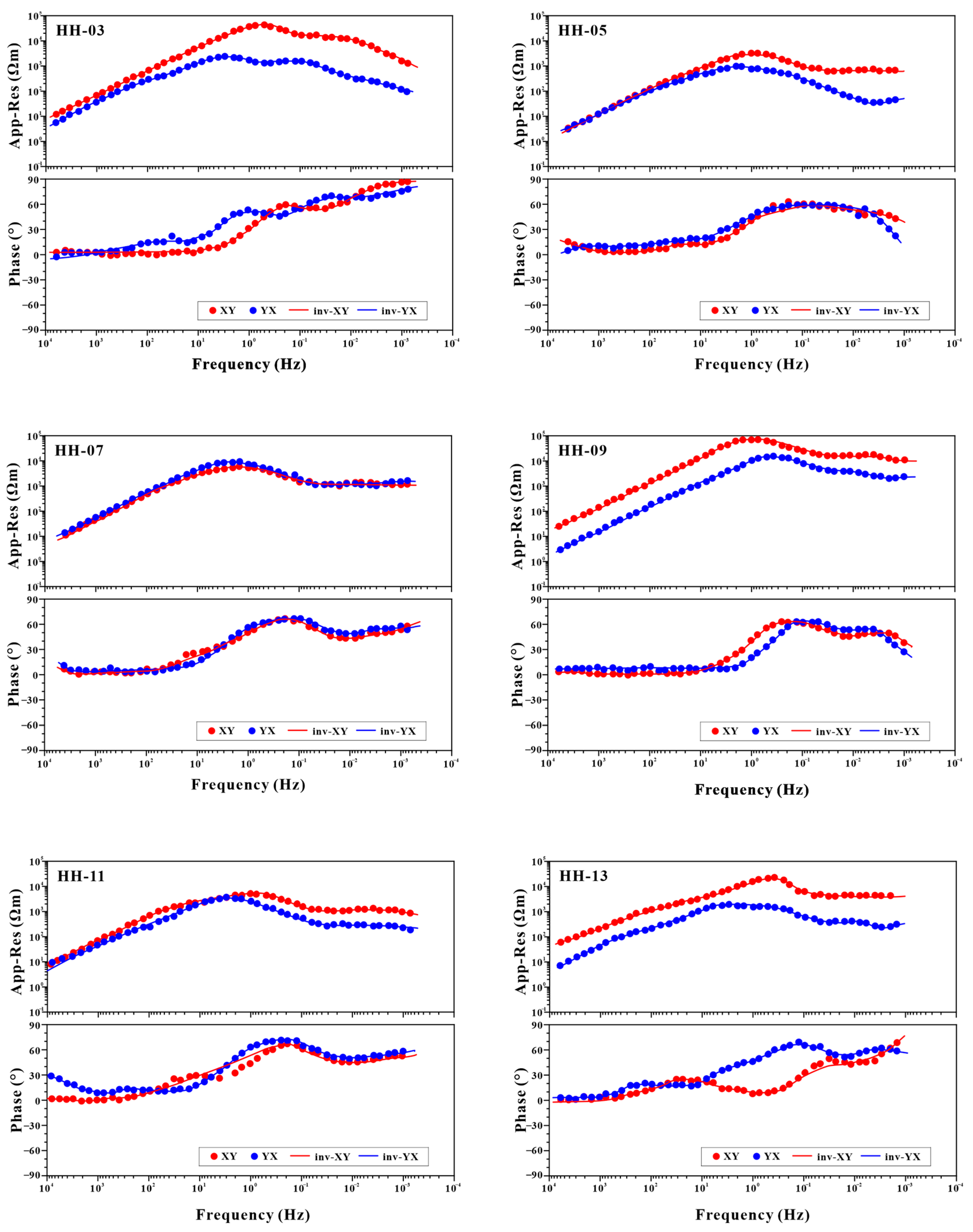
Representative apparent resistivity and phase curves from selected stations are presented in Figure 3, demonstrating reliable continuity and high data quality. Apparent resistivity values within the study area are generally elevated, predominantly ranging between 100 and 105 Ω·m. Notably, several stations exhibit pronounced variations in apparent resistivity magnitude and pattern, characterized by relatively lower resistivity values, which likely reflect intense tectonic deformation associated with the suturing process in this zone.
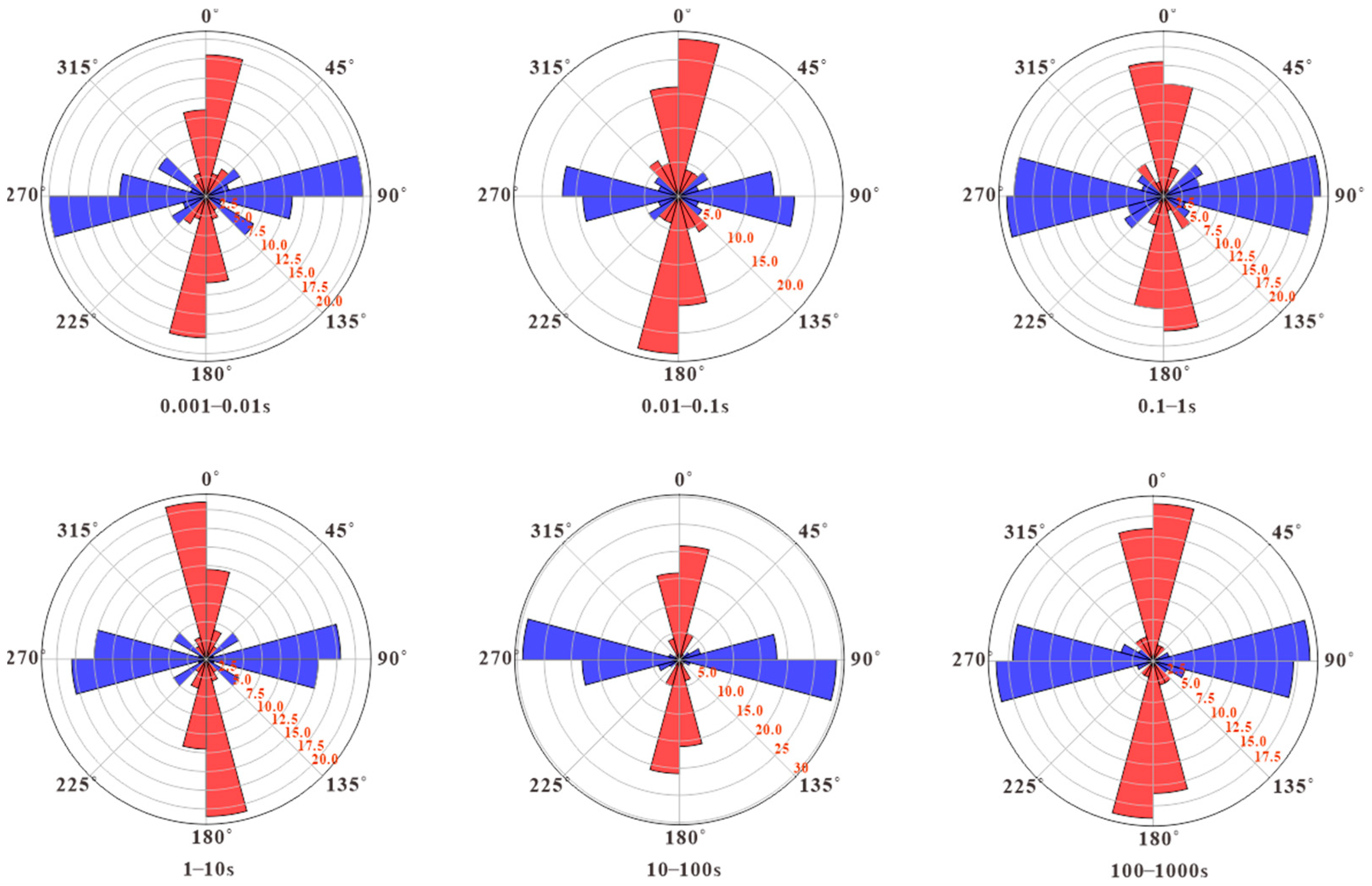
The phase tensor decomposition method was employed to determine the principal electrical axes at all measurement sites across multiple frequency bands, enabling the characterization of the regional geoelectric structural orientation [33]. The smooth-model inversion algorithm within the SCS2D v3.0 software, developed by Zonge Engineering and Research Organization, was employed in this study. The nonlinear conjugate gradient (NLCG) algorithm was applied in this study to perform two-dimensional inversion using data from the combined TE+TM model, which produced the conductivity model along the profile [34].
To construct a reliable subsurface electrical structure model, this study employed a two-dimensional joint inversion method that integrates both TE and TM modes. The advantage of this approach lies in its ability to comprehensively utilize the complementary electrical response characteristics of the two modes, jointly constraining and solving the same two-dimensional geoelectrical model, thereby enhancing the uniqueness and reliability of the inversion results. The inversion is conducted using a nonlinear least-squares algorithm. Initially, a two-dimensional finite element mesh is constructed, and a uniform background resistivity model is adopted as the initial model for inversion. Subsequently, the algorithm iteratively updates the resistivity values of the mesh units, with the core objective of minimizing the misfit between the TE+TM mode responses calculated by two-dimensional forward modeling and the field-measured data.
This background resistivity of 985 Ω·m was determined by calculating the geometric mean of far-field apparent resistivity values weighted by 1/frequency2. The number of iterations was at least 8, with the inversion typically showing rapid improvement within the first few iterations before reaching convergence. All RMS results of the iterations were controlled to be less than 5%. The key parameter settings included an overall trade-off factor of 3.0 between data fit and model smoothness. The regularization factors were specifically configured as follows: a relative weight of 0.1 for the background model constraint, 1.0 for horizontal smoothness, and 1.0 for vertical smoothness.

2.2. Analysis of Rock Composition

The basement of the Xing’an and Songnen blocks mainly consists of granite, while the extrusive rocks in the suture zone are predominantly andesitic [9]. Consequently, natural andesite and granite samples were collected near the corresponding MT stations along the profiles.
The chemical compositions of the fresh rocks were analyzed using a PANalytical Axiosmax wavelength-dispersive X-ray fluorescence (XRF) spectrometer (PANalytical, Almelo, The Netherlands) at the Harbin Center for Integrated Natural Resources Survey, China Geological Survey. Based on a mass ratio of 1:10 between the sample powder and the flux, 0.9 g sample glass powder and 9 g flux were accurately weighed using a JJ124BC precision electronic balance (Changshu Shuangjie Testing Instrument Factory, Changshu, China). The two components were mixed in a crucible and thoroughly stirred with a glass rod to ensure homogeneity while preventing contamination. The homogenized mixture was transferred into a platinum crucible, to which an appropriate amount of LiBr solution was added. The crucible was then placed in a fusion furnace for high-temperature melting. The molten sample was poured into a platinum mold to cool, forming flat glass beads that were subsequently analyzed by X-ray fluorescence (XRF). The flux consisted of a 50% LiBO2 and 50% Li2B4O7 mixture. Using the UniQuant standardless quantitative analysis method, the whole-rock major element analysis of each sample was completed with an analytical precision better than 5%.

2.3. In Situ Electrical Conductivity Measurement

This study systematically measured the electrical conductivity of natural andesite and granite under strictly controlled high-pressure, high-temperature, and oxygen fugacity conditions, employing the same experimental method and apparatus as Wang et al. [32]. Cylindrical specimens of natural andesite and granite, with diameters of 6.0 mm and heights of 4.0 mm, were prepared using core drilling and diamond saw cutting techniques. After preparation, the samples were sequentially cleaned in an ultrasonic bath with deionized water, ethanol, and acetone to remove surface impurities. To eliminate adsorbed moisture, the specimens were dried in a vacuum oven at 423 K before assembly for experimentation. Electrical conductivity measurements were performed in a YJ-3000t multi-anvil press (Key Laboratory of High-Temperature and High-Pressure Study of the Earth’s Interior, Institute of Geochemistry, Chinese Academy of Sciences, Guiyang, China) at a constant pressure of 1.0 GPa, with temperature ranging from 573 K to 973 K. Oxygen fugacity was controlled within the Ni–NiO buffer by using nickel electrodes and foil shielding, ensuring a stable and consistent redox environment throughout the experiments. In situ complex impedance spectroscopy was conducted using a Solartron 1260 impedance/gain-phase analyzer (AMETEK, Inc., Berwyn, PA, USA) over a frequency range from 0.1 Hz to 1 MHz, applying an AC voltage of 1.0 V. The pressure was gradually increased to 1.0 GPa, followed by stepwise temperature increments at 50 K intervals. At each temperature point, impedance data were collected only after the system reached thermal and chemical equilibrium, minimizing the measurement errors caused by the thermal changes. The laboratory conductivity data in this study serve as typical reference values for each lithology and do not account for variations that may arise from microscopic heterogeneity within a single lithology.

3. Results

3.1. Magnetotellurics (MT)

The determination of a robust geoelectric strike direction is a critical prerequisite for conducting geologically meaningful two-dimensional magnetotelluric inversion. To achieve this, we systematically employed the phase tensor decomposition method across all 15 measurement sites and over multiple frequency bands [33]. This analysis enabled the characterization of the principal electrical axes and, consequently, the regional geoelectric dimensionality and orientation. The results of this comprehensive analysis are summarized in Figure 4, which presents rose diagrams depicting the dominant geoelectric strike directions for six representative period bands ranging from 0.001 s to 1000 s. As illustrated in Figure 4, within the 1–10 s and 10–100 s intervals—which are crucial for imaging the crustal structure of interest—the principal electrical axes predominantly align along the west–east (W-E) and north–south (N-S) directions, respectively (acknowledging the inherent 90° ambiguity). By integrating these geoelectric findings with the regional geological context, where Early Cretaceous andesitic formations flank the profile’s margins and Carboniferous-Jurassic granitic intrusions dominate the center, the regional geoelectric strike was robustly interpreted as east–west oriented.
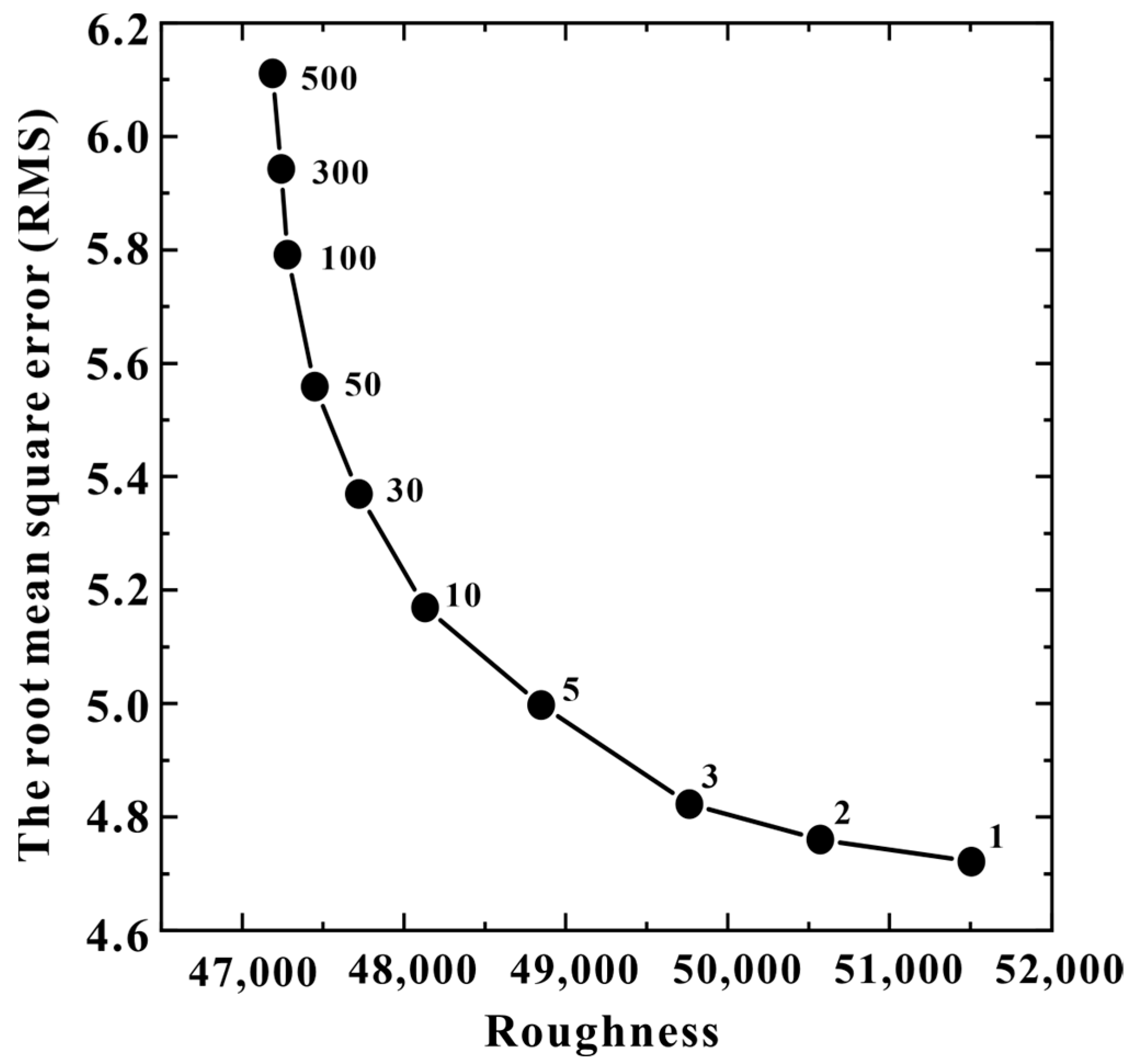
To determine the optimal regularization parameter for the magnetotelluric inversion, we conducted a series of trial inversions with trade-off factors varying over two orders of magnitude. The resulting data misfit and model roughness for each inversion were calculated and plotted against each other, forming the characteristic L-shaped curve (Figure 5). This L-curve analysis provides a principled framework for visualizing the trade-off: its vertical branch corresponds to under-regularized models that fit the data well at the expense of excessive complexity, while its horizontal branch represents over-regularized, overly smooth models that poorly fit the data. The optimal value was selected at the distinct ‘knee’ of this curve, where a small increase in regularization yields a significant gain in model stability without substantially degrading the data fit. Consequently, a trade-off factor of 3 was chosen as it occupies this knee point, representing the most favorable compromise between achieving a satisfactory data fit and obtaining a geologically plausible, stable model.
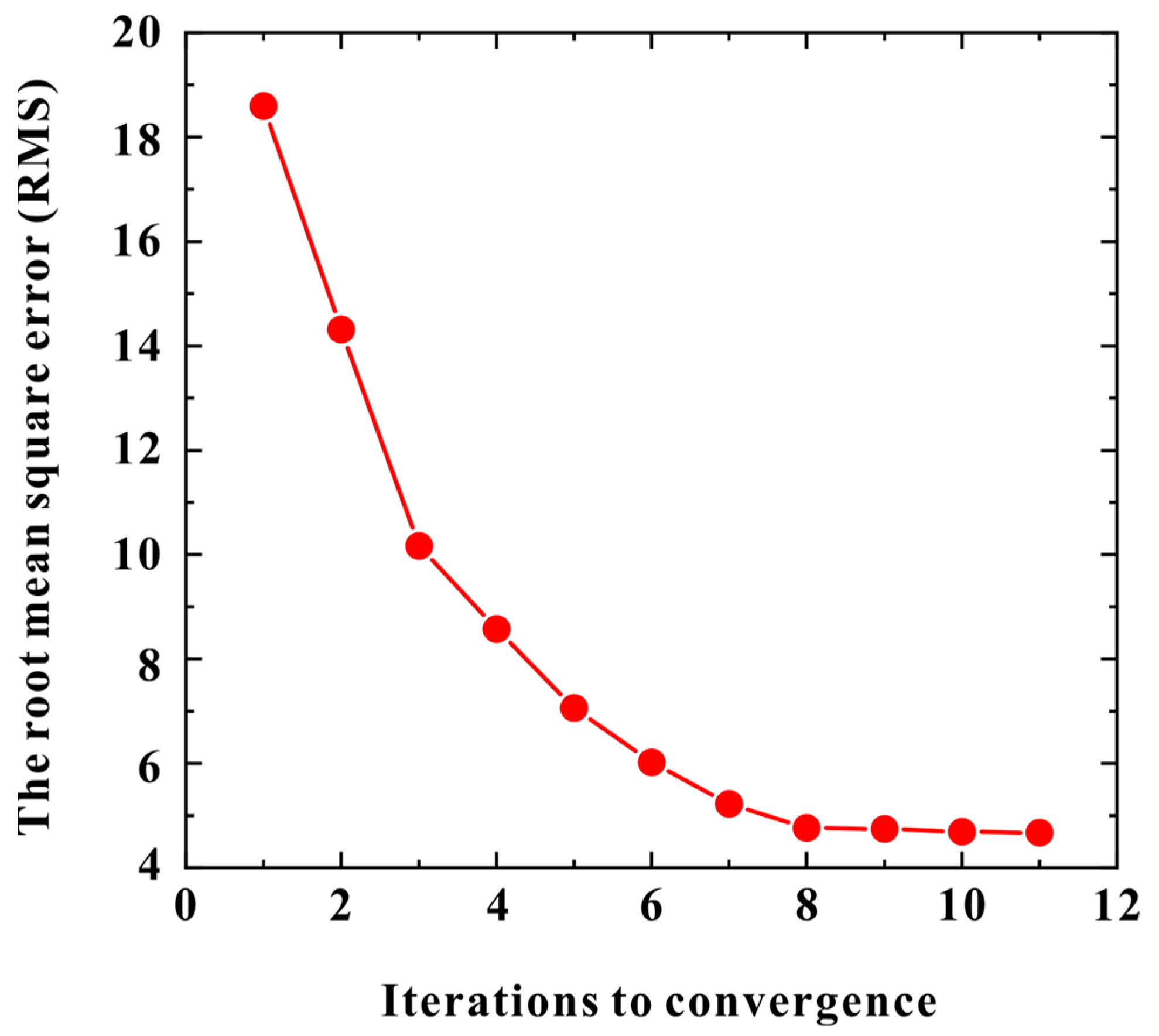
The inversion process commenced with a high initial root-mean-square (RMS) misfit of 18.601, indicating a significant discrepancy between the observed data and the responses from the starting model (Figure 5). The inversion algorithm efficiently reduced this misfit, as evidenced by a rapid and monotonic decrease in the RMS value during the initial iterations. This behavior demonstrates the algorithm’s strong convergence and its capability to quickly improve the model fit. The convergence rate decelerated notably after several iterations, and the RMS value stabilized after the eighth iteration, forming a distinct plateau. The attainment of this stable, low misfit level indicates that the inversion had reached a robust solution, balancing data fit and model complexity.
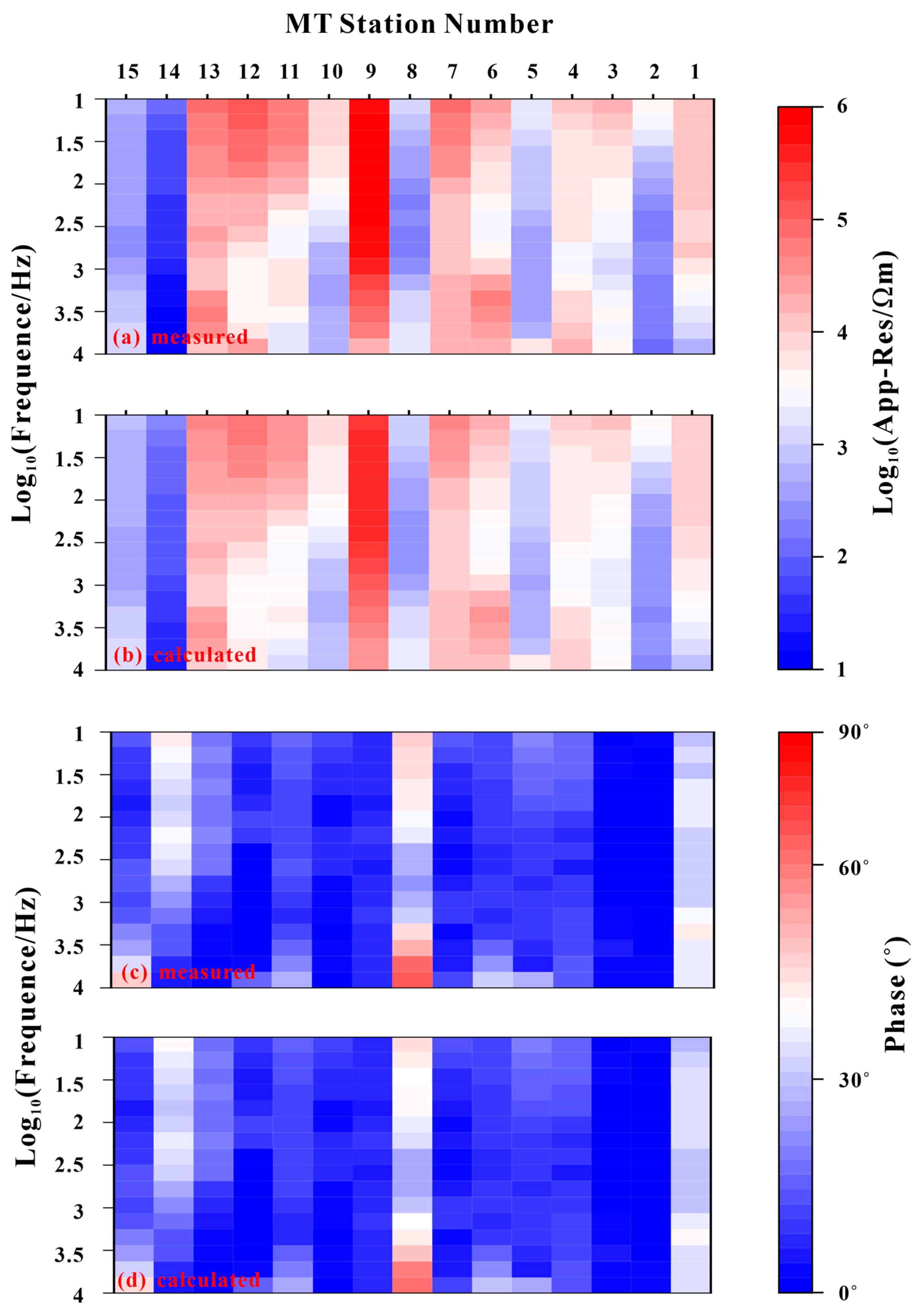
A reliable subsurface electrical structure model was constructed using a two-dimensional joint inversion of the TE and TM modes in accordance with the methodology described in Section 2.1. The inversion results are presented in Figure 6. Pseudo-section diagrams of both measured and modeled data along the MT profile, as shown in Figure 7, illustrate the fit between observations and model responses and confirm the reliability of the inversion. Consistency between the apparent resistivity and phase pseudo-sections further validates the robustness of the inversion results.

3.2. Analysis of Rock Composition

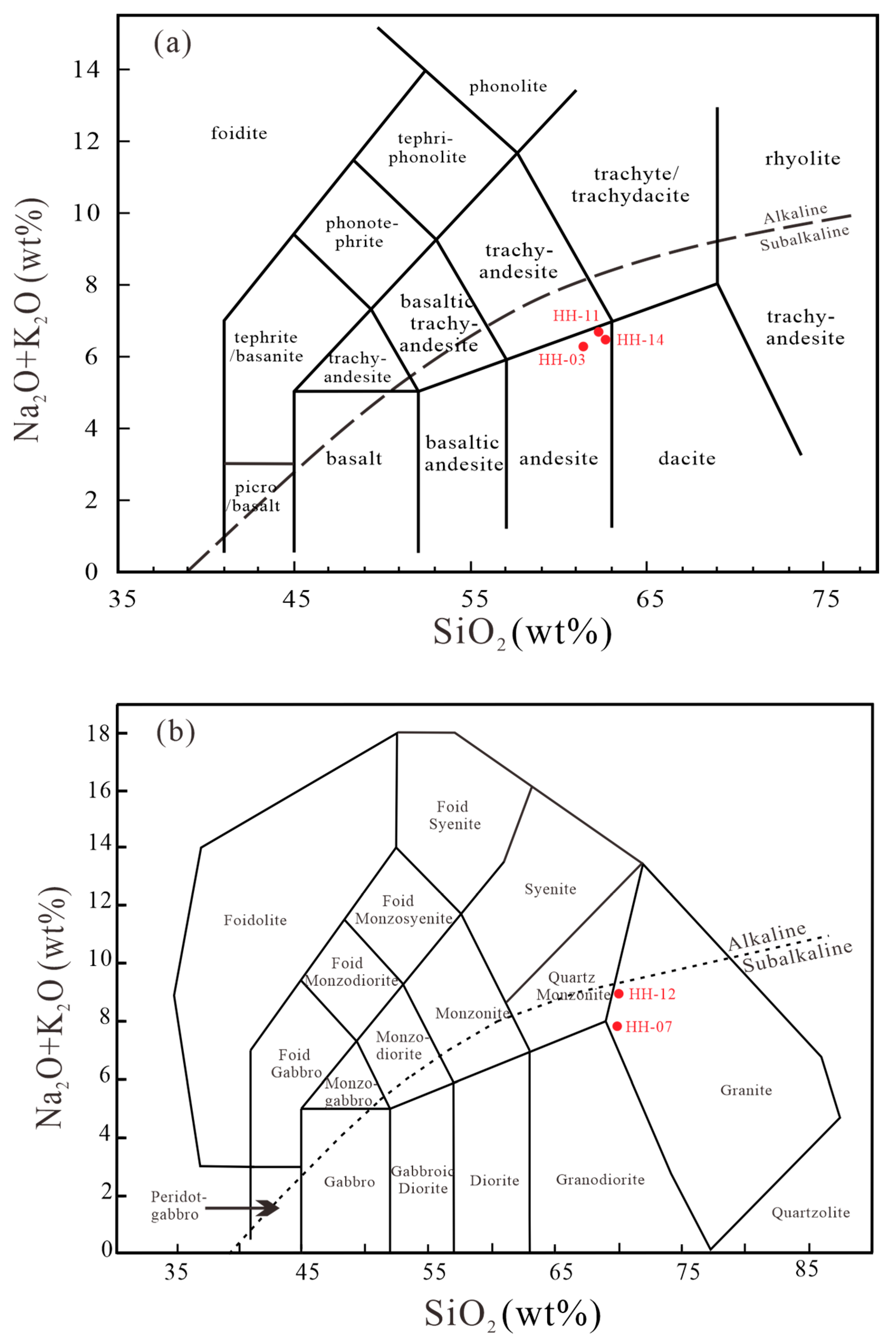
Detailed XRF data are presented in Table 1. The lithologies of these samples were accurately classified according to the total alkali–silica (TAS) diagram shown in Figure 8. A modified chemical classification and nomenclature of volcanic rocks and magmas using the total alkali versus silica method adapted from Middlemost et al. [35].
The samples from HH-05, HH-11, and HH-14 had SiO2 contents of 61.45% to 62.64%, consistent with intermediate to acidic andesitic compositions. Their Al2O3 concentrations (16.39%–17.38%) indicated substantial aluminum saturation. Total alkali oxides (Na2O+K2O) ranged from 6.37% to 6.77%, placing them in the calc-alkaline series. K2O/Na2O ratios (0.51–0.53) suggest slight sodium enrichment. The A/CNK values (1.83–1.97) reflect a strongly peraluminous character. These features align with an oceanic subduction-related island arc setting at a convergent margin.
Samples HH-07 and HH-12 showed higher SiO2 (69.50%–69.67%), typical of granitic compositions. Their Al2O3 contents (13.49%–13.56%) remained aluminum saturated but lower than the andesites. Total alkali oxides (7.79%–8.94%) and high K2O/Na2O ratios (3.33–3.67) classify them as high-K calc-alkaline granites. The A/CNK values (1.25–1.43) indicate metaluminous to weakly peraluminous compositions. The low MgO, CaO, and FeO concentrations suggested advanced magmatic differentiation.

3.3. In-Suit Electrical Conductivity Measurement

The impedance spectra were analyzed by fitting to an equivalent circuit model composed of two series-connected parallel resistor–constant phase element (R-CPE) units: one representing the bulk response of the sample and the other accounting for electrode polarization effects. The bulk resistance (R) was determined from the high-frequency semicircle in the Nyquist plot [31,32].
The electrical conductivity (σ) was determined by applying the following formula:
σ   =   L / SR
In this equation, L represents the sample length (4.0 mm), R represents the bulk resistance, and S represents the cross-sectional area (9π mm2).
Conductivity’s variation with temperature conformed to the Arrhenius equation:
σ   = σ 0 exp ( H / kT )
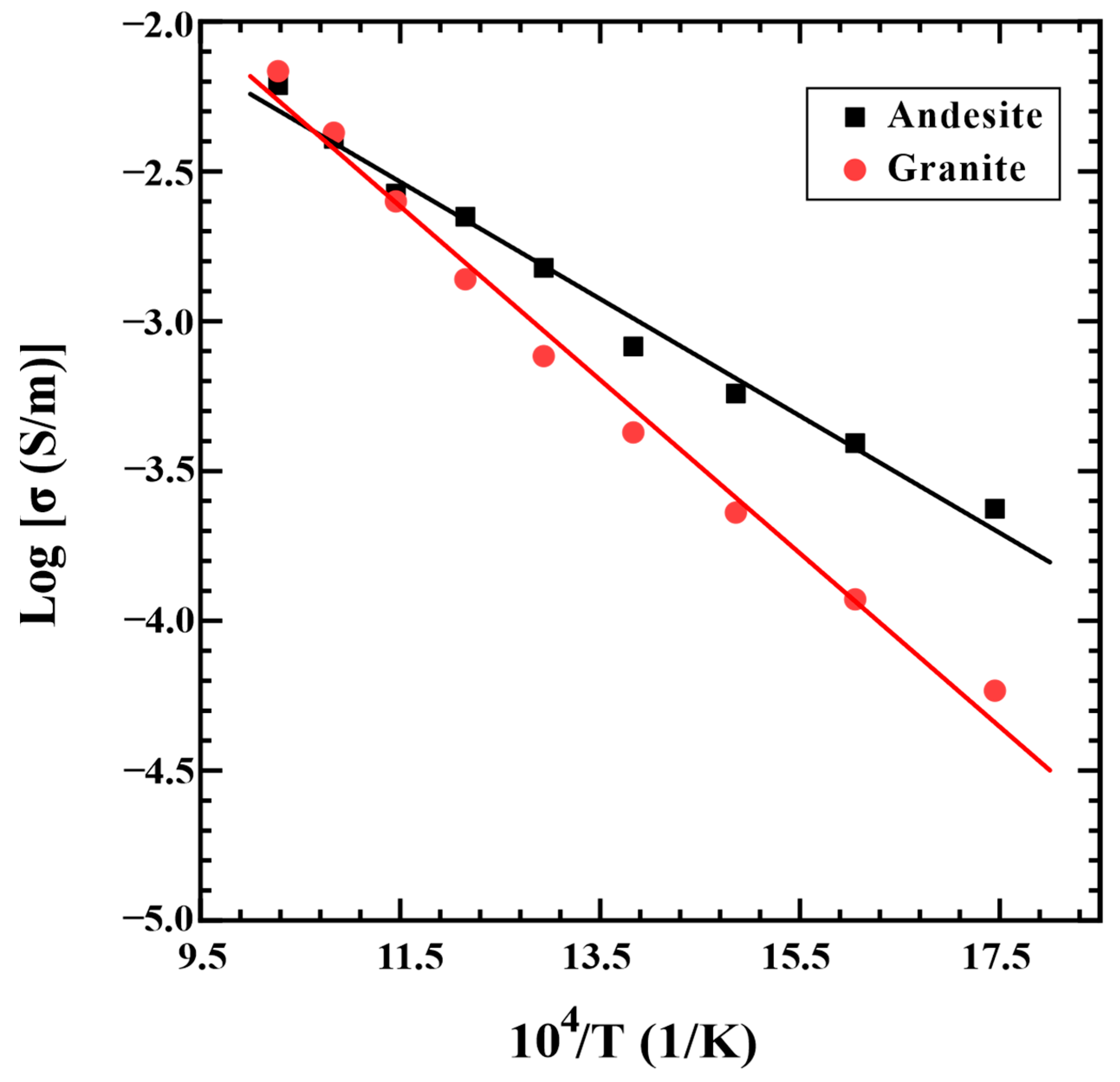
where σ0 corresponds to the pre-exponential factor, ΔH corresponds to the activation enthalpy, k corresponds to the Boltzmann constant, and T corresponds to the absolute temperature. The parameters σ0 and ΔH were obtained by performing a linear regression analysis of lg(σ) plotted against the reciprocal of temperature (1/T). The total measurement error in conductivity was found to be less than 5%, mainly originating from inaccuracies in measuring sample dimensions and fitting impedance data. All of the fitting parameters are detailed in Table 2.
Figure 9 illustrates how electrical conductivity varies with inverse temperature for andesite and granite under conditions of 573–973 K and 1.0 GPa. For both rock types, the logarithm of electrical conductivity demonstrated a strong linear relationship with inverse temperature, aligning with the Arrhenius equation. When temperatures were below 923 K, andesite showed markedly higher electrical conductivity compared to granite. However, as the temperature increased, the conductivity of granite progressively approached that of andesite. The primary reason is that andesite has a relatively low activation energy for charge carriers, which leads to increased electrical conductivity at lower temperatures [36,37]. Conversely, the mineralogical composition and structural characteristics of granite substantially improve its conductivity at elevated temperatures, thereby reducing the conductivity gap between the two rock types over time [38,39].

4. Discussion

4.1. The Strike Direction and Spatial Extent of the Heihe-Hegenshan Suture in the Heihe Region

The MT inversion results based on the TE + TM model reveal that the strata in the study area generally exhibit high resistivity. The final root-mean-square (RMS) misfit achieved was 4.76 for the TE+TM mode. Three low-resistivity anomaly bodies, labeled C1, C2, and C3, were identified within the profile (Figure 10). Considering that the crust of the Xing’an and Songnen blocks is mainly composed of granite bodies and based on the in situ conductivity experimental comparison results in this study, these high-resistivity zones are interpreted as the basement of the two blocks [9]. Previous studies have demonstrated that suture zones typically appear as high-conductivity or low-resistivity anomalies at the lithospheric scale [40,41]. Additionally, a high-conductivity anomaly between the Xing’an and Songnen blocks separates the distribution of magmatic rocks before and after collision, delineating the boundary of Carboniferous magmatism. Deep seismic reflection features of the Songnen block, dipping westward, further support this interpretation [19,22]. Moreover, the depth of C1 exceeds 30 km, and its resistivity is at least one order of magnitude lower than that of the crustal units R1 and R2. Therefore, C1 is inferred to represent the Heihe-Hegenshan suture zone at the southeastern margin of the Duobaoshan island arc, separating the island arc from the Songnen block. Fault F1 is a major deep fault that dips northwest. C2 is controlled by two normal faults, F2 and F3, forming an intracontinental extensional basin while C3 is controlled by fault F4, which dips southeast.
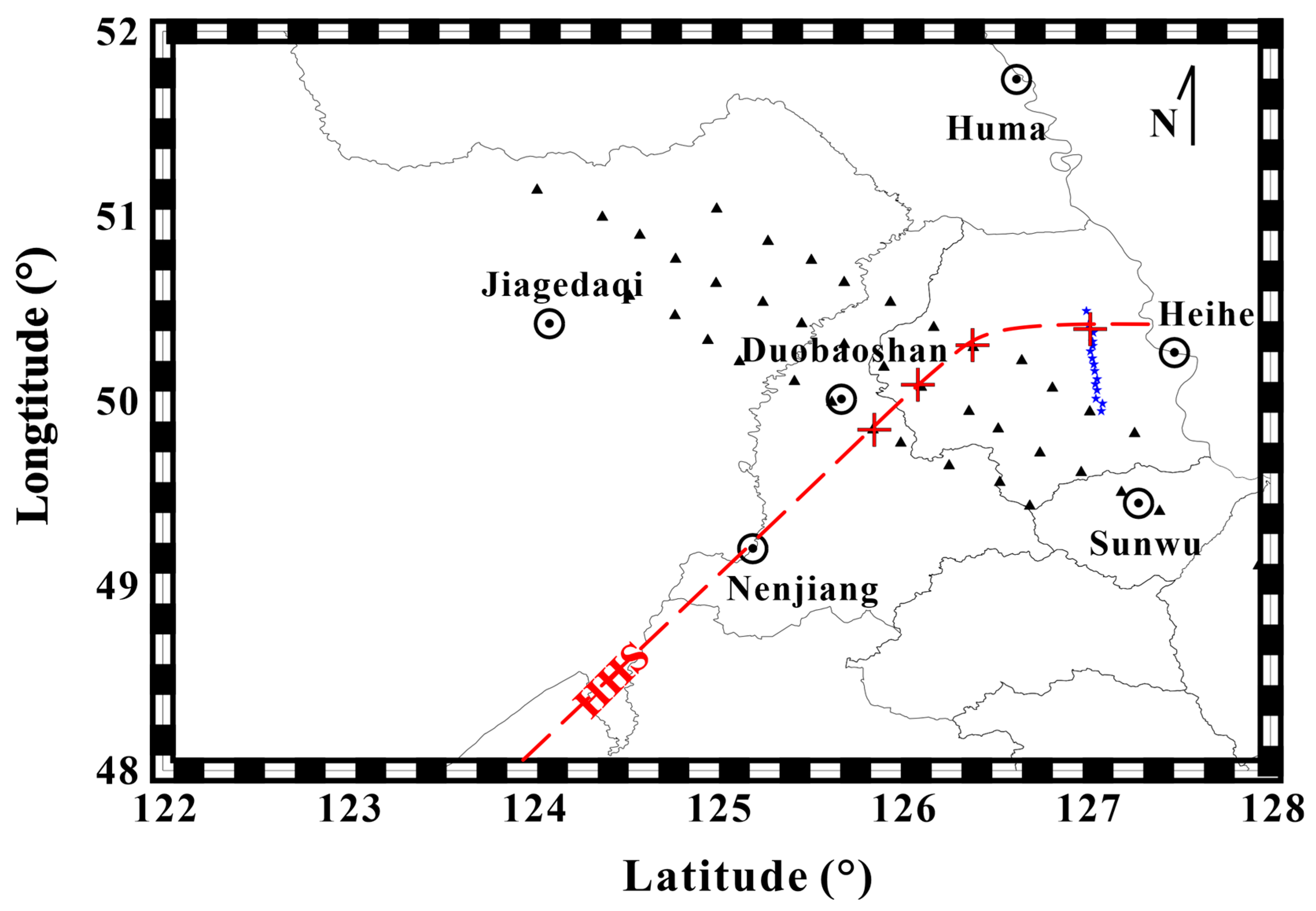
To analyze the extension location of the Heihe-Hegenshan suture in the Heihe area, we marked the points along the suture zone identified through MT observations in this study. Combining these with the MT station locations delineated for the HHS by Meng et al. [20], we projected these points onto the regional geological map to outline the suture zone’s position and extension direction (Figure 11).
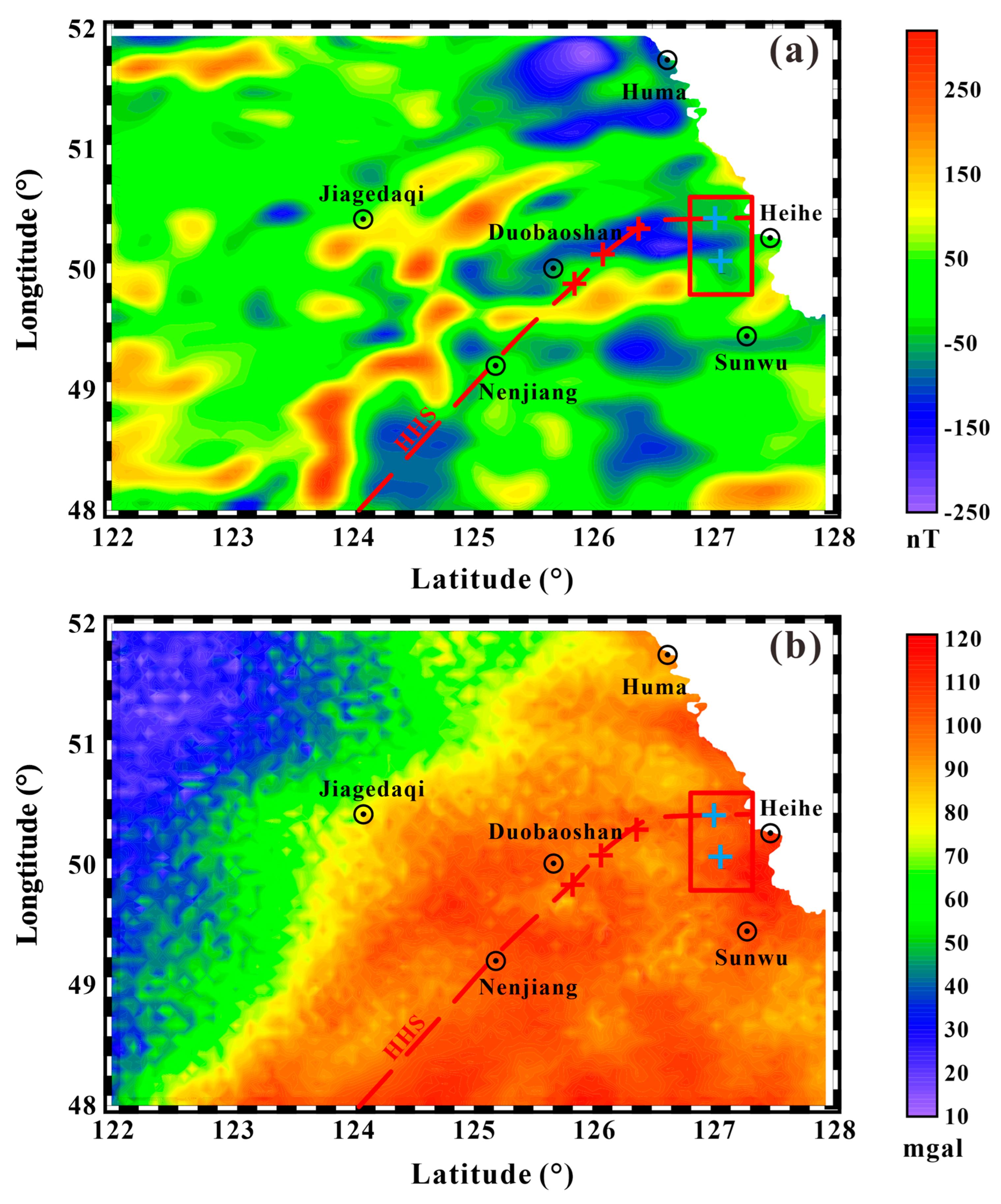
To further verify the accuracy of our inference, we collected and processed publicly available satellite gravity and magnetic data for the study area, extracted Bouguer gravity anomalies and reduced-to-pole magnetic anomaly features, and projected the inferred suture zone locations onto the maps for comparison. The Bouguer gravity anomaly data are from the WGM2012 model (BGI, http://bgi.omp.obs-mip.fr/data, accessed on 22 April 2024), with an accuracy of 2′ × 2′. The magnetic anomaly model EMAG2 is from the US National Oceanic and Atmospheric Administration (https://www.ngdc.noaa.gov, accessed on 22 April 2024), which also has a resolution of 2′ × 2′.
As shown in Figure 12a, the inferred trajectory of the HHS traverses a distinct high-low magnetic anomaly gradient zone, with its orientation closely matching the bending trend of the magnetic anomaly belt, both flanked by regions of high magnetic anomalies. In the Bouguer gravity anomaly map presented in Figure 12b, the Xing’an and Songnen blocks exhibit a prominent positive anomaly background, whereas the inferred suture extension manifests as a series of bead-like, continuously distributed relatively low-value anomaly belts. These geophysical characteristics provided strong support for the inferred location of the suture. The high-low magnetic anomaly gradient zone belt likely reflects the presence of weakly magnetic tectonic rocks within the suture, such as ophiolitic fragments, intensely deformed or retrograded mafic-ultramafic rocks, consistent with the common lithological assemblages exposed in suture zones [42,43]. The bead-like low gravity anomalies suggested well-developed fault structures in the area, indicative of deep dynamic processes such as terrane accretion and tectonic fragmentation during the suture’s evolution. The spatial distribution patterns of gravity and magnetic anomalies together revealed a typical geophysical response pattern of a suture zone, indicating its significance as a major tectonic boundary [43,44]. The superimposed distribution of low magnetic and low gravity anomalies further elucidated the complex lithological and structural characteristics within the suture, supporting a geological evolution history marked by multiple phases of tectonic activity and magmatism in this region. Notably, the spatial distribution pattern and extension direction of the inferred HHS in this study were highly consistent with the location of the Nenjiang-Heihe Fault (NHF) proposed by Zhao et al. [45]. More importantly, the crustal electrical structure profile obtained from magnetotelluric (MT) data inversion in this study further revealed that the fault zone cuts downward to a depth exceeding 30 km, extending into the lower crust and even reaching the top of the upper mantle. This deep-seated structural feature fully aligned with the characteristics of a typical lithospheric-scale major fault within a plate suture zone, thereby providing crucial deep geophysical evidence for the identification of the HHS in this region.

4.2. Depth-Dependent Electrical Structure and Its Dominant Controlling Factors of the Suture Zone

This study investigated the correlations among geothermal temperature, electrical resistivity, and depth within the HHS while also examining the causes of electrical property variations across the suture. Using a thermal conductivity–depth relationship, we converted temperature, depth, and rock conductivity data, and subsequently compared these results with the electrical structure of profile C1 to discuss the depth differentiation of electrical structures in suture zones and their dominant controlling factors.
The relationship between temperature and depth was determined by numerically solving the heat conduction equation [32]
T   =   T 0 + ( Q k )   Z     ( A 0 2 k )   Z 2
where T0 is the surface temperature measured in K, Q is the surface heat flow expressed in mW/m2, Z denotes the depth of the lithospheric layer in km, k signifies the thermal conductivity in W/m·K, and A0 indicates the radiogenic heat production rate within the lithosphere, measured in μW/m3.
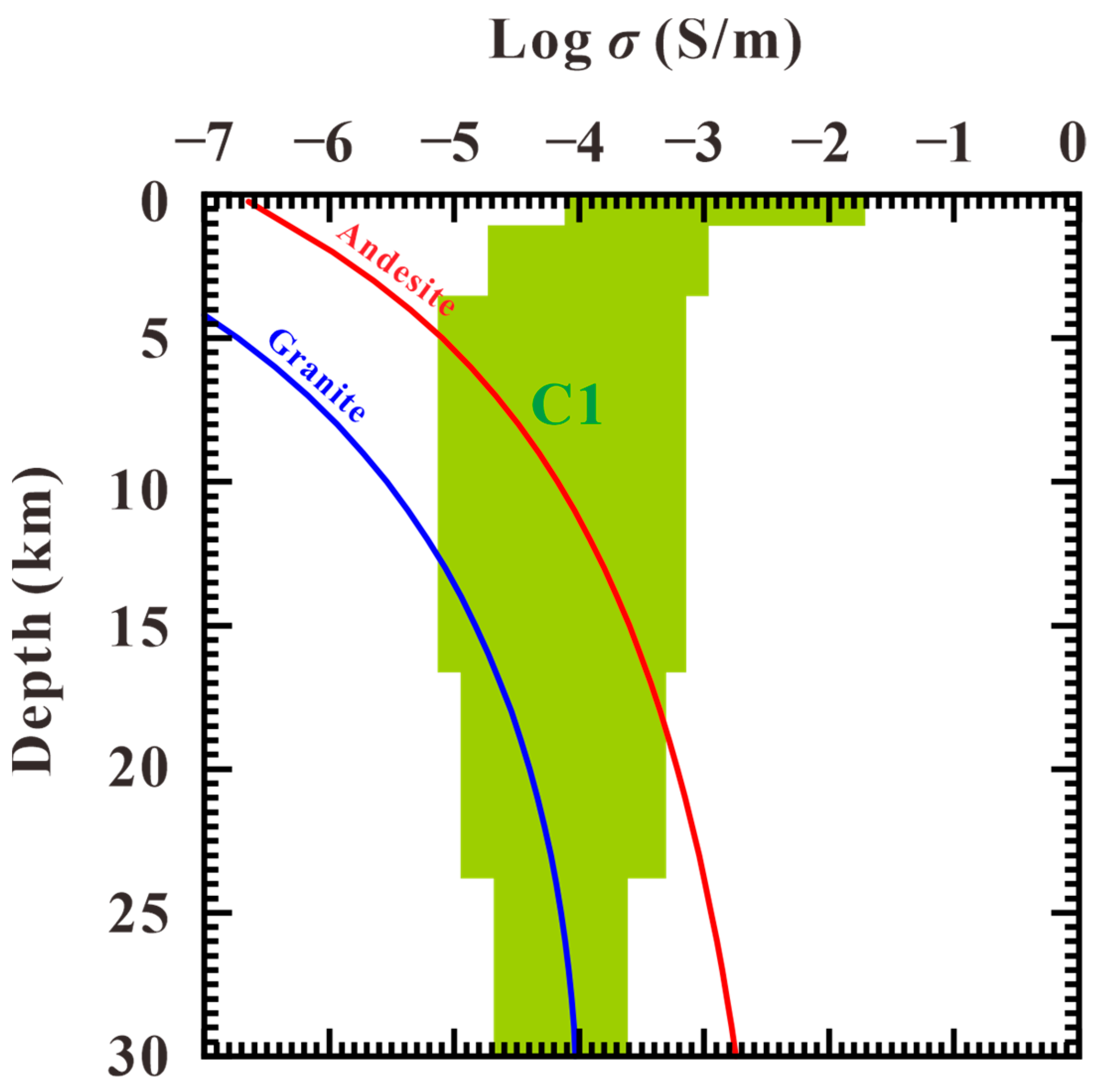
Given the limited availability of observational data, it is necessary to reference measurement results obtained from neighboring regions. Based on the local thermal structure and associated parameters of the deep geothermal field, values of 300 K for surface temperature, 2.48 W/m·K for thermal conductivity of andesite, 1.70 W/m·K for thermal conductivity of granite (which constituted the continental crustal basement) and 0.94 μW/m3 for lithospheric radiogenic heat production were utilized [46,47]. Using the conductivity-temperature relationships acquired in this study, a depth profile of electrical conductivity for andesite and granite can be derived.
As shown in Figure 13, the electrical conductivity of andesite and granite increased with depth, consistent with the enhanced mineral conductivity caused by rising temperature. In regions deeper than 5 km, the conductivity characteristics of these two rock types adequately explained the electrical structure revealed by the C1 profile. It demonstrates that the electrical conductivity of the C1 anomaly at depths exceeding 5 km aligns with the laboratory-derived conductivity–depth profiles for andesite and granite. The strong correspondence between the observed and experimental data supports a petrophysical interpretation: the deeper section of the C1 anomaly is likely governed by the temperature-dependent conductivity of these crustal rocks. Given its higher conductivity at mid-crustal temperatures, andesite emerged as the most probable constituent. However, at depths shallower than 5 km, the theoretical conductivities of andesite and granite were significantly lower than the high-conductivity anomalies observed in C1. This discrepancy indicates that within this depth range, temperature was not the primary factor controlling the formation’s electrical properties. Instead, hydrothermal fluids, hydrous alteration minerals, and electronically conductive high-conductivity phases such as metallic sulfides, graphite, etc., dominate. However, the content of graphite in this area was insufficient to cause the high-conductivity anomalies [12,13]. Previous studies have indicated that the present surface heat flow values in this area are relatively low, with no significant geothermal anomalies, suggesting a declining regional thermal background [46,47,48,49]. Nevertheless, the widespread distribution of shallow, low-temperature hydrothermal mineral deposits indicates that the region experienced active hydrothermal activity in the past [50,51,52]. Considering these factors, we inferred that the current high-conductivity anomalies in the shallow subsurface (<5 km) are likely remnants of ancient hydrothermal systems, preserved in the form of pore fluids, alteration minerals, and sulfides, which continuously influence the electrical structure at these depths. In contrast, at depths exceeding 5 km, the decay or migration of heat sources and the reduction in thermal activity caused the rock conductivity to be primarily governed by the temperature and pressure conditions. Consequently, the conductivity behavior aligned more closely with the conductive properties of andesite and granite.

5. Conclusions

This multidisciplinary study, integrating broadband magnetotelluric (MT) imaging, geochemical analysis, and high-pressure electrical conductivity experiments, provides robust constraints on the deep lithospheric architecture and geodynamic processes of the Heihe-Hegenshan Suture (HHS) in the eastern Central Asian Orogenic Belt (CAOB). The magnetotelluric survey successfully identified a prominent, deep-reaching high-conductivity anomaly (C1), which was interpreted as the core of the HHS. The integration of this geophysical signature with regional aeromagnetic and Bouguer gravity data—where the suture manifests as a distinct high-low magnetic gradient zone and a bead-like, low-gravity anomaly belt—robustly constrains its spatial extent and northward continuation, confirming its role as a major lithospheric boundary. Critically, the MT inversion reveals that this structure extends to depths exceeding 30 km, penetrating the lower crust and likely reaching the upper mantle, aligning with the characteristics of a fundamental, lithospheric-scale fault. The interpretation of these geophysical anomalies was quantitatively grounded by laboratory measurements of the electrical conductivity of key crustal rocks (andesite and granite) under simulated crustal conditions. The established conductivity-temperature relationships for these rocks provided crucial petrophysical constraints, significantly reducing the non-uniqueness inherent in the geophysical inversion and allowing for a more confident interpretation of the subsurface electrical structure. Furthermore, by constructing conductivity-depth profiles, this study reveals a fundamental shift in the factors controlling the electrical structure of the suture zone with depth. At shallow depths (<5 km), the observed high-conductivity anomalies are unlikely to be caused by the intrinsic properties of the primary rocks, but are instead dominated by the presence of ancient hydrothermal fluids, alteration minerals, and conductive phases like sulfides. In contrast, at greater depths (>5 km), the electrical structure is primarily governed by the temperature-dependent conductivity of the crustal rocks, with the high-conductivity anomaly of the suture zone reflecting its distinct lithological and thermal character. In summary, this research substantiates the continuity and deep-rooted nature of the Heihe-Hegenshan Suture. The synthesis of geophysical, geochemical, and experimental petrological data in this study not only confirmed the continuity and northward extension of the HHS in Northeast China but also demonstrated the power of integrated methodologies in unraveling complex orogenic systems.

Author Contributions

M.W. and T.S. designed the project. T.S. and M.W. wrote the initial draft of the work and the final paper, and interpreted the results. M.W. performed the electrical conductivity experiments. M.W., Q.Y., K.W., H.Y. (Huaben Yang), J.F. and H.Y. (He Yuan) collected the MT data. T.S., M.W. and T.Z. interpreted the MT results. All authors discussed the results and commented on the manuscript. All authors have read and agreed to the published version of the manuscript.

Funding

This research was funded by the funding project of Northeast Geological S&T Innovation Center of China Geological Survey (Nos. QCJJ2023-21, NO.QCJJ2022-3), the Science and Technology Innovation Foundation of Command Center of Integrated Natural Resources Survey Center (KC20230004), the Open Research Fund Program of Key Laboratory of Metallogenic Prediction of Nonferrous Metals and Geological Environment Monitoring (Central South University), the Ministry of Education (No. 2024YSJS13), and Geological Survey Project of China Geological Survey (No. DD20230395).

Data Availability Statement

The data presented in this study are available on request from the corresponding author. The data are not publicly available due to privacy restrictions of Harbin Center for Integrated Natural Resources Survey, China Geological Survey.

Conflicts of Interest

The authors declare that they have no conflicts of interest.

References

  1. Jahn, B.-M.; Wu, F.Y.; Chen, B. Granitoids of the Central Asian Orogenic Belt and continental growth in the Phanerozoic. Earth Environ. Sci. Trans. R. Soc. Edinb. 2000, 91, 181–193. [Google Scholar] [CrossRef]
  2. Jahn, B.-M.; Windley, B.; Natal’in, B.; Dobretsov, N. Phanerozoic continental growth in Central Asia. J. Asian Earth Sci. 2004, 5, 599–603. [Google Scholar] [CrossRef]
  3. Windley, B.F.; Alexeiev, D.; Xiao, W.J.; Kröner, A.; Badarch, G. Tectonic models for accretion of the Central Asian Orogenic Belt. J. Geol. Soc. 2007, 16, 31–47. [Google Scholar] [CrossRef]
  4. Xiao, W.J.; Song, D.F.; Windley, B.F.; Li, J.J.; Han, C.M.; Wan, B.; Zhang, J.E.; Ao, S.J.; Zhang, Z.Y. Accretionary processes and metallogenesis of the Central Asian Orogenic Belt: Advances and perspectives. Sci. China Earth Sci. 2020, 63, 329–361. [Google Scholar] [CrossRef]
  5. Zhou, J.B.; Wilde, S.A.; Zhao, G.C.; Han, J. Nature and assembly of microcontinental blocks within the Paleo-Asian Ocean. Earth-Sci. Rev. 2018, 186, 76–93. [Google Scholar] [CrossRef]
  6. Zhou, T.; Liu, Y.J.; Guan, Q.B.; Liu, B.R.; Xiao, W.J.; Li, S.Z.; Chen, Z.X.; Peskov, A.Y. Tectonic evolution of the eastern Central Asian Orogenic Belt during the Carboniferous–Permian. Earth-Sci. Rev. 2025, 262, 105046. [Google Scholar] [CrossRef]
  7. Liu, Y.J.; Li, W.M.; Feng, Z.Q.; Wen, Q.B.; Neubauer, F.; Liang, C.Y. A review of the Paleozoic tectonics in the eastern part of Central Asian Orogenic Belt. Gondwana Res. 2017, 43, 123–148. [Google Scholar] [CrossRef]
  8. Liu, Y.J.; Li, W.M.; Ma, Y.F.; Feng, Z.Q.; Guan, Q.B.; Li, S.Z.; Chen, Z.X.; Liang, C.Y.; Wen, Q.B. An orocline in the eastern central Asian orogenic belt. Earth-Sci. Rev. 2021, 221, 103808. [Google Scholar] [CrossRef]
  9. Wu, F.Y.; Sun, D.Y.; Ge, W.C.; Zhang, Y.B.; Grant, M.L.; Wilde, S.A.; Jahn, B.-M. Geochronology of the Phanerozoic granitoids in northeastern China. J. Asian Earth Sci. 2011, 41, 1–30. [Google Scholar] [CrossRef]
  10. Sun, D.Y.; Wu, F.Y.; Li, H.M.; Lin, Q. Emplacement age of the postorogenic A-type granites in Northwestern Lesser Xing’an Ranges, and its relationship to the eastward extension of Suolunshan-Hegenshan-Zhalaite collisional suture zone. Chin. Sci. Bull. 2001, 46, 427–432. [Google Scholar] [CrossRef]
  11. Zhang, X.Z.; Yang, B.J.; Wu, F.Y.; Liu, G.X. The lithosphere structure of Northeast China. Front. Earth Sci. China 2007, 1, 165–171. [Google Scholar] [CrossRef]
  12. Gao, R.Z.; Xue, C.J.; Lü, X.B.; Zhao, X.B.; Yang, Y.S.; Li, C.C. Genesis of the Zhengguang gold deposit in the Duobaoshan ore field, Heilongjiang Province, NE China: Constraints from geology, geochronology and S-Pb isotopic compositions. Ore Geol. Rev. 2017, 84, 202–217. [Google Scholar] [CrossRef]
  13. Cai, W.Y.; Wang, K.Y.; Li, J.; Fu, L.J.; Lai, C.K.; Liu, H.L. Geology, geochronology and geochemistry of large Duobaoshan Cu–Mo–Au orefield in NE China: Magma genesis and regional tectonic implications. Geosci. Front. 2021, 12, 265–292. [Google Scholar] [CrossRef]
  14. Chen, Z.; Zhou, J.B.; Li, G.Y.; Wilde, S.A. The nature and spatial–temporal evolution of suture zones in Northeast China. Earth-Sci. Rev. 2023, 241, 104437. [Google Scholar] [CrossRef]
  15. Xu, X.X.; Wang, J.; Liu, J.C.; Yuan, H. Electric Structure of Crust and Upper Mantle Along the Xilinhot-Dongwuqi Profile in Inner Mongolia. Chin. J. Geophys. 2011, 54, 580–589. [Google Scholar]
  16. Zhang, S.H.; Gao, R.; Li, H.Y.; Hou, H.S.; Wu, H.C.; Li, Q.S.; Yang, K.; Li, C.; Li, W.H.; Zhang, J.S.; et al. Crustal structures revealed from a deep seismic reflection profile across the Solonker suture zone of the Central Asian Orogenic Belt, northern China: An integrated interpretation. Tectonophysics 2014, 612–613, 26–39. [Google Scholar] [CrossRef]
  17. Liang, H.D.; Gao, R.; Hou, H.S.; Liu, G.X.; Han, J.T.; Han, S. Lithospheric electrical structure of the Great Xing’an Range. J. Asian Earth Sci. 2015, 113, 501–507. [Google Scholar] [CrossRef]
  18. Hou, H.S.; Wang, H.Y.; Gao, R.; Li, Q.S.; Li, H.Q.; Xiong, X.S.; Li, W.H.; Tong, Y. Fine crustal structure and deformation beneath the Great Xing’an Ranges, CAOB: Revealed by deep seismic reflection profile. J. Asian Earth Sci. 2015, 113, 491–500. [Google Scholar] [CrossRef]
  19. Fu, W.; Hou, H.S.; Gao, R.; Zhou, J.B.; Zhang, X.Z.; Pan, Z.D.; Huang, S.Q.; Guo, R. Lithospheric structures of the northern Hegenshan-Heihe suture: Implications for the Paleozoic metallogenic setting at the eastern segment of the central Asian orogenic belt. Ore Geol. Rev. 2021, 137, 104305. [Google Scholar] [CrossRef]
  20. Meng, F.W.; Liu, Y.H.; Han, J.T.; Hou, H.S.; Liu, L.J.; Kang, J.Q.; Guo, Z.Y.; Wu, Y.H. Paleozoic suture and Mesozoic tectonic evolution of the lithosphere between the northern section of the Xing’an Block and the Songnen Block: Evidence from three-dimensional magnetotelluric detection. Tectonophysics 2022, 823, 229210. [Google Scholar] [CrossRef]
  21. Wang, T.Q.; Ma, G.Q.; Comeau, M.J.; Becken, M.; Zhou, Z.K.; Liu, W.Y.; Kang, J.Q.; Han, J.T. Evidence for the superposition of tectonic systems in the northern Songliao Block, NE China, revealed by a 3-D electrical resistivity model. J. Geophys. Res. Solid Earth 2022, 127, e2021JB022827. [Google Scholar] [CrossRef]
  22. Blakely, R.J. Potential Theory in Gravity and Magnetic Applications; Cambridge University Press: Cambridge, UK, 1996. [Google Scholar]
  23. Hinze, W.J.; Von Frese, R.; Saad, A.H. Gravity and Magnetic Exploration: Principles, Practices, and Applications; Cambridge University Press: Cambridge, UK, 2013. [Google Scholar]
  24. Pommier, A. Interpretation of magnetotelluric results using laboratory measurements. Surv. Geophys. 2014, 35, 41–84. [Google Scholar] [CrossRef]
  25. Dai, L.D.; Hu, H.Y.; Jiang, J.J.; Sun, W.Q.; Li, H.P.; Wang, M.Q.; Vallianatos, F.; Saltas, V. An overview of the experimental studies on the electrical conductivity of major minerals in the upper mantle and transition zone. Materials 2020, 13, 408. [Google Scholar] [CrossRef]
  26. Dai, L.D.; Hu, H.Y.; Liu, X.; Manthilake, G.; Saltas, V.; Jiang, J.J. Editorial: High-pressure physical behavior of minerals and rocks: Mineralogy, petrology and geochemistry. Front. Earth Sci. 2023, 10, 112646. [Google Scholar] [CrossRef]
  27. Chen, J.Y.; Gaillard, F.; Villaros, A.; Yang, X.S.; Laumonier, M.; Jolivet, L.; Unsworth, M.; Hashim, L.; Scaillet, B.; Richard, G. Melting conditions in the modern Tibetan crust since the Miocene. Nat. Commun. 2018, 9, 3515. [Google Scholar] [CrossRef]
  28. Hu, H.Y.; Dai, L.D.; Li, H.P.; Sun, W.Q.; Li, B.S. Effect of dehydrogenation on the electrical conductivity of Fe-bearing amphibole: Implications for high conductivity anomalies in subduction zones and continental crust. Earth Planet. Sci. Lett. 2018, 498, 27–37. [Google Scholar] [CrossRef]
  29. Li, B.; Zhang, L.; Guo, X.; Li, W.C.; Ni, H.W. Electrical conductivity of shoshonitic melts with application to magma reservoir beneath the Wudalianchi volcanic field, northeast China. Phys. Earth Planet. Inter 2020, 306, 106545. [Google Scholar] [CrossRef]
  30. Sun, W.Q.; Jiang, J.J.; Dai, L.D.; Hu, H.Y.; Wang, M.Q.; Qi, Y.Q.; Li, H.P. Electrical properties of dry polycrystalline olivine mixed with various chromite contents: Implications for the high conductivity anomalies in subduction zones. Geosci. Front. 2021, 12, 101178. [Google Scholar] [CrossRef]
  31. Wang, M.Q.; Dai, L.D.; Hu, H.Y.; Hu, Z.M.; Jing, C.X.; Yin, C.Y.; Luo, S.; Lai, J.H. Electrical conductivity of anhydrous and hydrous gabbroic melt under high temperature and high pressure: Implications for the high conductivity anomalies in the region of mid-ocean ridge. Solid Earth 2023, 14, 847–858. [Google Scholar] [CrossRef]
  32. Wang, M.Q.; Sun, T.; Hong, M.L.; Hu, Z.M.; Yin, Q.C.; Dai, L.D. The Electrical Properties of Dacite Mixed with Various Pyrite Contents and Its Geophysical Applications for the High-Conductivity Duobaoshan Island Arc. Minerals 2024, 14, 1032. [Google Scholar] [CrossRef]
  33. Caldwell, T.G.; Bibby, H.M.; Brown, C. The magnetotelluric phase tensor. Geophys. J. Int. 2004, 158, 457–469. [Google Scholar] [CrossRef]
  34. Rodi, W.; Mackie, R.L. Nonlinear conjugate gradients algorithm for 2D magnetotelluric inversion. Geophysics 2001, 66, 174–187. [Google Scholar] [CrossRef]
  35. Middlemost, E.A.K. Naming materials in the magma/igneous rock system. Earth-Sci. Rev. 1994, 37, 215–224. [Google Scholar] [CrossRef]
  36. Hui, K.S.; Zhang, H.; Li, H.P.; Dai, L.D.; Hu, H.Y.; Jiang, J.J.; Sun, W.Q. Experimental study on the electrical conductivity of quartz andesite at high temperature and high pressure: Evidence of grain boundary transport. Solid Earth 2015, 6, 1037–1043. [Google Scholar] [CrossRef]
  37. Hui, K.S.; Dai, L.D.; Li, H.P.; Hu, H.Y.; Jiang, J.J.; Sun, W.Q.; Zhang, H. Experimental study on the electrical conductivity of pyroxene andesite at high temperature and high pressure. Pure Appl. Geophys. 2017, 174, 1033–1041. [Google Scholar] [CrossRef]
  38. Dai, L.D.; Hu, H.Y.; Li, H.P.; Jiang, J.J.; Hui, K.S. Influence of temperature, pressure, and chemical composition on the electrical conductivity of granite. Am. Mineral. 2014, 99, 1420–1428. [Google Scholar] [CrossRef]
  39. Han, K.; Guo, X.Z.; Wang, X.B.; Zhang, J.F.; Özaydin, S.; Li, D.W.; Clark, S.M. The electrical conductivity of granite: The role of hydrous accessory minerals and the structure water in major minerals. Tectonophysics 2023, 856, 229857. [Google Scholar] [CrossRef]
  40. Liang, H.D.; Gao, R.; Xue, S.; Yang, Z. Lithospheric electrical structure between the Erguna and Xing’an Blocks: Evidence from broadband and long period magnetotelluric data. Phys. Earth Planet. Inter. 2020, 308, 106586. [Google Scholar] [CrossRef]
  41. Comeau, M.J.; Becken, M.; Käufl, J.S.; Grayver, A.V.; Kuvshinov, A.V.; Tserendug, S.; Batmagnai, E.; Demberel, S. Evidence for terrane boundaries and suture zones across Southern Mongolia detected with a 2-dimensional magnetotelluric transect. Earth Planets Space 2020, 72, 5. [Google Scholar] [CrossRef]
  42. Jiang, W.W.; Zhou, L.H.; Xiao, D.Q.; Gao, J.R.; Yuan, S.Q.; Tu, G.H.; Zhu, D.Y. The characteristics of crust structure and the gravity and magnetic fields in northeast region of China. Prog. Geophys. 2006, 21, 730–738, (In Chinese with English Abstract). [Google Scholar]
  43. Shao, J.A.; Zhang, L.L.; Zhou, X.H.; Zhang, L.Q.; Tang, K.D. The relationship between mafic-ultramafic rocks and suture zone in Hegenshan, Inner Mongolia—Evidence from geophysical data. Chin. J. Geophys. 2020, 63, 1867–1877. [Google Scholar]
  44. Jiang, Y.; Jiang, S.H.; Li, S.Z.; Wang, G.; Zhang, W.; Lu, L.L.; Guo, L.L.; Liu, Y.J.; Santosh, M. Paleozoic to Mesozoic micro-block tectonics in the eastern Central Asian Orogenic Belt: Insights from magnetic and gravity anomalies. Gondwana Res. 2022, 102, 229–251. [Google Scholar] [CrossRef]
  45. Zhao, Z.; Chen, J.; Cheng, B.; Liu, Y.; Qiao, K.; Cui, X.; Yin, Y.; Li, C. Spatial Analysis of Structure and Metal Mineralization Based on Fractal Theory and Fry Analysis: A Case Study in Nenjiang-Heihe Metallogenic Belt. Minerals 2023, 13, 313. [Google Scholar] [CrossRef]
  46. Jiang, G.Z.; Hu, S.B.; Shi, Y.Z.; Zhang, C.; Wang, Z.T.; Hu, D. Terrestrial heat flow of continental China: Updated dataset and tectonic implications. Tectonophysics 2019, 753, 36–48. [Google Scholar] [CrossRef]
  47. Shi, Y.Z.; Jiang, G.Z.; Shi, S.M.; Wang, Z.C.; Wang, S.J.; Wang, Z.T.; Hu, S.B. Terrestrial heat flow and its geodynamic implications in the northern Songliao Basin, Northeast China. Geophys. J. Int. 2022, 229, 962–983. [Google Scholar] [CrossRef]
  48. Yan, D.; Tian, Y.; Zhao, D.; Li, H.L. Thermal and rheological structure of lithosphere beneath Northeast China. Tectonophysics 2022, 840, 229560. [Google Scholar] [CrossRef]
  49. Chen, C.Q.; He, L.J.; Fan, Y.X.; Wu, J.H.; Zhang, H.H.; Guo, L.Y. The contradiction between lithospheric thermal and seismic structures reveals a nonsteady thermal state–A case study from Northeast China. J. Asian Earth Sci. 2024, 269, 106179. [Google Scholar] [CrossRef]
  50. Yuan, M.W.; Li, S.R.; Li, C.L.; Santosh, M.; Alam, M.; Zeng, Y.J. Geochemical and isotopic composition of auriferous pyrite from the Yongxin gold deposit, Central Asian Orogenic Belt: Implication for ore genesis. Ore Geol. Rev. 2018, 93, 255–267. [Google Scholar] [CrossRef]
  51. Deng, C.Z.; Li, C.L.; Rong, Y.M.; Chen, D.; Zhou, T.; Wang, X.Y.; Chen, H.Y.; Lehmann, B.; Yin, R.S. Different metal sources in the evolution of an epithermal ore system: Evidence from mercury isotopes associated with the Erdaokan epithermal Ag-Pb-Zn deposit, NE China. Gondwana Res. 2021, 95, 1–9. [Google Scholar] [CrossRef]
  52. Gao, S.; Hofstra, A.H.; Qin, K.Z.; Xu, H. Formation of bonanza Au-Ag-telluride ores in epithermal systems: Constraints from Cu-O isotopes and modeling. Am. Mineral. 2025, 110, 709–720. [Google Scholar] [CrossRef]
Figure 1. (a) Location of the Central Asian Orogenic Belt (CAOB) and (b) Geotectonic background map of the study area (XXS, Xinlin-Xiguitu Suture; HHS, Heihe-Hegenshan Suture; SXCYS, Solonker-Xar Moron-Changchun-Yanji Suture; NBF, Nenjiang-Balihan Fault; SCF, Central Songliao Basin Fault; JYF, Jiamusi-Yitong Fault; MYS, Mudanjiang-Yilan Suture; DMF, Dunhua-Mishan Fault) (modified from Liu et al. [8]).
Minerals 15 01144 g001
Figure 2. Simplified geological map of the study area with locations of magnetotelluric (MT) sounding stations.
Minerals 15 01144 g002
Figure 3. Representative apparent resistivity and phase curves of MT.
Minerals 15 01144 g003
Figure 4. Rose diagrams of the electrical strike for different period bands. (Red and blue represent the two orientations of dominant strike).
Minerals 15 01144 g004
Figure 5. Curve of the root mean square error (RMS) and roughness from inversion using various regularization factors.
Minerals 15 01144 g005
Figure 6. Curve of the root mean square error (RMS) versus the number of iterations.
Minerals 15 01144 g006
Figure 7. Pseudo-sections diagram of the measured data and response data along the MT profile. (a,c) Measured apparent resistivity and phase of the TE+TM data. (b,d) Response apparent resistivity and phase of the TE + TM data.
Minerals 15 01144 g007
Figure 8. TAS (total alkali and silica) classification for (a) dacitic samples and (b) granitic samples in this study.
Minerals 15 01144 g008
Figure 9. Relationship between electrical conductivity and inverse temperature of rock samples measured at 1.0 GPa within the temperature range of 573 to 973 K.
Minerals 15 01144 g009
Figure 10. Cross-section of electrical conductivity from the MT data along the observation profile.
Minerals 15 01144 g010
Figure 11. Simplified map of the study area showing MT station locations. The blue stars are the locations of the observing stations in this study, and the black triangles are the locations originated from Meng et al. [20]. The red crosses and dotted line are the location of the HHS.
Minerals 15 01144 g011
Figure 12. Characteristics of regional (a) aeromagnetic anomalies (reduction to the Pole) and (b) Bouguer gravity anomalies. The red and blue crosses are the MT stations that observed high-electrical-conductivity anomalies in Meng et al. [20] and this study, respectively.
Minerals 15 01144 g012
Figure 13. Laboratory-based conductivity-depth profiles constructed from the electrical conductivities of the andesite and granite and the thermodynamic parameters compared with the profile of electrical conductivity for the high-conductivity anomaly of C1 in HHS.
Minerals 15 01144 g013
Table 1. Whole-rock X-ray fluorescence (XRF) analysis of andesite and granite samples collected from corresponding MT stations.
SampleHH-05HH-11HH-14HH-07HH-12
AndesiteGranite
SiO261.4562.2462.6469.5069.67
Al2O316.9817.3816.3913.4913.56
FeO9.068.939.415.545.24
MgO0.840.920.630.160.57
CaO2.872.062.391.841.71
Na2O4.204.434.341.921.80
K2O2.172.332.227.035.99
MnO0.100.070.070.000.02
P2O50.310.260.250.050.14
TiO20.530.370.610.380.50
LOI1.211.021.060.100.80
Total99.71100.00100.00100.01100.00
A/CNK1.841.971.831.251.43
A/NK2.672.572.501.511.74
Na2O+K2O6.376.776.568.947.79
K/A0.520.530.513.673.33
Table 2. Fitting parameters of the Arrhenius relation for the electrical conductivity of the andesite and granite sample at the conditions of 593–973 K and 1.0 GPa.
SampleP (GPa)T (K)Log [σ0 (S/m)]ΔH (eV)R2
Andesite1573–973−0.29 ± 0.120.39 ± 0.0298.56
Granite1573–9730.71 ± 0.150.58 ± 0.0298.78
Disclaimer/Publisher’s Note: The statements, opinions and data contained in all publications are solely those of the individual author(s) and contributor(s) and not of MDPI and/or the editor(s). MDPI and/or the editor(s) disclaim responsibility for any injury to people or property resulting from any ideas, methods, instructions or products referred to in the content.