


Precise Determination of Eu Concentration in Coal and Sedimentary Rock Samples Using High-Resolution Inductively Coupled Plasma Mass Spectrometry (HR-ICP-MS)
Abstract
:1. Introduction
2. Experimental Method
2.1. Instruments
2.2. Reagents and Gases
2.3. Investigated Samples
2.4. Sample Pre-Treatment
2.5. Determination Procedure
3. Results and Discussion
3.1. Mass Spectral Interferences and Correction
3.2. Calibration Curves and Method Detection Limit
3.3. Precision, Accuracy, and Recovery
3.4. Analytical Results
4. Conclusions
Author Contributions
Funding
Data Availability Statement
Acknowledgments
Conflicts of Interest
References
- Chitlango, F.Z.; Wagner, N.J.; Moroeng, O.M. Characterization and Pre-Concentration of Rare Earth Elements in Density Fractionated Samples from the Waterberg Coalfield, South Africa. Int. J. Coal Geol. 2023, 275, 104299. [Google Scholar] [CrossRef]
- Di, S.; Dai, S.; Nechaev, V.P.; French, D.; Graham, I.T.; Zhao, L.; Finkelman, R.B.; Wang, H.; Zhang, S.; Hou, Y. Mineralogy and Enrichment of Critical Elements (Li and Nb-Ta-Zr-Hf-Ga) in the Pennsylvanian Coals from the Antaibao Surface Mine, Shanxi Province, China: Derivation of Pyroclastics and Sediment-Source Regions. Int. J. Coal Geol. 2023, 273, 104262. [Google Scholar] [CrossRef]
- Hou, Y.; Dai, S.; Nechaev, V.P.; Finkelman, R.B.; Wang, H.; Zhang, S.; Di, S. Mineral Matter in the Pennsylvanian Coal from the Yangquan Mining District, Northeastern Qinshui Basin, China: Enrichment of Critical Elements and a Se-Mo-Pb-Hg Assemblage. Int. J. Coal Geol. 2023, 266, 104178. [Google Scholar] [CrossRef]
- Nechaev, V.P.; Dai, S.; Chekryzhov, I.Y.; Tarasenko, I.A.; Zin’kov, A.V.; Moore, T.A. Origin of the Tuff Parting and Associated Enrichments of Zr, REY, Redox-Sensitive and Other Elements in the Early Miocene Coal of the Siniy Utyes Basin, Southwestern Primorye, Russia. Int. J. Coal Geol. 2022, 250, 103913. [Google Scholar] [CrossRef]
- Strzałkowska, E. Rare Earth Elements and Other Critical Elements in the Magnetic Fraction of Fly Ash from Several Polish Power Plants. Int. J. Coal Geol. 2022, 258, 104015. [Google Scholar] [CrossRef]
- Wang, Q.; Dai, S.; French, D.; Spiro, B.; Graham, I.; Liu, J. Hydrothermally-Altered Coal from the Daqingshan Coalfield, Inner Mongolia, Northern China: Evidence from Stable Isotopes of C within Organic Matter and C-O-Sr in Associated Carbonates. Int. J. Coal Geol. 2023, 276, 104330. [Google Scholar] [CrossRef]
- Dai, S.; Xie, P.; Ward, C.R.; Yan, X.; Guo, W.; French, D.; Graham, I.T. Anomalies of Rare Metals in Lopingian Super-High-Organic-Sulfur Coals from the Yishan Coalfield, Guangxi, China. Ore Geol. Rev. 2017, 88, 235–250. [Google Scholar] [CrossRef]
- Dai, S.; Seredin, V.V.; Ward, C.R.; Hower, J.C.; Xing, Y.; Zhang, W.; Song, W.; Wang, P. Enrichment of U–Se–Mo–Re–V in Coals Preserved within Marine Carbonate Successions: Geochemical and Mineralogical Data from the Late Permian Guiding Coalfield, Guizhou, China. Miner. Depos. 2014, 50, 159–186. [Google Scholar] [CrossRef]
- Seredin, V.V.; Dai, S. Coal Deposits as Potential Alternative Sources for Lanthanides and Yttrium. Int. J. Coal Geol. 2012, 94, 67–93. [Google Scholar] [CrossRef]
- Sverjensky, D.A. Europium Redox Equilibria in Aqueous Solution. Earth Planet. Sci. Lett. 1984, 67, 70–78. [Google Scholar] [CrossRef]
- Bau, M. Rare-Earth Element Mobility during Hydrothermal and Metamorphic Fluid-Rock Interaction and the Significance of the Oxidation State of Europium. Chem. Geol. 1991, 93, 219–230. [Google Scholar] [CrossRef]
- Dai, S.; Ren, D.; Zhou, Y.; Chou, C.-L.; Wang, X.; Zhao, L.; Zhu, X. Mineralogy and Geochemistry of a Superhigh-Organic-Sulfur Coal, Yanshan Coalfield, Yunnan, China: Evidence for a Volcanic Ash Component and Influence by Submarine Exhalation. Chem. Geol. 2008, 255, 182–194. [Google Scholar] [CrossRef]
- Uysal, I.T.; Golding, S.D. Rare Earth Element Fractionation in Authigenic Illite–Smectite from Late Permian Clastic Rocks, Bowen Basin, Australia: Implications for Physico-Chemical Environments of Fluids during Illitization. Chem. Geol. 2003, 193, 167–179. [Google Scholar] [CrossRef]
- Eskenazy, G.M. Rare Earth Elements in a Sampled Coal from the Pirin Deposit, Bulgaria. Int. J. Coal Geol. 1987, 7, 301–314. [Google Scholar] [CrossRef]
- Qi, H.; Hu, R.; Zhang, Q. REE Geochemistry of the Cretaceous Lignite from Wulantuga Germanium Deposit, Inner Mongolia, Northeastern China. Int. J. Coal Geol. 2007, 71, 329–344. [Google Scholar] [CrossRef]
- Yossifova, M.G.; Eskenazy, G.M.; Valčeva, S.P. Petrology, Mineralogy, and Geochemistry of Submarine Coals and Petrified Forest in the Sozopol Bay, Bulgaria. Int. J. Coal Geol. 2011, 87, 212–225. [Google Scholar] [CrossRef]
- McLennan, S.M.; Taylor, S.R. Sedimentary Rocks and Crustal Evolution: Tectonic Setting and Secular Trends. J. Geol. 1991, 99, 1–21. [Google Scholar] [CrossRef]
- Karayigit, A.I.; Yerin, Ü.O.; Oskay, R.G.; Bulut, Y.; Córdoba, P. Enrichment and Distribution of Elements in the Middle Miocene Coal Seams in the Orhaneli Coalfield (NW Turkey). Int. J. Coal Geol. 2021, 247, 103854. [Google Scholar] [CrossRef]
- Seredin, V.V. Rare Earth Element-Bearing Coals from the Russian Far East Deposits. Int. J. Coal Geol. 1996, 30, 101–129. [Google Scholar] [CrossRef]
- Dai, S.; Graham, I.T.; Ward, C.R. A Review of Anomalous Rare Earth Elements and Yttrium in Coal. Int. J. Coal Geol. 2016, 159, 82–95. [Google Scholar] [CrossRef]
- Bau, M.; Dulski, P. Distribution of Yttrium and Rare-Earth Elements in the Penge and Kuruman Iron-Formations, Transvaal Supergroup, South Africa. Precambrian Res. 1996, 79, 37–55. [Google Scholar] [CrossRef]
- Duan, P.; Wang, W.; Liu, X.; Sang, S.; Ma, M.; Zhang, W. Differentiation of Rare Earth Elements and Yttrium in Different Size and Density Fractions of the Reshuihe Coal, Yunnan Province, China. Int. J. Coal Geol. 2019, 207, 1–11. [Google Scholar] [CrossRef]
- Dai, S.; Liu, J.; Ward, C.R.; Hower, J.C.; French, D.; Jia, S.; Hood, M.M.; Garrison, T.M. Mineralogical and Geochemical Compositions of Late Permian Coals and Host Rocks from the Guxu Coalfield, Sichuan Province, China, with Emphasis on Enrichment of Rare Metals. Int. J. Coal Geol. 2016, 166, 71–95. [Google Scholar] [CrossRef]
- Wei, C.; Ye, L.; Hu, Y.; Huang, Z.; Danyushevsky, L.; Wang, H. LA-ICP-MS Analyses of Trace Elements in Base Metal Sulfides from Carbonate-Hosted Zn-Pb Deposits, South China: A Case Study of the Maoping Deposit. Ore Geol. Rev. 2021, 130, 103945. [Google Scholar] [CrossRef]
- Qi, Y.; Hu, R.; Gao, J.; Leng, C.; Gao, W.; Gong, H. Trace and Minor Elements in Sulfides from the Lengshuikeng Ag–Pb–Zn Deposit, South China: A LA–ICP–MS Study. Ore Geol. Rev. 2022, 141, 104663. [Google Scholar] [CrossRef]
- Chatt, A.; Kulathilake, A.I.; Nyarku, S.K. Determination of Trace Elements in Particulate and Soluble Fractions of Seawater by Neutron Activation Analysis. Mar. Chem. 1983, 12, 223. [Google Scholar] [CrossRef]
- Ohde, S. Determination of Rare Earth Elements in Carbonatites from the Kangankunde Mine, Malawi by Instrumental Neutron Activation Analysis. J. Radioanal. Nucl. Chem. 2003, 257, 433–435. [Google Scholar] [CrossRef]
- Li, M.; Li, Z.; Ding, W.; Liu, P.; Yao, W. Using Rare Earth Element Tracers and Neutron Activation Analysis to Study Rill Erosion Process. Appl. Radiat. Isot. 2006, 64, 402–408. [Google Scholar] [CrossRef]
- Kumar, K.; Saion, E.; Halimah, M.K.; Ck, Y.; Hamzah, M.S. Rare Earth Element (REE) in Surface Mangrove Sediment by Instrumental Neutron Activation Analysis. J. Radioanal. Nucl. Chem. 2014, 301, 667–676. [Google Scholar] [CrossRef]
- Chand, M.; Ashok Kumar, G.V.S.; Senthilvadivu, R.; Usha Lakshmi, K.; Serajuddin, M.; Ramadevi, G.; Kumar, R. Analysis of Coal Ash Samples from Thermal Power Plants of India for Their Gallium Content Using NAA and EDXRF Techniques. Appl. Radiat. Isot. 2022, 187, 110336. [Google Scholar] [CrossRef]
- Cook, N.J.; Ciobanu, C.L.; O’Rielly, D.; Wilson, R.; Das, K.; Wade, B. Mineral Chemistry of Rare Earth Element (REE) Mineralization, Browns Ranges, Western Australia. Lithos 2013, 172–173, 192–213. [Google Scholar] [CrossRef]
- Smoliński, A.; Stempin, M.; Howaniec, N. Determination of Rare Earth Elements in Combustion Ashes from Selected Polish Coal Mines by Wavelength Dispersive X-Ray Fluorescence Spectrometry. Spectrochim. Acta Part B At. Spectrosc. 2016, 116, 63–74. [Google Scholar] [CrossRef]
- Turner, A.; Chan, C.C.; Brown, M.T. Application of Field-Portable-XRF for the Determination of Trace Elements in Deciduous Leaves from a Mine-Impacted Region. Chemosphere 2018, 209, 928–934. [Google Scholar] [CrossRef]
- Gaft, M.; Dvir, E.; Modiano, H.; Schone, U. Laser Induced Breakdown Spectroscopy Machine for Online Ash Analyses in Coal. Spectrochim. Acta Part B At. Spectrosc. 2008, 63, 1177–1182. [Google Scholar] [CrossRef]
- Stankova, A.; Gilon, N.; Dutruch, L.; Kanicky, V. A Simple LIBS Method for Fast Quantitative Analysis of Fly Ashes. Fuel 2010, 89, 3468–3474. [Google Scholar] [CrossRef]
- Decrée, S.; Savolainen, M.; Mercadier, J.; Debaille, V.; Höhn, S.; Frimmel, H.; Baele, J.-M. Geochemical and Spectroscopic Investigation of Apatite in the SIILINJÄRVI Carbonatite Complex: Keys to Understanding Apatite Forming Processes and Assessing Potential for Rare Earth Elements. Appl. Geochem. 2020, 123, 104778. [Google Scholar] [CrossRef]
- Müller, S.; Meima, J.A.; Rammlmair, D. Detecting REE-Rich Areas in Heterogeneous Drill Cores from Storkwitz Using LIBS and a Combination of k-Means Clustering and Spatial Raster Analysis. J. Geochem. Explor. 2021, 221, 106697. [Google Scholar] [CrossRef]
- Agterdenbos, J.; van Elteren, J.T.; Bax, D.; Ter Heege, J.P. The Determination of Selenium with Hydride Generation AAS-IV. Spectrochim. Acta Part B At. Spectrosc. 1986, 41, 303–316. [Google Scholar] [CrossRef]
- Macalalad, E.; Bayoran, R.; Ebarvia, B.; Rubeška, I. A Concise Analytical Scheme for 16 Trace Elements in Geochemical Exploration Samples Using Exclusively AAS. J. Geochem. Explor. 1988, 30, 167–177. [Google Scholar] [CrossRef]
- Carrone, G.; Morzan, E.; Candal, R.; Tudino, M. Optimization of Sample Injection in TS-Ff-AAS for Determination of Trace Elements. Microchem. J. 2021, 160, 105608. [Google Scholar] [CrossRef]
- Abd Manan, T.S.; Beddu, S.; Mohamad, D.; Mohd Kamal, N.L.; Wan Mohtar, W.H.; Khan, T.; Jusoh, H.; Sarwono, A.; Ali, M.M.; Che Muda, Z.; et al. Physicochemical and Leaching Properties of Coal Ashes from Malaysian Coal Power Plant. Chem. Phys. Lett. 2021, 769, 138420. [Google Scholar] [CrossRef]
- Iwashita, A.; Nakajima, T.; Takanashi, H.; Ohki, A.; Fujita, Y.; Yamashita, T. Effect of Pretreatment Conditions on the Determination of Major and Trace Elements in Coal Fly Ash Using ICP-AES. Fuel 2006, 85, 257–263. [Google Scholar] [CrossRef]
- Iwashita, A.; Nakajima, T.; Takanashi, H.; Ohki, A.; Fujita, Y.; Yamashita, T. Determination of Trace Elements in Coal and Coal Fly Ash by Joint-Use of ICP-AES and Atomic Absorption Spectrometry. Talanta 2007, 71, 251–257. [Google Scholar] [CrossRef] [PubMed]
- Medvedev, N.S.; Shaverina, A.V.; Tsygankova, A.R.; Saprykin, A.I. Analysis of High-Purity Germanium Dioxide by ETV-ICP-AES with Preliminary Concentration of Trace Elements. Talanta 2016, 155, 358–362. [Google Scholar] [CrossRef] [PubMed]
- Dong, X.; Xiong, Y.; Wang, N.; Song, Z.; Yang, J.; Qiu, X.; Zhu, L. Determination of Trace Elements in High-Purity Quartz Samples by ICP-OES and ICP-MS: A Normal-Pressure Digestion Pretreatment Method for Eliminating Unfavorable Substrate Si. Anal. Chim. Acta 2020, 1110, 11–18. [Google Scholar] [CrossRef] [PubMed]
- Arbuzov, S.I.; Chekryzhov, I.Y.u.; Verkhoturov, A.A.; Spears, D.A.; Melkiy, V.A.; Zarubina, N.V.; Blokhin, M.G. Geochemistry and Rare-Metal Potential of Coals of the Sakhalin Coal Basin, Sakhalin Island, Russia. Int. J. Coal Geol. 2023, 268, 104197. [Google Scholar] [CrossRef]
- Dai, S.; Ren, D.; Chou, C.-L.; Finkelman, R.B.; Seredin, V.V.; Zhou, Y. Geochemistry of Trace Elements in Chinese Coals: A Review of Abundances, Genetic Types, Impacts on Human Health, and Industrial Utilization. Int. J. Coal Geol. 2012, 94, 3–21. [Google Scholar] [CrossRef]
- Dai, S.; Wang, X.; Seredin, V.V.; Hower, J.C.; Ward, C.R.; O’Keefe, J.M.K.; Huang, W.; Li, T.; Li, X.; Liu, H.; et al. Petrology, Mineralogy, and Geochemistry of the Ge-Rich Coal from the Wulantuga Ge Ore Deposit, Inner Mongolia, China: New Data and Genetic Implications. Int. J. Coal Geol. 2012, 90–91, 72–99. [Google Scholar] [CrossRef]
- Palozzi, J.; Bailey, J.G.; Tran, Q.A.; Stanger, R. A Characterization of Rare Earth Elements in Coal Ash Generated during the Utilization of Australian Coals. Int. J. Coal Prep. Util. 2023, 43, 2106–2135. [Google Scholar] [CrossRef]
- Shen, M.; Dai, S.; French, D.; Graham, I.T.; Spiro, B.F.; Wang, N.; Tian, X. Geochemical and Mineralogical Evidence for the Formation of Siderite in Late Permian Coal-Bearing Strata from Western Guizhou, SW China. Chem. Geol. 2023, 637, 121675. [Google Scholar] [CrossRef]
- Wang, N.; Dai, S.; Wang, X.; Nechaev, V.P.; French, D.; Graham, I.T.; Zhao, L.; Song, X. New Insights into the Origin of Middle to Late Permian Volcaniclastics (Nb-Zr-REY-Ga-Rich Horizons) from Eastern Yunnan, SW China. Lithos 2022, 420–421, 106702. [Google Scholar] [CrossRef]
- Zhou, M.; Dai, S.; Wang, X.; Zhao, L.; Nechaev, V.P.; French, D.; Graham, I.T.; Zheng, J.; Wang, Y.; Dong, M. Critical Element (NB-Ta-Zr-Hf-REE-Ga-Th-u) Mineralization in Late Triassic Coals from the Gaosheng Mine, Sichuan Basin, Southwestern China: Coupled Effects of Products of Sediment-Source-Region Erosion and Acidic Water Infiltration. Int. J. Coal Geol. 2022, 262, 104101. [Google Scholar] [CrossRef]
- Raut, N.M.; Huang, L.-S.; Aggarwal, S.K.; Lin, K.-C. Determination of Lanthanides in Rock Samples by Inductively Coupled Plasma Mass Spectrometry Using Thorium as Oxide and Hydroxide Correction Standard. Spectrochim. Acta Part B At. Spectrosc. 2003, 58, 809–822. [Google Scholar] [CrossRef]
- Raut, N.M.; Huang, L.-S.; Lin, K.-C.; Aggarwal, S.K. Uncertainty Propagation through Correction Methodology for the Determination of Rare Earth Elements by Quadrupole Based Inductively Coupled Plasma Mass Spectrometry. Anal. Chim. Acta 2005, 530, 91–103. [Google Scholar] [CrossRef]
- Zawisza, B.; Pytlakowska, K.; Feist, B.; Polowniak, M.; Kita, A.; Sitko, R. Determination of Rare Earth Elements by Spectroscopic Techniques: A Review. J. Anal. At. Spectrom. 2011, 26, 2373–2390. [Google Scholar] [CrossRef]
- Smirnova, E.V.; Mysovskaya, I.N.; Lozhkin, V.I.; Sandimirova, G.P.; Pakhomova, N.N.; Smagunova, A.A. Spectral interferences from polyatomic Barium ions in inductively plasma mass spectrometry. J. Appl. Spectrosc. 2006, 73, 911–917. [Google Scholar] [CrossRef]
- Loges, A.; Wagner, T.; Barth, M.; Bau, M.; Göb, S.; Markl, G. Negative Ce Anomalies in Mn Oxides: The Role of Ce4+ Mobility during Water–Mineral Interaction. Geochim. Cosmochim. Acta 2012, 86, 296–317. [Google Scholar] [CrossRef]
- Longerich, H.P.; Fryer, B.J.; Strong, D.F.; Kantipuly, C.J. Effects of Operating Conditions on the Determination of the Rare Earth Elements by Inductively Coupled Plasma-Mass Spectrometry (ICP-MS). Spectrochim. Acta Part B At. Spectrosc. 1987, 42, 75–92. [Google Scholar] [CrossRef]
- Vaughan, M.-A.; Horlick, G.; Tan, S.H. Effect of Operating Parameters on Analyte Signals in Inductively Coupled Plasma Mass Spectrometry. J. Anal. At. Spectrom. 1987, 2, 765–772. [Google Scholar] [CrossRef]
- Tan, S.H.; Horlick, G. Background Spectral Features in Inductively Coupled Plasma/Mass Spectrometry. Appl. Spectrosc. 1986, 40, 445–460. [Google Scholar] [CrossRef]
- Tan, S.H.; Horlick, G. Matrix-Effect Observations in Inductively Coupled Plasma Mass Spectrometry. J. Anal. At. Spectrom. 1987, 2, 745–763. [Google Scholar] [CrossRef]
- Gray, A.L.; Williams, J.G. System Optimisation and the Effect on Polyatomic, Oxide and Doubly Charged Ion Response of a Commercial Inductively Coupled Plasma Mass Spectrometry Instrument. J. Anal. At. Spectrom. 1987, 2, 599–606. [Google Scholar] [CrossRef]
- Shibata, N.; Fudagawa, N.; Kubota, M. Effects of Hydrogen Mixed with Argon Carrier Gas in Electrothermal Vaporization-Inductively Coupled Plasma-Mass Spectrometry. Spectrochim. Acta Part B At. Spectrosc. 1992, 47, 505–516. [Google Scholar] [CrossRef]
- Jarvis, K.E.; Gray, A.L.; McCurdy, E. Avoidance of Spectral Interference on Europium in Inductively Coupled Plasma Mass Spectrometry by Sensitive Measurement of the Doubly Charged Ion. J. Anal. At. Spectrom. 1989, 4, 743–747. [Google Scholar] [CrossRef]
- Yan, X.; Dai, S.; Graham, I.T.; He, X.; Shan, K.; Liu, X. Determination of Eu Concentrations in Coal, Fly Ash and Sedimentary Rocks Using a Cation Exchange Resin and Inductively Coupled Plasma Mass Spectrometry (ICP-MS). Int. J. Coal Geol. 2018, 191, 152–156. [Google Scholar] [CrossRef]
- Balcaen, L.; Bolea-Fernandez, E.; Resano, M.; Vanhaecke, F. Inductively Coupled Plasma—Tandem Mass Spectrometry (ICP-MS/Ms): A Powerful and Universal Tool for the Interference-Free Determination of (Ultra)Trace Elements—A Tutorial Review. Anal. Chim. Acta 2015, 894, 7–19. [Google Scholar] [CrossRef]
- Rodushkin, I. Multielement Analysis of Coal by ICP Techniques Using Solution Nebulization and Laser Ablation. Talanta 2000, 51, 743–759. [Google Scholar] [CrossRef]
- Dai, S.; Wang, P.; Ward, C.R.; Tang, Y.; Song, X.; Jiang, J.; Hower, J.C.; Li, T.; Seredin, V.V.; Wagner, N.J.; et al. Elemental and Mineralogical Anomalies in the Coal-Hosted Ge Ore Deposit of Lincang, Yunnan, Southwestern China: Key Role of N2–CO2-Mixed Hydrothermal Solutions. Int. J. Coal Geol. 2015, 152, 19–46. [Google Scholar] [CrossRef]
- Wei, Q.; Rimmer, S.M.; Dai, S. Distribution of Trace Elements in Fractions after Micronization and Density-Gradient Centrifugation of High-Ge Coals from the Wulantuga and Lincang Ge Ore Deposits in China. Energy Fuels 2017, 31, 11818–11837. [Google Scholar] [CrossRef]
- Low, F.; Zhang, L. Microwave Digestion for the Quantification of Inorganic Elements in Coal and Coal Ash Using ICP-OES. Talanta 2012, 101, 346–352. [Google Scholar] [CrossRef]
- Dulski, P. Interferences of Oxide, Hydroxide and Chloride Analyte Species in the Determination of Rare Earth Elements in Geological Samples by Inductively Coupled Plasma-Mass Spectrometry. Fresenius’ J. Anal. Chem. 1994, 350, 194–203. [Google Scholar] [CrossRef]
- Taylor, S.R.; McLennan, S.M. The Continental Crust: Its Composition and Evolution; Blackwell Oxford Press: Oxford, UK, 1985. [Google Scholar]

| Sample ID | Lithology | Ba/Eu | Description |
|---|---|---|---|
| SRM 2682b | Coal | 2247 | NIST standard reference material |
| SRM 2685c | Bituminous coal | 292 | |
| GSR-6 | Argillaceous limestone | 235 | NIM standard reference material |
| GSR-20 | Carbonaceous siliceous shale | 274 | |
| WLTG C6-2 | Low-rank coal | 18,598 | No. 6 coal of Wlulantuga Deposit, Shengli Coalfield, Inner Mongolia [48] |
| ZJ-4-6 | Low-rank coal | 3813 | No. 4 coal of Zhoujing Mine, Baise Coalfield, Guangxi Province [65] |
| ZJ-5-12 | Low-rank coal | 2083 | No. 5 coal of Zhoujing Mine, Baise Coalfield, Guangxi Province [65] |
| QS-9-1 | Bituminous coal | 4367 | No. 9 coal of Qisheng Mine, Xingtai Coalfield, Hebei Province (this study) |
| GQ-2-1 | Bituminous coal | 2698 | No. 2 coal of Gequan Mine, Xingtai Coalfield, Hebei Province (this study) |
| GQ-2-3 | 681 | ||
| X1-1R | Roof, carbonate metasomatites | 202,200 | Dazhai Mine, Lincang Ge ore deposit, Yunnan Province [68,69] |
| X1-2R | 42,236 | ||
| Z2-15F | Floor, quartz-carbonate metasomatites | 51,027 | |
| Z2-16F | 33,816 | ||
| GQ-2-10P | Parting, sandstone | 1075 | Gequan Mine, Xingtai coalfield, Hebei Province (this study) |
| GQ-2-13P | 343 |
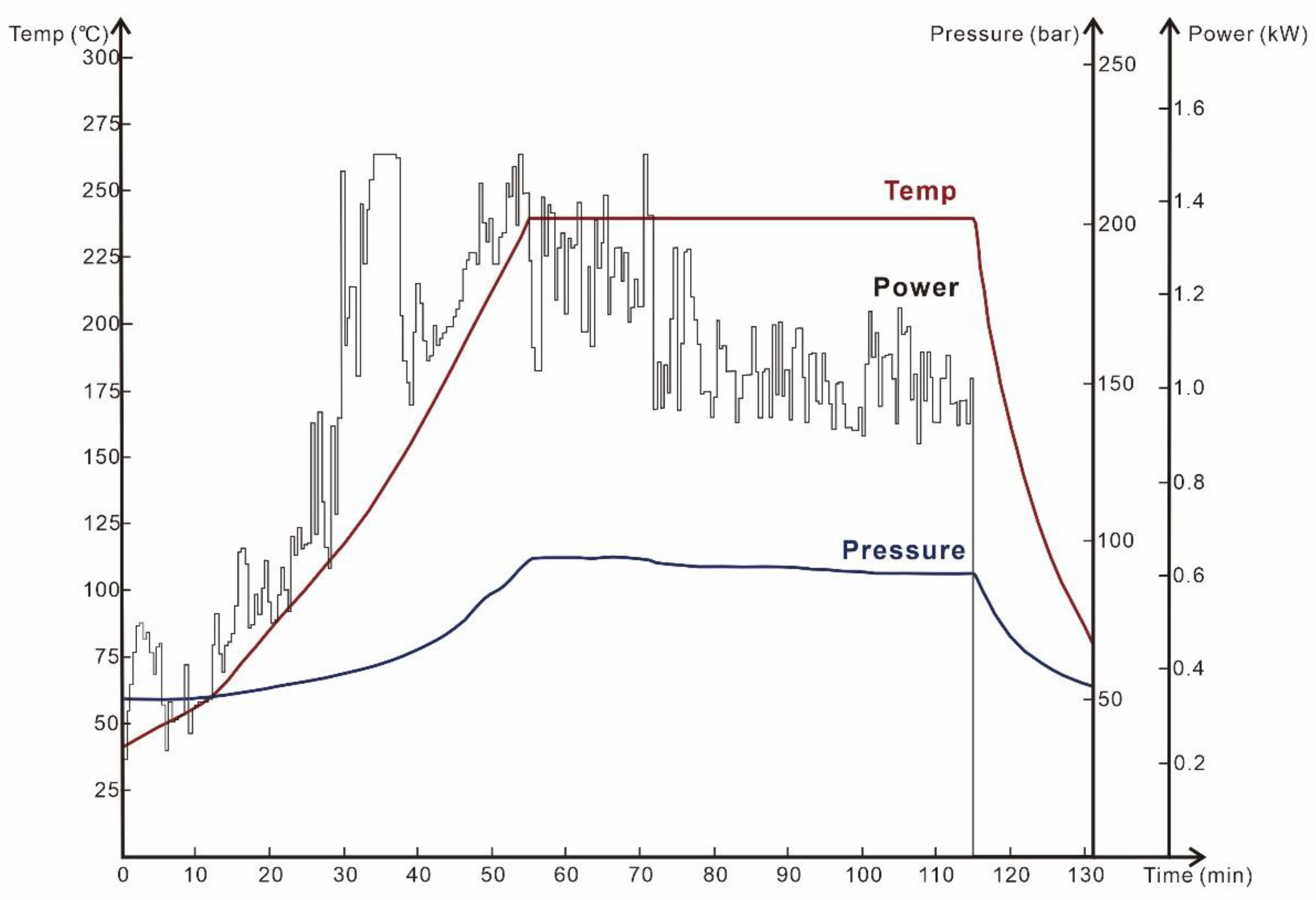
| Step | Time (Min) | Temperature (°C) | Pressure (Bar) | Microwave Power (Watt) |
|---|---|---|---|---|
| 1 | 12 | 60 | 100 | 1000 |
| 2 | 20 | 125 | 100 | 1000 |
| 3 | 8 | 160 | 130 | 1000 |
| 4 | 15 | 240 | 160 | 1200 |
| 5 | 60 | 240 | 160 | 1000 |
| Cooling time | 60 |
| Items | Values/Status | Items | Values/Status |
|---|---|---|---|
| Plasma RF Forward Power | 1340 W | Uptake time | 60 s |
| Nebulizer gas pressure | 26.3 PSI | Wash time | 75 s |
| Coolant gas flow | 13.0 L/min | Dwell time | 7.5 ms |
| Auxiliary gas flow | 1.0 L/min | Number of cycles | 5 |
| Spray chamber temperature | 2 ± 0.1 °C | Nebulizer | Quartz Nebulizer |
| Peristaltic pump speed | 30 RPM | ICP-MS interface | Nickel Xt |
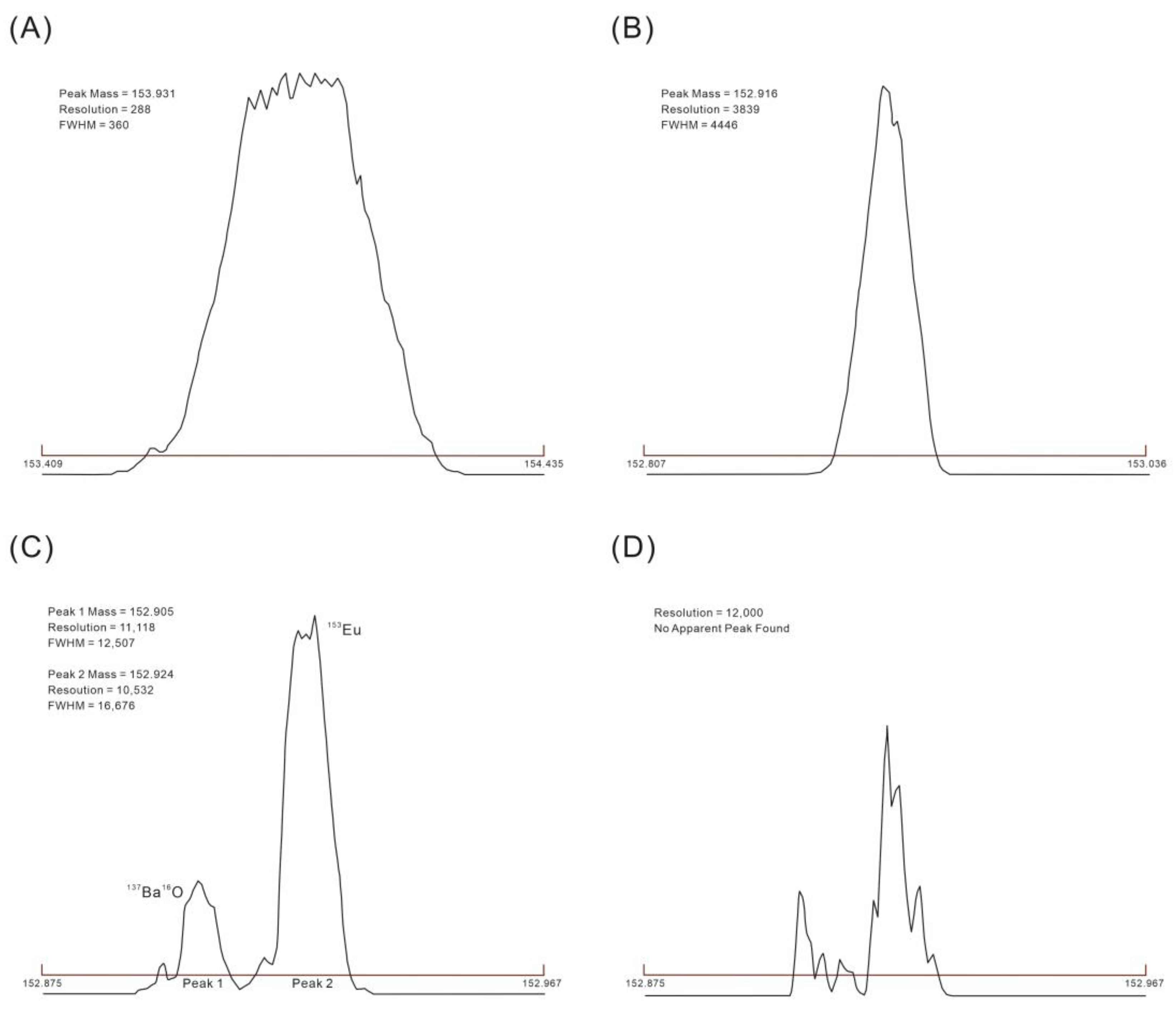
| Element/Interferent | Peak Mass | Required Resolution (amu) |
|---|---|---|
| Eu | 152.921 | |
| 137Ba16O | 152.901 | 7455 |
| 136Ba17O | 152.904 | 8710 |
| 135Ba18O | 152.905 | 9316 |
| 136Ba16O1H | 152.907 | 10,964 |
| 134Ba18O1H | 152.911 | 15,654 |
| 135Ba17O1H | 152.913 | 17,742 |
| 135Ba16O2H | 152.915 | 23,316 |
| 134Ba17O2H | 152.918 | 43,436 |
| Resolution | Linearity (μg/L) | Correlation Coefficients | MDL (μg/L) |
|---|---|---|---|
| 300 | 0–100 | 0.999972 | 0.008 |
| 4000 | 0–100 | 0.999971 | 0.003 |
| 10,000 | 0–100 | 0.999966 | 0.006 |
| 12,000 | 0–100 | np | np |
| Sample ID | Method | Cer | Obs | RE * | SD | RSD | Rec |
|---|---|---|---|---|---|---|---|
| SRM 2682b | Low Resolution | 0.17 | 0.21 | 23.52 | 0.10 | 0.47 | 93.94 |
| Medium Resolution | 0.20 | 17.65 | 0.27 | 1.36 | 99.28 | ||
| High Resolution | 0.18 | 5.88 | 0.14 | 0.80 | 96.14 | ||
| SRM 2685c | Low Resolution | 0.29 | 0.27 | 6.90 | 0.09 | 0.33 | 112.11 |
| Medium Resolution | 0.31 | 6.90 | 0.19 | 0.62 | 105.77 | ||
| High Resolution | 0.30 | 3.45 | 0.37 | 1.22 | 100.10 | ||
| GSR-6 | Low Resolution | 0.51 | 0.52 | 1.96 | 0.28 | 0.53 | 106.95 |
| Medium Resolution | 0.52 | 1.96 | 0.29 | 0.55 | 108.13 | ||
| High Resolution | 0.53 | 3.92 | 0.51 | 0.96 | 94.41 | ||
| GSR-20 | Low Resolution | 0.43 | 0.42 | 2.38 | 0.24 | 0.56 | 98.41 |
| Medium Resolution | 0.42 | 2.38 | 0.61 | 1.46 | 104.06 | ||
| High Resolution | 0.44 | 2.38 | 0.51 | 1.16 | 97.48 |
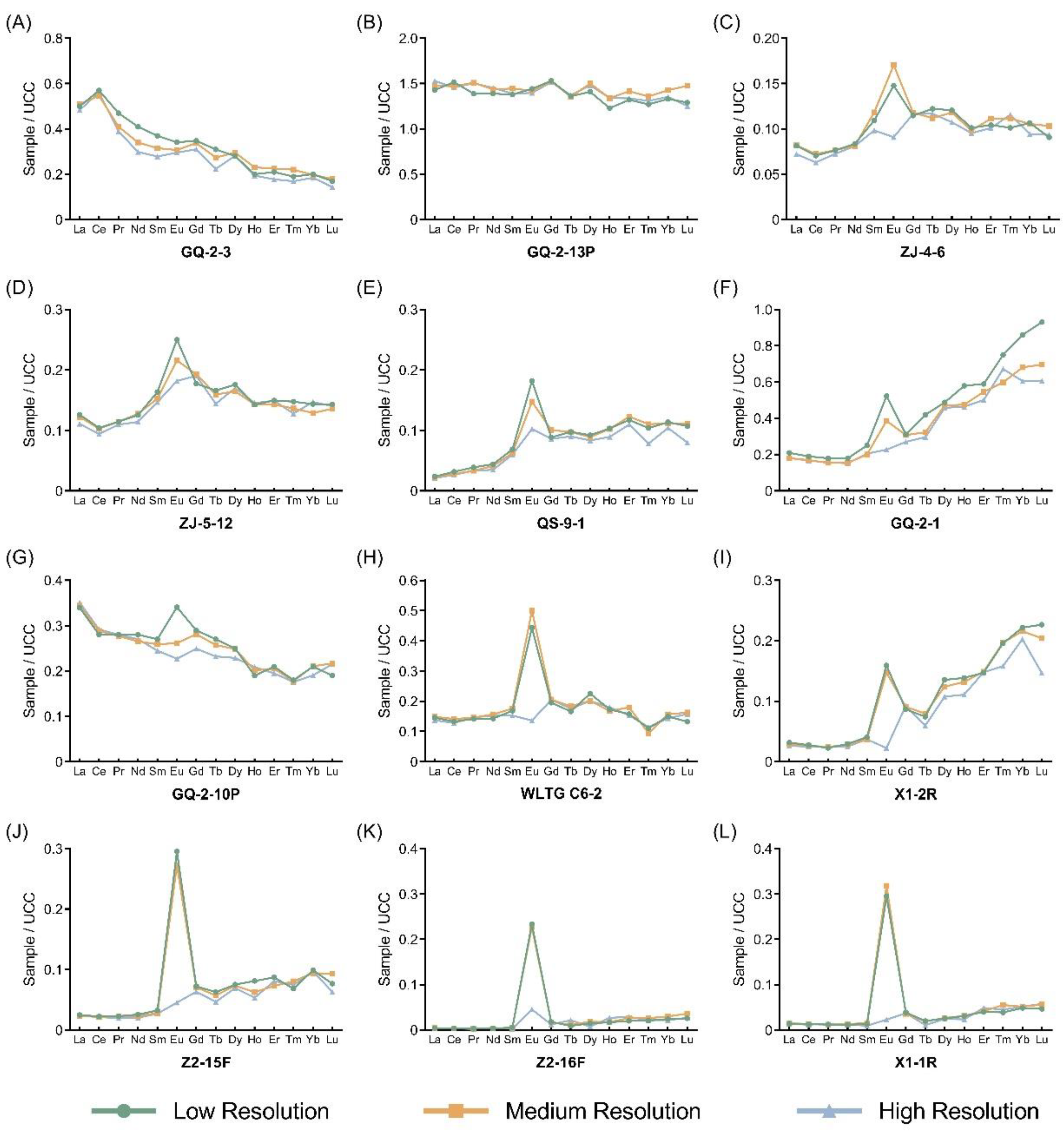
| Sample ID | Method | La | Ce | Pr | Nd | Sm | Eu | Gd | Tb | Dy | Ho | Er | Tm | Yb | Lu |
|---|---|---|---|---|---|---|---|---|---|---|---|---|---|---|---|
| SRM 2682b | LR | 3.75 | 7.30 | 0.68 | 3.36 | 0.57 | 0.21 | 0.58 | 0.08 | 0.43 | 0.08 | 0.27 | 0.03 | 0.21 | 0.03 |
| MR | 4.02 | 7.80 | 0.72 | 3.35 | 0.57 | 0.20 | 0.69 | 0.09 | 0.57 | 0.10 | 0.29 | 0.04 | 0.23 | 0.03 | |
| HR | 3.69 | 7.86 | 0.69 | 3.34 | 0.56 | 0.18 | 0.44 | 0.05 | 0.45 | 0.08 | 0.31 | 0.02 | 0.19 | 0.02 | |
| SRM 2685c | LR | 7.99 | 17.05 | 1.93 | 7.56 | 1.45 | 0.27 | 1.31 | 0.19 | 1.11 | 0.22 | 0.64 | 0.09 | 0.60 | 0.09 |
| MR | 7.84 | 16.49 | 1.94 | 7.52 | 1.38 | 0.31 | 1.26 | 0.19 | 1.21 | 0.24 | 0.69 | 0.09 | 0.65 | 0.10 | |
| HR | 7.81 | 16.62 | 1.92 | 7.53 | 1.22 | 0.30 | 1.24 | 0.17 | 0.90 | 0.20 | 0.66 | 0.08 | 0.59 | 0.08 | |
| GSR-6 | LR | 14.24 | 29.27 | 3.43 | 12.77 | 2.30 | 0.52 | 2.26 | 0.32 | 1.75 | 0.34 | 1.04 | 0.11 | 0.93 | 0.13 |
| MR | 14.09 | 28.80 | 3.36 | 12.81 | 2.28 | 0.52 | 2.21 | 0.32 | 1.79 | 0.33 | 0.96 | 0.15 | 0.86 | 0.14 | |
| HR | 14.39 | 28.50 | 2.99 | 12.49 | 2.23 | 0.53 | 2.23 | 0.34 | 1.69 | 0.26 | 0.83 | 0.14 | 0.79 | 0.11 | |
| GSR-20 | LR | 12.98 | 24.64 | 3.00 | 11.00 | 2.30 | 0.42 | 2.19 | 0.34 | 2.15 | 0.47 | 1.56 | 0.23 | 1.55 | 0.23 |
| MR | 12.82 | 24.91 | 2.94 | 11.16 | 2.26 | 0.42 | 2.42 | 0.36 | 2.31 | 0.51 | 1.51 | 0.22 | 1.54 | 0.23 | |
| HR | 12.69 | 24.45 | 2.77 | 10.44 | 2.09 | 0.44 | 2.20 | 0.29 | 2.19 | 0.41 | 1.34 | 0.20 | 1.36 | 0.20 | |
| WLTG C6-2 | LR | 4.37 | 8.49 | 1.01 | 3.71 | 0.76 | 0.39 | 0.74 | 0.11 | 0.79 | 0.14 | 0.36 | 0.04 | 0.33 | 0.04 |
| MR | 4.46 | 9.04 | 1.03 | 4.07 | 0.79 | 0.44 | 0.78 | 0.12 | 0.71 | 0.13 | 0.41 | 0.03 | 0.34 | 0.05 | |
| HR | 4.12 | 8.18 | 1.04 | 3.95 | 0.69 | 0.12 | 0.78 | 0.11 | 0.70 | 0.14 | 0.35 | 0.04 | 0.32 | 0.05 | |
| ZJ-4-6 | LR | 2.44 | 4.52 | 0.54 | 2.17 | 0.49 | 0.13 | 0.44 | 0.08 | 0.42 | 0.08 | 0.24 | 0.03 | 0.23 | 0.03 |
| MR | 2.46 | 4.63 | 0.54 | 2.11 | 0.53 | 0.15 | 0.45 | 0.07 | 0.41 | 0.08 | 0.26 | 0.04 | 0.23 | 0.03 | |
| HR | 2.17 | 4.04 | 0.51 | 2.11 | 0.44 | 0.08 | 0.44 | 0.07 | 0.38 | 0.08 | 0.23 | 0.04 | 0.21 | 0.03 | |
| ZJ-5-12 | LR | 3.78 | 6.67 | 0.81 | 3.26 | 0.74 | 0.22 | 0.67 | 0.11 | 0.61 | 0.11 | 0.34 | 0.05 | 0.32 | 0.05 |
| MR | 3.66 | 6.60 | 0.81 | 3.32 | 0.69 | 0.19 | 0.73 | 0.10 | 0.58 | 0.11 | 0.33 | 0.05 | 0.28 | 0.04 | |
| HR | 3.33 | 6.02 | 0.78 | 2.97 | 0.66 | 0.16 | 0.72 | 0.09 | 0.60 | 0.12 | 0.34 | 0.04 | 0.32 | 0.04 | |
| QS-9-1 | LR | 0.71 | 2.02 | 0.28 | 1.15 | 0.31 | 0.16 | 0.34 | 0.06 | 0.32 | 0.08 | 0.27 | 0.03 | 0.25 | 0.03 |
| MR | 0.68 | 1.79 | 0.24 | 1.07 | 0.28 | 0.13 | 0.38 | 0.06 | 0.31 | 0.08 | 0.28 | 0.04 | 0.25 | 0.04 | |
| HR | 0.63 | 1.70 | 0.24 | 0.90 | 0.27 | 0.09 | 0.33 | 0.06 | 0.29 | 0.07 | 0.25 | 0.03 | 0.23 | 0.03 | |
| GQ-2-1 | LR | 6.30 | 12.16 | 1.28 | 4.68 | 1.13 | 0.46 | 1.18 | 0.27 | 1.71 | 0.46 | 1.36 | 0.25 | 1.89 | 0.30 |
| MR | 5.42 | 10.86 | 1.10 | 4.02 | 0.90 | 0.34 | 1.17 | 0.21 | 1.65 | 0.38 | 1.26 | 0.20 | 1.50 | 0.22 | |
| HR | 5.43 | 10.69 | 1.12 | 3.95 | 0.92 | 0.20 | 1.03 | 0.19 | 1.60 | 0.37 | 1.15 | 0.22 | 1.33 | 0.19 | |
| GQ-2-3 | LR | 15.00 | 36.48 | 3.34 | 10.66 | 1.67 | 0.30 | 1.32 | 0.20 | 0.98 | 0.16 | 0.48 | 0.06 | 0.44 | 0.05 |
| MR | 15.30 | 34.98 | 2.91 | 8.84 | 1.42 | 0.27 | 1.28 | 0.18 | 1.04 | 0.18 | 0.52 | 0.07 | 0.43 | 0.06 | |
| HR | 14.50 | 35.84 | 2.76 | 7.75 | 1.25 | 0.26 | 1.18 | 0.14 | 0.99 | 0.16 | 0.41 | 0.06 | 0.41 | 0.05 | |
| X1-1R | LR | 0.43 | 0.81 | 0.09 | 0.31 | 0.06 | 0.26 | 0.15 | 0.01 | 0.09 | 0.02 | 0.09 | 0.01 | 0.11 | 0.01 |
| MR | 0.44 | 0.87 | 0.09 | 0.34 | 0.07 | 0.28 | 0.13 | 0.01 | 0.09 | 0.02 | 0.10 | 0.02 | 0.11 | 0.02 | |
| HR | 0.41 | 0.76 | 0.10 | 0.32 | 0.04 | 0.02 | 0.14 | 0.01 | 0.09 | 0.02 | 0.11 | 0.01 | 0.11 | 0.02 | |
| X1-2R | LR | 0.95 | 1.75 | 0.16 | 0.76 | 0.18 | 0.14 | 0.33 | 0.05 | 0.47 | 0.11 | 0.34 | 0.06 | 0.49 | 0.07 |
| MR | 0.87 | 1.70 | 0.17 | 0.74 | 0.17 | 0.13 | 0.34 | 0.05 | 0.43 | 0.11 | 0.34 | 0.06 | 0.47 | 0.07 | |
| HR | 0.79 | 1.60 | 0.18 | 0.65 | 0.17 | 0.02 | 0.35 | 0.04 | 0.38 | 0.09 | 0.34 | 0.05 | 0.45 | 0.05 | |
| Z2-15F | LR | 0.75 | 1.44 | 0.16 | 0.67 | 0.15 | 0.26 | 0.28 | 0.04 | 0.26 | 0.06 | 0.20 | 0.02 | 0.22 | 0.02 |
| MR | 0.71 | 1.37 | 0.16 | 0.61 | 0.13 | 0.24 | 0.27 | 0.04 | 0.26 | 0.05 | 0.17 | 0.03 | 0.21 | 0.03 | |
| HR | 0.71 | 1.37 | 0.14 | 0.53 | 0.12 | 0.04 | 0.24 | 0.03 | 0.24 | 0.04 | 0.19 | 0.02 | 0.21 | 0.02 | |
| Z2-16F | LR | 0.13 | 0.19 | 0.02 | 0.09 | 0.02 | 0.21 | 0.07 | 0.01 | 0.05 | 0.01 | 0.05 | 0.01 | 0.05 | 0.01 |
| MR | 0.14 | 0.22 | 0.02 | 0.10 | 0.02 | 0.20 | 0.06 | 0.01 | 0.06 | 0.01 | 0.06 | 0.01 | 0.07 | 0.01 | |
| HR | 0.10 | 0.21 | 0.02 | 0.13 | 0.01 | 0.04 | 0.05 | 0.01 | 0.03 | 0.02 | 0.07 | 0.01 | 0.05 | 0.01 | |
| GQ-2-10P | LR | 10.20 | 17.92 | 1.99 | 7.28 | 1.22 | 0.30 | 1.10 | 0.17 | 0.88 | 0.15 | 0.48 | 0.06 | 0.46 | 0.06 |
| MR | 10.33 | 18.46 | 1.96 | 6.90 | 1.17 | 0.23 | 1.07 | 0.16 | 0.87 | 0.16 | 0.47 | 0.06 | 0.46 | 0.07 | |
| HR | 10.54 | 18.65 | 1.99 | 7.03 | 1.10 | 0.20 | 0.95 | 0.15 | 0.80 | 0.17 | 0.45 | 0.06 | 0.42 | 0.07 | |
| GQ-2-13P | LR | 42.90 | 97.04 | 9.87 | 36.10 | 6.21 | 1.27 | 5.81 | 0.87 | 4.94 | 0.98 | 3.04 | 0.42 | 2.93 | 0.41 |
| MR | 44.30 | 94.11 | 10.72 | 37.31 | 6.50 | 1.25 | 5.79 | 0.87 | 5.25 | 1.07 | 3.25 | 0.45 | 3.14 | 0.47 | |
| HR | 45.82 | 93.36 | 10.68 | 37.79 | 6.25 | 1.23 | 5.76 | 0.88 | 5.18 | 1.07 | 3.08 | 0.43 | 2.98 | 0.40 |
Disclaimer/Publisher’s Note: The statements, opinions and data contained in all publications are solely those of the individual author(s) and contributor(s) and not of MDPI and/or the editor(s). MDPI and/or the editor(s) disclaim responsibility for any injury to people or property resulting from any ideas, methods, instructions or products referred to in the content. |
© 2023 by the authors. Licensee MDPI, Basel, Switzerland. This article is an open access article distributed under the terms and conditions of the Creative Commons Attribution (CC BY) license (https://creativecommons.org/licenses/by/4.0/).
Share and Cite
Zhao, S.; Liu, J.; Jia, R.; Feng, J.; Teng, K.; Han, Q.; Shang, N. Precise Determination of Eu Concentration in Coal and Sedimentary Rock Samples Using High-Resolution Inductively Coupled Plasma Mass Spectrometry (HR-ICP-MS). Minerals 2024, 14, 8. https://doi.org/10.3390/min14010008
Zhao S, Liu J, Jia R, Feng J, Teng K, Han Q, Shang N. Precise Determination of Eu Concentration in Coal and Sedimentary Rock Samples Using High-Resolution Inductively Coupled Plasma Mass Spectrometry (HR-ICP-MS). Minerals. 2024; 14(1):8. https://doi.org/10.3390/min14010008
Chicago/Turabian StyleZhao, Shumao, Jingjing Liu, Rongkun Jia, Jiawei Feng, Kaiyan Teng, Qiuchan Han, and Niande Shang. 2024. "Precise Determination of Eu Concentration in Coal and Sedimentary Rock Samples Using High-Resolution Inductively Coupled Plasma Mass Spectrometry (HR-ICP-MS)" Minerals 14, no. 1: 8. https://doi.org/10.3390/min14010008
APA StyleZhao, S., Liu, J., Jia, R., Feng, J., Teng, K., Han, Q., & Shang, N. (2024). Precise Determination of Eu Concentration in Coal and Sedimentary Rock Samples Using High-Resolution Inductively Coupled Plasma Mass Spectrometry (HR-ICP-MS). Minerals, 14(1), 8. https://doi.org/10.3390/min14010008

