Abstract
A symmetry group of a spatial graph in is a finite group consisting of orientation-preserving self-diffeomorphisms of which leave setwise invariant. In this paper, we show that in many cases symmetry groups of which agree on a regular neighborhood of are equivalent up to conjugate by rational twists along incompressible spheres and tori in the exterior of .
1. Introduction
There are several approaches to the theory of graphs embedded in the 3-sphere, which are often motivated by molecular chemistry, since the chemical properties of a molecule depend on the symmetries of its molecular bond graph (see, for example, [1]). The symmetries of an abstract graph are described by automorphisms. If is embedded in , some of these automorphisms are induced from self-diffeomorphisms of . For example, [2,3,4,5,6] studied the extendabilities of the automorphisms of , mainly in the case of Möbius ladders, complete graphs, and 3-connected graphs.
Even if the automorphisms of extend to self-diffeomorphisms of , we face the problem of the uniqueness of the extensions. In this situation, it is enough to consider to be a topological space, since we need to study self-diffeomorphisms of which agree on . In the case of a non-torus knot in , there are only finitely many conjugacy classes of symmetries (see [7,8]). For a cyclic period or a free period of a knot in , it is shown in [9,10] that the cyclic group generated by the periodic self-diffeomorphism of defining the symmetry is unique up to conjugate in some cases. Moreover, the author [11] generalized this result to the case of links in . In this paper, we generalize these results to the case of symmetries of spatial graphs in .
Suppose that any component of is a non-trivial graph with no leaf. We see as a geometric simplicial complex, and denote by the underlying topological space of . A tame embedding of into is called a spatial embedding of into , or simply a spatial graph in . We say that is splittable if there exists a sphere in disjoint from that separates the components of . We say that is non-splittable if it is not splittable. Suppose that an incompressible torus in bounds a solid torus V in containing . The core of V is called a companion knot of if it is not ambient isotopic to in V. If there is no companion knot of , every incompressible torus in separates the components of .
Let M be a 3-manifold, and X a submanifold of M. Denote by a regular neighborhood of X, and by the exterior of X. We refer to a finite subgroup G of the diffeomorphism group as a finite group action on M. Finite group actions and on M are equivalent (relative to X) if some conjugates to (and restricts to the identity map on X). A symmetry group G of a spatial graph in is a finite group action on the pair which preserves the orientation of .
Let be the unit sphere in , and the unit circle in the -plane in . Denote by the rotation about the z-axis through angle . Suppose that and , where , is given by and . Let F be a 2-sided sphere or torus embedded in a 3-manifold M. Split M open along F into a (possibly disconnected) 3-manifold . Denote by and the boundary components of originated from F. An n-twist along F is a discontinuous map on M induced from a diffeomorphism on which restricts to the identity map on and the map on conjugate to or according as F is a sphere or not. We say that the n-twist is rational if . Figure 1 illustrates a rotational symmetry of with a setwise invariant sphere S, and its conjugate by a -twist along S.
Figure 1.
Conjugation by a -twist along a sphere S.
Our main theorem is the following:
Theorem 1.1.
Let Γ be a spatial graph in with no companion knot. Suppose that and are symmetry groups of Γ such that
- (1)
- for at least one component γ of Γ,
- (2)
- either Γ is non-splittable, or and are cyclic groups acting on Γ freely, and
- (3)
- and agree on .
Then there is a finite sequence of rational twists along incompressible spheres and tori in whose composition conjugates to a symmetry group of Γ equivalent to relative to .
This paper is arranged as follows. In Section 2, we study symmetry groups of non-splittable spatial graph in terms of the equivariant JSJ decomposition of the exteriors. In Section 3, we establish a canonical version of the equivariant sphere theorem for the exteriors of spatial graphs with cyclic symmetry groups, and prove Theorem 1.1.
2. Non-splittable Case
For a non-splittable spatial graph in with a non-trivial symmetry group, there is a canonical method for splitting equivariantly into geometric pieces by the loop theorem, the Dehn’s lemma, and the JSJ decomposition theorem (see [12,13,14]).
Let M be a Haken 3-manifold with incompressible boundary. The JSJ decomposition theorem and Thurston’s uniformization theorem [15] assert that there is a canonical way of splitting the pair along a disjoint, non-parallel, essential annuli and tori into pieces each of which is one of the following four types:
- (1)
- is an I-bundle over a compact surface and is the -subbundle,
- (2)
- admits a Seifert fibration in which is fibered,
- (3)
- admits a complete hyperbolic structure of finite volume, and
- (4)
- the double of along a non-empty compact submanifold of is of type (3).
For a finite group action G on M, the fixed point set of G is the set of points in M each of which has the stabilizer G. The singular set of G is the set of points in M each of which has a non-trivial stabilizer.
Lemma 2.1.
Let T be a torus embedded in . Suppose that and are orientation-preserving finite group actions on such that
- (1)
- ,
- (2)
- and do not interchange the components of , and
- (3)
- and agree on .
Then a rational twist along a component of conjugates to a finite group action on such that the actions of and on are equivalent relative to .
Proof.
It is enough by Lemma 2.4 of [11] to consider the case where the actions of and on are not free. For each , Theorem 2.1 of [16] implies that admits a -invariant product structure , in which consists of I-fibers. Since each element of takes a meridian of T to a meridian of T, the setwise stabilizer of each I-fiber is a trivial group or a 2-fold cyclic group. Therefore, the quotient space admits the induced I-bundle structure over a 2-orbifold B with underlying surface F and n cone points of index two. Since T is a torus, the orbifold Euler characteristic of B is calculated as follows (see [17]):
Since , F is a sphere and holds.
Denote by the projection map onto the quotient space for each i, and by the T-fiber in . Connect the four cone points on cyclically by a collection of arcs , , , and with disjoint interiors. Each lifts to an essential loop on such that and with are disjoint if , and otherwise meets transversally in a point. Suppose that each is isotopic to a loop on along an annulus saturated by I-fibers in , and to a loop on along an annulus saturated by I-fibers in . Then the endpoints of each is connected by with or 2. Since the underlying surface of is a sphere, is isotopic to relative to the cone points. Therefore, is moved by an -equivariant isotopy relative to so as to agree with on .
The I-bundle structures in and respectively induce orbifold isomorphisms and such that setwise preserves the loop . The restriction of on is isotopic relative to the cone points to the identity map or an involution. Since splits into two disks with no cone point, is deformed by a -equivariant isotopy so that afterwards is the identity map or an involution.
Take an -invariant -bundle structure on with respect to which and are cross sectional, and an -invariant -bundle structure on with respect to which every fiber in splits into two cross sections. Then and induce a -invariant product structure on . Let be the lift of which takes each to . Then we have for some rational numbers m and n.
Assume . Take a rational number so that and are coprime integers. Then holds for some integers and . Let be the covering map given by . Denote by the linear transformation on represented by . Then the map conjugates h to . Thus, h extends to -twist along . Since h conjugates the action of on to itself, conjugates to a finite subgroup of . Therefore, it is enough to consider the case .
It is obvious that holds for any integers k and l. By verifying that, for some choice of k and l, the above argument applied to makes isotopic to relative to , we may assume that they agree.
By considering an isotopy of relative to which takes to on , we may assume that and agree on . Note that splits into disks, and that splits into balls. Then the identity map on extends to an orbifold isomorphism . Since the quotient space of any finite group action on is isomorphic to one of the orbifolds listed on page 191 of [15], and the identity map on extend to an orbifold isomorphism . Thus, and are equivalent relative to . Hence, the conclusion follows. □
Lemma 2.2.
Let M be a Seifert manifold in with non-empty boundary, and F a non-empty closed submanifold of . Suppose that and are finite group actions on such that
- (1)
- and ,
- (2)
- for at least one component T of F,
- (3)
- and induce the same permutation on the set of the components of , and
- (4)
- and agree on F.
Then there is a finite sequence of rational twists along incompressible tori in M whose composition conjugates to a finite group action on such that the actions of and on M are equivalent relative to F.
Proof.
The case and , the case and , and the case and respectively follow from Lemma 2.1 of [11], Lemma 2.1 of this paper, and Theorem 8.1 of [16]. We therefore exclude these cases.
Denote by the system of the exceptional fibers in M. Let be a fibered regular neighborhood of each . It follows from Theorem 2.2 of [16] that each preserves some Seifert fibration of M. Then the uniqueness of a Seifert fibration of M (see VI.18.Theorem of [12]) implies that is isotopic to a setwise -invariant fibered regular neighborhood of the system of exceptional fibers in . Since Lemma 3.1 of [11] implies that the orders of the exceptional fibers are pairwise coprime, we may assume that for each k. Therefore, it is enough by Lemma 2.1 of [11] to consider the case where M is a product -bundle.
It follows from Theorem 2.1 of [16] that M admits a -invariant product structure . If , M admits a -invariant product structure which agrees with on F (see Theorem 2.3 of [16]). If , we see M as the quotient of the double of M along by generated by an orientation-reversing involution, and apply the same argument to the finite group action on , which is the extension of by . Then we obtain a -invariant product structure of M which agrees with on F.
By the uniqueness of the -bundle structure of M (see VI.18.Theorem of [12]), there is a map isotopic to the identity which takes the -bundle structure induced by to the -bundle structure induced by . Modify in by a fiber preserving isotopy in a fibered regular neighborhood of F so as to restrict to the identity map on F. By conjugating by , we may therefore assume that and induce the same -bundle structure of M.
Let be the projection map onto the base surface B. Each induces a finite group action on B. We consider B to be lying on . Then each extends to an action on . Since and agree on , the quotient spaces and are orbifold isomorphic to suborbifolds of the same spherical orbifold listed on page 188 of [15]. We may assume that and are not orientation-preserving, otherwise the conclusion follows from Lemma 3.2 and Remark 3.3 of [11]. Then the assumption implies that each is generated by the reflection of in a loop. Since and permute the components of similarly, consists of loops such that
- (1)
- and interchange and for , and
- (2)
- and setwise preserve for .
Without loss of generality, . Denote by the fixed point circle of the action of each on . Suppose that each is equipped with an orientation, and splits B into two pieces and so that and . We may assume without loss of generality that and for , and that we meets in order as we go along .
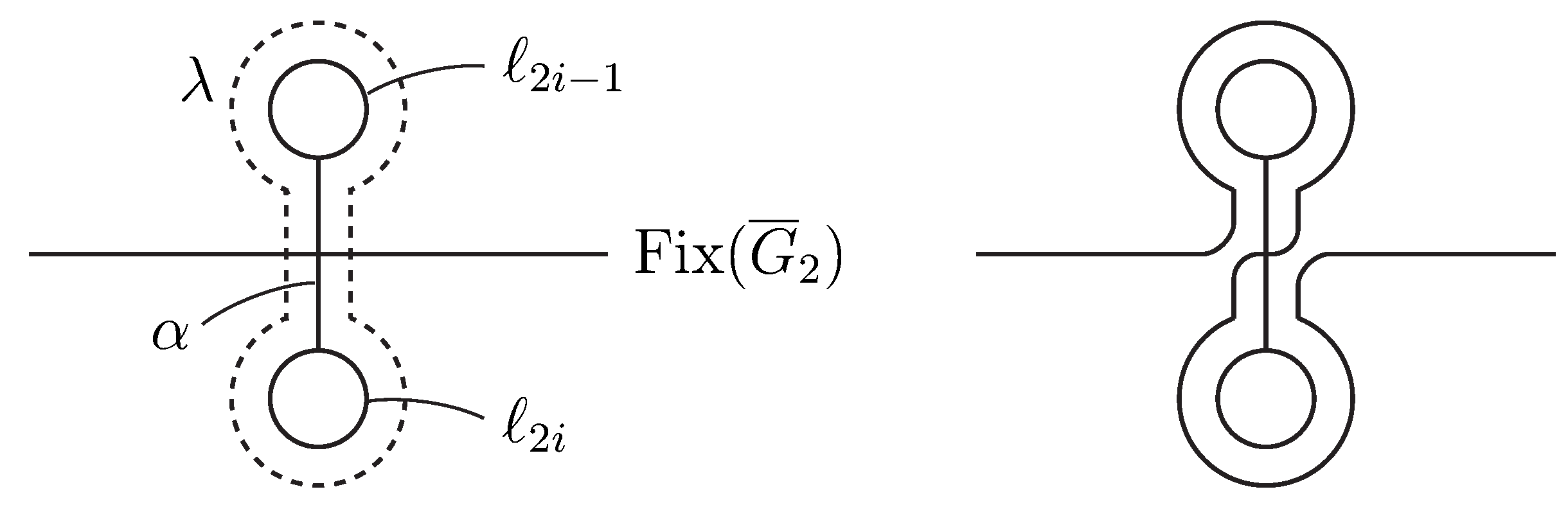
Suppose and for some i. By taking a proper arc on connecting and , we obtain a setwise -invariant arc on B which meets in a point and connects and . Then is modified by the half twist along the loop , denoted by , so that afterwards and , as illustrated in Figure 2. The argument presented for the proof of Lemma 2.1 implies that this modification is realized by a -twist along the torus which conjugates to a subgroup of . We may therefore assume and for .
Figure 2.
Half twist along .
Suppose that and are connected by an arc in . Then is modified by the half twists along the loop so as to meet and in the reverse order, as illustrated in Figure 3, which is realized by the conjugation of by a -twist along the torus , as before. Since every permutation on the set is a product of transpositions, we may assume that meets in order. Moreover, we can change the order in which meets the two points in by the half twists along , which is also realized by a -twist along the torus . We may therefore assume that is equivalent to relative to .
Figure 3.
Half twist along .
Now we may assume . Take a map which restricts to the identity map on F and takes to setwise preserving every -fiber. It is easy to verify that h is extendable to a map in . Hence, the conclusion follows by conjugating by h. □
Lemma 2.3.
Let M be a compact connected 3-manifold in with non-empty boundary whose interior admits a complete hyperbolic structure of finite volume, and F a non-empty closed submanifold of . Suppose that and are finite group actions on such that
- (1)
- and ,
- (2)
- and induce the same permutation on the set of the components of , and
- (3)
- and agree on F.
Then there is a sequence of rational twists along tori in F whose composition conjugates to a finite group action such that the actions of and on M is equivalent relative to F.
Proof.
It follows from Theorem 5.5 of [18] that admits two complete hyperbolic structures of finite volume, one is -invariant and the other is -invariant. Mostow’s rigidity theorem [15] implies that complete hyperbolic structures of finite volume on are unique up to isometry representing the identity map on . We may therefore assume that is endowed with the -invariant hyperbolic structure, and that is conjugate to an isometric action by which is isotopic to the identity map.
Next, we are going to modify h in a regular neighborhood of F so as to restrict to the identity map on F. It follows from Propostition D.3.18 of [19] that F consists of tori. Let be an isotopy from h to the identity map. Denote by the finite group action on whose restriction on is induced from the finite group action on F given by the conjugate of by . In particular, the actions of on and are respectively given by and . Note that preserves the product structure , and that we can embed in so that extends to a finite group action on .
We consider the partition of the set of the components of F into the orbits under the permutation induced by . Suppose that the orbits are represented by . Lemma 2.1 implies that a rational twist along conjugates the setwise stabilizer of in so that the action on is equivalent relative to to the action which preserves the product structure. Suppose that the rational twists along the tori in are equivariantly induced from those along . By conjugating by their composition, it is equivalent relative to to the action which preserves the product structure. This implies that h is modified equivariantly so as to restrict to the identity map on F.
Suppose that and agree on F. Then restricts to the identity map on F. Since the isometry group of is finite (see [15]), Newman’s theorem [20] implies . Hence, and agree on M. This completes the proof. □
Lemma 2.4.
Let M be a compact connected 3-manifold in with non-empty boundary such that the double of M along a non-empty compact submanifold Φ of admits a complete hyperbolic structure of finite volume in its interior. Let F be a closed submanifold of containing Φ. Suppose that and are finite group actions on such that
- (1)
- and ,
- (2)
- and induce the same permutation on the set of the components of , and
- (3)
- and agree on F.
Then there is a finite sequence of rational twists along tori in F whose composition conjugates to a finite group action such that the actions of and on M are equivalent relative to F.
Proof.
We see M as the quotient of by generated by an orientation-reversing involution. Each induces a finite group action on which is an extension of by . As in the proof of Lemma 2.3, we consider endowed with a -invariant hyperbolic structure. Then some , which is isotopic to the identity map, conjugates to an isometric action . Clearly, meets in a totally geodesic surface, and therefore holds.
Suppose that and respectively induce and which agree on F. Then restricts to an isometry on each component of , which is a compact surface of negative Euler characteristic (see Propostition D.3.18 of [19]). Since is trivial in , and agree on . Therefore, [20] implies . Hence, some , which setwise preserves and is isotopic to the identity map, conjugates the action of on M to .
It follows from Proposition D.3.18 of [19] that consists of tori. As in the proof of Lemma 2.3, modify h in by rational twists along tori in so that afterwards h restricts to the identity map on and conjugates the action of on M to . Moreover, we may assume by Lemma 2.3 of [11] that h restricts to the identity map on . Since h extends to an automorphism of which is diffeomorphic outside M, the conclusion follows. □
Proposition 2.5.
Theorem 1.1 is true, if Γ is non-splittable.
Proof.
The equivariant loop theorem (see Chapter VII of [15] and [21]) implies that there is a -invariant system of disjoint disks properly embedded in which splits into pieces with incompressible boundary. The equivariant Dehn’s lemma [21,22] implies that the boundary loops of bound a -invariant system of disjoint disks properly embedded in . Since is non-splittable, is irreducible. Therefore, there is an isotopy of relative to which takes to . Since any finite group action on is orthogonal [15], we may assume that and agree on . Moreover, the induced actions on the balls obtained by splitting along are equivalent relative to the boundary (see [15]). Therefore, it is enough to consider the case where is a Haken manifold with incompressible boundary.
We may assume by the equivariant JSJ decomposition theorem (see Theorem 8.6 of [16]) and by the uniqueness of the JSJ decomposition [13,14] that there is a -invariant and -invariant system of essential annuli and tori in realizing the canonical JSJ decomposition of the pair .
The argument presented for the proof of Proposition 3.10 of [11] implies that some , which is isotopic to the identity map relative to , conjugates to a finite group action which agree with on the annuli in . We may therefore assume that contains no annuli.
The rest of the proof proceeds by induction on the number of tori in . Take a piece attaching . By Lemmas 2.2, 2.3 and 2.4, it is enough to consider the case where agrees with on . Moreover, we may assume by Lemma 2.1 that and agree on the components of each of which is a product I-bundle over a torus. Hence, the conclusion follows by the induction hypothesis. □

3. Possibly Splittable Case
For a symmetry group G of a splittable spatial graph in , there is a setwise G-invariant system of spheres realizing the prime factorization of (see [23]). However, is not unique in contrast to the JSJ decomposition of a Haken 3-manifold. If some component of is setwise invariant and every essential sphere in has a trivial stabilizer, there is a canonical choice of (see [11]). We first prove that this is possible also in the setting of Theorem 1.1.
Lemma 3.1.
Let Γ be a splittable spatial graph in . Suppose that and are symmetry groups of Γ such that
- (1)
- for at least one component γ of Γ,
- (2)
- and are cyclic groups acting on Γ freely, and
- (3)
- and agree on .
Then each admits a setwise -invariant system of disjoint balls in not containing γ such that each realizes the prime factorization of . Moreover, for some choice of and , there is a finite sequence of rational twists along incompressible tori in and a map in which restricts to the identity map on whose composition conjugates the action of on to the action of on .
Proof.
Denote by the non-splittable spatial subgraph of containing which is obtained by the prime factorization of . It follows from the equivariant sphere theorem [23] that each admits a setwise -invariant system of disjoint, non-parallel, essential spheres in realizing the prime factorization. Suppose that each bounds a ball disjoint from . Note that avoids or meets in a trivial 1-string tangle (see [15]).
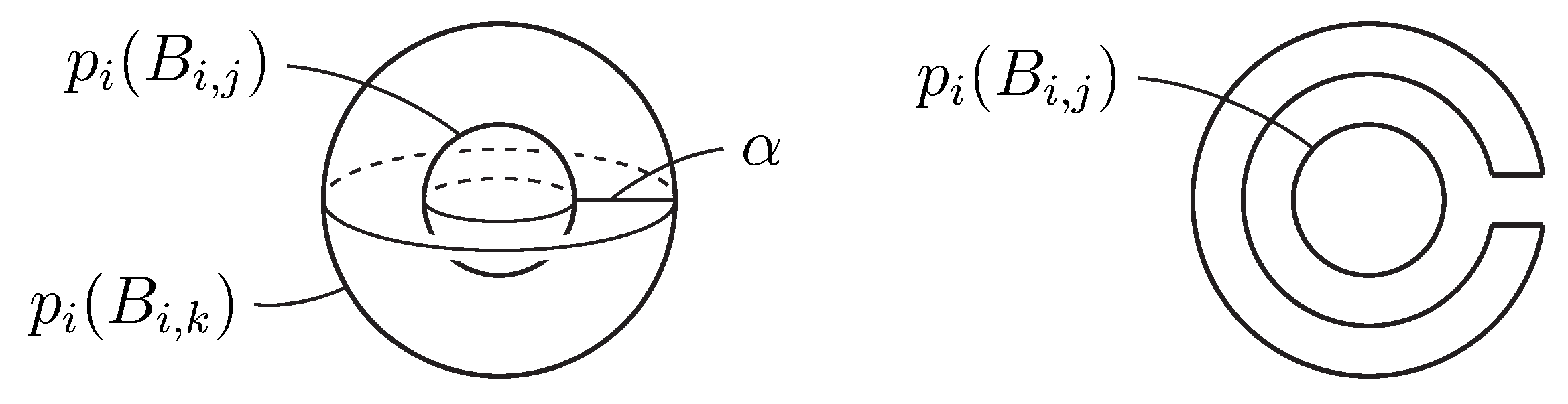
Suppose for some distinct j and k. Denote by the projection map onto the quotient space. Take an arc properly embedded in which connects and . Suppose that lies on if connects and . By replacing with another ball in if necessary, meets in its endpoints. By drilling into along , is deformed to a ball disjoint from , as illustrated in Figure 4 in which the result of the deformation is presented in a cross-sectional view. By a finite repetition of this operation, we obtain a system of disjoint balls. This proves the first half of the lemma. Without loss of generality, for .
Figure 4.
Modification of which makes disjoint from .
Proposition 2.5 implies that there is a finite sequence of rational twists along incompressible tori in whose composition h conjugates to a symmetry group of equivalent to relative to . By a -equivariant isotopy, we may assume that these incompressible tori are disjoint from . Then h restricts to the identity map on . Suppose that realizes the above equivalence of and . Then H takes to . As a consequence of the affirmative answer to the Smith conjecture [15], is either an empty set, a trivial knot, or a Hopf link whose components have different indices. Suppose that the orientation of is induced from the orientation of by H.
Suppose that and are connected by an arc in , and that meets in an arc . Then can be modified by a -equivariant deformation along similar to the inverse of that mentioned above so as to contain . Moreover, it can be deformed along so as to avoid again, as illustrated in Figure 5. Note that this operation changes the order in which the circle in containing meets the balls in .
Figure 5.
Modification of realizing the transposition of and .
Let C be a component of . Without loss of generality, C meets in order, and avoids . Since and agree on , the component of meets possibly not in order. Since every permutation on the set is a product of transpositions realized by the above operation, we may assume that meets in order. Apply this argument to each component of . Since each realizes the prime factorization of , we can modify H by a -equivariant isotopy relative to so that we have and for each j. Thus, H is modified so as to conjugate the action of on to the action of on .
After this modification, H restricts to an orientation-preserving homeomorphism on . Therefore, is ambient isotopic to in . Hence, H can be modified in so as to restrict to the identity map on . This completes the proof. □
Lemma 3.2.
Suppose that and are orientation-preserving finite cyclic group actions on such that
- (1)
- and do not interchange the components of , and
- (2)
- and agree on .
Then a rational twist along conjugates to a finite group action equivalent to relative to .
Proof.
It is enough to consider the case where is not trivial. It follows from the remark after Theorem 8.1 of [16] that admits a -invariant product structure and a -invariant product structure . Since the actions of and on are conjugate to a rotation of (see [15]), each consists of two I-fibers in . Since and agree on , we have .
Denote by the projection map onto the quotient space for each i, and by the -fiber in . Connect the two cone points of by an arc embedded in . Then is a spatial -curve consisting of two vertices on the fixed points and edges each connecting them. Denote by the branched surface consisting of I-fibers in attaching for each i. Then each is an arc connecting the two cone points on . Since the underlying space of is a sphere, is isotopic to relative to the cone points. Therefore, is deformed by a -equivariant isotopy relative to so that . There are two cases depending on whether and are isotopic relative to the endpoints or not.
Assume that and are isotopic relative to the endpoints. Then is deformed by an isotopy relative to so as to agree with on a setwise -invariant tubular neighborhood saturated in the I-bundle structure induced from . Since each meets the solid torus in the system of meridian disks, is moved to by an isotopy relative to . We may therefore assume , and that and agree on . Then the I-bundle structures in and respectively induce the orbifold isomorphisms and such that is isotopic to the identity map by an isotopy relative to the cone points which setwise preserves . Then we can deform by an isotopy on relative to which setwise preserves so that and induce the same -bundle structure on . Hence, the diffeomorphism of which takes to induces the equivalence of and relative to , as required.
Assume that and are not isotopic relative to the endpoints. Let be a lift of an orientation-preserving involution on which interchanges the cone points. Then h is a diffeomorphism isotopic to the identity map which conjugates the action of on to itself and is realized by a -twist along the sphere . We may therefore assume that and are isotopic relative to the endpoints. Hence, the conclusion follows by the argument presented for the previous case. □
Proof of Theorem 1.1.
It is enough by Proposition 2.5 to prove the theorem in the case where is splittable. Then and are cyclic groups acting on freely. We may assume by Lemma 3.1 that there is a setwise -invariant and setwise -invariant system of disjoint balls in not containing such that realizes the prime factorization of , and that and agree on .
Suppose that consists of balls . Each is a non-empty, non-splittable, spatial subgraph of . By applying Proposition 2.5 to the actions of the setwise stabilisers of in and on , we may assume that and agree on . Hence the conclusion follows by applying Lemma 3.2 to the actions of and on equivariantly. □
Remark 3.3.
Theorem 1.1 requires the spatial graph to have no companion knot, and the symmetry groups and of to act on freely if is splittable. These requirements are needed because of the following examples.
- (1)
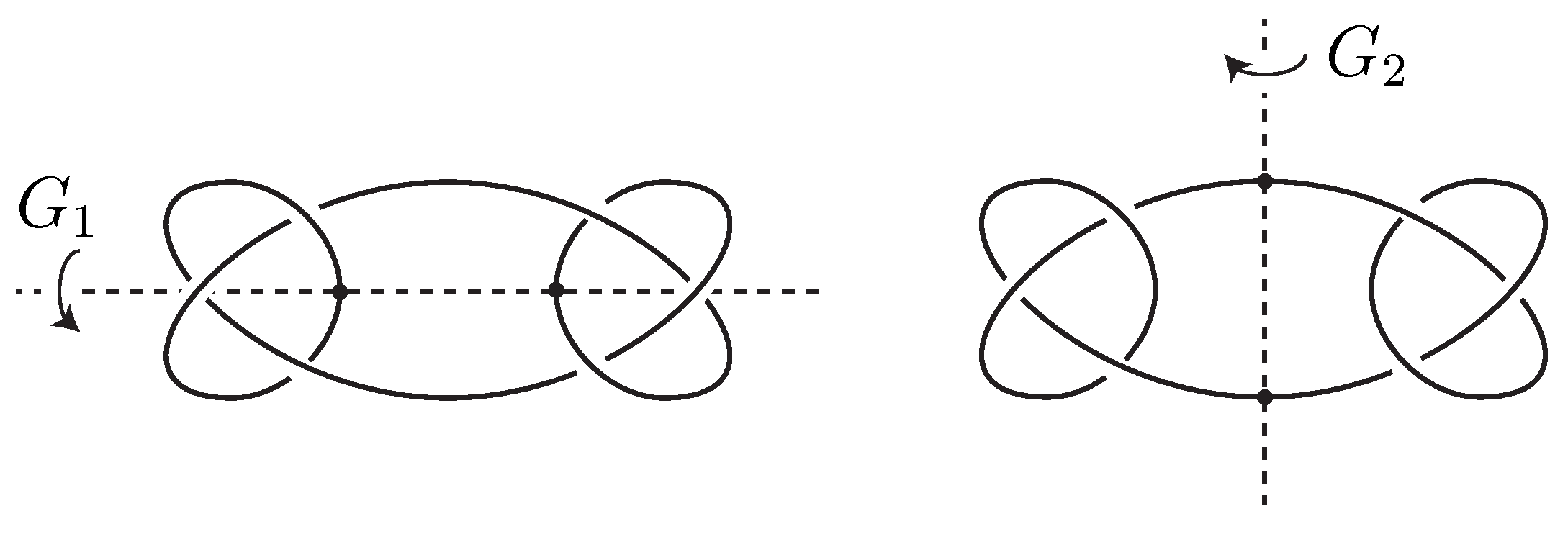
- Suppose that is a granny knot. Then has two companion knots and , both of which are trefoil knots. We obtain , , and a 2-fold composing space by the JSJ decomposition of . Figure 6 illustrates -symmetries and of such that interchanges and but does not. By conjugating by a map in which moves in the longitudinal direction, and are not equivalent but agree on . Moreover, any rational twists along incompressible tori in cannot change the induced symmetries of and , since the trefoil knot exterior is atoroidal.
Figure 6. -symmetries of a spatial graph with companion knots. - (2)
- Suppose that is a spatial graph which splits into non-splittable spatial graphs , and , as illustrated in Figure 7, where is a spatial -curve. According to the choice of two edges of , we obtain a trefoil knot , a figure-eight knot , or their connected sum . Then any map in does not permute these edges. The -symmetries and of illustrated in Figure 7 are not equivalent, since there is no map in which takes to and interchanges and . Moreover, we cannot perform rational twists along incompressible spheres and tori in to make equivalent to , since any setwise -invariant incompressible sphere in separates and .
Figure 7. -symmetries which are not free on a splittable spatial graph.
Acknowledgements
The author would like to thank the referees for helpful comments which improved this paper.
References
- Simon, J. Topological chirality of certain molecules. Topology 1986, 25, 229–235. [Google Scholar] [CrossRef]
- Flapan, E. Symmetries of Möbius ladders. Math. Ann. 1989, 283, 271–283. [Google Scholar] [CrossRef]
- Flapan, E. Rigidity of graph symmetries in the 3-sphere. J. Knot Theor. Ramif. 1995, 4, 373–388. [Google Scholar] [CrossRef]
- Flapan, E.; Naimi, R.; Pommersheim, J.; Tamvakis, H. Topological symmetry groups of graphs embedded in the 3-sphere. Comment. Math. Helv. 2005, 80, 317–354. [Google Scholar] [CrossRef]
- Flapan, E.; Naimi, R.; Tamvakis, H. Topological symmetry groups of complete graphs in the 3-sphere. J. London Math. Soc. 2006, 73, 237–251. [Google Scholar] [CrossRef]
- Noda, C. The topological symmetry group of a canonically embedded complete graph in S3. Tokyo J. Math. 1997, 20, 45–50. [Google Scholar] [CrossRef]
- Flapan, E. Infinitely periodic knots. Cana. J. Math. 1985, 37, 17–28. [Google Scholar] [CrossRef]
- Flapan, E. The finiteness theorem for symmetries of knots and 3-manifolds with nontrivial characteristic decompositions. Topol. Appl. 1986, 24, 123–131. [Google Scholar] [CrossRef]
- Boileau, M.; Flapan, E. Uniqueness of free actions on S3 respecting a knot. Can. J. Math. 1987, 39, 969–982. [Google Scholar] [CrossRef]
- Sakuma, M. Uniqueness of symmetries of knots. Math. Z. 1986, 192, 225–242. [Google Scholar] [CrossRef]
- Ikeda, T. Finite group actions on homologically peripheral 3-manifolds. Math. Proc. Cambridge Philos. Soc. 2011, 151, 319–337. [Google Scholar] [CrossRef]
- Jaco, W. Lectures on three manifold topology; CBMS Regional Conference Series in Mathematic 43; American Mathematical Society: Providence, RI, USA, 1980. [Google Scholar]
- Jaco, W.; Shalen, P. Seifert fibered spaces in 3-manifolds; Memoirs of the American Mathematical Society 220: Providence, RI, USA, 1979. [Google Scholar]
- Johannson, K. Homotopy equivalences of 3-manifolds with boundaries; Lecture Notes in Mathmatics 761; Springer: Berlin, Germany, 1979. [Google Scholar]
- Morgan, J.W.; Bass, H. (Eds.) The Smith conjecture; Pure and Applied Mathematics 112; Academic Press Inc.: Orlando, FL, USA, 1984. [Google Scholar]
- Meeks, W.H.; Scott, P. Finite group actions on 3-manifolds. Invent. Math. 1986, 86, 287–346. [Google Scholar] [CrossRef]
- Scott, P. The geometries of 3-manifolds. Bull. Lond. Math. Soc. 1984, 15, 401–487. [Google Scholar] [CrossRef]
- Dinkelbach, J.; Leeb, B. Equivariant Ricci flow with surgery and applications to finite group actions on geometric 3-manifolds. Geom. Topol. 2009, 13, 1129–1173. [Google Scholar] [CrossRef]
- Benedetti, R.; Petronio, C. Lectures on hyperbolic geometry; Universitext; Springer-Verlag: Berlin, Germany, 1992. [Google Scholar]
- Newman, W.H.A. A theorem on periodic transformations of spaces. Quart. J. Math. 1931, 2, 1–8. [Google Scholar] [CrossRef]
- Meeks, W.H.; Yau, S.T. The equivariant Dehn’s lemma and loop theorem. Comment. Math. Helvetici 1981, 56, 225–239. [Google Scholar] [CrossRef]
- Edmonds, A.L. A topological proof of the equivariant Dehn lemma. Trans. Am. Math. Soc. 1986, 297, 605–615. [Google Scholar] [CrossRef]
- Plotnick, S.P. Finite group actions and nonseparating 2-spheres. Proc. Am. Math. Soc. 1984, 90, 430–432. [Google Scholar]
© 2012 by the author; licensee MDPI, Basel, Switzerland. This article is an open access article distributed under the terms and conditions of the Creative Commons Attribution license (http://creativecommons.org/licenses/by/3.0/.)