Skip to Content
SymmetrySymmetry
  • Article
  • Open Access

23 August 2011

Squaring the Circle and Cubing the Sphere: Circular and Spherical Copulas

and
Department of Statistics, University of Washington, Box 354322, Seattle, WA 98195-4322, USA
*
Author to whom correspondence should be addressed.
This article belongs to the Special Issue Symmetry in Probability and Inference

Abstract

Do there exist circular and spherical copulas in R d ? That is, do there exist circularly symmetric distributions on the unit disk in R 2 and spherically symmetric distributions on the unit ball in R d , d 3 , whose one-dimensional marginal distributions are uniform? The answer is yes for d = 2 and 3, where the circular and spherical copulas are unique and can be determined explicitly, but no for d 4 . A one-parameter family of elliptical bivariate copulas is obtained from the unique circular copula in R 2 by oblique coordinate transformations. Copulas obtained by a non-linear transformation of a uniform distribution on the unit ball in R d are also described, and determined explicitly for d = 2 .

1. Introduction

Do there exist spherically symmetric distributions on the closed unit ball B d in R d that have uniform one-dimensional marginal distributions on [ 1 , 1 ] ? A distribution on B d with this property may be said to “square the circle” when d = 2 and to “cube the sphere” when d 3 .
The cumulative distribution function (cdf) of a multivariate distribution on the unit cube [ 0 , 1 ] d whose marginal distributions are uniform [ 0 , 1 ] is commonly called a copula; see Nelsen [1] for an accessible introduction to this topic. However, although it is customary to confine attention to distributions on the unit cube, our interest is in spherically symmetric (= orthogonally invariant) distributions on B d with uniform marginal distributions. Therefore we take “copula” to mean a multivariate cdf on the centered cube C d : = [ 1 , 1 ] d with uniform [ 1 , 1 ] marginals.
For d = 2 (resp., d 3 ), such a copula, if it exists, will be called a circular copula (resp., spherical copula) if it is the cdf of a circularly symmetric (resp., spherically symmetric) distribution on the unit disk B 2 (resp., unit ball B d ).
It will be noted in Section 2 and Section 3 that circular and spherical copulas are unique if they exist, but exist only for dimensions d = 2 and d = 3 . The proof of non-existence for d 4 is remarkably simple. Explicit expressions for these copulas are given in Section 3 and Section 4 respectively.
In Section 5, a new one-parameter family of bivariate copulas called elliptical copulas is obtained from the unique circular copula in R 2 by oblique coordinate transformations. Finally, in Section 6, copulas obtained by a non-linear transformation of a uniform distribution on the unit ball in R d are described, and determined explicitly for d = 2 .

2. Uniqueness and Existence of Circular and Spherical Copulas

Proposition 2.1.
Circular and spherical copulas are unique if they exist. (This result is well-known (e.g., Feller [2], pp. 31–33, who uses “random direction” to indicate the uniform distribution of U B 3 ), and reappears frequently (e.g., Arellano-Valle [3], Theorem 3.1). The essence of the result goes back at least to Schoenberg [4].)
Proof. 
If a circular or spherical copula exists on C d , it is the cdf of a random vector Z ( Z 1 , , Z d ) with a spherically symmetric distribution on B d and with each Z i uniform [ 1 , 1 ] . The latter implies that Z has no atom at the origin, i.e., P [ Z = 0 ] = 0 , so we may consider the “polar coordinates” representation Z = R · U , where R = Z 1 and U = Z / Z . It is well known (e.g., Cambanis et al. [5], Lemmas 1 and 2) that the random unit vector U ( U 1 , , U d ) is independent of R and is uniformly distributed on the unit sphere B d , which implies that each U i 2 Beta ( 1 / 2 , ( d 1 ) / 2 ) . Since Z i = R U i , we have that
log ( Z i 2 ) = log ( R 2 ) + log ( U i 2 ) .
Because R and U i are independent, it follows that the characteristic function of log ( R 2 ) is the quotient of the characteristic functions of log ( Z i 2 ) and log ( U 1 2 ) . Thus the distribution of log ( R 2 ) , and therefore that of R, is uniquely determined by the distributions of Z i 2 and U i 2 , which are already specified above. Thus the the joint distribution of ( R , U ) is uniquely determined, hence so is the distribution of Z, hence so its cdf = copula. □
The existence of spherical copulas is easy to determine in three or more dimensions:
Proposition 2.2.
Spherical copulas do not exist for d 4 . For d = 3 , the unique spherical copula is generated by the uniform distribution on the unit sphere B 3 : = { ( x 1 , x 2 , x 3 ) x 1 2 + x 2 2 + x 3 2 = 1 } .
Proof. 
Let Z be as in the proof of Proposition 2.1. Then
1 3 = E ( Z i 2 ) = E ( R 2 ) E ( U i 2 ) 1 d
since Z i uniform [ 1 , 1 ] , 0 R 1 , and U i 2 Beta ( 1 / 2 , ( d 1 ) / 2 ) . Thus d 3 , so a spherical copula cannot exist when d 4 .
Furthermore, if a spherical copula is to exist for d = 3 , it follows from (2) that its generating random vector Z B 3 must satisfy E ( R 2 ) = 1 , hence R = 1 with probability one. This can occur only if Z is uniformly distributed on the unit sphere B 3 . But it is well known (this follows from the fact that the area of a spherical zone is proportion to its altitude—cf. Feller [2], Proposition (i), p. 30) that this distribution does indeed have uniform marginal distributions on [ 1 , 1 ] , hence generates the unique spherical copula for d = 3 . □

3. The Bivariate Case: The Unique Circular Copula

The following three questions constitute an engaging classroom exercise.
Question 1. Let ( X , Y ) be a random vector uniformly distributed on the unit disk (= ball) B 2 in R 2 . Find the marginal probability distributions of X and Y.
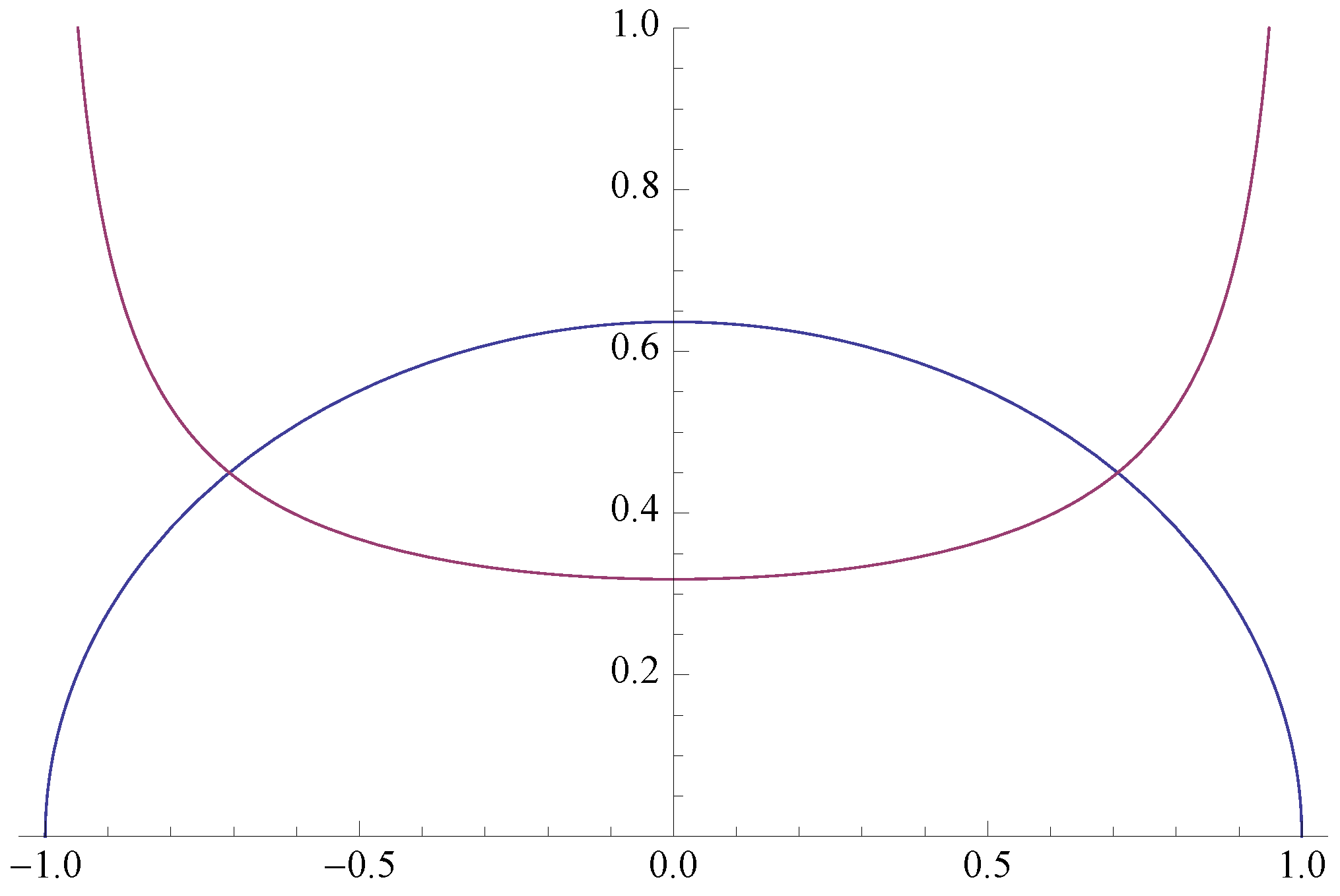
Answer: One can easily show that X has the “semi-circular” probability density function (pdf) given by
f ( x ) = 2 π 1 x 2 , 1 x 1 .
(See Figure 1.) By symmetry, Y has the same pdf as X.
Figure 1. The densities (3) (lower, blue) and (4) (upper, purple).
Question 2. Let ( X , Y ) be a random vector uniformly distributed on the unit circle B 2 in R 2 . Find the marginal probability distributions of X and Y.
Answer: We can represent ( X , Y ) as ( cos Θ , sin Θ ) where Θ uniform [ 0 , 2 π ) . It follows readily that X has pdf
f ( x ) = 1 π 1 x 2 , 1 < x < 1 .
(See Figure 1.) By symmetry, Y has the same pdf as X.
In both cases, the joint distribution of ( X , Y ) is circularly symmetric, that is, invariant under all orthogonal transformations of R 2 . A comparison of the shapes of the pdfs in Figure 1 suggest a third question:
Question 3. Does a circularly symmetric bivariate distribution with uniform [ 1 , 1 ] marginals exist on B 2 ? If so, it determines a circular copula on C 2 , which is unique by Proposition 2.1. This also follows from uniqueness results for the Abel transform; see, e.g., Bracewell [6].
Answer: Optimistically, let’s seek an absolutely continuous solution. That is, we seek a bivariate pdf on B 2 of the form
f ( x , y ) = g ( x 2 + y 2 )
such that the marginal pdf
f ( x ) 1 x 2 1 x 2 f ( x , y ) d y , 1 < x < 1
is constant in x. Here g is a nonnegative function on ( 0 , 1 ) that must satisfy
2 π 0 1 r g ( r 2 ) d r = 1
in order that B 2 f ( x , y ) d x d y = 1 (transform to polar coordinates: ( x , y ) ( r , θ ) ).
To determine a suitable g, first set h ( t ) = g ( 1 t ) , then let u = y / 1 x 2 to obtain
f ( x ) = 1 x 2 1 x 2 h ( 1 x 2 y 2 ) d y = 1 x 2 1 1 h ( ( 1 u 2 ) ( 1 x 2 ) ) d u = 2 1 x 2 0 1 h ( ( 1 u 2 ) ( 1 x 2 ) ) d u .
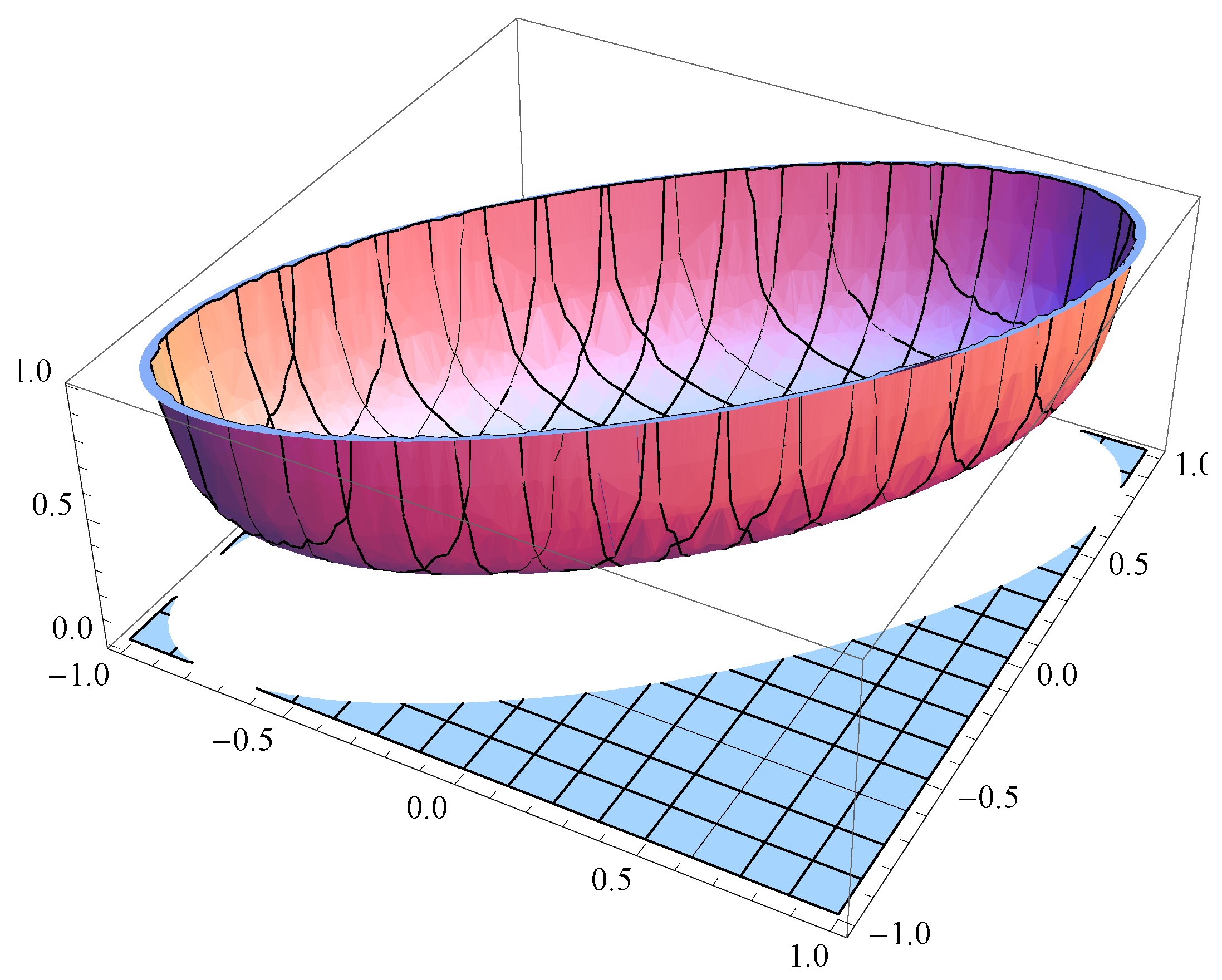
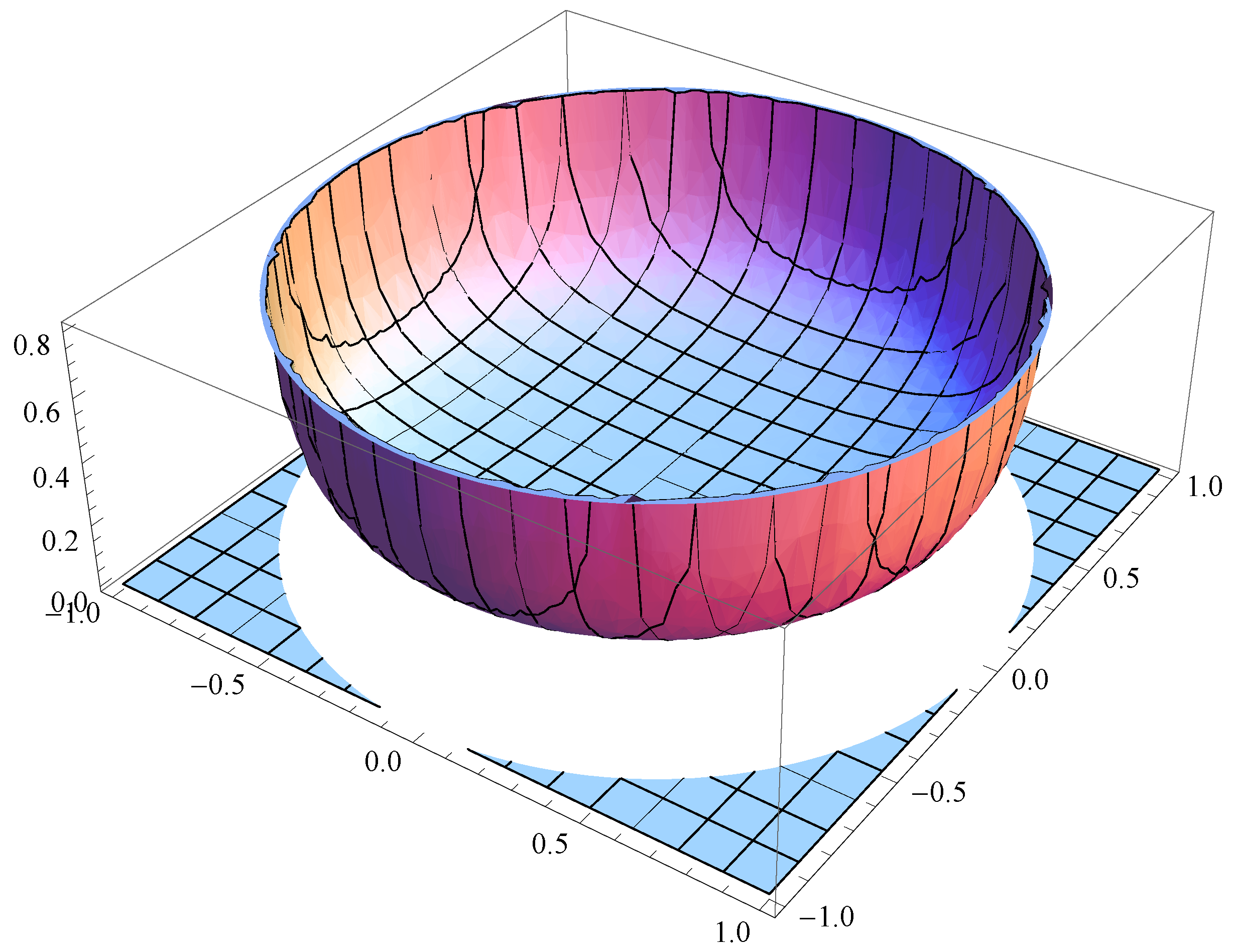
If we take h ( t ) = c t 1 / 2 then clearly f ( x ) does not depend on x, and choosing c = 1 / 2 π satisfies (5). Thus the bivariate pdf (see Figure 2)
f ( x , y ) = 1 2 π 1 x 2 y 2 , x 2 + y 2 < 1
determines a circularly symmetric bivariate distribution on B 2 and yields the desired circular copula.
Figure 2. Circularly symmetric bivariate density (6) on B 2 .
Question 4. Having determined the unique circularly symmetric distribution (6) on B 2 with uniform marginals, what is the corresponding cdf F ( x , y ) , that is, what is the corresponding circular copula?
Answer (see Theorem 3.1): The circular symmetry of ( X , Y ) implies that its distribution is invariant under sign changes, i.e., ( X , Y ) = d ( ± X , ± Y ) . By the following lemma, the cdf F ( x , y ) P [ X x , Y y ] on C 2 [ 1 , 1 ] 2 can be expressed in terms of F 0 ( x , y ) , its truncation to the first quadrant:
F 0 ( x , y ) P [ 0 X x , 0 Y y ]
for 0 x , y 1 , and also in terms of the complementary cdf F ¯ ( x , y ) P [ X > x , Y > y ] for 0 x , y 1 . Because ( X , Y ) = d ( ± X , ± Y ) and has uniform [ 1 , 1 ] marginals,
F 0 ( x , y ) = P [ 0 X 1 , 0 Y 1 ] P [ X > x , 0 Y 1 ] P [ 0 X 1 , Y > y ] + P [ X > x , Y > y ] = 1 4 1 x 4 1 y 4 + F ¯ ( x , y ) = x + y 1 4 + F ¯ ( x , y ) , 0 x , y 1 .
Lemma 3.1.
Let ( X , Y ) be a bivariate random vector on C 2 with uniform [ 1 , 1 ] marginal distributions and sign-change invariance, i.e., ( X , Y ) = d ( ± X , ± Y ) . Then for ( x , y ) C 2 ,
F ( x , y ) = x + y + 1 4 + σ ( x y ) F 0 ( | x | , | y | )
= x + y + 1 4 + σ ( x y ) | x | + | y | 1 4 + F ¯ ( | x | , | y | )
where σ ( w ) = sign ( w ) if w 0 and σ ( 0 ) = 0 .
Proof. 
To obtain (9), consider four cases:
Case 1: 0 x , y 1 . Because ( X , Y ) is sign-change invariant and has uniform [ 1 , 1 ] marginals,
F ( x , y ) = P [ 0 < X x , 0 < Y y ] + P [ 0 < X x , Y 0 ] + P [ X 0 , 0 < Y y ] + P [ X 0 , Y 0 ] = F 0 ( x , y ) + x 4 + y 4 + 1 4 = x + y + 1 4 + σ ( x y ) F 0 ( | x | , | y | ) .
Case 2: 1 x 0 y 1 . Similarly,
F ( x , y ) = P [ X 0 , 0 < Y y ] P [ x < X 0 , 0 Y y ] + P [ X 0 , Y 0 ] P [ x < X 0 , Y 0 ] = y 4 F 0 ( x , y ) + 1 4 ( x ) 4 = x + y + 1 4 + σ ( x y ) F 0 ( | x | , | y | ) .
Case 3: 1 y 0 x 1 . Similarly,
F ( x , y ) = P [ 0 < X x , Y 0 ] P [ 0 X x , y < Y 0 ] + P [ X 0 , Y 0 ] P [ X 0 , y < Y 0 ] = x 4 F 0 ( x , y ) + 1 4 ( y ) 4 = x + y + 1 4 + σ ( x y ) F 0 ( | x | , | y | ) .
Case 4: 1 x , y 0 . Similarly,
F ( x , y ) = P [ X 0 , Y 0 ] P [ x < X 0 , Y 0 ] P [ X 0 , y < Y 0 ] + P [ x < X 0 , y < Y 0 ] = 1 4 ( x ) 4 ( y ) 4 + F 0 ( x , y ) = x + y + 1 4 + σ ( x y ) F 0 ( | x | , | y | ) .
Finally, (10) follows from (9) by (8). □
Thus, to determine the circular copula F ( x , y ) for the pdf (6), it suffices to determine the complementary cdf F ¯ ( x , y ) for 0 x , y 1 and apply (10). Because F ¯ ( x , y ) = 0 when x 2 + y 2 1 , we need only consider the case where x 2 + y 2 < 1 .
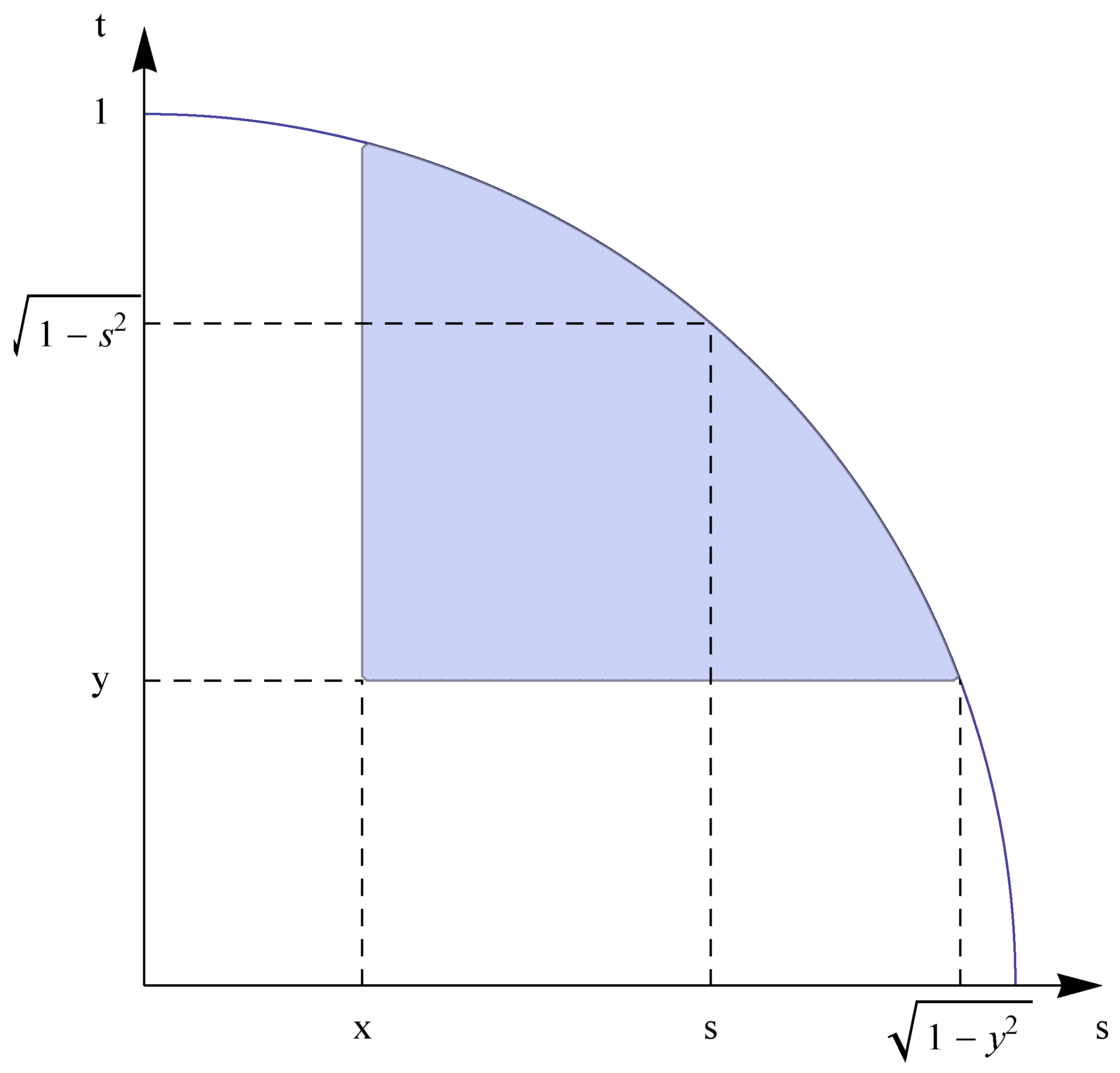
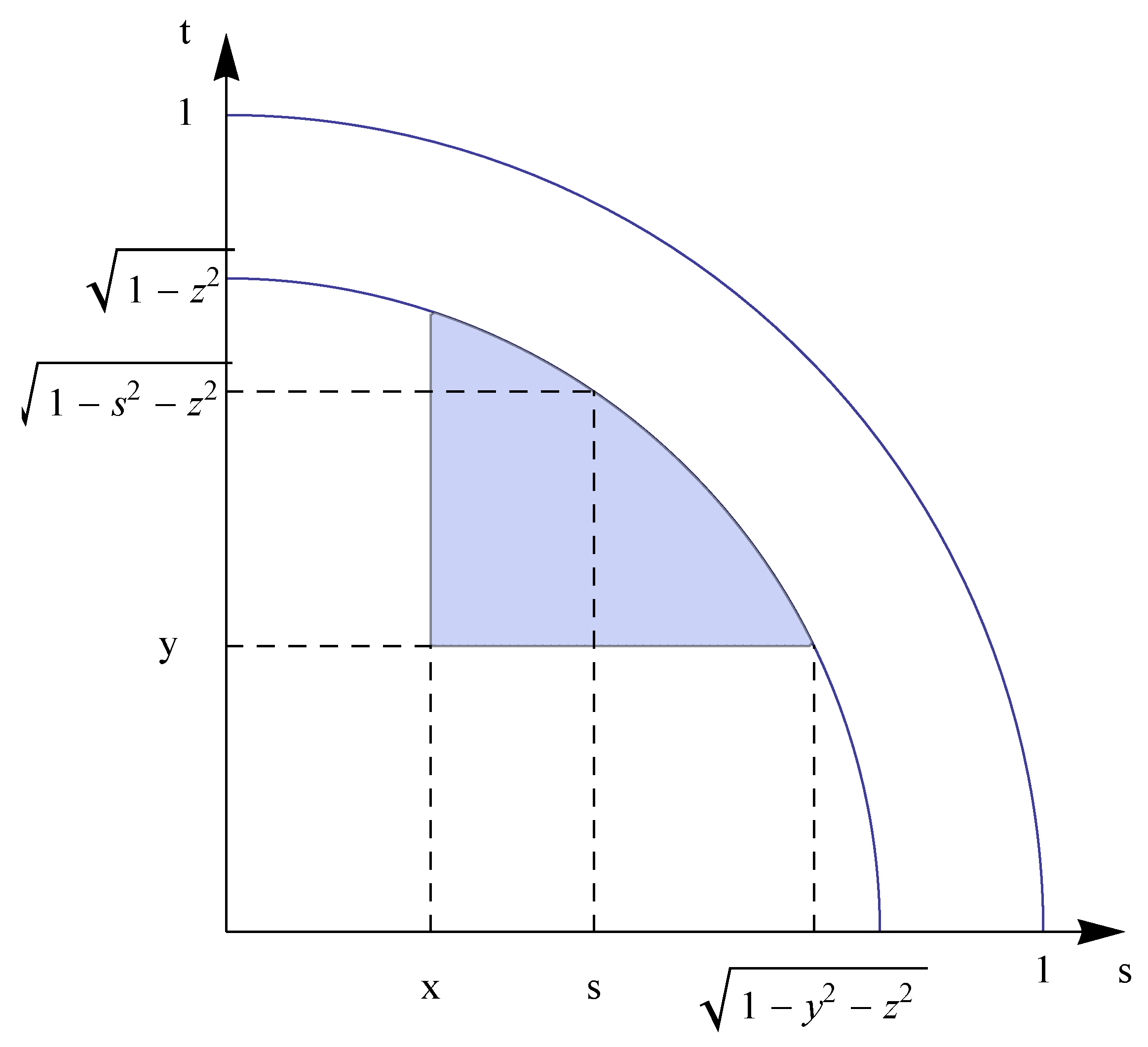
First approach: When 0 x , y 1 and x 2 + y 2 < 1 , F ¯ ( x , y ) can be expressed as follows. By using Figure 3 we find that
F ¯ ( x , y ) = 1 2 π x 1 y 2 y 1 s 2 1 1 s 2 t 2 d t d s = 1 2 π x 1 y 2 y 1 s 2 1 ( 1 t 2 1 s 2 ) d t 1 s 2 d s = 1 2 π x 1 y 2 y 1 s 2 1 d v 1 v 2 d s = 1 2 π x 1 y 2 π 2 arcsin y 1 s 2 d s .
Figure 3. Region of integration, 2-dimensional case.
However, we were unable to evaluate this integral directly.
Second approach: Fortunately, we have found a solution in the molecular biology and optics literatures, where the problem of finding the area of the intersection of two spherical caps on the unit sphere B 3 has been addressed. The following general result is due to Tovchigrechko and Vakser [7] and also appears in Oat and Sander [8].
Lemma 3.2.
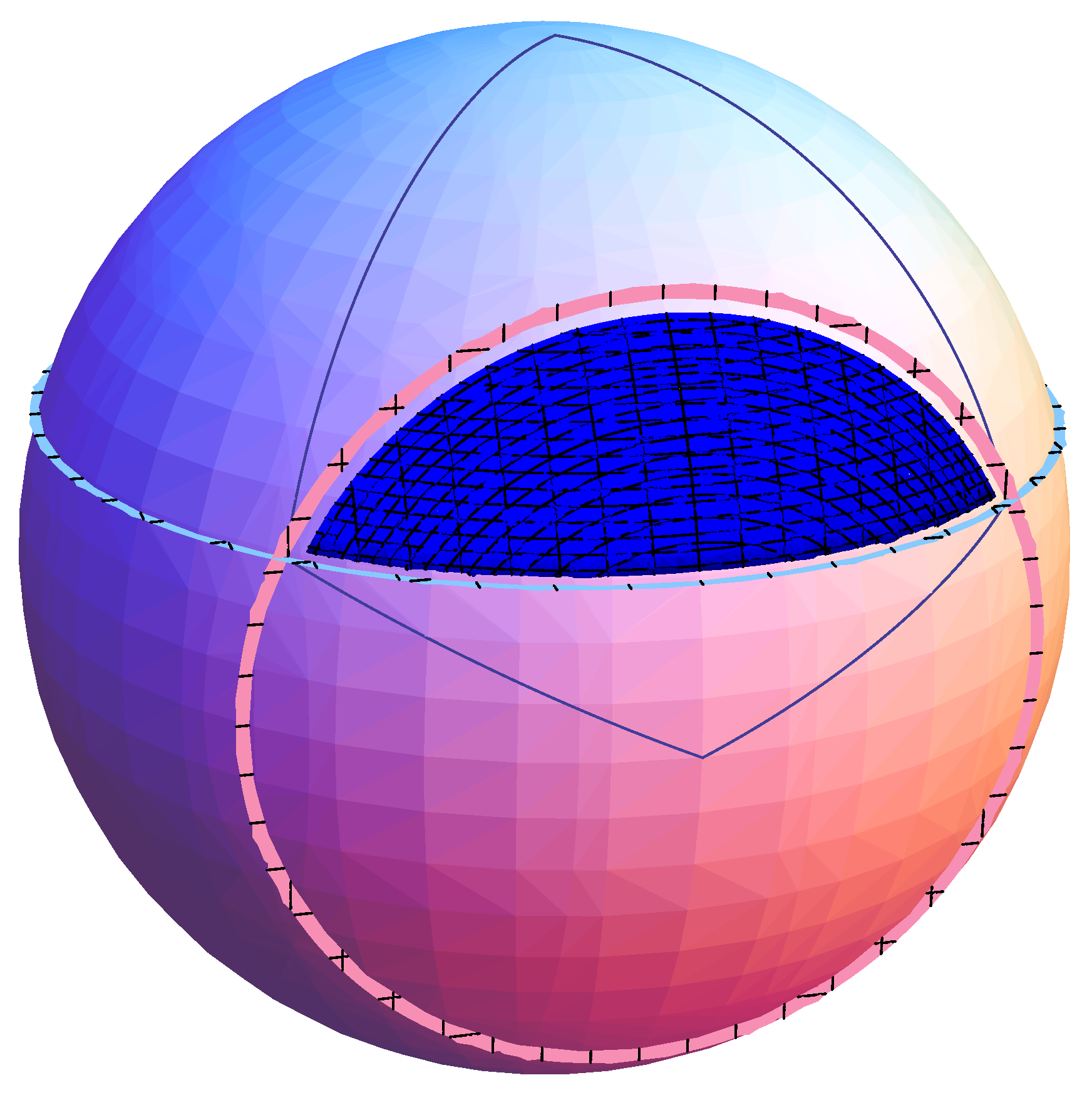
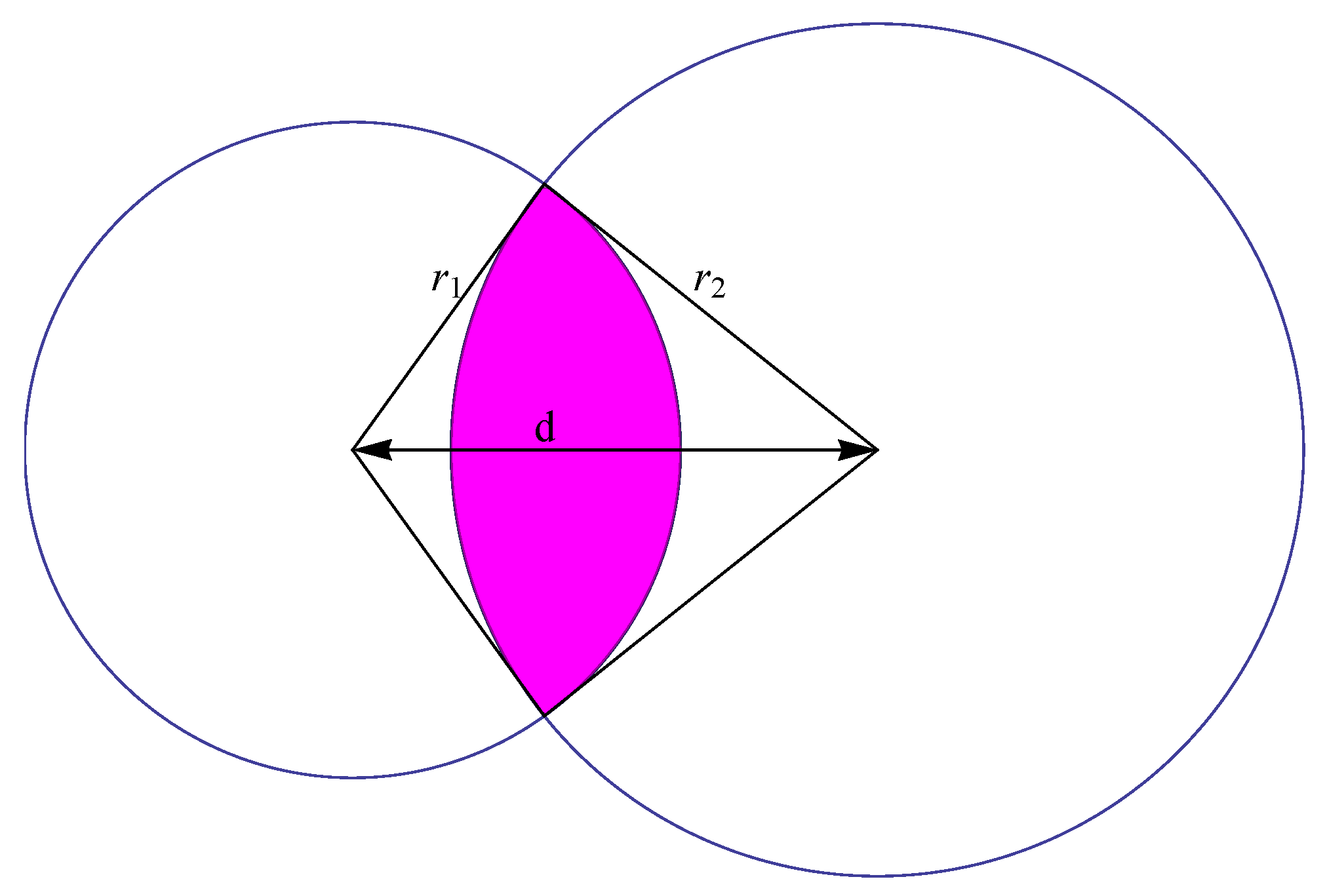
Let S 1 and S 2 be spherical caps on B 3 . Let r 1 and r 2 denote their angular radii and let d denote the angular distance between their centers ( 0 < d π ). Assume that 0 < r 1 , r 2 π / 2 and d r 1 + r 2 , so that the intersection S 1 S 2 and consists of a single “diangle”; (see Figure 4 and Figure 5.) Then Area ( S 1 S 2 ) is given by
A ( r 1 , r 2 ; d ) = 2 π 2 π cos ( r 1 ) 2 π cos ( r 2 ) 2 arccos cos ( d ) cos ( r 1 ) cos ( r 2 ) sin ( r 1 ) sin ( r 2 ) + 2 cos ( r 1 ) arccos cos ( d ) cos ( r 1 ) cos ( r 2 ) sin ( d ) sin ( r 1 ) + 2 cos ( r 2 ) arccos cos ( d ) cos ( r 2 ) cos ( r 1 ) sin ( d ) sin ( r 2 ) .
Figure 4. Intersection of two spherical caps.
Figure 5. Intersection of two spherical caps, circular representation (modified from Tovchigrechko and Vakser [7]).
This result can be applied to obtain our desired circular copula as follows.
If ( X , Y , Z ) is uniformly distributed on B 3 , then the event { X > x , Y > y } corresponds to the intersection of the two spherical caps { X > x } and { Y > y } , so P [ X > x , Y > y ] is given by the area A ( x , y ) of this intersection divided by the total area of B 3 , i.e., by 4 π . (See Figure 4 and Figure 5.) Also, the joint distribution of ( X , Y ) is circularly symmetric on the unit disk B 2 and has uniform marginals, so must be the unique such bivariate distribution, namely the distribution with pdf (6).
Thus, for 0 x , y 1 and x 2 + y 2 < 1 , our desired complementary cdf is given by
F ¯ ( x , y ) = 1 4 π A ( x , y )
= 1 4 π A ( arccos ( x ) , arccos ( y ) ; π / 2 ) = 1 2 x 2 y 2 1 2 π arccos x y ( 1 x 2 ) ( 1 y 2 ) + x 2 π arccos y 1 x 2 + y 2 π arccos x 1 y 2
1 x y 4 + α ( x , y )
where for 0 x , y 1 and x 2 + y 2 < 1 ,
α ( x , y ) = 1 2 π x arcsin y 1 x 2 + y arcsin x 1 y 2 arcsin x y ( 1 x 2 ) ( 1 y 2 ) .
Theorem 3.1.
The unique circular copula on C 2 is given by
F ( x , y ) = x + y + 1 4 + α ( x , y )
where α ( x , y ) is defined by (16) for x 2 + y 2 < 1 and by
α ( x , y ) = σ ( x y ) · | x | + | y | 1 4
for x 2 + y 2 1 . Note that Equations (16) and (18) agree when x 2 + y 2 = 1 and both are sign-change equivariant on C 2 : for all ( x , y ) C 2 and all ϵ , δ = ± 1 ,
α ( ϵ x , δ y ) = ϵ δ · α ( x , y ) .
Proof. 
From Equations (10) and (15), when x 2 + y 2 < 1 we have
F ( x , y ) = x + y + 1 4 + σ ( x y ) α ( | x | , | y | )
= x + y + 1 4 + α ( x , y )
by (19). When x 2 + y 2 1 , F ¯ ( | x | , | y | ) = 0 so (17) again holds by (10) and (18). □
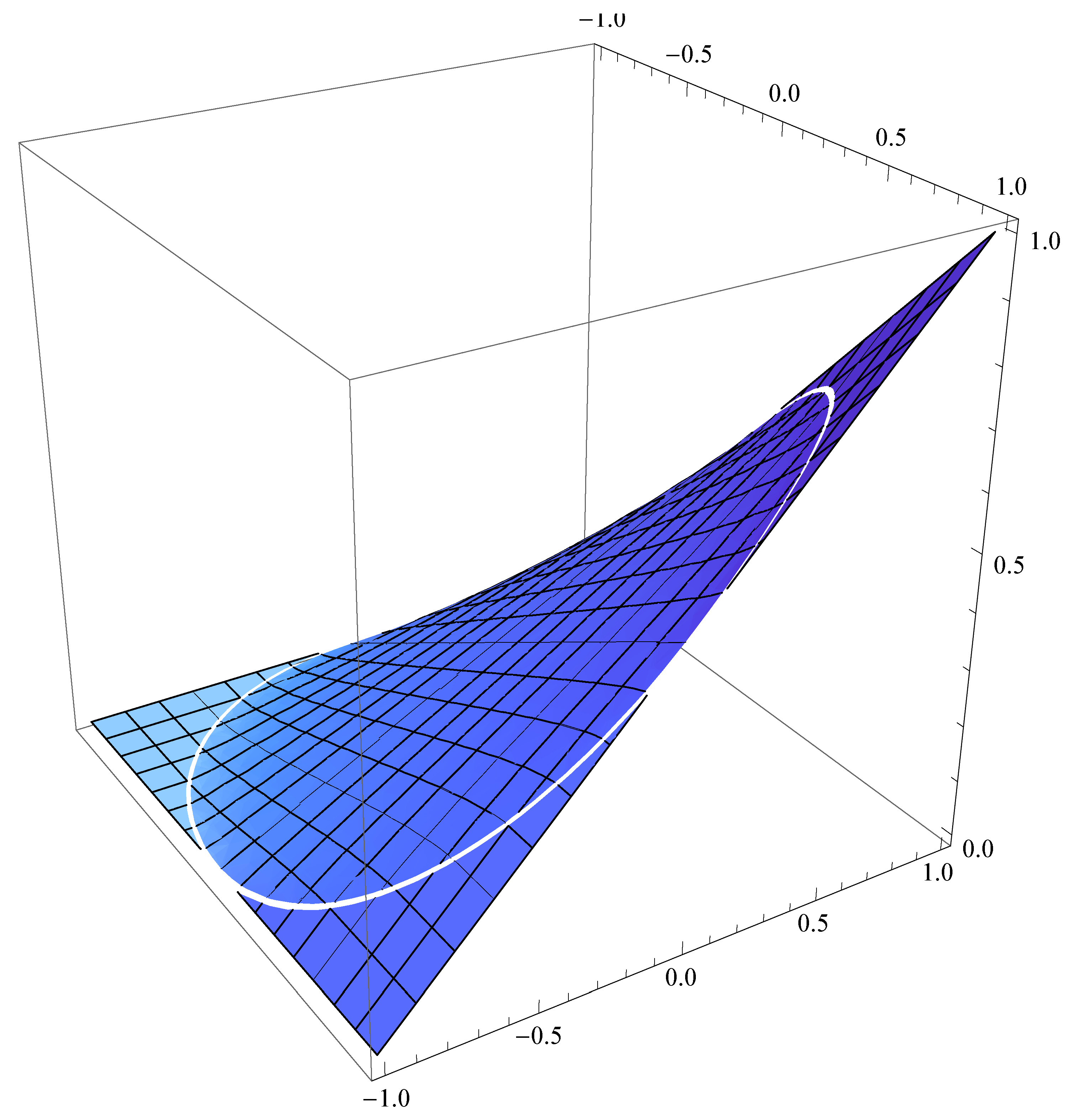
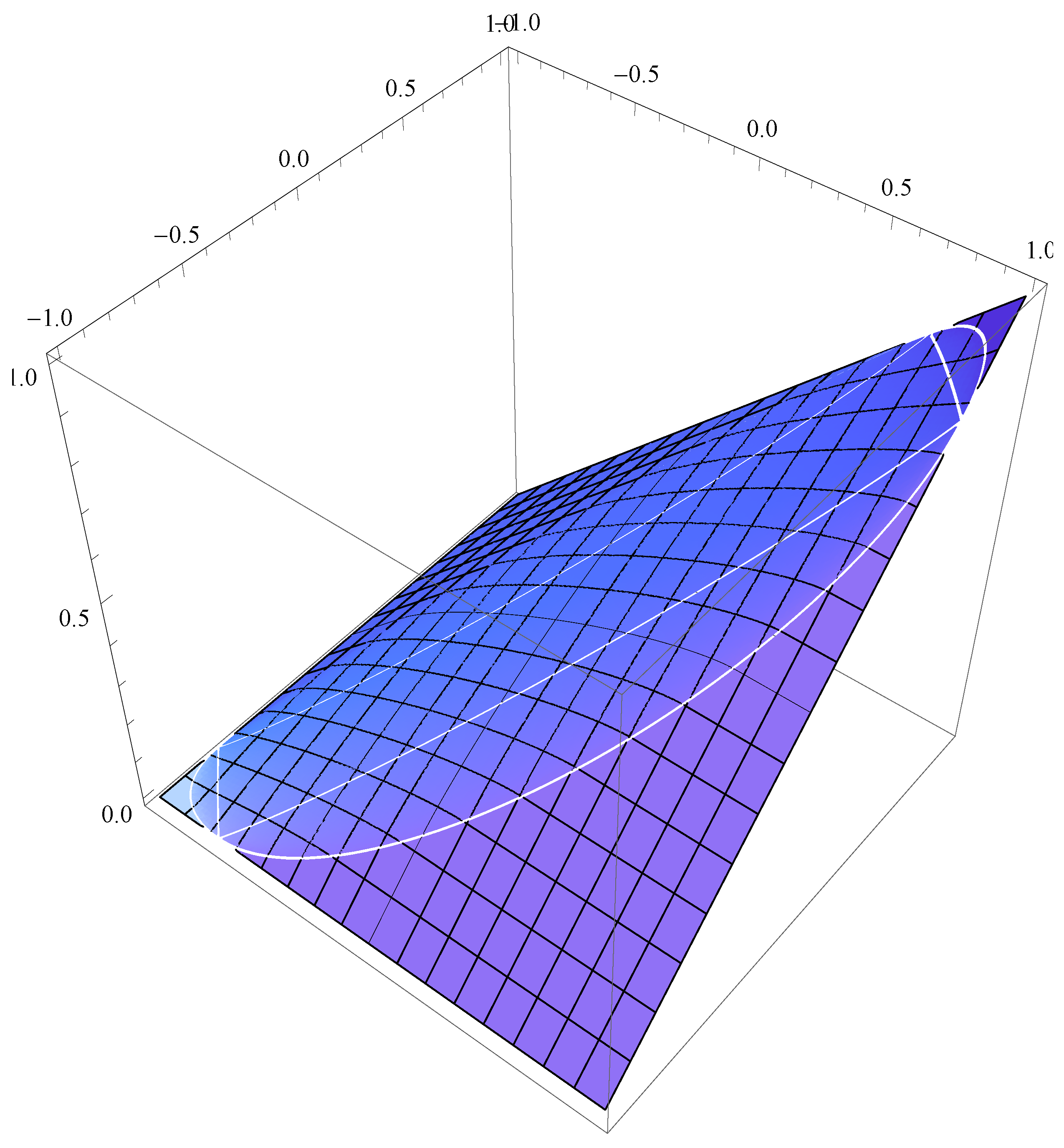
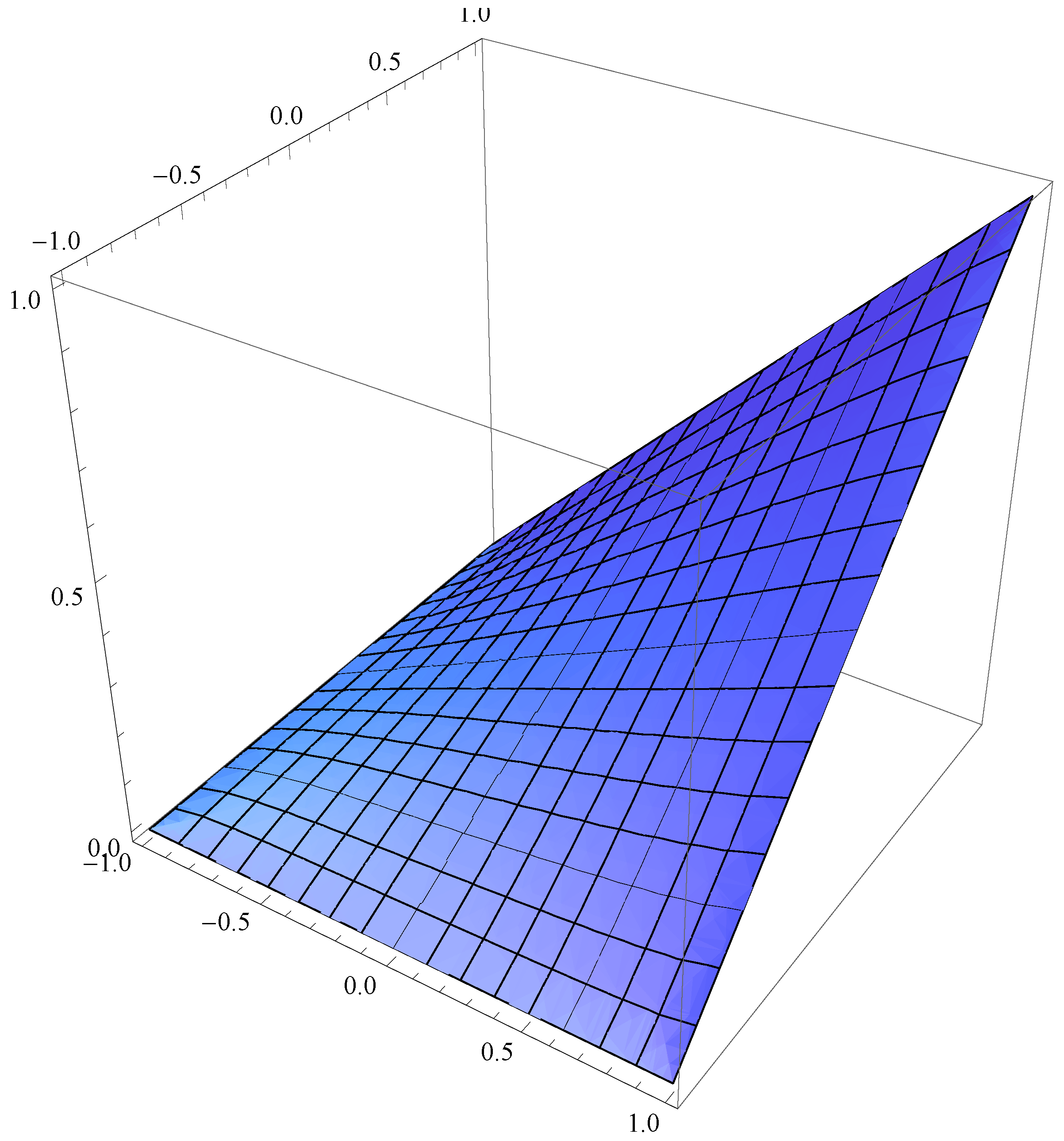
See Figure 6 for a plot of the resulting copula (on [ 1 , 1 ] 2 ).
Figure 6. The copula (17) in Theorem 3.1.

4. The Trivariate Case: the Unique Spherical Copula

Question 5. Having determined the unique spherically symmetric distribution on B 3 with uniform marginals, namely, the uniform distribution on the unit sphere B 3 , what is the corresponding cdf F ( x , y , z ) on C 3 , i.e., the unique spherical copula?
Answer: As in Section 3, let ( X , Y , Z ) be uniformly distributed on B 3 , so that F ( x , y , z ) = P [ X x , Y y , Z z ] . Again we first determine the complementary cdf F ¯ ( x , y , z ) P [ X > x , Y > y , Z > z ] for 0 x , y , z 1 and x 2 + y 2 + z 2 < 1 , the intersection of the first octant of C 3 with the interior of B 3 . Here the event { X > x , Y > y , Z > z } corresponds to the intersection of the three spherical caps { X > x } , { Y > y } , and { Z > z } on B 3 , so F ¯ ( x , y , z ) is the area A ( x , y , z ) of this intersection divided by the total area 4 π of B 3 .
Recall that two approaches were proposed in Section 3 to obtain the area A ( x , y ) of the intersection of two circular caps { X > x } and { Y > y } . The first approach led to the integral (11) that we were unable to evaluate explicitly, so we adopted a second approach based on the geometric Lemma 3.2 of Tovchigrechko and Vakser [7]. Andrey Tovchigrechko has kindly suggested a method for extending Lemma 3.2 to the case of three spherical caps in general position, which if carried out would yield an explicit expression for A ( x , y , z ) . However, we have found that because the axes of our three caps are mutually orthogonal, the two approaches just mentioned for the bivariate case can be combined to obtain F ¯ ( x , y , z ) 1 4 π A ( x , y , z ) directly for the trivariate case, as now described.
We begin by extending (11) to obtain an integral expression for F ¯ ( x , y , z ) when 0 x , y , z 1 and x 2 + y 2 + z 2 < 1 . We require the fact that
0 a , b 1 and a 2 + b 2 = 1 implies arcsin ( a ) + arcsin ( b ) = π / 2 .
Lemma 4.1.
If 0 x , y , z 1 and x 2 + y 2 + z 2 < 1 , then
F ¯ ( x , y , z ) = 1 4 π x 1 y 2 z 2 π 2 arcsin y 1 s 2 arcsin z 1 s 2 d s .
Because ( X , Y , Z ) is exchangeable, (23) remains valid under any permutation of x , y , z on the right-hand side.
Proof. 
Since X 2 + Y 2 + Z 2 = 1 and ( X , Y , Z ) = d ( X , Y , Z ) , it follows from (6) by using Figure 7 that
P [ X > x , Y > y , Z > z ]    = 1 2 P [ X > x , Y > y , X 2 + Y 2 < 1 z 2 ]    = 1 4 π x 1 y 2 z 2 y 1 s 2 z 2 1 1 s 2 t 2 d t d s    = 1 4 π x 1 y 2 z 2 y 1 s 2 z 2 1 ( 1 t 2 1 s 2 ) d t 1 s 2 d s    = 1 4 π x 1 y 2 z 2 y 1 s 2 1 s 2 z 2 1 s 2 d v 1 v 2 d s    = 1 4 π x 1 y 2 z 2 arcsin 1 s 2 z 2 1 s 2 arcsin y 1 s 2 d s .
Figure 7. Region of integration, 3-dimensional case, Lemma 4.1.
Now apply (22) to obtain (23). □
As noted above, the integral in (23) appears difficult to evaluate explicitly but the following indirect argument succeeds. Recall from (11) and (15) that when 0 x , y 1 and x 2 + y 2 < 1 ,
F ¯ ( x , y ) = 1 2 π x 1 y 2 π 2 arcsin y 1 s 2 d s = 1 x y 4 + α ( x , y )
where α ( x , y ) is given by (16). Because z 1 x 2 y 2 1 y 2 when 0 x , y , z 1 and x 2 + y 2 + z 2 < 1 , it follows that
1 2 π z 1 x 2 y 2 π 2 arcsin y 1 s 2 d s    = 1 x 2 y 2 z 4 + α ( z , y ) α ( 1 x 2 y 2 , y ) .
Therefore from (23) and (24), if 0 x , y , z 1 and x 2 + y 2 + z 2 < 1 then
4 π F ¯ ( x , y , z )    = z 1 x 2 y 2 π 2 arcsin x 1 s 2 d s      + z 1 x 2 y 2 π 2 arcsin y 1 s 2 d s π 2 1 x 2 y 2 z    = π 2 ( 1 x 2 y 2 z ) + 2 π α ( z , x ) α ( 1 x 2 y 2 , x )      + π 2 ( 1 x 2 y 2 z ) + 2 π α ( z , y ) α ( 1 x 2 y 2 , y )      π 2 ( 1 x 2 y 2 z )    = π 2 ( 1 x 2 y 2 z )      + 2 π α ( z , x ) + α ( z , y ) α ( 1 x 2 y 2 , x ) α ( 1 x 2 y 2 , y )    = π 2 ( 1 x 2 y 2 z )      + x arcsin z 1 x 2 + z arcsin x 1 z 2 arcsin x z ( 1 x 2 ) ( 1 z 2 )      + y arcsin z 1 y 2 + z arcsin y 1 z 2 arcsin y z ( 1 y 2 ) ( 1 z 2 )      x arcsin 1 x 2 y 2 1 x 2 1 x 2 y 2 arcsin x x 2 + y 2      + arcsin x 1 x 2 y 2 ( 1 x 2 ) ( x 2 + y 2 ) y arcsin 1 x 2 y 2 1 y 2      1 x 2 y 2 arcsin y x 2 + y 2 + arcsin y 1 x 2 y 2 ( 1 y 2 ) ( x 2 + y 2 ) .
By (22), however,
1 x 2 y 2 arcsin x x 2 + y 2 + 1 x 2 y 2 arcsin y x 2 + y 2 = 1 x 2 y 2 π 2 ,
so if we define h ( x , y ) by
h ( x , y ) = arcsin x y ( 1 x 2 ) ( 1 y 2 ) + arcsin x 1 x 2 y 2 1 x 2 x 2 + y 2 + arcsin y 1 x 2 y 2 1 y 2 x 2 + y 2
for 0 x , y 1 and x 2 + y 2 < 1 , then
4 π F ¯ ( x , y , z )    = π 2 z + h ( x , y ) arcsin x y ( 1 x 2 ) ( 1 y 2 )      + x arcsin z 1 x 2 + z arcsin x 1 z 2 arcsin x z ( 1 x 2 ) ( 1 z 2 )      + y arcsin z 1 y 2 + z arcsin y 1 z 2 arcsin y z ( 1 y 2 ) ( 1 z 2 )      x arcsin 1 x 2 y 2 1 x 2 y arcsin 1 x 2 y 2 1 y 2    = π 2 z + h ( x , y ) + α ( x , y )      x arcsin y 1 x 2 y arcsin x 1 y 2      + x arcsin z 1 x 2 + z arcsin x 1 z 2 arcsin x z ( 1 x 2 ) ( 1 z 2 )      + y arcsin z 1 y 2 + z arcsin y 1 z 2 arcsin y z ( 1 y 2 ) ( 1 z 2 )      x arcsin 1 x 2 y 2 1 x 2 y arcsin 1 x 2 y 2 1 y 2
where α ( x , y ) is given by (16). Now (22) gives
x arcsin y 1 x 2 + x arcsin 1 x 2 y 2 1 x 2 = x π 2 y arcsin x 1 y 2 + y arcsin 1 x 2 y 2 1 y 2 = y π 2
so the above simplifies to
4 π F ¯ ( x , y , z ) = π 2 ( x + y + z ) + h ( x , y ) + 2 π Δ ( x , y , z )
where
Δ ( x , y , z ) = α ( x , y ) + α ( x , z ) + α ( y , z )
a symmetric function of ( x , y , z ) . By (22), however,
h ( x , y ) = π 2 arcsin 1 x 2 y 2 ( 1 x 2 ) ( 1 y 2 ) + arcsin x 1 x 2 y 2 1 x 2 x 2 + y 2 + arcsin y 1 x 2 y 2 1 y 2 x 2 + y 2 π 2 γ + α + β
and
sin ( α + β )    = sin α cos β + cos α sin β    = x 1 x 2 y 2 1 x 2 x 2 + y 2 x 1 y 2 x 2 + y 2 + y 1 x 2 x 2 + y 2 y 1 x 2 y 2 1 y 2 x 2 + y 2    = 1 x 2 y 2 ( 1 x 2 ) ( 1 y 2 )    = sin γ
so α + β = γ , hence h ( x , y ) π 2 identically in ( x , y ) . Therefore we conclude that
F ¯ ( x , y , z ) = 1 x y z 8 + Δ ( x , y , z ) 2
for 0 x , y , z 1 and x 2 + y 2 + z 2 < 1 .
We now apply (28) to obtain the cdf F ( x , y , z ) for all ( x , y , z ) C 3 . For this, extend the definition of Δ in (27) to all ( x , y , z ) C 3 by means of (16) and (18).
Theorem 4.1.
The unique spherical copula F ( x , y , z ) on C 3 is given as follows:
for x 2 + y 2 + z 2 < 1 ,
F ( x , y , z ) = 1 + x + y + z 8 + Δ ( x , y , z ) 2 , if x 2 + y 2 + z 2 < 1 1 + x + y + z 8 + Δ ( x , y , z ) 2 + σ ( x y z ) 1 | x | | y | | z | 8 + Δ ( | x | , | y | , | z | ) 2 , if x 2 + y 2 + z 2 1 .
Proof. 
See [9]. □

5. A One-Parameter Family of Elliptical Copulas

Let ( X , Y ) f ( x , y ) in (6), the unique circularly symmetric distribution on the unit disk B 2 with uniform [ 1 , 1 ] marginals. For any angle γ ( π / 2 , π / 2 ) , consider the transformed variables
U = X , V γ = X sin γ + Y cos γ .
By the circular symmetry of ( X , Y ) , V γ = d Y uniform [ 1 , 1 ] , so the random vector ( U , V γ ) again generates a copula on the centered square C 2 . Denote the pdf and cdf of ( U , V γ ) by f γ ( u , v ) and F γ ( u , v ) respectively. Then { F γ γ ( π / 2 , π / 2 ) } is a one-parameter family of elliptical copulas, so-called because the support of ( U , V γ ) is the ellipse
E γ : = { ( u , v ) u 2 + v 2 2 u v sin γ cos 2 γ } .
(Note that E 0 = B 2 .) From (29), the correlation coefficient of U and V γ is given simply by
ρ ( U , V γ ) = sin γ
so γ indicates the degree of linear dependence between U and V γ .
Proposition 5.1.
The pdf of ( U , V γ ) is given by
f γ ( u , v ) = 1 2 π cos 2 γ u 2 v 2 + 2 u v sin γ 1 E γ ( u , v ) .
Proof. 
The pdf can be obtained by a standard Jacobian computation. From (29),
x ( u , v ) = u , y ( u , v ) = v u sin γ cos ( γ )
so
x ( u , v ) u = 1 , x ( u , v ) v = 0 , y ( u , v ) u = tan γ , y ( u , v ) v = 1 cos γ .
Thus the Jacobian of the transformation is J = 1 / cos γ , so from (6) we obtain
f γ ( u , v ) = f ( x ( u , v ) , y ( u , v ) ) · J = 1 2 π 1 u 2 ( v u sin γ ) 2 / cos 2 γ 1 B 2 ( x ( u , v ) , y ( u , v ) ) · 1 cos γ = cos γ 2 π ( 1 u 2 ) cos 2 γ ( v u sin γ ) 2 1 cos γ · 1 B 2 ( x ( u , v ) , y ( u , v ) ) = 1 2 π cos 2 γ u 2 v 2 + 2 u v sin γ 1 E γ ( u , v ) .
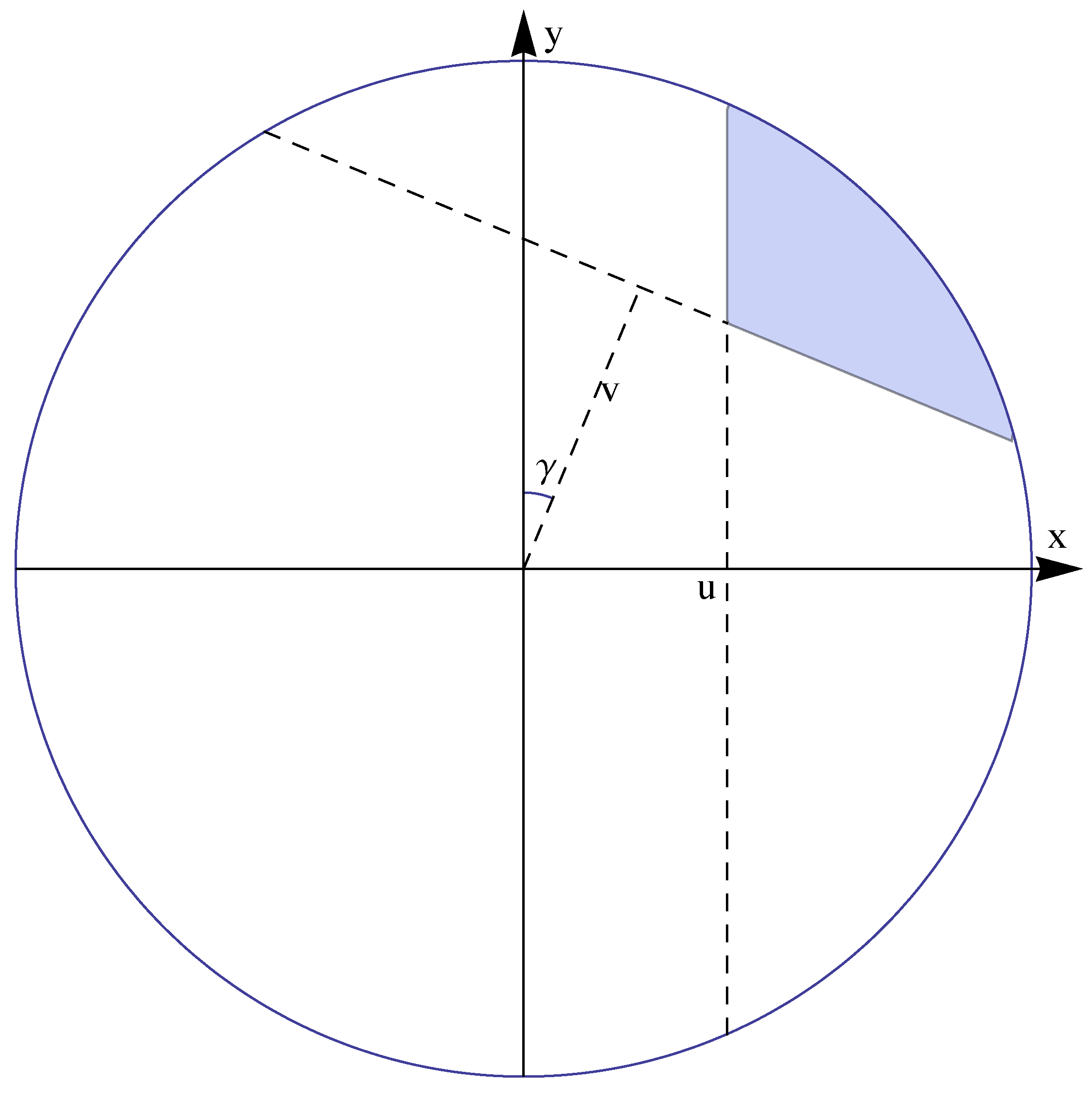
Figure 8 shows the density f γ ( u , v ) with γ = π / 4 .
Figure 8. The density f γ ( u , v ) in (32) (with γ = π / 4 ).
To describe the family of elliptical copulas F γ , we extend the definitions (16) and (18) as follows. First, for ( u , v ) E γ define
α γ ( u , v ) = 1 2 π u arcsin v u sin γ cos γ 1 u 2 + v arcsin u v sin γ cos γ 1 v 2 arcsin u v sin γ ( 1 u 2 ) ( 1 v 2 ) .
Note that α γ reduces to α in (16) when γ = 0 , i.e., when V γ = Y . From (12),
A ( arccos u , arccos v ; π 2 γ ) = ( 1 u v ) π + 4 π α γ ( u , v ) .
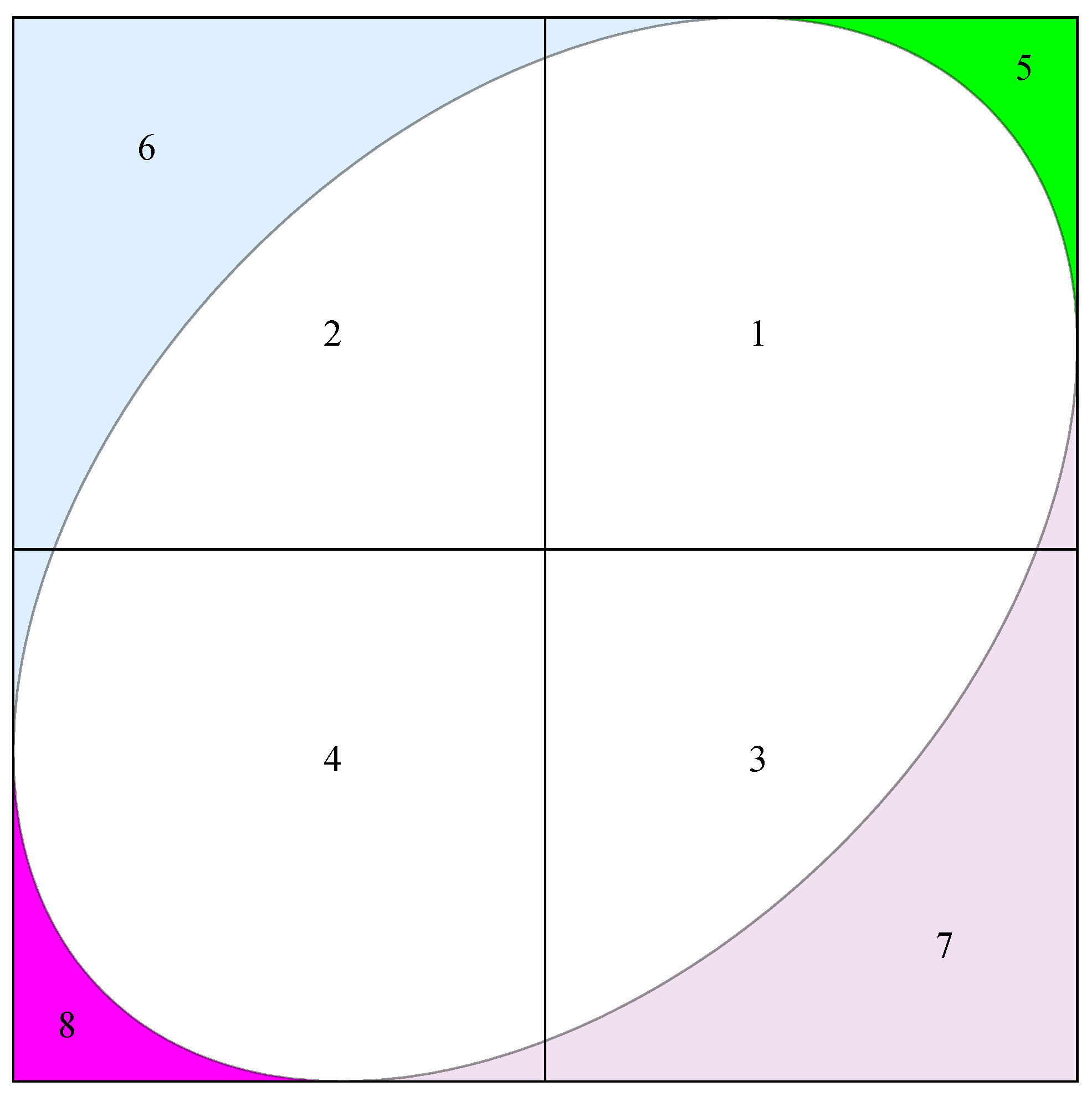
Next, extend the definition of α γ ( u , v ) to C 2 \ E γ as follows (see Figure 9):
α γ ( u , v ) = u + v 1 4 if ( u , v ) R 5 ( γ ) : = ( C 2 \ E γ ) { ( u , v ) u + v > 1 + sin γ } , u v + 1 4 if ( u , v ) R 6 ( γ ) : = ( C 2 \ E γ ) { ( u , v ) v u > 1 sin γ } , u + v + 1 4 if ( u , v ) R 7 ( γ ) : = ( C 2 \ E γ ) { ( u , v ) v u < sin γ 1 } , u v 1 4 if ( u , v ) R 8 ( γ ) : = ( C 2 \ E γ ) { ( u , v ) u + v < sin γ 1 } .
Figure 9. Eight regions R 1 ( γ ) R 8 ( γ ) for an elliptical copula (with γ = π / 8 ).
Note that (34) and (36) agree on E γ , i.e., when u 2 + v 2 2 u v sin γ = cos 2 γ . Also note that (36) reduces to α in (18) when γ = 0 . The following lemma will be useful for the proof of Theorem 5.1.
Lemma 5.1.
Let ( U , V ) be a bivariate random vector in C 2 with uniform [ 1 , 1 ] marginals that satisfies ( U , V ) = d ( U , V ) . Then the cdf F ( u , v ) satisfies
F ( u , v ) = u + v 2 + F ( u , v ) , ( u , v ) C 2 .
Proof. 
By the symmetry condition,
F ( u , v ) = P [ U u , V v ] = P [ U u , V v ] = 1 P [ U < u ] P [ V < v ] + P [ U < u , V < v ] = 1 u + 1 2 + v + 1 2 + P [ U u , V v ] = u + v 2 + F ( u , v ) .
Theorem 5.1.
The cdf ≡ copula of ( U , V γ ) is given by (see Figure 12)
F γ ( u , v ) = u + v + 1 4 + α γ ( u , v ) , ( u , v ) C 2 .
Figure 12. The copula F γ ( u , v ) in (38) (with γ = π / 4 ).
Proof. 
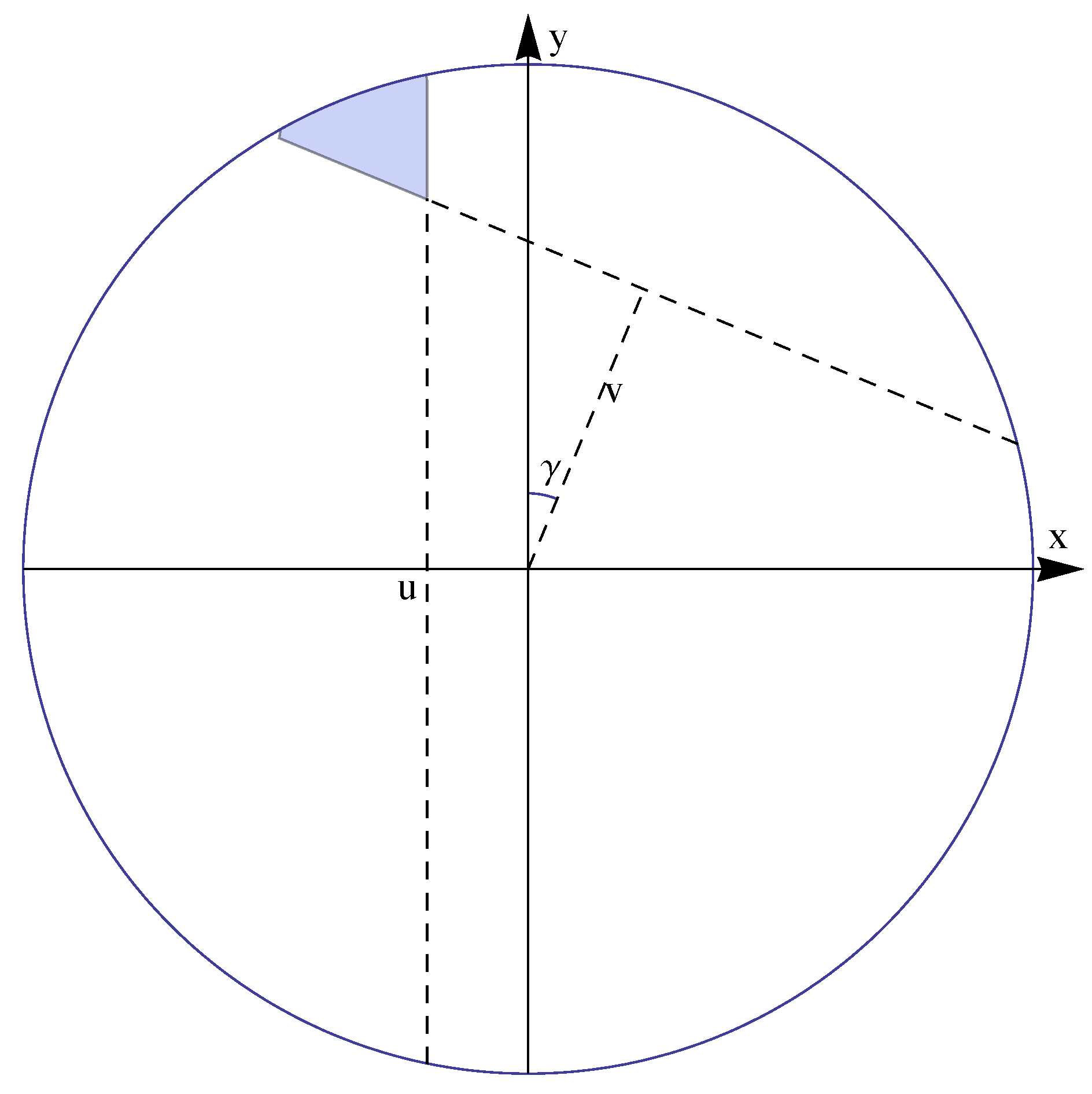
To find F γ ( u , v ) we again use the formula (12) for the area of the intersection of two spherical caps on B 3 . Here, unlike (14), the axes of the two caps are not necessarily perpendicular. The single formula (38) is obtained by considering the partition C 2 = i = 1 8 R i ( γ ) , where R 5 ( γ ) R 8 ( γ ) are defined in (36) and (see Figure 9)
R 1 ( γ ) = E γ { ( u , v ) 0 u , v 1 } , R 2 ( γ ) = E γ { ( u , v ) 1 u 0 v 1 } , R 3 ( γ ) = E γ { ( u , v ) 1 v 0 u 1 } , R 4 ( γ ) = E γ { ( u , v ) 1 u , v 0 } .
Case 1: ( u , v ) R 1 ( γ ) . By using Figure 10,
F γ ( u , v ) = P [ U u , V γ v ] = 1 P [ U > u ] P [ V γ > v ] + P [ U > u , V γ > v ] = 1 1 u 2 1 v 2 + P [ X > u , X sin γ + Y cos γ > v ] = u + v 2 + 1 4 π A ( arccos u , arccos v ; π / 2 γ ) = u + v + 1 4 + α γ ( u , v ) [ by ( 35 ) ] .
Figure 10. The region [ X > u , X sin ( γ ) + Y cos ( γ ) > v ] for Case 1 (with γ = π / 8 ).
Case 2: ( u , v ) ) R 2 ( γ ) . Because ( X , Y ) = d ( X , Y ) and using Figure 11
F γ ( u , v ) = P [ U u ] P [ U u , V γ > v ] = u + 1 2 P [ X u , X sin γ + Y cos γ > v ] = u + 1 2 P [ X u , X sin γ + Y cos γ > v ] = u + 1 2 P [ X u , X sin ( γ ) + Y cos ( γ ) > v ] = u + 1 2 1 4 π A ( arccos ( u ) , arccos v ; π / 2 + γ ) = u + v + 1 4 α γ ( u , v ) [ by ( 35 ) ] = u + v + 1 4 + α γ ( u , v ) [ by ( 34 ) ] .
Figure 11. The region [ X < u , X sin ( γ ) + Y cos ( γ ) > v ] for Case 2 (with γ = π / 8 ).
Case 3: ( u , v ) R 3 ( γ ) . Then ( u , v ) R 2 ( γ ) , so by Lemma 5.1 and Case 2,
F γ ( u , v ) = u + v 2 + F γ ( u , v ) = u + v 2 + u v + 1 4 + α γ ( u , v ) = u + v + 1 4 + α γ ( u , v ) [ by ( 34 ) ] .
Case 4: ( u , v ) R 4 ( γ ) . Then ( u , v ) R 1 ( γ ) , so by Lemma 5.1 and Case 1, the argument for Case 3 applies verbatim.
Case 5: ( u , v ) R 5 ( γ ) .
F γ ( u , v ) = 1 P [ U > u ] P [ V γ > v ] = 1 1 u 2 1 v 2 = u + v + 1 4 + α γ ( u , v ) [ by ( 36 ) ] .
Case 6: ( u , v ) R 6 ( γ ) .
F γ ( u , v ) = P [ U u ] = u + 1 2 = u + v + 1 4 + α γ ( u , v ) [ by ( 36 ) ] .
Case 7: ( u , v ) R 7 ( γ ) . Then ( u , v ) R 6 ( γ ) , so by Lemma 5.1 and Case 6, the argument for Case 3 applies verbatim.
Case 8: ( u , v ) R 8 ( γ ) . Then ( u , v ) R 5 ( γ ) , so by Lemma 5.1 and Case 5, the argument for Case 3 applies verbatim. □

6. Copulas Derived from the Uniform Distribution on the Unit Ball

Up to now we have addressed the question of whether copulas can be generated by means of linear functions of a circularly symmetric or spherically symmetric random vector. Now we ask whether non-linear functions of such random vectors can generate copulas. We shall restrict attention to random vectors uniformly distributed over the unit ball B d and produce relatively simple non-linear functions that generate copulas on C d .
We begin with the bivariate case. Suppose that ( X , Y ) is distributed uniformly on the unit disk B 2 = { ( x , y ) R 2 x 2 + y 2 1 } . Because
X Y uniform [ 1 Y 2 , 1 Y 2 ] and Y X uniform [ 1 X 2 , 1 X 2 ]
it follows that the random variables
U : = X 1 Y 2 , V : = Y 1 X 2
satisfy
U Y uniform [ 1 , 1 ] V X uniform [ 1 , 1 ] .
Thus, U and Y are independent, V and X are independent, and unconditionally,
U uniform [ 1 , 1 ] V uniform [ 1 , 1 ]
so the joint distribution of ( U , V ) generates a copula F ( u , v ) on the centered cube C 2 [ 1 , 1 ] 2 . Note that U and V are not linear functions of ( X , Y ) .
Question 6: Are U and V independent, and if not, what is the nature of their dependence?
Answer: Clearly U and V are uncorrelated, since E ( U ) = E ( V ) = 0 and
E ( U V ) = E X Y ( 1 X 2 ) ( 1 Y 2 ) = 0
all by the circular symmetry of ( X , Y ) . However, the joint pdf and cdf of ( U , V ) derived below show that they are not independent.
Proposition 6.1.
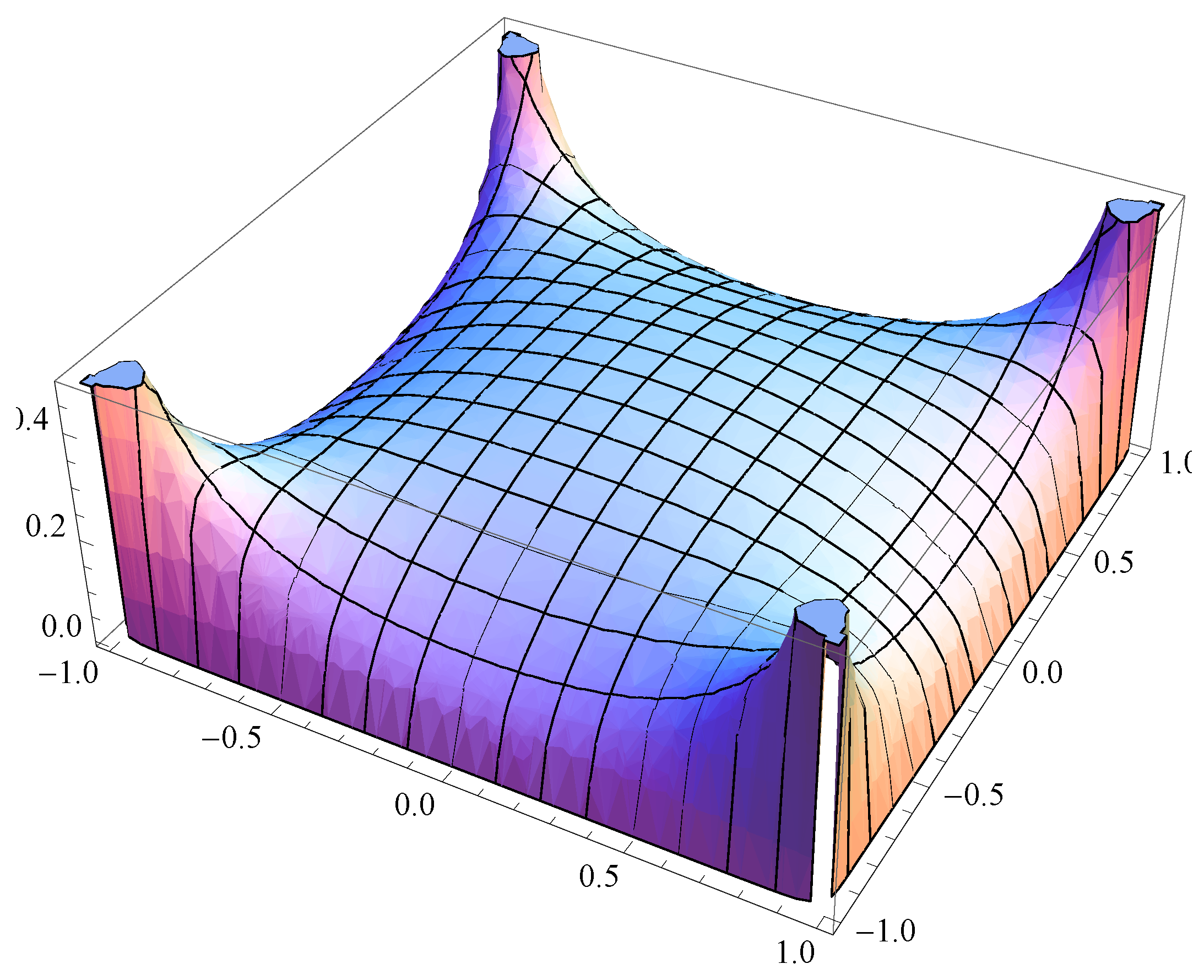
The joint density of ( U , V ) is given by (see Figure 13)
f ( u , v ) = 1 π ( 1 u 2 ) ( 1 v 2 ) ( 1 u 2 v 2 ) 2 1 C 2 ( u , v ) .
Figure 13. Joint density f ( u , v ) of ( U , V ) in (40).
Proof. 
This pdf is again obtained via the Jacobian method. It follows from (39) that
u 2 ( 1 y 2 ) = x 2 , a n d v 2 ( 1 x 2 ) = y 2 .
Substitution of the second expression for y 2 into the left side of the first relation and vice versa yields
x 2 = u 2 ( 1 v 2 ) 1 u 2 v 2 , y 2 = v 2 ( 1 u 2 ) 1 u 2 v 2
so, since x and u (y and v) have the same signs by (39), we obtain
x x ( u , v ) = u 1 v 2 1 u 2 v 2 , y y ( u , v ) = v 1 u 2 1 u 2 v 2 .
Thus
x u = 1 v 2 1 1 u 2 v 2 + u ( 1 u 2 v 2 ) 3 / 2 ( u v 2 ) = 1 v 2 1 u 2 v 2 1 + u 2 v 2 1 u 2 v 2 = 1 v 2 ( 1 u 2 v 2 ) 3 / 2 ,
x v = u ( 1 v 2 ) 1 / 2 ( v ) 1 u 2 v 2 + 1 v 2 ( 1 u 2 v 2 ) 3 / 2 ( u 2 v ) = u v 1 v 2 1 u 2 v 2 1 + u 2 ( 1 v 2 ) 1 u 2 v 2 = u v ( 1 u 2 ) 1 v 2 ( 1 u 2 v 2 ) 3 / 2 .
By symmetry it follows that the Jacobian is given by
J = 1 v 2 ( 1 u 2 v 2 ) 3 / 2 u v ( 1 u 2 ) 1 v 2 ( 1 u 2 v 2 ) 3 / 2 u v ( 1 v 2 ) 1 u 2 ( 1 u 2 v 2 ) 3 / 2 1 u 2 ( 1 u 2 v 2 ) 3 / 2
and hence the determinant of J is given by
| J | = ( 1 u 2 ) ( 1 v 2 ) ( 1 u 2 v 2 ) 2 .
Because the pdf of ( X , Y ) is f ( x , y ) = 1 π 1 B 2 ( x , y ) , the result (40) follows. □
For 0 u , v 1 , ( u , v ) ( 1 , 1 ) , let E 1 ( u ) and E 2 ( v ) be the ellipses
E 1 ( u ) = ( x , y ) | x 2 u 2 + y 2 1
E 2 ( v ) = ( x , y ) | x 2 + y 2 v 2 1 .
The next lemma leads to the cdf F ( u , v ) corresponding to the pdf (40).
Lemma 6.1.
Area ( E 1 ( u ) E 2 ( v ) ) = 2 u arcsin v 1 u 2 1 u 2 v 2 + 2 v arcsin u 1 v 2 1 u 2 v 2 .
Proof. 
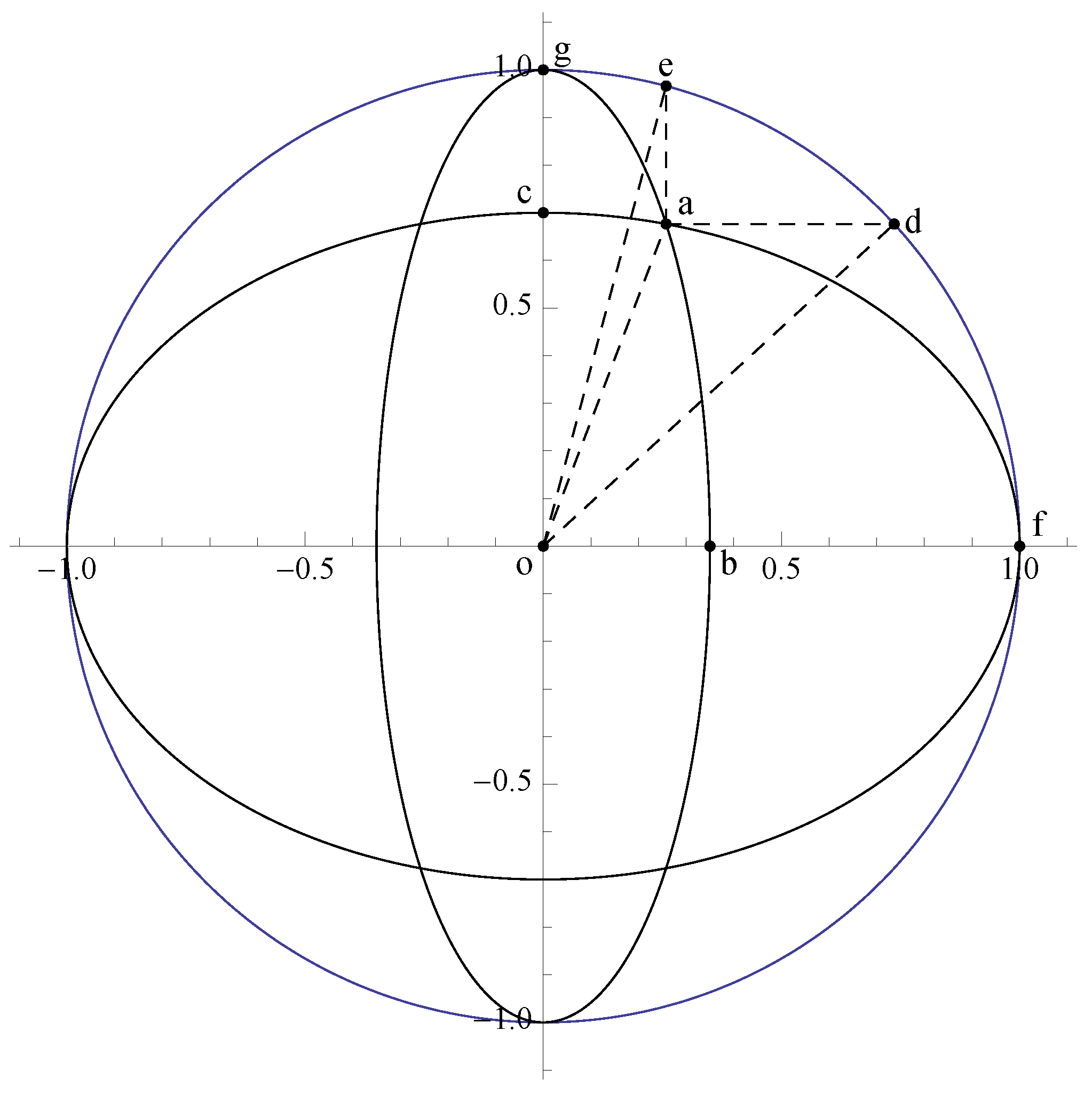
Define the points o , a , b , c , d , d , f , g as follows: see Figure 14,
o = ( 0 , 0 ) a = ( x ( u , v ) , y ( u , v ) ) = u 1 v 2 1 u 2 v 2 , v 1 u 2 1 u 2 v 2 b = ( u , 0 ) c = ( 0 , v ) d = ( 1 y 2 ( u , v ) , y ( u , v ) ) e = ( x ( u , v ) , 1 x 2 ( u , v ) ) f = ( 1 , 0 ) g = ( 0 , 1 ) .
Figure 14. Integration regions for Lemma 6.2.
Then
1 4 Area ( E 1 ( u ) E 2 ( v ) ) = Area ( o a b ) + Area ( o a c ) = u Area ( o d f ) + v Area ( o e g ) = u 2 arcsin ( y ( u , v ) ) + v 2 arcsin ( x ( u , v ) )
from which the result follows. □
Theorem 6.1.
The copula (= cdf) corresponding to the pdf (40) is given by (see Figure 15)
F ( u , v ) = u + v + 1 4 + u 2 π arcsin v 1 u 2 1 u 2 v 2 + v 2 π arcsin u 1 v 2 1 u 2 v 2 , ( u , v ) C 2 .
Figure 15. Nonlinear transformation copula F ( u , v ) in Theorem 6.1.
Proof. 
Because ( U , V ) is sign-change invariant and has uniform [ 1 , 1 ] marginals, it follows from (7) and (9) in Lemma 3.1 and from (39) that for ( u , v ) C 2 ,
F ( u , v ) = u + v + 1 4 + σ ( u v ) P [ 0 U | u | , 0 V | v | ] = u + v + 1 4 + σ ( u v ) 4 P [ U 2 u 2 , V 2 v 2 ] = u + v + 1 4 + σ ( u v ) 4 P [ ( X , Y ) E 1 ( u ) E 2 ( v ) ] = u + v + 1 4 + σ ( u v ) 4 π Area ( E 1 ( | u | ) E 2 ( | v | ) ) .
The result now follows from Lemma 6.1. □
Remark: 
The construction (39) extends readily to generate a copula on C d . For d = 3 , for example, let ( X , Y , Z ) be uniformly distributed on the unit ball B 3 and define
U : = X 1 Y 2 Z 2 , V : = Y 1 X 2 Z 2 , W : = Z 1 X 2 Y 2 .
Then the marginal distributions of U, V, and W are each uniform [ 1 , 1 ] so the cdf G ( u , v , w ) is a copula on C 3 . To find this copula one would need to determine Volume ( E 1 ( u ) E 2 ( v ) E 3 ( w ) ) , where now, for 0 u , v , w 1 , E 1 ( u ) , E 2 ( v ) , and E 3 ( w ) are the ellipsoids
E 1 ( u ) = ( x , y , z ) | x 2 u 2 + y 2 + z 2 1 E 2 ( v ) = ( x , y , z ) | x 2 + y 2 v 2 + z 2 1 E 3 ( w ) = ( x , y , z ) | x 2 + y 2 + y 2 w 2 1 .

Acknowledgements

We gratefully acknowledge several helpful suggestions by Ilya Vakser and Andrey Tovchigrechko.

References

  1. Nelsen, R.B. An Introduction to Copulas, 2nd ed.; Springer Series in Statistics; Springer: New York, NY, USA, 2006. [Google Scholar]
  2. Feller, W. An Introduction to Probability Theory and Its Applications, 2nd ed.; John Wiley & Sons Inc.: New York, NY, USA, 1971; Volume II. [Google Scholar]
  3. Arellano-Valle, R.B. On some characterizations of spherical distributions. Statist. Probab. Lett. 2001, 54, 227–232. [Google Scholar] [CrossRef]
  4. Schoenberg, I.J. Metric spaces and completely monotone functions. Ann. Math. 1938, 39, 811–841. [Google Scholar] [CrossRef]
  5. Cambanis, S.; Huang, S.; Simons, G. On the theory of elliptically contoured distributions. J. Multivar. Anal. 1981, 11, 368–385. [Google Scholar] [CrossRef]
  6. Bracewell, R.N. The Fourier Transform and Its Applications, 3rd ed.; McGraw-Hill Book Co.: New York, NY, USA, 1986. [Google Scholar]
  7. Tovchigrechko, A.; Vakser, I.A. How common is the funnel-like energy landscape in protein-protein interactions? Protein Sci. 2001, 10, 1572–1583. [Google Scholar] [CrossRef] [PubMed]
  8. Oat, C.; Sander, P.V. Ambient aperture lighting. In Proceedings of the 2007 Symposium on Interactive 3D Graphics, SI3D 2007, Seattle, WA, USA, 30 April–2 May 2007; Gooch, B., Sloan, P.P.J., Eds.; ACM: New York, NY, USA, 2007; pp. 61–64. [Google Scholar]
  9. Perlman, M.D.; Wellner, J.A. Squaring the Circle and Cubing the Sphere: Circular and Spherical Copulas; Technical Report 578; University of Washington, Department of Statistics: Seattle, WA, USA, 2010; Available at http://www.stat.washington.edu/research/reports/2011/tr578.pdf (accessed on 23 August 2011).

Article Metrics

Citations

Article Access Statistics

Multiple requests from the same IP address are counted as one view.