CGAP-HBSA: A Source Camera Identification Framework Under Few-Shot Conditions

Abstract
1. Introduction
- (1)
- We propose a pseudo-label augmentation method based on cross-correlation coefficients. Compared with classical pseudo-labeling strategies such as self-training, consistency regularization, and ensemble voting, our method achieves higher interpretability and stronger adaptability to few-shot camera image data.
- (2)
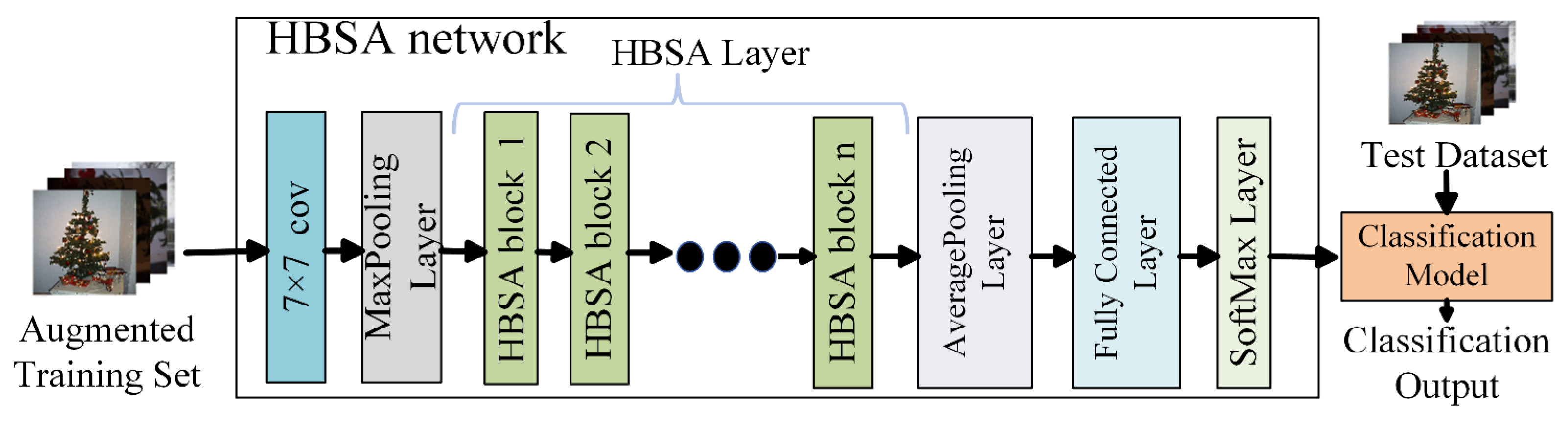
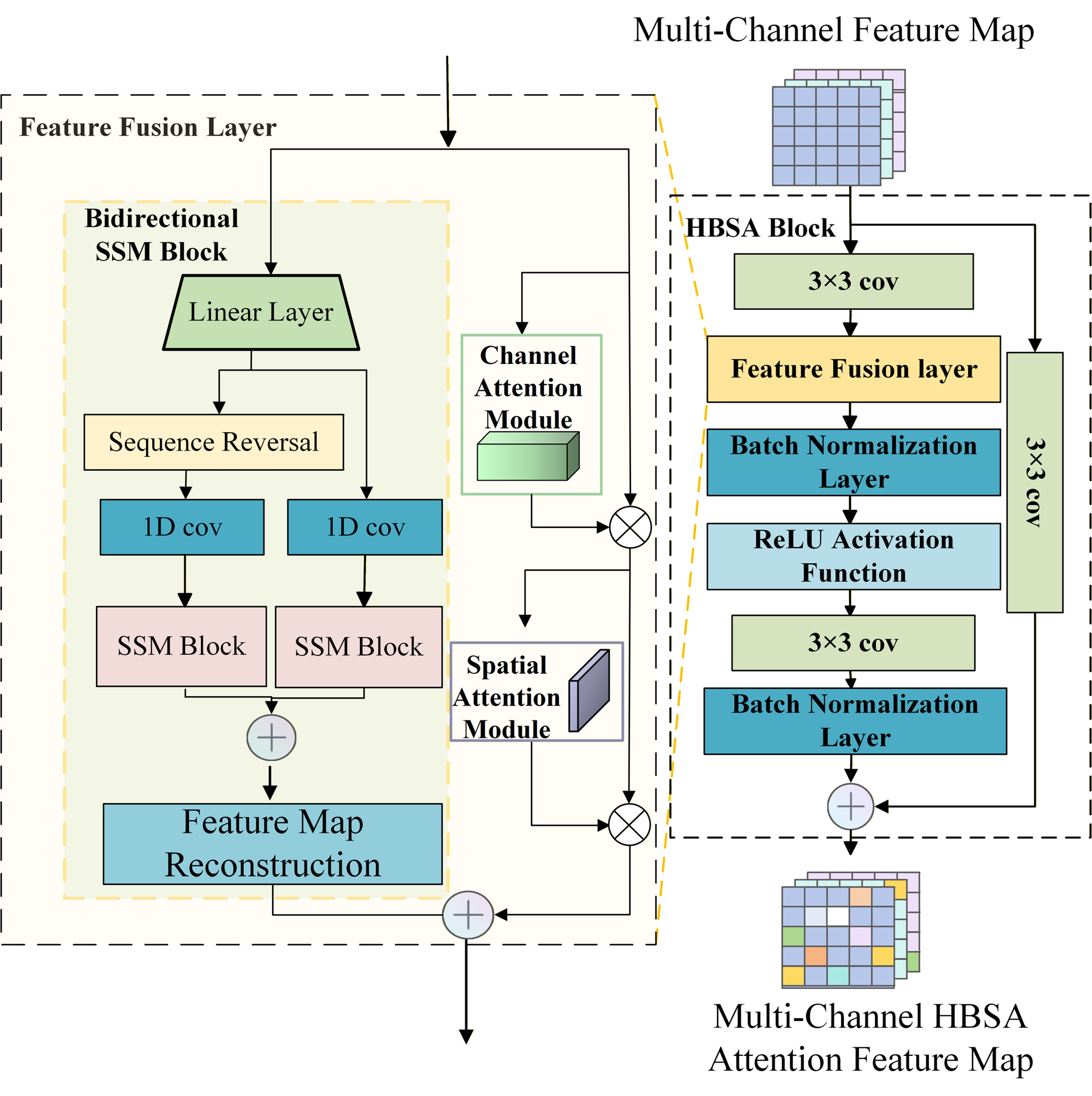
- We design the HBSA block and use multiple blocks to construct HBSA layers, forming the HBSA network. This architecture enables effective information propagation within blocks and progressive transmission across blocks, thereby enhancing global modeling ability and reducing dependence on data scale.
- (3)
- We conduct comparative experiments and ablation studies on two datasets to validate the effectiveness of the proposed approach.
2. Related Works
3. The Proposed CGAP-HBSA Framework
3.1. Overview
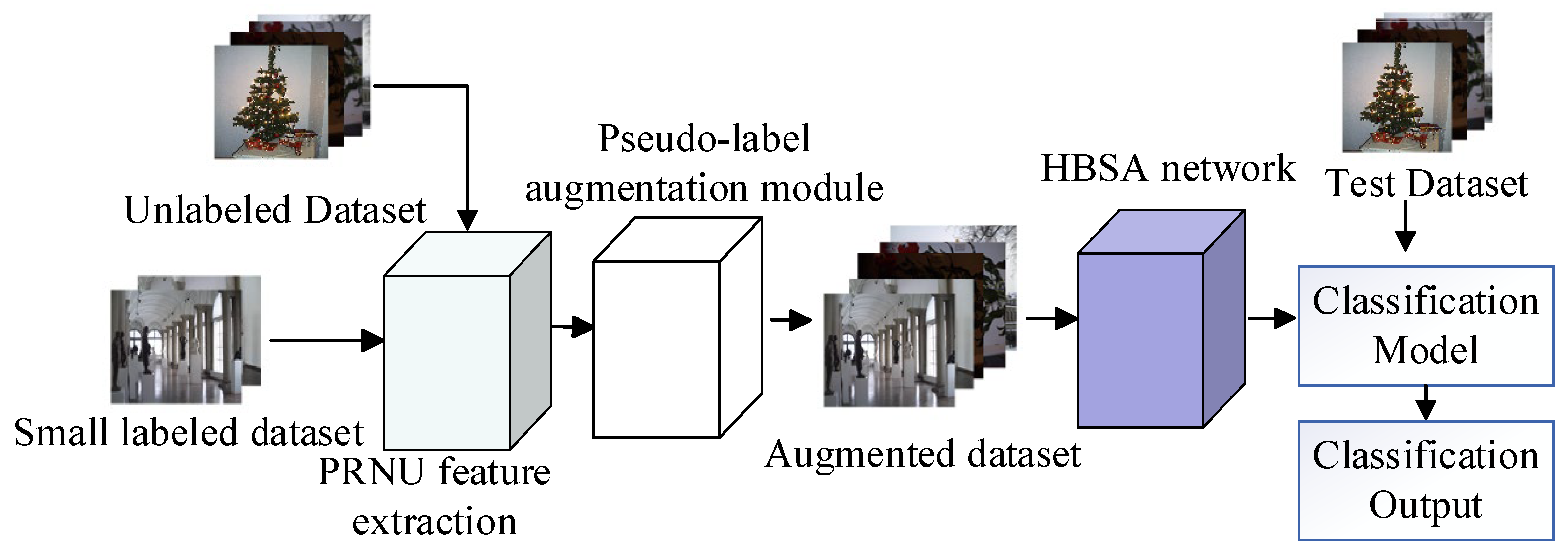
- (1)
- Feature Extraction. The primary role of this stage is to extract discriminative features from image samples, which are subsequently used for pseudo-label augmentation in the few-shot dataset. We employ Photo-Response Non-Uniformity (PRNU) features as the basis for camera sample augmentation, leveraging their four key advantages: uniqueness, high discriminability, stability, and robustness.
- (2)
- Pseudo-labeled Sample Augmentation. This component expands the few-shot dataset by leveraging both the labeled small-sample set and a large number of unlabeled samples. Through the proposed cross-correlation guided pseudo-labeling method, we generate augmented labeled samples, forming an expanded training dataset. By enriching the dataset in this way, the risk of model overfitting is effectively reduced.
- (3)
- HBSA Network. Finally, the extracted features and the augmented dataset are used to construct and train the HBSA network, which serves as the classification model. The HBSA network is composed of six layers, with the HBSA layer at its core. The HBSA layer repeatedly downsamples the feature maps while expanding the channel dimensions, thereby capturing higher-dimensional representations. The classification model is trained on the expanded dataset, and during inference, test samples are input into the trained HBSA network to produce the final predictions.
3.2. Cross-Correlation–Based Pseudo-Label Expansion Algorithm
| Algorithm 1 Pseudo-Label Expansion Based on Normalized Cross-Correlation | |
| input: Labeled few-shot dataset Unlabeled dataset | |
| output: Pseudo-labeled augmented dataset | |
| 1: | Initialize set parameters ; |
| 2: | : |
| 3: | if then end if |
| 4: | Stage 1: Randomly sample instances from , |
| 5: | Stage 2: Utilize to construct the temporary pair set: Compute the normalized cross-correlation (NCC) value for each pair , denoted as . |
| 6: | Stage 3: Identify the pair with the maximum NCC value: |
| 7: | if Stage 4: Assign the label of X to . Add to , and remove from . end if |
| 8: | end for |
3.3. HBSA Network and HBSA Block
- (1)
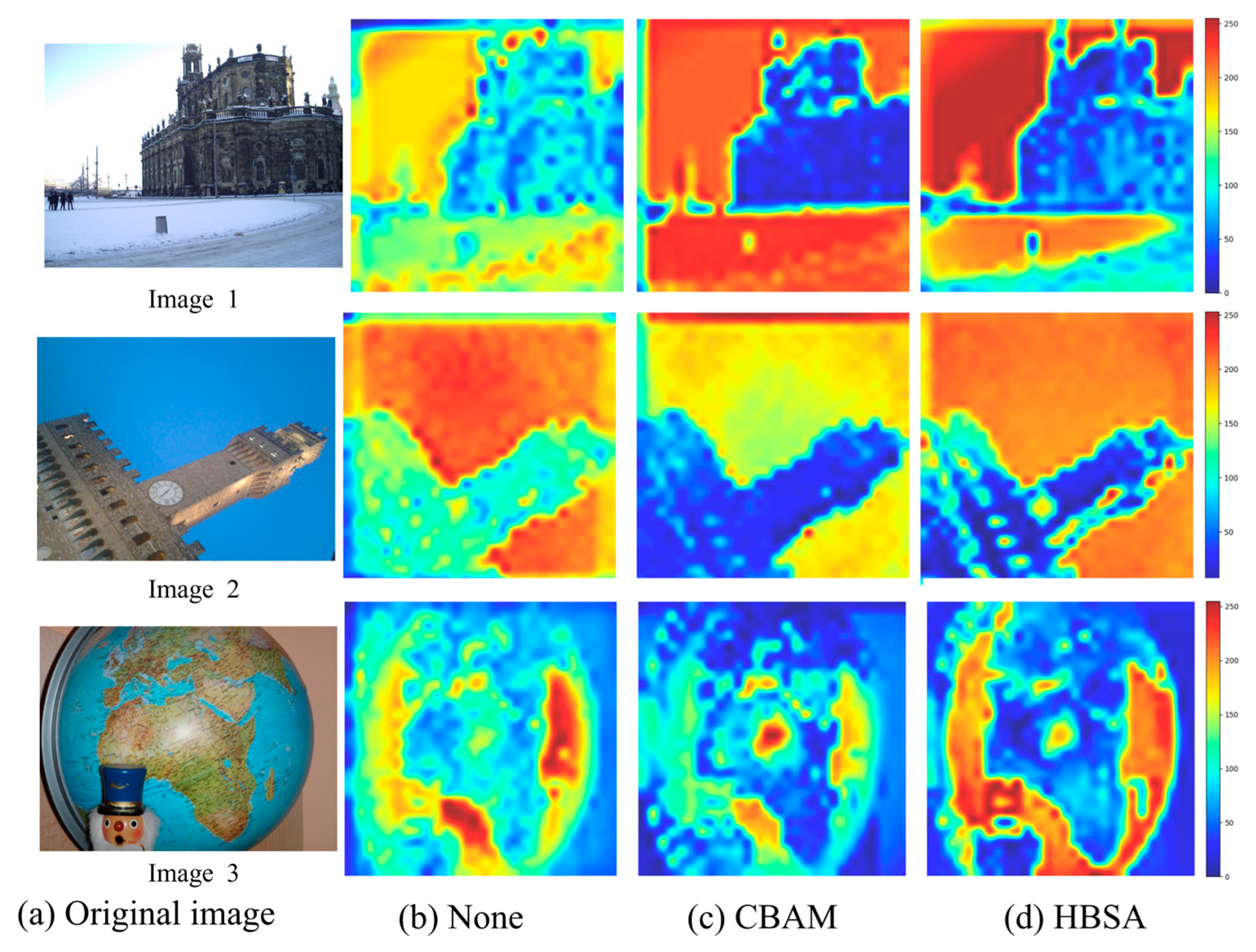
- Insufficient global modeling capacity. The convolution operation in classical CNN is inherently local. Although stacking multiple convolutional layers can expand the receptive field, the ability to capture long-range dependencies—such as global information within an image—remains limited.
- (2)
- Underutilization of contextual information. Feature extraction is confined to local regions, without explicitly modeling global contextual relationships across layers (e.g., cross-region dependencies within an image).
4. Experiments and Analysis
4.1. Datasets and Experimental Setup
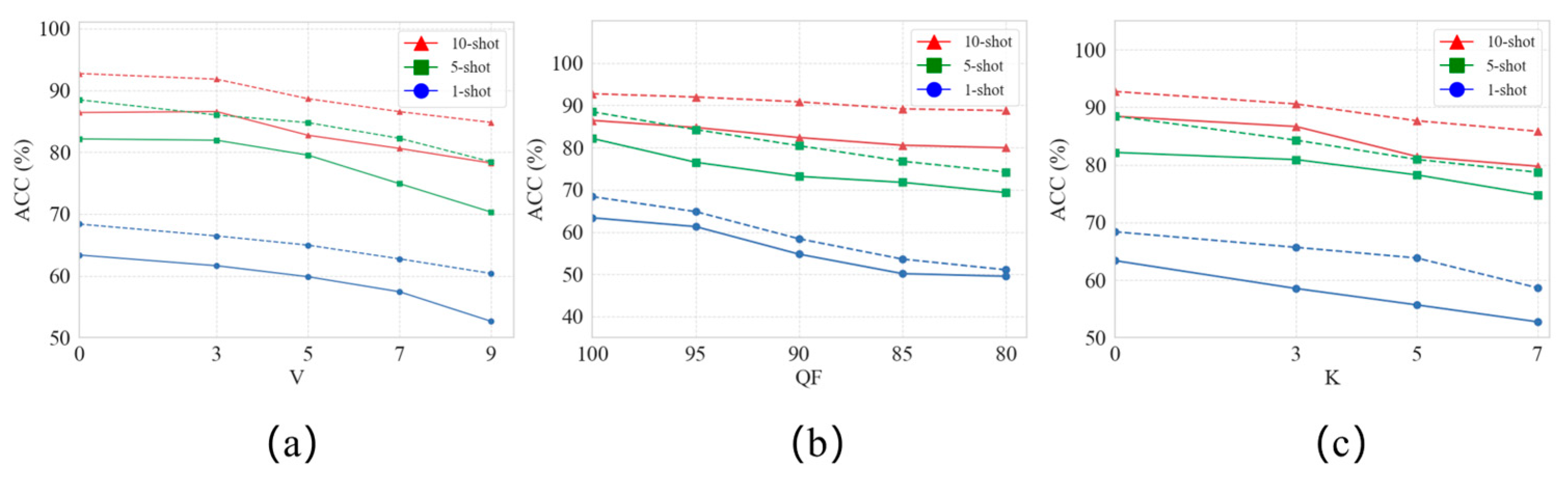
4.2. Hyperparameter Selection Experiments
4.3. Comparative Experiments
- (1)
- MTD-EM [7]: An ensemble learning method based on Mega-Trend Diffusion. In this approach, virtual samples generated for dataset expansion are combined with the few-shot dataset to train multiple SVM classifiers, whose outputs are then ensembled for source camera classification.
- (2)
- Multi-PCEP [8]: A prototype construction framework based on ensemble projection. Semi-supervised learning is first employed to construct prototype sets. These prototypes are then used to retrain SVM classifiers, where the posterior probability of each image sample belonging to each class is taken as the final projection vector. The classification results are obtained through ensemble voting.
- (3)
- Multi-DS [9]: An ensemble learning method based on multi-distance metrics. This approach employs an SVM self-correction mechanism to iteratively refine pseudo-labels for the augmented dataset. The expanded dataset is then used to train the classification model for camera source identification.
- (4)
- MDM-CPS [10]: A method combining multiple distance metrics with coordinate-based pseudo-label selection. By incorporating collaborative attention Blocks, this method filters pseudo-labeled samples to expand few-shot datasets, which are then used to train classification models for source camera recognition.
- (5)
- Vision Mamba (Vim) [13]: A recent sequence-based vision model. Images are flattened into sequences and globally modeled using state-space models (SSMs). With efficient selective scanning and gating mechanisms, Vim captures global image features and has been successfully applied to image classification, object detection, and semantic segmentation tasks.
4.4. Ablation Experiments
4.5. Anti-Image Processing Experiments
5. Conclusions
Author Contributions
Funding
Data Availability Statement
Conflicts of Interest
Appendix A
Comparative Experiments on Image Key

References
- Akshatha, K.; Karunakar, A.; Anitha, H.; Raghavendra, U.; Shetty, D. Digital camera identification using PRNU: A feature based approach. Digit. Investig. 2016, 19, 69–77. [Google Scholar] [CrossRef]
- Li, Z.; Liu, F.; Yang, W.; Peng, S.; Zhou, J. A survey of convolutional neural networks: Analysis, applications, and prospects. IEEE Trans. Neural Netw. Learn. Syst. 2021, 33, 6999–7019. [Google Scholar] [CrossRef] [PubMed]
- Wu, H.; Wen, Z. Research on Adaptive Attention Dense Network in Camera Source Recognition Method. J. Hunan Univ. Technol. 2026, 40, 85–91. [Google Scholar] [CrossRef]
- Long, C.; Jianlin, Z.; Hao, P.; Meihui, L.; Zhiyong, X.; Yuxing, W. Few-shot image classification via multi-scale attention and domain adaptation. Opto-Electron. Eng. 2023, 50, 220232. [Google Scholar] [CrossRef]
- Lu, J.; Li, C.; Huang, X.; Cui, C.; Emam, M. Source Camera Identification Algorithm Based on Multi-Scale Feature Fusion. Comput. Mater. Contin. 2024, 80, 3047–3065. [Google Scholar] [CrossRef]
- Tan, Y.; Wang, B.; Li, M.; Guo, Y.; Kong, X.; Shi, Y. Camera Source Identification with Limited Labeled Training Set. In Proceedings of the 14th International Workshop, IWDW 2015, Tokyo, Japan, 7–10 October 2015; pp. 18–27. [Google Scholar]
- Wu, S.; Wang, B.; Zhao, J.; Zhao, M.; Zhong, K.; Guo, Y. Virtual sample generation and ensemble learning based image source identification with few-shot training samples. Int. J. Digit. Crime Forensics 2021, 13, 34–46. [Google Scholar] [CrossRef]
- Wang, B.; Yu, F.; Ma, Y.; Zhao, H.; Hou, J.; Zheng, W. Pcep: Few-shot model-based source camera identification. Mathematics 2023, 11, 803. [Google Scholar] [CrossRef]
- Wang, B.; Hou, J.; Ma, Y.; Wang, F.; Wei, F. Multi-DS strategy for source camera identification in few-shot sample data sets. Secur. Commun. Netw. 2022, 2022, 8716884. [Google Scholar] [CrossRef]
- Wang, B.; Hou, J.; Wei, F.; Yu, F.; Zheng, W. MDM-CPS: A few-shot sample approach for source camera identification. Expert Syst. Appl. 2023, 229, 120315. [Google Scholar] [CrossRef]
- Yoo, J.C.; Han, T.H. Han Fast normalized cross-correlation. Circuits Syst. Signal Process. 2009, 28, 819–843. [Google Scholar] [CrossRef]
- Gu, A.; Dao, T. Mamba: Linear-Time Sequence Modeling with Selective State Spaces. arXiv 2023, arXiv:2312.00752. [Google Scholar] [CrossRef]
- Liu, X.; Zhang, C.; Huang, F.; Xia, S.; Wang, G.; Zhang, L. Vision mamba: A comprehensive survey and taxonomy. IEEE Trans. Neural Networks Learn. Syst. 2025, 1–21. [Google Scholar] [CrossRef] [PubMed]
- Woo, S.; Park, J.; Lee, J.Y.; Kweon, I.S. CBAM: Convolutional Block Attention Module. arXiv 2018, arXiv:1807.06521. [Google Scholar]
- Gloe, T.; Böhme, R. The Dresden Image Database for Benchmarking Digital Image Forensics. In Proceedings of the 2010 ACM Symposium on Applied Computing, Sierre, Switzerland, 22–26 March 2010; pp. 1584–1590. [Google Scholar] [CrossRef]
- Zheng, Y.-Y.; Kong, J.-L.; Jin, X.-B.; Wang, X.-Y.; Su, T.-L.; Zuo, M. CropDeep: The crop vision dataset for deep-learning-based classification and detection in precision agriculture. Sensors 2019, 19, 1058. [Google Scholar] [CrossRef] [PubMed]
- Liu, Y.; Wang, C.; Lu, M.; Yang, J.; Gui, J.; Zhang, S. From Simple to Complex Scenes: Learning Robust Feature Representations for Accurate Human Parsing. IEEE Trans. Pattern Anal. Mach. Intell. 2024, 46, 5449–5462. [Google Scholar] [CrossRef] [PubMed]
- Wang, C.; Zhang, Q.; Wang, X.; Zhou, L.; Li, Q.; Xia, Z.; Ma, B.; Shi, Y.-Q. Light-Field Image Multiple Reversible Robust Watermarking Against Geometric Attacks. IEEE Trans. Dependable Secur. Comput. 2025, 22, 5861–5875. [Google Scholar] [CrossRef]



| No. | Camera Model | Manufacturer | Country | City | Abbreviation | Number of Samples | Size |
|---|---|---|---|---|---|---|---|
| 1 | Agfa_DC-504 | Agfa | Belgium | Mortsel | A1 | 167 | 4032 × 3024 |
| 2 | Canon_PowerShotA640 | Canon | Japan | Tokyo | C1 | 188 | 3648 × 2736 |
| 3 | Casio_EX-Z150 | Casio | Japan | Tokyo | C2 | 181 | 3264 × 2448 |
| 4 | FujiFilm_FinePixJ50 | Fujifilm | Japan | Tokyo | F1 | 209 | 3264 × 2448 |
| 5 | Kodak_M1063 | Kodak | USA | Rochester | K1 | 463 | 3664 × 2748 |
| 6 | Nikon_CoolPixS710 | Nikon | Japan | Tokyo | N1 | 186 | 4352 × 3264 |
| 7 | Olympus_mju_1050SW | Olympus | Japan | Tokyo | O1 | 202 | 3648 × 2736 |
| 8 | Praktica_DCZ5.9 | Praktica | Germany | Dresden | P1 | 209 | 2560 × 1920 |
| 9 | Pentax_OptioA40 | Pentax | Japan | Tokyo | P2 | 169 | 4000 × 3000 |
| 10 | Panasonic_DMC-FZ50 | Panasonic | Japan | Osaka | P3 | 262 | 3648 × 2736 |
| 11 | Ricoh_GX100 | Ricoh | Japan | Tokyo | R1 | 192 | 3648 × 2736 |
| 12 | Rollei_RCP-7325XS | Rollei | Germany | Hamburg | R2 | 198 | 3072 × 2304 |
| 13 | Samsung_L74wide | Samsung | Republic of Korea | Seoul | S1 | 231 | 3072 × 2304 |
| 14 | Sony_DSC-H50 | Sony | Japan | Tokyo | S2 | 284 | 3456 × 2592 |
| No. | Camera Model | Manufacturer | Country | City | Abbreviation | Number of Samples | Size |
|---|---|---|---|---|---|---|---|
| 1 | Apple_iPad2 | Apple | USA | Cupertino | A1 | 171 | 960 × 720 |
| 2 | Asus_Zenfone2Laser | Asus | Taiwan | Taipei | A2 | 209 | 3264 × 1836 |
| 3 | Huawei_Ascend | Huawei | China | Shenzhen | H1 | 155 | 3264 × 2448 |
| 4 | Lenovo_P70A | Lenovo | China | Beijing | L1 | 216 | 4784 × 2704 |
| 5 | LG_D290 | LG | Republic of Korea | Seoul | L2 | 227 | 3264 × 2448 |
| 6 | Microsoft_Lumia640LTE | Microsoft | USA | Redmond | M1 | 187 | 3264 × 1840 |
| 7 | OnePlus_A3000 | OnePlus | China | Shenzhen | O1 | 287 | 4640 × 3480 |
| 8 | Samsung_GalaxyS3 | Samsung | Republic of Korea | Seoul | S1 | 207 | 3264 × 2448 |
| 9 | Sony_XperiaZ1Compact | Sony | Japan | Tokyo | S2 | 215 | 5248 × 3936 |
| 10 | Wiko_Ridge4G | Wiko | France | Aix-en-Provence | W1 | 253 | 3264 × 2448 |
| 11 | Xiaomi_RedmiNote3 | Xiaomi | China | Beijing | X1 | 311 | 4608 × 2592 |
| n | 1-Shot | 5-Shot | 10-Shot |
|---|---|---|---|
| 1 | 56.24% | 72.17% | 77.28% |
| 2 | 60.13% | 78.25% | 86.63% |
| 3 | 68.37% | 88.47% | 92.73% |
| 4 | 65.16% | 81.27% | 94.34% |
| 5 | 56.54% | 78.97% | 81.25% |
| n | 1-Shot | 5-Shot | 10-Shot |
|---|---|---|---|
| 1 | 52.14% | 65.52% | 70.28% |
| 2 | 72.75% | 78.26% | 82.94% |
| 3 | 75.48% | 89.75% | 91.24% |
| 4 | 67.24% | 85.47% | 89.45% |
| 5 | 54.73% | 71.52% | 77.98% |
| Method | Dresden | VISION |
|---|---|---|
| MTD-EM [7] | 53.93 | 76.03 |
| Multi-PCEP [8] | 77.15 | 74.94 |
| Multi-DS [9] | 73.75 | 76.03 |
| MDM-CPS [10] | 88.49 | 83.72 |
| Vim [13] | 62.15 | 69.83 |
| CGAP-HBSA (ours) | 88.47 | 89.75 |
| Method | Dresden | VISION |
|---|---|---|
| MTD-EM [7] | 75.16 | 80.49 |
| Multi-PCEP [8] | 87.06 | 84.84 |
| Multi-DS [9] | 86.08 | 85.56 |
| MDM-CPS [10] | 92.43 | 87.74 |
| Vim [13] | 86.42 | 84.75 |
| CGAP-HBSA (ours) | 92.73 | 91.24 |
| Method | 1-Shot | 5-Shot | 10-Shot |
|---|---|---|---|
| HBSA_none | 63.28% | 84.35% | 86.96% |
| HBSA_SC | 62.52% | 86.17% | 90.80% |
| HBSA_BiSSM | 65.33% | 85.72% | 91.10% |
| HBSA | 68.37% | 88.47% | 92.73% |
| Method | 1-Shot | 5-Shot | 10-Shot |
|---|---|---|---|
| HBSA_none | 66.32% | 80.84% | 86.13% |
| HBSA_SC | 74.87% | 82.16% | 89.28% |
| HBSA_BiSSM | 73.30% | 85.40% | 90.80% |
| HBSA | 75.48% | 89.75% | 91.24% |
Disclaimer/Publisher’s Note: The statements, opinions and data contained in all publications are solely those of the individual author(s) and contributor(s) and not of MDPI and/or the editor(s). MDPI and/or the editor(s) disclaim responsibility for any injury to people or property resulting from any ideas, methods, instructions or products referred to in the content. |
© 2025 by the authors. Licensee MDPI, Basel, Switzerland. This article is an open access article distributed under the terms and conditions of the Creative Commons Attribution (CC BY) license.
Share and Cite
Hu, Y.; Wen, Z.; Chen, A.; Wu, L. CGAP-HBSA: A Source Camera Identification Framework Under Few-Shot Conditions. Symmetry 2026, 18, 71. https://doi.org/10.3390/sym18010071
Hu Y, Wen Z, Chen A, Wu L. CGAP-HBSA: A Source Camera Identification Framework Under Few-Shot Conditions. Symmetry. 2026; 18(1):71. https://doi.org/10.3390/sym18010071
Chicago/Turabian StyleHu, Yifan, Zhiqiang Wen, Aofei Chen, and Lini Wu. 2026. "CGAP-HBSA: A Source Camera Identification Framework Under Few-Shot Conditions" Symmetry 18, no. 1: 71. https://doi.org/10.3390/sym18010071
APA StyleHu, Y., Wen, Z., Chen, A., & Wu, L. (2026). CGAP-HBSA: A Source Camera Identification Framework Under Few-Shot Conditions. Symmetry, 18(1), 71. https://doi.org/10.3390/sym18010071