Article

Nanoparticles Composed of β-Cyclodextrin and Sodium p-Styrenesulfonate for the Reversible Symmetric Adsorption of Rhodamine B


1
State Key Laboratory of Bio-Based Fiber Materials, Zhejiang Sci-Tech University, Hangzhou 310018, China
2
Shengzhou Innovation Research Institute, Zhejiang Sci-Tech University, Shengzhou 312451, China
*
Authors to whom correspondence should be addressed.
Symmetry 2026, 18(1), 55; https://doi.org/10.3390/sym18010055 (registering DOI)
Submission received: 30 October 2025 / Revised: 18 December 2025 / Accepted: 25 December 2025 / Published: 27 December 2025
(This article belongs to the Section Chemistry: Symmetry/Asymmetry)

Abstract

Nanomaterials have been extensively employed for the efficient removal of the cationic dye rhodamine B (RhB) from aqueous solutions. However, challenges such as complex synthesis processes, limited adsorption capacity, and poor cycling stability remain to be addressed. In this research, a novel nanoparticle-based β-cyclodextrin and sodium p-styrenesulfonate composite (M-β-SCDP) was synthesized via a two-step method to enhance its adsorption capabilities for RhB from water. The modification resulted in a material enriched with active sites (−OH, −SO3−) and a mesoporous structure, greatly enhancing its adsorption capacity to 2392.34 mg·g−1 for RhB removal from water solutions. The M-β-SCDP exhibited excellent reversible symmetric adsorption, which remained stable after 10 regeneration cycles with no loss in adsorption capacity. The simple manufacturing process, along with its effective adsorption capabilities and outstanding reusability, indicates that M-β-SCDP has great potential for real-world use in efficiently treating RhB in water.

1. Introduction

Organic dyes are widely used in sectors like textiles, printing, and cosmetics because of their vivid colors and remarkable longevity. Nonetheless, they are major contaminants in industrial wastewater, presenting severe risks to the environment and human health. Rhodamine B (RhB), a cationic xanthene dye that is hydrophilic, is one of these dyes and has been identified as a potential carcinogen, being associated with eye, gastrointestinal, skin, and respiratory irritations and infections [1,2]. Given the hazards associated with RhB, it is imperative to treat wastewater effectively to support industrial production, enhance product quality, protect the human environment, and maintain ecological balance.
At present, various methods have been created to effectively eliminate dyes from wastewater, including adsorption, biodegradation, ion exchange, advanced oxidation processes (AOPs), and membrane filtration [3,4,5,6,7,8]. Among these methods, adsorption stands out for its cost-effectiveness, efficiency, and environmentally safe properties [9,10,11]. Nevertheless, the application of traditional adsorption materials, including hematite, montmorillonite, and activated carbon, is constrained by several limitations such as narrow pore size distribution, low porosity, limited adsorption capacity, poor selectivity, and high energy demands for recycling and regeneration [12,13,14]. Therefore, it is crucial to create new adsorbents with multi-scale pore structures, high porosity, and numerous binding sites to improve adsorption capacity.
β-Cyclodextrin (β-CD) is a ring-shaped oligosaccharide that traps pollutants within its cavity, creating specific host–guest complexes [15,16,17,18]. However, its limited solubility in water constrains its application in wastewater treatment. Therefore, creating insoluble β-CD derivatives via polymerization, cross-linking, or immobilization methods is crucial for improving efficient and selective separation and purification processes [19,20,21,22,23,24]. Rohith et al. have recently advanced the field by synthesizing a green citric acid cross-linked β-CD polymeric sorbent aimed at efficiently removing RhB from wastewater, and the maximum degree of sorption of RhB was 96.43%. However, this adsorbent suffered severe regeneration efficiency decay, with the RhB removal rate dropping from 96.43% to 58.83% after three cycles [25]. Li et al. also designed a β-CD porous polymer that features a large pore volume, ideal for efficiently eliminating aromatic pollutants from wastewater. The distribution coefficient of the adsorbent was in the range of 103~106 mL·g−1, much higher than those of other β-cyclodextrin-based adsorbents. However, the reagents employed in the adsorbent preparation process were highly toxic, and the reaction conditions were exceptionally stringent, which resulted in significant challenges for scaling up to industrial production [26]. Ultimately, the primary aim of formulating β-CD derivatives as adsorbents is to obtain the porous structure and the abundant active sites to improve the adsorption efficiency of RhB. In recent years, novel adsorbents functionalized with sulfonate groups (-SO3) have been fabricated for the removal of cationic dyes. Hong et al. prepared an adsorbent with sulfonate-functionalized graphene, which demonstrated outstanding adsorption capacity (675 mg·g−1) towards RhB. Nevertheless, the reaction conditions were very demanding, and it was difficult to achieve large-scale production [27]. Therefore, it is significant to prepare the novel adsorbents functionalized with sulfonate groups and β-CD through a straightforward synthesis route for the removal of RhB. Furthermore, the synergistic effect of sulfonate groups and β-CD can construct abundant active sites and porous structures to enhance the adsorption capacity and the reversible symmetric adsorption of the adsorbent during the removal of RhB from water.
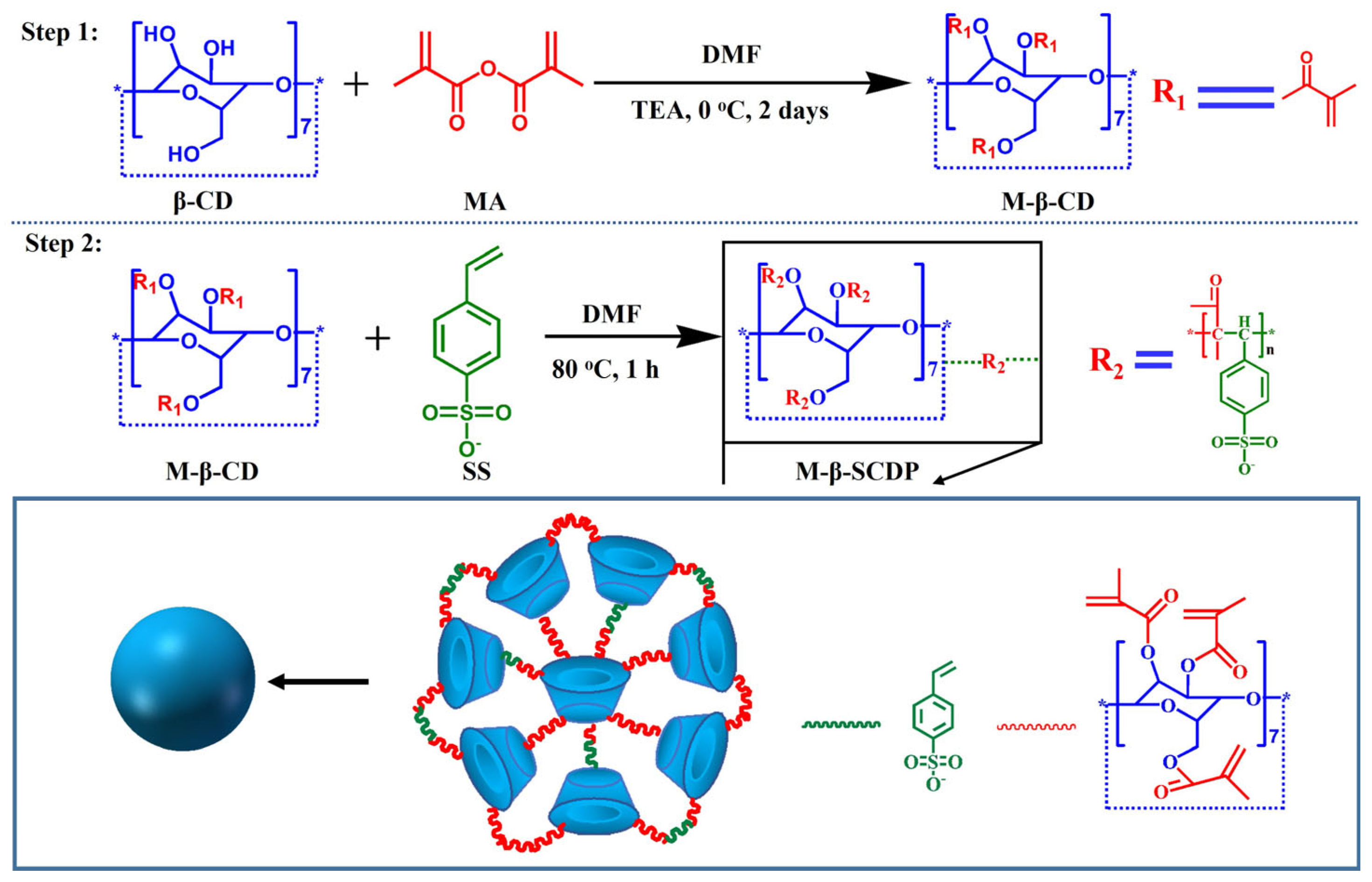
In this research, we created a novel mesoporous adsorbent (M-β-SCDP) through the addition polymerization of sodium p-styrenesulfonate (SS) and β-cyclodextrin derivatives modified with methacrylic anhydride (MA). The adsorption efficiency of M-β-SCDP was thoroughly analyzed, considering the influence of RhB pH, concentration, contact time and temperature. Additionally, the adsorption behavior of RhB on M-β-SCDP was explained using isothermal models, adsorption kinetics, and thermodynamic analysis. This research provides both practical and theoretical insights for creating effective adsorption materials, showing great promise for cleaning water polluted with organic dyes.

2. Materials and Methods

2.1. Materials

Methacrylic anhydride (MA, 94%, RHAWN, Shanghai, China), β-Cyclodextrin (β-CD, 98%, RHAWN, Shanghai, China), triethylamine (TEA, 99%, RHAWN, Shanghai, China), sodium p-styrenesulfonate (SS, 90%, RHAWN, Shanghai, China), ammonium persulfate (APS, 98.5%, RHAWN, Shanghai, China), N,N-dimethylformamide (DMF, AR, 97%, RHAWN, Shanghai, China), and methanol (MeOH, AR, 99.5%, RHAWN, Shanghai, China) were prepared. Aqueous solutions of rhodamine B (RhB) were prepared using deionized water at varying initial concentrations. All chemical solvents underwent purification and drying through a distillation purification system.

2.2. Preparation of M-β-CD

A 500 mL flask was used to mix 11.35 g (0.01 mol) of β-CD and 2 g (0.02 mol) of TEA in 200 mL of DMF. Subsequently, 1.54 g (0.01 mol) of MA was added to the mixed liquid. The flask containing the aforementioned mixture was allowed to react for 2 days at 0 °C. The resulting mixture was then dialyzed in water for 2 days and subsequently dried at 50 °C for 6 h to produce M-β-CD [28].

2.3. Preparation of M-β-SCDP

The M-β-CD (5 g), SS (5 g), and APS (0.2 g) were added in 100 mL DMF, and then the mixture was stirred mechanically while being heated to 80 °C. After reacting for 1 h, the mixture was filtered, and excess DMF was employed to eliminate any remaining M-β-CD, SS, and APS. The recovered solids underwent freeze-drying for 48 h to obtain M-β-SCDP. The prepared samples were named M-β-SCDPx according to different stirring rates (x being 500 rpm, 1000 rpm, and 2000 rpm, respectively). And the synthetic strategy of M-β-SCDP was shown in Scheme 1.

2.4. Adsorption Experiments

Aqueous solutions of RhB with varying concentrations (50~1000 mg·L−1) and varying dosages (20~100 mg) were prepared at a certain volume (V = 100 mL) to explore the adsorption properties of the adsorbents. The pH (2~12) of RhB solutions was altered with HCl and NaOH, each having a concentration of 0.1 mol·L−1. Furthermore, the thermodynamics for RhB by M-β-SCDP were determined by batch experiments. The experiments for adsorption were conducted in reagent bottles with M-β-SCDP agitated at 150 rpm by a shaker equipped with a thermostatic water bath. The adsorbent’s equilibrium adsorption capacity was calculated using the following equation [29,30]:
q e = ( C 0 C e ) × V / m
In this context, qe (mg·g−1) denotes the equilibrium adsorption capacity, and C0 and Ce (mg·L−1) indicate the initial and equilibrium concentrations of pollutant, respectively; V (L) refers to the water volume; m (g) signifies the adsorbent dose.
The regeneration of the adsorbent after pollutant adsorption was studied by using a certain volume of MeOH for desorption. A UV/VIS/NIR spectrometer (Lambda35, High Wycombe, UK) was selected to collect the UV-vis absorption spectra of the solutions. The adsorbents were separated through a centrifugal machine (SC-3616, Hefei, China) after the adsorption of RhB with the loss rate of blank experiments less than 1%. The experiments were repeated multiple times, and the average outcomes were recorded.

2.5. Characterization

The chemical structures of the samples were identified by Fourier Transform Infrared Spectroscopy (FTIR Spectrum two, High Wycombe, UK) with the range of 4000–400 cm−1. To verify the findings from FTIR spectroscopies, 13C NMR (AVANCE400, Ettlingen, Germany) and XPS spectrometers (ESCALAB250, Waltham, MA, USA) were employed. The Brunauer–Emmett–Teller (Micromeritics ASAP 2020 V4, Norcross, GA, USA) method was used to estimate the pore width and volume of the materials. Field emission scanning electron microscopy (FESEM) (SU8010, Tokyo, Japan) was used to examine the morphologies of the specimens that were prepared.

3. Results and Discussion

3.1. Structural Characterization

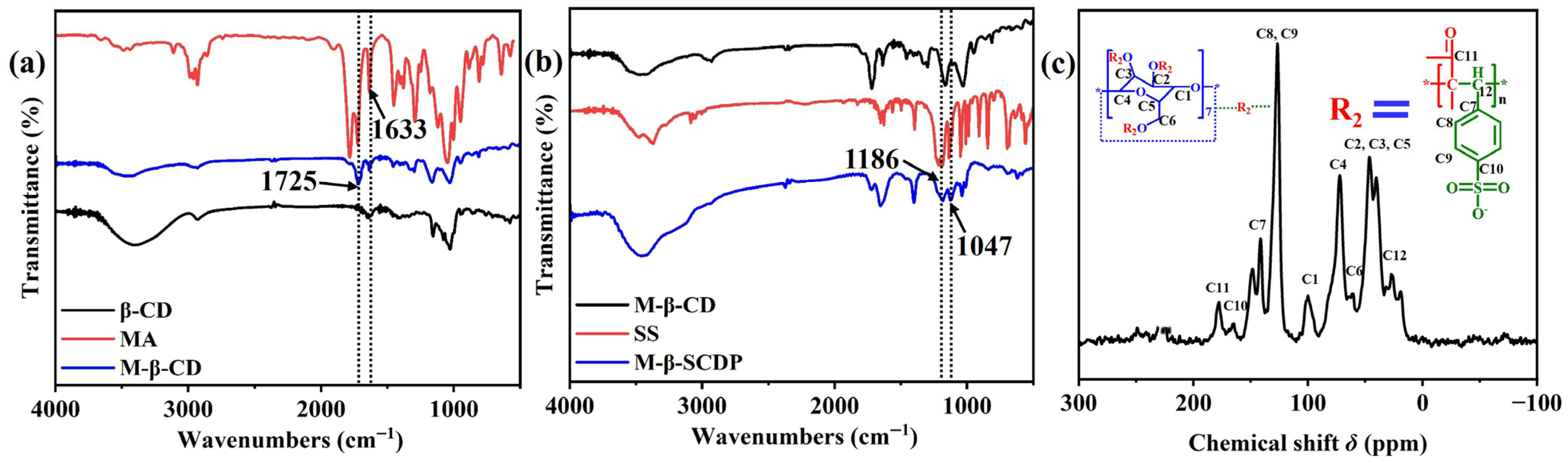
M-β-CD was created through an esterification reaction involving MA and β-CD, and its chemical structure was identified using FTIR, as depicted in Figure 1a. A broad and characteristic peak around 3410 cm−1 in the FTIR spectrum of M-β-CD corresponds to the presence of hydroxyl groups (–OH) [31,32]. In contrast to β-CD, the 1725 cm−1 is linked to the O-C=O stretching vibration of the methacrylate group in M-β-CD [28,33]. The FTIR of M-β-SCDP, as shown in Figure 1b, revealed new peaks at 1186 and 1047 cm−1, associated with the S=O vibration from -SO3− groups [34,35]. These characteristic peaks represent the distinctive absorption of SS, confirming its successful incorporation into the M-β-SCDP.
As shown in Figure 1c, the 13C MAS-NMR spectra of M-β-SCDP exhibited resonances at δ = 98.9 ppm (C1), 45.8 ppm (C2), 41.5 ppm (C3), 46.5 ppm (C4), 74.4 ppm (C5), and 66.6 ppm (C6), which are associated with β-CD spectra. Resonance at δ = 131.5 ppm (C-7), 121.62 ppm (C-8), 120.13 ppm (C-9), and 165.36 ppm (C-10) corresponded to the spectra of SS. A broad signal was observed at δ = 178.9 ppm (C11) and 25.8 ppm (C12), indicating that the carbocation addition reaction occurred between SS and M-β-CD [36].
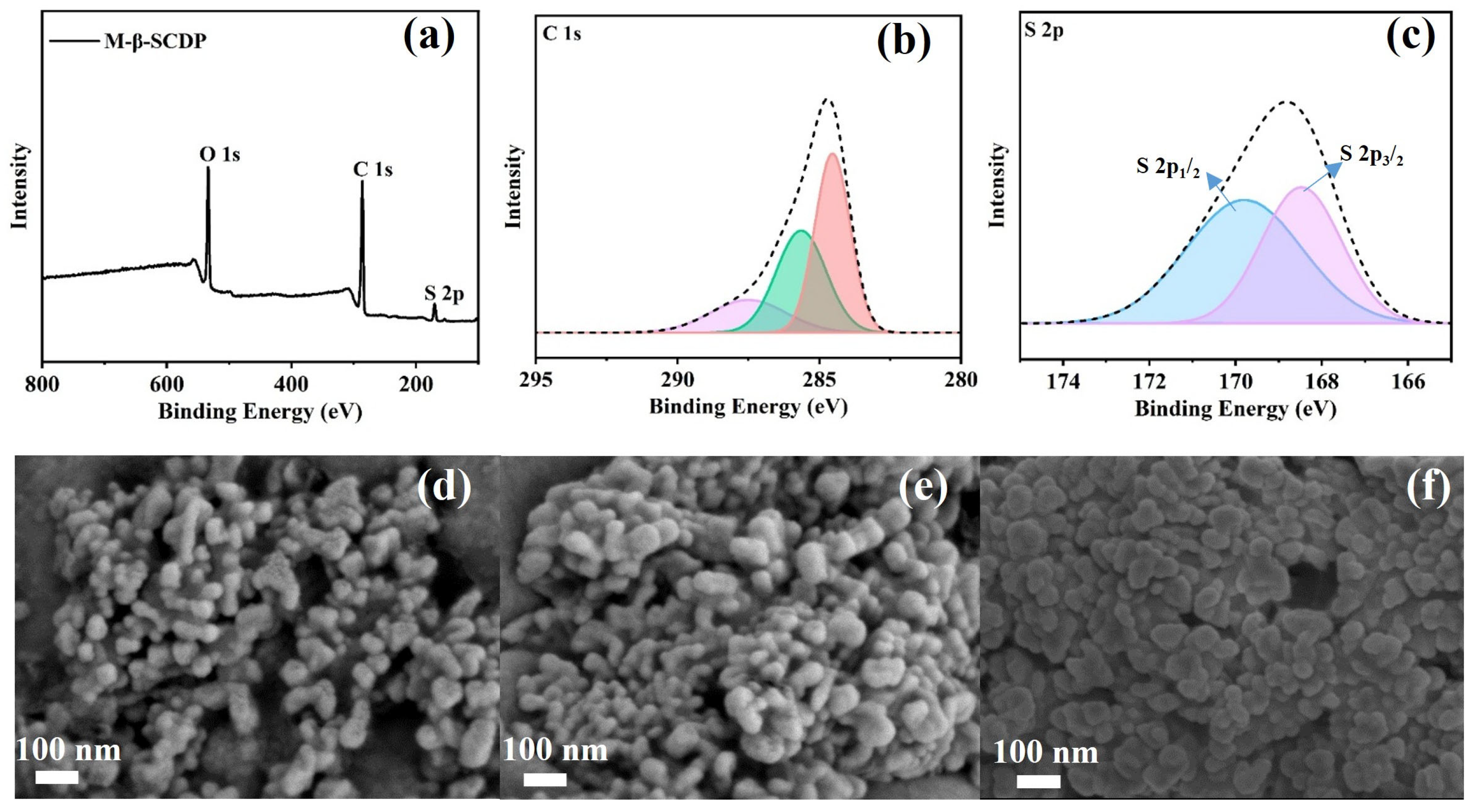
Furthermore, to ascertain the elemental composition of M-β-SCDP, XPS analysis was undertaken, with the results shown in Figure 2. The survey spectrum (Figure 2a) confirmed the presence of oxygen (O), carbon (C) and sulfur (S). As depicted in Figure 2b, C-C (284.53 eV), C-O (285.63 eV), and C=O (287.51 eV) could be detected in C 1s spectrum. The peaks at 169.80 eV (S 2p1/2) and 168.47 eV (S 2p3/2) are specifically associated with sulfates derived from the SS, as illustrated in Figure 2c and Table S1 [37]. This could further assist in the successful integration of SS monomers onto M-β-SCDP. The morphologies of the as-prepared specimens were investigated through FESEM, as shown in Figure 2d–f. It was found that different morphologies were clearly presented for the specimens, which were dependent on the stirring rate of the reaction mixtures. The porous structure of the specimens could be observed, which are beneficial to enhance their adsorption capacities.
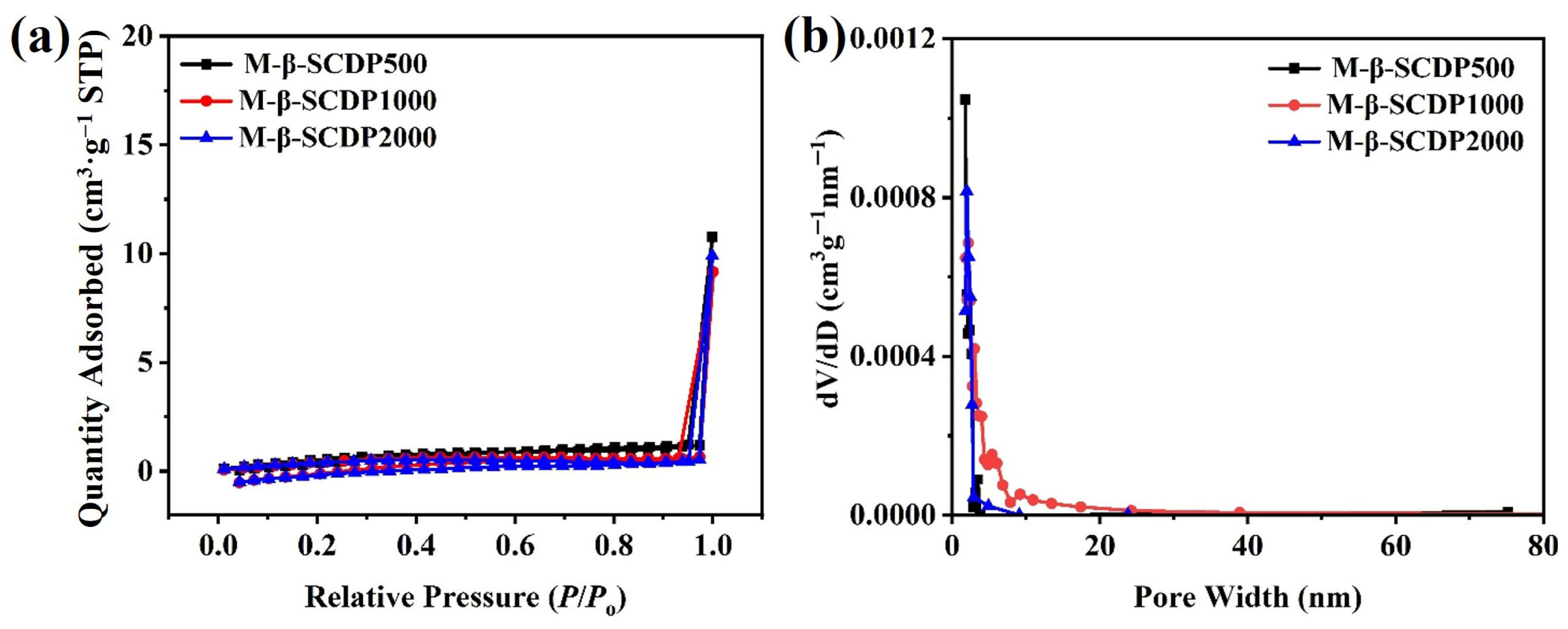
The porous characteristics of the materials were investigated using nitrogen sorption measurements. As shown in Figure 3a, there was a steady increase in uptake beginning from a relative pressure (P/P0) of 0.045 and reaching 0.85 for M-β-SCDP500, M-β-SCDP1000, and M-β-SCDP2000. This behavior suggests the presence of mesopores within these materials [38]. This inference is further corroborated by the pore size distribution results, which indicated the presence of mesopores ranging from 2 to 50 nm, as illustrated in Figure 3b and Table S2. As previously discussed, the synthesized M-β-SCDP materials possessed mesoporous structures, which facilitate the utilization of active adsorption sites [39]. This finding prompted further investigation into their adsorption properties concerning pollutants.

3.2. Evaluation of Adsorption Performance of M-β-SCDP for RhB

3.2.1. Solution pH

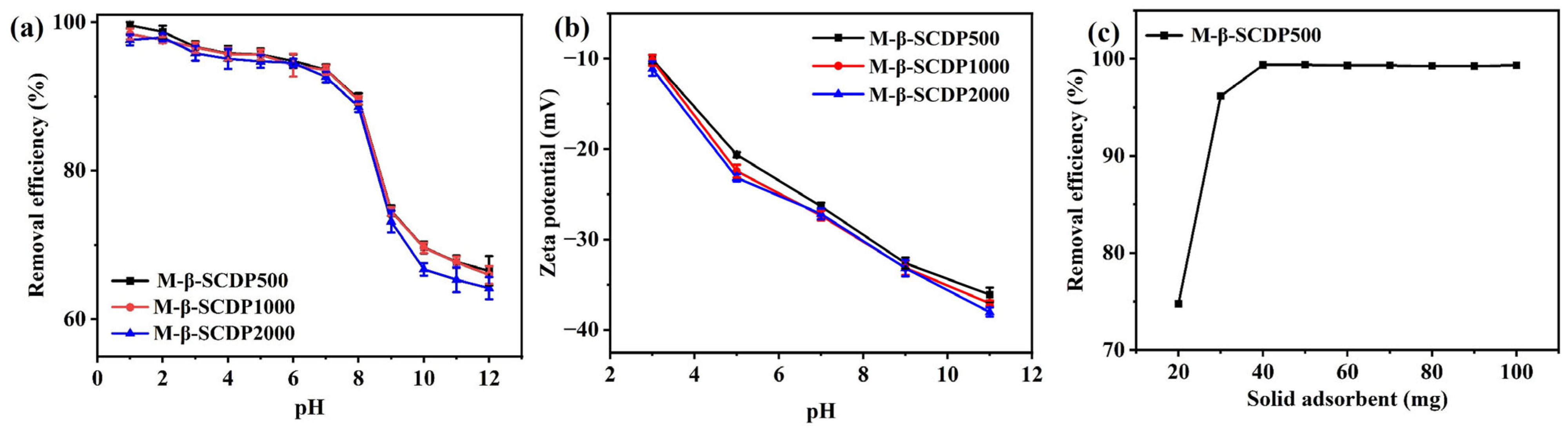
To investigate whether the adsorption performance is influenced by environmental conditions, specifically pH, various pH levels were selected for the RhB solutions. The effectiveness of M-β-SCDPs (M-β-SCDP500, M-β-SCDP1000, and M-β-SCDP2000) in adsorbing RhB was analyzed with pH levels from 2 to 12, with adjustments made using 0.1 mol·L−1 HCl and NaOH solutions. The RhB removal efficiency of M-β-SCDPs at different pH levels is presented in Figure 4a, indicating that RhB removal was pH-dependent. The maximum removal efficiency for RhB was observed at pH 4, with a removal rate exceeding 95%. In theory, the pH level of RhB solution can affect the dissociation of functional groups at the active sites of the M-β-SCDPs, surface charges, and the molecular form of RhB in the solution.
As shown in Figure 4b, the zeta potential of M-β-SCDPs was negative, which contributed to the electrostatic interaction towards RhB at lower pH values. The protonation of hydroxy and sulfonic acid groups in M-β-SCDPs led to repulsive interactions with RhB, restricting the adsorption capacity for RhB. As the pH increased, the degree of electrostatic repulsion diminished, while electrostatic attractions between RhB and the adsorbents were enhanced due to reduced protonation of the hydroxy groups, resulting in an increased removal efficiency for RhB. At pH levels above 4, the hydroxy groups in M-β-SCDPs and the dimethylamine group in RhB were likely to lose protons, limiting the adsorption of RhB. Moreover, the adsorption capacity of M-β-SCDPs stayed mostly consistent due to the plentiful binding sites present on the adsorbent surfaces. Consequently, M-β-SCDP500 was selected for further investigation into kinetics, adsorption isotherms, thermodynamics, removal mechanisms, and recyclability.

3.2.2. Adsorbent Dosage

Research into the variation of adsorbent quantities is essential in adsorption studies, as it influences the effectiveness of pollutant removal and the economic feasibility of the treatment method. This research analyzed how the adsorption of Rhodamine B (RhB) was influenced by different adsorbent loadings, using varying amounts of adsorbent material (20, 30, 40, 50, 60, 70, 80, 100 mg). Figure 4c displays how the adsorption efficiency of RhB varied with different dosages of M-β-SCDP500. When the amount of M-β-SCDP500 was raised from 0.02 g to 0.1 g, the efficiency of RhB removal increased from 74.76% to 99.32%, but the capacity of RhB for adsorption dropped from 149.52 mg·g−1 to 39.73 mg·g−1. The decrease in adsorption capacity is due to the higher M-β-SCDP500 dosage, which offers more active sites, improving RhB removal efficiency, but eventually causing adsorbent saturation. Consequently, an adsorbent dosage of 40 mg was identified as the optimal amount for batch experiments.

3.2.3. Kinetic Studies

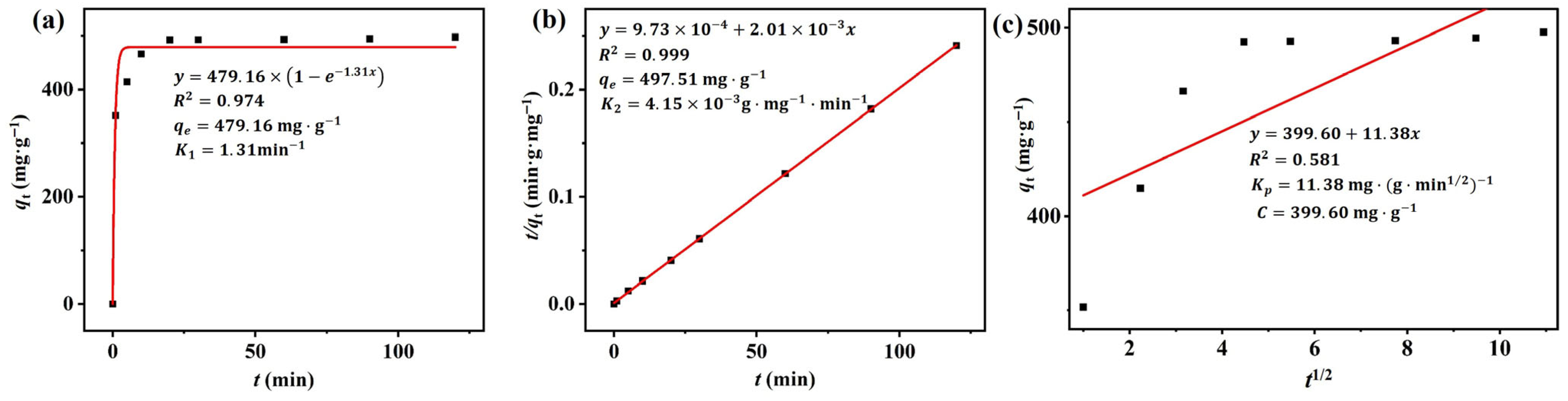
The adsorption kinetics of M-β-SCDP for pollutants were investigated across varying contact times. As illustrated in Figure 5, the adsorbents demonstrated rapid adsorption capabilities, achieving a removal efficiency exceeding 70% within 1 min and reaching equilibrium uptake within 30 min. This indicates that pollutants can be effectively adsorbed by M-β-SCDP500 in a relatively short period. The outstanding adsorption capability of M-β-SCDP500 is due to the plentiful functional groups on nanoparticle surfaces and their mesoporous architecture. The kinetic parameters for adsorption were obtained using pseudo-first-order, pseudo-second-order, and particle diffusion models, shown in Table 1 and explained by Equations (2)–(4) [40,41].
Pseudo - first   order :   ln q e q t = l n q e K 1 t
Pseudo - sec ond   order :   t / q t = 1 / K 2 q e 2 + t / q e
Particle   diffusion   model :   q t = K p t 1 / 2 + C
qe and qt represent the quantities of pollutants adsorbed at equilibrium and at a specific contact time t (min), respectively; K1 (min−1) represents the pseudo-first-order rate constant, while K2 (g·mg−1·min−1) represents the pseudo-second-order kinetic rate constant; Kp represents the diffusion rate constant (mg·(g·min1/2)−1) within particles, and C represents the adsorption constant (mg·g−1) in the particle diffusion model. Figure 5 and Table 1 display the relative curves and parameters based on the fitting results.
The adsorption kinetics of M-β-SCDP500 for RhB are illustrated in Figure 6. The pseudo-second-order model (R2 of 0.999) provided a better fit for the adsorption kinetics of RhB on M-β-SCDP500 than the pseudo-first-order model, which had an R2 of 0.974. This points to the adsorption process being in agreement with chemical adsorption.

3.2.4. Adsorption Isotherm

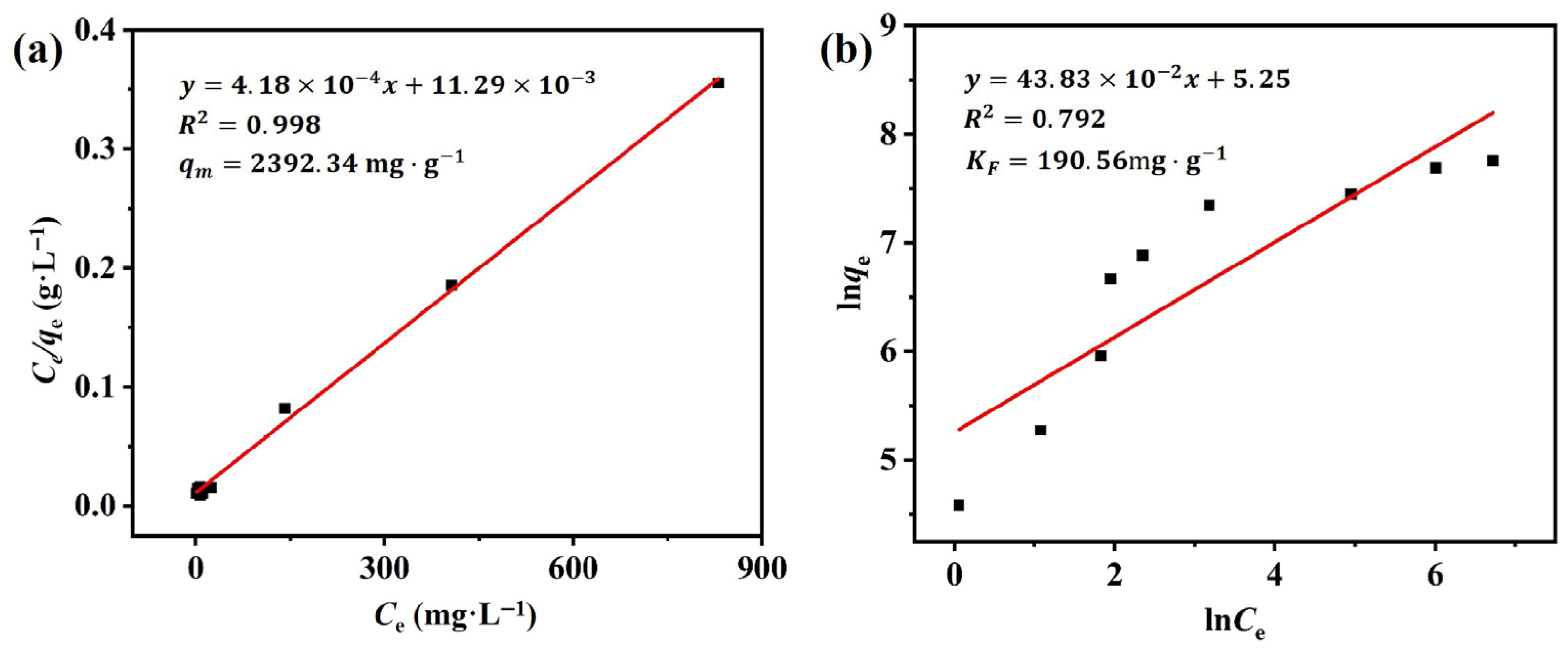
Typically, to evaluate an adsorbent’s adsorption capacity, the adsorption equilibrium is analyzed at different pollutant concentrations under a constant temperature in 30 min. To determine isotherm parameters, the Langmuir and Freundlich isotherm models are frequently used, as shown in Equations (5) and (6) [42,43].
Langmuir   model :   C e / q e = 1 / b q m + C e / q m
Freundlich   model :   l n q e = l n K F + 1 n l n C e
Ce (mg·L−1) represents the concentration of the RhB solution at equilibrium, while qe (mg·g−1) denotes the adsorption capacity at this concentration, and qm (mg·g−1) is the highest adsorption capacity; b (L·mg−1) and KF (mg1−1/n·L1/n·g−1) are the constants of the Langmuir and Freundlich models, respectively; 1/n represents the intensity of adsorption.
The Langmuir model describes the adsorbent surface as having multiple identical adsorption sites, all with equal affinity for the adsorbate. The occupation of one active site does not influence adjacent sites. In contrast, the Freundlich model portrays the M-β-SCDP500 surface as varied, enabling multilayer adsorption interactions with adsorbate molecules. In this model, stronger active sites are preferentially occupied, leading to a decrease in adsorbent affinity for adsorbate molecules as surface coverage increases [44].
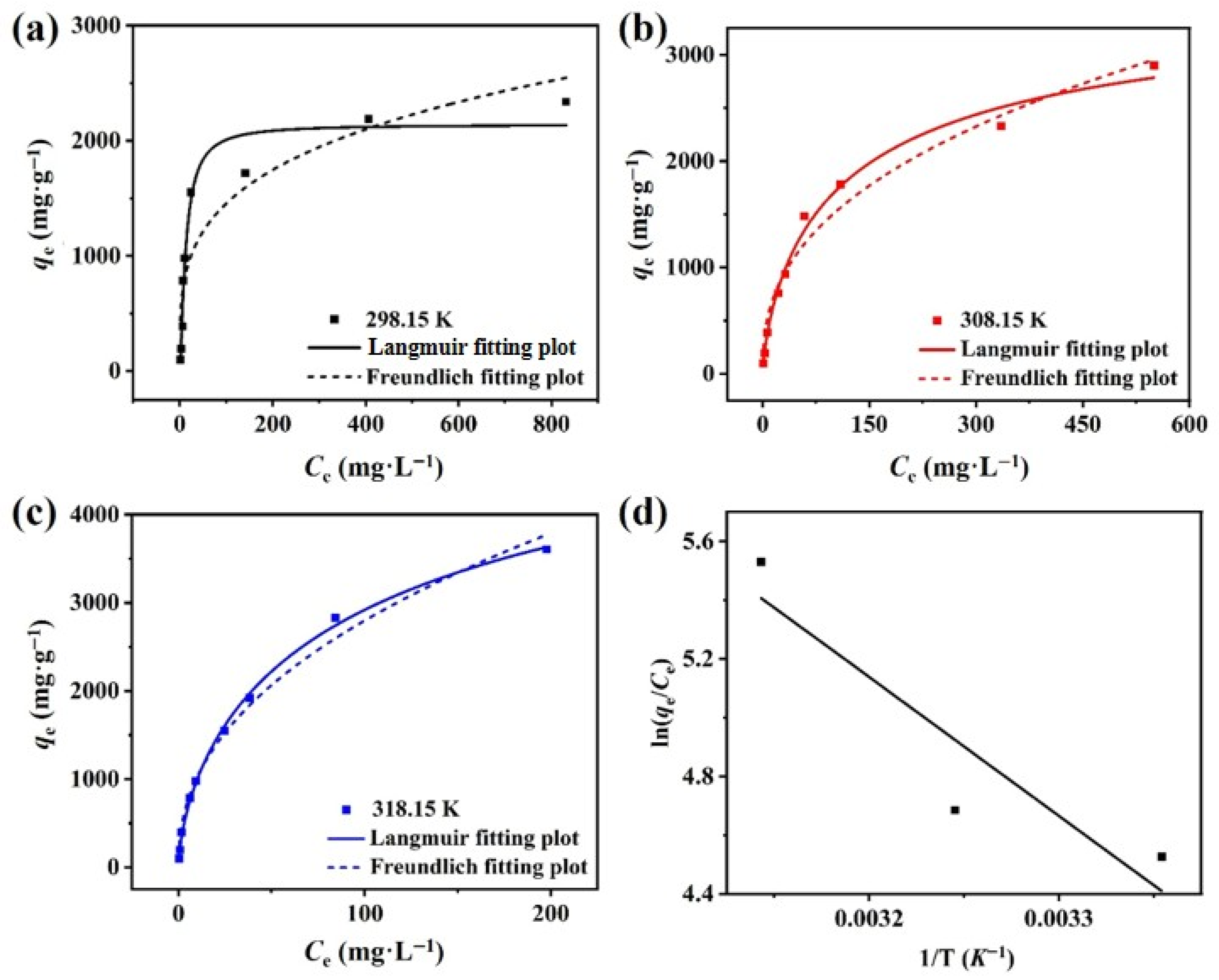
Compared to the Freundlich model, which had a correlation coefficient (R2) of 0.792, the Langmuir isotherm model, characterized by an R2 of 0.998, showed a superior fit for the adsorption of RhB by M-β-SCDP500. This discovery suggests that the Langmuir model better represents the RhB adsorption process, implying that pollutants were adsorbed on a uniform monolayer surface of the adsorbents. As detailed in Table 2, M-β-SCDP500 has an adsorption capacity for RhB of 2392.34 mg·g−1, which is higher than that of many other adsorbents reported in the literature.

3.2.5. Thermodynamic Studies and Recyclability

In this investigation, different temperatures were chosen to study the impact of temperature on RhB nanoparticle adsorption, allowing for the determination of thermodynamic parameters and the assessment of temperature effects. The adsorption capacity of M-β-SCDP500 for RhB exhibited a significant increase with rising solution temperatures. Table 3 displays the thermodynamic parameters for RhB adsorption at different temperatures, calculated using Equations (7)–(9) [48].
K d = q e / C e
l n K d = S o / R H o / R T
G o = R T l n K d
Ce represents the concentration at equilibrium (mg·L−1); qe denotes the quantity of pollutants adsorbed per gram of adsorbent at equilibrium (mg·g−1); Kd is the constant for adsorption equilibrium; T represents the absolute temperature measured in Kelvin; and R stands for the gas constant, which is 8.314 J·mol−1·K−1. ΔH° and ΔS° were derived from the slope and intercept of the linear regression of lnKd against the inverse of T (Figure 7d). Equation (9) was used to calculate the values of ΔG° at various temperatures.
Table 3 displays positive ΔH° values for RhB adsorption, indicating that these processes were endothermic. Conversely, negative ΔG° values for the adsorbate suggests that the process was thermodynamically spontaneous. Similarly, the ΔS° value for the adsorption of RhB was positive, demonstrating heightened randomness at the M-β-SCDP500–solution interface throughout the adsorption process, which compensated for the absorbed heat and drove the adsorption process at increased temperatures, ultimately achieving the spontaneous and efficient adsorption of Rhodamine B [49].
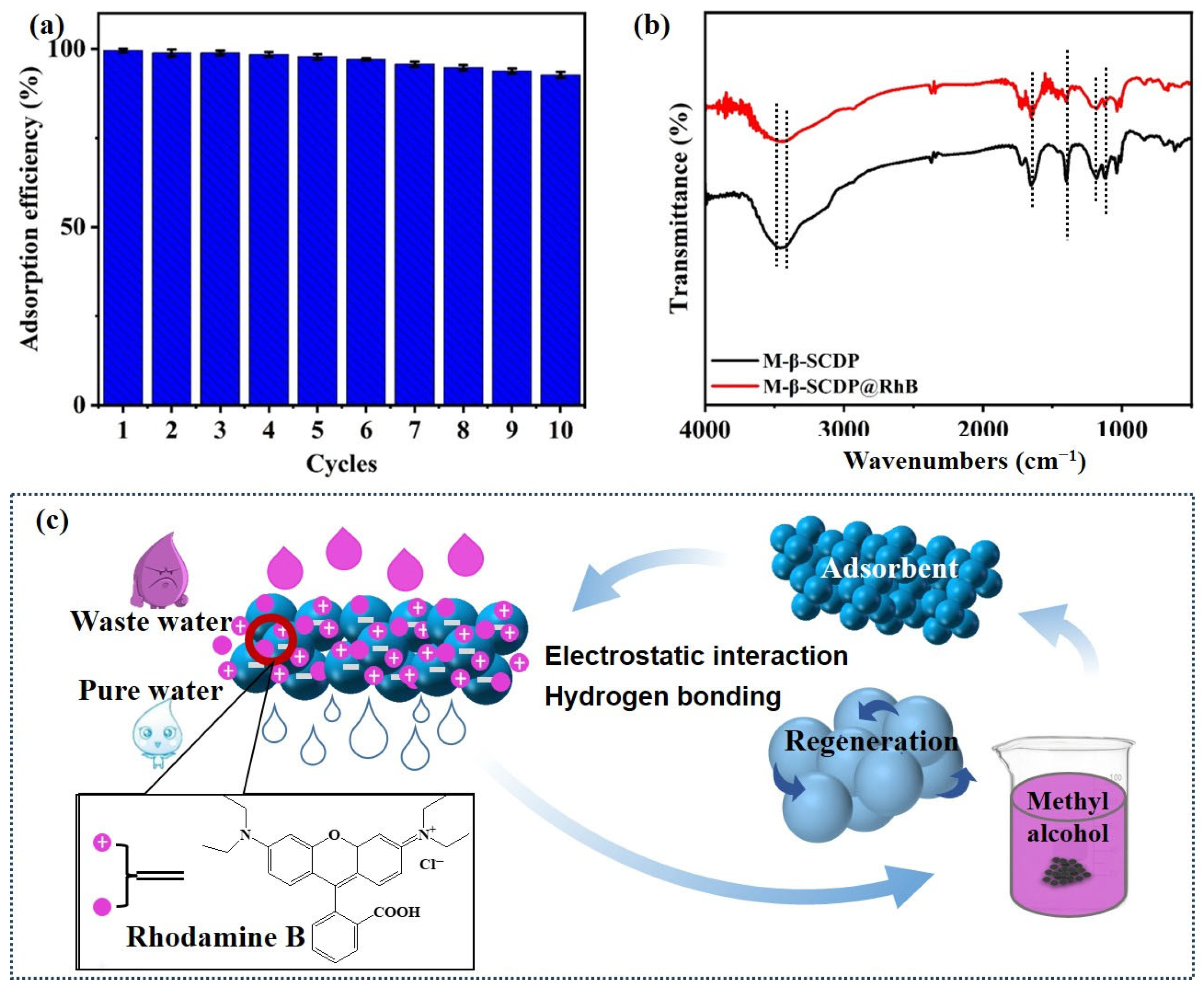
The adsorbents demonstrated outstanding adsorption performance, as illustrated in Figure 8. However, the reversible symmetric adsorption of adsorbents is crucial for practical applications. To evaluate the reusability of the adsorbents, M-β-SCDP500 with adsorbed pollutants was soaked in methanol (MeOH) for 30 min at room temperature to release RhB. Afterward, the adsorbents were extracted from the solutions through filtration and reused to eliminate RhB from water. Figure 8a indicates that the Rt value remained largely unchanged after 10 recycling cycles without any loss of adsorption capacity. Thus, considering the energy-demanding and degradative regeneration methods for activated carbons (ACs) [50], which also exhibit excellent adsorption performance, the M-β-SCDP500 adsorbents show great potential for effectively removing RhB from water and being reused efficiently.

3.2.6. Adsorption Mechanism

As illustrated in Figure 8b, FTIR was selected to display the chemical bonds of M-β-SCDP in both the presence and absence of RhB. A new stretching vibration of C=N with relatively weak intensity was detected at 1710 cm−1 in M-β-SCDP@RhB, indicating that the RhB molecule has been adsorbed onto the M-β-SCDP [51,52]. The emergence of these peaks implies that RhB were physically encapsulated within the pores of M-β-SCDP, not merely adsorbed onto the surface. Additionally, the hydroxyl group (-OH) bands in M-β-SCDP@RhB exhibited a slight upward shift and increased broadness compared to those in pure M-β-SCDP [53], indicating that hydrogen bonds were formed between M-β-SCDP and RhB. Furthermore, considering the results of the influence of RhB solution pH values on the adsorption process and the zeta potential of M-β-SCDP in Figure 4b, the adsorption process of M-β-SCDP for RhB also includes electrostatic interaction. Consequently, the adsorption mechanism of M-β-SCDP for the removal of RhB mainly included hydrogen bond interaction, and electrostatic interaction.

4. Conclusions

A novel adsorbent with rapid adsorption capabilities and exceptional performance was synthesized based on β-cyclodextrin, methacrylic anhydride, and p-styrenesulfonate. The fabricated specimens demonstrated a highly porous structure, contributing to their rapid and remarkable adsorption capacity for RhB, measured at 2392.34 mg·g−1, along with outstanding recyclability. Adsorption kinetics and isotherm experiments revealed that the adsorption process mainly relies on electrostatic adsorption, complexation, and hydrogen-bonding interaction. Additionally, M-β-SCDP exhibited excellent cyclic adsorption and desorption performance, with adsorption efficiency remaining virtually unchanged with no loss of adsorption capacity. In results, M-β-SCDP shows promise for the effective treatment of organic and inorganic pollutants in water because of its simple fabrication, excellent adsorption performance, and reversible adsorption symmetry.

Supplementary Materials

The following supporting information can be downloaded at: https://www.mdpi.com/article/10.3390/sym18010055/s1, Table S1: Deconvolution results of S 2p XPS spectrum for the M-β-SCDP; Table S2: Specific surface area, average pore size, and total pore volume of the M-β-SCDPs with different stirring rate (at 500 rpm, 1000 rpm and 2000 rpm, respectively).

Author Contributions

Conceptualization: Y.L. and X.Y.; methodology: Y.L.; software: Y.L.; validation: Y.L., Q.Z. and Y.Z.; formal analysis: P.Z.; investigation: J.Q.; resources: Y.L.; data curation: Y.L.; writing—original draft preparation: Y.L.; writing—review and editing: Y.L.; visualization: Y.L.; supervision: X.Y.; project administration: X.Y.; funding acquisition: Y.L. All authors have read and agreed to the published version of the manuscript.

Funding

This research was financially supported by the National Natural Science Foundation of China (52300111) and the Science Foundation of Zhejiang Sci-Tech University (21202087-Y).

Data Availability Statement

The original contributions presented in this study are included in the article. Further inquiries can be directed to the corresponding authors.

Conflicts of Interest

The authors declare no conflicts of interest.

References

  1. Amalina, F.; Abd Razak, A.S.; Krishnan, S.; Zularisam, A.W.; Nasrullah, M. A review of eco-sustainable techniques for the removal of Rhodamine B dye utilizing biomass residue adsorbents. Phys. Chem. Earth 2022, 128, 103267. [Google Scholar] [CrossRef]
  2. Chen, S.; Yang, X.; Li, J.; Ren, X.; Yan, B.; Ding, G. Preparation of Sodium Phthalocyanine Cobalt Sulfonate/Porous γ-Alumina Composites for Photocatalytic Reduction of Rhodamine B. Appl. Organomet. Chem. 2025, 39, e70078. [Google Scholar] [CrossRef]
  3. Liu, L.; Hu, Y.; Yang, Y.; Cheng, H.; Xiao, S. PDA-assisted immobilization of nZVI on cotton fabric for the removal of rhodamine B and chromium (VI) ion. Cellulose 2024, 32, 1105–1118. [Google Scholar] [CrossRef]
  4. Khumphon, J.; Ahmed, R.; Imboon, T.; Giri, J.; Chattham, N.; Mohammad, F.; Kityakarn, S.; Mangala Gowri, V.; Thongmee, S. Boosting photocatalytic activity in rhodamine B degradation using Cu-doped ZnO nanoflakes. ACS Omega 2025, 10, 9337–9350. [Google Scholar] [CrossRef]
  5. Hendri, Y.N.; Rati, Y.; Auni, A.K.E.; Marlina, R.; Munir, M.M.; Patah, A.; Darma, Y. Controlled pyrolysis of Zn-based metal organic framework-derived ZnO/C for Rhodamine-B degradation. Mater. Today Commun. 2023, 37, 107011. [Google Scholar] [CrossRef]
  6. Chennah, A.; Khan, M.A.; Zbair, M.; Ait Ahsaine, H. NiO/AC active electrode for the electrosorption of rhodamine B: Structural characterizations and kinetic study. Catalysts 2023, 13, 1009. [Google Scholar] [CrossRef]
  7. Slama, H.B.; Chenari Bouket, A.; Pourhassan, Z.; Alenezi, F.N.; Silini, A.; Cherif-Silini, H.; Oszako, T.; Luptakova, L.; Golińska, P.; Belbahri, L. Diversity of synthetic dyes from textile industries, discharge impacts and treatment methods. Appl. Sci. 2021, 11, 6255. [Google Scholar] [CrossRef]
  8. Benzaquén, T.B.; Carraro, P.M.; Eimer, G.A.; Urzúa-Ahumada, J.; Poon, P.S.; Matos, J. Rice husks as a biogenic template for the synthesis of Fe2O3/MCM-41 nanomaterials for polluted water remediation. Molecules 2025, 30, 12484. [Google Scholar] [CrossRef]
  9. Thottathil, S.; Puttaiahgowda, Y.M.; Selvaraj, R.; Vinayagam, R. Sustainable quercetin-based porous organic polymer for efficient rhodamine B dye removal and phytotoxicity assessment. J. Ind. Eng. Chem. 2025; in press. [Google Scholar] [CrossRef]
  10. Zhao, J.; Tang, Q.; Liu, J.; Liu, T.; Liu, D. Chloride anion adsorption from wastewater using a chitosan/β-cyclodextrin-based composite. Chem. Eng. Technol. 2022, 45, 1238–1246. [Google Scholar] [CrossRef]
  11. Zuo, H.; Li, Z.; Shi, Q.; Zhao, L.; Ma, J.; Li, R.; Liu, X.E. Industrial scale utilization of bamboo-based columnar activated carbon for efficient treatment of Rhodamine B: Process optimization and performance analysis. Sep. Purif. Technol. 2025, 379, 134877. [Google Scholar] [CrossRef]
  12. Tang, M.; Wu, C.; Liu, J.; Li, G.; Wang, Y.; Zhao, Y.; Zhang, G. Effective adsorption of rhodamine B by N/O Co-doped AC@CNTs composites prepared through catalytic coal pyrolysis. Surf. Interfaces 2024, 46, 103972. [Google Scholar] [CrossRef]
  13. Zhao, T.; Li, H.; Jia, X.; Ma, P.-C. Facile preparation of ZIF-8 functionalized basalt fiber felt and its high adsorption capacity for iodine. Surf. Interfaces 2023, 41, 103318. [Google Scholar] [CrossRef]
  14. Barczak, B.; Januszewicz, K. Advancing sustainable wastewater treatment with biomass-based highly porous activated carbon: Insights into sorption mechanisms and efficiency. J. Environ. Chem. Eng. 2025, 13, 118041. [Google Scholar] [CrossRef]
  15. Jiang, Y.; Liu, B.; Xu, J.; Pan, K.; Hou, H.; Hu, J.; Yang, J. Cross-linked chitosan/β-cyclodextrin composite for selective removal of methyl orange: Adsorption performance and mechanism. Carbohydr. Polym. 2017, 182, 106–114. [Google Scholar] [CrossRef]
  16. Crini, G.; Peindy, H.; Gimbert, F.; Robert, C. Removal of C.I. Basic Green 4 (Malachite Green) from aqueous solutions by adsorption using cyclodextrin-based adsorbent: Kinetic and equilibrium studies. Sep. Purif. Technol. 2007, 53, 97–110. [Google Scholar] [CrossRef]
  17. Li, J.; Loh, X.J. Cyclodextrin-based supramolecular architectures: Syntheses, structures, and applications for drug and gene delivery. Adv. Drug Deliv. Rev. 2008, 60, 1000–1017. [Google Scholar] [CrossRef] [PubMed]
  18. Salgın, U.; Alomari, İ.; Soyer, N.; Salgın, S. Adsorption of bisphenol A onto β-Cyclodextrin-based nanosponges and innovative supercritical green regeneration of the sustainable adsorbent. Polymers 2025, 17, 856. [Google Scholar] [CrossRef] [PubMed]
  19. Amran, F.; Zaini, M.A.A. Beta-cyclodextrin adsorbents to remove water pollutants—a commentary. Front. Chem. Sci. Eng. 2022, 16, 1407–1423. [Google Scholar] [CrossRef]
  20. Liu, Q.; Zhou, Y.; Lu, J.; Zhou, Y. Novel cyclodextrin-based adsorbents for removing pollutants from wastewater: A critical review. Chemosphere 2019, 241, 125043. [Google Scholar] [CrossRef]
  21. Fei, Y.; Dexian, C.; Jie, M. Synthesis of cyclodextrin-based adsorbents and its application for organic pollutant removal from water. Curr. Org. Chem. 2017, 21, 1976–1990. [Google Scholar] [CrossRef]
  22. Kundu, S.; Korin Manor, N.; Radian, A. Iron–montmorillonite–cyclodextrin composites as recyclable sorbent catalysts for the adsorption and surface oxidation of organic pollutants. ACS Appl. Mater. Interfaces 2020, 12, 52873–52887. [Google Scholar] [CrossRef]
  23. Ozelcaglayan, E.D.; Parker, W.J. β-cyclodextrin functionalized adsorbents for removal of organic micropollutants from water. Chemosphere 2023, 320, 137964. [Google Scholar] [CrossRef]
  24. Rajandran, P.; Masngut, N.; Abdul Manas, N.H.; Wan Azelee, N.I.; Mohd Fuzi, S.F.Z.; Bunyamin, M.A.H. Column adsorption studies on carbazole removal using β-cyclodextrin-functionalized activated rice hull biochar. Biocatal. Agric. Biotechnol. 2025, 69, 103767. [Google Scholar] [CrossRef]
  25. Rohith, M.; Rohith, P.; Daya, V.P.; Girija, P. Facilitating the excision of toxic dyes from wastewater via a green citric acid crosslinked β-CYCAL sorbent and its comparative study. J. Polym. Res. 2024, 31, 159. [Google Scholar] [CrossRef]
  26. Li, H.; Meng, B.; Chai, S.-H.; Liu, H.; Dai, S. Hyper-crosslinked β-cyclodextrin porous polymer: An adsorption-facilitated molecular catalyst support for transformation of water-soluble aromatic molecules. Chem. Sci. 2016, 7, 905–909. [Google Scholar] [CrossRef]
  27. Hong, M.; Wang, Y.; Wang, R.; Sun, Y.; Yang, R.; Qu, L.; Li, Z. Poly(sodium styrene sulfonate) functionalized graphene as a highly efficient adsorbent for cationic dye removal with a green regeneration strategy. J. Phys. Chem. Solids 2021, 152, 109973. [Google Scholar] [CrossRef]
  28. Patra, P.; Patra, A.S.; Mukherjee, A.K.; Pal, S. Development of a highly efficient selective flocculant based on functionalized β-cyclodextrin toward beneficiation of low-quality iron ore. Polym. Adv. Technol. 2021, 32, 2169–2175. [Google Scholar] [CrossRef]
  29. Chen, J.; Li, X.; Lv, X.; Xu, W.; Ma, Y.; Yang, X.; Jia, H.; Yi, S.; Fang, D. Hectorite-modified sodium alginate/γ-cyclodextrin microspheres with tunable interlayers for dye removal. ACS Appl. Polym. Mater. 2025, 7, 13743–13754. [Google Scholar] [CrossRef]
  30. Yao, Y.; Yao, T.; Qian, C. Synthesis and Application for Pb2+ Removal of a Novel Magnetic Biochar Embedded with FexOy Nanoparticles. Symmetry 2025, 17, 516. [Google Scholar] [CrossRef]
  31. Yuan, Z.; Liu, H.; Wu, H.; Wang, Y.; Liu, Q.; Wang, Y.; Lincoln, S.F.; Guo, X.; Wang, J. Cyclodextrin Hydrogels: Rapid Removal of Aromatic Micropollutants and Adsorption Mechanisms. J. Chem. Eng. Data 2020, 65, 678–689. [Google Scholar] [CrossRef]
  32. Niu, H.; Chen, W.; Chen, W.; Yun, Y.; Zhong, Q.; Fu, X.; Chen, H.; Liu, G. Preparation and characterization of a modified-β-cyclodextrin/β-carotene inclusion complex and its application in pickering emulsions. J. Agric. Food Chem. 2019, 67, 12875–12884. [Google Scholar] [CrossRef]
  33. Cheng, Y.-H.; Fung, M.-P.; Chen, Y.-Q.; Chiu, Y.-C. Development of mucoadhesive methacrylic anhydride-modified hydroxypropyl methylcellulose hydrogels for topical ocular drug delivery. J. Drug Deliv. Sci. Technol. 2024, 93, 105450. [Google Scholar] [CrossRef]
  34. Yin, T.; Zhang, X.; Shao, S.; Xiang, T.; Zhou, S. Covalently crosslinked sodium alginate/poly(sodium p-styrenesulfonate) cryogels for selective removal of methylene blue. Carbohydr. Polym. 2023, 301, 120356. [Google Scholar] [CrossRef]
  35. Wang, Y.; Wang, W.; Shi, X.; Wang, A. Enhanced swelling and responsive properties of an alginate-based superabsorbent hydrogel by sodium p-styrenesulfonate and attapulgite nanorods. Polym. Bull. 2013, 70, 1181–1193. [Google Scholar] [CrossRef]
  36. Shalaby, A.A.; Abd Elmageed, M.H.; Malash, G.F.; Tamer, T.M.; Omer, A.M.; Mohy-Eldin, M.S.; Khalifa, R.E. Development of novel cellulose acetate-g-poly(sodium 4-styrenesulfonate) proton conducting polyelectrolyte polymer. J. Saudi Chem. Soc. 2021, 25, 101327. [Google Scholar] [CrossRef]
  37. Wu, Y.; Zheng, H.; Li, H.; Sun, Y.; Zhao, C.; Zhao, R.; Zhang, C. Magnetic nickel cobalt sulfide/sodium dodecyl benzene sulfonate with excellent ciprofloxacin adsorption capacity and wide pH adaptability. Chem. Eng. J. 2021, 426, 127208. [Google Scholar] [CrossRef]
  38. Ao, S.; Yu, X.; Wang, X.; Ruan, D.; Qiao, Z.; Wang, Y. Sodium ion diffusion behavior in multiple open/closed pore ratios of novel β-cyclodextrin-derived hard carbon anode materials. Nano Lett. 2025, 25, 1314–1321. [Google Scholar] [CrossRef]
  39. Massaro, M.; Colletti, C.G.; Lazzara, G.; Guernelli, S.; Noto, R.; Riela, S. Synthesis and characterization of halloysite–cyclodextrin nanosponges for enhanced dyes adsorption. ACS Sustain. Chem. Eng. 2017, 5, 3346–3352. [Google Scholar] [CrossRef]
  40. Rizzi, V.; Gubitosa, J.; Signorile, R.; Fini, P.; Cecone, C.; Matencio, A.; Trotta, F.; Cosma, P. Cyclodextrin nanosponges as adsorbent material to remove hazardous pollutants from water: The case of ciprofloxacin. Chem. Eng. J. 2021, 411, 128514. [Google Scholar] [CrossRef]
  41. Habiba, U.; Siddique, A.; Li Lee, J.; Joo, C.; Ang, C.; Afifi, M. Adsorption study of methyl orange by chitosan/polyvinyl alcohol/zeolite electrospun composite nanofibrous membrane. Carbohydr. Polym. 2018, 191, 79–85. [Google Scholar] [CrossRef]
  42. Lagiewka, J.; Pajdak, A.; Zawierucha, I. Adsorption performance and mechanism of a novel composite based on β-cyclodextrin polymer and chitosan: Selective and rapid removal of acid orange 7. Carbohydr. Polym. 2025, 353, 123297. [Google Scholar] [CrossRef] [PubMed]
  43. Ouyang, J.; Gao, J.; Shen, J.; Wei, Y.; Wang, C. Preparation of magnetic graphene/β-cyclodextrin polymer composites and their application for removal of organic pollutants from wastewater. J. Environ. Chem. Eng. 2023, 11, 110944. [Google Scholar] [CrossRef]
  44. Tu, Y.; Xu, G.; Jiang, L.; Hu, X.; Xu, J.; Xie, X.; Li, A. Amphiphilic hyper-crosslinked porous cyclodextrin polymer with high specific surface area for rapid removal of organic micropollutants. Chem. Eng. J. 2020, 382, 123015. [Google Scholar] [CrossRef]
  45. Kayranli, B. Adsorption efficiency of groundnut husk biochar in reduction of rhodamine B, recycle, and reutilization. Biomass Convers. Biorefin. 2025, 15, 25501–25513. [Google Scholar] [CrossRef]
  46. Wang, J.; Wu, G.; Zhang, Y.; Wu, J.; Wei, L. One-step synthesis of mesoporous manganese silicate for efficient adsorption of methylene blue, rhodamine B, and brilliant green. Sep. Purif. Technol. 2025, 379, 134953. [Google Scholar] [CrossRef]
  47. Zhang, C.; Wang, Y.; Zhao, Y.; Zhang, G. Ultrahigh-capacity adsorption of rhodamine B by N, S co-doped carbon nanotube composites derived from coal. Sep. Purif. Technol. 2025, 376, 134045. [Google Scholar] [CrossRef]
  48. Ptaszkowska-Koniarz, M.; Goscianska, J.; Pietrzak, R. Removal of rhodamine B from water by modified carbon xerogels. Colloids Surf. A 2018, 543, 109–117. [Google Scholar] [CrossRef]
  49. Hayeeye, F.; Sattar, M.; Chinpa, W.; Sirichote, O. Kinetics and thermodynamics of rhodamine B adsorption by gelatin/activated carbon composite beads. Colloids Surf. A 2017, 513, 259–266. [Google Scholar] [CrossRef]
  50. Mozhiarasi, V.; Natarajan, T.S. Bael fruit shell–derived activated carbon adsorbent: Effect of surface charge of activated carbon and type of pollutants for improved adsorption capacity. Biomass Convers. Biorefin. 2022, 14, 8761–8774. [Google Scholar] [CrossRef]
  51. Peng, M.; Kaczmarek, A.M.; Van Hecke, K. Ratiometric Thermometers based on rhodamine B and fluorescein dye-incorporated (nano) cyclodextrin metal-organic frameworks. ACS Appl. Mater. Interfaces 2022, 14, 14367–14379. [Google Scholar] [CrossRef]
  52. Dukali, R.; Radovic, I.; Stojanovic, D.; Sevic, D.; Radojevic, V.; Jocic, D.; Aleksic, R. Electrospinning of laser dye rhodamine B-doped poly(methyl methacrylate) nanofibers. J. Serb. Chem. Soc. 2014, 79, 867–880. [Google Scholar] [CrossRef]
  53. Furukawa, Y.; Ishiwata, T.; Sugikawa, K.; Kokado, K.; Sada, K. Nano- and microsized cubic gel particles from cyclodextrin metal–organic frameworks. Angew. Chem. Int. Ed. 2012, 51, 10566–10569. [Google Scholar] [CrossRef] [PubMed]
Scheme 1. Synthetic strategy of the M-β-CD-based β-CD and MA in step 1; synthetic strategy of the M-β-SCDP-based M-β-CD and SS in step 2.
Symmetry 18 00055 sch001
Figure 1. Description of M-β-CD and M-β-SCDP. (a) FTIR spectra for β-CD, MA, and M-β-CD. (b) FTIR spectra for M-β-CD, SS, and M-β-SCDP. (c) 13C NMR spectra for M-β-SCDP.
Symmetry 18 00055 g001
Figure 2. Results from XPS analysis of M-β-SCDP: (a) survey scan, (b) C 1s, (c) S 2p. FESEM images of M-β-SCDP with different stirring rates at (d) 500 rpm, (e) 1000 rpm, and (f) 2000 rpm, respectively.
Symmetry 18 00055 g002
Figure 3. (a) N2 sorption isotherms of M-β-SCDP500, M-β-SCDP1000, and M-β-SCDP2000. (b) Distribution of pore sizes in M-β-SCDP500, M-β-SCDP1000, and M-β-SCDP2000, determined by using density functional theory (DFT) model.
Symmetry 18 00055 g003
Figure 4. Removal efficiencies (a) and zeta potential (b) of M-β-SCDP500, M-β-SCDP1000, and M-β-SCDP2000 for RhB with different pH values of pollutant solution. (c) The RhB removal efficiencies at different dosages of M-β-SCDP500. Initial concentration of pollutants: C[RhB initial] = 200 mg·L−1, V = 100 mL, m = 50 mg, T = 298.15 K.
Symmetry 18 00055 g004
Figure 5. Adsorption kinetics of RhB uptake by M-β-SCDP500: (ac). C0 = 500 mg·L−1, pH = 4 ± 0.1, V = 100 mL, m = 40 mg, T = 298.15 K.
Symmetry 18 00055 g005
Figure 6. Adsorption isotherms of pollutant uptake by M-β-SCDP500 at different concentrations of RhB (at 50 mg·L−1, 100 mg·L−1, 200 mg·L−1, 400 mg·L−1, 500 mg·L−1, 800 mg·L−1, 1000 mg·L−1, and 2000 mg·L−1): (a,b). pH = 4 ± 0.1, V = 100 mL, m = 40 mg, T = 298.15 K.
Symmetry 18 00055 g006
Figure 7. (ac) Adsorption isotherms of RhB uptake by M-β-SCDP500 at different temperatures (298.15 K, 308.15 K, and 318.15 K). (d) The linear relationship between ln K0 and the inverse of T for RhB. pH = 4 ± 0.1, V = 100 mL, m = 40 mg.
Symmetry 18 00055 g007
Figure 8. Depiction of M-β-SCDP500 adsorption for RhB target: (a) recyclability of adsorbent for RhB, (b) FTIR spectra of M-β-SCDP500 before and after RhB loading, (c) adsorption mechanism of M-β-SCDP500 for RhB.
Symmetry 18 00055 g008
Table 1. Adsorption of RhB by M-β-SCDP500 at different contact times.
AdsorbentPollutantPseudo-First OrderPseudo-Second OrderParticle Diffusion Model
q1e (mg·g−1)K1 (min−1)R2q2e (mg·g−1)K2 (g·mg−1·min−1)R2KpCR2
M-β-SCDP500RhB479.161.310.974497.51 4.15 × 10 3 0.99911.38399.600.581
Table 2. The adsorption capacity of M-β-SCDP500 for RhB compared to other adsorbents.
AdsorbentsPollutantsqm (mg·g−1)Reference
Quercetin-based novel porous organic polymer (QPOP)RhB499.52[9]
Bamboo-based columnar activated carbons (BAC-10)RhB300.3[11]
Groundnut husk biochar (GHB)RhB182.24[45]
Mesoporous manganese silicate (MH)RhB420.63[46]
Carbon nanotube composites (SCTNs/AC)RhB3242.04[47]
M-β-SCDP500RhB2392.34This work
Table 3. Thermodynamic characteristics of RhB adsorption on M-β-SCDP500 across different temperatures.
AdsorbentsPollutantΔH°
(kJ·mol−1)
ΔS°
(J·mol−1·K−1)
ΔG° (kJ·mol−1)
298.15 K308.15 K313.15 K
M-β-SCDP500RhB12.1778.46−11.21−24.18−24.96
Disclaimer/Publisher’s Note: The statements, opinions and data contained in all publications are solely those of the individual author(s) and contributor(s) and not of MDPI and/or the editor(s). MDPI and/or the editor(s) disclaim responsibility for any injury to people or property resulting from any ideas, methods, instructions or products referred to in the content.