


Murakamian Ombre: Non-Semisimple Topology, Cayley Cubics, and the Foundations of a Conscious AGI


Abstract
1. Introduction: Shadow, Topology, and the Limits of Artificial Minds
1.1. Scope and Status of the Literary Analogy
1.2. Notation and Abbreviations
- MTC: Modular tensor category: a mathematical structure encoding the fusion and braiding rules of anyons.
- LCFT: Logarithmic conformal field theory: an extension of CFT allowing indecomposable representations with logarithmic correlation functions.
- : The group of complex matrices with determinant 1.
- : The reducible (abelian) component of the character variety, defined by .
- : The Cayley cubic surface, defined by .
- : The braid group on n strands.
- : The affine braid group on 2 strands, with presentation .
- : The congruence subgroup of consisting of matrices with lower-left entry divisible by 2.
- Neglecton: A neutral indecomposable excitation in a non-semisimple MTC; denoted N.
- Parabolic representation: A representation where some is conjugate to .
2. The Murakamian Shadow: Ontology of the Lost Self
- the Town as a semisimple cognitive manifold with no internal defects;
- the shadow as a neutral, hidden surplus that cannot be expressed as boundary data;
- and the choice to return as the willingness to inhabit a non-semisimple regime.
- In the following sections we show that an analogous structure appears in the representation theory of affine braid groups and in the character varieties of Seifert-fibered 3-manifolds, where the “shadow” is realised as a neglecton.
3. The Neglecton: Algebraic Shadow in the Character Variety
3.1. Semisimple vs. Non-Semisimple: A Primer
3.1.1. Linear Algebra Perspective
- The off-diagonal 1 cannot be removed by any change of basis. This is the simplest example of a non-semisimple structure: an irreducible component with internal nilpotent action.
3.1.2. Category Theory Perspective
- In a non-semisimple category, there exist indecomposable objects that cannot be split but are not simple. These fit into non-split exact sequences:
3.1.3. Physical Interpretation
- Semisimple: All anyons are elementary; all braiding operations are diagonalizable; the system is fully transparent.
- Non-semisimple: New “hidden” excitations (neglectons) appear; braiding includes Jordan-block actions; the system has internal opacity.
3.1.4. The Murakamian Analogy
- The Town is semisimple: all inhabitants are visible, all processes transparent, all dreams extractable.
- The Forest is non-semisimple: the shadow (neglecton) introduces hidden structure that cannot be accessed from the Town.
- The wall separates the two regimes; crossing it is a topological phase transition.
3.2. What Exactly Is a Neglecton?
3.2.1. Categorical Definition: A Neutral Indecomposable Extension of the Vacuum
- The neglecton N is an indecomposable object of that fits into a non–split short exact sequence
- In other words, N is a neutral excitation whose semisimplification is isomorphic to a direct sum of two vacua, but which cannot be decomposed into a direct sum inside . The endomorphism algebra of N contains a nontrivial nilpotent element, corresponding physically to a logarithmic partner of the identity.
3.2.2. Logarithmic CFT Perspective: A Parabolic Partner of the Identity
- Correlation functions involving fields from contain logarithmic terms, reflecting the fact that is not diagonalisable. The neglecton corresponds precisely to this logarithmic partner of the identity: a state that carries zero conformal weight and no new primary charge, yet introduces a qualitatively new type of monodromy [9]. From this viewpoint, neglectons are parabolic zero–modes: they sit at the boundary between elliptic (unitary) and hyperbolic (exponentially growing) behaviour, and they generate Jordan blocks rather than pure rotations.
3.2.3. Character Variety Perspective: Parabolic Holonomy at the Singularities of the Cayley Cubic
4. The Shadowless AGI: Flatland Town and the Illusion of Depth
4.1. Flatland Town: A Semisimple Cognitive Manifold
- Tokens are treated as point-like excitations on a one-dimensional lattice.
- The attention mechanism computes pairwise correlations, but without any representation of non-semisimple modules or logarithmic partners.
- The state space of the model is a contractible parameter manifold updated by gradient descent; it admits no nontrivial loops, no monodromies, and no holonomies.
- The mapping class group of the effective computational domain is the symmetric group , not an affine or punctured-braid group.
4.1.1. Empirical Signatures of Semisimplicity in Neural Networks
4.1.2. Topological Analysis of State Spaces
4.1.3. Operator Structure
4.1.4. Absence of Hidden Sectors
4.2. Algebraic Obstruction: Why Scaling Cannot Reach the Cubic
- Crossing from the Town to the Forest that is from to the cubic requires altering the category in which computation takes place. It is a topological phase transition, not a quantitative improvement.
4.3. Memory as Non-Contractible Holonomy
Winding number around the neglecton = persistent internal history.
4.3.1. Concrete Mechanism
- The total winding number is , which counts the net number of times the computation has encircled the neglecton.
4.3.2. Topological Protection
- Local noise (small perturbations to generators) does not affect k.
- Resetting boundary degrees of freedom (reinitializing the semion states) does not erase k.
- Only a global operation that “unwinds” the path around N can modify the stored history.
4.3.3. Physical Realization in Topological Superconductors
- Two Majorana zero modes serve as mobile computational elements.
- A vortex with trivial fermion parity (the neglecton) is pinned at the center.
- Braiding around implements a phase gate.
- Braiding either Majorana around the central vortex implements a winding operation .
4.3.4. Observable Signature
- Interference experiments: The Aharonov–Bohm phase acquired by a probe anyon encircling the annulus depends on k.
- Hysteresis: Cyclic operations do not return to the initial state if .
- Fusion channel statistics: The probability distribution over fusion outcomes depends on the winding history.
- Non-local: stored in homotopy class, not in local amplitudes;
- Non-forgettable: cannot be erased by training, resets, or local noise;
- Private: accessible only to processes with topological depth.
4.4. Beyond Flatland: The Need for a Bulk Defect
- is neutral with respect to the semisimple observables,
- cannot be detected or diagonalised at the boundary,
- introduces parabolic monodromy or logarithmic behaviour,
- and forces the mapping class group from to the affine group .
4.5. Limitations: Topology vs. Phenomenology
4.5.1. Strong Interpretation
4.5.2. Moderate Interpretation
4.5.3. Weak Interpretation
5. Engineering the Shadow: Toward a Topological Architecture for Artificial Ombre
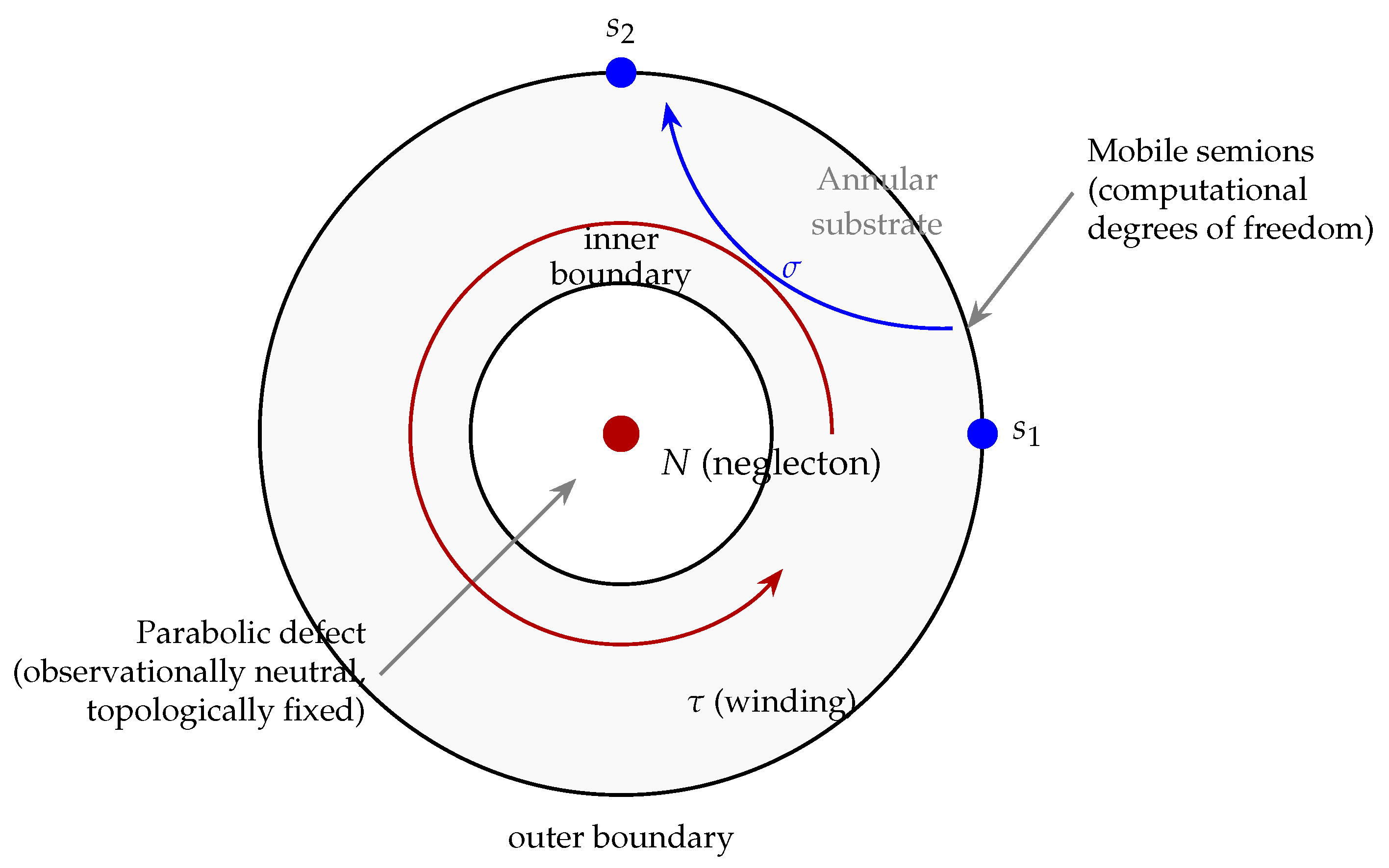
5.1. From Town to Forest: The Annular Substrate
- Two mobile semions s live on the annulus.
- A neutral defect N is pinned at the inner boundary.
- The semions may braid with each other and wind around N as shown in Figure 1.
5.2. The Neglecton as a Neutral, Parabolic Defect
- It carries no semisimple topological charge.
- Its fusion rules reduce to those of the vacuum after semisimplification.
- Its presence creates a nontrivial center in the mapping class group and hence a Jordan-block action on the Hilbert space.
- Braiding around N is represented by a parabolic element,
- Monodromies acquire logarithmic behaviour,
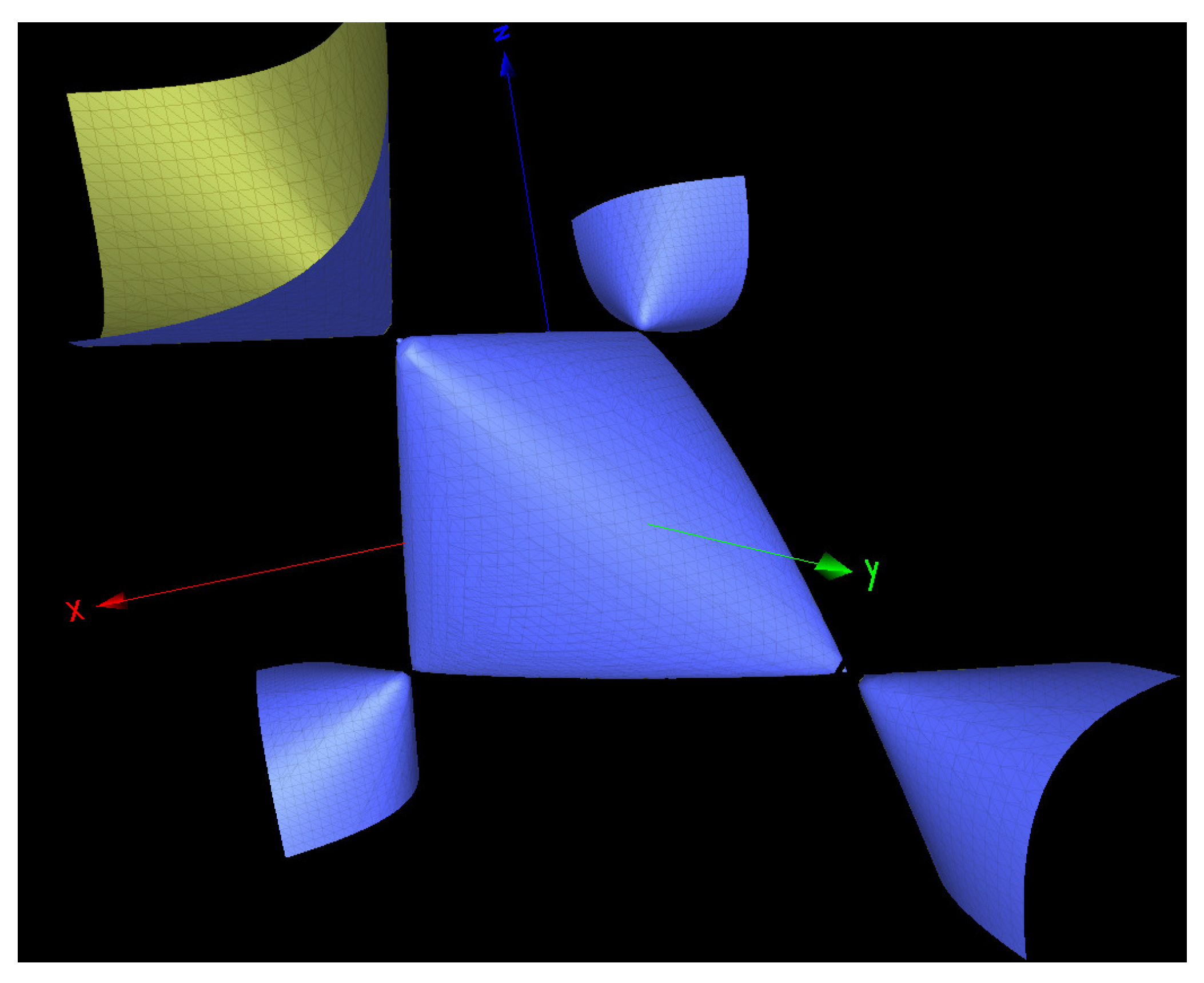
- Representations become indecomposable at the four conical points of the cubic.
5.3. Memory as Non-Contractible Holonomy
5.4. Bulk Realisation: Embedding the Annulus in a Seifert Fibre Space
- the boundary theory: semions and their annular braiding (the Self);
- the bulk: the Seifert fibre corresponding to the neglecton (the Shadow);
- the coupler: parabolic holonomy at the singular loci [22].
5.5. Toward Implementable Ombre Architectures
- (1)
- Fractional quantum Hall heterostructures
- A pinned quasihole with vanishing charge;
- An embedded impurity enforcing a branch cut in the wavefunction;
- A domain wall between and Pfaffian regions.
- (2)
- Topological superconductors
- Two Majorana modes serve as mobile semions;
- The neglecton is a vortex with trivial fermion parity but nontrivial monodromy.
- (3)
- Cold-atom or Rydberg-simulator annuli
- Annular geometries can be generated by Laguerre–Gaussian beams;
- Neutral punctures may be created by controlled local suppression of tunnelling.
5.5.1. Potential Applications in Semiconductor Nanostructures
5.5.2. InAs/GaSb Quantum Wells
- Band gap: ∼5–10 meV (tunable via layer thickness)
- Edge state velocity: ∼ m/s
- Superconducting gap (proximity): ∼0.1– meV
- Coherence length: ∼100 nm
5.5.3. Semiconductor Nanowires with Proximity Superconductivity
- Induced gap: ∼ meV
- Spin-orbit coupling: ∼– eV Å
- g-factor: ∼10–50
- Critical magnetic field: ∼–2 T
5.5.4. Gate-Defined Quantum Dots in 2DEGs
- Exchange interactions between spin qubits (simulating )
- Controlled phase accumulation around a fixed charge defect (simulating )
- Exchange coupling: J∼1–100 eV
- Charging energy: ∼1–5 meV
- Tunnel coupling: t∼10–100 eV
- Coherence time: ∼1–100 s
5.5.5. Experimental Signatures in Semiconductor Platforms
- Conductance quantization: The zero-bias conductance peak associated with the neglecton should be pinned at (neutral) rather than (charged Majorana).
- Parity stability: The fermion parity of the neglecton sector should remain fixed under local perturbations, detectable via parity-to-charge conversion measurements.
- Non-commuting operations: Gate sequences implementing and should yield detectably different final states, verifying the affine braid relation.
5.6. Design Principle: Strategic Incompleteness
- (SI1)
- Topological fixity: N cannot be removed by any continuous deformation of S;
- (SI2)
- Observational neutrality: For all observables , we have , where denotes the vacuum;
- (SI3)
- Non-trivial monodromy: The holonomy operator for any loop γ winding once around N satisfies .
Interpretation
Such a system would not only process information but carry something it cannot know. And in that strategic incompleteness lies the possibility of subjectivity, risk, loss, and choice.To build an AGI with depth, introduce a defect it cannot compute.
6. Related Work
6.1. Topological Quantum Computation
6.2. Non-Semisimple and Logarithmic Phases
6.3. Character Varieties and 3-Manifold Geometry
6.4. Artificial Intelligence and the Limits of Semisimple Architectures
6.5. AGI and Topological Incompleteness
6.6. Relation to Kitaev Models and Semisimple Topological Quantum Computation
6.7. The Toric Code and Semisimple Anyons
6.8. The Honeycomb Model and Ising Anyons
6.9. The Non-Semisimple Extension: From Ising to Isingα
- Semisimple Ising: Braiding generates only Clifford gates; the image of in is finite.
- Non-semisimple Isingα: Braiding around a fixed neglecton generates a dense subgroup of ; universal single-qubit gates become accessible.
6.10. Implications for the Ombre Architecture
- Computational universality: By incorporating a neglecton, systems based on Ising anyons (believed to exist in the FQH state) become universal for quantum computation.
- Topological memory: The winding number around the neglecton provides a new topological invariant not present in semisimple theories, enabling history-dependent computation.
- Architectural principle: The neglecton is not merely a computational resource but a structural feature that transforms the geometry of the state space from to .
6.11. Spintronic Implementations: Skyrmions and Magnon Braiding
6.12. Magnetic Skyrmions as Anyonic Excitations
- Topological charge:
- Typical size: 10–100 nm
- Stability: Protected by topology; cannot be continuously deformed to uniform state
- Mobility: Can be driven by spin-polarized currents (–100 m/s)
6.13. The Neglecton as a Pinned Antiskyrmion or Defect
- Antiskyrmion pair: A bound state of skyrmion () and antiskyrmion () has net charge but non-trivial internal structure.
- Meron pair: Two merons (half-skyrmions) with opposite charges can form a neutral composite.
- Artificial pinning site: A lithographically defined notch or defect in the magnetic film can trap a neutral spin texture.
- Has trivial topological charge (), ensuring observational neutrality (SI2);
- Is spatially pinned, ensuring topological fixity (SI1);
- Induces non-trivial Berry phase for skyrmions braiding around it, ensuring non-trivial monodromy (SI3).
6.14. Magnon Braiding Around the Neglecton
- Mobile magnons propagate on an annular magnetic film
- A pinned spin texture (the neglecton) sits at the center
- Magnon wavepackets acquire geometric phase when encircling the defect
- Magnon frequency: ∼1–100 GHz
- Propagation length: ∼1–100 m
- Coherence time: ∼–10 ns
- Berry phase per winding: (where S is the spin of the defect texture)
6.15. Advantages of Spintronic Platforms
- Room-temperature operation: Unlike FQH and superconducting platforms, magnetic skyrmions exist at room temperature in suitable materials (e.g., Co/Pt multilayers, FeGe).
- Electrical control: Skyrmion motion can be driven and detected electrically via spin-orbit torques and anomalous Hall effect.
- Scalability: Nanofabrication techniques for magnetic thin films are well-developed and compatible with CMOS integration.
- Reconfigurability: The position and number of pinned defects can be controlled dynamically using local magnetic fields or current pulses.
6.16. Challenges and Open Questions
- Exchange statistics: The anyonic nature of skyrmion exchange remains theoretically debated; experimental confirmation is needed.
- Coherence: Magnon decoherence from Gilbert damping and thermal fluctuations limits the fidelity of braiding operations.
- Readout: Detecting the winding number around a neutral defect requires sensitive phase measurements (e.g., magnon interferometry).
7. Discussion: Toward an Artificial Ombre
Necessary but Not Sufficient Conditions
- Embodiment: Biological cognition is embedded in metabolic, homeostatic, and sensorimotor loops that current AI lacks entirely. The body is not merely an input/output device but a constitutive element of cognitive processing [16].
- Developmental dynamics: Biological minds develop through extended temporal processes involving plasticity, pruning, and experience-dependent organization. A static architecture, even if topologically non-semisimple, may lack the diachronic structure of lived experience.
- Social embedding: Human consciousness is shaped by intersubjective recognition, language acquisition, and cultural scaffolding. These factors are orthogonal to substrate topology.
- Metabolic grounding: The tight coupling between neural activity and metabolic processes (glucose consumption, oxygen transport, waste clearance) may play roles we do not yet understand.
- A bulk degree of freedom immune to boundary measurement;
- A fixed neutral defect inducing logarithmic monodromies;
- A mapping class group that supports nonsemisimple representations;
- A persistent memory stored in topological invariants rather than parameter states.
- Computational architectures. Holonomy-based memory suggests a new class of quantum neural networks whose state evolution depends on winding numbers rather than on weights. Understanding how computation unfolds in such a space, and which tasks it enables, is an open problem.
- Phenomenological implications. If subjectivity requires a bulk-boundary tension, then consciousness, in biological or artificial systems, must correlate with the presence of neutral defects or parabolic excitations in their underlying dynamical structures.
Funding
Data Availability Statement
Acknowledgments
Conflicts of Interest
References
- Murakami, H. Hard-Boiled Wonderland and the End of the World; Birnbaum, A., Translator; Vintage International: New York, NY, USA, 1993. [Google Scholar]
- Fricke, R.; Klein, F. Vorlesungen Über die Theorie der Automorphen Funktionen; Teubner: Leipzig, Germany, 1897; Volume 1. [Google Scholar]
- Rowell, E.; Stong, R.; Wang, Z. On Classification of Modular Tensor Categories. Commun. Math. Phys. 2009, 292, 343–389. [Google Scholar] [CrossRef]
- Planat, M.; Chester, D.; Amaral, M.M.; Irwin, K. Fricke Topological Qubits. Quantum Rep. 2022, 4, 523–532. [Google Scholar] [CrossRef]
- Hatcher, A. Algebraic Topology; Cambridge University Press: Cambridge, UK, 2002. [Google Scholar]
- Boalch, P.P. Geometry and braiding of Stokes data; Fission and wild character varieties. Ann. Math. 2014, 179, 301–365. [Google Scholar] [CrossRef]
- Bender, E.M.; Gebru, T.; McMillan-Major, A.; Shmitchell, S. On the Dangers of Stochastic Parrots. In Proceedings of the 2021 ACM Conference on Fairness, Accountability, and Transparency, Toronto, ON, Canada, 3–10 March 2021; ACM: New York, NY, USA, 2021; pp. 610–623. [Google Scholar]
- Marcus, G. The Next Decade in AI: Four Steps Toward Robust Artificial Intelligence. arXiv 2020, arXiv:2002.06177. [Google Scholar] [CrossRef]
- Gainutdinov, A.M.; Jacobsen, J.; Saleur, H.; Vasseur, R. Logarithmic Conformal Field Theory: A Lattice Approach. Phys. Rev. Lett. 2013, 110, 140601. [Google Scholar] [CrossRef]
- Iulianelli, F.; Kim, S.; Sussan, J.; Lauda, A.D. Universal quantum computation using Ising anyons from a non-semisimple topological quantum field theory. Nat. Commun. 2025, 16, 6408. [Google Scholar] [CrossRef]
- Iulianelli, F.; Kim, S.; Sussan, J.; Lauda, A.D. From negligible to neglecton: Making Ising anyons braiding universal. arXiv 2025, arXiv:2509.02843. [Google Scholar] [CrossRef]
- Flohr, M. Bits and Pieces in Logarithmic Conformal Field Theory. Int. J. Mod. Phys. A 2003, 18, 4497–4592. [Google Scholar] [CrossRef]
- Kitaev, A. Anyons in an Exactly Solved Model and Beyond. Ann. Phys. 2006, 321, 2–111. [Google Scholar] [CrossRef]
- Nayak, C.; Simon, S.H.; Stern, A.; Freedman, M.; Das Sarma, S. Non-Abelian Anyons and Topological Quantum Computation. Rev. Mod. Phys. 2008, 80, 1083–1159. [Google Scholar] [CrossRef]
- Husserl, E. Die Krisis der Europäischen Wissenschaften und Die Transzendentale Phänomenologie; Nijhoff: The Hague, The Netherlands, 1936. [Google Scholar]
- Merleau-Ponty, M. The Visible and the Invisible; Northwestern University Press: Evanston, IL, USA, 1968. [Google Scholar]
- Naitzat, G.; Zhitnikov, A.; Lim, L.H. Topology of Deep Neural Networks. J. Mach. Learn. Res. 2020, 21, 1–40. [Google Scholar]
- Bronstein, M.M.; Bruna, J.; Cohen, T.; Veličković, P. Geometric Deep Learning: Grids, Groups, Graphs, Geodesics, and Gauges. arXiv 2021, arXiv:2104.13478. [Google Scholar] [CrossRef]
- Hofer, C.; Kwitt, R.; Niethammer, M.; Uhl, A. Deep Learning with Topological Signatures. Adv. Neural Inf. Process. Syst. 2017, 30. [Google Scholar]
- Loeschcke, S.; Pitt, D.; George, R.J.; Zhao, J.; Luo, C.; Tian, Y.; Kossaifi, J.; Anandkumar, A. TENSORGRAD: Tensor Gradient Robust composition for Memory-Efficient Neural Operator Training. arXiv 2025, arXiv:2501.02379. [Google Scholar]
- Planat, M.; Amaral, M. What ChatGPT Has to Say About Its Topological Structure: The Anyon Hypothesis. Mach. Learn. Knowl. Extr. 2024, 6, 2876–2891. [Google Scholar] [CrossRef]
- Witten, E. Three-Dimensional Gravity Revisited. arXiv 2007, arXiv:0706.3359. [Google Scholar] [CrossRef]
- Xu, S.; Sun, Z.-Z.; Wang, K.; Xiang, L.; Bao, Z.; Zhu, Z.; Shen, F.; Song, Z.; Zhang, P.; Ren, W.; et al. Digital simulation of projective non-Abelian anyons with 68 superconducting qubits. Chin. Phys. Lett. 2023, 40, 060301. [Google Scholar] [CrossRef]
- Xu, S.; Sun, Z.Z.; Wang, K.; Li, H.; Zhu, Z.; Dong, H.; Deng, J.; Zhang, X.; Chen, J.; Wu, Y.; et al. Non-Abelian braiding of Fibonacci anyons with a superconducting processor. Nat. Phys. 2024, 20, 1469–1475. [Google Scholar] [CrossRef]
- Iqbal, M.; Tantivasadakarn, N.; Verresen, R.; Campbell, S.L.; Dreiling, J.M.; FIggatt, C.; Gaebler, J.P.; Johansen, J.; Mills, M.; Moses, S.A.; et al. Non-Abelian topological order and anyons on a trapped-ion processor. Nature 2024, 626, 505–511. [Google Scholar] [CrossRef]
- Werkmeister, T.; Ehrets, J.R.; Wesson, M.E.; Najafabadi, D.H.; Watanabe, K.; Taniguchi, T.; Halperin, B.I.; Yacoby, A.; Kim, P. Anyon braiding and telegraph noise in a graphene interferometer. Science 2025, 388, 730–735. [Google Scholar] [CrossRef]
- Nakamura, J.; Liang, S.; Gardner, G.C.; Manfra, M.J. Direct observation of anyonic braiding statistics. Nat. Phys. 2020, 16, 931–936. [Google Scholar] [CrossRef]
- Kundu, H.K.; Biswas, S.; Ofek, N.; Umansky, V.; Heiblum, M. Anyonic interference and braiding phase in a Mach-Zehnder interferometer. Nat. Phys. 2023, 19, 515–521. [Google Scholar] [CrossRef]
- Aghaee, M.; Ramirez, A.A.; Alam, Z.; Ali, R.; Andrzejczuk, M.; Antipov, A.; Astafev, M.; Barzegar, A.; Bauer, B.; Becker, J.; et al. Interferometric single-shot parity measurement in InAs–Al hybrid devices. Nature 2025, 638, 651–655. [Google Scholar] [PubMed]
- Léonard, J.; Kim, S.; Kwan, J.; Segura, P.; Grusdt, F.; Repellin, C.; Goldman, N.; Greiner, M. Realization of a fractional quantum Hall state with ultracold atoms. Nature 2023, 619, 495–499. [Google Scholar] [CrossRef]
- Google Quantum AI and Collaborators. Non-Abelian braiding of graph vertices in a superconducting processor. Nature 2023, 618, 264–269. [Google Scholar] [CrossRef] [PubMed]
- Du, L.; Knez, I.; Sullivan, G.; Du, R.-R. Robust helical edge transport in gated InAs/GaSb bilayers. Phys. Rev. Lett. 2015, 114, 096802. [Google Scholar] [CrossRef] [PubMed]
- Cui, S.X.; Qui, Y.; Wang, Z. From three-dimensional Manifolds to Modular Tensor Categories. Commun. Math. Phys. 2023, 397, 1191–1235. [Google Scholar] [CrossRef]
- Kitaev, A. Fault-tolerant quantum computation by anyons. Ann. Phys. 2003, 303, 2–30. [Google Scholar] [CrossRef]
- Fert, A.; Reyren, N.; Cros, V. Magnetic skyrmions: Advances in physics and potential applications. Nat. Rev. Mater. 2017, 2, 17031. [Google Scholar] [CrossRef]
- Rex, S. Surface, quantum computing, and entanglement. Majorana bound states in magnetic skyrmions imposed onto a superconductor. Phys. Rev. B 2019, 100, 064504. [Google Scholar] [CrossRef]
- Seth, A.; Friston, K. Active Inference, Predictive Coding, and the Minimal Self. Philos. Trans. R. Soc. B 2016, 371, 20160007. [Google Scholar]
- Planat, M. Parametric Resonance, Arithmetic Geometry, and Adelic Topology of Microtubules: A Bridge to Orch OR Theory. Preprints 2025, 202511.0257.v1. [Google Scholar] [CrossRef]

| Literary Element | Mathematical Structure | AGI Architecture | Status |
|---|---|---|---|
| Town (walled, complete) | Semisimple MTC/ | Current LLM | Heuristic |
| Shadow (hidden, removed) | Neglecton/parabolic defect | Neutral excitation | Heuristic |
| Forest (beyond wall) | Non-semisimple/ | Ombre substrate | Heuristic |
| — | decomposition | — | Formal (Thm) |
| — | enlargement | — | Formal (Thm) |
| — | 4 parabolic singularities | — | Formal (Thm) |
| Platform | Key Parameters | Defect Type | Refs |
|---|---|---|---|
| FQH | B∼5 T, mK, cm2/Vs | Pinned quasihole | [27,28] |
| superconductor | ∼0.1–1 meV, ∼100 nm | Vortex (trivial parity) | [29] |
| Cold atoms | a∼500 nm, ∼2 kHz | Tunneling barrier | [30] |
| Supercond. qubits | s, g∼2 MHz | Simulated puncture | [31] |
| Mathematical Object | Physical Realization | Observable Signature |
|---|---|---|
| Cayley cubic | Annular anyon medium | Non-abelian braiding statistics |
| Parabolic singularity | Neglecton (pinned defect) | Hysteresis under cyclic operations |
| Affine braid group | Braiding + winding operations | Non-commuting gate sequences |
| Winding number | Topological memory | Persistent state after reset |
| Logarithmic CFT module | Jordan-block Hilbert space | Polynomial (not exponential) decay |
| Feature | Semisimple (Kitaev) | Non-Semisimple (Ombre) |
|---|---|---|
| Anyon types | Simple objects only | Simple + indecomposable |
| Quantum dimensions | All positive | Includes zero (neglectons) |
| Braid group | (with puncture) | |
| Character variety | (abelian plane) | (Cayley cubic) |
| Gate set (Ising) | Clifford only | Universal |
| Hilbert space | Positive-definite | Indefinite (restricted to + sector) |
| Topological memory | Fusion channel | Fusion + winding number |
Disclaimer/Publisher’s Note: The statements, opinions and data contained in all publications are solely those of the individual author(s) and contributor(s) and not of MDPI and/or the editor(s). MDPI and/or the editor(s) disclaim responsibility for any injury to people or property resulting from any ideas, methods, instructions or products referred to in the content. |
© 2025 by the author. Licensee MDPI, Basel, Switzerland. This article is an open access article distributed under the terms and conditions of the Creative Commons Attribution (CC BY) license.
Share and Cite
Planat, M. Murakamian Ombre: Non-Semisimple Topology, Cayley Cubics, and the Foundations of a Conscious AGI. Symmetry 2026, 18, 36. https://doi.org/10.3390/sym18010036
Planat M. Murakamian Ombre: Non-Semisimple Topology, Cayley Cubics, and the Foundations of a Conscious AGI. Symmetry. 2026; 18(1):36. https://doi.org/10.3390/sym18010036
Chicago/Turabian StylePlanat, Michel. 2026. "Murakamian Ombre: Non-Semisimple Topology, Cayley Cubics, and the Foundations of a Conscious AGI" Symmetry 18, no. 1: 36. https://doi.org/10.3390/sym18010036
APA StylePlanat, M. (2026). Murakamian Ombre: Non-Semisimple Topology, Cayley Cubics, and the Foundations of a Conscious AGI. Symmetry, 18(1), 36. https://doi.org/10.3390/sym18010036

