Article

GF-NGB: A Graph-Fusion Natural Gradient Boosting Framework for Pavement Roughness Prediction Using Multi-Source Data


by
Yuanjiao Hu
1,*,
Mengyuan Niu
1,
Liumei Zhang
1,
Lili Pei
2,*,
Zhenzhen Fan
1 and
Yang Yang
1
1
School of Computer Science, Xi’an Shiyou University, Xi’an 710065, China
2
Data Science and Artificial Intelligence Research Institute, Chang’an University, Xi’an 710064, China
*
Authors to whom correspondence should be addressed.
Symmetry 2026, 18(1), 134; https://doi.org/10.3390/sym18010134
Submission received: 2 December 2025 / Revised: 5 January 2026 / Accepted: 7 January 2026 / Published: 9 January 2026
(This article belongs to the Special Issue Symmetry/Asymmetry in Intelligent Transportation)

Abstract

Pavement roughness is a critical indicator for road maintenance decisions and driving safety assessment. Existing methods primarily rely on multi-source explicit features, which have limited capability in capturing implicit information such as spatial topology between road segments. Furthermore, their accuracy and stability remain insufficient in cross-regional and small-sample prediction scenarios. To address these limitations, we propose a Graph-Fused Natural Gradient Boosting framework (GF-NGB), which combines the spatial topology modeling capability of graph neural networks with the small-sample robustness of natural gradient boosting for high-precision cross-regional roughness prediction. The method first extracts an 18-dimensional set of multi-source features from the U.S. Long-Term Pavement Performance (LTPP) database and derives an 8-dimensional set of implicit spatial features using a graph neural network. These features are then concatenated and fed into a natural gradient boosting model, which is optimized by Optuna, to predict the dual objectives of left and right wheel-track roughness. To evaluate the generalization capability of the proposed method, we employ a spatially partitioned data split: the training set includes 1648 segments from Arizona, California, Florida, Ontario, and Missouri, while the test set comprises 330 segments from Manitoba and Nevada with distinct geographic and climatic conditions. Experimental results show that GF-NGB achieves the best performance on cross-regional tests, with average prediction accuracy improved by 1.7% and 3.6% compared to Natural Gradient Boosting (NGBoost) and a Graph Neural Network–Multilayer Perceptron hybrid model (GNN-MLP), respectively. This study reveals the synergistic effect of multi-source texture features and spatial topology information, providing a generalizable framework and technical pathway for cross-regional, small-sample intelligent pavement monitoring and smart maintenance.

1. Introduction

Road surface performance monitoring is a core component of road asset management. As a key indicator for assessing road serviceability, accurate prediction of pavement roughness is essential for optimizing maintenance strategies and ensuring traffic safety. The International Roughness Index (IRI) is widely used to evaluate pavement smoothness because of its strong correlation with vehicle dynamic response. However, as a holistic indicator, IRI integrates elevation information over an entire inspection section, which limits its ability to identify localized and asymmetric surface defects such as rutting, uneven settlement, and cracking. To address this limitation, Root Mean Square Roughness (RMS) is often regarded as an important complement to the IRI system. Based on statistical analysis of longitudinal profile elevation data, RMS captures roughness characteristics within specific frequency bands, enabling a more detailed representation of geometric irregularities on pavement surfaces.
RMS roughness is closely associated with tire–road friction, skid resistance, and ride comfort, and its temporal evolution reflects pavement wear and aging processes. Consequently, developing high-precision RMS prediction models is of significant importance for full-life-cycle pavement management, traffic safety enhancement, and intelligent maintenance decision-making. Nevertheless, traditional RMS measurement techniques are time-consuming and inefficient, making them unsuitable for large-scale and continuous monitoring applications. As a result, predicting RMS roughness using readily available indirect parameters has become an active research topic. Historically, pavement performance evaluation has treated macro-roughness and micro-texture as two relatively independent systems, relying on different sensing technologies and evaluation metrics while neglecting their intrinsic coupling mechanisms. In practice, macro-roughness and micro-texture jointly constitute the coupled interface governing tire–pavement interactions. Recent advances in high-speed and high-precision sensing technologies, such as three-dimensional (3D) laser scanning, have enabled the acquisition of large-scale pavement texture datasets [1,2]. These developments have opened new opportunities for extracting meaningful information from micro-texture statistical characteristics. Texture descriptors including mean profile depth (MPD), skewness, and standard deviation (STD) reflect surface undulation, wear conditions, and texture distribution patterns, which are critical factors influencing the formation and evolution of macro-roughness (RMS). In addition, pavement roughness is strongly affected by climatic conditions and spatial location, as variations in temperature, precipitation, and geographic environment across regions lead to spatially correlated roughness evolution.
The U.S. Long-Term Pavement Performance (LTPP) [3,4] program provides extensive high-quality data covering diverse climatic zones, traffic loads, and pavement structures, making it well suited for investigating the mapping relationships between pavement micro-texture and macro-roughness. Benefiting from their strong nonlinear fitting capability and effectiveness in handling high-dimensional data, machine learning algorithms have been widely adopted for pavement performance prediction. These methods have demonstrated particular advantages in modeling complex multi-factor coupling relationships and improving prediction accuracy [5,6]. Meanwhile, deep learning approaches offer the ability to model spatial dependencies and spatiotemporal evolution patterns among road segments. Through convolutional or attention-based mechanisms, they can capture dynamic interactions between features and better represent spatial propagation effects compared with traditional feature-engineering-based models. Despite these advances, two major limitations remain. First, conventional ensemble learning models often struggle with fine-grained multi-source feature fusion and automated hyperparameter optimization [7], which restricts their ability to adequately characterize implicit spatial influences between road segments [8,9,10]. Second, although deep learning models can represent spatial topology [11], spatial correlations are not fully integrated into the feature modeling process, resulting in suboptimal utilization of multidimensional information. Moreover, some approaches rely heavily on manually designed prior knowledge, further limiting the effective integration of spatial connectivity and heterogeneous feature relationships.
To this end, this study integrates the LTPP database with a multidimensional framework comprising Mean Profile Depth (MPD), Texture Skewness, Standard Deviation (STD), Texture Dropout, and climatic environmental features (such as average temperature, freezing index, precipitation, etc.) [12,13,14] to construct multidimensional pavement texture and environmental features. Concurrently, latitude-longitude spatial information is introduced for graph structure modeling, achieving collaborative modeling at both the feature and spatial levels while enhancing the model’s generalization capability for pavement performance across different states/regions. The main contributions and innovations are as follows:
  • Proposing a Graph-Fusion Natural Gradient Boosting (GF-NGB) framework for dual-objective prediction. This framework integrates the spatial topology modeling capability of graph neural networks with the small-sample robustness of natural gradient boosting, effectively overcoming the limitations of existing methods in insufficiently capturing implicit spatial information of road segments. It provides a new paradigm for cross-regional pavement roughness prediction.
  • Constructs an integrated system of “explicit multi-source features + implicit spatial features.” By extracting 8-dimensional implicit spatial topology features from road segments and concatenating them with 18-dimensional original explicit features, it fully leverages the synergistic effects of multi-source information, enhancing the accuracy and stability of dual-objective prediction for left and right wheel track roughness in cross-regional small-sample scenarios.
  • A rigorous spatial partitioning strategy avoids spatial information leakage caused by random segmentation. This systematically validates the model’s generalization capability across geographic and climatic variations. The research conclusions provide reliable theoretical support and a scalable technical pathway for cross-regional intelligent pavement monitoring and smart maintenance decision-making.
The paper is organized as follow: Section 2 provides an overview of related research, Section 3 describes the proposed methodology, Section 4 presents the experimental design and results, and Section 5 summarizes the conclusions.

2. Related Work

2.1. Feature-Based Roughness Prediction

Feature-based machine learning methods model historical pavement performance data by integrating pavement texture features, structural layer parameters, climatic conditions, and spatial latitude/longitude information to predict pavement roughness. These approaches not only quantify the contribution of various factors to pavement performance but also deliver efficient, interpretable predictions, providing decision support for road maintenance strategies.
Ali Alnaqbi [15] utilized a long-term pavement performance database to predict the smoothness of flexible pavements using Random Forest, Support Vector Machine (SVM), Gaussian Process Regression (GPR), and Artificial Neural Network (ANN) models. The study identified initial pavement smoothness, pavement age, and effective asphalt composition as key factors, with initial smoothness demonstrating significant predictive power for future performance. It emphasized that feature selection and correlation analysis can enhance prediction accuracy. Building upon this, Tamagusko and Ferreira applied decision trees, Random Forest (RF), and XGBoost for supervised learning prediction [16]. Results demonstrated superior performance of tree models in capturing nonlinear relationships and handling complex data distributions, providing reliable support for pavement management and maintenance strategies. Xiong [17] addressed subjective data bias and model uncertainty in building thermal perception prediction by introducing multidimensional association rule mining and probabilistic calibration methods, significantly enhancing the reliability of machine learning model predictions. Rasol [18] constructed a machine learning model for predicting pavement friction coefficients based on large-scale intelligent sensor data, providing an efficient data-driven approach for traffic safety assessment and predictive maintenance decisions. Comparisons between Random Forest, Gradient Boosting Machine (GBM), and stacked ensemble models revealed GBM’s stable and efficient performance across various pavement defect predictions, offering practical guidance for data-driven maintenance. Concurrently, Zhou proposed an explainable machine learning framework [19] that employs feature-driven modeling for complex system prediction and optimization. This framework emphasizes that feature importance analysis can guide model optimization and maintenance decisions, offering methodological insights for road roughness prediction. Sandamal [20] introduced explainable supervised learning methods to establish models for long-term pavement roughness prediction. This approach not only achieved high prediction accuracy but also identified key influencing factors, supporting the development of economical and sustainable maintenance strategies. Farshid leveraged large-scale observational data from the U.S. Long-Term Pavement Performance Database [21] to model the International Roughness Index (IRI) using multiple machine learning approaches. Results demonstrated machine learning’s superiority over traditional methods in capturing complex relationships between traffic loads, climatic conditions, and structural parameters, thereby enhancing maintenance fund allocation and driving safety levels.
Overall, feature-based machine learning methods have made significant strides in road roughness prediction. Through feature selection, ensemble learning, and interpretability analysis, these approaches not only achieve high-precision forecasting but also reveal the contribution of different pavement attributes to performance. However, such methods primarily rely on local features and do not fully account for spatial correlations between road segments, presenting limitations when handling large-scale networked road networks.

2.2. Structural Modeling in Pavement Analysis

In recent years, road roughness and pavement performance prediction have gradually shifted from single-feature-based models to structured modeling approaches, which can fully exploit the latent patterns and spatial relationships within pavement data. Compared to traditional machine learning methods, deep learning models can automatically extract richer representational information from raw features, enhancing prediction accuracy and robustness while modeling complex dependencies across continuous or networked road segments.
Wu [22] proposed a framework evolving from ensemble learning to deep ensemble learning for multi-indicator pavement performance prediction. Research indicates that deep learning can uncover more latent information with large datasets. By integrating multiple models, it not only improves prediction accuracy but also enhances the ability to capture nonlinear relationships, offering new insights for comprehensive performance analysis of complex pavement systems. Building on this, Zeng [23] further addressed the spatial correlation issue in continuous road segments by incorporating road spatial relationships into deep learning models, enabling information sharing between adjacent segments. This approach not only improves prediction accuracy but also provides reliable data support for maintenance and repair decisions, highlighting the crucial role of spatial structural information in deep learning modeling. For scenarios with limited samples or sparse data, Pan proposed a lightweight few-shot learning model based on twin networks, enabling efficient recognition of different asphalt pavement textures under data constraints [24]. This approach significantly reduces storage and training costs through global average pooling and one-dimensional convolutions. Concurrently, Dai [25] employs an ensemble deep learning method to predict short-term pavement temperatures, integrating multiple deep neural network architectures to enhance capture of time-varying surface temperature characteristics. This provides data-driven decision support for winter ice prevention and traffic safety management. Bashar and Torres-Machi utilized Synthetic Aperture Radar (SAR) data combined with deep learning for pavement roughness estimation [26], addressing the coverage gaps of traditional ground monitoring on local and secondary roads. This approach offers a low-cost, high-coverage solution for large-scale road network management.
Additionally, Han and Huang proposed a deep learning-based short-term traffic flow forecasting method for road networks [27]. By compressing and decomposing road network data, they enhanced processing efficiency for complex networks, supporting real-time traffic management. Sultana employed artificial neural networks to predict the International Roughness Index (IRI) [28] of jointed plain concrete pavements using LTPP data, accounting for traffic loading, climatic conditions, and maintenance history, while Li developed an ANN-based surrogate model for asphalt pavement roughness prediction within a mechanistic–empirical framework [29]. Deng and Shi [30] addressed short-term prediction of asphalt pavement rutting by proposing a partitioned deep learning model. This approach incorporates the transient effects of maintenance actions into modeling, significantly enhancing predictive capabilities for rutting progression. It provides data support for road maintenance and performance management, demonstrating deep learning’s potential in addressing structural pavement defects.
Overall, structured deep learning methods demonstrate significant advantages in pavement performance prediction. They not only automatically extract effective features from multi-source raw data, reducing reliance on manual feature engineering, but also model spatial correlations between road sections and temporal dependencies, thereby improving prediction accuracy. Combined with few-shot learning strategies, they adapt well to scenarios with limited or sparse data. Compared to traditional feature-based machine learning methods, deep learning excels in modeling complex systems and predicting continuous road segments, though it demands relatively higher data volumes and computational resources.

3. Methodology

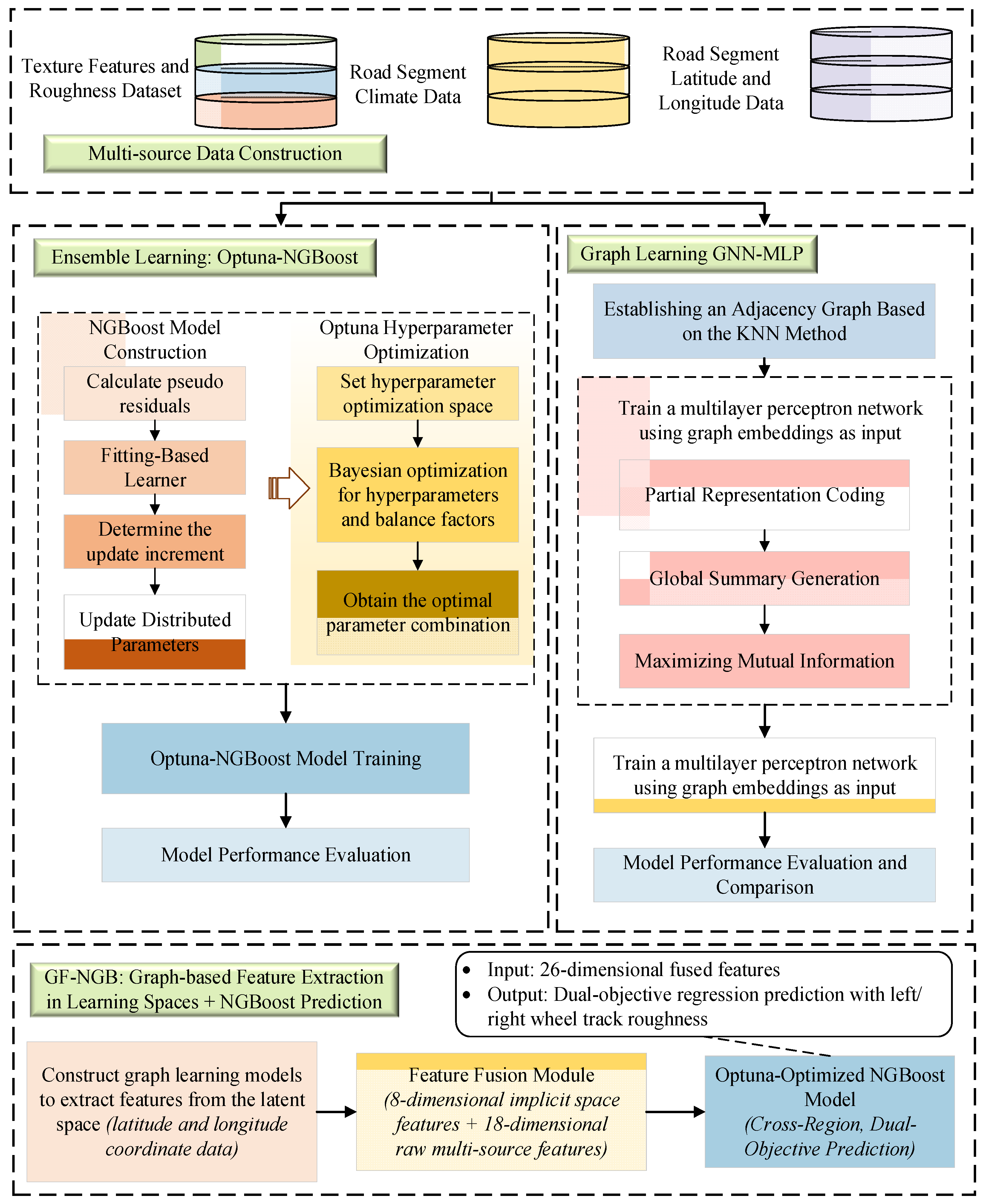
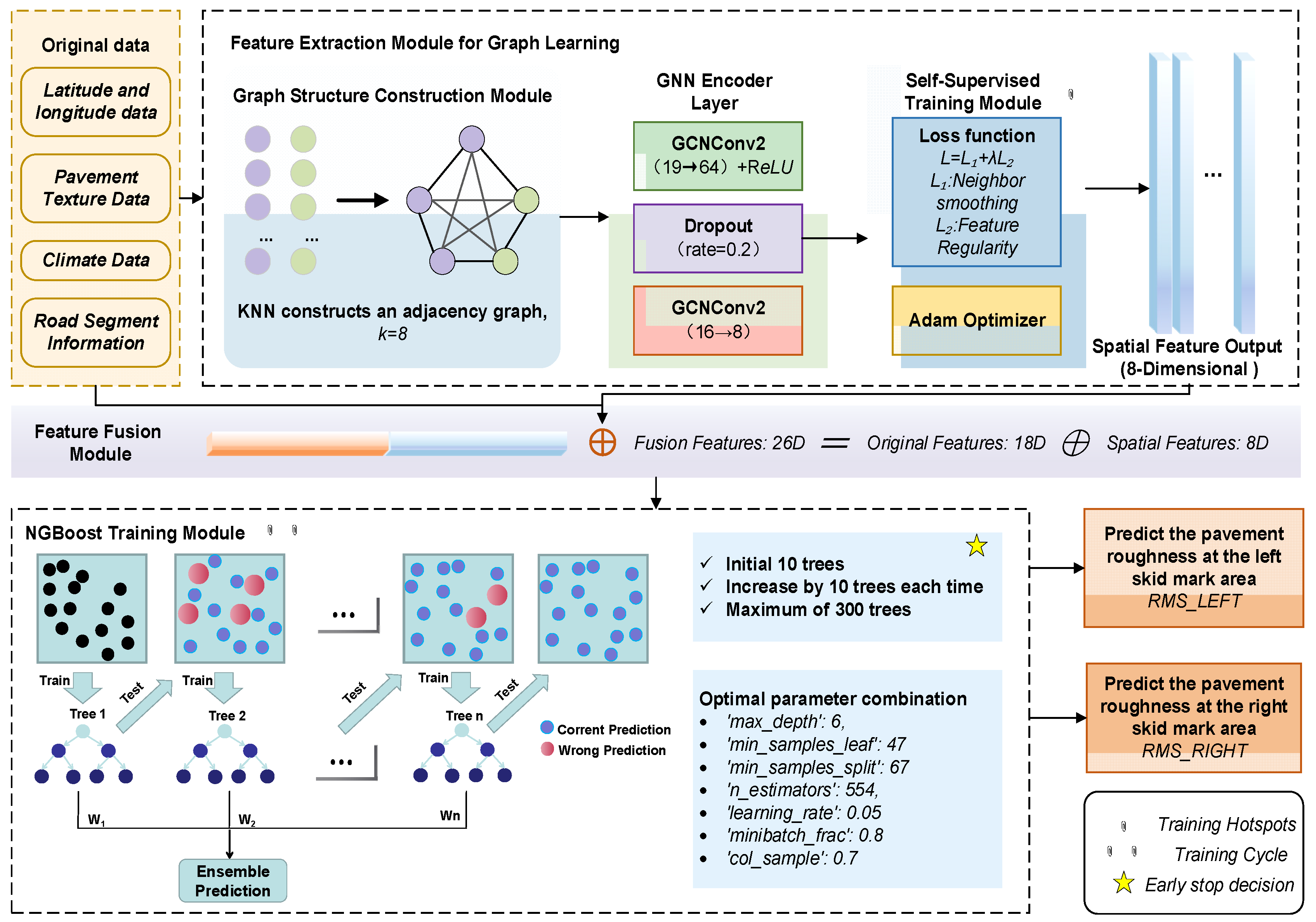
This study proposes a graph fusion natural gradient boosting approach for dual-objective prediction to accurately forecast Pavement roughness, with the overall workflow illustrated in Figure 1. This study adopts a progressive modeling approach to systematically construct and validate the Graph-Fused Natural Gradient Boosting framework (GF-NGB). In Stage 1, we constructed a natural gradient boosting model (NGBoost) optimized by Optuna, which utilizes only 18-dimensional multi-source explicit features such as climate, texture, and road segment attributes for pavement roughness prediction. In Stage 2, to investigate the role of implicit spatial structural information, we developed a Graph Neural Network-Multi-Layer Perceptron (GNN-MLP) model. This model constructs a k-nearest neighbor graph based on segment latitude and longitude coordinates, extracts spatial topological features through two layers of graph convolutions, and performs regression using a three-layer fully connected network. In Stage 3, we proposed the unified fusion framework GF-NGB: employing GNN as a spatial feature extractor, concatenating its 8-dimensional spatial embedding features with the original 18-dimensional explicit features to form a 26-dimensional fusion feature vector. This fusion feature vector is then input into the Optuna-optimized NGBoost model to achieve dual-target prediction of left and right wheel trajectories.

3.1. Probability-Based Predictive Optimization Regression Model

Pavement roughness prediction is fundamentally a complex nonlinear regression problem, whose accuracy is influenced by multiple interacting texture features and measurement noise. Traditional regression prediction models exhibit limited generalization capabilities in complex and variable road scenarios and struggle to capture nonlinear interactions between features, resulting in constrained prediction accuracy. To address this, this study introduces the NGBoost algorithm as the foundational framework [31,32]. Combined with the Optuna automated hyperparameter optimization strategy, it proposes an optimization regression model based on probabilistic prediction [33,34,35] (Optuna-NGBoost). This approach achieves optimal configuration of model parameters through global Bayesian search, thereby enhancing both the prediction accuracy and generalization capability for Pavement roughness.

3.1.1. NGBoost Modeling Mechanism

NGBoost is a probabilistic prediction framework based on natural gradient that can simultaneously model roughness mean values while providing reasonable uncertainty estimates. This enables a more comprehensive reflection of road condition trends and potential risks. This characteristic holds significant practical value for pavement performance evaluation and intelligent decision-making, particularly suited for the study environment characterized by moderate sample size and highly nonlinear texture features.
During modeling, NGBoost assumes the conditional distribution of response roughness values follows a specific parametric probability distribution family, defined as:
y p y θ = N μ , σ 2
Here, μ represents the mean of the roughness prediction, i.e., the model’s output RMS forecast value; σ 2 denotes the variance of the roughness prediction, indicating the uncertainty or fluctuation range of the model’s forecast; p y θ denotes the probability distribution of roughness under parameter θ Compared to traditional point forecasting methods, this modeling approach better captures the true fluctuation range caused by factors such as texture variations and pavement aging. During parameter learning, the model fits roughness-related parameters by maximizing the likelihood function (or minimizing the negative log-likelihood):
L θ = i = 1 n log p y i , θ i
Here, p y i , θ i denotes the probability predicted by the model for the i sample as y i , reflecting the degree of alignment between the predicted roughness value and the true value. L θ represents the loss function of NGBoost, namely the negative log-likelihood loss [36], which measures the discrepancy between the current model parameters θ and the true roughness data [37]. Compared to traditional gradient updates, NGBoost employs natural gradients to optimize the distribution parameter θ for the complete roughness prediction distribution. This approach better aligns with the geometric structure of the probability space [38,39], resulting in a more stable and efficient learning process. For this study, this optimization mechanism significantly enhances the model’s fitting capability and generalization performance under complex input texture features, particularly when the sample distribution exhibits noise or heteroscedasticity. At the m th iteration, the core training steps of NGBoost are as follows:
  • Calculate pseudo residuals: For each training sample, compute the natural gradient of the negative log-likelihood loss with respect to the current distribution parameter to obtain the pseudo residual:
g i m = θ L ( y i θ m 1 )
m denotes the m -th base learner. L θ = i = 1 n log p y i , θ i is the negative log-likelihood loss. This gradient direction represents the steepest descent direction of the loss function in the parameter space.
2.
Base learner fitting
Perform regression fitting on the pseudo residual g i m using a decision tree to characterize the unexplained error information in the current model:
f m x i g i m
3.
Step Size Determination
Determine the optimal step size ρ m via line search to minimize the loss function at this step size:
ρ m = arg min ρ i = 1 L ( θ m 1 + ρ f m x i )
4.
Distribution Parameter Update
Iteratively update the distribution parameters based on the learning rate η :
θ m = θ m 1 + η ρ m f m x i
After M iterations, the model outputs the conditional probability distribution y i p y i θ M = Ν μ i , σ i 2 for each sample: achieving joint modeling of the roughness mean μ i and uncertainty σ i 2 .

3.1.2. NGBoost Parameter Optimization Based on Optuna

To overcome the subjectivity and limitations of manual parameter tuning and fully leverage the predictive potential of the NGBoost model in complex nonlinear problems, this paper introduces the Optuna automated hyperparameter optimization framework to perform global Bayesian optimization on the model’s key hyperparameters [40]. Optuna performs adaptive exploration of the hyperparameter search space by constructing probabilistic surrogate models, enabling efficient identification of optimal parameter combinations within limited trial counts. This approach avoids the computational inefficiency and susceptibility to local optima inherent in traditional grid search or random search methods.
During optimization, the negative log-likelihood (NLL) loss on the validation set serves as the objective function. Leveraging NGBoost’s probabilistic prediction capability, the consistency between the model’s conditional probability distribution and actual roughness observations is evaluated. By minimizing NLL, the model achieves more reasonable and stable uncertainty estimates while maintaining point prediction accuracy, thereby enhancing overall prediction robustness and generalization capability.
The parameter optimization design, as shown in Table 1, focuses on a joint search of structural parameters for the base learner decision trees and key control parameters within the NGBoost model. Considering the differences in roughness distribution characteristics and response mechanisms between left and right wheel tracks, separate Optuna automated hyperparameter optimization processes were constructed for the left wheel track (RMS_LEFT) and right wheel track (RMS_RIGHT) to obtain their respective optimal parameter combinations. Among these, “max_depth” limits the maximum depth of the base learner decision tree to prevent model overfitting; “n_estimators” controls the number of base learners, where excessively large values increase computational complexity while excessively small values may cause model underfitting; “learning_rate” determines the step size for model parameter updates; ‘minibatch_frac’ and “col_sample” respectively control the random sampling ratios of sample rows and feature columns in each boosting iteration to enhance model generalization and reduce overfitting risks.
Optuna automatically executes multiple rounds of experiments within the aforementioned parameter space and dynamically adjusts the search strategy based on validation set performance [41,42], ultimately determining the optimal hyperparameter combination. Subsequently, the model is retrained on the full training set using this optimal parameter configuration, providing a stable and reliable foundation for subsequent road surface roughness prediction experiments.

3.2. GNN-MLP Graph Neural Network Model

In the context of road surface roughness prediction, road segments are not independent samples but are distributed as a spatial network. Adjacent road sections often exhibit high similarity in traffic load, environmental climate, and maintenance history, with their spatial proximity containing rich structural information. Traditional feature-based prediction models typically assume sample independence, making it difficult to explicitly capture these spatial dependencies. This limitation restricts the models’ ability to represent the spatial continuity and structural characteristics of pavement roughness. In this study, the road network is characterized by sparse and irregularly distributed pavement sections across large geographic regions, as commonly observed in the LTPP dataset. Such characteristics further amplify the necessity of explicitly modeling spatial topology to capture long-range spatial dependencies that cannot be effectively represented by conventional feature-based methods.
To fully exploit spatial correlation features within road networks, this paper introduces Graph Neural Networks (GNNs) [43] to construct a pavement roughness prediction model. By abstracting road segments as nodes in a graph and modeling spatial proximity as edges, GNNs integrate node attribute information with neighborhood structural information during feature learning, enabling explicit modeling of spatial correlations in pavement roughness. Building upon this foundation, a Multi-Layer Perceptron (MLP) is further introduced as the regression prediction module to perform nonlinear mapping on the graph embedding representation. This forms the joint modeling framework of “GNN graph embedding + MLP regression prediction” (GNN-MLP).
Model inputs include road segment texture features, environmental climate features, and latitude-longitude coordinate information. When constructing the spatial adjacency graph, the KNN method uses only latitude and longitude coordinates to determine neighboring nodes, ensuring the graph structure reflects true spatial proximity rather than feature similarity. Each node selects its K spatially nearest neighbors to form an edge set, providing the topological foundation for graph embedding learning. Texture and climate features are input as node attributes into the GNN to learn a joint spatial-attribute representation of road surface roughness.

3.2.1. Spatial Graph Construction

Given a pavement roughness dataset comprising n road segments, a spatial adjacency graph G = ( V , E ) is constructed based on latitude-longitude data. The node set V = { v 1 , v 2 , v n } represents individual road segments, while the edge set is established using the k-nearest neighbors (k-NN) algorithm. For each node, the segments with the closest latitude and longitude coordinates are selected as neighboring nodes, forming edges e i j . This construction process ensures each segment connects with its spatially most relevant neighbors, providing a topological foundation for subsequent graph embedding learning. During spatial graph construction, a KNN method based on geographic distance is employed to determine node connectivity [44]. To avoid introducing additional hyperparameters and maintain model stability, all edges in the graph are uniformly weighted as 1, adopting an unweighted graph structure. Spatial distance information is implicitly captured through the neighbor selection process.
This design choice reflects a trade-off between capturing sufficient local spatial context and avoiding excessive graph density, which is particularly important for large-scale pavement datasets with heterogeneous spatial distributions. Specifically, for each node, the k = 8 segments closest in latitude and longitude coordinates are selected as neighbor nodes to form edges, with distance measured using the Euclidean distance of latitude and longitude coordinates.

3.2.2. GNN Modeling Mechanism

After constructing the spatial adjacency graph, graph neural networks (GNNs) are employed to perform embedding learning on node features. By executing neighborhood information aggregation operations on the graph structure, GNNs enable each node to simultaneously fuse attribute information and structural information from neighboring nodes when updating its own feature representation. This yields node embedding representations that incorporate spatial dependencies. Considering the absence of dense temporal labels and the limited availability of high-quality roughness annotations, the self-supervised DGI framework is particularly suitable for extracting robust spatial representations from pavement networks.
In the specific implementation, this paper adopts the Graph Convolutional Network (GCN) as the base encoder and incorporates the Deep Graph Infomax (DGI) approach for self-supervised graph representation learning [45]. DGI learns high-quality node embeddings without relying on roughness labels by maximizing mutual information between local node representations and global graph structure representations. Its core steps include:
  • Local Representation Encoding: Obtain the local representation of each node ε through the GCN encoder:
    h i = f G N N ( x i , N ( i ) )
    where x i represents the attribute features of node i (texture features MPD, Skewness, STD, Dropout, and climate features), N ( i ) denotes its set of spatial neighbors, and f G N N signifies the embedding learning function based on graph convolutional and DGI self-supervised mechanisms. This embedding vector effectively captures the spatial position and contextual features of a road segment within the overall road network while aggregating neighbor node attributes and spatial topology information [46].
  • Global Summary Representation Generation:
By aggregating all node embeddings through the readout function, a global representation of the entire graph is generated:
s = R ( { h i } )
3.
Mutual Information Maximization Objective Function:
In self-supervised learning, the discriminator aims to maximize mutual information between each segment node’s local embedding [47] and the global graph structure summary of the entire road network, while distinguishing positive and negative samples. Positive samples represent authentic node-path pairs with their complete adjacency graphs, preserving original spatial proximity and texture features to form genuine path-attribute joint representations. Negative samples simulate path-attribute relationships after anomalies or damage by randomly perturbing node textures or neighbor structures. The discriminator D distinguishes positive samples (authentic node-graph pairs) from negative samples (corrupted node-graph pairs), maximizing mutual information between local node representations and global graph structural summaries. Its objective function is expressed as:
L = 1 n i = 1 n log D ( z i , s ) + 1 n i = 1 n log ( 1 D ( z ˜ i , s ) )
where z ˜ i represents the negative sample generated through feature corruption.

3.2.3. GNN-MLP Regression Modeling

To fully leverage the continuity of spatial proximity relationships in road networks [48], a spatial smoothing constraint is introduced during the graph embedding prediction phase. This constraint calculates the squared difference between the predicted roughness value of each road segment and the predicted values of its spatial neighbors. This difference is incorporated as a regularization term into the overall loss function of the model, guiding adjacent road segments to maintain spatial consistency in their prediction results.
L t o t a l = L M S E + λ s m o o t h i j N i y ^ i y ^ j 2
where y ^ i represents the predicted RMS value for node i , N ( i ) denotes the set of neighbors for node i , and λ s m o o t h is a hyperparameter controlling the smoothing constraint strength. This constraint effectively utilizes spatial structural information to enhance prediction stability and generalization capability. To further improve the model’s ability to model nonlinear relationships, a Multi-Layer Perceptron (MLP) is constructed as the regression prediction model on top of the graph embedding representation to model road surface roughness.
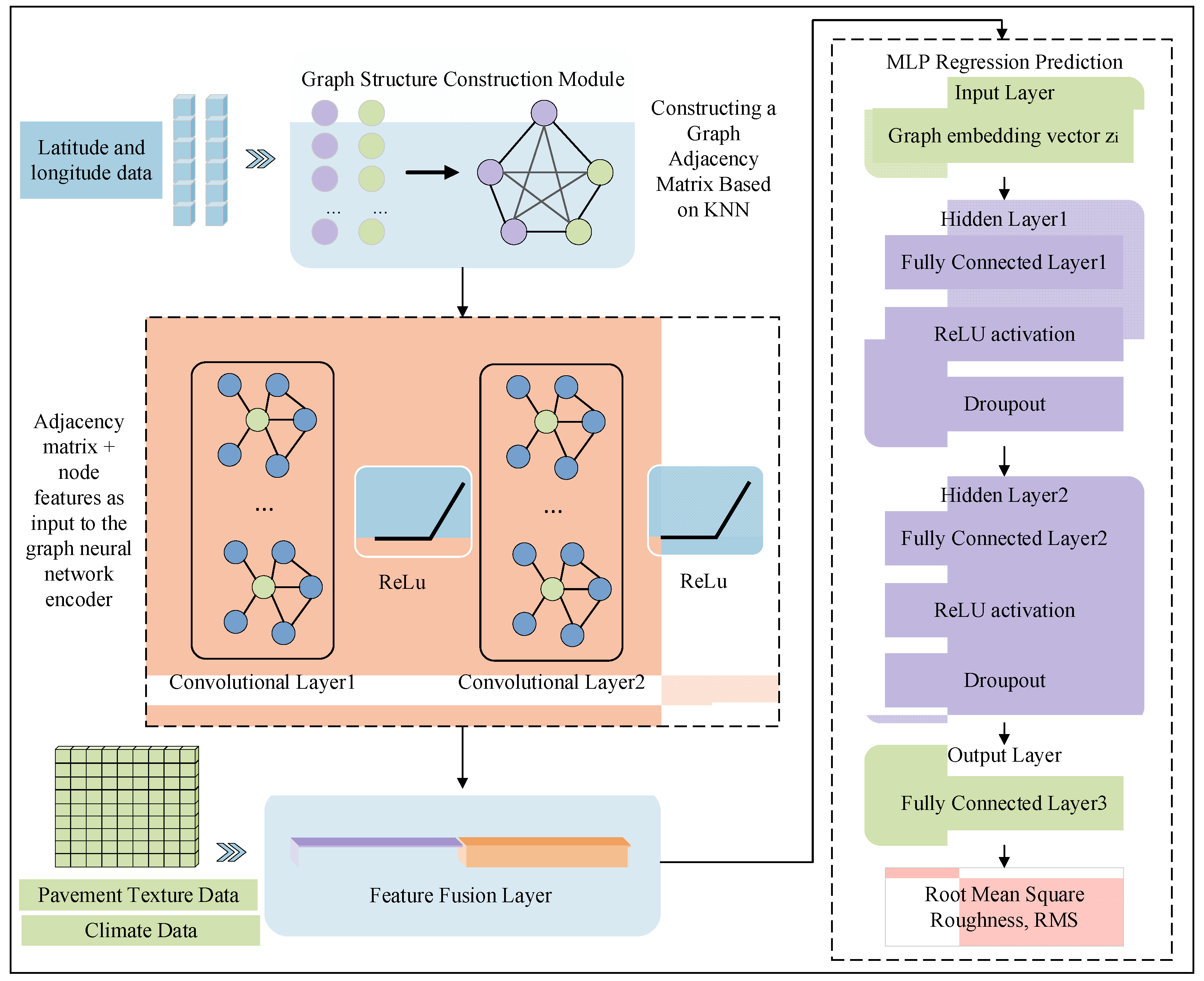
The MLP constructs a three-layer fully connected network as a regressor based on graph embedding, utilizing the ReLU activation function and Dropout technique to enhance the model’s generalization capability. The GNN-MLP network architecture is shown in Figure 2. The MLP [47,49,50] can fully explore the complex relationship between texture structure features and roughness through multi-layer nonlinear mapping. The model inputs the graph embedding vector of each road segment into the three-layer MLP to predict the RMS roughness value. The specific design is as follows:
  • Input Layer: Receives the graph embedding vector z i , with dimensions matching the embedding space.
  • Hidden Layer: Consists of two fully connected layers, each followed by a ReLU activation function and a Dropout layer.
h 1 = D r o p o u t ( Re L U ( W 1 z i + b 1 ) )
h 2 = D r o p o u t ( Re L U ( W 2 h 1 + b 2 ) )
3.
Output Layer: Maps hidden features to roughness predictions via linear transformation:
y ^ i = W 3 h 2 + b 3
Among these, the weight matrix W i and bias term b i are used to map graph embedding vectors into a nonlinear feature space, fully exploring the complex relationship between graph structure and texture information for roughness prediction; h 1 and h 2 represent intermediate outputs from the two hidden layers of the MLP, serving as high-order semantic features generated by nonlinear transformations of each road segment’s graph embedding. This further enhances the model’s ability to learn latent spatial dependencies and textural combination features across road segments. Re L U employs the rectified linear unit (ReLU) activation function to introduce nonlinear expressive capability, preventing vanishing gradients caused by highly variable textural feature distributions. The Dropout layer effectively prevents overfitting and improves model generalization by randomly discarding some neuron outputs during training.

3.3. GF-NGB Ensemble Modeling Framework

Building upon the previously described Optuna-NGBoost probabilistic regression model and GNN-MLP spatial modeling approach, this paper further proposes the GF-NGB probabilistic pavement roughness prediction model. This model employs spatial embeddings learned by graph neural networks as a feature enhancement technique, combined with NGBoost’s natural gradient probabilistic modeling capability, to achieve joint modeling of the mean pavement roughness and prediction uncertainty. The key innovation of the proposed GF-NGB framework lies in its seamless integration of graph-based spatial representation learning with probabilistic ensemble regression, enabling simultaneous modeling of spatial dependency and predictive uncertainty for pavement roughness.
Figure 3 illustrates the two-stage GF-NGB network architecture. In the first stage, based on raw input features and latitude-longitude coordinates, a KNN-based adjacency graph is constructed. A GNN encoder then extracts spatial embedding features, with spatial smoothing and feature regularization optimized through self-supervised loss. The resulting 8-dimensional spatial features are concatenated with the original 18-dimensional features to form a 26-dimensional enhanced feature vector. In the second stage, the enhanced features are input into the NGBoost model for probabilistic regression training. Through natural gradient updates and iterative training, the model outputs the mean and standard deviation of roughness for the left and right wheel tracks of each road segment, achieving joint modeling of predicted values and uncertainty.

3.3.1. Spatial Feature Enhancement for GNN in GF-NGB

To explicitly capture spatial proximity relationships between road segments in the GF-NGB model, this paper constructs a spatial adjacency graph based on segment geographic locations and employs graph neural networks for spatial embedding feature learning. This process comprises three steps: KNN spatial graph construction, graph embedding feature encoding, and self-supervised training.
  • KNN Spatial Graph Construction
Using road segments as nodes, spatial distances are calculated based on their latitude and longitude coordinates. The KNN method is employed to construct the spatial adjacency graph. For any segment node i , the k segments geographically closest to it are selected as neighbor nodes, with k set to 8 in this study. This yields the neighbor set N i for node i , describing the spatial proximity relationships between segments. For the neighborhood set N i , compute the mean and standard deviation of the neighborhood features:
σ i = 1 K j N i x j x ¯ i 2
These neighborhood-level statistical descriptors provide complementary information to individual segment features, enabling the model to better capture local spatial variability patterns commonly observed in pavement roughness evolution. To balance road segment intrinsic attributes and spatial embedding features, this paper employs feature concatenation to construct enhanced feature vectors. Original features are concatenated with neighborhood statistical features to form enhanced feature vectors:
x i e n h = x i x ¯ i σ i 3 d
This augmented feature retains its own information while incorporating neighborhood distribution characteristics, thereby capturing local patterns and enhancing the model’s discriminative capability.
2.
Graph Embedding Feature Encoding
Utilizing encoded node features, spatial embedding representations are generated through neighborhood information aggregation:
h i l + 1 = σ j N i 1 N i N j W l h j l
where h j l denotes the feature of node i at layer l ; W l represents the learnable weight matrix at layer l for feature mapping; σ denotes the activation function (e.g., ReLU) introducing nonlinear transformation; N i indicates the number of neighbors for node i , used for normalization. This enables nodes to simultaneously fuse their own features with neighbor information, yielding high-quality spatial embedding representation h i (dimension 8) as input for subsequent feature enhancement.
3.
Self-Supervised Training
The self-supervised training phase employs the loss function:
L G N N = L s m o o t h + λ L r e g
where L s m o o t h denotes the spatial smoothing loss, constraining embeddings of adjacent nodes to be similar; L r e g represents the feature regularization term, preventing overfitting; λ is the hyperparameter controlling regularization strength. This loss function ensures embeddings retain local information while maintaining global smoothness and stability.

3.3.2. GF-NGB Ensemble Modeling

During the feature fusion stage, the raw features from each node are concatenated with the spatial embeddings output by the GNN [38] to form enhanced feature vectors. The fused features comprise 26 dimensions: the first 18 dimensions represent the original features, while the last 8 dimensions correspond to the spatial embedding features. This augmented feature retains the inherent information of the road segment while incorporating neighborhood spatial patterns, enhancing NGBoost’s ability to perceive local patterns and nonlinear relationships. The training set is divided into training and validation sets (80% and 20%) for early stopping or hyperparameter validation. NGBoost probabilistic regression training first initializes the prediction function f m z i , representing the model’s initial roughness prediction value. Subsequently, training proceeds for iterations m = 1 … M:
  • Pseudo-residual calculation:
r i m = C y i , f m 1 z i f z i
where y i is the true roughness value at node i , z i represents the input features of node i , C is the negative log-likelihood loss function measuring the discrepancy between the predicted distribution and true values, and r i m denotes the unexplained error direction of the current prediction.
2.
Base learner fitting:
h m = arg min h i r i m h z i 2
Here, h m represents the mmm-th base learner, the base learner fits the pseudo-residual r i m to correct the current prediction.
3.
Line Search Step Size:
ρ m = arg min ρ i C y i , f m 1 z i + ρ h m z i
ρ m controls the magnitude of weight updates in the base learner during each iteration, ensuring model convergence stability. f m 1 z i is the prediction function after the m 1 -th iteration, and h m z i is the output of the m -th base learner at node i , This step ensures stable convergence by optimizing the weight update along the direction of the pseudo-residual.
4.
Prediction Function Update:
f m Z = f m 1 Z + η ρ m h m Z
Here, η is the learning rate, adjusting the update step size to prevent training divergence caused by excessive gradients; Z = z 1 , z 2 , , z N represents the feature set enhanced across all nodes. Ultimately, the model outputs the predicted mean and confidence interval for the left and right wheel tracks:
R M S L E F T = μ 1 ± 1.96 σ 1 , R M S R I G H T = μ 2 ± 1.96 σ 2
Here, μ 1 , μ 2 denote the predicted mean, while σ 1 , σ 2 represent the predicted standard deviation for uncertainty quantification; 1.96 corresponds to the 95% confidence interval. Such probabilistic outputs are particularly valuable for pavement management applications, as they support risk-aware maintenance decision-making by explicitly quantifying prediction uncertainty.

3.4. Evaluation Methods and Metrics for Pavement Roughness

To comprehensively and objectively evaluate the regression performance of the constructed pavement roughness prediction model, this study employs four metrics for integrated assessment: Mean Absolute Percentage Error (MAPE), Root Mean Square Error (RMSE), Mean Absolute Error (MAE), and Coefficient of Determination (R2). These metrics quantify the model’s prediction error and explanatory capability from different perspectives. Their calculation formulas and definitions are as follows:
  • Mean Absolute Percentage Error (MAPE)
MAPE measures the relative percentage of prediction error based on actual values, expressed as a percentage. This metric eliminates the influence of data magnitude and is suitable for comparing prediction errors across different ranges of pavement roughness. An ideal MAPE value is 0% (perfect prediction accuracy). A smaller value indicates a smaller relative deviation between the predicted and actual values, signifying higher prediction accuracy of the model.
M A P E = 100 % n i = 1 n | R M ^ S i R M S i R M S i |
2.
Root Mean Square Error (RMSE)
RMSE is the square root of MSE, sharing the same units as the predicted values. It intuitively reflects the average magnitude of prediction errors. A smaller value indicates better model performance.
R M S E = 1 n i = 1 n ( R M S i R M ^ S i ) 2
3.
Mean Absolute Error (MAE)
MAE calculates the average absolute difference between predicted and actual values. It is insensitive to outliers and provides a direct interpretation of error magnitude.
M A E = 1 n i = 1 n | R M S i R M ^ S i |
4.
Coefficient of Determination (R2)
R2 evaluates a model’s ability to explain variance in the target variable. A value closer to 1 indicates better model fit to the data.
R 2 = 1 i = 1 n ( R M S i R M ^ S i ) 2 i = 1 n ( R M S i R M ¯ S i ) 2
In the above formula, n represents the total sample size, R M S i denotes the true road roughness value for the th sample, i is the corresponding predicted road roughness value, and R M ¯ S i is the average of all true sample values.

4. Experiments and Analysis

4.1. Multi-Source Data Extraction and Integration

Road surface roughness is a key indicator measuring the irregularity of a roadway’s surface, directly impacting driving comfort, traffic safety, and vehicle operating costs. As one of the core parameters for evaluating road service performance, higher roughness values indicate a more uneven road surface, resulting in greater vibration during vehicle operation. Research indicates that road roughness not only impacts driving experience and traffic efficiency but also accelerates structural fatigue damage in vehicles, increases fuel consumption, and indirectly elevates road maintenance costs. Therefore, this study leverages the U.S. Long-Term Pavement Performance (LTPP) database to construct a multidimensional, structured modeling dataset. This dataset integrates pavement texture features, roughness measurement data, climatic variables, and road geolocation information, providing comprehensive inputs for high-precision pavement roughness prediction. The training dataset comprises 1648 samples from five regions: Arizona, California, Florida, and Missouri in the United States, and Ontario in Canada. The independent test dataset contains 330 samples from Manitoba, Canada, and Nevada, USA. This division ensures the model’s generalization capability across diverse geographical and climatic conditions while balancing training data volume and test coverage.

4.1.1. Extraction of Pavement Texture and Roughness Data

RMS values for left and right wheel tracks (RMS_LEFT, RMS_RIGHT) are extracted from the MON_HSS_TEXTURE_SECTION table. Corresponding texture features include MPD, TEXTURE_SKEW, and STANDARD_DEVIATION for each wheel track, while DROPOUT_LEFT/RIGHT_PERCENT indicates missing measurements. Therefore, this study selects the RMS values for the left and right wheel tracks (RMS_LEFT, RMS_RIGHT) as target variables for roughness prediction. The RMS metrics are extracted from the MON_HSS_TEXTURE_SECTION table within the LTPP database, which records the left and right wheel path roughness data for each road section across different inspection batches.
To investigate the influence mechanism of pavement texture on roughness, metrics such as average profile depth, average texture spacing, texture distribution skewness, and texture height standard deviation were extracted from the MON_HSS_TEXTURE_SECTION table for both left and right wheel paths. Key fields include: MPD_LEFT (average profile depth of the left wheel path), MPD_RIGHT (average profile depth of the right wheel path), DROPOUT_LEFT_PERCENT (percentage of missing measurement data for the left wheel path), DROPOUT_RIGHT_PERCENT (percentage of missing measurement data for the right wheel path), TEXTURE_SKEW_LEFT (skew of texture distribution for the left wheel path), TEXTURE_SKEW_RIGHT (skew of texture distribution for the right wheel path), STANDARD_DEVIATION_LEFT (Standard deviation of texture height for the left wheel path), STANDARD_DEVIATION_RIGHT (Standard deviation of texture height for the right wheel path). These metrics characterize the microstructure features of the road surface, providing critical texture information for roughness prediction.

4.1.2. Extraction of Road Surface Climate and Environmental Features

To account for environmental influences on pavement roughness, this study incorporates multiple climate and environmental features, including monthly mean temperature (MEAN_MON_TEMP_AVG), freeze index (FREEZE_INDEX_MONTH), freeze–thaw months (FREEZE_THAW_MONTH), monthly total precipitation (TOTAL_MON_PRECIP), monthly total snowfall (TOTAL_SNOWFALL_MONTH), and monthly average wind speed (MEAN_MON_WIND_AVG). Among these, temperature-related indicators are sourced from the CLM_VWS_TEMP_MONTH table in the LTPP database. Precipitation and snowfall indicators originate from the CLM_VWS_PRECIP_MONTH table. While the average wind speed is sourced from the CLM_VWS_WIND_MONTH table. These climate environmental characteristics, when combined with pavement texture indicators, can be used to analyze the environmental dependence and seasonal variation patterns of roughness.

4.1.3. Roadway Latitude-Longitude Data Extraction

To incorporate spatial structural information, this study extracts the longitude (LONGITUDE) and latitude (LATITUDE) for each road segment from the SECTION_COORDINATES table in the LTPP database. This spatial data supports KNN-based adjacency graph construction, providing foundational support for graph neural networks to learn spatial correlations between road segments.

4.1.4. Multi-Source Data Fusion

Pavement texture features, roughness data, climate and environmental characteristics, and latitude/longitude information originate from different datasets with varying collection dimensions and recording granularity. To construct a structurally complete and semantically consistent modeling dataset, a fusion and spatio-temporal alignment process is performed using unified primary key fields.
The fusion procedure consists of three main steps:
  • Integration of climate and environmental features: Monthly temperature, freezing index, and freeze–thaw months are extracted from the CLM_VWS_TEMP_MONTH table. Total monthly precipitation and snowfall are obtained from the CLM_VWS_PRECIP_MONTH table, while average monthly wind speed is sourced from CLM_VWS_WIND_MONTH. Using YEAR, SHRP_ID, and MONTH as key fields, temperature and precipitation data are first merged, followed by a left join with wind speed data. The resulting composite dataset forms a comprehensive climate table including temperature, precipitation, and wind speed metrics.
  • Merging road texture and roughness data: A mapping between VISIT_NO and SHRP_ID is established using the MON_HSS_PROFILE_SECTION table. Each record in the MON_HSS_TEXTURE_SECTION table is mapped to its corresponding section ID, and unmatched records are removed. This produces a section-level dataset containing pavement texture and roughness information.
  • Final multi-source dataset construction: The section-level texture-roughness dataset is inner-joined with the climate table using SHRP_ID, YEAR, and MONTH to unify climatic and texture information. Finally, LONGITUDE and LATITUDE fields are incorporated to provide spatial structure, enabling subsequent adjacency graph construction or spatial modeling.
Through this multi-step process, a structurally complete and semantically clear multi-source pavement roughness modeling dataset is obtained, providing a robust foundation for predictive analysis.
Table 2 presents descriptive statistics for the multi-source pavement dataset, including left and right wheel track roughness, wheel track depth, texture characteristics, climatic environment features, and spatial location indicators. It is evident that various features exhibit significant differences in numerical scale and distribution range. Notably, RMS_LEFT and RMS_RIGHT demonstrate uniform distributions with minimal skewness; texture standard deviation exhibits fluctuations, reflecting local heterogeneity in pavement roughness; climate indicators such as freeze–thaw months and snowfall distribution show skewness, indicating extreme climatic conditions in specific regions; spatial location indicators cover a wide area, with latitude and longitude information providing a foundation for subsequent adjacency graph and spatial modeling. Overall, the dataset structure is complete and variable distributions are reasonable, offering a solid data foundation for subsequent feature modeling and structural modeling.

4.2. Analysis of Factors Influencing Pavement Roughness Performance

To systematically reveal the primary factors influencing pavement roughness performance and their underlying mechanisms, this study employs Spearman’s rank correlation coefficient to comprehensively analyze the relationships between pavement texture features, climatic environment features, spatial location features, and the pavement roughness indicator (RMS) based on the constructed multi-source dataset. This analysis aims to identify key factors significantly influencing pavement roughness variations and reveal the role characteristics and interrelationships of different feature types in the roughness formation process.
The Spearman rank correlation coefficient is a nonparametric statistic measuring the strength and direction of monotonic relationships between two variables. This method is independent of data distribution patterns and insensitive to outliers, enabling robust detection of monotonic relationships between variables. Assuming the capacity of the pavement roughness dataset is n , the two observations of the i sample are X i (representing a specific texture feature) and Y i (representing the pavement roughness index RMS or a texture feature other than X i ). The calculation process is as follows:
  • Convert observations to ranks. Sort all observations of variables X and Y in ascending order, replacing original data with their corresponding ranks R ( X i ) and R ( Y i ) . If duplicate observations exist, use the average rank.
  • Calculate rank differences. Compute the rank difference for each pair of observations: d i = R ( X i ) R ( Y i )
  • Calculate correlation coefficients. The Spearman rank correlation coefficient ρ is calculated as: ρ = 1 6 i = 1 n d i 2 n ( n 2 1 )
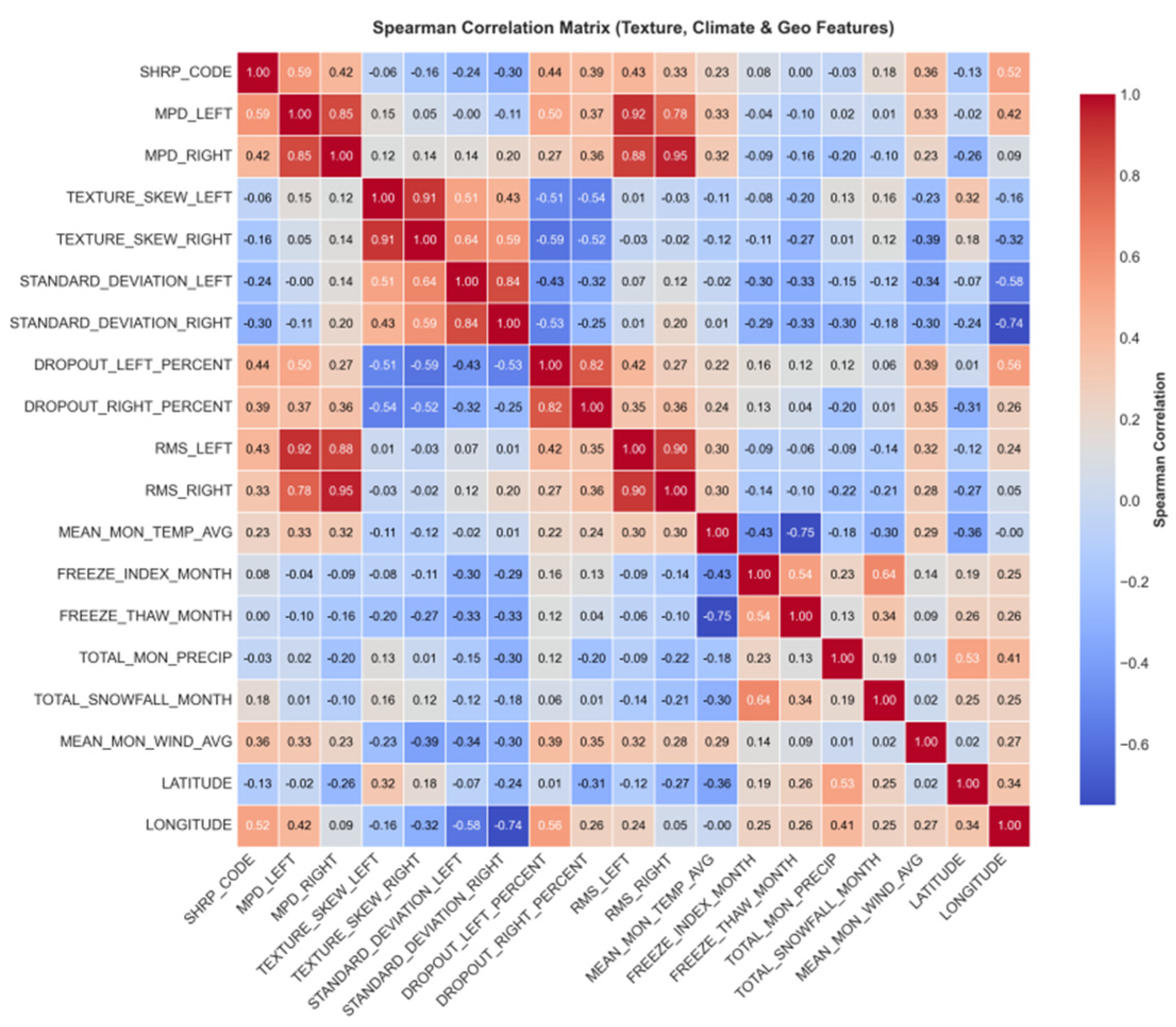
Following these steps, calculate Spearman rank correlation coefficients between all texture features and between each feature and RMS. Subsequently, visualize the resulting coefficient matrix using a heatmap, as shown in Figure 4. This heatmap provides an intuitive representation of the correlation structure among pavement texture features, climatic environmental factors, and spatial location characteristics, along with the strength and direction of their association with pavement roughness performance. It serves as a basis for subsequent influence factor analysis and model feature selection.
Analysis of the correlation heatmap in Figure 4 leads to the following conclusions:
  • Correlation between pavement texture characteristics and roughness performance
The average profile depth metrics (MPD_LEFT, MPD_RIGHT) exhibit a significant positive correlation with pavement roughness (RMS_LEFT, RMS_RIGHT), with scatter points concentrated in a relatively tight cluster. This indicates that increased texture depth directly enhances vehicle vibration response. Similarly, the texture profile standard deviation (STANDARD_DEVIATION_LEFT, STANDARD_DEVIATION_RIGHT) also exhibits a positive correlation with RMS, indicating that texture dispersion has a certain influence on roughness. In contrast, texture skewness metrics (TEXTURE_SKEW_LEFT, TEXTURE_SKEW_RIGHT) showed weaker correlations with RMS and more dispersed scatter plots, reflecting limited influence of texture asymmetry on roughness.
2.
Internal Correlation of Texture Features
The texture metrics (MPD, ATD, RMS) for left and right wheel paths exhibit high consistency, indicating spatial symmetry in road surface texture. A positive correlation exists between MPD and standard deviation (STANDARD_DEVIATION), suggesting that the macro-texture level of the road surface and its dispersion degree exhibit a synergistic trend. The correlation between Texture Skew and other texture indicators is relatively weak, suggesting that texture distribution patterns are relatively independent of average depth and dispersion. Therefore, these features should be comprehensively considered during modeling.
3.
Correlation of Texture Features with Climate and Geographic Characteristics
Latitude (LATITUDE) positively correlates with Texture Skew Left (TEXTURE_SKEW_LEFT), suggesting higher-latitude road sections may exhibit more pronounced texture asymmetry. Longitude (LONGITUDE) shows a positive correlation with texture standard deviation (STANDARD_DEVIATION_RIGHT), indicating a relationship between the eastern orientation of road sections and texture variability. Overall, climate variables (e.g., temperature, precipitation, freeze–thaw cycles) exhibit weak correlations with texture features, suggesting climate influences on pavement texture may be delayed or indirect.
4.
Internal Correlation Among Climate Variables
Temperature positively correlates with freeze–thaw months, suggesting higher-temperature sections may experience more freeze–thaw cycles. The freeze index positively correlates with snowfall, consistent with climatic logic. Precipitation shows weaker correlation with snowfall, reflecting differences in precipitation types. Correlation analysis among climate variables aids in understanding the potential influence of environmental factors on pavement roughness.

4.3. Analysis and Evaluation of Cross-Regional Prediction Results

4.3.1. Analysis of Pavement Roughness Prediction Results

The training dataset comprises road segment data from Arizona, California, Florida, Ontario, and Missouri, totaling 1648 records. The test dataset includes 330 road segment records from Manitoba, Canada, and Nevada, USA. This cross-regional partitioning effectively evaluates the model’s generalization capability across diverse geographical environments and climatic conditions, avoiding potential spatial information leakage issues associated with random partitioning. This section rigorously assesses the proposed GF-NGB framework’s generalization ability on independent test sets exhibiting significant geographical and climatic differences. By comparing with a series of representative benchmark models, we comprehensively validate GF-NGB’s prediction accuracy and robustness in cross-regional, small-sample scenarios. The comparison models primarily include: (1) ensemble learning models NGBoost and XGBoost; (2) graph learning models: Chebyshev Network (ChebNet), Graph Sample and Aggregate (GraphSAGE), and GNN-MLP.
NGBoost Model Optimization. Model training was conducted using the Optuna-based optimization method for NGBoost core parameters proposed in Section 3.1. The optimized hyperparameter combination is: max_depth = 6, min_samples_leaf = 47, min_samples_split = 67, n_estimators = 554, learning_rate = 0.05, minibatch_frac = 0.80, col_sample = 0.7. This indicates that the model achieves an optimal performance balance between the training and test sets after jointly adjusting the base learner structure, training iteration count, and sampling strategy, providing high accuracy and reliability for Pavement roughness prediction.
GNN-MLP Model Construction. Following the GNN-MLP graph neural network model construction process described in Section 3.2, a two-layer graph convolutional network serves as the graph encoder. A spatial adjacency graph is constructed based on road segment geographic coordinates using the k-nearest neighbors algorithm (k = 8) to capture local spatial correlations. Specifically, the first GCN layer maps 18-dimensional input features to a 64-dimensional latent space, while the second GCN layer further aggregates second-order neighborhood information while maintaining a 64-dimensional output. The resulting segment node embedding vectors are then fed into a regressor composed of a three-layer fully connected network. Through multi-layer nonlinear transformations, this regressor thoroughly explores the complex correlations between graph embedding features and Pavement roughness.
GF-NGB Cascade Model Construction. Following the GF-NGB framework proposed in Section 3.3, a two-stage cascaded design is adopted for model training. The first stage performs spatial feature extraction, reusing the Spatial Encoder module identical to GNN-MLP as the spatial feature extractor. This stage takes the road segment geographic coordinate matrix (latitude-longitude data) as input, constructs a spatial adjacency graph via the k-nearest neighbors algorithm (k = 8), and outputs 8-dimensional spatial topological features after GCN encoding. Training employs the Adam optimizer (learning rate = 0.005), optimizing neighbor smoothing loss and feature regularization loss through 20 rounds of self-supervised training. This aims to enable the encoder to capture the inherent spatial continuity of the road network. The second stage involves feature fusion and NGBoost prediction. The extracted 8-dimensional spatial topology features are concatenated along the feature dimension with the 18-dimensional multi-source explicit features from the original dataset, forming a 26-dimensional fused feature vector. This is then input into an Optuna-optimized NGBoost model for dual-objective regression. For small-sample cross-regional scenarios, NGBoost training employs an early-stopping strategy with a validation set (patience value = 20 iterations) to strictly prevent overfitting.
  • Analysis of Prediction Results for Manitoba
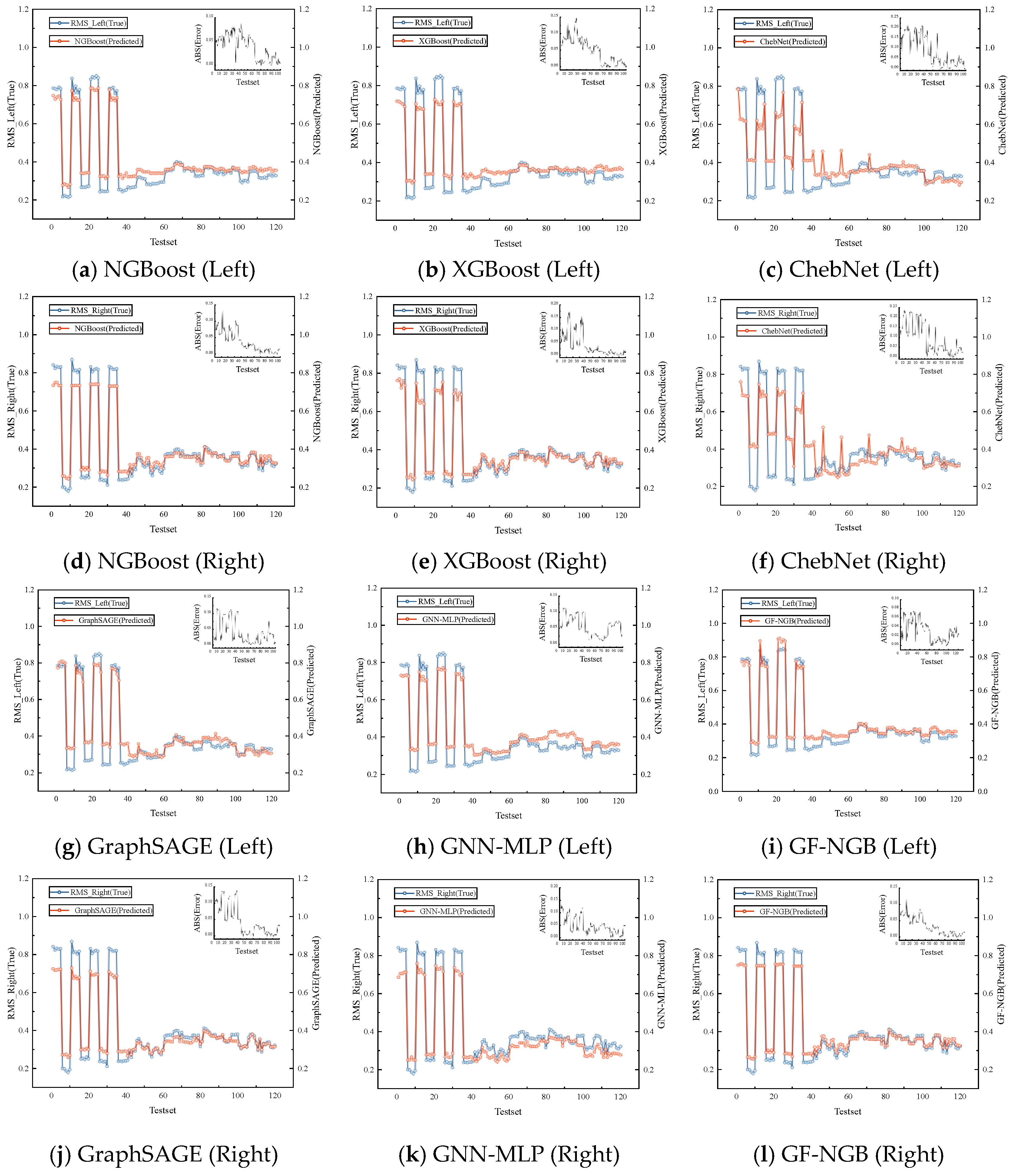
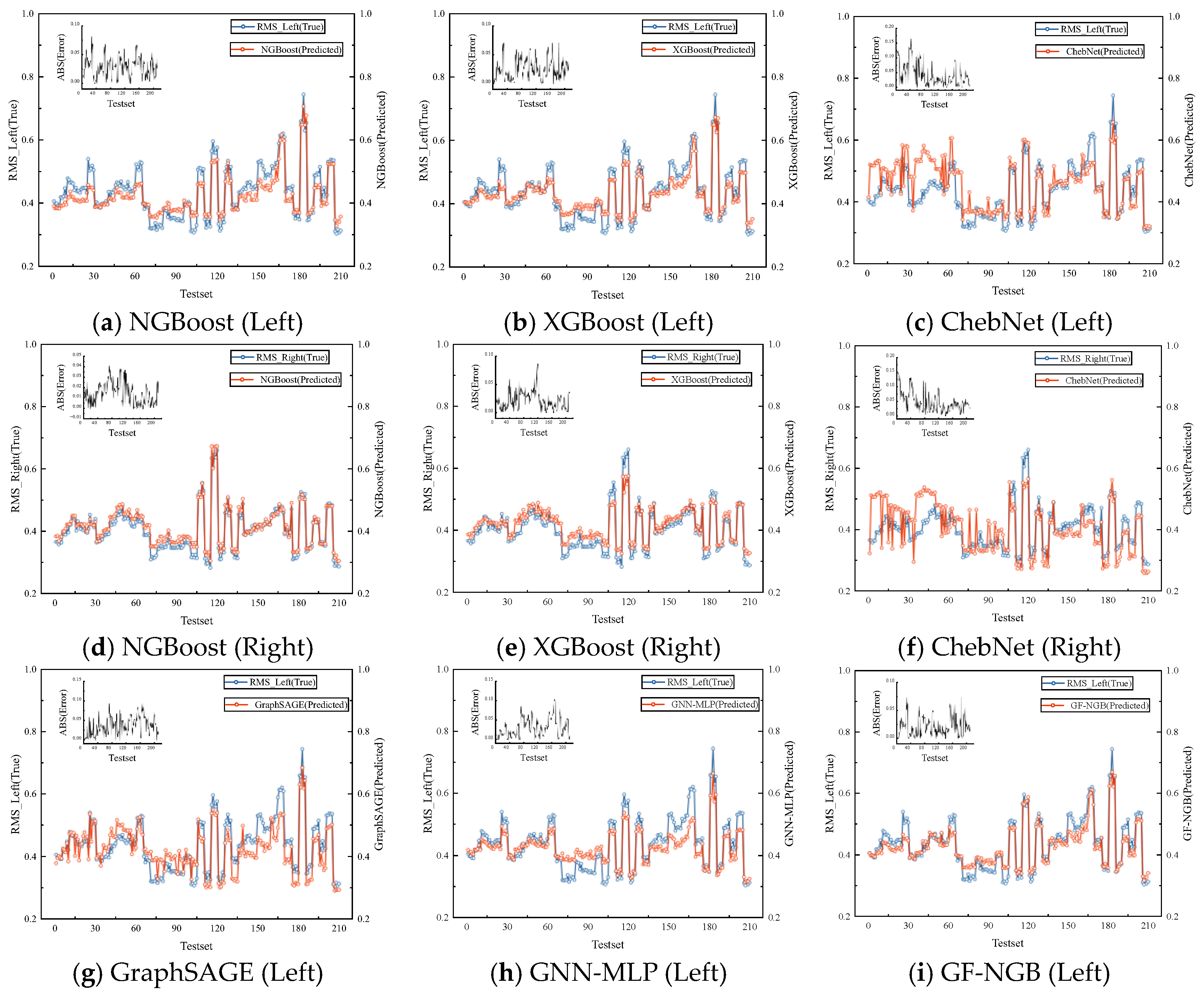
Figure 5 illustrates the performance of different methods in predicting pavement roughness in Manitoba. Comparing the predicted curves with the actual curves reveals significant performance differences among the models. Among ensemble learning methods, the NGBoost model better captures the overall distribution trend of pavement roughness compared to XGBoost. Its prediction curve aligns more closely with the actual curve, with prediction errors primarily fluctuating within the (0, 0.1) interval. Among graph learning methods, the ChebNet model exhibits poor initial trend fitting. Although intermittent alignment occurs in the middle and late stages, its predictive accuracy remains insufficient. The error curve shows severe oscillations, further indicating weak prediction stability and significant deviation between predicted and actual values. Compared to ChebNet, GraphSAGE and GNN-MLP demonstrate improved predictive performance. GNN-MLP exhibits superior prediction at extreme values and exhibits smoother overall error fluctuations.
A comprehensive comparison of ensemble learning, graph learning, and the GF-NGB cascade model developed in this paper reveals that the GF-NGB prediction curve closely matches the actual curve throughout both the initial phase of extreme fluctuations and the later phase of gradual changes, while exhibiting the smoothest error fluctuations. This clearly demonstrates that GF-NGB not only enhances prediction accuracy but also exhibits superior robustness.
2.
Analysis of Nevada Prediction Results
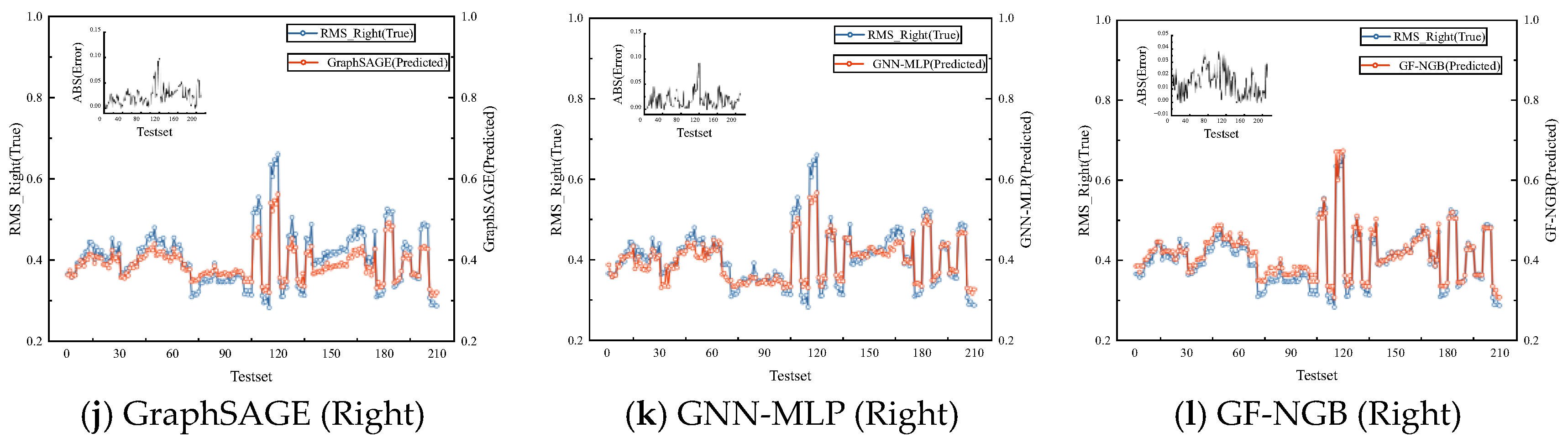
Figure 6 illustrates the performance of different methods in predicting Nevada Pavement roughness. Among ensemble learning approaches, the XGBoost model outperforms others in predicting left-side roughness, while NGBoost excels in predicting right-side roughness. Notably, NGBoost demonstrates greater accuracy in forecasting extreme peaks. Among graph learning methods, ChebNet delivered relatively mediocre predictions, exhibiting low fitting accuracy, poor synchrony in fluctuation trends, and significant prediction bias for extreme values. Compared to ChebNet, GraphSAGE and GNN-MLP showed improved predictive performance, though GNN-MLP demonstrated overall superior prediction capabilities.
A comprehensive comparison of ensemble learning, graph learning methods, and the GF-NGB cascade model developed in this paper reveals that the GF-NGB model significantly outperforms other methods in this Pavement roughness prediction task: Its prediction curve exhibits high overall alignment with actual values, precisely synchronizing with the dynamic fluctuation patterns and amplitudes of real-world data. Prediction errors for extreme peaks are substantially smaller than those of other models, while error fluctuations remain stable across the entire interval, demonstrating strong robustness.
The actual values of pavement roughness in Manitoba exhibit a distribution pattern characterized by “high-frequency small-amplitude fluctuations with dense initial and sparse subsequent variations”: Data within the first 50 test set intervals demonstrate continuous, dense fluctuations with short periods and high frequencies. Overall amplitudes are concentrated in the low-to-medium range of 0.2 to 0.8, with no extreme peaks observed. Furthermore, both the frequency and amplitude of fluctuations in the latter half show significant convergence. Nevada’s pavement roughness data exhibits long-period, gentle fluctuations as a baseline, accompanied by multiple localized extreme peaks in the middle and latter segments. Amplitudes span 0.2 to 0.8 and include sharp spikes. Consequently, the distribution patterns of pavement roughness data between the two states show significant differences. Combining the performance across both states demonstrates that GF-NGB maintains optimal performance under two distinctly different data distributions: Manitoba’s high-frequency fluctuations and Nevada’s extreme peaks. This result proves that GF-NGB’s strategy of integrating spatial topological features with multi-source explicit features not only enhances fitting capability for single-region characteristics but also strengthens its generalized adaptability to different regional distribution patterns. Whether confronting high-frequency dense fluctuations or roughness curves featuring long-period peaks, GF-NGB achieves precise and robust predictions by adaptively balancing local sensitivity and global consistency. This validates its effectiveness in cross-regional pavement performance evaluation.

4.3.2. Evaluation of Pavement Roughness Prediction Results

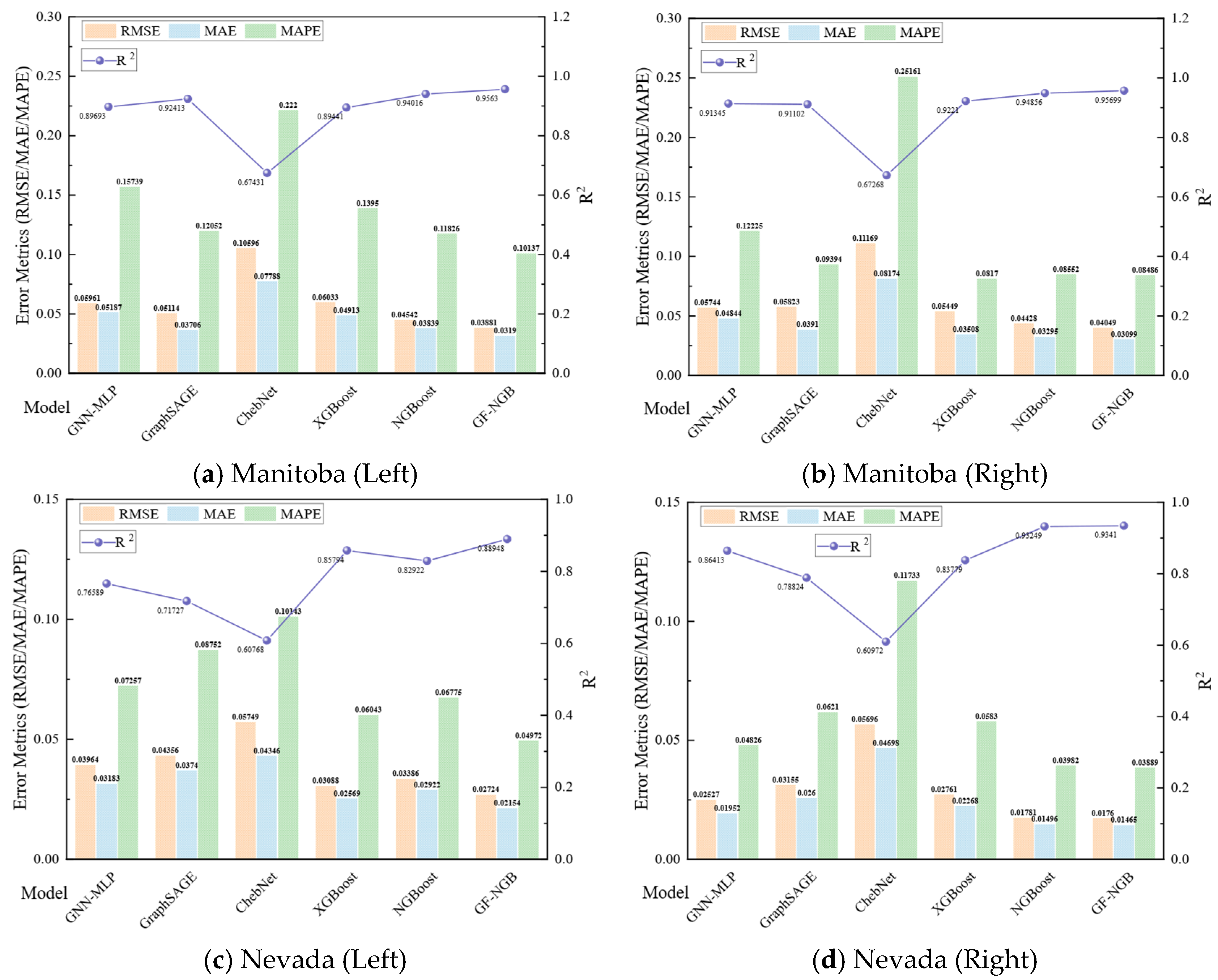
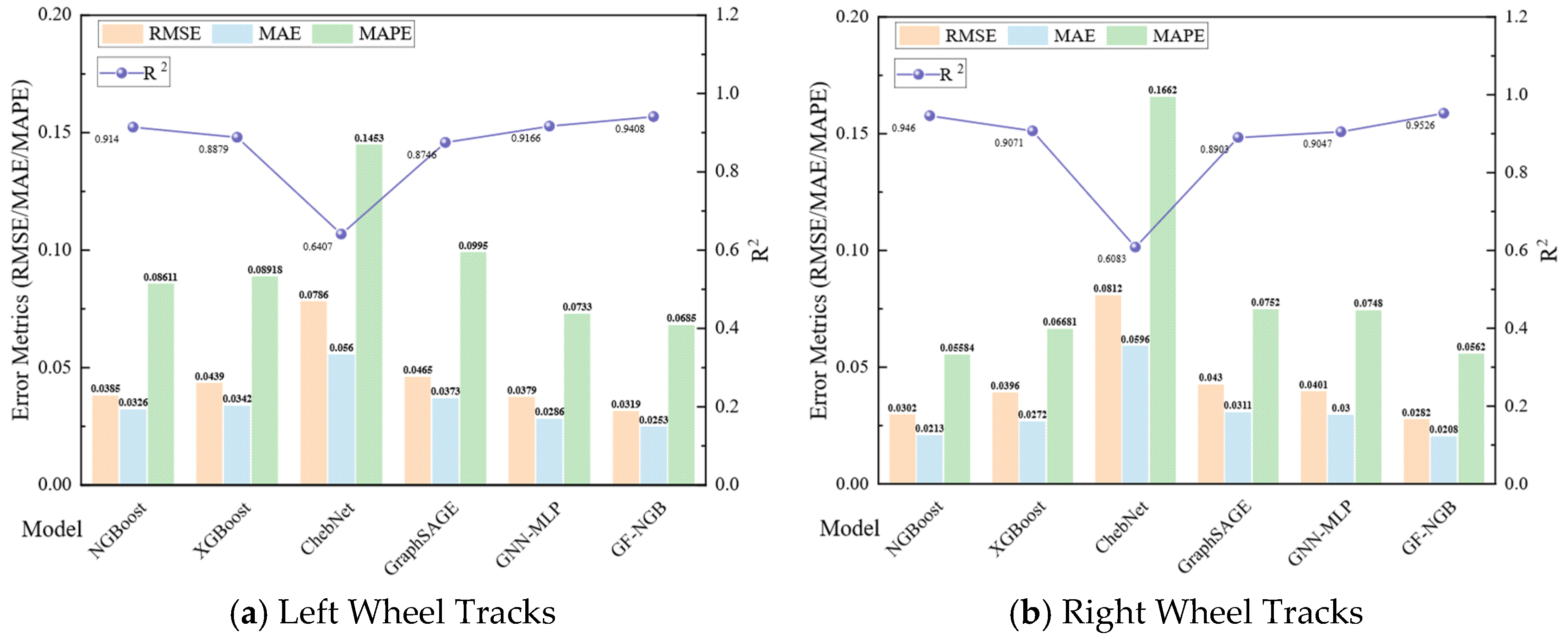
To provide rigorous data support for the qualitative analysis in Section 4.3.1, this section employs four metrics—R2, RMSE, MAE, and Mean Absolute MAPE—to quantitatively evaluate the predictive performance of each model on the cross-regional test dataset. Table 3 and Table 4 present the quantitative evaluation results for Manitoba and Nevada, respectively, while Figure 7 visually represents these findings. The evaluation results indicate that in both test regions with markedly different climatic conditions, the GF-NGB model demonstrates significantly superior prediction accuracy and fitting performance compared to all baseline models, achieving optimal levels across all quantitative metrics. Specifically, in Manitoba, GF-NGB’s average coefficient of determination (R2) improved by 5.1%, 3.9%, 2.8%, 4.8%, and 1.2% compared to GNN-MLP, GraphSAGE, ChebNet, XGBoost, and NGBoost, respectively. In Nevada, the R2 improvements further expanded to 9.6%, 15.9%, 30%, 6.4%, and 3.1%, respectively. These results not only validate GF-NGB’s superior generalization across regional scenarios but also demonstrate its stable modeling capability when handling pavement roughness data with varying distribution patterns.

4.4. Analysis and Evaluation of Dual-Objective Prediction Results

4.4.1. Analysis of Left and Right Wheel Track Surface Roughness Prediction Results

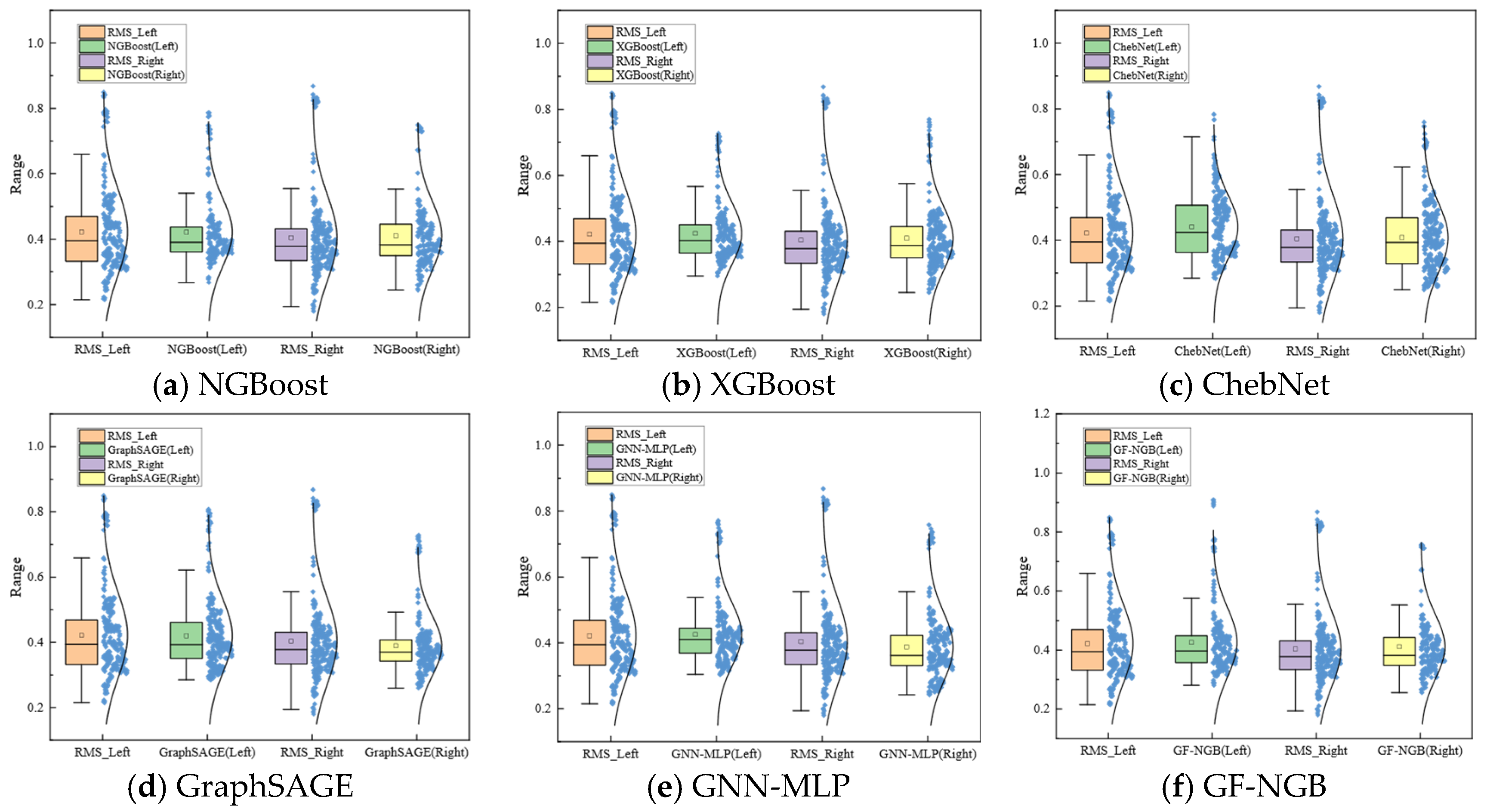
Pavement roughness typically exhibits asymmetric distribution between left and right wheel tracks, a phenomenon stemming from multiple factors including uneven lateral distribution of traffic loads, variations in overtaking behavior, and spatial heterogeneity in material wear. Therefore, achieving synchronized and precise prediction of roughness in both wheel tracks is crucial for refining road maintenance decisions. Building upon the cross-regional analysis in Section 4.3, this section further examines the performance of various models in dual-objective prediction tasks. The aim is to validate whether the proposed GF-NGB framework is equally applicable to multi-objective regression problems characterized by strong spatial correlation and divergent distribution patterns. Figure 8 presents box plots of dual-objective prediction results for different models at left and right wheel tracks.
The box plots of the distribution of dual-objective predicted values versus actual values for left and right wheel track roughness (Figure 8) reveal a certain degree of asymmetry in the data distribution across both sides, with significant differences in prediction performance among different models. Compared to benchmark models such as NGBoost, ChebNet, GraphSAGE, and GNN-MLP, the GF-NGB model exhibits the highest overlap between its prediction boxplots and the scatter plot of actual values. Its box range precisely covers the 0.2–0.8 interval where actual values are densely distributed. In contrast, the centers of other models’ prediction boxplots show varying degrees of systematic deviation, resulting in significantly lower spatial alignment with the actual value scatter plot. Regarding consistency in predicting left and right wheel track bands, some comparison methods exhibited pronounced prediction biases, manifested as poor alignment between single-side track band prediction boxes and actual values. The GF-NGB method achieved highly matched box distributions for both left and right track bands, demonstrating excellent dual-objective prediction balance and consistency. Further examination of local details reveals that within the data-dense interval (0.3, 0.5), other models generally exhibit some degree of prediction deviation. In contrast, the GF-NGB method’s predicted box plots in this interval more closely align with the actual distribution pattern, indicating more reliable prediction stability within common value ranges. The above analysis fully demonstrates that the proposed GF-NGB method not only achieves optimal overall distribution fitting in the dual-objective prediction task for left and right wheel track surface roughness but also exhibits superior comprehensive performance in terms of prediction consistency and local accuracy.

4.4.2. Evaluation of Pavement Roughness Prediction Results for Left and Right Wheel Tracks

To provide rigorous data support for the qualitative analysis in Section 4.4.1, this section employs four metrics—R2, RMSE, MAE, and Mean Absolute MAPE—to quantitatively evaluate the prediction performance of each model on the left and right wheel tracks. Table 5 presents the quantitative evaluation results, while Figure 9 visually represents these findings. The evaluation results demonstrate that the proposed GF-NGB method significantly outperforms the comparison models across all quantitative metrics in the dual-objective prediction task for left and right wheel tracks, fully validating the reliability of the qualitative analysis conclusions. Regarding the goodness-of-fit metric R2, the GF-NGB model achieved average improvements of 1.7%, 4.9%, 3.2%, 6.4%, and 3.6% over NGBoost, XGBoost, ChebNet, GraphSAGE, and GNN_MLP for the left and right wheel tracks, respectively. Notably, the GF-NGB model exhibits only a 1% difference in goodness-of-fit between left and right tire tracks. This indicates that the model not only achieves the highest prediction accuracy but also demonstrates optimal dual-objective prediction balance, without exhibiting significant prediction bias toward either track. Based on the above quantitative evaluations, GF-NGB demonstrates comprehensive advantages in dual-objective Pavement roughness prediction tasks, including high accuracy, good balance, and robust error control.

5. Conclusions

This study proposes an innovative Graph-Fused Natural Gradient Boosting (GF-NGB) framework to address the key challenges of achieving high-precision pavement roughness prediction under cross-regional and small-sample conditions—namely, the significant constraints posed by spatial heterogeneity and data scarcity on model accuracy and stability. By integrating multi-source explicit features of pavement and environmental attributes with implicit spatial-topological information extracted via graph neural networks, the framework significantly enhances prediction accuracy and generalization stability in cross-regional, small-sample scenarios, effectively overcoming the limitations of traditional ensemble learning and standalone deep learning approaches.
The rigorous validation conducted in two geographically distinct states demonstrated that GF-NGB consistently achieved optimal performance in cross-regional prediction. Specifically, it attained average R2 values of 95.7% in Manitoba (characterized by high-frequency fluctuation data) and 91.2% in Nevada (containing extreme peak data). For dual-target prediction, the model improved the average accuracy of left and right wheel-track predictions by up to 6.4% compared to baseline models, while maintaining a minimal R2 difference of only 1.0% between the two targets, reflecting well-balanced predictive performance. Comprehensive multi-dimensional evaluation confirmed that GF-NGB exhibits integrated strengths in high accuracy, strong generalization, and robust error control. These results strongly validate the significant synergistic enhancement effect between explicit road attributes and implicit spatial-topological features in pavement performance assessment.
Despite these promising results, several limitations remain. The current model exhibits reduced sensitivity in predicting extreme roughness values, and the constructed graph structure considers only geographic adjacency without explicitly modeling other influential relationships such as traffic loading, material properties, and usage patterns. In addition, broader comparisons with state-of-the-art graph learning and spatio-temporal prediction models are warranted. Future work will focus on incorporating multi-relational and heterogeneous graph representations to capture richer inter-segment dependencies, developing uncertainty-aware mechanisms for extreme roughness prediction, and extending systematic evaluations against advanced graph-based learning frameworks. These efforts aim to further enhance the robustness, interpretability, and practical applicability of graph-driven pavement performance prediction models.

Author Contributions

Author Contributions Conceptualization and formal analysis, Y.H. and M.N.; methodology, M.N., L.Z. and L.P.; validation, Y.H. and Z.F.; visualization, L.Z. and Y.Y.; writing—original draft, Y.H., M.N. and L.P.; writing—review and editing, Y.H., Z.F. and Y.Y.; funding acquisition, L.Z., L.P. and Y.H. All authors have read and agreed to the published version of the manuscript.

Funding

This research was funded by the Youth Talent Promotion Program of Shaanxi Association for Science and Technology, grant number 20250463; Shaanxi Provincial Natural Science Basic Research Program—Youth Project, grant number 2025JC-YBQN-584.

Data Availability Statement

The processed and integrated datasets generated during this study, along with the associated code, are available from the corresponding author upon reasonable request. Their availability is subject to restrictions as they form part of an ongoing research project. The raw data utilized in this study are publicly available from the LTPP program via its data portal at: https://infopave.fhwa.dot.gov.

Acknowledgments

The authors would like to thank editors and anonymous reviewers for their constructive comments, which helped to improve the quality of this paper.

Conflicts of Interest

The authors declare that they have no known competing financial interests or personal relationships that could have appeared to influence the work reported in this paper.

Abbreviations

The following abbreviations are used in this manuscript:
ChebNetChebyshev Network
DGIDeep Graph Infomax
GF-NGBGraph-Fusion Natural Gradient Boosting
GNNGraph Neural Network
GNN-MLPGraph Neural Network–Multilayer Perceptron
GraphSAGEGraph Sample and Aggregate
IRIInternational Roughness Index
LTPPLong-Term Pavement Performance
MAEMean Absolute Error
MAPEMean Absolute Percentage Error
MLPMulti-Layer Perceptron
MPDMean Profile Depth
NGBoostNatural Gradient Boosting
NLLNegative Log-Likelihood
RMSERoot Mean Square Error
RMSRoot Mean Square Roughness
STDStandard Deviation
XGBoostExtreme Gradient Boosting

References

  1. Ji, J.; Jiang, T.; Ren, W.; Dong, Y.; Hou, Y.; Li, H. Precise Characterization of Macro-texture and Its Correlation with Anti-skidding Performance of Pavement. J. Test. Eval. 2022, 50, 1934–1946. [Google Scholar] [CrossRef]
  2. Hu, Y.; Sun, Z.; Han, Y.; Li, W.; Pei, L. Evaluate pavement skid resistance performance based on Bayesian-LightGBM using 3D surface macrotexture data. Materials 2022, 15, 5275. [Google Scholar] [CrossRef]
  3. Younos, M.A.; Abd El-Hakim, R.T.; El-Badawy, S.M.; Afify, H.A. Multi-input performance prediction models for flexible pavements using LTPP database. Innov. Infrastruct. Solut. 2020, 5, 2120–2135. [Google Scholar] [CrossRef]
  4. Radwan, M.; Hashema, A.M.; Faheem, H.; Ali, M.; Khan, R. Modeling Pavement Performance Based on LTPP Database for Flexible Pavements. Teknik Dergi 2020, 31, 10127–10146. [Google Scholar] [CrossRef]
  5. Boonsiripant, S.; Athan, C.; Jedwanna, K.; Lertworawanich, P.; Sawangsuriya, A. Comparative Analysis of Deep Neural Networks and Graph Convolutional Networks for Road Surface Condition Prediction. Sustainability 2024, 16, 9805. [Google Scholar] [CrossRef]
  6. Wang, Q.; Zhou, M.; Sabri, M.M.S.; Huang, J. A Comparative Study of AI-Based International Roughness Index (IRI) Prediction Models for Jointed Plain Concrete Pavement (JPCP). Materials 2022, 15, 5605. [Google Scholar] [CrossRef]
  7. Hegazy, J.A.; Carpenter, R.G.; Sinha, A.G. The use of deep neural networks for developing generic pavement rutting predictive models. Int. J. Pavement Eng. 2022, 23, 4260–4276. [Google Scholar] [CrossRef]
  8. Hu, Y.; Sun, Z.; Pei, L.; Han, Y.; Li, W. Evaluate asphalt pavement frictional characteristics based on IGWO-NGBoost using 3D macro-texture data. Expert Syst. Appl. 2024, 242, 122786. [Google Scholar] [CrossRef]
  9. Xin, L.; Zhenzhen, X.; Lili, P.; Jun, H.; Yaohui, D. A new model for predicting IRI using TabNet with hunter-prey optimization. Int. J. Pavement Eng. 2024, 25, 2414070. [Google Scholar] [CrossRef]
  10. Wang, X.; Zhao, J.; Li, Q.; Fang, N.; Wang, P.; Ding, L.; Li, S. A hybrid model for prediction in asphalt pavement performance based on support vector machine and grey relation analysis. J. Adv. Transp. 2020, 2020, 7534970. [Google Scholar] [CrossRef]
  11. Jiang, F.; Yang, S.; Jones, M.W.; Zhang, L. From attributes to natural language: A survey and foresight on text-based person re-identification. Inf. Fusion 2025, 118, 102879. [Google Scholar] [CrossRef]
  12. Gu, F.; Pan, J.; Hu, G.; Li, X.; Zhang, Y. Evolution of tire-pavement friction with the regular surface macro-texture characteristics and environmental factors using three-dimensional (3D) printing technology. J. Clean. Prod. 2023, 382, 135293. [Google Scholar] [CrossRef]
  13. Xu, S.; Zhang, F.; Zhou, X.; Li, H.; Wang, Y. Spatiotemporal evolution analysis of pavement texture depth on RIOH track using statistical and rescaled range approaches. Constr. Build. Mater. 2022, 338, 127560. [Google Scholar] [CrossRef]
  14. Du, Y.; Qin, B.; Wang, Z.; Li, L.; Chen, J. Promoting the pavement skid resistance estimation by extracting tire-contacted texture based on 3D surface data. Constr. Build. Mater. 2021, 307, 124729. [Google Scholar] [CrossRef]
  15. Alnaqbi, A.; Zeiada, W.; Al-Khateeb, G.G. Machine learning modeling of pavement performance and IRI prediction in flexible pavement. Innov. Infrastruct. Solut. 2024, 9, 385. [Google Scholar] [CrossRef]
  16. Tamagusko, T.; Ferreira, A. Pavement Performance Prediction using Machine Learning: Supervised Learning with Tree-Based Algorithms. Transp. Res. Procedia 2025, 82, 2521–2531. [Google Scholar] [CrossRef]
  17. Xiong, R.; Shi, Y.; Jing, H.; Liang, W.; Nakahira, Y.; Tang, P. Calibrating subjective data biases and model predictive uncertainties in machine learning-based thermal perception predictions. Build. Environ. 2024, 247, 111053. [Google Scholar] [CrossRef]
  18. Rasol, M.; Schmidt, F.; Ientile, S. FriC-PM: Machine learning-based road surface friction coefficient predictive model using intelligent sensor data. Constr. Build. Mater. 2023, 370, 130567. [Google Scholar] [CrossRef]
  19. Zhou, Q.; Egemen, O.; Al-Qadi, I.L. Predicting Pavement Roughness Using Deep Learning Algorithms. Transp. Res. Rec. 2021, 2675, 1062–1072. [Google Scholar] [CrossRef]
  20. Sandamal, K.; Shashiprabha, S.; Muttil, N.; Rathnayake, U. Pavement Roughness Prediction Using Explainable and Supervised Machine Learning Technique. Sustainability 2023, 15, 9617. [Google Scholar] [CrossRef]
  21. Farshid, D.; Hosseini, A.; Mahour, M.P.; Fini, E.H. Machine Learning Approach to Predict International Roughness Index Using LTPP Data. J. Transp. Eng. Part B 2021, 147, 04021058. [Google Scholar] [CrossRef]
  22. Wu, Y. From ensemble learning to deep ensemble learning: Multi-indicator prediction of pavement performance. Appl. Soft. Comput. 2024, 166, 112188. [Google Scholar] [CrossRef]
  23. Zeng, Q.; He, X.; Yang, S.; Cui, Q.; Xu, C. Pavement Performance Prediction Considering Spatial Correlation: A Deep Learning Framework. J. Comput. Civ. Eng. 2025, 39, 04025067. [Google Scholar] [CrossRef]
  24. Pan, S.; Yan, H.; Liu, Z.; Chen, N.; Miao, Y.; Hou, Y. Automatic pavement texture recognition using lightweight few-shot learning. Phil. Trans. R. Soc. A 2023, 381, 20220166. [Google Scholar] [CrossRef] [PubMed]
  25. Dai, B.; Yang, W.; Ji, X.; Zhu, F.; Fang, R.; Zhou, L. Ensemble Deep Learning Model for Short-Term Road Surface Temperature Prediction. J. Transp. Eng. Part B 2023, 149, 04022067. [Google Scholar] [CrossRef]
  26. Bashar, M.Z.; Torres-Machi, C. Deep learning for estimating pavement roughness using synthetic aperture radar data. Autom. Constr. 2022, 142, 104504. [Google Scholar] [CrossRef]
  27. Han, L.; Huang, Y.S. Short-term traffic flow prediction using deep learning. IET Intell. Transp. Syst. 2020, 14, 495–503. [Google Scholar] [CrossRef]
  28. Salma, S.; Yasarer, H.; Uddin, W.; Barros, R. International Roughness Index Modeling For Jointed Plain Concrete Pavement Using Artificial Neural Network. IOP Conf. Ser. Mater. Sci. Eng. 2021, 1203, 032034. [Google Scholar] [CrossRef]
  29. Li, H.; AzariJafari, H.; Kirchain, R.; Santos, J.; Khazanovich, L. Surrogate modelling of surface roughness for asphalt pavements using artificial neural networks: A mechanistic-empirical approach. Int. J. Pavement Eng. 2024, 25, 2434909. [Google Scholar] [CrossRef]
  30. Deng, Y.; Shi, X. Short-Term Predictions of Asphalt Pavement Rutting Using Deep-Learning Models. J. Transp. Eng. Part B 2024, 150, 04024004. [Google Scholar] [CrossRef]
  31. Duan, T.; Avati, A.; Ding, D.Y.; Basu, S.; Ng, A.Y.; Schuler, A. NGBoost: Natural Gradient Boosting for Probabilistic Prediction. arXiv 2019, arXiv:1910.03225. [Google Scholar]
  32. Can, I.M.; Bilgilioglu, S.S. Snow avalanche susceptibility mapping using novel tree-based machine learning algorithms (XGBoost, NGBoost, and LightGBM) with eXplainable Artificial Intelligence (XAI). Stoch. Environ. Res. Risk Assess. 2023, 37, 2243–2270. [Google Scholar] [CrossRef]
  33. Li, F.; Gan, Y.; Li, X. The Application of Wind Power Prediction Based on the NGBoost–GRU Fusion Model in Traffic Renewable Energy System. Sustainability 2025, 17, 6405. [Google Scholar] [CrossRef]
  34. Ramujee, K.; Praseeda, D. A comparative study of NGBoost and traditional machine learning models for prediction of compressive strength of geopolymer concrete. Asian J. Civ. Eng. 2025; ahead of print. [Google Scholar] [CrossRef]
  35. Zhou, Z.; Cao, J.; Shi, X.; Zhang, W.; Huang, W. Probabilistic rutting model using NGBoost and SHAP: Incorporating other performance indicators. Constr. Build. Mater. 2024, 438, 137052. [Google Scholar] [CrossRef]
  36. Alizamir, M.; Wang, M.; Ikram, R.M.A.; Gholampour, A.; Ahmed, K.O.; Heddam, S.; Kim, S. An interpretable XGBoost-SHAP machine learning model for reliable prediction of mechanical properties in waste foundry sand-based eco-friendly concrete. Results Eng. 2025, 25, 104307. [Google Scholar] [CrossRef]
  37. Saddam, H.; Wazir, M.M.; AlShqeerat, K.H.A.; Faisal, S.; Alrimy, B.A.A. A Novel Feature-Engineered NGBoost Machine-Learning Framework for Fraud Detection in Electric Power Consumption Data. Sensors 2021, 21, 8423. [Google Scholar] [CrossRef]
  38. Cao, Y.; Su, F.; Fordjour, A.M.A.; Lei, J.; Wu, X.; Liu, Y. Enhancing mix proportion design of low carbon concrete using Bayesian optimization-NGBoost and NSGA-III. J. Clean. Prod. 2024, 465, 142746. [Google Scholar] [CrossRef]
  39. Hu, Y.; Sun, Z.; Han, Y.; Hao, X.; Pei, L. Pavement Skid Resistance Evaluation Based on Hyperopt-NGBoost Fusion Model Using 3D Macrotexture Data. Arab. J. Sci. Eng. 2022, 48, 5507–5524. [Google Scholar] [CrossRef]
  40. Pinichka, C.; Chotpantarat, S.; Cho, K.H.; Siriwong, W. Comparative analysis of SWAT and SWAT coupled with XGBoost model using Optuna hyperparameter optimization for nutrient simulation. J. Environ. Manag. 2025, 388, 126053. [Google Scholar] [CrossRef]
  41. Jain, A.; Singh, A.; Doherey, A. Prediction of Cardiovascular Disease using XGBoost with OPTUNA. SN Comput. Sci. 2025, 6, 421. [Google Scholar] [CrossRef]
  42. Wen, Y.; Li, Y.; Zou, Y.; Shu, K.; Chen, H.; Zhao, Z.; Li, R. Community-influencing path explanation for link prediction in heterogeneous graph neural network. Neural Netw. 2025, 190, 107645. [Google Scholar] [CrossRef]
  43. Yang, Z.; Liu, Z.; Zhou, J.; Song, C.; Xiang, Q.; He, Q.; Zhang, J. A graph neural network (GNN) method for assigning gas calorific values to natural gas pipeline networks. Energy 2023, 278, 127875. [Google Scholar] [CrossRef]
  44. Ziya, F.; Kumar, S. MetaLP-DGI: Meta-Learning-Based Link Prediction With Centrality-Aware Deep Graph Infomax Embeddings. Concurr. Comput. Pract. Exp. 2025, 37, e70211. [Google Scholar] [CrossRef]
  45. Lanjewar, M.G.; Parab, J.S.; Shaikh, A.Y. Development of framework by combining CNN with KNN to detect Alzheimer’s disease using MRI images. Multimed. Tools Appl. 2022, 82, 12699–12717. [Google Scholar] [CrossRef]
  46. Huang, H.; Zhang, Y. Clustering Method for Edge and Inner Buildings Based on DGI Model and Graph Traversal. ISPRS Int. J. Geo-Inf. 2025, 14, 222. [Google Scholar] [CrossRef]
  47. Elzayady, H.; Badran, K.M.; Salama, G.I. Arabic Opinion Mining Using Combined CNN-LSTM Models. Int. J. Intell. Syst. Appl. 2020, 12, 25–36. [Google Scholar] [CrossRef]
  48. Song, Y.; Xie, X.; Guo, B.; Xiong, X.; Li, P. MLP-MFF: Lightweight Pyramid Fusion MLP for Ultra-Efficient End-to-End Multi-Focus Image Fusion. Sensors 2025, 25, 5146. [Google Scholar] [CrossRef]
  49. Yuan, C.; Zhao, D.; Agaian, S.S. UCM-Net: A lightweight and efficient solution for skin lesion segmentation using MLP and CNN. Biomed. Signal Process. Control 2024, 96, 106573. [Google Scholar] [CrossRef]
  50. Tang, W.; Zhang, Q.; Li, L.; Chen, R.; Li, H.; Wang, H.; Liu, X. Hybrid CNN-MLP architecture for data-driven airflow parameters perception in underground metal mine. Expert Syst. Appl. 2025, 279, 127441. [Google Scholar] [CrossRef]
Figure 1. Method Overview Diagram.
Symmetry 18 00134 g001
Figure 2. GNN-MLP-Based Road Surface Roughness Prediction Network.
Symmetry 18 00134 g002
Figure 3. GF-NGB Probabilistic Road Surface Roughness Prediction Model Network Diagram.
Symmetry 18 00134 g003
Figure 4. Heatmap of Correlation Analysis Among Impact Factor Characteristics.
Symmetry 18 00134 g004
Figure 5. Manitoba Pavement Roughness Prediction Results.
Symmetry 18 00134 g005
Figure 6. Nevada Pavement Roughness Prediction Results.
Symmetry 18 00134 g006aSymmetry 18 00134 g006b
Figure 7. Quantitative Evaluation Results for Manitoba and Nevada.
Symmetry 18 00134 g007
Figure 8. Distribution of Dual-Objective Prediction Results Across Different Models. (Note: Colored box plots show the distribution statistics for each group, with overlaid blue points representing the raw data).
Symmetry 18 00134 g008
Figure 9. Quantitative Evaluation Display of Dual-Target Prediction Results for Left and Right Wheel Tracks.
Symmetry 18 00134 g009
Table 1. Optuna-NGBoost Model Hyperparameter Search Space Settings.
Parameter NameParameter MeaningSearch Space
max_depthMaximum tree depth for base learner decision trees [3, 6]
min_samples_leafMinimum number of samples for leaf nodes[10, 50]
min_samples_splitMinimum number of samples required for internal node splitting[20, 80]
n_estimatorsIteration count [300, 800]
learning_rateLearning rate[0.01, 0.08]
minibatch_fracPercentage of row subsamples used per boosting iteration[0.6, 1.0]
col_sampleControl percentage of randomly sampled columns per tree [0.6, 1.0]
Table 2. Descriptive Statistics for Multi-Source Roadway Datasets.
VariableCountMeanStdMin25%50%75%Max
RMS_LEFT16480.460.190.230.340.400.541.57
RMS_RIGHT16480.440.180.230.320.390.501.58
MPD_LEFT16480.830.310.400.610.750.952.68
MPD_RIGHT16480.780.290.400.600.720.902.71
DROPOUT_LEFT_PERCENT16481.722.100.070.501.152.2015.20
DROPOUT_RIGHT_PERCENT16481.382.160.070.360.671.7416.49
TEXTURE_SKEW_LEFT1648−0.540.31−1.28−0.75−0.47−0.290.49
TEXTURE_SKEW_RIGHT1648−0.570.31−1.41−0.78−0.50−0.340.11
STANDARD_DEVIATION_LEFT16480.310.140.090.190.290.421.11
STANDARD_DEVIATION_RIGHT16480.280.150.080.170.240.390.99
MEAN_MON_TEMP_AVG164816.736.97−0.2012.5017.2022.0035.00
FREEZE_INDEX_MONTH16481.859.470.000.000.000.0055.00
FREEZE_THAW_MONTH16481.924.590.000.000.001.0026.00
TOTAL_MON_PRECIP164845.9841.550.0017.1039.6060.50153.70
TOTAL_SNOWFALL_MONTH16488.1345.980.000.000.000.00268.00
MEAN_MON_WIND_AVG16482.921.141.301.703.103.904.60
LATITUDE164837.713.6430.8634.9937.4238.2744.25
LONGITUDE1648−104.8916.55−120.77−120.76−110.02−92.58−79.33
Table 3. Evaluation of Manitoba Pavement Roughness Prediction Results.
MethodsRMSEMAER2MPAE(%)
LeftRightLeftRightLeftRightLeftRight
GNN-MLP0.0596 0.0574 0.0519 0.0484 0.8969 0.9134 15.7393 12.2250
GraphSAGE0.0511 0.0582 0.0371 0.0391 0.9241 0.9110 12.0523 9.3941
ChebNet0.1060 0.1117 0.0779 0.0817 0.6743 0.6727 22.1995 25.1608
XGBoost0.0603 0.0545 0.0491 0.0351 0.8944 0.9221 13.9496 8.1699
NGBoost0.0454 0.0443 0.0384 0.0330 0.9402 0.9486 11.8256 8.5518
GF-NGB (ours)0.0388 0.0405 0.0319 0.0310 0.9563 0.9570 10.1366 8.4858
Table 4. Evaluation of Nevada Pavement Roughness Prediction Results.
MethodsRMSEMAER2MPAE(%)
LeftRightLeftRightLeftRightLeftRight
GNN-MLP0.0396 0.0253 0.0318 0.0195 0.7659 0.8641 7.2565 4.8259
GraphSAGE0.0436 0.0315 0.0374 0.0260 0.7173 0.7882 8.7525 6.2096
ChebNet0.0575 0.0570 0.0435 0.0470 0.6077 0.6097 10.1429 11.7330
XGBoost0.0309 0.0276 0.0257 0.0227 0.8579 0.8378 6.0426 5.8301
NGBoost0.0339 0.0178 0.0292 0.0150 0.8292 0.9325 6.7746 3.9823
GF-NGB (ours)0.0272 0.0176 0.0215 0.0147 0.8895 0.9341 4.9716 3.8887
Table 5. Evaluation of Left and Right Tire Track Prediction Results.
MethodsRMSEMAER2MPAE(%)
LeftRightLeftRightLeftRightLeftRight
NGBoost0.03850.03020.03260.02130.9140.9468.61135.5844
XGBoost0.04390.03960.03420.02720.88790.90718.91796.6809
ChebNet0.07860.08120.0560.05960.64070.608314.5316.62
GraphSAGE0.04650.0430.03730.03110.87460.89039.957.52
GNN-MLP0.03790.04010.02860.030.91660.90477.337.48
GF-NGB (ours)0.03190.02820.02530.02080.94080.95266.855.6199
Disclaimer/Publisher’s Note: The statements, opinions and data contained in all publications are solely those of the individual author(s) and contributor(s) and not of MDPI and/or the editor(s). MDPI and/or the editor(s) disclaim responsibility for any injury to people or property resulting from any ideas, methods, instructions or products referred to in the content.