1. Introduction
The confluence of a global aging population and the rising prevalence of chronic diseases has catalyzed an urgent demand for advanced remote health monitoring systems. In this context, Wireless Body Area Networks (WBANs) have emerged as a cornerstone technology within the Internet of Medical Things (IoMT) [
1,
2]. A WBAN consists of a coordinator and multiple miniature, intelligent sensors—either wearable or implantable—that facilitate the real-time sensing and wireless transmission of vital physiological data, such as electrocardiograms (ECGs) and electroencephalograms (EEGs) [
3]. This capability provides a flexible and cost-effective solution for continuous health surveillance, particularly for telemedicine and elderly care [
4].
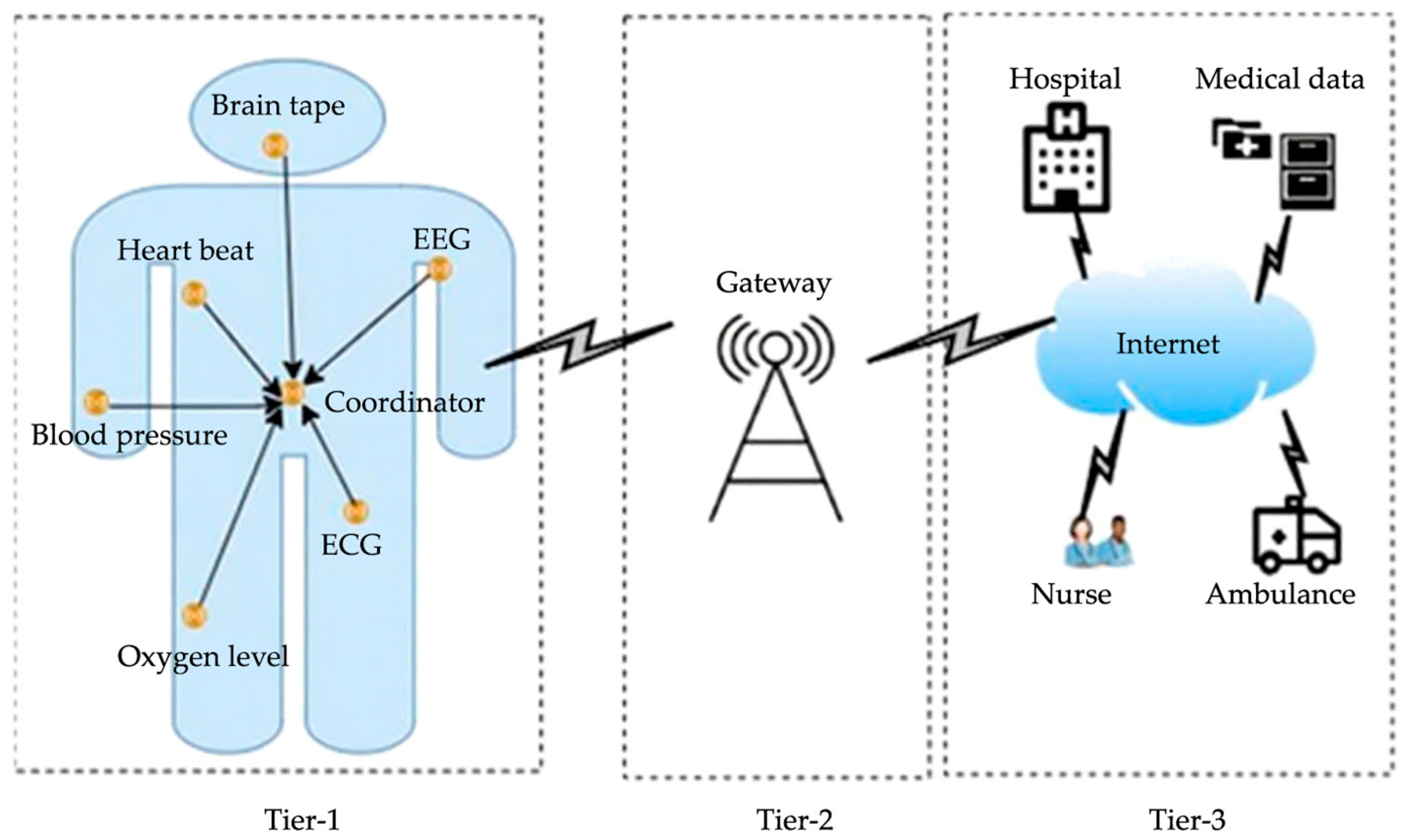
The typical WBAN three-layer architecture is shown in
Figure 1, which consists of Tier 1 (Body Sensor Layer) with various physiological sensors and a coordinator to collect human body data, Tier 2 (Gateway Layer) where a gateway forwards the data to the Internet, and Tier 3 (Application Layer) where hospitals, medical staff, etc., use the data via the Internet for health monitoring and medical services. The operation of WBANs is typically governed by standards like the specialized IEEE 802.15.6 or the more general-purpose IEEE 802.15.4, which define the physical (PHY) and Medium Access Control (MAC) layer protocols [
5].
However, as the adoption of WBANs accelerates, their dense deployment in crowded environments like hospitals gives rise to a critical performance bottleneck: inter-network interference [
6]. When multiple WBANs operate in close proximity, they often share the same unlicensed Industrial, Scientific, and Medical (ISM) band. Without effective coordination mechanisms, overlapping signals from different networks cause severe interference, leading to packet collisions, reduced throughput, and increased delay [
7]. This phenomenon poses a direct threat to patient safety in medical applications. Addressing these reliability issues is paramount. Consequently, this paper proposes and validates a novel two-phase interference mitigation strategy. First, WBANs are grouped using a clustering algorithm enhanced with a weighted interference metric and a priority-aware mechanism, which reduces inter-Internet interference by 26.7% and improves the distribution balance of high-priority networks by 65.7%. Then the interference between groups is modeled as an undirected graph considering its inherent symmetry. Subsequently, a graph-coloring-based approach assigns collision-free communication time slots within each group. Simulation results show that the strategy maintains a transmission success rate above 80% even in dense scenarios, significantly outperforming benchmarks like IEEE 802.15.4.
The remainder of this paper is organized as follows.
Section 2 provides a comprehensive review of related work.
Section 3 establishes the system model and problem formulation.
Section 4 details our proposed two-phase algorithm.
Section 5 presents the simulation setup and performance evaluation.
Section 6 discusses the implications of the findings, and
Section 7 concludes the paper.
2. Related Work
As WBANs become widely deployed and coexist in scenarios, inter-network interference from overlapping signals severely degrades performance. To mitigate this, researchers have proposed various optimization schemes. Since the performance of a WBAN in managing interference is fundamentally influenced by its MAC layer, which arbitrates channel access, the design of efficient MAC protocols has been a vibrant area of research, primarily driven by the need to balance energy efficiency, low latency, and high reliability.
2.1. MAC Protocol for WBANs
The design of efficient MAC protocols for WBANs has been a vibrant area of research, primarily driven by the need to balance energy efficiency, low latency, and high reliability.
2.1.1. MAC Protocols Based on IEEE 802.15.4
The IEEE 802.15.4 standard is widely adopted in WBANs due to its low-power characteristics [
5], but its static parameters and rigid structure present limitations for medical applications. Research has focused on parameter tuning, cross-layer design, and superframe enhancement.
In parameter tuning, protocols like TunableMAC use fuzzy logic to co-optimize sleep time and transmission power [
8], while MC-HYMAC introduces dynamic power control and on-demand slot calculation [
9]. Cross-layer designs leverage information from multiple layers. For example, CoCLF-MAC uses a two-level fuzzy system to adjust CSMA/CA backoff and GTS allocation [
10], and other notable works improve real-time transmission by restructuring the backoff window based on higher-layer requirements [
11]. The most extensive optimizations involve superframe structure. Later protocols added dedicated periods for high-priority traffic, like the Emergency Time Slots (ETSs) in ECTP-MAC [
12]. Recent works have incorporated advanced algorithms, such as MPMO-GOA-MAC, which uses the Grasshopper Optimization Algorithm (GOA) [
13], and MDP-HYMAC, which employs a Markov Decision Process (MDP) in an edge AI architecture to offload complex computations [
14].
2.1.2. MAC Protocols Based on IEEE 802.15.6
As a standard conceived for WBANs, IEEE 802.15.6 natively incorporates QoS support and low-power operation [
3]. Research has focused on enhancing priority scheduling and superframe adaptation.
Priority scheduling is central to WBAN MAC design. To prevent starvation of lower-priority data, PB-MAC constructs a multi-faceted priority model [
15]. More advanced solutions redefine priority based on clinical relevance [
16] or integrate multiple system parameters for a comprehensive calculation, as in CRITIC [
17]. Recent protocols leverage AI, such as MDP-MAC, which uses reinforcement learning [
18], and the LTA framework, which employs multi-agent RL for nodes to learn optimal TDMA slots [
19]. The ADP2-MAC protocol proposed in 2025 utilizes a probabilistic approach to dynamically determine polling intervals based on traffic arrival patterns, significantly optimizing delay for heterogeneous traffic [
20].
Another key research direction is superframe structure improvement. Strategies include structural reconfiguration for traffic separation (e.g., TA-MAC [
21]), creating hybrid access mechanisms (e.g., HyMac [
22], HM-MAC [
7]), and dynamic intelligent scheduling, while MMH-MAC employs Q-learning to dynamically select the most appropriate superframe structure [
23].
Finally, a distinct category focuses on multi-channel interference avoidance. In addition to the collaborative HM-MAC [
7], various non-collaborative approaches have been explored, though they often struggle to balance interference mitigation with the energy constraints of sensor nodes.
2.2. Inter-Network Interference Mitigation for WBANs
2.2.1. Inter-Network Interference Mitigation Using Time Slot Scheduling
Time slot scheduling aims to reduce data conflicts. Park et al. proposed a bio-inspired method using synchronization and desynchronization to reduce superframe overlap [
24]. Khan et al. proposed the IPC algorithm, which uses an interference map to dynamically adjust TDMA slot allocation based on traffic priority [
25]. Mkongwa et al. proposed the RDTM, which combines a dynamic backoff range with priority scheduling to improve transmission success in crowded environments [
11].
2.2.2. Inter-Network Interference Mitigation Using Channel Allocation
Channel allocation focuses on improving channel reuse. Wu et al. used a graph coloring method based on a game theory model to improve channel reuse within a two-hop range [
26]. Mu et al. proposed an intelligent scheme using machine learning to partition the network and a vertex coloring algorithm to allocate channels [
27]; however, the scheme’s high computational complexity makes it less suitable for resource-constrained sensor nodes. Periyamuthaiah et al. used a deep learning approach with a multi-objective optimization algorithm to optimize channel access [
28]. Recent advancements have also introduced deep learning to graph-based interference management. However, despite their potential effectiveness, these deep learning models often entail high computational overheads that are challenging for resource-constrained WBAN nodes. In contrast, our proposed method integrates a weighted interference metric with a priority-aware heuristic. This design not only ensures low computational complexity, suitable for WBANs, but also explicitly prioritizes critical data streams, addressing the gaps left by strictly geometric or random allocation schemes.
2.2.3. Inter-Network Interference Mitigation Using Power Control
Power control mechanisms optimize transmission power to reduce interference and improve energy efficiency. Chhea et al. used the Kuramoto model to synchronize QoS utility functions and reduce interference [
29]. Fan et al. proposed the EFRS scheme, which uses a Latin-square-based channel allocation strategy to maximize channel reuse and avoid co-channel interference [
30]. While intelligent power optimization using reinforcement learning offers dynamic adaptability, applying such algorithms requires careful consideration of their convergence time and computational complexity, which may not align with the real-time requirements of critical health monitoring.
However, many existing approaches face significant drawbacks. Single-channel solutions remain vulnerable to saturation in dense scenarios [
11]; collaborative multi-channel approaches, while effective, often introduce high communication overhead [
7]; and intelligent protocols based on advanced AI can be too computationally demanding for resource-constrained sensor nodes [
13,
14]. Furthermore, a common weakness is that many of these proposed solutions are validated in simulations that fail to capture the complexity of real-world interference environments [
6,
11].
This analysis underscores the need for a novel MAC protocol that balances intelligence with low complexity to enable effective, non-cooperative interference mitigation. While multi-channel protocols offer a robust solution [
7], they face a trade-off between overhead and optimality. Furthermore, the high computational complexity of many advanced AI-based protocols [
13,
14,
19] remains a barrier for energy-constrained nodes. Therefore, before proposing a solution, it is necessary to establish a mathematical framework to accurately quantify the impact of interference. While existing research offers various strategies for mitigating inter-network interference, these approaches often introduce a high overhead or computational complexity, limiting their practical application on resource-constrained sensor nodes. To overcome these challenges, a rigorous analytical framework is required before developing a more effective solution.
3. System Model
To provide a formal basis for the subsequent algorithms, this section models the network interference problem by defining the system environment and introducing Interference Signal Strength (ISS) as the key metric to precisely quantify interference.
3.1. Network Model
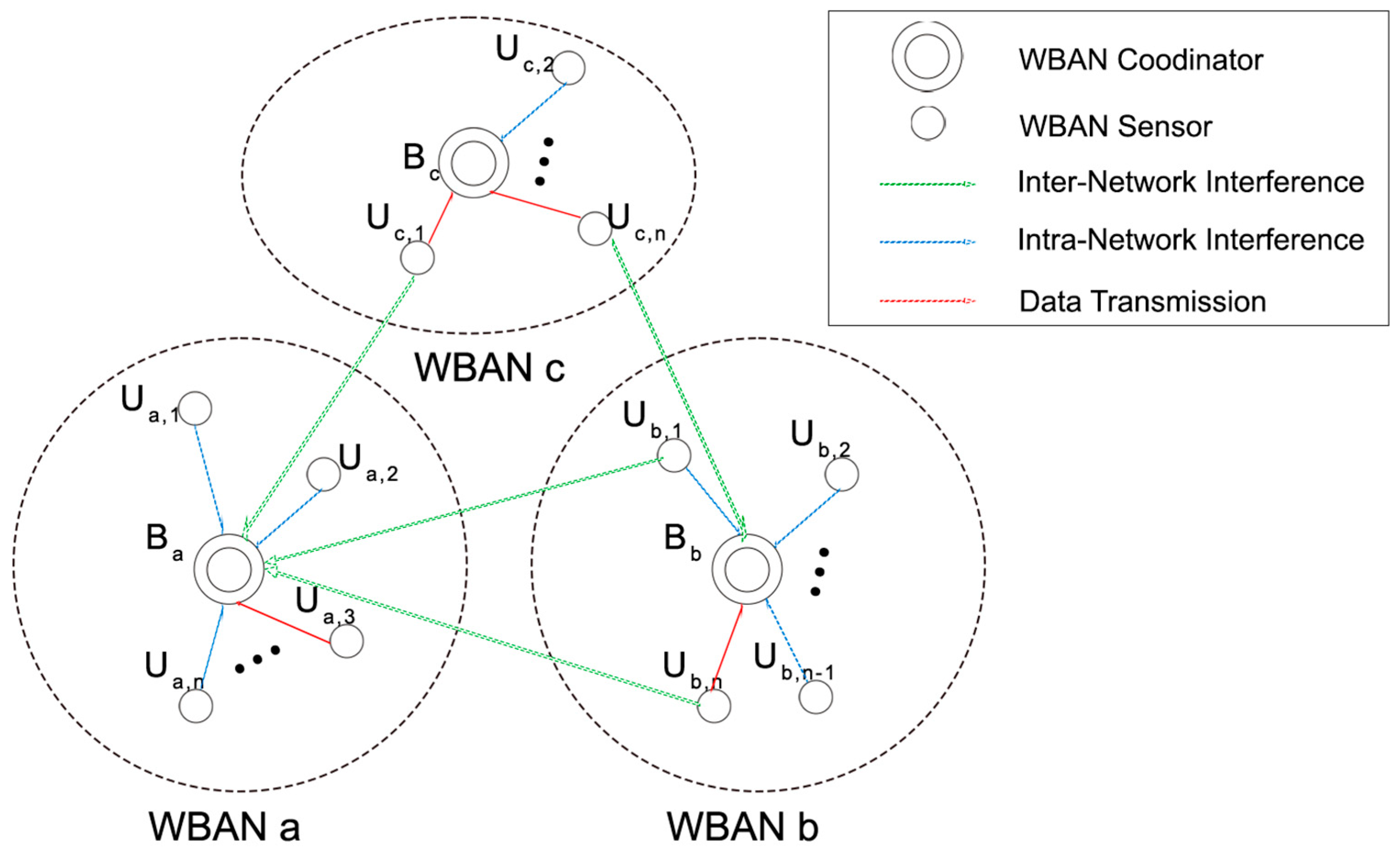
In a coexisting WBAN environment, interference primarily arises from the signal overlap between different networks. When the transmission signal strength from one WBAN exceeds the interference tolerance threshold of another, the receiving node may fail to decode data correctly, leading to packet loss or retransmissions. As shown in
Figure 2, inter-network interference occurs as WBANs become more common and coexist in crowded environments like hospitals, public transportation, and smart homes.
To quantitatively measure the interference between WBANs, this study adopts Interference Signal Strength (ISS) as its primary metric.
We consider a finite area where multiple WBANs are deployed, with the set of WBANs defined as
where
is the total number of WBANs. Each WBAN is assumed to adopt a star topology, consisting of a central coordinator and several sensor nodes. These nodes monitor physiological signals and transmit data to their respective coordinators. In such a dense deployment scenario, signals from different WBANs overlap, creating inter-network interference, which is the primary challenge compromising the reliability of data transmission.
We define the priority of a WBAN based on the criticality of the physiological data it collects. For example, WBANs monitoring real-time ECG or EEG signals are assigned high priority (), while those monitoring body temperature or blood pressure are assigned normal priority ().
3.2. Channel Model
This study employs the log-distance path loss model to calculate the path loss,
, as it effectively simulates wireless signal propagation in indoor environments. The formula is given by
In this equation, is the reference path loss at a distance of one meter, is the path loss exponent (typically ranging from 2 to 4 depending on the environment), is the distance between sensor nodes, and is a normal-distributed random variable simulating shadow fading.
The path loss is calculated using a log-distance model. Interference is considered to occur if exceeds a predefined threshold , which is typically between −85 dBm and −75 dBm according to the IEEE 802.15.6 standard and can be adjusted based on the specific application scenario to ensure interference is minimized while maintaining network throughput and reliability.
Although dynamic thresholding offers theoretical flexibility, we adopt a fixed ISS threshold (−85 dBm) calibrated to the receiver sensitivity defined in the IEEE 802.15.6 standard. This approach provides a robust safety margin that effectively encompasses the interference range in typical medical bands without the computational overhead of continuous threshold recalculation.
3.3. Interference Formulation
To quantitatively measure the degree of interference between WBANs, this study adopts Interference Signal Strength (ISS) as its core metric, and interference between two WBANs,
and
, is calculated as
where
is the transmission power of a sensor node
in
, and
is the channel gain between the transmitting node in
and the receiving node in
.
In a non-ideal propagation environment, the channel gain can be expressed as
where
is the path loss during signal propagation.
This model provides a theoretical and quantitative groundwork for the subsequent algorithms. We began by defining a system scenario comprising multiple star-topology WBANs. We then introduced a quantitative interference model centered on Interference Signal Strength (ISS) and detailed the calculation of signal propagation using a log-distance path loss model. This framework not only accurately describes the interference relationships between WBANs but also provides a clear criterion for identifying interference events via a defined threshold. This mathematical model lays a critical theoretical and quantitative groundwork for the design of the network clustering and time slot allocation algorithms presented in the subsequent sections.
4. Clustering- and Graph-Coloring-Based Inter-Network Interference Mitigation for WBANs
This section introduces an innovative two-phase strategy that systematically mitigates interference. The first phase employs a priority-aware K-means++ algorithm to cluster networks, minimizing inter-cluster interference. The second phase utilizes an enhanced graph coloring algorithms to assign collision-free time slots within each cluster, thereby eliminating intra-cluster interference.
4.1. Interference-Priority-Weighted K-Means++ Clustering
In densely deployed WBAN environments, the random distribution of devices creates a complex web of interference. A clustering mechanism can effectively decompose this global optimization problem into smaller, manageable local problems, thus reducing computational complexity and mitigating inter-network interference. This study employs an adapted K-means++ algorithm for WBAN clustering with two primary objectives: minimizing inter-network interference by partitioning networks based on their interference relationships, and ensuring a balanced distribution of high-priority WBANs to prevent resource contention for critical medical tasks.
To manage resource allocation and reduce interference, we introduce a clustering mechanism using an adapted K-means++ algorithm. The optimizations are twofold:
Weighted Interference Distance Metric: Traditional K-means++ relies on Euclidean distance, which is insufficient for accurately capturing the complex interference relationships in a wireless environment where physical proximity does not always equate to strong interference. Therefore, we introduce a weighted distance metric that combines both physical distance and Interference Signal Strength (ISS):
where
represents the physical distance between WBANs
and
, and
is their mutual interference strength. The parameters
and
are used to balance the two factors. The parameters
and
are weighting factors that normalize and balance the physical distance and interference strength. Through sensitivity analysis, we set
and
to give slightly higher importance to the actual Interference Signal Strength (ISS), as physical proximity does not always strictly correlate with RF interference due to shadowing effects. A larger
prioritizes geometric distance, which is suitable for low-density deployments, while a larger
prioritizes interference strength, making it ideal for high-density environments. This ensures that highly interfering WBANs are more likely to be grouped into the same cluster;
Adapted Cluster Center Selection: We optimize the K-means++ cluster center selection process by introducing a priority-weighted mechanism. The probability of selecting a WBAN Wᵢ as a new center is determined not only by its distance from existing centers but also by its priority level. This ensures a more balanced distribution of critical networks. The selection probability is defined as
where
is the distance-based selection probability and
is the priority-based selection probability, calculated as
Here, is the distance of to the nearest existing center, and is the priority value assigned to .
The detailed procedure for the adapted K-means++ clustering is presented in Algorithm 1. In each iteration, the new cluster center is calculated as the geometric centroid of the WBANs assigned to that cluster, adjusted by the node with the highest priority weight to ensure coverage of critical nodes. The algorithm iterates until the shift in cluster centers is less than a predefined threshold or a maximum of 20 iterations is reached, ensuring fast convergence suitable for dynamic environments.
| Algorithm 1 Adapted K-means++ for WBAN clustering |
|
|
| 01 | Initialize: centers = [] |
| 02 | |
| 03 | cluster centers: |
| 04 | For: |
| 05 | For: |
| 06 | Compute
where
|
| 07 | Compute) |
| 08 | Compute) |
| 09 | Compute
|
| 10 | Select
|
| 11 | Iteratively optimize cluster assignment: |
| 12 | Repeat |
| 13 | Assign WBANs to nearest cluster center: |
| 14 | For
cluster
) |
| 15 | Update cluster centers: |
| 16 | For
|
| 17 | Until convergence (or stopping condition met) |
4.2. Graph-Coloring-Based Time Slot Allocation
After clustering, time slot allocation within each cluster is performed to mitigate intra-cluster interference. This problem is transformed into a graph coloring problem.
The goal of time slot allocation is to avoid communication conflicts between WBANs while maximizing channel resource utilization. By transforming this problem into a graph coloring problem, we can formally model the interference relationships.
Interference Graph Construction: For each cluster, an interference graph
is constructed. The vertices represent the WBANs, and an edge is added between two WBANs if their mutual ISS exceeds the threshold .
Priority-Weighted Welch–Powell Algorithm: The traditional Welch–Powell algorithm sorts graph vertices in descending order of their degree, prioritizing nodes with more neighbors for coloring. However, in a WBAN context where some networks carry critical data, relying solely on the degree may prevent high-priority WBANs from securing a time slot promptly, thereby compromising the reliability of essential medical monitoring. To address this, we enhance the algorithm by introducing a priority-weighted degree for sorting vertices due to its low polynomial time complexity. Compared to NP-hard optimal coloring or complex heuristic schedulers (e.g., DSATUR), Welch–Powell provides the optimal balance between execution speed and chromatic number minimization, which is essential for the resource-constrained hardware of WBAN coordinators and ideal for real-time WBAN scheduling compared to exhaustive search methods. We enhance this by incorporating a priority weight (Equation (9)), ensuring that high-priority nodes are colored (assigned slots) earlier in the sequence, thereby reducing their probability of being assigned to shared or contention-heavy slots:
where
is the node’s degree,
is its priority weight, and
and
are adjustment parameters. Typically,
is set to ensure that the interference factor remains dominant while still giving preference to high-priority nodes. This ensures that high-priority and highly interfered WBANs are prioritized for time slot allocation, guaranteeing reliable transmission for critical data.
This section has detailed a novel, two-phase interference mitigation strategy. The first phase employs an adapted K-means++ algorithm, using a weighted interference distance metric and a priority-aware center selection mechanism to achieve a macroscopic network partition. This effectively isolates inter-network interference and balances the load of critical services. The second phase addresses each cluster individually by modeling the time slot allocation as a graph coloring problem, which is solved using a Priority-Weighted Welch–Powell algorithm to achieve collision-free communication. This systematic “cluster-then-schedule” approach provides a highly effective and reliable algorithmic solution for managing interference in complex WBAN environments.
4.3. Complexity Analysis
The computational complexity of the proposed strategy is low. The clustering phase has a complexity of
, where T is the number of iterations, K is the number of clusters, and N is the number of WBANs. The coloring phase has a complexity of
in the worst case. This is significantly more efficient than optimization-based approaches [
28] or extensive machine learning models [
27], making it feasible for implementation on WBAN coordinators.
4.4. Mobility Management
Although the primary simulation considers a snapshot of the network, WBAN mobility is handled through a threshold-based re-clustering mechanism. If the average ISS of a WBAN changes by more than 10% or if the Packet Loss Rate (PLR) exceeds a safety threshold, the coordinator triggers a local update request. This allows the network to adapt to body movements without running the full algorithm continuously.
5. Performance Evaluation
The performance of the proposed strategy was validated via simulations in OMNeT++ and compared with IEEE 802.15.4, CSMA/CA, and LMAC protocols.
5.1. Simulation Setup
To comprehensively evaluate the performance of our proposed strategy, we established a simulation environment in OMNeT++. The simulation was set in a 50 m × 50 m area, chosen to reproduce a typical coexistence scenario such as simultaneous WBAN deployments across multiple hospital rooms. Each WBAN adopted a star topology, consisting of one coordinator and a variable number of 3 to 6 sensor nodes. To simulate the needs of critical medical applications, approximately 15% of the WBANs were designated as high-priority. Data packets were generated with random sizes ranging from 128 to 512 bytes, and signal propagation was simulated using the log-distance path loss model to account for indoor environmental effects.
The system’s performance was evaluated under three distinct load levels, which were configured by varying the number of coexisting WBANs and their data generation rates. low load was defined as 10 WBANs with a data rate of 3–5 packets/second. Medium load consisted of 20 WBANs with a rate of 5–8 packets/second. High load simulated a dense scenario with 30 WBANs generating 8–12 packets/second each. This tiered approach allowed for a thorough analysis of the strategy’s effectiveness under varying degrees of network congestion and interference. As shown in
Table 1, the simulations were conducted under the parameter settings described below.
We utilized the log-distance path loss model with log-normal shadowing to approximate the indoor hospital environment. While this model simplifies complex body-to-body shadowing effects, it is widely accepted in MAC layer performance evaluations and provides a sufficient baseline for validating interference mitigation logic.
All simulation results represent the average of 50 independent runs to ensure statistical validity, with 95% confidence intervals calculated to verify that the margin of error remains within ±2% of the mean values.
5.2. Clustering
The performance of the adapted K-means++ algorithm was evaluated on two key metrics critical for coexisting WBAN environments: the distribution balance of high-priority WBANs and the mitigation of inter-network interference. For this analysis, we compared our adapted algorithm against the standard K-means++ implementation.
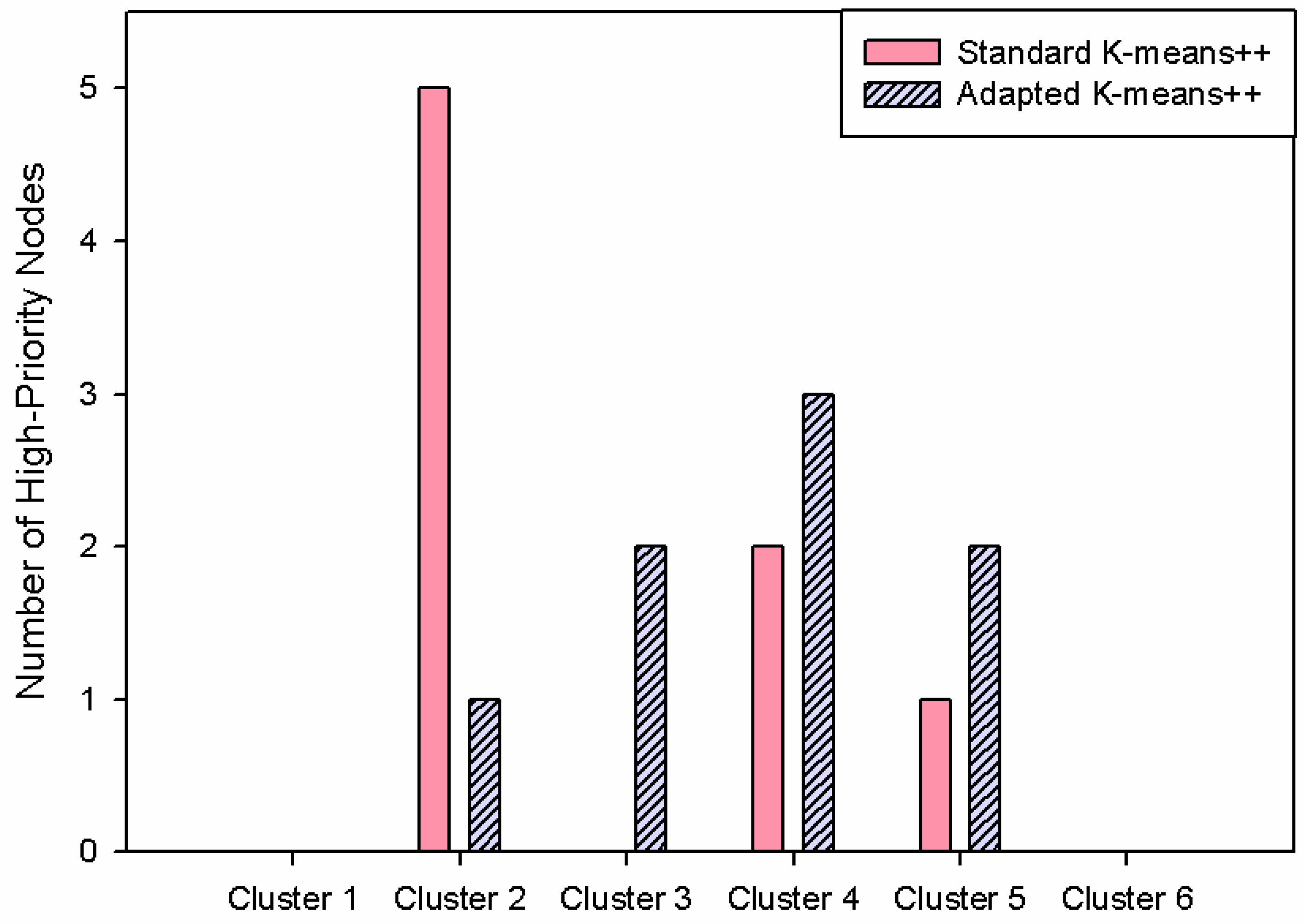
Distribution of High-Priority WBANs: A balanced distribution of high-priority WBANs is crucial for avoiding resource contention and ensuring reliable transmission for critical medical tasks. We use the standard deviation of the number of high-priority WBANs per cluster (σH) to measure this balance, where a lower value indicates a more uniform distribution. As shown in
Figure 3, it is observed that Clusters 1 and 6 have no assigned nodes. This occurs because the K-means++ algorithm adaptively initializes centers based on data density. In this specific simulation instance, the spatial and interference distribution of the 30 WBANs naturally converged into four distinct groups. The algorithm effectively pruned the unnecessary clusters, demonstrating its flexibility in handling varying network densities. The standard K-means++ algorithm resulted in a significant concentration of high-priority WBANs, with five such nodes clustered into a single group, leading to severe resource competition. In contrast, our adapted algorithm achieved a significantly more uniform distribution, spreading high-priority nodes across multiple clusters. This visual result is confirmed quantitatively: our adapted algorithm reduced the standard deviation of high-priority nodes per cluster by 65.7% (from 1.37 to 0.47) compared to the standard version, effectively preventing resource bottlenecks.
Silhouette Score: To quantitatively evaluate the quality of the clustering results, we use the Silhouette Coefficient. This measures how similar an object is to its own cluster (cohesion) compared to other clusters (separation). The Silhouette Coefficient for a single sample
is given by
, where
is the average distance from sample
to all other data points in the same cluster,
is the average distance from sample
to all data points in the nearest neighboring cluster. The value of the Silhouette Coefficient ranges from −1 to 1, where a high value indicates that the object is well matched to its own cluster and poorly matched to neighboring clusters. As shown in
Table 2 the standard K-means++ algorithm, which solely optimizes for Euclidean distance, achieves a higher Silhouette Coefficient (approximately 0.45) compared to our adapted algorithm (approximately 0.35). This indicates that from a purely geometric perspective, the standard algorithm produces more distinctly separated clusters.
Cluster Compactness (Intra-Cluster Distance):
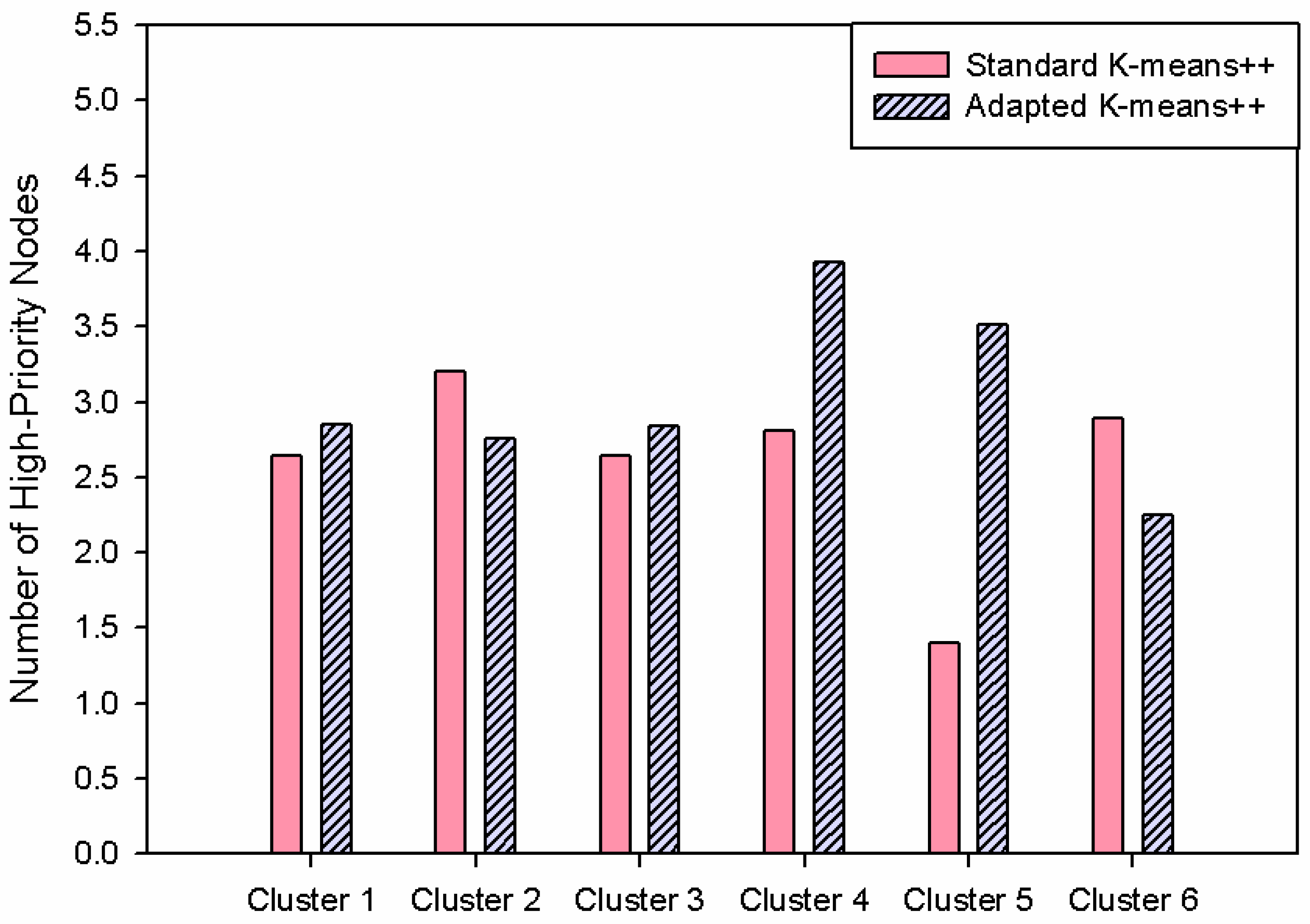
Figure 4 highlights a strategic trade-off in our algorithm’s design. The standard K-means++ algorithm, by minimizing Euclidean distance, produces geometrically more compact clusters (lower average intra-cluster distance), which aligns with its higher Silhouette Score in
Table 2. In contrast, our adapted algorithm’s primary goal is to group WBANs based on true interference relationships, not just proximity. It achieves this by using a weighted distance metric that incorporates Interference Signal Strength (ISS). Therefore, the resulting higher intra-cluster distance is a direct manifestation of this “function-over-geometry” philosophy. By sacrificing some geometric compactness, our algorithm reduces mean inter-network interference by 26.7%, more effectively achieving the core objective of interference isolation.
Inter-Network Interference: This structural trade-off is a deliberate design choice. By incorporating a weighted interference distance metric, our algorithm prioritizes grouping highly interfering WBANs together, even if it compromises geometric compactness. This strategy proved more effective at partitioning the network according to its true interference topology. As a result, our adapted algorithm reduced the mean inter-network interference (μICI) by 26.7% (from 8.6 to 6.3) compared to the standard K-means++, demonstrating superior communication quality at the macroscopic level.
This evaluation confirms a strategic trade-off, where our algorithm prioritizes functional goals over geometric perfection. The incorporation of a weighted interference distance metric, which synergizes physical distance with Interference Signal Strength (ISS), provides a more accurate representation of the true interference topology, directly leading to the 26.7% reduction in mean inter-network interference. Furthermore, the priority-aware center selection mechanism proved vital, achieving a 65.7% improvement in distribution balance. These results confirm that our clustering phase effectively partitions the network to isolate interference and prevent resource contention for critical medical data streams, which are paramount for reliable communication in dense WBAN environments.
In summary, the performance evaluation confirms a strategic trade-off. While the standard K-means++ excels in traditional geometric metrics like silhouette score and compactness, our adapted algorithm successfully achieves its primary design goals: it significantly improves the distribution balance of critical nodes and more effectively minimizes inter-network interference, which are paramount for reliable communication in dense WBAN environments. The distribution balance and inter-network interference performance of the two algorithms are quantitatively compared in
Table 3 and
Table 4, respectively.
5.3. Network Performance Analysis
The overall network performance was evaluated based on transmission success rate (TSR) and throughput.
5.3.1. Transmission Success Rate
Transmission success rate (TSR) is a critical metric for measuring the data reliability of a WBAN. A high TSR indicates low channel competition and stable data transmission, whereas a low TSR reflects increased channel conflicts, severe interference, and data loss.
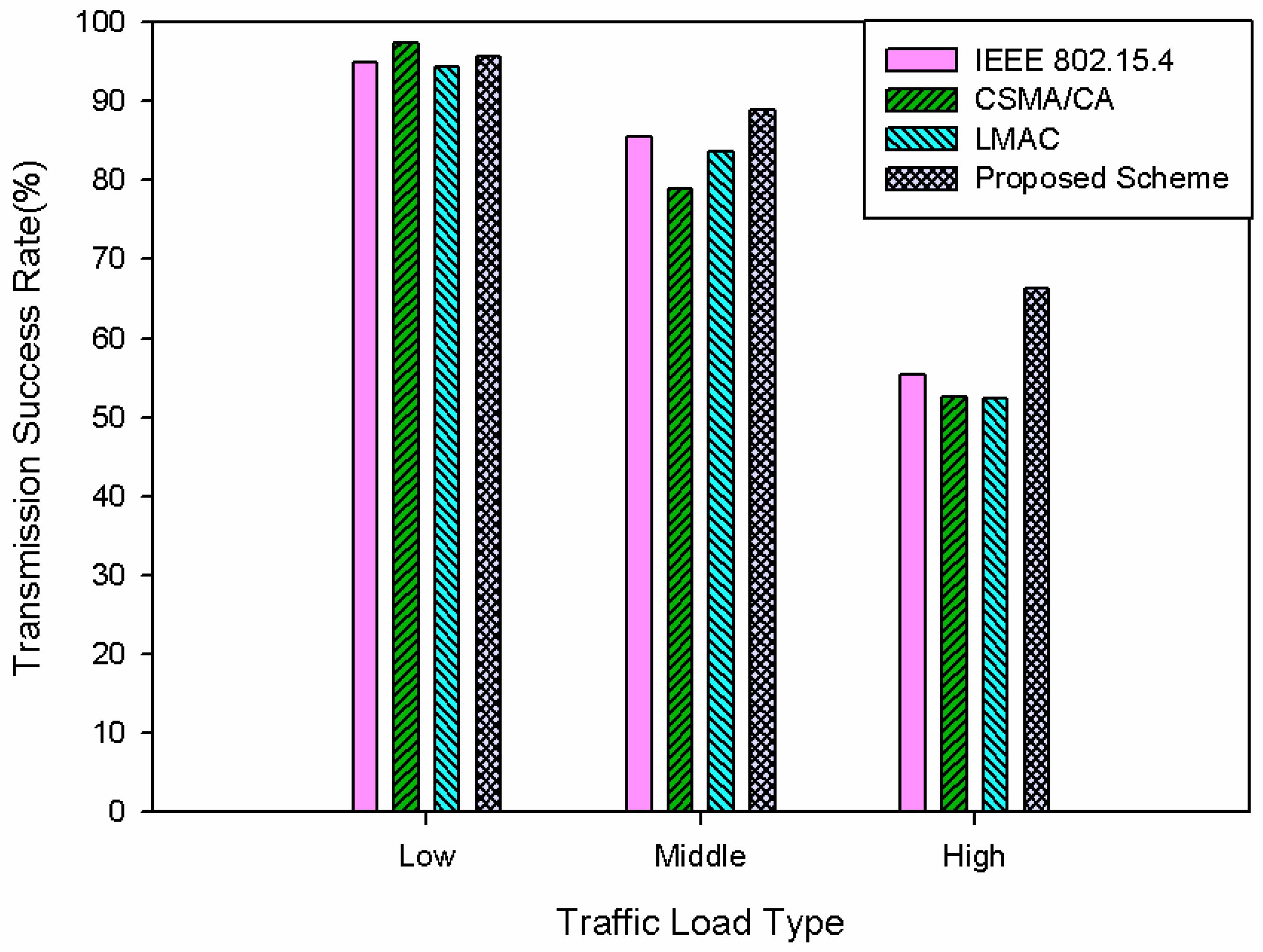
As shown in
Figure 5, the TSR of all protocols decreased as network load increased.
At low load, all protocols maintained a TSR above 90% with minimal variance. This is because ample channel resources resulted in negligible contention among WBANs.
As the load increased to medium, performance began to diverge. The TSR of CSMA/CA dropped sharply due to its contention-based access mechanism, which led to a higher collision rate. IEEE 802.15.4 performed better due to its backoff mechanism. While LMAC also showed a high TSR, its static slot allocation could not adapt to dynamic traffic, leading to inefficient resource use in some slots. In contrast, our proposed strategy exhibited the smallest decline in TSR, demonstrating that its optimized clustering and graph-coloring-based slot allocation effectively prevent data collisions.
Under high load, where channel competition and interference were most severe, our strategy’s TSR remained above 80%, showcasing its superior resilience and stability against interference.
5.3.2. Throughput
Throughput measures the amount of data successfully transmitted per unit of time and is a key indicator of a WBAN’s data transmission capacity. Higher throughput signifies better network resource utilization and more stable data transmission.
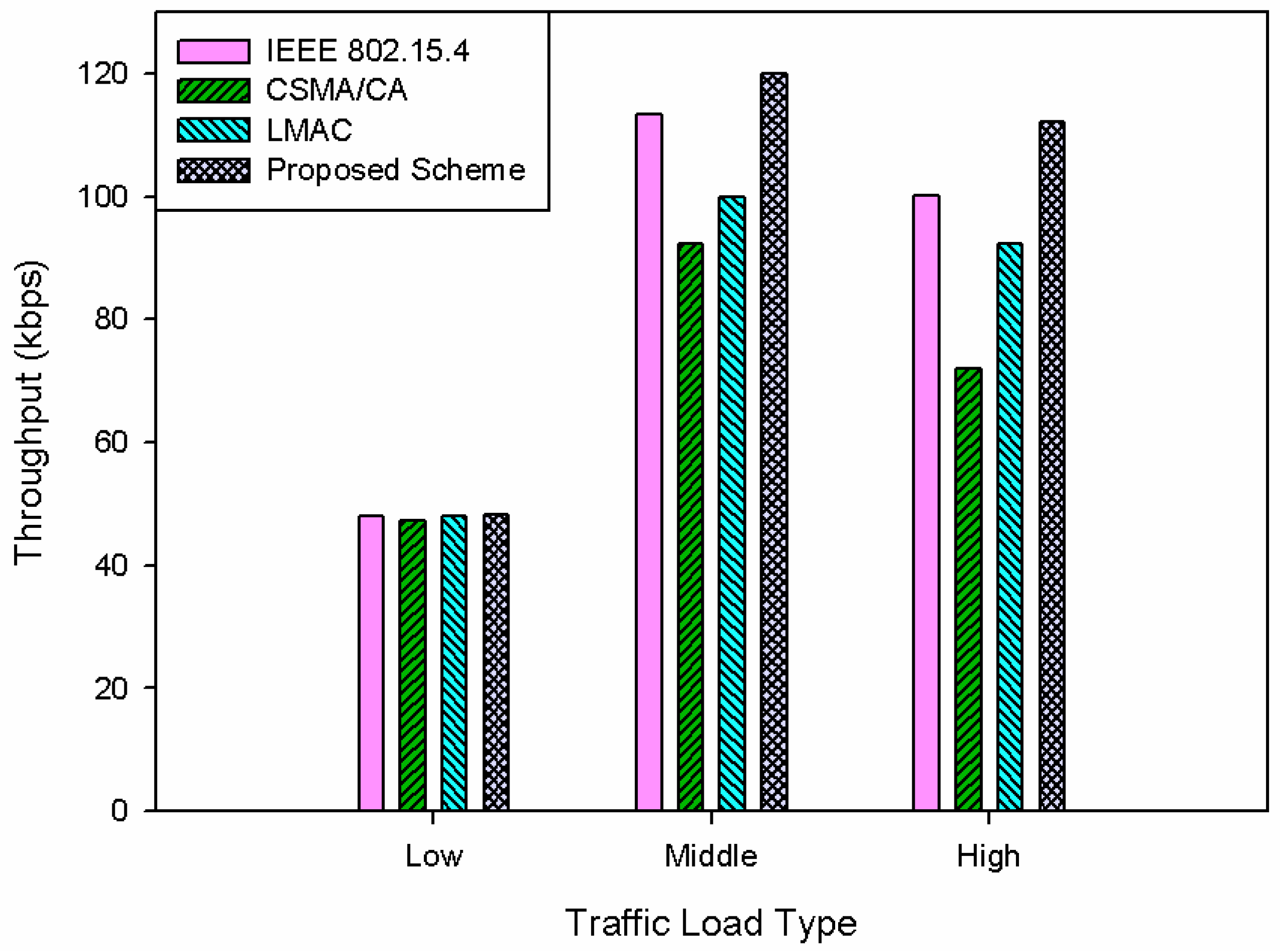
Figure 6 shows the network throughput under different loads.
At low load, throughput was similar across all protocols, primarily limited by low packet-generation rates rather than channel capacity. The benefits of our strategy were not yet prominent.
At medium load, as traffic increased, the performance gap widened. By effectively reducing interference through its adapted clustering and scheduling, our strategy achieved higher throughput than most existing approaches, demonstrating a clear advantage.
In the high-load scenario, as the channel neared saturation, the throughput of all protocols declined. The drop was most significant for CSMA/CA due to escalating collisions. IEEE 802.15.4’s decline was less severe, and LMAC’s throughput stabilized due to its fixed slots. Our strategy, however, maintained the highest throughput thanks to its flexible and adaptive slot allocation, confirming its robustness in highly congested environments.
5.3.3. Average Packet Delay Analysis
While throughput and TSR are critical, latency is vital for medical monitoring. Simulation results indicate that at low traffic loads, the proposed TDMA-based strategy introduces a minor, deterministic increase in average packet delay compared to CSMA/CA, due to the wait time for assigned slots. However, as network load increases (dense scenarios), CSMA/CA suffers from exponential delay growth due to backoff algorithms and retransmissions. In contrast, our proposed strategy maintains a stable and bounded delay profile (averaging below 25 ms in high-load tests), ensuring timely delivery of high-priority vital signs.
6. Discussion
The simulation results convincingly demonstrate the effectiveness of our proposed two-phase interference mitigation strategy. The fundamental strength of our approach lies in its “divide and conquer” methodology, which partitions the complex global interference problem of coexisting WBANs into smaller, more manageable intra-cluster subproblems. By accurately modeling the interference topology rather than relying on simple geometric proximity, our strategy demonstrates a more effective partitioning of the network, which is the cornerstone of its superior performance.
The superior performance of our strategy, particularly under high load, is a direct result of this deterministic, schedule-based framework. By modeling intra-cluster scheduling as a graph coloring problem and enhancing the algorithm with a priority-weighted degree, we ensure collision-free, preferential access for critical WBANs. Unlike contention-based protocols (e.g., CSMA/CA, IEEE 802.15.4), which suffer from cascading collisions and performance collapse in congested scenarios, our method guarantees channel access. This is why our strategy can maintain a transmission success rate above 80% and achieve the highest throughput, demonstrating its exceptional stability and efficient resource utilization. The optimized clustering and graph-coloring-based scheduling not only allocate resources efficiently to mitigate conflicts but also ensure reliable transmission for high-priority WBANs. This provides a novel framework for designing interference-aware WBAN systems.
A key finding is the trade-off between geometric cluster compactness (Silhouette Score) and interference isolation. As noted in
Table 2, our method yields a lower Silhouette Score than standard K-means++. However, this is a deliberate design choice: by incorporating ISS into the distance metric, we force high-interference pairs into separate time slots even if they are physically close. This functional optimization leads to the observed 26.7% reduction in interference, validating that geometric proximity is not the sole determinant of wireless performance.
It is important, however, to acknowledge the inherent trade-offs of this strategy. The clustering and graph coloring algorithms introduce a degree of computational overhead during network (re)configuration. Moreover, the TDMA-based scheduling, while guaranteeing channel access for prioritized data, may result in slightly increased latency for non-critical packets compared to contention-based access. This trade-off is a deliberate design choice. For critical healthcare applications where data integrity and reliability are paramount, the predictability and guaranteed channel access offered by our strategy far outweigh the minor increase in latency for lower-priority data.
7. Conclusions
This paper introduced and comprehensively evaluated a novel, two-phase interference mitigation strategy designed to address the critical challenges of coexisting WBANs in dense medical environments. By systematically combining a priority-aware clustering algorithm with graph-coloring-based time slot allocation, our strategy effectively minimizes both inter- and intra-cluster interference. Simulation results unequivocally demonstrate its superiority over benchmark protocols, especially under high network loads, where it maintains a transmission success rate above 80%. While the strategy entails a modest and justified trade-off in scheduling latency, the significant gains in network reliability confirm its suitability for critical healthcare applications. In conclusion, this research provides a robust and scalable framework for designing dependable WBAN systems in complex, interference-prone medical settings, representing a significant step toward enabling the next generation of connected healthcare. For future work, a promising avenue is to implement and test the proposed strategy on a real-world hardware testbed, which would be invaluable for validating its performance beyond simulations and assessing its real-world energy consumption.
Author Contributions
Conceptualization, H.S. and L.Z.; methodology, H.S. and J.Y.; software, J.Y. and Y.S.; validation, J.Y. and Z.M.; formal analysis, H.S.; investigation, H.S., Z.M. and Y.S.; resources, L.Z.; data curation, Z.M. and Y.S.; writing—original draft preparation, H.S.; writing—review and editing, H.S., Z.M., Y.S., J.Y. and L.Z.; visualization, Z.M. and Y.S.; supervision, L.Z.; project administration, L.Z.; funding acquisition, L.Z. All authors have read and agreed to the published version of the manuscript.
Funding
This work is supported by the Beijing Natural Science Foundation under Grant No. L222048.
Data Availability Statement
Data is contained within the article.
Conflicts of Interest
The authors declare no conflicts of interest.
References
- Fang, X.L.; Luo, J.Z. Key Technologies and New Challenges on Body Area Networks. Chin. J. Internet Things 2018, 2, 64–68. [Google Scholar]
- IEEE Std 802.15.6-2012; IEEE Standard for Local and Metropolitan Area Networks—Part 15.6: Wireless Body Area Networks. IEEE: Piscataway, NJ, USA, 2012.
- Taleb, H.; Nasser, A.; Andrieux, G.; Charara, N.; Cruz, E.M. Wireless technologies, medical applications and future challenges in WBAN: A survey. Wirel. Netw. 2021, 27, 5271–5295. [Google Scholar] [CrossRef]
- Song, W.; Park, J. Clustering-based channel allocation method for mitigating inter-WBAN interference. Appl. Sci. 2022, 12, 11851. [Google Scholar] [CrossRef]
- IEEE Std 802.15.4-2015; IEEE Standard for Low-Rate Wireless Networks. IEEE: Piscataway, NJ, USA, 2022.
- Salayma, M.; Al-Dubai, A.; Romdhani, I.; Nasser, Y. Wireless Body Area Network (WBAN): A Survey on Reliability, Fault Tolerance, and Technologies Coexistence. ACM Comput. Surv. 2018, 50, 3. [Google Scholar] [CrossRef]
- Le, T.T.T.; Moh, S. Hybrid Multi-Channel MAC Protocol for WBANs with Inter-WBAN Interference Mitigation. Sensors 2018, 18, 1373. [Google Scholar] [CrossRef]
- Collotta, M.; Ferrero, R.; Rebaudengo, M. A Fuzzy Approach for Reducing Power Consumption in Wireless Sensor Networks: A Testbed with IEEE 802.15.4 and WirelessHART. IEEE Access 2019, 7, 64866–64877. [Google Scholar] [CrossRef]
- Olatinwo, D.D.; Abu-Mahfouz, A.M.; Hancke, G.P.; Myburgh, H.C. Energy-Efficient Multichannel Hybrid MAC Protocol for IoT-Enabled WBAN Systems. IEEE Sens. J. 2023, 23, 27967–27983. [Google Scholar] [CrossRef]
- Nekooei, S.M.; Chen, G. Cooperative Coevolution Design of Multilevel Fuzzy Logic Controllers for Media Access Control in Wireless Body Area Networks. IEEE Trans. Emerg. Top. Comput. Intell. 2020, 4, 336–350. [Google Scholar] [CrossRef]
- Mkongwa, K.G.; Zhang, C.; Liu, Q. A Reliable Data Transmission Mechanism in Coexisting IEEE 802.15.4-Beacon Enabled Wireless Body Area Networks. Wirel. Pers. Commun. 2023, 128, 1019–1040. [Google Scholar] [CrossRef]
- Yazdi, F.R.; Hosseinzadeh, M.; Jabbehdari, S. A Priority-Based MAC Protocol for Energy Consumption and Delay Guaranteed in Wireless Body Area Networks. Wirel. Pers. Commun. 2019, 108, 1677–1696. [Google Scholar] [CrossRef]
- Kumar, S.; Verma, P.K. A Novel Multi-Phase Multi-Objective GOA-Based MAC Protocol for IoT-Based WBANs. IETE J. Res. 2025, in press. [Google Scholar] [CrossRef]
- Olatinwo, D.D.; Abu-Mahfouz, A.M.; Hancke, G.P.; Myburgh, H.C. Markov-Decision Process-Based Energy-Aware MAC Protocol for IoT WBAN Systems. IEEE Sens. J. 2024, 24, 27981–27997. [Google Scholar] [CrossRef]
- Sun, G.; Wang, K.; Yu, H.; Du, X.; Guizani, M. Priority-Based Medium Access Control for Wireless Body Area Networks with High-Performance Design. IEEE Internet Things J. 2019, 6, 5363–5375. [Google Scholar] [CrossRef]
- Al Masud, S.M.R.; Saha, A.K. A Delay-Tolerant MAC Protocol for Emergency Care in WBAN Considering Preemptive and Non-Preemptive Methods. Int. J. Adv. Comput. Sci. Appl. 2021, 12, 463–473. [Google Scholar] [CrossRef]
- Das, K.; Moulik, S.; Chang, C.Y. Priority-Based Dedicated Slot Allocation with Dynamic Superframe Structure in IEEE 802.15.6-Based Wireless Body Area Networks. IEEE Internet Things J. 2022, 9, 4497–4506. [Google Scholar] [CrossRef]
- Su, H.; Pan, M.-S.; Chen, H.; Liu, X. MDP-Based MAC Protocol for WBANs in Edge-Enabled eHealth Systems. Electronics 2023, 12, 947. [Google Scholar] [CrossRef]
- Mystica, K.J.; Manickam, J.M.L. Learning to Allocate: A Delay and Temperature-Aware Slot Allocation Framework for WBAN with TDMA-MAC. Wirel. Netw. 2025, 31, 165–183. [Google Scholar] [CrossRef]
- Sidiqui, S.; Dey, I. Optimizing Next Generation Wireless BAN with Prioritized Access for Heterogeneous Traffic. arXiv 2025, arXiv:2510.24931. [Google Scholar] [CrossRef]
- Bhandari, S.; Moh, S. A MAC Protocol with Dynamic Allocation of Time Slots Based on Traffic Priority in Wireless Body Area Networks. Int. J. Comput. Netw. Commun. 2019, 11, 25–41. [Google Scholar]
- Yang, X.; Wang, L.; Zhang, Z. Wireless Body Area Networks MAC Protocol for Energy Efficiency and Extending Lifetime. IEEE Sens. Lett. 2018, 2, 7500404. [Google Scholar] [CrossRef]
- Rana, S.U.; Hossain, M.; Kazary, S.; Rahman, O. Multi-Class Multi-Load Handling MAC Protocol for WBAN Based on IEEE 802.15.6 Standard Using Reinforcement Learning. In Proceedings of the 2024 IEEE International Conference on Computing, Applications, and Systems (COMPAS), Cox’s Bazar, Bangladesh, 11–12 December 2024. [Google Scholar]
- Park, J. Bio-inspired approach for inter-WBAN coexistence. IEEE Trans. Veh. Technol. 2019, 68, 7236–7240. [Google Scholar] [CrossRef]
- Khan, F.N.; Ahmad, R.; Ahmed, W.; Alam, M.M.; Drieberg, M. Interference and priority aware coexistence (IPC) algorithm for link scheduling in IEEE 802.15. 6 based WBANs. IEEE Access 2019, 7, 168736–168751. [Google Scholar] [CrossRef]
- Wu, K.J.; Hong, Y.W.P.; Sheu, J.P. Coloring-based channel allocation for multiple coexisting wireless body area networks: A game-theoretic approach. IEEE Trans. Mob. Comput. 2022, 21, 63–75. [Google Scholar] [CrossRef]
- Mu, J.; Wei, Y.; Ma, H.; Li, Y. Spectrum allocation scheme for intelligent partition based on machine learning for inter-WBAN interference. IEEE Wirel. Commun. 2020, 27, 32–37. [Google Scholar] [CrossRef]
- Periyamuthaiah, S.; Vembu, S. Optimal interference mitigation with deep learningbased channel access in wireless body area networks. Int. J. Commun. Syst. 2024, 37, e5883. [Google Scholar] [CrossRef]
- Chhea, K.; Ron, D.; Lee, J.R. Application of Kuramoto model to transmission power control in wireless body area networks. IEEE Access 2020, 8, 213531–213540. [Google Scholar] [CrossRef]
- Fan, L.; Liu, X.; Zhou, H.; Leung, V.C.M.; Su, J.; Liu, A.X. Efficient resource scheduling for interference alleviation in dynamic coexisting WBANs. IEEE Trans. Mob. Comput. 2022, 22, 1479–1490. [Google Scholar] [CrossRef]
| Disclaimer/Publisher’s Note: The statements, opinions and data contained in all publications are solely those of the individual author(s) and contributor(s) and not of MDPI and/or the editor(s). MDPI and/or the editor(s) disclaim responsibility for any injury to people or property resulting from any ideas, methods, instructions or products referred to in the content. |