
Article

Performance Analysis of a MIMO System Under Realistic Conditions Using 3GPP Channel Model

by
Nikolaos Mouziouras
*,
Andreas Tsormpatzoglou
and
Constantinos T. Angelis
Department of Informatics & Telecommunications, Campus of Arta, University of Ioannina, 47150 Arta, Greece
*
Author to whom correspondence should be addressed.
Symmetry 2025, 17(12), 2159; https://doi.org/10.3390/sym17122159
Submission received: 16 November 2025 / Revised: 10 December 2025 / Accepted: 12 December 2025 / Published: 15 December 2025
(This article belongs to the Special Issue Exploring Symmetry in Wireless Communication)

Abstract

In recent years, the scientific community has increasingly focused on state-of-the-art techniques, such as MIMO and mmWave transmission, aimed at enhancing the performance of telecommunication channels both quantitatively and qualitatively through various approaches. These efforts often rely on channel models designed to more accurately represent real-world conditions, thereby ensuring that the results are objective and practically applicable. In the present study, we employ one of the most scientifically reliable system- level simulators, Vienna SLS Simulator, to evaluate the performance of a wireless channel that we configure based on the latest standards (3GPP TR 36.873). We take into account the well-known non-symmetrical behavior of mMIMOs, where m stands for microwave MIMOs, in wireless communication systems and analyze the resulting changes in key performance metrics including average cell throughput, average user spectral efficiency and signal-to-interference-plus-noise ratio (SINR). We vary specific parameters such as transmission power, antenna polarization, ratio of indoor to outdoor users, and others with the aim of validating or challenging existing scientific assumptions. Particular attention is given to studying how variations in the aforementioned factors affect channel geometry and spatial uniformity, emphasizing the role of antenna geometry, polarization and user distribution in shaping channel asymmetries in mmWave MU-MIMO systems. Overall, this study provides insights into designing more balanced and efficient wireless systems in realistic urban environments.

1. Introduction

The continuing evolution of wireless communication systems toward 5G and emerging 6G architectures has intensified the demand for accurate performance evaluation under realistic propagation environments [1,2,3,4,5,6,7,8,9,10,11,12]. At high carrier frequencies, such as those in the mmWave range, network performance becomes highly sensitive to user heterogeneity, mobility, environmental blockages, antenna geometry, and polarization characteristics. To represent these effects more faithfully, standardized three-dimensional (3D) spatial channel models—most notably those specified in 3GPP TR 36.873 and TR 38.901—have been widely adopted in research and industry for the evaluation of MIMO and beamforming-based systems [13,14]. These models incorporate elevation information, cluster dynamics, polarization behavior, and LOS/NLOS transitions, offering substantially improved realism over earlier two-dimensional abstractions.
Despite this progress, a recurring limitation in many system-level studies is the reliance on assumptions that implicitly enforce spatial or structural symmetry. Prior evaluations using MU-MIMO or mmWave systems frequently assume balanced user placement, idealized antenna configurations, statistically averaged polarization properties, or uniform scattering environments [15,16,17,18]. In practice, however, modern deployments—particularly in dense urban microcells—exhibit strong asymmetries. Indoor and outdoor users experience fundamentally different propagation conditions; dominant LOS components influence channel rank; antenna arrays exhibit non-ideal polarization purity; and realistic user mobility patterns introduce temporal imbalance in the channel [19,20,21,22]. These asymmetries significantly affect SINR distribution, spectral efficiency, achievable multiplexing gains, and scheduler behavior, yet their specific impact is often understudied or treated only qualitatively.
For the purposes of system-level analysis, channel symmetry may be understood as the degree to which spatial, geometric and propagation properties of the channel remain balanced across users or directions. Symmetry can be disrupted by directional power imbalance, irregular user distributions, variations in elevation angle spread, polarization mismatch and heterogeneous blockage conditions. Identifying how these factors shape multi-user performance is essential for understanding realistic behavior in mmWave MU-MIMO systems, where beamforming, interference management, and spatial multiplexing depend critically on the underlying channel structure [23,24,25,26,27,28].
Motivated by this gap, the present work examines channel symmetry as a conceptual framework for interpreting the influence of real-world imbalances in multi-user MIMO networks. However, in this study, channel symmetry is examined qualitatively by varying only the parameters that introduce symmetry or asymmetry while keeping all other system conditions fixed. This approach enables us to isolate the role of symmetry in system performance without introducing additional metric complexity. A formal symmetry index is therefore beyond the scope of the present work and is left for future investigation. By modifying a single symmetry-related parameter at a time—such as antenna geometry, single versus dual polarization, indoor-to-outdoor user ratios, mobility levels, user density, or cell radius—while holding all remaining parameters constant, we attribute performance variations directly to the underlying symmetry mechanisms.
To conduct this analysis, we employ the Vienna 5G System Level Simulator, an open-source platform providing detailed physical-layer modeling, 3D channel realizations, MU-MIMO processing, and full compatibility with 3GPP standards. The chosen scenario is the Urban Micro (UMi) Street Canyon model as defined in TR 36.873, implemented at a mmWave carrier frequency of 28 GHz. The analysis proceeds in two stages: (1) a simulator validation phase, where fundamental parameters such as transmit power, frequency and K-factor are varied to confirm consistency with known theoretical and empirical trends; and (2) a symmetry-focused investigation, in which multiple scenario parameters are swept to reveal symmetry-driven performance phenomena under realistic deployment conditions.
We clarify that, in the context of this study, simulator validation refers to verifying that the Vienna SLS behaves consistently with well-known theoretical expectations when key parameters such as transmit power, frequency, and K-factor are varied. Because Vienna SLS has already undergone extensive experimental validation in its foundational publications, our objective here is to confirm correct model configuration and logical system response rather than perform new measurement-based validation. This level of validation is appropriate for the scope of the present work, which focuses on scenario analysis under standardized 3GPP channel models.
The results highlight how asymmetries naturally arise in practical networks and how they influence multi-user performance in mmWave MU-MIMO environments. By emphasizing the role of symmetry as an explanatory mechanism, this work provides insight into system behavior that is typically obscured by idealized assumptions and contributes to bridging the gap between theoretical models and real-world deployment challenges.
The rest of this paper is organized as follows: Section 2 highlights the main findings in the literature, the proposed system model and the simulation setup. The results are discussed in Section 3. Finally, the conclusions are presented in Section 4.

2. System Model

2.1. Simulator

The simulator used in the framework is the Vienna SLS Simulator. This scientifically recognized tool has continuously evolved over the years, integrating advancements in telecommunications technology. It is generally available in two versions: the Link Level Simulator and the System Level Simulator. Both simulators have been developed by the Vienna University of Technology, are open-source, written in MATLAB R2018b (Vienna SLS V2.0), and offer full parameter customization. Each version targets different aspects of wireless network modeling. In our case, where the objective is to evaluate the overall network performance, the System Level Simulator is the appropriate choice.
Key features of the current simulator include support for downlink transmission in heterogeneous networks, the ability to position 3D blockages (e.g., walls and buildings), and customizable network topologies. The simulator incorporates new transmission technologies like mmWave and MU-MIMO, using appropriate 3GPP 3D channel models based on frequency ranges. Link quality assessment is based on instantaneous SINR, calculated by combining path loss, antenna patterns, shadowing, channel realizations, precoding, and receive filters. Each propagation element can be modeled differently depending on link conditions such as LOS/NLOS, which can be determined probabilistically or by physical blockage models. Simulation output includes throughput and BLER per user, macroscopic SINR, LOS/NLOS categorization, cell association, and large-scale fading values [10].

2.2. Channel Models

One of the key challenges in the simulation of wireless systems is the selection of an appropriate channel model. According to 3GPP specifications, both two-dimensional (2D) and three-dimensional (3D) channel models are available. The main distinction between the two lies in the angular domain of signal propagation: while 2D models consider only the azimuth angle (i.e., horizontal direction), 3D models also account for the elevation angle, thereby capturing the vertical dimension of signal propagation.
Three-dimensional channel models are inherently more complex and computationally demanding, offering a higher degree of parameterization and realism [29]. This makes them more suitable for simulations aiming to replicate real-world conditions, especially in urban envronments or scenarios involving advanced technologies such as multiple-input multiple-output (MIMO) systems and beamforming techniques. As such, 3D models are often preferred in performance evaluations where spatial accuracy is critical.
According to 3GPP standards, the primary 2D channel models used for 4G LTE and beyond (including 5G) are:
  • 3GPP Spatial Channel Model (SCM)/SCM-Extended (SCME)
  • 3GPP WINNER II Channel Model (SCM extension)
  • 3GPP TR 38.901 (5G Channel Model)—2D Option [11].
On the other hand, the primary 3D channel models used for 4G LTE and beyond (including 5G) are:
  • 3GPP TR 36.873—3D Channel Model for LTE
  • 3GPP TR 38.901—3D Channel Model for 5G NR [11].
TR 36.873 introduced the concept of three-dimensional (3D) channel modeling for LTE systems. This was a significant advancement over previous two-dimensional (2D) models, as it incorporated both azimuth and elevation angles, allowing for more accurate characterization of signal propagation in real-world environments, particularly in urban deployments. Among the channel scenarios defined in TR 36.873 and TR 38.901 is the Urban Micro (UMi) environment, which models dense urban areas with low base station heights. A key scenario under this category is the UMi Street Canyon model, which specifically addresses urban street environments characterized by narrow roads flanked by tall buildings. This model captures complex propagation effects such as reflections, diffractions, and blockage that occur in these environments [12,13].
Early channel models, such as SCM and WINNER II, focused mainly on 2D azimuth statistics and assumed symmetric antenna behavior. The introduction of 3D models, including 3GPP TR 36.873 and TR 38.901, enables realistic evaluations of elevation, polarization and cluster geometry and they are now widely used for microwave massive MIMO (mMIMO) studies. However, most system-level evaluations typically adopt symmetric antenna configurations or treat polarization and cross-polarization discrimination as purely statistical parameters [30]. Consequently, the literature provides partial insight into how practical asymmetries in antenna arrays, polarization, user distribution and environment influence multi-user mMIMO performance at the system level [31,32]. Unlike these prior studies, our work incorporates non-symmetrical antenna and channel behaviors to capture realistic performance variations that symmetric models overlook. We evaluate how non-symmetrical characteristics such as antenna geometry, single vs. dual polarization, transmit power, indoor/outdoor user ratios, cell size and asymmetric MIMO element configurations affect channel characteristics and key performance indicators, including throughput, user spectral efficiency and SINR. These contributions enable a more realistic evaluation of multi-user mMIMO systems and bridge the gap between idealized simulations and practical network deployments.
Our study introduces several distinctions relative to existing works that utilize the Vienna SLS in combination with 3GPP channel models. While previous studies primarily evaluate multi-user MIMO performance in terms of SINR, throughput, or spectral efficiency [16,17,25,28], our work explicitly investigates the role of structural and propagation symmetry in shaping these performance metrics. In particular, we analyze how antenna geometry, polarization, user placement, and cell topology influence spatial uniformity and channel asymmetry—a perspective largely absent in prior SLS studies. We employ a controlled simulation methodology in which one parameter affecting symmetry is varied at a time, while all other system parameters (e.g., transmit power, MIMO configuration, user density) remain constant [16], enabling a direct attribution of observed changes in performance to symmetry effects rather than to confounding factors such as network load or power variations [24,25]. Unlike many prior evaluations that focus on sub-6 GHz bands or idealized symmetric channels [4,7,13,17], our work uses the 3D TR 36.873 UMi Street Canyon model at 28 GHz, explicitly incorporating LOS/NLOS variability, cluster geometry, and polarization effects to capture realistic propagation asymmetries. Additionally, the study examines the impact of indoor versus outdoor users and user mobility on symmetry-related performance variations [23], offering insights into how heterogeneous urban deployments influence channel balance and multi-user MIMO behavior. Finally, by linking key performance indicators such as SINR, average UE spectral efficiency, and cell throughput to symmetry-induced mechanisms, we establish a conceptual connection between symmetry theory and system-level wireless modeling that has not been made explicitly in prior work.

2.3. Paper Contribution

The primary goal of this work is to investigate how wireless channel behavior is affected under realistic urban propagation conditions by varying key factors such as antenna geometry, user density and mobility or cell size. Special attention is given to examining how these factors influence channel balance in terms of symmetry and asymmetry. To achieve this, we employ the Vienna System Level Simulator (SLS) as a reliable tool, with a secondary objective of validating its performance against the latest three-dimensional (3D) channel model TR 36.873, ensuring a realistic representation of spatial and polarization characteristics. We considered a base station with three sectors arranged in a classical hexagonal network cell. The cell has a fixed size, as will the user density and the antenna will be positioned at a specific height. The novelty of the paper is that in order to approximate three-dimensional scenarios, we will employ the above referred channel model, using the UMi Street Canyon scenario (details of which will be provided later) using mmWave frequencies. This study provides a comprehensive analysis of the influence of physical geometry, polarization, and user distribution on channel symmetry, offering insights for the design and optimization of more balanced and efficient wireless communication systems.
The central novelty of this work lies in explicitly linking multi-user MIMO performance metrics to symmetry-related characteristics of the system and propagation environment. While prior studies using the Vienna SLS in combination with 3GPP channel models primarily focus on evaluating SINR, throughput, or spectral efficiency under generic channel and network configurations [16,17,25], our study extends this perspective by examining how spatial and structural symmetry influences these key performance indicators. In this work, symmetry is treated as an independent analytical factor: antenna geometry, polarization, user distribution, and cell topology are systematically varied while all other system parameters remain fixed. This controlled methodology allows observed differences in performance to be attributed directly to symmetry effects rather than to conventional drivers, thereby establishing a clear relationship between channel structure and overall system behavior. Our findings further indicate that symmetry or asymmetry in the propagation and network layout can impact SINR, spectral efficiency, and throughput, revealing performance trends that conventional, performance-driven simulations do not capture. Finally, by connecting these empirical trends to theoretical principles of symmetry [14,15], the study provides both a conceptual and practical framework for understanding how real-world asymmetries in mMIMO deployments influence system performance.
We assume the use of MU-MIMO antenna systems, utilizing XPOL antennas. The system employs Orthogonal Frequency-Division Multiplexing (OFDM) modulation and planar antenna arrays at both the Base Station (BS) and the User Terminals (UTs). The system is simulated under varying parameters, including antenna array dimensions, traffic load, and total transmit power, to assess link quality and capacity under the 3D channel model. Moreover, mMIMO systems that could be the used to transmit and/or receive are assumed that introduce non-symmetry in the used wireless system, especially when they use different antenna configurations in the BS and in user. This assumption was taken into account in this research work [14,15].
The Vienna System Level Simulator version 2.0 will be used for the experiments, with the startup configuration parameters that are shown in Table 1.
The selected simulation parameters were chosen to represent a realistic urban microcell (UMi) deployment while maintaining computational tractability. A user density of 2500 users/km2 reflects a typical dense urban scenario, capturing the effects of high spatial user concentration without being unrealistically extreme. The 28 GHz carrier frequency aligns with mmWave studies and allows evaluation of frequency-dependent propagation effects, including increased path loss, blockage, and directional propagation. A 10 MHz bandwidth with 60 kHz subcarrier spacing balances spectral resolution with simulation complexity, while the 4 × 2 MIMO configuration captures key multi-antenna effects without excessive computational demand. Indoor/outdoor user distribution (80% indoors) and user heights are representative of urban layouts, and a TTI of 10 µs is consistent with high-resolution LTE simulations. Transmit power of 47 dB ensures measurable SINR variations, while the UMi environment model follows 3GPP TR 36.873 specifications, including LOS/NLOS variability, multipath clusters, and polarization. These choices collectively enable a controlled, reproducible study of symmetry-related performance effects in multi-user mmWave MIMO systems.
To ensure reproducibility, we provide the following details: simulations are performed at 500 Monte Carlo runs with independent channel realizations following the Vienna SLS LTE 3D UMi Street Canyon model at 28 GHz. Each run spans 10 TTIs (1 ms each). The total time of simulation depends on the channel characteristics. An average time is about 4 min. If the data become more demanding, the simulation time reaches to 25 min. A round-robin scheduler is used and the random number generator is initialized with fixed seeds to allow replication of user placements and fading conditions. Channel realizations account for LOS/NLOS variability, multipath clusters, polarization, and shadowing. Each Monte Carlo run uses independent channel realizations consistent with the 3GPP TR 36.873.
These simulations are based on the selection of a three-dimensional model employing MIMO antenna systems and a high carrier frequency, in an effort to approach modern high-performance and high-demand telecommunication environments. In the first stage of the simulations, preliminary experiments were conducted to test and observe the simulator’s behavior.
  • Transmission antenna power.
  • Carrier frequency.
  • The K-factor, which essentially determines the ratio between Line-of-Sight (LOS) and Non-Line-of-Sight (NLOS) conditions.
Ιn the second stage of the simulation process, a multiple parametric variation (parameter sweep) is performed, during which a selected set of system or channel parameters is systematically modified in order to observe their impact on the channel model.
  • Transmit power and antenna polarization.
  • MIMO antenna configuration ratio.
  • Ratio of indoor to outdoor users.
  • User mobility speed.
  • Use of an indoor propagation model.
  • User density.
  • Cell size.
Although 4G-LTE primarily operates in sub-6 GHz bands, our simulations use 28 GHz to explore LTE-like systems under mmWave conditions and to systematically investigate the impact of non-symmetrical behaviors in practical deployments. This high frequency allows us to study key mmWave channel characteristics, which directly affect beamforming, interference and overall system performance. By leveraging the 3D TR 36.873 channel model, our study captures realistic elevation, polarization, and cluster geometry effects. It actually enables a detailed analysis of how asymmetries in antenna arrays, polarization schemes (single vs. dual), transmit power, cell radius, indoor/outdoor user ratios, MIMO element configurations and user mobility, influence performance. The shorter wavelength at 28 GHz improves spatial resolution, enhancing the accuracy of beamforming and multi-user interference analysis in dense urban microcell scenarios. These simulations allow us to directly quantify how asymmetries in antennas, channel characteristics and user distribution influence key performance metrics such as SNR, average throughput, and spectral efficiency.

3. Simulation Results

The following mathematical expressions describe the key metrics used to evaluate the performance of the data channel under the aforementioned conditions. Specifically, we focus on three fundamental parameters: Average Cell Throughput, Average User Spectral Efficiency and Signal-to-Interference-plus-Noise Ratio (SINR).
  • Average Cell Throughput measures how much useful data a cell delivers per unit time, averaged over all active users.
  • Average UE Throughput on the other hand measures how much data a specific user receives per unit time, averaged over the simulation or measurement interval.
  • Average User Spectral Efficiency (SE) is a KPI used in LTE/5G/NR systems to measure how efficiently the radio spectrum is used by each user.
  • Average Cell Spectral Efficiency (CSE) measures how efficiently an entire cell uses its radio spectrum.
  • Signal-to-Interference-plus-Noise Ratio (SINR) is one of the most important metrics in wireless communications because it directly describes how clearly a receiver can detect the desired signal in the presence of interference and noise [33].
These metrics provide a comprehensive assessment of system behavior and enable quantitative comparison across different simulation scenarios. Vienna SLS use following equations [34].
Average UE SINR (MIMO)
For a UE u with L spatial layers and N time-frequency resources (subcarriers, RBs, REs), the post-equalization SINR for layer l on resource n is
S I N R u , n , l = w u , n , l H h u , n , l 2 P u , l i u w u , n , l H h i , n , l 2 P i + σ 2 w u , n , l 2 ,
where
  • h u , n , l : Channel vector for UE u, layer l, resource n.
  • w u , n , l : receive filter (ZF, MMSE, etc.).
  • P u , l : allocated TX power for layer l.
  • σ 2 : Noise variance.
Then the Average UE S I N R is
S I N R ¯ u = 1 N L n = 1 N l = 1 L S I N R u , n , l ,
On the other hand, if weighted by bandwidth/power allocation, it is
S I N R ¯ u = n , l w n , l S I N R u , n , l n , l w n , l ,
Average UE Throughput
If UE u achieves instantaneous throughput R u t (bits/s) at time slot t, then the average UE throughput over a simulation time T is
T ¯ u = 1 T t = 1 T R u t ,
In OFDM-MIMO systems, the instantaneous throughput is calculated as
R u t = n S u t l = 1 L B s u b log 2 1 + S I N R u , n , l t · 1 B L E R u t ,
where
  • S u t : The set of RBs/subcarriers assigned to UE u at time t.
  • B s u b : Bandwidth per subcarrier.
  • ( 1 B L E R u ): only successful transmissions count.
Average Cell Throughput (sum of all served UEs in that cell):
T ¯ c e l l =   1 T s i m t = 1 T s i m u U c e l l R u t ,
Average UE Spectral Efficiency
Spectral efficiency is throughput normalized by bandwidth:
η u = T ¯ u B t o t ,
where
  • η u : Average UE spectral efficiency (bits/s/Hz).
  • B t o t : Total system or allocated bandwidth.
If using only the bandwidth allocated to the UE:
η u = T ¯ u 1 T t = 1 T B u ( t ) ,
If using the whole system bandwidth:
η u = T ¯ u B s y s t e m ,
Average UE Spectral Efficiency (per UE)
Vienna reports UE spectral efficiency in bits/s/Hz. The simulator computes (per UE) the time-average throughput (bits/s) from the LPM (in expected or Bernoulli successful bits per slot). The standard mathematical relation used is
η u b i t s / s / H z = R u ¯ B s y s   With   R u ¯ = 1 T s i m   t = 1 T s i m R u t
where
  • R u t is the instantaneous user throughput (bits/s) produced by the LPM at time t.
  • B s y s is the system bandwidth (Hz).
  • η u is therefore the average UE spectral efficiency (bits/s/Hz).
Average Cell Spectral Efficiency
The Cell spectral efficiency (bits/s/Hz/cell) is the sum of the throughputs of all UEs attached to the cell divided by the system bandwidth (and often averaged over time/Monte-Carlo drops).
η c e l l = 1 B s y s · 1 T s i m t = 1 T s i m u U c e l l R u t ,
Average UE Throughput (per UE u):
T ¯ u = 1 T s i m t = 1 T s i m R u t ,
Part 1: Simulator Validation. In the first part, we conduct simple experiments in order to verify the efficiency of the simulator. The chosen parameters aim to validate theoretically the simulator’s behavior across realistic and theoretically meaningful conditions. Transmit power levels of 10 W, 30 W, and 50 W (Table 2) were selected to confirm that metrics such as spectral efficiency and average UE throughput follow expected physical trends before moving on to symmetry-oriented analyses. Carrier frequencies of 2.4 GHz, 3.5 GHz, and 5.8 GHz (Table 3) were used to assess the simulator’s handling of frequency-dependent propagation effects—including path loss, multipath richness, and diffraction—by monitoring their impact on throughput, and spectral efficiency. Similarly, K-factor values of 0 dB, 9 dB, and 18 dB (Table 4) were varied to verify the simulator’s modeling of LOS dominance versus multipath richness, ensuring that the resulting channel behavior and corresponding user-level performance align with theoretical expectations.
  • Simulation 1: Increase Tx Power
It is important to note that, within microwave communication links, low-power antennas are generally preferred. These antennas typically operate at high-frequency bands and are integrated into small-cell deployments. The rationale behind the use of low transmission power is to minimize interference, whereas the elevated frequencies inherently introduce increased path loss. This combination necessitates the deployment of denser networks characterized by smaller cell radii.
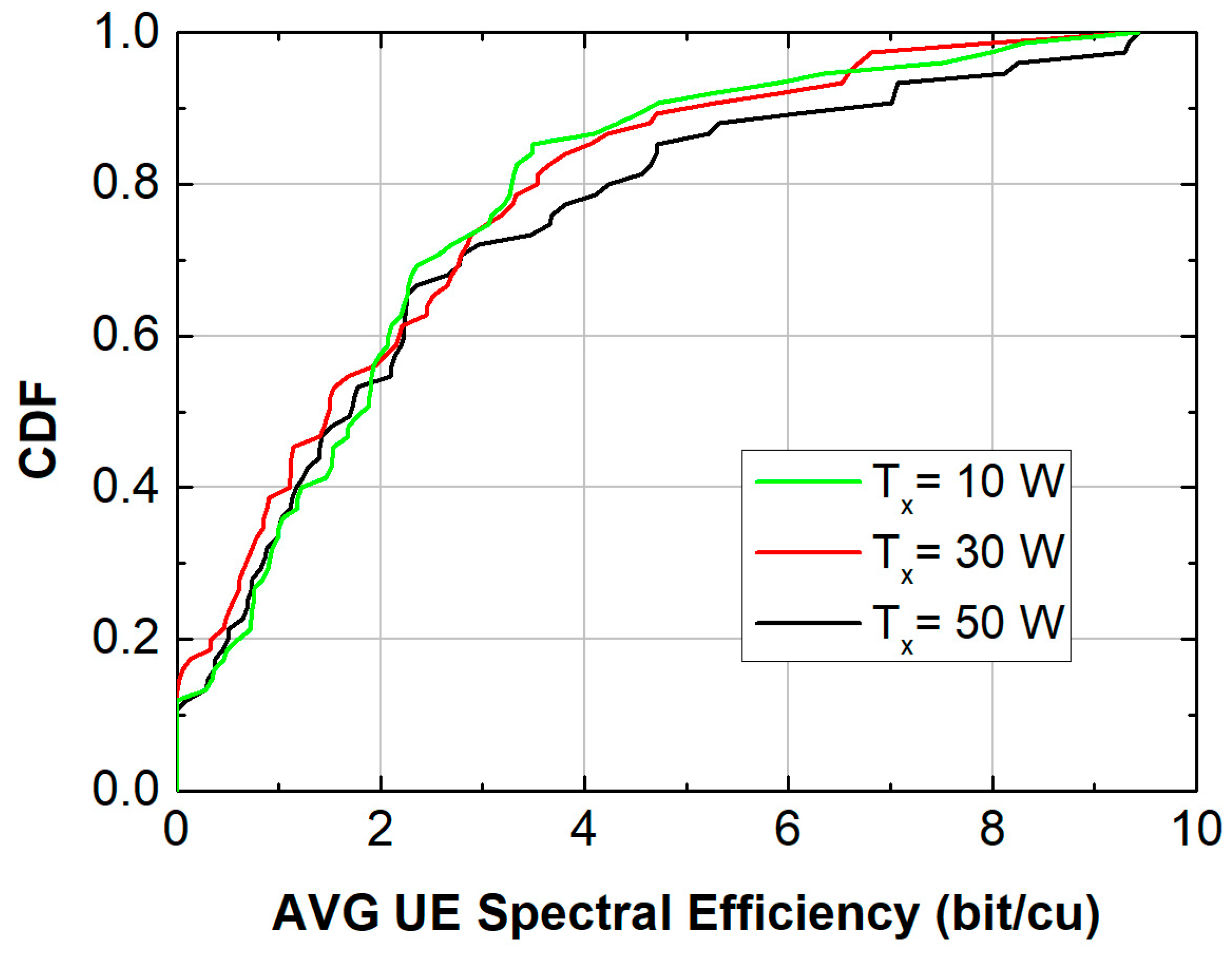
In this simulation we examined the impact of transmit power on system performance by evaluating average user throughput and average user spectral efficiency (Figure 1 and Figure 2). As expected, increasing the transmit power of the antenna generally improves the received signal strength, which can enhance SNR, reduce bit error rates (BER) and enable higher-order modulation schemes, leading to higher user throughput [4,25,28]. Although the 50 W transmit power achieves the highest average user throughput and 30 W the lowest, the differences between configurations remain relatively modest (Figure 1). In multi-user MIMO systems, this behavior can be explained by several factors. First, interference-limited behavior: as transmit power increases, the desired signal improves, but interference also increases, partially offsetting throughput gains [24]. Second, scheduler adaptation: modern schedulers allocate resources based on channel conditions, so higher power may not proportionally increase data rates if some links are already strong [16,25]. Third, saturation of modulation schemes: once the SNR is sufficient for the highest modulation order, further power increases do not yield proportional throughput gains [25,28]. Finally, channel asymmetry: users at different locations (indoor vs. outdoor, near vs. far from the antenna) experience diverse channel gains, so increasing power benefits some users more than others, leading to modest changes in average throughput across all users [16,23]. Thus, even though 50 W achieves the best average throughput, the limited differences across 10 W, 30 W, and 50 W are a natural outcome of interference, scheduling, and channel conditions in a multi-user mMIMO environment.
  • Simulation 2: Increasing Frequency
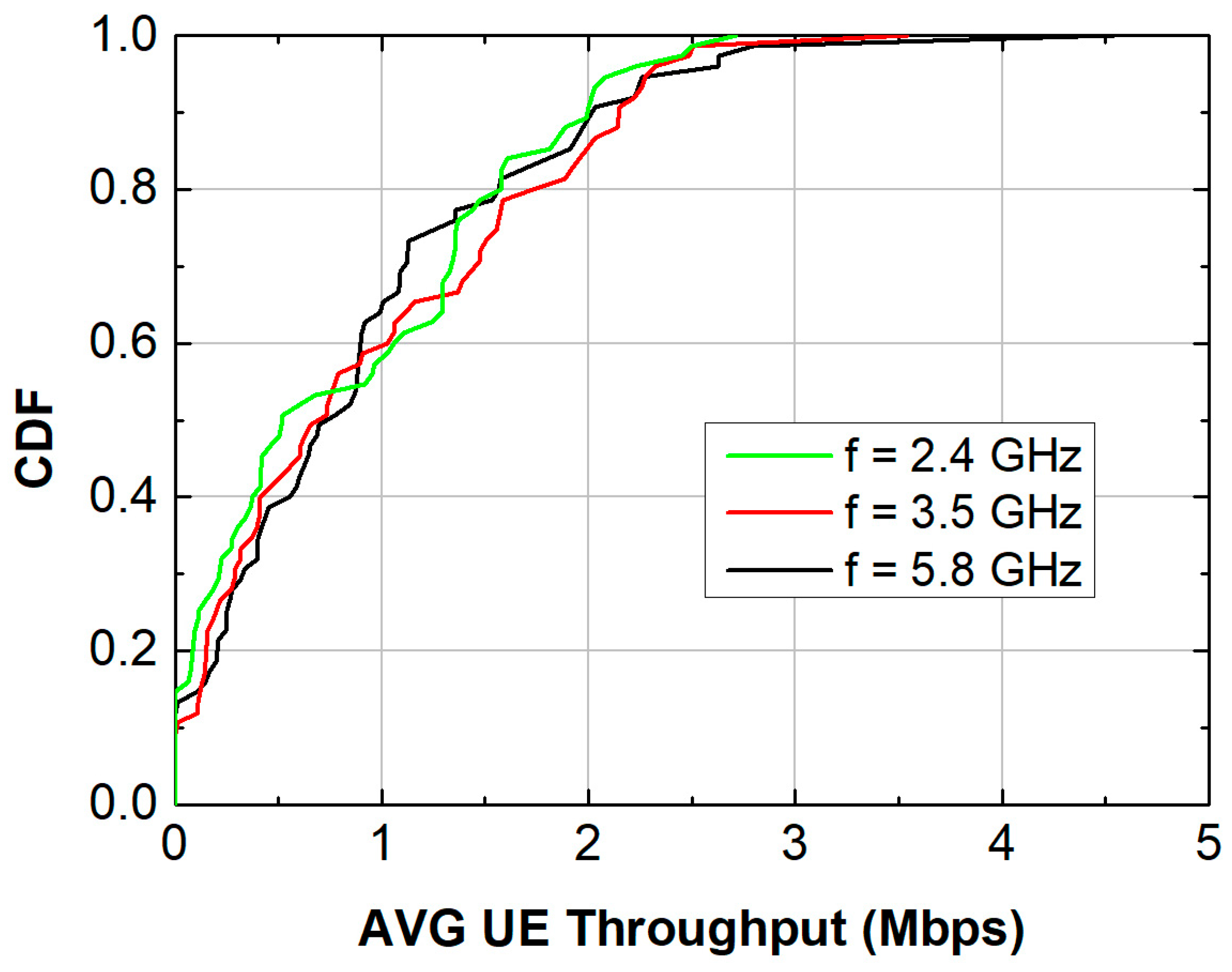
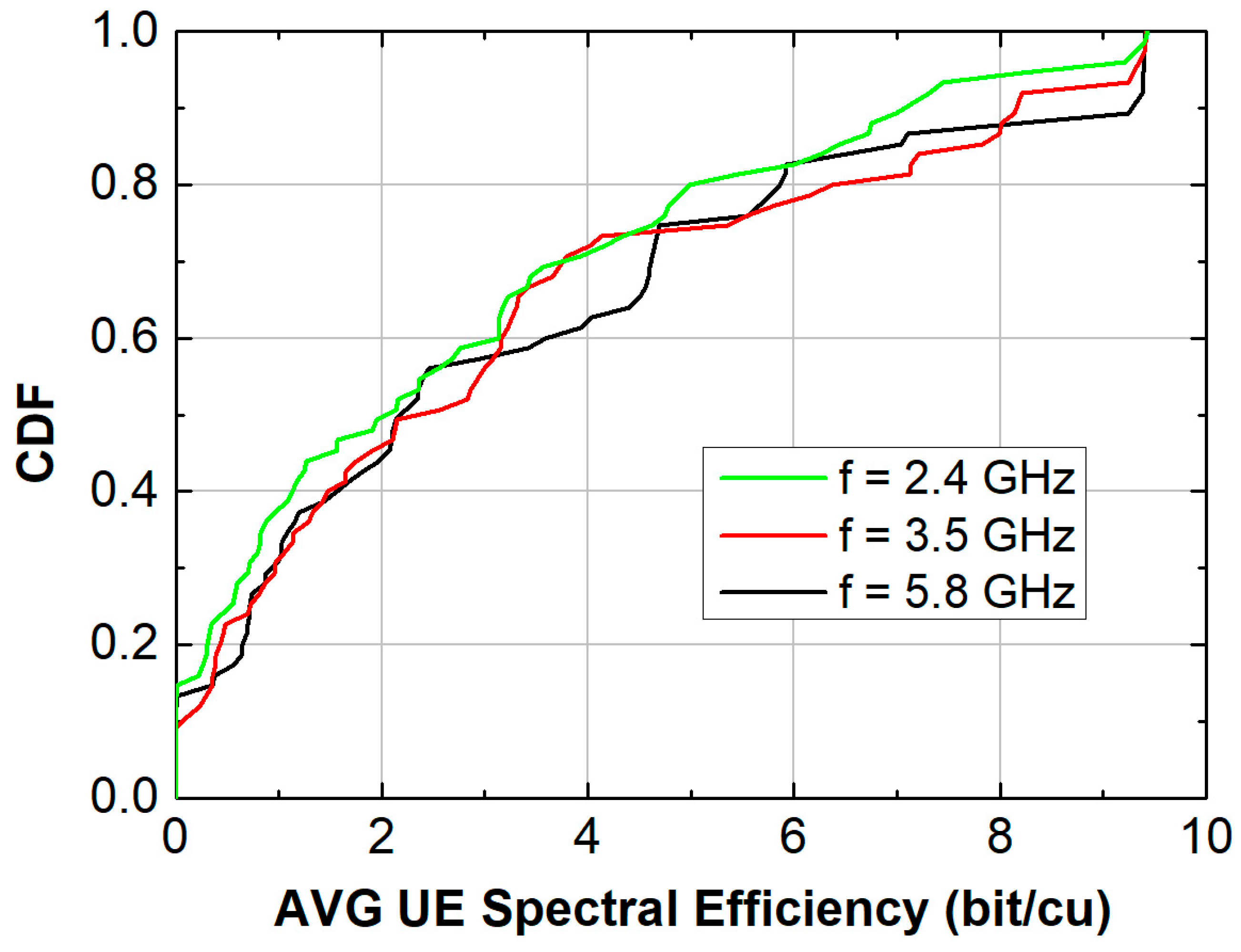
Increasing the carrier frequency alters wireless channel characteristics and allows wider bandwidths, supporting higher data rates and improved spectral efficiency [4,5,7]. In our simulations (Table 3), average cell throughput rises from 21.34 Mb/s at 2.4 GHz to 33.30 Mb/s at 5.8 GHz and average user spectral efficiency increases from 2.86 bit/cu to 3.34 bit/cu. However, these gains are limited by several factors [7,16,18]. Urban multipath saturation means that dense microcell environments already provide multiple spatial paths at lower frequencies, limiting additional gains. Shorter wavelengths permit denser MIMO arrays, but our 4 × 2 configuration and antenna coupling restrict performance improvements (Figure 3 and Figure 4). [22]. Moreover, higher frequencies are more susceptible to blockage and reduced diffraction, affecting link reliability and spectral efficiency [7,18]. Thus, while higher frequencies yield measurable throughput and spectral efficiency improvements, these are not proportional to the frequency increase alone.
Although average cell throughput increases with frequency (Table 3), average user throughput does not always improve monotonically, as shown in Figure 3. This is because user throughput depends not only on overall cell capacity but also on the distribution of channel quality among users. At higher frequencies, increased path loss, directional propagation, blockage, and channel sparsity create greater variability in received signal strength across users [7,18,22]. Consequently, while some users benefit from higher frequency and wider bandwidth, others—particularly those in less favorable locations—may experience reduced throughput. In other words, higher frequency improves total cell capacity, but asymmetric MIMO configurations, heterogeneous indoor/outdoor user distributions and beamforming limitations cause the average user throughput to deviate from the cell-level trend [16,17,23,28].
  • Simulation 3: Changing K-factor
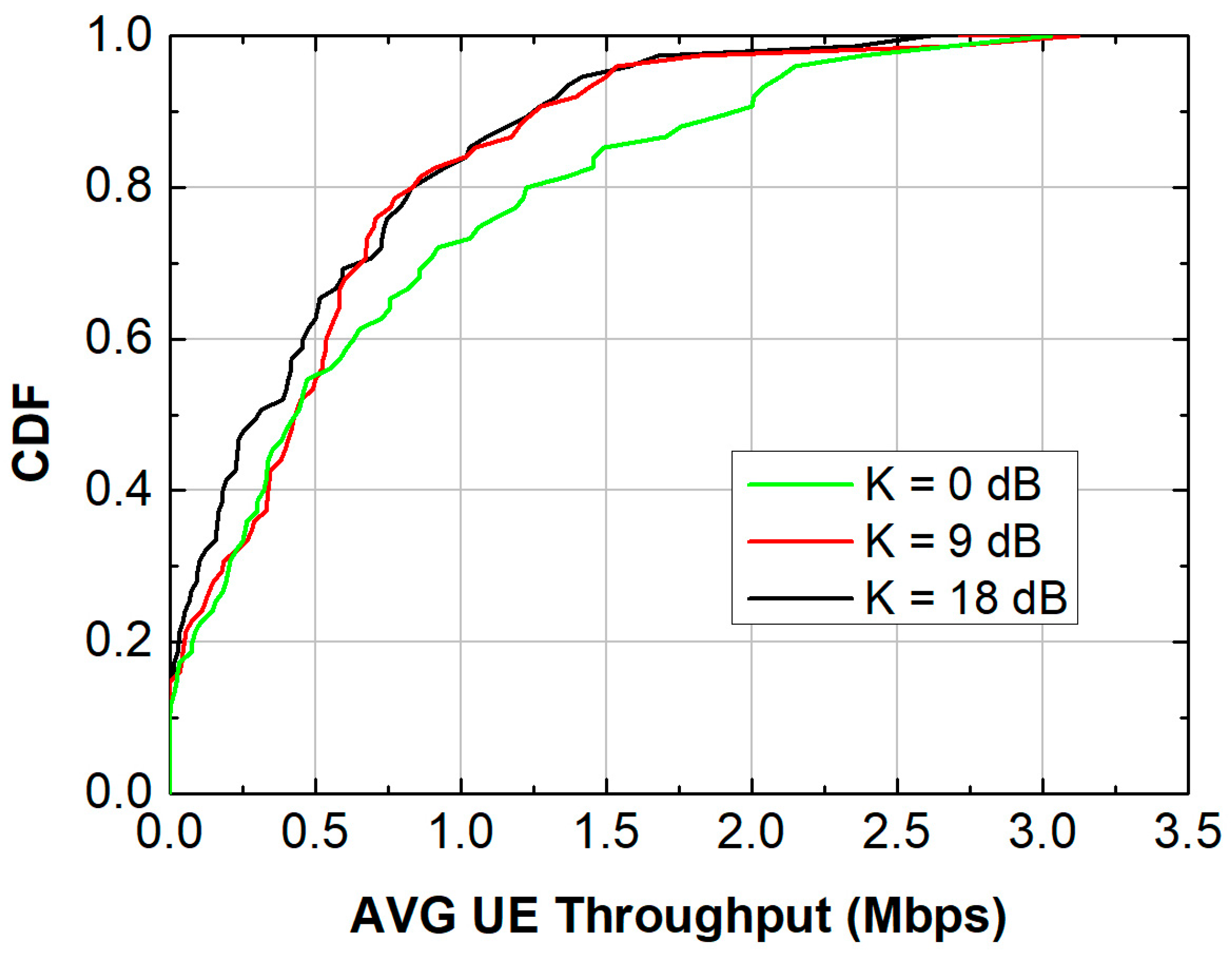
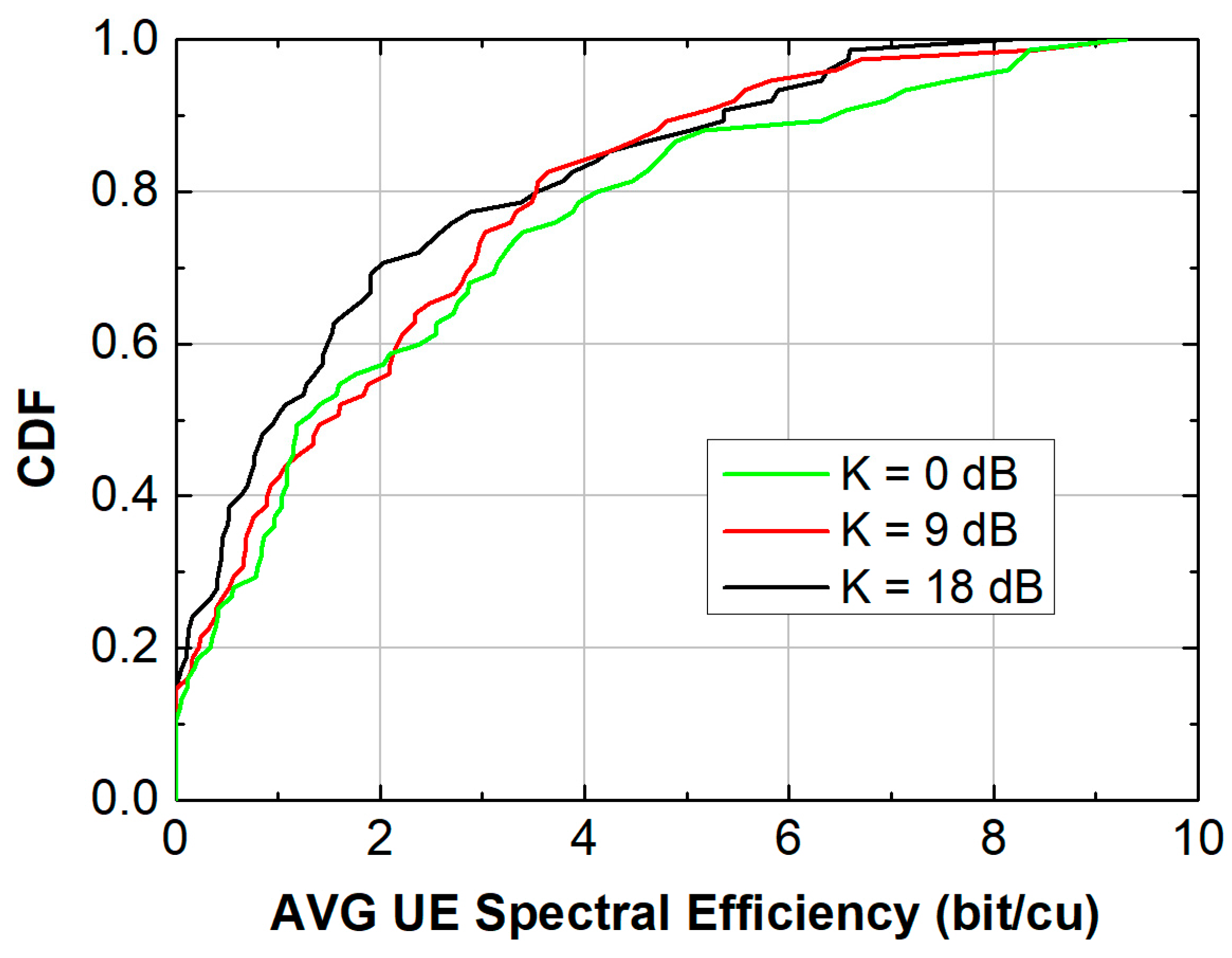
The K-factor characterizes the ratio of power in the dominant line-of-sight (LOS) component to that in the non-line-of-sight (NLOS) multipath components, serving as a key parameter in defining channel conditions [19,20]. A higher K-factor indicates a dominant LOS path, producing a more stable channel with reduced small-scale fading, whereas a lower K-factor reflects weaker LOS conditions and stronger multipath scattering, resulting in more pronounced signal fluctuations [21,22]. In multi-user MIMO systems, the K-factor has a direct impact on link reliability, effective channel rank, and spatial multiplexing capability, ultimately influencing throughput and spectral efficiency.
Typical K-factor values vary with the propagation environment: low in dense urban NLOS scenarios, moderate in suburban or urban LOS conditions, and high in open rural or free-space settings [19,23]. Our simulation results (Table 4, Figure 5 and Figure 6) align with these established trends. At low K values (0–5 dB), rich multipath propagation promotes low channel correlation and full utilization of available spatial streams, yielding high throughput. For moderate K values (~10 dB), the stronger LOS component slightly increases channel correlation, causing a modest reduction in throughput while maintaining stable link performance. At very high K values (>20 dB), the channel approaches rank-1 behavior, limiting spatial multiplexing gains and decreasing overall throughput, consistent with previous observations in both LTE and mmWave MIMO systems [24,25]. This analysis highlights the critical role of the K-factor in determining the balance between channel stability and spatial multiplexing potential.
Part 2: Model Analysis. In the second part, we investigate the behavior of our model, varying simultaneously multiple characteristics.
  • Simulation 4: Changing Power Transmission and Antenna Polarization
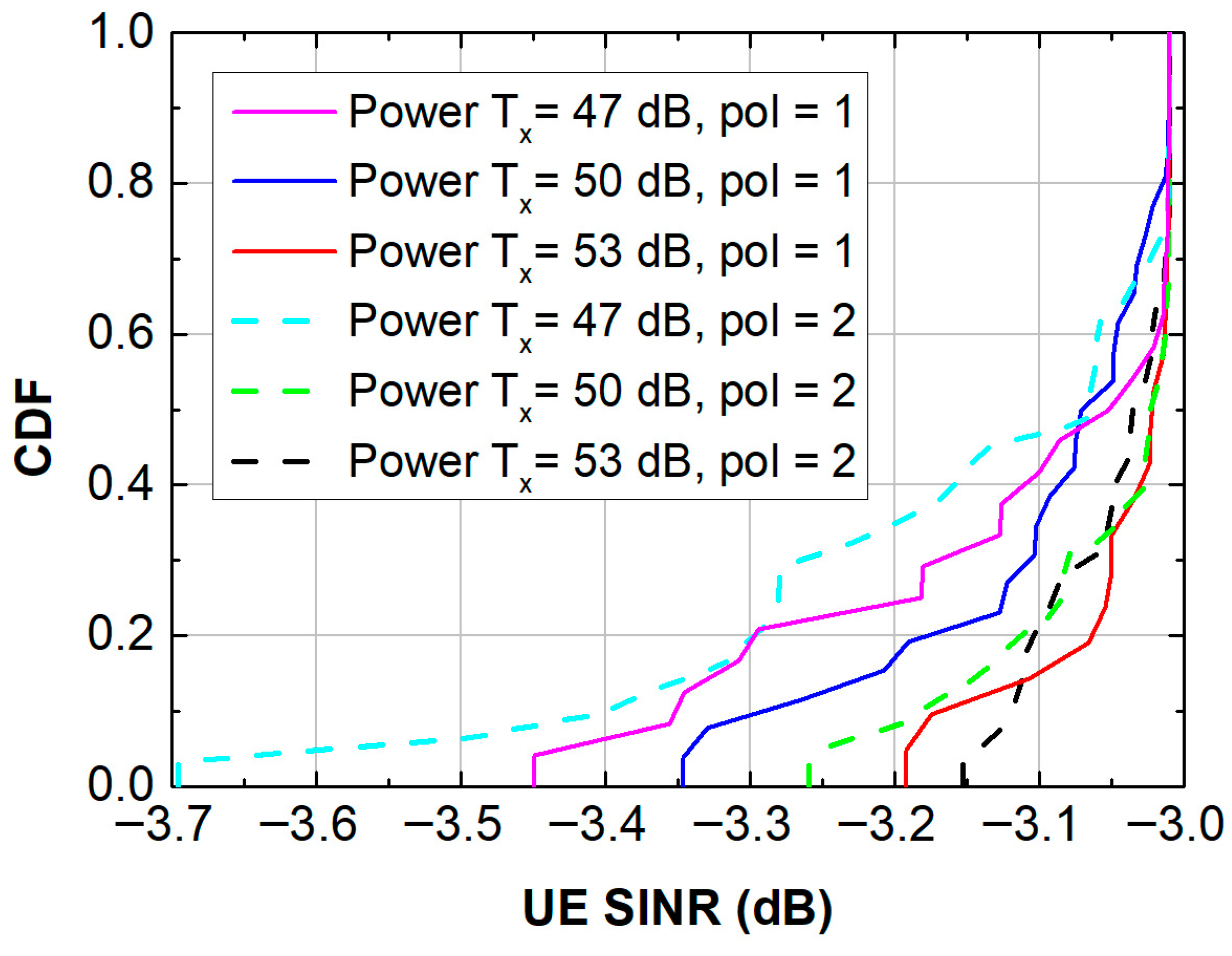
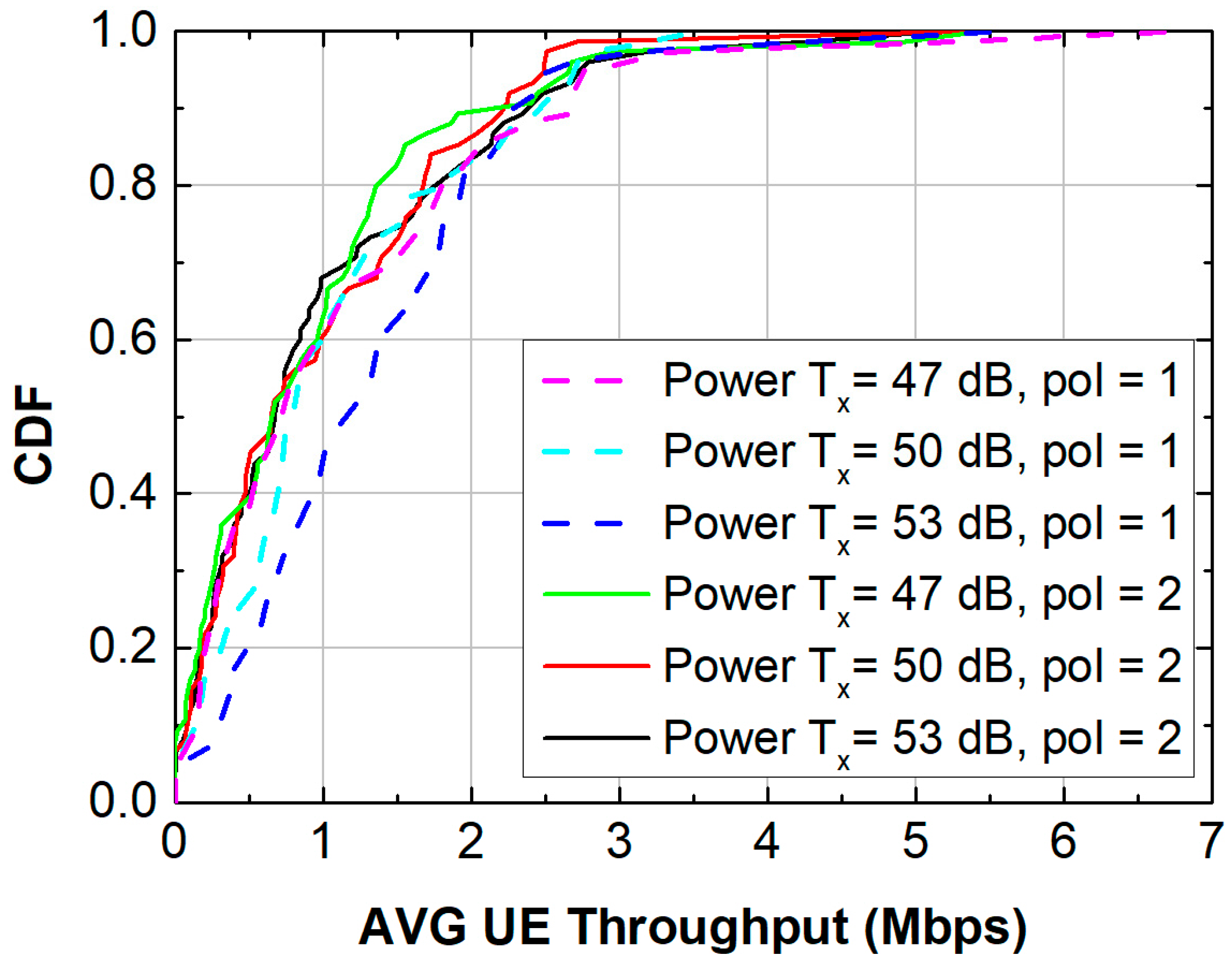
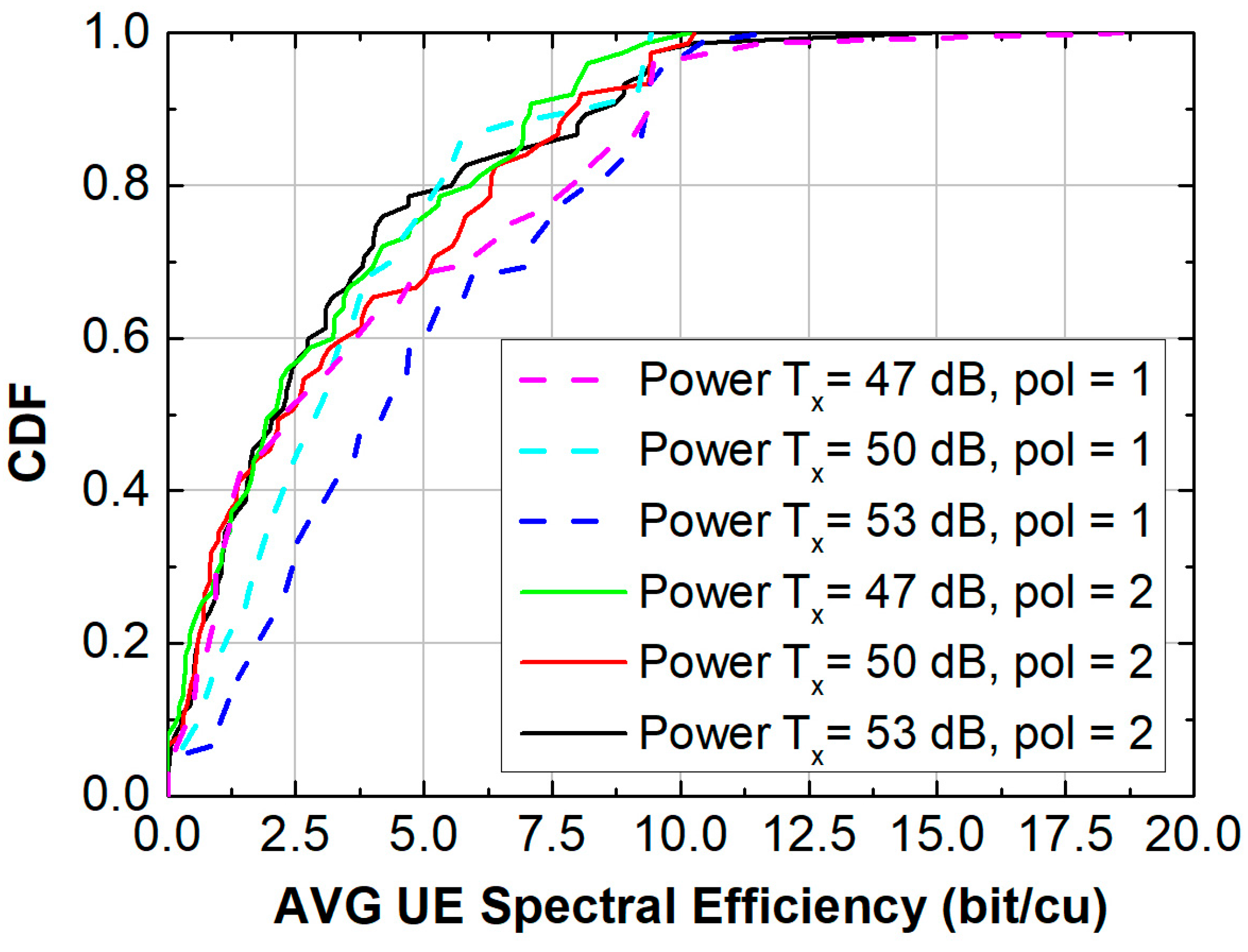
At this stage of the simulation (Table 5), higher values of the transmitted power were selected, corresponding to more powerful antenna. The expected outcome was that increasing the transmitted power would improve the performance metrics of the communication channel—which is indeed observed—while changing the polarization should have produced a similar improvement, which, however, was not the case (Figure 7, Figure 8 and Figure 9). This performance improvement is occurred, since a dual-polarized antenna can transmit in two orthogonal polarization directions simultaneously, effectively creating two independent channels over the same physical medium. However, this holds true only when there is no significant correlation between the channels or when the transmission and reception angles are perfectly aligned. It becomes evident from the above discussion and the associated diagrams that changes in antenna polarization also influence channel asymmetry, as the unequal distribution of energy across different spatial directions affects the channel characteristics. In particular, for high-frequency antenna systems, the physical placement, alignment, and polarization of the antennas play a crucial role in determining and shaping the asymmetry of the resulting wireless channels [20].
  • Simulation 5: Changing Antenna Elements and Polarization
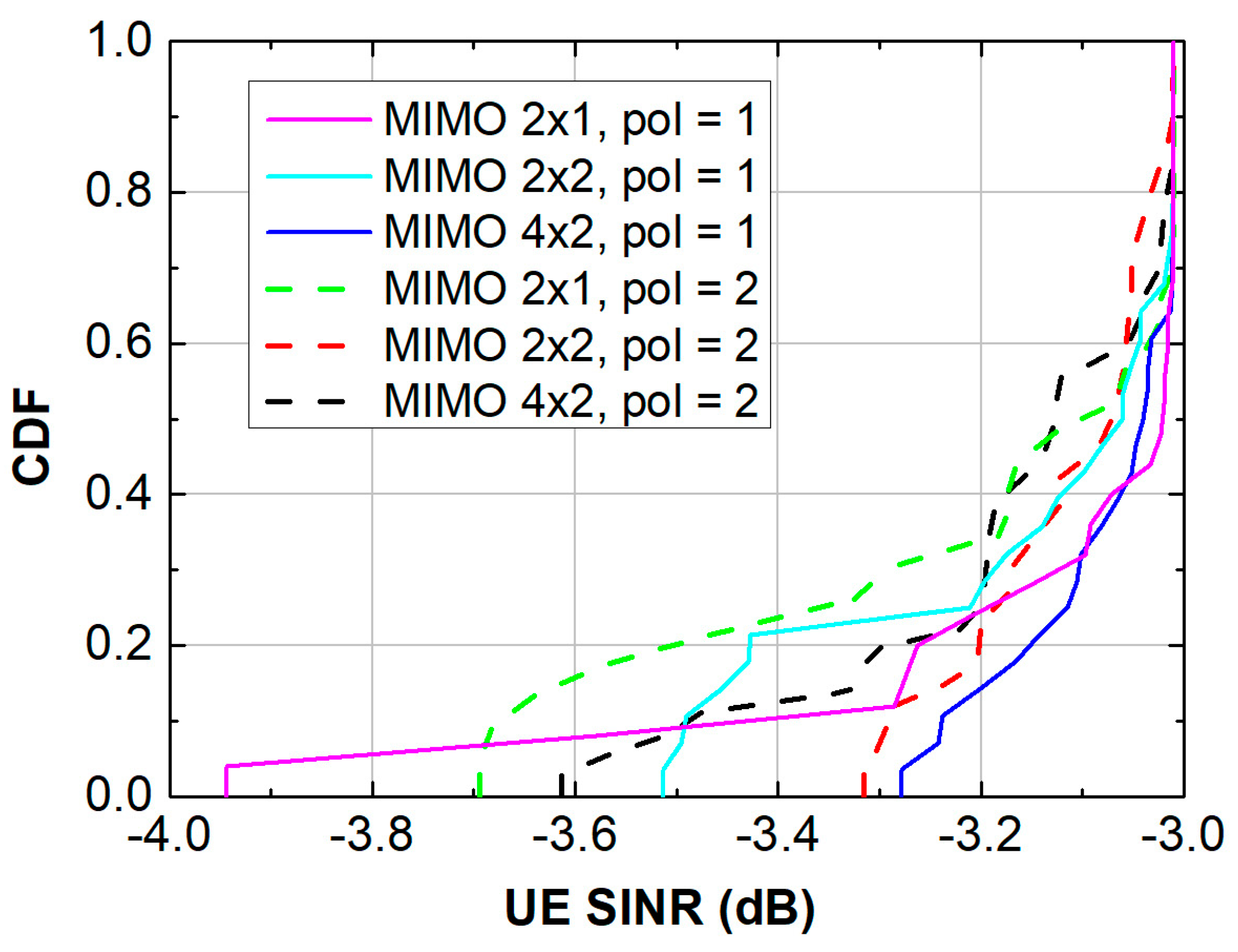
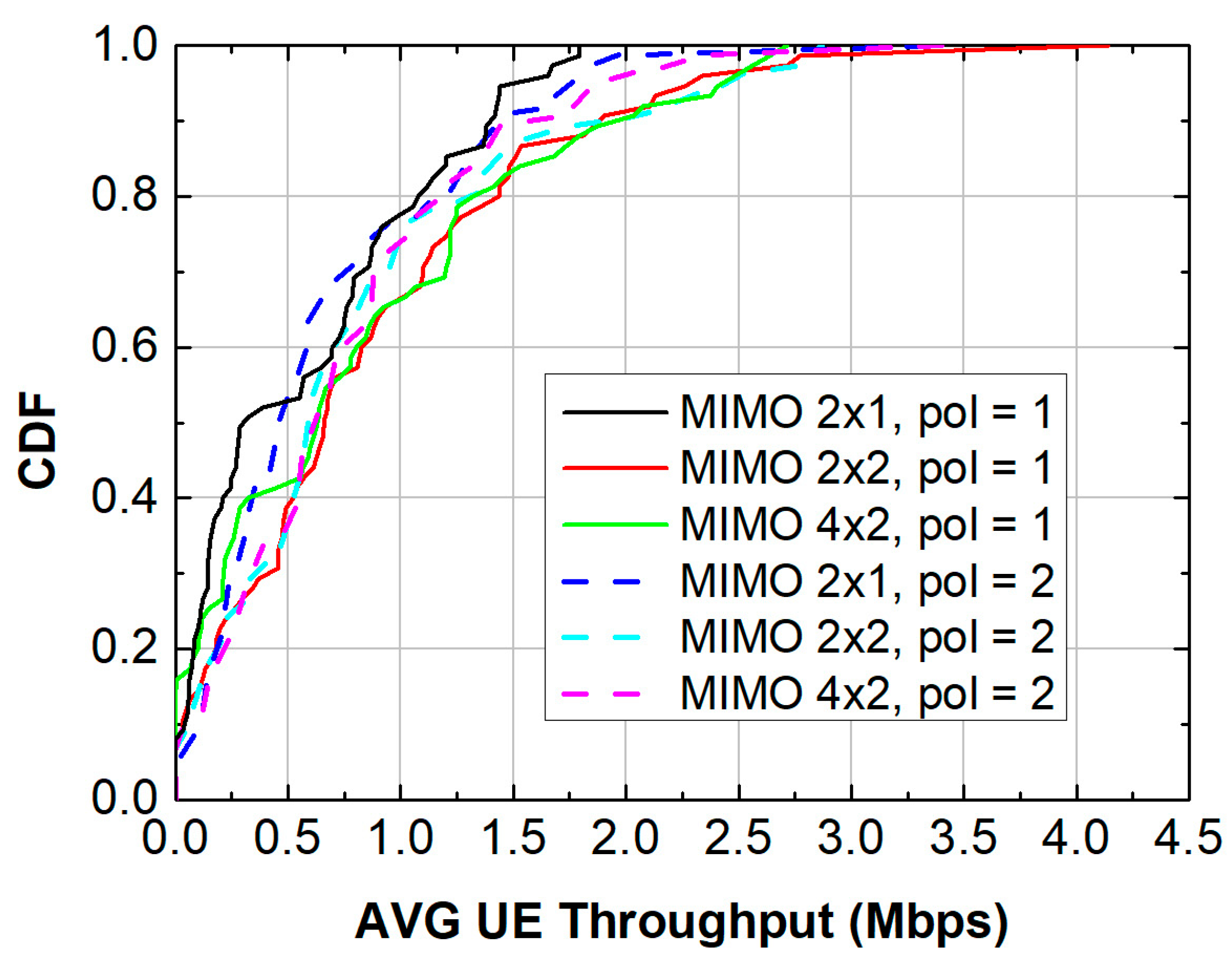
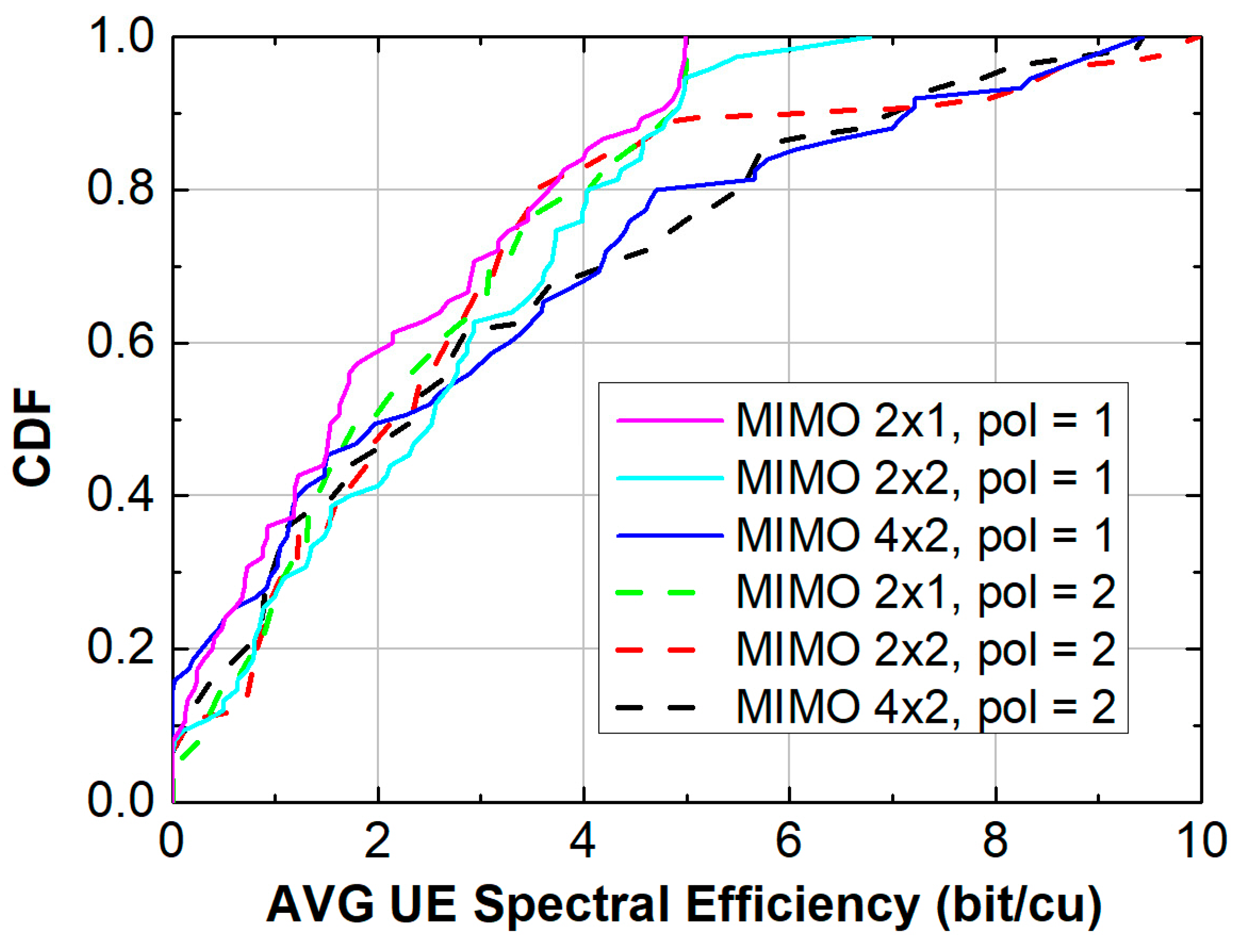
What is occurred in this simulation is that performance improves with more antenna elements (Table 6). Spectral efficiency increases due to the ability to support a greater number of spatial streams. In the context of multi-user MIMO (MU-MIMO), the system can serve more users simultaneously, leading to a rise in user throughput [21]. Similarly, the change in antenna polarization yielded the expected results, as the introduction of dual polarization enabled polarization multiplexing, thereby unlocking additional degrees of freedom in the channel. Moreover, the use of dual-polarized elements improves channel symmetry between polarization branches by reducing systematic imbalance, which leads to more consistent channel conditions and further enhances the reliability of spatial multiplexing. This contributed significantly to improvements in both system capacity and spectral efficiency (it must be considered that in contrast to the previous simulation the value of XPR has changed to a higher value—12 dB).
Specifically, Figure 10 demonstrates that increasing the number of antenna elements enhances average cell throughput by enabling more spatial streams. Figure 11 shows that spectral efficiency improves (with the number of antennas and the adoption of dual polarization), reflecting the additional degrees of freedom and improved channel symmetry. Figure 12 emphasizes that dual-polarized configurations reduce systematic imbalances between polarization branches, resulting in more uniform channel conditions and greater reliability in multi-user MIMO transmissions.
Moreover, in dense urban microcell scenarios, multipath richness and building-induced asymmetries may cause single-polarized systems to experience uneven channel conditions across users [7,19]. Dual-polarized configurations, however, leverage polarization diversity to mitigate such asymmetries, providing more uniform signal quality and improving reliability for both indoor and outdoor users [20,22]. This effect is particularly evident when users are distributed across varying locations relative to the base station or experience different LOS/NLOS conditions, as dual polarization reduces the sensitivity of the system to localized channel imbalances. Consequently, dual-polarized MIMO configurations offer a clear advantage in maintaining consistent spectral efficiency and throughput in heterogeneous urban deployments, highlighting their practical relevance beyond theoretical gains [21].
  • Simulation 6: Adding Velocity to users and changing the indoor fraction
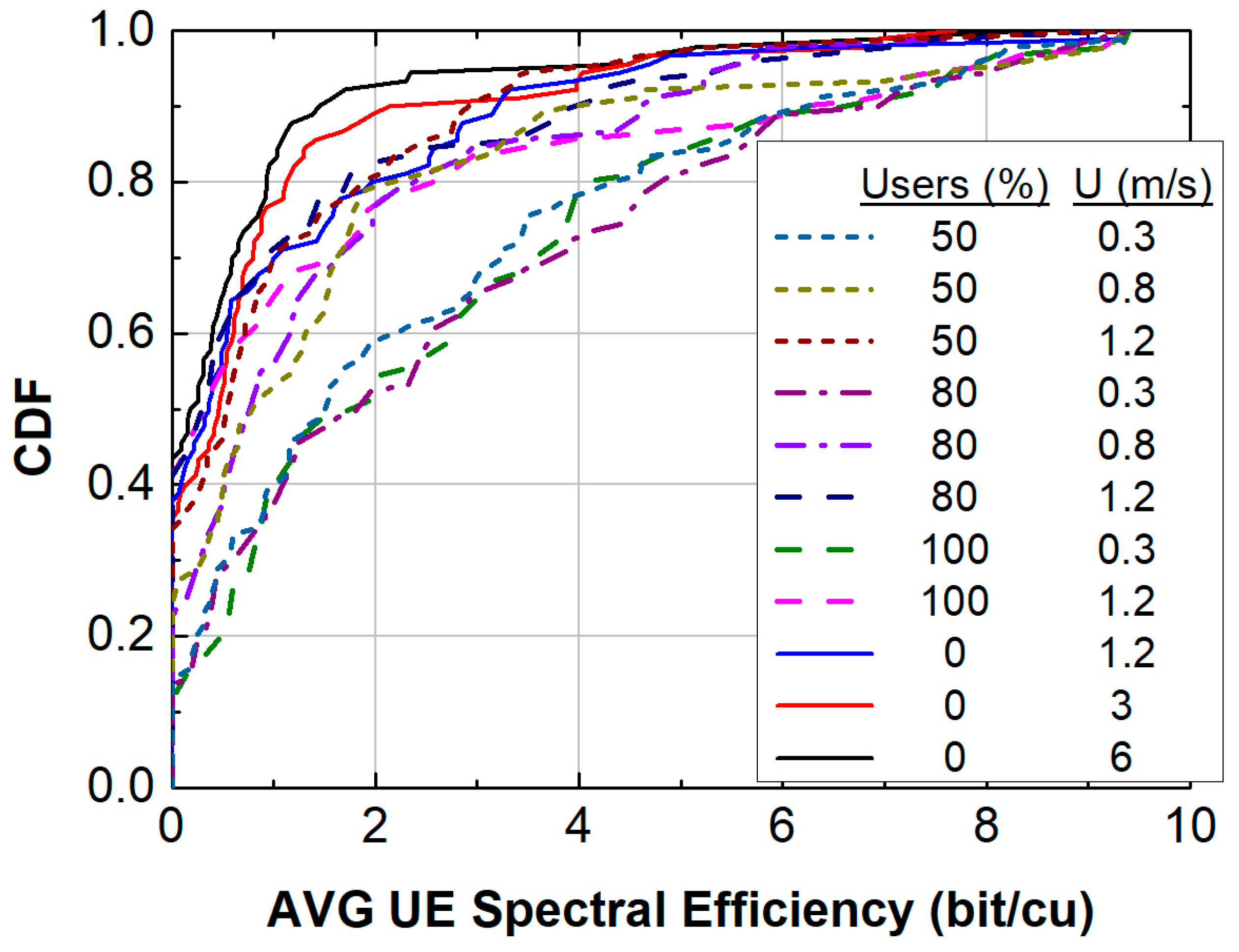
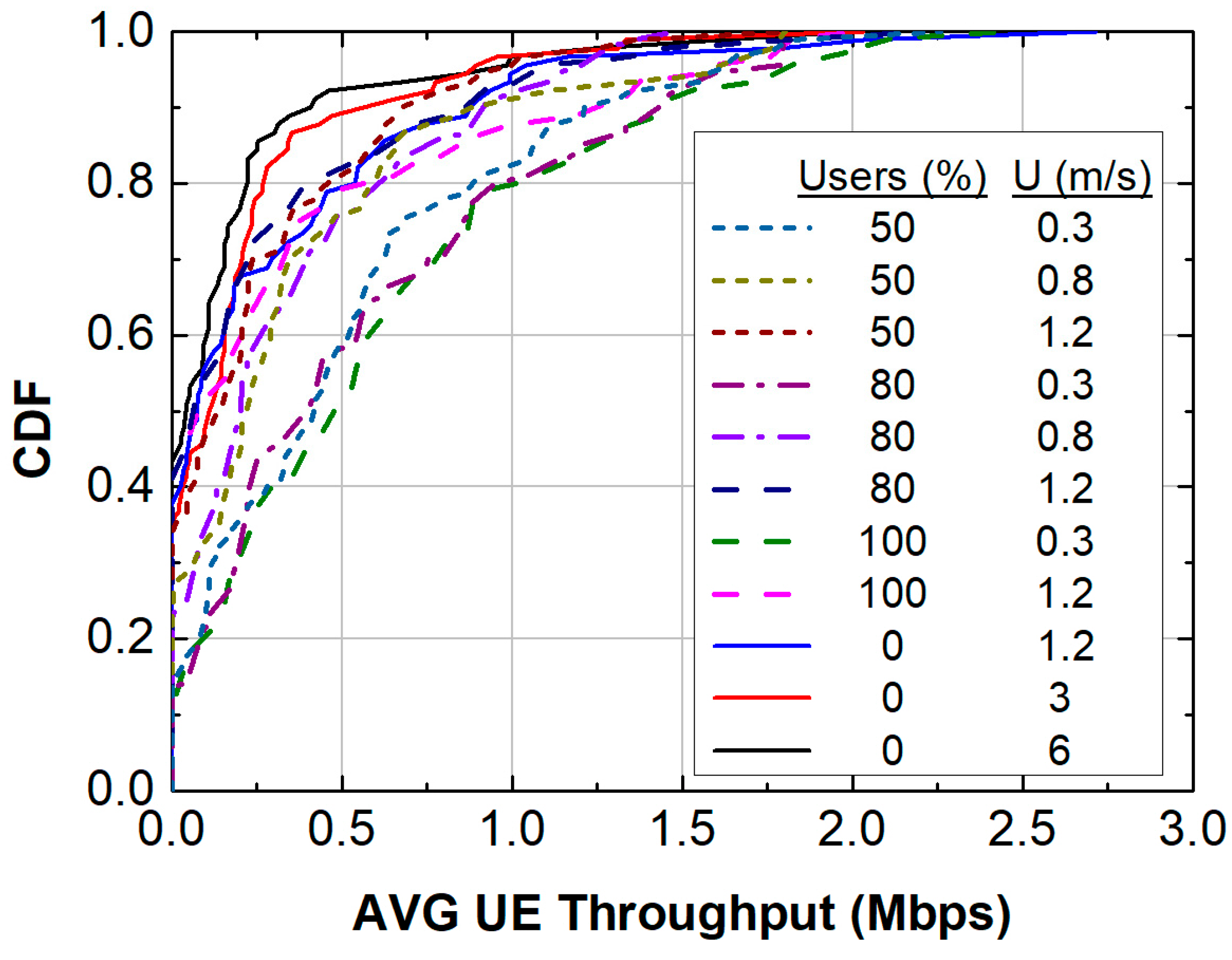
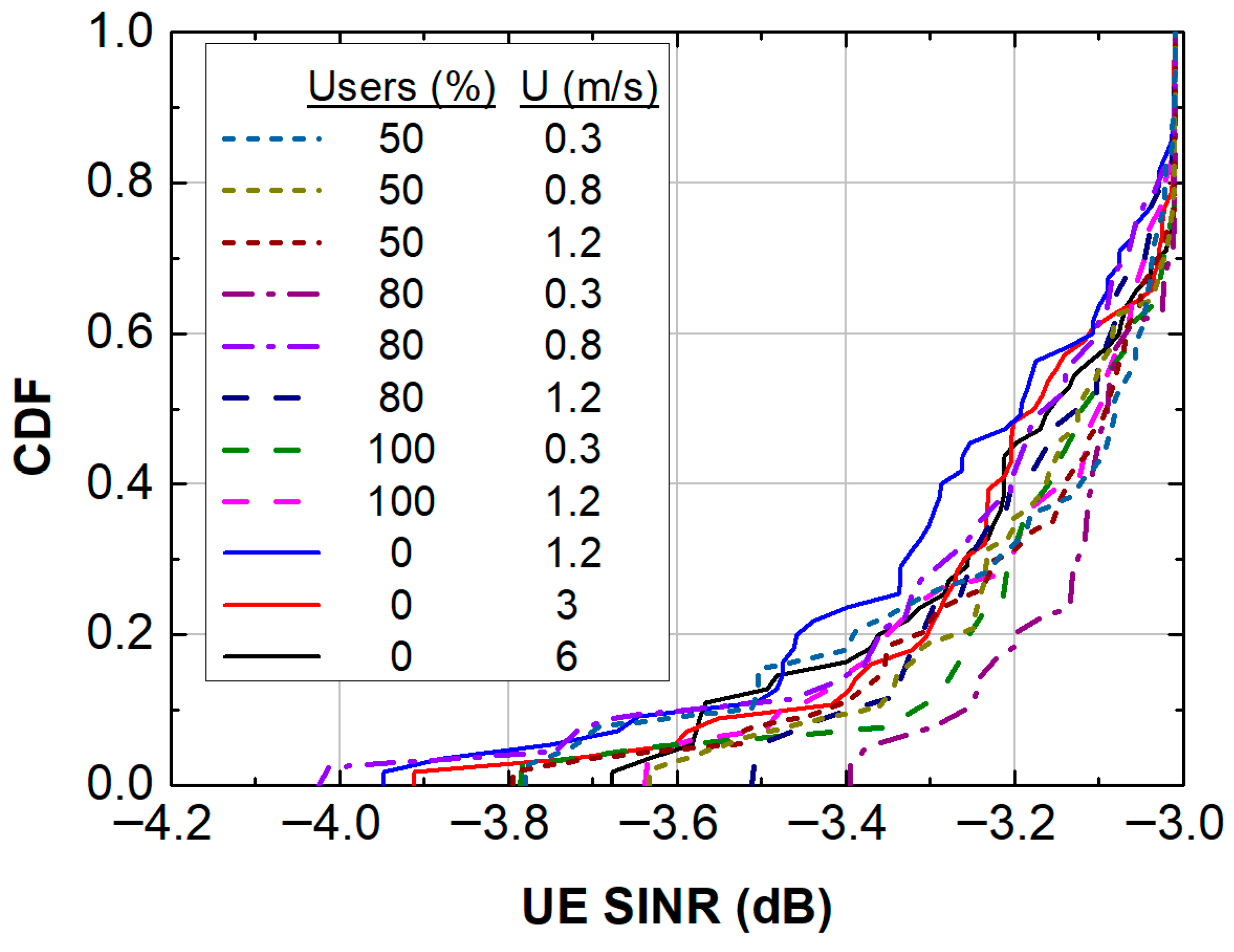
In this category of simulations, we aimed to vary user speeds in order to approximate realistic urban-environment conditions. Since users are divided into indoor and outdoor groups, we adopted three representative mobility classes—quasi-stationary, slow-moving, and normal walking speed. These categories capture realistic mobility behavior for both indoor and outdoor scenarios. Furthermore, we adjusted the proportion of users within each mobility class to investigate the impact of mobility distribution on the performance of our model.
More specifically, we considered three indicative user speeds that represent typical mobility patterns for both indoor and outdoor scenarios. 0.3 m/s (1.1 km/h) corresponds to very slow movement, often observed in indoor or stationary contexts; 0.8 m/s (3 km/h) reflects moderate indoor mobility, such as walking within or not a building; and 1.2 m/s (4 km/h) approximates the speed of a pedestrian in outdoor environments (Table 7). These mobility profiles are examined under varying indoor-to-outdoor user ratios to assess their combined impact on system performance.
In the second phase of the study, we focus exclusively on outdoor users to evaluate performance under mobility patterns representative of pedestrian movement and vehicular transit in urban environments (Table 7).
We observe that as user speed increases, overall system performance degrades, which is an expected outcome (Figure 13, Figure 14 and Figure 15). Higher mobility induces more rapid variations in the wireless channel, such as a reduced coherence time, leading to more frequent link failures and increased retransmissions. Consequently, spectral efficiency decreases (Figure 14), particularly in microwave links where Doppler effects are more pronounced. Additionally, expected user throughput is reduced due to the inefficient utilization of time-frequency resources, which further negatively impacts the Signal-to-Interference-plus-Noise Ratio (SINR) (Figure 15). Interestingly, for a fixed user speed, increasing the user density—in this low penetration environment—does not appear to dominantly affect the system’s nominal performance [23].
In the following scenario, where all users are located in an outdoor environment, a similar trend is observed (Table 7). The lower nominal values, in comparison with the other simulations, should not be concerning, as this scenario takes place in a street canyon environment. This means that buildings are still present, causing propagation effects and channel variations characteristic of such urban settings [24].
In the next scenario, where only indoor users are present (Table 7), the values are relatively high, primarily due to two factors: first, the indoor speeds are inherently very low, even if they increase; and second, as mentioned from the outset, the model exhibits low penetration characteristic.
All performance curves were plotted together to facilitate a direct comparison. All parameter variations have been plotted on the same diagram (Figure 13, Figure 14 and Figure 15).), allowing the correlations to be clearly observed.
It is being proved that high user mobility and heterogeneous indoor-outdoor distribution significantly influence channel symmetry, thereby impacting overall system performance. Conversely, stationary users experience more uniform and symmetric propagation conditions, highlighting the role of user dynamics in shaping channel behavior.
In order to challenge the initial assumption made in the first part of this simulation—that indoor and outdoor users experience similar mobility speeds in a low-penetration environment—we modify setup to reflect more realistic conditions. Specifically, we consider a high-penetration loss scenario, which is more representative of actual mmWave deployments (Table 8). We will use a different indoor model, which clearly includes several parameter differences compared to the UMi scenario. However, given the proportional relationships, it can be considered to operate comparatively with respect to our previous measurement.
Accordingly, we vary the ratio of indoor to outdoor users as follows (Table 8).
  • Simulation 7: Changing our model to indoor situations
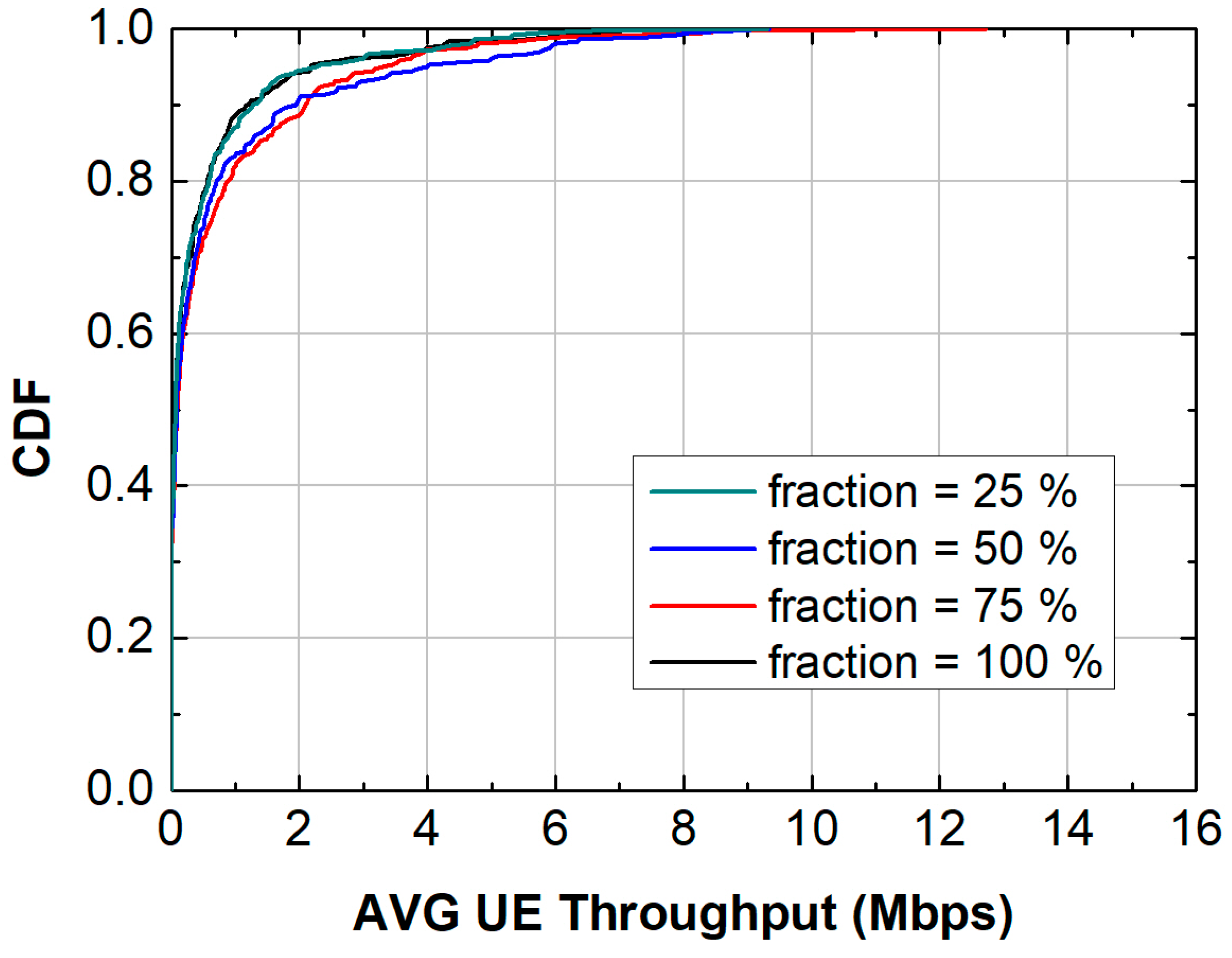
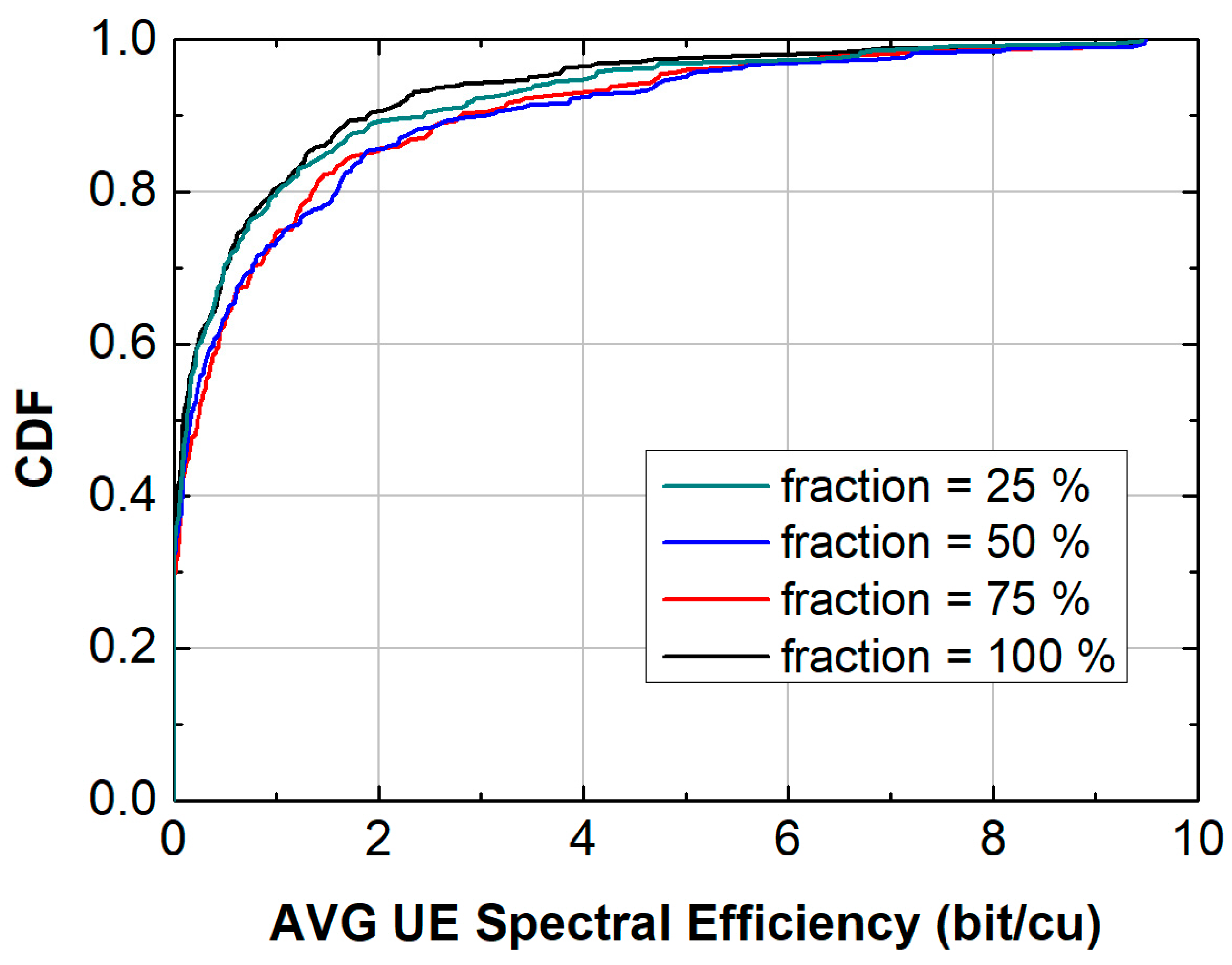
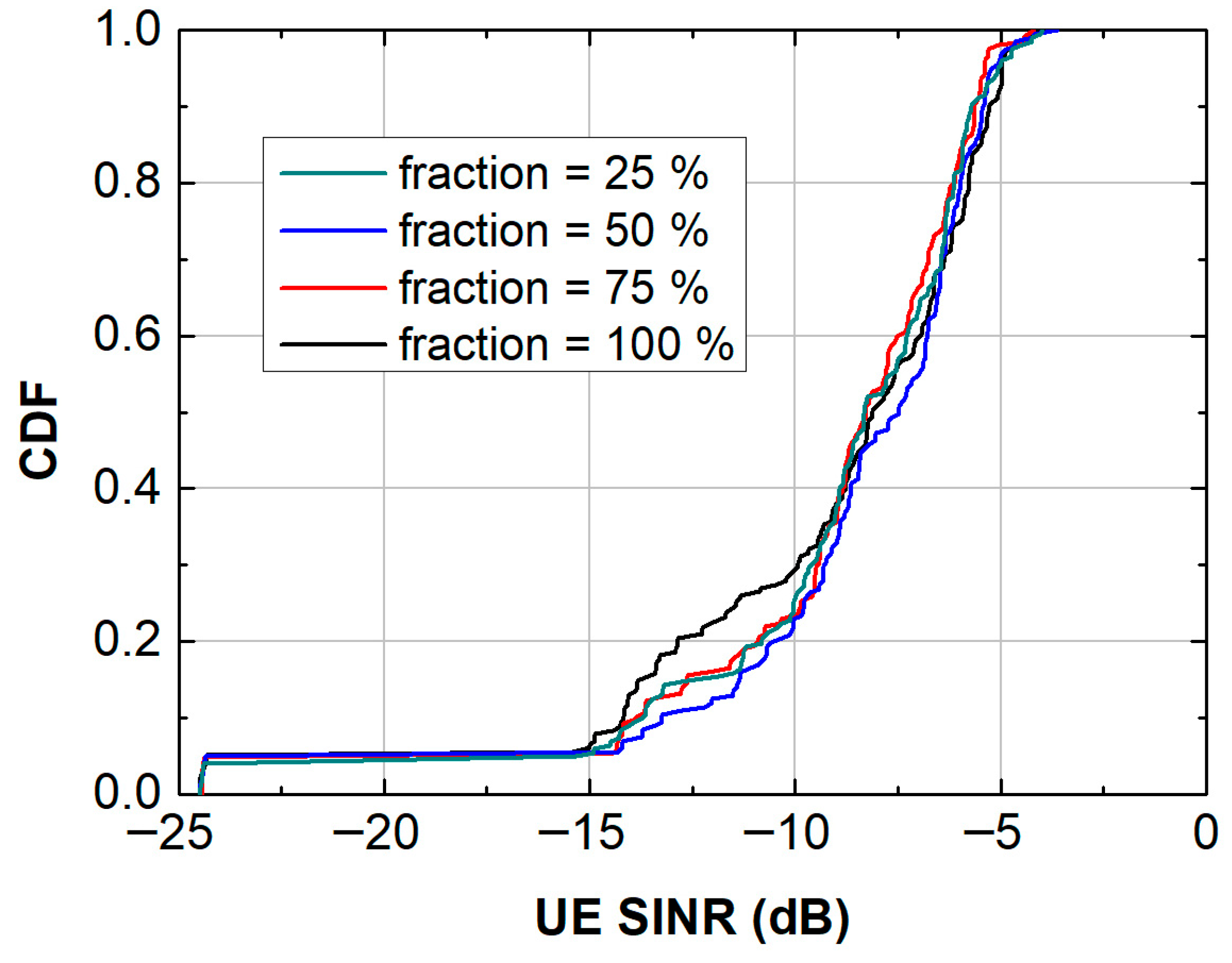
It is evident that as the proportion of indoor users increases, overall system performance tends to degrade. This degradation is inversely related to the rise in inter-user interference, which becomes more pronounced due to the greater number of users within high-penetration environments. Although the presence of beamforming significantly mitigates this effect by focusing transmission energy toward intended users, it does not eliminate the challenge of simultaneously serving a larger number of users. In dense user scenarios, beamforming alone may be insufficient to fully compensate for the increased interference and reduced channel quality experienced by indoor users (Figure 16, Figure 17 and Figure 18) [25]. These findings highlight that indoor geometry and user distribution strongly influence channel symmetry: higher indoor fractions exacerbate asymmetry, leading to non-uniform received power and spectral efficiency across users.
  • Symmetry Measurement Approach
In this study, channel symmetry refers to the uniformity of signal quality and performance metrics across all users in the system. Variations in key indicators, such as UE spectral efficiency or throughput, reflect the degree of asymmetry: higher variability indicates that some users experience much better or worse channel conditions than others, while lower variability corresponds to more uniform and balanced channels. By quantifying these variations using the statistical variance of average UE spectral efficiency, we can provide a simple numerical measure of channel symmetry, complementing our qualitative observations. This approach allows us to link changes in system parameters—such as polarization, antenna configuration, user distribution, and mobility—to their impact on channel uniformity in a straightforward and interpretable manner.
The standard mathematical measure of variation is the variance. Since we are focusing on the variation in average UE spectral efficiency across users or scenarios, the equation is:
  • Variance (σ2) of Average Spectral Efficiency
High variance (σ2) means more asymmetry and large differences in user experience. On the other hand, low variance leads to more symmetric; users experience similar channel conditions [26].
σ 2 = 1 N i = 1 N x i x ¯ 2
where
  • x i = Avg UE spectral efficiency for the i-th user or scenario;
  • x ¯ =   1 N i = 1 N x i is the mean of all values;
  • N = number of users or scenarios considered;
  • σ 2 = variance, which quantifies the spread of values around the mean.
Channel Symmetry Indicator (CSI)
C S I = 1 σ 2 + ϵ
where
  • σ 2 = 1 N i = 1 N x i x ¯ 2 is the variance of average UE spectral efficiency across users or scenarios
  • x i = Avg UE spectral efficiency of the i-th user or scenario;
  • x ¯ =   1 N i = 1 N x i is the mean value;
  • N = number of users or scenarios considered;
  • ϵ = small number (e.g., 1 × 10⁻⁶) to avoid division by zero [27].
Accordingly, higher CSI means lower variance and more symmetric channel (uniform performance across users). While, lower CSI means higher variance and more asymmetric channel (large differences in user performance) (Table 9)
The CSI results confirm the trends observed in our simulations: dual-polarized antennas and increased antenna elements improve channel symmetry, resulting in higher CSI, while higher indoor fractions and increased user mobility reduce symmetry, reflected in lower CSI values. These quantitative results strengthen our discussion on the impact of system parameters on multi-user channel performance.
  • Simulation 8: Increasing Users
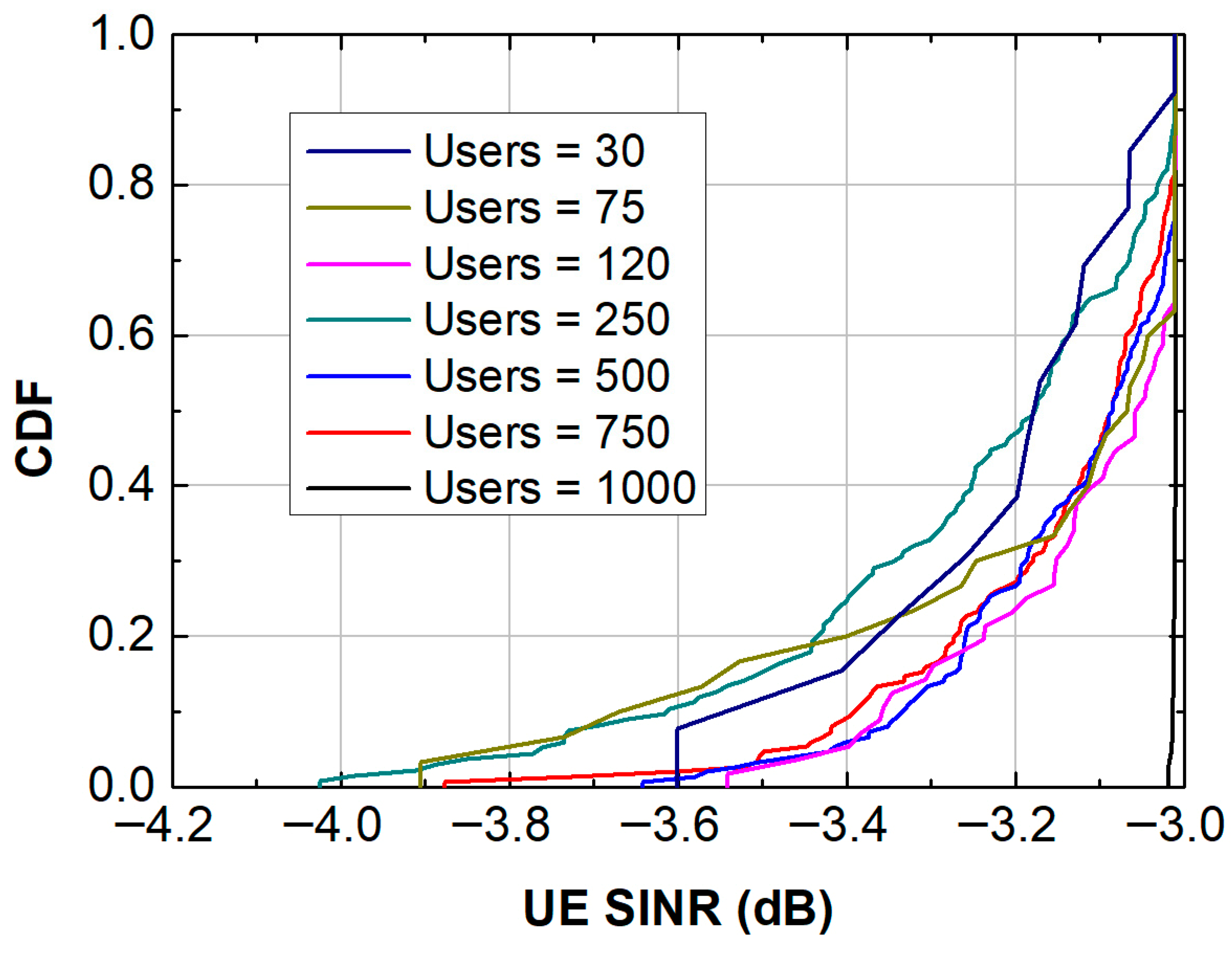
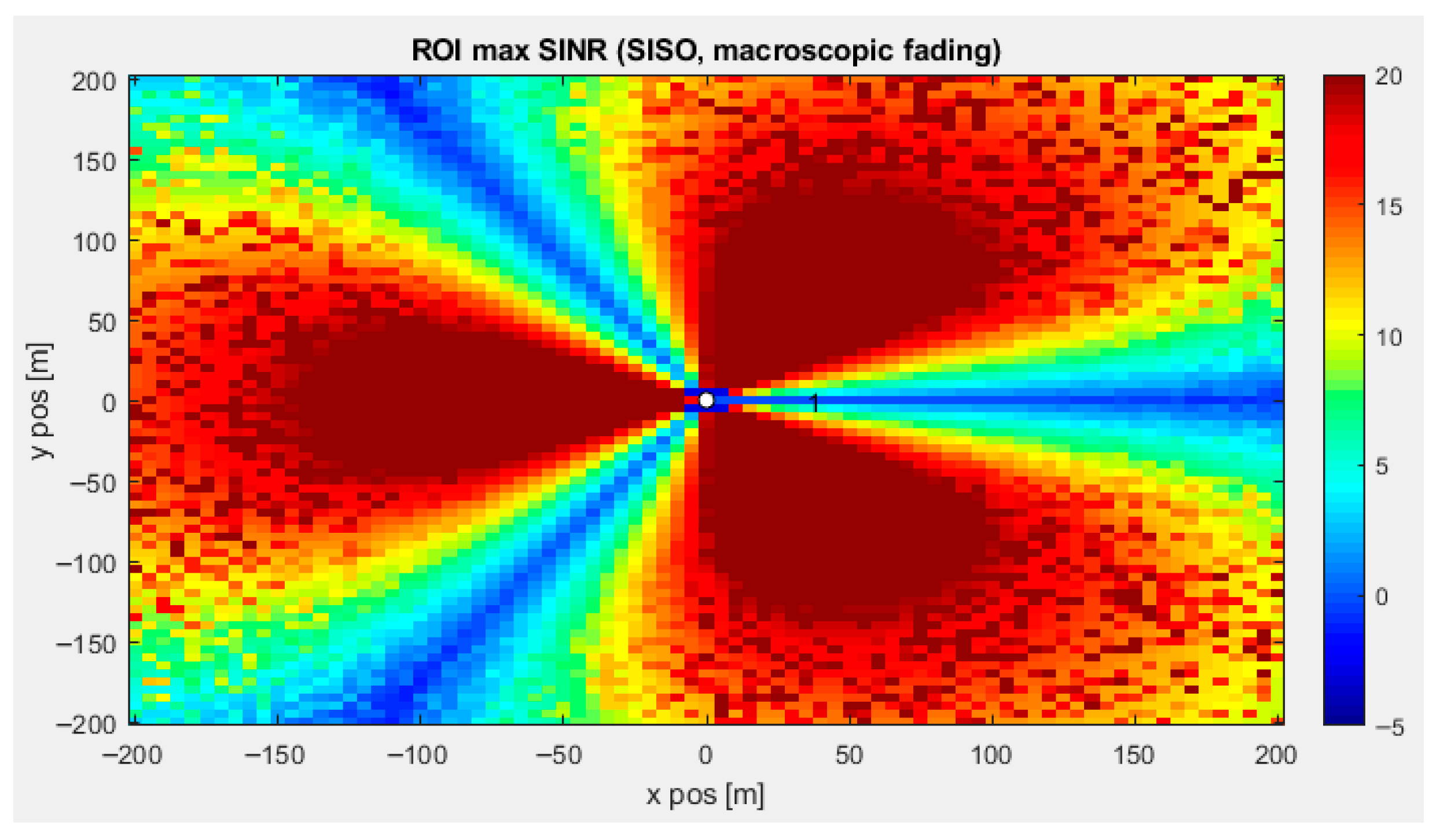
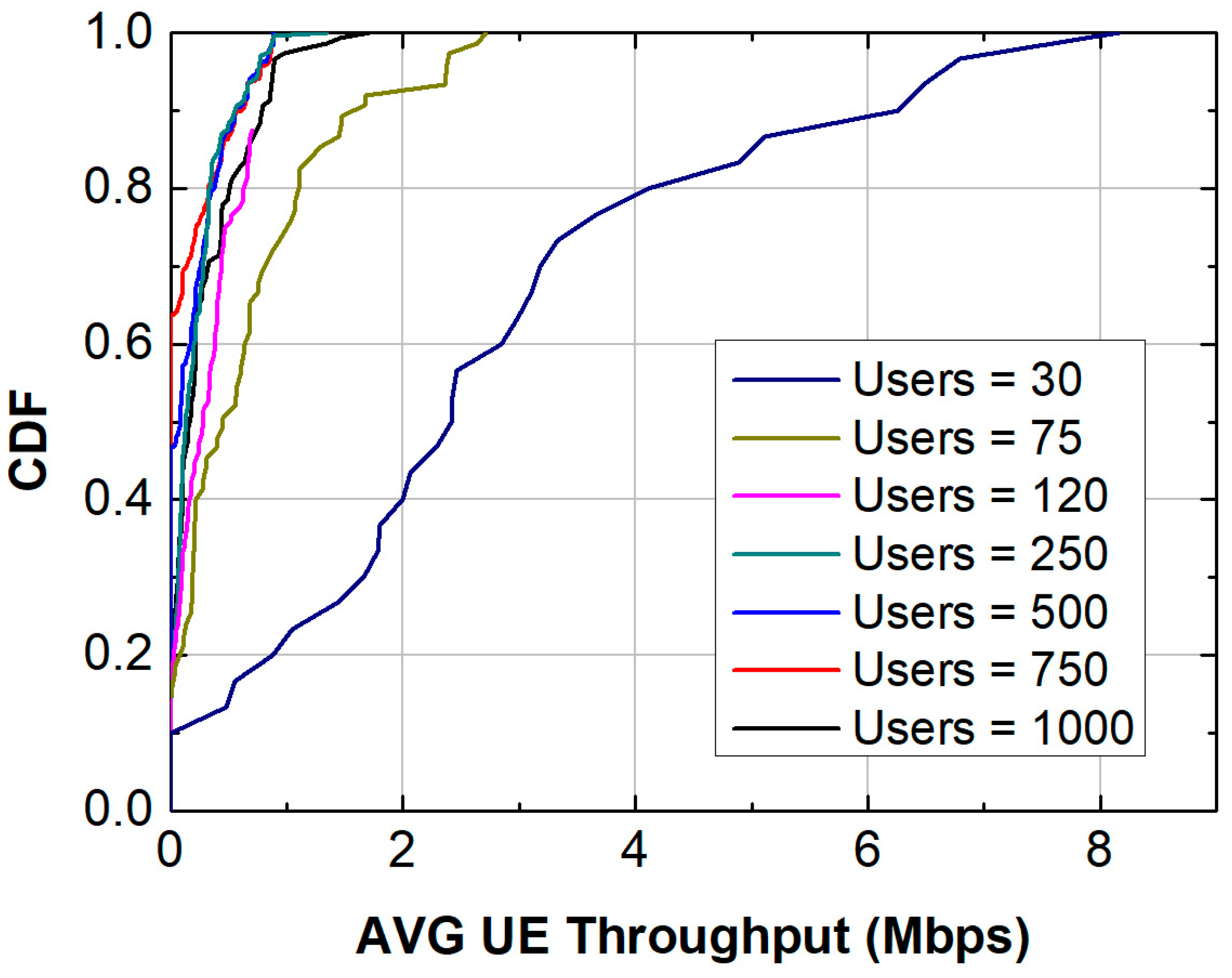
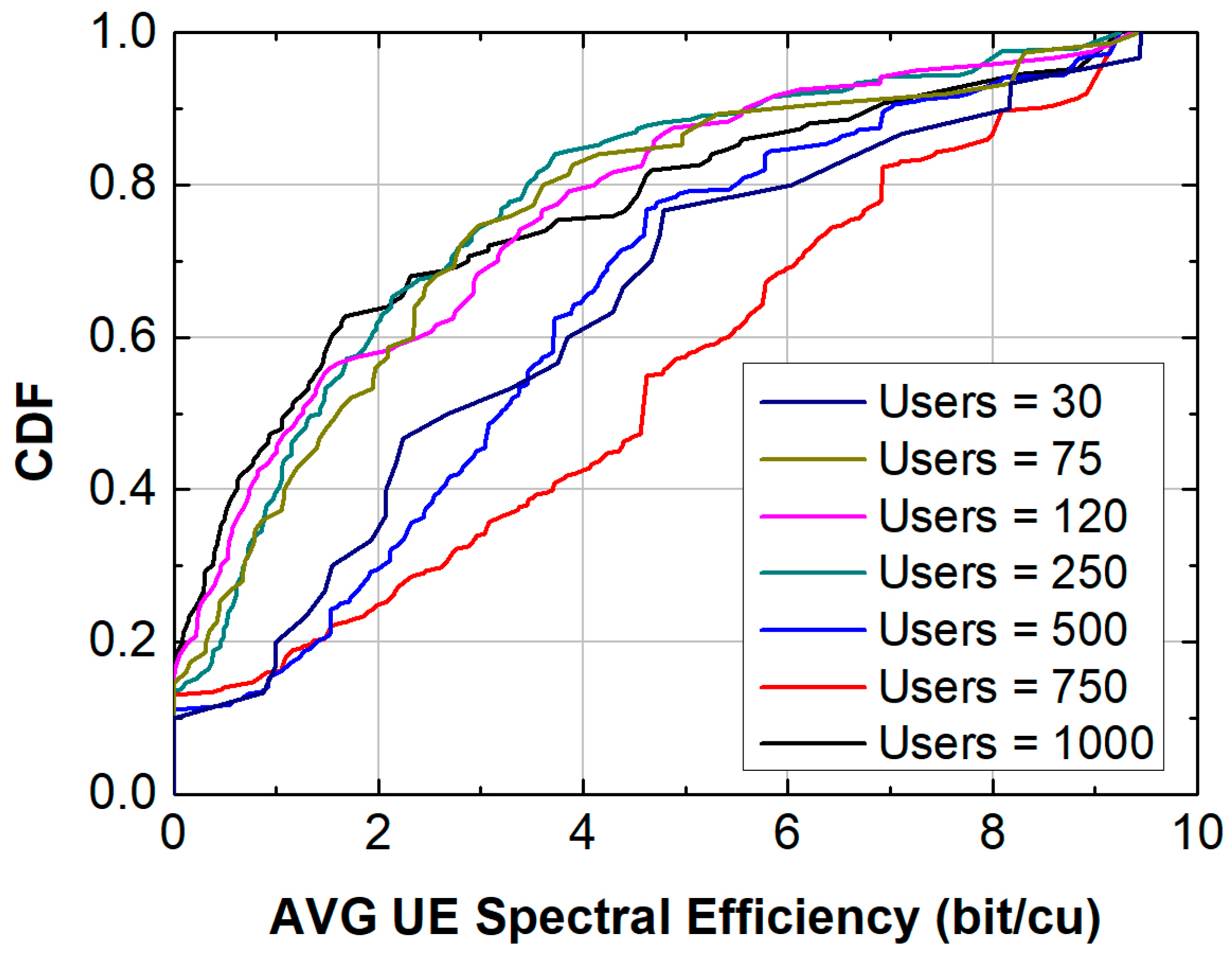
According to the 3GPP TR 38.901 and TR 36.873 specifications, in urban microcell scenarios, the user density typically ranges between 25 and 100 users per cell. However, in dense urban deployments, where realistic building layouts and propagation environments are considered, the user density can exceed to 1000 users per square kilometer, which corresponds to more than 200 users per cell (Figure 19), depending on the specific cell radius (Table 10).
In typical scenarios, increasing the number of users leads to a higher number of simultaneous transmissions, which consequently amplifies both inter-cell and intra-cell interference. This effect is particularly pronounced in Urban Microcell (UMi) environments, which emulate dense urban deployments—even if penetration loss parameters are set to relatively low values. As a result, the average user throughput tends to decline due to the intensified competition for radio resources and increased interference levels [35]. From the perspective of channel performance, particularly in mMIMO systems, as the number of users increases, the scheduler benefits from a larger pool of users, allowing it to select those with favorable instantaneous channel conditions. In contrast, under light load conditions (i.e., when few users are present), many resource blocks may remain underutilized or entirely unused, resulting in suboptimal spectral efficiency [28]. Naturally, this approach has both upper and lower performance bounds. From the perspective of channel symmetry, increasing the number of users leads to greater spatial heterogeneity. Consequently, under low user density conditions, channels tend to exhibit higher symmetry compared to high-density scenarios (Figure 20, Figure 21 and Figure 22) [35].
  • Simulation 9: Increasing Cell Radius
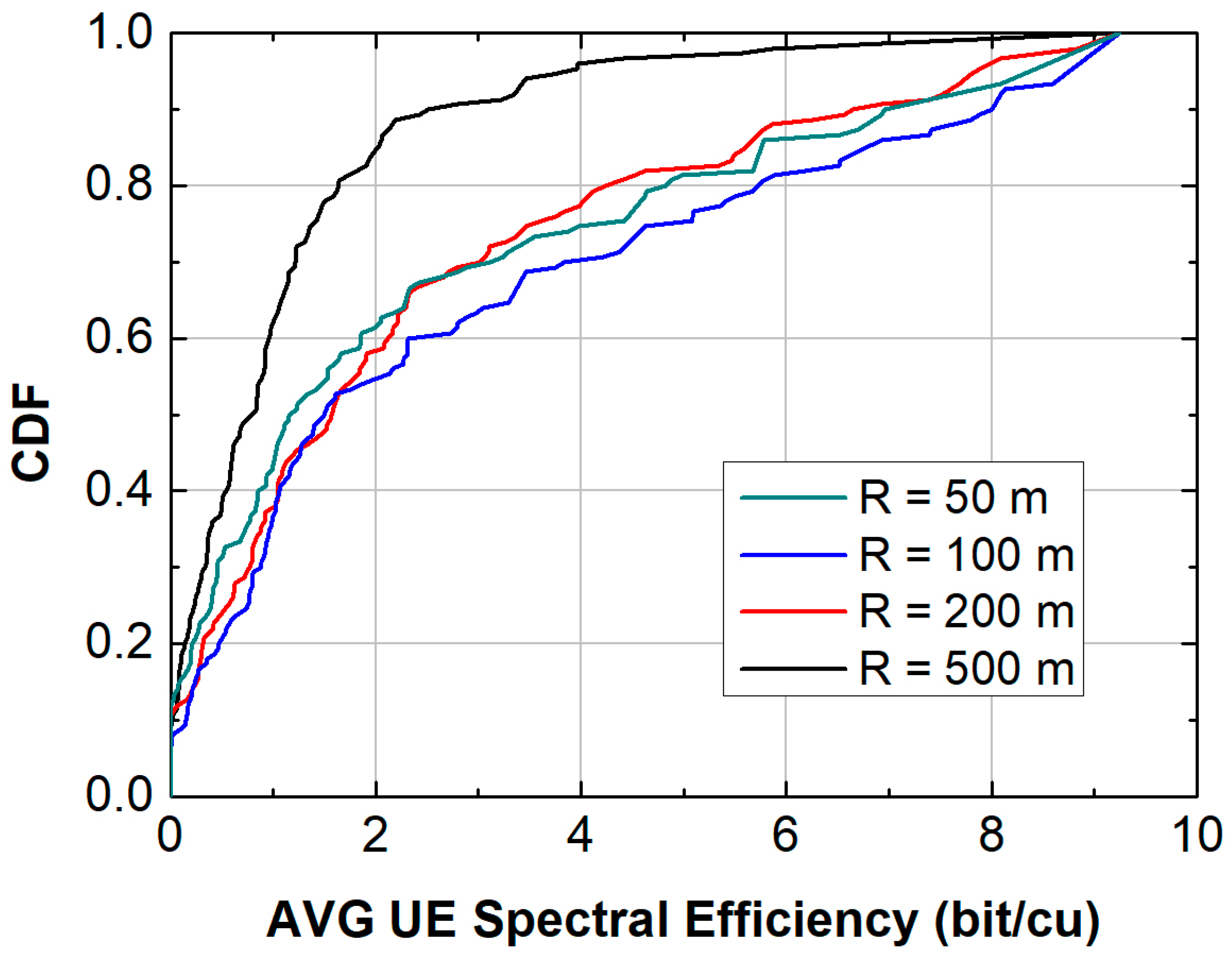
In the current simulation (Table 11), the impact of varying the cell radius on wireless channel performance was investigated. As previously stated, the model adopts a simplified single-cell scenario, operating under microwave connectivity assumptions. The cell radius was varied between 50 and 200 m, which corresponds to the typical range for microcell deployments in urban environments (UMi scenario). Additionally, an out-of-range value was included to evaluate the system’s behavior under extreme conditions.
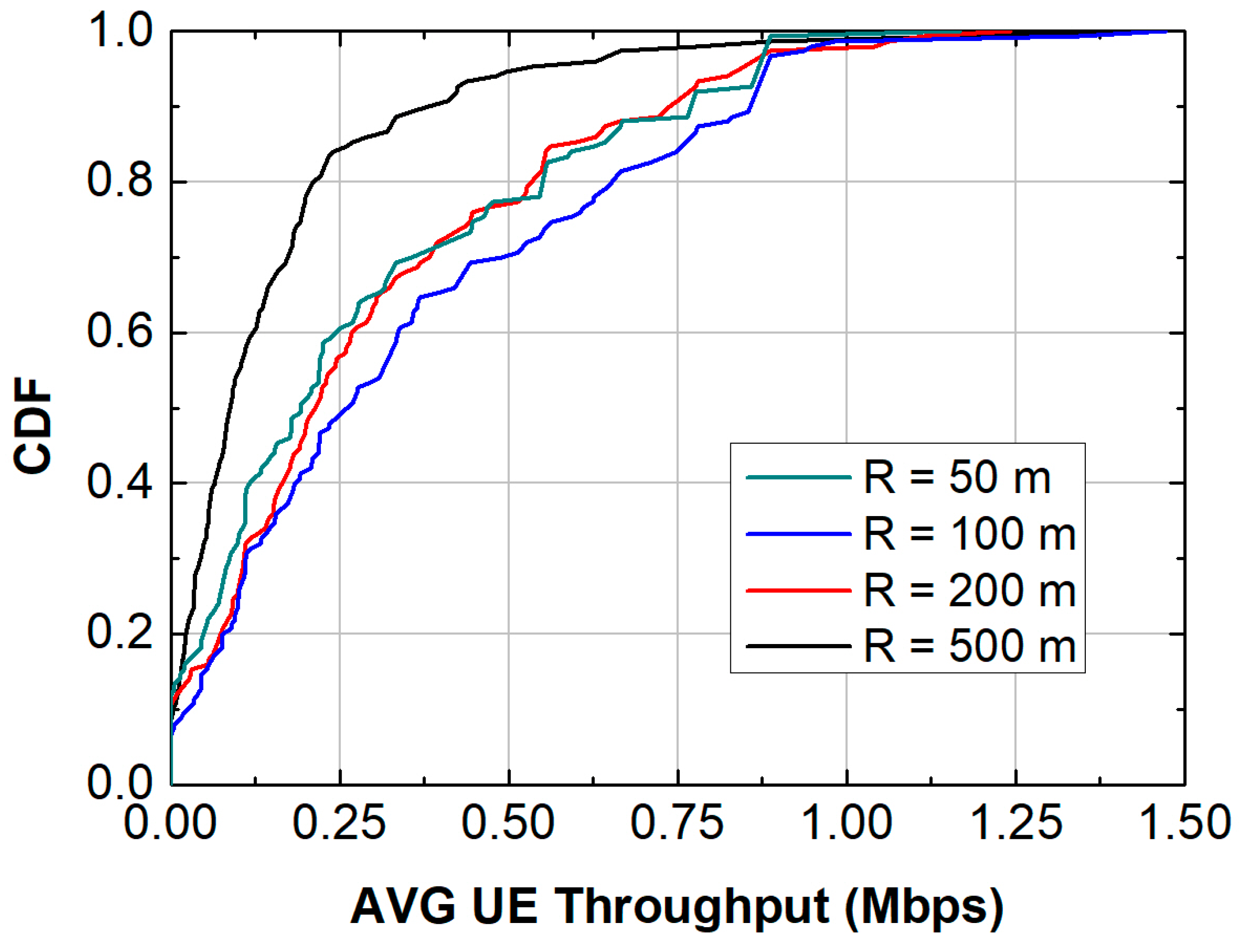
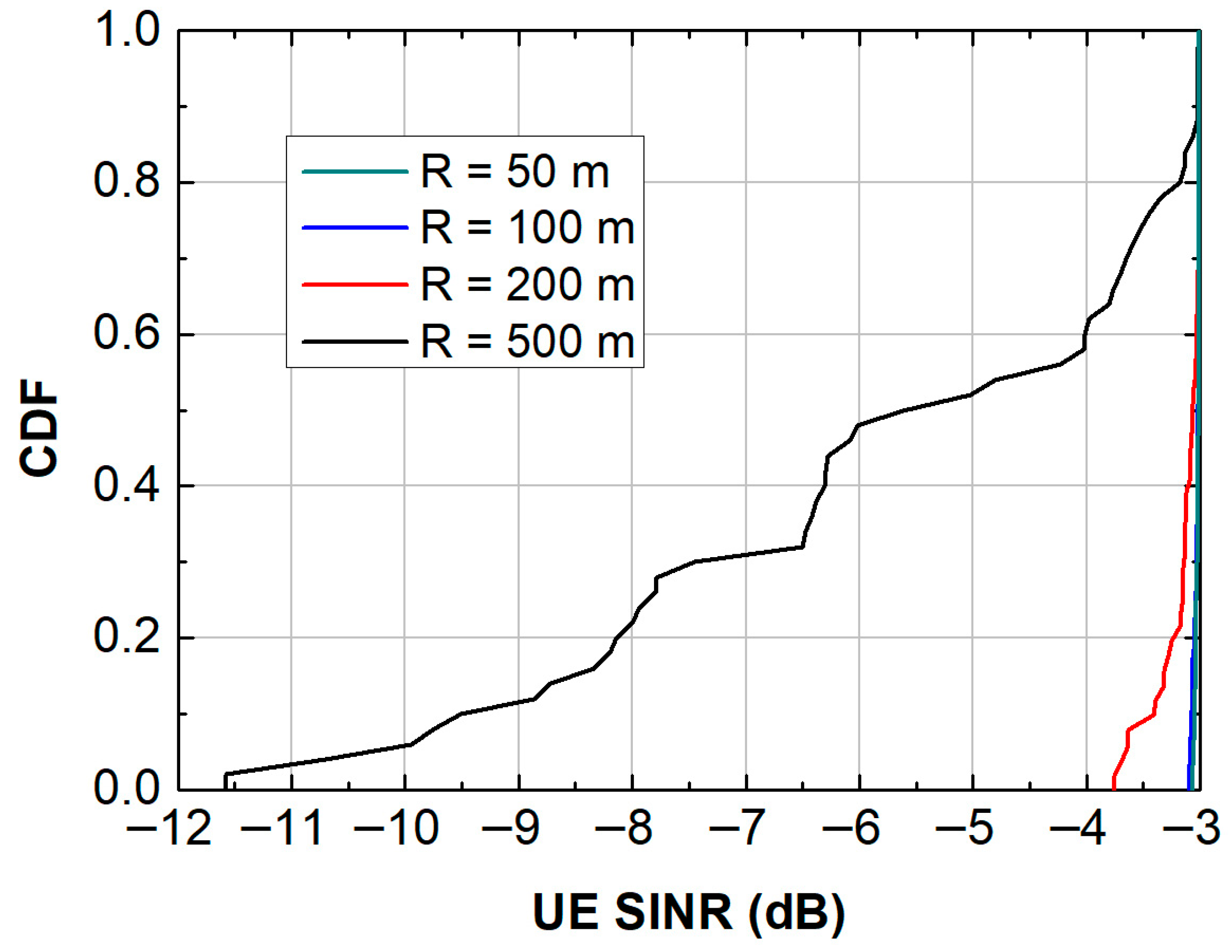
Within the typical operational limits, the performance of the channel remains relatively stable, with slight improvements observed—likely due to more favorable user distribution and channel conditions. However, as the cell radius extends beyond standard bounds, the overall system performance deteriorates. This degradation can be attributed primarily to increased path loss and the consequent reduction in the signal-to-interference-plus-noise ratio (SINR), particularly for users located at the periphery of the coverage area [27].
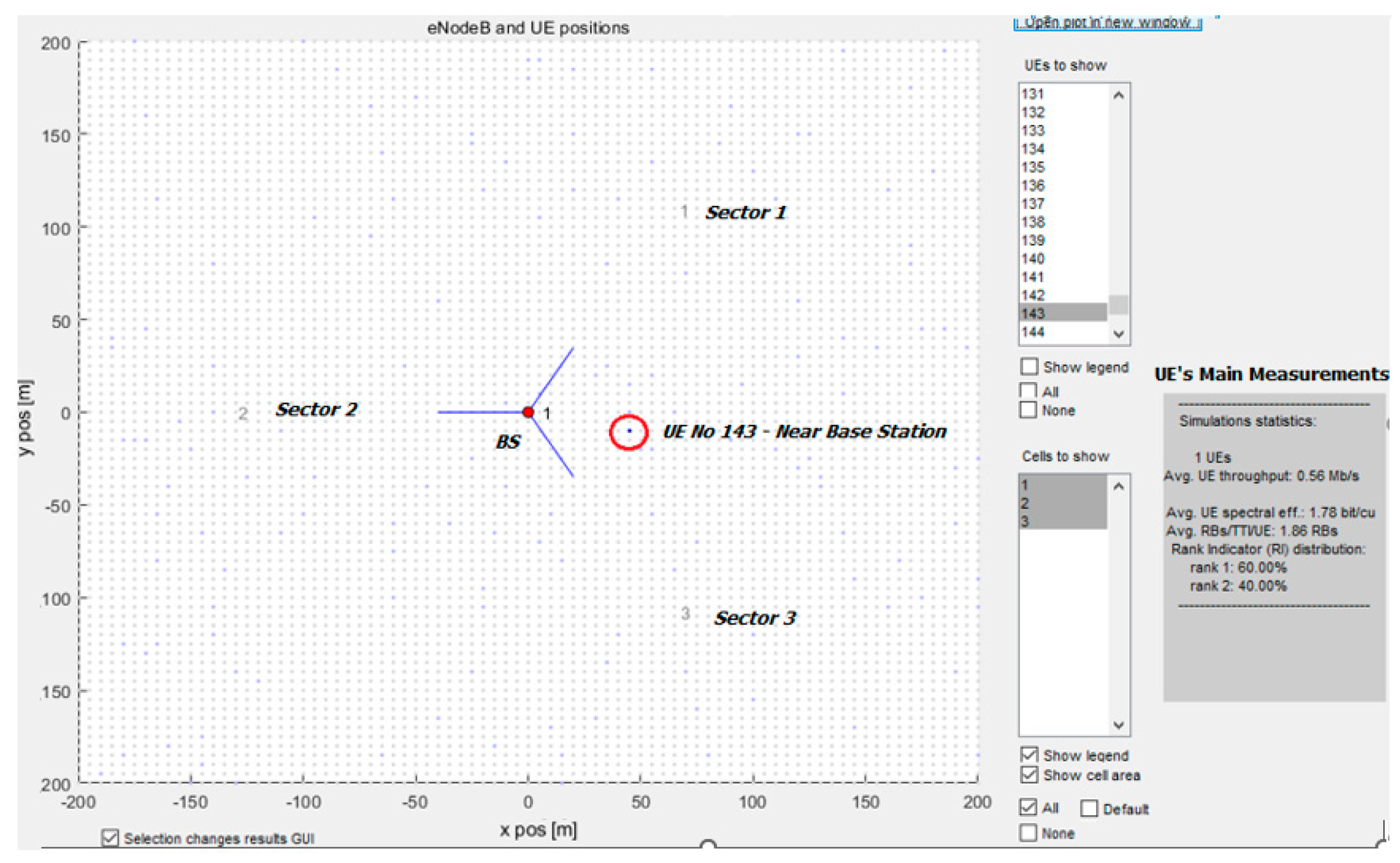
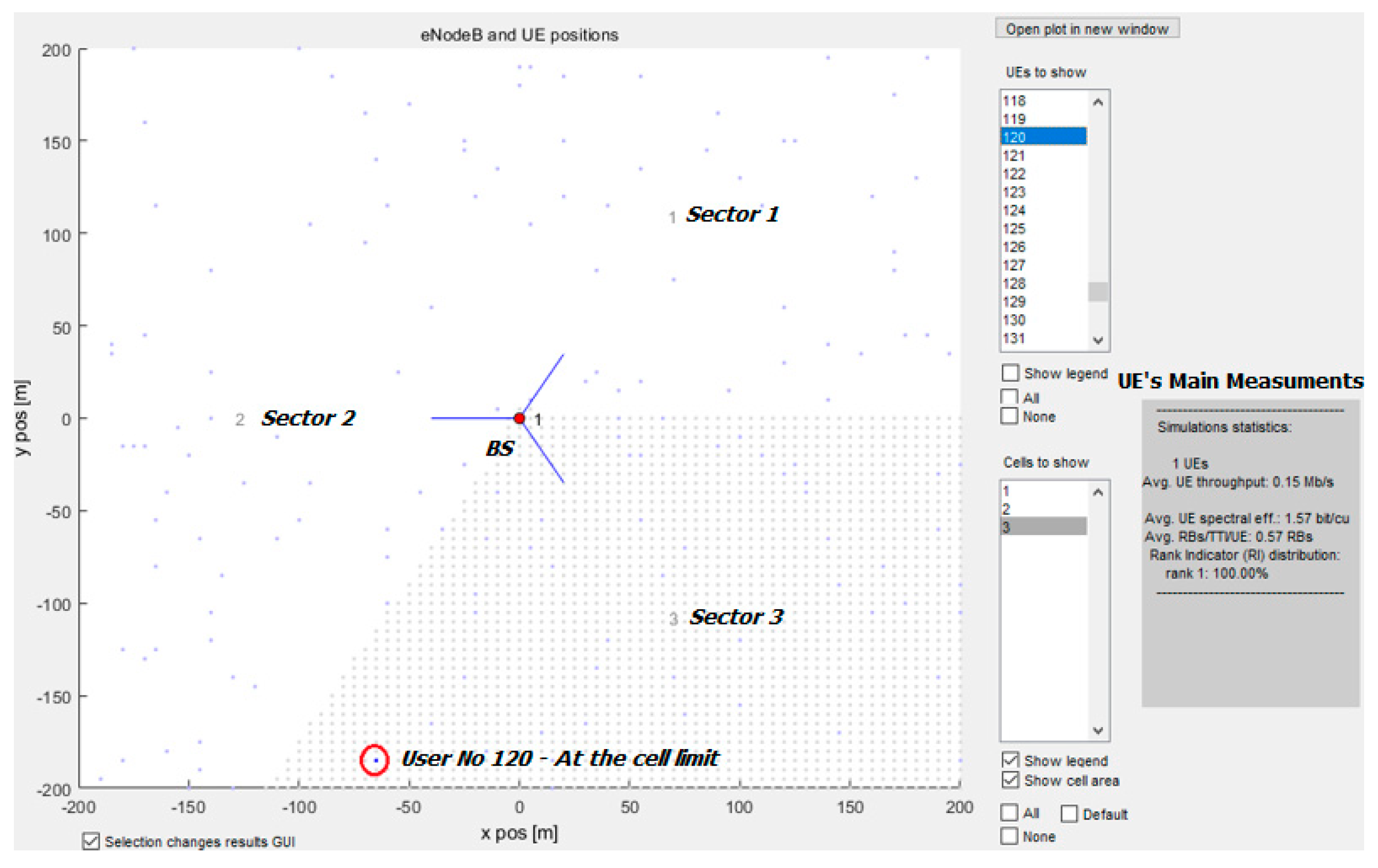
These observations are further substantiated by the accompanying Figures (Figure 23, Figure 24 and Figure 25), which illustrate SINR and capacity variations as a function of user distance from the transmitter (Figure 26 and Figure 27).
In summary, larger cells tend to produce greater disparities in received power among users, amplifying asymmetry between centrally located and edge users. In contrast, smaller cells generally exhibit more symmetric characteristics. Therefore, both the size and spatial configuration of the cell play a critical role in determining the uniformity of system performance and the balance of spatial signal distribution in mmWave MU-MIMO networks.
The analysis of simulations 4–9 demonstrates how variations in system parameters affect both channel symmetry and practical performance metrics. Increasing the number of antenna elements from 2 × 1 to 4 × 2, as shown in Table 6, improved average cell throughput and average user spectral efficiency for dual-polarized configurations. This improvement reflects realistic urban and indoor/outdoor scenarios, where variations in user location, building-induced shadowing and multipath propagation.
Similarly, the adoption of dual polarization consistently enhanced channel symmetry, particularly in dense urban microcell scenarios, by providing two independent channels over the same medium. As a result, users in indoor and outdoor locations experienced more uniform spectral efficiency, demonstrating the practical benefit of polarization diversity for reliable coverage and fairness.
Mobility and user distribution further influenced asymmetry and system performance. For instance, as user speed increased from 0.3 m/s to 1.2 m/s (Table 7), average user spectral efficiency droppes, reflecting real-world effects of Doppler shifts and rapidly varying channel conditions in pedestrian and urban environments. Likewise, increasing the indoor user fraction reduced throughput due to higher penetration losses, illustrating the practical challenges of mmWave deployments in office or dense building environments.
Finally, expanding the cell radius (Table 11) increased disparities in received power across users, creating asymmetric channel conditions that lowered SINR at the cell edge. This demonstrates a practical trade-off between coverage and channel uniformity in urban deployments, highlighting the importance of optimizing cell size, user allocation, and beamforming strategies.
In the table below (Table 12), all our results are consolidated to provide an overall representation.

4. Conclusions

In this paper, multiple simulations were performed to verify the simulator’s consistency under controlled parameter variations and to examine the behavior of a specific high-demand model across a range of input settings.
The first series of experiments demonstrated that the simulator operates in accordance with its specifications. Out-of-range values were not selected during this initial validation phase of the simulator.
The key elements of our model included the selection of a modern three-dimensional model, which accurately represents telecommunication operations in an urban environment with both indoor and outdoor mobile users. The antennas used were MIMO, albeit with a limited number of elements and the operating frequency was relatively high in order to incorporate the benefits of microwave links.
The simulations involved variations in both the antenna system parameters (such as antenna power and polarization) and structural system parameters (such as cell size, number of users and user ratio). In most cases, the results were consistent with the international literature, while deviations from expected outcomes were observed and explained based on the specific conditions. The results demonstrated that these factors significantly influence channel symmetry and spatial uniformity.
Overall, this study highlights the importance of antenna geometry, polarization, user placement and mobility in shaping channel symmetry, offering insights for designing more balanced and efficient mmWave MU-MIMO systems. Future work will extend the simulator to more realistic and demanding deployment environments—including indoor office layouts, industrial facilities and complex urban street canyons—to examine how environmental geometry and material properties further influence channel symmetry. Strengthening the understanding of symmetry under real-world conditions can directly support network engineering decisions, such as optimizing small-cell placement, refining beam-management procedures, and selecting antenna configurations that improve link reliability and fairness among users. In addition, simulations will be expanded to more advanced architectures—such as Massive MIMO and cell-free systems—to evaluate how symmetry behaves under ultra-dense user scenarios, high mobility, and next-generation urban deployments.
Our future work aims primarily to focus, after fully characterizing the variation in data channel performance due to changes in the system parameters, on developing an experimental setup to implement the model that we have theoretically approached in the present study.

Author Contributions

Methodology, N.M.; Software, N.M.; Validation, N.M., A.T. and C.T.A.; Formal analysis, N.M.; Investigation, A.T.; Resources, C.T.A.; Writing—original draft, N.M.; Writing—review & editing, A.T. and C.T.A.; Supervision, C.T.A. All authors have read and agreed to the published version of the manuscript.

Funding

This research received no external funding.

Data Availability Statement

The original contributions presented in this study are included in the article. Further inquiries can be directed to the corresponding author.

Conflicts of Interest

The authors declare no conflicts of interest.

References

  1. Ahmed Solyman, A.A.; Yahya, K. Evolution of wireless communication networks: From 1G to 6G and future perspective. Int. J. Electr. Comput. Eng. 2022, 2023, 3943–3950. [Google Scholar] [CrossRef]
  2. Salman, H.A.; Alsajri, A.; Kalakech, A.; Steiti, A. Difference between 4G and 5G networks. Babylon. J. Netw. 2023, 2023, 41–54. [Google Scholar] [CrossRef]
  3. Kumar, R.; Kaur, G. Advancements and impact of 4G communication: A technological revolution. World J. Adv. Res. Rev. 2019, 3, 6–10. [Google Scholar]
  4. Yang, S.; Hanzo, L. Fifty years of MIMO detection: The road to large-scale MIMOs. IEEE Commun. Surv. Tutor. 2015, 17, 1941–1988. [Google Scholar] [CrossRef]
  5. Sharma, U.; Srivastava, G.; Khandelwal, M.K.; Roges, R. Design Challenges and Solutions of Multiband MIMO Antenna for 5G/6G Wireless Applications: A Comprehensive Review. Prog. Electromagn. Res. B 2024, 104, 69–89. [Google Scholar] [CrossRef]
  6. Popoola, S.I.; Faruk, N.; Atayero, A.A.; Oshin, M.A.; Bello, O.W.; Mutafungwa, E. Radio Access Technologies for Sustainable Deployment of 5G networks in emerging markets. Int. J. Appl. Eng. Res. 2017, 12, 14154–14172. [Google Scholar]
  7. Sakaguchi, K.; Haustein, T.; Barbarossa, S.; Strinati, E.C.; Clemente, A.; Destino, G.; Heath, R.W., Jr. Where, when, and how mmWave is used in 5G and beyond. IEICE Trans. Electron. 2017, 100, 790–808. [Google Scholar] [CrossRef]
  8. Wei, L.; Yuan, S.S.A.; Huang, C.; Zhang, J.; Bader, F.; Zhang, Z.; Muhaidat, S.; Debbah, M.; Yuen, C. Electromagnetic channel modeling and capacity analysis for HMIMO communications. IEEE Trans. Wirel. Commun. 2025, 24, 4500–4514. [Google Scholar] [CrossRef]
  9. Xu, H.; Wu, J.W.; Qi, Z.J.; Wu, H.T.; Shao, R.W.; Cheng, Q.; Zhu, J.; Dai, L.; Cui, T.J. A physics-based perspective for understanding and utilizing spatial resources of wireless channels. arXiv 2024, arXiv:2410.06115. [Google Scholar] [CrossRef]
  10. Müller, M.K.; Ademaj, F.; Dittrich, T.; Fastenbauer, A.; Ramos Elbal, B.; Nabavi, A.; Nagel, L.; Schwarz, S.; Rupp, M. Flexible multi-node simulation of cellular mobile communications: The Vienna 5G System Level Simulator . EURASIP J. Wirel. Commun. Netw. 2018, 2018, 227. [Google Scholar] [CrossRef]
  11. Hafi, H.; Brik, B.; Frangoudis, P.A.; Ksentini, A.; Bagaa, M. Split federated learning for 6G enabled-networks: Requirements, challenges, and future directions. IEEe Access 2024, 12, 9890–9930. [Google Scholar] [CrossRef]
  12. Liu, W.-C.; Sheen, W.-H.; Wu, M.-Y.; Yeh, T.-Y. Theory and Implementation of a Three-Dimensional Spatial Channel Model for the 3GPP TR 36.873 Long-Term Evolution System. DEStech Trans. Eng. Technol. Res. 2018. [Google Scholar] [CrossRef]
  13. Zhu, Q.; Wang, C.X.; Hua, B.; Mao, K.; Jiang, S.; Yao, M. 3GPP TR 38.901 channel model. In the Wiley 5G Ref: The Essential 5G Reference Online; Wiley Press: Hoboken, NJ, USA, 2021; pp. 1–35. [Google Scholar]
  14. Salahat, E.; Kulaib, A.; Ali, N.; Shubair, R. Exploring Symmetry in Wireless Propagation Channels. In Proceedings of the European Conference on Networks and Communications (EuCNC), Oulu, Finland, 12–15 June 2017. [Google Scholar]
  15. Khamayseh, Y.; Al-Qudah, R. Performance of symmetric and asymmetric links in wireless networks. Int. J. Electr. Comput. Eng. (IJECE) 2022, 12, 605–619. [Google Scholar] [CrossRef]
  16. Riviello, D.G.; Di Stasio, F.; Tuninato, R. Performance analysis of multi-user MIMO schemes under realistic 3GPP 3-D channel model for 5G mmwave cellular networks. Electronics 2022, 11, 330. [Google Scholar] [CrossRef]
  17. Sudhamani, C.; Roslee, M.; Chuan, L.L.; Waseem, A.; Osman, A.F.; Jusoh, M.H. Performance Analysis of a Millimeter Wave Communication System in Urban Micro, Urban Macro, and Rural Macro Environments. Energies 2023, 16, 5358. [Google Scholar] [CrossRef]
  18. Shaibu, F.E.; Onwuka, E.N.; Salawu, N.; Oyewobi, S.S.; Djouani, K.; Abu-Mahfouz, A.M. Performance of Path Loss Models over Mid-Band and High-Band Channels for 5G Communication Networks: A Review. Future Internet 2023, 15, 362. [Google Scholar] [CrossRef]
  19. Lim, Y.-G.; Cho, Y.J.; Oh, T.; Lee, Y.; Chae, C.-B. Relationship between cross-polarization discrimination (XPD) and spatial correlation in indoor small-cell MIMO systems . IEEE Wirel. Commun. Lett. 2018, 7, 654–657. [Google Scholar] [CrossRef]
  20. Özdogan, Ö.; Björnson, E. Massive MIMO with dual-polarized antennas. IEEE Trans. Wirel. Commun. 2023, 22, 1448–1463. [Google Scholar] [CrossRef]
  21. Jia, Y.; Xu, P.; Guo, X. MIMO system capacity based on different numbers of antennas. Results Eng. 2022, 15, 100577. [Google Scholar] [CrossRef]
  22. Liu, Y.; Ai, B.; Zhang, J. Downlink spectral efficiency of massive MIMO systems with mutual coupling. Electronics 2023, 12, 1364. [Google Scholar] [CrossRef]
  23. Hu, J.; Wang, L.; Wu, J.; Pei, Q.; Liu, F.; Li, B. A comparative measurement study of cross-layer 5G performance under different mobility scenarios. Comput. Netw. 2024, 257, 110952. [Google Scholar] [CrossRef]
  24. Fokin, G.; Volgushev, D. Model for interference evaluation in 5G millimeter-wave ultra-dense network with location-aware beamforming. Information 2023, 14, 40. [Google Scholar] [CrossRef]
  25. Shi, Q.; Hong, M. Spectral efficiency optimization for millimeter-wave multi-user MIMO systems. IEEE J. Sel. Top. Signal Process. 2018, 12, 455–468. [Google Scholar] [CrossRef]
  26. Kass, G.V.; Mood, A.M.; Graybill, F.A.; Boes, D.C. Introduction to the Theory of Statistics, 3rd ed.; McGraw-Hill: Columbus, OH, USA, 1974. [Google Scholar]
  27. Björnson, E.; Sanguinetti, L.; Hoydis, J.; Larsson, E.G. Massive MIMO Networks: Spectral, Energy, and Hardware Efficiency; Cambridge University Press: Cambridge, UK, 2017. [Google Scholar]
  28. Liu, Y.; Zhang, Q.; He, X.; Lei, X.; Zhang, Y. Spectral-efficient hybrid precoding for multi-antenna multi-user mmWave massive MIMO systems with low complexity. EURASIP J. Wirel. Commun. Netw. 2022, 2022, 66. [Google Scholar]
  29. Shah, N.A.; Lazarescu, M.T.; Quasso, R.; Lavagno, L. CUDA-Optimized GPU Acceleration of 3GPP 3D Channel Model Simulations for 5G Network Planning. Electronics 2023, 12, 3214. [Google Scholar] [CrossRef]
  30. Hou, C.; Li, Q.; Zhang, J.; Wu, Z.; Zhang, Y.; Guo, L.; Zhu, X.; Du, P. A Three-Dimensional Fully Polarized Millimeter-Wave Hybrid Propagation Channel Model for Urban Microcellular Environments. Electronics 2024, 13, 3629. [Google Scholar] [CrossRef]
  31. Yunita, T.; Ryanu, H.H.; Pramudita, A.A. Effect of antenna polarization arrangement on MIMO channel capacity. Emerg. Sci. J. 2025, 9, 1076–1088. [Google Scholar] [CrossRef]
  32. Wang, P.; Li, Y.; Peng, Y.; Liew, S.C.; Vucetic, B. Non-Uniform Linear Antenna Array Design and Optimization for Millimeter-Wave Communications. IEEE Trans. Wirel. Commun. 2016, 15, 7343–7356. [Google Scholar] [CrossRef]
  33. Tse, D.; Viswanath, P. Fundamentals of Wireless Communication; Cambridge University Press: Cambridge, UK, 2005. [Google Scholar]
  34. Schwarz, S.; Taranetz, M.; Rupp, M. The Vienna LTE-Advanced Simulators: Design, Implementation and Use; Springer: Berlin/Heidelberg, Germany, 2016. [Google Scholar]
  35. Wang, Y.; Liu, F.; Li, Z.; Chen, S.; Zhao, X. An Approach to Maximize the Admitted Device-to-Device Pairs in MU-MIMO Cellular Networks. Electronics 2024, 13, 1198. [Google Scholar]
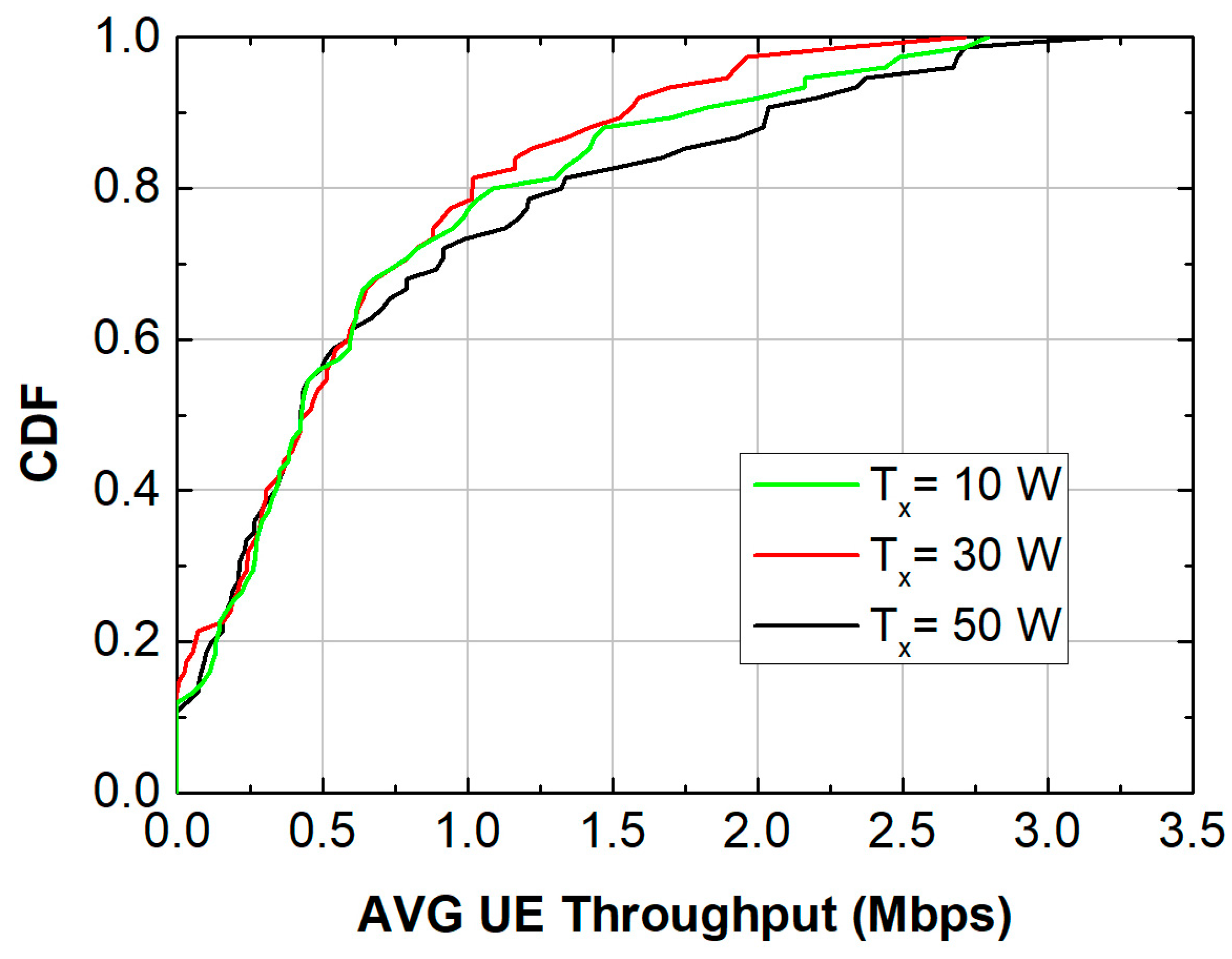
Figure 1. AVG Throughput Increasing TX Power.
Symmetry 17 02159 g001
Figure 2. AVG Spectral Efficiency Increasing TX Power.
Symmetry 17 02159 g002
Figure 3. AVG UE Throughput Increasing Carrier Frequency.
Symmetry 17 02159 g003
Figure 4. AVG UE Spectral Efficiency Increasing Carrier Frequency.
Symmetry 17 02159 g004
Figure 5. AVG UE Throughput Increasing K-factor.
Symmetry 17 02159 g005
Figure 6. AVG UE Spectral Efficiency Increasing K-factor.
Symmetry 17 02159 g006
Figure 7. AVG UE Throughput Changing Transmitting Power and Antenna Polarization.
Symmetry 17 02159 g007
Figure 8. Avg UE Spectral Efficiency Changing Transmitting Power and Antenna Polarization.
Symmetry 17 02159 g008
Figure 9. UE SINR Changing Transmitting Power and Antenna Polarization.
Symmetry 17 02159 g009
Figure 10. AVG UE Throughput Changing Antenna Elements & Antenna Polarization.
Symmetry 17 02159 g010
Figure 11. Avg UE Spectral Efficiency Changing Antenna Elements & Antenna Polarization.
Symmetry 17 02159 g011
Figure 12. UE SINR Changing Antenna Elements & Antenna Polarization.
Symmetry 17 02159 g012
Figure 13. AVG UE Throughput Changing Indoor Fraction & Users Velocity.
Symmetry 17 02159 g013
Figure 14. Avg UE Spectral Efficiency Changing Indoor Fraction & Users Velocity.
Symmetry 17 02159 g014
Figure 15. UE SINR Changing Indoor Fraction & Users Velocity.
Symmetry 17 02159 g015
Figure 16. AVG UE Throughput (indoor model).
Symmetry 17 02159 g016
Figure 17. Avg UE Spectral Efficiency (indoor model).
Symmetry 17 02159 g017
Figure 18. UE SINR (dB) (indoor model).
Symmetry 17 02159 g018
Figure 19. ROI max SINR (simulation 8).
Symmetry 17 02159 g019
Figure 20. AVG UE Throughput Increasing Users.
Symmetry 17 02159 g020
Figure 21. AVG UE Spectral Efficiency Increasing Users.
Symmetry 17 02159 g021
Figure 22. UE SINR Increasing Users.
Symmetry 17 02159 g022
Figure 23. AVG UE Throughput Increasing Cell Radius.
Symmetry 17 02159 g023
Figure 24. AVG UE Spectral Efficiency Increasing Cell Radius.
Symmetry 17 02159 g024
Figure 25. UE SINR Increasing Cell Radius.
Symmetry 17 02159 g025
Figure 26. Example of UE near Base Station–UE No143.
Symmetry 17 02159 g026
Figure 27. Example of UE far from Base Station–UE No120.
Symmetry 17 02159 g027
Table 1. Parameters of Simulation Model.
ParametresValue
User Density2500 users/Km2
User Velocity0
Carrier Frequency28 GHz
TTi10
Bandwidth10 MHz
Subcarrier Spacing60 KHz
TX Power47 dB
PolarizationsSingle-dual
Indoor UTs percentage80%
UMi—specifications
BS Height10 m
User Height1.5 m
Building floor height3 m
User Velocity0
User distribution75 users/cell
Antenna—specifications
nTx4
nRx2
Table 2. Channel Performance (Increasing Antenna Power).
Channel Specifications (Simulation 1)Average Cell Throughput (Mb/s)Avg UE Spectral Efficiency (bit/cu)
Power Tx = 10 watt17.262.20
Power Tx = 30 watt15.622.15
Power Tx = 50 watt19.042.50
Table 3. Channel Performance (Increasing Carrier Frequency).
Channel Specifications (Simulation 2)Average Cell Throughput (Mb/s)Avg UE Spectral Efficiency (bit/cu)
Frequency: 2.4 GHz21.342.86
Frequency: 3.5 GHz23.703.27
Frequency: 5.8 GHz33.303.34
Table 4. Channel Performance (Increasing K-factor).
Channel Specifications (Simulation 3)Average Cell Throughput (Mb/s)Avg UE Spectral Efficiency (bit/cu)
K-factor = 0 dB17.942.39
K-factor = 9 dB14.052.62
K-factor: 18 dB12.511.84
Table 5. Channel Performance (Increasing Power Transmission and Antenna Polarization).
Channel Specifications
(ol = 1: Single Polarization
Pol = 2: Dual Polarization)
Average Cell Throughput (Mb/s)Avg UE Spectral Efficiency (bit/cu)
Power Tx = 47 db, pol = 128.013.93
Power Tx = 50 db, pol = 126.713.46
Power Tx = 53 db, pol = 133.014.76
Power Tx = 47 db, pol = 223.623.04
Power Tx = 50 db, pol = 224.473.40
Power Tx = 53 db, pol = 225.193.20
Table 6. Channel Performance (Changing Antenna Elements & Antenna Polarization).
Channel Specifications (Pol = 1: Single Polarization
Pol = 2: Dual Polarization)
Average Cell Throughput (Mb/s)Avg UE Spectral Efficiency (bit/cu)
MIMO 2 × 1, pol = 114.462.02
MIMO 2 × 2, pol = 119.052.54
MIMO 4 × 2, pol = 120.352.96
MIMO 2 × 1, pol = 216.542.30
MIMO 2 × 2, pol = 220.082.72
MIMO 4 × 2, pol = 222.323.03
Table 7. Channel Performance (Changing Indoor Fraction & Users Velocity).
Channel Specifications
(Simulation 6)
Average Cell Throughput (Mb/s)Avg UE Spectral
Efficiency (bit/cu)
Indoor fraction 50%, velocity = 0.3 m/s
(1.1 km/h) very slow movement
15.602.42
Indoor fraction 50%, velocity = 0.8 m/s
(3 km/h) slow movement
10.921.67
Indoor fraction 50%, velocity = 1.2 m/s
(4 km/h) normal pedestrian
7.761.09
Indoor fraction 80%, velocity = 0.3 m/s
(1 km/h) very slow movement
16.802.67
Indoor fraction 80%, velocity = 0.8 m/s
(3 km/h) slow movement
10.121.49
Indoor fraction 80%, velocity = 1.2 m/s
(4 km/h) normal pedestrian
7.841.67
Only Indoor Users, velocity = 0.3 m/s
(1 km/h) very slow movement
18.232.58
Only Indoor Users, velocity = 1.2 m/s
(3 km/h) pedestrian movement
10.211.61
Only Outdoor Users, velocity = 1.2 m/s
(normal pedestrian)
8.561.13
Only Outdoor Users, velocity = 3 m/s
(10 km/h—running)
6.280.92
Only Outdoor Users, velocity = 6 m/s
(20 km/h—bicycling)
5.170.70
Table 8. Channel Performance (Indoor Model).
Channel Specifications
(Simulation 7)
Average Cell Throughput (Mb/s)Avg UE Spectral
Efficiency (bit/cu)
Indoor fraction 25%, indoor office model type, soft movement = 0.3 m/s4.640.78
Indoor fraction 50%, indoor office model type, soft movement = 0.3 m/s6.830.98
Indoor fraction 75%, indoor office model type, soft movement = 0.3 m/s6.610.91
Indoor fraction 100%, indoor office model type, soft movement = 0.3 m/s4.640.69
Table 9. Summarized CSI Simulation Results.
SimScenarioVariance of
Avg UE SE (σ2)
CSIObservation
1Pol = 1
Tx: 47 → 53 dB
0.2893.46Higher variance →
asymmetric channel
1Pol = 2
Tx: 47 → 53 dB
0.02245.45Lower variance →
improved symmetry
2Pol = 1
2 × 1, 2 × 2, 4 × 4
0.1486.76Higher variance →
asymmetric channel
2Pol = 2
2 × 1, 2 × 2, 4 × 2
0.09011.11Lower variance →
improved symmetry
3Only Indoor0.2354.26Lower variance → more symmetric among indoor users
3Only Outdoor0.03132.26Lowest variance → very symmetric channel
Table 10. Channel Performance (Increasing Users).
Channel Specifications
(Simulation 8)
Average Cell Throughput (Mb/s)Avg UE Spectral
Efficiency (bit/cu)
Indoor fraction 50%, 30 users per cell (r = 100 m)28.063.63
Indoor fraction 50%, 75 users per cell (r = 100 m)16.732.36
Indoor fraction 50%, 120 users per cell (r = 100 m)14.272.25
Indoor fraction 50%, 250 users per cell (r = 100 m)17.582.16
Indoor fraction 50%, 500 users per cell (r = 100 m)29.883.48
Indoor fraction 50%, 750 users per cell (r = 100 m)38.51
Average user = 0.15
4.40
Indoor fraction 50%, 1000 users per cell (r = 100 m)38.91
Average user = 0.13
4.97
Table 11. Channel Performance (Increasing Cell Radius).
Channel Specifications
(Simulation 9)
Average Cell Throughput (Mb/s)Avg UE Spectral
Efficiency (bit/cu)
150 users per cell (cell radium = 50 m)14.362.32
150 users per cell (cell radium = 100 m)14.452.52
150 users per cell (cell radium = 200 m)12.442.12
150 users per cell (cell radium = 500 m)7.911.31
Table 12. Summarized Simulation Results.
SimulationParameter(s) VariedObserved
Effect
Unexpected/Counterintuitive ObservationsSymmetry/Asymmetry ImpactPractical Significance/Implication
1Transmit Power
(10–50 W)
Higher power generally improves SNR and throughput30 W slightly lower throughput than 10 WMinor impact on symmetry; interference creates uneven gainsHighlights multi-user
interactions and power
optimization
2Carrier Frequency
(2.4–5.8 GHz)
Cell throughput increases with frequencyAvg User throughput does not always increase proportionallyHigher frequency can increase asymmetry due to directional propagation and blockageFrequency selection must consider spatial
variability
3K-factor
(0–18 dB)
Low K → high spatial multiplexing; high K →
reduced MU-MIMO gain
Moderate K (~9 dB) sometimes higher spectral efficiencyHigh LOS improves symmetry but reduces rank; low K balances asymmetry and spatial streamsTrade-off
between channel stability and multiplexing
4Transmit Power + Antenna PolarizationHigher power improves throughput; dual polarization improves symmetryDual polarization not always effectiveDual polarization reduces asymmetry; misalignment limits effectCareful antenna design and alignment needed in urban scenarios
5Number of Antenna Elements + PolarizationMore antennas and dual polarization increase throughputGains saturate
beyond certain counts
Larger arrays reduce asymmetry through spatial diversityOptimize array size and polarization for reliability and
coverage
6User Mobility + Indoor FractionHigher
mobility/
indoor fraction → lower throughput
Minor reductions in low-mobility indoor usersIncreased mobility and heterogeneous distribution increase asymmetryMobility-aware scheduling and indoor coverage strategies
required
7Indoor Deployment ModelHigher indoor fraction → more interference, lower throughput75% indoor fraction sometimes outperformed 50%Dense indoor layouts increase asymmetry; careful layout reduces itBeamforming and environment- specific tuning critical
8Number of UsersModerate load → optimal;
very high load → interference
Very high users
(750–1000) increased avg throughput
High density increases asymmetry; scheduler balances loadLoad-adaptive scheduling
leverages
multi-user diversity
9Cell RadiusLarger cells → increased asymmetry; smaller cells → more uniformSlight throughput improvement 100 m vs. 50 mLarger radius amplifies path-loss disparities → asymmetryCareful microcell planning
ensures balanced coverage
Disclaimer/Publisher’s Note: The statements, opinions and data contained in all publications are solely those of the individual author(s) and contributor(s) and not of MDPI and/or the editor(s). MDPI and/or the editor(s) disclaim responsibility for any injury to people or property resulting from any ideas, methods, instructions or products referred to in the content.