Abstract
This study presents novel and generalizable sufficient conditions for determining the oscillatory behavior of solutions to higher-order half-linear neutral delay dynamic equations on time scales. Utilizing the Riccati transformation technique in combination with Taylor monomials, we derive new and comprehensive oscillation criteria that cover a wide range of cases, including super-linear, half-linear, and sublinear equations. These results extend and improve upon existing oscillation criteria found in the literature by introducing more general conditions and providing a broader applicability to different types of dynamic equations. Furthermore, the study highlights the role of symmetry in the underlying equations, demonstrating how symmetry properties can be leveraged to simplify the analysis and provide additional insights into oscillatory behavior. To demonstrate the practical relevance of our findings, we include illustrative examples that show how these new criteria, along with symmetry-based perspectives, can be effectively applied to various time scales.
1. Introduction
Time scales theory has attracted considerable interest since Hilger introduced it in his landmark paper [1]. This framework offers a unified approach to unifying, extending, and generalizing concepts from discrete, continuous, and quantum calculus to arbitrary time domains, fostering a rapidly expanding field of research.
The study of the oscillation of dynamic differential equations with time scales is great importance in understanding and analyzing continuous and discrete systems of various natural-life phenomena. This in turn enables us to unify the modeling of processes that evolve on continuous and discrete times and to bridge the gap between differential equations and difference equations. For example, these equations are used in modeling the cyclical behavior of economic systems using time scale calculation and in analyzing the oscillation and stability of the economic market; for more information, please see [2,3,4].
The time scale is defined as a closed nonempty subset of that inherits the standard topology. The intervals on a time scale, indicated with a subscript , show where the usual interval and intersect. Specifically, when equals or , it matches the established differential equations and difference equations theories, respectively.
For any , we define the forward and backward jump operators , , respectively, as follows:
A point is classified as right-scattered if , right-dense if , left-scattered if , left-dense if , and dense if .
The time scale has a graininess function which is given by and the function indicates for any . We also define the rd-continuous function as a function with right-dense continuous points and that has finite left-sided limits at left-dense points. Furthermore, the set denotes the all rd-continuous functions and is the set of all differential rd-continuous functions where .
The delta derivative of a function is defined as
The product rule for delta derivatives is
The delta derivative of the quotient is given by
If a function satisfies on , it is called an antiderivative of . The integral of is defined as
The past two decades have witnessed substantial research efforts dedicated to the study of the oscillatory and nonoscillatory behavior of solutions to dynamic equations on time scales; see [5,6,7,8,9,10,11,12]. Several papers are devoted to the study of oscillatory behavior in the case of second-order dynamic equations. While some studies have addressed the oscillation of solutions of higher-order equations, they primarily focus on the half-linear dynamic equation without a neutral term. For example, in [13], the authors explore oscillatory behavior under these conditions. Similarly, Grace et al., in [14], investigated the oscillation of higher-order nonlinear dynamic equations with a negative nonlinear neutral term. Their findings were derived using an integral criterion and a comparison theorem.
In contrast, the current work examines the oscillatory behavior of solutions to higher-order dynamic equations with a neutral term. By employing Riccati substitution, this study considers three distinct cases—superlinear, half-linear, and sublinear forms—to address gaps in the existing literature.
Although higher-order dynamic equations on time scales have garnered significant attention in recent research, many critical aspects remain unresolved within the broader theory of dynamic equations on time scales. In this paper, we focus on specific higher-order half-linear neutral delay dynamic equations of the following form:
where for and , , with n even, and .
For any arbitrary time scale with , and a fixed point in , we assume the following conditions:
- (H1)
- such that for all with .
- (H2)
- such that and for all .
- (H3)
- such that for all with .
- (H4)
- such that and for all , with and .
A solution of (1) is a nontrivial function , where and . This function has the property that and satisfies (1) identically on . A solution x of Equation (1) is oscillatory if it changes sign infinitely often. Otherwise, it is nonoscillatory. Equation(1) is oscillatory if all its solutions are oscillatory.
In the following, we provide background details that motivate our study in this paper. Grace et al. [15] examined the oscillatory behavior of (1) in the specific case of , , and ; i.e.,
where and are quotients of positive odd integers, and r and q are real-valued, positive, rd-continuous functions. They discussed all possible cases of , , and . They considered
and
and determined sufficient criteria for oscillation of all solutions:
- for all large and small if .
- for all large if .
- for all large and small if .
Yang et al. [16] considered another specific case, investigating the oscillation criteria of second-order quasi-linear dynamic equations of the form
where , , , , and for all with and .
In 2013, Grace [13] established new oscillation criteria for the higher-order dynamic equation
where is the ratio of positive odd integers, and r and q are real-valued rd-continuous functions defined on .
On the other hand, many researchers have been interested in the oscillation of solutions of differential equations of different orders and classifications, especially functional ones, due to their importance in modeling systems that contain different times; see [17,18,19,20,21,22]. In refs. [23,24], they studied the oscillation of fractional differential equations and developed the well-known classical criteria. We also find some studies interested in partial differential equations, such as [25].
This motivates us to study the oscillatory behavior of Equation (1) for , , and , improving and extending the results of [15] and [16] using the Riccati technique.
The results in this paper extend some of the findings in [6,11,26,27,28,29,30]. The obtained results provide a unified approach for investigating the oscillation behavior of nth-order quasi-linear neutral delay differential and difference equations.
In what follows, we introduce some theorems that we will use in the investigation of our main results.
Theorem 1
([3], Theorem 1.93). Suppose that there exists a strictly increasing function and the time scale . Also, let the function . If there is and for , then
Theorem 2.
([31], Theorem 5). Assume that is positive or negative with and , and is non-positive or non-negative, and not identically zero on for some . Then, there is , such that for all , with
- (i)
- for all and all ;
- (ii)
- for all and all .
Lemma 1
([32], Lemma 2.8). Let , with , , and , with on . Let Theorem 2 hold with . Then, there exists a sufficiently large such that
Lemma 2
([33], Lemma 2.7). Let , and , with on . Let Theorem 2 hold with . Then, there exists a sufficiently large such that
2. Main Results
Firstly, we will introduce some fundamental lemmas.
Lemma 3.
Let (H1)–(H4) hold. Assume that q is eventually not identically equal to zero. If x is a nonoscillatory eventually positive solution of (1), then
where
Proof.
Since x is an eventually positive solution of (1), then by (H3) and (H4) there exists such that , and for all . From (1) and (H2), we obtain for all . Consequently,
Hence, is monotone and of one sign eventually. We claim that for all . If not, then there is such that for all . Since q is not eventually identically zero, we can assume that for all . From (4), we have
where , then
Integrating (5) on , we obtain
Letting , then it follows from (H1) that . Consequently, , which leads to a contradiction. Therefore, for all . Now, since
then, applying the Pötzsche chain rule ([3], Theorem 1.90), we obtain
for all . By (4), (6) and (7), we obtain
which yields for all . Then, by Theorem 2 and Lemma 1, we obtain
which completes the proof. □
The following result extends [16] (Theorem 2.1).
Theorem 3.
Proof.
Suppose Equation (1) has a nonoscillatory solution x on . To simplify, assume that for all , where . Then, z is defined by (3) and satisfies for all . By Lemma 3, there exists such that , and for all . Thus,
and
Now, we define
Then,
Recalling the condition (H4) and the increasing fact of z on , we can use Theorem 1 to obtain
for all . Thus, we have
for all , using the increasing fact of z on and . It follows from (10) that
for all . Then, by integration, we obtain
This contradicts (8), and thus the proof is completed. □
2.1. Super Half-Linear Case:
Now, unlike mentioned in Theorem 3, we consider the case
To simplify notation, we let
Theorem 4.
Then, every solution of (1) is oscillatory.
Proof.
Suppose that (1) has a nonoscillatory solution x on such that , , and are all positive for every , where . By Lemma 3, there exists such that , , and for all . By Lemma 1, we have
where . Then, (11) leads to
for all . But since for all , then from (H4) it is clear that
Therefore, (18) takes the form
for all . Integrating (19) on , we obtain
for all , with . Again, since from (11), on , we have on , then
for all . But since z is increasing on , hence , so there exists a and a small constant such that for all . Hence, (20) yields
where . Thus, from the definition of and (21), we have
where . Moreover, since is nonincreasing on , then by (22), we have
for all , which implies that
Therefore, by (15), we obtain
This, with (23), leads to
By the Pötzsche chain rule and Theorem 1, we find that
for all . Thus,
This, with (24), gives
Integrating on , we obtain
Letting , we obtain
This contradicts (13), and completes the proof. □
2.2. Half-Linear Case:
Theorem 5.
Proof.
Assume that (1) has a nonoscillatory solution x on such that for all , where . Putting in (20), we directly obtain
Moreover, we have
Since , we can choose , so that for all . Hence,
for all . But since is decreasing and , we obtain
Hence,
i.e.,
This contradicts (25), and completes the proof. □
Corollary 1.
2.3. Sub Half-Linear Case:
Theorem 6.
3. Applications and Examples
In the case of , we have the second-order quasi-linear neutral delay dynamic equation
where , and are as mentioned previously for (1).
In this case, our results reduce to the following one.
Theorem 7.
Let (H1)–(H4) hold. Suppose that one of the following conditions holds:
- (i)
- .
- (ii)
- if .
- (iii)
- if .
- (iv)
- if .
Then, every solution of (32) is oscillatory.
Remark 1.
The above conclusions are included in those of the results in [16].
According to Theorems 3–6, we can obtain oscillation criteria for (1) on any time scale. For example, when , (1) reduces to
where and are quotients of positive odd integers, and . Note that when , and for and , by Theorems 3–6, we establish the following theorems which extend those of [6,11,26,27,28,29,30].
Theorem 8.
Suppose that one of the following conditions holds:
- (i)
- .
- (ii)
- if .
- (iii)
- if .
- (iv)
- if .
where
Then, every solution of (33) is oscillatory.
Corollary 2.
Assume that the conditions of Corollary 1 hold, and . If
then every solution of (33) is oscillatory.
Our results are considered more general to second-order nonlinear dynamic equations of the form
where and are quotients of positive odd integers, and r and q are real-valued, positive, and rd-continuous functions.
Remark 2.
Theorems 4–6 include [15], Theorems 3.1–3.3, respectively, in the case of and .
Example 1.
Consider the second-order differential equation
where , , , . Here, , , , , , , and for . Readily, (H1)–(H3) are satisfied. Also, (H4) is satisfied since and for all , with and . Since
then all the assumptions of Corollary 2 hold, so we obtain
From (34) and (36), we obtain
Then, by Corollary 2, (35) is oscillatory for .
Remark 3.
Applying [30] (Corollary 2.2) to Example 1, we find that (35) is oscillatory if . Thus, for Example 1, Corollary 2 gives weaker conditions for oscillation than [30] (Corollary 2.2).
Example 2.
Consider the differential equation
where . Note that , , , , , . Thus, (H1)–(H4) are satisfied. Since
we apply Corollary 2 to obtain
From (34) and (38), we obtain
Then, every solution of (37) is oscillatory if .
Remark 4.
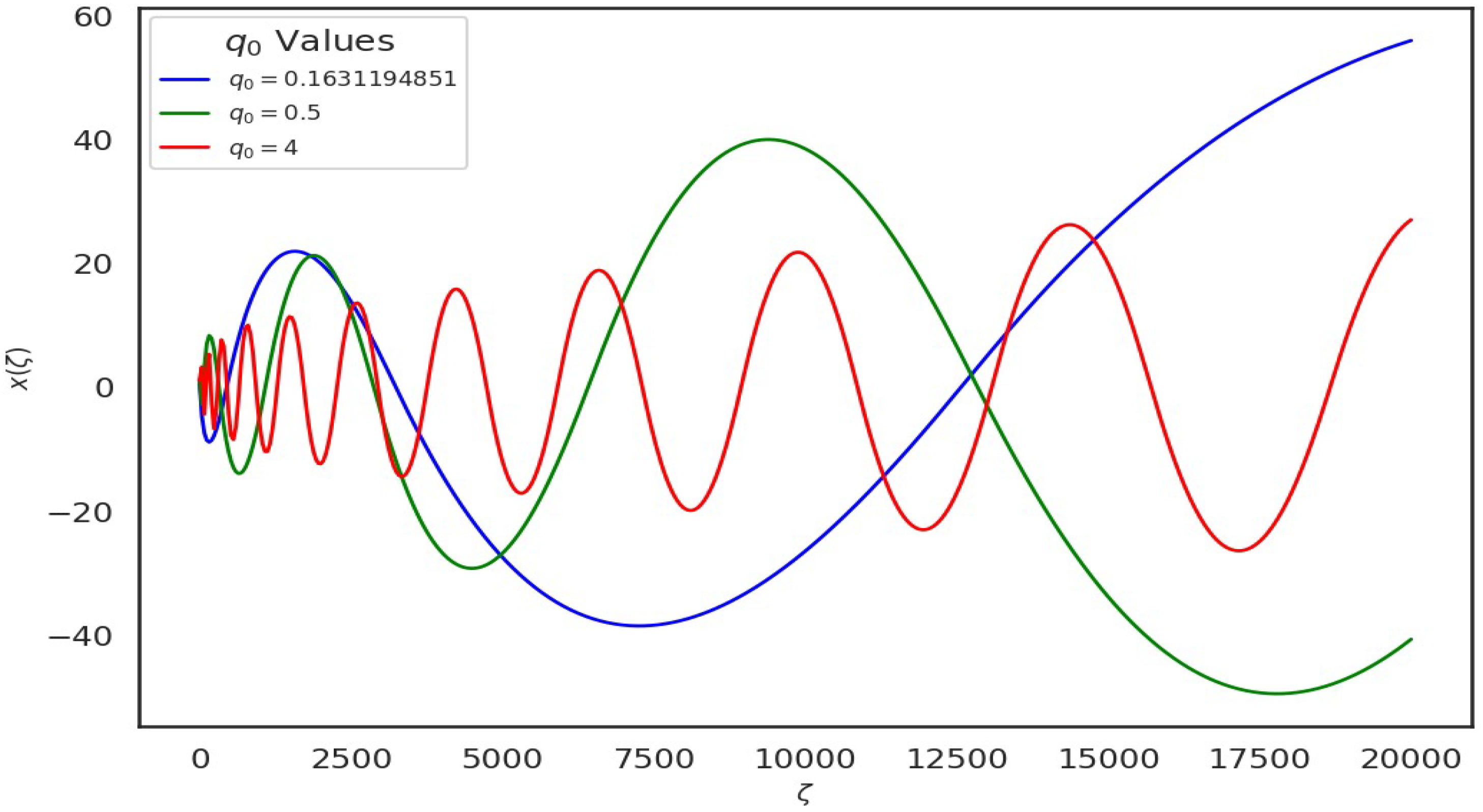
The established criteria related to the oscillation of (37) based on comparison with a first-order delay differential equation (see, e.g., [26], Theorem 2) gives and condition (23) in [34] gives . This indicates that our results provide more effective oscillation criteria for (37). Figure 1 illustrates solutions of (37) for various values.
Figure 1.
Some solutions of Equation (37).
4. Conclusions
This paper has presented the extensive development of new oscillation criteria for nth-order dynamic equations. Our comprehensive analysis led to the establishment of more effective criteria for oscillation in the case where . Notably, Corollary 2 enhances the results previously reported in [26] and provides improved criteria for delay differential equations compared to those in [30]. Furthermore, we introduced novel and significant findings specifically for the case where , contributing to the advancement of oscillation theory on time scales. These results not only refine existing methodologies but also expand the scope of applications within the field.
It would be interesting to extend this approach to the higher-order half-linear dynamic equation with negative neutral term
Author Contributions
Methodology, A.M.H., S.S.A. and M.B.; Software, A.M.A.; Formal analysis, A.M.H. and S.S.A.; Investigation, A.M.H. and M.B.; Resources, A.M.A. and M.B.; Data curation, S.S.A.; Writing—original draft, A.M.H., S.S.A. and M.B.; Writing—review and editing, A.M.A.; Project administration, A.M.A. All authors have read and agreed to the published version of the manuscript.
Funding
This research was conducted under a project titled “Researchers Supporting Project”, funded by King Saud University, Riyadh, Saudi Arabia under grant number (RSPD2024R533).
Data Availability Statement
The original contributions presented in the study are included in the article, further inquiries can be directed to the corresponding author.
Acknowledgments
The authors present their appreciation to King Saud University for funding this research through Researchers Supporting Project number (RSPD2024R533), King Saud University, Riyadh, Saudi Arabia.
Conflicts of Interest
The authors declare no conflicts of interest.
References
- Hilger, S. Analysis on measure chains—A unified approach to continuous and discrete calculus. Results Math. 1990, 18, 18–56. [Google Scholar] [CrossRef]
- Agarwal, R. Difference Equations and Inequalities: Theory, Methods, and Applications; CRC Press: Boca Raton, FL, USA, 2000. [Google Scholar]
- Bohner, M.; Peterson, A. Dynamic Equations on Time Scales: An Introduction with Applications; Birkhauser: Boston, MA, USA, 2001. [Google Scholar]
- Gopalsamy, K. Stability and Oscillations in Delay Differential Equations of Population Dynamics; Springer Science & Business Media: New York, NY, USA, 2013. [Google Scholar]
- Botros, M.; Ziada, E.; El-Kalla, I.L. Solutions of Fractional differential equations with some modifications of Adomian Decomposition method. Delta Univ. Sci. J. 2023, 6, 292–299. [Google Scholar]
- Agarwal, R.; O’Regan, D.; Saker, S. Oscillation criteria for second-order nonlinear neutral delay dynamic equations. J. Math. Anal. Appl. 2004, 300, 203–217. [Google Scholar] [CrossRef]
- Chen, D. Oscillation and asymptotic behavior for nth-order nonlinear neutral delay dynamic equations on time scales. Acta Appl. Math. 2010, 109, 703–719. [Google Scholar] [CrossRef]
- Moaaz, O.; Dassios, I.; Muhsin, W.; Muhib, A. Oscillation theory for non-linear neutral delay differential equations of third order. Appl. Sci. 2020, 10, 4855. [Google Scholar] [CrossRef]
- Moaaz, O.; Qaraad, B.; El-Nabulsi, R.; Bazighifan, O. New results for kneser solutions of third-order nonlinear neutral differential equations. Mathematics 2020, 8, 686. [Google Scholar] [CrossRef]
- Negi, S.S.; Abbas, S.; Malik, M.; Xia, Y.H. Oscillation Criteria of Special Type Second-Order Delayed Dynamic Equations on Time Scales. Math. Sci. 2018, 12, 25–39. [Google Scholar] [CrossRef]
- Saker, S.; O’Regan, D. New oscillation criteria for second-order neutral functional dynamic equations via the generalized Riccati substitution. Commun. Nonlinear Sci. Numer. Simul. 2011, 16, 423–434. [Google Scholar] [CrossRef]
- Moaaz, O.; Ramos, H.; Awrejcewicz, J. Second-order emden–fowler neutral differential equations: A new precise criterion for oscillation. Appl. Math. Lett. 2021, 118, 107172. [Google Scholar] [CrossRef]
- Grace, S. On the oscillation of higher order dynamic equations. J. Adv. Res. 2013, 4, 201–204. [Google Scholar] [CrossRef][Green Version]
- Grace, S.; Chhatria, G. Oscillation of higher order nonlinear dynamic equations with a nonlinear neutral term. Math. Methods Appl. Sci. 2023, 46, 2373–2388. [Google Scholar] [CrossRef]
- Grace, S.; Agarwal, R.; Kaymakçalan, B.; Sae-Jie, W. Oscillation criteria for second-order nonlinear dynamic equations. Can. Appl. Math. Q. 2008, 16, 59–67. [Google Scholar]
- Yang, Q.; Xu, Z. Oscillation criteria for second order quasilinear neutral delay differential equations on time scales. Comput. Math. Appl. 2011, 62, 3682–3691. [Google Scholar] [CrossRef][Green Version]
- Essam, A.; Moaaz, O.; Ramadan, M.; AlNemer, G.; Hanafy, I. Improved results for testing the oscillation of functional differential equations with multiple delays. AIMS Math. 2023, 8, 28051–28070. [Google Scholar] [CrossRef]
- Almarri, B.; Moaaz, O.; Abouelregal, A.; Essam, E. New Comparison Theorems to Investigate the Asymptotic Behavior of Even-Order Neutral Differential Equations. Symmetry 2023, 15, 1126. [Google Scholar] [CrossRef]
- Chatzarakis, G.; Elabbasy, E.; Bazighifan, O. An oscillation criterion in 4th-order neutral differential equations with a continuously distributed delay. Adv. Differ. Equ. 2019, 336. [Google Scholar]
- Moaaz, O.; Park, C.; Muhib, A.; Bazighifan, O. Oscillation criteria for a class of even-order neutral delay differential equations. Mathematics 2020, 63, 607–617. [Google Scholar] [CrossRef]
- Santra, S.; Sethi, A.; Moaaz, O.; Khedher, K.; Yao, S. New oscillation theorems for second-order differential equations with canonical and non-canonical operator via riccati transformation. Mathematics 2021, 9, 1111. [Google Scholar] [CrossRef]
- Zhang, C.; Agarwal, R.; Bohner, M.; Li, T. Oscillation of second-order nonlinear neutral dynamic equations with noncanonical operators. Bull. Malays. Math. Sci. Soc. 2015, 38, 761–778. [Google Scholar] [CrossRef]
- Alzabut, J.; Agarwal, R.; Grace, S.; Jonnalagadda, J. Oscillation results for solutions of fractional-order differential equations. Fractal Fract. 2022, 6, 466. [Google Scholar] [CrossRef]
- Chatzarakis, G.; Logaarasi, K. Forced oscillation of impulsive fractional partial differential equations. Partial Differ. Equ. Appl. Math. 2023, 7, 100478. [Google Scholar] [CrossRef]
- Yoshida, N. Oscillation Theory of Partial Differential Equations; World Scientific: Singapore, 2008. [Google Scholar]
- Baculíková, B.; Džurina, J. Oscillation theorems for second-order nonlinear neutral differential equations. Comput. Math. Appl. 2011, 62, 4472–4478. [Google Scholar] [CrossRef]
- Baculíková, B.; Džurina, J.; Graef, J. On the oscillation of higher-order delay differential equations. J. Math. Sci. 2012, 187, 387–400. [Google Scholar] [CrossRef]
- Džurina, J. Oscillation theorems for second order advanced neutral differential equations. Tatra Mt. Math. Publ. 2011, 48, 61–79. [Google Scholar] [CrossRef]
- Saker, S. Oscillation criteria of second-order half-linear dynamic equations on time scales. J. Comput. Appl. Math. 2005, 177, 375–387. [Google Scholar] [CrossRef]
- Xu, R.; Meng, F. Oscillation criteria for second order quasi-linear neutral delay differential equations. Appl. Math. Comput. 2007, 192, 216–222. [Google Scholar] [CrossRef]
- Agarwal, R.; Bohner, M. Basic calculus on time scales and some of its applications. Results Math. 1999, 35, 3–22. [Google Scholar] [CrossRef]
- Erbe, L.; Karpuz, B.; Peterson, A. Kamenev-type oscillation criteria for higher-order neutral delay dynamic equations. Int. J. Differ. Equ. 2011, 6, 1–16. [Google Scholar]
- Karpuz, B. Comparison tests for the asymptotic behaviour of higher-order dynamic equations of neutral type. Forum Math. 2015, 27, 2759–2773. [Google Scholar] [CrossRef]
- Grace, S.; Džurina, J.; Jadlovská, I.; Li, T. An improved approach for studying oscillation of second-order neutral delay differential equations. J. Inequalities Appl. 2018, 2013, 1–13. [Google Scholar] [CrossRef]
Disclaimer/Publisher’s Note: The statements, opinions and data contained in all publications are solely those of the individual author(s) and contributor(s) and not of MDPI and/or the editor(s). MDPI and/or the editor(s) disclaim responsibility for any injury to people or property resulting from any ideas, methods, instructions or products referred to in the content. |
© 2025 by the authors. Licensee MDPI, Basel, Switzerland. This article is an open access article distributed under the terms and conditions of the Creative Commons Attribution (CC BY) license (https://creativecommons.org/licenses/by/4.0/).