Abstract
This paper proposes new iterative algorithms by using the generalized viscosity implicit midpoint rule in Banach space, which is also a symmetric space. Then, this paper obtains strong convergence conclusions. Moreover, the results generalize the related conclusions of some researchers. Finally, this paper provides some examples to verify these conclusions. These conclusions further extend and enrich the relevant theory of symmetric space.
1. Introduction
Definition 1
([1]). Let be real Banach space and be the dual space. is called the normalized duality mapping and defined by
Definition 2
([2]). Let be the nonempty set of and for any .
- (1)
- If , then is called nonexpansive mapping. Let denote the fixed point set of .
- (2)
- If , , then is called contractive mapping.
Definition 3
([3]). Let be the nonempty set of and for any .
- (1)
- If there exists such that , then is called accretive operator.
- (2)
- For any , if , then is called m-accretive operator.
- (3)
- For any , if , then is called the resolvent of m-accretive operator .
It is well known that is nonexpansive mapping, and the fixed point set of is the zero set of accretive operator . Then the fixed point theory of nonexpansive mapping was used to solve the zero point problem of the accretive operator; see [1,2,3,4,5,6] and the references therein. It is well known that the implicit midpoint rule is a useful method for solving ordinary differential equations. Meanwhile, the viscosity iterative algorithm is very useful for finding solutions for variational inequality problems and the common fixed point of nonlinear operators; see [7,8,9,10,11,12,13,14] and the references therein.
Chang et al. [1] introduced the viscosity iterative algorithm for nonexpansive mapping and accretive operators, in 2009, as shown below.
Jung [15] proposed the following algorithm, in 2016:
He proved that converged strongly to . The results generalized related conclusions.
is a real reflexive Banach space with a uniformly Gâteaux differentiable norm and is a nonempty closed convex subset of . Li [16] proposed a new iterative algorithm in 2017 and obtained strong convergence results:
In the Hilbert space, Xu et al. [17] proposed the viscosity implicit midpoint rule:
Under certain conditions of , they found that converged strongly to , and was the solution of variational inequality .
Luo et al. [18] extended the conclusions of Xu [17] from the Hilbert space to a uniformly smooth Banach space, in 2017:
Under certain conditions of , they found that converged strongly to , and was the solution of variational inequality .
In the Hilbert space, Ke et al. [19] introduced the generalized viscosity implicit rule for nonexpansive mapping:
Under some conditions of and , they found that converged strongly to , and was the solution of variational inequality .
In 2018, Zhang et al. [20] proposed two iterative algorithms by using the viscosity implicit midpoint rule in Banach space:
Under some conditions of , and , they found that converged strongly to , and was the solution of variational inequality .
In Banach space, Zhang et al. [21] proposed an iterative algorithm by using the generalized viscosity implicit midpoint rule, in 2019:
Under some conditions of , , and , they found that converged strongly to , and was the solution of variational inequality .
On the basis of the above research, this paper proposes new iterative algorithms by using the generalized viscosity implicit midpoint rule in Banach space to obtain a strong convergence conclusion. The results extend the previous results. In the end, this paper provides some examples to verify these conclusions.
2. Preliminaries
Definition 4
([20]). is called uniformly convex, if there exists such that , where , , . is a strictly increasing convex and continuous function with . If g satisfies
then the Banach space is uniformly convex.
Definition 5
([22]). is a nonempty set. If the distance function satisfies , , then is symmetric. endowed with metric forms a symmetric space.
It is well known that the Banach space has symmetry.
Definition 6
([23]). For any and , if exists, then has a Gâteaux differentiable norm. For any , has a uniformly Gâteaux differentiable norm, if is attained uniformly for .
As we all know, if has a uniformly Gâteaux differentiable norm, so is single valued and norm-to-weak* uniformly continuous on any bounded subset of ; see [23].
Definition 7
([20]). For any bounded closed convex subset of , where is a closed convex subset of , and has at least two points and denotes the diameter of . If there exists no diametral point, such that , so has normal structure.
In order to prove the conclusions of this paper, we require the following lemmas.
Lemma 1
([24]). Assume that for any and ,
Lemma 2
([25]). Let be three non-negative real sequences and satisfy
where . If , and , then .
Lemma 3
([4,26]). Assume that is the real reflexive Banach space which has a uniformly Gâteaux differentiable norm, is the nonempty closed convex subset of with normal structure, is the fixed contraction with and is the nonexpansive mapping which has a fixed point. For , is defined by
So strongly converges to , which is the only solution of the variational inequality
Lemma 4
([2]). Let be the Banach space and for , there exists
3. Results
Theorem 1.
Assume that is a reflexive and uniformly convex Banach space with a uniformly Gâteaux differentiable norm, is a nonempty closed convex subset of with normal structure. is contractive mapping with , is the m-accretive operator in and is the nonexpansive mapping with . For any and , is generated by
where and satisfy the following conditions:
- (i)
- ;
- (ii)
- , , ;
- (iii)
- , .
Then and strongly converge to which is the only one solution of variational inequality , .
Proof.
The proof process is divided into eleven steps.
- Step 1: Show the boundedness of and .
Taking , then we obtain
and then we obtain
It follows that
Then is bounded. So , , , , , and are also bounded.
- Step 2: Show that .
From (2), we obtain
From (2), we obtain
From Lemma 1, we obtain
Taking (4) and (5) into (3), we have
It follows that
where and .
Taking , then . From , so .
Taking . From , so , where . From and , so .
From Lemma 2, we have .
- Step 3: Show that .
From (1) and is a convex function, then we find
It follows that
Then we have
If , so from and the boundedness of , we find .
If , so
Then
So we have
and then .
From the property of , so we find .
We also have
From step 2, we have .
- Step 4: Show that .
From (2), we find
From steps 2 and step 3, the boundedness of and , and , we have .
- Step 5: Show that .
From (2), we find
From step 2 and step 4, and the boundedness of and , we have .
- Step 6: Show that .
Using the results of step 3 and 5, we obtain
So we have .
- Step 7: Show that .
Using the results of step 4 and 5, we obtain
So we have .
- Step 8: Show that .
Using the results of step 6 and Lemma 1, we obtain
From , we get .
- Step 9: Show that .
Using the results of step 5 and step 8, we obtain
So we have .
- Step 10: Show that .
Let be defined by . From Lemma 3, we find that strongly converges to , and is also the unique solution of the variational inequality , .
We have
It follows that . According to step 7, we find .
- Step 11: Show that .
According to Lemma 4, we obtain
It follows that
Taking . From , we have
From , we obtain .
Taking , then we have
From and step 10, we obtain .
Let , so we have .
According to Lemma 2, we have .
We also have
From step 5, we find . This completes the proof. □
Theorem 2.
Assume that is a reflexive and uniformly convex Banach space with uniformly Gâteaux differentiable norm, is nonempty closed convex subset of with normal structure. is contractive mapping with , is an m-accretive operator in and is nonexpansive mapping with . For any and , is generated by
where and satisfy some conditions:
- (i)
- ;
- (ii)
- ,,;
- (iii)
- ,;
- (iv)
- .
Then and strongly converge to which is the only solution of variational inequality , .
Proof.
Let
Then we have
It follows that
Taking , then . From , we have .
Let , so we have .
According to Lemma 2, we have . According to Theorem 1, we find that and strongly converge to which is the only solution of variational inequality , . Then and also strongly converge to . This completes the proof. □
Theorem 3.
Assume that is a reflexive and uniformly convex Banach space with a uniformly Gâteaux differentiable norm, is a nonempty closed convex subset of with normal structure. is contractive mapping with , is an m-accretive operator in and is nonexpansive mapping with . For any and , is generated by
where and satisfy some conditions:
- (i)
- ;
- (ii)
- , , ;
- (iii)
- , ;
- (iv)
- .
Then and strongly converge to which is the only solution of variational inequality , .
Proof.
The proof process is divided into eleven steps.
- Step 1: Show the boundedness of and .
Taking , then we obtain
and then we obtain
It follows that
Then is bounded. So , , , , , and are also bounded.
- Step 2: Show that .
According to (6), we find
From (6), we obtain
From Lemma 1, we have
Taking (8) and (9) into (7), we have
It follows that
where , .
Taking , then . From , so .
Let , then
.
From , , and , so .
According to Lemma 2, so we have .
- Step 3: Show that .
From (1) and is a convex function and, then we obtain
It follows that
Then we have
If
so from , step 1 and , we have .
If
so
Then
So we have
and then .
According to the property of , we obtain .
We also have
According to and step 2, we have .
- Step 4: Show that .
From (6), we obtain
From step 1, step 2 and step 3, and , we have .
- Step 5: Show that .
Using the results of step 2 and step 4, we obtain
According to and the boundedness of and , we have .
- Step 6: Show that .
Using the results of step 3 and step 5, we obtain
So we have .
- Step 7: Show that .
Using the results of step 4 and step 5, we obtain
So we have .
- Step 8: Show that .
Using the results of step 6 and Lemma 1, we obtain
From , we have .
- Step 9: Show that .
Using the results of step 5 and step 8, we obtain
So we have .
- Step 10: Show that .
According to Theorem 1, we find that strongly converges to which is the only solution of variational inequality , .
We obtain
It follows that . According to step 1 and step 7, we have .
- Step 11: Show that .
According to Lemma 4, we obtain
It follows that
Taking . From , we have
From , we obtain .
Taking , then we have
From and step 10, we obtain .
Let , then , where . From the boundedness of , and and , we obtain .
According to Lemma 2, we have .
We also have
From step 5, we obtain . This completes the proof. □
4. Numerical Examples
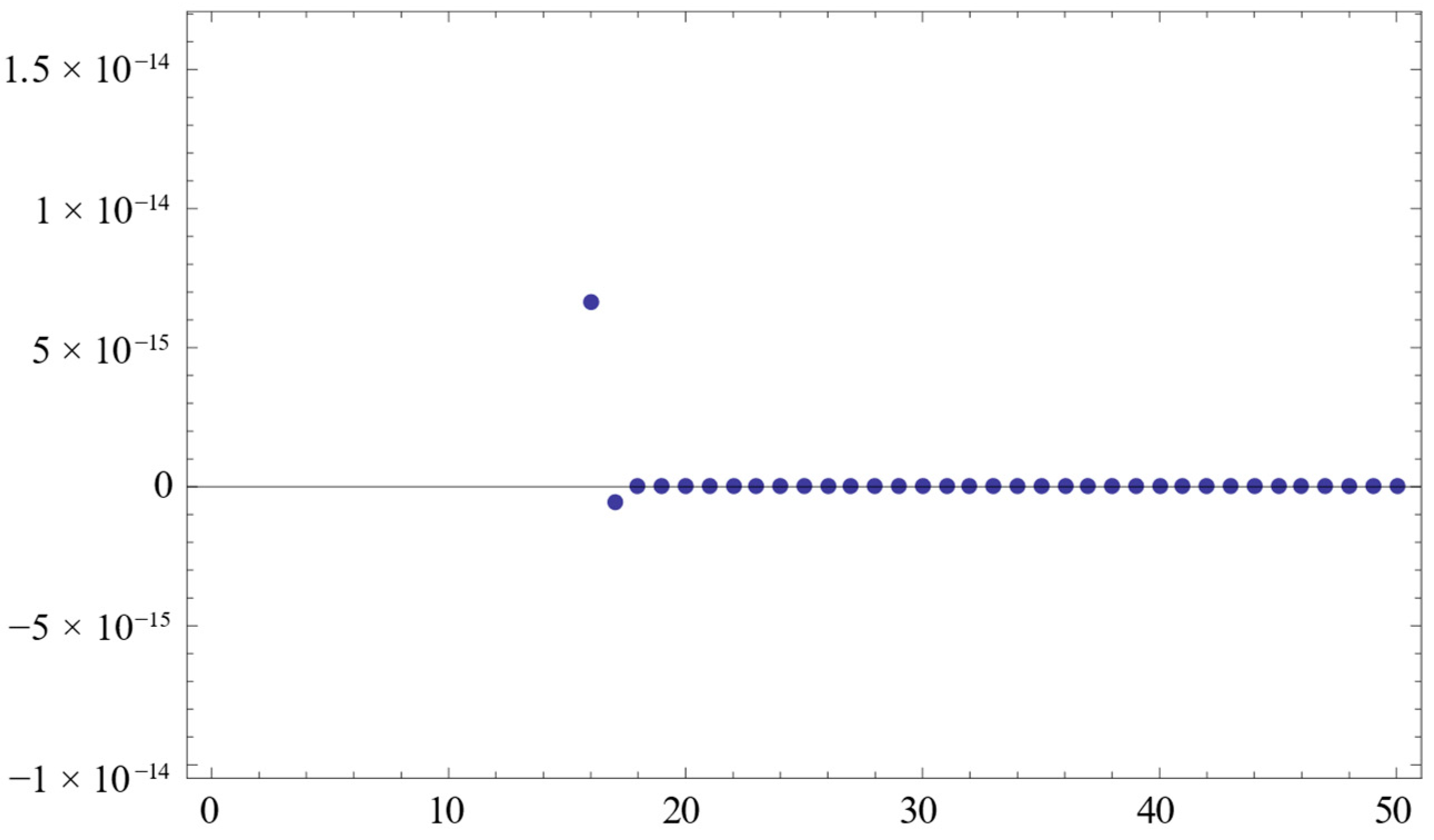
We provide some numerical examples to verify conclusions.
Example 1.
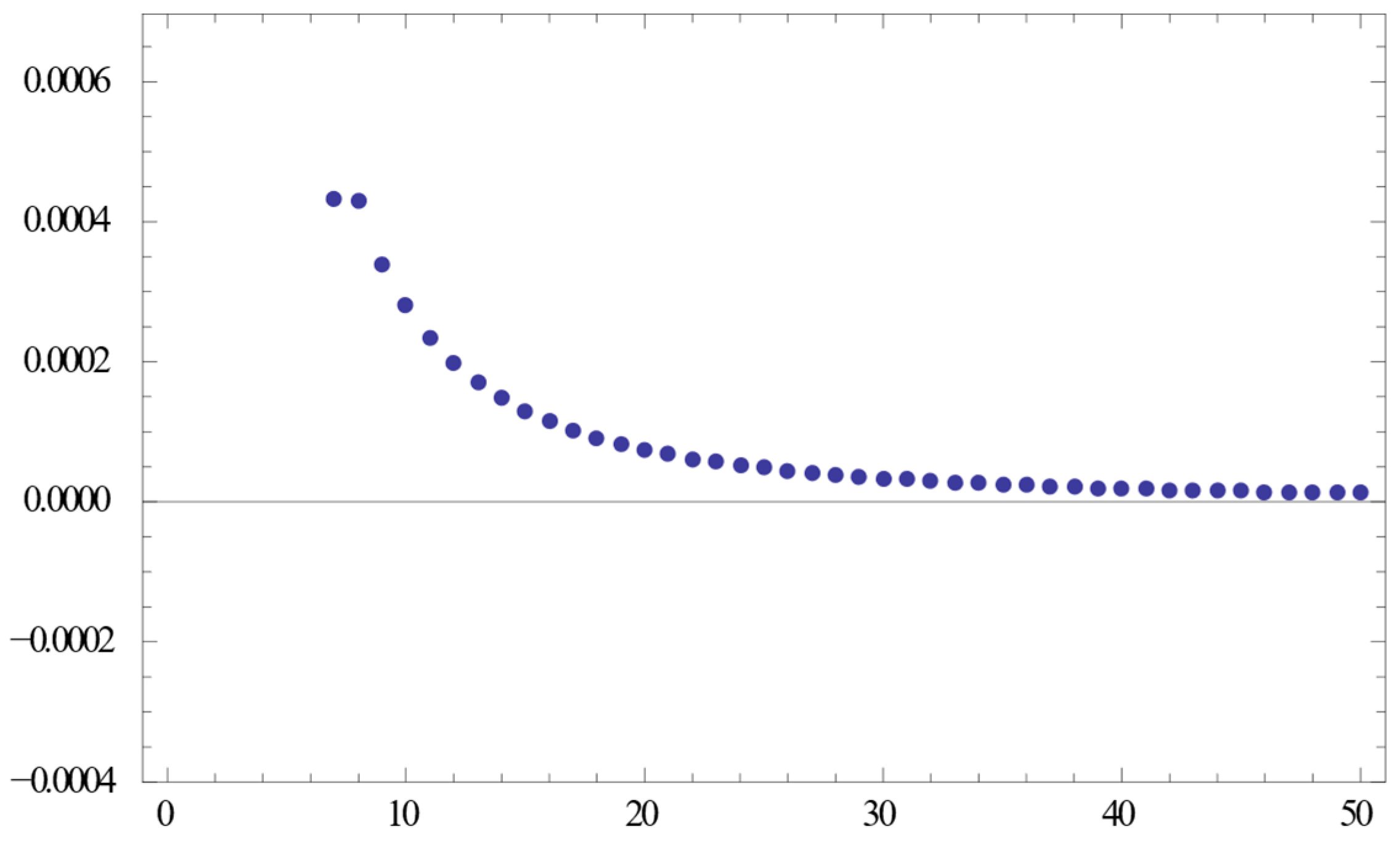
For any , assume , and , then . Assume , and . From Theorem 1, they satisfy these conditions. is generated by (2). So we find that strongly converges to 0.
From (2), we have
Let in (10) and then we obtain the desired results; see Figure 1.
Figure 1.
Numerical results.
Example 2.
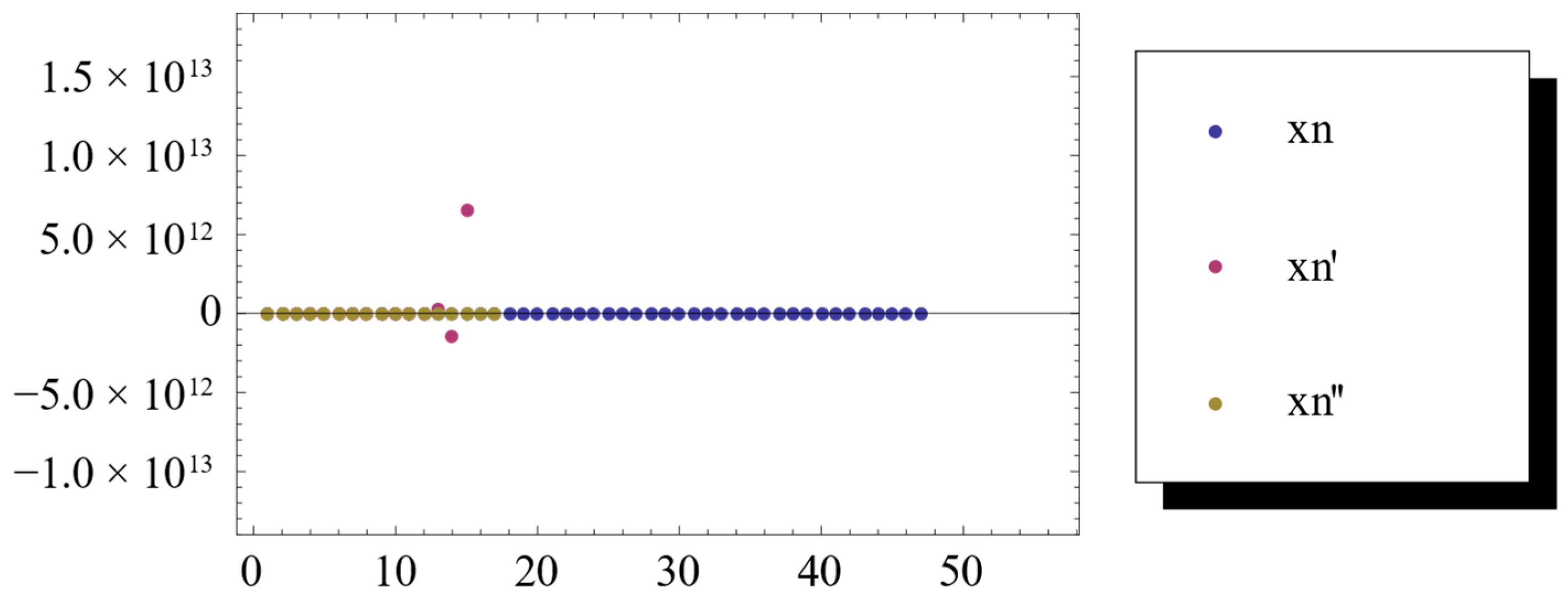
For any , assume , and , then . Assume , , and . From Theorem 3, they satisfy these conditions. is generated by (6). So we find that strongly converges to 0.
From (6), we have
Next, let in (11) and then we obtain the desired results; see Figure 2.
Figure 2.
Numerical results.
Example 3.
The inner product is defined by
The usual norm is defined by
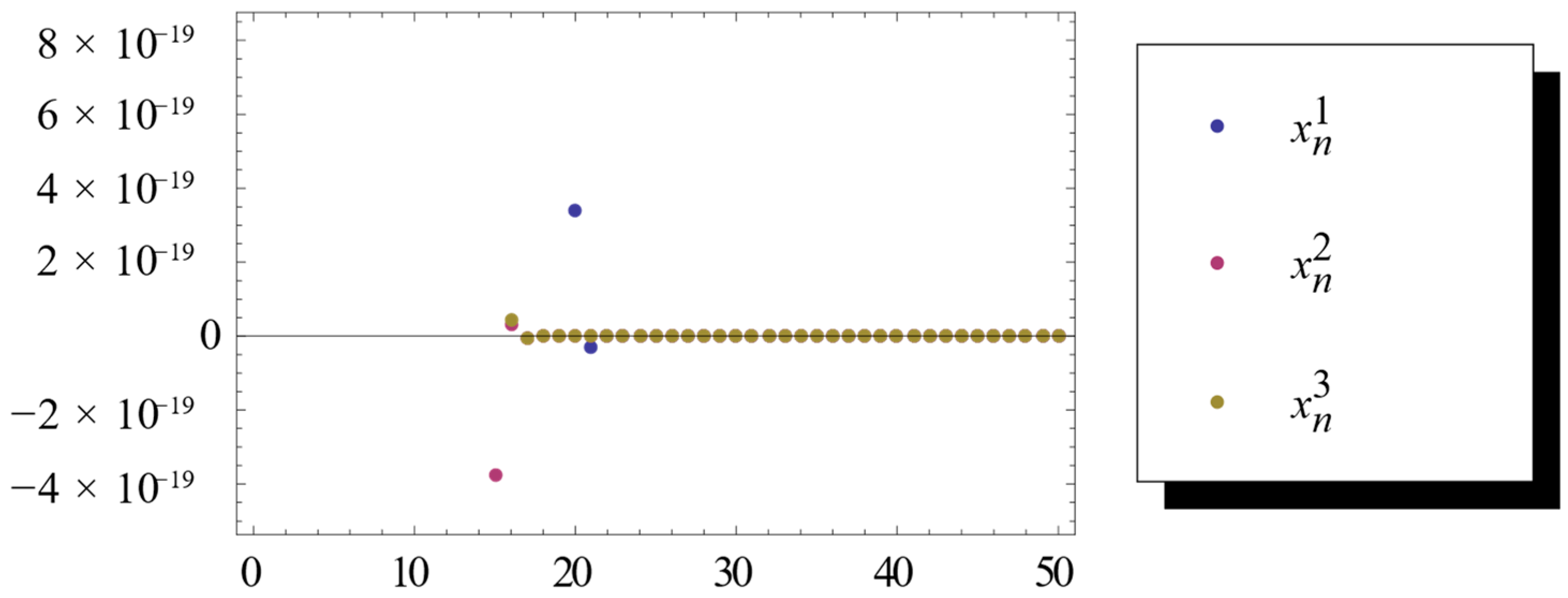
For any , assume , and , then . Assume , and . From Theorem 1, they satisfy these conditions. is generated by (2). So we find that strongly converges to 0.
From (2), we have
Let in (12) and then we obtain the desired results; see Figure 3.
Figure 3.
Numerical results.
Example 4.
The inner product is defined by
The usual norm is defined by
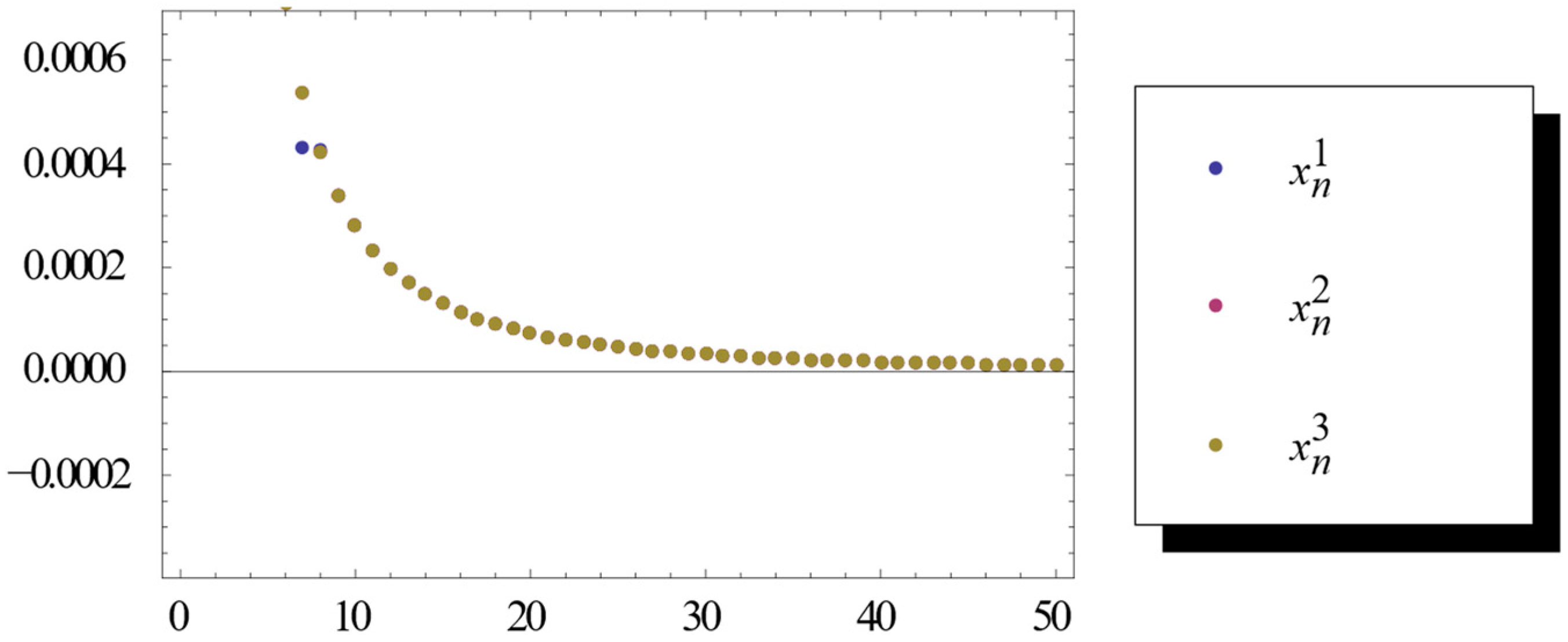
For any , assume , and , then . Assume , , and . From Theorem 3, they satisfy these conditions. is generated by (6). So we find that strongly converges to 0.
From (6), we have
Let in (13) and then we obtain the desired results; see Figure 4.
Figure 4.
Numerical results.
Example 5.
Let be generated by Example 1. is generated by
is generated by
And assume most of the conditions of Example 1 are satisfied except , and , so we obtain
and
Figure 5.
Numerical results.
Figure 5 shows that iterative algorithm (2) has a faster convergence speed than the algorithm of Zhang [20,21]. The stability and effectiveness of iterative algorithm (2) are also better than the algorithm of Zhang [20,21].
5. Conclusions
In the paper, we propose a new iterative algorithm by using the generalized viscosity implicit midpoint rule and Banach space, which is also a symmetric space. Under some conditions, we find that the sequence strongly converges to a common point of the fixed point set of nonexpansive mapping and the zero point set of the accretive operator. Our work extends the results of Xu [17], Luo [18], Ke [19], Zhang [20] and Zhang [21]. In the end, we give five numerical examples and show that our algorithm can achieve faster convergence speed, stability and effectiveness. This work further extends and enriches the relevant theory of symmetric space. In this paper, we considered extending nonexpansive mapping to more general mappings, and will continue to research this issue to find better iterative algorithms.
Funding
This research received no external funding.
Data Availability Statement
Data are contained within the article.
Conflicts of Interest
The author declares no conflicts of interest.
References
- Chang, S.S.; Lee, H.W.J.; Chan, C.K. Strong convergence theorems by viscosity approximation methods for accretive mappings and nonexpansive mappings. J. Appl. Math. Inform. 2009, 27, 59–68. [Google Scholar]
- Jung, J.S.; Cho, Y.J.; Zhou, H.Y. Iterative processes with mixed errors for nonlinear equations with perturbed m-accretive operators in Banach spaces. Appl. Math. Comput. 2002, 133, 389–406. [Google Scholar] [CrossRef]
- Moudafi, A. Viscosity approximation methods for fixed points problems. J. Math. Anal. Appl. 2000, 241, 46–55. [Google Scholar] [CrossRef]
- Qin, X.L.; Cho, S.Y.; Wang, L. Iterative algorithms with errors for zero points of m-accretive Operators. Fixed Point Theory Appl. 2013, 2013, 148. [Google Scholar] [CrossRef]
- Reich, S. Approximating zeros of accretive operators. Proc. Am. Math. Soc. 1975, 51, 381–384. [Google Scholar] [CrossRef]
- Reich, S. On fixed point theorems obtained from existence theorems for differential equations. J. Math. Anal. Appl. 1976, 54, 26–36. [Google Scholar] [CrossRef]
- Auzinger, W.; Frank, R. Asymptotic error expansions for stiff equations: An analysis for the implicit midpoint and trapezoidal rules in the strongly stiff case. Numer. Math. 1989, 56, 469–499. [Google Scholar] [CrossRef]
- Bader, G.; Deuflhard, P. A semi-implicit mid-point rule for stiff systems of ordinary differential equations. Numer. Math. 1983, 41, 373–398. [Google Scholar] [CrossRef]
- Deuflhard, P. Recent progress in extrapolation methods for ordinary differential equations. SIAM Rev. 1985, 27, 505–535. [Google Scholar] [CrossRef]
- Schneider, C. Analysis of the linearly implicit mid-point rule for differential-algebra equations. Electron. Trans. Numer. Anal. 1993, 1, 1–10. [Google Scholar]
- Somalia, S. Implicit midpoint rule to the nonlinear degenerate boundary value problems. Int. J. Comput. Math. 2002, 79, 327–332. [Google Scholar] [CrossRef]
- Van Veldhuxzen, M. Asymptotic expansions of the global error for the implicit midpoint rule (stiff case). Computing 1984, 33, 185–192. [Google Scholar] [CrossRef]
- Hammad, H.A.; ur Rehman, H.; De la Sen, M. Accelerated modified inertial Mann and viscosity algorithms to find a fixed point of α—Inverse strongly monotone operators. AIMS Math. 2021, 6, 9000–9019. [Google Scholar] [CrossRef]
- Hammad, H.A.; ur Rehman, H.; Kattan, D.A. Strong convergence for split variational inclusion problems under hybrid algorithms with applications. Alex. Eng. J. 2024, 87, 350–364. [Google Scholar] [CrossRef]
- Jung, J.S. Strong convergence of an iterative algorithm for accretive operators and nonexpansive mappings. J. Nonlinear Sci. Appl. 2016, 9, 2394–2409. [Google Scholar] [CrossRef]
- Li, D.F. On nonexpansive and accretive operators in Banach spaces. J. Nonlinear Sci. Appl. 2017, 10, 3437–3446. [Google Scholar] [CrossRef]
- Xu, H.K.; Alghamdi, M.A.; Shahzad, N. The viscosity technique for the implicit midpoint rule of nonexpansive mappings in Hilbert spaces. Fixed Point Theory Appl. 2015, 2015, 41. [Google Scholar] [CrossRef]
- Luo, P.; Cai, G.; Shehu, Y. The viscosity iterative algorithms for the implicit midpoint rule of nonexpansive mappings in uniformly smooth Banach spaces. J. Inequal. Appl. 2017, 2017, 154. [Google Scholar] [CrossRef] [PubMed]
- Ke, Y.F.; Ma, C.F. The generalized viscosity implicit rules of nonexpansive mappings in Hilbert spaces. Fixed Point Theory Appl. 2015, 2015, 190. [Google Scholar] [CrossRef]
- Zhang, H.C.; Qu, Y.H.; Su, Y.F. Strong convergence theorems for fixed point problems for nonexpansive mappings and zero point problems for accretive operators using viscosity implicit midpoint rules in Banach spaces. Mathematics 2018, 6, 257. [Google Scholar] [CrossRef]
- Zhang, H.C.; Qu, Y.H.; Su, Y.F. The generalized viscosity implicit midpoint rule for nonexpansive mappings in Banach space. Mathematics 2019, 7, 512. [Google Scholar] [CrossRef]
- Filali, D.; Ali, F.; Akram, M.; Dilshad, M. A Novel Fixed-Point Iteration Approach for Solving Troesch’s Problem. Symmetry 2024, 16, 856. [Google Scholar] [CrossRef]
- Reich, S. On the asymptotic behavior of nonlinear semigroups and the range of accretive operators. J. Math. Anal. Appl. 1981, 79, 113–126. [Google Scholar] [CrossRef]
- Barbu, V. Nonlinear Semigroups and Differential Equations in Banach Spaces; Editura Academiei Republicii Socialiste Romania; Springer: Dordrecht, The Netherlands, 1976; Volume 2, pp. 1–6. [Google Scholar]
- Liu, L.S. Ishikawa and Mann iterative process with errors for nonlinear strongly accretive mappings in Banach spaces. J. Math. Anal. Appl. 1995, 194, 114–125. [Google Scholar] [CrossRef]
- Reich, S. Strong convergence theorems for resolvents of accretive operators in Banach spaces. J. Math. Anal. Appl. 1980, 75, 287–292. [Google Scholar] [CrossRef]
Disclaimer/Publisher’s Note: The statements, opinions and data contained in all publications are solely those of the individual author(s) and contributor(s) and not of MDPI and/or the editor(s). MDPI and/or the editor(s) disclaim responsibility for any injury to people or property resulting from any ideas, methods, instructions or products referred to in the content. |
© 2024 by the author. Licensee MDPI, Basel, Switzerland. This article is an open access article distributed under the terms and conditions of the Creative Commons Attribution (CC BY) license (https://creativecommons.org/licenses/by/4.0/).