1. Introduction
Spectral graph theory plays a crucial role in numerous domains by providing innovative methods and frameworks for different methodologies such as algebra, geometry, computational mathematics, decision theory, optimization, social systems, computer science, and topology. A graph is an ordered pair
, where
is referred to as a vertex set and
referred to as edge set. Graphs with directed edges are directed graphs or digraphs and are expressed as
,
are referred as order and size of
, which play a crucial role in various fields including computational science, regulatory theory, game theory, systems biology, etc., due to their wide range of applications and valuable insights. They can be used to model direct relationships in networks like social networks, data flow, transportation systems, communication networks, supply chains, etc. They can help to provide insides into the structure to optimize and analyze these systems. There are various algorithms that use the concept of digraphs, such as Tarjan’s algorithm for computing strongly connected components of a digraph, the Dijkstra algorithm for computing the shortest path, and the Ford–Fulkerson algorithm for computing the maximum flow, etc. Many terminologies and concepts have been proposed and extended for digraphs [
1,
2,
3,
4,
5,
6,
7,
8]. A digraph
is simple if it has no loops or multiple diedges, and is connected if there is a dipath between every two vertices. Throughout this article, we investigate only finite, simple, and unweighted digraphs.
If diedge
, or
, then we say
and
are adjacent. For
, the set of doubly adjacent vertices is given as
The bijection between graph and symmetric digraph is denoted as . This indicates , and associates with symmetric diedges and . Due to this bijection, a simple and connected graph is considered to be a symmetric digraph. It is to be mentioned that, as the adjacency matrix of a simple connected graph is symmetric, so all of its eigenvalues must be real.
For a digraph
, we can express the adjacency matrix
as
A digraph is referred to as bipartite if , such that if , then and .
The degree of
is expressed as
where
is indegree and
is outdegree. A bipartite digraph is
semiregular bipartite digraph, or simply a bipartite semiregular digraph, if
The
and
are the sequences of indegrees and outdegrees of
, respectively. The energy of a digraph is computed as:
The largest absolute value of the eigenvalue of a digraph is referred to as spectral radius, computed as
, such that
refers to an eigenvalue. Gudiño and Rada [
6] proposed the lower bound of digraph
, where regular graphs satisfied the equality. Furthermore, in [
9], a lower bound of
in terms of
is estimated as
, such that regular graphs or semiregular bipartite graphs attained the equality. Recently, in [
10], a sequence of bounds of the
was proposed with the help of the already-established lower bounds of
.
Gutman, in [
11], described the energy of a graph as
where
are eigenvalues. More information about
can be found in [
11,
12,
13,
14], and related to
in [
15]. The energy of digraph
is described in [
13] as
where
refers to real part of eigenvalue
.
McClelland inequality is illustrated by Rada [
11] as
where equality is achieved iff
can be expressed as the direct sum of
copies of
.
In [
6], the energy and spectral radius are related as
In [
6], for
, Equation (
4) becomes
Here, equality is achieved in case or , with being or .
In [
9], the upper bound of
is given as
Equality in Equation (
6) is satisfied iff
with
is
or
. In [
10], the bounds in terms of sequence for
are estimated:
Inspired and motivated by the work already performed in [
9,
16,
17], we seek to derive a more refined sequence of bounds for
and
.
2. Spectral Radius of Digraph
The adjacency spectral radius is pivotal in examining the flow dynamics of digraphs, providing important insights into the structure to determine the most efficient paths for transmitting information. Through the study of spectral radius, a more optimized system for communication transportation and other network-driven activities can be designed. We can say that spectral radius can be a powerful tool for improving the reliability and efficiency of digraph-based systems.
We can construct a sequence for as , and , for all 1.
Remark 1. The geometric symmetrization of is , such thatwhere . It is easy to see that the following are satisfied for a digraph with adjacency matrix :
- 1.
, for each vertex and .
- 2.
.
- 3.
[18].
Remark 2. For a digraph , we can write Lemma 1. Let be the sequence as expressed in Equation (8). Then, , we have Proof. It is easy to see that
for
By leveraging the Cauchy–Schwarz inequality, we can rewrite Equation (
9) as
From Equation (
10) and Remark 1, we have
Hence, .
This indicates that is increasing. □
Lemma 2. For in Equation (8), . Proof. The result follows by adopting the same line of reasoning as used in proving Proposition 4 of [
19]. □
Theorem 1. For a digraph having at least one doubly adjacent vertex, and the sequence as expressed in Equation (8), we have1. Here, the necessary and sufficient conditions for equality to behold in Equation (11) is { Cycle}, such that every of is one of the following: - (i).
k-regular;
- (ii).
semiregular bipartite.
This satisfies .
Proof. Applying Rayleigh–Ritz theorem gives us
where
Hence, the result. Moreover, for equality to be satisfied in Equation (
11), we must have
Here, for , c is positive eigenvector of corresponding to , which implies that the multiplicity of is either one or two. This leads to three cases.
Case 1. Assume that
is strongly connected. This shows that
is irreducible. Since
, and using Corollary 2.1.5 from [
20], we can reduce that to
, which provides a contradiction. Hence, for equality,
. This implies that
becomes a symmetric matrix. Consequently, all eigenvalues are real. This further shows
is a symmetric digraph, and can be represented as
, such that
is a connected, simple, and unweighted. If
has the one multiplicity, then c is a positive eigenvector of
, corresponding to
. This implies
for each
. Hence,
is
k-regular, satisfying
. If the multiplicity of
is two, then
must be an eigenvalue of
. Hence,
is bipartite ([
21], Theorem 3.5). Now, for the sake of simplicity, we consider that
where
is a matrix of order
. Since c is a positive eigenvector of
corresponding to
, such that
, we obtain
where
. Since
and
, both have the same nonzero eigenvalues, so
is the spectral radius of both
and
with multiplicity one. By using the Equation (
12), we obtain
Hence, and are eigenvectors of and , respectively, corresponding to . Hence, and , where are two positive constants. This implies that is semiregular bipartite, satisfying
Case 2. Suppose
is expressed as direct sum of
with adjacency matrices
of order
satisfying
. Thus, we can write
where all other elements are 0.
Since we assume that the equality in Equation (
11) is to be attained, we can write
By applying Case 1, the required result is attained.
Case 3. Lastly, assume that digraph attained from by discarding those which do not lie on a cycle. Hence, . It can be easily seen that cycle arrangement and coincide. Furthermore, since is the direct sum of , by applying case 2, the eigenvalues of and coincide.
Hence, + { cycle}.
The proof of converse part is straightforward. □
Corollary 1. For the sequences and , corresponding to a digraph with at least one doubly adjacent vertex, we have Here, the necessary and sufficient conditions for equality in Equation (14) is +{ Cycle}, so that every of is either k-regular graph or semi-regular bipartite graph, such that . Corollary 2. For the sequences and , corresponding to a digraph having at least one doubly adjacent vertex, we have Here, the necessary and sufficient conditions for equality to behold in Equation (15) is +{ cycle}, so that every of is either a k-regular graph or a -semi-regular bipartite graph, such that . Remark 3. It is easy to see that the sequence of bounds corresponding to is increasing, Theorem 1 can be illustrated by the following examples.
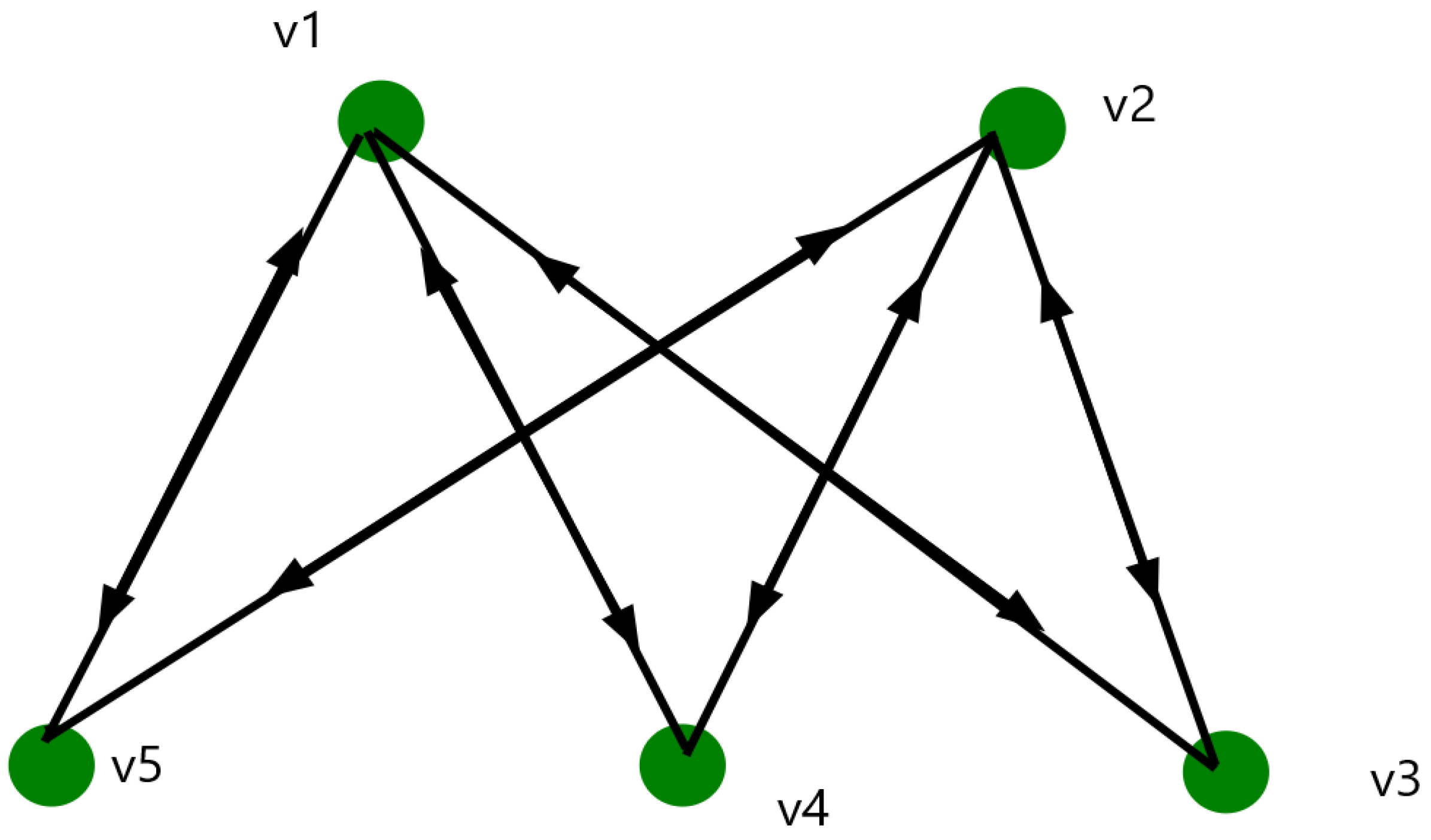
Example 1. Take a digraph semi-regular bipartite digraph () havingwith partition as , where is set of all those vertices having three out-degrees, and is a set of all vertices having two out-degrees, as exhibited in Figure 1. For each vertex, is computed as: Also,or .or . Similarly, we haveor .or . Hence, for j = 1,and for k = 2, On the other hand, by direct computation, . Here, . This shows that our result is compatible with equality to be held in Theorem 1.
Hence, .
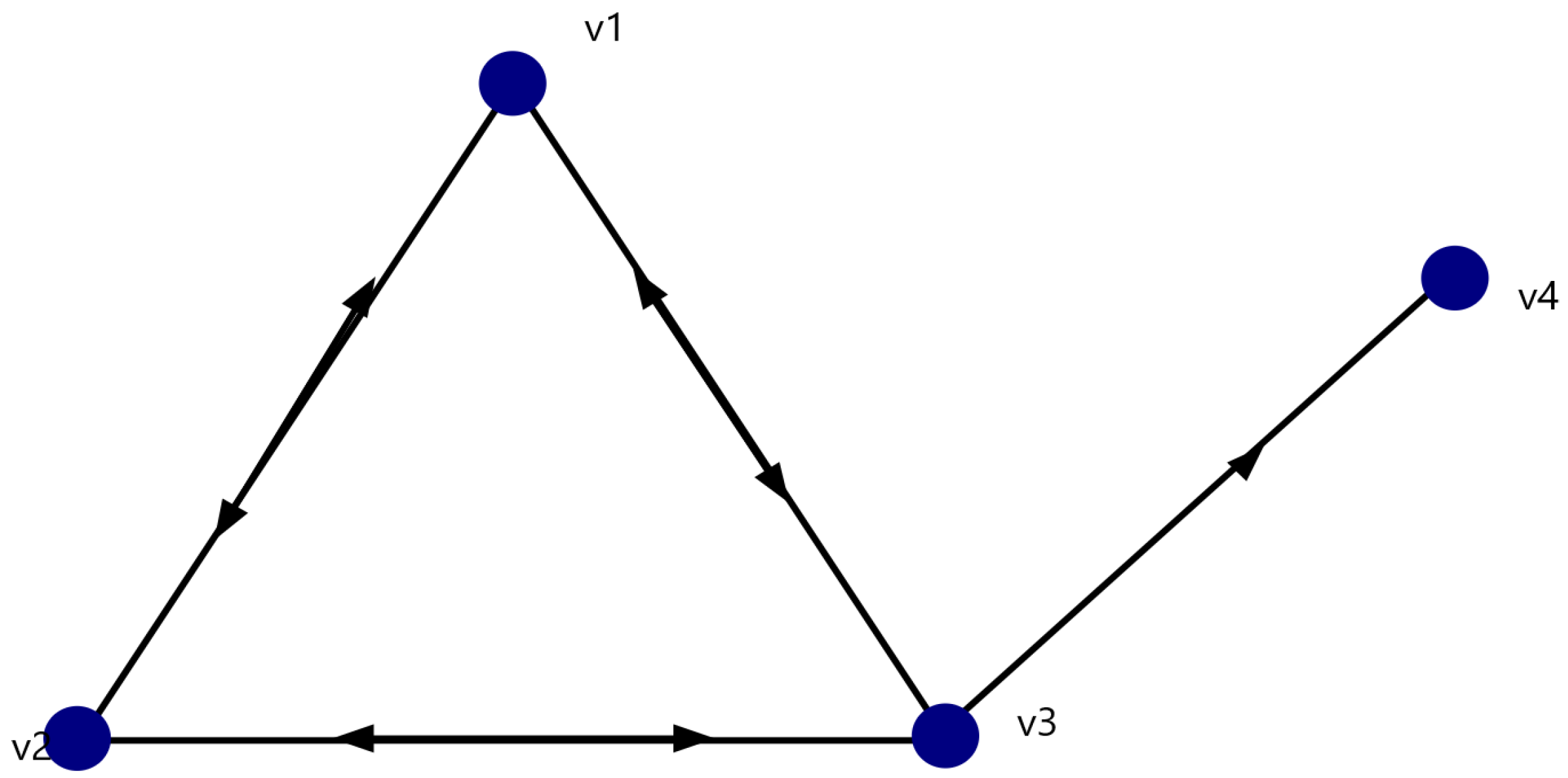
Example 2. Take a digraph , where is a symmetric digraph corresponding to , and is a cycle with , as exhibited in Figure 2. For each vertex, is computed as Also, . Hence, which shows that the equality in Theorem 1 holds.
3. Energy of Digraphs
Digraph energy is important for improving the reliability and efficiency of networks and directed networks. By studying and analyzing the digraph energy, the strength of vertex connectivity can be evaluated, critical pathways can be identified, and optimization of networks can be improved in terms of improving transmission information or increasing resilience to failures. In this section, we drive a sequence of bounds for by leveraging a sequence of bounds of , as computed in the previous section.
The following lemma is fundamental in constructing the upper bounds for .
Lemma 3 ([
11]).
Suppose is a digraph with , . So, we have- 1.
;
- 2.
.
Here, is an eigenvalue.
Theorem 2. Consider the sequence , as expressed in Equation (8), corresponding to a digraph having at least one doubly adjacent vertex. Then,. The necessary and sufficient condition for equality in Equation (17) to be attained is +{ Cycle}, such that of is a complete , or , or a k-regular complete with at least two nontrivial eigenvalues, whose absolute value is . Proof. Since
is adjacency matrix of
,
, and
is highest eigenvalue of
, then
are the real values of eigenvalues
. By Cauchy–Schwarz inequality, we obtain
Applying Lemma 3 (2) gives us
such that
are
. Using Equations (
18) and (
19), we have
Consider a correspondence such that , . It is clear that is strictly increasing in , and decreasing in . Here arise two cases.
Case 1. Assume that
. By Theorem 1 and Equation (
19),
. Since
is strictly decreasing and using Equation (
20), we have
This implies that inequality in Equation (
17) is attained as
Assume the equality in Equation (
17) satisfies that from Equation (
21); we have
, and this implies
.
Hence, from Theorem 1, +{ Cycle}, such that every of is k-regular or a semi-regular bipartite, so that
Hence,
is a symmetric digraph. For a symmetric digraph
, we have
number of
=
=sum of all in-degrees of each vertex. Hence,
If is completely connected, or , then equality is attained directly.
Case 2. Finally, suppose that
. Since sequence
is increasing, we have
As
is increasing in
, therefore
Moreover, for attaining the equality in Equation (
17), we must have
The result follows by adopting the same line of reasoning using the same methodology as used in Theorem 11 in [
10] and Theorem 3.1 in [
17]. It follows satisfied equality. The proof of converse part is straightforward. □
Theorem 2 can be illustrated by the following examples.
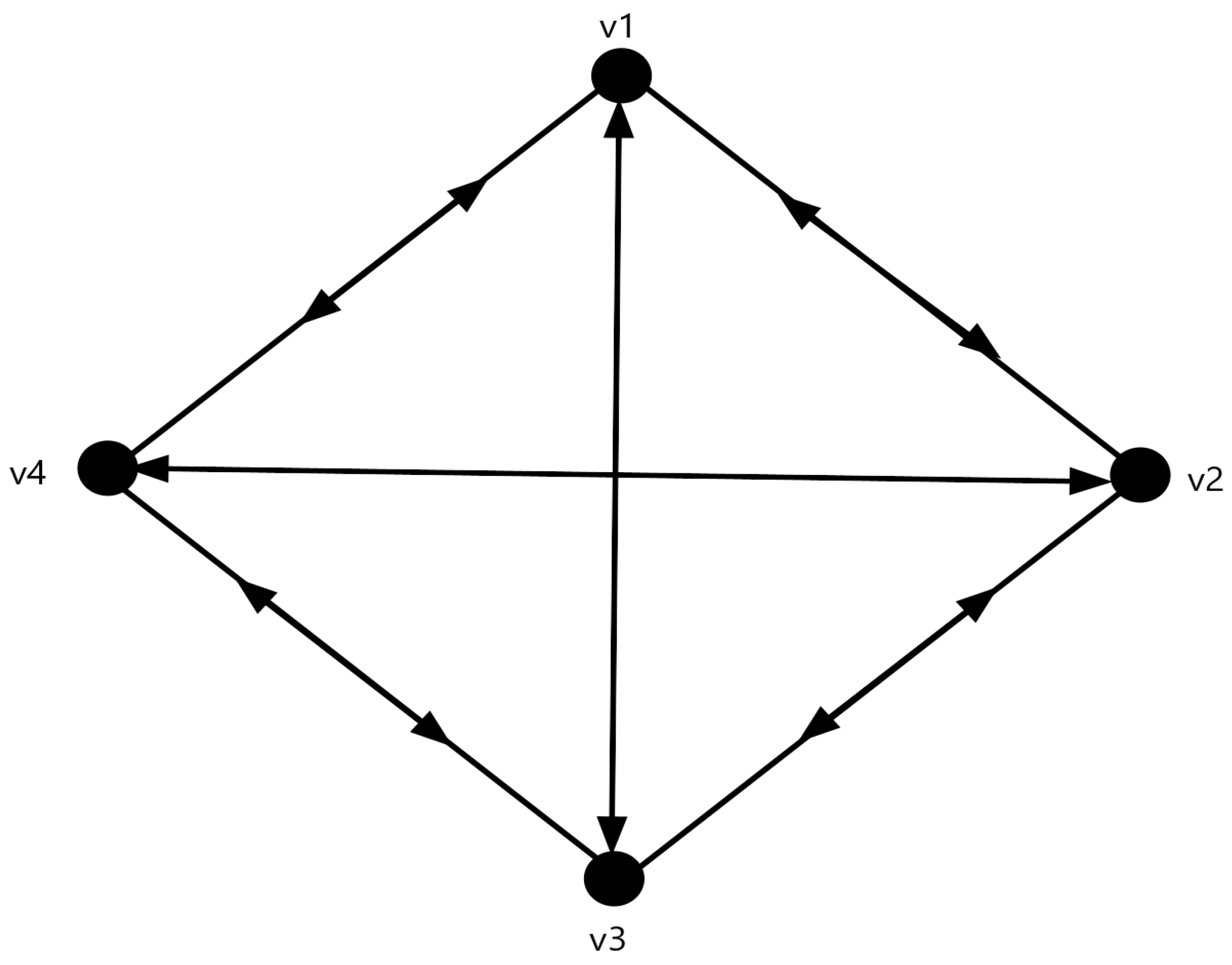
Example 3. Take a digraph , where is a symmetric digraph corresponding to with with and , as exhibited in Figure 3. For each vertex, is computed as: Also,or .or . Similarly, we haveor . Furthermore, we now haveor . Also, . Hence, . By using the above data, we can compute Hence,, which shows that the equality in Theorem 2 holds. Hence, the necessary and sufficient conditions for equality in Equation (17) to be attained are +{ Cycle}, such that of is a complete , or a three-regular complete with at least two nontrivial eigenvalues whose absolute value is . Corollary 3. Consider the sequence , for of upper bounds for corresponding to a digraph having at least one doubly adjacent vertex. Then, is decreasing for , and increasing for .
Proof. From Lemma 2 and Remark 3,
Consider , for .
- i:
If
, then case 1 of Theorems 1 and 2,
, is decreasing as
- ii:
If
, then case 2 of Theorems 1 and 2,
, is increasing as
□
The following example is the illustration of Theorem 2 and Corollary 3.
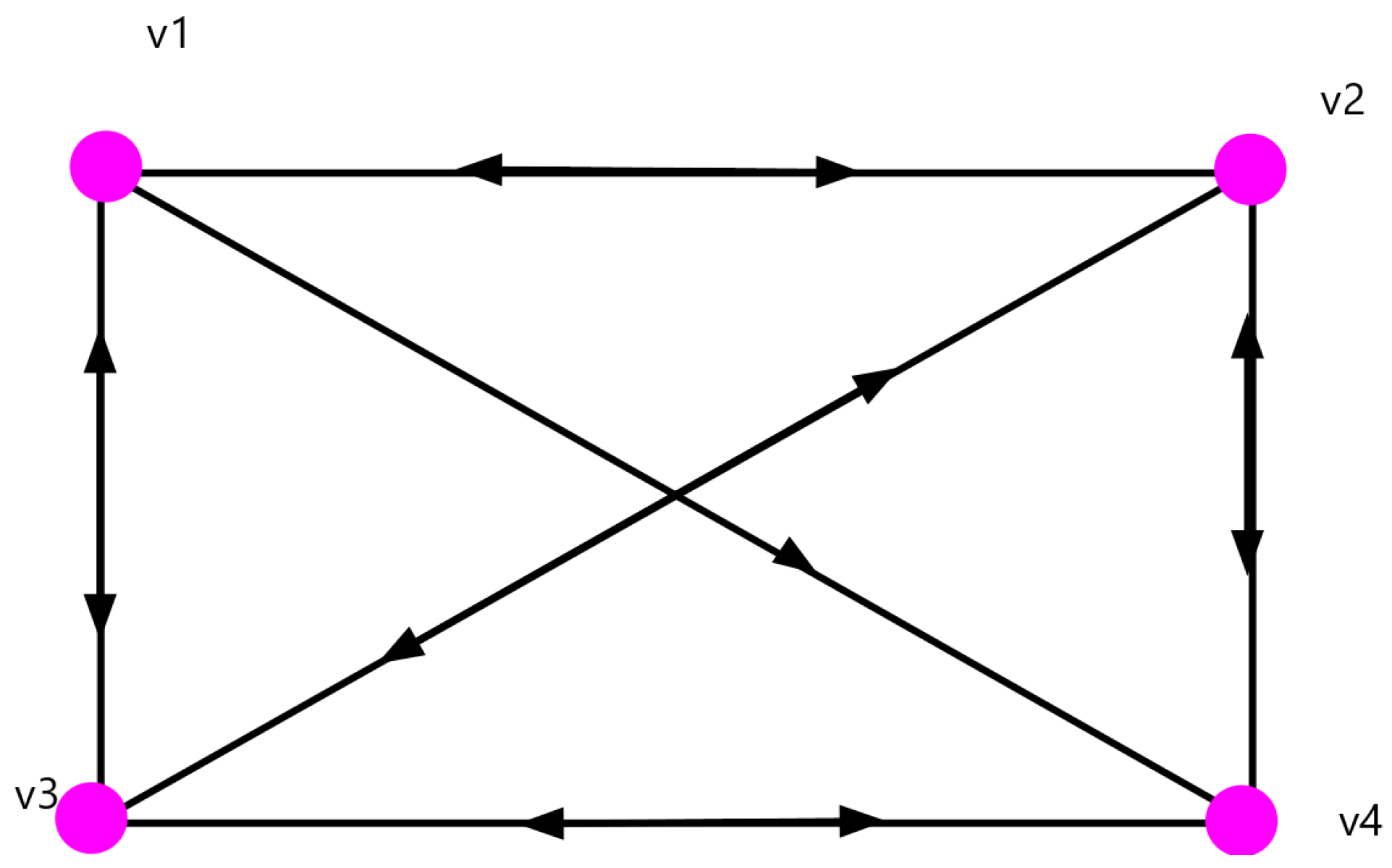
Take a digraph
having at least one doubly adjacent vertex with
, as exhibited in
Figure 4.
For each vertex,
is computed as
Also,
or
or
.
or
.
Also,
, so
and
The above calculation implies that, for
1,2,3,…,
Hence, this shows that the sequence of bounds is increasing for . And, by using Theorem 3.0.2, the upper bounds for the . This sequence of upper bounds for decreases as we proved, or we can directly compute that this sequence decreases by using case 1 of Corollary 3.