1. Introduction
A number of physical properties of solids, expectantly those related to charge transport, are often described by so-called effective electron Hamiltonian, referring to the domain spanned over a small portion of the Brillouin zone in a restricted energy interval around the Fermi energy. Based on the underlying symmetry of the crystal lattice, at the specific points of the Brillouin zone, a minimal multi-band Hamiltonian can be constructed, which is sufficient to describe some single-particle and collective models of the system [
1]. One such example is the Bernevig–Hughes–Zhang Hamiltonian [
2], which appears to be sufficient to describe the electron properties of a number of systems mapped to it. In the case when two bands are located near the Fermi level and other bands are sufficiently far in energy, the minimal Hamiltonian can be further reduced to the two-band effective Hamiltonian represented by a
matrix. The electron bands of the two-band effective Hamiltonian have an electron–hole symmetry and, in multiple cases, they are simple enough to permit an analytical result for a number of band-related calculations and obtained transport functions. Examples of systems whose electron bands are described by the two-band model are numerous and can be easily found in all three dimensions. We mention just some notable examples like the Su–Schrieffer–Heeger model (SSH) [
3] and Peierls model [
4] in 1D, massless and massive 2D Dirac system [
5,
6,
7], Weyl systems or multiple Weyl point systems [
8,
9,
10,
11], massless 3D Dirac [
12], Mexican-hat systems [
13,
14], nodal-line systems [
15], and electron gas in a weak periodic potential [
16].
In all of the mentioned systems, the single-particle and optical properties have been analytically derived, thus providing an insight into the underlying mechanisms and physical scales. In reality, however, many of specific properties that make the mentioned systems interesting are observed on small intrinsic energy scales no bigger then few meV around the Fermi energy. This also makes it challenging to experimentally distinguish between different possible ground states. For that reason, the single particle density of states (DOS) calculations is important since it provides direct information about electron bands. Those can be directly measured by, for example, measuring DOS at the Fermi energy via Pauli paramagnetic susceptibility or, indirectly, as a part of the joint density of states approach to the inter-band conductivity [
17]. Generally, the number of analytically solvable electron models is rather small, which is exactly why every case of effective Hamiltonian yielding an analytical result is important. Besides an academic value, it provides a way to observe similarities in the electron properties between different models in various dimensions, by changing the parameters of the initial Hamiltonian promoted into the final result, precisely addressing the underlying mechanisms leading to them.
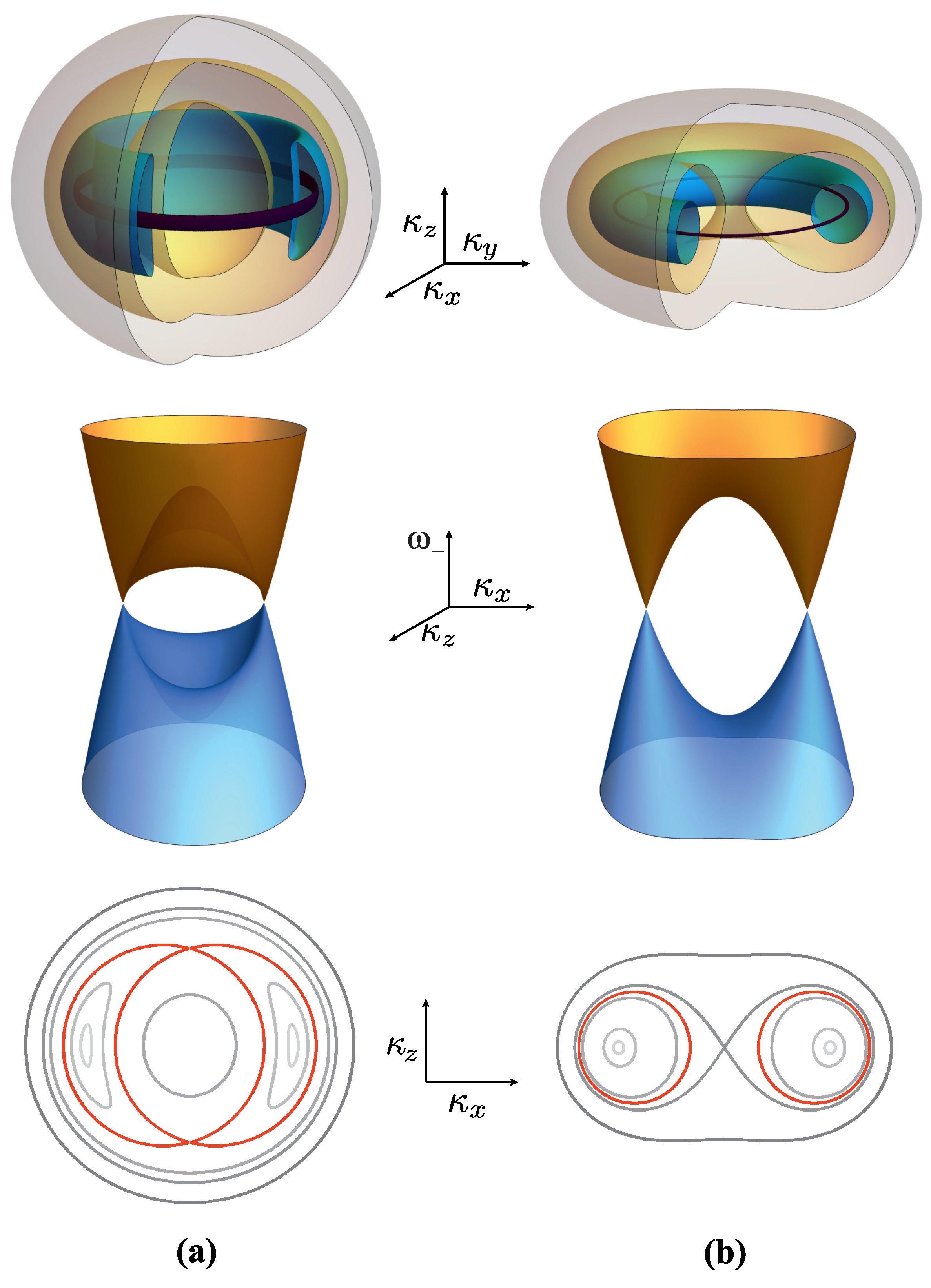
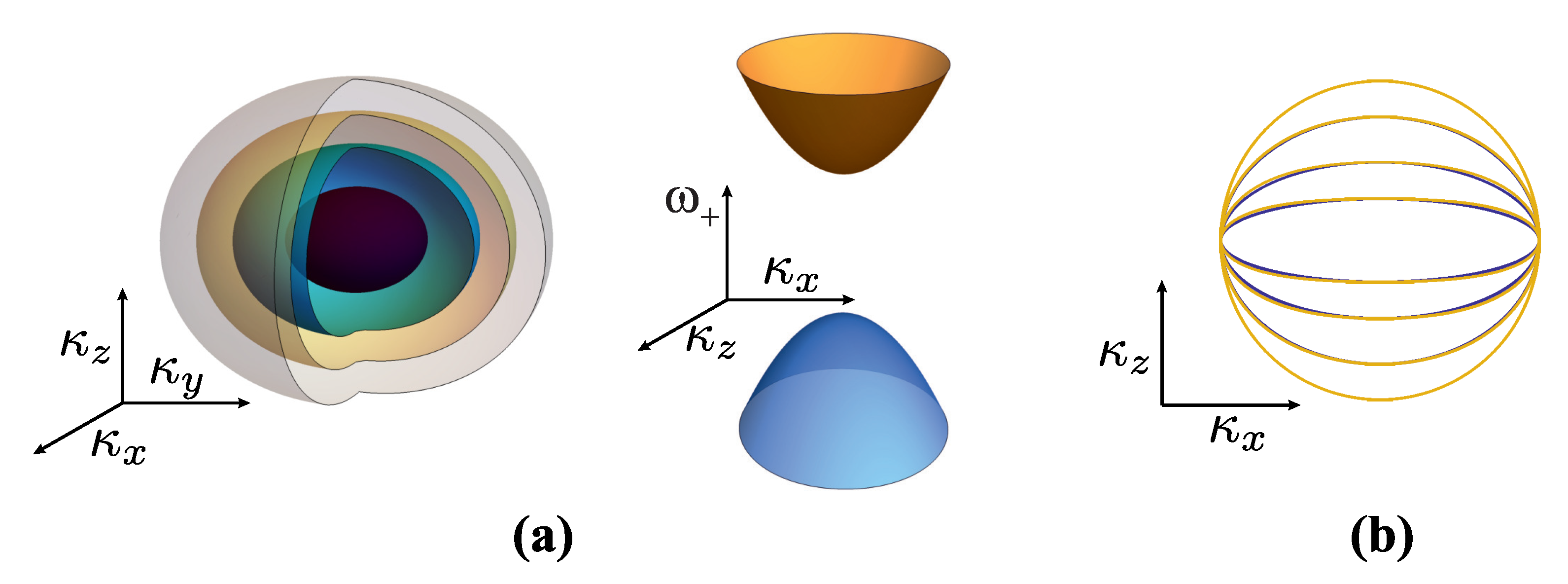
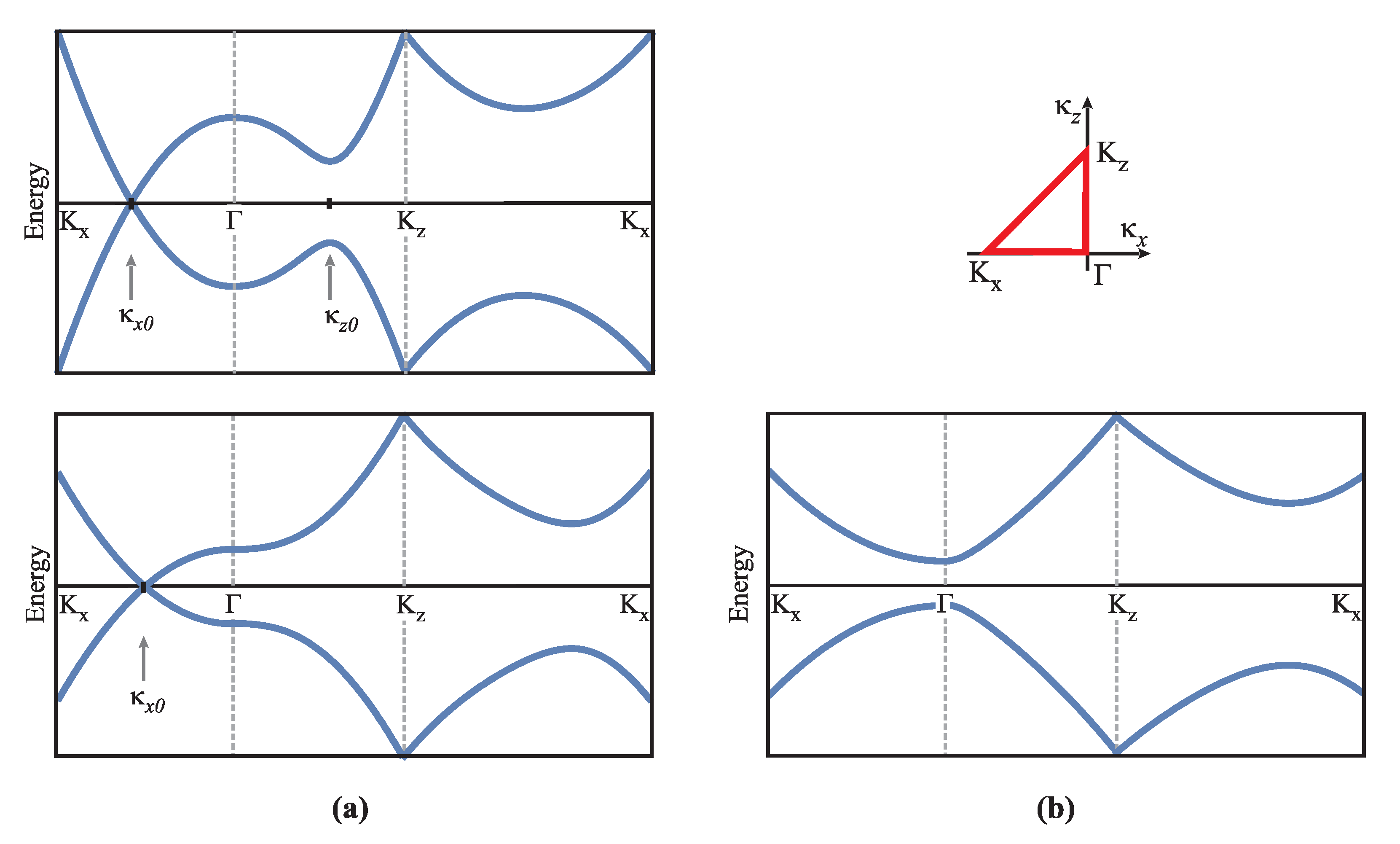
In this paper, we define and analyze the two-band effective Hamiltonian capable of describing two different electronic ground states (phases). The first one is the nodal-loop phase (NLP), and it is characterized by the touching of the valence bands over a ring. The second one is the gapped phase (GP), characterized by the separation of the valence bands by a finite energy gap. We find the corresponding electron dispersions for both phases and assume that the doping procedure (Fermi energy shifting) leaves the valence bands intact. We analyze the Fermi surface (FS) for each phase together with the identification of the van Hove points. Electron dispersions are presented in terms of dimensionless variables in which their properties are determined by a single parameter
. It is shown that the NLP has a torus-like FS, which, depending on parameter
, can be a doughnut-like or self-intersecting spindle, while the FS in the case of GP has a trivial shape related to usual doped 3D insulators. The DOS calculations are performed by finding the corresponding integration boundaries for each phase. Finally, the expressions for DOS in both phases are given. The DOS of both of the phases is analyzed in detail, with particular emphasis placed on the behavior near van Hove points and in connection to the parameter
, where the DOS in the NLP showed a richer structure compared to the GP. It is our intention to use the two-band model in order to shed additional light upon otherwise complicated band structures that are inherent to the majority of the nodal-line systems [
18,
19].
2. The Two-Band Hamiltonian
The low-energy Hamiltonian of the 3D system under consideration, in the basis of the plane waves characterized by the wave vector
, presented as a real
matrix, reads
In the above expression,
and
are the Pauli matrices, while
,
b and
c are positive parameters. Index
is the phase index, with
denoting the NLP and
denoting the GP. Hamiltonian (
1) contains the square of the total Bloch wave vector
. The diagonalization of Equation (
1) is straightforward, yielding electron–hole symmetric eigenvalues for each phase
,
We scale electron dispersion Equation (
2) to the gap parameter
, introducing dimensionless variables
,
(i.e.,
) and parameter
. We obtain the dispersions Equation (
2) in dimensionless form
determined by two parameters: (1) the phase parameter
essentially controlling the band topology, and (2) parameter
that controls the physical properties of bands, such as van Hove points and effective mass parameters. Below, we provide a detailed description of band properties.
4. Density of States
Here, we present a calculation of the density of states (DOS) for the energy dispersion from Equation (
2) for both NLP and GP. Due to the electron–hole symmetry, we use only the upper band
in the calculations. By definition, the DOS per unit volume of a spin degenerate band is [
20]
To simplify further calculation, we use the dimensionless variables defined in
Section 2 and, changing the sum in Equation (
6) to an integral in the spherical coordinate system, we obtain
To further evaluate (
7), we decompose the
-function with respect to the
variable into a sum
where
are the two zero-points of the argument of the
-function with respect to variable
,
Using the identities Equations (
9) and (
8) with Equation (
7), with substitution
, we obtain
The interval of u-integration is determined by three restrictions that are enumerated here:
- ➀
(the trivial restriction),
- ➁
the positive expression under the square root in denominator in (
10):
,
- ➂
the domain restriction in (
9):
implying
.
By the common intersection of these three conditions, the intervals of integration are found, which depend on phase , energy , and parameter . From here on, we investigate the DOS for every electronic phase separately.
5. Density of States in the Nodal-Loop Phase
We set in the mentioned restrictions to find the permitted value of u. Thus, we obtain:
- ➀
,
- ➁
,
- ➂
.
In the above conditions, we have introduced an auxiliary function
defined as
where, again,
is given by (
4). The final condition for the interval of
u-integration is found by taking the intersection
. The boundaries in
and
depend on
and
and, for the specific values of those two parameters, they will shift relatively to each other giving the different intersection. It is shown, after rather tedious calculation, that, depending on value of parameter
, the interval of allowed values of
u falls in two classes:
where we have used
from
Section 3. The integration boundaries in integral (
10) are determined by expressions (
12), while the primitive function is of the form
Applying the above, frequently using the identity
we finally obtain the result
where the constant factor is
The constraints on
and
in (
12) appear in terms of the Heaviside
-functions in Equation (
15). Also notice that, for
, the third contribution vanishes. The DOS (
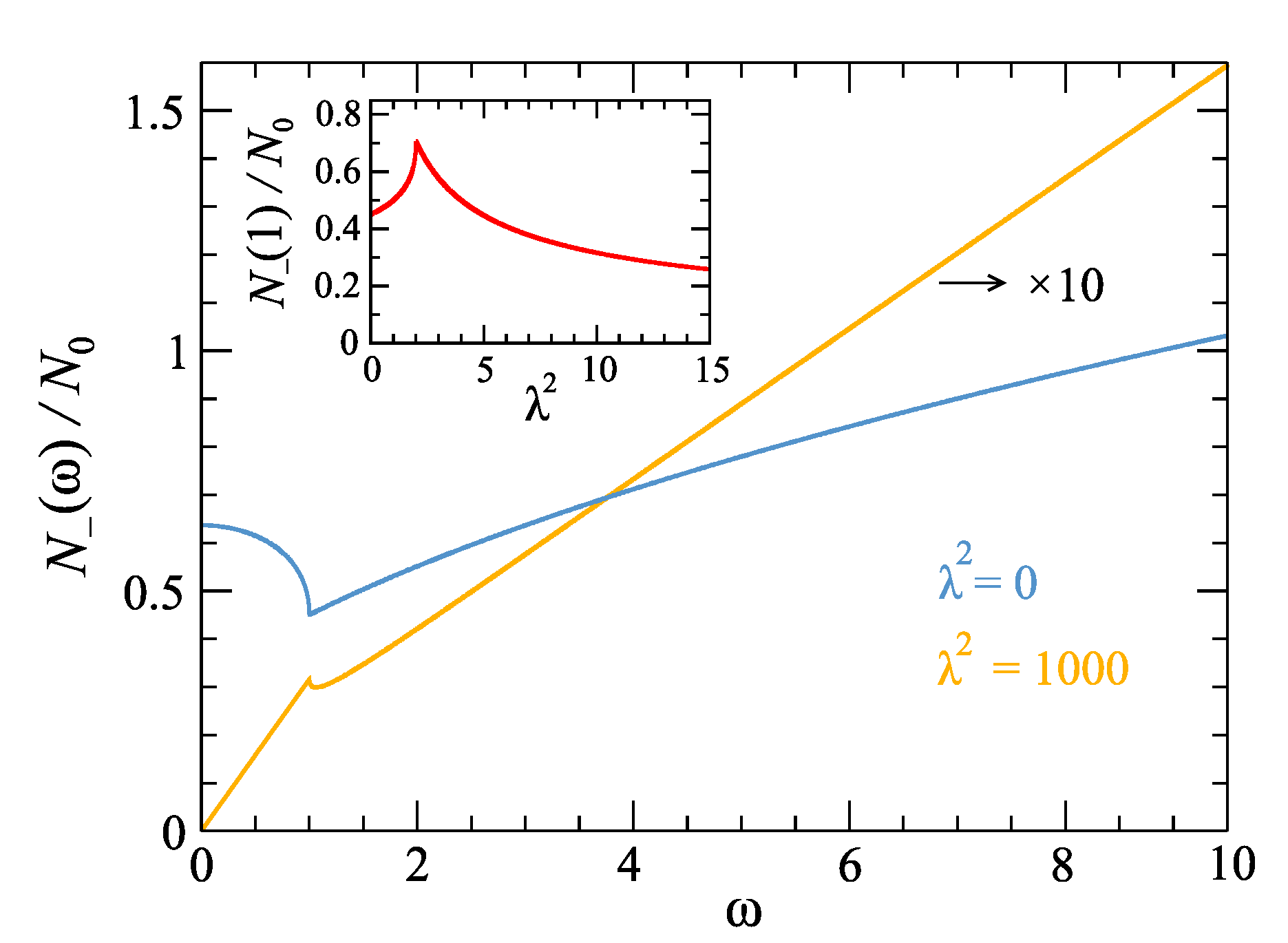
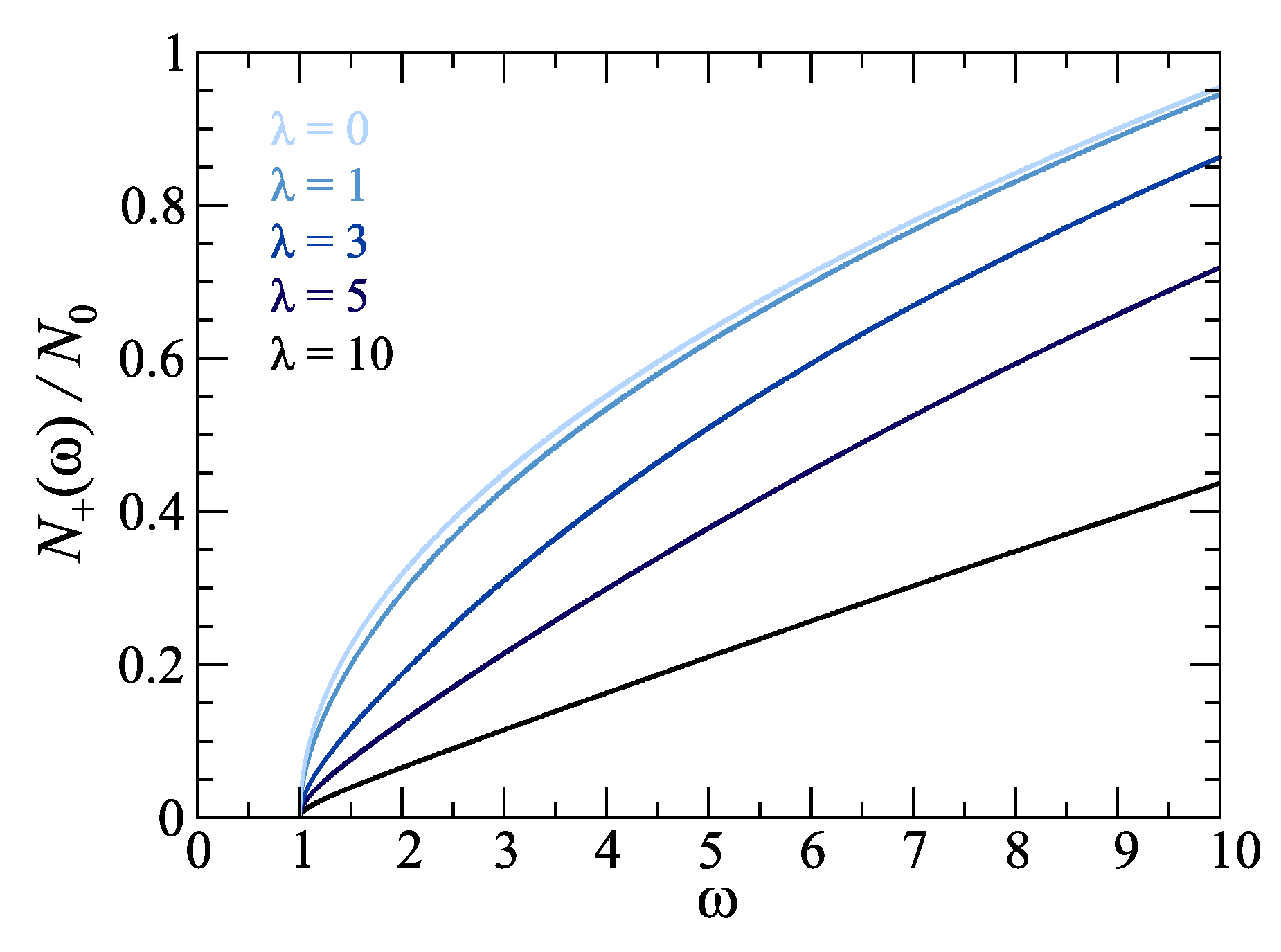
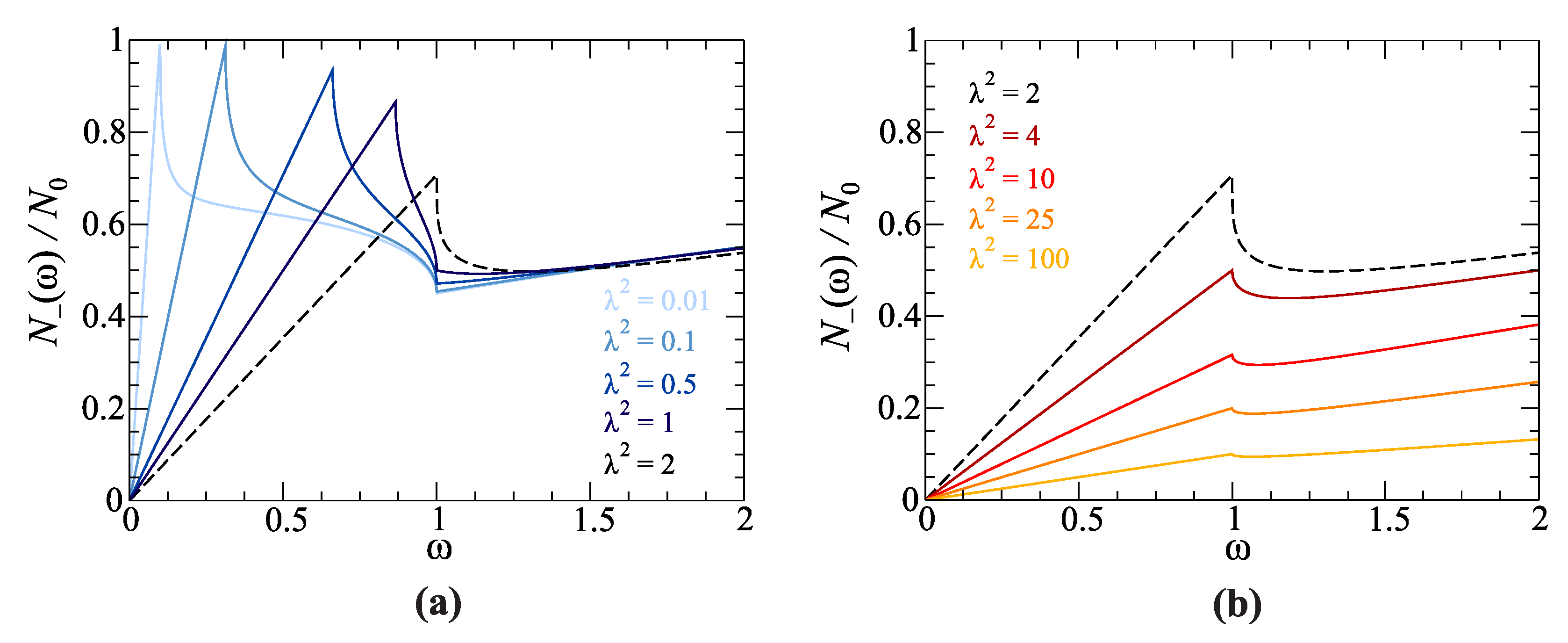
15) is shown in
Figure 5 as a function of
for several values of parameter
.
Also, in the vicinity of high symmetry points, we expand Equation (
15) using the approximative Taylor expansion for
,
First, we analyze the intersecting spindle case, for
(
Figure 5a). The
function is linear in
from
up to
, where the van Hove singularity, due to presence of the saddle point in spectrum, is located. The DOS at this point is
while, for
just above
, Equation (
15) can be expanded to
For
, DOS monotonically decreases until the next van Hove singularity, due to the presence of the elliptic point in spectrum at
, is reached. Since
is a limiting point that divides two-surfaced and a single-surfaced FS, we inspect, in detail the corresponding DOS. Inserting
in Equation (
15), we obtain
Equation (
19) is shown in
Figure 6 (inset). For
, it increases as function of
, forming a cusp for
, after which it decreases as
.
In the high-energy limit,
, only the first two terms in Equation (
15) remain. Expanding
and using expansion (
17), we obtain
Equation (
20) is similar to the DOS of the 3D free electron gas. This result is to be expected since, for large wave vectors (i.e., the large energy), the dispersion (
3) becomes roughly parabolic in the wave vector since the
term dominates over the
term.
Some results, found for DOS in the case of intersecting torus, apply for the “doughnut torus” case,
. The third term in Equation (
15) vanishes, and what remains is DOS linear in
, i.e.,
, for
. For
, DOS has a discontinuity, as shown by Equation (
19), and, just above
, it has a square root dependence,
which diverges for
and therefore signals that additional elements have to be retained in the expansion of
. Thus, for
, the result up to the leading order in
is
where it is worth noticing the analytical property that DOS depends on the forth root of energy, appearing only in this case. Finally, in the high-energy limit,
follows the square root dependence given by Equation (
20).
We also single out two specific cases:
1. The first one is for energy
that satisfies inequality
&
. It is shown in
Figure 6, the
case. In this interval, the auxiliary function
, so the Equation (
15) reduces to
DOS in this case is linear in
, with different slopes below and above
, and it is highly reduced in amplitude. This property of linearity, especially in the
case, is particularly noticeable for the small parameter
in Equation (
2) if other bands are much higher (lower) in energy compared to
. In this limit, this 3D system effectively resembles the 2D behavior (see the results for DOS in Ref. [
21]).
2. The second specific case is for
. It is a case when Hamiltonian (
1) is given only by the first term featuring the
Pauli matrix. Diagonalization leads to energies
Although trivial in appearance, dispersion (
24) leads to the unique properties of the corresponding DOS. To see them, we analyze Equation (
15), in which the third term can be written as
Setting the
in the above expression and using expansion (
17) together with Equation (
20) in which
, we obtain
This special form of DOS is shown in
Figure 6 with the dome-like feature for
below 1. This can be seen as a natural limit of the trend shown in
Figure 5 as
is decreasing.
6. Density of States in the Gapped Phase
Here, we investigate the DOS of the gapped phase by setting
in the restrictions enumerated in
Section 4, obtaining permitted intervals of
u-integration for each case:
- ➀
,
- ➂
,
- ➂
.
In the conditions above, an auxiliary function (
11) is implemented and the intersection
determines the integration boundaries. We remind the reader that in the GP,
(i.e., the band is located above the band gap), which makes the integration boundaries easy to determine:
Inserting the integration boundaries (
27) in (
10), and using (
13) and (
14), we obtain DOS in the GP phase,
shown in
Figure 7. As in the NLP case, we can determine the limiting values.
First, by expanding the expression (
28) for energies just above the band gap, i.e.,
, we obtain
Second, in the high energy limit,
, similarly to Equation (
20), we obtain
The “square root behavior” in both cases, resembling the 3D free electron gas, is not surprising since we work with the band with the elliptic point at its bottom.
Third, in the case of energies over which the parameter
is the dominant variable, i.e.,
, by setting
we obtain
As expected, this is the same result as in Equation (
23) (see
Figure 7, case
), which follows from the correct expansion of Equation (
3) with dominant
-term.
Finally, let us examine the
limit, in which the expression (
29) reduces to
which is a DOS of the 3D parabolic insulator.
7. Conclusions
We present analytical results comprising electron bands and density of states (DOS) for the effective low-energy two-band electron Hamiltonian, which models the so-called nodal-loop phase (NLP) and the gapped phase (GP) depending on parameters. This way to model the real materials is quite common and useful for the description of the response to the low-energy excitations, the most common among them being the different types of transport properties, such as optical conductivity, for systems with two bands close to the Fermi energy. Besides in the common models, where the density of state naturally appears, such as the plasmon properties, Coulomb screening, or superconductivity mechanisms, it has recently been shown that it plays a key role in the description of the dynamical charge transport in the Holstein-like systems in which it turns out that electron relaxation can be described solely in terms of electron DOS [
22]. In that sense, an analytical character of DOS, presented in this paper for the considered Hamiltonian, is of an utmost importance in order to understand the underlying mechanisms leading to the properties of the above-mentioned quantities depending on it.
In this paper, we present analysis of exactly those features. We observe a vanishing value of DOS at the Fermi energy (in the intrinsic case), followed by the linear increase with energy in the NLP case, typical for semimetalic systems, or square-root behavior above the bottom of the band in the GP case, characteristic for 3D insulators with parabolic electron dispersion. Also, we provide a detailed description of DOS around the van Hove singularities appearing due to the presence of the peculiar points in the electron spectrum. In the NLP case, the hyperbolic (saddle) point and the elliptic point are encountered, while the GP case features only the elliptical point at the bottom of the band. A good analysis of similar Hamiltonian with the NLP, from its topological properties to the real materials described by it, is given in Refs. [
1,
23]. On the other hand, an example of the application of the NLP Hamiltonian to the description of the optical conductivity is given in Refs. [
24,
25]. The band structure of the corresponding real systems can be quite complex and is usually addressed by different ab initio methods [
18,
19]. This work intends to complement those methods via the precise, analytical description of the bands and DOS properties in the most relevant region—the narrow interval around the Fermi energy located either in the vicinity of the nodal line or the band gap. The validity of the presented model is closely related to the validity of the effective Hamiltonian (
1) in the sense of its deviation from the particular real system, as well as to the nature of an effect one wants to describe. For example, the optical excitations (“vertical transitions”) are very suitable in that matter. Although the presented model is primarily intended to be an analytical tool to help describe and understand features in a number of quantities depending on DOS, we need to at least discuss its experimental observability. The direct experimental observation of DOS is achieved by measuring the Pauli susceptibility, which, on the other hand, requires the doping mechanism to vary the Fermi energy, leaving the bands intact in the process. In other techniques, such as STM and ARPES, DOS appears within the convolution, leading to the specific, technique-dependent response function, and is not directly observable as is. The description of those techniques and corresponding response functions is far out of the scope and main message of this paper and will be discussed elsewhere.