

Abstract
In practical applications, the basic fuzzy set is used via symmetric uncertainty variables. In the research field, it is comparatively rare to discuss two-fold uncertainty due to its complication. To deal with the multi-polar uncertainty in real life problems, -polar (multi-polar) fuzzy (-PF) sets are put forward. The main objective of this paper is to explore the idea of -PF sets, which is a generalization of bipolar fuzzy (BPF) sets, in ternary semirings. The major aspects and novel distinctions of this work are that it builds any multi-person, multi-period, multi-criteria, and complex hierarchical problems. The main focus of this study is to confine generalization of some important results of BPF sets to the results of -PF sets. In this research, the notions of -polar fuzzy ternary subsemiring (-PFSS), -polar fuzzy ideal (-PFI), -polar fuzzy generalized bi-ideal (-PFGBI), -polar fuzzy bi-ideal (-PFBI), and -polar fuzzy quasi-ideal (-PFQI) in ternary semirings are introduced. Moreover, this paper deals with several important properties of -PFIs and characterizes regular and intra-regular ternary semiring in terms of these ideals.
1. Introduction
High-ranking organization makes native decisions in every field with multiple aspects of a situation. This concept can also be applied to create a formalized model system for conducting fair elections. For the growth and development of democratic countries, free and fair elections are required. Since Pakistan is a multi-party democratic country where, in the national and provincial assemblies, political parties compete for seats. Specifically, in district Gujrat, the political parties are PMLQ, PPP, PMLN, PTI, and any independent candidates. There is always a fierce competition between them. It a big challenge in Gujrat as well as in Pakistan. To handle the hard problems occurring in elections, we can use the model based on the m-polar fuzzy set to select the appropriate candidate conveniently. This would increase the reliability of that selected party between its followers and the voters. If we choose a leader without any rigging, then we can build a peaceful society based on justice. In the same way, all illegal activities can be stopped and soon the country can move forward. It is a lasting solution for the government and citizens to conflict and insecurity. With regards to this, the idea of m-polar (multi-polar) fuzzy set, which is the generalization of bi-polar fuzzy set, is explored. In the study of m-polar fuzzy set, we need to evaluate the existence of multi-polar information about the given set. When have assigned the membership degree to many objects according to multi-polar information, then the m-polar fuzzy set will work successfully. The -PF set is an extension of the BPF set. Fuzzy set is an appropriate theory for handling the uncertainties of world problems. The theory of the fuzzy set is well established, it has a wide range of applications in various disciplines containing medical diagnosis, computer networks, artificial intelligence, social sciences, management sciences, decision making problems, and many more. A membership function with a unit interval range demonstrates a fuzzy set. The degree of belongingness of entries to a set is known as the membership degree. In 1965, Zadeh proposed the idea of fuzzy set for the first time [1]. The structure of the fuzzy group was first introduced by Rosenfeld in 1971 [2]. There have been several different types of fuzzy set extensions over the years, such as interval-valued fuzzy sets, intuitionistic fuzzy sets, and so on. It is difficult to express the distinction between irrelevant and contrary elements in a fuzzy set by using membership degrees ranging from to based on these studies. Zhang [3] introduced the concept of BPF set. The BPF set is in fact an extension of the fuzzy set with membership degree . The membership degree indicates that element does not belong to the corresponding property, the membership degree shows that elements fulfil the property to a certain extent, and the membership degree shows that elements fulfil the implicit counter property to a certain extent in a BPF set. For the importance of BPF set, see [4,5,6,7,8].
The BPF set and 2-polar fuzzy set are cryptomorphic mathematical concepts that can be obtained briefly from one another. Actually, a natural one-to-one correspondence exists between BPF set and 2-polar fuzzy set. By using this idea of one-to-one correspondence, the BPF set is extended to -PF set. Sometimes, different objects have been monitored in different ways. This led to the study of -PF set. The concept that lies behind such description is linked with the existence of multi-polar information about the given set. The -PF set works successfully to assign the membership degrees to several objects regarding multi-polar information. Here, no membership degree will be assumed as negative as -PF set provides only a positive degree of memberships of each element [9].
An -PF set can be considered as different fuzzy sets, similar to the case of BPF set. Therefore, in this condition every input is represented by an m-dimentional vector of numbers from the unit interval all indicate a confidence degree. Assume that the set is the set of context. Then, for each an -PF set will represent the element’s satisfaction degree regarding to k context [10]. For example, if we take a fuzzy set “good person” then there are different interpretations among the people of a particular area.
We have noticed that we face many problems in real world having multipolar information from multi-agents. For instance, [0, 1]n (n ≈ 7 × 10⁹) contains the exact degree of mankind’s telecommunication safety due to monitoring of different person in different times. There are many other instances, such as degree of inclusion (rough measures, fuzziness measures, accuracy measures, decision performance evaluations, and approximation qualities), ordering results of universities, and ordering results of magazines. The objective of this study is to make extension of bipolar fuzzy ideals into m-PFIs, because we have uncertainty and vagueness of data involving multi-attributes and multi-agents in real life problems.
1.1. Innovative Contribution
A semiring is an algebraic structure that is very useful in mathematics and used in engineering, physics, computer, coding, topological space, automata theory, formal languages, modelling, and graph theory. There are numerous structures that are not handled by using binary multiplication of semiring, which is a reason for the existence of ternary framework. Lehmer [11] was the first to propose the idea of a ternary algebraic structure to deal with such types of problems. For example, ℤ is a ring that is essential in ring theory and its subset ℤ+ is a subsemiring of ℤ, but ℤ− is not closed under binary product, therefore, it is not a subsemiring of ℤ. While ℤ− is closed under ternary multiplication. In this paper, we initiate the study of -PFIs in ternary semirings.
1.2. Related Works
Kar and Dutta created the idea of ternary semiring, and they studied the characteristics of ternary semirings in [12,13]. Kavikumar and Khamis studied fuzzy ideals and fuzzy quasi-ideals in ternary semirings [14] and Kavikumar et al. studied fuzzy bi-ideals in ternary semirings [15]. The study of -PF algebraic structure began with the concept of -PF Lie subalgebras [16]. Later on, the theory of -PF Lie ideals was studied in Lie algebras [17]. The idea of the -PF graphs was given in [18,19]. In 2019, Ahmad and Al-Masarwah introduced the concept of -PF commutative ideals and -polar -fuzzy ideals [20,21] in BCKBCI-algebras. By continuing this work, they introduced a new form of generalized -PFIs in [22] and studied normalization of -PF subalgebras in [23]. In 2021, Shabir et al. [24] studied -PFIs in terms of LA-semigroups. In 2021, -PFIs of semigroup introduced by Bashir [25]. Recently, Bashir et al. [26] have worked on multi-polar fuzzy ideals of ternary semigroup.
1.3. Organization of the Paper
This paper is organized as follows: in Section 2, we give the basic concept of -PF ternary semiring. Section 3 is the main section of this paper in which -PF subsets, -PFIs, -PFGBIs, -PFBIs, and -PFQIs of ternary semirings are discussed. In Section 4, we have characterized regular ternary semiring by the properties of -PFIs. In Section 5, a comparison of this paper to past work is provided. In the last, we provide the conclusions of our research as well as our future plans. The list of acronyms is given in Table 1.
Table 1.
List of acronyms.
2. Preliminaries
This section includes some basic and necessary definitions, preliminaries, and results based on ternary semirings that are important in their own right. These are prerequisites for later sections. A non-empty set with the dual operations ‘’ usual addition and ternary product is stated as ternary semiring if is abelian monoid under and semigroup under ternary multiplication and distributive laws of ternary multiplication over addition holds. Identity of the ternary semiring is an element ‘’ such that for all [27,28]. Throughout this paper, will represent a ternary semiring except otherwise specified. An additive subsemigroup of is called a ternary subsemiring of if for all . If is a non-empty subset of then it is called LI resp. MI, RI of if is closed under binary addition and resp. . In this paper, subset means non-empty subset. A ternary subsemiring of is called BI of if [15]. Let be an additive subsemigroup of then is called QI of if [14].
An -PF subset or a -set on is a mapping . An -PF set is the -tuple of membership degree function of that is where is a mapping for all Now, we express operations and on three -PF subsets and of . and that is and for all and Let and be -PF subsets of . Then product and addition is defined by
for some , and for all
The next Example shows the product and addition of -PF subsets and of for .
Example 1.
Table 2.
Addition.
Table 3.
Multiplication under 0.
Table 4.
Multiplication under v.
Table 5.
Multiplication under w.
We define 3-PF subset , and as follows:
By definition we have
Hence, the product of , and is defined by .
Also,
Hence, addition of and is defined by
3. Characterization of Ternary Semirings by -Polar Fuzzy Sets
This is the most essential portion, because here we make our major contributions with the help of several lemmas, theorems, and examples, the notions of -PFTSs and -PFIs of ternary semirings are explained in this section. For semigroups and ternary semigroups, Bashir et al. [24,25,26] have proven the results we have generalized the results in ternary semirings. Throughout the paper, is the -PF subset of mapping every element of on
Definition 1.
Letbe an-PF subset of.
- (1)
- Then for all, the setthat isfor all, is called a t-cut or a level set.
- (2)
- The support ofis defined to be the set that isfor all.
3.1. m-Polar Fuzzy Ternary Subsemirings and Ideals in Ternary Semirings
Here, we define the m-PFTS and m-PFIs of a ternary semirings with examples and explain the related lemmas.
Definition 2.
An-PF subsetofis called an-PFTS ofif for all, it satisfies the following conditions:
- (1)
- that is;
- (2)
- that isfor all
Definition 3.
An m-PF subsetofis called an-PFRI(resp.-PFLI,-PFMI) ofif for all:
- (1)
- (2)
- (resp.) for all.
If an -PF subset is -PFRI, -PFLI and -PFMI of E, then is called m-PFI.
The following Example is of -PFI.
Example 2.
Clearly, is a 3-PFRI, 3-PFLI and 3-PFMI of . Hence, is 3-PFI of .
Definition 4.
Letbe a subset of. Then the-polar characteristic functionofis defined as
Lemma 1.
Letandbe subsets of. Then the following hold.
- (1)
- (2)
- (3)
- .
Proof.
Obviously hold. □
Lemma 2.
Letbe subset of. Then the following hold.
- (1)
- is a ternary subsemiring ofif and only ifis an-PFTS of ;
- (2)
- is a LIresp. MI, RIofif and only iis an-PFLI resp.-PFMI, -PFRIof.
Proof.
Let be a teranry subsemiring of . We have to show that and for all We consider the following cases:
Case 1: Let . Then . Since is ternary subsemiring of . So implies that. Hence,
Case 2: Let . Then and . Clearly, . Hence,
Case 3: Let . This implies that Clearly, . Hence,
Also, Case 1: Let . Then . Since is ternary subsemiring of . So implies that . Hence,
Case 2: Let and . Then . Clearly, . Hence,
Case 3: Let and . Then, and . Clearly, . Hence,
Case 4: Let . Then . Clearly,. Hence,
Conversely, assume that is an -PF ternary subsemiring of . Let . Then, By definition, we have . This implies that . Also, we have
This implies that . So, is ternary subsemiring of
Suppose is LI of . We show that is an -PFLI of i.e., and .
Case 1: Let and . Then . Since is LI of , So . Implies that . Hence,
Case 2: Let and Then Clearly Hence, Now we show that
Conversely, assume that is an -PFLI of . Let and . Then By definition We have . This implies that . Also, Let . Then and . By definition,. This implies that . So is LI of.
In the similar way we can prove for RI and MI. □
Lemma 3.
Letbe an m-PF subset of. Then the following properties hold.
- (1)
- is an-PFTS of if and only ifand
- (2)
- is an-PFLI of if and only ifand
- (3)
- is an-PFRI of if and only ifand
- (4)
- is an-PFMI of if and only ifand
Proof.
Let is an -PFTS of that is and for all and . Let if is not expressible as for some . Then . Hence, . But if is expressible as for some then
Hence, Also, let , if is not expressible as for some . Then . Hence, . But if is expressible as for some then
Hence, . Conversely, let and We show that is an -PF ternary subsemiring of . Let then,
So,
Also,
So, Hence proved.
2 Let be an -PFLI of that is and for all and . Let . If is not expressible as for some . Then . Hence, . Although if is expressible as for some then
Hence, Additionally,
Let, if is not expressible as for some . Then. Hence Though if is expressible as for some then
Hence, . Conversely, Let and . We show that is -PFLI of . Let . Then,
So,
Additionally,
So, for all
Similarly, we can prove the parts 3 and 4. □
Lemma 4.
The following assertions are true in.
- (1)
- Let, andbe three-PF ternary subsemirings of. Thenis also an-PF ternary subsemiring of;
- (2)
- Let, andand be three-PFRI resp.-PFMI, -PFLIof. Thenis also an-PFLI resp.-PFMI, -PFRIof
Proof.
Straightforward. □
Proposition 1.
Letbe an m-PF subset of ternary semiring. Thenis an m-PFTSresp. m-PFLI, m-PFMI, m-PFRIofif and only if is a ternary subsemiringresp. LI, MI, RIoffor all.
Proof.
Let be an -PFTS of and , then , and for all . Since is an -PFTS of . We have for all . Also, for all . Hence, is a ternary subsemiring of .
Conversely, suppose that is a ternary subsemiring of . Let . Suppose on contrary that is an -PFTS of such that and take . Then but . Hence . Also for suppose on contrary that and take such that , then . But . So . Thus is an -PFTS of □
3.2. m-Polar Fuzzy Generalized Bi-Ideals in Ternary Semirings
Here, we define m-PFGBI of ternary semirings.
Definition 5.
An-PF subsetofis called an-PFGBI ofif for allit satisfies the following conditionsthat isfor alland
Lemma 5.
A subsetofis a GBI ofif and only ifis an-PFGBI of
Proof.
Similar to Lemma 2. □
Lemma 6.
An-PFTS ofis an-PFGBI ofif and only if
Proof.
Let be an -PFGBI of . Let If is not expressible as for some then But if is expressible as for some Then for all We have
Conversely, let and So
Hence, . □
Proposition 2.
Letbe an-PFTS of. Thenis an-PFGBI ofif and only ifis a GBI offor all.
Proof.
Let be an -PFTS of and is an -PFGBI of . Let Then and for all Since is -PFGBI of So we have and such that for all Hence is GBI of . Conversely, suppose that is a GBI of . On contrary suppose that is not an -PFGBI of . Let such that . Take Then but which is contradiction. So, So is an -PFGBI of □
3.3. m-Polar Fuzzy Bi-Ideals in Ternary Semirings
Here, we define m-PFBI of ternary semirings and explain some lemmas based on this definition.
Definition 6.
An-PFTSofis called an-PFBI ofif for allit satisfies the following conditionsthat isfor alland
Lemma 7.
A subsetofis a BI ofif and only ifis an-PFBI of
Proof.
Similar to Lemma 2 and Lemma 5. □
Lemma 8.
An-PFTS ofis an-PFBI ofif and only if
- (1)
- (2)
- (3)
Proof.
Proof of (1) and (2) are follows from Lemma 3 and Proof of (3) follows from Lemma 6. □
Proposition 3.
Letbe an-PFTS of. Thenis an-PFBI ofif and only ifis a BI offor all.
Proof.
Follows from Proposition 2. □
3.4. m-Polar Fuzzy Quasi-Ideals in Ternary Semirings
Now, we define m-PFQI of ternary semirings and some its characteristics.
Definition 7.
An-PF additive subsemigroupofis called an-PFQI ofif i.e., that is i.e., for all
Lemma 9.
Letbe an additive subsemigroup of. Thenis QI ofif and only ifis an m-PFQI of.
Proof.
Let is a quasi-ideal. Then obviously, is fuzzy subsemigroup of .
This means that is -PFQI. Conversely, let is any element of . Then we have
This implies that and so □
Proposition 4.
Letbe an-PFTS of. Thenis an-PFQI ofif and only if is a QI offor all.
Proof.
Let is -PFQI of . Suppose that then an and So and and for some and Thus , , and for all Now
Thus,
So Since This means that So is a QI of . Additionally, as is a -PFQI of that is Let then So and thus Conversely, assume that is not an -PFQI of . Let such that for all Choose such that for all This implies that and but for some Hence and but which is the contradiction. Hence □
Lemma 10.
Letandbe-PFRI,-PFMI and-PFLI ofrespectively. Thenis an-PFQI of
Proof.
Let , and be -PFRI, -PFMI and -PFLI of respectively. Let where Then If where Then □
Hence, is an -PFQI of .
Lemma 11.
Every-PFLI (resp.-PFMI,-PFRI) of E is an-PFQI of.
Proof.
The Proof follows from Lemma 3. □
The next example shows that the converse of Lemma 11 may not be true.
Example 3.
Table 6.
Addition .
Table 7.
Ternary Multiplication ‘*’.
Define a 3-PF subset of as follows:
and Then simple calculation shows that is a QI of E. Therefore, by using Proposition 3, is a 3-PFQI of . Now, . So is not a -PFRI of .
Theorem 1.
Every-PFQI ofis an-PFBI of.
Proof.
Suppose that is an -PFQI of . Let . Then,
Also,
So, Hence, is an -PFBI of □
3.5. Applications of Proposed Work
The -PF set has a broad variety of applications in real-life challenges regarding multi-agent, multi-objects, multi-attributes, multi-index, and multi-polar information. The -PF sets can also be applied in decision-making, cooperative games, and diagnosis data, among other applications. These sets may also be used to describe multi-relationships and as a model for clustering or grouping. We will give an example to demonstrate it.
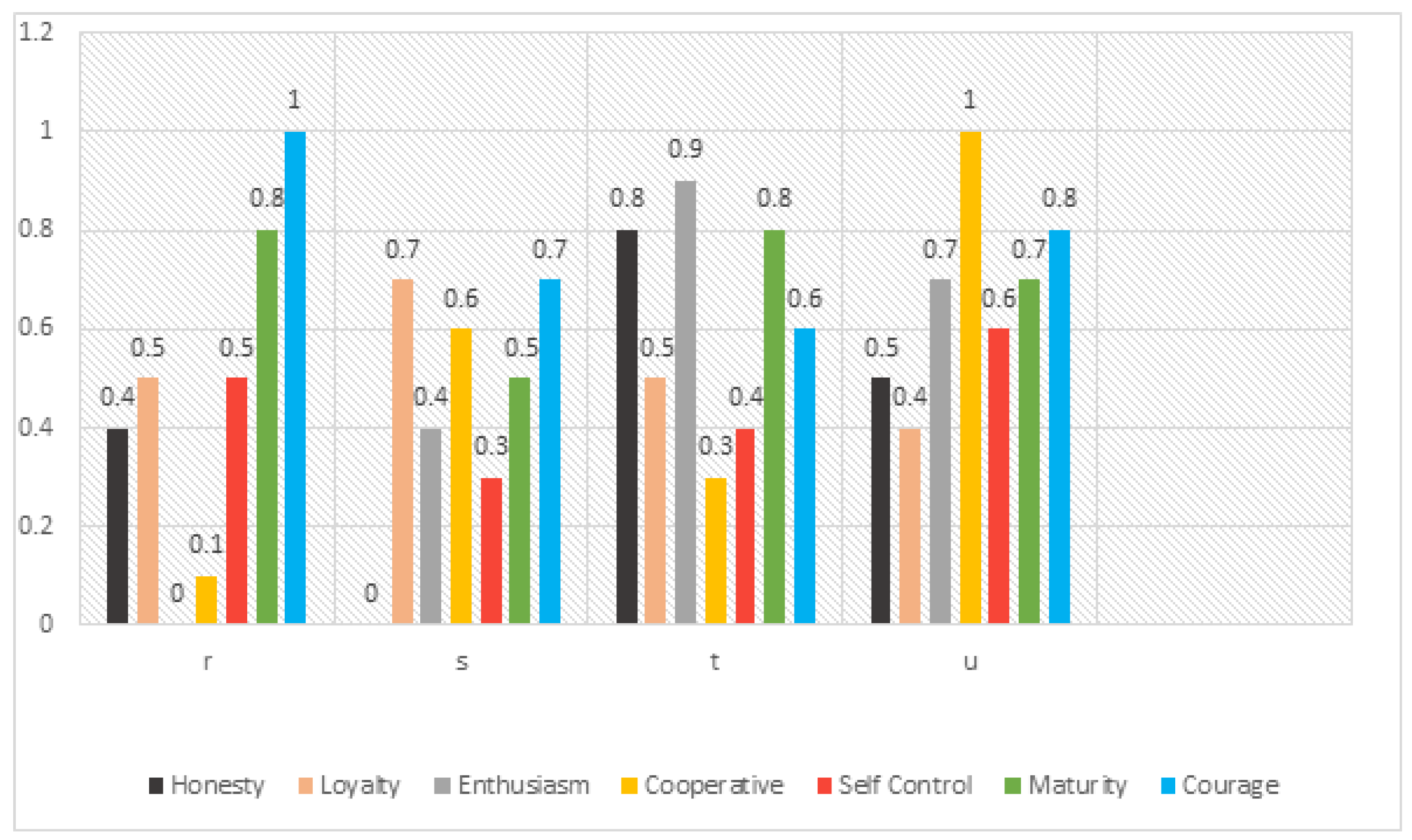
Let be the set of persons. We characterized them as a good person according to seven qualities in the form of -PF subset given in Table 8:
Table 8.
Table of qualities with their membership values.
Thus, we get a -PF subset such that
Here, is the graphical representation of a -PF subset shown in Figure 1.
Figure 1.
Graphical representation of a 7-PF subset.
Here, 1 represents good remarks, 0.5 represents average, and 0 represents bad remarks.
4. Characterization of Regular, and Intra-Regular Ternary Semirings by -Polar Fuzzy Ideals
This section presents many important results on regular and intra-regular ternary semirings in terms of -PFIs. Many results of Bashir et al. [25,26] were studied and generalized in the structure of ternary semirings by -PFIs.
Definition 8.
An element ‘a’ ofis called regular if there exist elementssuch that[5].
Theorem 2.
[15] A ternary semiringis regular if and only iffor every RI, MIand LIof.
Theorem 3.
Forthe following conditions are equivalent.
- (1)
- is regular;
- (2)
- for each-PFRI , -PFMI and-PFLI of
Proof.
Suppose that and be -PFRI, -PFMI, and -PFLI of respectively. Let we have
Hence, Since is regular so for each there exist an element such that . So, Therefore,
Let Then is a LI of , is a RI of and is a lateral ideal of . Then by using Lemma 2, the -polar characteristic functions of, and are -PFLI, -PFRI and -PFMI of respectively. Then we have
Thus, Hence it follows from Theorem 1 that is regular. □
Theorem 4.
The following conditions are equivalent in.
- (1)
- is regular;
- (2)
- for every-PFBI of;
- (3)
- for every-PFQI of.
Proof.
Let be -PFBI of . Let . As is regular, so there exists elements such that . We have
So,
Since is -PFBI of . So we have = So, Thus
It is obvious.
Let , and be -PFLI, -PFMI and -PFRI of respectively. Then is -PFQI of . Hence by hypothesis
So, But always hold. Hence that is . Thus, by Theorem 3, is regular. □
Definition 9.
[5] An element ‘a’ ofis stated as intra-regular if there existsuch that.
Theorem 5.
[5] A ternary semiringis intra-regular if and only iffor every LI X, MIand every RIof.
Theorem 6.
is intra-regular if and only iffor every-PFLI,-PFMIand-PFRI idealof.
Proof.
Let be intra-regular ternary semiring. Let , and be three -PFRI , -PFMI and -PFLI of respectively. Let then there exist such that Hence,
Conversely, let for -PFLI , -PFMI and -PFRI ideal of Let and be LI, MI and RI, respectively. Then and are -PFLI, -PFMI and -PFRI of respectively. Now by our supposition implies then So is intra-regular by Theorem 5. □
5. Comparative Study
In this section, we have described how this research work is better and related to previous work. Shabir and Bashir [24,25,26] used -PF ideals for the characterization of the regular LA-semigroup, semigroups and ternary semigroups, respectively. Our work is superior to Shabir and Bashir [24,25,26], as there are numerous structures that cannot be handled by using binary operations, such as the fact that is not a semiring but it is a ternary semiring. Similarly, and are ternary semirings under ternary multiplication. To get over this problem, we have applied the ternary operation and generalized entire results of Shabir & Bashir [24,25,26] in the ternary semirings. Several results are generalized, and new results are found. As a result, our methodology offers a broad variety of applications than Shabir & Bashir [24,25,26].
In existing techniques, the alternatives are used directly and they are time consuming and error-based.
In the result, the existing methods do not give precise outcomes. The bipolar fuzzy environment minimizes this problem due to pairwise comparison and m-polar fuzzy environment is much better environment to minimize this issue because of presence of multi-attributes based data on real world problems. Our technique may achieve efficiently the precise outcomes.
6. Conclusions
The -PF set theory is a beneficial mathematical tool for resolving uncertainty. In this paper, the definition of -PF set is applied on the structure of ternary semiring. We converted the fundamental algebraic structure of Shabir and Bashir [24,25,26] into a ternary semiring from the LA-semigroup, ternary semigroup, and semiring. Most significantly, we have proven some results related to ternary semirings in terms of -PFIs, -PFGBIs, -PFBIs, and -PFQIs. This paper has a vast range of applications of -PF set theory. Additionally, we have studied the characterization of regular and intra-regular ternary semirings in terms of -PFIs. In future, we may work on regular and intra-regular ternary semirings regarding intuitionistic fuzzy ideals, picture fuzzy ideals, interval-valued fuzzy ideals, cubic fuzzy ideals, and many other extensions of fuzzy ideals. We hope that this research work will be a basis for further study of the ternary semiring theory.
Author Contributions
Conceptualization: S.B. and R.M.; Methodology: S.K.; Software: S.B.; Validation: M.M.A.A.-S.; Formal Analysis: S.K.; Investigation: S.K.; Resources: M.M.A.A.-S.; Data Curation, R.M.; Writing—Original Draft Preparation: S.K.; Writing—Review and Editing: S.B.; Visualization: S.K.; Supervision: S.B.; Project Administration: S.K.; funding acquisition: M.M.A.A.-S. All authors have read and agreed to the published version of the manuscript.
Funding
This research received no external funding.
Institutional Review Board Statement
Not applicable.
Informed Consent Statement
Not applicable.
Data Availability Statement
We didn’t use any data for this research work.
Acknowledgments
The authors extend their appreciation to the Deanship of Scientific Research at King Khalid University for funding this work through the Large Group Research Project undergrant number (R.G.P.2/181/44).
Conflicts of Interest
The authors declare that they have no conflict of interest.
References
- Zadeh, L.A. Fuzzy sets. Inf. Control. 1965, 8, 338–353. [Google Scholar] [CrossRef]
- Rosenfeld, A. Fuzzy groups. J. Math. Appl. 1971, 35, 512–517. [Google Scholar] [CrossRef]
- Zhang, W.R. Bipolar fuzzy sets and relations: A computational framework for cognitive modeling and multiagent decision analysis. In Proceedings of the NAFIPS/IFIS/NASA’94, First International Joint Conference of the North American Fuzzy Information Processing Society Biannual Conference, San Antonio, TX, USA, 18–21 December 1994; pp. 305–309. [Google Scholar]
- Bashir, S.; Fatima, M.; Shabir, M. Regular ordered ternary semigroups in terms of bipolar fuzzy ideals. Mathematics 2019, 7, 233. [Google Scholar] [CrossRef]
- Bashir, S.; Mazhar, R.; Abbas, H.; Shabir, M. Regular ternary semirings in terms of bipolar fuzzy ideals. Comput. Appl. Math. 2020, 39, 1–18. [Google Scholar] [CrossRef]
- Shabir, M.; Liaquat, S.; Bashir, S. Regular and intra-regular semirings in terms of bipolar fuzzy ideals. Comput. Appl. Math. 2019, 38, 1–19. [Google Scholar] [CrossRef]
- Saqib, M.; Akram, M.; Bashir, S. Certain efficient iterative methods for bipolar fuzzy system of linear equations. J. Intelligent Fuzzy Syst. 2020, 39, 3971–3985. [Google Scholar] [CrossRef]
- Saqib, M.; Akram, M.; Bashir, S.; Allahviranloo, T. Numerical solution of bipolar fuzzy initial value problem. J. Intell. Fuzzy Syst. 2021, 40, 1309–1341. [Google Scholar] [CrossRef]
- Chen, J.; Li, S.; Ma, S.; Wang, X. m-polar fuzzy sets: An extension of bipolar fuzzy sets. Sci. World J. 2014, 2014, 416530. [Google Scholar] [CrossRef]
- Ho, D.T.; Garibaldi, J.M. Context modelling in fuzzy systems. In Proceedings of the IEEE International Conference on Fuzzy Systems IEEE, Brisbane, Australia, 10 June 2012; pp. 1–7. [Google Scholar]
- Lehmer, D.H. A ternary analogue of abelian groups. Am. J. Math. 1932, 54, 329–338. [Google Scholar] [CrossRef]
- Dutta, T.K.; Kar, S. On regular ternary semirings, Advances in algebra. In Proceedings of the ICM Satellite Conference in Algebra and Related Topics; World Scientific: Singapore, 2003; pp. 343–355. [Google Scholar]
- Dutta, T.K.; Kar, S. A note on regular ternary semirings. Kyungpook Math. J. 2006, 46, 357–365. [Google Scholar]
- Kavikumar, J.; Khamis, A.B. Fuzzy Ideals and Fuzzy Quasi-ideals in Ternary Semirings. IAENG Int. J. Appl. Math. 2007, 37, 2. [Google Scholar]
- Kavikumar, J.; Khamis, A.B.; Jun, Y.B. Fuzzy bi-ideals in ternary semirings. Int. J. Math. Stat. Sci. 2009, 1, 54–58. [Google Scholar]
- Akram, M.; Farooq, A.; Shum, K.P. On m-polar fuzzy lie subalgebras. Ital. J. Pure Appl. Math. 2016, 36, 445–454. [Google Scholar]
- Akram, M.; Farooq, A. m-polar fuzzy Lie ideals of Lie algebras. Quasigroups Relat. Syst. 2016, 24, 141–150. [Google Scholar]
- Mandal, S.; Sahoo, S.; Ghorai, G.; Pal, M. Genus value of m-polar fuzzy graphs. J. Intell. Fuzzy Syst. 2018, 34, 1947–1957. [Google Scholar]
- Akram, M.; Adeel, A. m-Polar fuzzy graphs and m-polar fuzzy line graphs. J. Discret. Math. Sci. Cryptogr. 2017, 20, 1597–1617. [Google Scholar] [CrossRef]
- Al-Masarwah, A. m-polar fuzzy ideals of BCK/BCI-algebras. J. King Saud-Univ.-Sci. 2019, 31, 1220–1226. [Google Scholar] [CrossRef]
- Al-Masarwah, A.; Ahmad, A.G. m-polar (α, β)-fuzzy ideals in BCK/BCI-algebras. Symmetry 2019, 11, 44. [Google Scholar] [CrossRef]
- Al-Masarwah, A.N.A.S.; Ahmad, A.G. A new form of generalized m-PF ideals in BCK/BCI-algebras. Ann. Commun. Math. 2019, 2, 11–16. [Google Scholar]
- Al-Masarwah, A. On (complete) normality of m-pF subalgebras in BCK/BCI-algebras. AIMS Math. 2019, 4, 740–750. [Google Scholar] [CrossRef]
- Shabir, M.; Aslam, A.; Pervaiz, F. m-polar fuzzy ideals in terms of LA-semigroups (Submitted).
- Bashir, S.; Shahzadi, S.; Al-Kenani, A.N.; Shabir, M. Regular and Intra-Regular Semigroups in Terms of m-Polar Fuzzy Environment. Mathematics 2021, 9, 2031. [Google Scholar] [CrossRef]
- Bashir, S.; Al-Kenani, A.N.; Arif, M.; Mazhar, R. A new method to evaluate regular ternary semigroups in multi-polar fuzzy environment. AIMS Math. 2022, 7, 12241–12263. [Google Scholar] [CrossRef]
- Rao, D.M.; Rao, G.S. Special elements of a ternary semiring. Int. J. Eng. Res. Appl. 2014, 4, 123–130. [Google Scholar]
- Rao, M.D.; Srinivasa Rao, G. A Study on Ternary Semirings. Int. J. Math. Arch. 2014, 12, 24–30. [Google Scholar]
Disclaimer/Publisher’s Note: The statements, opinions and data contained in all publications are solely those of the individual author(s) and contributor(s) and not of MDPI and/or the editor(s). MDPI and/or the editor(s) disclaim responsibility for any injury to people or property resulting from any ideas, methods, instructions or products referred to in the content. |
© 2023 by the authors. Licensee MDPI, Basel, Switzerland. This article is an open access article distributed under the terms and conditions of the Creative Commons Attribution (CC BY) license (https://creativecommons.org/licenses/by/4.0/).