
Article

Advanced Feature-Selection-Based Hybrid Ensemble Learning Algorithms for Network Intrusion Detection Systems

1
Computer Science Department, University of Technology, and Middle Technical University, Baghdad 10010, Iraq
2
Telecommunication Engineering Department, Ahlia University, Manama P.O. Box 10878, Bahrain
3
Computer Science Department, University of Technology, Baghdad 10010, Iraq
*
Author to whom correspondence should be addressed.
Symmetry 2022, 14(7), 1461; https://doi.org/10.3390/sym14071461
Submission received: 25 June 2022 / Revised: 11 July 2022 / Accepted: 12 July 2022 / Published: 17 July 2022
(This article belongs to the Special Issue Deep Learning and Symmetry)

Abstract

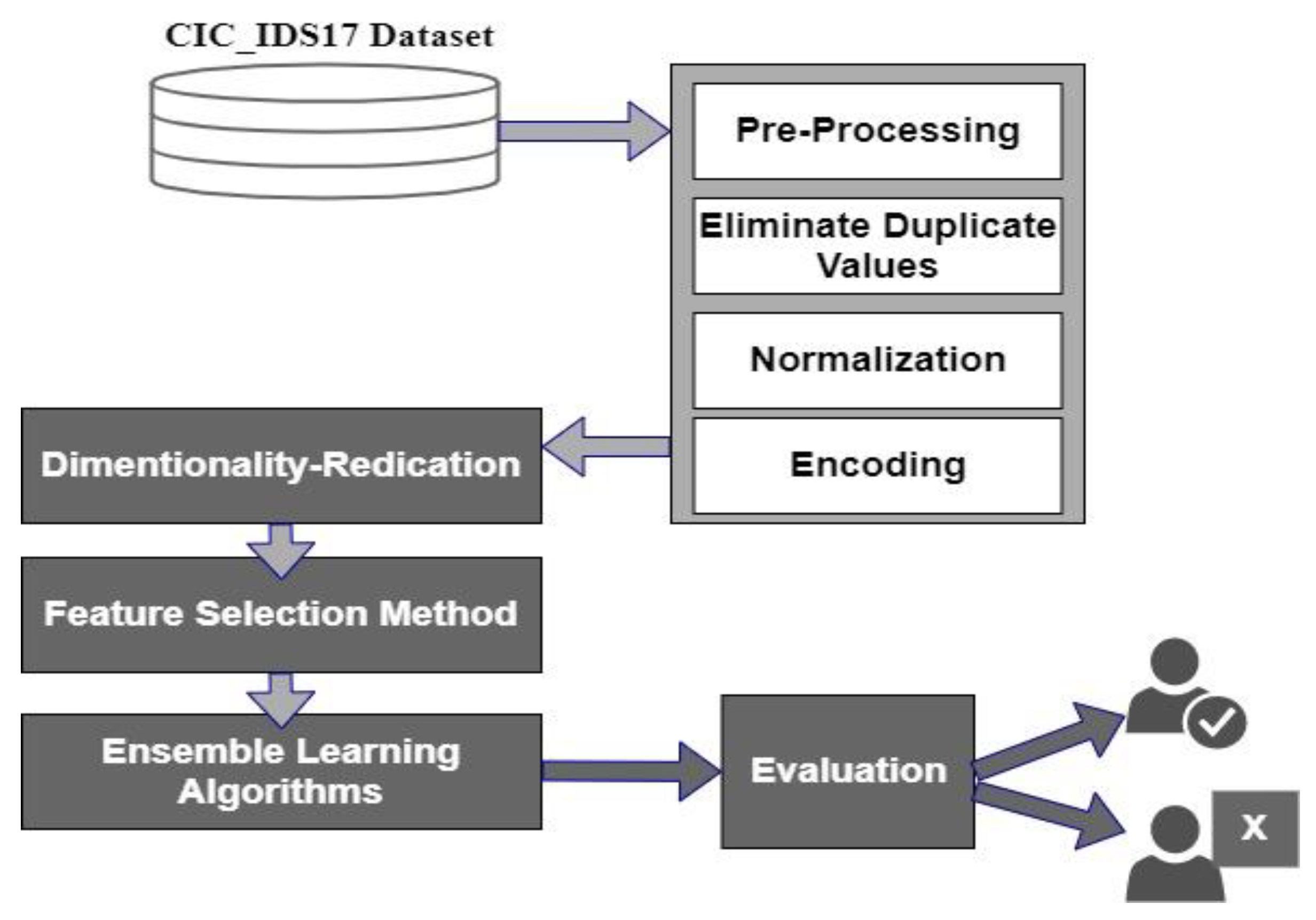
As cyber-attacks become remarkably sophisticated, effective Intrusion Detection Systems (IDSs) are needed to monitor computer resources and to provide alerts regarding unusual or suspicious behavior. Despite using several machine learning (ML) and data mining methods to achieve high effectiveness, these systems have not proven ideal. Current intrusion detection algorithms suffer from high dimensionality, redundancy, meaningless data, high error rate, false alarm rate, and false-negative rate. This paper proposes a novel Ensemble Learning (EL) algorithm-based network IDS model. The efficient feature selection is attained via a hybrid of Correlation Feature Selection coupled with Forest Panelized Attributes (CFS–FPA). The improved intrusion detection involves exploiting AdaBoosting and bagging ensemble learning algorithms to modify four classifiers: Support Vector Machine, Random Forest, Naïve Bayes, and K-Nearest Neighbor. These four enhanced classifiers have been applied first as AdaBoosting and then as bagging, using the aggregation technique through the voting average technique. To provide better benchmarking, both binary and multi-class classification forms are used to evaluate the model. The experimental results of applying the model to CICIDS2017 dataset achieved promising results of 99.7%accuracy, a 0.053 false-negative rate, and a 0.004 false alarm rate. This system will be effective for information technology-based organizations, as it is expected to provide a high level of symmetry between information security and detection of attacks and malicious intrusion.
Keywords: correlation feature selection; Cybersecurity; ensemble learning; Forest Panelized Attribute; intrusion detection system; machine learning correlation feature selection; Cybersecurity; ensemble learning; Forest Panelized Attribute; intrusion detection system; machine learning