1. Introduction
The research aim of this paper is to investigate the differential geometric properties of the mixed type surfaces in Lorentz-Minkowski space. Let
be a frontal, where
is a 3-dimensional Lorentz-Minkowski space. If frontal
f is an immersion, spacelike, timelike and lightlike points can be defined on it in terms of the induced metric. the lightlike points is independent from singular points of frontal
f. It can be a singular point of the induced metric. When
p is the lightlike point of the first kind [
1,
2], the lightlike locus
may be a spacelike regular curve in [
2]. Then we have tangent vector
e of
and two lightlike vectors
L,
N along
. Thus they construct a moving frame along
.
The focal surface and evolute of regular space curves are investigated as classical objects in differential geometry (cf. [
3,
4,
5,
6,
7]). the focal surface is the envelope of family of normal planes. the evolute is not only the locus of the centre of osculating spheres but also set of singular values of the focal surfaces. Since lightlike locus is a spacelike regular curve, we can give the definitions of focal surface and evolute of lightlike locus. It is the envelope of family of normal planes which are spanned by two lightlike vectors
L and
N satisfying a symmetric (or, dual) condition along
. Moreover, the osculating lightlike surface of lightlike locus is considered in [
1]. It is the envelope of family of osculating planes which are also limiting tangent plane spanned by
e and
L of
f along
.
On the other hand, the evolute of plane curve is the envelope of family of its normal lines and the envelope of family of tangent lines is the original curve. It is natural to ask what lies between normal lines and tangent lines. In [
8], P. J. Giblin and J. P. Warder give the definition of straight lines
L which is obtained by rotating tangent lines counterclockwise through a angle
along plane curve. Moreover, envelope of lines
L is called by
. Then
is original curve and
is the evolute of plane curve. Inspired by this thought, since osculating planes of
f along
are similar to tangent lines of plane curve and normal planes of
f along
are similar to normal lines of plane curves, we can define
θ-planes which move between osculating planes and normal planes along lightlike locus and study new symmetric properties about these planes. the
is given by angle of between
-planes and osculating planes. It follows that the
slant focal surface of lightlike locus is defined by the envelope of family of
-planes of
f along
. If
, the slant focal surfaces is the osculating lightlike surface. If
, the slant focal surface is the focal surface of lightlike locus. and the
slant evolute is given by singular set of the slant focal surface.
In this paper, we give some basic notions including frame
along lightlike locus in
Section 2. In
Section 3, by using this frame, we give the definitions of the slant focal surface and the slant evolute of lightlike locus
. Then geometry and singularities of them can be investigated by the moving frame. On the other hand, wave front is firstly given in [
9]. Furthermore, many articles on the frontal or front have been published during the two decades [
10,
11,
12,
13,
14,
15,
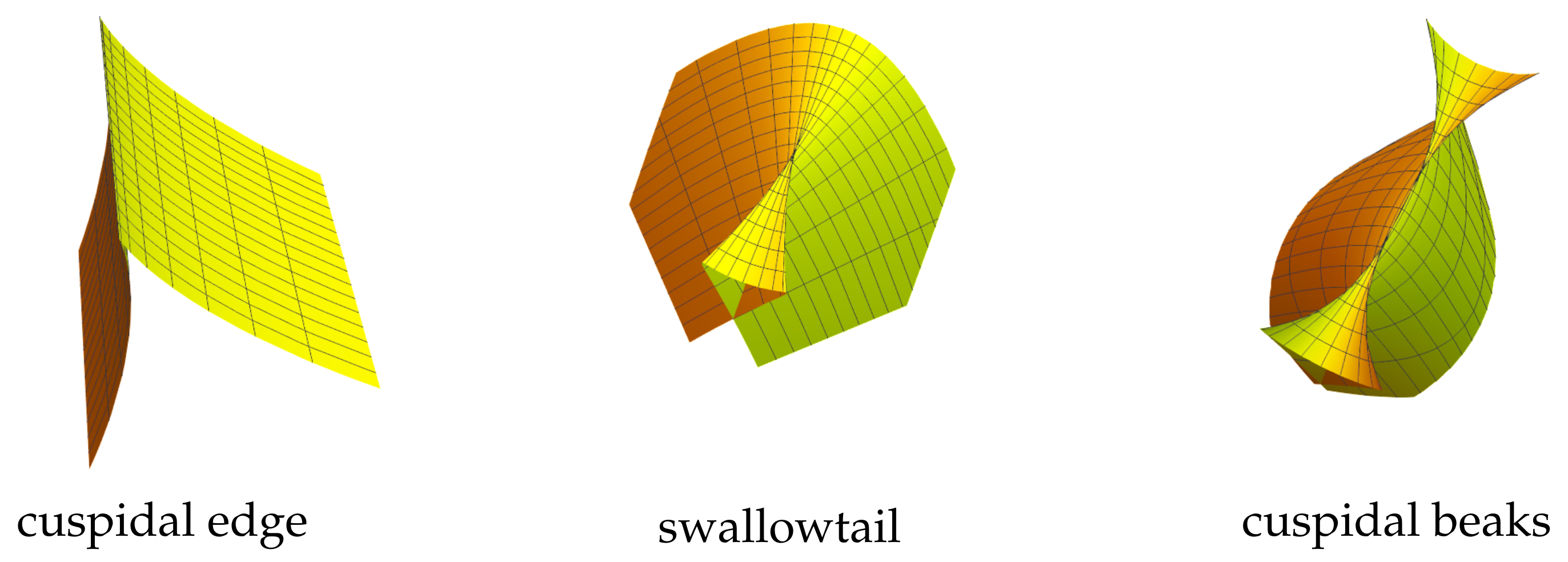
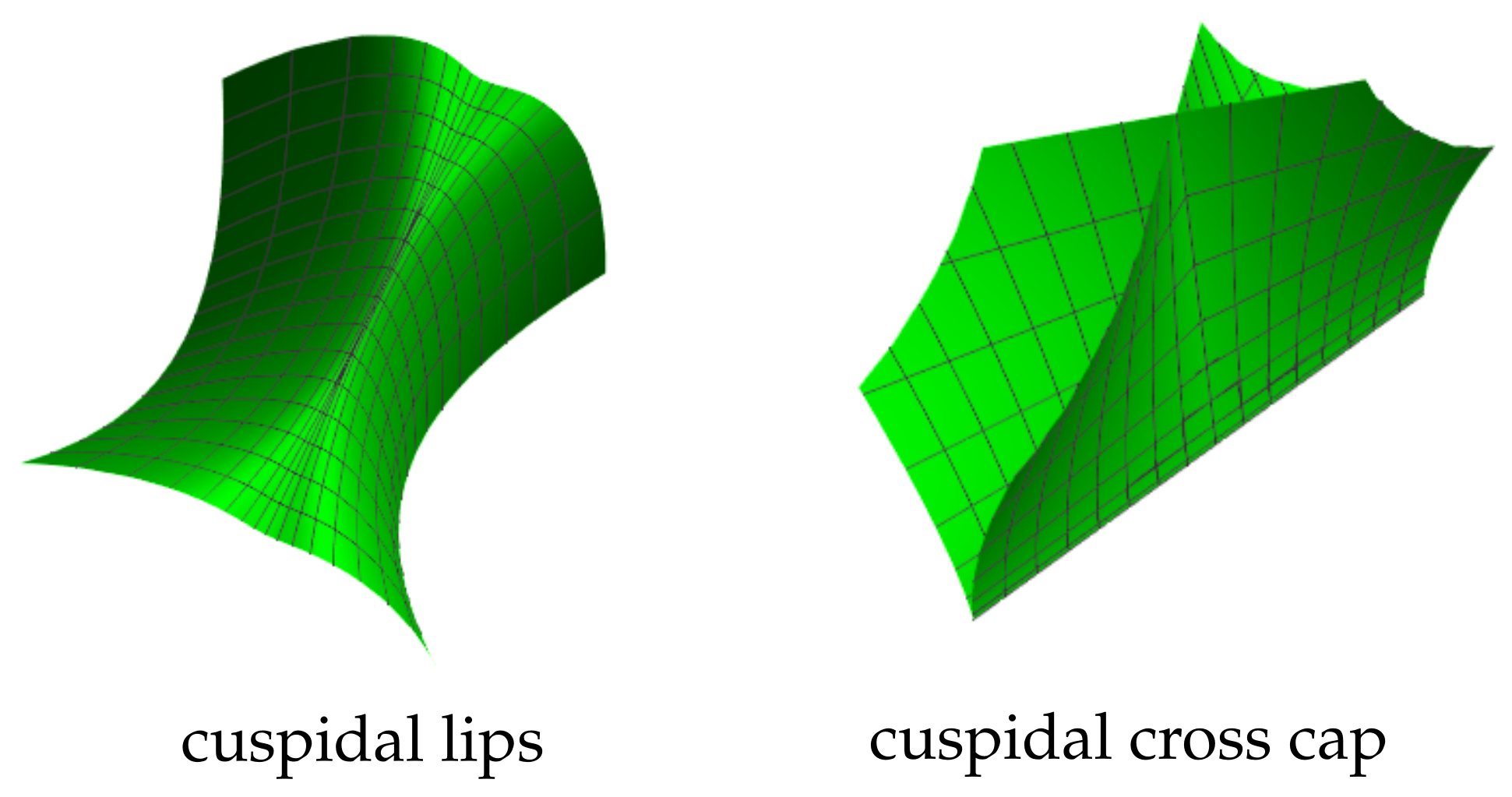
16]. Thus, by the criterions of singularities of frontal or front, we obtain that singularities of slant focal surfaces have not only cuspidal edge, swallowtail but also cuspidal beaks under this frame. But cuspidal cross cap and cuspidal lips are never appeared on the slant focal surface. Moreover, we investigate relationship between slant focal surfaces and slant evolutes from viewpoint of singularity theory. We obtain that the image of slant evolute is precisely the set of non-degenerate singular values of slant focal surface. Since the geometry of moving frame is related to the properties of
on the frontal
f, thus the geometry and singularities of slant focal surfaces and slant evolutes are deeply depended on geometric properties of the frontal
f. In
Section 4, slant focal surfaces and slant evolutes are given by the discriminant set and the secondary discriminant sets of
-function. Moreover, if the slant evolute is a constant point under a certain condition, then the lightlike locus is on a lightcone whose vertex is the slant evolute, meanwhile this lightcone is the osculating lightlike surface. Finally, if the evolute of lightlike locus is a constant point, then the lightlike locus is on a pseudo sphere. In recent years, some of the latest connected studies can be seen in [
17,
18,
19,
20,
21,
22,
23,
24,
25,
26]. In the future work, we are going to proceed to study some applications combine with singularity theory and submanifold theory, etc. to obtain new results and theorems about symmetry.
All manifolds and mappings are unless otherwise stated.
3. Singularities of Slant Focal Surfaces of the Lightlike Locus
In this section, we investigate singularities of slant focal surfaces of the lightlike locus and give the relationship between the slant focal surface and the slant evolute from the viewpoint of singulartity theory.
Let
be an admissible frontal. Under the notations in
Section 2.2, we can define slant focal surfaces of the lightlike locus
as follows:
Definition 1. For a fixed
, the
slant focal surface of lightlike locus
is given by
where
. At least locally, we can easily see that
. If
, the slant focal surface
is given by
If
, the slant focal surface
is given by
In the case when
, we consider the slant focal surface under the assumption
. It is given by
then we have the followings.
Remark 1. If , coincides with the osculating lightlike surface of f along (cf. [1]). Moreover, if , we call the focal surfaces of the lightlike locus . Assume that
and
, by Equations (
2) and (
10), we have
To simplify (
13), we define three functions
satisfying
Furthermore, we define a mapping
for a fixed
by,
Then is an isotropic lift of . Thus, is a frontal for a fixed .
To investigate singularities of
, we define a mapping
for a fixed
which is transverse to
as follows (cf. [
1]):
where
We can define a smooth function
(cf. [
1]) for a fixed
by
then
p is a singular point if and only if
. Moreover,
p is
non-degenerate if and only if
. By implicit function theorem, the singular set
is parameterized by a regular curve
in a neighborhood of
p. For the singular set
, there exists a non-zero vector field
near
p satisfying
at
p. We call
null vector field. Furthermore, we call
singular direction and
null direction if
is parametered by
u. When
is parametered by
m, we also call
singular direction and
null direction.
Theorem 1. Under the assumption , we assume that is a singular point of and have the followings.
- (a)
If and , then
- (1)
at is -equivalent to the cuspidal edge if and only if .
- (2)
at is -equivalent to the swallowtail if and only if - (3)
at is never -equivalent to the cuspidal cross cap.
- (b)
If , then
- (1)
at is -equivalent to the cuspidal edge if and only if .
- (2)
at is -equivalent to the cuspidal beaks if and only if - (3)
at is never -equivalent to the swallowtail, cuspidal cross cap and cuspidal lips.
- (c)
If , then
- (1)
at is -equivalent to the cuspidal edge if and only if .
- (2)
at is -equivalent to the swallowtail if and only if - (3)
at is never cuspidal cross cap, cuspidal beaks and cuspidal lips.
Here, a singular point
p of
f is a
cuspidal beaks if
f is
-equivalent to
at 0. A singular point
p of
f is a
cuspidal lips (briefly,
CL) if
f is
-equivalent to
at 0. A singular point
p of
f is a
cuspidal cross cap (briefly,
CCR) if
f is
-equivalent to
at 0. We can draw the pictures of these singularities by software “MATHEMATICA” in
Figure 1 and
Figure 2. About the criteria for CE, SW, please see [
13]. Criteria for CCR, see [
10]. Criteria for CBK, CL, see [
11].
Proof. We denote , , , , , , We easily see that if and only if and is linearly independent. Since , then . Thus, is a front.
If , then , so that p is non-degenerate singular point. By implicit theorem, we have . Then and .
Then proves the assertion (1) of (a), and prove the assertion (2) of (a). Since is a front and cuspidal cross cap is a frontal which is not front, then the assertion (3) of (a) holds.
When
, we have
. Point
p is non-degenerate singular point if and only if
. If
p is non-degenerate, we have
. Then
and
. We consider
then
is a cuspidal edge and there is no swallowtail, thus the assertion (1) of (b) holds.
If
is degenerate singular point, we can consider
and
Thus, and prove the assertion (2) of (b).
And the proves there is no cuspidal lips. Since is front, there is no cuspidal cross cap. Thus, the assertion (3) of (b) holds.
Then
. Since
, then
. Thus,
p on
is non-degenerate singular point. By implicit theorem, we have
. Then
and
. We consider
Then gives a condition for cuspidal edge on , and give a condition for swallowtail on . Since is a front and cuspidal cross cap is a frontal which is not front, there is no cuspidal cross cap. Since p is only non-degenerate singular point, then there is no cuspidal beaks and cuspidal lips. □
Assume that
at least locally and
, by Equations (
2) and (
11), we have
Under the assumption
, we investigate singularities of
. Then we define a function
by:
then we obtain that singular set
. We give the condition for singular points of
under the assumption
and
as follows.
Theorem 2. Under the assumption and , we assume that is a singular point of and have the followings.
- (a)
If , then
- (1)
at is -equivalent to the cuspidal edge if and only if .
- (2)
at is -equivalent to the swallowtail if and only if - (3)
at is never -equivalent to the cuspidal cross cap
- (b)
If , then
- (1)
at is -equivalent to the cuspidal edge if and only if - (2)
at is -equivalent to the cuspidal beaks if and only if - (3)
at is never -equivalent to swallowtail, cuspidal cross cap and cuspidal lips.
Remark 2 Since the proof of Theorem 2 is similar to the one of Theorem 1 under the assumption. Then we omit it here.
On the other hand, we give the definition of slant evolutes of lightlike locus. Then we give that the image of the set of non-degenerate singular points of the slant focal surfaces coincide with the image of the slant evolute. Moreover, we give relationships between singularities of the slant evolutes and singularities of slant focal surfaces.
Definition 2. For a fixed
, the
slant evolute of lightlike locus
with
for
is given by
Theorem 3. Let be a lightlike locus with . Point is a singular point of . Then we have the following:
(1) the image of set of non-degenerate singular point of coincide with the image of .
(2) at is -equivalent to the cuspidal edge if and only if at is a regular point.
(3) at is -equivalent to the swallowtail of and only if at is locally diffeomorphic to(2,3,4)-cusp.
Proof. For slant focal surface, we can assume that
under
. If
, we have the Equation (
10). Then we give a proof as follows:
Since
, by Equations (
17) and (
18), we have non-degenerate singular set
, where
By a direct calculation, non-degenerate singular locus under . Similarly, we easily have that the under . Thus, the assertion (1) holds.
By Equations (
10) and (
27), we have
To simplify the follow equations, we define three functions
as follows:
By (
2), (
13), (
14) and (
28), we have
By Equations (
29) and (
30), we have
if and only if
. By the assertion (1) of (a) of Theorem 1, the assertion (2) holds under the assumption
.
If
is a (2,3,4)-cusp of
, then
,
. Hence,
if and only if
. Using (
29), (
31) and (
32), a long but straightforward computation gives that
if and only if
. Since
and
, thus, by the assertion (2) of (a) of Theorem 1, the assertion (3) holds under the assumption
.
If , we have the similar conclusions to those under the assumption . Since this proof is similar to the above proof, so we omit it. □
4. Properties of Non-Degenerate Singular Set of Slant Focal Surfaces
In this section, we consider the properties of non-degenerate singular set of under .
4.1. θ-Functions
Let
be the lightlike locus of admissible frontal
f. For a fixed
, we define a function
by
then
represents a
family of θ-planes. If
, the
0-planes are osculating lightlike planes. If
, the
-planes are normal planes. We denote
, for any
. Then we have the following proposition.
Proposition 1. Under the above notations, then we have the followings:
(1)
if and if there exist such that(2)
if and only if there exists such that(3)
Under the assumption , if and only if there exists such thatwhere , .
Proof. Since
, we have the following calculations:
By the Equation (
2),
if and only if there exists
such that
Moreover, if
, by the formula (a) and Equation (
2), we can also have that
then the assertion (1) and (2) holds.
Under
, if
, by the formula (a), formula (b) and Equation (
2), a long but straightforward calculation gives that
then the assertion (3) holds. □
For
-functions
under a fixed
, its discriminant set is defined as follows
and its second discriminant set is
We can easily see that the slant focal surface coincides with the discriminant set , and the slant evolute coincides with the second discriminant set . Furthermore, the second discriminant set is also the set of non-degenerate singular values of the discriminant set by Theorem 3.
4.2. Slant Evolutes of Lightlike Locus and Pseudo Spheres
In this subsection, we consider relationship between slant evolutes of lightlike locus and pseudo spheres.
Lemma 1. For a fixed , for all if and only if there exist a constant vector such that for all .
Proof. If for all and a fixed , we set , then we have .
Conversely, if there exist a constant vector
such that
, then there exist functions
such that
for
and
. By taking the derivative of both the sides as follows:
If
, by (
35) and (
36), we have
By differentiating (
37), then
By (
37) and (
38), we have
for
.
If
, since
, by (
34)–(
36), we have
and
. Thus, constant vector
for any
and a fixed
, then
for a fixed
. □
Let , where . If , . If , . If , . Moreover, we denote whose vertex is x.
Proposition 2. When , for all if and only if lies in lightcone whose vertex is . When , for all if and only if there exist a constant vector and a non-negative real number such that .
Proof. If , by a direct calculation, . Since , set , then for . Thus, lies in lightcone whose . Conversely, if and . It follows that for all . By Lemma 1, .
If , , set , by the Lemma 1, . Thus, is a constant value. Then there exist a non-negative real number r such that . Conversely, if , then . It follows that . By the Lemma 1, for all .□
Proposition 3. For a fixed , if we assume that , then for all if and only if there exists a constant vector such that is on the lightcone . Moreover, = for all .
Proof. Under the assumption , . It follows that . Since , we set , then . Thus, lightcone . Since and , then we can easily see that is a lightcone whose vertex is . Thus, =.
Conversely, we can easily see that under . It follows that for all . □
4.3. Examples
We give an example in order to understand the slant focal surfaces and slant evolutes of lightlike locus from intuitional viewpoint.
Example 1. Let
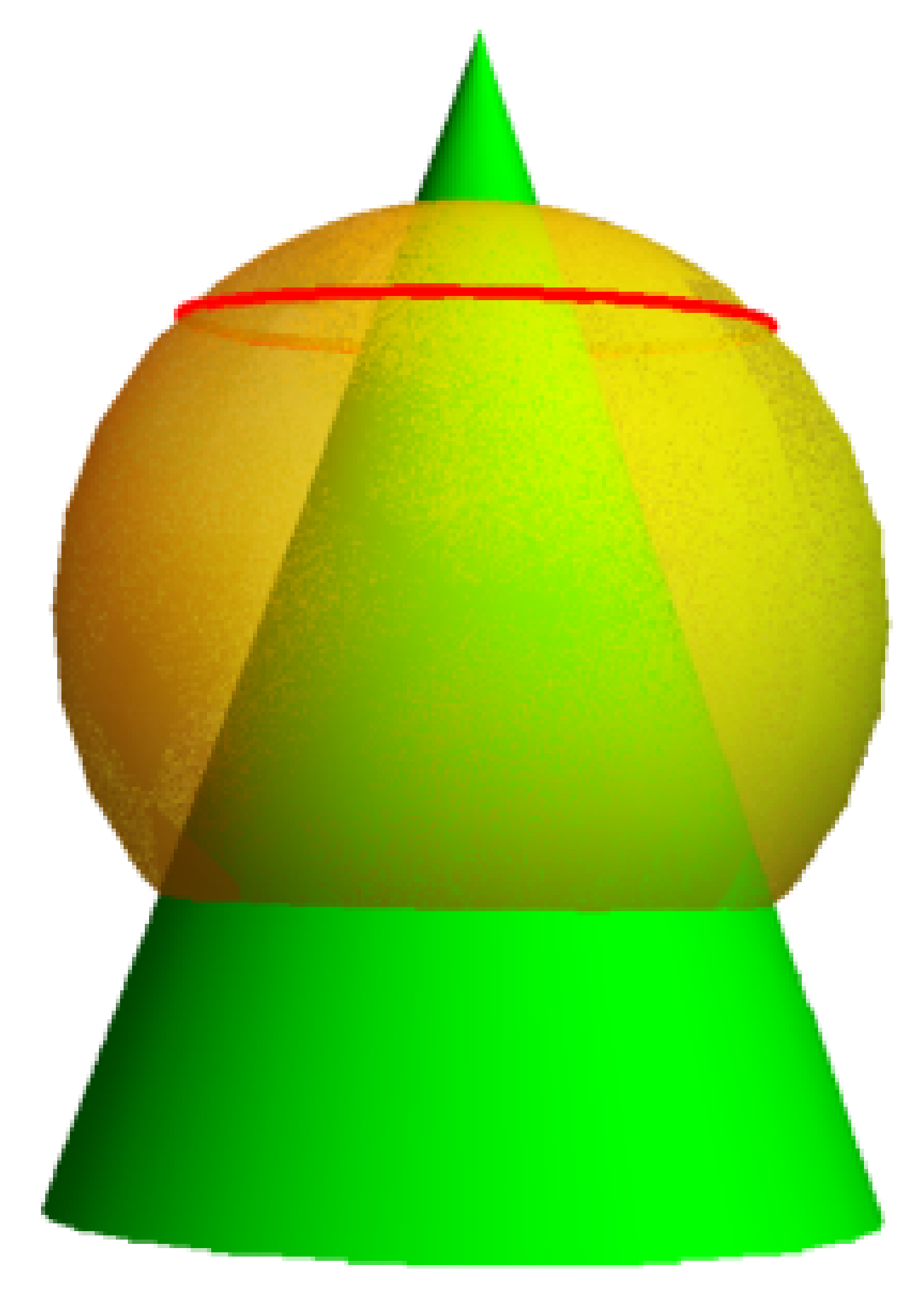
is a mixed surfaces,
. Then lightlike set
and lightlike locus
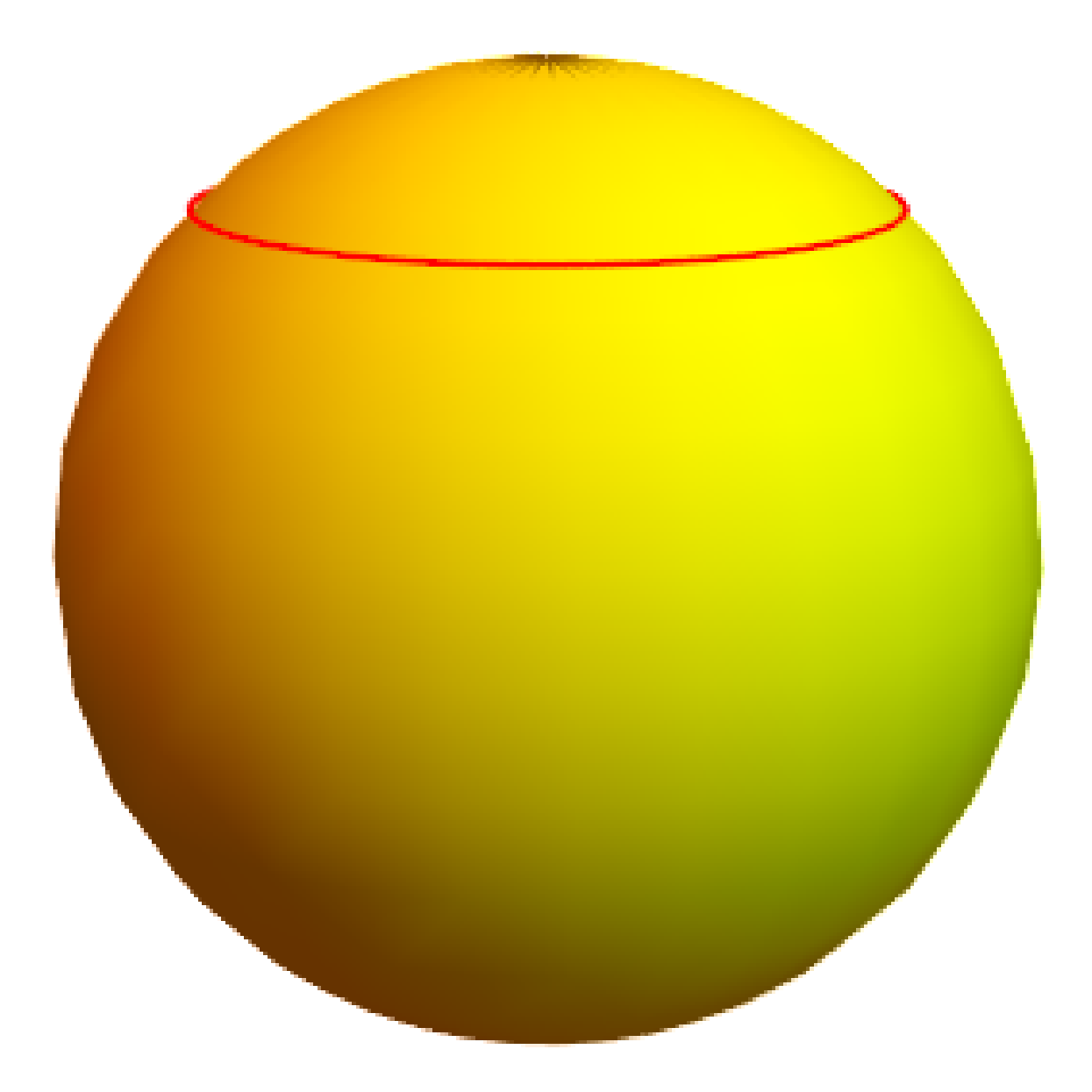
We can see the mixed surfaces (yellow surfaces) and lightlike locus (red curves) in
Figure 3.
By a direct calculation,
, slant focal surfacs
are given by
We can see that
is a tangent flat approximation of
f along
(cf. [
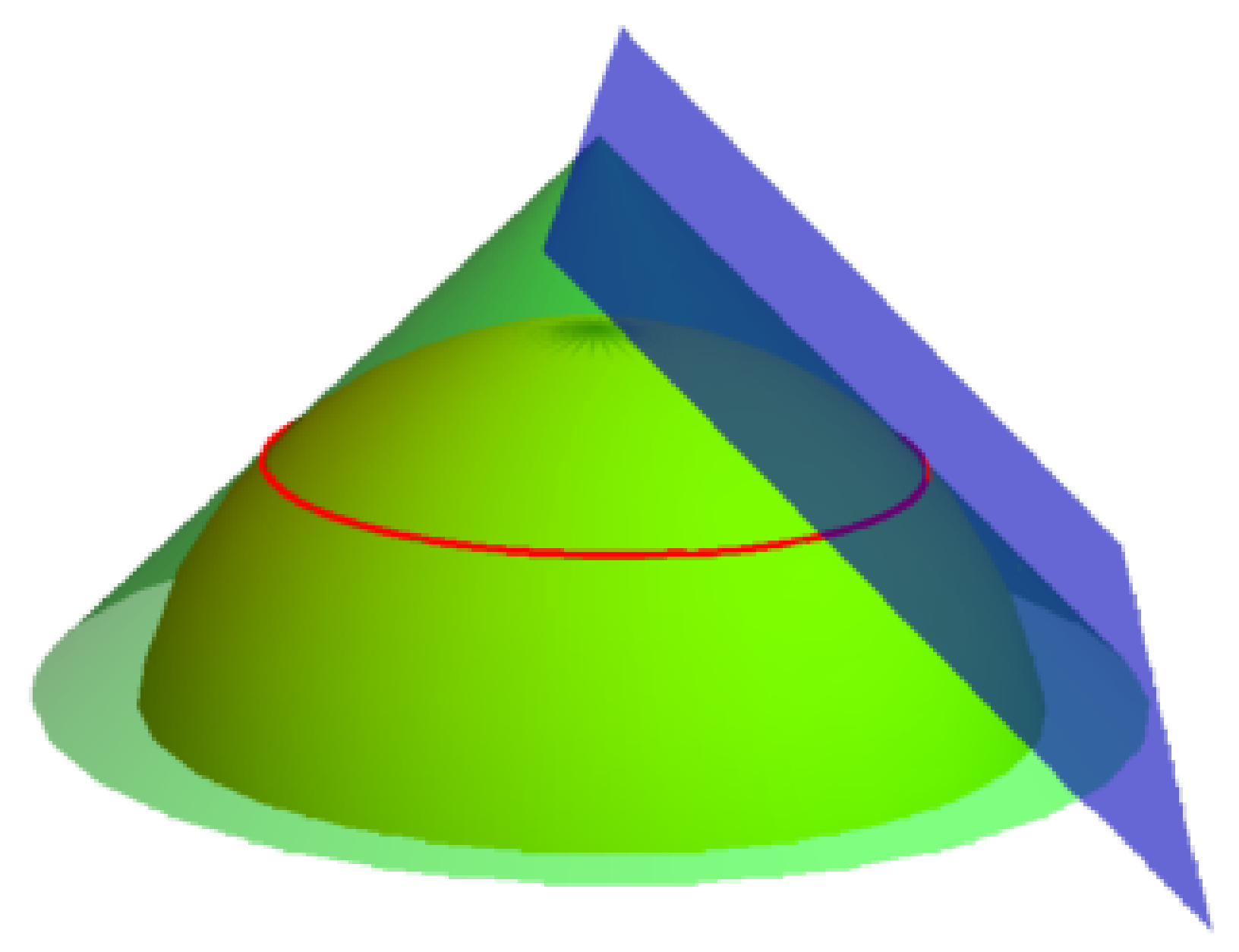
1]). Then we have the
(green surface) in the following picture. Tangent plane (blue plane) of
at
coincides with that of
at
in
Figure 4.
If
,
then focal surface
is in
Figure 5.
Since
, when
, we have that slant evolutes are given by
Since
and
for
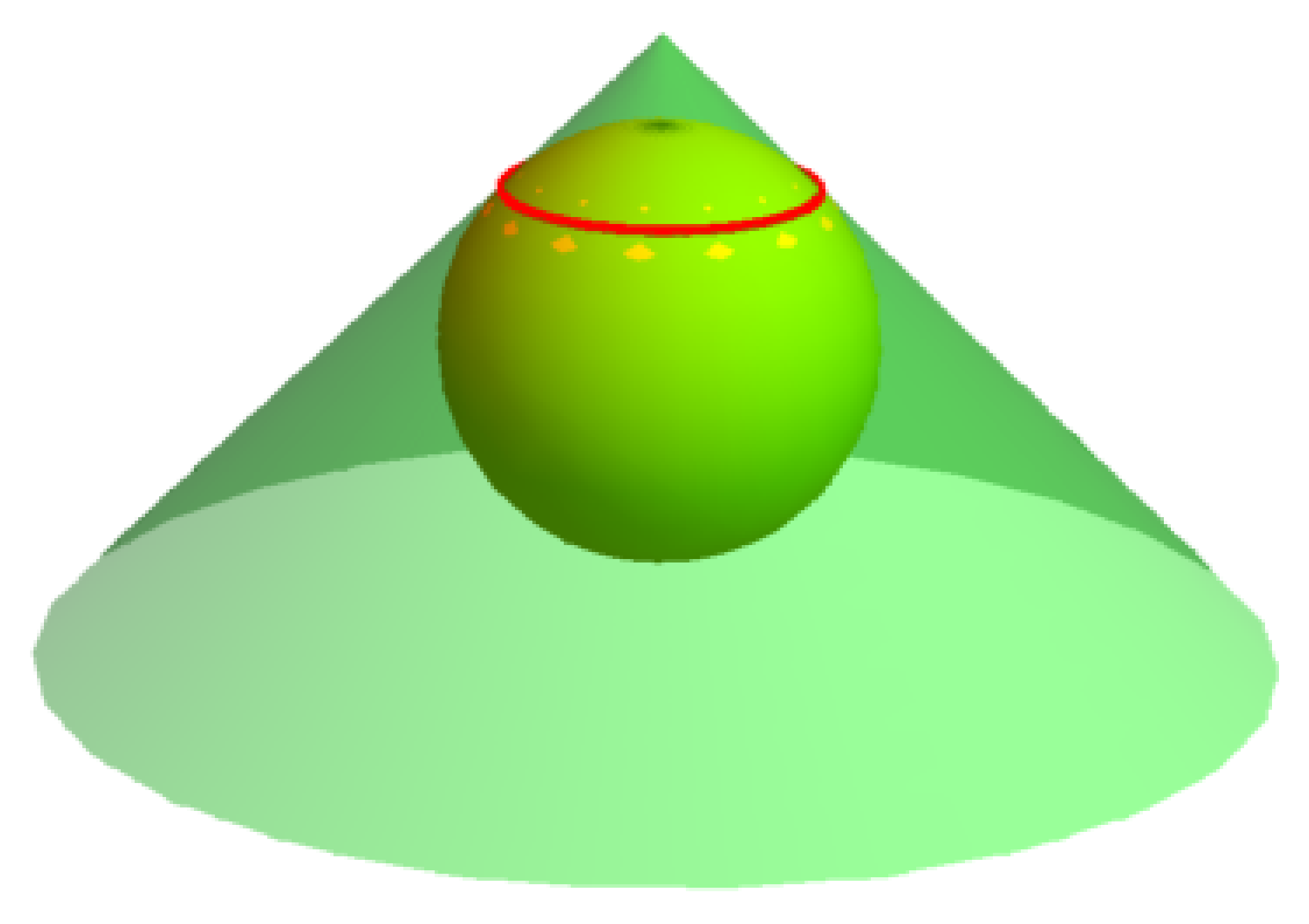
, by Proposition 3,
is on the lightcone
whose vertex is
. the
is the green surface in
Figure 6.