


Abstract
Fuzzy topological topographic mapping () is a mathematical model that consists of a set of homeomorphic topological spaces designed to solve the neuro magnetic inverse problem. The key to the model is its topological structure that can accommodate electrical or magnetic recorded brain signal. A sequence of FTTM, , is an extension of FTTM whereby its form can be arranged in a symmetrical form, i.e., polygon. The special characteristic of , namely, the homeomorphisms between its components, allows the generation of new . The generated s can be represented as pseudo graphs. A pseudo-graph consists of vertices that signify the generated and edges that connect their incidence components. A graph of pseudo degree zero, however, is a special type of graph where each of the components differs from its adjacent. A researcher posted a conjecture on in 2014, and it was finally proven in 2021 by researchers who used their novel grid-based method. In this paper, the extended , namely, the conjecture on that was posed in 2018, is narrated and proven using simple mathematical induction.
1. Introduction
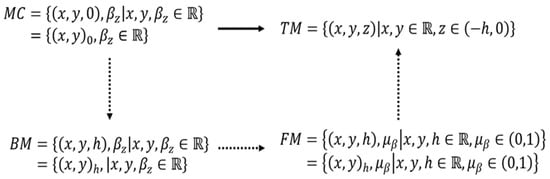
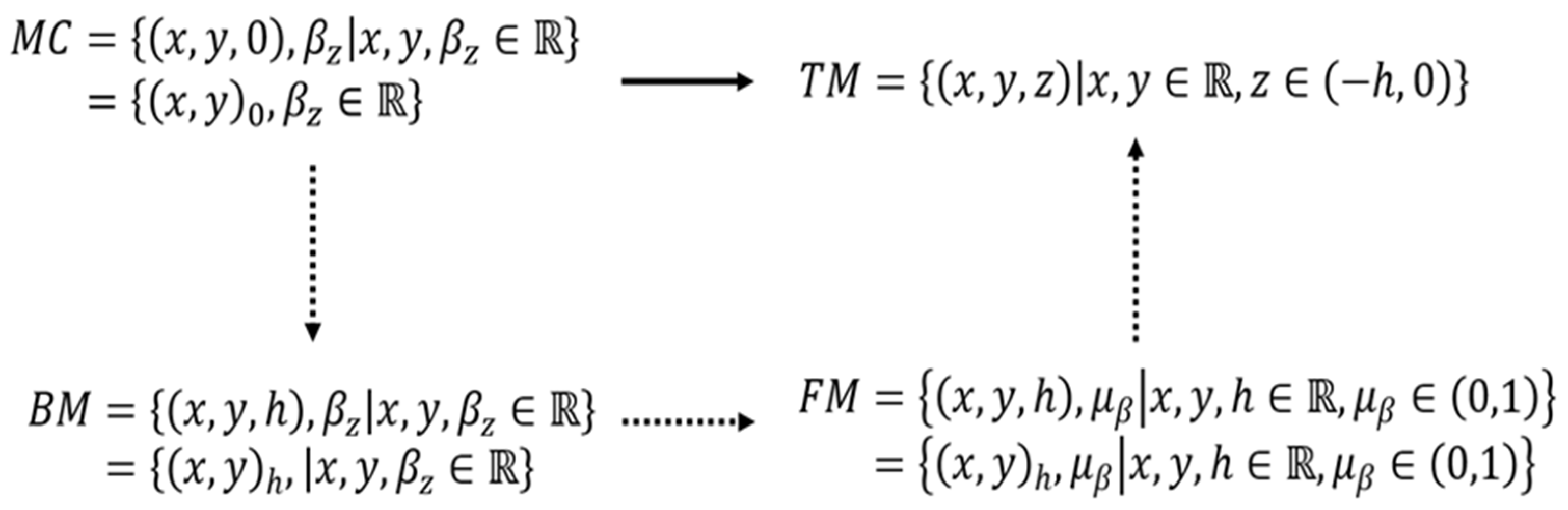
Fuzzy topographic topological mapping (FTTM) [1] was introduced to solve the neuro magnetic inverse problem, in particular, the sources of electroencephalography (EEG) signals recorded from an epileptic patient. Originally, the model is a 4-tuple of topological spaces and mappings of its respective homeomorphic mappings [2]. The topological spaces are magnetic plane (MC), base magnetic plane (BM), fuzzy magnetic field (FM) and topographic magnetic field (TM). The FTTM is defined formally as follows (see Figure 1).
Figure 1.
The FTTM.
Definition 1.
([3]) Let such that are topological spaces with . Set of is denoted by . Sequence of of FTTM is such that and .
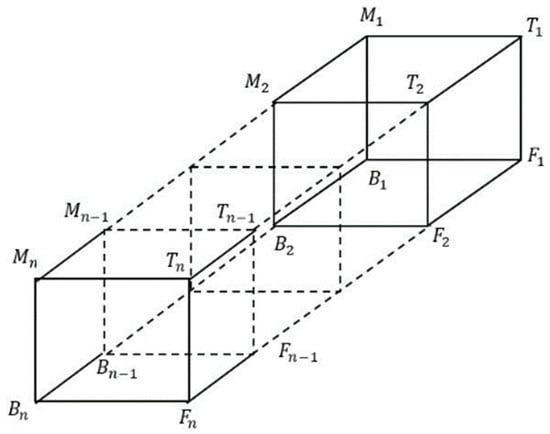
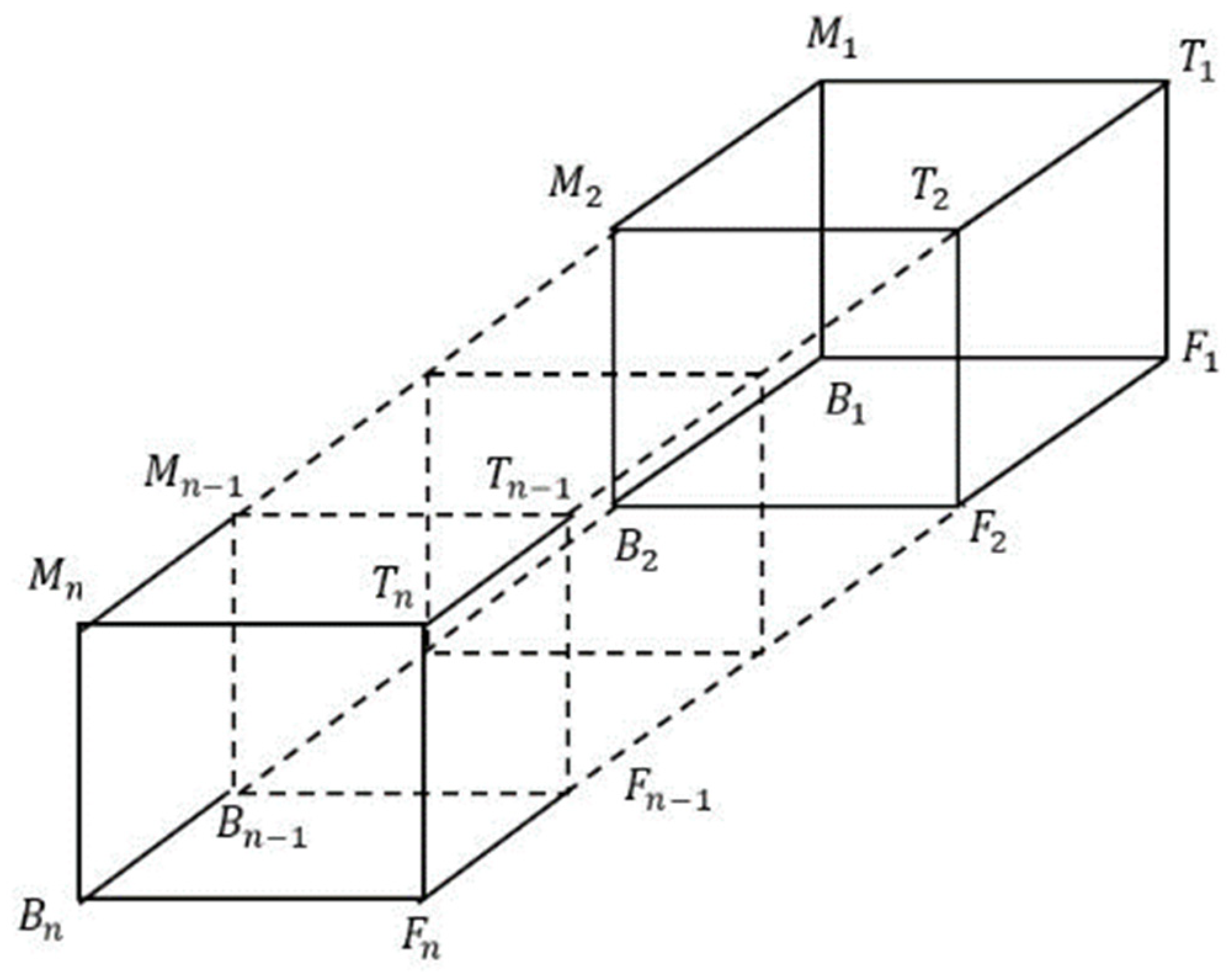
There are many studies on ordinary and fuzzy hypergraphs available in the literature [4,5,6,7]. For example, O’Keeffe and Treacy [8] recently studied finite and periodic graphs and their embeddings in ordinary 3-D Euclidean space. Such isotopic and anisotropic graphs were discussed by the researchers. Poulik et al. [9] used a fuzzy graph to model wi-fi network system in a town, and Poulik and Ghoral [10] recently applied it for modeling of COVID-19 transmission. Similarly, Hassan et. al. [11] used a fuzzy graph to model COVID-19, and Hassan et al. [12] utilized a fuzzy graph for Malaysian banknote authentication purpose. However, the concept of FTTM as a graph was invented by Sayed and Ahmad [13]. Earlier, the sequence of FTTM was presented by Jamaian [14], whereby it is denoted as Basically, is an extension of FTTM and is illustrated in the following Figure 2. It is arranged in a symmetrical form and can accommodate magnetoencephalography (MEG) [1] or electroencephalography (EEG) [15] signals, as well as grey scale image data [16]. This accommodative feature of FTTM is due to its homeomorphic structures.
Figure 2.
The sequence of .
2. Generalized FTTM
The FTTM structure can be generalized to any n number of components as well.
Definition 2.
([17]) A is defined as
such that are the components of .
The model can be expanded to any k number of versions, denoted as . The collection of version of is now simply called a sequence of .
Definition 3.
([17]) A sequence of versions of denoted by such that,
where is the first version of , the is the second version of and so forth.
Obviously, a new can be generated from a combination of components from different versions of due to their homeomorphisms.
Definition 4.
([17]) A new generated from is defined as
where and for at least one .
A set of elements generated by is denoted by . Earlier researchers have shown that the number of can be determined from using the geometrical features of its graph representation [1]. The amount of generated FTTM with four components is given by the following theorem.
Theorem 1.
([1]) The number of generated that can be created from is
The extended version of Theorem 1 that includes n number of components of FTTM was posed by [1] earlier in 2014.
Theorem 2.
([3]) The number of generated FTTM that can be created from is
The following example is presented to illustrate Theorem 2.
Example 1.
Consider , with and , then } that is as given by Theorem 2.
3. Extended Generalization of FTTM
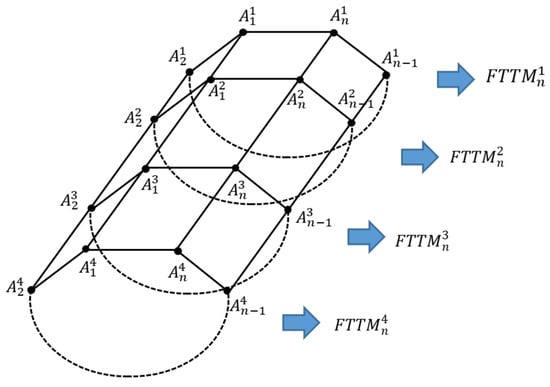
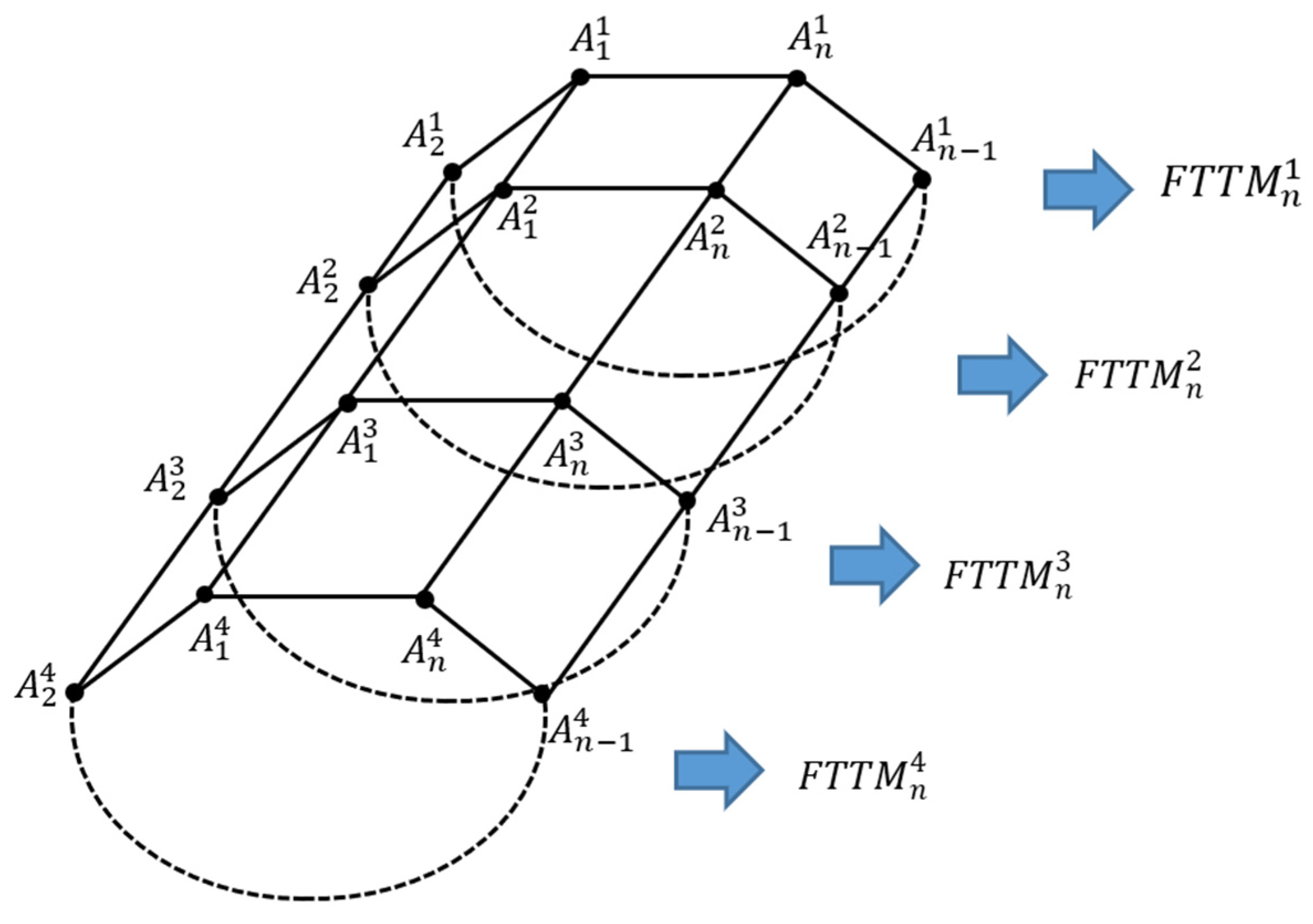
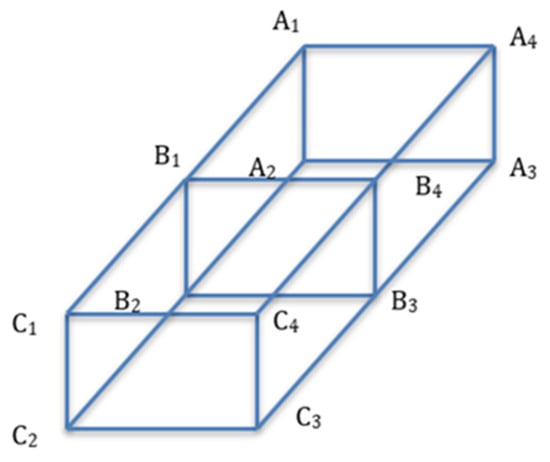
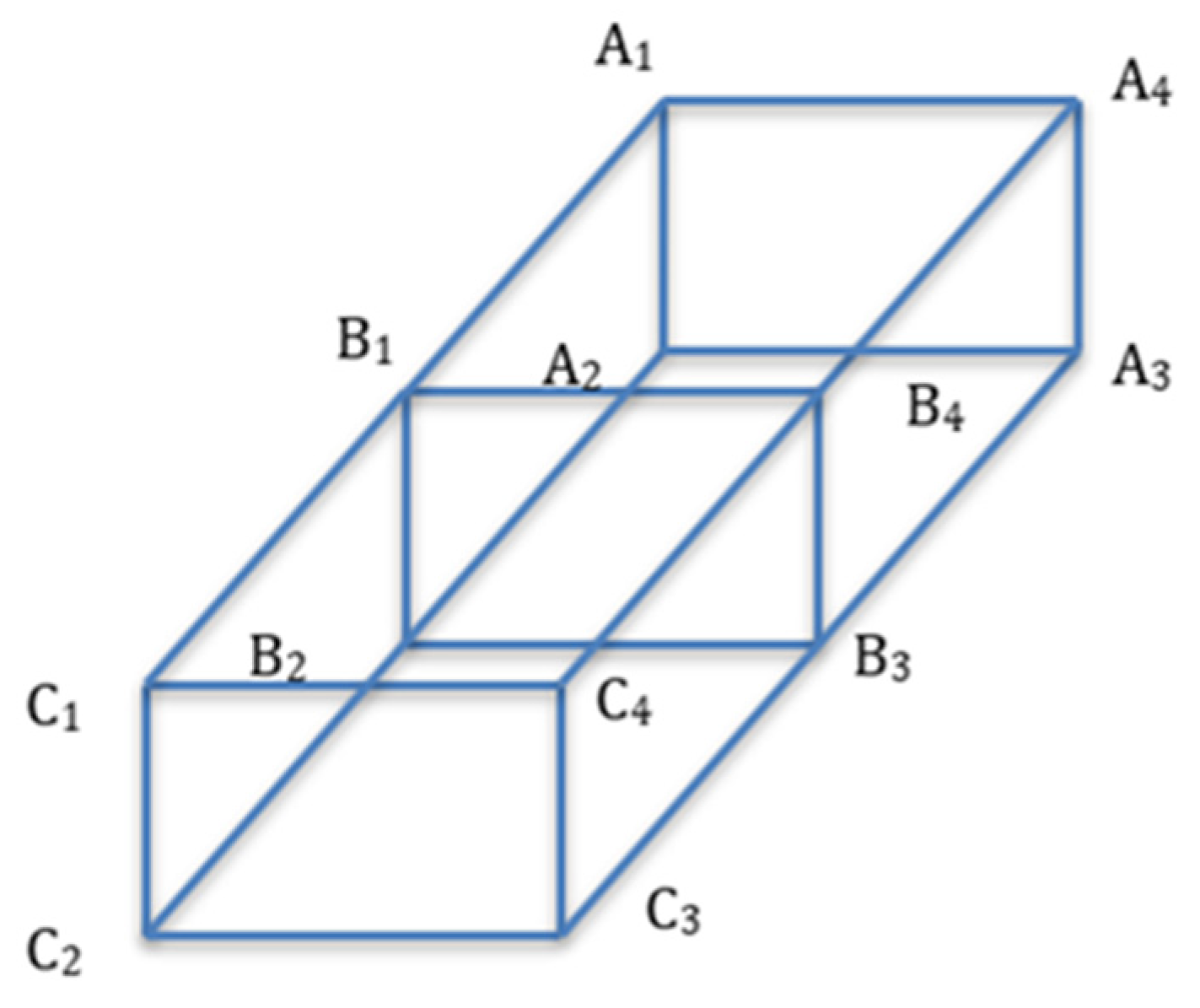
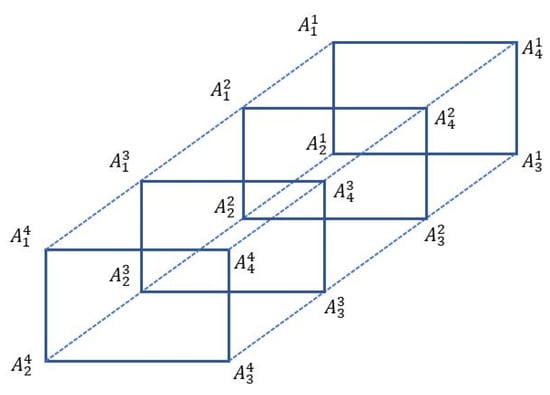
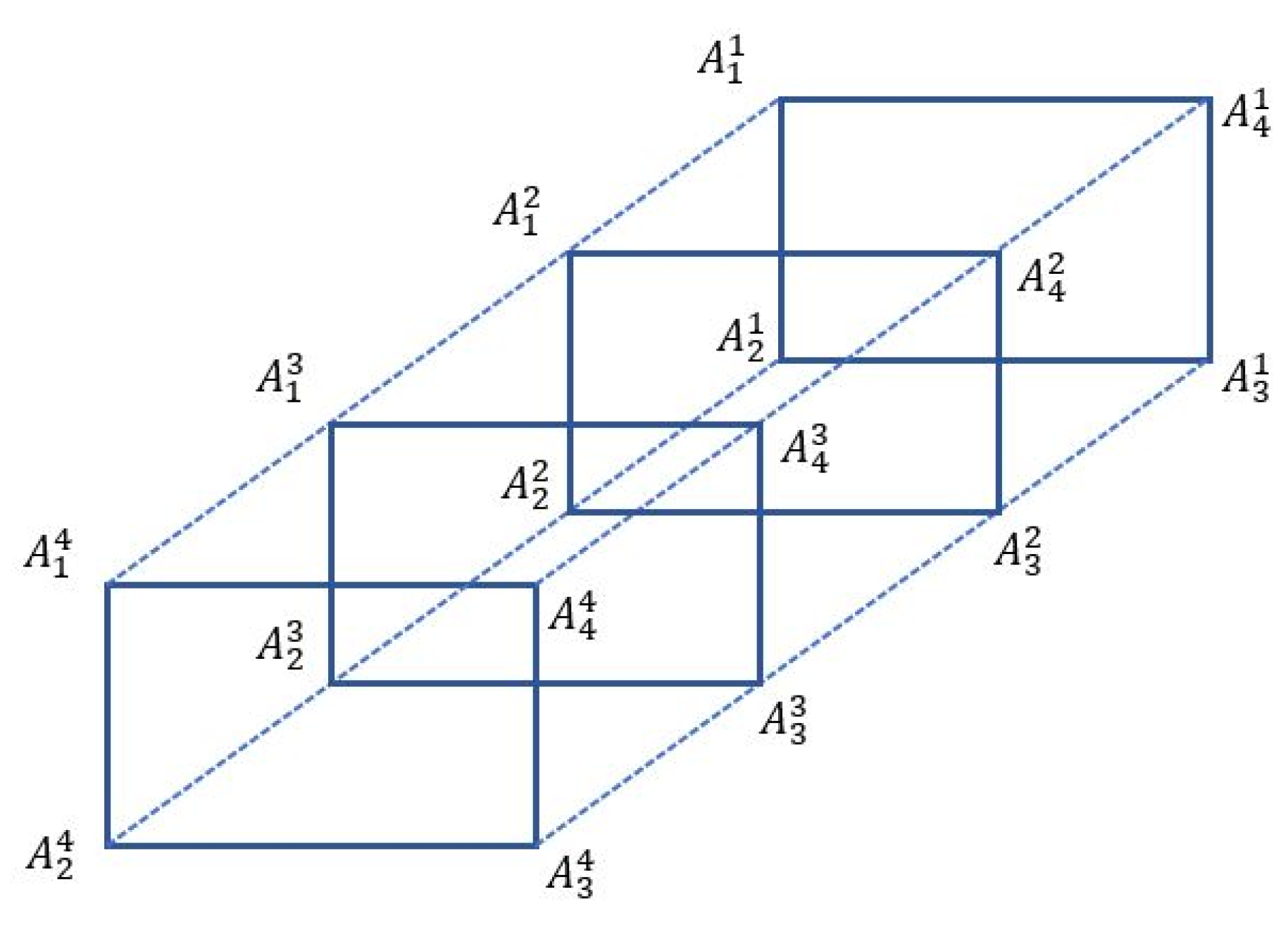
Furthermore, is an extended generalization of FTTM that can be represented by a graph of the sequence of number of polygons with sides or vertices. The polygon is arranged from back to front where the first polygon represents , the second polygon represents and so forth. An edge is added to connect to the component wisely, similarly, for and and the rest (Figure 3).
Figure 3.
Graph of [18].
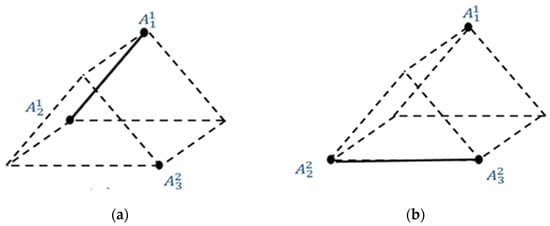
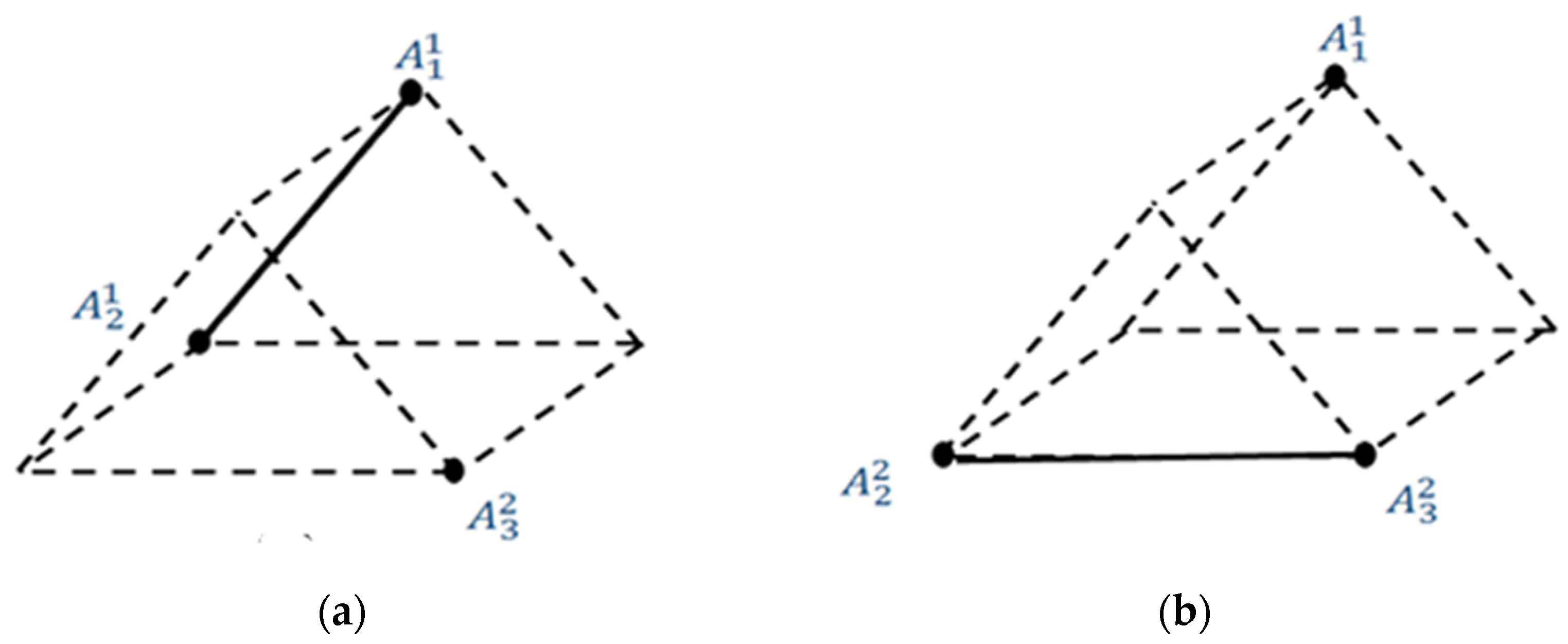
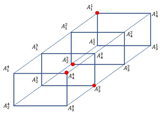
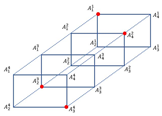
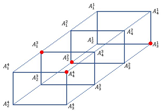
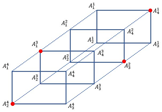
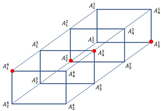
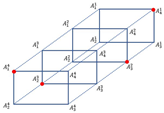
When a new is obtained from , then it is called a pseudo-graph of generated and plotted on the skeleton of . A generated element of a pseudo-graph consists of vertices that signify the generated and edges that connect the incidence components. Two samples of pseudo-graphs are illustrated in Figure 4.
Figure 4.
Pseudo graph: (a) ; (b) of [18].
Another concept related closely to the pseudo-graph is pseudo degree. It is defined as the sum of the pseudo degree from each component of the . The pseudo degree of a component is the number of other components that are adjacent to that particular component.
Definition 5.
([17]) The defines the pseudo degree of component. It maps a component of to an integer
for .
Definition 6.
([17]) The defines the pseudo degree of graph. Let
where .
Definition 7.
([17]) The set of elements generated by that have pseudo degree zero is
In other words, vertices of are all isolated.
From now on,
- is simply denoted by .
- denotes the cardinality of the set .
Example 2.
(see Figure 5)
Figure 5.
[17].
Earlier, Elsafi proposed a conjecture in [3] related to the graph of pseudo degree, in particular, .
Conjecture 1.
([5])
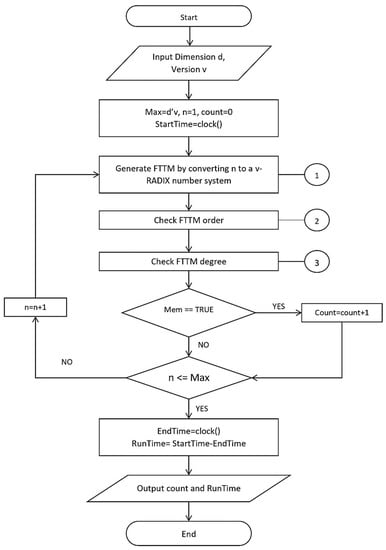
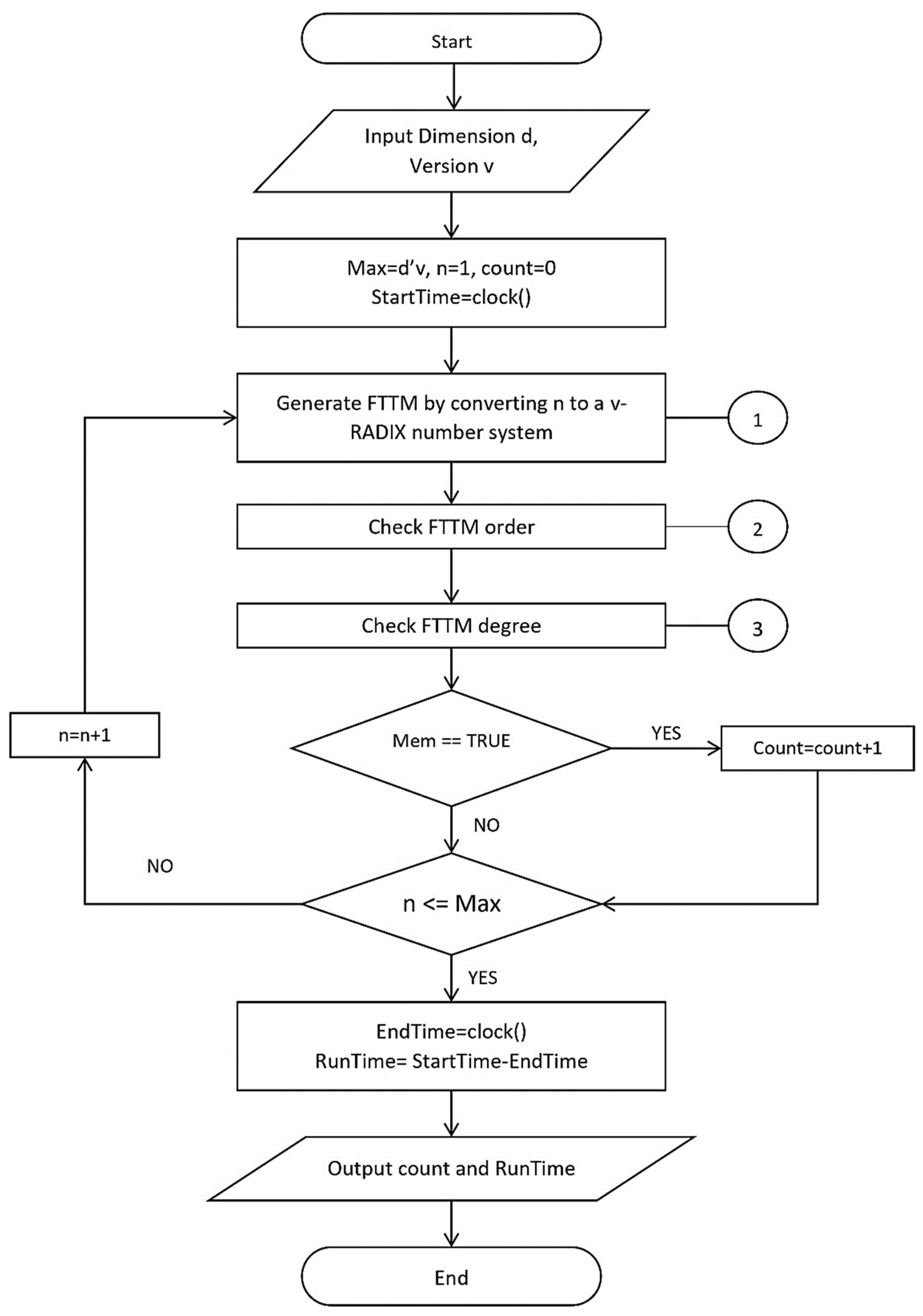
Conjecture 1 was finally proven successfully by Mukaram et al. [18] in 2021. In order to achieve it, the researchers developed an algorithm [15,17] to obtain some patterns of the conjecture (see Figure 6) for k = 3 and 4 before the analytical proof for was devised and presented in [18] using their novel grid-based method.
Figure 6.
Flowchart for determining [18].
Some interesting numerical results were obtained (see Table 1).
Table 1.
for and [18].
Example 3.
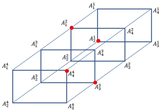
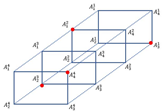
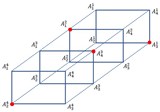
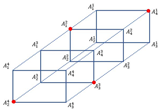
Consider (see Figure 7) such that
where .
Figure 7.
.
Its pseudo degree zero elements are
and its geometrical representations are shown in Table 2.
Table 2.
Geometrical features of Pseudo degree zero for .
4. Conjecturing
Mukaram et al. [17] conjectured Since Elsafi’s conjecture (see Conjecture 1) is presented in odd and even values of , it was suspected that should exhibit a similar form as . Table 3 and Table 4 list for odd and even , respectively. The ratio of is then calculated.
Table 3.
for odd .
Table 4.
for even .
From Table 3 and Table 4, the ratio seems to converge to 9. The equation is then conjectured to be as follows:
such that is an unknown that needs to be determined.
Table 5.
for even .
Table 6.
for odd .
From Table 5 and Table 6, the ratio seems to converge to 4. The equation for is then conjectured to be as follows:
Form Table 7, the following relation is then proposed
Table 7.
and for .
Finally, a new conjecture, namely, is stated formally.
Conjecture 2.
for with and .
Example 4.
When ,
Example 5.
When ,
5. The Theorem
In this section, we prove , i.e., Conjecture 2, analytically using mathematical induction [19]. In doing so, a lemma and a couple of theorems are developed for the purpose.
Conjecture 2 can be divided into two parts, namely, the even and odd parts.
5.1. Even
First, the sub term of the even part, for and with is considered. Here are some of its respective terms (see Table 8).
Table 8.
In for n = 6, 8, 10, 12 and 14.
The expression can be deduced to a simpler form (see Table 9).
Table 9.
In = 4In−2 + 168 for even number, n.
As for the sequence with it can be deduced further as follows.
Lemma 1.
with for .
Proof.
Therefore, which implies . Hence,, but then,is a summation of a geometric series. If that is the case,
□
The deduction can be reinstated and proven as a theorem formally.
Theorem 3.
such thatwithfor.
Proof.
(by mathematical induction)
Now, by using Lemma 1.
m = 1
Assume is true. We need to show .
Then, .
Since
Thus,
□
The procedure to prove the even part has shown how we can deal with the odd part.
5.2. Odd
Second, the sub term of the odd part, namely, for for with . Here are some of its respective terms (see Table 10).
Table 10.
for n = 7, 9, 11, 13 and 15.
The expression can be deduced to a simpler form (see Table 11).
Table 11.
for odd number, n.
The deduction on the odd part can be reinstated as a theorem formally.
Theorem 4.
Proof.
(by mathematical induction)
Now, using Lemma 1
m = 1
Assumeis true. We need to show.
Then,since
Thus,
□.
Conjecture 2 is now simplified and composed to be a theorem as follows
Theorem 5.
for.
Proof.
(by mathematical induction)
We are going to use the mathematical induction method to prove the conjecture (see Table 11).
m = 1
.
- (i)
- Assumeis true.
We need to show
Look,
Since
since(Note: we start with).
- (ii)
- Assumeis true.
We need to show. Look,
since
since(Note: we start with).
Therefore,
for. □
6. Discussions
Fuzzy topological topographic mapping () is a mathematical model that consists of a set of homeomorphic topological spaces designed originally to solve the neuro magnetic inverse problem. A sequence of FTTM denoted as is an extension of FTTM that is arranged in a symmetrical form. It can be represented as a graph. The special characteristic of , namely, the homeomorphisms between its components, allows the generation of new . Since 2019, and were generalized and introduced. The former means a sequence of three and the latter denotes a sequence of four FTTMs with n number of components, respectively. These arrangements can produce more s, i.e., generated FTTMs. Among the generated FTTMs are pseudo graphs. A graph of pseudo degree zero, is a special type of graph where each of the components differs from its adjacent component, i.e., with isolated vertices. Initially, a researcher [3] posted a conjecture on in 2014, and it was finally proven in 2021 [18] using their novel grid-based method. Moreover, the latter researchers [17,18] also conjectured on , which remains an open problem until today.
7. Conclusions
In this paper, the conjecture on is narrated, discussed and finally proven using mathematical induction. The methodology taken for proving is simpler and clearer than the grid-based method employed by [18]. Nevertheless, the methodology required to prove another pseudo degree zero, for remains open. Certainly, it demands some related simulation works in order to identify and devise such methods of proving. Mathematical induction is a very common proving technique that involves integers. It can be considered whenever it is required. The technique can probably be adopted to prove other pseudo degree zero such as for or other similar complicated forms of sequences.
Author Contributions
Conceptualization, N.A.S. and T.A.; methodology, T.A.; software, M.Z.M. and N.A.; formal analysis, T.A., N.A. and M.Z.M.; investigation, M.Z.M. and T.A.; writing—original draft preparation, T.A. and N.A.S.; writing—review and editing, A.I. and S.R.A.; supervision, T.A., A.I. and S.R.A.; funding acquisition, T.A., N.A. and S.R.A. All authors have read and agreed to the published version of the manuscript.
Funding
This research is supported by Fundamental Research Grant Scheme (FRGS) FRGS/1/2020/STG06/UTM/01/1 awarded by Ministry of Higher Education, Malaysia.
Data Availability Statement
Not applicable.
Acknowledgments
Authors acknowledge the support of Universiti Teknologi Malaysia (UTM) and Ministry of Higher Education Malaysia (MOHE) in this work.
Conflicts of Interest
The authors declare no conflict of interest.
References
- Shukor, N.A.; Ahmad, T.; Idris, A.; Awang, S.R.; Fuad, A.A.A. Graph of Fuzzy Topographic Topological Mapping in Relation to k-Fibonacci Sequence. J. Math. 2021, 2021, 7519643. [Google Scholar] [CrossRef] [Scilit]
- Ahmad, T.; Ahmad, R.S.; Rahman, W.E.Z.W.A.; Yun, L.L.; Zakaria, F. Homeomorphisms of Fuzzy Topographic Topological Mapping (FTTM). Matematika 2005, 21, 35–42. [Google Scholar]
- Elsafi, M.S.A.E. Combinatorial Analysis of N-Tuple Polygonal Sequence of Fuzzy Topographic Topological Mapping. Ph.D. Thesis, University Teknologi Malaysia, Skudai, Malaysia, 2014. [Google Scholar]
- Debnath, P. Domination in interval-valued fuzzy graphs. Ann. Fuzzy Math. Inform. 2013, 6, 363–370. [Google Scholar]
- Konwar, N.; Davvaz, B.; Debnath, P. Results on generalized intuitionistic fuzzy hypergroupoids. J. Intell. Fuzzy Syst. 2019, 36, 2571–2580. [Google Scholar] [CrossRef] [Scilit]
- Zhu, J.; Li, B.; Zhang, Z.; Zhao, L.; Li, H. High-Order Topology-Enhanced Graph Convolutional Networks for Dynamic Graphs. Symmetry 2022, 14, 2218. [Google Scholar] [CrossRef] [Scilit]
- Wang, G.; Chen, L.; Xiong, Z. The l1-Embeddability of Hypertrees and Unicyclic Hypergraphs. Symmetry 2022, 14, 2260. [Google Scholar] [CrossRef] [Scilit]
- O’Keeffe, M.; Treacy, M.M.J. The Symmetry and Topology of Finite and Periodic Graphs and Their Embeddings in Three-Dimensional Euclidean Space. Symmetry 2022, 14, 822. [Google Scholar] [CrossRef] [Scilit]
- Poulik, S.; Das, S.; Ghorai, G. Randic index of bipolar fuzzy graphs and its application in network systems. J. Appl. Math. Comput. 2021, 68, 2317–2341. [Google Scholar] [CrossRef] [Scilit]
- Poulik, S.; Das, S.; Ghorai, G. Estimation of most affected cycles and busiest network route based on complexity function of graph in fuzzy environment. Artif. Intell. Rev. 2022, 55, 4557–4574. [Google Scholar] [CrossRef] [Scilit] [PubMed]
- Hassan, N.; Ahmad, T.; Ashaari, A.; Awang, S.R.; Mamat, S.S.; Mohamad, W.M.W.; Fuad, A.A.A. A fuzzy graph approach analysis for COVID-19 outbreak. Results Phys. 2021, 25, 104267. [Google Scholar] [CrossRef] [Scilit] [PubMed]
- Hassan, N.; Ahmad, T.; Mahat, N.A.; Maarof, H.; How, F.K. Counterfeit fifty Ringgit Malaysian banknotes authentication using novel graph-based chemometrics method. Sci. Rep. 2022, 12, 4826. [Google Scholar] [CrossRef] [Scilit] [PubMed]
- Sayed, M.; Ahmad, T. Graph of finite sequence of fuzzy topographic topological mapping of order two. J. Math. Stat. 2013, 9, 18–23. [Google Scholar] [CrossRef] [Scilit]
- Jamaian, S.S.; Ahmad, T.; Talib, J. Generalized finite sequence of fuzzy topographic topological mapping. J. Math. Stat. 2010, 6, 151–156. [Google Scholar]
- Zenian, S.; Ahmad, T.; Idris, A. A Comparison of Ordinary Fuzzy and Intuitionistic Fuzzy Approaches in Visualizing the Image of Flat Electroencephalography. J. Phys. Conf. Ser. 2017, 890, 012079. [Google Scholar] [CrossRef] [Scilit]
- Rahman, W.E.Z.W.A.; Ahmad, T.; Ahmad, R.S. Simulating the Neuronal Current Sources in the Brain. Proc. Biomed. 2002, 19–22. [Google Scholar]
- Mukaram, M.Z.; Ahmad, T.; Alias, N. Graph of pseudo degree zero generated by . In Proceedings of the International Conference on Mathematical Sciences and Technology 2018 (Mathtech2018): Innovative Technologies for Mathematics & Mathematics for Technological Innovation, Penang, Malaysia, 10–12 December 2018; AIP Publishing LLC: Penang, Malaysia, 2018; p. 020007. [Google Scholar] [CrossRef] [Scilit]
- Mukaram, M.Z.; Ahmad, T.; Alias, N.; Shukor, N.A.; Mustapha, F. Extended Graph of Fuzzy Topographic Topological Mapping Model. Symmetry 2021, 13, 2203. [Google Scholar] [CrossRef] [Scilit]
- Moura, L. Induction and Recursion. PowerPoint Presentation, University of Ottawa. 2010. Available online: https://www.site.uottawa.ca/~lucia/courses/2101-12/lecturenotes/06Induction.pdf (accessed on 1 October 2022).















Publisher’s Note: MDPI stays neutral with regard to jurisdictional claims in published maps and institutional affiliations. |
© 2022 by the authors. Licensee MDPI, Basel, Switzerland. This article is an open access article distributed under the terms and conditions of the Creative Commons Attribution (CC BY) license (https://creativecommons.org/licenses/by/4.0/).