Abstract
The purpose of this paper is to determine the existence of tripled fixed point results for the tripled symmetry system of fractional hybrid delay differential equations. We obtain results which support the existence of at least one solution to our system by applying hybrid fixed point theory. Similar types of stability analysis are presented, including Ulam–Hyers, generalized Ulam–Hyers, Ulam–Hyers–Rassias, and generalized Ulam–Hyers–Rassias. The necessary stipulations for obtaining the solution to our proposed problem are established. Finally, we provide a non-trivial illustrative example to support and enhance our analysis.
Keywords:
tripled fixed point technique; Ulam–Hyers–Rassias stability; fractional hybrid delay differential equation; Caputo derivative MSC:
47H10; 26A33; 34A08; 35R11
1. Introduction
The study of fractional derivatives is very important for many engineering applications as it utilizes differential equations which have a long history of application in many fields, including chemistry, physics and dynamical systems. The significance of fractional-order differential equations is that fractional-order types are more accurate than integer-order types because they have a greater degree of freedom [1,2,3]. Hybrid differential equations s), which are one of the most common ways of representing perturbations in dynamical systems, have piqued the curiosity of many academics [4,5,6]. Many studies have involved the application of hybrid fixed point theory to s by incorporating various symmetry perturbations [7,8,9,10]. Before describing our investigation, we provide an overview of related studies addressing the identified problem. In 2013, Dhage established the existence and uniqueness of the following solution:
and where [8,11]. Subsequently, Lu et al. [5] generalized (1) by employing the Riemann–Liouville derivative to obtain a satisfactory relation between the analytical solution and the experimental results
and . In addition, Hilal et al. [6] proposed the for fractional hybrid differential equations (s), which included Caputo’s fractional-order derivative as follows:
here and are real values. Recently, Iqbal et al. [7] extended the work of [6] by adding a delay parameter to obtain the following
where are non-zero real values, is Caputo’s derivative, with here , and are non-linear continuous functions. Samei et al. investigated the existence of solutions for the following hybrid Caputo–Hadamard fractional differential inclusion
for and , , where and denote the Caputo–Hadamard fractional derivative and Hadamard integral of order and for , respectively; functions , , , are continuous, and the multifunction satisfies certain conditions [12]. Etemad et al. investigated the fractional hybrid multi-term Caputo integro-differential inclusion
with three-point integral hybrid boundary value conditions, where , denotes the fractional Caputo derivative of order , is a continuous function and is a set-valued map via certain properties [13]. Ma in [14] considered three pairs of local and non-local group constraints for Ablowitz–Kaup–Newell–Segur matrix eigenvalue problems and generated three reduced non-local integrable non-linear Schrödinger hierarchies. They performed two group reductions of the Ablowitz–Kaup–Newell–Segur matrix spectral problems to derive a class of novel reduced non-local reverse-spacetime integrable modified Korteweg–de Vries equations [15].
A number of authors have sought innovative approaches to improve the various types of fractional-order differential equations. Stability analysis of fractional differential equation () solutions was introduced to address this issue. In 1940, Ulam developed the novel concept of stability analysis to apply stability theory. In 1941, Hyers [16] then generalized the concept using a more advanced approach. Rassias [17,18] amplified the concept for the previously mentioned range to incorporate more types of stability, such as Ulam–Hyers–Rassias (UHR) and generalized Ulam–Hyers–Rassias (UHR). In bio-mathematics, applications of tripled systems of fractional-order epidemic models, such as susceptible-infected-susceptible and susceptible-infected-recovered models, with Caputo fractional-order derivative [19], have been developed. Papers [20,21,22,23,24,25] provide additional information on these stabilities and their applications.
In this paper, we demonstrate the requirements for at least one solution and analyze its stability for the following fractional hybrid delay differential equations (s) with non-homogeneous initial conditions and second-order quadratic perturbations
under conditions
where is Caputo’s derivative, , are real numbers, is a delay parameter and are non-linear continuous functions. In addition, the hybrid fixed point theorem and other non-linear functional analysis outcomes are used to construct compatible criteria for the existence and uniqueness of the solution. The proposed system (2) is subjected to stability analysis in many directions. Finally, an example is presented to support our findings.
A brief outline of the paper is as follows: Section 2 provides the definitions and preliminary facts necessary for the analysis. We also review several definitions and properties of fractional-order integral and differential operators that will be utilized afterwards. In Section 3, we prove the existence of the problem (2). The existence, uniqueness and UH stability results for the problem (2) are also investigated. An example is given in Section 4. A concluding section completes the paper.
2. Preliminaries
In this section, we present notations and basic definitions which are useful for the derivation of our results. For supporting material to the current work, please see [3,11,26,27]. The Riemann–Liouville fractional integral of order for a function is given by
provided that an integral exists. The Caputo derivative of order for on is defined by
where and is the integer part of
Lemma 1
([1]). Differential operators and fractional-order integral are connected with the equation below
for any , here
Let be Banach spaces having all continuous functions from with a norm
Then the product is also a Banach space with the norm , for each .
As in Theorem 2.4 in [9], we can state the following Theorem.
Theorem 1.
Let O be a closed and bounded set so that and the two operators , fulfil the following axioms
- (1)
- ℜ is a contraction;
- (2)
- ℑ is continuous and compact;
- (3)
- for each , implies
Then the operator equations have a solution in
We now assume the following hypotheses in order to develop the results linked to the presence of the solution as well as to the study of functional stability:
- (H)
- For positive real values and , the functions and satisfy the inequalities below: and
- (H)
- For continuous functionals , , the functions and fulfil the following constraints
- (H)
- We present the notations below to prevent lengthy calculations and to help the reader comprehend the main results.andand .
Definition 1.
A function is called Lipschitz for a positive real value ρ if the inequality below holds
Moreover, ℜ is said to be a strict contraction if
Definition 2.
A solution of the that is described as
- is UH stable if, for a constant , so that, for each , and for every solution , with the inequality belowthere is a unique solution of the (6) with a constant , so that .
We provide the following definitions of UHR and UHR stability for our considered system (6)
Definition 3.
(6) is called
- UHR stable with respect to if there is a non-zero positive real value and for every , so that, for each solution of the inequalitywhere there is a solution of the (6) with a constant , so that , for each .
- UHR stable with respect to if there is a positive real number , so that, for each solution of the inequalitywhere there is a solution of the (6) with a constant , so that , for .
3. Main Results
The following section considers the conditions in which the underlying s (2) can be solved. We begin by proving the following lemma.
Lemma 2.
Let then the solution of the
takes the form
Proof.
Applying the integral on and using Lemma 1, we have
From the initial conditions , the Equation (10) transfers to (9) as
□
Theorem 2.
It should be noted that, according to Lemma 2, the proposed system s (2) is equivalent to the integral system below,
Now, we have a theorem to produce the required result for at least one solution of the problem (2).
Theorem 3.
Proof.
Suppose a closed bounded set
where
and
Let and be operators defined by
Then, we get, ,
and for
From (14) and (15), we obtain operator equations as
that is
this implies that
Now, we show that ℜ and ℑ fulfil the hypotheses of Theorem 1. For this, we prove that ℜ is Lipschitz on with , and is completely continuous. Let then from (H), we obtain that
Taking supremum over we have
Similarly, we can write
and
Thus, ℜ is Lipschitz on with a positive constant from (16)–(18), one gets
For continuity of suppose that is a sequence in O converging to based on the Lebesgue dominated convergence theorem, we can write
Analogously, we get, for each ,
Now, we shall show is equicontinuous. So, we must conclude that ℑ is equicontinuous and uniformly bounded on Assume is any solution, then by (H), we have
which leads to
Follows the same scenario, we have
and
Therefore, from (19)–(21), we obtain that
Thus, ℑ is a uniformly bounded operator on Now, assume that with then, for each we can write
which yields that
Similarly, we get
and
If then the right sides in (22)–(24) tend to zero. Furthermore, are bounded and continuous. Hence, from (22)–(24), we get
that is, , as . Hence, ℑ is uniformly continuous for each and So, ℑ is equicontinuous in According to the Arzelá–Ascoli Theorem, ℑ is compact and, hence, completely continuous. Now, in order to show the postulate (H) of Theorem 1, let and, using the postulate (H), we have
it follows that
Passing supremum over ℷ in (25), we have
Hence, all the hypotheses of Theorem 1 are fulfilled. Then the system of s (2) has a solution in □
4. Stability Results
This section focuses on demonstrating and analyzing the necessary and required criteria for UH, UH, UHR and UHR stability in the proposed three-fold problem solution (2).
Definition 4.
For a is called a solution of
for each , if there are three functions which only depend on , so that,
- (i)
- ;
- (ii)
- The perturbed system is defined by
In order to obtain the results for the underlying form, we make the following assumption:
- (H)
- The three operators fulfil the more general Lipschitz type conditions below
Lemma 3.
If the hypotheses and are true, the solution of the following s
under conditions , , , which obeys the inequalities for as
Proof.
Theorem 4.
Assume that (H) and (H) hold and consider Lemma 3 endowed with the condition where
and
Then the solution of the problem (2) is UH and UH stable.
Proof.
Let be an arbitrary solution of the problem (2) of s and be the unique solution of the suggested problem (2). Consider
it follows that
Hence,
Similarly, we have
and
From (32)–(34), we get
and
The inequalities above can be arranged as
Applying (30) in the above inequality, we have
By simplification and putting (35) implies that
Hence, from (36)–(38) and taking we have
where
Therefore, the solution of the suggested system (2) is UH stable. In addition, suppose that , which yields . So the solution of the proposed problem (2) is UH stable. □
Now, the following hypothesis is assumed to be accurate in order to obtain the results below:
- (H)
- For some given functions r and assume that the inequalities below are true
Lemma 4.
If the postulate holds, the solution of the following system
with conditions
obeys the relations given for each
Proof.
As in Lemma (3), proof can be obtained. □
Theorem 5.
Proof.
Let be a chosen point of the suggested system of s (2) and be a unique solution of the considered problem (2); consider
it follows that
Therefore,
Analogously
and
Now, inequalities (41)–(43) can be written in matrix form as
Solving (44) and putting
and we have
where . Therefore, the solution of the suggested system (2) is UHR stable with respect to w. Obviously, one can show that the considered Problem (2) is UHR stable with respect to w. □
5. Supportive Example
To reinforce our study findings, we present the example below. All the experiments were carried out in MATLAB Ver. 8.5.0.197613 (R2015a) on a computer equipped with a CPU AMD Athlon(tm) II X2 245 at 2.90 GHz running under the operating system Windows 7.
Example 1.
and
Further, we can get , , , , , , , using (13) we have
using (4), we get
and, by employing Equation (5), we obtain
and so, . From (12), we deduce that
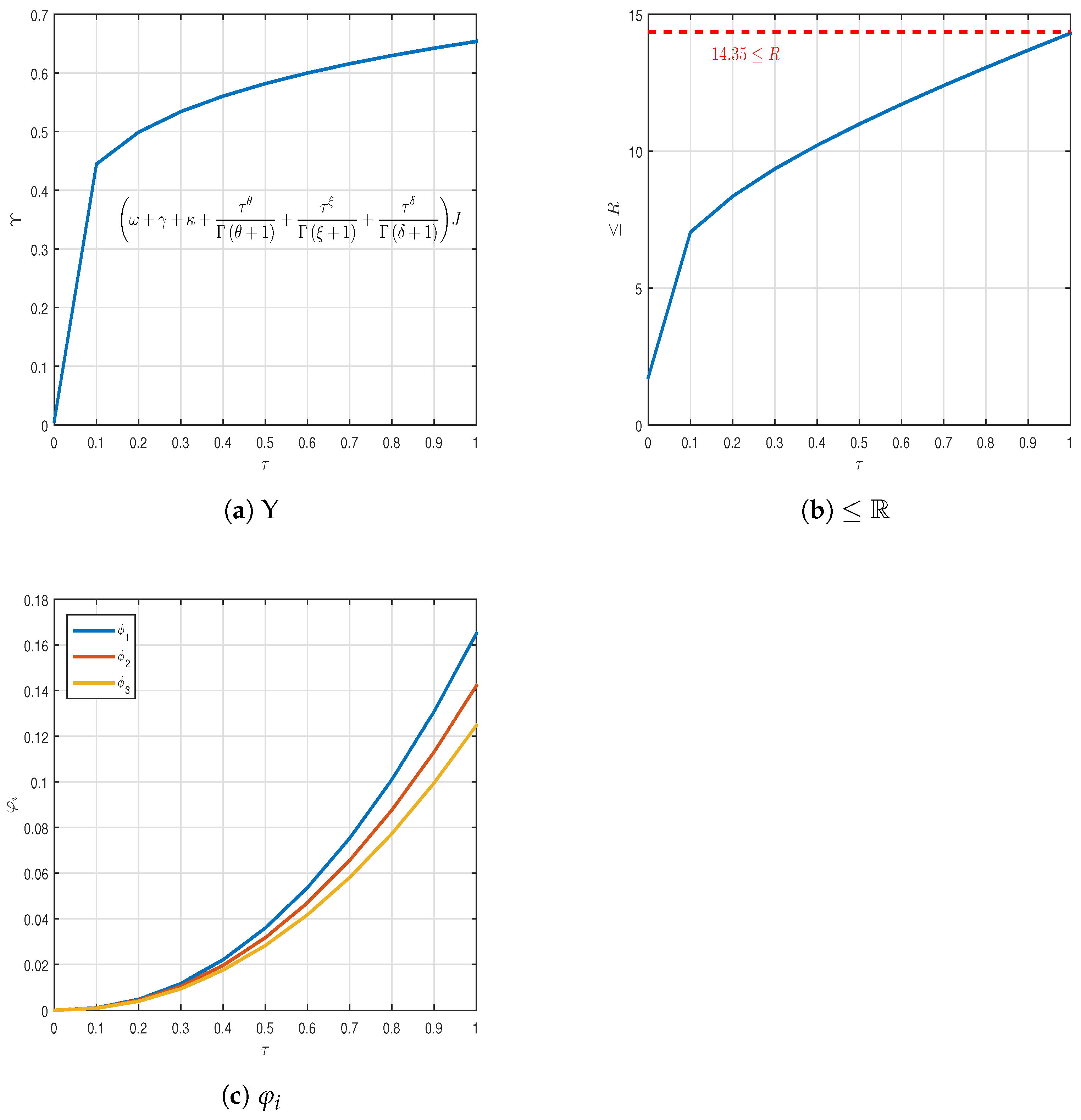
One can check these numerical results in Table 1 and can see a 2D plot of υ, and in Figure 1a–c for .
Table 1.
Numerical values of and in Example 1.
Figure 1.
Graphical representation of and in Example 1 for .
Further,
Therefore, assumptions (H), (H), (H) hold and so, by Theorem 3, the problem (45) has at least one solution. The red dotted lines in Figure 1b show that must be more than for . So, applying Theorem 3, we conclude that the proposed Problem (45)
In addition to,
we obtain this proves that the solution of (45) is UH stable, and the proposed solution is simply demonstrated to be UH stable.
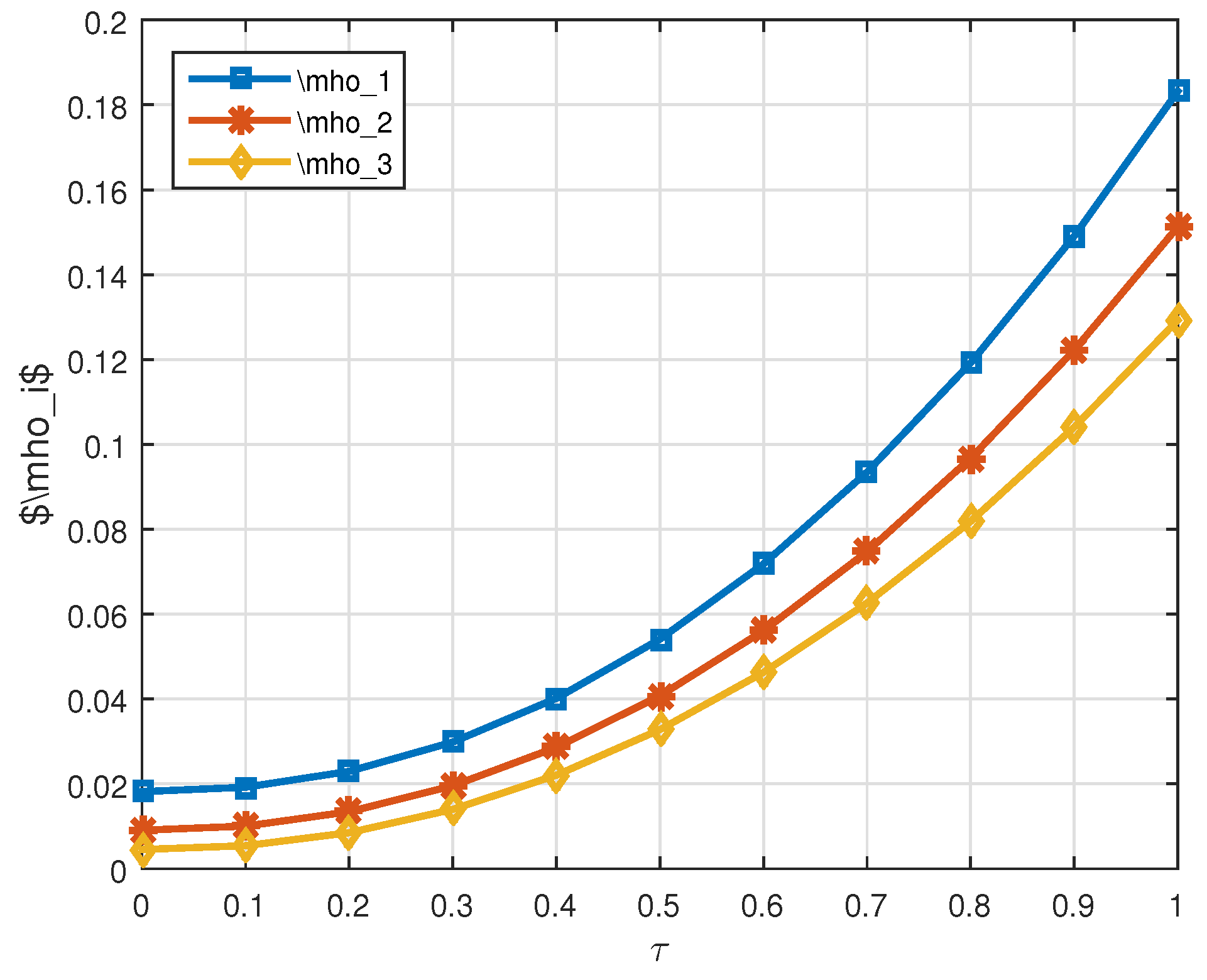
One can check these numerical results in Table 2, which shows the numerical results of . A 2D plot of is shown in Figure 2 for .
Table 2.
Numerical values of in Example 1.
Figure 2.
Graphical representation of for in Example 1.
Moreover, for ; similarly, Theorem 5 states that the requirements of UHR and UHR stability can be easily satisfied.
6. Conclusions
In this paper, we defined a new fractional mathematical model of an and investigated the qualitative behaviors of its solutions, including existence, uniqueness and stability. To confirm the existence criterion, we utilized the presumptions of the famous fixed point for the operator within the hybrid case. Modeling using systems of fractional differential equations is an important class of bio-mathematics, physics, applied chemistry and many other areas. The field has recently been extended to FDEs as well. BVPs have many applications in engineering and physical sciences. In addition, stability analysis in the Ulam–Hyers sense of a given system was considered. Finally, illustrations were provided to confirm the legitimacy of the results obtained.
Author Contributions
H.A.H.: Implementation, formal analysis, methodology, initial draft, validation, investigation and major contribution to the writing of the manuscript; R.A.R.: methodology, implementation, validation, investigation, formal analysis and initial draft; A.N.: methodology, implementation, validation, investigation, formal analysis and initial draft; M.E.S.: validation, implementation, formal analysis, methodology, investigation, simulation, initial draft, software and major contribution to the writing of the manuscript; M.d.l.S.: investigation, editing—reviewing the manuscript, formal analysis and funding. All authors have read and agreed to the published version of the manuscript.
Funding
This work was supported in part by the Basque Government under Grant IT1555-22.
Institutional Review Board Statement
Not applicable.
Informed Consent Statement
Not applicable.
Data Availability Statement
The data used to support the findings of this study are available from the corresponding author upon request.
Conflicts of Interest
The authors declare no conflict of interest.
References
- Kilbas, A.A.; Srivastava, H.M.; Trujillo, J.J. Theory and Applications of Fractional Differential Equations; North-Holland Mathematics Studies; Elsevier: Amsterdam, The Netherlands, 2006. [Google Scholar]
- Lakshmikantham, V.; Leela, S.; Devi, J.V. Theory of Fractional Dynamic Systems; Cambridge Scientific: Cambridge, UK, 2009. [Google Scholar]
- Miller, K.S.; Ross, B. An Introduction to the Fractional Calculus and Fractional Differential Equations; Wiley: New York, NY, USA, 1993. [Google Scholar]
- Baleanu, D.; Khan, H.; Jafari, H.; Khan, R.A.; Alipour, M. On existence results for solutions of a coupled system of hybrid boundary value problems with hybrid conditions. Adv. Differ. Equ. 2015, 2015, 318. [Google Scholar] [CrossRef]
- Lu, H.; Sun, S.; Yang, D.; Teng, H. Theory of fractional hybrid differential equations with linear perturbations of second type. Bound Value Probl. 2013, 2013, 23. [Google Scholar] [CrossRef]
- Hilal, K.; Kajouni, A. Boundary value problem for hybrid differential equations with fractional order. Adv. Differ. Equ. 2015, 2015, 183. [Google Scholar] [CrossRef]
- Iqbal, M.; Shah, K.; Khan, R.A. On using coupled fixed-point theorems for mild solutions to coupled system of multipoint boundary value problems of nonlinear fractional hybrid pantograph differential equations. Math. Meth. Appl. Sci. 2019, 44, 8113–8124. [Google Scholar] [CrossRef]
- Dhage, B.C. Basic results in the theory of hybrid differential equations with linear perturbations of second type. Tamkang J. Math. 2013, 44, 171–186. [Google Scholar] [CrossRef]
- Ahmad, I.; Shah, K.; ur Rahman, G.; Baleanu, D. Stability analysis for a nonlinear coupled system of fractional hybrid delay differential equations. Math. Methods Appl. Sci. 2020, 43, 8669–8682. [Google Scholar] [CrossRef]
- Hammad, H.A.; Zayed, M. Solving a system of differential equations with infinite delay by using tripled fixed point techniques on graphs. Symmetry 2022, 14, 1388. [Google Scholar] [CrossRef]
- Dhage, B.C. A fixed point theorem in Banach algebras involving three operators with applications. Kyungpook Math. J. 2004, 44, 145–155. [Google Scholar]
- Samei, M.E.; Hedayati, V.; Rezapour, S. Existence results for a fraction hybrid differential inclusion with Caputo–Hadamard type fractional derivative. Adv. Differ. Equ. 2019, 2019, 163. [Google Scholar] [CrossRef]
- Hammad, H.A.; Aydi, H.; Zayed, M. Involvement of the topological degree theory for solving a tripled system of multi-point boundary value problems. AIMS Math. 2023, 8, 2257–2271. [Google Scholar] [CrossRef]
- Ma, W.X. Reduced Non-Local Integrable NLS Hierarchies by Pairs of Local and Non-Local Constraints. Int. J. Appl. Comput. Math. 2022, 8, 206. [Google Scholar] [CrossRef]
- Ma, W.X. Reduced nonlocal integrable mKdV equations of type (-λ,λ) and their exact soliton solutions. Commun. Theor. Phys. 2022, 74, 065002. [Google Scholar] [CrossRef]
- Hyers, D.H. On the stability of the linear functional equation. Proc. Natl. Acad. Sci. USA 1941, 27, 222–224. [Google Scholar] [CrossRef] [PubMed]
- Rassias, T.M. On the stability of the linear mappings in Banach Spaces. Proc. Am. Math. Soc. 1978, 72, 297–300. [Google Scholar] [CrossRef]
- Rassias, T.M. On the stability of functional equations and a problem of Ulam. Acta. Appl. Math. 2000, 62, 23–130. [Google Scholar]
- Okyere, E.; Prah, J.A.; Oduro, F.T. A Caputo based SIRS and SIS fractional order models with standard incidence rate and varying population. Commun. Math. Biol. Neurosci. 2020, 2020, 60. [Google Scholar] [CrossRef]
- Rus, I.A. Ulam stabilities of ordinary differential equations in a Banach space. Carpathian J. Math. 2010, 26, 103–107. [Google Scholar]
- Hajiseyedazizi, S.N.; Samei, M.E.; Alzabut, J.; Chu, Y. On multi-step methods for singular fractional q–integro-differential equations. Open Math. 2021, 19, 1378–1405. [Google Scholar] [CrossRef]
- Jung, S.M. Hyers–Ulam stability of linear differential equations of first order. Appl. Math. Lett. 2006, 19, 854–858. [Google Scholar] [CrossRef]
- Tang, S.; Zada, A.; Faisal, S.; El-Sheikh, M.M.A.; Li, T. Stability of higher order nonlinear impulsive differential equations. J. Nonlinear Sci. Appl. 2016, 9, 4713–4721. [Google Scholar] [CrossRef]
- Hammad, H.A.; Aydi, H.; De la Sen, M. Analytical solution for differential and nonlinear integral equations via Fϖe-Suzuki contractions in modified ϖe-metric-like spaces. J. Func. Spaces 2021, 2021, 6128586. [Google Scholar]
- Hammad, H.A.; Aydi, H.; De la Sen, M. Solutions of fractional differential type equations by fixed point techniques for multivalued contractions. Complexity. 2021, 2021, 5730853. [Google Scholar] [CrossRef]
- Dhage, B.C. A nonlinear alternative in Banach algebras with applications to functional differential equations. Nonlinear Funct. Anal. Appl. 2004, 8, 563–575. [Google Scholar]
- Hammad, H.A.; Aydi, H.; Mlaiki, N. Contributions of the fixed point technique to solve the 2D Volterra integral equations, Riemann-Liouville fractional, and Atangana-Baleanu integral operators integrals. Adv. Differ. Equ. 2021, 2021, 97. [Google Scholar] [CrossRef]
Publisher’s Note: MDPI stays neutral with regard to jurisdictional claims in published maps and institutional affiliations. |
© 2022 by the authors. Licensee MDPI, Basel, Switzerland. This article is an open access article distributed under the terms and conditions of the Creative Commons Attribution (CC BY) license (https://creativecommons.org/licenses/by/4.0/).