The Analytical Solutions of Stochastic-Fractional Drinfel’d-Sokolov-Wilson Equations via (G′/G)-Expansion Method


Abstract
1. Introduction
2. Preliminaries
- is a constant,
- For is independent,
- is a continuous function of t,
- has normal distribution with variance and mean 0.
3. The -Expansion Method Description
- 1.
- First, a general form of the nonlinear equation in the fractional space of stochastic processes is considered:
- 2.
- To obtain the traveling wave equation of Equation (3), we introducewhere the localized wave solution is a deterministic function, and is a constant. As a result, we perform the following changes:where is the itô correction term. Using (5) changes the PDE (3) to a stochastic ordinary differential equation (SODE):
- 3.
- To remove the stochastic term from Equation (6), we took an expectation on both sides to obtain a deterministic ODE in the following form:
- 4.
- 5.
- To calculate parameter N, we follow these steps: First, we define the degree of u as Second, we determine the highest order nonlinear and highest-order derivatives in Equation (6) as follows:andWith the N calculated, the coefficients of are equated in the obtained equation. As a result, a set of algebraic equations containing (), , and are produced. We then solve the system to find these constants. Next, relying on the sign of we have the solutions of Equation (6).
4. Wave Equation for SFDSWEs
5. Analytical Solutions of SFDSWEs
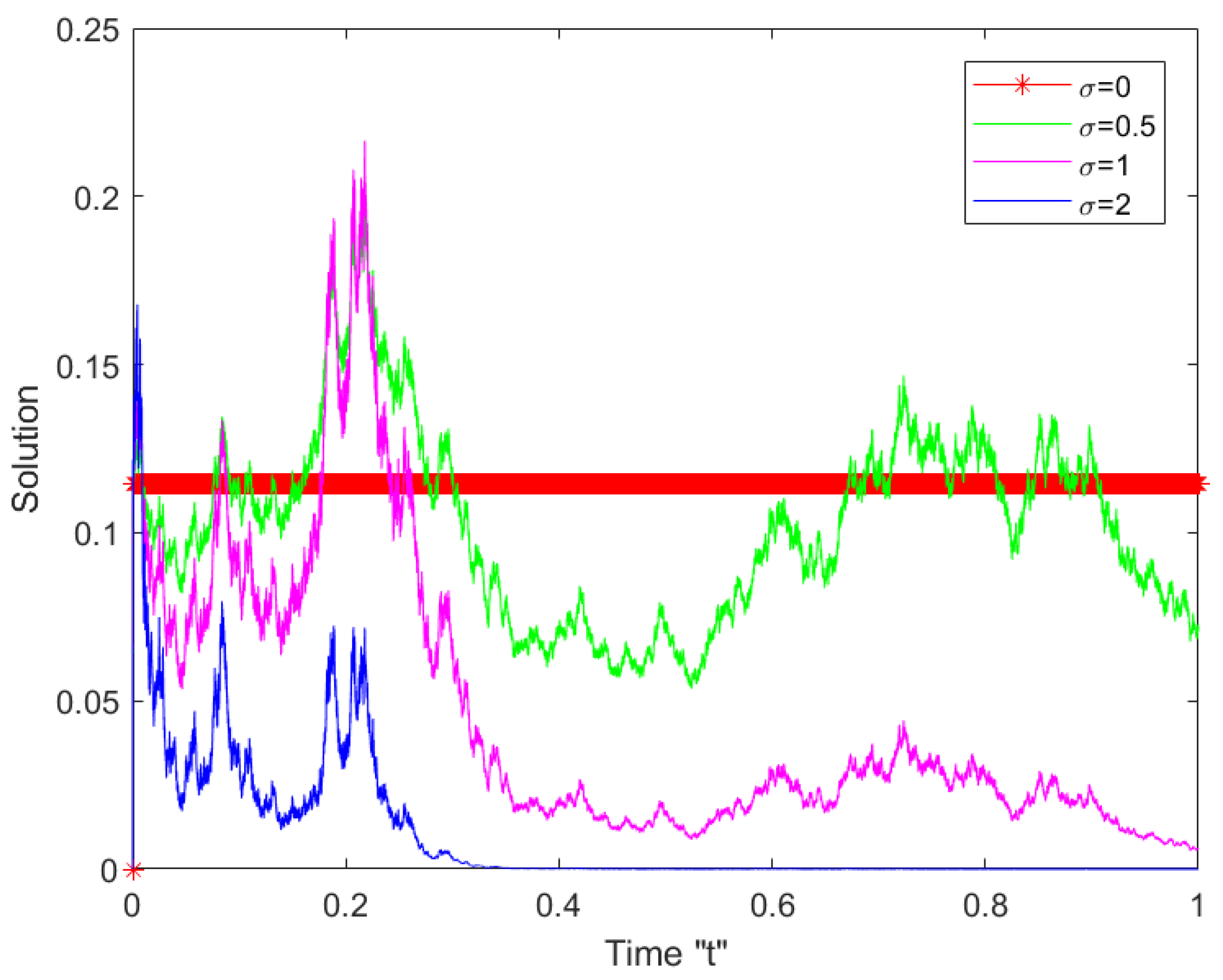
6. Effect of Noise and Fractional Order on the Solutions
7. Conclusions
Author Contributions
Funding
Institutional Review Board Statement
Informed Consent Statement
Data Availability Statement
Acknowledgments
Conflicts of Interest
References
- Ma, W.X.; Batwa, S. A binary darboux transformation for multicomponent NLS equations and their reductions. Anal. Math. Phys. 2021, 11, 44. [Google Scholar] [CrossRef]
- Wazwaz, A.M. A sine-cosine method for handling nonlinear wave equations. Math. Comput. Model. 2004, 40, 499–508. [Google Scholar] [CrossRef]
- Yan, C. A simple transformation for nonlinear waves. Phys. Lett. A 1996, 224, 77–84. [Google Scholar] [CrossRef]
- Hirota, R. Exact solution of the Korteweg-de Vries equation for multiple collisions of solitons. Phys. Rev. Lett. 1971, 27, 1192–1194. [Google Scholar] [CrossRef]
- Wang, M.L.; Li, X.Z.; Zhang, J.L. The (G′/G)-expansion method and travelling wave solutions of nonlinear evolution equations in mathematical physics. Phys. Lett. A 2008, 372, 417–423. [Google Scholar] [CrossRef]
- Zhang, H. New application of the (G′/G)-expansion method. Commun. Nonlinear Sci. Numer. Simul. 2009, 14, 3220–3225. [Google Scholar] [CrossRef]
- Mohammed, W.W.; Alesemi, M.; Albosaily, S.; Iqbal, N.; El-Morshedy, M. The exact solutions of stochastic fractional-space Kuramoto-Sivashinsky equation by using (G′/G)-expansion Method. Mathematics 2021, 9, 2712. [Google Scholar] [CrossRef]
- Xie, Z.; Feng, X.; Chen, X. Partial least trimmed squares regression. Chemom. Intell. Lab. Syst. 2022, 221, 104486. [Google Scholar] [CrossRef]
- Jin, H.Y.; Wang, Z.A. Boundedness, blowup and critical mass phenomenon in competing chemotaxis. J. Differ. Equ. 2016, 260, 162–196. [Google Scholar] [CrossRef]
- Qi, M.; Cui, S.; Chang, X.; Xu, Y.; Meng, H.; Wang, Y.; Yin, T. Multi-region Nonuniform Brightness Correction Algorithm Based on L-Channel Gamma Transform. Secur. Commun. 2022, 2022, 2675950. [Google Scholar] [CrossRef]
- Ye, R.; Liu, P.; Shi, K.; Yan, B. State Damping Control: A novel simple method of rotor UAV with high performance. IEEE Access 2020, 8, 214346–214357. [Google Scholar] [CrossRef]
- Mohammed, W.W.; Blömker, D. Fast-diffusion limit for reaction-diffusion equations with multiplicative noise. J. Math. Anal. Appl. 2021, 496, 124808. [Google Scholar] [CrossRef]
- Mohammed, W.W.; Iqbal, N. Impact of the same degenerate additive noise on a coupled system of fractional space diffusion equations. Fractals 2022, 30, 2240033. [Google Scholar] [CrossRef]
- Yang, X.F.; Deng, Z.C.; Wei, Y. A Riccati-Bernoulli sub-ODE method for nonlinear partial differential equations and its application. Adv. Diff. Equ. 2015, 1, 117–133. [Google Scholar] [CrossRef]
- Khan, K.; Akbar, M.A. The exp(-ϕ(ς))-expansion method for finding travelling wave solutions of Vakhnenko-Parkes equation. Int. J. Dyn. Syst. Differ. Equ. 2014, 5, 72–83. [Google Scholar]
- Wazwaz, A.M. The tanh method: Exact solutions of the Sine–Gordon and Sinh–Gordon equations. Appl. Math. Comput. 2005, 167, 1196–1210. [Google Scholar] [CrossRef]
- Malfliet, W.; Hereman, W. The tanh method. I. Exact solutions of nonlinear evolution and wave equations. Phys. Scr. 1996, 54, 563–568. [Google Scholar] [CrossRef]
- Yan, Z.L. Abunbant families of Jacobi elliptic function solutions of the-dimensional integrable Davey-Stewartson-type equation via a new method. Chaos Solitons Fractals 2003, 18, 299–309. [Google Scholar] [CrossRef]
- Fan, E.; Zhang, J. Applications of the Jacobi elliptic function method to special-type nonlinear equations. Phys. Lett. A 2002, 305, 383–392. [Google Scholar] [CrossRef]
- Prévôt, C.; Röckner, M. A Concise Course on Stochastic Partial Differential Equations; Springer: Berlin/Heidelberg, Germany, 2007. [Google Scholar]
- Arnold, L. Random Dynamical Systems; Springer: Berlin/Heidelberg, Germany, 1998. [Google Scholar]
- Imkeller, P.; Monahan, A.H. Conceptual stochastic climate models. Stoch. Dynam. 2002, 2, 311–326. [Google Scholar] [CrossRef]
- Mohammed, W.W. Amplitude equation with quintic nonlinearities for the generalized Swift-Hohenberg equation with additive degenerate noise. Adv. Differ. Equ. 2016, 2016, 84. [Google Scholar] [CrossRef]
- Khalil, R.; Al Horani, M.; Yousef, A.; Sababheh, M. A new definition of fractional derivative. J. Comput. Appl. Math. 2014, 264, 65–70. [Google Scholar] [CrossRef]
- Sokolov, V. Equations of Korteweg-de Vries type and simple lie algebras. Sov. Math. Dokl. 1981, 23, 457–462. [Google Scholar]
- Drinfel’d, V.G.; Sokolov, V.V. Lie algebras and equations of Korteweg-de Vries type. J. Sov. Math. 1985, 30, 1975–2036. [Google Scholar] [CrossRef]
- Wilson, G. The affine lie algebra and an equation of Hirota and Satsuma. Phys. Lett. A 1982, 89, 332–334. [Google Scholar] [CrossRef]
- Bibi, S.; Mohyud-Din, S.T. New traveling wave solutions of Drinefel’d–Sokolov–Wilson equation using tanh and extended tanh methods. J. Egypt. Math. Soc. 2014, 22, 517–523. [Google Scholar] [CrossRef]
- Arora, R.; Kumar, A. Solution of the coupled Drinfeld’s–Sokolov–Wilson (DSW) system by homotopy analysis method. Adv. Sci. Eng. Med. 2013, 5, 1105–1111. [Google Scholar] [CrossRef]
- Zhao, X.Q.; Zhi, H.Y. An improved F-expansion method and its application to coupled Drinfel’d-Sokolov-Wilson equation. Commun. Theor. Phys. 2008, 50, 309–314. [Google Scholar]
- Ren, B.; Lou, Z.M.; Liang, Z.F.; Tang, X.Y. Nonlocal symmetry and explicit solutions for Drinfel’d-Sokolov-Wilson system. Eur. Phys. J. Plus 2016, 131, 441. [Google Scholar] [CrossRef]
- Misirli, E.; Gurefe, Y. Exp-function method for solving nonlinear evolution equations. Math. Comput. Appl. 2011, 16, 258–266. [Google Scholar] [CrossRef]
- Chen, S.; Liu, Y.; Wei, L.; Guan, B. Exact solutions to fractional Drinfel’d–Sokolov–Wilson equations. Chin. J. Phys. 2018, 56, 708–720. [Google Scholar] [CrossRef]
- Sahoo, S.; Ray, S.S. New double-periodic solutions of fractional Drinfeld-Sokolov-Wilson equation in shallow water waves. Nonlinear Dyn. 2017, 88, 1869–1882. [Google Scholar] [CrossRef]
- Calin, O. An Informal Introduction to Stochastic Calculus with Applications; World Scientific Publishing Co. Pte. Ltd.: Singapore, 2015. [Google Scholar]
- Caraballo, T.; Langa, J.A.; Valero, J. Stabilisation of differential inclusions and PDEs without uniqueness by noise. Commun. Pure Appl. Anal. 2008, 7, 1375–1392. [Google Scholar] [CrossRef]
- Caraballo, T.; Robinson, J.C. Stabilisation of linear PDEs by Stratonovich noise. Syst. Control Lett. 2004, 53, 41–50. [Google Scholar] [CrossRef]



Publisher’s Note: MDPI stays neutral with regard to jurisdictional claims in published maps and institutional affiliations. |
© 2022 by the authors. Licensee MDPI, Basel, Switzerland. This article is an open access article distributed under the terms and conditions of the Creative Commons Attribution (CC BY) license (https://creativecommons.org/licenses/by/4.0/).
Share and Cite
Al-Askar, F.M.; Cesarano, C.; Mohammed, W.W. The Analytical Solutions of Stochastic-Fractional Drinfel’d-Sokolov-Wilson Equations via (G′/G)-Expansion Method. Symmetry 2022, 14, 2105. https://doi.org/10.3390/sym14102105
Al-Askar FM, Cesarano C, Mohammed WW. The Analytical Solutions of Stochastic-Fractional Drinfel’d-Sokolov-Wilson Equations via (G′/G)-Expansion Method. Symmetry. 2022; 14(10):2105. https://doi.org/10.3390/sym14102105
Chicago/Turabian StyleAl-Askar, Farah M., Clemente Cesarano, and Wael W. Mohammed. 2022. "The Analytical Solutions of Stochastic-Fractional Drinfel’d-Sokolov-Wilson Equations via (G′/G)-Expansion Method" Symmetry 14, no. 10: 2105. https://doi.org/10.3390/sym14102105
APA StyleAl-Askar, F. M., Cesarano, C., & Mohammed, W. W. (2022). The Analytical Solutions of Stochastic-Fractional Drinfel’d-Sokolov-Wilson Equations via (G′/G)-Expansion Method. Symmetry, 14(10), 2105. https://doi.org/10.3390/sym14102105