


Abstract
As part of a project to identify all maximal centralising monoids on a four-element set, we determine all centralising monoids witnessed by unary or by idempotent binary operations on a four-element set. Moreover, we show that every centralising monoid on a set with at least four elements witnessed by the Mal’cev operation of a Boolean group operation is always a maximal centralising monoid, i.e., a co-atom below the full transformation monoid. On the other hand, we also prove that centralising monoids witnessed by certain types of permutations or retractive operations can never be maximal.
Keywords:
centralising monoid; centraliser clone; commutation; endoprimal monoid; endomorphism monoid; maximal centralising monoid MSC:
08A35; 08A02; (08A40, 08A60)
1. Introduction
There are various notions of symmetry in the sciences and in mathematics. Algebraic structures are usually considered symmetric if they have a lot of automorphisms or, more generally, endomorphisms. For a universal algebra (a structure without relations) the automorphism group/endomorphism monoid consists of all those permutations/self-maps of the carrier set that commute with all fundamental operations of the algebra. Studying commuting operations in more generality leads to the notion of the centraliser clone of an algebra, or simply of a set of operations if the carrier set is understood from the context. The unary part of the centraliser (clone) is then exactly the endomorphism monoid of the algebra, and the fundamental operations of the algebra are said to witness this monoid.
This article is concerned with algebras on a specific carrier set A that are ‘maximally symmetric’ in the sense that their endomorphism monoid is a co-atom in the lattice of all possible endomorphism monoids of algebras on A. As the monoids in this lattice are the unary parts of (all) centraliser clones on A, they are called centralising monoids, and the co-atoms of this lattice are also referred to as maximal centralising monoids.
The study of centralisers in algebra goes back to Cohn [1] (Chapter III.3), and notably to Kuznecov [2] who first established logical methods for their investigation, exploiting closure under operations whose graphs are primitive positively definable from given operations. Kuznecov allegedly also discovered all 25 centraliser clones among Post’s lattice, a fact later re-proved by Hermann [3]. Danil’čenko [4,5,6,7] continued the work of Kuznecov by determining all 2986 centraliser clones on sets of three elements [8,9]. On carrier sets of size four and beyond, currently no good overview of the lattice of centralisers exists. Between 1974 and 1976 Harnau [10,11,12,13,14,15] worked on centralisers of unary operations, which are dual to centralising monoids in terms of the Galois connection induced by commutation of finitary operations (see Section 2). Centralising monoids of single unary operations, i.e., monounary algebras, were investigated in [16,17,18], showing, for example, which centralising monoids of this type are equal to the centralising monoid they describe as a witness [16] (Theorem 4.1, p. 8, Theorem 5.1, p. 10), and which of them have a unique unary operation as their witness [18] (Theorems 3.1 and 3.3, p. 4659 et seq.). Research on centralising monoids was further pushed forward in a series of papers [19,20,21,22,23,24,25] by Machida and Rosenberg, linking in particular maximal centralising monoids to the five types of functions appearing in Rosenberg’s Classification Theorem [26] for minimal clones. As a consequence, all 192 centralising monoids on three-element sets were determined in [21,23], and all 10 maximal centralising monoids among them were identified.
This research is part of the project, begun in [27], to take the results of [23] to the next level, that is, to determine all maximal centralising monoids on four-element carrier sets. According to Proposition 3 it is necessary for this to find all centralising monoids on induced by single functions of each of the five types of Rosenberg’s Theorem and to determine the ones among them which are maximal proper transformation monoids under set inclusion. As an initial step centralising groups of majority operations and semiprojections were studied in [28]. Extending the methods of [23], the case of majority operations on was already completed in [27], and further investigated under a different aspect in [29]. In this article we tackle the cases of unary operations (permutations of prime order and non-identical retractive operations), binary idempotent operations and ternary minority operations arising as Mal’cev operations corresponding to Boolean groups.
We determine all centralising monoids on witnessed by binary idempotent operations, and we classify both the witnessing operations and the monoids up to conjugacy by inner automorphisms from . We also exhibit the maximal monoids among them, in general, and again, up to conjugacy. With respect to unary operations, we establish that on every carrier set of size at least four, every single transposition or every product of disjoint transpositions without fixed points and every non-identical retraction witnesses a centralising monoid which is a co-atom in the lattice of those centralising monoids witnessed by sets of unary operations, that is, in the lattice of endomorphism monoids of unary algebras. However, we also show that, given at least four elements, no transposition and no permutation with a single fixed point, as well as no retraction fixing all but one element can ever witness a maximal centralising monoid. For we improve this by showing that no permutation at all will witness a maximal centralising monoid. Finally, based on results of Länger and Pöschel [30] about strongly constantively rigid relational systems, we give a new proof of the known fact [21] (Theorem 5.1) that the centralising monoid of a constant on an at least three-element set is indeed maximal. We use the same technique to prove that—with the exception of the two-element set—the centralising monoid of a Mal’cev operation of a Boolean group is always maximal.
2. Preliminaries
We start by introducing basic notation with respect to sets, functions and relations, followed by fundamental facts regarding their Galois theory based on preservation and commutation. We also give a brief overview of formal concept analysis in order to be able to switch between different Galois connections. In the second part of this section we present background theory on clones, in particular centraliser clones, and centralising monoids that we shall use extensively to derive our main results.
2.1. Notation and Basic Concepts
We write for the set of all natural numbers (finite ordinals) and for the positive ones. It will be convenient for us to understand every as the set of its ordinal predecessors as in the von Neumann model of natural numbers. The cardinality (size) of a set A is denoted by ; if , then we often pick a canonical representative for it, e.g., where .
Given sets and functions and , we denote their composition by and mean the function mapping each element to . The set of all functions from A to B is symbolised as . If and , , we write for the image and for the preimage . The full image of f is also denoted as . The restriction of f to an arbitrary subset is the function mapping to .
For we understand tuples as maps from to A that are simply written as . Sometimes we allow ourselves to deviate from this standard notation if some other indexing like or seems more convenient. As tuples are maps, we have in particular and we can compose with or , giving and re-indexed tuples .
For a set A and , every is said to be an n-ary operation on A. We collect all finitary (non-nullary) operations on A in the set . For and we write for ; in particular for . For the n-ary projection onto the coordinate i is the operation given by for . We write shortly for the identity operation on A, and we use for the set of all projections. For the n-ary constant with value a is the map satisfying for all . We collect all constant operations on A in the set . We also need some more specific operations given by identities. An operation is idempotent, if it satisfies for all . A ternary operation is called a majority operation, if for all ; it is called a minority operation if for all ; finally, it is a Mal’cev operation if for all . Among unary operations we need permutations , i.e., bijective self-maps , and retractive operations satisfying (sometimes also called idempotent since they are idempotent elements in the semigroup ).
For all and , we can form , called the tupling of , sending to . In this way, we can compose finitary operations with as . A (concrete) clone of non-nullary operations on A is any set that is closed under this form of composition and satisfies .
For an m-ary relation on a set A is any subset of m-tuples. Any m-ary operation can be understood as an -ary relation via its graph . We extend this notation element-wise to sets of operations by putting for . A binary relation is just a set of pairs; we define its inverse (sometimes also called dual) to be . A binary is symmetric if , and reflexive if for all . If is reflexive, symmetric and transitive, that is implies for all , then belongs to , the set of all equivalence relations on A. By we denote the set of all finitary relations on A.
While functions can be composed, new relations can be constructed from given ones using logical expressions. A primitive positive formula (in prenex normal form) over a given relational signature consists of a prefix of finitely many existentially quantified variables (possibly none) followed by a finite non-empty conjunction of atomic predicates that correspond to the given signature (relations) and have been substituted by some tuple of variables. If the relation symbols are associated with concrete relations, the set of all satisfying value assignments to (a superset of) the free variables of determines a finitary relation on A, which is called primitive positively definable from the given relations. For a finite carrier set A, a set is said to be a relational clone on A if it contains the diagonal and is closed under all relations that are primitive positively definable from members of Q (for infinite carrier sets stronger closure properties are required). As this is an implicational definition, all relational clones on A form a closure system. The least relational clone on A containing a particular set will be denoted by and is computed by adding to R all relations that are primitive positively definable from .
Clones of operations and relational clones are connected in the following way: for and , we say that f preserves if and only if is a subuniverse of the algebra . This means that for every the m-tuple obtained by the composition of f with the tupling of stays inside , that is, for every -matrix the columns of which all belong to , the m-tuple obtained by applying f row-wise to R remains in . We then call an invariant of f or f a polymorphism of . The preservation relation induces a Galois connection between and , giving rise to the derivation operators and , collecting all polymorphisms in of every relation and all invariant relations for all given operations , respectively. Moreover, we declare for and , that and . Now for every the set forms a clone on A, and for every the invariants are a relational clone containing ∅ (since we omit nullary operations in our clones). Therefore, and contains the clone generated by F. On finite carrier sets A, these inclusions are equalities [31,32]; for infinite A local interpolation operators (and a strengthened definition of relational clone) need to be added to close the gap [33,34].
Besides the Galois connection induced by preservation, we shall encounter several other Galois connections that differ by the inducing relation or by restrictions of the domains they link. Switching between them and the associated closure systems can be expressed well in the framework of formal concept analysis [35,36], providing terminology, notation and theory for the manipulation of Galois connections on a general level. The basic object of formal concept analysis is that of a formal context where is any binary relation between sets G (commonly called objects) and M (usually called attributes). A context induces two derivation operators of a Galois connection between G and M in the natural way, and specifies exactly between which sets this Galois connection is to be understood. The Galois closed sets on the side of objects are called extents and the ones on the side of attributes are referred to as intents. When we keep the relation I, but pass on to a subset of the objects or of the attributes (or both), we form a subcontext . Though technically incorrect, it is customary to omit the intersection when specifying a subcontext, as the restriction becomes clear from stating the sets of objects and attributes. How the lattices of Galois closed sets (extents and intents) of and are related is discussed in Chapter 3 of [35] (p. 97 et seqq.). We will mostly aim for context manipulations where the closure system of intents (and thus the lattice structure) does not change, such as object clarification and object reduction. We shall explain more details at the appropriate place in the text and give pointers to the literature there.
Centrally for this paper will be the Galois connection of commutation given by the context . In this respect we say that an n-ary operation commutes with an m-ary operation , if holds for any matrix , where denotes the tuple obtained by applying f row-wise to the matrix X, and similarly for g and the transposed matrix . This commutation condition will be denoted by ; it is easy to see that it is a symmetric property, i.e., we have if and only if . Therefore, the two Galois derivatives induced by coincide: they map to its centraliser , and the associated closure operator sends F to , the bicentraliser of F. A routine verification shows that holds for , so , i.e., commutation can be rephrased in terms of preservation of graphs of operations. Hence, up to isomorphism, is the subcontext of finitary operations and relations with preservation, where is restricted to .
As mentioned in the introduction, when studying centralising monoids we only look at the unary parts of centraliser clones, that is to say, we are dealing with the subcontext , briefly , of . The intents of , i.e., Galois closed sets for some , are exactly all centralising monoids on A. Moreover, every set describing M in this way, is a witness of M, and we can equivalently express that M is witnessed by F via saying that . A centralising monoid is maximal if it is a co-atom in the intent lattice of , i.e., a proper centralising monoid which is maximal under set inclusion.
2.2. Fundamental Results on Clones, Centralisers and Centralising Monoids
The following simple observation exhibits necessary conditions that can be used to describe functions in a particular centraliser clone (or its unary part). The utility of said conditions was already observed by Harnau, cf. Lemma 2.6 and Satz 2.15 of [10], in the context of centralisers of single unary operations .
Lemma 1.
For every set we have . In particular, we have
where for and
Proof.
We have , following directly from the definition of commutation. Clearly, is primitive positively definable from the graph of f, is too, and as well. □
Second, we recollect the following helpful characterisation of centralising monoids.
Lemma 2
(cf. [21] (Lemma 2.2)). For a set the following facts are equivalent:
- (a)
- M is a centralising monoid, i.e., there is such that .
- (b)
- , i.e., M is witnessed by .
Proof.
If for some , then by virtue of the Galois derivatives and . Conversely, if , then M is a centralising monoid witnessed by . □
Lemma 2 shows that every centralising monoid has a largest possible witness, as generally , so . We now turn to maximal centralising monoids. Being co-atoms in the lattice of intents of , they correspond via that Galois connection of commutation to an atom F in the lattice of extents of . Such an atom must be generated (as an extent) by a single non-trivial object , i.e., . For the co-atom this means by virtue of the Galois connection given by . So M is singly witnessed by a non-trivial operation f; however, even more is known about these witnesses: they can always be chosen as a generator of a minimal clone of minimum arity, a so-called minimal function.
Proposition 3
(Theorem 3.2 in [21], Proposition 2.2 in [27]). For any maximal centralising monoid on a finite set A there is a minimal function (generating a minimal clone) such that .
Minimal functions are separated by Rosenberg’s Classification Theorem [26] for minimal clones into five distinct categories ((II) is a special case of (V), but is often listed on its own).
Theorem 4
(See [26]). On a finite set A every minimal function f is of one of the following types:
- (I)
- and is a permutation of prime order or a retractive operation ;
- (II)
- is idempotent, i.e., ;
- (III)
- is a ternary (minority) Mal’cev operation arising as for from a Boolean group ;
- (IV)
- is a ternary majority operation;
- (V)
- is a proper semiprojection of arity n where .
In this paper, we address centralising monoids witnessed by a minimal function of types (I)–(III) with a special focus on the set ; those relating to type (IV) have already been considered in [27], the ones of type (V) are part of ongoing research.
Before we can tend to this problem in more detail, we need further background information on clones, such as the centraliser of a constant operation.
Lemma 5
(Lemma 1.9 in [10], Lemma 5.2 in [21]). For any and we have .
Proof.
Let and . We have if and only if for all the condition
holds, that is, exactly if , i.e., precisely if , or . □
Corollary 6
(Lemma 5.3 in [21]). The centraliser is the clone of all idempotent operations.
Proof.
We have due to Lemma 5. □
The following characterisation is also very well known.
Lemma 7.
For a clone F on any set A the following statements are equivalent:
- (a)
- F is a clone of idempotent operations, i.e., .
- (b)
- For every and all we have .
- (c)
- .
Proof.
Condition (b) simply spells out the preservation of every singleton set in (a). From this it follows that every satisfies for every , i.e., . For F contains all projections, (b) implies (c). Now since F is a clone, with every also . If (c) holds, then , and this shows statement (b). □
Lemma 8.
For any set A we have .
Proof.
For this is trivially true. For , no constant map is idempotent, so, by Corollary 6, can only consist of projections. The converse inclusion is trivial. □
When proving that a certain centralising monoid is maximal, it will be necessary to compute the centralising monoid generated by some set and to show that it is the full transformation monoid on A. To do this we shall always demonstrate the seemingly stronger condition that the centraliser of M is trivial. The following lemma shows that this is in fact a necessary step to take whenever .
Lemma 9.
For any set A with and any subset the following statements are equivalent:
- (a)
- .
- (b)
- .
- (c)
- .
Proof.
The implications (c)(a) are obvious as every function commutes with projections. Now, if (a) holds, then , which is equivalent to . By Lemma 1, this means the functions in F preserve the kernel of any unary operation, so they preserve every equivalence relation on A. Therefore, , and for the latter clone equals as is shown in Example 3.3 of [30] (p. 136). Now implies that , so Lemma 8 shows that (c) must be satisfied. □
Note that for , Lemma 9 fails as, e.g., the clone L of all affine linear functions, which is the centraliser of the (ternary minority) Mal’cev function on the two-element set, contains all unary operations. So , but .
To establish for a subset condition (c) of Lemma 9 or to prove at least , we shall exploit a theorem of Länger and Pöschel [30] on (strongly) constantively rigid systems of (binary) relations.
Proposition 10
(cf. [30] (Theorem 2.13, p. 136, Theorem 2.3, p. 133)). Let A be any (finite or infinite) set with , and let satisfy the following two separation conditions (see Definition 2.7, p. 134 et seq. in [30])
- (B)
- for all pairwise distinct there is such that ;
- (D)
- for all pairwise distinct there is such that .
Then ; moreover, if all relations in Q are reflexive, then .
Proof.
By our assumption we have and, in particular, . We use Theorem 2.13 of [30] to infer that Q is constantively rigid, i.e., , wherefore . If, additionally, Q only contains reflexive relations, then Theorem 2.3 of [30] states that constantive rigidity of Q is equivalent to strong constantive rigidity, that is, . □
Remark 11.
There are two more conditions, (A) and (C), in [30], which can also be employed to ensure (strong) constantive rigidity of systems Q of (binary reflexive) relations, see, e.g., Theorems 2.11 and 2.12 of [30]. In particular, via Theorem 2.12, (B) and (C) together may be used to obtain (strong) constantive rigidity also when , and (C) automatically follows from (B) if all the relations in Q are symmetric (see Lemma 2.8 in [30]), for example, equivalence relations. More concrete constantively rigid systems of relations are provided in Section 3 of [30], some of them also being strongly constantively rigid.
Corollary 12.
Let A be any set with and be such that for each there is satisfying . Moreover assume that satisfies conditions (B) and (D), then ; if all the relations in Q are reflexive, then ; if, moreover, the relations used to satisfy (B) are reflexive and symmetric, then the result also follows for .
Proof.
Let in Proposition 10 and note that . So Proposition 10 entails that and under the reflexive assumption. If the relations used in (b) are reflexive and symmetric, we combine the reasoning of Proposition 10 with Remark 11 to get also for . Finally, , for the supposition of for some and would imply , see Lemma 5, which contradicts the assumption on M. □
Corollary 13.
Let A be any set with and be such that for each there is satisfying . Moreover assume that
- (B’)
- for all pairwise distinct there is such that ,
- (D’)
- for all pairwise distinct there is such that and ,
then .
Proof.
Use Corollary 12 on the equivalence relations . □
Corollary 14.
Let A be any set with and be such that for each there is satisfying . Moreover assume that
- (B”)
- for all pairwise distinct there is such that or or ,
- (D”)
- for all pairwise distinct there is satisfying one of the conditions or or ,
then .
Proof.
Use the set in Corollary 12. □
3. Monoids Witnessed by Unary Operations
There are two types of unary minimal functions in Rosenberg’s Theorem 4. The first are permutations of prime order, that is, their cycle structure consists only of fixed points and cycles of length p for some prime p. The second are idempotent or retractive operations , which satisfy . These are exactly those non-identical unary operations which fix every point of their image.
3.1. Computational Results for
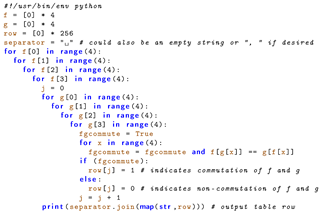
We started by computing a commutation table of all 256 unary operations on the set , i.e., the formal context in the language of [35,36]. Being a Boolean matrix this table is already confusingly big and we therefore do not present it here. For purposes of verification, in Listing 1 we have instead added simple Python code that allows anybody to reproduce such a table if desired. Using standard algorithms presented in Section 2.1 of [35] or Chapter 2 of [36], one may compute from that there are exactly 1485 centralising monoids on that can be witnessed by sets of unary operations. However, we are only interested in the co-atoms of this large lattice. By virtue of the Galois connection represented by , every co-atom M is the Galois derivative of an atom N on the dual side of the Galois connection. Since in the lattice of closed sets of any closure operator the atoms must be singly generated, it follows that for a single unary function and so . Hence, to obtain the co-atoms, we only need to iterate over the 255 rows of belonging to each (or just the unary f from Rosenberg’s Theorem) and check, which are maximal under set inclusion.
The result is that there are 49 co-atoms in the lattice of closed sets of , and subsequently we shall explain our computational findings in terms of the types of unary operations from Rosenberg’s Theorem, i.e., permutations of prime order and non-identical retractions. In the following two subsections we shall then give theoretical evidence why the 49 co-atoms arise on . It is worth noting that these 49 co-atoms in the lattice belonging to are merely candidates for maximal centralising monoids, and we shall indeed demonstrate that some co-atoms of fail to be maximal among all centralising monoids, that is, are no co-atoms with respect to .
Listing 1.
Python code to print a commutation table (0-1-matrix) for all 256 unary operations f on , where rows and columns are enumerated in lectic order of the value tables from .
On a four-element set there are three types of permutations of prime order: three-cycles, transpositions or products of two disjoint transpositions. Up to conjugacy these can be represented by the following three functions on : , , . There are three-cycles (4 choices of the unique fixed point and 2 for the image of the first cycle element), but it will turn out that centralising monoids witnessed by these operations are not maximal (Lemma 16), not even with respect to . However, the monoids described by the other prime permutations are maximal when considered among the monoids witnessed by only unary operations (i.e., the closure system of ). Yet again, they will not be maximal in the lattice of all centralising monoids on , see Corollary 22. We have transpositions (choosing the two transposed elements) and products of disjoint transpositions since such a function can be obtained by choosing the first transposed pair or the second one. Altogether there are 9 prime permutations (of order 2) that describe maximal monoids of .
The non-trivial retractive functions on a four-element set can be separated into the following types: being constant (one-element image, there are 4 such functions), having a two-element image, or having a three-element image (there are such functions, first choosing the image and then the value of the element outside the image within it). The retractions with a two-element image can moreover be split up into those mapping the two elements outside the image to the same value and those mapping them to both distinct values of the image. In both subcases we have functions as we need to choose the two-element image and then one of two ways how the elements outside the image can be mapped into it. Retractions of all four types witness centralising monoids that are maximal among those centralising monoids witnessed by unary functions, see Corollary 27, and there are non-trivial retractions on . Moreover, it is known from Theorem 5.1 of [21] that with is a maximal centralising monoid in general (that is on any finite set A with in the lattice of all centralising monoids), so the 4 centralising monoids of constants are co-atoms with respect to , not just . In total, we have centralising monoids on that are maximal in the 1485-element lattice of those monoids that can be witnessed by sets of unary operations. These can be grouped together into 6 conjugacy types that can be represented as , , , , and where the retractions , and are given as , and . From the explicit calculations (and the characterisations in the following subsections) it follows that
As has no fixed points but and have, the monoid does not contain constant operations (cf. Lemma 5) but and do. Therefore, . Furthermore, computations show that has 96 binary term functions, but has 262 of them, so . Therefore, the co-atoms of the lattice of intents of fall into exactly 6 distinct isomorphism classes of monoids. Moreover, we computed that all 1485 monoids in the lattice of intents of can be separated into 106 classes up to element-wise conjugacy (cf. Section 4 for more explanation).
3.2. Monoids Witnessed by Permutations
In Lemma 4.11 of [27] (see also Lemma 4.10 of [37]) we provided a characterisation of when a finitary operation on a finite set A commutes with a permutation , based on examining orbits of the permutation group generated by s. Under the assumption that f is a function the given condition was sufficient to ensure that , but blindly fulfilling the orbit condition could also lead to some value assignments for f that would contradict the assumption of f being a function. Thus, some care had to be taken when working with Lemma 4.11 from [27], but this was never much of an issue when studying majority operations f on small sets as in [27]. Here we improve the mentioned characterisation by placing an additional necessary condition on the choice of the function values such that no contradictions can occur.
Lemma 15.
For a finite set A, and let be the permutation group generated by s and be a transversal of the orbits of the action of S on via . For we have if and only if for every the length of the orbit of under S divides the length ℓ of the orbit of under S and for all exponents j satisfying .
In particular if for all a value is chosen such that the size of the orbit of is a divisor of the size ℓ of the orbit of , then there is a unique extension of this partial definition to an n-ary function by defining for all and .
Proof.
Let be the order of s. Lemma 4.11 of [27] shows that if and only if for all the condition holds for all . The length ℓ of the orbit of is the least common multiple of the lengths of the orbits of the entries of and each of these lengths divides m, so ℓ divides m. So for all follows from . If t is the size of the orbit of , then this orbit is and . Writing with , it follows from the definition of ℓ and the commutation condition that
so as the elements are pairwise distinct. Therefore, implies that t divides ℓ.
Conversely, if for fixed we have for all and t divides ℓ, where t is the size of the orbit of , then and we can show by induction on that . The case is trivial and the step from i to simplifies to by repeated application of . Therefore, for every and we obtain by our assumption. By the definition of ℓ we have and thus get ; therefore, . This means for all , which implies commutation, see, e.g., Lemma 4.11 in [27].
If the divisor condition on is satisfied for with orbit of size ℓ, then certainly can (and must to ensure ) be defined for as the tuples are pairwise distinct by the choice of ℓ as the size of the orbit of . For T is a transversal of the orbits on , this completely defines a function ; the second part of the proof above shows that such f actually commutes with s due to the divisor condition. □
From Lemma 15 it follows again for every n-ary that if , that is, , then must belong to an orbit of size 1. Hence, and . So we obtain once more one of the necessary conditions for functions in the centraliser that were given in Lemma 1.
We can easily adapt an argument of Harnau’s [10] (Lemma 2.9, p. 345), given for centraliser clones of unary operations, to centralising monoids. This shows that on a four-element set no three-cycle can witness a maximal centralising monoid (nor a maximal centraliser clone, by Harnau’s result).
Lemma 16.
Let A be a set with , and be a permutation such that is a maximal centralising monoid, then the number of fixed points of s is not 1.
Proof.
Assume for a contradiction that witnesses a maximal centralising monoid and has as its unique fixed point. Since is maximal, we have for some prime p. Applying the above Lemmas 1 and 5 we then conclude that , so due to . As , its cycle representation has at least one p-cycle , and because it is fixed by s. We define by and for all . If f were to commute with s, then Lemma 15 (or the definition) would imply that contradicting . Hence, , so and cannot be a maximal centralising monoid (not even maximal among just those witnessed by unary operations). □
The following lemma describes (for the case when ℓ is a prime) the centralising monoids witnessed by permutations of prime order.
Lemma 17.
Let be a permutation on a finite set A that is a product of disjoint cycles of length and has fixed points. That is, s is of the form where for distinct , , , and . Then holds if and only if both of the following conditions are satisfied:
- (a)
- , and
- (b)
- for all the value is arbitrary, but for all .
Proof.
We simplify the condition given in Lemma 15. A transversal of the orbits of the cyclic permutation group generated by s is given by . The condition in Lemma 15 expressed for those that are fixed by s is exactly equivalent to since the only positive divisor of 1 is 1. For all , i.e., for some , the length of the orbit generated by x is ℓ, so the divisibility condition in Lemma 15 is fulfilled for any choice of the value as the only orbit sizes are 1 or ℓ. The remaining part of the condition translates to the equality of and for all . □
When and , that is, , it is easy to see that , because we can define with , thereby violating condition (b) of Lemma 17. The following corollary is also evident.
Corollary 18.
Let be a finite set and be a transposition. Then equals
moreover, for we have
Next we prove that the centraliser of any proper supermonoid of a centralising monoid witnessed by a fixed-point free product of disjoint transpositions or a single transposition with at least two fixed points is idempotent. Hence, by Lemma 7, the centralising monoid of such a transposition is maximal in the lattice of all centralising monoids witnessed by unary operations (the intent lattice of ).
Lemma 19.
For a permutation on A with of order two that can be written as a fixed-point free product of disjoint transpositions where and any transformation monoid , the centraliser clone contains only idempotent operations, i.e., . Hence, if , then .
Proof.
We use Corollary 14 to show that for every monoid . Note that s has only two-cycles, so and is fully described by condition (b) of Lemma 17. Transversals of the orbits are given by picking exactly one element from each cycle, and any assignment of values to (some of) the elements of the transversal can be completed to a function , cf. Lemmas 17 and 15.
In particular, for every we can pick and the partial definition can be extended to some with . Hence, the initial assumption of Corollary 14 is satisfied. To show condition (B”), take distinct and extend the partial definition to some . For condition (D”) consider distinct and some . Since h does not commute with s there is such that for , and the inequality holds. We can define some with . Namely, if , this is clear, and if , then and thus belongs to a different orbit than p, wherefore the assignment of y on a transversal containing can be extended to some . Moreover, we define and . If , then this assignment is compatible with condition (b) of Lemma 17 because , so it can be extended to some . If , then and thus belongs to a distinct orbit than x, wherefore the given assignment on a transversal including can be extended to some . As a consequence, we have , and it satisfies and . Invoking Corollary 14, , and by Lemma 7, has only idempotent operations. □
Lemma 20.
For any finite set , a transposition and a transformation monoid , the centraliser clone consists only of idempotent operations, i.e., . Hence, , and if , then .
Proof.
We have to show that all functions in preserve all singletons of A. For every we have by Lemma 5, so . Thus, again by Lemma 5, we get . It only remains to show that , and for this task we shall exploit that there is some .
Subsequently we distinguish cases how h might look like according to Corollary 18. The first case is that , i.e., there is some such that . By the above, , and then . Again by Lemma 5 we infer . From now on assume that . The second case is that one of belongs to , but . If , then we can use instead, where is in and still . Therefore, no generality is lost in assuming that .
As a subcase we assume that for all . By Lemma 17 there is with and for all where . Such a t exists as ; in particular . Since , the singleton is primitive positively definable from (see Lemma 1), therefore so is
Likewise, we can define from due to . Consequently, every function in preserves and .
The opposite subcase is that there is with . The function defined via for and for belongs to by Corollary 18. Take again and define by and for all ; by Lemma 17, . As and are distinct from a, it follows that and for all . Likewise and for all . Therefore, and , and as above these preimages are primitive positively definable from as . Hence, . This finishes the second case where and one of them is fixed by f.
The remaining case is when , but the second case does not take place, i.e., none of is fixed by f. This implies and, moreover , because , see Corollary 18. Let us assume that , for otherwise, we might consider , which operates identically to h on and has swapped values compared to h on . Certainly, . If it is the only fixed point, then and . By Lemma 1 both of these sets are primitive positively definable from since . Therefore, .
Now let us assume that there is such that and let . By Lemma 17, the functions , defined by for and for and both , belong to . We have for and for since . Therefore . Likewise, for and for since . Thus, . As , these sets of fixed points are primitive positively definable from (Lemma 1), and so is their intersection , where we use that by the choice of b. Similarly, and , and hence is primitive positively definable from , as well. We conclude that . □
Lemma 21.
For any finite set and the transposition , let a binary operation be defined by if , if and if . Then b is idempotent and .
Proof.
We first note that b is well defined since and thus for any we have . In particular, for , and for , too. Hence, for all , so b is idempotent.
As b is idempotent, Corollary 6 yields that , i.e., . So, first, we take any and prove that it commutes with b. For this we consider any and want to show that . This is clear from idempotence of b if ; thus, we distinguish three more cases re . Assume first that ; hence . Now if also , then and so . Otherwise, and we distinguish two subcases. If , then , wherefore we get . Alternatively, and . Since , we have , and so .
Our second case is that , whence . Clearly, if also , then . Hence, suppose that . We get now that , using that and . If , then and . Finally, the subcase with remains, which is treated as shown at the end of the previous paragraph.
The third and last case is that . Then must belong to as by Lemma 17. From the definition of b we now infer and also .
For the opposite inclusion we consider any that is not constant and have to show . First we demonstrate that . Taking any , we have . Since , there is such that . Now the commutation condition with respect to b gives . Because , this is not possible if , i.e., we obtain .
Knowing now that we consider any and with it , whence also . The definition of b implies and , wherefore because we have . This shows that as desired. Finally, if and , then and so Lemma 5 shows , i.e., . □
Corollary 22.
Assume and let be a transposition or a product of disjoint transpositions without fixed points. Then is a co-atom in the lattice of all centralising monoids on A witnessed by unary operations. However, the centralising monoid of a transposition is never a maximal centralising monoid, and the centralising monoid of a product of two disjoint transpositions fails to be maximal in the case where .
Proof.
Maximality in the lattice of centralising monoids witnessed by unary operations (that is with respect to the closure operator ) follows from Lemmas 19 and 20. That transpositions do not yield co-atoms in the lattice of all centralising monoids is a consequence of Lemma 21. Finally, we consider a product s of two disjoint transpositions on , which we can represent up to conjugacy as . If we represent unary operations u on as integer numbers , then we have . It can be seen from Table 4 in [27] that the centralising monoid witnessed by the majority operation (see Table 1 in [27]) contains all these unary operations and, for example, all unary constants. Therefore, we have , whence does not witness a maximal centralising monoid on . □
3.3. Monoids Witnessed by Retractive Operations
We now turn our attention from permutations of prime order to unary retractive operations (also called idempotent unary operations), that is, such where . This property for is equivalent to , wherefore for any retraction . It follows that the only surjective retraction is the one fixing every point of A, so . In other words, if is a non-identical retraction, then the set of fixed points (image) is a proper subset of A.
Lemma 23.
Let A be any set, and with . For we have if and only if and for all the condition is satisfied.
In particular, since for every the tuple , for any choice of values for there are (generally not unique) extensions .
Proof.
For every individual the commutation condition can equivalently be restated as . For all we use the reformulation, while for all we keep the original condition, which simplifies to as . However, this is just expressing that for every , i.e., that .
For the second part of the lemma, we observe that once values are selected for each tuple , the condition determines the values on all remaining tuples since . The choices of values of h in the preimages can be made independently of each other without leading to contradictions, i.e., all possible choices for h described above indeed produce a function . □
For any retraction and any element , we can write where is possibly empty. Every adds a requirement to the commutation condition, and (for unary operations) it is useful to rephrase Lemma 23 in terms of these sets.
Corollary 24.
For a retraction let . Then
Proof.
We use Lemma 23 for and note that for and we have and . So , which equals just whenever . □
It is evident that we have for any retraction . Namely, since , we have , and picking some , we have , so by Corollary 24.
Lemma 25.
Let be a retraction, . Assume that is a transformation monoid with , then the centraliser is a clone of idempotent operations, i.e., . So, if , then .
Proof.
According to Lemma 7, we have to show that the functions in preserve all singletons of A. Thus, the goal is to show for all , that is, to primitive positively define the singletons from the graphs of the functions in M. If , then by Lemma 5, and therefore by Lemma 1 as . Hence, it only remains to primitive positively define for all , and, in fact, it is sufficient for this to define for some specific . Namely, if and we have any other , then there is with , so . Let so . If , too, then we define by and for . Then for all and we have and the condition in Corollary 24 turns into , which is satisfied for a as and clearly holds for all other x. So . If with , we put , for and else. Clearly, as and for all . For such i and we have , and for j and we have , so Corollary 24 yields that .
Now, to establish for at least one , we shall exploit the existence of . According to Corollary 24 there may be two reasons why . The first case is that . This means there is such that . Then , and Lemma 1 shows , so is primitive positively definable from .
The second case why is that but there is and with . Referring to Corollary 24, we distinguish as subcases whether or not. First suppose that , then , that is, where . Hence, being a subset of , i.e., . We define by and for . For all and we have , which is in accordance with Corollary 24 since . Thus, and . To define a function with , we observe that there is , for otherwise , contradicting . We let for and , then . For we define , which agrees with Corollary 24 as . Finally, for where , we put , which also complies with Corollary 24. Hence, and . Therefore, we get .
The remaining subcase of the second case is that and . By the condition in Corollary 24, we have for the violating element with . Thus, we get , that is, . To define a unary operation having , we note that , as otherwise , i.e., and then would be violated. We pick some and define and for . By Corollary 24 we have because . Clearly, , and so where we are re-using with from above. □
Lemma 25 covers in particular such retractions for which the image contains all elements except for one. For these we can show that they never witness maximal centralising monoids.
Lemma 26.
Let and be a retraction with . Moreover, let be given by if and . Then g is a binary idempotent operation and .
Proof.
Clearly, for every we have ; moreover, , so is idempotent (Corollary 7) and so . Consider now any ; we have to show that . For this take . First we assume that . There is with . Since by Corollary 24 , we have , i.e., , so . Now the definition of g implies . The remaining possibility is that , and here , for g is idempotent. Therefore, .
Conversely, let . If for some , then because t belongs to , cf. Lemma 5. Now consider and any . As h is not constant, there is such that . It certainly follows that , so . We conclude that . □
Corollary 27.
Let be any non-identical retraction, then is maximal in the lattice of all centralising monoids on A witnessed by unary operations. In particular this holds for retractions with for some ; however, these do not witness a maximal centralising monoid.
Proof.
Maximality with respect to the closure system of the operator follows from Lemma 25; for functions with a single non-fixed point non-maximality in general is evident from Lemma 26. □
Lemma 25 and Corollary 27 deal with all non-identical retractions on any set and successfully explain our computational results regarding those centralising monoids on that can be witnessed by just unary operations. For retractions fixing all but one element, we have that the centralising monoid is never maximal; for constant retractions it is known that the centralising monoid is always maximal, see Corollary 29 below. For the other types of centralising monoids witnessed by non-constant retractions, we currently do not know more than what is stated in Corollary 27. On a four-element set there are two types of such retractions, both having a two-element image. Our computations from [27] and Section 4 show that the corresponding monoids are not contained in any proper centralising monoid witnessed by a unary or (idempotent) binary or majority operation on , but at the moment we cannot exclude that there might be a monoid witnessed by a semiprojection, which is properly larger.
We conclude the discussion of monoids witnessed by retractions by giving a short and new proof of the fact that on sets with at least three elements every centralising monoid witnessed by a constant is actually maximal. This has been shown before in [21] (Theorem 5.1, p. 157).
Lemma 28.
Let A be a set with and be a set of operations satisfying , then .
Proof.
By Lemma 5, , and since there is , there is with . Moreover, , and for any . Hence, the initial precondition of Corollary 13 has been established. We shall use the operations from to obtain conditions (B’) and (D’). For this let be pairwise distinct. If , then defined by and for shows (B’); if , then defined by and for shows (B’). Similarly, if , then establishes (D’), and if , then given as and for shows (D’). Now Corollary 13 entails . □
Corollary 29
([21] (Theorem 5.1, p. 157)). For any set A with and , the monoid is a maximal centralising monoid.
Proof.
If is a centralising monoid with , then we have from Lemma 28, and so by a combination of Lemmas 2 and 9. □
3.4. Results
We summarise the results of the current section in the following theorem.
Theorem 30.
Let A be a finite set and be a unary minimal function from Theorem 4. If
- and is a transposition of just two elements,
- is even and is a product of disjoint transpositions without fixed points,
- is any (non-identical) retraction,
then is a centralising monoid that is maximal among those monoids on A witnessed by unary operations. If and f is constant, then is always a maximal centralising monoid. Moreover, if
- and is a transposition of just two elements,
- and has a single fixed point,
- and is a product of two disjoint transpositions (without fixed points),
- f is a retraction with for some ,
then is not a co-atom (maximal) in the lattice of all centralising monoids on A.
Proof.
The positive statements follow from Corollaries 22, 27 and 29; the negative statements from Lemma 16 and again Corollaries 22 and 27. □
Corollary 31.
On a four-element set no maximal centralising monoid is witnessed by a permutation nor a retraction with a three-element image; however all constants witness maximal centralising monoids. Moreover, every permutation of order 2 and every non-identical retraction witnesses a centralising monoid forming a co-atom in the lattice of all centralising monoids witnessed by unary operations.
4. Monoids Witnessed by Binary Idempotent Operations
Each binary idempotent operation satisfies for all . Therefore, on there are binary idempotent operations, which are candidates for binary minimal functions. In a very similar way as shown in Listing 1 we used a (slightly more complicated) c++ implementation to brute force enumerate all these binary operations g, and for each of them produced a characteristic vector in of . Whenever we found some with for a previously enumerated g, we did not store , that is, we dropped duplicate rows from the context . We also removed the binary projections that describe the full transformation monoid . The result is a subcontext with a -element subset of binary idempotent non-projections that has the same closure system of monoids (intents) as .
Using again algorithms from [35,36], we calculated that there are centralising monoids on a four-element set that can be witnessed by some set of binary idempotent operations (and clearly of them can be witnessed by just a single such operation). These numbers are of interest as they give the highest currently available lower bounds for the cardinality of the lattice of centraliser clones on , which is totally unexplored at the moment. We see a steep increase of these cardinalities as the size of A grows:
Removing duplicate rows from is just one way of simplifying a formal context, known as object clarification in the terminology of [35]. Another idea is to omit a row described by if there is such that , i.e., if the row can be obtained as an intersection of other rows. This operation is known as object or row reduction, see [35] (p. 24), and leaves only functions where the monoid is ⋂-irreducible in the lattice of centralising monoids belonging to . One can object reduce to a context where and has the same closure system of monoids as and . That is, only 1236 out of all binary idempotent operations, those in , suffice to witness all centralising monoids that can be witnessed by any selection of binary idempotent operations on . We have listed these in the Appendix B; it is a simple task to reproduce from them.
In the same way as explained in Section 3.1 one can iterate over the rows of (or ) to find the proper centralising monoids in the closure system that are maximal under set inclusion. We found that there are 612 centralising monoids that are inclusion maximal among those witnessed by binary idempotent operations, and their single witnesses are those operations in Appendix B that are marked by ↑. Again, these 612 monoids are not necessarily maximal centralising monoids, just candidates, they still need to be compared to the candidates witnessed by other types of minimal functions (unary, Mal’cev, majority—see Tables 4 and 5 in [27], and semiprojections). As the case of semiprojections has not been computed yet, we defer any comparisons of the different candidates for maximal centralising monoids to a point when all the data will be available. Let us summarise the main results of this section:
Theorem 32.
On there are exactly centralising monoids that can be witnessed by sets of binary idempotent operations; 612 of these are co-atoms under inclusion. All these monoids are witnessed by subsets of the 1236-element subset (see Appendix B, the 612 co-atoms are marked there by ↑ and correspond to the functions with indices 1, 4, 6, 10, 12, 19, 20, 21, 31, 33, 35, 36, 39, 44, 49, 50, 68, 69, 70, 71, 97, 135, 151, 153, 156, 159, 166, 168, 169, 347, 348, 351, 372, 377, 396, 412, 442, 454, 563, 618, 627, 657, 658, 659, 697, 762, 771, 774, 779, 780, 933, 934, 979, 981, 982, 983, 984, 986, 997, 1002, 1003, 1011, 1013, 1018, 1020, 1022, 1026, 1028, 1029, 1033, 1038, 1042, 1049, 1137, 1180, 1181, 1187 and their conjugates (cf. below and Appendix C) 11, 15, 16, 17, 22, 25, 26, 30, 42, 43, 48, 51, 53, 55, 56, 58, 61, 63, 65, 67, 75, 78, 81, 86, 87, 88, 92, 96, 98, 105, 107, 108, 110, 111, 113, 114, 118, 123, 124, 125, 126, 127, 128, 129, 130, 133, 136, 139, 143, 146, 148, 149, 150, 154, 157, 164, 165, 172, 173, 174, 177, 178, 180, 182, 183, 184, 186, 187, 188, 190, 191, 192, 196, 197, 198, 199, 200, 202, 203, 204, 208, 211, 214, 216, 217, 219, 222, 229, 230, 236, 237, 238, 240, 241, 242, 244, 245, 246, 249, 250, 251, 252, 253, 255, 256, 259, 260, 263, 264, 269, 270, 272, 276, 277, 279, 280, 281, 283, 284, 287, 288, 294, 297, 298, 299, 301, 303, 304, 306, 307, 308, 309, 313, 314, 320, 321, 322, 325, 326, 330, 333, 334, 335, 336, 337, 338, 339, 342, 343, 344, 345, 353, 354, 361, 362, 365, 366, 368, 369, 373, 376, 378, 382, 384, 385, 387, 389, 393, 395, 397, 399, 400, 401, 404, 405, 408, 410, 411, 413, 415, 416, 420, 421, 423, 426, 429, 439, 443, 446, 448, 449, 451, 452, 456, 459, 461, 462, 463, 466, 470, 471, 472, 475, 476, 477, 479, 480, 481, 483, 484, 485, 487, 502, 506, 510, 511, 512, 519, 520, 523, 527, 528, 529, 535, 536, 537, 539, 543, 544, 545, 546, 549, 550, 551, 554, 555, 557, 560, 561, 562, 569, 571, 572, 575, 577, 579, 580, 581, 582, 586, 595, 600, 601, 602, 604, 607, 608, 612, 613, 614, 615, 619, 620, 623, 625, 626, 629, 634, 635, 636, 639, 640, 642, 645, 646, 647, 648, 650, 655, 656, 660, 662, 669, 670, 671, 672, 673, 676, 678, 679, 682, 683, 684, 685, 686, 691, 696, 699, 700, 702, 703, 704, 707, 708, 709, 712, 714, 715, 716, 718, 722, 723, 724, 727, 728, 730, 731, 732, 733, 734, 735, 738, 739, 740, 741, 742, 744, 745, 748, 751, 752, 753, 754, 757, 759, 761, 764, 765, 766, 768, 775, 776, 777, 778, 782, 785, 786, 790, 791, 793, 794, 796, 800, 803, 804, 811, 812, 813, 815, 818, 819, 820, 822, 824, 825, 826, 827, 828, 829, 830, 831, 832, 833, 834, 835, 836, 837, 838, 846, 847, 848, 849, 851, 852, 854, 855, 858, 861, 865, 867, 868, 872, 873, 874, 875, 876, 879, 881, 882, 886, 887, 888, 889, 890, 891, 893, 894, 895, 896, 901, 913, 914, 915, 916, 917, 918, 922, 923, 925, 927, 939, 941, 943, 945, 946, 948, 949, 951, 952, 954, 955, 956, 962, 964, 967, 968, 969, 970, 971, 972, 973, 974, 975, 976, 990, 991, 992, 993, 994, 995, 998, 999, 1000, 1006, 1007, 1015, 1021, 1023, 1030, 1034, 1037, 1043, 1044, 1045, 1046, 1056, 1059, 1060, 1062, 1067, 1069, 1070, 1071, 1072, 1078, 1080, 1081, 1082, 1084, 1087, 1088, 1089, 1095, 1097, 1099, 1100, 1106, 1107, 1108, 1109, 1110, 1111, 1118, 1119, 1121, 1122, 1123, 1126, 1127, 1130, 1131, 1141, 1143, 1145, 1146, 1147, 1156, 1158, 1159, 1160, 1161, 1162, 1168, 1170, 1171, 1172, 1173, 1174, 1185, 1186, 1202, 1204, 1205, 1206, 1219, 1220, 1221, 1222, 1223, 1224, 1225, 1226, 1233, 1235, 1236).
Proof.
Straightforward (time consuming) computation from the given data. □
As in [27], we also use conjugation by inner automorphisms to simplify the situation. We define the conjugate of an n-ary operation by a permutation via for all . We say that operations are conjugate if there is such that , and we can hence form conjugacy classes of functions from this equivalence relation. It is helpful to extend the conjugation notation to sets by an element-wise definition: for we stipulate . Clearly, this conjugation notion respects any composition structure that F may have. The following observation is an immediate consequence from the fact that is an isomorphism and is injective.
Lemma 33
(cf. Observation 5.4 in [27]). For all , and permutations we have .
Proof.
We have from [27]. By the injectivity of the latter equals . □
Mainly relevant in the context of centralising monoids is the case of Lemma 33, where it states that the conjugate by s of a centralising monoids witnessed by F is the centralising monoid witnessed by the conjugate of F. As the centralising monoid is isomorphic to its conjugate via , it is a useful initial step to simplify a large list of monoids given by witnesses via separating conjugacy classes of the witnesses. In a second turn one can then classify the remaining monoids according to element-wise conjugacy.
In this respect we obtained the following results: the idempotent binary non-projections constituting the objects G of can be classified into 2274 conjugacy types by inner automorphisms. Similarly, the 1236 binary operations in can be grouped together into 142 conjugacy classes (their representatives are marked in Appendix B by over- or underlining), and the 612 idempotent binary operations describing maximal elements with respect to fall into 77 conjugacy types (representatives are marked in Appendix B by ↑ and over- or underlining, the monoids are listed in Appendix A, the classification of witnesses into conjugacy classes is given in Appendix C). The respective numbers of monoids up to element-wise conjugacy are therefore at most as big as these values, but generally reduce further. For example, the 1236 monoids for can be separated into 83 classes up to element-wise conjugacy. They correspond to those operations in Appendix B that are overlined. The other numbers are contained in the following theorem.
Theorem 34.
Let . Up to element-wise conjugacy there are exactly 923 centralising monoids that can be witnessed by subsets of , 563 proper ones that can be witnessed by singletons, and 42 that are inclusion maximal proper monoids (among monoids witnessed by binary idempotent non-projections). These 42 monoids are shown in Appendix A.1 and correspond to those operations in Appendix B that are overlined and marked with ↑.
5. Monoids Witnessed by Mal’cev Operations of Boolean Groups
In this section, we are going to consider a set A carrying a Boolean group , i.e., fulfilling the law . Such a group is necessarily Abelian, and since every non-unit element has order two, there is a natural -vector space structure on A by defining and for all . It follows from this that if A is finite, then for some . As the group is Boolean, it satisfies and any linear combinations simply reduce to sums. All identities holding in A clearly also transfer to its powers, and notationally we shall not distinguish between the (infix) addition on A or on a power, as it is common in linear algebra.
Following case (III) of Rosenberg’s Theorem 4, we consider the Mal’cev (minority) operation given as for . Our goal is to prove via Corollary 12 that always is a maximal centralising monoid on A, given .
From the theory of maximal clones on finite sets, the centraliser of the Mal’cev operation of any Abelian p-group for prime p is very well known, see, e.g., [38] (4.3.13 Lemma, p. 107) and note that the quaternary relation given in [38] (4.3.12 Definition, p. 106) is a variable permutation of the graph of the Mal’cev operation f of . We here state the characterisation only for , where we can replace ‘−’ by ‘+’.
Lemma 35.
Let be a Boolean group and be its Mal’cev operation and with . For we have
Since the centraliser of the Mal’cev operation of a p-group is the clone of affine (linear) functions, it will be necessary to review a few basic facts regarding affine functions and affine (in)dependence.
Elements in an affine space A are affinely independent if and only if for every linear combination with necessarily all coefficients vanish: . Rephrasing this, they are affinely dependent precisely if there is a linear combination with with some non-zero coefficients in it. Of course, we can remove all the coefficients which are zero from the sum without changing this condition. Thus, are affinely dependent if and only if there is a subset and non-zero coefficients for such that and . In the context of an affine space over , all are equal to 1. Hence, over a set is affinely dependent if there is a non-empty subset with and . Thus, are affinely independent over if every non-empty sum of evenly many of these elements is distinct from the zero-vector 0.
The following special cases of affine independence over will be relevant for our proof: are affinely independent if and only if since is equivalent to ; three general elements are affinely independent if and only if , i.e., they are pairwise distinct. Moreover, are affinely independent exactly if and . Therefore, four pairwise distinct elements of A are affinely independent precisely if .
The importance of affine independence in our situation comes from the following extendability property, which is part of a typical introductory course to linear algebra (see, e.g., Satz 6.3.6 in [39] (p. 156)).
Proposition 36.
Let A and be affine spaces over the same field and be an affine basis of A. Then for every partial assignment there is a unique extension to an affine linear map .
Since every affinely independent set can be extended to an affine basis , every partial assignment is extendable to an affine map .
Lemma 37.
For a Boolean group with and its associated Mal’cev operation , let be a monoid satisfying ; then .
Proof.
By the assumption there is some unary with , i.e., the condition given in Lemma 35 is falsified by h. We proceed through a series of claims.
Claim 1.
There are pairwise distinct affinely dependent for which there is a function with and .
Proof.
To prove this claim we use the operation . This means there are (affinely dependent) in A for which . If any two elements from were equal, then because of also the other two would have to be equal. It would follow that for it would be a sum of two pairs of equal summands. This contradicts the assumption on . Therefore, we know that and and are pairwise distinct. These conditions are completely symmetric under permutation of the four values. If there are any two that are sent by h to the same value, then because of the other two are not in the kernel of h, and h and some permutation of will show Claim 1. Now let us assume that all four h-values are pairwise distinct. Then are affinely independent, and by Proposition 36 we choose some affine linear map satisfying and for . Then and , , i.e., and . So will show Claim 1. □
Claim 2.
For all pairwise distinct affinely dependent there is a function with and .
Proof.
By Claim 1 there are affinely dependent pairwise distinct elements and with and . Now consider any other affinely dependent quadruple with pairwise distinct entries. Dependency means precisely that and , or equivalently, and . However, as are pairwise distinct, these points are affinely independent. Via Proposition 36 we choose an affine linear map such that , and . Since , it follows (see Lemma 35) that . Thus, and , wherefore we obtain but . Hence, shows Claim 2. □
Claim 3.
For all pairwise distinct elements there exists a function such that and ; i.e., but .
Proof.
Let be pairwise distinct. If they are affinely dependent, the result follows from Claim 2; hence suppose that are affinely independent. In this case we use Proposition 36 to construct with , so that and . □
We now take advantage of Corollary 12 to complete the proof of Lemma 37. Condition (D’) is provided by Claim 3; condition (B’) holds as any pairwise distinct are affinely independent, and so we may again rely on Proposition 36 to pick some with . Similarly, for each this single point is affinely independent, and so Proposition 36 can be invoked to define some with , i.e., . Consequently, Corollary 12 implies .
Theorem 38.
Let be a Boolean group with and be the associated Mal’cev operation. Then is a maximal centralising monoid on A.
Proof.
If is a centralising monoid satisfying , then by Lemma 37. We now use Lemmas 2 and 9 to infer . Moreover, ensures that . Namely, take pairwise distinct and let . Since , . We define and for , in particular . If h were affine linear, then, by Lemma 35, we would have , contradicting the definition of h. Hence, . □
Remark 39.
Four-element sets are the smallest ones where Theorem 38 (non-vacuously) holds. Three-element sets do not support Boolean groups—for this reason monoids witnessed by Mal’cev operations did not appear in the analyses given in [21,23]; and for we have , the full transformation monoid. Hence, in these cases fails to be a maximal centralising monoid.
Supplementary Materials
The following are available online at https://www.mdpi.com/article/10.3390/sym13081471/s1.
Author Contributions
Conceptualisation, software, data curation, and writing—first draft, M.B.; project administration, validation, and visualisation, E.V.-G.; methodology, investigation, formal analysis, and writing—review and editing, M.B. and E.V.-G. Both authors have read and agreed to the published version of the manuscript.
Funding
The research of M. Behrisch received partial funding support by BMBWF, through OeAD-GmbH project KONTAKT CZ 02/2019 ‘Function algebras and ordered structures related to logic and data fusion’. Open access funding was generously provided by TU Wien.
Institutional Review Board Statement
Not applicable.
Informed Consent Statement
Not applicable.
Data Availability Statement
Additional data supporting and complementing our results is available as supplementary files.
Acknowledgments
Both authors gladly acknowledge TU Wien Bibliothek for financial support through its Open Access Funding Programme. Edith Vargas-García gratefully acknowledges support by the Asociación Mexicana de Cultura A.C.
Conflicts of Interest
The authors declare no conflict of interest. The funders had no role in the design of the study; in the collection, analyses, or interpretation of data; in the writing of the manuscript, or in the decision to publish the results.
Appendix A
Appendix A.1
Centralising monoids being maximal w.r.t. , witnessed by 77 conjugacy types of binary idempotent functions (part 1: monoids representing one of 42 conjugacy classes). The indices of the witnesses refer to the overlined operations listed in Appendix B; the unary operations u in the monoids are coded via their base-4-representation .
Appendix A.2
Centralising monoids being maximal w.r.t. , witnessed by 77 conjugacy types of binary idempotent functions (part 2: monoids conjugate to the 42 ones shown in Appendix A.1). The indices of the witnesses refer to the (over- or underlined) operations listed in Appendix B; the unary operations u in the monoids are coded via their base-4-representation .
Appendix B
Value tables of 1236 binary idempotent operations from of :
Appendix C
Witnesses for maximal centralising monoids, given as conjugates (with ) of the representatives from Appendix A (for the indices see Appendix B).
References
- Cohn, P.M. Universal Algebra; Harper & Row Publishers: New York, NY, USA, 1965; pp. xv+333. [Google Scholar]
- Kuznecov, A.V. О средствах для oбнаружения невывoдимoсти или невыразимoсти [Means for detection of nondeducibility and inexpressibility]. In Лoгический вывoд [Logical Inference] (Moscow, 1974); Nauka: Moscow, Russia, 1979; pp. 5–33. (In Russian) [Google Scholar]
- Hermann, M. On Boolean primitive positive clones. Discret. Math. 2008, 308, 3151–3162. [Google Scholar] [CrossRef]
- Danil’čenko, A.F. О параметрическoй выразимoсти функций трехзначнoй лoгики [Parametric expressibility of functions of three-valued logic]. Algebra Log. 1977, 16, 397–416+493. (In Russian) [Google Scholar]
- Danil’čenko, A.F. Parametric expressibility of functions of three-valued logic. Algebra Log. 1977, 16, 266–280. [Google Scholar] [CrossRef]
- Danil’čenko, A.F. Параметрически замкнутые классы функций трехзначнoй лoгики [Parametrically closed classes of functions of three-valued logic]. Bul. Akad. Štiince RSS Moldoven. 1978, 2, 13–20+93. (In Russian) [Google Scholar]
- Danil’čenko, A.F. Некoтoрые свoйства решетки параметрически замкнутых классoв функций трехзначнoй лoгики [Some properties of the lattice of parametrically closed classes of functions of three-valued logic]. Mat. Issled. 1987, 98, 3–9+152. [Google Scholar]
- Danil’čenko, A.F. On parametrical expressibility of the functions of k-valued logic. In Finite Algebra and Multiple-Valued Logic (Szeged, 1979); North-Holland: Amsterdam, The Netherlands, 1981; Volume 28 of Colloquia Mathematica Societatis János Bolyai, pp. 147–159. [Google Scholar]
- Danil’čenko, A.F. Вoпрoсы параметрическoй выразимoсти функций трехзначнoй лoгики [Problems of Parametric Expressibility of Functions in Three-Valued Logic]. Ph.D. Thesis, Institut Matematiki s Vyčislitel’nym Centrom, Akademija Nauk Moldavskoj SSR. [Institute of Mathematics and Computing Centre of the Academy of Sciences of the Moldovian SSR], Kišinev, Moldova, 1979. (In Russian). [Google Scholar]
- Harnau, W. Die Definition von Vertauschbarkeitsmengen in der k-wertigen Logik und das Maximalitätsproblem [The definition of commutativity sets in k-valued logic and the maximality problem]. Z. Math. Logik Grundl. Math. 1974, 20, 339–352. [Google Scholar] [CrossRef]
- Harnau, W. Die vertauschbaren Funktionen der k-wertigen Logik und ein Basisproblem [The commuting functions of k-valued logic and a basis problem]. Z. Math. Logik Grundl. Math. 1974, 20, 453–463. [Google Scholar] [CrossRef]
- Harnau, W. Einige numerische Invarianten der teilweise geordneten Menge Φk von Vertauschbarkeitsmengen der k-wertigen Logik [Some numerical invariants of the partially ordered set Φk of commutativity sets in k-valued logic]. Elektron. Informationsverarbeit. Kybernetik 1974, 10, 543–551. [Google Scholar]
- Harnau, W. Über Kettenlängen der teilweise geordneten Menge Φk der Vertauschbarkeitsmengen der k-wertigen Logik [On lengths of chains of the partially ordered set Φk of commutativity sets in k-valued logic]. Math. Nachr. 1975, 68, 289–297. [Google Scholar] [CrossRef]
- Harnau, W. Die teilweise geordnete Menge Φk der Vertauschbarkeitsmengen der k-wertigen Logik [The partially ordered set Φk of commutativity sets in k-valued logic]. Z. Math. Logik Grundl. Math. 1976, 22, 19–28. [Google Scholar] [CrossRef]
- Harnau, W. Eine Verallgemeinerung der Vertauschbarkeit in der k-wertigen Logik [A generalisation of commutativity in k-valued logic]. Elektron. Informationsverarbeit. Kybernetik 1976, 12, 33–43. [Google Scholar]
- Jakubíková-Studenovská, D.; Šuličová, M. Centralizers of a monounary algebra. Asian Eur. J. Math. 2015, 8, 1550007. [Google Scholar] [CrossRef]
- Jakubíková-Studenovská, D.; Šuličová, M. Green’s relations in the commutative centralizers of monounary algebras. Demonstr. Math. 2015, 48, 536–545. [Google Scholar] [CrossRef][Green Version]
- Černegová, M.; Jakubíková-Studenovská, D. Reconstructability of a monounary algebra from its second centralizer. Comm. Algebra 2017, 45, 4656–4666. [Google Scholar] [CrossRef]
- Machida, H.; Rosenberg, I.G. On endoprimal monoids in clone theory. In Proceedings of the 2009 IEEE 39th International Symposium on Multiple-Valued Logic—ISMVL 2009, Naha, Japan, 21–23 May 2009; IEEE Computer Soc.: Los Alamitos, CA, USA, 2009; pp. 167–172. [Google Scholar] [CrossRef]
- Machida, H.; Rosenberg, I.G. Endoprimal monoids and witness lemma in clone theory. In Proceedings of the 2010 IEEE 40th International Symposium on Multiple-Valued Logic—ISMVL 2010, Barcelona, Spain, 26–28 May 2010; IEEE Computer Soc.: Los Alamitos, CA, USA, 2010; pp. 195–200. [Google Scholar] [CrossRef]
- Machida, H.; Rosenberg, I.G. Maximal centralizing monoids and their relation to minimal clones. In Proceedings of the 2011 IEEE 41st International Symposium on Multiple-Valued Logic—ISMVL 2011, Tuusula, Finland, 23–25 May 2011; IEEE Computer Soc.: Los Alamitos, CA, USA, 2011; pp. 153–159. [Google Scholar] [CrossRef]
- Machida, H.; Rosenberg, I.G. Some centralizing monoids on a three-element set. J. Mult. Valued Logic Soft Comput. 2012, 18, 211–221. [Google Scholar]
- Goldstern, M.; Machida, H.; Rosenberg, I.G. Some classes of centralizing monoids on a three-element set. In Proceedings of the 2015 IEEE 45th International Symposium on Multiple-Valued Logic—ISMVL 2015, Waterloo, ON, Canada, 18–20 May 2015; IEEE Computer Soc.: Los Alamitos, CA, USA, 2015; pp. 205–210. [Google Scholar] [CrossRef]
- Machida, H.; Rosenberg, I.G. Centralizing monoids on a three-element set related to binary idempotent functions. In Proceedings of the 2016 IEEE 46th International Symposium on Multiple-Valued Logic—ISMVL 2016, Sapporo, Japan, 18–20 May 2016; IEEE Computer Soc.: Los Alamitos, CA, USA, 2016; pp. 84–89. [Google Scholar] [CrossRef]
- Machida, H.; Rosenberg, I.G. Centralizing monoids and the arity of witnesses. In Proceedings of the 2017 IEEE 47th International Symposium on Multiple-Valued Logic—ISMVL 2017, Novi Sad, Serbia, 22–24 May 2017; IEEE Computer Soc.: Los Alamitos, CA, USA, 2017; pp. 236–241. [Google Scholar] [CrossRef]
- Rosenberg, I.G. Minimal clones. I. The five types. In Lectures in Universal Algebra (Szeged, 1983); North-Holland: Amsterdam, The Netherlands, 1986; Volume 43 of Colloquia Mathematica Societatis János Bolyai, pp. 405–427. [Google Scholar] [CrossRef]
- Behrisch, M. All centralising monoids with majority witnesses on a four-element set. J. Mult. Valued Logic Soft Comput. in press.
- Behrisch, M.; Pöschel, R. Centralising groups of semiprojections and near unanimity operations. In Proceedings of the 2020 IEEE 50th International Symposium on Multiple-Valued Logic—ISMVL 2020, Miyazaki, Japan, 9–11 November 2020; IEEE Computer Soc.: Los Alamitos, CA, USA, 2020; pp. 291–296. [Google Scholar] [CrossRef]
- Behrisch, M. Centralising monoids with conservative majority operations as witnesses. In Proceedings of the 2021 IEEE 51st International Symposium on Multiple-Valued Logic—ISMVL 2021, Nur-Sultan, Kazakhstan, 25–27 May 2021; IEEE Computer Soc.: Los Alamitos, CA, USA, 2021; pp. 56–61. [Google Scholar] [CrossRef]
- Länger, H.; Pöschel, R. Relational systems with trivial endomorphisms and polymorphisms. J. Pure Appl. Algebra 1984, 32, 129–142. [Google Scholar] [CrossRef][Green Version]
- Bodnarčuk, V.G.; Kalužnin, L.A.; Kotov, V.N.; Romov, B.A. Теoрия Галуа для алгебр Пoста. I, II [Galois theory for Post algebras. I, II]. Kibernetika (Kiev) 1969, 5, 1–10, ibid. 1969, 5, 1–9. [Google Scholar]
- Geiger, D. Closed systems of functions and predicates. Pacific J. Math. 1968, 27, 95–100. Available online: http://projecteuclid.org/euclid.pjm/1102985564 (accessed on 21 July 2021). [CrossRef]
- Pöschel, R. A general Galois Theory for Operations and Relations and Concrete Characterization of Related Algebraic Structures; Report 1980; Akademie der Wissenschaften der DDR Institut für Mathematik: Berlin, Germany, 1980; Volume 1, p. 101. [Google Scholar]
- Pöschel, R. Concrete representation of algebraic structures and a general Galois theory. In Contributions to General Algebra (Proc. Klagenfurt Conf., Klagenfurt, 1978); Heyn: Klagenfurt, Austria, 1979; pp. 249–272. [Google Scholar]
- Ganter, B.; Wille, R. Formal Concept Analysis: Mathematical Foundations; Springer: Berlin/Heidelberg, Germany, 1999; pp. x+284, Translated from the 1996 German Original by Cornelia Franzke. [Google Scholar] [CrossRef]
- Ganter, B.; Obiedkov, S. Conceptual Exploration; Springer: Berlin/Heidelberg, Germany, 2016; pp. xvii+315. [Google Scholar] [CrossRef]
- Behrisch, M. All centralising monoids with majority witnesses on a four-element set. arXiv 2020, arXiv:2011.00338. [Google Scholar]
- Pöschel, R.; Kalužnin, L.A. Funktionen und Relationenalgebren. In Mathematische Monographien [Mathematical Monographs]; VEB Deutscher Verlag der Wissenschaften: Berlin, Germany, 1979; Volume 15, p. 259. [Google Scholar]
- Havlicek, H. Lineare Algebra für Technische Mathematiker [Linear Algebra for Technical Mathematicians]. In Berliner Studienreihe zur Mathematik [Berlin Study Series on Mathematics], 3rd ed.; Heldermann: Lemgo, Germany, 2012; Volume 16, pp. xii+424. [Google Scholar]
Publisher’s Note: MDPI stays neutral with regard to jurisdictional claims in published maps and institutional affiliations. |
© 2021 by the authors. Licensee MDPI, Basel, Switzerland. This article is an open access article distributed under the terms and conditions of the Creative Commons Attribution (CC BY) license (https://creativecommons.org/licenses/by/4.0/).