Abstract
Over the past few decades, several researchers and professionals have focused on the development and application of multi-criteria group decision making (MCGDM) methods under a fuzzy environment in different areas and disciplines. This complex research area has become one of the more popular topics, and it seems that this trend will be increasing. In this paper, we propose a new MCGDM approach combining intuitionistic fuzzy sets (IFSs) and the Characteristic Object Method (COMET) for solving the group decision making (GDM) problems. The COMET method is resistant to the rank reversal phenomenon, and at the same time it remains relatively simple and intuitive in practical problems. This method can be used for both symmetric and asymmetric information. The Triangular Intuitionistic Fuzzy Numbers (TIFNs) have been used to handle uncertain data. This concept can ensure the preference information about an alternative under specific criteria more comprehensively and allows for easy modelling of symmetrical or asymmetrical linguistic values. Each expert provides the membership and non-membership degree values of intuitionistic fuzzy numbers (IFNs). So this approach deals with a different kind of uncertainty than with hesitant fuzzy sets (HFSs). The proposed combination of COMET and IFSs required an adaptation of the matrix of expert judgment (MEJ) and allowed to capture the behaviour aspects of the decision makers (DMs). Therefore, we get more reliable solutions while solving MCGDM problems. Finally, the proposed method is presented in a simple academic example.
1. Introduction
During the process of MCGDM, DMs usually use qualitative or quantitative measures or both to assess the performance of different alternatives under certain criteria concerning the overall objective. Individually DMs express their assessments based on the quality of the features representing the given set of alternatives as well as their expertise. On the other hand, sometimes, it is difficult to get exact assessment values under many real decision situations due to the presence of implicit vagueness and uncertainty in human judgments [,]. Atanassov [] extended the fuzzy sets [] to develop the concept of IFSs as an important extension, including non-membership function, to express this type of vagueness and uncertainty more accurately as compared to fuzzy sets []. The IFS describes the fuzzy characteristics of things more comprehensibly. IFS has been extensively used and widely applied to decision making problems [,,,,,,,]. In recent years, most of the researchers have used the IFSs to complicated real-life MCDM problems. For example, Xu [] investigated fuzzy multiple attribute GDM problems where the attribute values are represented in IFNs with the information on attribute weights provided by DMs according to one or some of the different preference structures. Xu et al. [] introduced a new outranking choice method to solve MCGDM problems under interval-valued intuitionistic fuzzy conditions. Chen [] created an inclusion-based TOPSIS method in the interval-valued IFS framework to address MCGDM medical problems. Next, Xu and Liao [] presented a new way to check the consistency of an IPR and then introduced an automatic procedure to repair the inconsistent one without the participation of the DMs, Park et al. [] extended the GDM VIKOR method in the presence of partially known attribute weight information under the interval-valued intuitionistic fuzzy environment while Shena et al. [] proposed an outranking sorting method to solve MCGDM problems using IFSs.
The consistency level of the preference relations has a vital role in decision making during the pairwise judgments to depict DM’s preferences []. Different consistency definitions have been proposed in the context of IPRs [,]. For instance, Xu [,] proposed multiplicative consistent IPRs with known weights of the DMs. He has also introduced an intuitionistic fuzzy weighted averaging operator to construct a method to solve MCGDM problems. Xu et al. [,] have identified the deficiency of the multiplicative transitivity condition and proposed a new definition of the multiplicative consistency for IPRs. Besides, Gong et al. [] presented the consistent additive requirements of the IPR according to that of IFN preference relation. Wang [] confirmed that the additive consistency defined indirectly in [] and proved that the consistency transformation equations matrix may not always be an IPR. Wang [] suggested linear goal programming models for determining intuitionistic fuzzy weights from IPRs and put forward the new definitions of additive consistency and weak transitivity for IPRs.
The triangular IFS, as an important extension of the IFS, can represent decision information from different dimensions [] and allows for easy modelling of symmetrical or asymmetrical linguistic values. The triangular IFS extends the nature of the discourse of the IFS from a discrete set of points to a continuous set []. The TFN and the traditional IFN can be considered as particular types of TIFN. By adding the TFN to the IFN, TIFN makes the information given by DMs not only relevant to a fuzzy concept of “excellent” or “good”, but also expressed more accurately [,]. Recently, the research on MCDM problems in the context of TIFNs is developing. For example, Otay [] introduced a multi-expert fuzzy approach combining intuitionistic fuzzy data envelopment analysis and IF-AHP (Analytic Hierarchy Process) for solving the performance evaluation problem of health care organizations. Qin et al. [] proposed the extended TODIM method to handle the MCGDM problems with TIFNs. In contrast, Sainia et al. [] proposed the triangular intuitionistic fuzzy MCDM problem for finding the best option when the phonetic factors for the given criteria are pre-characterized. Mishra et al. have proposed new divergence measures using interval-valued IF-TODIM method [].
The COMET method is effective in dealing with MCDM problems [,,,,] and has been widely studied and refined since then in practical decision situations [,]. It is an innovative idea for handling the solved problems of rational decision making in the presence of vagueness and uncertainty, which always avoids the rank reversal phenomenon paradox. When the complexity of the process is completely independent of the number of alternatives, this method is effective. It helps the DMs to make analyses, assessments, and ranking of the alternatives in real decision-making problems. Moreover, it is much easier for a DM to make pairwise comparisons of characteristic objects (COs) than directly the comparison between the alternatives. Finally, the overall ranking of alternatives is formulated on the basis of these pairwise comparisons of COs. Another advantage of the COMET method is that, unlike methods such as MIVES [,], AHP [], TOPSIS [], DEMATEL–MAIRCA [] or ELECTRE [], it does not require explicit determination of the criteria, which will significantly facilitate the decision-making process.
In this paper, we propose a new MCGDM metho by combining the COMET method and TIFNs. The primary motivation for this approach is the advantages of the COMET method and IFSs. In this approach, we use TIFNs to get the degree of membership and non-membership values in the form of IFN for an alternative under particular criteria. It is an entirely different approach to dealing with uncertain data than for hesitant fuzzy sets (HFSs) []. This change is due to the focus on another type of possible data uncertainty. An additional methodical contribution is the possibility to task the logical consistency of the MEJ matrix. This is a complete novelty in decision making using the COMET method while performing pairwise judgments of all the COs by the DMs, and the MEJ obtained as a result, which is a preference relation, can be an inconsistent matrix. To resolve this issue, MEJ is improved to an additive consistent matrix in this paper to avoid any inconsistency in the solution to MCGDM problems.
The rest part of the paper can be summarized as follows: Some basic concepts related to IFS, TIFN, IPR and the additive consistency measure for IPR are introduced in Section 2. An approach based on the COMET method is constructed in Section 3 to handle the intuitionistic fuzzy MCGDM problems in which the assessment values of alternatives under certain criteria take the form of IFNs. A practical example is given to make out the practicality and effectiveness of the proposed method in Section 4. We wind up the paper with a useful comparison and some final remarks in Section 5.
2. Basic Concepts
Basic definitions of IFS, IPR and comparison method for two IFNs based on the score and accuracy functions have to be recalled. The additive consistency measure for IPR and the concept of TIFN are also discussed in this section.
Definition 1.
An IFS in X is given by where and with the condition that for every . The numbers , denote, respectively, the degree of membership and non-membership of the element to the set . For convenience, in this paper, is called the intuitionistic fuzzy number (IFN) [,].
To develop a mechanism to compare two IFNs, Chen and Tan [] defined score function for an IFN as follows:
Afterwards, Hong and Choi [] defined an accuracy function as
It can be easily observed that and . The hesitancy degree of can be further calculated as
It can be easily observed that as higher the value of , the lower the value of . Furthermore, when , the IFN is reduced to a fuzzy number .
For any two IFNs and , Xu and Yager [] proposed a prioritized comparison method for two IFNs on the basis of the aforementioned and as follows:
- if then
- if and
- (i)
- then
- (ii)
- then
Xu [] introduced the following operations on IFSs:
Definition 2.
Let two IFNs A and B in X be and . Then
- ,
The IPR is an effective tool that can describe the fuzzy characteristics of things more delightedly and comprehensively, and is very helpful in dealing with vagueness and uncertainty of actual decision making problems. Xu [] introduced the concept of IPR which can express the hesitancy and uncertainty more effectively in pairwise comparisons of the DMs as follows:
Definition 3.
An IPR R on is represented by a matrix where for all []. For convenience, let be shortly written as where indicates the degree to which is preferred to , indicates the degree to which is not preferred to , and is denoted as an indeterminacy degree or a hesitancy degree with the conditions , , , , , for all
A significant property of preference relations is additive consistency. Wang [] directly used the membership degrees in the pairwise judgment matrix and proposed the additive consistent IPRs as follows:
Definition 4.
An IPR where for all is additive consistent if for all, the following condition is satisfied.
Since , for all . Therefore for all, it follows from the above equation that
Based on above definition, and the score function, Wang [] established a result to check the additive consistency of an IPR as
Definition 5.
An IPR is additive consistent if
To derive a consistent IPR from an inconsistent one, Tong and Wang [] first introduced the rectified inconsistence IPR for all where
for all.
If and by using Formulae (5) and (6), then is a consistent IPR. Each IFN in in this case, has the same hesitancy degree as that of the corresponding element in However, when Equations (5) and (6) provide any one of the result , , or then will not be a consistent IPR. In order to derive a consistent one from IPR , Tong and Wang [] proposed a transformation function as follows:
Tong and Wang [] further converted the IPR to by applying the above transformation function, where
for all
If is additive consistent IPR, then the additive consistency rectification process will stop otherwise it will continue until the desired result is obtained.
Dubois and Prade [] introduced the concept of a triangular fuzzy number. In a similar way, the concept of a TIFN is defined as follows.
Definition 6.
A TIFN is an intuitionistic fuzzy subset with the following membership function and non-membership function:
and
where, and TIFN is denoted by .
Definition 7.
For a TIFN we define the support of as the set of all elements of X with nonzero membership and non-membership values in , or symbolically the support of is defined as
Definition 8.
For a TIFN we define the core of as the set of all elements of X with membership value one and non-membership value zero in , or symbolically the core of is defined as
3. MCDM with COMET Method Using IFSs
The COMET method is proposed to handle MCGDM problems under IFS environment which can be described as follows. Assume that is a discrete set of alternatives and is a set of DMs who are requested to provide their opinion about the given alternatives under the criteria The proposed approach can be described in five following steps:
Step 1: Define the space of the problem as follows:
Let be different subsets of a family of all TIFNs selected by a DM for each criteria where In this way, the following families of TIFNs for each criterion are obtained:
for criteria
for criteria
for criteria
where are numbers of TIFNs in each family for all criteria.
The core corresponding to each criterion is defined as the core of each member of the family i.e.,
Step 2: Generate the COs:
By using the Cartesian product of all TIFNs cores, all COs can be obtained as follows:
As the result of this, the ordered set of all COs is obtained:
where s is total number of COs which can be computed by the formula .
Step 3: Rank and evaluate the COs:
A pairwise comparison of all the COs can be achieved by inserting the opinion each DM in the form of IFNs. Hereafter, the MEJ is determined as follows:
where is an IFN selected by each DM in pairwise comparison of and , and preferred the IFN to those when . The selection of depends entirely on the expertise and judgment of the DMs.
The aggregated of expert judgment can be obtained by using Definition 2 where where
Step 4: Consistency measure:
A consistency check is fundamentally required in order to avoid inconsistent solutions. Extensive studies have been done to estimate the level of the inconsistency of numerical preference relations [,,]. Saaty [] developed a concept of the consistency ratio () to measure the inconsistency degree of numerical preference relations. He proposed that the preference relation is like acceptable consistency if ; otherwise, it is inconsistent and required to return it to the DMs again for the improvement of their preferences until acceptable. Xu and Liao [] introduced a method to check the consistency of an IPR and proposed an interesting procedure to improve the inconsistent IPR without the support of the DM. Tong and Wang [] discussed the additive consistency criteria for IPR. In this paper, we improve the consistency level of an inconsistent aggregated MEJ based on the idea of additive consistency measure for IPR proposed by Tong and Wang in [].
Now, if is not additive consistent based on Definition 5, then rectification process as discussed in Section 2 has to be carried out. Let is an additive consistent matrix as obtained in the rectification process. To get the vertical vector of the Summed Judgments, we use the following formula:
Finally, to assign each CO the approximate value of preference, we find a vertical vector P whose component represents the approximate preference value of . The vector P can be obtained by using the following MATLAB code:
k=length(unique(SJ));
P=zeros(t,1);
for i=1:k
ind=find(SJ == max(SJ))
P(ind)=(k-i)/(k-1);
SJ(ind)= min(SJ)-1;
end
It is noted here that the Matlab code presented by Sałabun in [] can work only for positive real numbers. However, this Matlab code work for all real numbers.
Step 5: Inference in a fuzzy model and final ranking:
It can be easily observed that , is a set of crisp number with respect to criteria which fulfills the following conditions:
In order to get the final ranking of alternatives, we proceed further as follows:
For each
where The group of the activated rules can be selected as:
Here, the total number of COs is where . Note that the group of activated rules is the collection of all those COs where the membership and non-membership values of all the IFNs corresponding to each element of alternative are non-zero.
Let the approximate preference values of the activated rules (COs) be which are actually some values in ’s . Suppose TIFN value at provided by each DM for each criterion are represented by the IFN as
Corresponding to each , suppose is an IFN achieved by aggregating all the IFNs using Definition 2 where
Let be IFN which is calculated as the sum of the product of fulfillment degrees of all the activated rules and their preference values, i.e.,
The final preference value of each alternative is computed by as
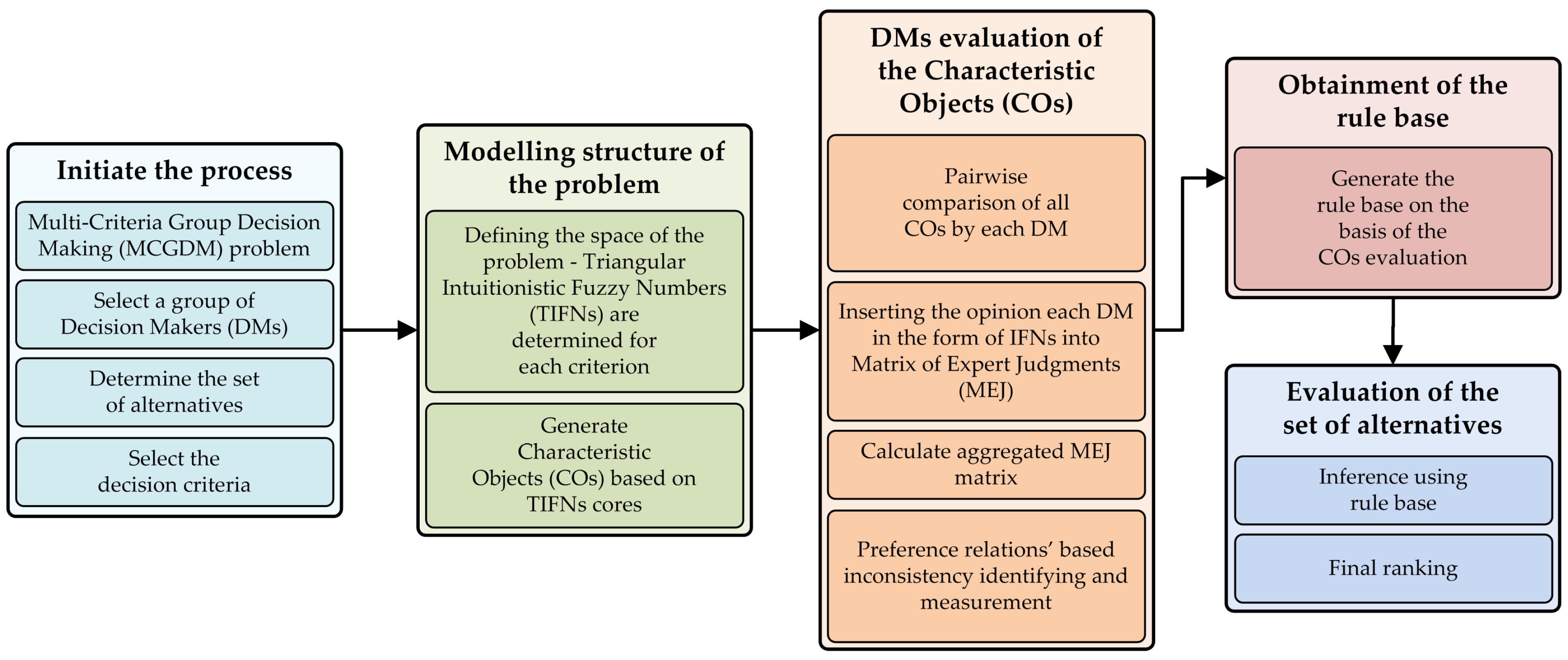
where represents the score value of each obtained by using the Formula (1). Finally, the final ranking order of the alternatives is obtained by sorting these preference values. The larger the preference value, the superior the alternative . The whole procedure is presented as the flowchart in Figure 1.
Figure 1.
The flowchart of the proposed approach combining the advantages of the Characteristic Object Method (COMET) and Triangular Intuitionistic Fuzzy Numbers (TIFNs).
4. Illustrative Example
In this section, we show the same problem as presented by Faizi et al. in [] but with another type of uncertainity which provide membership and non-membership values. The decision problem is defined as the selection of the best mobile company for a factory.
Let us consider a company whose supreme capability of using mobile units is a quantity of 1000 per month expects to select a new mobile partnership. Four firms , , and are possible, and three DMs are suggested to consider two criteria (fixed line rent) and (rates per unit) to decide which mobile company should be chosen. The original ranking order of the mobile companies along with fixed line rent and rates per unit can be shown in Table 1.
Table 1.
The original ranking order of the alternatives.
A set of TIFNs for both criteria and set by all the DMs are shown as in Table 2 and Table 3 respectively.
Table 2.
Different families of TIFNs chosen by the decision makers (DMs) for criteria .
Table 3.
Different families of TIFNs chosen by the DMs for criteria .
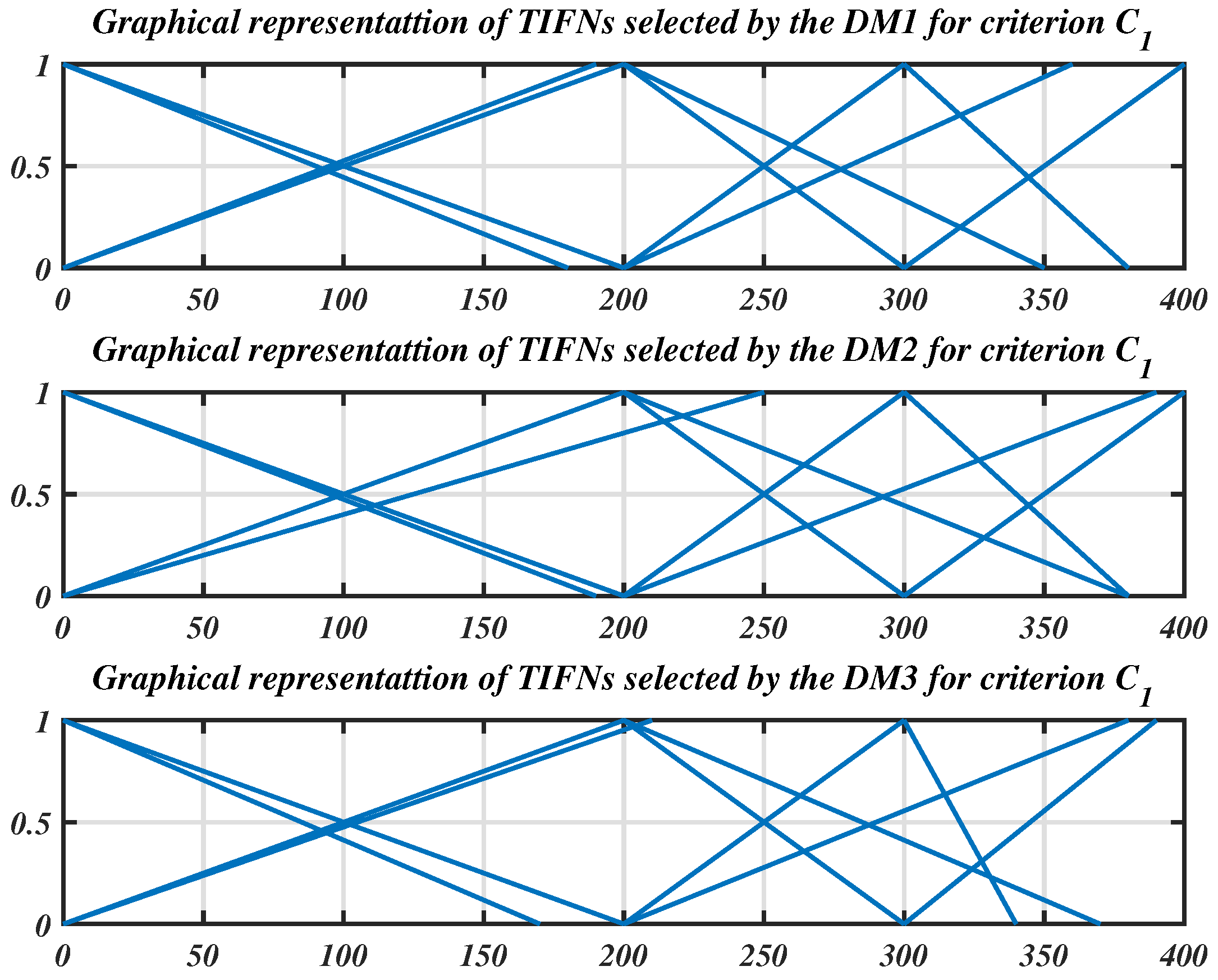
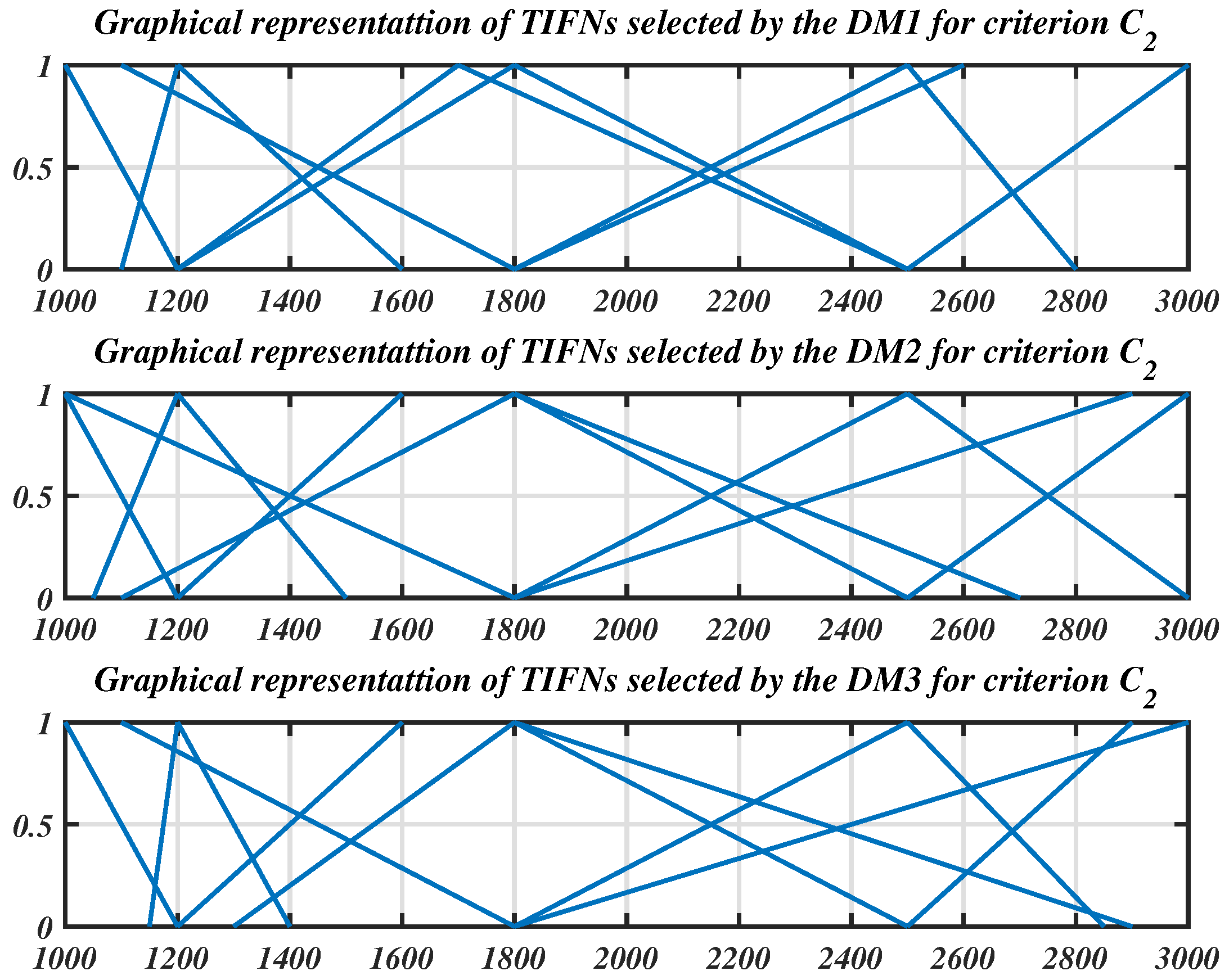
The graphical representations of TIFNs chosen by the DMs for both the criteria and are shown in Figure 2 and Figure 3, respectively.
Figure 2.
Graphs of asymmetrical TIFNs chosen by the DMs for criteria .
Figure 3.
Graphs of asymmetrical TIFNs chosen by the DMs for criteria .
The sets of cores of a given family of TIFNs are and for both the criteria andrespectively. The optimal solution of the given MCGDM problem by using the COMET method can be determined by taking different number of COs. Here, in this paper, we find the optimal solution to this problem with the use of following nine COs.
During the pairwise comparison of all the COs, suppose the three DMs agreed to provide their joint assessment values in the form of IFNs that are unified in the matrix MEJ. Then, the unified MEJ can be shown as below.
It is easy to verify that the above MEJ which is infact an IPR is not additive consistent based on Definition 5. Therefore, the rectification process as mentioned in Section 2 has to be performed for this MEJ. By using Equations (5) and (6), the transformation matrix can be computed as above.
In transformed IPR, (correspondingly, ). The d value for the transformed IPR can be obtained as using Formula (7). According to Equation (8), we obtain the additively consistent IPR as shown below.
The vector is obtained by using Formula (9) as follows:
The P vector actually provides the approximate preference values of all the nine COs as mentioned above. Now, in order to calculate the preference value of first alternative , we proceed as follows:
There are 9 rules (COs) for the alternative , but the activated rules are The approximate preference values of corresponding COs are The IFN corresponding to the alternative is computed by using Formula (10) as follows:
The preference value of the alternative can be determined by computing the score value of by using Formula (1). i.e.,
Similarly the preference values of the remaining alternatives can be found in the same way by following the five steps. A sharp comparison of the ranking order of alternatives using the proposed COMET method with the original ranking as well as the ranking obtained in [] can be seen in Table 4.
Table 4.
Comparison of the ranking obtained using intuitionistic fuzzy sets (IFSs) and hesitant fuzzy sets (HFSs) with the original ranking.
From Table 4, is the best alternative, followed by and , in this order. It can be easily observed that this ranking order of the alternatives is reasonably matched with the original ranking of alternatives as mentioned in the same table.
5. Conclusions
The uncertainty and diversity of assessment information provided by the DMs can be well reflected and modeled using IFSs. The symmetrical and asymmetrical IFSs are very useful to express vagueness and uncertainty more accurately as compared to fuzzy sets. Therefore, we extend the COMET method to develope a useful technique for solving MCGDM problems with IFSs. To illustrate the effectiveness of the COMET method using IFSs, we presented a simple numerical example and analyzed the academic problem of selection of the best mobile company. This problem has already been solved in [] by using HFSs. In the problem discussed in [], the L-R type generalized fuzzy numbers are preferred by the DMs to get the hesitance degree values for the given set of alternatives. Table 4 exhibits the ranking results of all the alternatives as derived by the COMET method using IFSs and HFSs. It can be observed that the ranking orders of the alternatives obtained by the COMET method using IFSs are exactly matched with those derived by the same method using HFSs. Therefore, the present method is also validated. By using the COMET method with IFSs and HFSs, the ranking of the alternatives is obtained as , which adequately matches as those with the original ranking as shown in Table 4. The accuracy in the results appeared only due to the inclusion of the idea of an additive consistent MEJ. However, some differences are also observed in the ranking order of the alternatives and . This is due to the increase of uncertainty level for both membership and non-membership values given by TIFNs during computations, e.g., for alternatives and , the aggregated IFNs obtained as a result of aggregating all the IFNs for both criteria were equal to and , respectively. This fact may represent the observed difference in the ranking order of both alternatives. However, it is quite reasonable that the optimal ranking is difficult to find by increasing the level of uncertainty. From the above investigation, it can be assumed that the order of the alternatives given by the proposed method is also stable and accurate. The main feature of the COMET method is that it always ignores the issue of rank reversal paradox, i.e., it delivers accurate evaluations of objects that are not subject to change by the introduction of new objects to the original object set. For example, by inserting 5th alternative in the given decision problem, then, the original ranking of five alternatives is obtained as . The preference value of using the proposed method is obtained as , which makes the new ranking order as . From both ranking orders as calculated above, it can be easily observed that the inclusion of the new alternative does not affect the ranking order of the remaining alternatives. This observation justifies the basis of our claim. The prominent characteristic of the proposed approach is to provide a valuable and flexible way to efficiently assist the DMs under an uncertain environment. Furthermore, the proposed approach can be applied for both TIFNs and IFNs, which reflects the uncertainty appropriately. In the future, we hope that the COMET method can be applied to MCDM/MCGDM problems under more uncertain environments such as interval-valued fuzzy sets, interval-valued intuitionistic fuzzy sets, hesitant fuzzy linguistic term sets, and so on.
Author Contributions
Conceptualization, S.F., W.S., T.R., S.Z. and J.W.; methodology, S.F., W.S., T.R., S.Z. and J.W.; software, S.F., W.S., T.R., S.Z. and J.W.; validation, S.F., W.S., T.R., S.Z. and J.W.; formal analysis, S.F., W.S., T.R., S.Z. and J.W.; investigation, S.F., W.S., T.R., S.Z. and J.W.; resources, S.F., W.S., T.R., S.Z. and J.W.; data curation, S.F., W.S., T.R., S.Z. and J.W.; writing—original draft preparation, S.F., W.S., J.W.; writing—review and editing, S.F., W.S., T.R., S.Z. and J.W.; visualization, S.F., W.S., T.R., S.Z. and J.W.; supervision, S.F., W.S., T.R., S.Z. and J.W.; project administration, S.F., W.S., T.R., S.Z. and J.W.; funding acquisition, W.S. All authors have read and agreed to the published version of the manuscript.
Funding
The work was supported by the National Science Centre, Decision No. DEC-2016/23/N/HS4/01931, and by the Faculty of Computer Science and Information Technology, West Pomeranian University of Technology, Szczecin statutory funds.
Acknowledgments
The authors would like to thank the editor and the anonymous reviewers, whose insightful comments and constructive suggestions helped us to significantly improve the quality of this paper.
Conflicts of Interest
The authors declare no conflict of interest.
Abbreviations
The following abbreviations are used in this manuscript:
| MCGDM | Multi-Criteria Group Decision Making |
| MCDM | Multi-Criteria Decision Making |
| GDM | Group Decision Making |
| DM | Decision Maker |
| IF | Intuitionistic Fuzzy |
| IFS | Intuitionistic Fuzzy Set |
| IFN | Intuitionistic Fuzzy Number |
| TIFN | Triangular Intuitionistic Fuzzy Number |
| IPR | Intuitionistic Preference Relations |
| HFS | Hesitant Fuzzy Set |
| COMET | Characteristic Objects METhod |
| MEJ | Matrix of Expert Judgments |
References
- Božanić, D.; Pamučar, D.; Bojanić, D. Modification of the analytic hierarchy process (AHP) method using fuzzy logic: Fuzzy AHP approach as a support to the decision making process concerning engagement of the group for additional hindering. Serbian J. Manag. 2015, 10, 151–171. [Google Scholar] [CrossRef]
- Xu, J.; Wu, Z. A discrete consensus support model for multiple attribute group decision making. Knowl.-Based Syst. 2011, 24, 1196–1202. [Google Scholar] [CrossRef]
- Atanassov, K.T. New operations defined over the intuitionistic fuzzy sets. Fuzzy Sets Syst. 1994, 61, 137–142. [Google Scholar] [CrossRef]
- Zadeh, L.A. Fuzzy sets. Inf. Control 1965, 8, 338–353. [Google Scholar] [CrossRef]
- Roy, J.; Das, S.; Kar, S.; Pamučar, D. An extension of the CODAS approach using interval-valued intuitionistic fuzzy set for sustainable material selection in construction projects with incomplete weight information. Symmetry 2019, 11, 393. [Google Scholar] [CrossRef]
- Chen, T.Y. The inclusion-based TOPSIS method with interval-valued intuitionistic fuzzy sets for multiple criteria group decision making. Appl. Soft Comput. 2015, 26, 57–73. [Google Scholar] [CrossRef]
- Park, J.H.; Cho, H.J.; Kwun, Y.C. Extension of the VIKOR method for group decision making with interval-valued intuitionistic fuzzy information. Fuzzy Optim. Decis. Mak. 2011, 10, 233–253. [Google Scholar] [CrossRef]
- Wu, J.; Chiclana, F. A social network analysis trust–consensus based approach to group decision-making problems with interval-valued fuzzy reciprocal preference relations. Knowl.-Based Syst. 2014, 59, 97–107. [Google Scholar] [CrossRef]
- Wu, J.; Chiclana, F. A risk attitudinal ranking method for interval-valued intuitionistic fuzzy numbers based on novel attitudinal expected score and accuracy functions. Appl. Soft Comput. 2014, 22, 272–286. [Google Scholar] [CrossRef]
- Xu, Z. An integrated model-based interactive approach to FMAGDM with incomplete preference information. Fuzzy Optim. Decis. Mak. 2010, 9, 333–357. [Google Scholar] [CrossRef]
- Xu, J.; Shen, F. A new outranking choice method for group decision making under Atanassov’s interval-valued intuitionistic fuzzy environment. Knowl.-Based Syst. 2014, 70, 177–188. [Google Scholar] [CrossRef]
- Faizi, S.; Sałabun, W.; Ullah, S.; Rashid, T.; Więckowski, J. A New Method to Support Decision-Making in an Uncertain Environment Based on Normalized Interval-Valued Triangular Fuzzy Numbers and COMET Technique. Symmetry 2020, 12, 516. [Google Scholar] [CrossRef]
- Xu, Z.; Liao, H. Intuitionistic fuzzy analytic hierarchy process. IEEE Trans. Fuzzy Syst. 2013, 22, 749–761. [Google Scholar] [CrossRef]
- Shen, F.; Xu, J.; Xu, Z. An outranking sorting method for multi-criteria group decision making using intuitionistic fuzzy sets. Inf. Sci. 2016, 334, 338–353. [Google Scholar] [CrossRef]
- Saaty, T.L. Decision making with the analytic hierarchy process. Int. J. Serv. Sci. 2008, 1, 83–98. [Google Scholar] [CrossRef]
- Wang, Z.J. Geometric consistency based interval weight elicitation from intuitionistic preference relations using logarithmic least square optimization. Fuzzy Optim. Decis. Mak. 2015, 14, 289–310. [Google Scholar] [CrossRef]
- Xu, Z.; Liao, H. A survey of approaches to decision making with intuitionistic fuzzy preference relations. Knowl.-Based Syst. 2015, 80, 131–142. [Google Scholar] [CrossRef]
- Xu, Z. Intuitionistic fuzzy aggregation operators. IEEE Trans. Fuzzy Syst. 2007, 15, 1179–1187. [Google Scholar]
- Xu, Z. Intuitionistic preference relations and their application in group decision making. Inf. Sci. 2007, 177, 2363–2379. [Google Scholar] [CrossRef]
- Xu, Z.; Cai, X.; Szmidt, E. Algorithms for estimating missing elements of incomplete intuitionistic preference relations. Int. J. Intell. Syst. 2011, 26, 787–813. [Google Scholar] [CrossRef]
- Gong, Z.W.; Li, L.S.; Forrest, J.; Zhao, Y. The optimal priority models of the intuitionistic fuzzy preference relation and their application in selecting industries with higher meteorological sensitivity. Expert Syst. Appl. 2011, 38, 4394–4402. [Google Scholar] [CrossRef]
- Wan, S.P.; Wang, Q.Y.; Dong, J.Y. The extended VIKOR method for multi-attribute group decision making with triangular intuitionistic fuzzy numbers. Knowl.-Based Syst. 2013, 52, 65–77. [Google Scholar] [CrossRef]
- Wang, Z.J. Derivation of intuitionistic fuzzy weights based on intuitionistic fuzzy preference relations. Appl. Math. Model. 2013, 37, 6377–6388. [Google Scholar] [CrossRef]
- Shu, M.H.; Cheng, C.H.; Chang, J.R. Using intuitionistic fuzzy sets for fault-tree analysis on printed circuit board assembly. Microelectron. Reliab. 2006, 46, 2139–2148. [Google Scholar] [CrossRef]
- Li, D.F. A ratio ranking method of triangular intuitionistic fuzzy numbers and its application to MADM problems. Comput. Math. Appl. 2010, 60, 1557–1570. [Google Scholar]
- Yu, D. Prioritized information fusion method for triangular intuitionistic fuzzy set and its application to teaching quality evaluation. Int. J. Intell. Syst. 2013, 28, 411–435. [Google Scholar] [CrossRef]
- Otay, İ.; Oztaysi, B.; Onar, S.C.; Kahraman, C. Multi-expert performance evaluation of healthcare institutions using an integrated intuitionistic fuzzy AHP&DEA methodology. Knowl.-Based Syst. 2017, 133, 90–106. [Google Scholar]
- Qin, Q.; Liang, F.; Li, L.; Chen, Y.W.; Yu, G.F. A TODIM-based multi-criteria group decision making with triangular intuitionistic fuzzy numbers. Appl. Soft Comput. 2017, 55, 93–107. [Google Scholar] [CrossRef]
- Saini, N.; Bajaj, R.K.; Gandotra, N.; Dwivedi, R.P. Multi-criteria decision making with triangular intuitionistic fuzzy number based on distance measure & parametric entropy approach. Procedia Comput. Sci. 2018, 125, 34–41. [Google Scholar]
- Mishra, A.R.; Rani, P.; Pardasani, K.R.; Mardani, A.; Stević, Ž.; Pamučar, D. A novel entropy and divergence measures with multi-criteria service quality assessment using interval-valued intuitionistic fuzzy TODIM method. Soft Comput. 2020, 24, 11641–11661. [Google Scholar] [CrossRef]
- Faizi, S.; Rashid, T.; Sałabun, W.; Zafar, S.; Wątróbski, J. Decision making with uncertainty using hesitant fuzzy sets. Int. J. Fuzzy Syst. 2018, 20, 93–103. [Google Scholar] [CrossRef]
- Watróbski, J.; Sałabun, W. The characteristic objects method: A new intelligent decision support tool for sustainable manufacturing. In Proceedings of the International Conference on Sustainable Design and Manufacturing, Chania, Greece, 5–6 April 2016; Springer: Berlin/Heidelberg, Germany, 2016; pp. 349–359. [Google Scholar]
- Sałabun, W. The Characteristic Objects Method: A New Distance-based Approach to Multicriteria Decision-making Problems. J. Multi-Criteria Decis. Anal. 2015, 22, 37–50. [Google Scholar] [CrossRef]
- Sałabun, W.; Ziemba, P.; Wątróbski, J. The rank reversals paradox in management decisions: The comparison of the ahp and comet methods. In Proceedings of the International Conference on Intelligent Decision Technologies, Puerto de la Cruz, Spain, 15–17 June 2016; Springer: Berlin/Heidelberg, Germany, 2016; pp. 181–191. [Google Scholar]
- Sałabun, W.; Karczmarczyk, A.; Wątróbski, J.; Jankowski, J. Handling data uncertainty in decision making with COMET. In Proceedings of the 2018 IEEE Symposium Series on Computational Intelligence (SSCI), Bengaluru, India, 18–21 November 2018; pp. 1478–1484. [Google Scholar]
- Wątróbski, J.; Sałabun, W.; Karczmarczyk, A.; Wolski, W. Sustainable decision-making using the COMET method: An empirical study of the ammonium nitrate transport management. In Proceedings of the 2017 Federated Conference on Computer Science and Information Systems (FedCSIS), Prague, Czech Republic, 3–6 September 2017; pp. 949–958. [Google Scholar]
- Wątróbski, J.; Sałabun, W. Green supplier selection framework based on multi-criteria decision-analysis approach. In Proceedings of the International Conference on Sustainable Design and Manufacturing, Chania, Greece, 5–6 April 2016; Springer: Berlin/Heidelberg, Germany, 2016; pp. 361–371. [Google Scholar]
- Pujadas, P.; Pardo-Bosch, F.; Aguado-Renter, A.; Aguado, A. MIVES multi-criteria approach for the evaluation, prioritization, and selection of public investment projects. A case study in the city of Barcelona. Land Use Policy 2017, 64, 29–37. [Google Scholar] [CrossRef]
- Roigé Montornés, N.; Pujadas Álvarez, P.; Cardús González, J.; Aguado de Cea, A. Water network renewal strategy: A case study of Aigües de Barcelona. In Water Management; ICE: London, UK, 2019. [Google Scholar]
- Pamucar, D.S.; Pejcic Tarle, S.; Parezanovic, T. New hybrid multi-criteria decision-making DEMATELMAIRCA model: Sustainable selection of a location for the development of multimodal logistics centre. Econ. Res.-Ekon. Istraživanja 2018, 31, 1641–1665. [Google Scholar] [CrossRef]
- Wątróbski, J.; Jankowski, J.; Ziemba, P.; Karczmarczyk, A.; Zioło, M. Generalised framework for multi-criteria method selection. Omega 2019, 86, 107–124. [Google Scholar] [CrossRef]
- Bashir, Z.; Rashid, T.; Wątróbski, J.; Sałabun, W.; Malik, A. Hesitant probabilistic multiplicative preference relations in group decision making. Appl. Sci. 2018, 8, 398. [Google Scholar] [CrossRef]
- Atanassov, K.T. Interval valued intuitionistic fuzzy sets. In Intuitionistic Fuzzy Sets; Springer: Berlin/Heidelberg, Germany, 1999; pp. 139–177. [Google Scholar]
- Chen, S.M.; Tan, J.M. Handling multicriteria fuzzy decision-making problems based on vague set theory. Fuzzy Sets Syst. 1994, 67, 163–172. [Google Scholar] [CrossRef]
- Hong, D.H.; Choi, C.H. Multicriteria fuzzy decision-making problems based on vague set theory. Fuzzy Sets Syst. 2000, 114, 103–113. [Google Scholar] [CrossRef]
- Xu, Z.; Yager, R.R. Some geometric aggregation operators based on intuitionistic fuzzy sets. Int. J. Gen. Syst. 2006, 35, 417–433. [Google Scholar] [CrossRef]
- Tong, X.; Wang, Z.J. A group decision framework with intuitionistic preference relations and its application to low carbon supplier selection. Int. J. Environ. Res. Public Health 2016, 13, 923. [Google Scholar] [CrossRef]
- Piegat, A. Fuzzy Modeling and Control; Springer: Berlin/Heidelberg, Germany, 2013; Volume 69. [Google Scholar]
- Cutello, V.; Montero, J. Fuzzy rationality measures. Fuzzy Sets Syst. 1994, 62, 39–54. [Google Scholar] [CrossRef]
- Herrera-Viedma, E.; Herrera, F.; Chiclana, F.; Luque, M. Some issues on consistency of fuzzy preference relations. Eur. J. Oper. Res. 2004, 154, 98–109. [Google Scholar] [CrossRef]
- Saaty, T.L. A scaling method for priorities in hierarchical structures. J. Math. Psychol. 1977, 15, 234–281. [Google Scholar] [CrossRef]
- Faizi, S.; Sałabun, W.; Rashid, T.; Wątróbski, J.; Zafar, S. Group decision-making for hesitant fuzzy sets based on characteristic objects method. Symmetry 2017, 9, 136. [Google Scholar] [CrossRef]
© 2020 by the authors. Licensee MDPI, Basel, Switzerland. This article is an open access article distributed under the terms and conditions of the Creative Commons Attribution (CC BY) license (http://creativecommons.org/licenses/by/4.0/).