


Abstract
Let G be a simple connected graph. In this paper, we study the spectral properties of the generalized distance matrix of graphs, the convex combination of the symmetric distance matrix and diagonal matrix of the vertex transmissions . We determine the spectrum of the join of two graphs and of the join of a regular graph with another graph, which is the union of two different regular graphs. Moreover, thanks to the symmetry of the matrices involved, we study the generalized distance spectrum of the graphs obtained by generalization of the join graph operation through their eigenvalues of adjacency matrices and some auxiliary matrices.
Keywords:
generalized distance matrix (spectrum); distance signless Laplacian matrix; joined union; lexicographic product; complete split graph; graph operation MSC:
05C50; 05C12; 15A18
1. Introduction
Complicated graph structures can often be built from relatively simple graphs via graph-theoretic binary operations such as products. Graph spectrum provides a unique way of characterizing graph structures, sometimes even identifying the entire graph classes. Moreover, using simple graph operations, the spectra of complicated graphs may be constructed from those of small and simple graphs. The interplay between graph spectra (including adjacency, Laplacian, etc.) and various binary graph operations such as corona, edge corona, and disjoint union has been extensively studied in the literature; see e.g., [1,2,3,4,5,6].
In this paper, we consider simple connected graphs [7]. A graph G is represented by , in which the set represents its vertex set and is the edge set connecting pairs of distinct vertices. The number is referred to as the order of G and is the size of it. A vertix adjacent to a vertex is called the neighborhood of v and is presented by . The degree of a vertex v is the cardinality of its neighborhood and denoted by or simply . A regular graph has the same degree for all vertices. The distance is the length of a shortest path between two vertices u and v. The maximum distance between two vertices is called the diameter of a graph. The matrix is called the distance matrix of G. As usual, is the complement of the graph G. Moreover, the complete graph , the complete bipartite graph , the path , the cycle , and the wheel graph are defined in the conventional way. The sum of the distances from a vertex v to all other vertices, , is called the transmission degree of v. A k-transmission regular graph admits for any vertex v. Let . Then the sequence is said to be the transmission degree sequence. The quantity is referred to as the second transmission degree of .
The diagonal matrix characterizes the vertex transmissions of G. For a connected graph, M. Aouchiche and P. Hansen [8,9] studied the Laplacian and the signless Laplacian for its distance matrix. The distance Laplacian matrix and the distance signless Laplacian matrix have attracted great recent research attention due to their usefulness in spectrum theory. Recently, Cui et al. [10] investigated a convex combination of and in the form of which is called the generalized distance matrix. Through the study of generalized distance matrix, not only new results can be derived but existing results can be looked into in a new unified point of view.
Let I be the identity matrix of order n. The characteristic polynomial of can be written as . The generalized distance eigenvalues of G are the zeros of . Noting that is real and symmetric, we arrange the eigenvalues as . We call the generalized distance spectral radius of G. The generalized distance spectrum and energy have been recently scoped in [11,12].
The rest of the paper is organized as follows. In Section 2, we study the generalized distance spectrum of join of regular graphs. We will show that the generalized distance spectrum of join of two regular graphs can be obtained from their adjacency spectrum. Again using adjacency eigenvalues, we determine the generalized distance spectrum of join of a regular graph with the union of two different regular graphs. In Section 3, we use the adjacency matrix eigenvalues and auxiliary matrices to characterize the generalized distance spectrum of the joined union of regular graphs.
2. On the Generalized Distance Spectrum of Join of Graphs
In this section, we study the generalized distance spectrum of join of regular graphs. We will establish new relationship between generalized distance spectrum and adjacency spectrum. As applications, we obtain the generalized distance spectrum of some special graph classes including complete bipartite graph, complete split graph, wheel graph and some derived graphs from a complete graph.
Consider two disjoint vertex sets and with and . For two graphs and , the union is . The join of them is denoted by consisting of and all edges joining each vertex in and each vertex in In other words, the join of them can be obtained by connecting each vertex of to all vertices of
The following gives the generalized distance spectrum of join of two regular graphs in terms of their eigenvalues of adjacency matrices.
Theorem 1.
Let be an -regular graph of order , for Let and are the adjacency eigenvalues of and , respectively. The characteristic polynomial of the generalized distance matrix of is given by
where and .
Proof.
For , let be an -regular graph of order . Let be the join of the graphs and . It is clear that G is graph of diameter 2. Let be the vertex set of the graph , then the vertex set of G is . For all , we have and for all , we have . Let us label the vertices of G, so that the first vertices are from . Under this labelling, it can be seen that the generalized distance matrix of G can be written as
where , , is an all one matrix, is the identity matrix of order , is the adjacency matrix of and is the adjacency matrix of the complement , for
Since is an -regular graph, it follows that , the all ones vector of order , is an eigenvector corresponding to the eigenvalue of and corresponding to the eigenvalue of . Let x be a vector orthogonal to , satisfying , then . Taking and using , we have . This shows that is an eigenvalue of corresponding to the eigenvalue of . Let y be a vector orthogonal to , satisfying , then . Taking and using , we have . This shows that is an eigenvalue of corresponding to the eigenvalue of . The equitable quotient matrix of is
Since the characteristic polynomial of M is and any eigenvalue of M is an eigenvalue of [13], the result follows. □
Let be the complete bipartite graph. It is well-known that . We have the following observation from Theorem 1, which gives the generalized distance spectrum of .
Corollary 1.
The generalized distance eigenvalues of consists of the eigenvalue with multiplicity , the eigenvalue with multiplicity and the eigenvalues .
Proof.
Similarly as in Theorem 1, this can be proved by taking and , for all . □
Let be the wheel graph of order . It is well known that . Using the fact that the adjacency spectrum of is , we have the following observation from Theorem 1, which gives the generalized distance spectrum of .
Corollary 2.
The generalized distance eigenvalues of the wheel graph consists of the eigenvalues and also the eigenvalues .
Proof.
Proof follows from Theorem 1, by taking and for . □
The graph of order n is called complete split graph. It is constructed by linking each vertex of a clique of t vertices to each vertex of an independent set of vertices. It is clear that . Using the fact that the adjacency spectrum of is , we have the following observation from Theorem 1, which gives the generalized distance spectrum of .
Corollary 3.
The generalized distance eigenvalues of consists of the eigenvalues with multiplicity , the eigenvalue with multiplicity and the eigenvalues, .
Proof.
Similarly as in Theorem 1, this can be shown by taking , for and , for . □
In the next result, we work out the relationship between the generalized distance spectrum of the join of regular graphs and their adjacency spectra.
Theorem 2.
For let be -regular with order . Let be their adjacency matrices and the adjacency eigenvalues are . We have that the generalized distance spectrum of is eigenvalues for and for and where and three extra eigenvalues defined by the eigenvalues of the following matrix
where and
Proof.
Given . Assume is -regular and has vertices. Let be the join of the graphs and . Obviously, G has diameter 2. Let be the vertex set of the graph , then the vertex set of G is . For all , we have , for all , we have and for all , we have . Let us label the vertices of G, so that the first vertices are from , the next vertices are from and the next vertices are from . Under this labelling, the generalized distance matrix of G has the form
where and for
For a regular graph , the all ones vector of order is an eigenvector corresponding to the eigenvalue . Other eigenvectors are orthogonal to . Therefore, the all ones vector of order is an eigenvector corresponding to the eigenvalue . Other eigenvectors are orthogonal to Suppose that be an eigenvalue of adjacency matrix of and its eigenvector is x satisfying then is an eigenvector of with the eigenvalue Let be any eigenvalues of the adjacency matrix of and with associated eigenvector y and z satisfying , respectively. In a similar way, it can be seen that the vectors and are eigenvectors of with corresponding eigenvalues and respectively.
Hence, we obtained eigenvectors and . They are eigenvectors. It is easy to see that they are orthogonal to and All other three eigenvectors of can be represented by for some
Suppose that is an eigenvalue of the matrix with associated eigenvector . Recall that and (). We obtain:
These equations admit a nontrivial solution only if (1) has an eigenvalue . Moreover, any nontrivial solution of the equations is an eigenvector of associated to As the remaining three eigenvectors of are formed like this, it is obvious that any eigenvalue of (1) is also an eigenvalue of . □
Consider the graph . We have the following observation from Theorem 2, which gives the generalized distance spectrum of .
Corollary 4.
The generalized distance eigenvalues of consists of eigenvalue , with multiplicity , the eigenvalue with multiplicity , the eigenvalue with multiplicity and three more eigenvalues which are the eigenvalues of the matrix
where .
Proof.
Proof follows from Theorem 2, by taking , for all and . □
Suppose we have a complete graph of order n. The graph is obtained by removing an edge e from . Taking and , in Corollary 4, we obtain the generalized distance spectrum of the graph given by , where and are the roots of the equation .
3. The Generalized Distance Spectrum of the Joined Union
In this section, we describe the relationship between generalized distance spectrum and the adjacency spectrum of the joined union of regular graphs.
The spectrum of a graph may determine the class of graphs that share the same properties. There have been some different names for the binary graph operation to be introduced below. We will call it joined union following [4,6]. This operation is also called generalized composition [14] or H-join [3]. Let have order n and have order for . The joined union is the graph satisfying:
Clearly, the joined union graph can be constructed by taking the union of and linking any pair of vertices between and if and are neighbors in By this definition, the usual join of and can be viewed as , which is a special joined union graph.
Theorem 3.
Suppose G is a graph with diameter at most 2 over . Denote by an -regular graph of order and adjacency eigenvalues where The generalized distance spectrum of the joined union consists of the eigenvalues for and , where and . The remaining n eigenvalues are given by the matrix
where
Proof.
Let G be a graph over and let be the vertex set of graph , for . Suppose that is the joined union of the graphs . By appropriately labelling the vertices of the graph H, we see that the generalized distance matrix of the graph H can be put into the form
where for
is the all-one matrix, is the adjacency matrix, and is the identity matrix of order .
Since is -regular, the all-one vector is an eigenvector of associated to eigenvalue . The rest of the eigenvectors turn out to be orthogonal to We do not require connectivity of and likewise we do not require to be a simple eigenvalue. Suppose that is an eigenvalue of associated with the eigenvector satisfying Note that X is essentially defined over and allows a correspondence from to . Namely, (, ). Given the vector , where
It can seen that the vector Y is an eigenvector of corresponding to the eigenvalue There exists a total of mutually orthogonal eigenvectors of in this manner. They turn out to be orthogonal to the vectors where and
This implies that the rest n eigenvectors of are spanned by the vectors which due to the fact that appear to be linearly independent, suggests that the rest eigenvectors of are for some coefficients
Assume that is an eigenvalue of associated to an eigenvector As ()
We derive the following equations involving
This set of equations admits a nontrivial solution only if becomes an eigenvalue of (2). Moreover, any nontrivial solution of (3) appears to be an eigenvector of associated to the eigenvalue We see that each eigenvalue of (2) must also be an eigenvalue of since the rest n eigenvectors of are represented in this manner. □
The lexicographic product of two graphs G and H can be constructed in the following way. The vertex set of is equivalent to the product set . If , then and are connected, namely, they form an edge in . We know that is a special case of joined union with (). When , it can be seen that . In view of Theorem 3, the generalized distance spectrum of the joined union can be written using eigenvalues of ’s as well as those of (2). The relationship between the eigenvalues of and the generalized distance spectrum of the joined union is not explicit though. The following example should shed a light on this relationship. When both G and H are regular graphs and G is a graph of diameter less than or equal to 2, the general distance spectrum of can be calculated via Theorem 3.
Corollary 5.
Suppose that G is s-regular over n vertices with adjacency eigenvalues and diameter less than or equal to 2. Assume that H is r-regular over m vertices with adjacency eigenvalues . Therefore, the generalized distance spectrum of contains for each times) together with the eigenvalues of the matrix , which are and for
It is clear that the complete t-partite graph is a joined union of the graphs , when the parent graph is . That is, . The following observation is a result of Theorem 3 and gives the generalized distance spectrum of, , the complete t-partite graph.
Corollary 6.
The generalized distance spectrum of with consists of the eigenvalue , for each times) and the k eigenvalues of the matrix
where
Proof.
Proof follows from Theorem 3 by using and the fact that the eigenvalues of are 0 with multiplicity (). □
Example 1.
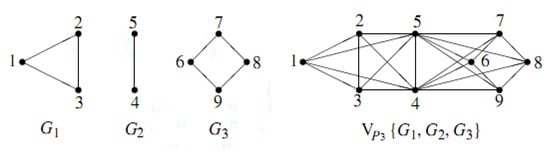
Considering the family of graphs as depicted in Figure 1 and the graph the path of order 3, the generalized distance matrix of the joined union is a block matrix of the form
where and
Figure 1.
The joined union .
Since the adjacency spectrums of are and respectively, then from Theorem 3, the generalized distance spectrum of H, consists of the eigenvalues also with the eigenvalues of the matrix
Therefore,
Note that, as , then the distance spectrum of H is
Also, as , then the distance signless Laplacian spectrum of H is
Author Contributions
Formal analysis, A.A., M.B., H.A.G. and Y.S.; Funding acquisition, Y.S.; Supervision, A.A.; Writing—original draft, A.A., M.B., H.A.G. and Y.S.; Writing—review & editing, A.A. and Y.S. All authors have read and agreed to the published version of the manuscript.
Funding
Y. Shang was supported in part by the UoA Flexible Fund No. 201920A1001 from Northumbria University.
Acknowledgments
The authors would like to thank the academic editor and the three anonymous referees for their constructive comments that helped improve the quality of the paper.
Conflicts of Interest
The authors declare no conflict of interest.
References
- Barik, S.; Sahoo, G. On the distance spectra of coronas. Linear Multilinear Algebra 2017, 65, 1617–1628. [Google Scholar] [CrossRef]
- Barik, S.; Pati, S.; Sarma, B.K. The spectrum of the corona of two graphs. SIAM J. Discrete Math. 2007, 24, 47–56. [Google Scholar] [CrossRef]
- Cardoso, D.M.; de Freitas, M.A.; Martins, E.A.; Robbiano, M. Spectra of graphs obtained by a generalization of the join graph operation. Discrete Math. 2013, 313, 733–741. [Google Scholar] [CrossRef]
- Neumann, M.; Pati, S. The Laplacian spectra of graphs with a tree structure. Linear Multilinear Algebra 2009, 57, 267–291. [Google Scholar] [CrossRef]
- Shang, Y. Random lifts of graphs: Network robustness based on the Estrada index. Appl. Math. E-Notes 2012, 12, 53–61. [Google Scholar]
- Stevanović, D. Large sets of long distance equienergetic graphs. Ars Math. Contemp. 2009, 2, 35–40. [Google Scholar] [CrossRef]
- Cvetković, D.M.; Doob, M.; Sachs, H. Spectra of Graphs—Theory and Application; Academic Press: New York, NY, USA, 1980. [Google Scholar]
- Aouchiche, M.; Hansen, P. Distance spectra of graphs: A survey. Linear Algebra Appl. 2014, 458, 301–386. [Google Scholar] [CrossRef]
- Aouchiche, M.; Hansen, P. Two Laplacians for the distance matrix of a graph. Linear Algebra Appl. 2013, 439, 21–33. [Google Scholar] [CrossRef]
- Cui, S.Y.; He, J.X.; Tian, G.X. The generalized distance matrix. Linear Algebra Appl. 2019, 563, 1–23. [Google Scholar] [CrossRef]
- Alhevaz, A.; Baghipur, M.; Ganie, H.A.; Shang, Y. Bounds for the generalized distance eigenvalues of a graph. Symmetry 2019, 11, 1529. [Google Scholar] [CrossRef]
- Alhevaz, A.; Baghipur, M.; Ganie, H.A.; Shang, Y. On the generalized distance energy of graphs. Mathematics 2020, 8, 17. [Google Scholar] [CrossRef]
- Brouwer, A.E.; Haemers, W.H. Spectra of Graphs; Springer: New York, NY, USA, 2012. [Google Scholar]
- Schwenk, A.J. Computing the characteristic polynomial of a graph. In Graphs Combinatorics; Bary, R., Harary, F., Eds.; Lecture Notes in Mathematics; Springer: Berlin, Germany, 1974; Volume 406, pp. 153–172. [Google Scholar]
© 2020 by the authors. Licensee MDPI, Basel, Switzerland. This article is an open access article distributed under the terms and conditions of the Creative Commons Attribution (CC BY) license (http://creativecommons.org/licenses/by/4.0/).