1. Introduction
The theory of finite fields has been one of the fundamental mathematical tools in computer science and communication engineering since the 1950s, when digit communications and computations were rapidly developed. Low complexity operation, particularly the multiplicative operation, squaring, and exponentiation operations, are preferred in various applications, including coding, cryptography, and communication. The performance of these operations is closely related to the representation of the finite elements; they are desired for efficient hardware implementation, and in this respect, many useful bases for
with low complexity have been found [
1,
2,
3,
4,
5,
6,
7,
8,
9,
10,
11]. An efficient algorithm for field multiplication using a normal basis was proposed by Massey and Omura in 1985 [
12].
In the past two decades, Galois rings have been used successfully in many aspects, such as in combinatorics to construct different kinds of combinatorial designs and in communication theory to construct error-correcting codes, sequences with good correlation properties, secret sharing schemes, hash functions, and so on [
3,
13,
14,
15,
16]. However, compared to the case of finite field extensions, the complexity problem of operations in Galois rings has not attracted much attention from scholars, except Abrahamsson, who considered the complexity of bases and carefully discussed the architectures for multiplication in Galois rings (for
) in his thesis [
17] in 2004. These are motivation by our study of operations, particularly for multiplicative operation, with low complexity in Galois rings.
In this paper, we study one aspect of the complexity problem of operations in Galois rings. More precisely, we mainly focus on the normal bases for Galois ring extensions. This paper is organized as follows. In
Section 2, we introduce some basic facts on Galois rings. Some results on normal bases and some basic properties on the multiplicative complexity of normal bases for Galois ring extension
are presented in
Section 3. Then, we determine all optimal normal bases for these Galois ring extensions in
Section 4.
2. Basic Facts about Galois Rings
In this section, we introduce several basic facts about Galois rings. For more information, the reader is referred to [
18].
Let
p be a prime number and
We have the modulo
p reduction mapping:
which induces the following modulo
p reduction mapping between polynomial rings:
is said to be a monic basic irreducible (primitive) polynomial over
if
is a monic irreducible (primitive) polynomial over
Let
be a basic primitive polynomial of degree
n in
The quotient ring:
where
is a root of
in
with order
,
is called a Galois ring. We note that
is a primitive element of the finite field
where
From now on, we take
to be a basic primitive polynomial. The modulo
p reduction can be naturally extended to the following homomorphism of rings:
Some basic facts about Galois ring are given as follows.
(Fact 1) Let
be the cyclic multiplicative group of order
generated by
, and
Then,
and:
(Fact 2) is a local commutative ring with the unique maximal ideal , and the group of units is
(Fact 3)
is a Galois extension of rings with Galois group
where
is the automorphism of order
n defined by:
More generally, for each positive integer
is a subring of
and
is a Galois extension of rings with Galois group
where
is the automorphism of
defined by:
and
(Fact 4) We have the trace mapping:
defined by:
which is an epimorphism of
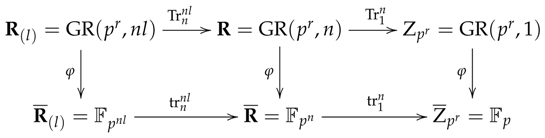
-modules, and we have the following commutative diagram:
where
and
are the trace mappings for finite field extensions.
On the other hand, for
the modulo
reduction gives the homomorphism of rings
, and we get the following commutative diagram:
where
is the automorphism of
defined by:
Next, we need some basic properties of the polynomial ring One of the most important properties of is the following Hensel’s lemma.
Two polynomials and in are called coprime if there exist and in such that
Lemma 1. ([18], Lemma 14.20) Let and Let be a monic polynomial in and be pairwise coprime monic polynomials in If in then there exist pairwise coprime polynomials in such that and The polynomial is called the Hensel lift of A monic polynomial in is called primary if is a power of a monic irreducible polynomial in . One can deduce the following result from the Hensel’s lemma.
Lemma 2. ([18], Theorem 14.21) Let be a monic polynomial of in We have the following decomposition:where are pairwise coprime primary polynomials in and are uniquely determined up to their order. Particularly, if where are distinct monic irreducible polynomials in then are distinct monic irreducible polynomials in and 3. Criteria on Normal Bases for Galois Ring Extensions
From (
1), we know that
is a free
-module of rank
n and
is a basis for
, where
is an element of order
in
Definition 1. An element is called a normal basis generator (NBG) for extension if is a basis for , where σ is the automorphism of defined by (3). Such a basis is called a normal basis for . In this section, we present several criteria on normal bases for Galois ring extension
, and these criteria can be reduced to the ones of finite field extensions
according to the following theorem. Recall that an element
is an NBG for
if
is a normal basis for
where
is the Frobenius automorphism of
defined by
for
From the definition of
in (
3), one has for
Theorem 1. For an element α in , α is an NBG for if and only if is an NBG for finite field extension
Proof. Suppose that
is not an NBG for
Then, there exist
such that:
and
for some
Let
The formula (
7) implies that
, so that
Therefore,
From
, we know that
and
Therefore,
is not an NBG for
.
On the other hand, suppose that
is not an NBG for
Then, there exist
such that:
and
for some
Let
and
From
, we get
Then,
, where
and
by assuming
. The formula (
8) implies that
, so that
Then, from
, we get
, where
and
Therefore,
is not an NBG for
This completes the proof of Theorem 1. □
By Theorem 1, a series of criteria on normal bases for finite field extensions can be shifted to ones for Galois ring extensions.
Lemma 3. ([19])Let and Let be the trace mapping for Then, for is an NBG for if and only if is an NBG for From the diagram (5), we know that for
Corollary 1. Let Let , and be the trace mapping from to Then, for is an NBG for if and only if is an NBG for
By Corollary 1, we assume
without loss of generality. In this case,
has the following decomposition in the polynomial ring
where
are distinct monic irreducible polynomials in
Let
be the set of all
p-polynomials
. Then,
is a ring with respect to the ordinary addition, and the following multiplication defined by composition ⊗:
and the mapping:
is an isomorphism of rings. Corresponding to the decomposition (
9) in
we have the following decomposition of:
where
are distinct monic irreducible
p-polynomials in
. Let
and
Lemma 4. ([18]) Let and For is an NBG for if and only if . This is a direct consequence of Theorem 1 and Lemma 4. We have the following criterion.
Corollary 2. Let , where Then, for is an NBG for if and only if
By the decomposition (
9), we have:
where
Then, we have the orthogonal idempotents
satisfying:
where
is the Kronecker symbol. These idempotents
can be computed by using the
-class of the roots of
(see [
19]).
In [
19], we present a new criterion of NBG for
by using idempotents in the ring
.
Lemma 5. ([19]) Letting is an NBG for if and only if Corollary 3. Let , where Then, for is an NBG for if and only if
In [
19], we present more explicit criteria on normal bases for
for several specific cases where the decomposition (
9) has a simpler form. By Corollary 3, we can give more explicit criteria on normal bases of the Galois ring extension for such cases. For example, let
p and
n be prime numbers and
Then, for
is an NBG for
if and only if
and
, where
is the trace mapping. Let
be the trace mapping. For
and:
Corollary 4. Let , where p and n are distinct prime numbers and Then, for is an NBG for if and only if both and belong to
We end this section by counting the number of NBG for
where
. It is well known ([
18], Corollary 8.25) that the number of NBG’s for
is (let
and
):
where
is the Euler function and
is the order of
p in
Since the mapping
is surjective and
-linear, we get that
As a direct consequence of Theorem 1, we can count the number of NBG’s for
Corollary 5. Let p be a prime number and be a positive integer with For the number of NBG’s for is:and the number of normal bases for is 4. Multiplicative Complexity on Normal Bases
It is known that normal bases on finite fields with low multiplication complexity have several applications in coding theory, cryptography, signal processing, and so on. As a comparison, Abrahamsson discussed the multiplicative complexity on normal bases over Galois rings and considered the architectures for multiplication in Galois rings (for ) in his thesis. In this section, we discuss the complexity of normal bases for extension where .
Definition 2. Let α be an NBG for , so that is a normal basis for , where σ is the automorphism of defined by (3). Then: The multiplicative complexity of the normal basis is defined by the number of nonzero Namely, For each
let
denote the modulo
reduction of
The mapping:
is a homomorphism of rings and
For
is an NBG for
if and only if
is an NBG for
by Theorem 1, then this is also equivalent to
being an NBG for
for any
Moreover, by the diagram (6), we get that for any
the equality (
10) implies that:
If then for all Therefore, we get the following simple and basic result.
Theorem 2. Let and α be an NBG for . Then, for each is an NBG for , where Moreover, let Then:where is the normal basis for It is known that for any normal basis
for finite field extension
Hence, by Theorem 2, for any normal basis
for Galois ring extension
The basis
is called optimal if
If
is an optimal normal basis for
, then by Theorem 2,
Therefore, . Namely, is an optimal normal basis for for all . In particular, is an optimal normal basis for the finite field extension
Definition 3. Two elements are equivalent to each other if for some denoted by
If
is an NBG for
and
for some
It is easy to see that
is also an NBG for
. Moreover, let:
Then,
and:
Since if and only if two normal bases and have the same complexity:
All optimal normal bases for finite field extension have been determined in [
8].
Lemma 6. (Gao and Lenstra [8]) There are only two types of optimal normal bases for finite field extension as follows. Type (I): and p are distinct prime numbers, and is equivalent to the following (optimal) normal bases for ,where ξ is an (n+ 1)-th primitive root of one in the algebraic closure of , so that Type (II): and is a prime number, and is equivalent to the following (optimal) normal bases for :where ξ is a root of one in the algebraic closure of Abrahamsson [
17] presented the following optimal normal bases for Galois ring extension as a generalization of Type (I) optimal normal bases for finite field extension.
Lemma 7. ([17]) Let p and be distinct prime numbers such that Let ζ be an th root of one in Then:is an optimal normal basis for In this section, we determine all optimal normal bases for Galois ring extensions. If and is an optimal normal basis for then is an optimal normal basis for , and then, is an optimal normal basis for Type (I) or Type (II) by Lemma 6. Now, we consider these two cases separately.
Theorem 3. Suppose that and p are distinct primes and Then, any optimal normal basis for is equivalent to the one given by Lemma 6.
Proof. For
is the finite field extension case. For
we assume that
is an optimal normal basis for
Then,
, where
is an
th primitive root of one in
. Let
be an
th primitive root of one in
such that
Then,
by
, where
is the cyclic multiplicative group of
(see Fact 3 in
Section 2), and:
since
is a (normal) basis for
. Therefore:
and for
(we can assume that
is an odd prime number, so that
n is even),
From
, we know that
and
for some
Then, by (
13), we have:
where we consider
for
and assume
so Equation (
13) becomes:
since
and
Therefore for
where:
Then, the complexity
where:
For the case of
We get
. For
we have
since
for
l satisfying
Then, we have:
which implies that
for all
which means that
for all
and
. Let
. From (
14), one gets that
is an optimal normal basis for
if and only if when
and
, we have:
Particularly, for
, we get:
If
then
for all
. By assumption
this means that
for all
, so that
by (
11), and the basis
is equivalent to the one given by Lemma 6.
Now, we assume that
For any fixed
by (
15), we get:
where
Therefore:
for all
If
and we get
for all
. In particular, for
, we get
and:
Therefore,
and
since
Then, we have
and
for
Taking
in (
15) and remarking that
we get
for
Since, for
we know that
Therefore,
and
Therefore,
is equivalent to the one given by Lemma 6. If
from (
16), we have
In this case, we fix
, and the condition (
15) implies that:
Let
we get:
Consider the fraction linear transformation:
with matrix
For any
, so that:
Therefore,
By (
17), we get:
Thus, This completes the proof of Theorem 3 for .
Now, we assume that
, and this theorem is true for
Let
, and
is an optimal normal basis for
By assumption, we have, up to equivalence,
Then, the same argument for can be shifted to get for all Therefore, This completes the proof of Theorem 3. □
Remark 1. Gao and Lenstra determined all optimal normal bases by using the Galois theory on finite fields [8] and consequently confirmed a conjecture that was raised by Mullin et al. Here, we give a direct proof of the Theorem 3 by using the mathematical induction. Theorem 4. Assume that is an odd prime number and Let Then:
(1) If there is no optimal normal basis for
(2) If and is an optimal normal basis for if and only if α is equivalent to , where ζ is a fifth primitive root of one in , so that , and b is the unique element in satisfying
Proof. (1) First, we consider
. Suppose that
, and
is an optimal normal basis for
. Then,
is an optimal normal basis for
. By Lemma 6,
is equivalent to
, where
is a
th primitive root of one in
. Let
be the
th primitive root of one in
such that
Then,
, and up to equivalence:
Since
is a normal basis for
by the assumption that
, also, this tell us that
Therefore, we know that:
and:
Then,
Since:
We get
and
for
. Then, from
, we know that
and
for
. However,
where
is an integer determined by
and
so that
From
, we get
for all
By (
18), we have:
and:
where
is determined by
and
If
, then
Therefore,
Therefore, we proved that there is no optimal normal basis in the case
(2) Letting
and
is an optimal normal basis for
. By Lemma 6, we get:
where
is a fifth primitive root of one in
, so that
and
Since
is invertible in
we can assume, up to equivalence,
Then,
, so that:
and by (
20), we have:
where
Therefore,
is an optimal basis for
if and only if
, and then, if and only if
Let be the ring of two-adic integers. Consider We have and , where is the two-adic exponential valuation. From Hensel’s lemma and , we know that there exists unique such that for any This completes the proof of Theorem 4. □
Putting Theorem 3 together with Theorem 4, we can derive the following results.
Theorem 5. Let Then:
(1) There exists the optimal normal basis for if and only if (A) and p are distinct prime numbers, and ; or (B)
(2) For Case (A), is an optimal normal basis for if and only if α is equivalent to an primitive root ζ of one. Namely,
(3) For Case (B), is an optimal normal basis for if and only if α is equivalent to , where ζ is a fifth primitive root of one in so that , and is the unique element satisfying