
The Spatio-Temporal Process of Regional Cultivated Land Use Transition: An Integrated Framework of “Factor-Structure-Function”

Abstract
1. Introduction
2. Methodology and Materials
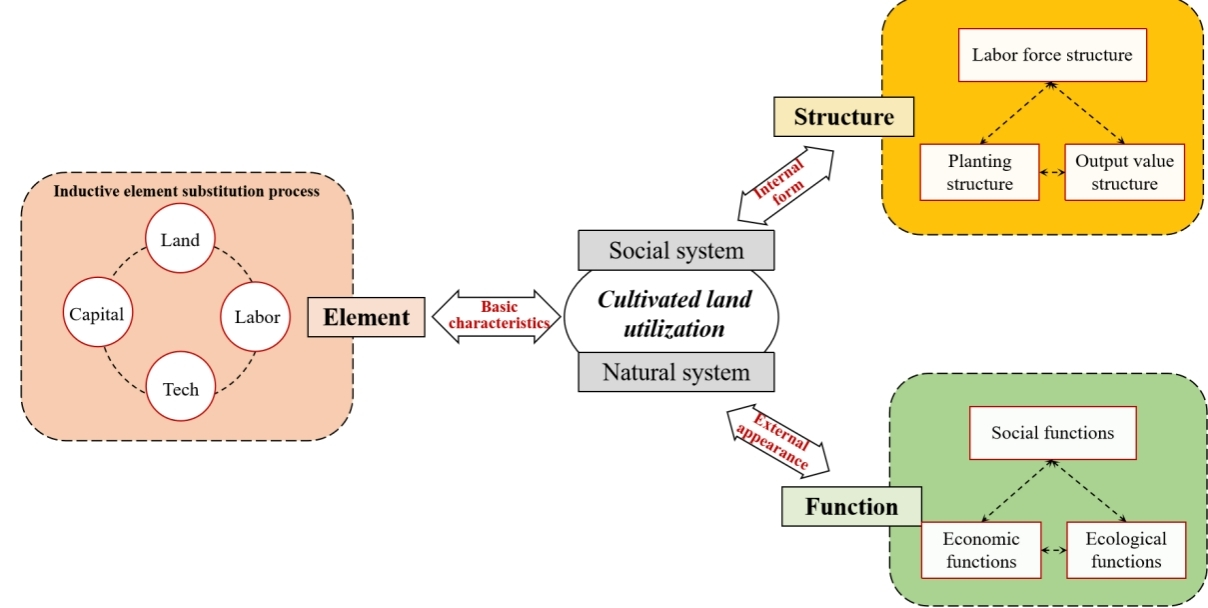
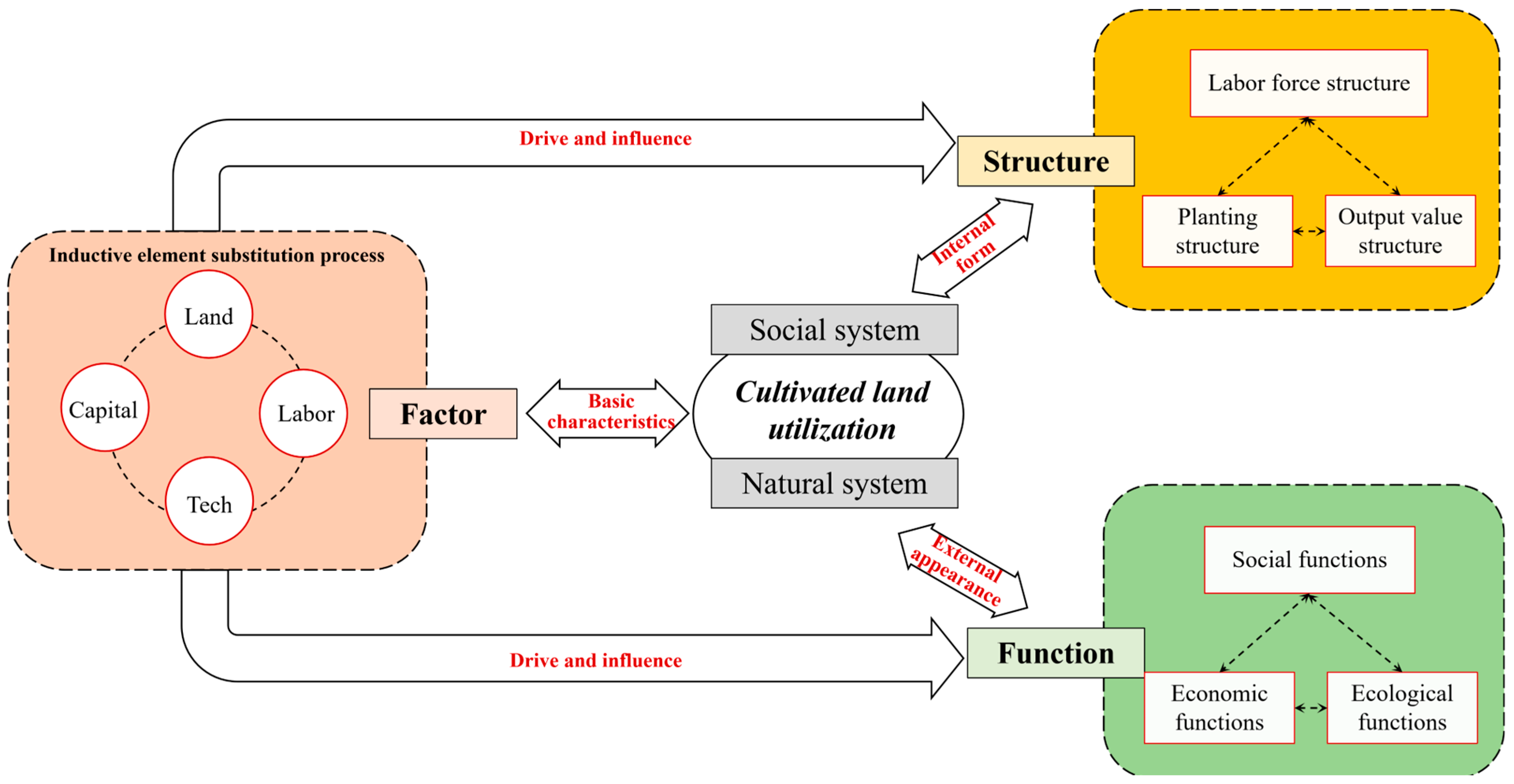
2.1. Theoretical Framework
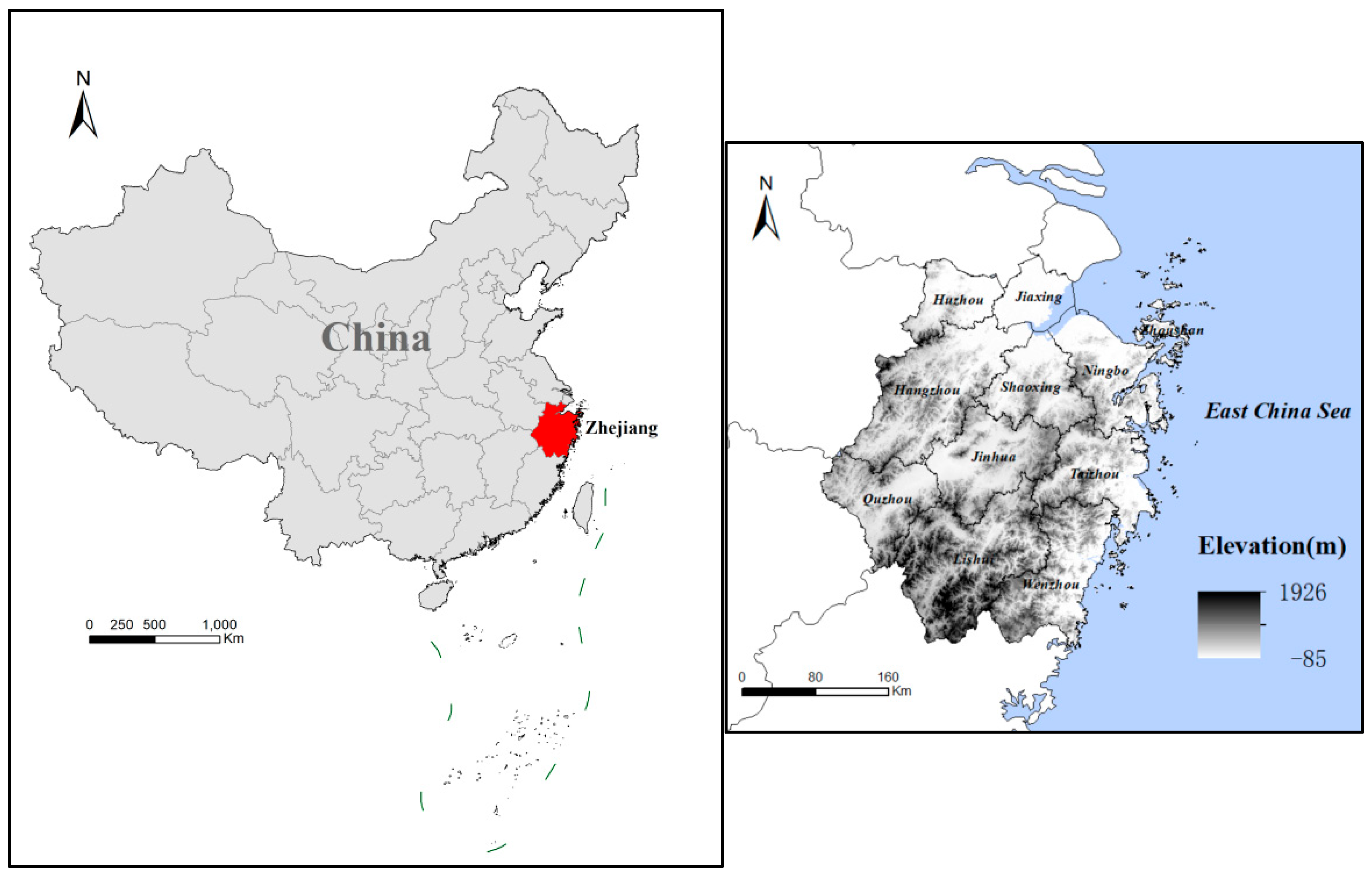
2.2. Study Area
2.3. Evaluation System for Diagnosing Regional CLUT
2.4. Methodology
2.4.1. Data Collection
2.4.2. Exploratory Spatial Data Analysis
2.4.3. Standard Deviational Ellipse
3. Results
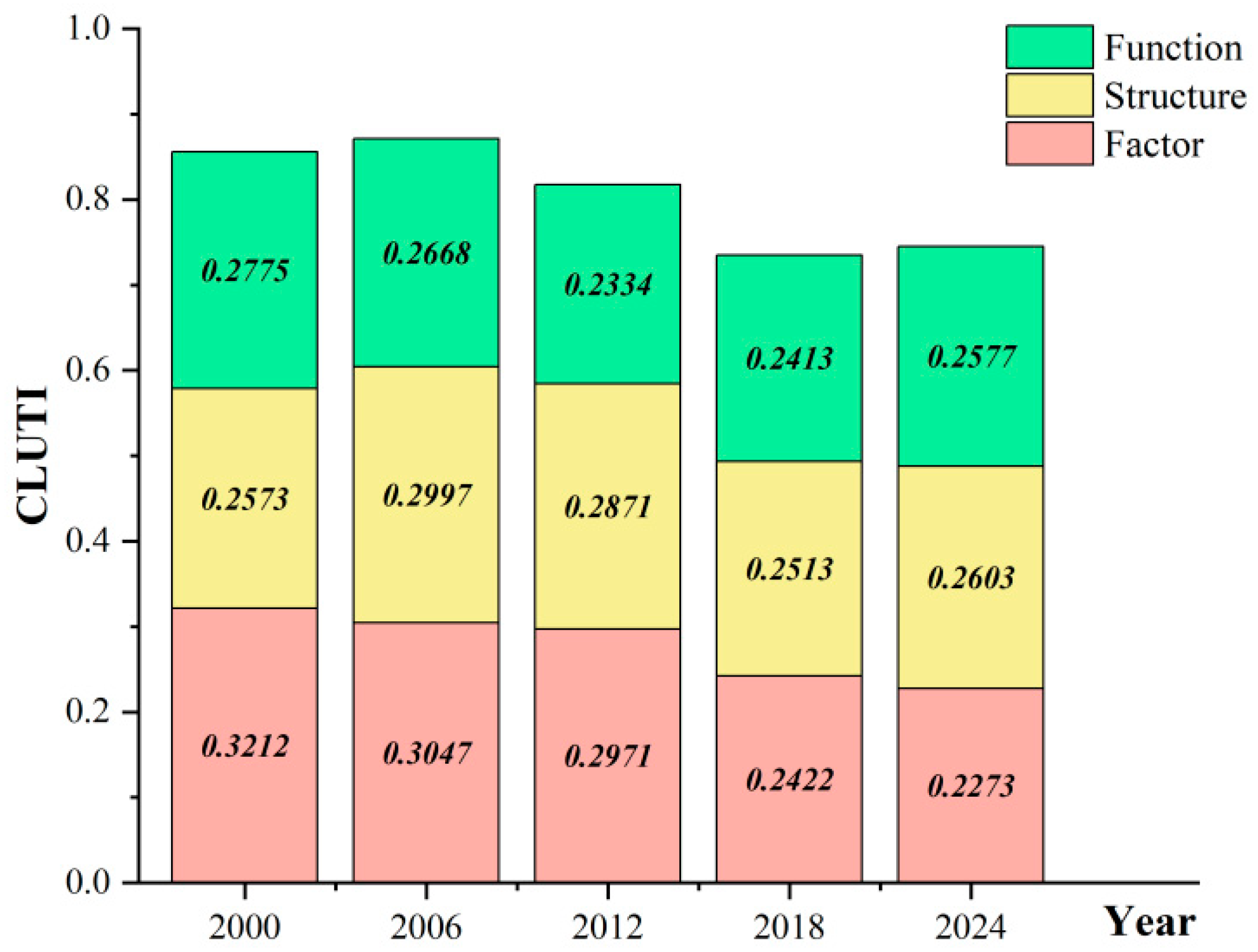
3.1. Temporal Dynamic Characteristics of CLUTI in Zhejiang Province
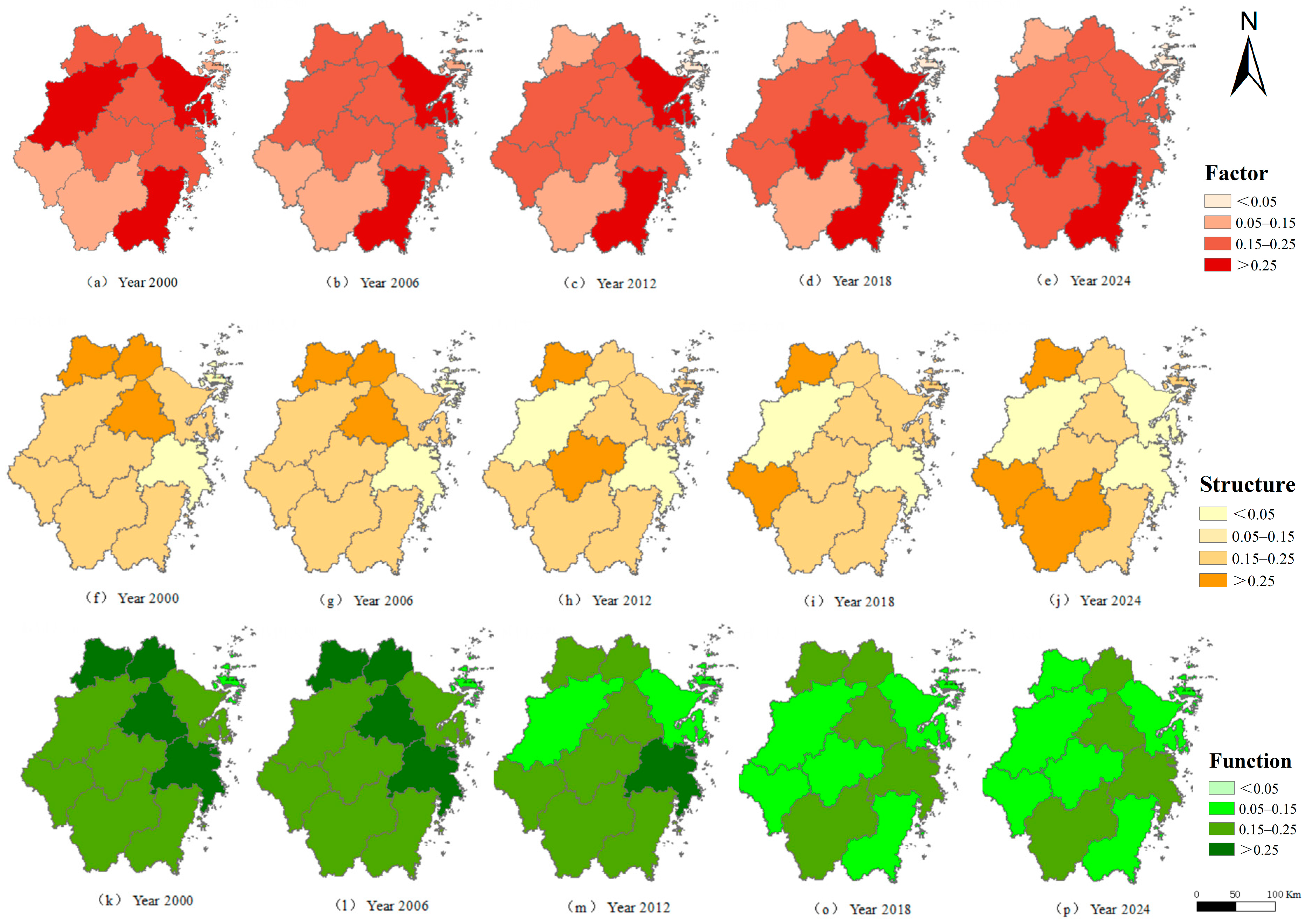
3.2. The Spatial Pattern of CLUTI in Zhejiang Province
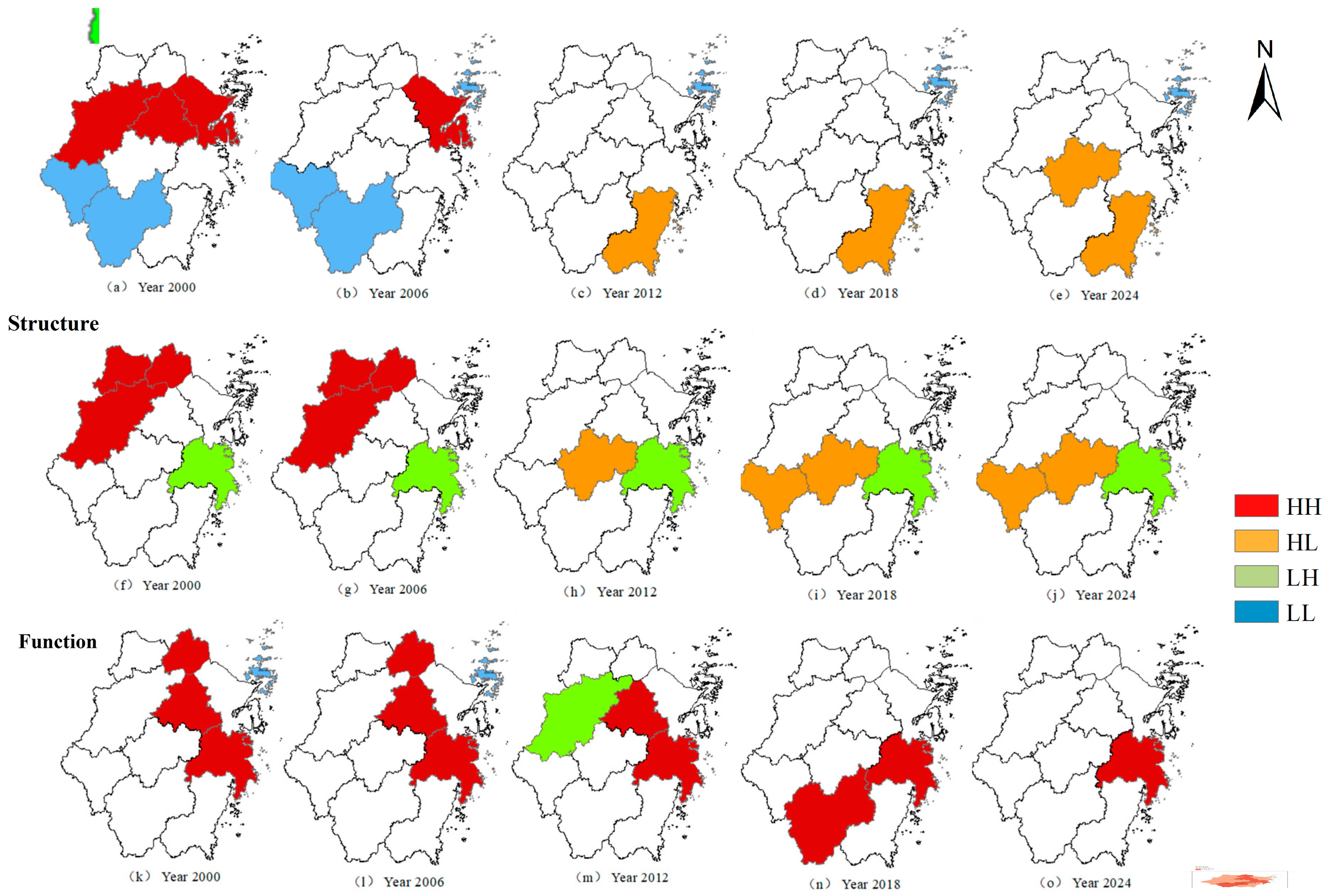
3.3. The Spatial Agglomeration Characteristics of CLUT
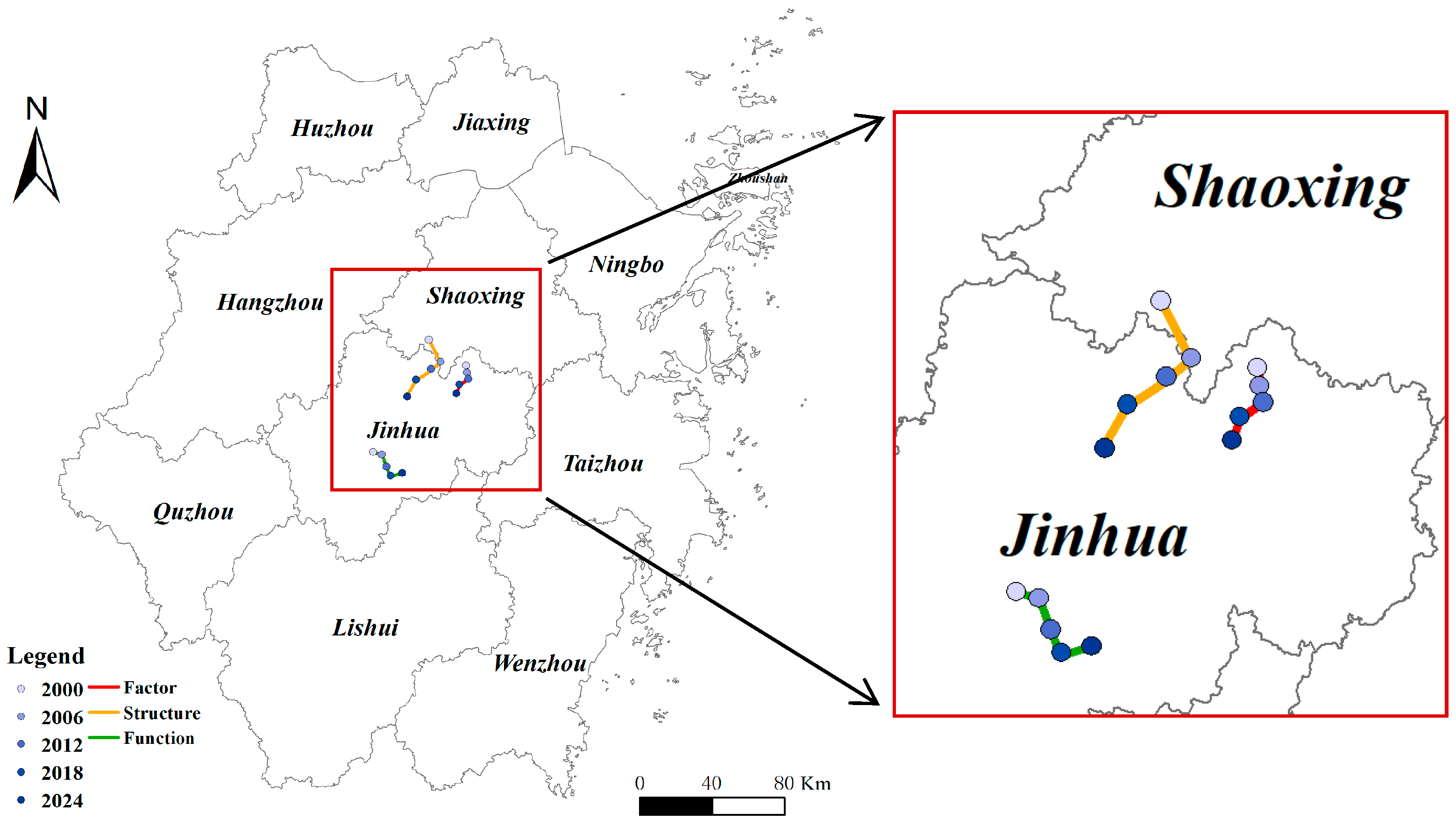
3.4. Changes in the Gravity Center of CLUT
4. Discussion
4.1. Differentiated CLUT Pathways Revealed by the Integrated Framework
4.2. Policy-Relevant Insights from Differentiated CLUT Pathways
4.3. Methodological Contribution of the Proposed Framework
4.4. Limitations and Future Prospects
5. Conclusions
Author Contributions
Funding
Data Availability Statement
Conflicts of Interest
References
- Turner, B.L.; Lambin, E.F.; Reenberg, A. The emergence of land change science for global environmental change and sustainability. Proc. Natl. Acad. Sci. USA 2007, 104, 20666–20671. [Google Scholar] [CrossRef] [PubMed]
- Lambin, E.F.; Veldkamp, A. Key findings of LUCC on its research questions. Glob. Change Newsl. 2005, 63, 12–14. [Google Scholar]
- Long, H.L. Theorizing land use transitions: A human geography perspective. Habitat. Int. 2022, 128, 102669. [Google Scholar] [CrossRef]
- Chen, X.; Yu, L.; Du, Z.R.; Liu, Z.; Qi, Y.; Liu, T.; Gong, P. Toward sustainable land use in China: A perspective on China’s national land surveys. Land. Use Policy 2022, 123, 106428. [Google Scholar] [CrossRef]
- Mather, A.S. The forest transition. Area 1992, 24, 367–379. [Google Scholar]
- Grainger, A. National land use morphhology: Patterns and possibilities. Geography 1995, 80, 235–246. [Google Scholar] [CrossRef]
- Lambin, E.F.; Meyfroidt, P. Land use transitions: Socio-ecological feedback veersus socio-economic change. Land Use Policy 2010, 27, 108–118. [Google Scholar] [CrossRef]
- Defries, R.S.; Foley, J.A.; Asner, G.P. Land-use choices: Balancing human needs and ecosystem function. Front. Ecol. Environ. 2004, 2, 249–257. [Google Scholar] [CrossRef]
- Sun, X.Q.; Xiang, P.C.; Cong, K.X. Research on early warning and control measures for arable land resource security. Land Use Policy 2023, 128, 106601. [Google Scholar] [CrossRef]
- Verburg, P.H.; Crossman, N.; Ellis, E.C.; Heinimann, A.; Hostert, P.; Mertz, O.; Nagendra, H.; Sikor, T.; Karl-Heinz, E.; Golubiewski, N. Land system science and sustainable development of the earth system: A global land project perspective. Anthropocene 2015, 12, 29–41. [Google Scholar] [CrossRef]
- Liu, J.; Jin, X.B.; Xu, W.Y.; Zhou, Y.K. Evolution of cultivated land fragmentation and its driving mechanism in rural development: A case study of Jiangsu Province. J. Rural. Stud. 2022, 91, 58–72. [Google Scholar] [CrossRef]
- Pang, X.F.; Xie, B.G.; Lu, R.C.; Zhang, X.M.; Xie, J.; Wei, S.Y. Spatial–Temporal Differentiation and Driving Factors of Cultivated Land Use Transition in Sino–Vietnamese Border Areas. Land 2024, 13, 165. [Google Scholar] [CrossRef]
- Yuan, X.F.; Shao, Y.J.; Li, Y.H.; Liu, Y.S.; Wang, Y.S.; Wei, X.D.; Wang, X.F.; Zhao, Y.H. Cultivated land quality improvement to promote revitalization of sandy rural areas along the great wall in Northern Shaanxi Province, China. J. Rural. Stud. 2022, 93, 367–374. [Google Scholar] [CrossRef]
- Lv, T.; Fu, S.; Zhang, X.; Wu, G.; Hu, H.; Tian, J. Assessing Cultivated Land–Use Transition in the Major Grain-Producing Areas of China Based on an Integrated Framework. Land 2022, 11, 1622. [Google Scholar] [CrossRef]
- Qiang, W.; Liu, A.; Cheng, S.; Kastner, T.; Xie, G. Agricultural trade and virtual land use: The case of China’s crop trade. Land Use Policy 2013, 33, 141–150. [Google Scholar] [CrossRef]
- Long, H.L.; Qu, Y. Land use transitions and land management: A mutual feedback perspective. Land Use Policy 2018, 74, 111–120. [Google Scholar] [CrossRef]
- Niu, W.H.; Wang, H.Y.; Luo, L.; Shi, Y.; Sui, Y.F.; Wu, L.; Zhang, B.B.; Yu, Q. Spatiotemporal impact of cultivated land use transition on grain production: Perspective of interaction between dominant and recessive transitions. Environ. Impact Assess. Rev. 2026, 117, 108170. [Google Scholar] [CrossRef]
- Qu, Y.; Zhan, L.; Wei, C.; Zhang, Q.; Wang, J. Interactive transition of cultivated land and construction land during china’s urbanization: A coordinated analytical framework of explicit and implicit forms. Land Use Policy 2024, 138, 107049. [Google Scholar] [CrossRef]
- Fu, F.; Deng, S.; Wu, D.; Liu, W.; Bai, Z. Research on the spatiotemporal evolution of land use landscape pattern in a county area based on CA-Markov model. Sustain. Cities Soc. 2022, 80, 103760. [Google Scholar] [CrossRef]
- Ma, H. Spatiotemporal analysis of land use changes and their trade-offs on the northern slope of the Tianshan Mountains, China. Front. Ecol. Evol. 2022, 10, 1016774. [Google Scholar] [CrossRef]
- Lu, H.; Xie, H.; He, Y.; Wu, Z.; Zhang, X. Assessing the impacts of land fragmentation and plot size on yields and costs: A translog production model and cost function approach. Agric. Syst. 2018, 161, 81–88. [Google Scholar] [CrossRef]
- Jiang, H.; Sun, Z.; Guo, H.; Weng, Q.; Du, W.; Xing, Q.; Cai, G. An assessment of urbanization sustainability in China between 1990 and 2015 using land use efficiency indicators. Npj Urban Sustain. 2021, 1, 34. [Google Scholar] [CrossRef]
- Tan, S.; Liu, Q.; Han, S. Spatial-temporal evolution of coupling relationship between land development intensity and resources environment carrying capacity in China. J. Environ. Manag. 2022, 301, 113778. [Google Scholar] [CrossRef]
- Niu, X.; Liao, F.; Liu, Z.; Wu, G. Spatial–Temporal Characteristics and Driving Mechanisms of Land–Use Transition from the Perspective of Urban–Rural Transformation Development: A Case Study of the Yangtze River Delta. Land 2022, 11, 631. [Google Scholar] [CrossRef]
- Chen, Z.; Li, X.; Xia, X. Temporal-spatial pattern and driving factors of cultivated land use transition at country level in Shaanxi province, China. Environ. Monit. Assess. 2022, 194, 365. [Google Scholar] [CrossRef]
- Hiironen, J.; Riekkinen, K. Agricultural impacts and profitability of land consolidations. Land Use Policy 2016, 55, 309–317. [Google Scholar] [CrossRef]
- Duan, J.K.; Ren, C.C.; Wang, S.T.; Zhang, X.M.; Stefan, R.; Xu, J.M.; Gu, B.J. Consolidation of agricultural land can contribute to agricultural sustainability in China. Nat. Food 2021, 2, 1014–1022. [Google Scholar] [CrossRef] [PubMed]
- Xiang, W.L.; Tan, M.H.; Yang, X.; Li, X.B. The impact of cropland spatial shift on irrigation water use in China. Environ. Impact Assess. Rev. 2022, 97, 106904. [Google Scholar] [CrossRef]
- Zou, Y.; Meng, J.J.; Zhu, L.K.; Han, Z.Y.; Ma, Y.X. Characterizing land use transition in China by accounting for the conflicts underlying land use structure and function. J. Environ. Manag. 2024, 349, 119311. [Google Scholar]
- Song, X.Q.; Wang, X.; Li, X.Y.; Zhang, W.N.; Scheffran, J. Policy-oriented versus market-induced: Factors influencing crop diversity across China. Ecol. Econ. 2021, 190, 107184. [Google Scholar] [CrossRef]
- Ke, X.L.; Chen, J.; Zuo, C.C.; Wang, X.Q. The cropland intensive utilisation transition in China: An induced factor substitution perspective. Land. Use Policy 2024, 141, 107128. [Google Scholar] [CrossRef]
- Song, X.Q.; Wu, Z.F. Modelling and mapping trends in grain production growth in China. Outlook Agric. 2013, 42, 255–263. [Google Scholar] [CrossRef]
- Lyu, Y.F.; Wang, M.J.; Zou, Y.N.; Wu, C.F. Mapping trade-offs among urban fringe land use functions to accurately support spatial planning. Sci. Total Environ. 2022, 802, 149915. [Google Scholar] [CrossRef] [PubMed]
- Lyu, Y.; Sheng, L.; Wu, C. Improving land-cover-based expert matrices to quantify the dynamics of ecosystem service supply, demand, and budget: Optimization of weight distribution. Ecol. Indic. 2023, 154, 110515. [Google Scholar] [CrossRef]
- Niu, S.D.; Fang, B.; Cui, C.; Huang, S.H. The spatial-temporal pattern and path of cultivated land use transition from the perspective of rural revitalization: Taking Huaihai Economic Zone as an example. J. Nat. Resour. 2020, 35, 1908–1925. (In Chinese) [Google Scholar] [CrossRef]
- Lichtenberg, E.; Ding, C.R. Assessing farmland protection policy in China. Land Use Policy 2008, 25, 59–68. [Google Scholar] [CrossRef]
- Zhou, Y.; Li, X.; Liu, Y. Cultivated land protection and rational use in China. Land Use Policy 2021, 106, 105454. [Google Scholar] [CrossRef]
- Chen, W.X.; Li, J.F.; Dong, Y.L. Telecoupling effects of requisition-compensation balance on regional grain productivity: Evidence from the Yangtze River Urban Agglomerations. Appl. Geogr. 2025, 168, 103434. [Google Scholar]
- Liu, C.Y.; Song, C.Q.; Ye, S.J. Provincial-level effectiveness of China’s arable land requisition-compensation balance policy, 1999–2019. Land Use Policy 2023, 131, 106733. [Google Scholar] [CrossRef]
- Xu, Y.S.; Zhu, Y.W.; Wu, Y.; Wang, X.L.; Zhang, W.W. The Population Flow under Regional Cooperation of “City-Helps-City”: The Case of Mountain-Sea Project in Zhejiang. Land 2022, 11, 1816. [Google Scholar] [CrossRef]



| Target Layer | Indicator Layer | Sub Indicator | Meaning of Indicator | |
|---|---|---|---|---|
| Production factor inputs | Land utilization | X1: Cultivated land Area (10,000 hm2) | The total area of cultivated land used for growing crops | 0.10 |
| X2: Cultivated land multiple cropping index (%) | The ratio of the total sown area of crops to the total area of cultivated land, used to reflect the degree of utilization of cultivated land | 0.04 | ||
| Agricultural inputs | X3: Agricultural laborers (10,000 people) | The number of laborers engaged in agricultural production | 0.06 | |
| X4: Fertilizer consumption (10,000 tons) | The total amount of fertilizer used in agricultural operations to increase crop yield | 0.06 | ||
| Technological advancement | X5: Power of agricultural machinery (10,000 kilowatts) | The power sum of various machinery used in agricultural production | 0.08 | |
| Agricultural output structure | Output value structure | X6: Output value structure of the planting industry (%) | The proportion of the output value of the planting industry in the agricultural industry | 0.10 |
| Planting structure | X7: The diversity of cultivated land planting (%) | The ratio of the cultivated land area for cash crops to that for food crops | 0.12 | |
| Management structure | X8: Per capita cultivated land management area (persons per mu) | Reflecting the average area of cultivated land operated and managed per agricultural workforce | 0.10 | |
| Cultivated land function | Social function | X9: Ensuring food security (%) | The grain output/(permanent population × 400 kg) that reflects the function of cultivated land in ensuring grain security | 0.10 |
| X10: Stabilizing rural income (%) | The ratio of per capita added value of crop farming in rural areas to per capita net income of rural residents reflects the function of cultivated land in ensuring economic livelihood | 0.06 | ||
| Economic function | X11: Total output value of the planting industry (CNY 100 million) | The total value of planting industry in monetary terms in one year | 0.12 | |
| Ecological function | X12: NDVI value | Indicating vegetation coverage on cultivated land | 0.06 |
Disclaimer/Publisher’s Note: The statements, opinions and data contained in all publications are solely those of the individual author(s) and contributor(s) and not of MDPI and/or the editor(s). MDPI and/or the editor(s) disclaim responsibility for any injury to people or property resulting from any ideas, methods, instructions or products referred to in the content. |
© 2025 by the authors. Licensee MDPI, Basel, Switzerland. This article is an open access article distributed under the terms and conditions of the Creative Commons Attribution (CC BY) license.
Share and Cite
Lyu, Y.; Zhao, S.; Qiu, Z.; Wang, M.; Wu, C. The Spatio-Temporal Process of Regional Cultivated Land Use Transition: An Integrated Framework of “Factor-Structure-Function”. Land 2026, 15, 68. https://doi.org/10.3390/land15010068
Lyu Y, Zhao S, Qiu Z, Wang M, Wu C. The Spatio-Temporal Process of Regional Cultivated Land Use Transition: An Integrated Framework of “Factor-Structure-Function”. Land. 2026; 15(1):68. https://doi.org/10.3390/land15010068
Chicago/Turabian StyleLyu, Yuefeng, Songnian Zhao, Zilu Qiu, Mengjing Wang, and Cifang Wu. 2026. "The Spatio-Temporal Process of Regional Cultivated Land Use Transition: An Integrated Framework of “Factor-Structure-Function”" Land 15, no. 1: 68. https://doi.org/10.3390/land15010068
APA StyleLyu, Y., Zhao, S., Qiu, Z., Wang, M., & Wu, C. (2026). The Spatio-Temporal Process of Regional Cultivated Land Use Transition: An Integrated Framework of “Factor-Structure-Function”. Land, 15(1), 68. https://doi.org/10.3390/land15010068