Article

Industrial Exaptation: Mono-Functional Industrial Relics and Their Capacity for Adaptive Multi-Performative Reinvention, a Case Study Analysis


New York Institute of Technology, School of Architecture and Design, New York, NY 10023, USA
Land 2025, 14(12), 2316; https://doi.org/10.3390/land14122316
Submission received: 29 September 2025 / Revised: 14 November 2025 / Accepted: 18 November 2025 / Published: 25 November 2025

Abstract

This paper examines the adaptive design potential and post-industrial transformation possibilities of decommissioned mono-functional infrastructures (built to serve a single-use purpose) as fertile grounds for industrial exaptation, rather than as obsolete structures from the 20th century industrial age. It develops a typological framework, organized by industrial process, to interrogate these structures and outlines a blueprint for their possible adaptive transformations. Through select global case studies, it proposes how industrial exaptation should move beyond just cultural spectacle to support multi-performative adaptive uses: from productive economies, new forms of industry, and domestic occupations, to ecological remediation strategies and climate-responsive adaptations. Rather than treating these forms as nostalgic artifacts, the paper argues for a paradigm shift: reclaiming industrial infrastructure under the domain of the design disciplines and reframing industrial exaptation as an urban, environmental, and civic project. Through this framework, these post-industrial forms are recast as evolutionary palimpsests—spatial templates for reimagining more sustainable futures in the age of the Anthropocene.

1. Introduction & Framework

1.1. Context and Research Questions

Throughout the past few centuries, global industrialization through the rise in non-renewable fossil-fuel-based industries greatly transformed our metropolitan landscapes. Through carbon-intensive extraction of planetary resources (from coal, oil & gas, to minerals & ores), dependencies on these industries for economy, energy, and engines of urbanization produced large-scale sites of extraction, manufacturing, processing, and storage in and around cities [1]. These industrial processes often resulted in the construction of monolithic architectural forms and massive building structures required to house them. Defined as “mono-functional” infrastructures—or infrastructures that were specifically designed to serve a single-use or purpose—examples of these 20th century resource-dependent industrial forms range from grain silos, power & peaker plants, refineries & factories, to reservoirs & quarries amongst others. Specifically and functionally built to facilitate the industry-based processes that occurred within, these architectures have left an indelible cultural and historic mark on our cities and those who had to contend with the externalities they levied on the built environment [2].
As cities transition away from fossil-fuel-based industries in the 21st century and beyond, these mono-functional forms—many of which have seen their use become obsolete, leaving them defunct and decommissioned in the interim—still remain, sprinkled around our urban landscape, architectural remnants of a past era and age of urbanization no longer. Many are worth preserving not only due to their historical significance, but also for the extensive embodied carbon already expended in their construction. Beyond these factors, the high financial and environmental costs of demolition, along with the urban disruption it causes, often make retention a viable option [3]. In addition, reusing existing structures can sometimes accelerate project delivery and reduce time-to-occupancy compared to new construction [4]. Industrial buildings also contain robust structural frameworks built for large-scale machinery that frequently exceed human capacity loads, enabling them to easily accommodate reprogramming without too much modification. Finally, certain heritage protections, regulatory incentives, and zoning overlays can further support the rationale for reuse, situating these sites within both urban policy and sustainability imperatives [5].
In confronting the dual crises of climate change and material resource depletion, these mono-functional infrastructures and mono-form architectures are ripe for reinvention today. Their often rigid, purpose-built spatial forms present unique design challenges but also radical opportunities for post-industrial exaptation—the process of repurposing structures for uses beyond their original intent. This raises key research questions that will be examined in this paper. What common spatial and structural logics define mono-functional industrial infrastructures across categories of extraction, production, storage, and treatment, and how can these logics serve as a comparative basis for their adaptive reuse? How might a typological-process framework sharpen our understanding of industrial exaptation, moving beyond anecdotal projects toward a systematic categorization of industrial forms and their potentials for climate adaptation? What post-Fordist inhabitation patterns, programmatic shifts, and new interior worlds can be reimagined for these industrial relics? How can a cross-case analysis of these typologies reveal transferable strategies that address broader ecological, climatic, and socio-urban challenges, from carbon accounting to coastal resiliency and heritage preservation? And finally, how can their adaptive reuse address broader post-industrial evolution and environmental resilience goals facing cities writ large? This paper explores these issues, framing industrial exaptation as a critical spatial, environmental, and cultural project for contemporary cities while foregrounding lesser-examined yet highly instructive case studies that challenge conventional approaches to industrial reuse.

1.2. Research Framework and Structure

Methodologically, the paper’s argument unfolds through the following structure. First, it defines “mono-functionality” within the current research context of adaptive reuse literature and builds a case for the relevance of this under-explored building stock as pivotal assets, particularly in the face of contemporary issues faced by post-industrial cities. Second, the paper identifies the various contemporary challenges that have complicated industrial adaptation efforts, including heritage trade-offs, carbon and lifecycle accounting, and the socio-political dimensions of reuse. Third, the paper introduces a typological-process taxonomy for understanding and analyzing industrial infrastructures, grouping these processes into four categories—extraction, production, storage, and treatment—and linking each to characteristic building typologies that share common traits for spatial and environmental adaptation to allow them to be studied comparatively across contexts rather than as isolated anomalies. Fourthly, it applies a comparative case study methodology, analyzing representative precedents from each category to test the viability, opportunities, and challenges of real-world industrial exaptations.
The case study methodology is deployed as a tool of research inquiry in order to draw transferable lessons that demonstrate the feasibility, diversity, and potential for new multi-performative uses not typically addressed in the field of adaptive reuse, and that can inform their wider implementation into other sites across diverse contexts. It also provides a framework for evaluating preservation versus demolition trade-offs, drawing on archival documentation and post-occupancy critiques to situate the successes and challenges of these projects between heritage protection, carbon accounting, and sustainability tradeoffs.
Rather than subscribing to statistical representativeness, the methodological validity of this approach lies in analytical generalization [6]. By mobilizing case studies as probes, the analysis synthesizes insights from precedents into broader conceptual frameworks, advancing industrial exaptation as a socio-ecological design strategy. In this sense, the paper’s structure doubles as its method: moving from definition and challenges, to typological classification, then to case-study-based evaluation, and ultimately to transferable strategies that inform both scholarship and practice for post-industrial urban futures.
The paper’s conclusion distills these findings into several major themes and lessons for industrial exaptation and its role in the future of cities. Taken together, they advance current paradigms of adaptive reuse research by foregrounding a building category inventory long neglected by design discourse and disciplinary agendas. Where prior studies have treated this legacy building stock as infrastructural remnants and urban detritus, this paper instead asserts their critical potential as active agents for environmental adaptation, long-term urban regeneration, and new disciplinary design territory in the age of the Anthropocene.

2. A Case for Mono-Functional Industrial Exaptation

2.1. Defining Mono-Functionality

This paper builds on the current growing body of research and design work focused on adaptive reuse and the circular economy, but it distinguishes itself by centering on mono-functionality, a term that underscores the spatial and environmental singularities embedded in legacy industrial infrastructures. By mono-function, this paper refers to buildings or complexes conceived for a single, highly specialized industrial process, often at an infrastructural scale, with limited human occupation and spatial or programmatic flexibility [2].
Unlike architectures designed for flexible human occupation, mono-functional infrastructures were conceived with a single operational logic in mind, engineered for economic efficiency rather than human inhabitation or spatial adaptability. Their distinctive structural configurations, specialized enclosures, and heavy-duty material assemblies were the result of physical manifestations of internal industrial processes. Idiosyncratic building typologies like grain silos, power plants, oil refineries, water and waste treatment facilities, quarries, reservoirs, and dams, amongst others, all exemplify these mono-industrial spatial characteristics. These are the infrastructures of industrial modernity, buildings that have historically been ceded by the architectural design disciplines to the realms of engineering and industrial technology. Conceived primarily as technological instruments, these buildings were therefore designed for process optimization, economic throughput and maximal industrial output rather than for civic occupation, public accessibility, or social programming. While such infrastructures were indispensable to the functioning of cities in past eras, their design was never intended to foster social life; instead, they often severed themselves from cities, operating as inward-facing, closed systems that supported utility but excluded collective social engagement [7]. As a result, they have long been treated in architectural research and historical surveys as utilities to be hidden or ignored, rather than as potential spatial and social catalysts within contemporary and future evolving urban ecologies.
This definition distinguishes mono-functional infrastructures from the more commonly studied adaptive reuse of multi-use heritage structures that were often designed with multiple layers of human occupation, aesthetic value, and designated historic significance [8]. By contrast, industrial complexes were rarely conceived with multi-functionality or cultural symbolism as primary considerations. In fact, generally multi-functional industrial infrastructures simply do not exist. The closest analogues may be warehouses or factory halls, whose open floorplates, flexible spans, and modular construction systems allow a certain degree of spatial adaptability. Yet even these spaces were engineered primarily for production efficiency, rather than for accommodating diverse human-oriented uses. Against this backdrop, the paper’s narrower focus on mono-functionality highlights one of the most technically demanding and underexplored categories of adaptive reuse.
Among mono-functional infrastructures themselves, there is considerable variety. They encompass typologies across multiple industrial processes from extraction and resource acquisition (quarries, mines, reservoirs), production and manufacturing (power plants, refineries, steel mills), storage and processing (grain elevators, oil tanks, gasometers), and treatment and disposal (recycling, incineration, sewage and wastewater facilities), processes which are analyzed further in later sections. While this paper does not claim to address every instance of mono-functional industrial buildings, it instead employs a typological-process framework to strategically select representative cases, each aligned with a respective industrial process category that collectively illustrate the broader spectrum of challenges and opportunities posed by these categories of buildings.

2.2. Contemporary Literature and Research Gaps

This deliberate focus on mono-functionality responds to a gap in both scholarship and practice. Much of the literature on adaptive reuse has concentrated on civic, residential, religious, institutional, or heritage structures—buildings whose cultural or aesthetic value has long been legible to preservationists, designers, and the public, and whose spatial configurations already lend themselves to adaptive programming [8,9,10]. Existing scholarship has examined industrial reuse largely through lenses of heritage conservation [11], industrial archaeology [2], or urban regeneration policy [12]. However, most of this work focuses on the preservation of industrial landmarks or the restoration of historic industrial shells. Scholars such as High and Lewis have noted that the social histories of labor and production embodied in industrial forms remain undertheorized in design fields [7], while Storm highlights the potential spatial agency of industrial ruins as catalysts for urban transformation [13].
Building on these critiques, recent scholarship has sought to broaden the conceptual lens of adaptive reuse by embedding heritage within wider sustainability and urban agendas. The UNESCO Recommendation on the Historic Urban Landscape marked an important shift in this regard [5], advocating for a holistic, landscape-based approach that integrates cultural heritage and the broader discourse on adaptive reuse with urban development, climate resiliency, and ecological systems, which will be discussed further in the next section. Rather than isolating monuments or districts, the HUL framework situates heritage within dynamic urban systems, encouraging tools such as community participation, regulatory alignment, and ecological integration [5].
While this paper builds on such critical discourse, it also extends it further by applying the HUL approach to a category long marginalized in both scholarship and practice: mono-functional industrial infrastructures. Unlike heritage centers traditionally considered under prior adaptive reuse research, mono-functional infrastructures are often excluded from design discourse due to their scale, logistical complexity, environmental constraints, stigmatized associations with waste, toxicity, and heavy industry, and overall perceived lack of aesthetic and social value. Yet it is precisely these conditions that render them both the most difficult and the most provocative sites for exaptation, demanding new conceptual, typological, and methodological approaches [9]. This paper extends these discussions by theorizing mono-functionality itself as a design problem: how do we reimagine structures whose extreme technical specificity renders them resistant to reuse, yet whose scale and materiality position them as critical resources for sustainable futures? This research framing makes them both technically challenging but therefore also conceptually provocative sites now for reinvention and transformation.

2.3. Mono-Functional Exaptation as a Design Opportunity

It is here that the concept of architectural exaptation becomes critical. Borrowed from evolutionary biology, where Gould and Vrba (1982) first introduced the term to describe traits that evolve functions different from those for which they originally developed, exaptation has since been extended into architectural discourse [14]. Within design fields, exaptation refers to the process by which built structures acquire new functions unrelated to their original purpose. Scholars such as Alessandro Melis, Telmo Pievani, and José Antonio Lara-Hernandez, in their book Architectural Exaptation: When Function Follows Form, expand this definition to argue that exaptation is not merely a pragmatic act of repurposing but a creative, ecological, and political opportunity for reimagining the latent capacity of built forms to perform new environmental and social roles [15]. This conceptual framing situates adaptive reuse not only as a technical practice but as a broader theoretical project that foregrounds the evolving relationship between form, function, and context.
Within the context of this article, this framework of exaptation is applied to mono-functional industrial infrastructures, denoting forms of reuse where mono-functional industrial structure’s original process-determined spatial logic is leveraged, re-coded, or hybridized to support functions non-derivative of the original process, and where urban & environmental adaptation become integral design drivers of their transformation. Industrial exaptation therefore entails process-specific spatial adaptation to address contemporary socio-environmental issues, enabled by function–form non-isomorphism in which function follows inherited form but is not constrained by it.
Building upon this framing, this paper argues that mono-functional industrial architectures, precisely because of their specificity, offer an extraordinary design provocation to be recast as critical urban assets and resources in light of the contemporary climate crisis and the need for adaptive urban reinvention facing cities today. This argument for mono-functional industrial exaptation rests on several points anchored upon environmental necessity and socio-urban opportunity.
Firstly, many of these structures are worth preserving for their historical significance, not because they have been deemed aesthetically noteworthy or architecturally momentous by historians—as most have in fact not been designated as such—but because they serve as an enduring marker of an industrial era that shaped the cultural and economic identity of cities writ large. Their monumental forms, having become iconic silhouettes on city skylines, carry a collective memory of industrial labor, production, and technological advancement [1,13,16]. This makes them valuable cultural artifacts not as a misguided 20th century nostalgia for a bygone era of industrial pollution and environmental degradation, but as enduring reminders of the vast ecological destruction that can be wrought by human industries and their economies of scale [13]. In effect, they serve as cautionary monuments that urge a more responsible approach to 21st century urbanization and its environmental ethics.
Secondly, the sheer extent of territory occupied by industrial buildings sited on industrial-zoned land makes their possible transformation particularly consequential in cities. While this paper focuses specifically on the transformation potential of mono-functional industrial buildings, it is important to recognize that these structures rarely exist in isolation. Owing to economies of scale and the efficiencies of industrial clustering and interrelated industrial processes, they are frequently concentrated in close proximity, collectively shaping extensive industrial zones within the urban and peri-urban fabric. Their impact therefore extends beyond individual building footprints to entire districts where industrial land and architecture are interwoven and co-dependent [17]. While defining a precise global percentage of urban land dedicated to industrial buildings and industrial land use is challenging due to competing definitions and city-to-city variance, it is estimated that this percentage ranges from 5% in some cities to up to 25% in others [18,19]. When read at this territorial scale, building-scale transformations can move beyond singular architectural conversions or iconic one-off projects towards a blueprint for systematic post-industrial redevelopment. Recasting these sites as integral towards an accumulated urbanistic strategy positions industrial exaptation as a tool for advancing multi-scalar spatial, ecological, and economic regeneration across entire post-industrial districts.
Thirdly, the sheer scale, specificity, and monumental nature of industrial buildings and complexes position them as uniquely suited for ambitious programmatic transformations and forms of urban life that smaller, conventional adaptive reuse buildings cannot as easily accommodate [10]. The very characteristics that rendered these buildings mono-functional in their original context (oversized floor plates, long-span structures, high-load-bearing capacities, etc.) make them ideal candidates for rescripting to support new experimental industries or socially and ecologically driven programs. These could range from more flexible community hubs, mixed-civic uses, or landscape-driven ecological remediation that demand such scales, to more specialized new forms of Industry 4.01 like creative manufacturing, or residential uses that demand such specificities. The diverse range of these possible new multi-purpose adaptations are explored in Section 7 of this paper. Rather than being seen as spatial liabilities, their oversized industrial shells should be recognized as rare urban assets capable of hosting multi-performative programs that address next-generation social and environmental imperatives in a post-industrial urban future.
Lastly, and perhaps most critically, the environmental argument for industrial exaptation remains one of its most potent. Issues of carbon accounting, coastal resiliency, material adaptation, and climate change position these structures as essential components in a broader strategy for sustainable 21st century urban transformation and an attitude towards adaptive redevelopment. This environmental dimension warrants closer examination, which the following section addresses in greater detail.

3. Carbon, Coastal Resiliency, and Climate Change

The environmental argument for industrial exaptation is perhaps its most urgent and compelling dimension. Beyond the obvious need to move away from designing for and housing polluting, carbon-intensive, non-renewable fossil-fuel consumptive, and industrial uses of the 20th century, this paper argues for a new adaptive blueprint for these structures, one that reframes them as critical assets within the context of global climate change.

3.1. Carbon Accounting

At the core of this argument is embodied carbon2. In an era defined by vast expenditure of carbon in new construction, demolishing and replacing these massive infrastructures represents a double ecological cost: first, through the carbon-expending destruction of existing material stock, and second, through the carbon-intensive processes required to produce and assemble new building systems. As many sustainability scholars have argued, the most climate-responsible building is often the one that already exists [20]. By giving new leases on life to these robust industrial shells and their already expended embodied carbon, cities can significantly reduce the carbon footprint of redevelopment while contributing to a circular urban economy.
While it is generally true that adaptive reuse consumes less carbon than new construction, the notion that it is inherently and always carbon reductive is far more nuanced. Although embodied carbon2—which constitutes a significant percentage of a building’s total carbon footprint—is preserved through reuse, a comprehensive life-cycle assessment is necessary to evaluate whether the combined carbon cost of existing embodied carbon and new retrofitting interventions ultimately yields a lower overall carbon footprint than full-scale demolition and replacement construction [21,22].
Beyond embodied energy, operational carbon3 must also be carefully considered, as retrofitting large-scale industrial shells can substantially increase it if extensive mechanical systems are required to ensure habitability or maintain climate control [23]. For instance, active heating and cooling systems for massive volumes originally designed for industrial production may negate some of the carbon savings from preserving existing structures. Thus, the carbon calculus of industrial exaptation depends heavily on programmatic choice, retrofitting strategies, and long-term energy performance that can often be a challenge to holistically evaluate. This complexity creates an opportunity for innovative life-cycle assessments, passive environmental design strategies that don’t consume operational carbon, and the use of carbon-sequestering materials in retrofits that can collectively respond to the unique thermal and structural characteristics of industrial forms [22,23]. Industrial exaptation projects must therefore balance the preservation of embodied carbon with strategies to minimize operational carbon over the building’s future lifecycle.

3.2. Coastal Resiliency and Climate Adaptation

Furthermore, the environmental case for industrial exaptation extends beyond carbon to include urgent issues of climate adaptation and coastal resiliency. By these terms, coastal resiliency can be understood as the capacity of coastal urban and ecological systems to absorb climate-driven disturbances such as flooding, storm surges, and sea-level rise while maintaining essential functions through adaptive and flexible strategies. Similarly, climate adaptation refers to the process of strategically adjusting ecological, infrastructural, and social systems to reduce vulnerabilities and enhance their long-term ability to cope with evolving climate impacts [24].
Historically, many mono-functional industries were sited along city coastlines, with industrial zones intentionally developed and strategically positioned to leverage shipping economies, water-based transport, and industrial cooling processes. Water-based transport and shipping economies were essential to 19th and early 20th century industries, as bulk raw materials such as coal, grain, ore, and oil were far too heavy and voluminous to be transported efficiently by early rail or road systems [25]. Proximity to ports, navigable rivers, and shipping docks allowed for direct import of raw materials and export of processed goods, significantly reducing costs and enabling industries to operate at larger scales. Grain silos, oil refineries, power plants, and manufacturing facilities clustered along waterfronts for precisely this reason, forming some of the earliest industrial districts in port cities worldwide [26].
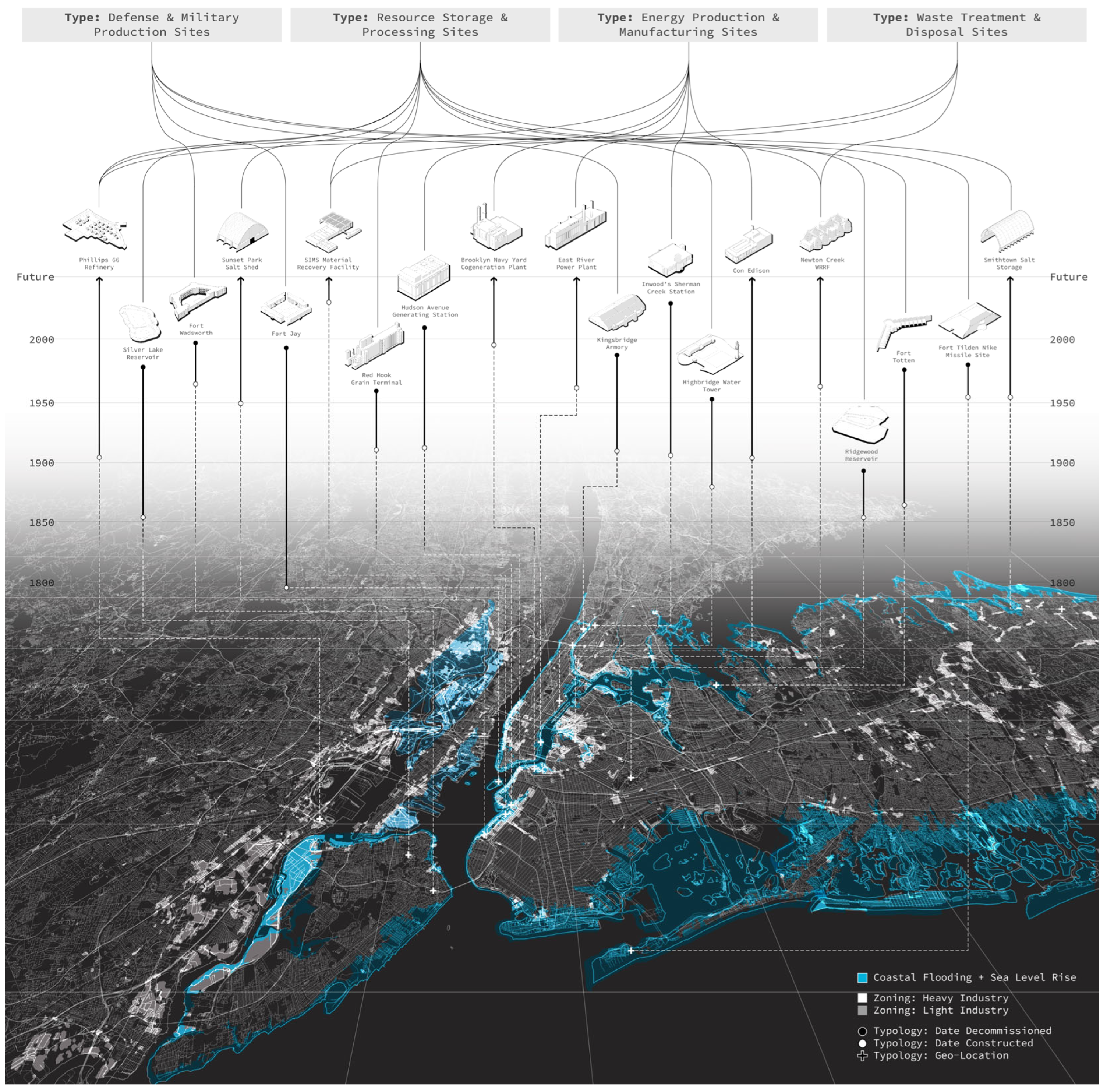
Beyond transport logistics, industrial cooling processes also demanded coastal or riverine proximity. Large-scale power generation plants, refineries, and manufacturing complexes required vast quantities of water to regulate heat from turbines, condensers, and other high-energy machinery. Coastal and riverfront sites provided a near-limitless supply of cooling water, which could be circulated through plant systems and discharged back into the water body—a practice that was dually extremely environmentally harmful yet was central to maintaining industrial productivity [26,27]. This reliance on abundant, accessible water sources entrenched a spatial logic of industrial coastalization, concentrating mono-functional infrastructures along urban shorelines [27], as exhibited in Figure 1’s cartographic mapping based on the city of New York.
Today, these waterfront locations, once economically advantageous, now place these structures on the frontlines of climate vulnerability. As sea-level rise, storm surges, and tidal flooding increasingly threaten urban shorelines, these structures pose both a risk and an opportunity: a risk in terms of structural and environmental exposure, and an opportunity for reimagining resilient coastal architecture [29,30].
Rather than abandoning or demolishing these vulnerable structures, this paper proposes rethinking them as critical components of resilient coastal infrastructure for a new urban-environmental age. Their massive shells, thick envelopes, and expansive footprints have the potential to be adapted not only for new use, but for new climates—retrofitted with materials, forms, and spatial logics designed to absorb, buffer, or otherwise adapt to changing hydrological forces. Additionally, existing literature on coastal infrastructures highlights how their post-industrial land can be re-scripted as a climate asset: for instance, waterfront brownfield sites retrofitted as stormwater retention basins and ecological parks [31], or flood-prone industrial zones transformed into hybrid protective and civic landscapes, such as the HafenCity flood-protected districts in Hamburg [32]. Such a reframing aligns with a growing body of scholarship on resilient urban design and the adaptive reuse of waterfronts writ large, where these urbanized coastal zones are increasingly conceptualized as ecological assets. For instance, Ahern advances the notion of ecosystem services within urban design, arguing that infrastructural sites can be strategically reconfigured to deliver climate adaptation benefits such as flood protection, biodiversity enhancement, and water purification [24]. New retrofitted climate adaptive programs could address hydrological resiliency, ranging from vertical wetlands4 and aquaponic systems [33], while retrofitting structures to double as flood barriers, stormwater retention/management systems, or blue–green infrastructures. Hybridized with multi-performative programs like flood-resilient housing, hydrological energy production, water filtration, or climate research centers, these exapted structures could shift from being passive environmental liabilities to active agents in climate adaptation.
Beyond introducing climate adaptive programs, the inherited infrastructural and spatial logics of industrial buildings can also be considered as assets for climate adaptability, leveraging the geometries of past industrial processes for passive climate strategies. Typological traits common to industry, for example, massive shells and thick envelopes, can provide thermal inertia that damps diurnal heat flux and support low-energy, passive cooling strategies. Other inherited spatial volumes like tall turbine halls and vertical process voids can enable buoyancy-driven stack ventilation and cross-sectional purging, whereas compartmentalized tanks and pressure-rated drums can host new environmental uses from water detention and grey-water reuse during surge events. In parallel, internal robust long-span grids and overspecified roof structures typical of industrial buildings can be leveraged to support blue–green systems such as wetlands, cisterns, and intensive planting. At a landscape scale, terraced extraction landforms can be deployed as stepped basins that slow, store, and re-route pluvial and coastal flows. Reinterpreted through this lens, the internal industrial processes of production (span and void), storage (containment and sealing), treatment (sequencing and compartmentation), and extraction (grading and terracing) can uniquely translate into climate-adaptive functions: surge buffering, water storage and reuse, passive ventilation and cooling, and resilient compartmentalization. This coupling of inherited industrial spatial logics to new climate-adapted functions distinguishes industrial exaptation from generic retrofits, positioning these forms as ready-made infrastructures for coastal and hydrological adaptation rather than merely as shells awaiting new programs.
By doing so, this paper positions mono-functional industrial exaptation not simply as an important architectural exercise, but as a necessary strategy for climate-conscious urban futures. By leveraging their scale, material robustness, typological commonalities, and waterfront positioning, these structures once symbols of environmental degradation can now be re-scripted as active agents of ecological repair and climate resiliency.

4. Current Challenges to Industrial Exaptation

While this paper has so far argued that industrial exaptation holds significant potential, its realization is far from straightforward. The process faces substantial technical, economic, environmental, and disciplinary challenges that complicate its execution and help explain why such adaptations have not yet been widely implemented. However, rather than viewing these issues solely as obstacles, they should be understood as critical considerations—points of intervention that, if addressed creatively, can become opportunities for innovation.

4.1. Contamination and Toxicity

Many industrial sites are classified as brownfields, defined by the presence of environmental contamination that complicates redevelopment. While not all industrial sites are considered brownfields, many are due to their history of handling hazardous materials in manufacturing, chemical processing, or waste disposal, leading to soil, groundwater, and even structural contamination from heavy metals, hydrocarbons, and other industrial pollutants [34,35]. Cleaning and remediating these toxic legacies often require extensive decontamination processes, ranging from soil excavation and chemical treatment to groundwater purification, which can be both costly and time-intensive. This environmental remediation is both a regulatory requirement and also an ethical imperative to ensure public safety and ecological health. While toxicity—and the economic investment needed to address it for redevelopment—is often one of the biggest barriers to industrial exaptation, this challenge is also an opportunity to test innovation in phytoremediation, low-carbon cleanup technologies, and environmental design strategies that can turn these sites into living laboratories for ecological regeneration [36].

4.2. Scale, Complexity, and Specificity

The very qualities that make industrial infrastructures spatially provocative—their massive scale, mono-functional layouts, and specialized structural systems—can also pose significant challenges for adaptive reuse. Long-span trusses, heavy-load structural grids, or siloed vertical volumes were engineered for highly specific industrial processes and can be difficult to adapt to new human-centered programs without substantial structural intervention [13]. Introducing daylight, circulation, or habitable micro-climates into these large, enclosed shells often requires extensive retrofitting, which can undermine both the cost-effectiveness and carbon rationale of adaptive reuse. Moreover, the scale of many of these sites can extend beyond individual buildings, encompassing entire industrial districts whose urban integration demands coordinated territorial planning. However, these same characteristics present a unique design opportunity: as platforms for experimental spatial configurations, large-scale public programs, or specialized new industries or district infrastructures at-scale that conventional buildings or complexes cannot accommodate so readily.

4.3. Economics

Economic feasibility remains one of the greatest barriers to industrial exaptation. Adaptive reuse of large industrial structures frequently involves significant upfront costs: structural reinforcement, contamination remediation, infrastructural upgrades, and programmatic retrofitting all require substantial capital investment. Unlike new construction, which benefits from standardized building systems and predictable cost models, industrial exaptation often entails bespoke solutions tailored to each unique structure [10]. Furthermore, market demand for certain adaptive reuse programs (such as cultural institutions or experimental ecological infrastructures) may be limited, making financial returns uncertain without public subsidies, tax incentives, or philanthropic support [37]. However, these economic constraints also open the door for alternative financing models, public–private partnerships, and policy innovation that can shift how value is defined not just in financial terms, but in social, ecological, and spatial returns [38,39].

4.4. Heritage Preservation and Sustainability Tradeoffs

While the retention of existing structures is often celebrated as the most climate-responsible path, the reality of adaptive reuse also inevitably involves careful negotiation between heritage preservation and sustainability imperatives that can complicate industrial reuse. In many instances, portions of industrial complexes are too structurally degraded, contaminated, or technically obsolete to be maintained without significant intervention, necessitating selective demolition and reconstruction [8]. Such compromises complicate the claim that reuse is always inherently more sustainable, highlighting the need to evaluate projects both as heritage preservation efforts and as forms of carbon accounting. This tension underscores the sometimes conflicting and challenging valuations of industrial relics. They function simultaneously as cultural artifacts whose facades carry symbolic value and civic meaning, as material repositories whose conservation avoids carbon-intensive replacement, and in some cases as liabilities where demolition is justified if the pursuit of long-term operational efficiency outweighs the benefits of retaining embodied carbon. When parts of these buildings are removed, it is not only a technical decision but also an act of cultural prioritization: deciding which layers of industrial history merit preservation and which can be sacrificed for optimizing energy and operational performance [40]. At its core, this negotiation is what makes balancing heritage protection and climate responsibility such a central challenge for industrial exaptation.
At the same time, industrial exaptation must be positioned against what some scholars describe as the “zero-strategy”—the choice to leave disused infrastructures to decay in situ, visible in the abandoned factories, quarries, and industrial landscapes of regions such as the Ruhr Valley [41]. However, while this strategy certainly removes any new carbon expenditure, it forfeits opportunities for ecological restoration, civic reintegration, or economic regeneration, and risks allowing heritage assets to collapse into obsolescence.
Against this backdrop, industrial reuse is best understood not as the wholesale preservation of industrial fabric, nor as its total replacement, but as an exciting opportunity and negotiated process of selective conservation, demolition, and transformation—one that weighs embodied carbon, cultural significance, and long-term socio-ecological transformation. Rather than a simple trade-off, this balancing act constitutes a generative design opportunity, compelling the discipline to refine its evaluative frameworks and to reconcile cultural memory with environmental necessity in the pursuit of more resilient and adaptive urban futures.

4.5. Disciplinary Interest and Perceived Value

Lastly, there remains the challenge of disciplinary will. Historically, industrial infrastructures have been largely neglected by the design disciplines for their perceived lack of aesthetic and social value. Their conception, construction, and proliferation were long relegated to the domain of engineers and industrial planners, driven primarily by technological performance and economic efficiency rather than by spatial or cultural ambition. While recent decades have seen notable examples of industrial adaptive reuse, most industrial exaptation efforts have overwhelmingly focused on civic, residential, religious, or heritage buildings—typologies already recognized for their historical or aesthetic significance [11]. This leaves much industrial infrastructure and building stock overlooked.
As a result, many industrial structures remain absent from serious disciplinary discourse as has been discussed previously in Section 2.2, despite their latent potential as urban catalysts [2,7]. Overcoming this bias requires a deliberate reframing: these infrastructures must no longer be seen as inert utilities or relics of environmental degradation but instead as culturally significant and environmentally strategic assets worthy of architectural innovation. Reclaiming these architectures within the purview of design challenges the entrenched disciplinary boundaries that have long separated “infrastructure” (considered typically under the domain of engineers) from “architecture” (considered under the purview of designers). It calls for a reintegration of design agency into infrastructural transformation.
This paper argues for a reclassification of these mono-functional typologies, positioning them not merely as artifacts of obsolete industry but as latent frameworks for public, ecological, and civic engagement with the city. By hybridizing programmatic uses to infuse cultural, social, and environmental value into buildings previously defined solely by technical function, design disciplines can reassert their agency over this neglected building stock and the other disciplines that have been charged with their design. In doing so, industrial exaptation becomes more than just a technical strategy, instead emerging as a disciplinary project that expands the aesthetic and cultural imagination of architecture in the age of climate crisis and cities in post-industrial transition.
This, ultimately, is where the greatest value of this paper’s research lies: in advocating for the disciplinary reclamation of industrial infrastructures as fertile ground for new forms of architectural experimentation, urban life, and environmental resiliency.

5. Functional Logics of Circular Industrial Processes

Understanding the functional logics that shaped industrial infrastructures is crucial for reimagining their future. Industrial buildings were designed with extreme spatial specificity, tightly calibrated to the internal processes of input, transformation, and output that defined their full cycles, operational lives, and economic efficiencies [2]. As a framework for this process-driven logic and for spatial cross-comparison, this section categorizes industrial buildings through the industrial input-output continuum. Each category—Extraction & Resource Acquisition, Production & Manufacturing, Storage & Processing, and Treatment & Disposal—represents a distinct phase of a circularly interconnected industrial system [42]. Within this categorization, spatial commonalities or differentiation indicators ranging from span/void metrics, enclosure/compartmentalization, circulation morphology, envelope mass/thermal enclosure, and eco-technical coupling are spatially unpacked to allow us to systematically understand how adaptable, or resistant, these forms may be to new uses. As surfaced previously, these inherited spatial traits also lend themselves uniquely to be repurposed and translated to address contemporary environmental needs and climate adaptive futures. By understanding industrial processes according to these typological, spatial, functional, and environmental roles, we can better intervene within the constraints and latent potentials embedded in their spatial organizations, offering a systematic framework for exaptation.

5.1. Extraction & Resource Acquisition

The industrial cycle begins with the acquisition and extraction of raw materials, encompassing mining, quarrying, oil and gas extraction, and logging operations. Spatial typologies encompassed by these processes include open-pit mines, terraced quarries, oil fields, offshore rigs, and logging mills, amongst others [42,43]. These infrastructures are typically landscape-scale, defined by vast excavation voids, stepped or terraced cuts, and heavy-duty platforms for machinery staging and movement. In quarries and mines, the spatial framework is often composed of large cuts carved deep into the earth, organized and linked by a terraced circulatory system. In oil fields and rigs, the architectural language is utilitarian and modular, dominated by steel lattice frameworks, cylindrical storage tanks, and linear pipe networks. Logging mills often feature long-span shed structures with open floor plates designed to facilitate the linear processing and sorting of timber.
Across these sites, the scale is primarily horizontal, responding to the specific characteristics of the raw resource itself and the spatial demands of harvesting and storing it on-site [42]. The majority of activity occurs in expansive open-air zones, with structural buildings serving primarily as ancillary infrastructure—offering minimal enclosed volumes compared to the dominant exposed operational landscapes. These inherited geomorphologies lend themselves to possible climate adaptation at the territorial scale, where terraces can be re-graded as stepped detention basins that slow and stage stormwater, reducing peak flows while enabling sediment capture and phytoremediation. Sheer rock faces and heavy earth embankments offer durable edges for surge buffering while deep quarry bowls provide volumetric storage for managed aquifer recharge, vertical wetlands, or seasonal retention. Because circulation in these sites already follows gravity-fed ramps and benches, retrofits can align new blue–green infrastructures with existing gradients, minimizing new earthworks while maximizing storage, conveyance, and compartmentation.

5.2. Production & Manufacturing

Once raw resources are extracted, they are transported to production and manufacturing facilities where raw materials like ore, grain, oil, coal or other fossil fuels are transformed into energy or finished goods. Industrial typologies associated with this phase include coal and oil power plants, hydroelectric dams, chemical or material refineries, steel mills, and assembly line factories, amongst others. These facilities handle the mechanical, chemical, and thermal transformation of raw inputs: burning coal or refining crude oil into energy, smelting ore into steel, or converting harvested agricultural products into processed goods. This transformation often requires sequential stages of crushing, heating, distillation, or assembly, with distinct spatial zones dedicated to each process [42].
Architecturally, these buildings are distinguished by large-span steel or reinforced concrete frames, high-load-bearing floors, and double- or triple-height volumes designed for heavy industrial machinery. Sequential zoning is a defining feature, with clear demarcation between input areas, processing cores, and output or distribution zones. Power plants typically feature turbine halls, boiler rooms, and smokestack systems, while hydroelectric dams integrate monolithic spillways, turbine chambers, and service galleries into their mass. Factories and mills often employ repetitive column grids to accommodate assembly line efficiency and the movement of goods by overhead cranes or conveyors. The spatial logic of this phase is highly linear and process-driven, organized to facilitate the continuous flow of materials from input to output [42]. Their structural robustness and massive internal spans reflect the scale, efficiency, and economy of industrial throughput.
These traits offer possible adaptation to low-energy environmental control and water management, with tall halls and volumes that could support passive cooling strategies, cross-ventilation, and stack venting with clerestories that can also be tuned for controlled daylighting that reduces operational loads. These characteristically low aperture-to-wall ratios and often heavy, thermally massive enclosure systems can damp exterior heat gains and diurnal temperature swings depending on climatic context, creating buffered interior microclimates that reduce peak cooling loads for newly inserted occupancies. Additionally, robust roof structures can possibly bear intensive green roofs, cisterns, or solar arrays without major reinforcement while ground-floor bays can be designed for heavy equipment can be reprogrammed as floodable zones with raised, dry cores, enabling partial inundation to support climate-readiness with minimal reconfiguration.

5.3. Storage & Processing

The outputs and inputs from production and manufacturing processes are often transferred to or from storage and processing facilities, which serve as intermediaries for stabilizing, conditioning, and regulating the movement of raw or processed materials as well as their controlled release into subsequent phases of the industrial cycle. Typologies include grain silos and terminals, gasometers, oil and chemical storage terminals, reservoirs, water towers, and large-scale warehouses, amongst others [42]. Silos are typically cylindrical and vertically oriented, employing gravity-fed internal chutes and sealed envelopes for environmental control. Oil terminals and chemical tanks utilize circular or spherical containment vessels designed for pressure and temperature regulation. Warehouses rely on long-span steel trusses, modular column grids, and wide bay spacing to accommodate mechanical handling systems and palletized storage. In addition to passive holding, these facilities often perform secondary processes such as inspection, drying, sorting, or blending of materials to maintain quality before further distribution or processing. Functioning as critical intermediaries, this phase mediates the supply and demand of raw and processed materials between extraction, production and treatment stages.
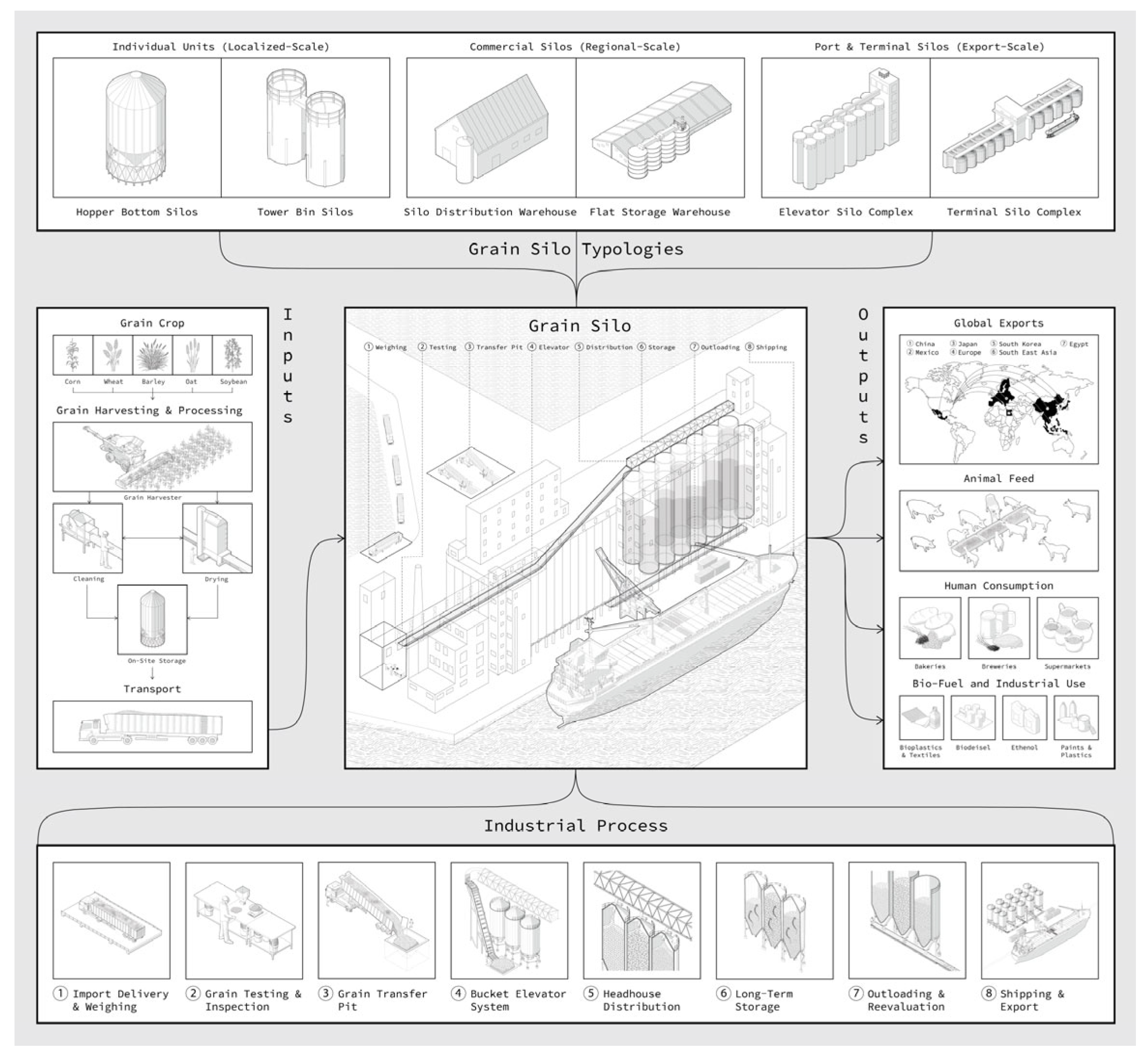
The architectural and spatial logic of this category is defined by containment and controlled circulation of air and/or materials. Vertical storage systems like silos and tanks are optimized for gravity-assisted flow, minimizing energy use for loading and discharge [44], as illustrated spatially in Figure 2. Horizontal warehouse typologies prioritize open-plan flexibility, designed for the kinetic movement of forklifts, conveyor belts, and modular racking systems. Reservoirs and water towers are engineered for hydrostatic balance and pressure management, with their placement often elevated or topographically strategic to facilitate gravity-fed distribution. Across these typologies, space is designed for the efficiency of bulk material movement rather than human occupation, with geometry and sequencing driven by material kinetics.
The inherited storage compartments characteristics offered by this industrial process could translate directly into hydrological and thermal adaptation strategies. Cylindrical or cellular units, for example, can be repurposed as distributed detention volumes for rain, flood, or grey-water during extreme hydrological events. Their thick shells, often constructed of concrete, offer thermal inertia for passive temperature damping and regulation of internal micro-climate conditions. The modularity, repetition and clustering of multiple containment systems also enable differentiated roles (detention, filtration, heat-sink, storage, or occupancy) for multi-purpose adaptation or flexible evolution over time.

5.4. Treatment & Disposal

Finally, the last phase of the industrial cycle involves the byproducts, waste, or residual materials from these stages that flow into Treatment & Disposal facilities where they undergo cleaning, recycling, or safe release, completing the industrial cycle. Typologies include wastewater treatment plants, sewage facilities, incinerators, landfills, and recycling centers [42]. These infrastructures are characterized by highly modular, process-based organization: open settling tanks, circular clarifiers, aeration basins, filtration beds, and linear conveyor systems for solid waste handling. Treatment plants often combine low-rise pump houses, chemical dosing rooms, and control centers with extensive open-air basins arranged in sequential layouts to accommodate mechanical and chemical processes. Incinerators and recycling centers feature large-span steel-frame enclosures for tipping halls, sorting belts, and combustion chambers [46].
The spatial logic of this category is highly sequential and process-oriented, with modular units arranged according to the progressive stages of treatment from sedimentation, filtration, aeration, and disposal to recycling [47]. Open-air basins and tanks are laid out in grids or linear arrays to allow gravity-fed flow between stages, while enclosed structures are sited adjacent to these open components to house monitoring, pumping, and control equipment. Circulation systems, both above and below ground, are dominated by exposed pipe networks, channels, and conveyors, reflecting the priority of continuous operational flow over human spatial experience.
In some way similar to industrial storage-type facilities, the linearly organized flow of treatment facilities through containment zones could be exapted for environmental strategies like blue–green infrastructures for example, with clarifiers and aeration basins can be re-profiled as constructed wetlands and bio-retention cells. Low-slung processing halls and subgrade galleries could lend themselves to raised-floor, dry-core retrofits in flood zones, while exterior tanks can be adapted as distributed reservoirs for greywater, rainwater, or surge attenuation during extreme events. Beyond water, the compartmentalization of waste facilities could even lend themselves to the integration of new forms of contemporary storage or exchange, amongst other programmatic possibilities. In short, by leveraging their linear process geometry, the inherited forms of this category can shift from end-of-the-pipeline utilities to infrastructures at the front-line of responding to pressing environmental demands.

6. Case Studies as a Methodological Framework

The second half of this paper employes a case study framework to test and advance the concept of industrial exaptation. In architectural and urban research, case studies are not merely descriptive illustrations but function as a systematic method of inquiry when structured within a analytical framework [6,48]. Here, they serve as vehicles for examining how industrial legacies, each with distinct spatial logics, material conditions, and environmental challenges, can be reimagined as multi-performative systems.
Each precedent is mobilized as a probe, exposing both the opportunities and challenges of industrial reuse. This dual lens allows the paper to move beyond celebratory narratives toward the identification of transferable lessons. By analyzing design interventions, material negotiations, and programmatic transformations, the study identifies and distills strategies that can be abstracted and adapted to other post-industrial contexts. Its methodological validity lies not in quantitative representativeness but in analytical, qualitative generalization: insights drawn from individual cases are synthesized into broader conceptual frameworks, yielding lessons with both architectural specificity and transferable systemic relevance.
The study relies on case-study literature as its primary empirical base, drawing on architectural drawings, design statements, planning and environmental reports, and scholarly and professional critiques cited throughout the text. These sources are treated as curated secondary data, systematically reviewed to extract information on spatial configuration, material transformation, programmatic change, and environmental performance claims. While no new quantitative field measurements were conducted for the research, the paper instead foregrounds interpretive, comparative analysis grounded in documented and published evidence for each case.
To avoid the charge of anecdotal or arbitrary selection, the study adopts a typological-process framework as its methodological basis. Industrial infrastructures are organized into the four overarching categories derived from the functional processes outlined in the previous section. Each category produces a characteristic architectural form whose spatial, structural, and environmental logics shape both the difficulties and potentials of reuse [49]. To ensure methodological clarity, each industrial category is anchored in a representative building typology whose spatial, dimensional, and organizational qualities exemplify the mono-functional logic of that process. Within each category, a carefully selected case study precedent is then analyzed as a real-world exemplar for transforming that building type. This structural continuum, moving systematically from industrial category, to representative building type, to situated case study, operationalizes the research framework outlined in the introduction and enables the paper to cover both conceptual breadth and empirical specificity. The industrial building type frames the recurring formal and infrastructural logics that define an industrial process, while the case study grounds these abstractions in a concrete architectural transformation.
From this constellation of possible building types, four specific case studies were selected as paradigmatic exemplars of their respective building types and industrial process. These four case studies function as the study’s core “data set.” For each case study, various characteristics are systematically and compared across categories to identify recurring transferable patterns and themes. Extraction and resource acquisition processes produce territorial voids and landscape-scale operations such as quarries, mines, and reservoirs. The Chenshan Quarry Botanical Garden in Shanghai was chosen to analyze this typological condition in contextual depth, showing how extraction zones defined by exposed geology and discontinuous terrain can be reinvented as ecological and hydrological infrastructures. Production and manufacturing processes generate vast building types like power plants, steel mills, manufacturing warehouses, and refineries, optimized for throughput rather than occupation. Brooklyn’s Powerhouse Arts was chosen to demonstrate how the oversized spans and robust grids of this typology can be retooled for creative industries, converting industrial specificity into productive flexibility. Storage and processing processes yields monolithic building typologies such as grain silos, oil tanks, and gasometers, engineered for efficiency and containment. The Vienna Gasometers were chosen to illustrate how these rigid cylindrical forms, once singularly functional, can be reoccupied to host mixed-use urban life, transforming storage shells into active districts. Finaly, treatment and disposal processes encompasses typologies from sewage, waste treatment, incinerators and recycling facilities, stigmatized by their unsanitary associations and rigid layouts. The Amsterdam-West Sewage Apartments is chosen as a rare precedent of this category, converting sludge-treatment drums into housing and grey-water infrastructure, dramatizing the potential of even the most specialized facilities to become civic assets.
These case studies were selected for their ability to embody the defining spatial and organizational logics of their respective industrial process while also illustrating distinct strategies of industrial adaptation that distinguish them from other possible examples. Structured through industrial process categories rather than by design authorship or media acclaim, the analysis moves beyond isolated one-off examples to establish a coherent methodological framework for categorizing other precedents writ large. They exhibit distinctive process-driven spatial logics and indicators ranging from measures of span/void ratios, enclosure/compartmentalization, circulation morphology, envelope mass/thermal enclosure, and eco-technical coupling. This framework also highlights the translation of inherited spatial attributes becoming the basis for novel and performative climate adaptation strategies. Overall, this typological-process analysis enables insights to be synthesized across otherwise disparate forms, laying the groundwork for a more systematic understanding of industrial exaptation as a transferable strategy into other contexts discussed in the concluding section of this paper.
Beyond this typological representativeness though, a set of broader methodological and conceptual considerations explains why these four precedents were prioritized. Firstly, while more globally celebrated examples of industrial exaptation have become widely acclaimed in architectural discourse such as the Tate Modern, Domino Refinery, or SESC Pompeia, the survey in this paper deliberately surfaces lesser-known precedents in the global media. Furthermore, the case studies chosen also highlight more non-conventional new programmatic uses: encompassing new forms of industry and creative manufacturing, specialized residential mixed-use, and environmental reclamation that push beyond typical cultural or tourism-driven adaptive reuse cases. Together, they broaden the discourse by advancing climate-forward approaches to industrial exaptation that remain largely underexplored in mainstream narratives. These cases also reflect a global approach, drawing the four examples intentionally from across different continents to showcase contextually specific solutions that are also an emblematic template for transitioning- and post-industrial cities worldwide. Together, they articulate a spectrum of transferable adaptive strategies that test the feasibility of transforming even the most specialized industrial forms into multi-performative assets.
The case study methodology also enables nuanced evaluation of heritage and sustainability trade-offs. Exaptation is examined not as inherently sustainable but instead as a negotiated balance between preservation, demolition, and new construction [8]. In cases where partial demolition accompanied reconstruction, the projects illustrate both the possibilities and compromises inherent in adaptive reuse, inviting critical reflection on heritage valuation and environmental accounting [49].
Finally, concluding comparative analysis allows these projects to be understood not as isolated conversions but as linked elements within a methodological system. Taken together, they reveal how the accumulation of industrial buildings produces territorial consequences and how single-building interventions can scale into systemic urban strategies. In this way, the case study method demonstrates industrial exaptation as a multi-scalar design paradigm spanning architectural, urban, ecological, and socio-cultural dimensions, while underscoring their feasibility, challenges, and transferabilities. The cases analyzed in the following section highlight how even highly specialized industrial forms can be reimagined to meet contemporary needs, exposing infrastructural vulnerabilities while also unlocking adaptive potentials. Ultimately, they illustrate how design as a disciplinary tool is critical to transforming post-industrial landscapes into multi-performative systems capable of hybridizing new functions for more resilient and adaptive futures.

7. Model Industrial Exaptations

7.1. Extraction and Resource Acquisition Case Study: The Chenshan Quarry Botanical Garden by Zhu Yufan Y3C Atelier

The industrial process of extraction and resource acquisition produces vast territorial voids—quarries, mines, reservoirs, and more—where the ground itself becomes the apparatus of production. These sites are characterized by monumental earthworks and scarred landscapes, infrastructures whose mono-functionality is inscribed directly into the terrain. Within this broader category, the quarry is chosen as the representative typology because its immense scale, exposed geology, and engineered circulation systems exemplify the horizontal spatial logics of extraction landscapes [42]. Unlike enclosed industrial buildings, quarries operate as landscape-scale infrastructures: open-air excavations carved into the earth, leaving behind steep terraced walls, deep pits, and irregular geometries shaped by the operational rhythms of heavy machinery [50]. Built structures are minimal—limited to ancillary sheds, control rooms, or equipment yards—reinforcing the dominance of landform over architecture. This combination of volumetric magnitude, operational specificity, and environmental degradation has historically consigned quarries to abandonment or remediation rather than active design-led transformation [51,52].
Yet there are a few notable precedents of quarry reuse that have demonstrated the typology’s dramatic spatial potential. Projects such as the well-known and celebrated Lithica Quarry in Menorca [53] and the Jinyun Quarries #8, 9, & 10 by DnA_Design and Architecture [54] in Zhejiang Province, China come to mind as exemplary transformations. However, these few adaptive quarry reuse projects typically have largely evolved into cultural landscapes oriented toward performance, tourism, and visual spectacle—important contributions to the cultural reactivation of these sites, yet often limited in their ecological and environmental sustainability ambition.
By contrast, the case study presented in this section, the Chenshan Quarry Botanical Garden by Zhu Yufan Y3C Atelier [55,56,57] in Shanghai, China, is a rare example of industrial exaptation that places environmental restoration and hydrological resiliency at its forefront. Before being transformed into the Quarry Garden, the Chenshan Quarry site had a long history of extraction and a marked decline in ecological and structural integrity. The quarry operated from the early 1950s through to the mid-1980s, extracting igneous rock used in Shanghai’s foundations, roads, and buildings. By the 1980s the operations had ceased, and the site was abandoned: quarries were filled with water, vegetation largely stripped, and landforms heavily altered by exposed cliffs, steep terraces, and soil erosion. The surface had minimal plant cover, making the slopes unstable and the deep pits, once industrial voids, had become safety hazards and eyesores [56].
In 2010, Zhu Yufan of Y3C Atelier transforms this barren, stone-scarred industrial void into an ecologically functioning and publicly accessible landscape by working directly with the quarry’s dramatic topography: retaining the sheer stone cliffs and terraced walls as visual anchors while introducing new spatial systems that restore natural processes. Key interventions include the introduction of constructed wetlands and bio-retention basins in the existing quarry pits to collect and filter stormwater, addressing both flood mitigation and water quality improvement. Rainwater-fed ponds and reflective pools are integrated at the quarry’s lowest points, taking advantage of its natural depressions while stabilizing soil and preventing erosion. Native vegetation is systematically reintroduced across the quarry terraces, regenerating local habitat and increasing biodiversity, while also visually softening the hard, scarred edges of the quarry walls. Carefully placed bridges, elevated walkways, and cantilevered viewing decks allow visitors to experience the vertical scale of the site without disturbing these new ecological systems, turning the quarry into an educational landscape rather than merely a scenic backdrop [56].
In terms of its state of preservation, the project balances between conservation and transformation. Nearly all quarry cliffs, pits, and terraces are retained as structural and visual anchors, while quarry debris and overburden are regraded into terraces and slopes to enable planting. This strategy minimized demolition, privileged in situ reuse, and reframed industrial scars as productive ecological substrates [57]. Yet, because some quarry debris was regraded into terraces and slopes, the project did entail selective alteration rather than complete preservation, reflecting a balance between conserving geological heritage and enabling ecological functionality.
Read through a spatial-process lens, the quarry’s operative voids are not only vestiges of extraction but instruments for climate adaptation. Pit depth, bench width, and cliff orientation create thermal gradients and wind shadows that can be harnessed to stage hydrological performance: deep pits stabilize water temperatures for constructed wetlands, terracing slows overland flow and extend detention time, and rock faces provide radiant moderation that buffers diurnal swings. Former haul roads become controlled-slope conveyances that meter stormwater to successive basins, turning industrial circulation into flood-management infrastructure. In short, the former quarry’s industrial processes translate to a spatial grammar of voids, terrace, ramp, face that converts directly into climate logics of storage, attenuation, and microclimatic refuge rather than relying on add-on technologies alone for programmatic reuse and climate adaptation.
What also sets this industrial exaptation apart from the other case studies in this paper is the project’s territorial scale. Rather than a single architectural intervention, the project comprises multiple interconnected quarry transformations, treating the entire extraction landscape as a unified system. This approach moves beyond singular building reuse, reframing the quarry complex as a regenerative ecological, hydrological, and urban system [56].
Since its completion in 2010, the Quarry Garden has received international recognition, receiving the ASLA Honor Award (2012), as a prototype model of ecological landscape restoration [55]. Early reports confirm that the project has succeeded in stabilizing quarry slopes, improving water retention, and attracting a wide range of visitors, including researchers, students, and local residents [56]. However, robust post-occupancy evaluation remains limited: comprehensive biodiversity monitoring, long-term soil performance data, or detailed hydrological metrics have not yet been widely published. Critiques of the project point to the ongoing maintenance costs of complex hydrological systems, raising questions on long-term management obligations and how municipal funding and stewardship will sustain performance over decades [51,56]. Accessibility also remains uneven: while the park offers powerful educational and ecological functions, its peripheral location relative to central Shanghai may limit everyday local use, making it more of a regional destination than a neighborhood commons [57]. The project therefore functions both as a realized public park and as an aspirational model of environmental infrastructure, signaling possibilities even as its full ecological performance continues to unfold in the coming years.
Taken together, the Quarry Garden represents an ambitious industrial reuse project focused on climate adaptation, water management, biodiversity regeneration, public education, and territory that sets it apart from other quarry reuse precedents [50,51,52]. Beyond creating just a cultural attraction, the project demonstrates how post-extraction sites can host multi-performative systems, although the full scope of its environmental efficacy remains contingent on long-term post-occupancy monitoring and ecological performance data [50,52]. Nevertheless, the project stands as a critical prototype for future quarry exaptation: offering a reuse model driven not by tourism or nostalgia, but by environmental necessity, resiliency, and an active ecological infrastructure integrated into life of its surrounding territory.

7.2. Production & Manufacturing Case Study: The Brooklyn 461 Powerhouse Arts by Herzog & De Meuron

The industrial process of production and manufacturing gives rise to vast, enclosed infrastructures—power plants, steel mills, refineries, manufacturing halls, and more—purpose-built for the demands of high-intensity, sequential operations. Within this spectrum, the power plant emerges as the representative typology, not only because of its common prevalence within all urban landscapes but also due to the spatial commonalities that define the category’s various types [58]. Unlike extraction sites, which are landscape-scaled and open-air, power plants are massive, enclosed interiorized infrastructures designed for high-intensity industrial processes. They are typically characterized by steel or reinforced concrete frames, double- to triple-height turbine halls, and thick load-bearing floors engineered to support heavy machinery and sequential process flows. Historically, power plants were sited near waterfronts or rail lines for fuel delivery and cooling, with their spatial organization dictated entirely by production efficiency rather than human-scale considerations [59].
Among industrial building types, power plants have become some of the most commonly repurposed structures, largely because their vast interior volumes, tall turbine halls, and robust structural frameworks easily lend themselves to repurposed flexible reprogramming [58]. This spatial generosity explains why many of the most celebrated power plant conversions, such as the Tate Modern [60] or Battersea Power Station [61] both in the UK, have been transformed into cultural museums or filled with large-scale commercial-retail floorplates. Flexibly arranged museums and galleries or deep-floorplate retail and commercial spaces can readily occupy these monumental voids, relying on their dramatic architectural character to create iconic cultural destinations. Other renowned case studies like the SESC Pompéia in São Paulo [62], or Domino Sugar Refinery in New York City [63], while not power plants, are former manufacturing building typologies that exhibit similar spatial characteristics and have also been effectively repurposed for community programming, public cultural facilities, and mixed-use commercial functions.
By contrast, the Brooklyn Powerhouse Arts case study by Herzog & de Meuron [64] in New York City, completed in 2023, reinterprets this category of industrial exaptation not as a cultural monument but instead as a site of renewed production for the 21st century. Where the previously mentioned case studies primarily serve spectatorship and consumption, Powerhouse Arts sustains the building’s original logic of making and assembly—reactivating the building’s productive legacy to transform the former power generation facility into a hub for specialized new industries [65]. It is surfaced here as a unique and lesser-celebrated case study precisely because it reinterprets its industrial identity programmatically in a transformed 21st century form, transitioning from heavy fossil-fuel production to a new productive paradigm of low-carbon, localized manufacturing, and creative industry.
This case study also represents a complex negotiation between preservation, reconstruction, and this aforementioned programmatic reinvention. The original 1904 Brooklyn Rapid Transit Power Station was built to serve Brooklyn’s then expanding transit network. Historically recognized by the city as a landmark of New York’s industrial heritage, it closed when steam power became obsolete, and underwent significant alteration before its reuse. Much of the boiler house was demolished in the 1950s, leaving only the turbine hall intact. In the decades that followed, the building fell into abandonment and deterioration, its structure exposed to the elements and marked by graffiti, decay, and extensive brownfield contamination, including polluted soils and underground oil, all of which required substantial remediation prior to redevelopment [66].
From this state of decay and loss, the project advanced toward a deliberate strategy of preservation and reconstruction, balancing historic continuity with new architectural performance. Approximately 40% of the original structural envelope, including the steel frame, brick facades, and high-load-bearing floors is retained, while severely degraded portions of the boiler house and ancillary structures were demolished and rebuilt [64,65]. The new additions are carefully designed to replicate the massing, rooflines, and fenestration rhythms of the demolished boiler house volume, employing matching brickwork, steel detailing, and industrially scaled windows to maintain continuity with the old historic turbine hall. In parallel, modern wall assemblies, glazing, and mechanical systems are integrated to meet contemporary performance standards. Working with the monumental scale of the turbine halls and the robust structural logic of the plant, the project reprograms these spaces into fabrication workshops and studios supporting light industries ranging from metalworking and ceramics to digital prototyping and experimental material labs. Compared to the simple flexibility required for museums or galleries, integrating light industries and creative manufacturing into adaptive reuse demands far greater technical and spatial specificity including specialized mechanical and electrical infrastructure, three-phase power, advanced ventilation, fume extraction, and acoustic isolation. Clear zoning separating “clean” digital fabrication areas from “dirty” heavy-production zones are introduced with loading docks, material storage, and waste systems to support new industrial processes [64,65]. Minimal but strategic architectural insertions in the building introduce new mezzanines and catwalk networks to subdivide the vast open spans into layered working platforms. Original gantry cranes, service catwalks, and overhead trusses were restored and integrated into the new program, maintaining their functional use for moving large-scale works [64,65]. Publicly accessible observation decks and circulation corridors are also designed to allow visitors to witness production processes, blurring the boundary between creative labor and public exhibition.
This hybrid strategy has elicited both praise and critique. Advocates argue that the project successfully preserves the monumental character of the power station while enabling its transformation into a highly specialized center for creative manufacturing. The replication of demolished forms is viewed as a sensitive compromise, retaining the legibility of the plant’s industrial identity while accommodating new programmatic demands [66,67,68]. Critics, however, question the extent of demolition, suggesting that reconstructing large sections undermines the project’s claim to embodied-carbon savings and raises concerns over historical authenticity [66,67,68]. In this way, the project raises tensions between conservation, replication, and carbon accounting.
In light of the paper’s discussion on climate adaptation and coastal resiliency, and what further distinguishes this precedent from some others, is the project’s explicit engagement with water resiliency and climate adaptation. Located in the flood-prone waterfront zone of Brooklyn’s Gowanus industrial district, designated a Superfund site5 and vulnerable to storm surges, the project adopts both built and landscape strategies to confront this exposure. It incorporates elevated mechanical systems, floodproof ground-level construction, and integrated water-retention landscape strategies to mitigate storm surge risks [66]. Steel sheet-pile sea walls topped with industrial concrete “yard blocks” raise the site’s elevation significantly above baseline flood levels. Above that, a nature-based “living shoreline” sponge park absorbs stormwater, mitigating canal overflow and coastal flooding. Critically, the building’s mechanical systems are relocated to the rooftop, housed within two purpose-designed bulkhead volumes, positioned well above anticipated flood levels, and structurally reminiscent of the original boiler stack silhouette. No equipment is installed at ground level to minimize flood risk, and the raised utilities help preserve operational continuity during extreme events [66]. These interventions acknowledge the ongoing climatic vulnerabilities of coastal industrial infrastructures, reframing the building not only as a productive hub but as part of a broader urban water-adaptive system.
Within the internal logics of the building, climate adaptability is also inseparable from the plant’s inherited spatial characteristics. The long-span turbine hall permits high-volume, low-velocity air movement and ventilation with its multi-level catwalks and mezzanines allowing stack-ventilation pathways that couple the building’s vertical section to thermal stratification. The robust brick-and-concrete envelopes offer mass for thermal load-shifting and protection of internal during heat and surge events while still allowing for external daylighting without excessive solar gain. These are inherited spatial characteristics that offer a blueprint for exapting other production and manufacturing buildings and their industrial-driven logics towards new climate-resilient futures.
Post-occupancy, the facility has succeeded in providing affordable workspace for New York’s creative economy, with workshops for ceramics, printmaking, and wood- and metal-working already in operation. Early reports suggest strong demand from artists and fabricators, validating its economic model of production-oriented reuse [67]. At the same time, the building remains an important test case for climate resiliency. While these measures represent a forward-looking adaptation of industrial heritage to coastal risk, their long-term performance remains untested under extreme storm events. Future post-occupancy evaluation will need to assess whether these combined strategies effectively mitigate surge, groundwater infiltration, and drainage overload in the face of intensifying climate pressures.
By combining productive reuse with climate-adaptive strategies, Powerhouse Arts is a distinctly different model of industrial exaptation. It demonstrates how these vast industrial shells can be reimagined not only as icons of cultural spectacle but as working, climate-resilient infrastructures, capable of sustaining new forms of urban industry and localized manufacturing while responding to the ecological vulnerabilities of coastal post-industrial landscapes in the face of rising coastal risks. As such, it offers a compelling precedent that reveals lessons for how industrial reuse can navigate conversation, replication, and coastal resiliency.

7.3. Storage & Processing Case Study: The Vienna Gasometers A, B, C, &D by Jean Nouvel, Coop Himmelblau, Manfred Wehdorn, and Wilhelm Holzbauer

The industrial process of storage and processing produces a range of specialized building types—grain elevators, oil tanks, and gasometer silos amongst others—each designed to optimize volumetric efficiency and logistical flow rather than human occupation. These typologies are defined by their highly specialized and repetitive spatial systems optimized for bulk material storage rather than human occupation. Characterized by cylindrical or polygonal vertical drums often aggregated in large clusters, these structures are designed to maximize gravity-fed storage and flow efficiency. In grain silos, for example, resources are moved vertically and deposited into vertical silos by bucket elevators and redistributed horizontally through conveyor belts or pneumatic tubes [44]. Other silo-types like gasometers are also cylindrically constructed to provide the most structurally efficient shape for containing pressurized gas, evenly distributing internal pressure along the walls while minimizing material use. This geometry also allows for telescoping or expandable storage tanks, a common feature in historical gasometers, enabling them to safely accommodate varying gas volumes [69].
Internally, silos are typically monolithic, windowless, and thermally insulated, their thick concrete or steel walls are engineered for both structural stability under massive vertical loads, internal pressures, and environmental control to protect and store their internal resources from external factors like air, moisture, temperature fluctuations, or pests. Circulation is almost entirely mechanical, with only narrow service catwalks and maintenance ladders for human access. Their spatial logic is inherently inward-facing and closed, presenting both a technical challenge and a unique architectural opportunity when adapting them for new uses given their deep, lightless interiors, rigid vertical compartments, and limited structural flexibility [69].
Grain silos have become one of the more widely examined typologies for adaptive reuse in contemporary industrial exaptation. Across the globe, several high-profile conversions have celebrated their monumental sculptural forms by transforming them into cultural institutions, where their imposing cylindrical volumes provide dramatic backdrops for art. Well-known examples include the Zeitz Museum of Contemporary Art Africa [70], the Kunstsilo in Kristiansand [71], and the MKM Museum Küppersmühle [72] in Duisburg. Other silo conversions embraced residential reuse, exploiting the silos’ repetitive modularity and verticality to create distinctive living environments, such as COBE’s Nordhavn Silo Apartments in Copenhagen [73], or MVRDV’s Silodam Housing Block in Amsterdam [74] and Frøsilo Gemini Apartments in Copenhagen [75].
While this paper addresses housing as an important reuse strategy in greater depth in the final case study, the following example shifts the focus to the silo container typology of gasometers—whose adaptive reuse offers a broader urban strategy for mixed-use integration beyond the cultural singularities that are typically associated with the celebrated silo transformations just mentioned. Although the Vienna Gasometers are among the more well-known industrial reuse projects, it is resurfaced here precisely for its unique programmatic transformation and ambitious 24 h mixed-use urban reintegration that few other silo reuse projects have achieved.
The Vienna Gasometers—four brick gas storage tanks built between 1896 and 1899—once formed the centerpiece of the city’s coal-based gasworks, supplying “town gas” for heating, street lighting, and domestic use across Vienna [75]. Each cylindrical structure, 75 m in diameter and over 70 m in height, functioned as a telescoping storage tank where pressurized coal gas was contained and distributed through the municipal grid. By the mid-20th century, however, the transition from manufactured coal gas to cleaner, more efficient natural gas delivered by pipeline rendered these facilities obsolete. Officially decommissioned in 1986, the gasometers were left as empty, deteriorating shells on the urban periphery—massive relics of industrial modernity whose specialized form precluded easy reuse and whose brick masonry envelopes showed visible signs of neglect until the late 1990s, when the city initiated a major redevelopment program including a design competition to reintegrate the site into the metropolitan fabric [75,76].
Unusually, the city commissioned four architects—Jean Nouvel, Coop Himmelblau, Manfred Wehdorn, and Wilhelm Holzbauer—one for each gasometer, with each designer approaching their individual silo transformation with significantly distinct but complementary diversity. Nouvel’s Gasometer A is defined by its radial glass curtain wall addition and creation of a large indoor plaza, subtly contrasting with the historic brick shell and introducing abundant natural light to the interior residential units from the translucent skylight. Coop Himmelblau’s Gasometer B, by contrast, features the boldest spatial intervention: a dramatic addition of a new 22-story volume asymmetrical steel-and-glass wedge that slices through the brick cylinder, creating a dynamic multi-level atrium and visually declaring the building’s new public character. Manfred Wehdorn’s Gasometer C introduces a domestically scaled interior with stepped interior residential terraces, office bands, and communal rooftop gardens, softening the rigid industrial volume into a more intimate and socially engaging environment. Holzbauer’s Gasometer D approach, unlike all the other three interventions, chooses to occupy the center of the gasometer with tri-partite floorplate volumes, divided by three smaller indoor courtyards that penetrate the perimeter of the existing shell. The base of each of the four gasometer houses share connected functions such as shopping arcades, restaurants, and event spaces, while upper levels are separated into this mix of residential apartments and office suites [75,76].
The richness of this collective approach results in a transformation greater than the sum of its parts. Each gasometer responds differently to the challenge of converting an inward-facing storage typology into habitable, light-filled spaces, providing a catalog of possible strategies for silo and gasometer reuse. Had the four drums been designed by a single architect, the outcome might have been more consistent, but far less dynamic as a model for post-industrial urban reintegration.
A central question in the Gasometers’ redevelopment was the balance between preservation and reconstruction. While the monumental exterior brick walls and steel framework were retained, the interiors were almost entirely gutted and built new. In conservation terms, only 15–20% of the original industrial fabric was preserved, while the majority of structural and spatial systems were replaced by new construction [76]. This approach has been both celebrated and critiqued: advocates point to the adaptive capacity of retaining the historic shells as recognizable landmarks that had by then become an aesthetic fixture of the urban fabric, while critics argue that the loss of interiors undermines claims of heritage authenticity and embodied carbon savings, reducing the project to façade retention [75,76]. Regardless of one’s positionality on this spectrum though, what is important to highlight is that the gasometer’s cylindrical geometry and high-mass shell confer certain climate advantages when reprogrammed. The inherited circular dimensionalities allowed for cross-ventilation and stack ventilation in the schemes once radial cuts or central voids were introduced, while short perimeter-to-core distances also allowed daylight to penetrate floor plates when atria or glazed wedges are carved. The thick masonry drums, originally designed for pressure stability, now supplies thermal lag that moderates interior temperatures and the individual microclimates of each of the four silos across mixed uses. These characteristics offer a template for how prior industry process driven logics can be adapted towards new spatial and environmental demands.
Beyond just these spatial adaptations though, what makes this project notably relevant to this paper is its success as a template for reintegrating industrial shells into a 24 h continuous public life of the city. Unlike the tourism-driven or museum-based approaches typical of other silo conversions, the Vienna Gasometers establish a self-contained yet interconnected urban district, layering multi-programmatic amenities with a diversity of uses that catalyzed the wider revitalization of Vienna’s Simmering district. Post-occupancy, it has brought more than 600 apartments, a concert hall, university facilities, a cinema, and extensive retail, drawing round-the-clock use and new activity to the Simmering district. Their programmatic diversity has enabled continuous occupancy and economic viability, validating the idea of industrial exaptation as a strategy for 24 h mixed-use reintegration [76].
The project also underscores the role of public–private partnerships, demonstrating how strategic city planning and architectural innovation can work in tandem to deliver transformative urban outcomes [75]. While its reliance on substantial city-level investment makes direct transferability to resource-constrained contexts both a challenge and an opportunity for innovative development partnership models, the Gasometers nonetheless provide a compelling model for re-densifying underutilized urban edges without resorting to greenfield expansion. More than a singular adaptive reuse, the project exemplifies how coordinated planning, inventive spatial strategies, and cross-sector collaboration can reintegrate industrial peripheries into the urban fabric, transforming dormant infrastructural relics into active district nodes and active extensions of city life.

7.4. Treatment & Disposal Case Study: The Amsterdam-West Sewage Apartments by Dick Van Gameren Architects

The industrial process of treatment and disposal encompasses facilities such as sewage plants, wastewater treatment facilities, incinerators, recycling centers, and solid-waste depots. These typologies have historically been marginalized in both design discourse and adaptive reuse practice, largely due to their stigmatized associations with waste and sanitation, their technical rigidity, and their location at the urban periphery [47]. Their layouts are typically process-driven: specialized tanks, filtration basins, and control structures linked by pipes and conduits leave little apparent spatial flexibility or cultural value. Among these, the sewage treatment plant was selected as the representative typology because it most clearly embodies the category’s shared challenges including unsanitary stigma, infrastructural specialization, and programmatic inflexibility [46]. Typically located on city peripheries or near water networks for sewage outflow, these facilities are characterized by low-slung processing halls, concrete clarifier tanks, and labyrinthine service conduits. Their spatial organization prioritizes sequential treatment processes—filtration, sedimentation, and aeration—rather than human-scale occupancy [47]. Consequently, many decommissioned treatment plants are demolished or abandoned, with truly very few examples demonstrating a meaningful reintegration into urban life.
While some speculative proposals have been explored conceptually and adjacent examples such as landfill-to-park transformations do exist (for example, Freshkills Park in Staten Island [77]) that demonstrate large-scale ecological reclamation, very few precedents exist for the architectural and infrastructural transformation of treatment and disposal facilities themselves. By contrast, the Amsterdam-West Sewage Apartments by Dick van Gameren Architects completed in the mid-1990s presents a highly unusual precedent, demonstrating how such treatment facilities can not only be repurposed but done so for residential use [78]. This is a programmatic transformation not yet addressed in the other typologies discussed in this paper, marking a significant expansion of industrial exaptation’s possibilities.
Constructed in the early 20th century, the original sewage drums originally served the rapidly growing western neighborhoods of Amsterdam, processing municipal wastewater through a series of sedimentation drums and clarifiers. By the late 1970s and early 1980s, however, technological obsolescence and urban expansion rendered the facility inefficient. Advances in regional wastewater treatment infrastructure, including the construction of larger centralized plants with greater processing capacity, led to its decommissioning. The site, stripped of its active function, was left with its three monumental cylindrical sludge-treatment tanks standing unused, a relic of hidden municipal infrastructure located near the edge of the Sloterplas lake. By the mid-1990s, these three tanks became the centerpiece of Dick van Gameren Architects’ adaptive reuse project, with a design that preserved the reinforced-concrete waste sedimentation drums but gave them distinct new roles. The smallest drum was lightly adapted to serve as resident storage space, requiring minimal structural change. The middle drum was transformed into a grey-water collection tank, with its overflow system routed directly into Amsterdam-West’s central Sloterplas lake, which integrates the building into the area’s existing water landscape. The largest drum received the most dramatic spatial reconfiguration: the introduction of seven multi-family apartment units. The conversion of the sewage drums was also complemented by the addition of two new mid-rise apartment buildings, establishing a dialogue between the preserved industrial structures and new contemporary residential blocks. Together, they framed an open central space that serves as a connective hub, linking the redevelopment to the surrounding neighborhood and the adjacent park [78,79]. The balance of conservation and new construction here leaned toward retention: while auxiliary processing structures were demolished, the massive sedimentation tanks—the most visually and structurally iconic elements—were preserved as anchors of identity and memory.
The uniqueness of this precedent lies in its rare integration of housing, a highly specialized program that requires ample natural light, ventilation, and relatively shallow floor depths, conditions not easily achieved within large-scale industrial infrastructures. The project resolves this challenge through a strategic architectural intervention in the largest drum: a bar of housing is inserted across the circular drum floor plan, effectively dividing it on either side with two semi-circular courtyards. The smaller, larger inward-facing courtyard functions as a private residents’ garden, bringing daylight and fresh air deep into the otherwise enclosed drum. Meanwhile, the street-facing courtyard houses the service core and vertical circulation, which is affixed to the drum’s concrete wall, forming the primary entry sequence into the building. Along with strategic exterior perforations of the sewage drum walls with new cantilevering balcony extensions, interior layouts place bathrooms and kitchens centrally, opening living spaces outward to allow daylight to be channeled deep into the circular core.
Technically, adapting a treatment facility for residential occupancy requires significant interventions: insulation and thermal upgrades, extensive decontamination of former processing areas, and the introduction of light & daylighting to meet contemporary housing standards. Moreover, the retention of a grey-water collection tank as part of the site’s functional program highlights a multi-system approach, where the new residential & infrastructural uses together work in tandem to create a hybrid system of habitation and environmental utility. Cumulatively, these typological spatial traits (thick circular walls, clear internal span, and self-contained drums) translate into not only the environmental strategies described above, but also into passive thermal buffering and acoustic damping, efficient coring for daylight and natural ventilation, and integrated water-management logics that together enable resilient habitation while reducing operational loads.
Post-occupancy assessments reveal both successes and considerations for replicability. The project has been praised as an inventive reuse that injects distinctive character into a housing project while preserving a piece of Amsterdam’s infrastructural history [78]. The apartments remain occupied decades later, demonstrating the cultural acceptance and social viability of residential conversion in even the most stigmatized of industrial shells. Moreover, the integration of grey-water infrastructure offers an early example of circular water systems tied directly to housing, a forward-looking ecological innovation for its time. However, the idiosyncratic layouts within the drums dictated by circular geometries reduce flexibility for conventional domestic use, an inherited spatial trait that must be taken into consideration when thinking about its replicability in other contexts.
Altogether, what makes this case study particularly significant is its programmatic inversion: a facility once designed for the hidden peripheral processing of waste has been reimagined as housing integrated within an urban community, symbolically and spatially reversing its historical role as an infrastructural outcast. It demonstrates how treatment & disposal infrastructures—typically one of the most specialized and socially isolated of industrial typologies—can integrate a program once though incompatible with such sites into the public and domestic life of the city [46]. This shift expands the discourse on industrial exaptation, suggesting that even the most specialized and socially/psychologically undesirable typologies can be transformed into multi-performative urban assets aligned with pressing 21st century housing needs.

8. Discussion, Concluding Themes, and Future Research

While the preceding analysis has highlighted the methodological, case-specific insights of industrial exaptation, its ultimate value lies in the lessons that can be abstracted and applied across diverse contexts. The case studies were not chosen to stand as isolated exemplars, but rather as testbeds through which broader principles can be distilled. In this sense, their importance extends beyond their immediate architectural outcomes: they demonstrate how adaptive strategies can be transferred, adapted, and scaled across cities facing different resource capacities, cultural contexts, and urban pressures. From this analysis, they also reveal several concluding themes: industrial exaptation as an ecological and climatic necessity, as a vehicle for meeting pressing contemporary urban-wide needs, as a strategy for reintegrating industrial lands into civic life, and as a disciplinary shift that reclaims mono-functional infrastructures as critically necessary design territory.

8.1. Transferability Strategies

While some of the case studies presented in this paper focus on large-scale projects in contexts of substantial investment, the strategies they exemplify can be distilled and applied in other contexts including resource-constrained settings. The critical question is not whether every city can replicate projects like the Vienna Gasometers or Brooklyn’s Powerhouse Arts, but how the principles embedded in these projects—incremental adaptation, ecological remediation, programmatic hybridity, and socio-cultural reintegration—can be scaled, phased, and reinterpreted under different contextual, economic, and governance conditions [38]. This emphasis on scalability and context-sensitivity complements prior adaptive-reuse scholarship that foregrounds feasibility heuristics and adaptation models (like the criteria identified in Douglas’ Building Adaptation) while extending them to mono-functional infrastructures whose process-driven morphology and risk profiles diverge from typical building stock [80].
Firstly, incremental retrofitting and programmatic phasing offer pragmatic strategies for extending the lifespan of industrial shells through staged, low-cost interventions rather than singular, capital-intensive transformations. Phased programming also enables underutilized sites to host temporary or interim uses (markets, workshops, or cultural events) while long-term redevelopment capital and institutional support accumulate. In the Amsterdam-West Sewage Apartments, modest insertions within specialized infrastructure generated residential value without wholesale reconstruction, demonstrating how carefully calibrated interventions can unlock new functions while preserving industrial material legacies. Similarly, the Vienna Gasometers illustrate how large industrial complexes can be activated through sequenced diversification, layering housing, retail, offices, and entertainment programming over time. These examples highlight how incremental adaptation can both distribute financial outlays and build civic momentum, preventing vacancy and enabling early public engagement [81]. More importantly, the sequencing itself becomes a design tool, spreading costs, cultivating community buy-in, and creating visible public value that catalyzes broader coalitions for systematic redevelopment.
Resource-constrained contexts can also leverage industrial reuse strategies that combine locally available, low-carbon material reuse with community-embedded design processes. Retrofitting often reveals structural overcapacity in concrete-framed power plants, silos, or treatment facilities, enabling lightweight infill or adaptive systems to be built from recycled or locally sourced materials rather than costly imports. The Chenshan Quarry Botanical Garden exemplifies this approach: its design retained the quarry’s exposed geology as structural, visual, and ecological anchors instead of importing new heavy materials. The new landscape systems ranging from constructed wetlands, bio-retention basins, and rainwater ponds were formed with local stone, soil, and re-graded quarry debris, minimizing the embodied carbon of imported materials. Native vegetation was reintroduced to stabilize soil and restore biodiversity, reducing both ecological disruption and the costs associated with exotic plantings. Crucially, such material pragmatism aligns with public-interest design frameworks that foreground local stewardship. Contemporary urban studies caution that culture- or amenity-led reuse can catalyze displacement if community equity instruments are absent, an ethical horizon that transferability strategies must explicitly address [82]. Therefore, paired with community partnerships—whether through land trusts, cooperative maintenance frameworks, or participatory ecological planning—industrial exaptation can advance social regeneration and environmental resiliency in tandem [37]. In this way, material reuse and community governance become mutually reinforcing, embedding exaptation as an incremental, socially grounded transformation rather than a top-down spectacle.
Lastly, transferability of these case studies’ lessons hinges on supportive governance and local economic development incentives. Policy tools such as zoning overlays, tax incentives, or adaptive reuse ordinances can reduce barriers to entry and encourage experimentation in reuse even without massive capital flows [38]. Beyond cultural spectacle or elite consumption, industrial reuse can also be leveraged for local economic development to incubate small-scale production, vocational training, and micro-enterprises—strategies that require only modest capital investment and can subsequently generate durable community economies and employment opportunities [8]. In other contextual settings, municipal governments can further incentivize adaptive reuse through public–private partnerships, leveraging land ownership or regulatory flexibility to offset private costs. Powerhouse Arts in Brooklyn exemplifies how housing vocational training and micro-enterprises using minimal but targeted upgrades can create locally grounded economies without requiring large cultural subsidies. Both Vienna and Amsterdam illustrate the role of supportive governance: in Vienna, municipal planning structured the Gasometers’ redevelopment through a coordinated multi-architect competition, while in Amsterdam, heritage and housing policy enabled and supported an unconventional reuse project. Comparative research literature and policy work on brownfields and heritage corroborates this enabling role of the state: targeted fiscal tools and regulatory clarity are repeatedly linked to successful industrial-land recycling and heritage-led urban regeneration [11,35]. Public–private partnership studies likewise stress careful risk allocation and transparent value capture to maintain public outcomes over a project’s life cycle [83]. Taken together, economic development strategies and governance instruments are mutually reinforcing: policy frameworks unlock regulatory and financial capacity, while adaptive reuse generates tangible social and economic value. This dual alignment makes industrial exaptation replicable beyond wealthy, capital-rich cities, positioning it as a strategic tool for climate-conscious, socially inclusive, and economically grounded urban transformation for all cities in post-industrial transition at large.

8.2. Concluding Themes: Towards Industry Exaptive-Integrated Cities

These case studies also advance a broader conceptualization of industrial exaptation as more than isolated architectural conversions. They demonstrate how industrial adaptive reuse can operate at multiple scales, multiple programs, and multiple infrastructures to address not only heritage or aesthetics but climate resiliency, new urban occupations, and socio-public integration. Once rigid structures of process and utility, these infrastructures now offer both profound challenges and unprecedented opportunities for reimagining urban futures—positioning industrial exaptation as an urgent spatial, ecological, and civic imperative for the 21st century contemporary city. Across the various industrial process categories and typological case studies discussed, several broader shared themes and concluding lessons emerge.
The first theme underlies the entire paper and all four case studies: industrial exaptation as an ecological and climatic necessity. It should be understood not only as an act of material reuse or as an inherently carbon-positive intervention, but also as a multi-scalar environmental strategy, repurposing existing land and new occupations as blueprints for climate-resilient cities [37]. This theme reinforces contemporary resilience framework scholarship that reposition urban form as a delivery system for ecosystem services including flood attenuation, biodiversity, and water quality at multiple scales [24]. This is powerfully illustrated in the Chenshan Quarry Botanical Garden, where landscape-led design transforms a degraded extraction site into a hydrological ecosystem. Similarly, the 461 Powerhouse Arts in Brooklyn reimagines a flood-prone site with both mechanical and natural systems for coastal adaptation and increasing hydrological threats. In these cases, design and environment are positioned not as separate concerns but as co-constructive forces, where climate adaptation becomes inseparable from spatial transformation, and where the exaptation of industrial lands offers a radical blueprint for a new kind of urbanism, one that is ecologically embedded and fundamentally addresses the environmental crises facing cities.
The second thematic argument this paper advances is that industrial exaptation must move beyond cultural programming alone and towards supporting more persistent, programmatic, and infrastructural needs of the 21st century city [9,11]. As cities urbanize and demand for sustainable new forms of industry and the ever-persistent need for housing continues to grow, cultural and touristic reuse, while meaningful, cannot singularly address the spatial and programmatic deficits faced by contemporary urban populations. This argument is advanced by Evans and Shaw, who identify how culture-led regeneration models have been critiqued for their limited functional persistence and fragile economic foundations [84]. Building on this empirical analysis, the argument advocates for the safeguarding and re-embedding of making, logistics, and repair within metropolitan cores, a trajectory to which Brooklyn’s 461 Powerhouse Arts offers a spatial corollary. This case study reactivates the building’s industrial DNA through a contemporary model of light industry and creative fabrication to support local economies and advance a new paradigm of urban “production.” Similarly, the Amsterdam-West Sewage Apartments reimagine a decommissioned treatment facility dually as residential and greywater-reuse infrastructure, overcoming both technical and perceptual constraints to deliver urgently needed housing while addressing decentralized water management. These examples demonstrate that adaptive reuse must move beyond symbolic or cultural gestures to address multi-system urban demands by embedding new economies, forms of inhabitation, and infrastructural resiliency into the spatial legacies of the industrial age.
The third theme foregrounded by this paper is the importance of reintegrating industrial land and infrastructure back into the socio-cultural fabric of the city, while offering a blueprint for transforming previously inert zones into vibrant, civic-oriented districts capable of sustaining 24 h occupancy and diverse community life. Historically, industry was zoned away from civic activity due to noise, toxicity, or odor. As urban regions densify and the functions of heavy industry recede, these once-excluded sites are increasingly enveloped by the expanding metropolitan condition. In this context, industrial exaptation becomes a spatial strategy not only for reuse but for urban reintegration prioritizing the redevelopment of brownfield sites over unsustainable greenfield expansion [35,36]. This theme follows a robust body of scholarship on post-industrial waterfront reintegration, which documents how obsolete logistics edges can be re-stitched into the urban fabric through governance reform, phased redevelopment, and public-realm frameworks [85,86]. The Vienna Gasometers exemplify this shift, albeit in a non-port industrial zone: four cylindrical gas storage structures reimagined as mixed-use vertical districts integrating housing, offices, retail, and entertainment that sparked a wider district urban revitalization. Their transformation introduces 24 h occupancy and layered civic programs, creating a template for seeding continuous public life in zones that once operated outside the rhythms of the city. Rather than enclaves of past production, these projects outline an important template of reinvention, densification, and new socio-urban life—where industrial legacies are folded back into the social, temporal, and public life of contemporary urbanism.
Finally, the paper argues for a paradigm shift in disciplinary attitudes. Historically, mono-functional industrial buildings and sites have been treated as the exclusive domain of engineers, utilities, and technical specialists—governed by operational efficiency, regulatory compliance, and systems optimization rather than spatial imagination. As a result, architects and urban designers were rarely included in their planning, design, or post-operational transformation, sidelined by disciplinary boundaries that positioned infrastructure as a purely technical concern [9]. Even in obsolescence, these sites were more often valued for their picturesque decay or aesthetic ruin than for their capacity to be reimagined as vital components of the city’s future [11]. Yet the precedents examined here challenge that marginalization, demonstrating that industrial exaptation is not simply a logistical or engineering task but a deeply architectural and urbanistic one—not as an act of nostalgic preservation but as a form of evolutionary urbanism. By reclaiming a role in the transformation of these spaces, designers can reassert agency within domains and building stocks from which they have historically been excluded a seat at the table, leveraging the design discipline’s formal, spatial, and social intelligence to reposition post-industrial infrastructures as adaptive frameworks for the future.
In conclusion, this paper argues that the true promise of industrial exaptation lies in their critical framework for rethinking cities in the post-industrial and climate crisis era. Rather than viewing these infrastructures as obsolete relics or one-off architectural spectacles, these infrastructures should be understood as critical urban resources: repositories of embodied carbon, latent spatial capacity, and infrastructural connectivity. The challenge ahead is not simply to adapt them for new uses but to do so in ways that are environmentally resilient, socially integrative, and programmatically inventive. The most compelling futures of industrial exaptation are those that embrace the specificity of industrial forms while radically expanding their urban and ecological roles, transforming the singular machines of the industrial past into multi-performative, productive, and deeply integrated systems for the future ahead. In this way, the paper positions them as evolutionary palimpsests—essential blueprints to be rewritten to address the infrastructural demands and environmental imperatives of the 21st century city and beyond.

8.3. Limitations and Future Research

With these conclusions in view, it is important to acknowledge the study’s current constraints and outline avenues for further inquiry. First, the quantitative evidentiary basis for post-occupancy evaluation of success, particularly when it comes to climate resiliency, remains limited. Much of the evidence currently relies on secondary sources and design documentation, with partial or limited robust longitudinal post-occupancy evaluation (POE) reports of ecological performance, energy loads, thermal comfort, social use, and governance outcomes. This limitation has two principal causes: the relative recent construction of these case studies reflecting the discipline’s late curiosity towards industrial exaptation which constrain what can be measured to date; and a broader disciplinary pattern in architecture and urban design in which rigorous post-occupancy evaluation is not consistently commissioned, funded, or published. As a result, some findings and causal attributions are interpretive rather than statistically verified by robust POEs.
Second, the sample of case studies selected for analysis in this study is both wide in categorical scope and limited to the four selected in sample size. While insights are intentionally projected from the four cases selected for typological and process diversity rather than for statistical representativeness, it cannot describe the full variance of outcomes across geographies, delivery models, or regulatory contexts. A larger comparative corpus is needed to extract and project further the representatives of the preliminary analysis presented here. This expansion is complicated by the unevenness of currently built industrial adaptive case studies across the four industrial process categories defined in this paper. For example, at present, power plants, warehouses, and silo complexes are more common in adaptive-reuse practice and construction, whereas extraction-based transformations like quarries are far more infrequently converted or even rarely repurposed for habitation as in the case for waste treatment infrastructures. This asymmetry skews the evidentiary base: some categories benefit from multiple robust transformations for study, while others do not, limiting cross-case inference for rarer types.
Taken together, these limitations suggest a clear next agenda for future research on this topic. The empirical basis for post-occupancy success and evaluation for case studies could be expanded next through standardized protocols. A multi-context, cross-typology standard of evaluation should adopt common quantitative indicators like hydrological resilience metrics, biodiversity indices, embodied and operational carbon balances, program occupancy and turnover that are paired with qualitative documentation sources and standards ranging from social behavioral mapping and user interviews. This empirical basis could build on existing scholarship on this aspect, including Langston’s Adaptive Reuse Potential (ARP) framework that scores existing buildings against weighted criteria to generate an ARP index that prioritizes candidates for reuse and links feasibility to expected post-occupancy outcomes [87]. Extended further and established specifically for industrial reuse case studies, such an empirical method could enable comparative POEs by providing defensible evidence for further transferability strategies for cities and post-industrial sites considering exaptive transformation.
Additionally, subsequent research steps suggest widely expanding and diversifying the sample of comparative case studies across under-represented industrial processes and geographies. A coordinated set of multi-site studies balanced across extraction, production, storage, and treatment categories would permit more robust cross-case triangulation and move the work from suggestive generalization toward robust, type-specific strategies. Within each category, future research should continue to test how particular spatial and typological attributes of industrial infrastructures correlate with measurable environmental, social, and economic outcomes.
Examining a more comprehensive set of cases would also allow the research to develop a fuller, evidence-based understanding of spatial design characteristics in order to assemble a transferable “toolkit” of strategies tied to specific industrial forms. For example, typological transferable design strategies within such a toolkit could include terraced detention modules and slope stabilization strategies for extraction sites, stack-ventilation, gantry reuse, and high-load service spines for production halls; daylighting, structural coring, and acoustic baffles for silos and gasometers; and habitation inserts with grey-water coupling for treatment drums. Supporting and embedding these spatial and design tactics in POE metrics that relate spatial affordances to ecological and social performance would translate case-based insight into actionable guidance for industrial reuse practitioners operating across diverse regulatory and resource contexts.
In conclusion, the limitations identified here are not defects of the inquiry so much as a roadmap for future steps not only for the research but for the broader study of industrial adaptive reuse writ large. Advancing these fronts will require partnerships between researchers, designers, and stakeholder to fund longitudinal evaluation and extract design tactics under varied constraints. If done so though, the themes offered in this paper can mature into reproducible guidance that meaningfully establishes a methodological framework for industrial adaptive reuse, advancing exaptation as a rigorously evaluable, transferable, and replicable practice for city’s shared climate-resilient and post-industrial futures.

Funding

This research received no external funding.

Data Availability Statement

The original contributions presented in this study are included in the article. Further inquiries can be directed to the corresponding author.

Acknowledgments

Figure 1 and Figure 2 in this paper were produced by the author for submission along with this paper, with the support of two research assistants. The drawings and diagrams constitute a significant personal contribution to the paper’s research which must be acknowledged. Additionally, the two research assistants, New York Institute of Technology students Emily Galofaro and Sharon Cunningham must be acknowledged for their valued assistance with producing these two research drawings.

Conflicts of Interest

The author declares no conflicts of interest. Funders had no role in the design of the study; in the collection, analyses, or interpretation of data; in the writing of the manuscript; or in the decision to publish the results.

Notes

1
Industry 4.0, also known as the Fourth Industrial Revolution, refers to the current era of digital transformation in manufacturing and industrial processes, characterized by the integration of technologies like automation and smart manufacturing.
2
Embodied Carbon refers to the total greenhouse gas emissions associated with the extraction, processing, manufacture, transportation, and installation of building materials, as well as the maintenance and eventual demolition of a structure.
3
Operational Carbon refers to the greenhouse gas emissions produced during the in-use phase of a building’s life, primarily from heating, cooling, lighting, and powering appliances and equipment.
4
Vertical Wetlands are engineered ecological systems that mimic natural wetland processes within a compact, often vertical or tiered structure.
5
A Superfund site is a contaminated location in the United States designated by the Environmental Protection Agency (EPA) for long-term remediation of hazardous material pollution. These sites are prioritized for cleanup due to the risks they pose to human health and the environment.

References

  1. Edensor, T. Industrial Ruins: Space, Aesthetics and Materiality; Berg: Oxford, UK, 2005. [Google Scholar]
  2. Palmer, M.; Neaverson, P. Industrial Archaeology: Principles and Practice; Routledge: London, UK, 1998. [Google Scholar]
  3. Wilkinson, S.; Remøy, H.; Langston, C. Sustainable Building Adaptation: Innovations in Decision-Making; Wiley-Blackwell: Oxford, UK, 2014. [Google Scholar]
  4. Langston, C. Life-Cost Approach to Building Evaluation; Routledge: London, UK, 2012. [Google Scholar]
  5. UNESCO. Recommendation on the Historic Urban Landscape; UNESCO: Paris, France, 2011; Available online: https://whc.unesco.org/en/hul/ (accessed on 1 November 2025).
  6. Flyvbjerg, B. Five misunderstandings about case-study research. Qual. Inq. 2006, 12, 219–245. [Google Scholar] [CrossRef]
  7. High, S.; Lewis, D.W. Corporate Wasteland: The Landscape and Memory of Deindustrialization; Cornell Press: Ithaca, NY, USA, 2007. [Google Scholar]
  8. Plevoets, B.; Van Cleempoel, K. Adaptive Reuse of the Built Heritage: Concepts and Cases of an Emerging Discipline; Routledge: London, UK, 2019. [Google Scholar]
  9. Haas, T.; Olsson, K. Transmutation and Reinvention of Public Spaces Through Ideals of Urban Planning and Design. Space Cult. 2013, 17, 59–68. [Google Scholar] [CrossRef]
  10. Bullen, P.A.; Love, P.E.D. Adaptive reuse of heritage buildings. Struct. Surv. 2011, 29, 411–421. [Google Scholar] [CrossRef]
  11. Pendlebury, J. Conservation values, the authorised heritage discourse and the conservation-planning assemblage. Int. J. Herit. Stud. 2013, 19, 709–727. [Google Scholar] [CrossRef]
  12. Yung, E.H.K.; Chan, E.H.W. Implementation challenges to the adaptive reuse of heritage buildings: Towards the goals of sustainable, low-carbon cities. Habitat Int. 2012, 36, 352–361. [Google Scholar] [CrossRef]
  13. Storm, A. Post-Industrial Landscape Scars; Palgrave Macmillan: Basingstoke, UK, 2014. [Google Scholar]
  14. Gould, S.J.; Vrba, E. Exaptation—A missing term in the science of form. Paleobiology 1982, 8, 4–15. [Google Scholar] [CrossRef]
  15. Melis, A.; Pievani, T.; Lara--Hernández, J.A. Architectural Exaptation: When Function Follows Form; Routledge: London, UK, 2024. [Google Scholar]
  16. Mah, A. Industrial Ruination, Community, and Place: Landscapes and Legacies of Urban Decline; University of Toronto Press: Toronto, ON, Canada, 2012. [Google Scholar]
  17. Peric, A. The role of local governance in the process of brownfield regeneration. Serbian J. Manag. 2015, 7, 263–284. [Google Scholar]
  18. UN-Habitat. State of the World’s Cities 2010/2011: Bridging the Urban Divide; Earthscan: London, UK, 2010. [Google Scholar]
  19. Nuissl, H.; Siedentop, S. Urbanisation and Land Use Change. In Sustainable Land Management in a European Context; Weith, T., Barkmann, T., Gaasch, N., Rogga, S., Strauß, C., Zscheisher, J., Eds.; Springer: Cham, Switzerland, 2021; pp. 75–99. [Google Scholar] [CrossRef]
  20. Elefante, C. The Greenest Building Is… One That is Already Built. Forum J. 2012, 27, 62–72. [Google Scholar] [CrossRef]
  21. Gibbons, O.; Orr, J. How to Calculate Embodied Carbon: A Guide for Structural Engineers; Institution of Structural Engineers: London, UK, 2020. [Google Scholar]
  22. Cabeza, L.F.; Rincón, L.; Vilariño, V.; Pérez, G.; Castell, A. Life cycle assessment (LCA) and life cycle energy analysis (LCEA) of buildings and the building sector: A review. Renew. Sustain. Energy Rev. 2014, 29, 394–416. [Google Scholar] [CrossRef]
  23. Stephan, A.; Crawford, R.H.; de Myttenaere, K. A comprehensive assessment of the life cycle energy demand of passive houses. Appl. Energy 2013, 112, 23–34. [Google Scholar] [CrossRef]
  24. Ahern, J. From fail-safe to safe-to-fail: Sustainability and resilience in the new urban world. Landsc. Urban Plan. 2011, 100, 341–343. [Google Scholar] [CrossRef]
  25. Cronon, W. Nature’s Metropolis: Chicago and the Great West; W.W. Norton: New York, NY, USA, 1991. [Google Scholar]
  26. Schubert, D. Ports and Urban Waterfronts. In The Routledge Handbook of Planning History; Hein, C., Ed.; Routledge: New York, NY, USA, 2017. [Google Scholar]
  27. Steinberg, T. Down to Earth: Nature’s Role in American History; Oxford University Press: New York, NY, USA, 2001. [Google Scholar]
  28. Shieh, E.; Galofaro, E. Industrial Zoning & Sites under Coastal Flooding Threat, NYC. Cartographic Map. Created 2025.
  29. Pelling, M. Adaptation to Climate Change: From Resilience to Transformation; Routledge: London, UK, 2011. [Google Scholar]
  30. New York City Department of City Planning. Resilient Industry: Mitigation and Preparedness in the City’s Industrial Areas; NYC DCP: New York, NY, USA, 2018. Available online: https://www.nyc.gov/assets/planning/download/pdf/plans-studies/resilient-industry/resilient-industry-full-report.pdf (accessed on 1 November 2025).
  31. Mossop, E. Landscapes of infrastructure. In The Landscape Urbanism Reader; Waldheim, C., Ed.; Princeton Architectural Press: New York, NY, USA, 2006; pp. 163–177. [Google Scholar]
  32. Restemeyer, B.; Woltjer, J.; van den Brink, M. A strategy-based framework for assessing the flood resilience of cities: A Hamburg case study. Plan. Theory Pract. 2015, 16, 45–62. [Google Scholar] [CrossRef]
  33. Mostafavi, M.; Doherty, G. Ecological Urbanism; Lars Müller Publishers: Zurich, Switzerland, 2016. [Google Scholar]
  34. Alker, S.; Joy, V.; Roberts, P.; Smith, N. The Definition of Brownfield. J. Environ. Plan. Manag. 2000, 43, 49–69. [Google Scholar] [CrossRef]
  35. De Sousa, C.A. Brownfield Redevelopment and the Quest for Sustainability; Elsevier: Oxford, UK, 2008. [Google Scholar]
  36. Cizler, J. Brownfield redevelopment as a measure for climate changes mitigation. J. Geogr. Inst. Cvijic 2013, 63, 57–73. [Google Scholar] [CrossRef]
  37. Coscia, C.; Lazzari, G.; Rubino, I. Industrial Heritage, Adaptive Reuse and Sustainable Redevelopment Scenarios. In Science of Valuations: Natural Structures, Technological Infrastructures, Cultural Superstructures; Giuffrida, S., Trovato, M.R., Rosato, P., Fattinnanzi, E., Oppio, A., Chiodo, S., Eds.; Springer: Cham, Switzerland, 2024; pp. 347–360. [Google Scholar]
  38. Shipley, R.; Utz, S.; Parsons, M. Does adaptive reuse pay? A study of the business of building renovation in Ontario, Canada. Int. J. Herit. Stud. 2006, 12, 505–520. [Google Scholar] [CrossRef]
  39. Throsby, D. Cultural capital and sustainability concepts in the economics of cultural heritage. In The Economics of Uniqueness; Licciardi, G., Amirtahmasebi, R., Eds.; World Bank: Washington, DC, USA, 2016; pp. 97–109. [Google Scholar]
  40. Velthuis, K.; Spennemann, D.H.R. The future of defunct religious buildings: Dutch approaches to re-use. Cult. Trends 2007, 16, 43–66. [Google Scholar] [CrossRef]
  41. Hospers, G.J. Restructuring Europe’s rustbelt: The case of the Ruhrgebiet. Intereconomics 2004, 39, 147–156. [Google Scholar] [CrossRef]
  42. Hayes, B. Infrastructure: A Field Guide to the Industrial Landscape, revised ed.; W. W. Norton & Company: New York, NY, USA, 2014. [Google Scholar]
  43. Caviar, S. (Ed.) Non-Extractive Architecture: On Designing Without Depletion; Sternberg Press: London, UK; MIT Press: Cambridge, MA, USA, 2021; Volume 1, 296p. [Google Scholar]
  44. Banham, R. A Concrete Atlantis: U.S. Industrial Building and European Modern Architecture; MIT Press: Cambridge, MA, USA, 1986. [Google Scholar]
  45. Shieh, E.; Galofaro, E.; Cunningham, S. Industrial Process Circularity of a Grain Silo Typology. Diagram. Created 2025.
  46. Kato, S.; Kansha, Y. Comprehensive Review of Industrial Wastewater Treatment Techniques. Environ. Sci. Pollut. Res. 2024, 31, 51064–51097. [Google Scholar] [CrossRef]
  47. Kara, H.; Asensio-Villoria, L.; Georgoulias, A. (Eds.) Architecture and Waste: A (Re)planned Obsolescence; Actar: New York, NY, USA, 2017. [Google Scholar]
  48. Yin, R.K. Case Study Research and Applications: Design and Methods, 6th ed.; Sage Publications: Thousand Oaks, CA, USA, 2018. [Google Scholar]
  49. Modica, M. Characterising Industrial Landscapes. In Alpine Industrial Landscapes: Towards a New Approach for Brownfield Redevelopment in Mountain Regions; Springer VS: Wiesbaden, Germany, 2022; pp. 109–132. [Google Scholar] [CrossRef]
  50. Talento, K.; Amado, M.; Kullberg, J.C. Quarries: From Abandoned to Renewed Places. Land 2020, 9, 136. [Google Scholar] [CrossRef]
  51. Végsöová, O.G.; Glova, J.; Gécová, K.; Hronček, P. Methodological Framework for Evaluating Quarry Reclamation Based on the Reclamation Quality Index. Land 2025, 14, 1557. [Google Scholar] [CrossRef]
  52. Heldal, T.; Meyer, G. Assessment of Ancient Stone Quarry Landscapes as Heritage Sites. In Engineering Geology for Society and Territory; Lollino, G., Giordan, D., Marunteanu, C., Christaras, B., Yoshinori, I., Margottini, C., Eds.; Springer: Cham, Switzerland, 2015; Volume 8, pp. 253–256. [Google Scholar] [CrossRef]
  53. Lithica Quarry of s’Hostal, Menorca, Spain. Europa Nostra European Heritage Awards Archive, May 2019. Available online: https://www.europeanheritageawards.eu/winners/lithica-quarry-shostal-menorca-spain/ (accessed on 1 November 2025).
  54. DnA_ Design and Architecture. Jinyun Quarries #8, 9, & 10. DnA Website. Available online: https://www.designandarchitecture.net/project/1668050059 (accessed on 1 November 2025).
  55. Zhu Yufan Y3C Atelier. Quarry Garden, Chenshan Botanical Garden, Shanghai. Awarded ASLA Honor Award, Architizer. Available online: https://www.architizer.com/projects/quarry-garden-in-chenshan-botanical-garden/ (accessed on 1 November 2025).
  56. Wei, F.; Henderson, R. Revealing Sites: Three Post-Industrial Landscapes of Zhu Yufan. Stud. Hist. Gard. Des. Landsc. 2023, 43, 334–342. [Google Scholar] [CrossRef]
  57. Quarry Magazine. From Eyesore to Eye Candy. Quarry Magazine. Available online: https://www.quarrymagazine.com/from-eyesore-to-eye-candy/ (accessed on 1 November 2025).
  58. Añibarro, M.V.; Andrade, M.J.; Jiménez-Morales, E. A Multicriteria Approach to Adaptive Reuse of Industrial Heritage: Case Studies of Riverside Power Plants. Land 2023, 12, 314. [Google Scholar] [CrossRef]
  59. Baiani, S.; Altamura, P.; Turchetti, G.; Romano, G. Energy and Circular Transition of the Industrial Heritage—The Ex SNIA Case in Rome. Agathón 2024, 15, 190–203. [Google Scholar] [CrossRef]
  60. Moore, R.; Raymund, R. Building Tate Modern: Herzog & de Meuron; Tate Publishing: London, UK, 2000. [Google Scholar]
  61. Eyre, W. Battersea Power Station: The Architectural Rebirth of a Romantic Ruin; ORO Editions: Novarto, CA, USA, 2025. [Google Scholar]
  62. Rodrigues dos Santos, C. Lina Bo Bardi: Leisure Center SESC Pompéia Factory; Blau Editions International: Berlin, Germany, 1996. [Google Scholar]
  63. Fazzare, E. Exclusive: Inside the Futuristic Domino Sugar Factory Renovation. Architectural Digest. 2023. Available online: https://www.architecturaldigest.com/story/exclusive-inside-futuristic-domino-sugar-factory-renovation? (accessed on 1 November 2025).
  64. Herzog & de Meuron. 461 Powerhouse Arts, Brooklyn, New York. Herzog & de Meuron Website. Available online: https://www.herzogdemeuron.com/projects/461-powerhouse-arts/ (accessed on 1 November 2025).
  65. ArchDaily. 461 Powerhouse Arts/Herzog & de Meuron + PBDW Architects. 2023. Available online: https://www.archdaily.com/1001634/powerhouse-arts-herzog-and-de-meuron (accessed on 1 November 2025).
  66. Urban Omnibus. Remediation as Industrial Succession: Powerhouse Arts. 2023. Available online: https://urbanomnibus.net/2023/01/remediation-as-industrial-succession-powerhouse-arts (accessed on 1 November 2025).
  67. Architectural Record. At Herzog & de Meuron’s Powerhouse Arts, Nostalgia for a Lost Industrial Past. 2023. Available online: https://www.architecturalrecord.com/articles/16362-at-herzog-and-de-meurons-powerhouse-arts-nostalgia-for-a-lost-industrial-past (accessed on 1 November 2025).
  68. Metalocus. Preserving the Brooklyn Industrial Memory: 461 Powerhouse Arts by Herzog & de Meuron. 2023. Available online: https://www.metalocus.es/en/news/preserving-brooklyn-industrial-memory-461-powerhouse-arts-en-brooklyn-herzog-de-meuron (accessed on 1 November 2025).
  69. Fiorino, L.; Landolfo, R.; Mazzolani, F.M. The Refurbishment of Gasometers as a Relevant Witness of Industrial Archaeology. Eng. Struct. 2015, 84, 252–265. [Google Scholar] [CrossRef]
  70. Heatherwick Studio. Zeitz Museum of Contemporary Art Africa (Zeitz MOCAA). Heatherwick Studio Website. Available online: https://www.heatherwick.com/project/zeitz-mocaa/ (accessed on 1 November 2025).
  71. Crook, L. Kunstsilo Gallery Opens withing “Basilica-Like” Grain Silo in Norway. Dezeen. 2024. Available online: https://www.dezeen.com/2024/05/09/kunstsilo-museum-grain-silo-norway/ (accessed on 1 November 2025).
  72. Herzog & de Meuron. MKM Museum Küppersmühle Extension, Duisburg, Germany. Herzog & de Meuron Website. Available online: https://www.herzogdemeuron.com/projects/433-mkm-museum-kuppersmuhle-extension/ (accessed on 1 November 2025).
  73. Cobe. The Silo; Strandberg Publishing: Copenhagen, Denmark, 2018. [Google Scholar]
  74. Ruby, I.; Ruby, A. MVRDV Buildings, updated ed.; Nai010 Publishers: Rotterdam, The Netherlands, 2016. [Google Scholar]
  75. Plicanic, M. A Society of Spectacle and Architecture: Gasometer City Vienna. In Proceedings of the Architecture & Ideology Conference, Belgrade, Serbia, 28–29 September 2012; pp. 607–614. Available online: https://www.researchgate.net/publication/235791870 (accessed on 1 November 2025).
  76. Sefa Adin, M.; Sirel, A. Heritage, Memory and Adaptive Reuse: Vienna Gasometer and Istanbul Hasanpaşa Gasworks as Palimpsest Spaces. Archit. Image Stud. Sci. J. 2024, 5, 68–84. [Google Scholar]
  77. Field Operations. Freshkills Park, Staten Island, New York. Field Operations Website. Available online: https://www.fieldoperations.net/project-details/project/freshkills-park.html (accessed on 1 November 2025).
  78. De Architectengroep. 88 Dwellings in Blocks and Tanks. Arquit. Viva AV Monogr. 2002, 97, 44–47. [Google Scholar]
  79. Inhabitat. Defunct Dutch Sewage Plant Converted into Fresh Green Apartments. Inhabitat. 2011. Available online: https://inhabitat.com/defunct-dutch-sewage-plant-converted-into-fresh-green-apartments/ (accessed on 1 November 2025).
  80. Douglas, J. Building Adaptation, 2nd ed.; Butterworth-Heinemann: Oxford, UK, 2006. [Google Scholar]
  81. Berens, C. Redeveloping Industrial Sites: A Guide for Architects, Planners, and Developer; Wiley: Hoboken, NJ, USA, 2011. [Google Scholar]
  82. Bishop, P.; Williams, L. The Temporary City; Routledge: London, UK, 2012. [Google Scholar]
  83. Hodge, G.; Greve, C. Public–Private Partnerships: An International Performance Review. Public Adm. Rev. 2007, 67, 545–558. [Google Scholar] [CrossRef]
  84. Evans, G.; Shaw, P. The Contribution of Culture to Regeneration in the UK; DCMS Report; London Metropolitan University: London, UK, 2004. [Google Scholar]
  85. Hoyle, B. The Port-City Interface: Trends, Problems and Examples. Geoforum 1989, 20, 429–435. [Google Scholar] [CrossRef]
  86. Hein, C. The Port Cityscape: Spatial and Cultural Readings; Routledge: New York, NY, USA, 2019. [Google Scholar]
  87. Langston, C. The AdaptSTAR Model and Adaptive Reuse Potential (ARP). In Sustainable Built Environment; Springer: Singapore, 2018. [Google Scholar]
Figure 1. Geo-spatial Cartographic Map illustrating inventory of mono-functional sites and industry zoning under sea level rise/coastal flooding threat in New York City [28]. Perspective diagram oriented to geographic north (up). Not to planimetric scale. X–Y axis: geographic extent; Z axis: time-based/event index.
Land 14 02316 g001
Figure 2. Industrial Process Circularity Diagram analyzing the Grain Silo Storage & Processing Building Typology [45].
Land 14 02316 g002
Disclaimer/Publisher’s Note: The statements, opinions and data contained in all publications are solely those of the individual author(s) and contributor(s) and not of MDPI and/or the editor(s). MDPI and/or the editor(s) disclaim responsibility for any injury to people or property resulting from any ideas, methods, instructions or products referred to in the content.