

A “Young Farmer Problem”? Opportunities and Constraints for Generational Renewal in Farm Management: An Example from Southern Europe



Abstract
1. Introduction
2. Methods and Materials
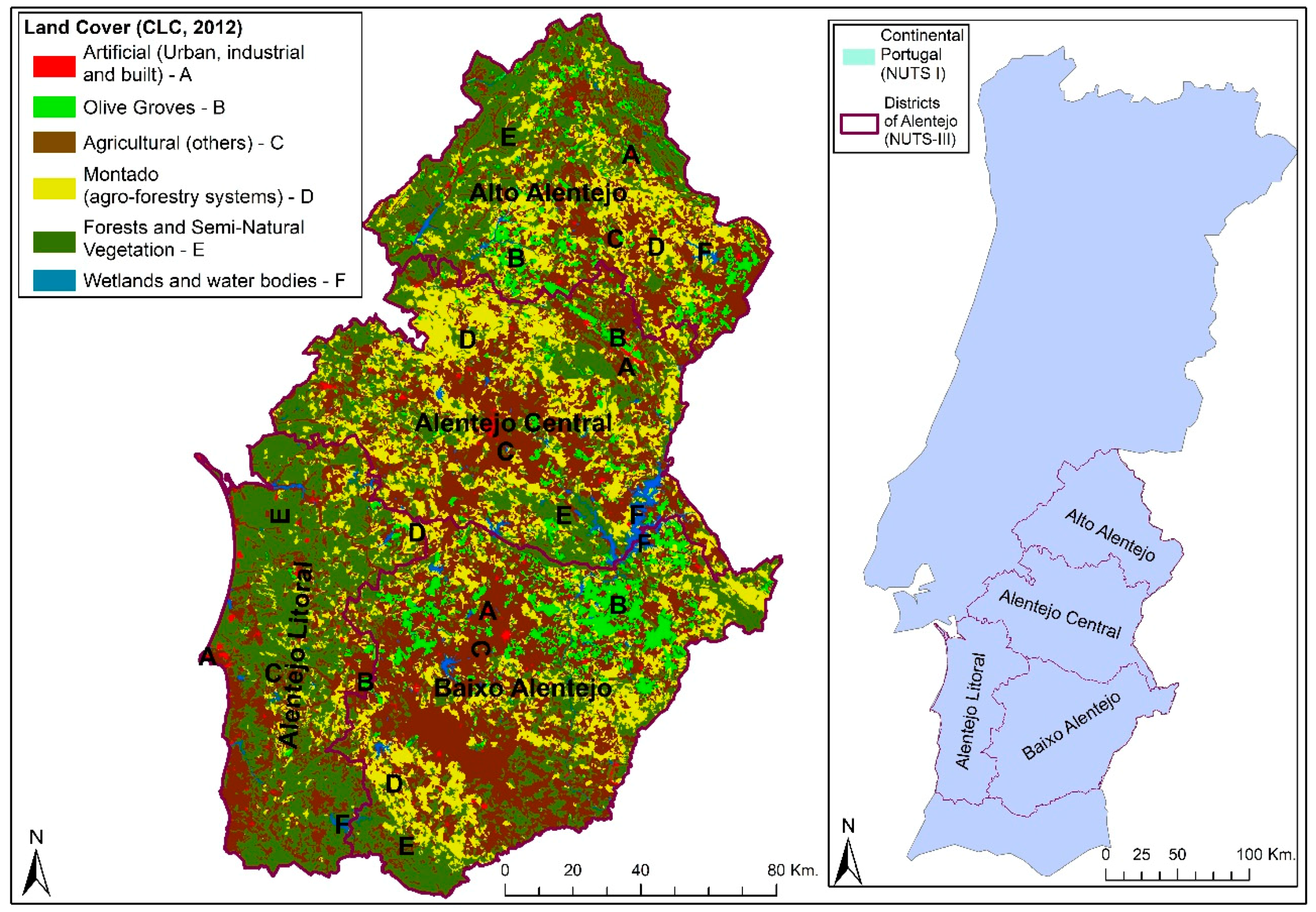
2.1. Case Study Description
2.2. The Public Policy Framework
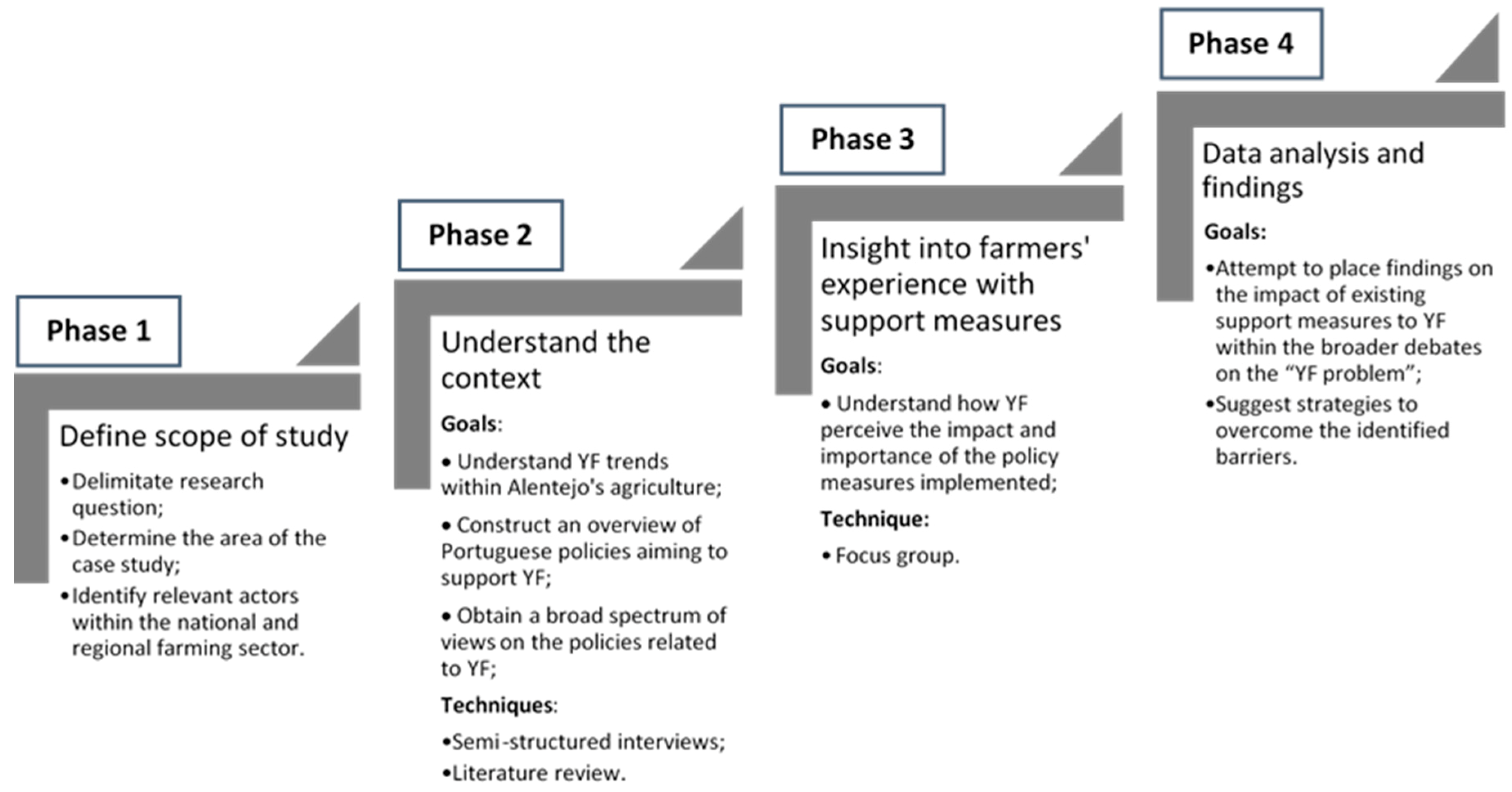
2.3. Research Design
- -
- Do you know the recent evolution of numbers of YF in Portugal? In Alentejo?
- -
- What is the profile of YF usually applying for existing support measures?
- -
- What barriers do YF face when attempting to set up a farm holding?
- -
- What support does your organization provide YF?
- -
- Which public support measures for YF are you aware of?
- -
- What type of technical support is there available for YF? Under what conditions?
- -
- Are the existing support measures appropriate to attract more young people to settle as farmers? Why?
- -
- Do you know the process to access support? How do you assess it?
- -
- Current YF policy measures:
- ◦
- To what extent have public support schemes and funds (CAP and others) been successful?
- ◦
- Why do you think the Portuguese government has opted for particular policy options?
- ◦
- Discuss differences in the suitability of the measures implemented under the previous RDP.
- -
- YF definition:
- ◦
- Is the current definition of YF appropriate for this country and region? If not, what would you change?
- ◦
- Are there particular types or notable characteristics of YF who are more likely to access supports (e.g. gender, age, successors versus ex novo, individuals versus couples or groups)?
- ◦
- Is there a specific sub-group of YF which does not qualify for funding? If yes, what are the characteristics of this group and what would be an appropriate type of funding scheme for them?
- -
- YF challenges:
- ◦
- What are the main challenges faced by YF?
- ◦
- Which of these challenges are sufficiently addressed by existing funding schemes? Which are not?
- -
- Improving schemes:
- ◦
- Roughly what percentage of eligible farmers do you think are applying for YF supports? Is this a good outcome? Why?
- ◦
- What types of alternative schemes would improve support for YF?
- ◦
- How do you think access to finance can be improved?
- ◦
- How do you think access to land can be improved?
2.4. Limitations and Uncertainties
3. Results and Discussion
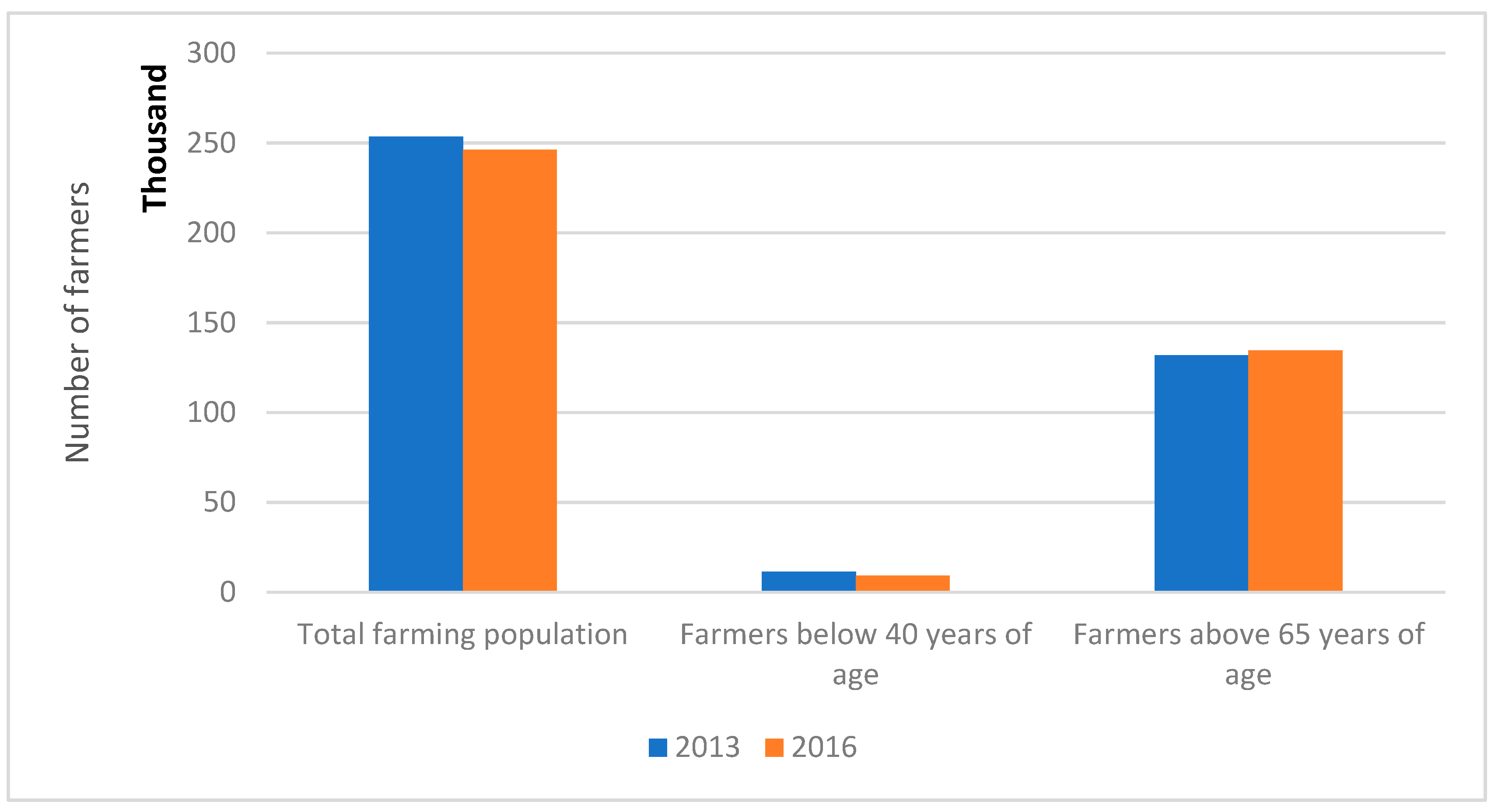
3.1. Recent Evolution of Portuguese Farming Population
3.2. Barriers to Set-Up
3.3. Evaluation of Support Measures and Recommendations
4. Conclusions
Author Contributions
Funding
Acknowledgments
Conflicts of Interest
References
- Zagata, L.; Sutherland, L.-A. Deconstructing the ‘young farmer problem in Europe’: Towards a research agenda. J. Rural Stud. 2015, 38. [Google Scholar] [CrossRef]
- CEJA. Young Farmers Are Key in the Future CAP. 2017. Available online: http://www.ceja.eu/wp-content/uploads/2017/05/Final-Young-Farmers-are-Key-in-the-Future-CAP-BW.pdf (accessed on 15 April 2018).
- Eurostat. Farm Structure Survey 2013—Main Results. 2015. Available online: http://ec.europa.eu/eurostat/statistics-explained/index.php/Farm_structure_survey_2013_-_main_results (accessed on 3 April 2018).
- European Commission. Young Farmers in the EU—Structural and Economic Characteristics. EU Agricultural Economic Briefs, Brief nº 15—Oct 2017. 2017. Available online: https://ec.europa.eu/agriculture/sites/agriculture/files/rural-area-economics/briefs/pdf/015_en.pdf (accessed on 3 April 2018).
- Leonard, B.; Kinsella, A.; O’Donoghue, C.; Farrell, M.; Mahon, M. Policy drivers of farm succession and inheritance. Land Use Policy 2016, 61. [Google Scholar] [CrossRef]
- Sutherland, L.-A.; Dranhofer, I.; Wilson, G.; Zagata, L. (Eds.) Transition Pathways towards Sustainability of Agriculture: Case Studies from Europe; CAB International: Wallingford, UK, 2015; p. 246. ISBN 978-178-064-219-2. [Google Scholar]
- Howley, P.; O’Donoghue, C.; Heanue, K. Factors affecting farmers adoption of agricultural innovations: A panel data analysis of the use of artificial insemination among dairy farmers in Ireland. J. Agric. Sci. 2012, 4. [Google Scholar] [CrossRef]
- Gonzalez, J.; Benito, C. Profession and identity. The case of family farming in Spain. Sociol. Rural. 2001, 41. [Google Scholar] [CrossRef]
- McDonald, R.; Macken-Walsh, A.; Pierce, K.; Horan, B. Farmers in a deregulated dairy regime: Insights from Ireland’s new entrants Scheme. Land Use Policy 2014, 41. [Google Scholar] [CrossRef]
- Vesala, H.T.; Vesala, K.M. Entrepreneurs and producers: Identities of Finnish farmers in 2001 and 2006. J. Rural Stud. 2010, 26. [Google Scholar] [CrossRef]
- Mili, S.; Martínez-Veja, J. Accounting for Regional Heterogeneity of Agricultural Sustainability in Spain. Sustainability 2019, 11, 299. [Google Scholar] [CrossRef]
- Duckett, D.; Feliciano, D.; Martin-Ortega, J.; Munoz-Rojas, J. Tackling wicked environmental problems: The discourse and its influence on praxis in Scotland. Landsc. Urban Plan. 2016, 154. [Google Scholar] [CrossRef]
- Zagata, L.; Hrabák, J.; Lošťák, M.; Bavorová, M. Research for AGRI Committee—Young Farmers—Policy Implementation after the 2013 CAP Reform. Policy Department for Structural and Cohesion Policies, European Parliament. 2017. Available online: http://www.europarl.europa.eu/RegData/etudes/STUD/2017/602006/IPOL_STU(2017)602006_EN.pdf (accessed on 3 April 2018).
- Williams, F. Barriers Facing New Entrants to Farming—An Emphasis on Policy; Land Economy Working Paper Series, Land Economy Research Group; SAC Aberdeen: Aberdeen, UK, 2006. [Google Scholar]
- Van Rompaey, A.; Dendoncker, N. Modelling Farm Growth and Its Impact on Agricultural Land Use: A Country Scale Application of an Agent-Based Model. Land 2018, 7, 109. [Google Scholar] [CrossRef]
- Matthews, A. Wasting Money on Young Farmers? CAP Reform.eu. 2013. Available online: http://capreform.eu/wasting-money-on-young-farmers/ (accessed on 3 April 2018).
- Zagata, L.; Lošťák, M. Farming Transitions: Pathways towards Regional Sustainability of Agriculture in Europe. WP4 Final Report. 2013. Available online: http://www.fao.org/family-farming/detail/en/c/379413/ (accessed on 24 April 2018).
- Kerbler, B. Factors affecting farm succession: The case of Slovenia. Agric. Econ. 2012, 58, 258–298. [Google Scholar] [CrossRef]
- Turner, B.L., II; Lambin, E.F.; Reenberg, A. The emergence of land change science for global environmental change and sustainability. Proc. Natl. Acad. Sci. USA 2007, 104, 20666–20671. [Google Scholar] [CrossRef]
- Aspinall, R.; Staiano, M. A Conceptual Model for Land System Dynamics as a Coupled Human–Environment System. Land 2017, 6, 81. [Google Scholar] [CrossRef]
- EIP-AGRI. New Entrants into Farming: Lessons to Foster Innovation and Entrepreneurship. Final Report. 2016. Available online: https://ec.europa.eu/eip/agriculture/sites/agri-eip/files/eip-agri_fg_new_entrants_final_report_2016_en.pdf (accessed on 3 April 2018).
- Hodge, I. (Ed.) The Governance of the Countryside. Property, Planning and Policy; Cambridge University Press: Cambridge, UK, 2016; p. 392. ISBN 978-052-162-396-4. [Google Scholar]
- Flyvbjerg, B. (Ed.) Making Social Science Matter: Why Social Inquiry Fails and How It Can Succeed Again; Cambridge University Press: Cambridge, UK, 2001; p. 14. ISBN 978-052-177-568-7. [Google Scholar]
- Šūmane, S.; Kunda, I.; Knickel, K.; Strauss, A.; Tisenkopfs, T.; Rios I des, I.; des Ios Rios, I.; Rivera, M.; Chebach, T.; Ashkenazy, A. Local and farmers’ knowledge matters! How integrating informal and formal knowledge enhances sustainable and resilient agriculture. J. Rural Stud. 2018, 59. [Google Scholar] [CrossRef]
- Governo da República Portuguesa. Portaria n.º 57/2015, de 27 de fevereiro, in Diário da República, 1st Series, n. 41, 27th February 2015. 2015. Available online: https://www.portugal2020.pt/Portal2020/Media/Default/Docs/Legislacao/RegEsp2020/Portaria57_2015.pdf (accessed on 3 April 2018).
- Silveira, A.; Ferrão, J.; Munoz-Rojas, J.; Pinto-Correia, T.; Guimarães, H.; Schmidt, L. The sustainability of agricultural intensification in the early 21st century: Insights from olive oil production in Alentejo (Southern Portugal). In Chainging Societies: Legacies and Challenges. The Diverse Worlds of Sustainability; Nunes de Almeida, A., Ed.; Imprensa de Ciências Sociais: Lisbon, Portugal, 2018; Volume 3, pp. 247–275. [Google Scholar]
- Copus, A. (Ed.) EDORA European Development Opportunities for Rural Areas; Final Report. Parts A, B and C. August 2011; European Spatial Planning Observation Network, 2011; ISBN 978-99959-684-1-0. Available online: https://www.espon.eu/programme/projects/espon-2013/applied-research/edora-european-development-opportunities-rural-areas (accessed on 3 April 2018).
- European Environmental Agency. Copernicus Land Service: Pan-European Component: The Corine Land Cover 2012. Available online: http://snig.dgterritorio.pt/geoportal/catalog/search/resource/detailsPretty.page?uuid=%7BF1C76231-BF01-4F3A-97E7-3C89567832B1%7D (accessed on 19 January 2019).
- Pinto-Correia, T.; Ribeiro, N.; Sá-Sousa, P. Introducing the montado, the cork and holm oak agroforestry system of Southern Portugal. Agrofor. Syst. 2011, 82. [Google Scholar] [CrossRef]
- Cancela d’Abreu, A.; Pinto-Correia, T.; Oliveira, R. (Eds.) Contributos para a Identificação e Caracterização da Paisagem em Portugal Continental; Colecção Estudos 10; DGOT-DU: Lisbon, Portugal, 2004; Volume 5, ISBN 978-972-856-928-0. [Google Scholar]
- Carvalho-Ribeiro, S.; Madeira, L.; Pinto-Correia, T. Developing comprehensive indicators for monitoring rural policy impacts on landscape in Alentejo, southern Portugal. Geografisk Tidsskrift-Danish J. Geogr. 2013, 113. [Google Scholar] [CrossRef]
- Pinto-Correia, T.; Azeda, C. Public policies creating tensions in Montado management models: Insights from farmers’ representations. Land Use Policy 2017, 64, 76–82. [Google Scholar] [CrossRef][Green Version]
- Pinto-Correia, T.; Almeida, M.; Gonzalez, C. Transition from production to lifestyle farming: New management arrangements in Portuguese small farms. Int. J. Biodivers. Sci. Ecosyst. Serv. Manag. 2017, 13. [Google Scholar] [CrossRef]
- Meneses, B.; Reis, E.; Vale, M.J.; Reis, R. Modelling land use and land cover changes in Portugal: A multi-scale and multi-temporal approach. Finisterra 2018, LIII, 107. [Google Scholar] [CrossRef]
- Taboadela, O.; Maril, M.; Lamella, C. La superdiversidad migratoria en el medio rural: Odemira, alentejo, un estudio de caso. Finisterra 2018, 107. [Google Scholar] [CrossRef]
- Kvale, S. Interviews. An Introduction to Qualitative Research Interviewing; Sage Publications: London, UK, 2006; p. 326. ISBN 978-080-395-820-3. [Google Scholar]
- Guest, G.; MacQueen, K.M.; Namey, E.E. Applied Thematic Analysis; Sage Publications: London, UK, 2012; p. 320. ISBN 978-141-297-167-6. [Google Scholar]
- INE-Instituto Nacional de Estatísticas. Inquérito à Estrutura das Explorações Agrícolas 2016. 2017. Available online: http://www.drapal.min-agricultura.pt/drapal/images/servicos/noticias/2017/IEEA_2016.pdf (accessed on 30 April 2018).
- INE–Instituto Nacional de Estatísticas. Inquérito à Estrutura das Explorações Agrícolas 2013. 2014. Available online: https://www.ine.pt/ngt_server/attachfileu.jsp?look_parentBoui=223514519&att_display=n&att_download=y (accessed on 10 November 2018).
- Ortiz-Miranda, D.; Moragues-Faus, A.; Arnalte-Alegre, E. (Eds.) Agriculture in Mediterranean Europe. Between Old and New Paradigms; Research in Rural Sociology and Development: Emerald, UK, 2013; Volume 19, p. 315. ISBN 978-1-78190-597-5. [Google Scholar]
- Lobley, M. Succession in the family farm business. J. Farm Manag. 2010, 13, 839–851. [Google Scholar]
- Bika, Z. The Territorial Impact of the Farmers’ Early Retirement Scheme. Sociol. Rural. 2007, 47. [Google Scholar] [CrossRef]
- Sottomayor, M.; Tranter, R.; Costa, L. Likelihood of Succession and Farmers’ Attitudes towards their Future Behaviour: Evidence from a Survey in Germany, the United Kingdom and Portugal. Int. J. Soc. Agric. Food 2011, 18, 121–131. [Google Scholar]
- Romito, G.; Young People Perception of Rural Areas. A European Survey Carried Out in Eight Member States. L’agricoltura A Beneficio Di Tutti 2012. Available online: https://www.reterurale.it/flex/cm/pages/ServeBLOB.php/L/EN/IDPagina/9962 (accessed on 24 April 2018).
- Bonjean, I.; Mathijs, E. SUFISA Conceptual Framework: Institutional Arrangements. Internal Project Document. 2016; unpublished. [Google Scholar]
- Rede Rural Nacional—Grupo de Trabalho Temático: Organização da Produção: Organização de Produtores, Cooperativismo e Associativismo. Available online: http://www.rederural.gov.pt/images/Noticias/GruposTrabalho/GTT_OP_PlanoAcaoFinal.pdf (accessed on 2 April 2019).
- Vendryes, T. Peasants against private property rights: A review of the literature. J. Econ. Surv. 2012, 28. [Google Scholar] [CrossRef]
- Borras, S., Jr.; Franco, J.C. Contemporary Discourses and Contestations around Pro-Poor Land Policies and Land Governance. J. Agrar. Chang. 2010, 10. [Google Scholar] [CrossRef]
- Assies, W. Land tenure, land law and development: Some thoughts on recent debates. J. Peasant Stud. 2009, 36, 573–589. [Google Scholar] [CrossRef]
- Medeiros, E. Is there a rise of the territorial dimension in the EU cohesion policy? Finisterra 2016, 103, 89–112. [Google Scholar] [CrossRef]

| CAP regulatory framework | Pilar I | YF Direct Payment | 25% top-up of the annual basic payment |
| Pilar II | YF Start-up aid | 20,000€ non-refundable start-up aid | |
| Investment Support | 10% bonus for YF | ||
| Training and counselling support | Support to private institutions which provide training sessions or advisory services to YF | ||
| YF application bonification within other schemes | |||
| National policies | CAJA | Monitor and analyse barriers and policies linked to YF | |
| Land Bank | Priority given to YF for State owned lands | ||
| Positive | Public support and funds are vital, allowing for an initial investment that would be inaccessible through private agencies. |
| Required business plan contributes to assuring viability of the holding. | |
| Training requirements provide farmers with a higher level of technical knowledge. | |
| Negative | Insufficient funds: |
| - When funds run out, many applications evaluated as positive are excluded from support. | |
| - Support on investment does not include VAT (Value-Added-Tax). | |
| - Instalment payments (Pillar II) are insufficient to cover kick-off costs. | |
| Outdated method used to calculate Pillar I direct payments (based on productivity estimates from 2001–2003). | |
| Lack of measures supporting access to credit. | |
| Technically and administratively difficult application process. | |
| Evaluation method has poor link to farming reality. | |
| Long and uncertain application process: during this period farmers need to supply money upfront (uncertain of whether it will ever be reimbursed). | |
| Land listed in the Land Reservoir is insufficient, remote, often expensive, and often with poor soils. | |
| Existing supports benefit farmers with higher investment capacity: | |
| - Only YF with access to private funds can get bonification from being dedicated exclusively to farming. | |
| - Increased support depending on previous investments is, in practical terms, only available to farmers with higher investment capacity. |
© 2019 by the authors. Licensee MDPI, Basel, Switzerland. This article is an open access article distributed under the terms and conditions of the Creative Commons Attribution (CC BY) license (http://creativecommons.org/licenses/by/4.0/).
Share and Cite
Eistrup, M.; Sanches, A.R.; Muñoz-Rojas, J.; Pinto Correia, T. A “Young Farmer Problem”? Opportunities and Constraints for Generational Renewal in Farm Management: An Example from Southern Europe. Land 2019, 8, 70. https://doi.org/10.3390/land8040070
Eistrup M, Sanches AR, Muñoz-Rojas J, Pinto Correia T. A “Young Farmer Problem”? Opportunities and Constraints for Generational Renewal in Farm Management: An Example from Southern Europe. Land. 2019; 8(4):70. https://doi.org/10.3390/land8040070
Chicago/Turabian StyleEistrup, Mathias, Ana Rita Sanches, José Muñoz-Rojas, and Teresa Pinto Correia. 2019. "A “Young Farmer Problem”? Opportunities and Constraints for Generational Renewal in Farm Management: An Example from Southern Europe" Land 8, no. 4: 70. https://doi.org/10.3390/land8040070
APA StyleEistrup, M., Sanches, A. R., Muñoz-Rojas, J., & Pinto Correia, T. (2019). A “Young Farmer Problem”? Opportunities and Constraints for Generational Renewal in Farm Management: An Example from Southern Europe. Land, 8(4), 70. https://doi.org/10.3390/land8040070

