Article

Land-Use Regulation and Regional Economic Performance: Evidence from County-Level Data in China

1
College of Economics and Management, Nanjing Agricultural University, Nanjing 210095, China
2
School of National Audit, Nanjing Audit University, Nanjing 211815, China
3
Research Center of the General Administration of Customs of the People’s Republic of China, Beijing 100730, China
*
Author to whom correspondence should be addressed.
Land 2026, 15(3), 441; https://doi.org/10.3390/land15030441
Submission received: 30 January 2026 / Revised: 28 February 2026 / Accepted: 6 March 2026 / Published: 10 March 2026

Abstract

Against the macro-background of balancing development and food security strategies, China has implemented a land-use regulation system centered on farmland protection. However, the economic impacts of such regulation lack sufficient quantitative evaluation. Using farmland retention targets at the county-level in the administrative region and combining them with relevant data, this study employs an Intensity Difference-in-Differences (Intensity DID) approach to examine how land-use regulation affects county-level economic growth and convergence. The findings reveal a U-shaped relationship between land-use regulation and county-level economic growth, suggesting that, at the current stage, the intensity of land-use regulation generally promotes economic growth. Heterogeneity analysis further indicates that county economies in major grain production areas (MGPAs) and main grain-producing counties (MGPCs) experience stronger negative constraints related to the policy, while MGPCs in non-major grain production areas (non-MGPAs) are most sensitive to land-use regulation. China’s county economies exhibit convergence; however, land-use regulation may reduce the growth rate of counties that were underdeveloped in the base period, thereby widening inter-county development disparities. This divergence is manifested in the lack of convergence between the clubs of MGPCs and non-MGPCs. Mechanism analysis suggests that differences in industrial structure, capital investment, and fiscal expenditure constitute the key focal points for addressing the issue. Policy implications indicate that China should strengthen land-use regulation on the premise of rationally determining the functions and scale of various land types, continue to advance market-oriented reforms of land factors, improve the vertical and horizontal interest compensation mechanism for MGPAs, and stimulate the endogenous development momentum of these regions.

1. Introduction

Since China launched its reform and opening-up in 1978, the economy has experienced rapid growth, to which competition among peer local governments has made a significant contribution. Regional economic performance is a core criterion in the promotion of government officials, leading to a strong focus on economic outcomes. Meanwhile, under China’s tax-sharing fiscal system, local governments are required to remit a substantial share of tax revenues to the central government. Driven jointly by promotion incentives and fiscal pressures, local governments have increasingly relied on land resources to fuel economic growth. They boost industrialization by transferring industrial land at low prices, while supporting urbanization through high-priced transfers of commercial and residential land, as well as land-mortgaged financing [1,2]. This approach generates huge amounts of land transfer fees and expands the local tax base. However, this extensive land-use model has caused severe resource misallocation and heightened systemic risks, rendering it ultimately unsustainable [3]. Its adverse effects are mainly reflected in two key aspects: first, the massive loss of high-quality cultivated land poses a direct threat to national food security, which is the fundamental foundation for high-quality economic development; second, the unconstrained supply of construction land leads to low utilization efficiency and severe waste of land resources.
Thus, strengthening land-use regulation and achieving intensive land supply have become an inevitable choice. The central government has set a minimum cultivated land retention target of 120 million hectares (1.8 billion mu) to feed the 1.4 billion people and has progressively assigned this target to local governments at all levels. Through successive legislative revisions, this policy has been endowed with legal validity and mandatory enforcement, and the results of cultivated land protection have been incorporated into official performance evaluations. This institutional arrangement serves the dual objectives of safeguarding national food security and improving the output efficiency of construction land. However, given China’s complex climatic conditions and pronounced regional differences in suitable crop varieties and cropping systems, substantial disparities have emerged in the cultivated land retention tasks assigned across regions. Regional variations in the allocation of cultivated land retention targets lead to heterogeneous effects on regional economic development. Against this backdrop, the question of how to achieve coordinated regional development and integrated urban–rural development has become a critical and pressing issue.
Existing research on the economic effects of land-use regulation remains inconclusive. Early provincial-level studies indicate that provinces with large agricultural or ecological spaces, such as major grain production areas [4,5], face tighter constraints on construction land supply due to heavier obligations in food production or ecological protection, which in turn may hinder regional economic development [6]. Heterogeneity in regulatory intensity across provinces has also led to disparities in regional economic development and people’s well-being [7]. Evidence at the county level points to similar outcomes. An empirical study of 82 counties in Hubei Province finds that stronger territorial space regulation reduces the land factors available to local governments, weakens regional competitiveness, and widens development gaps between counties [8,9]. In contrast, city-level research shows that tighter constraints on construction land supply can reshape local governments’ land allocation behaviors [10] by reducing excessive industrial land supply, enhancing the marketization of land factors, mitigating factor misallocation, and improving macro total factor productivity [11].
Overall, the existing literature leaves considerable room for improvement: (1) Most studies adopt provincial or municipal-level units, which may obscure intra-regional heterogeneity and weaken the credibility of conclusions. County-level data drawn from a single province also limits generalizability at the national level. (2) Few empirical studies explore the impact of land-use regulation on regional economic development disparities and their underlying mechanisms. County-level economies account for nearly 40% of China’s total economic output and involve hundreds of millions of residents. Fully leveraging the bridging and driving roles of counties and advancing new-type urbanization are crucial for narrowing urban–rural disparities and achieving common prosperity. Thus, it is imperative to investigate the impact of land-use regulation on regional economic development at the county level.
This study collects mandatory cultivated land retention targets for counties from the National General Land Use Plan (2006–2020) and exploits the 2010 “Dual Protection Project” inspection as a quasi-natural experiment for land-use regulation. An Intensity Difference-in-Differences (Intensity DID) model is constructed using panel data from 1969 counties nationwide spanning 2006–2022. The analysis examines the impact of land-use regulation on county-level economic growth and convergence and investigates its underlying mechanisms from the perspectives of industrial structure, capital investment, and fiscal expenditure. Compared with existing research, this paper makes three marginal contributions. First, it manually compiles cultivated land retention targets and lists of MGPCs for 1969 counties nationwide, constructing a unique dataset that enriches studies on the impact of land-use planning policies on regional economic development. Second, by focusing on counties nationwide, it analyzes the impact of land-use regulation on regional economic growth and convergence at a more micro level. Third, it systematically investigates the effects of land-use regulation on county economic growth, identifies its heterogeneous impacts in MGPAs and MGPCs, and clarifies its influence on county economic convergence and the underlying mechanisms. Overall, these findings provide insights for improving the vertical and horizontal interest compensation mechanism for MGPAs and for advancing the national strategy of balancing development and food security.

2. Materials and Methods

2.1. Policy Background

Land ownership in China falls into two categories: rural land under collective ownership and urban land owned by the state. As stipulated in the Land Administration Law of the People’s Republic of China, rural collective land cannot be directly utilized for urban construction; it must first be converted into state-owned land before being allocated or transferred in the name of the state. Both the revenues from land transfers and indirect tax revenue derived from land-use conversion accrue to local governments, giving them a competitive advantage in inter-jurisdictional competition. Consequently, local governments have strong incentives to acquire more land eligible for transfer. In this process, the costs of reclaiming existing construction land are significantly higher than those of converting agricultural land into construction land, while the conversion of high-quality cultivated land is easier to implement. As a result, agricultural land, particularly cultivated land, has become the primary source of newly supplied construction land.
According to the 2005 China Land-Use Change Survey conducted by the Ministry of Natural Resources, China’s per capita cultivated land area was 0.093 hectares (1.4 mu), equivalent to only 40% of the world average. Protecting cultivated land has, thus, become the fundamental prerequisite for implementing China’s national food security strategy. The surge in demand for construction land, driven by rapid economic growth, has posed significant challenges to cultivated land protection. To address this, China conducts unified management of national land resources through the formulation of land-use master plans, supported by legal frameworks. The Land Administration Law explicitly stipulates that the state implements a land-use regulation system. Based primarily on land-use master plans, this system regulates agricultural land, construction land, and unused land. Its core objective is to safeguard cultivated land resources to ensure food security, strictly control the quantity of land for various uses through land quota plans, focus on restricting the conversion of agricultural land to non-agricultural uses, and maintain a dynamic balance of total cultivated land.
In October 2008, the State Council approved the National General Land Use Plan (2006–2020), which specified national cultivated land retention targets of 120.87 million hectares (1.813 billion mu) by 2010 and 120.33 million hectares (1.805 billion mu) by 2020. Under the plan, the national cultivated land retention targets were allocated to provinces, each of which was required to formulate its own local land-use master plan and distribute the targets to cities. Cities, in turn, further assigned the targets to counties. The total allocation to lower-level governments could not fall below the targets set for the higher level, and accountability mechanisms for officials in charge of governments at all levels [12] were incorporated into their performance evaluations. In 2009, the former Ministry of Land and Resources launched the “Ensure Growth and Protect the Red Line” campaign, aimed at balancing economic development with cultivated land protection. In 2010, this campaign was institutionalized as the “Dual Protection Project,” establishing a regular supervision mechanism. By the second half of 2009, the allocation of cultivated land retention targets to counties (districts, county-level cities, and banners) was basically completed, specifying the 2020 retention targets for county-level administrative regions. Variations in target allocation from higher-level governments resulted in varying intensities of policy shocks. Combined with the timing of the 2010 supervision under the “Dual Protection Project,” this laid the foundation for the subsequent quantitative analysis.

2.2. Hypothesis

From a temporal perspective, the impact of land-use regulation on economic growth is not a simple linear relationship; rather, it evolves dynamically with regulatory intensity. At low regulatory intensity, land use tends to expand in an unordered manner. On the one hand, a large amount of cultivated land is occupied to accommodate urban expansion during rapid urbanization; on the other hand, the costs of converting cultivated land remain relatively low. Between 2001 and 2017, agricultural land accounted for approximately 70% of newly added construction land, with conversions of cultivated land representing over 40%. The massive loss of high-quality cultivated land directly threatens food security, which serves as a prerequisite for social stability and regional economic development [13]. Meanwhile, chaotic construction land use has become prominent. The low or zero price transfer of industrial land to attract investment often draws numerous low-end enterprises, crowding out high-productivity firms and hindering the upgrading of regional industrial structures [14,15]. The lack of planning for industrial land not only wastes land resources but also prevents the formation of agglomeration effects. Similarly, the model of generating land finance revenue by transferring commercial and residential land at high prices [16] drives up costs, fuels excessive real estate development, and artificially inflates the share of the tertiary sector. To control costs, other service sector entities are forced to adopt energy-intensive and polluting production methods [17], which deteriorates the ecological environment and undermines sustainable economic development.
A reasonable regulatory intensity helps balance the goals of “protection” and “development.” In terms of factor allocation, scientifically delineating land-use types ensures the reasonable land-use needs of industry, agriculture, and the service sector, thereby enhancing the combined efficiency of land, labor, and capital. In the agricultural sector, land-use regulation safeguards the total area of cultivated land, with 80% designated as basic farmland for grain crop production, providing a fundamental guarantee for food security. Stable agricultural production, coupled with supporting industries such as agricultural product processing, injects momentum into county economic development. For the development of the secondary and tertiary industries, regulation significantly increases the cost of converting cultivated land into construction land. First, the accountability system for top local government officials induces greater caution in land allocation. Second, conversions exceeding the target must be compensated for through the mechanism of “balancing between occupation and compensation”, which raises the associated economic costs. Constraints on both the quantity and source structure of newly added construction land compel local governments to abandon extensive land-use practices and improve efficiency by adjusting land transfer behaviors. In 2006, Shaoxing County in Zhejiang Province pioneered an intensive land-use strategy of “evaluating performance by output per mu,” establishing an evaluation index system centered on indicators such as tax revenue per mu and output per unit of energy consumption, and prioritizing land supply to high-efficiency enterprises that met the prescribed standards. This model has since been scaled up and promoted nationwide. As a result, the prevalence of low-priced [18], excessive [19,20], and non-market-oriented [21] land supply has markedly decreased. These reforms have effectively mitigated land misallocation [22], prevented uncoordinated industrial layout [23], reduced efficiency losses caused by structural and quantitative deviations in land factor inputs [24], and facilitated industrial structure upgrading and improvements in economic efficiency. Moreover, cultivated land occupation and economic growth exhibit an inverted U-shaped relationship, akin to the Kuznets curve [25,26]. Economic development tends to be growth-oriented in its early stages, while shifting toward greater emphasis on coordinated and sustainable development as development advances.
Based on the above analysis, Hypothesis H1 is proposed:
H1. 
There is a U-shaped relationship between land-use regulation and county-level economic growth, with the direction of impact depending on the regulatory intensity interval. The current level of regulatory intensity is generally conducive to improving land-use efficiency, thereby fostering economic growth.
From a regional perspective, the intensity of land-use regulation varies significantly across different regions. Such variations shape both the direction of policy externalities at the regional and even plot level [27], as well as the overall effects on regional economic development [28]. Given China’s resource constraints—characterized by a large population and scarce land—the government optimizes land allocation and balances the dual objectives of food security and economic development by applying differentiated regulatory intensities across regions and land types. In an era when land transfer became a primary tool for local governments to promote economic growth, land-use regulation restricted industrial choices, thereby reducing land value and expected returns. Consequently, the effectiveness of cultivated land protection tended to be inversely related to regional economic growth [29,30]. At the provincial level, most MGPAs have implemented land-use regulations but remain relatively lagging in economic development. This outcome can be attributed to two main reasons: first, major producing regions possess favorable natural conditions and comparative advantages in agricultural production, making them more suitable for specialized cultivation; second, as designated by the central government, they bear the responsibility of ensuring national food security, with strict restrictions on converting cultivated land to other uses [31]. In contrast, major grain-consuming regions such as Beijing, Shanghai, and Tianjin have high levels of urbanization and land productivity, leading to high opportunity costs for cultivated land protection and weak motivation to enforce such measures. These regions can also mitigate policy constraints by purchasing “cultivated land occupation indicators,” resulting in weaker regulatory outcomes. For regions with balanced grain production and consumption, predominantly in the western part of China, policy implementation is similarly limited due to relatively underdeveloped agricultural conditions and slower economic growth [32,33]. Differences in land-use regulatory intensity have further widened gaps in regional economic development and people’s well-being. At the per capita GDP and basic public service levels, the development gap between major grain-producing and non-producing regions [34] is expanding, primarily due to insufficient construction land supply and underutilization of land value [35,36]. At the county level, major grain-producing counties generally face “grain–fiscal imbalance” and “grain–livelihood imbalance” [37]. Therefore, we must remain vigilant regarding the potential imbalances in regional economic development caused by land-use regulation [38,39], as sustainable regional economic development requires a careful balance between efficient land resource use and ensuring a fair competitive environment [40,41].
Based on the above analysis, we propose Hypothesis H2:
H2. 
The impact of land-use regulation on county-level economic growth displays significant regional heterogeneity. Specifically, core grain-producing counties tend to be subject to stronger negative impacts than non-core grain-producing counties, which further exacerbates the economic development gap among counties.

2.3. Model Construction

Due to differences in natural geography, terrain, and ecological conditions, there are significant gaps in crop cropping systems and suitable varieties across counties. Each county has been assigned distinct mandatory cultivated land retention targets, resulting in spatial variations in the intensity of land-use regulation shocks. These variations are largely determined by natural resource conditions exogenous to economic development. Following Tang and Shao [42] and Xie and Zhang [11], we adopt the Intensity Difference-in-Differences (Intensity DID) approach to identify the impact of land-use regulation on county-level economic growth.
We construct a proxy variable for the intensity of construction land supply constraints imposed by land-use regulation (denoted as T i g h t i ) by subtracting the actual cultivated land area in 2009 from the 2020 cultivated land retention target, then dividing by the administrative area of each county:
T i g h t i = 2020   Cultivated Land Retention Target i     2009   Actual Cultivated Land Area i A d m i n i s t r a t i v e   A r e a i
A negative numerator indicates that a county’s cultivated land protection target for the period of 2009–2020 was lower than its base-year stock, meaning a certain amount of cultivated land could be occupied (primarily for conversion to construction land). A positive numerator means the county was required to meet the obligation of supplementing cultivated land over the same period. In general, a larger value of Tight signifies less available space for the new occupation of cultivated land at the county level, and even a requirement to supplement cultivated land through alternative means. This imposes stricter constraints on the supply of construction land and reflects a higher intensity of cultivated land regulation faced by local economic development.
Furthermore, the T i g h t i index captures quantitative land supply restrictions and regional disparities but lacks time variation. Thus, we use the 2010 “Dual Protection Project” inspection launched by the Ministry of Land and Resources as the policy shock point, and define a time dummy variable P o s t t (equal to 0 for t < 2010 and 1 for t 2010 ).
Based on this, the Intensity DID model is specified as follows:
ln y i , t y i , t 1 = α + β   R e g u l a t i o n i , t + γ X i t + μ i + σ t + ε i t
Dependent variable ln y i , t y i , t 1 is the growth rate of real per capita GDP at the county level, where y i , t and y i , t 1 represent the real per capita GDP of county i in period t and the lagged period t 1 (nominal GDP is deflated using provincial GDP indices with 2006 as the base year). The independent variable R e g u l a t i o n i , t is the interaction term between land-use regulation intensity ( T i g h t i ) and the time dummy ( P o s t t ). The control variables X i t include economic and social variables such as industrial structure (see Table 1 for details). μ i is the county fixed effects. σ t is the year fixed effects. Those two are to control for unobservable county-specific and time-varying macro-shocks. The residual term ε i t is with standard errors clustered at the county level.
The existing literature presents divergent theoretical perspectives on regional economic convergence. The neoclassical growth theory [43] assumes homogeneous production functions and stable factor endowments across economies. Driven by the law of diminishing marginal returns to capital, it predicts that backward regions will grow faster than developed regions, ultimately achieving absolute convergence. Subsequent theoretical developments extend this framework to conditional convergence, emphasizing the need to control for exogenous variables, which suggests that convergence occurs only under a set of specific conditions. It further evolves into club convergence, which argues that regions with similar initial conditions (such as geographic location and resource endowments) will form local convergence clubs.
In contrast, the endogenous growth theory [44,45] endogenizes technological externalities and specialized division of labor, highlighting that these factors can lead to increasing marginal returns to capital in developed regions, thereby widening regional economic disparities. From the perspective of new economic geography [46], rooted in increasing returns to scale and transportation costs, developed regions attract significant investment, leading to industrial agglomeration and emerging polarization, which results in persistent unbalanced growth across regions. Grounded in Keynesianism, the government intervention theory contends that policies may either facilitate convergence through resource reallocation or exacerbate regional divergence due to unbalanced policy orientation [47].
The core divergence among these theories stems from differing perceptions of capital returns, spatial effects, and the role of government, yet they all center on factor allocation and steady-state growth. This study adopts the neoclassical growth theory as its empirical framework for three key reasons. First, it offers a sufficiently flexible and compatible benchmark that can integrate the insights of other schools of thought, including technological progress, agglomeration effects, and policy interventions. Second, this compatibility allows for a comprehensive examination of how land-use regulation impacts county-level economic convergence, providing a solid theoretical foundation for the subsequent empirical analysis.
Under the neoclassical growth theory, the core mechanism of β-convergence stems from the law of diminishing marginal returns to capital. Regions with lower initial per capita GDP tend to grow faster due to higher marginal product of capital, resulting in a negative correlation between per capita GDP growth rate and initial per capita GDP (i.e., β < 0). To examine the convergence characteristics of China’s county economies, we follow Barro and Sala-I-Martin [30] and construct the absolute β-convergence model:
ln y i , t y i , t 1 = α + β ln y i , t 1 + γ ln y i , t 1 y i , t 2 + ε i t
Here, ln y i , t 1 is the natural logarithm of lagged real per capita GDP, expected to have a negative coefficient indicating convergence. ln y i , t 1 y i , t 2 is the lagged economic growth rate to control for growth inertia.
Heterogeneities in resource endowments and institutional constraints may lead economies to form “clubs” with internal convergence toward distinct steady states.
In 2009, the State Council issued the National Plan for Increasing Grain Production Capacity by 50 Billion Kilograms (2009–2020), which first classified counties into MGPCs and non-MGPCs. Given potential differences in steady states between these two groups, we test club convergence by adding a group dummy variable M G P C i (1 for main grain-producing counties, and 0 otherwise) to Equation (2), following Dai and Mao [48].
Absolute convergence assumes identical steady states across all economies, ignoring structural heterogeneities. In practice, steady states vary with physical capital, human capital, and institutional environments. To address this, we test conditional convergence by including lagged control variables X i , t 1 , along with county and year fixed effects.
The core of narrowing county-level development gaps and achieving balanced regional development lies in promoting conditional β-convergence of county economies. That is, by improving steady-state conditions such as factor allocation efficiency and institutional environment, relatively underdeveloped regions can achieve faster economic growth. To identify the impact of land-use regulation on conditional β-convergence, we extend the model by incorporating the interaction between land-use regulation intensity and initial economic development level:
ln y i , t y i , t 1 = α + β   R e g u l a t i o n i , t 1 × ln y i , t 1 + β 1   R e g u l a t i o n i , t 1 +   β 2 ln y i , t 1 + β 3 ln y i , t 1 y i , t 2 + γ X i , t 1 + μ i + σ t + ε i t
In Equation (3), R e g u l a t i o n i , t 1 × ln y i , t 1 is the interaction term between lagged land-use regulation intensity and initial per capita GDP, with coefficient β capturing the policy’s impact on convergence. Lagged R e g u l a t i o n i , t 1 is added to mitigate reverse causality. The lagged county-level real per capita GDP ( ln y i , t 1 ) is used to control for the initial economic development level of the county. ln y i , t 1 y i , t 2 captures the path dependence of economic growth. Lagged economic and social variables X i , t 1 are incorporated to control for conditional convergence, in line with heterogeneous steady states. County fixed effects ( μ i ) are included to absorb time-invariant heterogeneity, while year fixed effects ( σ t ) filter out macroeconomic cycle shocks. ε i t denotes the residual term, with standard errors clustered at the county level to address serial correlation and heteroscedasticity.

2.4. Data Sources

This study covers a sample period of 2006–2022, including 1969 counties (districts, county-level cities, and banners) in China, accounting for over 85% of the total county-level administrative units nationwide. Core socioeconomic indicators at the county level (e.g., GDP, industrial structure, and fiscal expenditure) are mainly collected from the China County Statistical Yearbook (various years) and provincial-level County Statistical Yearbooks (various years), ensuring consistency with national statistical standards. Provincial GDP indices are obtained from the official website of the National Bureau of Statistics (NBS) and used to deflate nominal GDP to real GDP with 2006 as the base year. For the land-use regulation intensity indicator, the 2020 cultivated land retention target data for each county are manually collected and collated from the National General Land Use Plan (2006–2020), publicly released on the official websites of municipal governments. Population density data are derived from the LandScan Global Population Dynamics Database. Using the unified 1:4,000,000 national fundamental geographic information system (GIS) administrative boundary vector layer, resident population data within each county’s administrative area are extracted and divided by the administrative area to calculate the average county-level population density. The number of patent grants is sourced from the Patent Database of the National Intellectual Property Administration (CNIPA), covering invention, utility model, and design patents authorized during the sample period. The list of MGPCs is manually compiled from public information released on the official websites of local agricultural and rural bureaus, finance bureaus, and other government departments, ensuring alignment with national and provincial grain production classification standards.

3. Results and Discussion

3.1. The Impact of Land-Use Regulation on County Economic Growth

3.1.1. Baseline Regression Results

Columns (1)–(3) of Table 2 report the baseline regression results regarding the impact of land-use regulation on county-level economic growth. In Column (1), without including fixed effects and control variables, the coefficient of R e g u l a t i o n i , t is 0.049, which is significant at the 1% level, indicating an initial positive correlation. Column (2) incorporates control variables, and the coefficient of R e g u l a t i o n i , t remains stable, with the model’s explanatory power increasing from 0.008 to 0.02, suggesting that control variables partially absorb heterogeneity. Column (3) further includes county and year fixed effects, and the coefficient rises to 0.051, with the model’s explanatory power improved further. The regression results of the first three columns all indicate that land-use regulation significantly promotes county-level economic growth. Column (4) introduces the squared term of land-use regulation ( R e g u l a t i o n i , t 2 ), and the results of the quadratic regression show that the impact of land-use regulation intensity on county-level economic growth presents a U-shaped relationship. The inflection point is at a regulation intensity of −0.328, thus supporting Hypothesis H1.

3.1.2. Robustness Tests

First, we adopt the dynamic coefficient method to test the parallel trend assumption of the Intensity Difference-in-Differences (Intensity DID) model. Specifically, we define a year dummy variable y e a r t k (equal to 1 if t = k , and 0 otherwise), and incorporate the interaction term between y e a r t k and the land-use regulation intensity variable T i g h t i into the regression equation. The model is specified as follows:
ln y i , t y i , t 1 = α + k = 2007 2022 β k T i g h t i × y e a r t k + γ X i t + μ i + σ t + ε i t
Our sample period spans 2006–2022, with 2010 as the policy shock year, denoted by the red vertical dashed line. To avoid noise from long-term dynamic effects due to policy fatigue, we use a time window merging approach: years 2014 and beyond are combined into a single dummy variable. We take 2006 (the start of the sample) as the reference year (hence, its coefficient is omitted in the results). The regression coefficients are reported in Figure 1. Before the policy implementation, none of the corresponding dynamic coefficients were significant, confirming the parallel trend assumption. After the policy was adopted, land-use regulation significantly promoted county-level economic growth during 2010–2013, while the impact weakened slightly in 2014 and subsequent years.
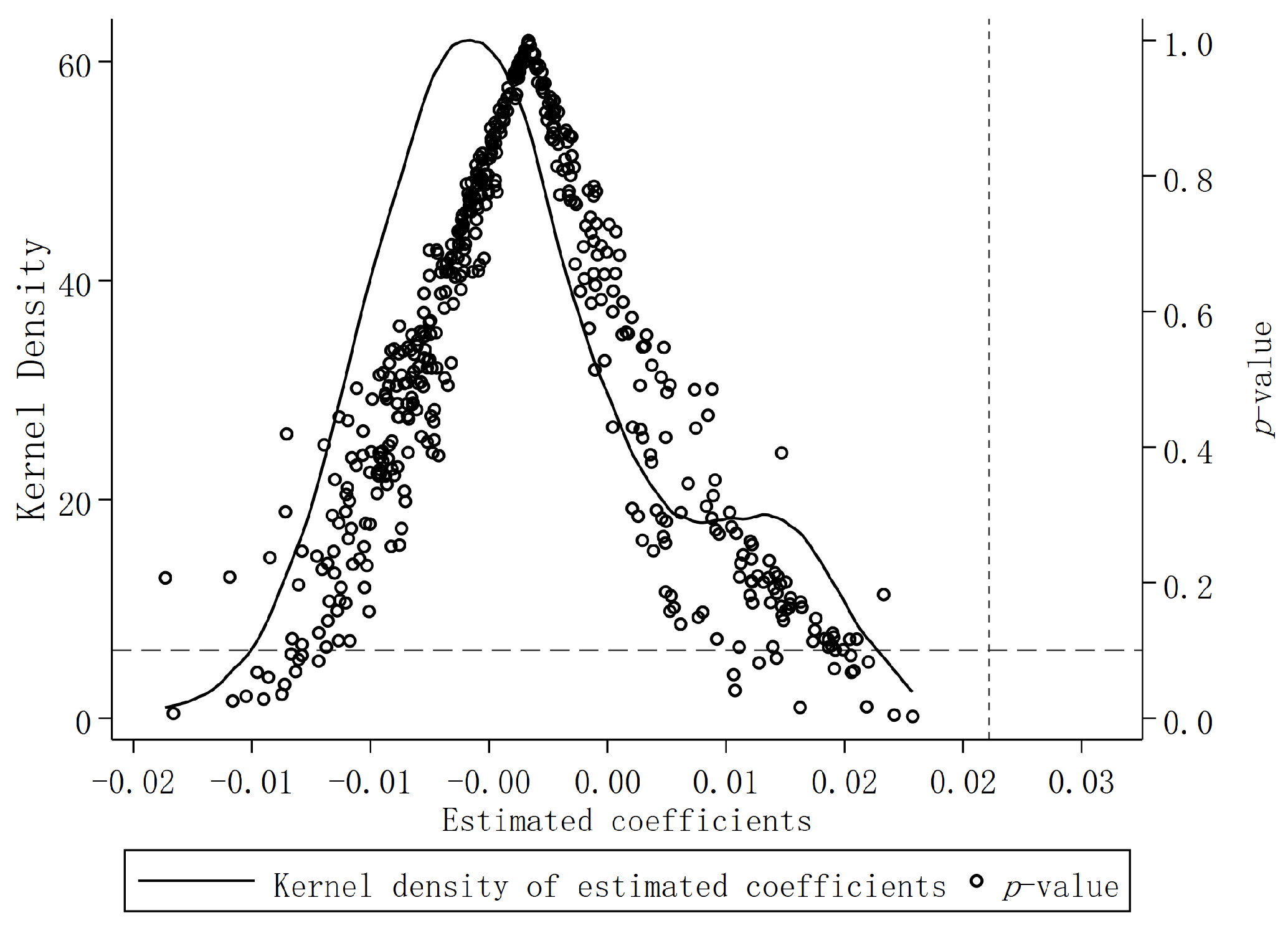
Second, a mixed placebo test is implemented to mitigate omitted variable bias and re-examine the policy effect of land-use regulation. Following the specification in Column (3) of Table 2, 500 iterative placebo regressions are performed, and the distribution of placebo effects is shown in Figure 2 [49]. The horizontal axis depicts the estimated placebo coefficients. The left vertical axis represents the kernel density of these placebo coefficients, while the right vertical axis indicates the corresponding p values of the estimates. The actual estimated treatment effect is 0.021, marked by a vertical dashed line, which falls outside the right tail of the kernel density curve of the placebo coefficients. This indicates that our estimated policy effect is significantly larger than the placebo estimates and is unlikely to be attributed to unobserved confounding factors. The horizontal dashed line corresponds to a p-value of 0.1. The p-values of most placebo estimates exceed 0.1, further confirming that the baseline regression results are not due to random chance or model misspecification.
Third, additional robustness tests are carried out based on Column (3) of Table 2. (1) Control variables are added. ln y i , t 1 and ln y i , t 1 y i , t 2 are included to control for economic growth inertia. (2) The independent variable1 is re-measured. The regression coefficient is 0.032, significant at the 1% level, consistent with the baseline result. (3) All explanatory variables are lagged by one period to mitigate endogeneity issues. The regression results are reported in Table 3.

3.1.3. Heterogeneity Analysis

China’s land-use regulation is centered on cultivated land protection, with the primary goal of safeguarding food security at the current stage. To ensure food security, the state has also designated MGPAs at the provincial level and MGPCs at the county level, assigning grain production tasks in a hierarchical manner. Specifically, China’s provinces are divided into 13 major grain production areas, seven major grain consumption areas, and 11 grain production–consumption balance areas. At the county level, core grain production zones are further defined as main grain-producing counties. Based on these policy-driven regional classifications, we define two dummy variables: M G P A i (1 if a county is located in a major grain production area, and 0 otherwise) and M G P C i (1 if a county is a main grain-producing county, and 0 otherwise). Building on the baseline model in Column (3) of Table 3, we adopt a Difference-in-Differences-in-Differences (DDD) approach to examine the heterogeneous impacts of the land-use regulation across MGPAs, MGPCs, and their cross-subgroups. We construct interaction terms between the core explanatory variable R e g u l a t i o n i , t and the above regional dummies to identify which county types are most constrained by land-use regulation and verify Hypothesis H2 on regional heterogeneity.
Table 4 reports the heterogeneous effects of land-use regulation on county-level economic growth. Column (1) presents the results for MGPAs versus non-MGPAs. Compared with non-MGPAs, land-use regulation significantly reduced the per capita GDP growth rate of counties in MGPAs by 1.9%. Column (2) shows the divergent effects between MGPCs and non-MGPCs. The coefficient on the interaction term M G P C i × R e g u l a t i o n i , t is significantly negative at −0.017 (p < 0.05), indicating that land-use regulation exerts a notable inhibitory effect on MGPCs’ economic growth. Columns (3)–(4) further explore the nested heterogeneity within MGPAs and non-MGPAs, respectively. The results show that within MGPAs, the economic growth rate of MGPCs was 2.8% lower than that of non-MGPCs due to land-use regulation. This inhibitory effect is stronger than the overall 1.9% reduction in MGPAs, implying that the policy shock on MGPAs is primarily concentrated in MGPCs. Within non-MGPAs, the economic growth rate of MGPCs is 5.6% lower than that of non-MGPCs, representing the strongest inhibitory effect across all subgroups.
Due to the secondary fiscal pressure and assessment pressure on provincial governments, the allocation of cultivated land retention tasks and grain production capacity tasks within provinces may also impose significant pressure on non-MGPCs. Therefore, we further compare the policy impact intensity between non-MGPCs in MGPAs and MGPCs in non-MGPAs. The regression results in Column (5) of Table 4 show that MGPCs in non-MGPAs are more likely to suffer a greater negative impact of land-use regulation on economic growth. This further corroborates the previous analysis, indicating the high sensitivity of MGPCs in non-MGPAs to land-use regulation.

3.2. β-Convergence Analysis of County Economic Growth and the Effect of Land-Use Regulation Policy

3.2.1. Baseline Regression Results

As shown in Column (1) of Table 5, without controlling for other variables, the estimated coefficient β of ln y i , t 1 is −0.031, which is significant at the 1% level, confirming the existence of absolute convergence in county economic growth. Column (2) introduces the main grain-producing county dummy variable M G P C i , T i g h t i , and their interaction term ( M G P C i × T i g h t i ) to verify club convergence. The coefficient of M G P C i is −0.005, significant at the 5% level, indicating that the overall economic growth rate of MGPCs is significantly lower than that of non-MGPCs. Due to differences in resource endowments and policy constraints, MGPCs and non-MGPCs converge to different steady states respectively, leading to an expanded gap between the clubs. In addition, the estimated coefficient β of ln y i , t 1 is −0.032, with an increased absolute value and significance at the 1% level, and the coefficient of M G P C i × T i g h t i is significantly negative. This result suggests that within MGPCs, development gaps have emerged due to differences in land-use regulation intensity, forming a bimodal convergence pattern between strongly regulated counties and weakly regulated counties. The results in Columns (3) and (4) indicate that China’s county economic growth exhibits conditional convergence.
Columns (5)–(7) of Table 5 report the policy effect of land-use regulation on county economic convergence. The coefficient of R e g u l a t i o n i , t 1 × ln y i , t 1 is significantly positive, indicating that land-use regulation is associated with lower economic growth rates in counties facing stronger cultivated land quantity constraints, thereby hindering county economic convergence. By comparing the coefficients between (1) and (5), (3) and (6), and (4) and (7), it is found that the policy shock is linked to a slower speed of county economic convergence and exacerbates the imbalance of county development. The interaction term coefficient is the largest in the conditional convergence model of Column (7) (0.043 ***), suggesting that the superposition of structural disadvantages, such as weak fiscal capacity in underdeveloped counties and land-use regulation policies, reduces the convergence speed of relatively backward counties by approximately 37%, intensifying growth bottlenecks.

3.2.2. Robustness Tests

A series of robustness tests is conducted based on the regression results of the model in Column (7) of Table 5. First, to exclude the impact of the fourth round of general land-use plan compilation launched in 2021, the sample period is restricted to 2006–2020. Second, to eliminate the influence of the planning adjustment plan issued in 2016 and implemented locally in 2018, the sample period is limited to 2006–2017. Third, the observation period length of economic growth rate is modified by replacing the dependent variable ln y i , t y i , t 1 in the baseline regression with ln y i , t y i , t 2 / 2 and ln y i , t y i , t 2 / 3 respectively2. The above results confirm that the regression findings regarding the impact of land-use regulation on county economic convergence are robust. The specific results are presented in Table 6.

3.2.3. Mechanism Analysis

To explore the mechanisms through which land-use regulation affects county economic convergence, this study employs a two-stage mediation effect model. In the first stage, we take the current values of county economic characteristic variables ( X i t ) as the dependent variable to assess the impact of land-use regulation on economic growth-driven factors (see Table 7), with a focus on the estimated parameter of the interaction term between land-use regulation and the lagged real per capita GDP ( R e g u l a t i o n i , t 1 × ln y i , t 1 ). In the second stage, we incorporate the lagged county economic characteristic variables ( X i t 1 ) as explanatory variables into the model to measure their impact on county economic growth ( ln y i , t y i , t 1 ) (see Table 8). The specific mechanisms are as follows.
(1)
Industrial Structure
The results in Column (1) of Table 7 and Column (1) of Table 8 indicate that land-use regulation inhibits the development of non-agricultural sectors (−0.158 ***). However, the significantly positive coefficient of the interaction term (0.017 ***) suggests that counties with higher initial economic levels can force industrial upgrading through intensive land use—such as attracting high-value-added industries and increasing floor area ratio (FAR) to improve land-use efficiency—thereby partially offsetting the main negative effect. The coefficient of N a g r i , t 1 is 0.605 ***, indicating that the increase in the share of secondary and tertiary industries significantly contributes to economic growth. Nevertheless, under strong regulatory constraints, economically underdeveloped regions in the base period struggle to replicate the industrial upgrading path due to their single initial industrial structure. Ultimately, counties with high economic levels offset the negative impacts through industrial upgrading, while those with low economic levels lack the capacity for transformation, significantly slowing down the speed of county economic convergence.
(2)
Capital Investment
The results in Column (2) of Table 7 and Column (2) of Table 8 show that land-use regulation has an inhibitory effect on fixed asset investment (−0.608 **), reflecting the impact of constrained construction land supply on infrastructure and real estate. However, the interaction term is significantly positive (0.070 ***), indicating that counties with higher initial economic levels can compensate for resource gaps through land replacement strategies such as “linking the increase and decrease of construction land”. The coefficient of I n v e s t i , t 1 is −0.028 ***, suggesting that the expansion of fixed asset investment is associated with an inhibitory effect on economic growth. A high proportion of fixed asset investment may stem from structural imbalances caused by local governments’ redundant infrastructure construction, overcapacity in real estate, or blind expansion of industrial parks. While such investment may drive GDP in the short term, it leads to capital misallocation and diminishing marginal returns due to inefficiency in the long run, which is not conducive to county economic convergence.
(3)
Fiscal Expenditure
The results in Column (3) of Table 7 and Column (3) of Table 8 indicate that land-use regulation is correlated with restricting local governments’ land finance (−0.328 ***), depriving them of the traditional path of “generating revenue through land” and forcing a transformation of the fiscal model. Fiscal expenditure is an important tool for local governments to regulate the economy: it can improve the efficiency of factor circulation through infrastructure investment, strengthen human capital by increasing the supply of public services such as education and healthcare, and offset the investment contraction of the private sector through fiscal expansion during economic downturns to maintain employment and social stability. Counties with higher initial economic levels have relatively developed secondary and tertiary industries and more diversified tax channels; the coefficient of the interaction term (0.034 ***) shows that they have better resilience and ability to cope with constraints. In contrast, the fiscal expenditure scale of economically underdeveloped counties in the base period is suppressed, and fiscal austerity may lead to further inefficient resource allocation and population outflow, trapping them in a vicious circle. The widened development gap between counties is not conducive to economic convergence.

4. Conclusions

This study uses panel data covering 1969 Chinese counties over the period of 2006–2022 to empirically investigate how land-use regulation influences economic growth and convergence at the county level. The main findings are summarized as follows.
First, there exists a U-shaped relationship between land-use regulation and county economic growth. In the early stages of development, land-use regulation exerts a negative impact on county economic growth. Once a county crosses a certain development threshold, however, such regulation improves land-use efficiency and turns to promote economic growth. During the sample period, the overall intensity of land-use regulation in China was generally appropriate, allowing most counties to achieve economic growth while safeguarding cultivated land resources.
Second, land-use regulation exhibits significant regional heterogeneity in its impacts on county economic growth. At the provincial level, county economies in MGPAs are more severely adversely affected by the policy. At the county level, MGPCs face tighter growth constraints, and this conclusion holds regardless of whether these counties are located within MGPAs or not. Notably, the MGPCs situated in non-MGPAs are the most policy-sensitive and incur the most substantial adverse impacts.
Third, China’s counties exhibit both absolute convergence and conditional convergence. In a fully market-oriented environment, balanced regional development would occur naturally. However, land-use regulation contributes to a slower speed of convergence. Specifically, it widens the development gap across counties, exacerbates growth bottlenecks in relatively underdeveloped counties, and results in significantly lower growth rates for MGPCs relative to non-MGPCs. In addition, the disparities among convergence clubs tend to widen over time.
Fourth, land-use regulation amplifies regional inequality through specific transmission mechanisms. It hinders industrial upgrading in initially underdeveloped counties, weakens their capacity to attract external investment, and restricts their ability to generate sufficient fiscal revenue through land finance or taxation. Such constrained fiscal capacity, in turn, reduces their expenditure on development-oriented policies, which may impede catch-up growth and the convergence process, thereby further widening regional development disparities.
Regarding future research directions, this study focuses on investigating the impacts of land quantity control policies on county-level economic development and the underlying mechanisms. Subsequent research could further expand the research dimensions by exploring the effects of land-use regulation on green development, public service equalization, urban–rural income disparities, and other related fields. Given data availability, an in-depth analysis can be conducted on the economic consequences under the dual constraints of land quantity and quality control. In addition, future studies may examine the synergistic and superimposed effects of land-use regulation policies with other policies, such as the household registration system and financial policies, thereby clarifying the development laws of county-level economies in the context of multi-policy interactions.

5. Policy Implications

Based on these findings, we propose the following four policy implications:
First, optimize land planning and regulatory systems. Food security constitutes a fundamental bottom line for sustainable social development, which requires the strict protection of the total cultivated land area. China has to rationalize land-use zoning and scale allocations. For regions constrained by excessively stringent regulatory intensity, development restrictions should be relaxed appropriately. Specifically, rural collective commercial construction land should be permitted to enter the market with equal rights and prices as state-owned land, thereby enhancing the value and utilization efficiency of rural land. For regions with weak regulation, the unordered expansion of urban construction land should be curbed, and wasteful and inefficient land-use practices should be eliminated.
Second, deepen market-oriented land reform. Strengthen the decisive role of the market in land resource allocation, reduce direct local government intervention in land transactions, and raise the proportion of industrial land transferred through open bidding, auction, and listing (BAL). Meanwhile, improve the supervision and transparency of land transfers to direct land resources to high-productivity enterprises, thereby mitigating the problem of extensive industrial land. Establish secondary market platforms for construction land transactions, lower barriers to the conversion of land use between industrial and commercial-residential purposes, and revitalize idle or inefficiently used land to alleviate supply–demand mismatches.
Third, improve the interest compensation mechanisms for MGPAs. The obligation to ensure grain production restricts local land development rights, which has motivated China to launch corresponding compensation programs. Vertically, the central government provides support through grain production subsidies and rewards for MGPCs, yet such support remains inadequate to compensate for regional development disparities. Horizontally, clarify the compensation obligations of major grain consumption areas and establish an interprovincial horizontal compensation mechanism, with core components including scientifically determined compensation standards, diversified funding sources, and standardized fund management systems.
Fourth, stimulate endogenous growth momentum in MGPAs. Support MGPAs and MGPCs in building modern grain industry systems, fostering new types of agricultural operators, and promoting moderately scaled and intensive grain production. Encourage the development of grain-processing industries in production areas, attract social capital and financial institutions to participate in the construction of high-quality industrial chains, and increase infrastructure investment to improve agricultural production conditions, thereby enhancing grain production capacity. Additionally, narrow the public service gap between grain-producing and grain-consuming regions to sustain local enthusiasm for grain cultivation.

Author Contributions

Conceptualization, X.L., Z.L. and J.H.; writing—original draft, X.L.; writing—review and editing, J.H. and J.Z.; data analysis, X.L.; funding acquisition, J.H. All authors have read and agreed to the published version of the manuscript.

Funding

This research was funded by the Major Program of National Fund of Philosophy and Social Science of China (grant number 23&ZD109).

Data Availability Statement

The data presented in this study are available upon request from the first author. The data are not publicly available due to data publisher regulations.

Conflicts of Interest

The authors declare no conflicts of interest.

Notes

1
R e g u l a t i o n i , t * = Q u a n t i t y   o f   C u l t i v a t e d   L a n d   C o n v e r t e d   t o   O t h e r   U s e s i , t Q u a n t i t y   o f   O t h e r   L a n d   C o n v e r t e d   t o   C u l t i v a t e d   L a n d i , t 2020   C u l t i v a t e d   L a n d   R e t e n t i o n   T a r g e t i 2006   A c t u a l   C u l t i v a t e d   L a n d   A r e a i . A larger value indicates a stronger intensity of construction land supply constraints in the corresponding year.
2
When T = 2 , the sample specifically includes eight groups of observation periods: 2006–2008, 2008–2010, 2010–2012, 2012–2014, 2014–2016, 2016–2018, 2018–2020, and 2020–2022. When T = 3 , it includes five groups of observation periods: 2006–2009, 2009–2012, 2012–2015, 2015–2018, and 2018–2021.

References

  1. Wu, Y.; Luo, J.; Zhang, X.; Skitmore, M. Urban Growth Dilemmas and Solutions in China: Looking Forward to 2030. Habitat Int. 2016, 56, 42–51. [Google Scholar] [CrossRef]
  2. Cai, Z.; Liu, Q.; Cao, S. Real Estate Supports Rapid Development of China’s Urbanization. Land Use Policy 2020, 95, 104582. [Google Scholar] [CrossRef]
  3. Zhong, X.; Zhou, S.; Yu, X. Land Market Misallocation, Regional Integration, and Economic Growth: Evidence from the Yangtze River Delta Region, China. Public Adm. Dev. 2024, 44, 17–31. [Google Scholar] [CrossRef]
  4. Wang, S.; Wu, H.; Li, J.; Xiao, Q.; Li, J.; Wang, S.; Wu, H.; Li, J.; Xiao, Q.; Li, J. Assessment of the Effect of the Main Grain-Producing Areas Policy on China’s Food Security. Foods 2024, 13, 654. [Google Scholar] [CrossRef] [PubMed]
  5. Hua, W.; Chen, Z.; Luo, L. The Effect of the Major-Grain-Producing-Areas Oriented Policy on Crop Production: Evidence from China. Land 2022, 11, 1375. [Google Scholar] [CrossRef]
  6. Huang, L.; Yang, L.; Tian, L.; Yu, R.; Wang, D.; Hao, J.; Lu, J. Does the Location of Construction Land Supply Play an Very Important Role on Economic Growth? The Case Study of Tianjin Binhai New Area. J. Urban Manag. 2020, 9, 104–114. [Google Scholar] [CrossRef]
  7. Barro, R.J.; Sala-i-Martin, X. Economic Growth; Mc Graw Hill: New York, NY, USA, 1995. [Google Scholar]
  8. Liu, S.Y. Risks and Reforms of the Land-based Development Model. Int. Econ. Rev. 2012, 2, 92–109+7. [Google Scholar]
  9. Yu, L.L.; Cai, Y.Y. Territorial Spatial Planning Regulation, Local Government Competition and Regional Economic Development: Empirical Research from County-level Regions in Hubei Province. China Land Sci. 2018, 32, 54–61. [Google Scholar]
  10. Chen, Y.; Chen, Z.; Xu, G.; Tian, Z. Built-up Land Efficiency in Urban China: Insights from the General Land Use Plan (2006–2020). Habitat Int. 2016, 51, 31–38. [Google Scholar] [CrossRef]
  11. Xie, T.T.; Zhang, H. Land Supply Constraints, Optimal Allocation of Industrial Land and Enterprise Efficiency: Evidence from Cultivated Land Protection Policies. Econ. Res. J. 2024, 59, 190–208. [Google Scholar]
  12. Shao, Z.; Spit, T.; Jin, Z.; Bakker, M.; Wu, Q. Can the Land Use Master Plan Control Urban Expansion and Protect Farmland in China? A Case Study of Nanjing. Growth Change 2018, 49, 512–531. [Google Scholar] [CrossRef]
  13. Chen, X.; Shuai, C.; Wu, Y. Global Food Stability and Its Socio-Economic Determinants towards Sustainable Development Goal 2 (Zero Hunger). Sustain. Dev. 2023, 31, 1768–1780. [Google Scholar] [CrossRef]
  14. Gao, B.; Huang, Z.; Zhang, T.; Sun, X.; Song, M.; Gao, B.; Huang, Z.; Zhang, T.; Sun, X.; Song, M. Exploring the Impact of Industrial Land Price Distortion on Carbon Emission Intensity: Evidence from China. Land 2022, 12, 92. [Google Scholar] [CrossRef]
  15. Chen, X.; Wang, H.; Chen, X.; Wang, H. Spatial–Temporal Evolution and Driving Factors of Industrial Land Marketization in Chengdu–Chongqing Economic Circle. Land 2024, 13, 972. [Google Scholar] [CrossRef]
  16. Qiu, T. Local Government Land Monopoly in China: The Influence of Residential Land Price on Supply. China Econ. J. 2025, 18, 263–292. [Google Scholar] [CrossRef]
  17. Deng, S.; Zhang, L. Urban Land Supply Strategies and Carbon Emissions in China: From the Perspective of Land-Based Fiscal Revenue and Land-Based Investment. Humanit. Soc. Sci. Commun. 2025, 12, 1519. [Google Scholar] [CrossRef]
  18. Liu, C.; Xiong, W. China’s Real Estate Market; National Bureau of Economic Research: Cambridge, MA, USA, 2018. [Google Scholar]
  19. LIANG, R.B. Promotion Incentives, Departmental Interests and Land Violations under Fiscal Decentralization. China Econ. Q. 2010, 9, 283–306. [Google Scholar]
  20. Fan, J.; Mo, T.; Zhang, T. Housing Models and Urbanization in China: Empirical Research from the Perspective of Land Supply. Soc. Sci. China 2015, 4, 44–63. [Google Scholar]
  21. Chen, T.; Kung, J.K. Busting the “Princelings”: The Campaign against Corruption in China’s Primary Land Market*. Q. J. Econ. 2019, 134, 185–226. [Google Scholar] [CrossRef]
  22. Gai, Q.E.; Zhu, X.; Cheng, M.W.; Shi, Q.H. Misallocation of Land Resources and Labor Productivity. Econ. Res. J. 2017, 52, 117–130. [Google Scholar]
  23. Zhao, Z.F.; Shi, J.C. Industrial efficiency losses from factor market distortions in China: An empirical analysis based on the DEA method. China Ind. Econ. 2006, 10, 40–48. [Google Scholar] [CrossRef]
  24. Zhang, S.H.; Yu, Y.Z. Land leasing, resource misallocation and total factor productivity. J. Financ. Econ. 2019, 45, 73–85. [Google Scholar] [CrossRef]
  25. Haider, A.; Rankaduwa, W.; ul Husnain, M.I.; Shaheen, F.; Haider, A.; Rankaduwa, W.; ul Husnain, M.I.; Shaheen, F. Nexus between Agricultural Land Use, Economic Growth and N2O Emissions in Canada: Is There an Environmental Kuznets Curve? Sustainability 2022, 14, 8806. [Google Scholar] [CrossRef]
  26. James, A.N. Agricultural Land Use and Economic Growth: Environmental Implications of the Kuznets Curve. Int. J. Sustain. Dev. 1999, 2, 530–553. [Google Scholar] [CrossRef]
  27. Kono, T.; Joshi, K.K. Spatial Externalities and Land Use Regulation: An Integrated Set of Multiple Density Regulations. J. Econ. Geogr. 2018, 18, 571–598. [Google Scholar] [CrossRef]
  28. Zhang, P.; Yang, D.; Qin, M.; Jing, W. Spatial Heterogeneity Analysis and Driving Forces Exploring of Built-up Land Development Intensity in Chinese Prefecture-Level Cities and Implications for Future Urban Land Intensive Use. Land Use Policy 2020, 99, 104958. [Google Scholar] [CrossRef]
  29. Zhang, W.; Wang, W.; Li, X.; Ye, F. Economic Development and Farmland Protection: An Assessment of Rewarded Land Conversion Quotas Trading in Zhejiang, China. Land Use Policy 2014, 38, 467–476. [Google Scholar] [CrossRef]
  30. Lichtenberg, E.; Ding, C. Assessing Farmland Protection Policy in China. Land Use Policy 2008, 25, 59–68. [Google Scholar] [CrossRef]
  31. Li, Y.; Han, X.; Zhou, B.; Lv, L.; Fan, Y.; Li, Y.; Han, X.; Zhou, B.; Lv, L.; Fan, Y. Farmland Dynamics and Its Grain Production Efficiency and Ecological Security in China’s Major Grain-Producing Regions between 2000 and 2020. Land 2023, 12, 1404. [Google Scholar] [CrossRef]
  32. Cao, R.F.; Cai, Y.Y.; Zhang, A.L.; Zhang, X. Spatiotemporal variability analysis of land use regulation performance in China. Resour. Sci. 2013, 35, 1125–1133. [Google Scholar]
  33. Yu, L.L.; Cai, Y.Y. Territorial spatial planning regulation and coordinated regional economic development: An analytical framework. J. Nat. Resour. 2017, 32, 1445–1456. [Google Scholar]
  34. Tan, R.; Qu, F.T.; Guo, Z.X. Regional differences in the contribution of cultivated land conversion to economic growth in China. Resour. Environ. Yangtze Basin 2005, 3, 277–281. [Google Scholar]
  35. Towe, C.A.; Klaiber, H.A.; Wrenn, D.H. Not My Problem: Growth Spillovers from Uncoordinated Land Use Policy. Land Use Policy 2017, 67, 679–689. [Google Scholar] [CrossRef]
  36. Burnett, P. Land Use Regulations and Regional Economic Development. Land Econ. 2016, 92, 237–255. [Google Scholar] [CrossRef]
  37. Song, N. How to Solve the Dilemma That the More Grain Produced, the Poorer the Finances Become? Evidence from the Major Grain-Producing County Reward Policy in China. Food Energy Secur. 2025, 14, e70163. [Google Scholar] [CrossRef]
  38. Cao, R.; Zhang, A.; Wen, L. Trans-Regional Compensation Mechanism under Imbalanced Land Development: From the Local Government Economic Welfare Perspective. Habitat Int. 2018, 77, 56–63. [Google Scholar] [CrossRef]
  39. Wang, H.; He, C.; Li, W.; Nie, X.; Zhong, H.; Wen, L. Will Transferable Development Rights (TDR) Increase Regional Economic Imbalance?—A Quota Transaction Case of Cultivated Land Conversion and Reclamation in Guangxi, China. Habitat Int. 2020, 104, 102254. [Google Scholar] [CrossRef]
  40. Zhang, X.; Wu, Y.; Skitmore, M.; Jiang, S. Sustainable Infrastructure Projects in Balancing Urban–Rural Development: Towards the Goal of Efficiency and Equity. J. Clean. Prod. 2015, 107, 445–454. [Google Scholar] [CrossRef]
  41. Jiang, Z.; Wu, H.; Xu, Z.; Shen, F.; Jia, N.; Huang, J.; Lin, A. Optimizing Land Use Spatial Patterns to Balance Urban Development and Resource-Environmental Constraints: A Case Study of China’s Central Plains Urban Agglomeration. J. Environ. Manag. 2025, 380, 125173. [Google Scholar] [CrossRef]
  42. Tang, M.; Shao, L. Cultivated land protection policies and local government land leasing behavior. J. Financ. Econ. 2022, 48, 123–137. [Google Scholar] [CrossRef]
  43. Solow, R.M. A Contribution to the Theory of Economic Growth. Q. J. Econ. 1956, 70, 65–94. [Google Scholar] [CrossRef]
  44. Romer, P.M. Increasing Returns and Long-Run Growth. J. Political Econ. 1986, 94, 1002–1037. [Google Scholar] [CrossRef]
  45. Lucas, R.E. On the Mechanics of Economic Development. J. Monet. Econ. 1988, 22, 3–42. [Google Scholar] [CrossRef]
  46. Krugman, P.R. Geography and Trade; MIT Press: Cambridge, MA, USA, 1991. [Google Scholar]
  47. Fleisher, B.M.; Chen, J. The Coast-Noncoast Income Gap, Productivity, and Regional Economic Policy in China. J. Comp. Econ. 1997, 25, 220–236. [Google Scholar] [CrossRef]
  48. Dai, M.; Mao, R. Industrial heterogeneity, industrial structure and inter-provincial economic convergence in China. Manag. World 2015, 6, 34–46+62+187. [Google Scholar] [CrossRef]
  49. Chen, Q.; Qi, J.; Yan, G.P. Placebo tests for difference-in-differences: A practical guide. Manag. World 2025, 41, 181–220. [Google Scholar] [CrossRef]
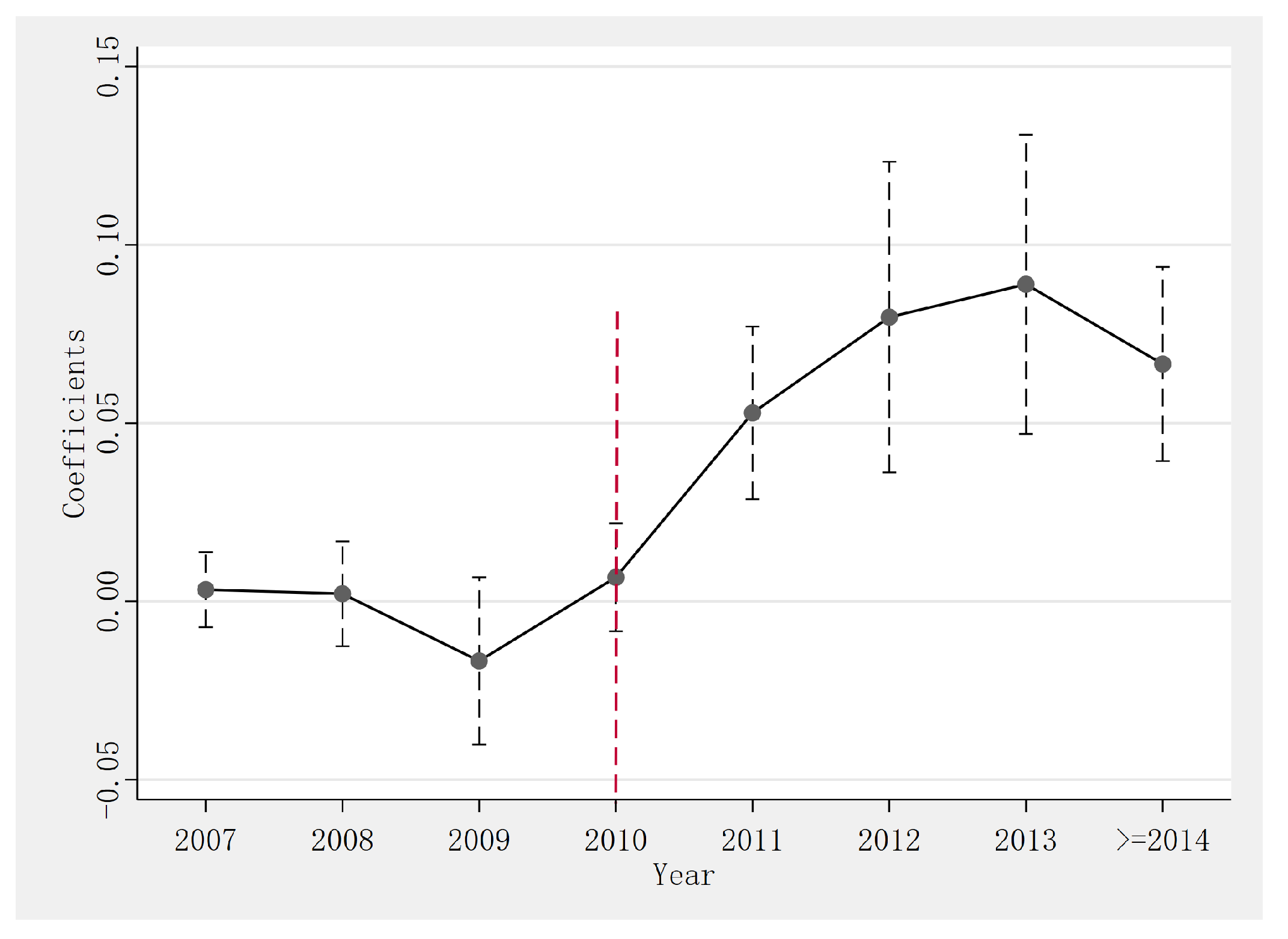
Figure 1. Parallel trend test.
Land 15 00441 g001
Figure 2. Placebo test.
Land 15 00441 g002
Table 1. Variable definitions and descriptive statistics.
VariableDefinitionsMeanSDMin.Max.
ln y i , t y i , t 1 Annual growth rate of real GDP per capita0.02150.1091−0.39110.3906
ln y i , t Logarithm of real GDP per capita (2006 constant prices)9.55230.72948.009211.5079
R e g u l a t i o n i , t T i g h t i × P o s t t −0.10280.1396−0.57080.1219
T i g h t i (2020 cultivated land retention target—2009 actual cultivated land area)/administrative area−0.13430.1474−0.57080.1219
P o s t t 1 = 2010 and later; 0 = otherwise0.76470.42420.00001.0000
M G P A i 1 = major grain production area; 0 = non-major area0.64550.47840.00001.0000
M G P C i 1 = main grain-producing county; 0 = non-main county0.47940.49960.00001.0000
N a g r i , t Ratio of secondary and tertiary industry added value to GDP0.81960.12370.41700.9990
I n v e s t i , t Ratio of fixed asset investment to GDP0.84860.50820.09082.5998
F i s c a l e x p i , t Ratio of public fiscal expenditure to GDP0.19420.13960.02790.7683
C r e d i t i , t Ratio of year-end financial institution loan balance to GDP0.66940.51440.06463.1117
S a v e i , t Ratio of resident savings deposit balance to GDP0.73900.40530.08242.2226
P d e n s i t y i , t Population density (10,000 persons per square kilometer)0.03580.04080.00020.2229
P a t e n t i , t Number of patent grants per 100,000 population0.01810.03680.00010.2106
E d u i , t Student–teacher ratio in primary and secondary schools13.46225.06641.794426.3253
Table 2. Analysis of the impact of land-use regulation on county economic growth.
Dependent Variable: Annual Growth Rate of Real per Capita GDP ( ln y i , t y i , t 1 )
BaselineSquared
(1)(2)(3)(4)
R e g u l a t i o n i , t 0.049 ***0.043 ***0.051 ***0.132 ***
(0.011)(0.012)(0.011)(0.033)
T i g h t i −0.041 ***−0.047 ***
(0.010)(0.011)
P o s t t −0.018 ***−0.015 ***
(0.002)(0.003)
R e g u l a t i o n i , t 2 0.201 ***
(0.076)
ln y i , t 1 −0.000
(0.000)
ln y i t 1 y i , t 2 −0.097 ***
(0.012)
_cons0.036 ***0.066 ***−0.119 ***−0.139 ***
(0.002)(0.008)(0.024)(0.028)
ControlsNoYesYesYes
Year FENoNoYesYes
County FENoNoYesYes
Obs.31,02825,43225,45024,063
R-squared0.0080.0200.1960.207
Notes: *, **, and *** indicate significance at the 10%, 5%, and 1% levels, respectively. Robust standard errors clustered at the county level are reported in parentheses. Controls denotes control variables (presented in the descriptive statistics table); Year FE denotes year fixed effects; and County FE denotes county fixed effects. Differences in sample sizes arise from missing values of some control variables.
Table 3. Robustness tests for the impact of land-use regulation on county economic growth.
Dependent Variable: Annual Growth Rate of Real per Capita GDP ( ln y i , t y i , t 1 )
Adding Control VariablesRe-Measuring the Independent VariableLagging
(1)(2)(3)
R e g u l a t i o n i , t 0.054 ***0.032 ***0.025 **
(0.013)(0.009)(0.011)
ln y i , t 1 −0.000−0.000 **
(0.000)(0.000)
ln y i t 1 y i , t 2 −0.096 ***−0.086 ***
(0.012)(0.013)
_cons0.056−0.172 ***−0.111 ***
(0.036)(0.034)(0.023)
ControlsYesYesYes
Year FEYesYesYes
County FEYesYesYes
Obs.24,06320,60725,083
R-squared0.2070.2370.195
Notes: *, **, and *** indicate significance at the 10%, 5%, and 1% levels, respectively. Robust standard errors clustered at the county level are reported in parentheses. Controls denotes control variables (presented in the descriptive statistics table); Year FE denotes year fixed effects; and County FE denotes county fixed effects. Differences in sample sizes arise from missing values of some control variables.
Table 4. Heterogeneity analysis of the impact of land-use regulation on county economic growth.
Dependent Variable: Annual Growth Rate of Real per Capita GDP ( ln y i , t y i , t 1 )
MGPA
vs. Non-MGPA
MGPC
vs.Non-MGPC
MGPC in MGPA
vs. Non-MGPC in MGPA
MGPC in Non-MGPA
vs. Non-MGPC in Non-MGPA
MGPC in Non-MGPA
vs. Non-MGPC in MGPA
(1)(2)(3)(4)(5)
M G P A i × R e g u l a t i o n i , t −0.019 **
(0.008)
M G P A i −0.005 ***
(0.002)
M G P C i × R e g u l a t i o n i , t −0.017 **
(0.008)
M G P C i 0.007 ***
(0.002)
A M G P C i × R e g u l a t i o n i , t −0.028 **
(0.013)
A M G P C i 0.006 *
(0.003)
N A M G P C i × R e g u l a t i o n i , t −0.056 ***
(0.015)
N A M G P C i 0.012 ***
(0.003)
M I X i × R e g u l a t i o n i , t −0.052 ***
(0.019)
M I X i 0.021 ***
(0.004)
R e g u l a t i o n i , t 1 −0.0170.012 ***−0.0060.013 ***0.001
(0.015)(0.003)(0.009)(0.003)(0.009)
_cons0.0210.008−0.0240.036 ***−0.019
(0.014)(0.014)(0.017)(0.012)(0.020)
ControlsYesYesYesYesYes
Year FEYesYesYesYesYes
Obs.27,63527,63518,08795489765
R-squared0.0660.0670.0850.0710.061
Notes: *, **, and *** indicate significance at the 10%, 5%, and 1% levels, respectively. Robust standard errors clustered at the county level are reported in parentheses. Controls denotes control variables (presented in the descriptive statistics table); Year FE denotes year fixed effects. Differences in sample sizes arise from missing values of some control variables. AMGPC = 1 if the county is an MGPC within an MGPA, and AMGPC = 0 if the county is a non-MGPC within an MGPA; NAMGPC = 1 if the county is an MGPC within a non-MGPA, and NAMGPC = 0 if the county is a non-MGPC within a non-MGPA; and MIX = 1 if the county is an MGPC within a non-MGPA, and MIX = 0 if the county is a non-MGPC within an MGPA.
Table 5. Analysis of β-convergence of county economy and the role of land-use regulation policy.
Dependent Variable: Annual Growth Rate of Real per Capita GDP ( ln y i , t y i , t 1 )
Absolute ConvergenceClub ConvergenceConditional ConvergencePolicy Effects
(1)(2)(3)(4)(5)(6)(7)
ln y i , t 1 −0.031 ***−0.032 ***−0.035 ***−0.149 ***−0.030 ***−0.033 ***−0.146 ***
(0.001)(0.001)(0.002)(0.007)(0.001)(0.002)(0.008)
ln y i t 1 y i , t 2 0.048 ***0.048 ***0.041 ***0.0220.047 ***0.040 ***0.020
(0.011)(0.013)(0.014)(0.014)(0.013)(0.014)(0.014)
R e g u l a t i o n i , t 1 × ln y i , t 1 0.015 **0.020 ***0.043 ***
(0.007)(0.006)(0.012)
R e g u l a t i o n i , t 1 −0.124 **−0.169 ***−0.366 ***
(0.059)(0.055)(0.119)
T i g h t i 0.001
(0.004)
M G P C i −0.005 **
(0.002)
M G P C i × T i g h t i −0.013 *
(0.007)
_cons0.320 ***0.325 ***0.345 ***1.428 ***0.309 ***0.330 ***1.400 ***
(0.012)(0.011)(0.020)(0.079)(0.013)(0.020)(0.081)
ControlsNoNoYesYesNoYesYes
Year FENoNoNoYesNoNoYes
County FENoNoNoYesNoNoYes
Obs.29,37429,26926,37026,36029,26926,37026,360
R-squared0.0340.0340.0370.1930.0360.0390.195
Notes: *, **, and *** indicate significance at the 10%, 5%, and 1% levels, respectively. Robust standard errors clustered at the county level are reported in parentheses. Controls denotes control variables (presented in the descriptive statistics table); Year FE denotes year fixed effects; and County FE denotes county fixed effects. Differences in sample sizes arise from missing values of some control variables.
Table 6. Robustness tests for the impact of land-use regulation on county economic convergence.
Dependent Variable: Annual Growth Rate of Real per Capita GDP ( ln y i , t y i , t 1 )
2006–20202006–2017T = 2T = 3
(1)(2)(3)(4)
R e g u l a t i o n i , t T × ln y i , t T 0.041 ***0.037 ***0.025 ***0.040 ***
(0.011)(0.013)(0.009)(0.012)
R e g u l a t i o n i , t T −0.352 ***−0.322 **−0.209 **−0.367 ***
(0.114)(0.131)(0.082)(0.112)
ln y i , t T −0.163 ***−0.180 ***−0.141 ***−0.143 ***
(0.010)(0.012)(0.008)(0.011)
ln y i t 1 y i , t T 0.070 ***0.080 ***0.077 ***0.074 ***
(0.016)(0.019)(0.013)(0.013)
_cons1.450 ***2.440 ***1.181 ***1.214 ***
(0.094)(0.129)(0.074)(0.102)
ControlsYesYesYesYes
Year FEYesYesYesYes
County FEYesYesYesYes
Obs.22,85815,50112,4167086
R-squared0.2230.3450.3450.488
Notes: *, **, and *** indicate significance at the 10%, 5%, and 1% levels, respectively. Robust standard errors clustered at the county level are reported in parentheses. Controls denotes control variables (presented in the descriptive statistics table); Year FE denotes year fixed effects; and County FE denotes county fixed effects.
Table 7. First-stage results of the mechanism analysis on the impact of land-use regulation on county economic convergence.
(1)(2)(3)
N a g r i , t I n v e s t i , t F i s c a l e x p i , t
R e g u l a t i o n i , t 1 × ln y i , t 1 0.017 ***0.070 ***0.034 ***
(0.006)(0.026)(0.012)
ln y i , t 1 0.051 ***−0.218 ***−0.095 ***
(0.005)(0.045)(0.005)
R e g u l a t i o n i , t 1 −0.158 ***−0.608 **−0.328 ***
(0.059)(0.242)(0.109)
ln y i t 1 y i , t 2 0.016 ***−0.081 **−0.010 **
(0.003)(0.032)(0.004)
_cons0.346 ***3.049 ***1.125 ***
(0.046)(0.429)(0.052)
Year FEYesYesYes
County FEYesYesYes
Obs.29,28629,19129,294
R-squared0.9080.6160.898
Notes: *, **, and *** indicate significance at the 10%, 5%, and 1% levels, respectively. Robust standard errors clustered at the county level are reported in parentheses. Controls denotes control variables (presented in the descriptive statistics table); Year FE denotes year fixed effects; and County FE denotes county fixed effects.
Table 8. Second-stage results of the mechanism analysis on the impact of land-use regulation on county economic convergence.
Dependent Variable: Annual Growth Rate of Real per Capita GDP ( ln y i , t y i , t 1 )
(1)(2)(3)
R e g u l a t i o n i , t 1 × ln y i , t 1 0.029 ***0.041 ***0.054 ***
(0.010)(0.012)(0.012)
ln y i , t 1 −0.176 ***−0.151 ***−0.187 ***
(0.009)(0.008)(0.009)
R e g u l a t i o n i , t 1 −0.244 ***−0.357 ***−0.485 ***
(0.093)(0.116)(0.109)
ln y i t 1 y i , t 2 0.023 *0.030 **0.028 **
(0.013)(0.013)(0.013)
N a g r i , t 1 0.605 ***
(0.062)
I n v e s t i , t 1 −0.028 ***
(0.004)
F i s c a l e x p i , t 1 −0.441 ***
(0.028)
_cons1.200 ***1.495 ***1.906 ***
(0.069)(0.076)(0.087)
Year FEYesYesYes
County FEYesYesYes
Obs.29,26129,18929,269
R-squared0.2130.1910.221
Notes: *, **, and *** indicate significance at the 10%, 5%, and 1% levels, respectively. Robust standard errors clustered at the county level are reported in parentheses. Controls denotes control variables (presented in the descriptive statistics table); Year FE denotes year fixed effects; and County FE denotes county fixed effects. Differences in sample sizes arise from missing values of some control variables.
Disclaimer/Publisher’s Note: The statements, opinions and data contained in all publications are solely those of the individual author(s) and contributor(s) and not of MDPI and/or the editor(s). MDPI and/or the editor(s) disclaim responsibility for any injury to people or property resulting from any ideas, methods, instructions or products referred to in the content.