Article

Ecological and Economic Sustainability in Resource-Based Cities: A Case Study of Ecosystem Services, Drivers, and Compensation Strategies in Xinzhou, China


1
State Key Laboratory for Tunnel Engineering, China University of Mining and Technology (Beijing), Beijing 100083, China
2
Department of Architecture, School of Mechanics and Civil Engineering, China University of Mining and Technology (Beijing), Beijing 100083, China
*
Author to whom correspondence should be addressed.
Land 2026, 15(2), 334; https://doi.org/10.3390/land15020334
Submission received: 6 January 2026 / Revised: 6 February 2026 / Accepted: 12 February 2026 / Published: 15 February 2026
(This article belongs to the Section Land Use, Impact Assessment and Sustainability)

Abstract

Mining-resource-based cities, as distinctive human–environment systems, face urgent challenges from intensified urbanization and mining, leading to land imbalance and ecosystem service degradation. To enhance resilience, it is essential to identify the evolution and drivers of ecosystem services and construct targeted ecological compensation models. This study focuses on Xinzhou, a representative mining city in China, and systematically analyzes three aspects: (1) spatiotemporal dynamics of land use and ecosystem service value (ESV) from 2000 to 2023 using Markov chains, equivalent factor method, hotspot and sensitivity analyses; (2) identification of ESV driving mechanisms through an integrated “stepwise regression + geographical detector” framework; and (3) formulation of ecological compensation models via quantification of priority indices, demand intensity coefficients, and compensation standards. Key findings indicate that land conversion was concentrated in coalfield zones and surrounding built-up areas, involving 2,518,341.75 hm2 (35.76% of total area), primarily characterized by a reduction in farmland and expansion of forest, grassland, and construction land. ESV showed a striped spatial pattern, with higher values in mountainous zones and lower values in valleys and basins with frequent human activity. The northwest coalfield region experienced an initial decline followed by a recovery in ESV. Annual mean temperature emerged as the dominant driver, while DEM influence increased annually. All factor interactions exhibited synergistic effects, with natural variables exerting greater influence than socio-economic ones. Ecological compensation demand was high overall, especially in Wutai, Kelan, and Pianguan counties, with high-value compensation areas mainly distributed in the eastern and central parts of Xinzhou. Looking ahead, a compensation framework prioritizing ecological–economic optimization should be developed, guided by zoned, typological, and dynamic configurations. By analyzing ecosystem governance from the perspective of a mining-resource-based city, this study enhances global ecosystem service evaluation frameworks and offers a replicable model to advance transnational ecological cooperation and green urban transformation.

1. Introduction

Ecosystem restoration has emerged as a central theme in global sustainable development. The UNEP report Making Peace with Nature (2021) emphasizes that restoration enhances natural systems’ capacity to respond to climate change while sustaining essential ecosystem services (https://www.unep.org/resources/making-peace-nature, accessed on 5 December 2025). This global emphasis is further reinforced by the Kunming–Montreal Global Biodiversity Framework adopted at COP15, which calls for restoring at least 30% of the area of degraded terrestrial, inland water, coastal, and marine ecosystems by 2030 to enhance biodiversity, ecosystem service functions, and ecological integrity (https://www.unep.org/resources/kunming-montreal-global-biodiversity-framework, accessed on 5 December 2025). With accelerating urbanization, land use—one of the most direct forms of human activity [1,2]—has increasingly undermined the structural and functional stability of ecosystems [3]. Resource-based cities, shaped by extensive development and single-industry dependence, face ecological degradation and economic imbalance [4,5]. Mining-resource-based cities, whose growth relies on mineral extraction and processing [6,7], are particularly vulnerable, experiencing land subsidence [8], biodiversity loss, water and soil pollution, and deteriorating air quality [9]. In China, resource-based cities account for approximately 40% of all cities nationwide as of December 2025 (https://www.gov.cn/zwgk/2013-12/03/content_2540070.htm, accessed on 7 December 2025), and the persistent tension between resource development and ecological protection makes ecosystem restoration and reconstruction an urgent priority.
Land use and land cover change (LUCC) refers to human-induced transformations of surface physical and biological cover types [10]. As a key indicator of human–environment interactions [11], LUCC underpins analyses of spatial variations in ecosystem service value (ESV) [12,13]. Transitions among land use types reshape ecosystem structure and function [14], and processes such as urbanization and resource development [15] may degrade ecosystem services in high-value land types [16,17]. Current methods for analyzing land use structure evolution primarily include land use dynamic degree analysis and land use transition matrices. To align with international terminology, the single and comprehensive land use dynamic degrees can be regarded as two commonly used land use change intensity indicators, which quantify the rate of change by relating the amount of land use variation to its initial area over a given period [18]. In contrast, the land use transition matrix characterizes the directional and structural shifts among land use categories by capturing the transfer of area from type i to type j [19,20]. Previous studies have combined intensity indicators with transition matrices to construct LUCC evolution models [21], enabling a more comprehensive and detailed depiction of the quantity, direction, and magnitude of land use changes over time.
Ecosystem services (ES) are the beneficial functions provided by ecosystems [22], commonly classified into provisioning, regulating, supporting, and cultural services [23,24]. Ecosystem service value (ESV) monetizes both material products and non-market services such as climate regulation and water conservation [25], offering a scientific basis for ecological management. Current ESV quantification mainly relies on ecological modeling methods (EMM) or the equivalent factor method (EFM) [26]. EMM depends on ecological processes and multi-source data [27], whereas EFM uses per-unit-area equivalent values for large-scale assessments [28]. Xie Gaodi et al. [29], drawing on Costanza et al. (1997) [28], developed China’s terrestrial ecosystem equivalent factor table, which has been widely applied in national ESV studies. ES drivers have been examined using geographical detectors and regression models [30,31], focusing on natural, socio-economic, and landscape factors [32,33,34,35]. The geographical detector effectively handles multicollinearity and identifies key drivers [36], but it cannot determine whether a factor exerts a positive or negative influence on ESV, which limits its interpretive depth.
Ecological compensation uses economic, policy, or technical means to offset ecological protection costs or ecological damage, ensuring sustainable ecosystem service supply [37]. Numerous scholars have conducted extensive research on ecological compensation across various ecosystem types, including farmland [38,39], coastal areas [40,41], urban agglomerations [42], grasslands [43,44], watersheds [45,46], and national parks [47]. Currently, four main approaches are used to construct ecological compensation mechanisms: (1) compensation standards based on ESV assessment [48]; (2) compensation models combining government leadership and market mechanisms [49]; (3) mechanisms based on the internalization of ecological externalities [50]; and (4) collaborative governance involving multiple stakeholders [51]. Among these, ESV-based compensation is the most widely applied, as it enables the quantification of natural value from the perspective of ecosystem service providers, thereby supporting the establishment of fair and reasonable compensation standards through scientific pricing [37,42,48,52].
In summary, LUCC directly triggers fluctuations in ESV, while ecological compensation mechanisms help adjust the resulting benefit imbalances, thereby promoting synergy between ecological protection and socio-economic development. Therefore, optimizing land use structure, scientifically assessing ESV, and formulating ecological compensation policies are essential strategies for regional ecosystem restoration. Despite substantial progress in LUCC research, ESV quantification, driving mechanism analysis, and ecological compensation, studies on ESV and ecological compensation remain unevenly distributed across national and regional scales, with relatively limited and fragmented investigations targeting specific city types—particularly resource-based and mining-resource-based cities [53,54]. First, many studies rely on single analytical techniques, such as the equivalent factor method, gray correlation analysis, or spatial quantile regression, while fewer attempts integrate methods such as Markov chains, hotspot analysis, sensitivity analysis, or combined “stepwise regression + geographical detector” frameworks to more comprehensively reveal spatial clustering patterns and interactions among driving factors [55]. Second, ecological compensation research often remains at a preliminary stage, typically estimating compensation priorities or amounts without developing more complete models that incorporate priority indices, demand intensity, and compensation standards, or achieving refined spatial delineation of compensation zones [56]. Third, studies focusing on specific subregions—such as subsidence areas or semiarid zones—may overlook the broader coupled human–environment dynamics shaped by both mining development and urbanization, thereby limiting deeper insights into ESV evolution within core coalfield areas [57]. Finally, analyses of driving mechanisms often emphasize single dominant factors—such as precipitation, mining intensity, or urbanization—without systematically comparing the relative influence of natural and socio-economic drivers or examining their potential synergistic effects, which constrains the development of governance and compensation frameworks tailored to coal-resource-based cities [58].
To address these limitations, this study introduces two targeted innovations. First, we select Xinzhou, a representative mining-resource-based city in China, as a case study to enrich the urban-scale research dimension. By focusing on a core coalfield city facing dual pressures from resource exploitation and urbanization, this study expands the research perspective beyond the commonly examined subsidence or semi-arid areas and responds to the scarcity of fine-grained urban-scale analyses. Furthermore, conducting ESV-based ecological compensation calculations at the county level and proposing operational development strategies help address the lack of refined and practical ecological compensation models in existing studies, providing a scientific basis for optimizing compensation mechanisms and guiding allocation. Second, we construct an integrated “stepwise regression + geographical detector” analytical framework to investigate the driving mechanisms of ESV evolution. The two methods provide complementary perspectives on the same set of driving factors: stepwise regression quantifies the direction, magnitude, and statistical significance of each factor’s influence, while the geographical detector reveals spatial heterogeneity and interaction effects. This dual-perspective framework enables the simultaneous capture of statistical effects and spatial differentiation patterns, offering a level of explanatory completeness that cannot be achieved by either method alone.
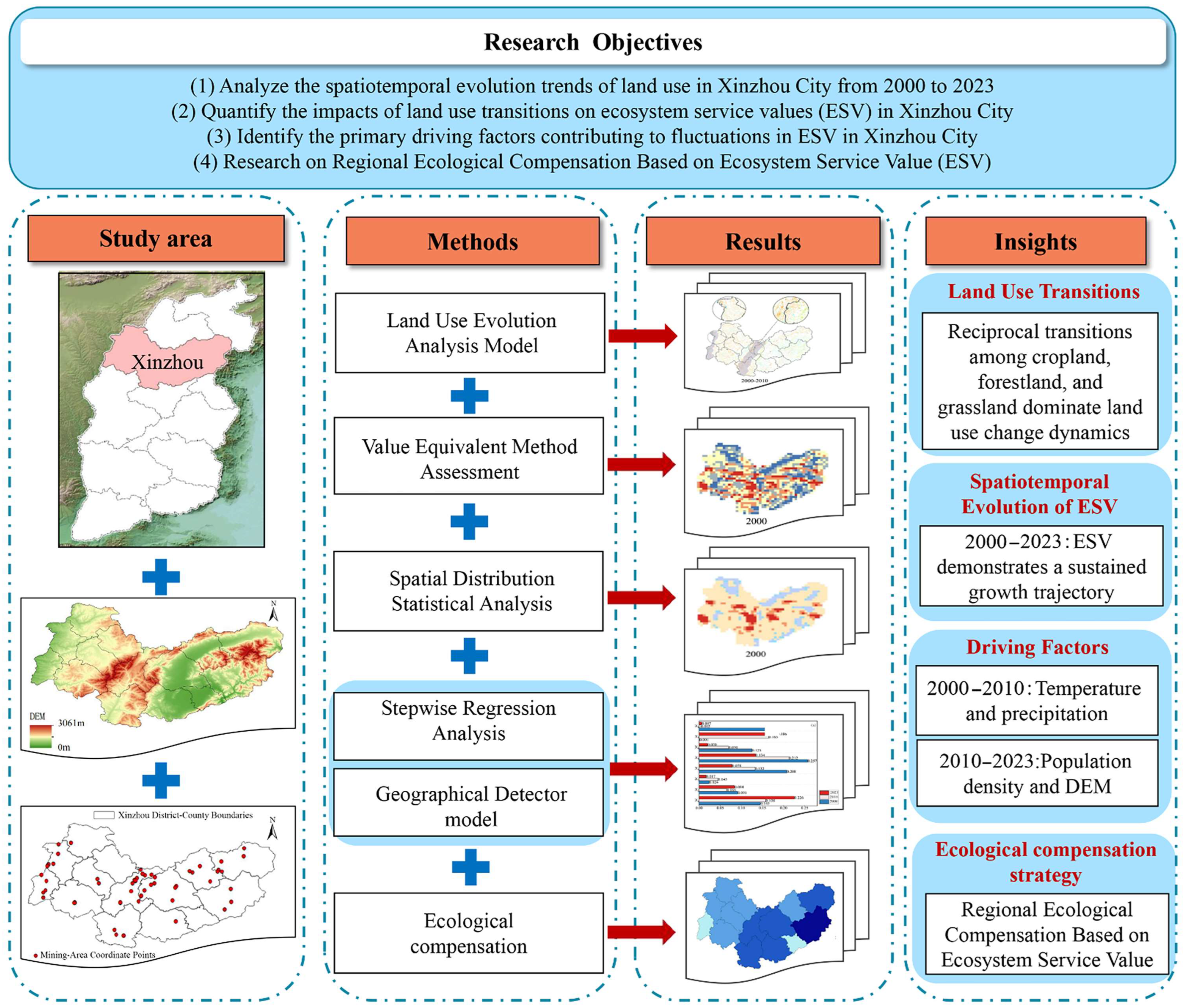
The overall research framework is illustrated in Figure 1.

2. Study Area and Data Sources

2.1. Overview of the Study Area

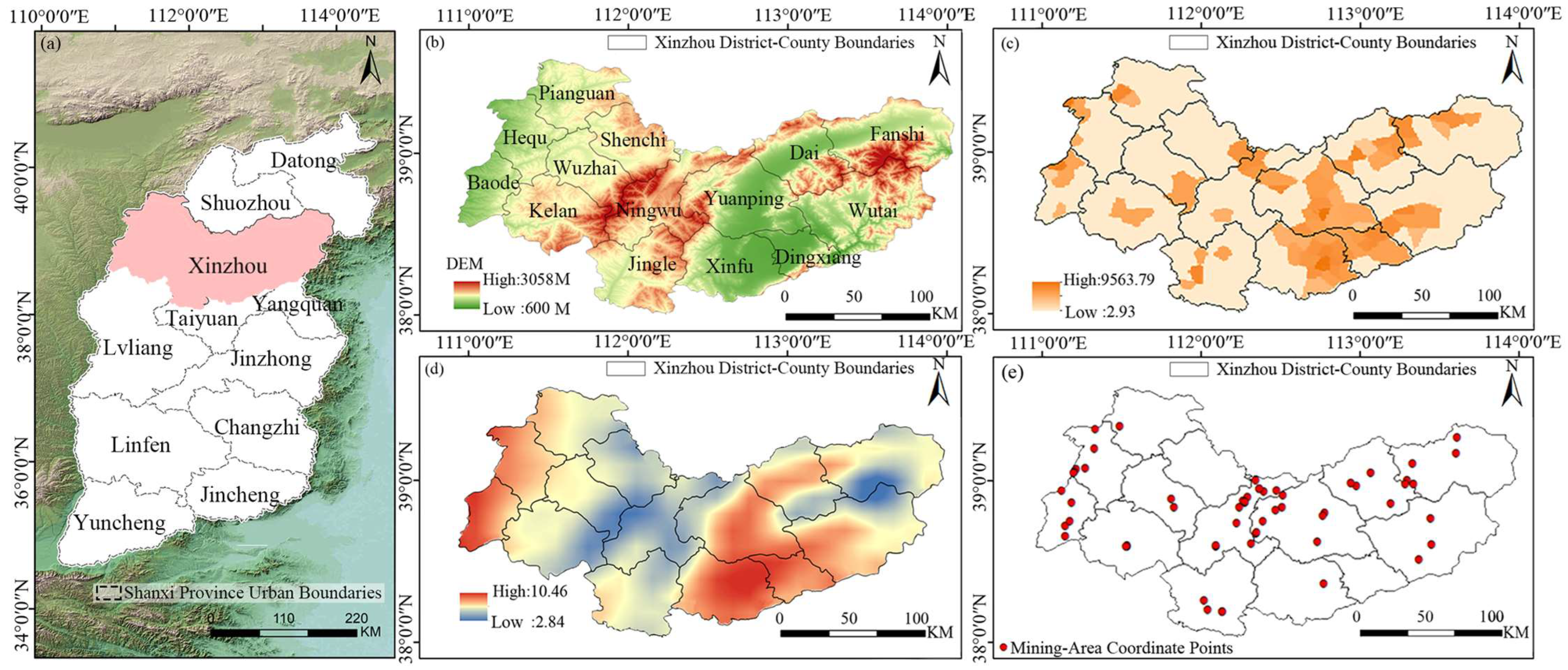
Xinzhou City is located in the north-central region of Shanxi Province, China, spanning from 110°53′3″ E to 113°58′ E and from 38°6′5″ N to 39°40′ N. Covering a total area of 2,518,341.75 hm2, it comprises one district, one county-level city, and twelve counties (Figure 2a), making it the largest administrative unit in Shanxi Province by land area. The region features complex terrain, with elevation increasing from north to south. The highest point reaches 3058 m above sea level, while the lowest is approximately 600 m (Figure 2b). As of 2024, Xinzhou had a permanent population of 2.6046 million (https://www.sxxz.gov.cn/ggsj/tjgb/202505/t20250506_4086238.shtml, accessed on 12 December 2025). The population is relatively evenly distributed, with higher concentrations primarily located in the central part of Xinfu District and the southern part of Yuanping City (Figure 2c, based on 2023 statistics). The region also exhibits significant temperature variation; in 2023, the annual average temperature across its administrative divisions ranged from −2.8 °C to 10.5 °C (Figure 2d).
Notably, Xinzhou is rich in mineral resources. By the end of 2020, a total of 50 types of mineral deposits (including subtypes) had been identified within the city, with coal, iron ore, and bauxite being the most prominent. According to the Xinzhou Statistical Yearbook (2000–2023), coal production has consistently accounted for over 80% of the city’s total mineral output. As of January 2024, Xinzhou had 63 active coal mines, with more than 65% of them concentrated in the Ningwu Coalfield in central Xinzhou and the Hedong Coalfield in the western region (Figure 2e).

2.2. Data Sources

All original datasets used in this study are listed in Table 1. Spatial visualizations were produced using the WGS_1984 geographic coordinate system. The land-use classification was derived from the China Land Cover Dataset (CLCD), which includes cropland, forest, shrubland, grassland, water bodies, ice/snow, barren land, impervious surfaces, and wetlands. Following previous studies [26] and the Land Use Status Classification standard issued by the Ministry of Natural Resources of China (GB/T 21010-2017), these categories were reclassified into six groups: farmland (FaL); forest land (FoL), including forests and shrubs; grassland (GL); water land (WL); construction land (CL), referring specifically to impervious surfaces; and unused land (UL), comprising barren land and ice/snow.

3. Research Methods

3.1. Land Use Evolution Analysis Model

To analyze land use changes in the study area, we employed two commonly used land use change intensity indicators—the single land use dynamic degree (K) and the comprehensive land use dynamic degree (Ks)—along with the land use transition matrix (Sij), which characterizes the directional transfers among land use categories.
(1) The single dynamic degree (K) measures the rate of change in a specific land use/land cover (LULC) type over a defined period [59]:
K = U b U a U a × 1 T × 100 %
where K is the single dynamic degree of a given LULC type, Ua and Ub are its areas at the beginning and end of the monitoring period, respectively, and T is the monitoring duration (years).
(2) The comprehensive dynamic degree (Ks) reflects the overall rate of land use change across the study area:
K s = i = 1 n   | u b i u a i | / 2 i = 1 n   u a i × 1 T × 100 %
where Ks denotes the comprehensive dynamic degree of LULC, uai and ubi are the areas of the i-th LULC type at the beginning and end of the monitoring period, T is the monitoring duration, and n is the number of LULC categories.
(3) The land use transition matrix, based on Markov chain theory, represents the composition, direction, and magnitude of land use changes within a region [59,60]:
K i j = K 11 K 1 n K n 1 K n n
where Kij is the area transferred from land use type i to type j, and n is the total number of land use categories. For details of the land use transition matrix, see Appendix A.1 Table A1.

3.2. ESV Quantification and Assessment

Following the framework in [28], ecosystem services were classified into four categories and nine subtypes: provisioning services (food production, raw material supply), regulating services (gas regulation, climate regulation, hydrological regulation, soil retention), supporting services (nutrient cycling, biodiversity maintenance), and cultural services (esthetic landscapes). Since the national ESV equivalent factor table developed by Xie et al. [29] may not fully capture the ecological characteristics of specific cities, a localized ESV equivalent factor table was constructed for Xinzhou based on its actual conditions (Table 2). Notably, in this study, construction land (CL) refers exclusively to impervious surfaces, which possess almost no ecological functions; therefore, the ESV assigned to CL is set to zero.
Step 1: Based on prior research, “the economic value provided by a natural ecosystem without human capital input is approximately one-seventh of the economic value of food production services from existing farmland per unit area” [61]. Following this principle, the economic value of ecosystem services in Xinzhou was calculated using the yield, planting area, and average market price of major grain crops (wheat, rice, corn, and soybeans). The national ESV equivalent factor table [29] was subsequently adjusted to derive per-unit-area ecosystem service values for each land use type in Xinzhou (Table 2). The calculation formula is
V C i = 1 7 i = 1 n   m i p i q i M × E C i   ( i = 1 , , n )
where VCi is the per-unit-area ecosystem service value of the i-th land use type; n is the number of grain crop types; mi, pi, and qi are the planting area, unit price, and yield of the i-th crop; M is the total planting area of all crops in Xinzhou; and ECi is the national ESV equivalent factor for the i-th land use type.
It is worth noting that the prices and yields of major grain crops in Xinzhou have remained highly stable over the past two decades under China’s national grain price regulation policies. Statistical records from the Compilation of Cost–Benefit Data of Agricultural Products in China and the Xinzhou Statistical Yearbook show that wheat, rice, maize, and soybean prices, as well as their corresponding yields, exhibited only mild and predictable fluctuations between 2000, 2010, and 2023. This long-term stability indicates that the benchmark value of food production services—the basis for the 1/7 coefficient—has experienced only minor variation. From a methodological perspective, the equivalent factor method is designed for regions with stable agricultural production systems, where moderate changes in crop prices or yields exert minimal influence on valuation outcomes. Moreover, this approach has been widely applied in ecosystem service valuation studies across China and has consistently demonstrated reliable performance under similarly stable agricultural conditions [17,52,54]. Therefore, the use of the 1/7 coefficient and the localized equivalent factors in Table 2 provides a reasonable and robust basis for ESV estimation in Xinzhou.
Step 2: Based on the localized factor table, the total ESV for each region in Xinzhou was calculated as
E S V = i = 1 n ( V C i × A i )
where Ai is the area of the i-th land use type, and n is the total number of land use categories.
The spatial distribution of ecosystem service value (ESV) in this study was visualized using ArcGIS 10.8. A grid-based approach was employed to divide the study area into 5 km × 5 km units. Based on the natural breaks (Jenks) classification method, ESVs in Xinzhou were categorized into five levels: low (0.00–1.24 × 10⁶ CNY), lower-middle (1.24 × 10⁶–2.23 × 10⁶ CNY), medium (2.23 × 10⁶–3.62 × 10⁶ CNY), upper-middle (3.62 × 10⁶–4.67 × 10⁶ CNY), and high (4.67 × 10⁶–7.84 × 10⁶ CNY).

3.3. Spatial Statistical Analysis of ESV Distribution

Hotspot analysis was employed to identify the spatial patterns of ecosystem service value (ESV) in Xinzhou from 2000 to 2023. To ensure spatial comparability and address the scale mismatch between land-use data and ecosystem service patterns, a 5 km × 5 km fishnet grid was generated in ArcGIS 10.8, and the mean ESV of each grid cell was calculated. The choice of a 5 km grid was supported by both methodological conventions and the ecological characteristics of Xinzhou. Previous ESV studies commonly adopted a 5 km resolution for regional-scale hotspot analysis [62]. Xinzhou covers 2,518,341.75 hm2, and earlier research indicated that the appropriate grain size for municipal-scale hotspot identification generally fell within the 3–8 km range. Moreover, the dominant ecosystem types in Xinzhou (e.g., forest, grassland, farmland) typically exhibited patch sizes of 1–10 km. A 5 km grid lay at the core of this interval, effectively balancing spatial detail and pattern stability while avoiding the “noise inflation” associated with overly fine grains and the “pattern loss” caused by excessively coarse grains [63]. Therefore, the 5 km × 5 km grid provided a robust and ecologically meaningful spatial unit for ESV hotspot detection in this study.
The Getis-Ord statistic ( G i * ) [64,65,66] was applied to detect spatial clustering patterns of high and low ESVs. This method effectively reveals the spatial heterogeneity of ecosystem service provision by identifying statistically significant clusters of high values (hotspots) and low values (coldspots). The calculation formula is as follows.
G i * = j = 1 n   w i , j x j X ¯ j = 1 n   w i , j S n j = 1 n   w i , j 2 j = 1 n   w i , j 2 n 1
where G i * is the standardized Z-score for unit i; wi,j is the spatial weight between units i and j; xj is the ESV of cell j; X ¯ is the global mean ESV; S is the global standard deviation; and n is the number of grid cells.
The global mean and standard deviation are
X ¯ = j = 1 n   x j n
S = j = 1 n x j 2 n ( X ¯ ) 2
where X   ¯ is the arithmetic mean of ESVs, and S measures dispersion, ensuring the validity of the Z-score test.

3.4. ESV Sensitivity Coefficient

To address uncertainty in value coefficients (VC), each VC was adjusted by ±50%. The resulting ESV estimates were validated using the sensitivity coefficient (CS) [66]. CS measures the dependence of ESV on VC:
(1) CS > 1: ESV is elastic with respect to VC, indicating lower reliability.
(2) CS < 1: ESV is inelastic, indicating higher reliability [67].
The formula is
C S = E S V j E S V i E S V i V C j k V C i k V C i k
where CS is the sensitivity coefficient; ESVi and ESVj are total ESV before and after VC adjustment; and VCik, VCjk are the original and adjusted coefficients for land use type k.

3.5. Analysis of ESV Driving Factors

Stepwise regression and the Geographical Detector Model (GDM) were combined to analyze ESV drivers (the pseudocode is provided in Appendix A.2). Stepwise regression identifies the direction and magnitude of factor influence, while GDM reveals spatial heterogeneity and interaction effects.
(1) Stepwise Regression Analysis
Stepwise regression explores the relationship between multiple independent variables (X) and a dependent variable (Y), automatically selecting the most influential predictors [68]. The general form is
Y = β 0 + β 1 X 1 + β 2 X 2 + + β k X k + ε
where β0 is the intercept, β1, β2, …, βk are regression coefficients, and ε is the error term (εN (0, σ2)).
(2) Geographical Detector model (GDM)
The GDM quantifies spatial stratified heterogeneity and identifies driving forces [69]. Two modules were applied:
(i) Factor detection evaluates the explanatory power of a factor X on spatial variation of Y, measured by the q-statistic:
q = 1 1 N σ 2 i = 1 m   N i σ i 2  
where q ranges from 0 to 1; m is the number of strata; N is the total number of units; σ2 is the variance of ESV across the study area; σ i 2 is the variance within stratum i; and Ni is the number of units in stratum i.
(ii) Interaction detection assesses the combined influence of two factors by comparing the interaction q-value q (XiXj) with individual q-values q(Xi), q(Xj), and their sum. Interactions are classified into five types [34]: nonlinear weakening, univariate nonlinear weakening, bivariate enhancement, independence, and nonlinear enhancement.

3.6. ESV-Based Ecological Compensation

Not all ecosystem service functions are suitable for inclusion in regional ecological compensation. Provisioning services—such as food production, raw material supply, and water provision—already possess market value and contribute directly to regional economic output. Therefore, this study focuses on the non-market value of ecosystem services (ENMV), including regulating, supporting, and cultural services, as the basis for ecological compensation in Xinzhou.
To determine compensation priorities, the Ecological Compensation Priority Score (ECPS) was calculated for each county and district [46]. Regions were classified as high-priority (ECPS > 0.5) or secondary-priority (ECPS < 0.5). The ECPS is defined as
E C P S j = E S V j * / G D P j
where j denotes a county or district, ECPSj is the ecological compensation priority score, E S V j * is the non-market value of ecosystem services, and GDPj is the gross domestic product of region j.
To capture variation in compensation demand, an ecological compensation demand intensity coefficient (Pj) was introduced, calculated using an arctangent function and normalized for comparability:
P j = 2 π × a r c t a n ( E C P S j )
As Equation (12) shows, ECPS is directly influenced by GDP. In Xinzhou, GDP in 2023 was nearly 17 times higher than in 2000, leading to substantial differences in compensation amounts across years. To ensure consistency and account for inflation, 2023 was selected as the base year for estimating the theoretical ecological compensation standard amount (Vj).
The ecological compensation standard amount is calculated as follows:
V j = ESV j *   ×   k   ×   P j  
where Vj is the ecological compensation standard amount for region j, k is the ecological value conversion coefficient (set at 10% in this study) [70,71], and Pj is the ecological compensation demand intensity coefficient.

4. Results

4.1. Spatiotemporal Evolution of Land Use

4.1.1. Spatiotemporal Patterns of Land Use

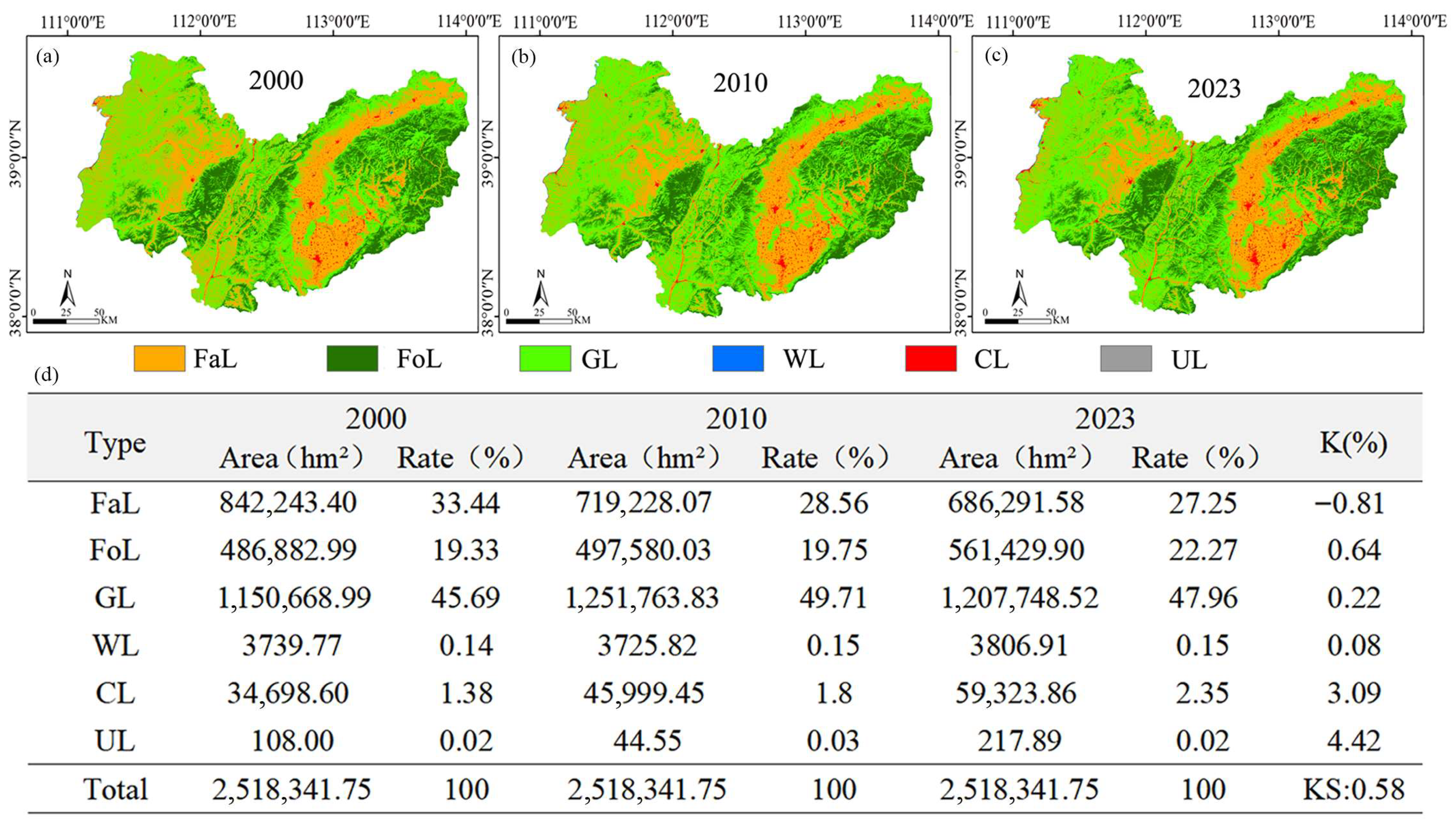
As shown in Figure 3a–d, farmland, forest land, and grassland have consistently dominated the land-use structure of Xinzhou. In 2000, 2010, and 2023, these three categories accounted for 98.46%, 98.02%, and 97.48% of the total area, respectively, indicating a highly stable overall land-use composition.
Despite this stability, substantial internal adjustments occurred between 2000 and 2023. The most notable change is the continuous decline in farmland, accompanied by increases in forest land, grassland, and construction land. Farmland decreased by 155,954.82 hm2, with its proportion falling by 6.19% and a single dynamic degree (K) of –0.81%. In contrast, forest land expanded by 832 hm2, its proportion rising by 2.94% and K reaching 0.64%. Grassland exhibited fluctuations but still recorded a net increase of 634 hm2, with its proportion increasing by 2.00% and K reaching 0.22%.
Other land-use types changed only marginally. Water bodies remained essentially stable, showing a slight annual increase and a single dynamic degree (K) of 0.08%. Driven by urbanization, construction land expanded steadily, with its proportion increasing by 0.97% and K reaching 3.08%—the highest among all categories. Unused land increased slightly from 108.00 hm2 to 217.89 hm2, indicating minimal overall change.

4.1.2. Patterns of Land Use Structure Transformation

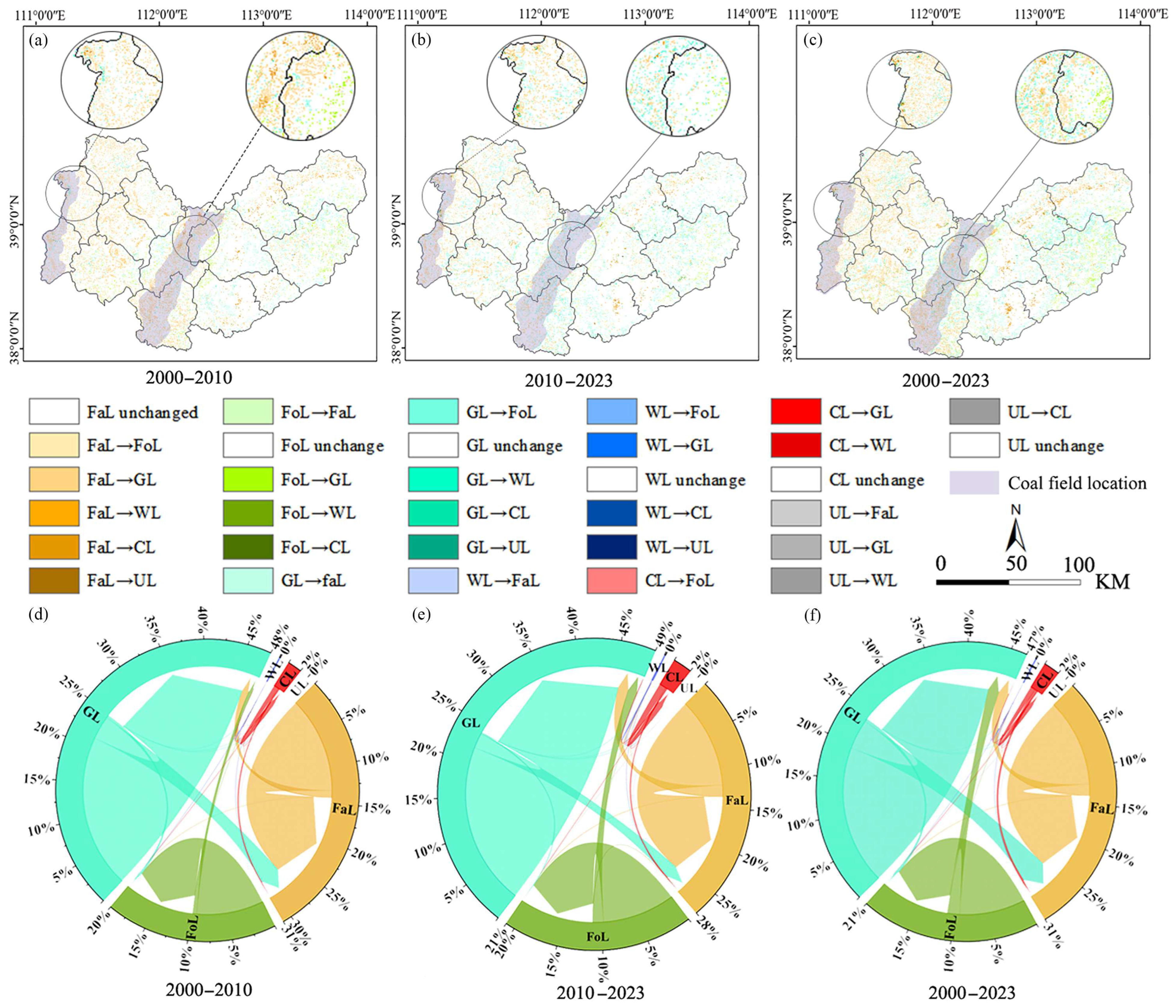
Figure 4a−f show that land-use transformations in Xinzhou between 2000 and 2023 were concentrated primarily in coalfield areas and adjacent construction zones. Over this period, the total transformed area reached 2,518,341.75 hm2, representing 35.76% of the city’s land area. The most substantial transitions occurred among farmland, forest land, and grassland, underscoring the dynamic interactions among these dominant categories. Farmland experienced extensive conversion to grassland, totaling 207,706.32 hm2 and accounting for 86.9% of farmland outflow, while 87,724.35 hm2 of grassland were converted to forest land, comprising 88.4% of forest land inflow.
The spatial pattern of these transitions exhibited low clustering and followed a “broadly dispersed with localized concentration” distribution. Farmland-to-grassland conversions were mainly concentrated in the western and northeastern regions, whereas grassland-to-forest conversions were primarily located in the southeast. This spatial differentiation reflects the combined influence of ecological restoration initiatives, topographic constraints, and regional development patterns.
Temporal variations in land-use transitions were also evident, particularly in changes involving grassland, water bodies, and unused land. During 2000–2010, the total transition area reached 279,398.79 hm2, with ecological restoration playing a dominant role. Farmland was converted predominantly to grassland (164,253.33 hm2, 93.7% of farmland outflow), forest land recorded a net increase of 10,697.04 hm2 mainly through inflow from grassland, and grassland itself showed a net increase of 101,094.84 hm2 sourced from farmland and forest land. Construction land expanded by 11,300.85 hm2, largely at the expense of farmland, while water bodies and unused land experienced slight net decreases.
In contrast, the period from 2010 to 2023 exhibited a reduced scale of transitions, with a total transformed area of 160,238.52 hm2, indicating a shift toward more stable land management. Farmland recorded a net decrease of 32,936.49 hm2, forest land increased by 63,372.96 hm2 primarily through conversions from grassland, and grassland showed a net decrease of 44,015.31 hm2 due to conversions to both farmland and forest land. Construction land continued to expand, with a net increase of 13,324.41 hm2 mainly derived from farmland, reflecting ongoing urbanization. Water bodies and unused land exhibited modest net increases during this period.

4.2. Spatiotemporal Evolution of ESV

4.2.1. Spatiotemporal Patterns of ESV Distribution

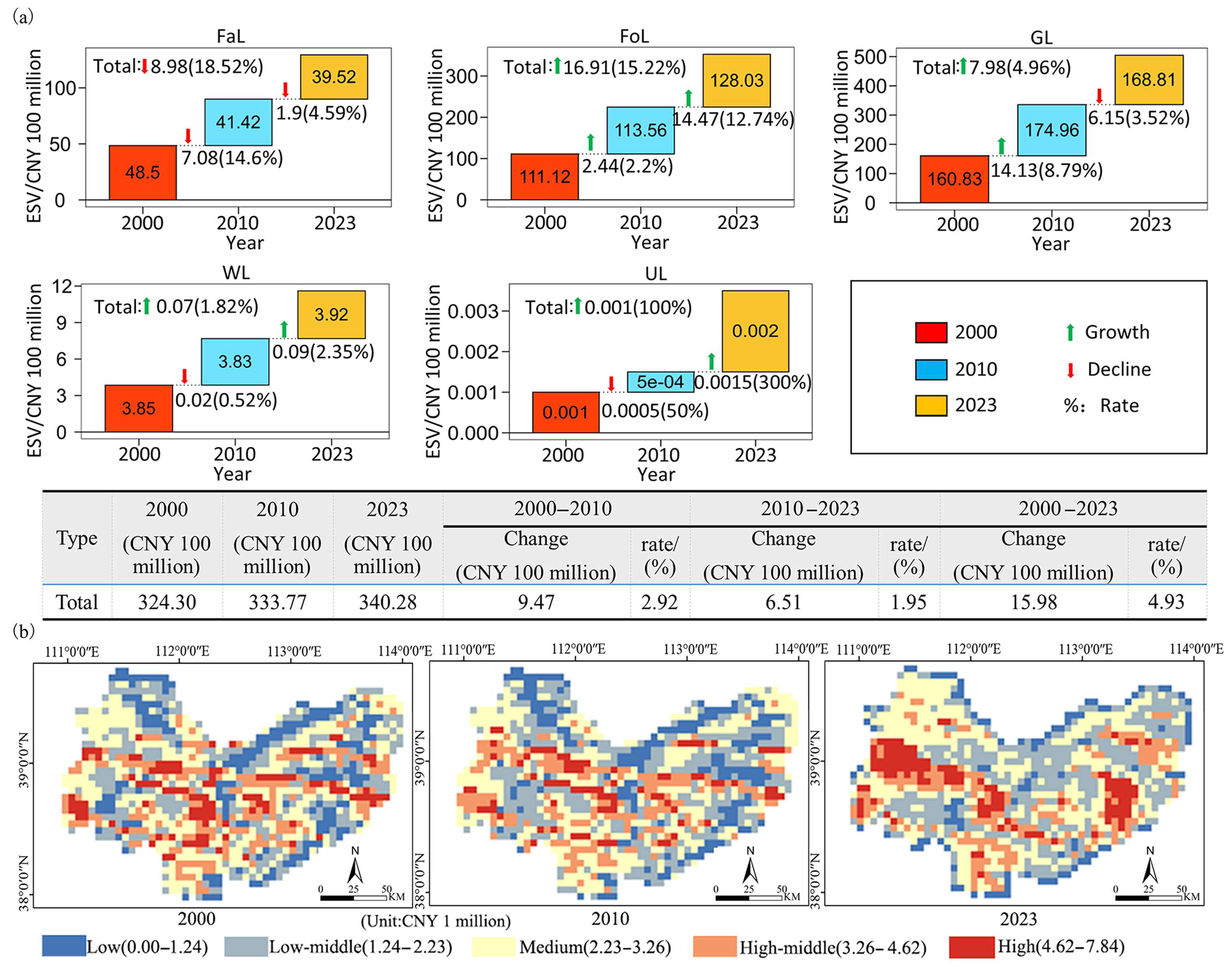
As shown in Figure 5, the total ecosystem service value (ESV) in Xinzhou increased steadily from 2000 to 2023, rising by 15.98 billion CNY (4.93%). The growth was more pronounced during 2000–2010 (an increase of 9.47 billion CNY, 2.92%) than during 2010–2023 (6.51 billion CNY, 1.95%).
(1) Figure 5a indicates clear differentiation among land-use types. Farmland ESV declined by 8.98 billion CNY (−18.52%), whereas forest land ESV increased substantially by 16.91 billion CNY (15.21%). Grassland ESV exhibited a rise–fall pattern but ultimately achieved a net increase of 7.98 billion CNY (4.96%). Water bodies and unused land showed only slight overall increases.
(2) Figure 5b shows that high and upper-middle ESV zones were concentrated in mountainous areas above 800 m, particularly in the Lvliang and Wutai ranges, forming a continuous high-value corridor. In contrast, low-value zones were located along the Hutuo River valley and the Xinding Basin, where human activities are more intensive. This spatial contrast underscores the inverse relationship between development intensity and ESV. Although coalfield regions also contained many high-value zones, mining activities still exerted negative ecological impacts. For example, 12.6% of high-value zones in northwestern mountainous coalfields degraded between 2000 and 2010. However, from 2010 to 2023, high-value areas expanded by 23.7%, likely driven by forest land recovery and a concurrent reduction in mining intensity.
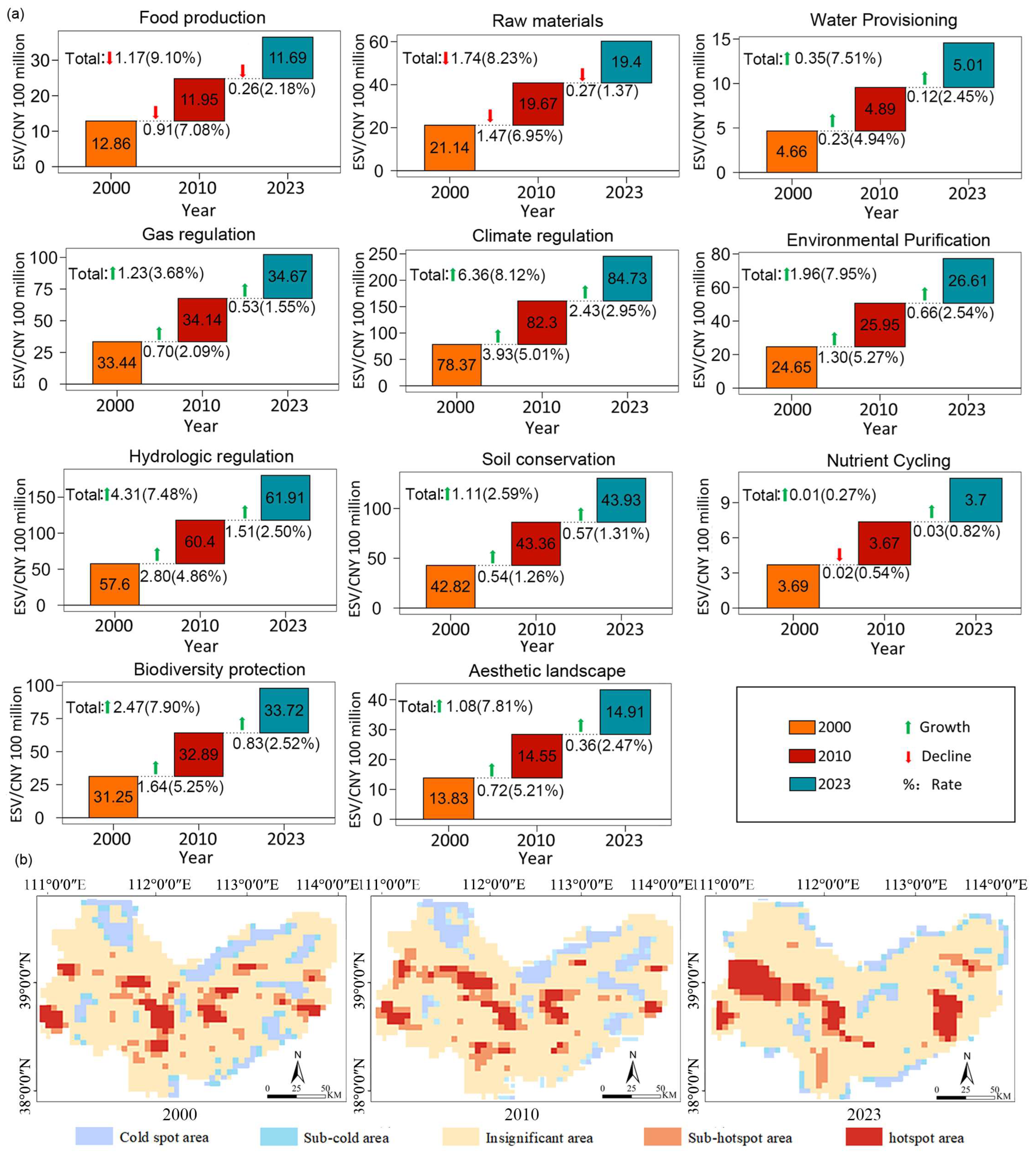
(3) As illustrated in Figure 6a, most ecosystem service functions increased from 2000 to 2023, reflecting gradual ecological improvement. Climate regulation and hydrological regulation consistently contributed the largest shares of ESV, with climate regulation showing the greatest growth (8.12%). In contrast, food production declined by 9.10%, a trend consistent with the expansion of forest land (2.94%) and the continuous loss of farmland (average annual decline of 0.78%).
(4) Figure 6b demonstrates that ESV hotspots expanded markedly from 2000 to 2023, while coldspots contracted. The most significant hotspot growth occurred in Hequ and Wutai, whereas Xinfu remained a persistent coldspot or sub-coldspot. During 2000–2010, the spatial pattern of hotspots and coldspots remained relatively stable, with highvalue clusters in central Xinzhou, moderate zones in the northwest, and coldspots in the northern and southeastern regions. In contrast, 2010–2023 witnessed substantial hotspot expansion—particularly in Hequ, Wuzhai, and Wutai—accompanied by a reduction in coldspots, mainly in Xinfu, Dai, and Kelan counties.

4.2.2. Sensitivity Response of ESV Evolution

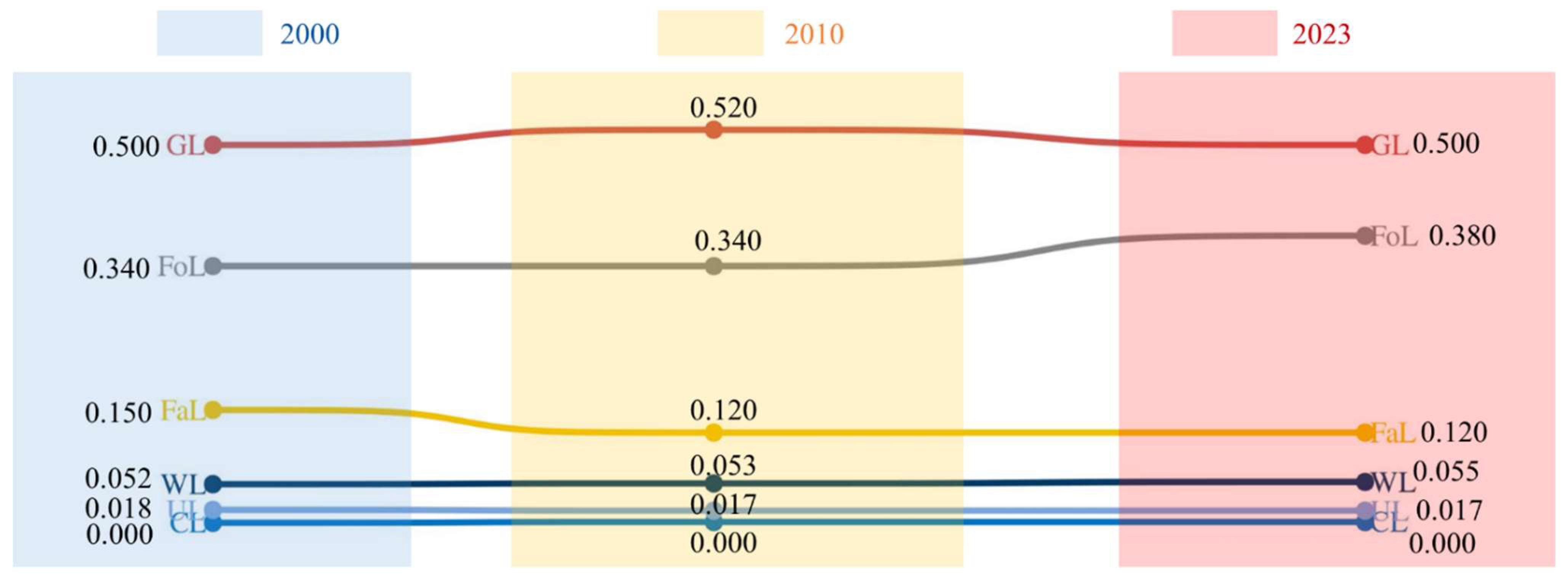
As shown in Figure 7, the coefficient of sensitivity (CS) remained below the threshold value of 1 throughout the study period, indicating reliable CS estimates. From 2000 to 2023, CS values for all land use types ranged between 0.00 and 0.52, with interannual fluctuations generally below 0.05. This reflects a clear inelastic response of ESV to changes in value coefficients (VC). Grassland exhibited the highest sensitivity (average CS = 0.51), followed by forest land (average CS = 0.35), together accounting for approximately 84–87% of the total sensitivity response. In contrast, unused land and construction land consistently showed CS values close to zero (<0.01), indicating minimal influence of VC adjustments on total ESV.
Significant gradient differences were observed among ecosystem types. The sensitivity of grassland was nearly 30 times higher than that of unused land, reflecting differences in spatial distribution, service intensity, and value conversion efficiency. Within each land use category, however, CS values remained relatively stable over time. For instance, farmland CS declined slightly from 0.15 in 2000 to 0.12 in 2023, while forest land fluctuated modestly between 0.34 and 0.38. This low temporal variability (coefficient of variation < 15%) further supports the long-term structural stability of land use in the study area.

4.3. Driving Factors of ESV

Previous studies have shown that interactions between ecosystems and environmental factors can modify tradeoffs among ecosystem service functions [72]. These influencing factors are generally grouped into socio-economic and natural environmental categories [73]. Considering Xinzhou’s conditions, eight variables were selected to represent both natural and human influences: elevation (X1), slope (X2), aspect (X3), annual precipitation (X4), annual mean temperature (X5), NDVI (X6), population density (X7), and annual GDP (X8). These variables have been widely adopted in previous ESV studies and capture the major biophysical constraints and human pressures relevant at the municipal scale. The selection of these variables follows two principles. First, extensive ESV research has consistently identified topography, climate, and vegetation conditions as the fundamental biophysical constraints shaping ecosystem service patterns, while socio-economic indicators such as population density and GDP are widely used to represent human disturbance intensity. Second, all selected variables are spatially continuous, quantifiable, and commonly applied at the municipal scale, ensuring both data availability and strong compatibility with Xinzhou’s ecological and socio-economic context.

4.3.1. Stepwise Regression Analysis Based on SPSS

Stepwise regression analysis (SPSS 26.0) was used to examine the direction and magnitude of each factor’s influence on ESV (Table 3). The results show clear temporal variation in both significance and direction across 2000, 2010, and 2023. Although the specific significant variables differed among years, natural environmental factors generally exerted positive influences on ESV, whereas socio-economic factors more often showed negative associations.
From the perspective of model performance, the explanatory power of the regression models increased steadily over time. In 2000, the model yielded an R2 of 0.124 and an adjusted R2 of 0.108, with the F-statistic indicating overall significance (F = 6.521, p = 0.001). By 2010, model performance improved substantially (R2 = 0.206, adjusted R2 = 0.202), and the overall model remained highly significant (F = 15.213, p < 0.001). In 2023, the model achieved its highest explanatory power, with an R2 of 0.294 and an adjusted R2 of 0.290, again showing strong overall significance (F = 18.046, p < 0.001). This progressive increase suggests that the influence of the selected driving factors on ESV became more structured and predictable over time.
In terms of individual variables, the significant factors in 2000 included annual precipitation (X4, positive), annual mean temperature (X5, positive), and annual GDP (X8, negative). By 2010, the set of significant variables expanded to include slope (X2, positive) and NDVI (X6, positive), while GDP (X8) continued to show a significant negative association with ESV. In 2023, elevation (X1), slope (X2), annual mean temperature (X5), and NDVI (X6) emerged as significant positive predictors, whereas population density (X7) exerted a significant negative effect.
Annual mean temperature (X5) consistently exhibited a significant positive influence across all three years, suggesting that warming conditions may enhance ESV in Xinzhou. Meanwhile, the negative effect of GDP (X8) observed in 2000 and 2010 was no longer significant in 2023, indicating a gradual reduction in the ecological costs associated with economic development. The emergence of elevation (X1) and population density (X7) as significant factors in 2023 further reflects the increasing importance of topographic constraints and demographic pressures in shaping ESV spatial patterns.

4.3.2. Analysis of Driving Factors Based on the Geographical Detector

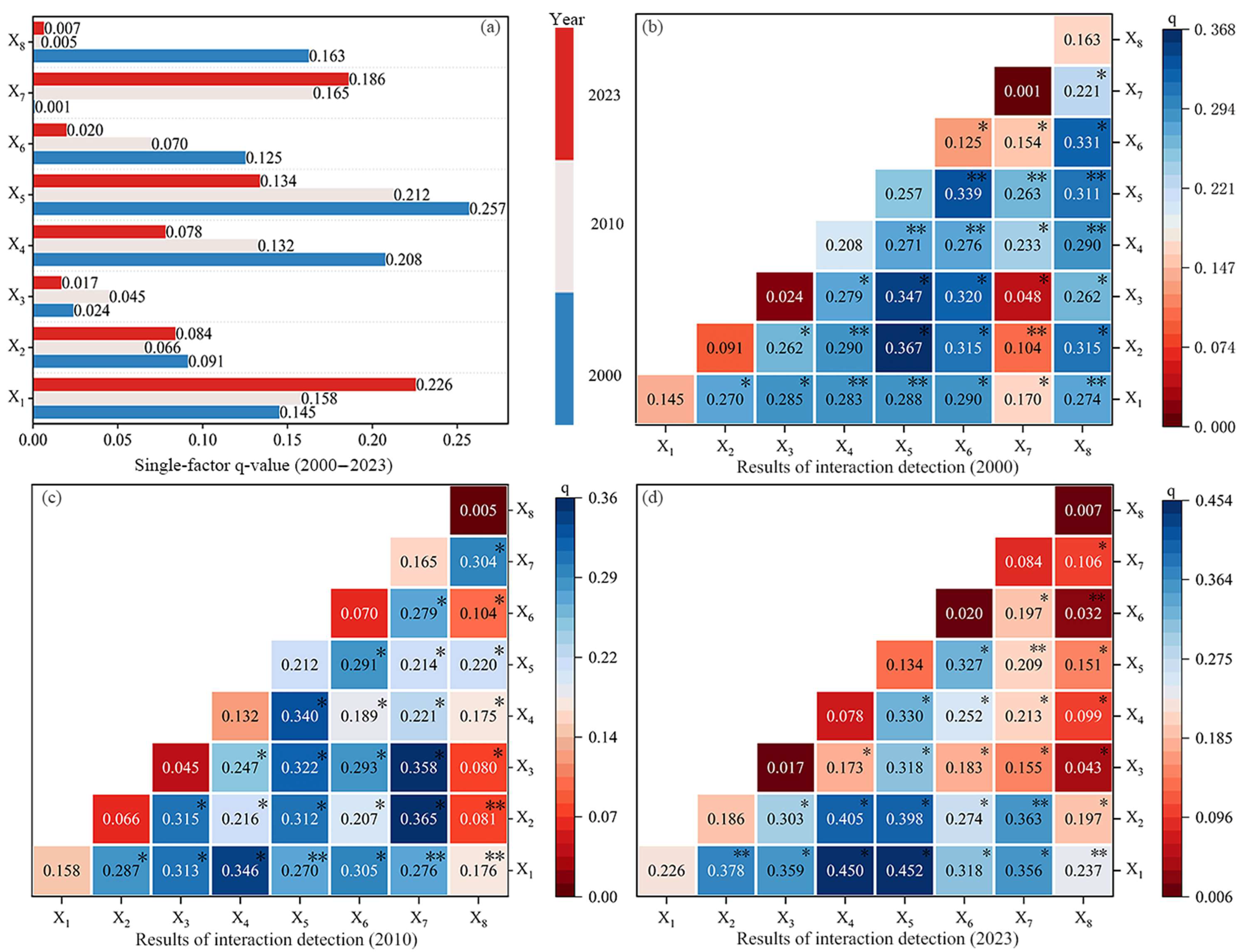
The Geographical Detector was applied to further assess the spatial influence of driving factors on ESV. As shown in Figure 8a, the explanatory power (q-values) varied across years. In 2000, annual mean temperature and annual precipitation had the strongest explanatory power, while aspect had the weakest. In 2010, annual mean temperature and population density ranked highest. By 2023, elevation and population density became the dominant factors.
Synthesizing q-values from 2000 to 2023 (Figure 8b–d), annual mean temperature, elevation, and population density consistently showed strong explanatory power, whereas aspect remained persistently weak (<5%). Natural environmental factors overall exhibited stronger explanatory effects than socio-economic factors, although the influence of socio-economic variables increased over time.
More specifically, the dominant factors varied across the three time periods. In 2000, annual mean temperature (25.7%) and annual precipitation (20.8%) exhibited the highest explanatory power for ESV. By 2010, annual mean temperature remained the most influential factor (21.2%), while population density (16.5%) emerged as the second strongest driver. In 2023, elevation (22.6%) became the leading factor, followed closely by population density (18.6%), indicating a shift toward the increasing importance of topographic and demographic constraints.
Interaction detection further revealed that the combined effects of any two factors generally exceeded the explanatory power of individual variables. Annual mean temperature frequently formed strong interactions. In 2000, its interactions with slope (q = 0.367) and aspect (q = 0.347) were particularly prominent, and NDVI also showed strong interactions with temperature and GDP. In 2010, population density displayed strong interactions with slope (q = 0.365) and aspect (q = 0.358), while annual precipitation interacted strongly with both elevation and temperature. By 2023, elevation became the core interacting factor, especially in combination with annual mean temperature (q = 0.452) and annual precipitation (q = 0.450), and slope also formed strong interactions with precipitation and temperature.
Overall, the results indicate that natural factors provide the fundamental spatial structure of ESV in Xinzhou, while socio-economic factors contribute additional, more localized variations. This is consistent with the characteristics of resource-based cities, where mining and development pressures are spatially concentrated, whereas natural gradients shape the broader ecological pattern.

4.4. Ecological Compensation Patterns

4.4.1. Non-Market Value of Ecosystem Service Functions

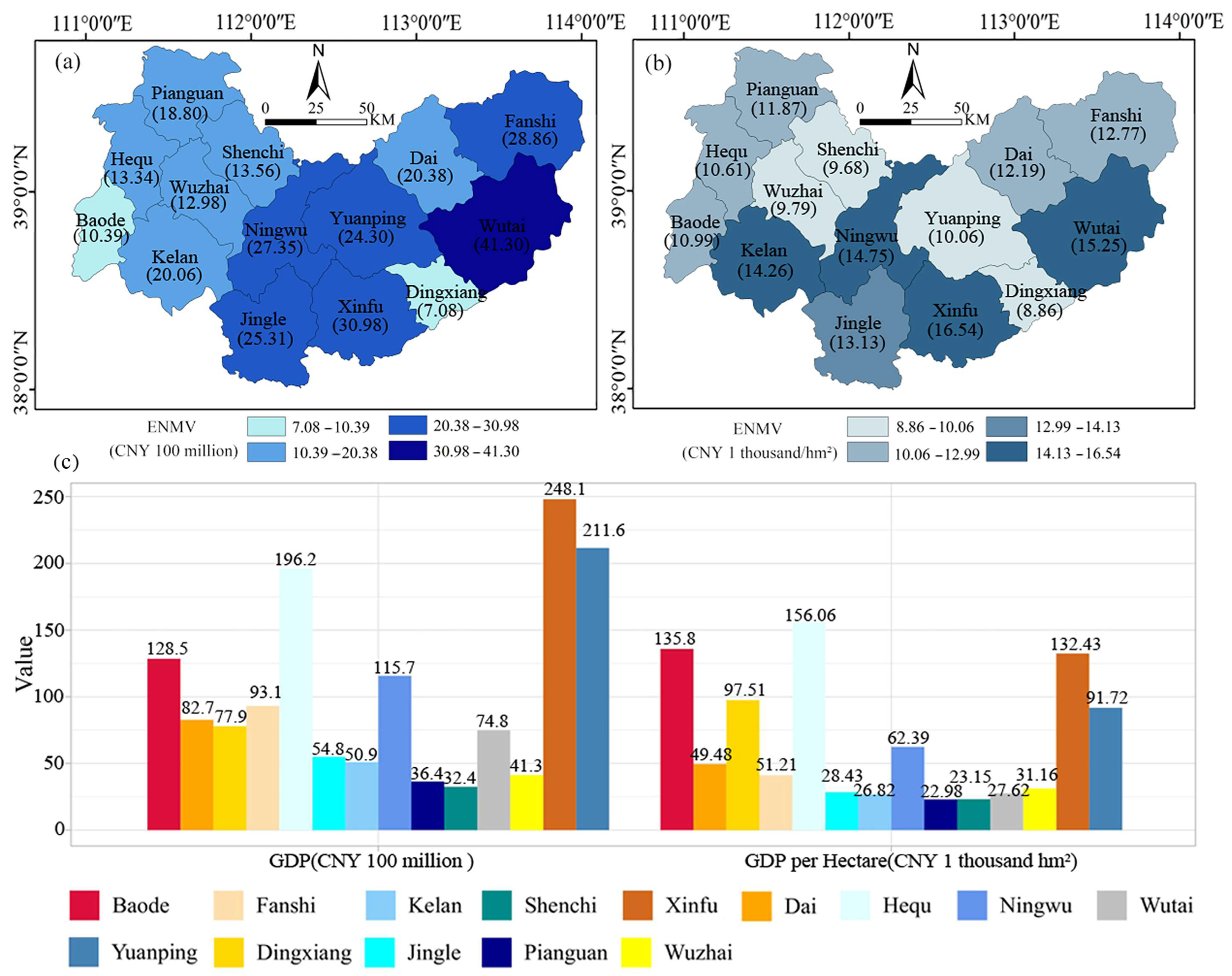
To avoid inflation-related distortions in historical data, the year 2023 was selected as the base year for estimating Xinzhou’s theoretical ecological compensation standard. Figure 9a,b illustrate the total and per-unit-area non-market ecosystem service value (ESV) across counties and districts, along with their spatial distribution patterns.
Wutai and Xinfu ranked highest in both total and per-unit-area non-market ESV, indicating that they provide the most valuable ecosystem services in Xinzhou. At the opposite end, Dingxiang recorded the lowest values in both metrics, reflecting its underdeveloped ecological service capacity. Wuzhai also performed poorly, ranking third from the bottom in total value and second from the bottom in per-unit-area value.
Kelan presents a distinct pattern: although it ranked eighth in total non-market ESV, it ranked fourth in per-unit-area value. This suggests a “high-quality but small-scale” ecological structure, likely supported by minimal human disturbance—construction land accounts for only 0.74% of its total area—allowing natural ecosystems to maintain high functional efficiency.
Economic development patterns in 2023 (Figure 9c) further highlight differences among these regions. Xinfu demonstrates a relatively balanced relationship between ecological protection and economic growth, ranking among the top two in both total GDP and per capita GDP. In contrast, Wutai, despite its high ecological value, ranked near the bottom in both economic indicators (sixth lowest in total GDP and fourth lowest in per capita GDP), suggesting that its strong ecological performance may be associated with slower economic development. Meanwhile, Dingxiang, although weak in ecosystem service provision, ranked among the top four in per capita GDP, implying a development strategy that prioritizes economic growth over ecological conservation.

4.4.2. Spatial Distribution of Ecological Compensation Amounts

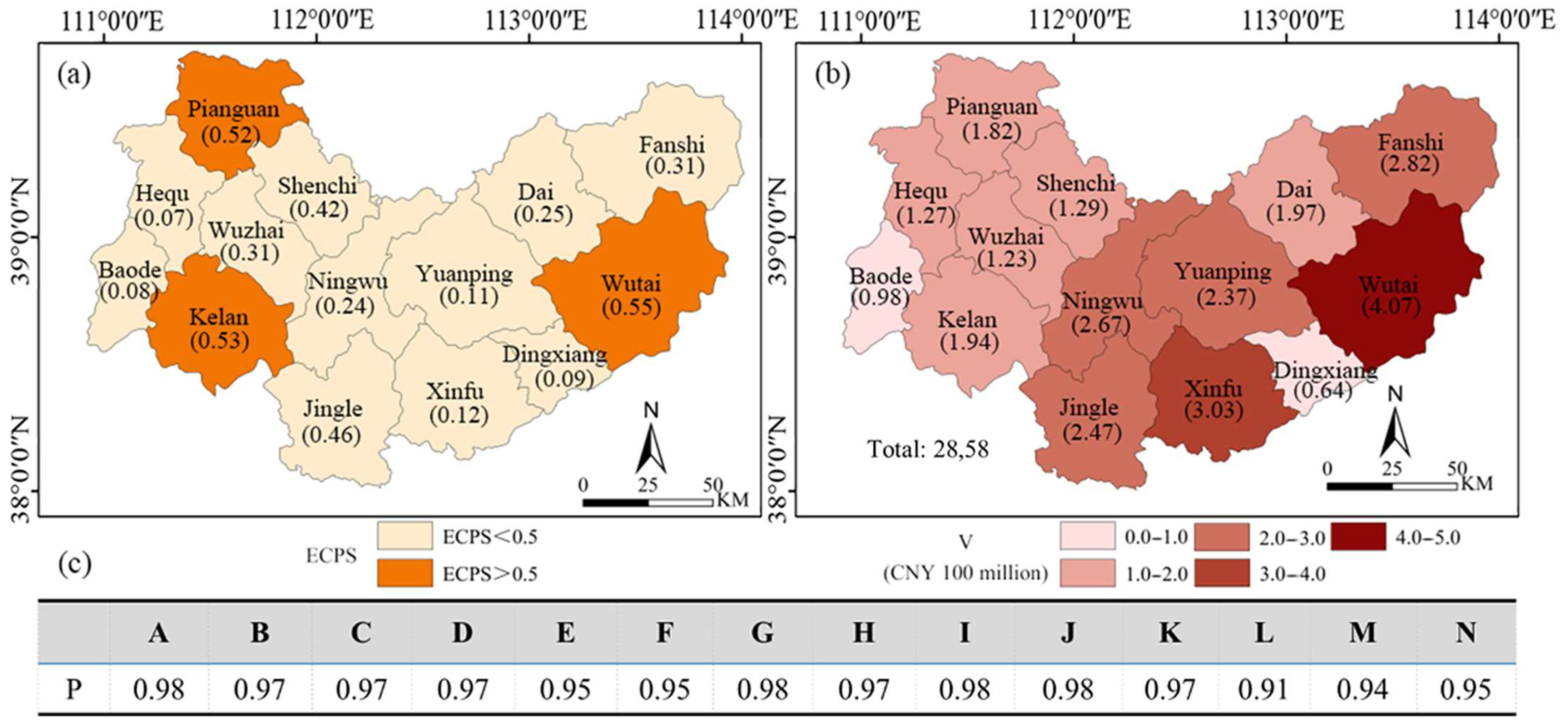
Figure 10 presents the ecological compensation priority index (ECPS), demand intensity coefficient (P), and standard compensation amounts for each county and district in Xinzhou. As shown in Figure 10a–c, although the priority levels for ecological compensation differ substantially across regions, the demand intensity is uniformly high (p > 0.9) in all counties. Wutai, Kelan, and Pianguan are identified as high-priority areas (ECPS > 0.5), indicating that their ecological contributions substantially exceed their economic outputs and thus warrant preferential compensation.
Wutai exhibits the highest ECPS value, reflecting the most urgent need for ecological compensation. Its combination of strong ecological performance and relatively weak economic development suggests limited internal capacity to finance ecological protection, making external support essential. In contrast, Hequ has the lowest ECPS value (0.07), indicating that its ecological contribution is comparatively modest relative to its economic input. This implies that Hequ retains considerable potential for self-funded ecological investment and does not require immediate external compensation.
Figure 10b shows the spatial distribution of standard ecological compensation amounts. In 2023, Xinzhou’s total ecological compensation requirement was estimated at 2.858 billion CNY, equivalent to approximately 2% of the city’s annual GDP (144.44 billion CNY). High-compensation areas are primarily located in the eastern and central regions of the city. Wutai (407 million CNY), Xinfu (303 million CNY), and Fanshi (280 million CNY) constitute the top three recipients. In contrast, the western counties—Dingxiang (64 million CNY), Baode (98 million CNY), and Wuzhai (123 million CNY)—have the lowest compensation amounts.

5. Discussion

5.1. Feasibility of the Research Framework

This study takes Xinzhou—a representative mining-resource-based city in China—as a case study to systematically analyze its land use structure, ecosystem service value (ESV), and ecological compensation mechanisms, thereby enriching the body of research on resource-dependent urban systems. The proposed research framework demonstrates strong logical coherence and methodological rigor. It follows a progressive structure that begins with land use change analysis and advances through ESV quantification, driving mechanism exploration and ecological compensation design, forming an integrated pathway of “change identification → value assessment → mechanism interpretation → policy formulation.” This framework is feasible and effective in the following four aspects: (1) The use of the Markov chain model to analyze land use change serves as a logical starting point, aligning with the fundamental drivers of ecosystem service evolution. This method effectively estimates transition probabilities among different land use types, identifies long-term trends, and provides a robust spatial foundation for subsequent ESV assessments. (2) The evaluation of ESV dynamics is based on the equivalent factor method, supplemented by hotspot and sensitivity analyses. This approach is not only operationally simple but also capable of capturing spatial heterogeneity. It offers strong regional adaptability and accurately reflects the spatiotemporal trajectories of ecosystem service functions at a macro scale. (3) The investigation of driving mechanisms employs both stepwise regression and the Geographical Detector, achieving a synergistic integration of quantitative analysis and spatial interpretation. Stepwise regression identifies the key influencing factors and their directional effects on ESV, while the Geographical Detector compensates for the limitations of traditional statistical methods in addressing spatial non-stationarity, enabling the detection of geographic variations in factor influence. (4) The ecological compensation model is constructed based on ESV assessment results, incorporating the ecological compensation priority index, demand intensity coefficient, and standard compensation amount. This design completes a closed-loop logic from ecological change identification to policy pathway formulation. It not only reflects the principle of fairness in ecological compensation from a theoretical perspective but also demonstrates strong practical operability and potential for broader application.
In summary, the research framework developed in this study is logically coherent and methodologically robust, balancing theoretical depth with technical feasibility. Its overall design exhibits strong systematization, applicability, and innovation, offering a replicable model for regional ecological compensation policy development and resource management

5.2. Spatiotemporal Evolution of Land Use Structure and ESV

In terms of land use structure, this study reveals that the expansion of construction land in Xinzhou from 2000 to 2023 primarily resulted from the conversion of farmland, indicating that urbanization has exerted a crowding-out effect on agricultural production space. This finding is consistent with conclusions drawn in existing literature [74,75]. Additionally, the study reveals that forest land in Xinzhou also increased during this period, with some farmland being converted into forest. This trend is likely driven by policy interventions—particularly the issuance of the “Opinions of the State Council on Further Improving the Policy Measures for Returning Farmland to Forest” in 2002 (https://www.gov.cn/gongbao/content/2002/content_61463.htm, accessed on 5 December 2025), which provided institutional support for forest expansion.
Regarding the spatiotemporal evolution of ESV, the results show that from 2000 to 2023, high and upper-middle ESV zones were mainly concentrated in coalfield areas and their surroundings. These areas exhibited a “decline–recovery” pattern in ESV. This phenomenon may be attributed to the dual effects of changes in coal mining intensity and policy guidance. Between 2000 and 2010, the proliferation of small and medium-sized coal mines in Xinzhou led to increasingly severe ecological degradation. After 2010, however, the Shanxi provincial government introduced a series of policy measures aimed at mitigating the negative environmental impacts of coal mining. These included the “Second Public Notice of Environmental Impact Assessment for the Xinzhou City Mineral Resources Master Plan” (https://zrzyj.sxxz.gov.cn/zwgk/ghjh/kczygh/201806/W020210825409843363346.doc, accessed on 8 December 2025 ), the “Notice of the General Office of the Shanxi Provincial People’s Government on the Rectification and Closure of Coal Mines” (https://www.shanxi.gov.cn/zfxxgk/zfxxgkzl/fdzdgknr/lzyj/szfbgtwj/202205/t20220513_5976823.shtml, accessed on 7 December 2025), and the “Notice on Further Promoting the Merger and Restructuring of Coal Enterprises” (https://www.shanxi.gov.cn/zfxxgk/zfxxgkzl/fdzdgknr/lzyj/szfbgtwj/202205/t20220513_5977305.shtml, accessed on 7 December 2025). These policies led to the closure of heavily polluting and economically inefficient mines and promoted ecological restoration projects—such as the construction of artificial conservation facilities and environmental rehabilitation—thereby contributing to the recovery of ESV in these regions.
In terms of ESV sensitivity response, the results show that from 2000 to 2023, the coefficient of sensitivity (CS) values for all land use types in Xinzhou remained below 1, with low interannual variability (coefficient of variation < 15%). This indicates that the regional land use structure has been generally stable over the long term. Such “stability” does not imply that the land use pattern was entirely unchanged, but rather that the overall structure exhibited strong resilience and resistance to external disturbances. Minor adjustments were still evident at the local level—for example, a slight decline in farmland CS and modest fluctuations in forest land CS—highlighting the need to monitor potential cumulative effects. Moreover, the analysis revealed that Xinzhou’s ecosystem service value (ESV) exhibited a clearly inelastic response to changes in value coefficients (VC), suggesting that adjustments to VC exert only limited marginal effects on regional ESV. This conclusion is consistent with previous studies [76]. Importantly, these findings provide a scientific basis for land management policy: rather than focusing on parameter adjustments of VC, greater emphasis should be placed on optimizing the spatial configuration of highly sensitive ecosystems—such as grasslands and forests—to achieve more substantial improvements in ESV. At the same time, while the overall land use structure remains robust, localized dynamics should be carefully addressed to prevent small-scale fluctuations from accumulating into long-term structural risks.

5.3. Driving Mechanisms of ESV

This study confirms that both natural and socio-economic factors are the primary drivers of spatiotemporal changes in ecosystem service value (ESV), consistent with the findings of Pan et al. (2021) [77]. The discussion is elaborated as follows:
(1) Natural Factors: The results indicate that ESV in Xinzhou is strongly influenced by temperature, which acts as a positive driver. This may be attributed to temperature’s significant role in regulating ecological processes such as plant growth, carbon fixation, and evapotranspiration. Previous studies have shown that temperature changes can directly affect vegetation health and biodiversity [78], thereby influencing the value of ecosystem services [79]. Additionally, this study reveals that the influence of annual precipitation on ESV in Xinzhou has declined over time—showing a positive effect in 2000 and 2010 but becoming statistically insignificant by 2023. This shift may be related to the increased frequency of extreme rainfall events in 2023, particularly during July and August (https://www.shanxi.gov.cn/ywdt/sxyw/202308/t20230801_9039702.shtml, accessed on 7 December 2025). According to Wübbelmann et al. (2023) [80], as the frequency and intensity of extreme rainfall events increase, the regulatory capacity of urban ecosystems tends to saturate, leading to heightened flood risks and imbalances in ecosystem service supply and demand, ultimately reducing overall ESV.
(2) Socio-Economic Factors: The study reveals that the negative impact of population density on ESV has intensified over time, becoming significantly negative by 2023. This pattern is consistent with Liu et al. (2020) [81], who argue that intensified human activity accelerates environmental degradation and ecosystem deterioration. Our results further show that population density has evolved into a key socio-economic driver of ESV decline in Xinzhou. Stepwise regression identifies it as a significant negative predictor in 2023, reflecting the growing ecological pressures associated with urban crowding. Geographical Detector results corroborate this trend: population density ranks among the dominant explanatory factors in both 2010 and 2023, with q-values second only to temperature in 2010 and to elevation in 2023. Its strong interactions with slope and aspect in 2010 also indicate that demographic pressures can amplify ecological impacts when coupled with topographic constraints. Overall, the evidence suggests that under continued urbanization and demographic expansion, population density exerts both direct negative effects on ecosystem functions and indirect synergistic effects through interactions with natural environmental gradients, thereby emerging as a major driver of ESV decline in Xinzhou. Furthermore, the study reveals that the negative impact of GDP on ESV, which was significant in earlier years, became statistically insignificant by 2023. This shift may reflect a transition in Xin-zhou’s development model—from “extensive economic growth” before 2010 to a more balanced “economy–environment coordination” model thereafter. On 1 December 2010, the National Development and Reform Commission officially approved the establishment of the Shanxi National Resource-Based Economic Transformation Comprehensive Reform Pilot Zone. Subsequently, Shanxi Province issued the “Implementation Plan for the Comprehensive Reform Pilot of the National Resource-Based Economic Transformation in Shanxi Province (2013–2015)” (https://www.shanxi.gov.cn/zfxxgk/zfxxgkzl/fdzdgknr/lzyj/szfwj/202205/t20220513_5975982.shtml, accessed on 7 December 2025). Under the extensive growth model, economic development often came at the expense of the environment, whereas the coordinated model emphasizes both economic growth and environmental protection—e.g., economic expansion may lead to increased investment in environmental protection [82].
It is also important to note that changes in land use structure directly affect ESV. This study reveals that grasslands have become the land use type providing the highest ESV, while the value provided by forest land is also rapidly increasing. These findings are consistent with Ding et al. (2024) [83], highlighting the critical role of grasslands and forests in supporting ecosystem services within land use systems. Beyond these land-use dynamics, the broader spatial context of Xinzhou also helps explain the observed patterns. Although Xinzhou is classified as a typical mining-resource-based city, the spatial footprint of mining activities is highly localized, and their ecological impacts remain relatively confined. In contrast, natural environmental gradients—such as topography, climatic conditions, and vegetation structure—extend continuously across the municipal landscape and form the underlying spatial framework that shapes ESV distribution. As a result, at the municipal scale, natural factors exhibit stronger explanatory power than socio-economic variables, a pattern that is fully consistent with ecological process theory. This finding also aligns with previous studies on resource-based regions, where mining-related disturbances tend to follow a “point-to-strip” spatial pattern [84], whereas natural environmental gradients display a “surface-to-continuous” distribution, leading natural factors to dominate in spatial statistical models.

5.4. Ecological Compensation Policy

A fundamental principle of ecological compensation is that the compensation amount should be at least equivalent to, or exceed, the extent of ecological damage incurred [85]. This study quantitatively assessed the priority and standard amount of ecological compensation in Xinzhou based on ecosystem service value (ESV) and gross domestic product (GDP), thereby addressing two critical questions: how to allocate compensation and how much to compensate. The findings indicate that high-compensation zones are primarily located in the eastern and western regions of the city, where natural resources are abundant. Previous studies have shown that such resource-rich areas tend to exhibit significantly higher ESV than surrounding regions [86]. However, these areas also bear substantial opportunity costs due to development restrictions—such as the trade-offs between tourism development and ecological conservation—which intensifies the urgency for compensation [87].
It is important to recognize that the tension between ecological protection and economic development varies across regions, depending on their respective natural resource endowments. Therefore, compensation strategies should be tailored to local conditions [86]. Establishing multi-objective and multi-modal ecological compensation policies is essential for achieving balanced regional development [42]. At the national level, China has already issued a comprehensive regulatory framework. On April 6, 2024, the State Council promulgated the Regulation on Ecological Protection Compensation, which outlines mechanisms such as vertical fiscal transfers, interregional horizontal compensation, and market-based compensation (https://www.gov.cn/zhengce/zhengceku/202404/content_6944395.htm, accessed on 7 December 2025). This regulation provides a valuable reference for the formulation of localized ecological compensation policies in Xinzhou.
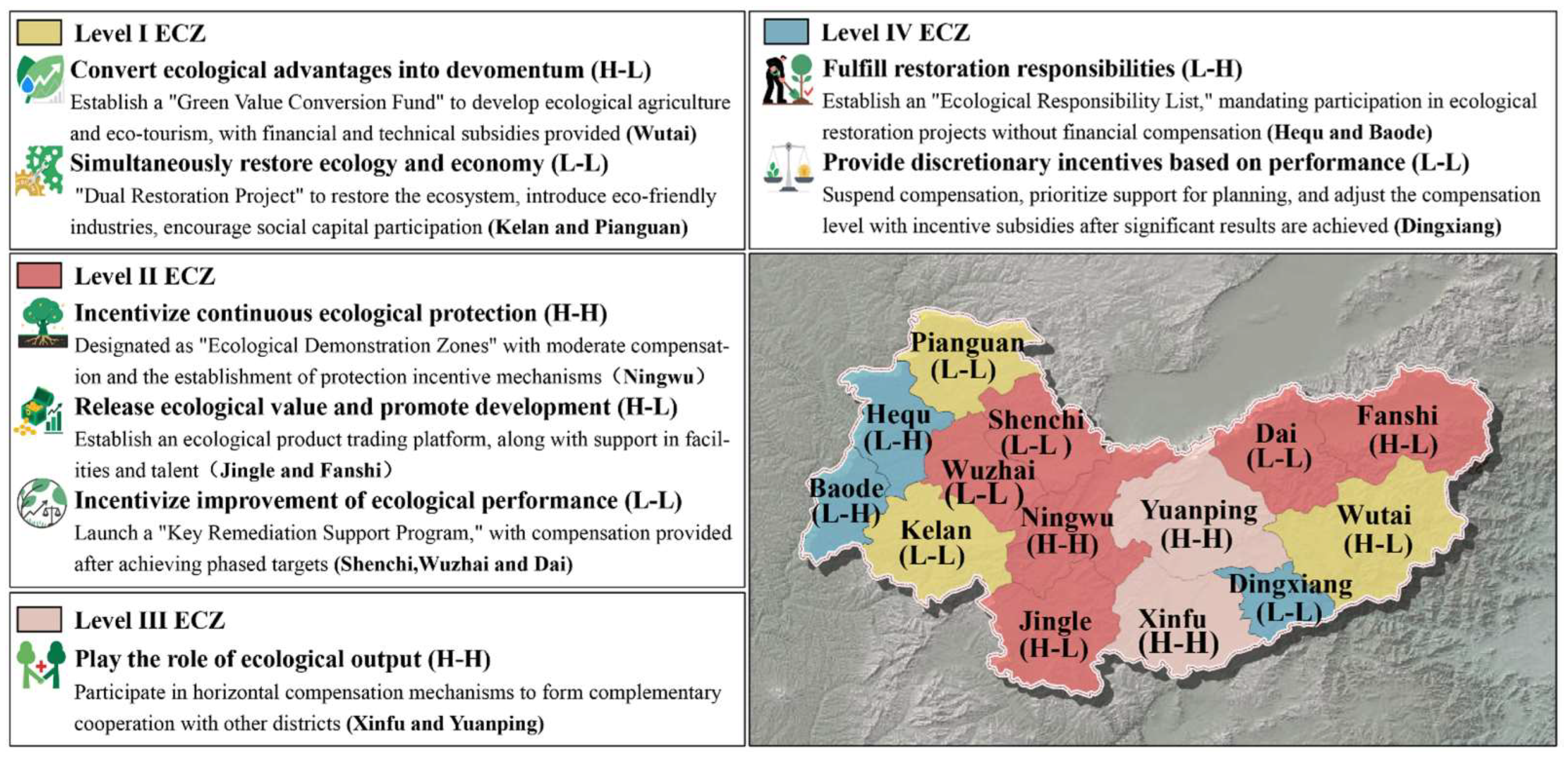
It is noteworthy that Xinzhou currently lacks a dedicated ecological compensation policy or planning framework. To address this gap, this study proposes the Xinzhou County-Level Ecological Compensation Sustainable Development Policy Framework, which comprises the following components.
(1)
Classification Criteria
First, based on the Ecological Compensation Priority Score (ECPS), counties are initially divided into two categories. Counties with ECPS > 0.5 are designated as Level I Ecological Compensation Zones (ECZ). Given the relatively large number of counties with ECPS < 0.5, further classification is applied: counties with 0.2 < ECPS ≤ 0.5 are assigned to Level II ECZ, those with 0.1 < ECPS ≤ 0.2 to Level III ECZ, and those with 0 < ECPS ≤ 0.1 to Level IV ECZ. Second, using the average Ecosystem Non-Market Value (ENMV) of ¥2.105 billion and average GDP of ¥10.317 billion across all counties in Xinzhou as benchmarks, values above the average are defined as High, and those below as Low. Accordingly, counties are categorized into four ENMV–GDP types: High–High (H-H), High–Low (H-L), Low–Low (L-L), and Low–High (L-H).
(2)
Goal Formulation
Level I ECZ: Wutai County (H-L), Kelan County (L-L), and Pianguan County (L-L). These counties exhibit poor economic conditions regardless of ecological status and are prioritized for policy support with the highest compensation intensity. The overarching goal is to “empower the disadvantaged and promote transformation.” Specifically, H-L counties aim to “convert ecological advantage into development momentum,” while L-L counties focus on “simultaneously restoring ecology and economy.”
Level II ECZ: Jingle County (H-L), Shenchi County (L-L), Wuzhai County (L-L), Fanshi County (H-L), Daixian County (L-L), and Ningwu County (H-H). These counties possess partial ecological or economic advantages. The general goal is to “incentivize protection and guide upgrading.” H-H counties should “incentivize continuous ecological protection,” H-L counties should “release ecological value and promote development,” and L-L counties should “incentivize improvement of ecological performance.”
Level III ECZ: Xinfu District and Yuanping City (both H-H). These counties demonstrate strong ecological and economic conditions and are capable of stable development. The goal is to shift toward “horizontal participation,” with a focus on “playing the role of ecological output.”
Level IV ECZ: Dingxiang County (L-L), Baode County (L-H), and Hequ County (L-H). These counties suffer from poor ecological quality but possess relatively strong economic capacity. The overarching goal is “responsibility assumption and performance-based orientation.” L-H counties should “fulfill restoration responsibilities,” while L-L counties should “provide discretionary incentives based on performance.”
(3)
Strategy Development
Tailored ecological compensation policy recommendations have been formulated for each county based on its classification and ENMV–GDP typology. Detailed strategies are presented in Figure 11.

5.5. Research Limitations

This study estimated the ecosystem service value (ESV) of Xinzhou using adjusted equivalent value coefficients per unit area, tailored to the city’s ecological and socio-economic context. However, the determination of equivalent coefficients involves subjectivity, which may reduce the precision and reliability of results [44,45]. To strengthen regional ESV assessments, future research should consider alternative or complementary approaches. Benefit transfer methods with spatial adjustments can enhance contextual sensitivity if cross-site matching and scale consistency are ensured [88]. Biophysical process-based models, such as InVEST and ARIES, can more directly represent ecological functions and trade-offs, though they require substantial parameterization, high-quality data, and careful treatment of uncertainty [89]. Market-based and stated-preference valuation techniques can further capture socio-economic and cultural values overlooked by coefficient-based methods, with established applications across diverse service categories [90]. Regarding driving mechanisms, although this study quantitatively analyzed spatial drivers of ESV variation in Xinzhou, policy-related factors were excluded due to difficulties in quantification. This omission may limit the comprehensiveness of the analysis, particularly where policy interventions strongly influence land use and ecological restoration. Future research should therefore identify suitable policy indicators—such as ecological investment intensity, regulatory enforcement, or conservation program coverage—and integrate them into the analytical framework to achieve a more holistic understanding of institutional and governance impacts on ecosystem service dynamics.

6. Conclusions

This study systematically examined land-use transitions, the spatiotemporal evolution and driving mechanisms of ecosystem service value (ESV), and the ecological compensation framework in Xinzhou, a representative mining-resource-based city in China, from 2000 to 2023. The main conclusions are as follows.
(1)
Land-use dynamics and spatial reconstruction.
Between 2000 and 2023, land-use transitions in Xinzhou covered approximately 2,518,341.75 hectares, accounting for 35.76% of the city’s total area. Coal mining zones and urban expansion corridors were the primary loci of transformation. Farmland declined continuously, while forest land, grassland, and construction land expanded markedly. These changes reflect substantial restructuring of the land system driven by urban development and illustrate the typical spatial reconstruction trajectory of mining-resource-based cities undergoing ecological conversion.
(2)
Spatial evolution of ESV.
ESV in Xinzhou exhibited a belt-like spatial pattern, with high-value areas concentrated in mountainous ecological barrier zones and low-value areas located in valleys and basins subject to intensive human disturbance. Coal mining areas in the northern region followed a characteristic “decline–recovery” trajectory, revealing a nonlinear relationship between mining disturbance and ecological restoration and highlighting the latent resilience of ESV in resource-dependent urban environments.
(3)
Driving mechanisms and synergistic interactions.
Annual mean temperature was the dominant driver of ESV variation, while the influence of terrain elevation intensified over time. Interactions among driving factors were predominantly synergistic, with natural environmental variables exhibiting stronger interactive effects than individual socio-economic factors. These results underscore the strong dependence of Xinzhou’s ecological service functions on biophysical foundations and multidimensional linkages.
(4)
Spatial prioritization of ecological compensation.
Ecological compensation demand in Xinzhou remains high. Wutai, Kelan, and Pianguan were identified as priority areas. High-compensation zones were mainly distributed across eastern ecological functional cores and central underdeveloped districts, reflecting pronounced disparities in ecological contribution and development levels. These spatial patterns provide a strategic basis for designing targeted compensation policies.
(5)
Institutional framework and policy recommendations.
A compensation mechanism centered on optimizing ecological–economic functionality is recommended, advancing zoning-based, category-specific, and dynamic approaches. Based on prioritization levels, the overarching objectives include “empowering the disadvantaged and promoting transition,” “incentivizing conservation and guiding upgrade,” “horizontal participation,” and “responsibility assumption with performance orientation.” Tailored policy pathways should be developed for different county types to support Xinzhou’s sustainable eco-economic transformation.
By adopting a mining-resource-based urban perspective, this study provides a replicable model rooted in the Chinese context. It contributes to the global theoretical framework of ecosystem service governance and offers practical insights for cross-regional ecological cooperation and green transition in resource-dependent cities.

Author Contributions

Conceptualization, Z.L. (Zhen Liu) and S.M.; methodology, Z.L. (Zhen Liu), X.L. (Xiaodan Li) and S.M.; software, S.M.; validation, X.L. (Xiaosai Li), J.L. and Z.L. (Zhiping Liu); formal analysis, Z.L. (Zhen Liu), X.L. (Xiaodan Li) and S.M.; investigation, X.L. (Xiaosai Li), J.L. and Z.L. (Zhiping Liu); resources, Z.L. (Zhen Liu) and X.L. (Xiaodan Li); data curation, X.L. (Xiaosai Li), J.L. and Z.L. (Zhiping Liu); writing—original draft, X.L. (Xiaodan Li), Z.L. (Zhen Liu) and S.M.; writing—review and editing, Z.L. (Zhen Liu), X.L. (Xiaodan Li) and S.M.; visualization, Z.L. (Zhen Liu) and S.M.; supervision, X.L. (Xiaodan Li); project administration, X.L. (Xiaodan Li); funding acquisition, X.L. (Xiaodan Li). All authors have read and agreed to the published version of the manuscript.

Funding

This research was supported by the National Natural Science Foundation of China (No. 51778614) and the Foundation of Shanxi Key Laboratory of Watershed Built Environment with Locality (Grant No. WaBEL2024-02).

Data Availability Statement

Raw and processed data files were used (minimal data set). The dataset has been deposited in the zenodo repository and is accessible via DOI: https://doi.org/10.5281/zenodo.17530919.

Acknowledgments

The authors gratefully acknowledge the support from the National Natural Science Foundation of China and the Shanxi Key Laboratory of Watershed Built Environment with Locality.

Conflicts of Interest

The authors declare no conflicts of interest. The funders had no role in the design of the study; in the collection, analyses, or interpretation of data; in the writing of the manuscript; or in the decision to publish the results.

Appendix A

Appendix A.1

Table A1. Land use transfer matrix in Xinzhou City from 2000 to 2023/hm2.
Primary ESVSecondary ESV2000
(CNY 100 Million)
2010
(CNY 100 Million)
2023
(CNY 100 Million)
2000–20102010–20232000–2023
Change
(CNY 100 Million)
Rate (%)Change
(CNY 100 Million)
Rate (%)Change
(CNY 100 Million)
Rate (%)
ProvisioningFood production12.8611.9511.69−0.91−7.08−0.26−2.18−1.17−9.10
Raw materials21.1419.6719.40−1.47−6.95−0.27−1.37−1.74−8.23
Water Provisioning4.664.895.010.234.940.122.450.357.51
RegulatingGas regulation33.4434.1434.670.72.090.531.556.368.12
Climate regulation78.3782.3084.733.935.012.432.951.967.95
Environmental Purification24.6525.9526.611.35.270.662.544.317.48
Hydrologic regulation57.6060.4061.912.84.861.512.501.112.59
SupportingSoil conservation42.8243.3643.930.541.260.571.312.477.90
Nutrient Cycling3.693.673.70−0.02−0.540.030.821.087.81
Biodiversity protection31.2532.8933.721.645.250.832.5215.984.93
CulturalEsthetic landscape13.8314.5514.910.725.210.362.470.357.51
Total 324.30333.77340.2822.242.926.511.951.233.68

Appendix A.2

Algorithm A1. An Algorithm for Analyzing Driving Factors of Ecosystem Service Value Based on Stepwise Regression and Geographical Detector
# -----------------------------------------
# Step 0: Data Preparation
# -----------------------------------------
Input: ESV dataset (Y), candidate driving factors (X1, X2, …, Xk)
Preprocess:
  - Standardize or normalize variables if needed
  - Check multicollinearity among X variables
  - Ensure spatial units are consistent
# -----------------------------------------
# Step 1: Stepwise Regression
# -----------------------------------------
Initialize model M with no predictors
CandidateSet = {X1, X2, …, Xk}
While CandidateSet is not empty:
  For each variable Xi in CandidateSet:
    Fit regression model M + Xi
    Compute model AIC/BIC/p-value
    Select Xi* that improves model fit the most
    If Xi* is statistically significant:
      Add Xi* to model M
      Remove Xi* from CandidateSet
    Else:
      Break
Output:
  - Selected predictors S = {Xs1, Xs2, …}
  - Regression coefficients β
  - Direction and magnitude of influence
# -----------------------------------------
# Step 2: Geographical Detector Model (GDM)
# -----------------------------------------
For each factor Xi in S:
  Discretize Xi into strata (e.g., natural breaks)
  Compute q(Xi) using:
    q = 1−(Σ(Ni ∗ σi2)/(N ∗ σ2) )
For each pair of factors (Xi, Xj):
  Overlay strata of Xi and Xj
  Compute q(Xi ∩ Xj)
  Compare q(Xi ∩ Xj) with q(Xi), q(Xj), q(Xi) + q(Xj)
  Determine interaction type:
    - Nonlinear weakening
    - Univariate nonlinear weakening
    - Bivariate enhancement
    - Independence
    - Nonlinear enhancement
Output:
  - q-values for single factors
  - q-values for interactions
  - Interaction classification
# -----------------------------------------
# Step 3: Interpretation
# -----------------------------------------
Combine results:
  - Use stepwise regression to interpret direction & magnitude
  - Use GDM to interpret spatial heterogeneity & interactions
  - Identify key drivers and dominant interaction mechanisms
End

References

  1. Xia, H.; Yuan, S.; Prishchepov, A.V. Spatial-temporal heterogeneity of ecosystem service interactions and their social-ecological drivers: Implications for spatial planning and management. Resour. Conserv. Recycl. 2023, 189, 106767. [Google Scholar] [CrossRef]
  2. Hui, H.; Zhang, J.J.; Xu, Q.; Luo, G.F. The impact of land use change on ecological carbon sequestration of mining city. In Legislation, Technology and Practice of Mine Land Reclamation; CRC Press: Boca Raton, FL, USA, 2014; Volume 1. [Google Scholar]
  3. Wang, X.; Han, J.; Lin, J. Response of land use and net primary productivity to coal mining: A case study of Huainan city and its mining areas. Land 2022, 11, 973. [Google Scholar] [CrossRef]
  4. Yu, C.; Li, H.; Jia, X.; Li, Q. Improving resource utilization efficiency in China’s mineral resource-based cities: A case study of Chengde, Hebei province. Resour. Conserv. Recycl. 2015, 94, 1–10. [Google Scholar] [CrossRef]
  5. He, S.Y.; Lee, J.; Zhou, T.; Wu, D. Shrinking cities and resource-based economy: The economic restructuring in China’s mining cities. Cities 2017, 60, 75–83. [Google Scholar] [CrossRef]
  6. Gu, Q.; Wu, Z.; Xie, D. Transformation and development of resource-based cities in China: A review and bibliometric analysis. Front. Environ. Sci. 2022, 10, 975669. [Google Scholar] [CrossRef]
  7. Jiao, W.; Zhang, X.; Li, C.; Guo, J. Sustainable transition of mining cities in China: Literature review and policy analysis. Resour. Policy 2021, 74, 101867. [Google Scholar] [CrossRef]
  8. Yuan, Y.; Bai, Z.; Zhang, J.; Xu, C. Increasing urban ecological resilience based on ecological security pattern: A case study in a resource-based city. Ecol. Eng. 2022, 175, 106486. [Google Scholar] [CrossRef]
  9. Sun, W.; Yu, Q.; Xu, C.; Zhao, J.; Wang, Y.; Miao, Y. Construction and optimization of ecological spatial network in typical mining cities of the Yellow River Basin: The case study of Shenmu City, Shaanxi. Ecol. Process. 2024, 13, 60. [Google Scholar] [CrossRef]
  10. He, C.; Zhang, J.; Liu, Z.; Huang, Q. Characteristics and progress of land use/cover change research during 1990–2018. J. Geogr. Sci. 2022, 32, 537–559. [Google Scholar] [CrossRef]
  11. Zhang, Y.; Niu, X.; Hu, Y.; Yan, H.; Zhen, L. Temporal and spatial evolution characteristics and its driving mechanism of land use/land cover change in Laos from 2000 to 2020. Land 2022, 11, 1188. [Google Scholar] [CrossRef]
  12. Turner, B.L.; Lambin, E.F.; Reenberg, A. The emergence of land change science for global environmental change and sustainability. Proc. Natl. Acad. Sci. USA 2007, 104, 20666–20671. [Google Scholar] [CrossRef]
  13. Sujetovienė, G.; Dabašinskas, G. Ecosystem service value changes in response to land use dynamics in Lithuania. Land 2023, 12, 2151. [Google Scholar] [CrossRef]
  14. Liu, W.; Zhan, J.; Zhao, F.; Yan, H.; Zhang, F.; Wei, X. Impacts of urbanization-induced land-use changes on ecosystem services: A case study of the Pearl River Delta Metropolitan Region, China. Ecol. Indic. 2019, 98, 228–238. [Google Scholar] [CrossRef]
  15. Zhang, T.; Xin, X.; He, F.; Wang, X.; Chen, K. How to promote sustainable land use in Hangzhou Bay, China? A decision framework based on fuzzy multiobjective optimization and spatial simulation. J. Clean. Prod. 2023, 414, 137576. [Google Scholar] [CrossRef]
  16. Deng, C.; Liu, J.; Liu, Y.; Li, Z.; Nie, X.; Hu, X.; Wang, L.; Zhang, Y.; Zhang, G.; Zhu, D.; et al. Spatiotemporal dislocation of urbanization and ecological construction increased the ecosystem service supply and demand imbalance. J. Environ. Manag. 2021, 288, 112478. [Google Scholar] [CrossRef] [PubMed]
  17. Jing, X.; He, Y.; Sun, Y.; Wang, M.; Wang, X. Spatial–Temporal Divergence and Coupling Analysis of Land Use Change and Ecosystem Service Value in the Yangtze River Delta Urban Agglomeration. Sustainability 2024, 16, 6624. [Google Scholar] [CrossRef]
  18. Wang, B.; Yang, T. Assessing Impact of Land Use Change on the Ecosystem Service Value in Yinchuan City from 1980 to 2018. Sustainability 2021, 13, 8311. [Google Scholar] [CrossRef]
  19. Yang, Y.; Ma, E.; Liao, L.; Wu, M. Land Use Change in a Typical Transect in Northern China and Its Impact on the Ecological Environment. Sustainability 2024, 16, 9291. [Google Scholar] [CrossRef]
  20. Shi, X.W.; Feng, G.; Su, P.; He, G.; Zou, Y.; Wang, X. Spatiotemporal evolution of land use and habitat quality assessment in the suburbs of metropolitan. Trans. Chin. Soc. Agric. Eng 2021, 37, 275–284. [Google Scholar]
  21. Zhang, B.; Feng, Q.; Lu, Z.; Li, Z.; Zhang, B.; Cheng, W. Ecosystem service value and ecological compensation in Qilian Mountain National Park: Implications for ecological conservation strategies. Ecol. Indic. 2024, 167, 112661. [Google Scholar] [CrossRef]
  22. Daily, G.C. Nature’s services: Societal dependence on natural ecosystems (1997). In The Future of Nature; Yale University Press: New Haven, CT, USA, 2013; pp. 454–464. [Google Scholar]
  23. Song, S.; Xiong, K.; Chi, Y. Grassland Ecosystem Service and Its Enlightenment on the Revitalization of Rural Ecological Animal Husbandry in the Rocky Desertification Area: A Literature Review. Pol. J. Environ. Stud. 2022, 31, 4499–4510. [Google Scholar] [CrossRef]
  24. Millennium Ecosystem Assessment (MEA). Ecosystems and Human Well-Being: Synthesis; Island Press: Washington, DC, USA, 2005. [Google Scholar]
  25. Zhou, Y.; Chen, T.; Wang, J.; Xu, X. Analyzing the factors driving the changes of ecosystem service value in the Liangzi lake basin—A geoDetector-based application. Sustainability 2023, 15, 15763. [Google Scholar] [CrossRef]
  26. Liu, Z.; Li, X.; Tao, H.; Yang, Q.; Liu, Z.; Li, J. Synergistic Evolution Characteristics and Driving Factors of High-Quality Economic Development and Green Space Ecological Benefits at Multiple Spatial Scales: Evidence from Shanxi Province, China. Land 2025, 14, 819. [Google Scholar] [CrossRef]
  27. Ouyang, Z.; Zheng, H.; Xiao, Y.; Polasky, S.; Liu, J.; Xu, W.; Wang, Q.; Zhang, L.; Xiao, Y.; Rao, E.; et al. Improvements in ecosystem services from investments in natural capital. Science 2016, 352, 1455–1459. [Google Scholar] [CrossRef]
  28. Costanza, R.; d’Arge, R.; De Groot, R.; Farber, S.; Grasso, M.; Hannon, B.; Limburg, K.; Naeem, S.; O’neill, R.V.; Paruelo, J.; et al. The value of the world’s ecosystem services and natural capital. Nature 1997, 387, 253–260. [Google Scholar] [CrossRef]
  29. Xie, G.D.; Zhen, L.; Lu, C.X.; Xiao, Y.; Chen, C. Expert knowledge based valuation method of ecosystem services in China. J. Nat. Resour. 2008, 23, 911–919. [Google Scholar]
  30. Su, S.; Li, D.; Hu, Y.N.; Xiao, R.; Zhang, Y. Spatially non-stationary response of ecosystem service value changes to urbanization in Shanghai, China. Ecol. Indic. 2014, 45, 332–339. [Google Scholar] [CrossRef]
  31. Zhang, S.; Wang, Y.; Wang, Y.; Li, Z.; Hou, Y. Spatiotemporal evolution and influencing mechanisms of ecosystem service value in the Tarim River Basin, Northwest China. Remote Sens. 2023, 15, 591. [Google Scholar] [CrossRef]
  32. Zhang, H.; Liu, S. Exploring the spatial–temporal patterns of urban ecosystem service relationships and their driving mechanisms: A case study of Wuhu City, China. Ecol. Indic. 2024, 167, 112726. [Google Scholar] [CrossRef]
  33. Zhang, X.; Xie, B.; Li, J.; Yuan, C. Spatiotemporal distribution and driving force analysis of the ecosystem service value in the Fujiang River Basin, China. Land 2023, 12, 449. [Google Scholar] [CrossRef]
  34. Pan, N.; Guan, Q.; Wang, Q.; Sun, Y.; Li, H.; Ma, Y. Spatial differentiation and driving mechanisms in ecosystem service value of arid region: A case study in the middle and lower reaches of Shule River Basin, NW China. J. Clean. Prod. 2021, 319, 128718. [Google Scholar] [CrossRef]
  35. Feng, X.; Zhao, L.; Ma, T.; Zhao, Z.; Hu, B. Scale Effects on Ecosystem Service Interactions and Driving Factors in the Three River Source Basin: Insights and Management Implications. Water 2024, 16, 3425. [Google Scholar] [CrossRef]
  36. Liang, Y.; Xu, C. Knowledge diffusion of Geodetector: A perspective of the literature review and Geotree. Heliyon 2023, 9, e19651. [Google Scholar] [CrossRef] [PubMed]
  37. Yu, H.; Xie, W.; Yang, L.; Du, A.; Almeida, C.M.; Wang, Y. From payments for ecosystem services to eco-compensation: Conceptual change or paradigm shift? Sci. Total Environ. 2020, 700, 134627. [Google Scholar] [CrossRef] [PubMed]
  38. Rasheed, S.; Venkatesh, P.; Singh, D.R.; Renjini, V.R.; Jha, G.K.; Sharma, D.K. Ecosystem valuation and eco-compensation for conservation of traditional paddy ecosystems and varieties in Kerala, India. Ecosyst. Serv. 2021, 49, 101272. [Google Scholar] [CrossRef]
  39. Zhang, J.; Niu, J. Ecological Compensation and Comprehensive Zoning of Cultivated Land Based on Ecosystem Service Value and Extended Three-Dimensional Ecological Footprint Model: A Case Study of Shandong Province. Land 2025, 14, 316. [Google Scholar] [CrossRef]
  40. Cole, S.; Moksnes, P.O.; Söderqvist, T.; Wikström, S.A.; Sundblad, G.; Hasselström, L.; Bergström, U.; Kraufvelin, P.; Bergström, L. Environmental compensation for biodiversity and ecosystem services: A flexible framework that addresses human wellbeing. Ecosyst. Serv. 2021, 50, 101319. [Google Scholar] [CrossRef]
  41. Nie, X.; Li, X.; Lyu, C.; Su, Y.; Wang, H. Can ecological compensation based on the transfer of development rights (TDR) improve ecosystem service value? A multi-scenario simulation. Land Use Policy 2024, 138, 107024. [Google Scholar] [CrossRef]
  42. Yang, Y.; Zhang, Y.; Yang, H.; Yang, F. Horizontal ecological compensation as a tool for sustainable development of urban agglomerations: Exploration of the realization mechanism of Guanzhong Plain urban agglomeration in China. Environ. Sci. Policy 2022, 137, 301–313. [Google Scholar] [CrossRef]
  43. Jayalath, T.A.; Grala, R.K.; Grado, S.C.; Evans, D.L. Increasing provision of ecosystem services through participation in a conservation program. Ecosyst. Serv. 2021, 50, 101303. [Google Scholar] [CrossRef]
  44. Zakeri, E.; Mousavi, S.A.; Karimzadeh, H. Designing a payment for ecosystem services scheme, the practical obstacles for implementation in arid and semiarid rangelands. Rangel. J. 2020, 42, 387–400. [Google Scholar] [CrossRef]
  45. Gao, X.; Shen, J.; He, W.; Zhao, X.; Li, Z.; Hu, W.; Wang, J.; Ren, Y.; Zhang, X. Spatial-temporal analysis of ecosystem services value and research on ecological compensation in Taihu Lake Basin of Jiangsu Province in China from 2005 to 2018. J. Clean. Prod. 2021, 317, 128241. [Google Scholar] [CrossRef]
  46. Sun, Y.; Xiao, S.; Wang, J.; Yu, J.; Peng, B. Research on Ecological Compensation Mechanism Based on Ecosystem Service Value: A Case Study of the Tingjiang River Basin. Sustainability 2024, 16, 10788. [Google Scholar] [CrossRef]
  47. Liu, M.; Yang, L.; Min, Q.; Sang, W. Theoretical framework for eco-compensation to national parks in China. Glob. Ecol. Conserv. 2020, 24, e01296. [Google Scholar] [CrossRef]
  48. Fan, H.; Xu, J.; Gao, S. Modeling the dynamics of urban and ecological binary space for regional coordination: A case of Fuzhou coastal areas in Southeast China. Habitat Int. 2018, 72, 48–56. [Google Scholar] [CrossRef]
  49. Jiangyi, L.; Shiquan, D. Eco-compensation in China: Achievement, experience, improvement. Environ. Sci. Pollut. Res. 2022, 29, 60867–60884. [Google Scholar] [CrossRef] [PubMed]
  50. Miao, J.; Wu, Q.; Wang, Z.; Wu, J. Eco-compensation mechanism construction of Chongyi Hakka terrace ecosystem. Adv. Transdiscipl. Eng. 2023, 68, 338–345. [Google Scholar]
  51. Wang, X.; Yang, Y.; Liu, D.; Zhang, Y. Multi-stakeholder participation in eco-compensation policy-making and implementation: A case study from China. Land Use Policy 2021, 101, 105190. [Google Scholar]
  52. Xiao, W.; Qu, L.; Li, K.; Guo, C.; Li, J. An assessment of the rational range of eco-compensation standards: A case study in the Nujiang Prefecture, Southwestern China. Land 2022, 11, 1417. [Google Scholar] [CrossRef]
  53. Jiang, W.; Wu, T.; Fu, B. The value of ecosystem services in China: A systematic review for twenty years. Ecosyst. Serv. 2021, 52, 101365. [Google Scholar] [CrossRef]
  54. Wang, J.; Fan, Y.; Wang, M.; Sun, T.; Liu, J. Ecological compensation in the Chinese coal resource-depleted cities based on the ecosystem service value. Glob. Nest J. 2025, 27, 06506. [Google Scholar]
  55. Zheng, G.D.; Xiao, N.; Liu, K.; Xu, H.P.; Bo, H.Z. Impacts of Coal Mining Subsidence on Land Use and Ecological Services in Taibai Lake District in Jining City, China. Appl. Ecol. Environ. Res. 2025, 23, 9101–9120. [Google Scholar] [CrossRef]
  56. Deng, F.; Zhu, S.; Guo, J.; Sun, X. Exploring the quality of ecosystem services and the segmental impact of influencing factors in resource-based cities. J. Environ. Manag. 2025, 375, 124411. [Google Scholar] [CrossRef]
  57. Zhu, S.; Zhao, Y.; Huang, J.; Wang, S. Analysis of spatial-temporal differentiation and influencing factors of ecosystem services in resource-based cities in semiarid regions. Remote Sens. 2023, 15, 871. [Google Scholar] [CrossRef]
  58. Wan, L.; Ye, X.; Lee, J.; Lu, X.; Zheng, L.; Wu, K. Effects of urbanization on ecosystem service values in a mineral resource-based city. Habitat Int. 2015, 46, 54–63. [Google Scholar] [CrossRef]
  59. Tariq, A.; Yan, J.; Mumtaz, F. Land change modeler and CA-Markov chain analysis for land use land cover change using satellite data of Peshawar, Pakistan. Phys. Chem. Earth Parts A/B/C 2022, 128, 103286. [Google Scholar] [CrossRef]
  60. Mansour, S.; Al-Belushi, M.; Al-Awadhi, T. Monitoring land use and land cover changes in the mountainous cities of Oman using GIS and CA-Markov modelling techniques. Land Use Policy 2020, 91, 104414. [Google Scholar] [CrossRef]
  61. Zhang, X.; Xie, H.; Shi, J.; Lv, T.; Zhou, C.; Liu, W. Assessing changes in ecosystem service values in response to land cover dynamics in Jiangxi Province, China. Int. J. Environ. Res. Public Health 2020, 17, 3018. [Google Scholar] [CrossRef]
  62. Xiao, J.; Zhang, Y.; Xu, H. Response of ecosystem service values to land use change, 2002–2021. Ecol. Indic. 2024, 160, 111947. [Google Scholar] [CrossRef]
  63. Turner, M.G.; Gardner, R.H.; O’neill, R.V. Landscape Ecology in Theory and Practice: Pattern and Process; Springer: New York, NY, USA, 2001. [Google Scholar]
  64. Wu, C.; Wang, Z. Multi-scenario simulation and evaluation of the impacts of land use change on ecosystem service values in the Chishui River Basin of Guizhou Province, China. Ecol. Indic. 2024, 163, 112078. [Google Scholar] [CrossRef]
  65. Lyu, R.; Clarke, K.C.; Zhang, J.; Feng, J.; Jia, X.; Li, J. Dynamics of spatial relationships among ecosystem services and their determinants: Implications for land use system reform in Northwestern China. Land Use Policy 2021, 102, 105231. [Google Scholar] [CrossRef]
  66. Kreuter, U.P.; Harris, H.G.; Matlock, M.D.; Lacey, R.E. Change in ecosystem service values in the San Antonio area, Texas. Ecol. Econ. 2001, 39, 333–346. [Google Scholar] [CrossRef]
  67. Liu, Y.; Li, J.; Zhang, H. An ecosystem service valuation of land use change in Taiyuan City, China. Ecol. Model. 2012, 225, 127–132. [Google Scholar] [CrossRef]
  68. Kafle, S.C. Correlation and regression analysis using SPSS. OCEM J. Manag. Technol. Soc. Sci. 2019, 1, 125–132. [Google Scholar]
  69. Wang, J.F.; Zhang, T.L.; Fu, B.J. A measure of spatial stratified heterogeneity. Ecol. Indic. 2016, 67, 250–256. [Google Scholar] [CrossRef]
  70. Fen, L.; Wenhua, L.; Lin, Z.; Heqing, H.; Yunjie, W.; Naomi, I. Estimating eco-compensation requirements for forest ecosystem conservation: A case study in Hainan province, southern China. Outlook Agric. 2011, 40, 51–57. [Google Scholar] [CrossRef]
  71. Yu, H.; Shao, C.; Wang, X.; Hao, C. Transformation path of ecological product value and efficiency evaluation: The case of the Qilihai wetland in Tianjin. Int. J. Environ. Res. Public Health 2022, 19, 14575. [Google Scholar] [CrossRef]
  72. Chen, H. Land use trade-offs associated with protected areas in China: Current state, existing evaluation methods, future application of ecosystem service valuation. Sci. Total Environ. 2020, 711, 134688. [Google Scholar] [CrossRef]
  73. Chen, S.; Liu, X.; Yang, L.; Zhu, Z. Variations in ecosystem service value and its driving factors in the Nanjing Metropolitan Area of China. Forests 2023, 14, 113. [Google Scholar] [CrossRef]
  74. Çağlıyan, A.; Dağlı, D. Monitoring land use land cover changes and modelling of urban growth using a future land use simulation model (FLUS) in Diyarbakır, Turkey. Sustainability 2022, 14, 9180. [Google Scholar] [CrossRef]
  75. Adjei, E.; Li, W.; Narine, L.; Zhang, Y. What drives land use change in the southern us? A case study of Alabama. Forests 2023, 14, 171. [Google Scholar] [CrossRef]
  76. Tiandraza, F.; Qu, S.; Hu, S.; Mkono, C.N.; Tikhomirova, A.; Randrialahamady, S.N. Response of ecosystem services to land use change in Madagascar island, Africa: A multi-scale perspective. Int. J. Environ. Res. Public Health 2023, 20, 3060. [Google Scholar] [CrossRef]
  77. Pan, H.H.; Wu, S.R.; Ji, Q.Q.; Du, Z.Q.; Zhang, H. Spatio-temporal pattern and driving forces of ecosystem services in coalfields of Shanxi Province, China. Chin. J. Appl. Ecol. 2021, 32, 3923–3932. [Google Scholar]
  78. Wang, H.; Zhou, S.; Li, X.; Liu, H.; Chi, D.; Xu, K. The influence of climate change and human activities on ecosystem service value. Ecol. Eng. 2016, 87, 224–239. [Google Scholar] [CrossRef]
  79. Bai, L.; Tian, J.; Peng, Y.; Huang, Y.; He, X.; Bai, X.; Bai, T. Effects of climate change on ecosystem services and their components in southern hills and northern grasslands in China. Environ. Sci. Pollut. Res. 2021, 28, 44916–44935. [Google Scholar] [CrossRef]
  80. Wübbelmann, T.; Förster, K.; Bouwer, L.M.; Dworczyk, C.; Bender, S.; Burkhard, B. Urban flood regulating ecosystem services under climate change: How can Nature-based Solutions contribute? Front. Water 2023, 5, 1081850. [Google Scholar] [CrossRef]
  81. Liu, S.; Yang, M.; Mou, Y.; Meng, Y.; Zhou, X.; Peng, C. Effect of urbanization on ecosystem service values in the Beijing-Tianjin-Hebei urban agglomeration of China from 2000 to 2014. Sustainability 2020, 12, 10233. [Google Scholar] [CrossRef]
  82. Zhang, S.; Chen, D.; Zou, Q. China’s green transformation under the dual incentives of economic growth and environmental protection. Int. Rev. Financ. Anal. 2025, 102, 104150. [Google Scholar] [CrossRef]
  83. Ding, Z.; Wang, Y.; Ma, L.; Yang, J.; Hou, H.; Wang, J.; Xiong, J.; Zhang, S. Investigating Ecosystem Service Trade-Offs and Synergies: The Need for Correlations and Driving Factors in the Upper Fen River Basin of Shanxi Province, China. Land 2024, 13, 1899. [Google Scholar] [CrossRef]
  84. Ghose, M.K. Effect of opencast mining on soil fertility. J. Sci. Ind. Res. 2004, 63, 1006–1009. [Google Scholar]
  85. Zhao, Z.; Yu, D.; Wang, K.; Lv, A. Ecosystem services value evaluation and strategies of payment for ecosystem service in western Jiangxi Province. Acta Ecol. Sin. 2020, 40, 7507–7518. [Google Scholar]
  86. Guan, X.; Liu, M.; Meng, Y. A comprehensive ecological compensation indicator based on pollution damage–protection bidirectional model for river basin. Ecol. Indic. 2021, 126, 107708. [Google Scholar] [CrossRef]
  87. Li, S.; Chen, L.; Chen, Z.; Deng, X.; Huang, J.; Hou, Y. Study on Influencing Factors of Willingness to Pay for Tourism Eco-Compensation in Danxiashan National Geopark. Sustainability 2023, 15, 12053. [Google Scholar] [CrossRef]
  88. Plummer, M.L. Assessing benefit transfer for the valuation of ecosystem services. Front. Ecol. Environ. 2009, 7, 38–45. [Google Scholar] [CrossRef]
  89. Binder, S.; Haight, R.G.; Polasky, S.; Warziniack, T.; Mockrin, M.H.; Deal, R.L.; Arthaud, G. Assessment and Valuation of Forest Ecosystem Services: State of the Science Review; Gen. Tech. Rep. NRS-170; US Department of Agriculture, Forest Service, Northern Research Station: Newtown Square, PA, USA, 2017; 47p.
  90. Selivanov, E.; Hlaváčková, P. Methods for monetary valuation of ecosystem services: A scoping review. J. For. Sci. 2021, 67, 499–511. [Google Scholar] [CrossRef]
Figure 1. Research Framework. Note: The base maps are reprinted from Tiandi Map (https://www.tianditu.gov.cn/, accessed on 16 December 2025).
Land 15 00334 g001
Figure 2. Overview of the study area. Note: The base maps are reprinted from Tiandi Map (https://www.tianditu.gov.cn/, accessed on 15 December 2025); (a) Location of the research area; (b) elevation of the study area; (c) population density in the study area; (d) average temperature in the study area in 2020; (e) mining area.
Land 15 00334 g002
Figure 3. Spatial Distribution and Change Characteristics of Land Use in Xinzhou City from 2000 to 2023. Note: FaL = Farmland, FoL = Forest land, GL = Grassland, WL = Water land, CL = Construction land, UL = Unused land. Panel (ac) shows the spatial distribution patterns of land use types; panel (d) illustrates the change characteristics of different land use categories. The base maps are reprinted from Tiandi Map (https://www.tianditu.gov.cn/, accessed on 15 December 2025).
Land 15 00334 g003
Figure 4. Land Use Transition Patterns in Xinzhou City from 2000 to 2023. Note: FaL = Farmland, FoL = Forest land, GL = Grassland, WL = Water land, CL = Construction land, UL = Unused land. Panel (ac) illustrates the spatial distribution of land use transitions across Xinzhou during 2000–2023; panel (df) presents a chord diagram showing the overall land use transitions among different categories over the same period. The base maps are reprinted from Tiandi Map (https://www.tianditu.gov.cn/, accessed on 15 December 2025).
Land 15 00334 g004
Figure 5. Trends in ESV Distribution and Value Class Patterns Across Different Land Use Types in Xinzhou City from 2000 to 2023. Note: FaL = Farmland, FoL = Forest land, GL = Grassland, WL = Water land, CL = Construction land, UL = Unused land. Panel (a) illustrates the temporal trends in ESV distribution across land use types; panel (b) shows the spatial distribution of ESVs classes. The base maps are reprinted from Tiandi Map (https://www.tianditu.gov.cn/, accessed on 15 December 2025).
Land 15 00334 g005
Figure 6. Trends in Functional ESV Distribution and Hotspot–Coldspot Patterns in Xinzhou City from 2000 to 2023. Note: Panel (a) presents the temporal trends in ESV across different ecosystem service functions; panel (b) displays the spatial distribution of ESV hotspots and coldspots. The base maps are reprinted from Tiandi Map (https://www.tianditu.gov.cn/, accessed on 15 December 2025).
Land 15 00334 g006
Figure 7. Sensitivity Coefficient of ecosystem service value in Xinzhou City. Note: FaL = Farmland, FoL = Forest Land, GL = Grassland, WL = Water Land, CL = Construction Land, UL = Unused Land.
Land 15 00334 g007
Figure 8. Detection Results of the Spatial Differentiation Driving Factors of ESV in Xinzhou City. Note: X1 = Elevation (DEM), X2 = Slope, X3 = Aspect, X4 = Annual Precipitation, X5 = Annual Mean Temperature, X6 = NDVI, X7 = Population Density, X8 = GDP. * indicates bivariate enhancement; ** indicates nonlinear enhancement; absence of a symbol indicates no significant interaction. Panel (a) Single-factor q-value (2000–2023); Panel (bd) Results of interaction detection (2000–2023).
Land 15 00334 g008
Figure 9. Spatial Patterns of Non-Market Ecosystem Service Value and GDP Distribution in Xinzhou City. Note: ENMV refers to the ecological non-market value of ecosystem services; Panel (a) Spatial Patterns of Non-Market Ecosystem Service Value in Xinzhou City; Panel (b) Spatial Patterns of per-unit-area non-market ecosystem service value in Xinzhou City; Panel (c) GDP (CNY 100 million) and GDP per Hectare (CNY 1 thousand hm2) of Each County in Xinzhou City; The base maps are reprinted from Tiandi Map (https://www.tianditu.gov.cn/, accessed on 15 December 2025).
Land 15 00334 g009
Figure 10. Spatial Distribution of Ecological Compensation Priorities and Standard Amounts in Xinzhou City. Note: A = Wutai, B = Xunfu, C = Fanshi, D = Ningwu, E = Jingle, F = Yuanping, G = Dai, H = Kelan, I = Pianguan, J = Shenchi, K = Hequ, L = Wuzhai, M = Baode, N = Dingxiang. Panel (a) shows the spatial distribution of the Ecological Compensation Priority Index (ECPS); Panel (b) presents the spatial distribution of standard compensation amounts for each county and district in Xinzhou; Panel (c) illustrates the demand intensity coefficient; The base maps are reprinted from Tiandi Map (https://www.tianditu.gov.cn/, accessed on 15 December 2025).
Land 15 00334 g010
Figure 11. County-Specific Ecological Compensation Policies in Xinzhou City. Note: The base maps are reprinted from Tiandi Map (https://www.tianditu.gov.cn/, accessed on 15 December 2025).
Land 15 00334 g011
Table 1. Data sources and processing.
Data TypeData SourceResolutionProcessing
Nature factorsElevationwww.resdc.cn (2000, 2010, 2023), accessed on 10 December 202530 m3D Analyst Tools, Raster Surface, Aspect and Slope by ArcGIS 10.8.
Slope
Aspect
Temperaturewww.resdc.cn (2000, 2010, 2023), accessed on 10 December 20251000 mExtraction and clipping by ArcGIS 10.8.
Precipitation1000 m
Index (NDVI)30 m
Human factorsProduct (GDP)https://github.com/thestarlab/ChinaGDP (2000, 2010, 2023), accessed on 10 December 20251000 m
Populationhttps://hub.worldpop.org/geodata/listing?id=135 (2000, 2010, 2023), accessed on 10 December 2025100 m
Land use datahttps://doi.org/10.5281/zenodo.5816591 (2000, 2010, 2023), accessed on 10 December 202530 m
Statistic datasocioeconomic dataShanxi statistical yearbook (2010, 2023) And CSMAR database (2000) (https://data.csmar.com/), accessed on 12 December 2025County ScaleFor Ecological Compensation Calculation
Grain Crop Production DataChina Agricultural Product Price Survey Yearbook (2000, 2010, 2023).Provincial ScaleFor ESV Equivalent Estimation
Table 2. ESV per unit area of different land use types in Xinzhou City (Yuan/hm2).
Primary CategorySecondary CategoryFarmland
(FaL)
Forest Land
(FoL)
Grassland
(GL)
Water Land
(WL)
Construction Land (CL)Unused Land (UL)
Provisioning ServicesFood Production984.87292.56270.36758.93011.59
Raw Material Supply1575.79672.03397.81422.91034.76
Water Supply23.17347.6220.156303.15023.17
Regulating ServicesGas Regulation776.312210.161398.121546.820127.45
Climate Regulation417.126613.093696.153412.270115.87
Environmental Purification115.871937.871220.465300.90359.19
Hydrological Regulation312.844327.622707.4273,268.30243.32
Supporting ServicesSoil Conservation1193.4326911703.241877.040150.63
Nutrient Cycling139.04205.66131.32144.83011.59
Biodiversity Maintenance150.632450.581548.756036.650139.04
Cultural ServicesEsthetic Landscape69.521074.66683.613835.19057.93
Total5758.5722,822.8413,977.39102,907.0001274.53
Table 3. Based on the results of SPSS stepwise regression analysis(Note: “*” and “**” indicate significance at the 95% and 99% confidence intervals, respectively).
YearVariablesUnstandardized
Coefficients
Standardized CoefficientstSignificanceCorrelationR2Adjusted R2F-Statistic (Sig.)
BStandard
Error
BetaZero-Order
2000(Constant)25,217,925.3281,313,841.448 19.1940.000 ** 0.1240.1086.521
(0.001 **)
X1−68,066.094203,406.090−0.006−0.3350.738−0.010
X2136,001.951181,896.6420.0120.7480.4550.008
X3−134,801.838128,237.907−0.014−1.0510.293−0.014
X4741,044.176154,517.3560.0674.7960.000 **0.050
X5611,513.290177,912.1450.0583.4370.001 **0.080
X6169,899.981171,090.6130.0150.9930.3210.010
X7−82,580.669328,706.799−0.004−0.2510.8020.002
X8−1,069,469.717367,847.751−0.050−2.9070.004 **0.070
2010(Constant)29,083,476.176694,641.686 41.8680.000 ** 0.2060.20215.213
(0.000 **)
X160,858.674108,862.4820.0060.5590.576−0.025
X2239,059.33899,464.9760.0222.4030.016 *0.002
X3−34,985.89970,289.263−0.004−0.4980.619−0.003
X4104,891.66984,007.6110.0301.2490.012 *0.009
X5987,493.50290,937.2880.09910.8590.000 **0.082
X6494,005.08193,377.2880.0465.2900.000 **0.045
X7−137,591.181172,771.775−0.007−0.7960.4260.008
X8−473,829.999112,628.344−0.037−4.2070.000 **−0.002
2023(Constant)31,885,775.0471,775,749.575 17.9560.000 ** 0.2940.29018.046
(0.000 **)
X11,049,964.641259,360.5350.1064.0480.000 **−0.060
X2582,615.391156,399.1490.0593.7250.000 **0.011
X3−133,723.110108,702.661−0.016−1.2300.219−0.008
X41,053,576.966155,447.5230.0146.7780.0750.148
X51,704,815.644230,972.9910.1877.3810.000 **0.126
X61,039,465.474157,409.6860.1056.6040.000 **0.143
X7−1,593,007.682294,230.999−0.086−5.4140.000 **−0.051
X8−167,980.973742,652.635−0.003−0.2260.067−0.022
Disclaimer/Publisher’s Note: The statements, opinions and data contained in all publications are solely those of the individual author(s) and contributor(s) and not of MDPI and/or the editor(s). MDPI and/or the editor(s) disclaim responsibility for any injury to people or property resulting from any ideas, methods, instructions or products referred to in the content.